
Annual Report 2024-2025 Director of Defence Counsel Services
Overview
1. This report covers the period from 1 April 2024 to 31 March 2025. It is prepared in accordance with Article 101.11(4) of the Queen’s Regulations and Orders for the Canadian Forces (QR&O), which sets out the legal services prescribed to be performed by the Director of Defence Counsel Services (Director) and requires that they report annually to the Judge Advocate General (JAG) on the provision of legal services and the performance of other duties undertaken in furtherance of the mandate of Defence Counsel Services (DCS).

Role of Defence Counsel Services
2. Pursuant to section 249.17 of the National Defence Act (NDA), civilian or military individuals who are “liable to be charged, dealt with and tried under the Code of Service Discipline” have the “right to be represented in the circumstances and in the manner prescribed in regulations.” DCS is the organization that is responsible for assisting individuals exercise these rights.
3. Pursuant to section 249.18 of the NDA, the Director is appointed by the Minister of National Defence (MND). Section 249.2 provides that the Director acts under the “general supervision of the Judge Advocate General” and makes provision for the JAG to exercise this role through “general instructions or guidelines in writing in respect of Defence Counsel Services.” Subsection 249.2(3) of the NDA places upon the Director the responsibility to ensure that any general instructions or guidelines issued by the JAG are made available to the public. No such directive was issued this year.
4. The Director is statutorily mandated pursuant to s. 249.19 of the NDA to provide, supervise, and direct the provision of services by DCS. These services may be divided into the categories of “legal advice” where advice of a more general nature is provided, often delivered through telephone calls to the duty counsel line, and “legal representation” which typically involves a sustained solicitor-client relationship with assigned counsel and representation of an accused before a Court Martial (CM), the Court Martial Appeal Court of Canada (CMAC) or the Supreme Court of Canada (SCC). Historically and occasionally, counsel have also appeared before provincial Mental Health Review Boards and the Federal Court.
5. Legal advice is provided in situations where members are:
- the subject of investigations under the Code of Service Discipline (CSD), summary investigations or boards of inquiry, often at the time when they are being asked to provide a statement or otherwise act contrary to their interests;
- arrested or detained, in the 48-hour period within which the custody review officer must decide as to the individual’s release from custody;
- seeking advice of a general nature in preparation for a Summary Hearing;
- considering an application before a Commanding Officer to vary any conditions imposed upon them;
- considering or preparing a Request for Review of the findings or sanction resulting from a Summary Hearing;
6. Legal representation by assigned counsel is provided in situations where:
- custody review officers decline to release an arrested individual, such that a pre-trial custody hearing before a Military Judge (MJ) is required;
- members request or require a judicial review of release conditions imposed by a custody review officer;
- there are reasonable grounds to believe that an accused is unfit to stand trial;
- charges against individuals have been preferred to CM;
- members apply to a MJ to vary an intermittent sentence or the conditions imposed by a CM or to a judge of the CMAC in the case of conditions imposed by that Court;
- members are appealing to the CMAC or to the SCC, or have made an application for leave to appeal and the Appeal Committee, established in QR&O, has approved representation at public expense; and
- in appeals by the MND to the CMAC or the SCC, in cases where members wish to be represented by the DCS.
7. The statutory duties and functions of DCS are exercised in a manner consistent with our constitutional and professional obligations to act solely in the best interests of the member as a client. Where demands for legal services fall outside the DCS mandate, members are advised to seek civilian counsel at their own expense.
8. DCS does not have the mandate to represent accused members at Summary Hearings. The military justice system relies upon the unit legal advisor, generally a Deputy Judge Advocate, to provide advice to the chain of command on the propriety of charges and the conduct and legality of the summary hearing process.
Update on a Legislative Reform Initiative
9. Bill C-66, An Act to amend the National Defence Act and other Acts (Military Justice System Modernization Act) was first read in the House of Commons on March 21, 2024. However, it did not make it past second reading before government was prorogued. Therefore, while Courts Martial still legislatively have jurisdiction to try a person for a Criminal Code (Cr.C.) sexual offence that is alleged to have been committed in Canada, by policy, these types of offences are being tried in the civilian criminal justice system. These accused persons are not entitled to representation by DCS counsel and their access to justice remains an outstanding issue as there is no policy to provide them with legal representation. This Bill also sought to enhance the independence of DDCS.
The Organization, Administration and Personnel of Defence Counsel Services
10. Throughout the reporting period, the organization has been physically situated at the Asticou Centre in Gatineau, Quebec, although a hybrid work posture is in place. A re-location of the DCS office within the National Capital Region is anticipated for the end of the calendar year.
Military Defence Counsel
11. The office consisted of the Director, the Assistant Director, and six Regular Force legal officers. In addition, the team included one Reserve Force legal officer working full time and six Reserve Force legal officers working part-time at various locations in Canada.
12. The JAG informed DCS that 22 legal officers had listed DCS as one of their posting preferences. In the reporting period, three Regular Force legal officers were posted to DDCS, the majority of whom had litigation experience before joining the Canadian Armed Forces (CAF).
Administrative Support
13. Administrative support was provided by two clerical personnel occupying positions classified at the levels of CR-04 and AS-01, as well as a paralegal at the level of EC-03.
Civilian Counsel
14. Under the NDA, the Director may contract civilian counsel to assist accused persons at public expense in cases where, having received the accused person’s request for representation by DCS, no uniformed counsel is able to represent the individual. Contracting occurs for several reasons but primarily as a result of a conflict of interest, often involving DCS’ representation of a co-accused. During this reporting period, the Director contracted civilian counsel to advise and/or represent members in three files.
Funding
15. During this fiscal year, the following funds were expended:
| Fund | Expenditure | |
|---|---|---|
| C125 | Courts Martial Costs (Counsel, Experts, Travel & Services) | $222,432.86 |
| L101 | Operating Expenditures | $66,450.57 |
| L111 | Civilian Pay and Allowances | $222,239.95 |
| C127 (Pay) | Primary Res Pay, Allowances | $280,643.55 |
| C127 (O&M) | Ops, Maintenance | $8,583.98 |
| Total | $800,350.91 | |
16. This amount is slightly lower than the previous year due to the unpredictability of the number of cases and length and location of trials.
Services, Activities and Training
Duty Counsel Services
17. Legal advice is available 24 hours a day, seven days a week, to members who are under investigation or in custody or require military justice related advice. Duty counsel receives, on average, 10 to 15 calls per day. Legal advice is typically provided through our duty counsel telephone line, a toll-free number which is distributed throughout the CAF and is available on the DCS website or through the Military Police (MP) and other authorities likely to be involved in investigations and detentions under the CSD. Legal officers rotate being duty counsel on a weekly basis while continuing with their daily caseload.
Court Martial Services
18. When facing a CM, accused persons: have the right to be represented by DCS counsel at public expense; may retain legal counsel at their own expense; or may choose not to be represented by counsel.
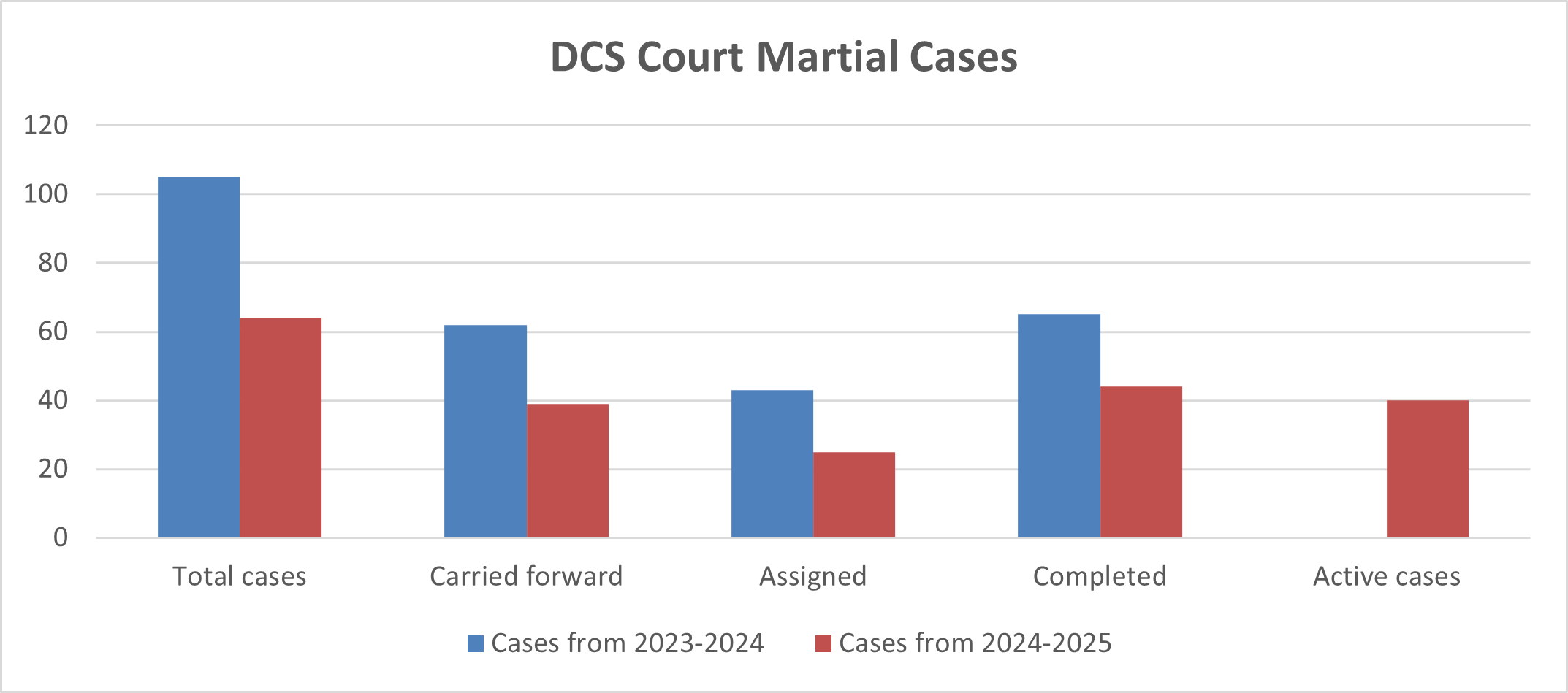
19. During this reporting period, 25 members requested representation by legal counsel at CM. When combined with the 39 cases carried over from the previous reporting period, the caseload for this reporting period was 64 cases.
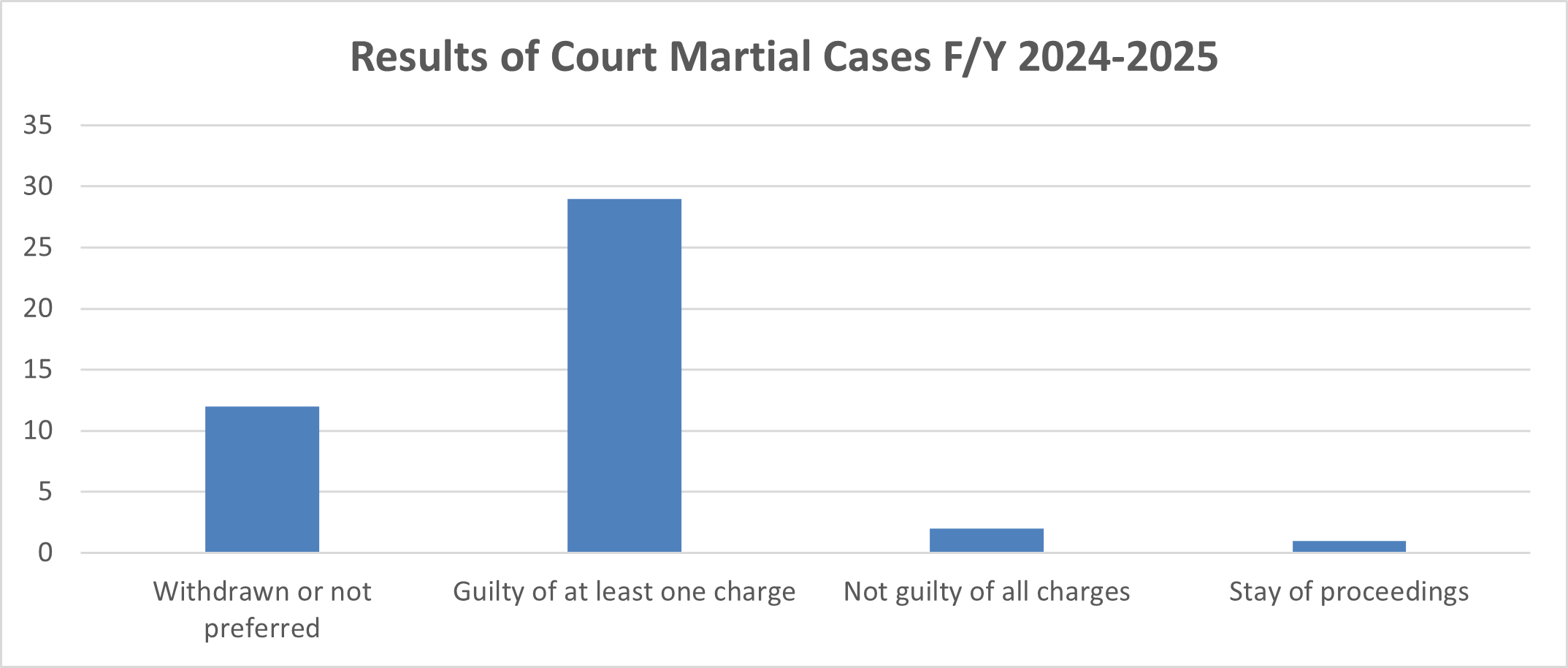
20. Forty-four cases were concluded within this reporting period. Of those 44 cases, 12 members represented by DCS counsel had their charges withdrawn or not preferred.
21. DCS counsel represented accused members in 32 Courts Martial during this reporting period. In 2 cases, the accused was found not guilty of all charges. In 29 cases, the accused was either found guilty or pled guilty to at least one charge. There was one stay of proceedings this reporting period.
DCS Court Martial Cases
Graphic breakdown: DCS Court Martial Cases
| Total Cases | Carried forward | Assigned | Completed | Active Cases | |
|---|---|---|---|---|---|
| 2024-2025 | 64 | 39 | 25 | 44 | 40 |
| 2023-2024 | 105 | 62 | 43 | 65 |
Results of Court Martial Cases Fiscal Year 2024-2025
Graphic breakdown: Results of Court Martial Cases Fiscal Year 2024-2025
| Results of Court Martial Cases | Withdrawn or not preferred | Guilty of at least one charge | Not guilty of all charges | Stay of proceedings |
|---|---|---|---|---|
| F/Y 2024-2025 | 12 | 29 | 2 | 1 |
22. This reporting period has seen a marked drop in the number of files proceeding to Courts Martial. The reasons may include: 1) fewer Cr.C. sexual offence preferrals; and 2) the MP electing to proceed with charges in the civilian criminal justice system, in situations that would otherwise have been dealt with in the military justice system. It is unknown why the MP have adopted this practice but DCS is collecting objective information to understand the prevalence of this issue and will report on its findings in the next reporting period.
Notable Decisions from Courts Martial
23. In R v Allison (Mister), the civilian dependent of a CAF member posted outside of Canada committed an act that was not an offence in Belgium but was an offence in Canada. The accused was convicted under s. 130 of the NDA for operating a conveyance while impaired, contrary to s. 320.14(1)(a) of the Cr.C., and sentenced to 30 days of imprisonment. Mr. Allison is appealing to the CMAC. The main issue on appeal is whether he should have been prosecuted by way of CM—submitting that this should only occur if: (a) it was absolutely essential to protect the appellant from foreign jurisdiction, or (b) it was in the appellant’s best interests. The CM decision is currently unpublished and the matter has yet to be heard before the CMAC.
24. In R v Fequet (MS), the accused was charged with four service offences: drunkenness contrary to s. 97 of the NDA and three offences pursuant to s. 130 of the NDA (two counts of assault and one count of assault of a peace officer). The accused was alleged to have assaulted two sailors prior to the arrival on scene of the MP. The interaction with the MP was recorded on the front facing camera of the MP vehicle. When the MP arrived, the accused was unconscious on the ground. As the MP attempted to roll him into the recovery position to ensure his airway was kept open, the accused suddenly regained consciousness, became agitated and struck one of the MP in the face with the back of his hand. The MJ found that the accused’s actions with the MP were reflexive and found him not guilty of assaulting the MP. The accused was acquitted of one assault charge and convicted on the remaining two charges. The sentencing portion of the CM has not yet been completed.
25. In R v Weston (Cpl), following a bus accident, the accused was charged with the unauthorized use of a CAF vehicle contrary to s. 112 of the NDA and for wielding a knife in public requiring the intervention of the Royal Canadian Mounted Police, contrary to s. 129 of the NDA. A few weeks before the Standing Court Martial was to commence, the prosecution preferred two additional charges on a new Charge Sheet: 1) drunkenness contrary to s. 97 of the NDA and 2) impaired driving, contrary to s. 320.14 of the Cr.C. The prosecution withdrew both Charge Sheets and preferred a new Charge Sheet with all four charges, granting the accused a new election. The accused elected to be tried by General Court Martial. At trial, the prosecution withdrew the drunkenness and impaired driving charges prior to any evidence being heard. The accused argued that he had not wielded a knife and that the prosecution had failed to prove that the vehicle he was driving was a CAF vehicle. The military panel acquitted the accused. Military panels do not publish reasons, so there is no published decision.
26. In R v Duguay (Cpl), 2024 CM 6002, the accused was convicted pursuant to s. 129 of the NDA for wearing three medals that the member had not been awarded. The MJ imposed the proposed joint submission of a severe reprimand and a fine of $2000.
27. In R v Lawless (Cpl), 2024 CM 3006, the court ruled that a consensual wrestling match between two CAF members is a violent struggle involving physical force contrary to s. 86 of the NDA. Fighting in the context of this offence requires a threat to discipline in a military environment, such as causing a quarrel or disturbance or having the potential to cause a quarrel or disturbance. In convicting the member, the MJ considered that: the fight occurred in the hallway of a building used as military quarters; it was not part of authorized military training; and no measures were put in place to ensure the participants’ safety. The accused was sentenced to a $400 fine and confinement to barracks for 7 days.
28. In R v Morin (MCpl), 2024 CM 3022, 2024 CM 3023, the accused crashed a CAF vehicle into a curb on a restricted access road at the National Defence Headquarters (Carling Campus). He was charged, pursuant to s. 111 (1)(a) of the NDA, with driving a CAF vehicle recklessly or in a manner that is dangerous to any person or property having regard to all the circumstances. An administrative investigation into a possible airbag malfunction led to the extraction of vehicle data from the airbag control module (ACM), which was later used in the disciplinary investigation without a search warrant or the accused’s consent. The accused unsuccessfully challenged the admissibility of the ACM evidence, as a violation of his privacy rights under s. 8 of the the Canadian Charter of Rights and Freedoms (Charter). The MJ found that, while the accused may have had a subjective expectation of privacy over the ACM data, it was not objectively reasonable given the government-owned nature of the vehicle and the workplace context of the incident. Ultimately, the MJ found that the prosecution failed to prove beyond a reasonable doubt that the accused’s driving constituted a marked departure from what a reasonable person would have done under similar circumstances. The accused was acquitted.
Legal Services at Appeal Courts
29. Where a member appeals their case and requests representation by DCS at public expense, they are required to make an application to the Appeal Committee, established under Article 101.19 of the QR&O, which assesses the merit of the appeal. Members who are responding to appeals by the MND may receive representation by DCS as a matter of right.
30. DCS applied for leave to appeal before the SCC in 2 cases. Leave to appeal was dismissed in one and a decision is pending in the other. DCS represented members in 12 CMAC appeals (3 appeals were filed by the MND and 9 were filed by the accused).
Decisions from the Court Martial Appeal Court of Canada
Appeals by DCS
31. In R v Sutherland (MCpl), 2024 CMAC 4, the member appealed their conviction of sexual assault, arguing that the MJ did not properly apply the law of eyewitness identification. The CMAC found that the MJ was alive to the difficulties of identification evidence and committed no error of law, thus the issue of sufficiency of eyewitness identification was a finding of fact to which deference was owed. The CMAC dismissed the appeal.
32. In R v Meeks (Sgt), 2024 CMAC 9, the member was convicted of assault causing bodily harm and sentenced to thirty days of detention. While released pending appeal, the member was deemed medically disabled and administratively released by the CAF. The main issues on appeal were whether an administrative release renders a sentence of detention inoperative and whether the member’s remaining sentence of 22 days of detention should be suspended. The CMAC concluded that the R v Tupper, 2009 CMAC 5 decision should be read narrowly as standing for the proposition that an appellate court may consider a post-sentence administrative discharge when considering the fitness of the sentence. Where detention, dismissal or other unique military punishments serve no sentencing objective on a released offender, the punishment may be inefficient and ineffective or moot but is not invalid and of no force and effect. The CMAC allowed the appeal and suspended the remaining period of detention.
33. In R v Kohlsmith (Sgt), 2024 CMAC 8, the member was convicted of sexual assault. The issue on appeal was whether the member’s constitutional right to be tried within a reasonable time had been violated pursuant to section 11(b) of the Charter. The CMAC determined that the military judge made no reviewable error in either of his 11(b) decisions and dismissed the appeal.
34. In R v JL (Pte), 2024 CMAC 10, the issue on appeal was whether minors charged and prosecuted for service offences in the military justice system benefit from the principle of fundamental justice which presumes their diminished moral culpability, pursuant to s. 7 of the Charter. The 17-year-old member had been convicted of sexual assault and behaving in a disgraceful manner. The CMAC read down section 60(1) of the NDA as it applies to persons under the age of 18, as a constitutional remedy pursuant to subsection 52(1) of the Constitution Act, 1982. It now excludes all service offences outlined in Division II of Part III of the NDA, except those for which a MJ, upon conviction, has discretion to impose a sentence that avoids a consequence under the Criminal Records Act. The CMAC entered a stay of proceedings on the charges.
35. In R v O’Dell (Cpl), 2024 CMAC 5, the member appealed the sexual assault conviction and the imposition of the Sex Offender Information Registration Act (SOIRA) order. The CMAC found that the evidence and submissions before the military judge satisfied the test set out at paragraph 140 of R v Ndhlovu, 2022 SCC 38. In this case, the imposition of a SOIRA order on the member’s liberty would be grossly disproportional to the objective of s. 490.012 of the Cr.C., or the equivalent s. 227.01(1) of the NDA. The CMAC dismissed the appeal against conviction and allowed the appeal against sentence, setting aside the SOIRA order.
Appeals by MND
36. In R v Brousseau (MCpl), 2023 CM 4005, proceedings were terminated after a finding of an abuse of process. In R v Brousseau (MCpl), 2024 CMAC 2, the MND appealed on two grounds: 1) that the MJ erred in law in finding that the prosecution’s conduct constituted an abuse of process, and 2) that the MJ erred in law in declaring evidence of the past sexual relations between the complainant and the respondent admissible. The CMAC found that the MJ misapprehended the facts and erred in exercising his discretionary power, ordering a new trial based on the first appeal ground. The CMAC declined to deal with the second ground, only noting that nothing in their reasons should be construed as endorsing in any way the MJ’s reasoning on that issue.
Decisions from the Supreme Court of Canada
37. In R v Edwards (LS), 2024 SCC 15, the SCC addressed whether the dual role of MJs as CAF officers and military judges violated the right to an independent and impartial tribunal under section 11(d) of the Charter. The SCC upheld the constitutionality of Canada's military justice system, ruling that the military status of judges does not infringe upon the constitutional guarantee of judicial independence. The majority opinion emphasized that MJs possess the essential hallmarks of judicial independence—security of tenure, financial security, and administrative independence—and that the military context does not diminish these protections. In dissent, Justice Karakatsanis found that the existing framework did not sufficiently shield MJs from potential interference by the military chain of command, thereby violating section 11(d).
Performance of other duties in accordance with Article 101.11(3) of QR&O
38. DCS counsel represented a retired military member before the Provincial Court of British Columbia (Criminal Division), in relation to an application by the MP to extend the detention of the retired member’s property which had been seized by the MP. The MP investigation focused on allegations while the member was in service.
Activities
39. The Director:
- participated in the Military Justice Forum meetings chaired by the JAG;
- participated in the CMACC Bench and Bar meetings; and
- briefed at the Basic Legal Operations Courses at the Canadian Forces Military Law Centre.
40. The Director responded to consultation requests regarding the implementation of recommendations from external reviews of the military justice system. Many of the recommendations have been reaffirmed and repeated by reviews over the past several years. The Director supports any change that enhances the rights of accused members, access to justice, and the independence of DCS.
41. In this reporting period, the DCS website was updated to reflect legislative changes and is fully accessible by the public at <canada.ca/en/department-national-defence/services/benefits-military/legal-services/defence-counsel-services.html>.
Professional Development
42. Professional development opportunities have included ad hoc on-line individual legal training, the OJAG Continuing Legal Education Conference and the National Criminal Law Program held in Halifax, 8-12 July 2024.
Conclusion
43. Being my third report as Director, I convey that this year again, legal officers within DCS have provided outstanding legal services to members of the military community who request our assistance. I am particularly proud of our legal officers who provided 24/7 legal advice and travelled throughout and outside of Canada to protect the rights of our members who are being prosecuted under the NDA. All members of DCS are resilient individuals who ensure they maintain a healthy and balanced lifestyle so they may best serve their clients.
44. The Director’s priority is to promote an inclusive environment where clients can establish a trusting solicitor-client relationship while ensuring that their defence counsel is professionally competent and independent from government.
N. Ahmed
Colonel
Director of Defence Counsel Services
24 June 2025