
Mobilizing Insights in Defence and Security (MINDS) – Annual report 2024-2025



Message from the Director General

I am pleased to present the 2024-25 Mobilizing Insights in Defence and Security (MINDS) Annual Report. Since the program’s inception in 2019, MINDS has helped advance the understanding of defence and security issues and respond to the need for relevant and timely advice from defence and security experts.
The release of Our North, Strong and Free (ONSAF) this past year builds on previous commitments and provides a renewed vision for defence and investing in Canadian capacity to respond to the significant global shifts we have witnessed since the release of Strong, Secure, Engaged. Through numerous engagements and collaborative partnerships, MINDS has actively supported ONSAF’s implementation by fostering dialogue on its implications for sovereignty, security, continental defence, and, most importantly, the defence of Canada.
In line with ONSAF, the Department has also taken important steps to bolster Canada’s defence industrial base. As global threats intensify and supply chains remain fragile, the ability to rapidly acquire, produce, and sustain military capabilities is critical to national security, economic resilience, and technological leadership. MINDS will continue supporting these efforts by generating policy-relevant insights to help inform decision-making and shape long-term strategic planning.
In this context, MINDS serves as a vital platform for connecting the Defence Team with Canada’s diverse defence and security expert community. Notably, in 2024-25, MINDS received the highest number of applications in the history of its Targeted Engagement Grant mechanism, reflecting the program’s growing relevance and reach.
Looking ahead, I am confident that MINDS will continue to provide valuable external expertise on emerging defence challenges and opportunities. In an increasingly complex global environment, the Program’s ability to deliver timely, relevant and well-rounded advice from leading experts will remain critical to shaping forward-looking defence policy.
Jacob Abella
Director General, Defence Intergovernmental Affairs Assistant Deputy Minister (Policy)
Department of National Defence
Executive Summary
In its sixth year of operations, the Mobilizing Insights in Defence and Security (MINDS) Program remained a responsive and relevant enabler of defence and security expertise. It advanced key priorities by supporting timely research through new Collaborative Networks, grants, and scholarships. MINDS also facilitated expert engagement through its virtual Expert Briefing Series, fostering dialogue between the Defence Team and the expert community. This year, the MINDS program:
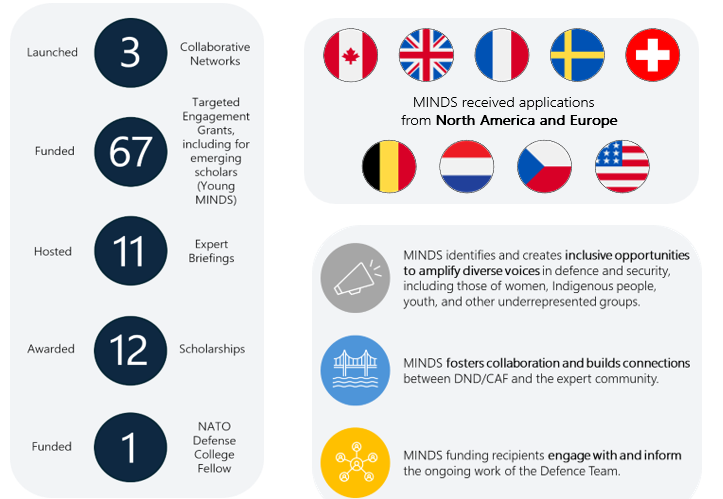
Caption
- Launched 3 Collaborative Networks
- Funded 67 Young MINDS and Targeted Engagement Grants
- Hosted 10 Expert Briefings
- Awarded 12 Scholarships
- Funded 1 NATO Defense College Fellow
The image features a set of nine circular flags of the following countries:
- Canada
- United Kingdom
- France
- Sweden
- Switzerland
- Belgium
- Netherlands
- Czech Republic
- United States
The image caption reads:
"MINDS received applications from North America and Europe."
The image depicts three icons with text beside each one.
An icon depicting a megaphone with the corresponding text: “MINDS identifies and creates inclusive opportunities to amplify diverse voices in defence and security, including those of women, Indigenous peoples, youth, and other underrepresented groups.
An icon depicting a bridge with the corresponding text: “MINDS fosters collaboration and builds connections between DND/CAF and the expert community”.
An icon depicting a network with the corresponding text: “ MINDS funding recipients engage with and inform the ongoing work of the Defence team.”
The MINDS Program
MINDS is founded on the idea that policy- and decision-making are strengthened when assumptions are challenged, and diverse viewpoints are considered. MINDS provides opportunities for collaboration between the Defence Team and the defence and security expert community through a Program that:
- responds to the needs for relevant, timely and action-oriented policy advice from defence and security experts;
- fosters the next generation of experts and scholars; and,
- contributes to Canadians' understanding of defence and security issues.
MINDS Pillars
MINDS offers a variety of unique tools, or pillars, by which the Defence Team can engage with external experts to access high caliber, relevant and timely research and expertise that incorporate a diversity of viewpoints and provide well-rounded advice. The MINDS pillars include:
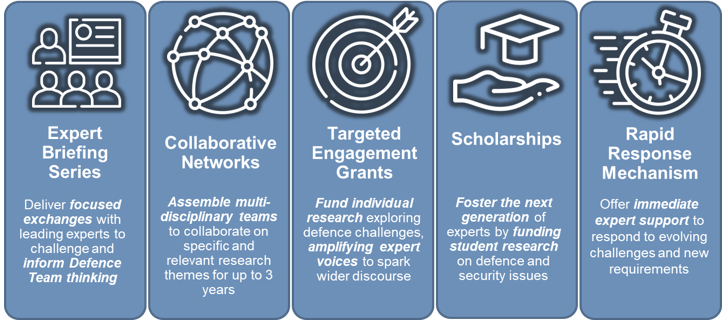
Caption
A set of five columns showcasing the MINDS Program pillars.
The first column features an icon depicting a presentation with Expert Briefing Series written underneath and the following description: “Delivers focused exchanges with leading experts to challenge and inform DND/CAF thinking”.
The second column features an icon depicting a network with Collaborative Networks written underneath and the following description: “Assembles multi-disciplinary teams to collaborate on specific and relevant research themes over a 3-year period”.
The third column features an icon depicting arrow hitting a target with Targeted Engagement Grants written underneath and the following description: “Funds individual research exploring defence challenges, amplifying expert voices to spark wider discourse”.
The fourth column features an icon depicting a graduation cap with Scholarships written underneath and the following description: “Fosters the next generation of experts by funding student research on defence and security issues”.
The fifth column features an icon depicting a timer with Rapid Response Mechanism written underneath and the following description: “Offers immediate expert support to respond to evolving challenges and new requirements”.
Year in Review
The release of Our North, Strong and Free (ONSAF) in April 2024 marked a pivotal moment for the Defence Team. ONSAF provides an update to Strong, Secure, Engaged (2017), and responds to the profound global shifts reshaping the strategic environment. In support of ONSAF, the MINDS program provided timely, evidence-based insights that contributed to departmental efforts in addressing complex and emerging policy challenges. By aligning the program with ONSAF's strategic priorities—from highlighting the urgent and important task of asserting Canada's sovereignty in the Arctic and Northern regions to strengthening Canada's defence industrial base—MINDS has contributed to advancing informed, forward-looking decision-making across the Department in response to a rapidly evolving global security environment.
Expert Engagement in Response to ONSAF Priorities
This year, MINDS received the highest number of Targeted Engagement Grant (TEG) applications in the program's history. Notably, there was a significant increase in proposals focused on key ONSAF priorities, including supporting CAF personnel, with applications rising from previous years. These projects explored critical issues such as the evolution of organizational culture change, recruitment, training, and retention—all aimed at fostering a safe and inclusive workplace for those who serve. Interest in emerging and disruptive technologies also grew, highlighting the urgency of understanding how technological innovation is reshaping defence and security.
Advancing ONSAF by Strengthening Canada's Defence Industrial Base
In direct support of ONSAF, MINDS advanced efforts to strengthen Canada's defence industrial base by funding research and engagement initiatives aligned with this priority. Recognizing the need for more agile, innovative, and resilient procurement systems, MINDS introduced a new Policy Challenge focused on flexible procurement and industrial innovation. This generated significant interest, with MINDS receiving 21 TEG applications focused on defence procurement. As a result of TEG funding, the Canadian Global Affairs Institute (CGAI) dedicated its Annual Procurement Conference to the theme of investing in Canadian defence industry, emphasizing strategies to achieve the 2 percent of Gross Domestic Product (GDP) defence spending target. MINDS also convened a high-impact Expert Briefing that explored key issues such as procurement reform, supply chain resilience, and opportunities for Canadian industry to better support CAF modernization. Furthermore, one of MINDS-funded Collaborative Networks, Triple Helix, organized four roundtables in Montreal, Fredericton, Ottawa and Halifax bringing together defence industry representatives to foster innovation and build partnerships.
A – MINDS Policy Challenges
The MINDS Policy Challenges articulate key strategic policy issues facing the Defence Team and represent areas for knowledge transfer and collaboration with the defence and security expert community. The Policy Challenges were developed in consultation with key stakeholders from across the Defence Team and grounded in the ONSAF policy update. Applicants for all MINDS funding mechanisms must demonstrate how their research proposals will address at least one of these Challenges.
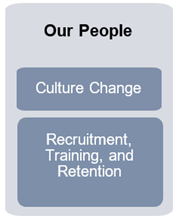
Caption
Two boxes listing the Policy Challenges under Our People:
- Culture Change
- Recruitment, Training and Retention
Our People
The Defence Team's first priority is its people and their well-being. As such, the Defence Team is undertaking a series of major initiatives aimed at evolving its culture to achieve the fundamental mission of creating and maintaining a safe and inclusive workplace. The goal is to transform the organization into a modern military forged in innovation, guided by honour, and empowered by unity. At the heart of this broad effort is the urgent need to evolve our organizational culture to ensure we not only uphold but also embody and reflect Canada's values, including its rich diversity and unwavering commitment to equity and inclusion. This work is essential to attracting and retaining top talent and ensuring we have the capabilities to defend Canada and its values in an increasingly complex and dynamic security environment. Ensuring the CAF can attract, recruit, develop and retain talent is a top priority. This involves addressing key challenges that personnel face related to healthcare, family care, housing, education and professional development. Strengthening our foundations and supporting our personnel will ensure that our military can continue to grow, establish new capabilities to meet emerging threats, and deploy ready, resilient and relevant forces to meet todays and future challenges.
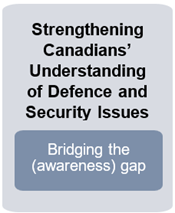
Caption
One box listing the Policy Challenges under Strengthening Canadians' Understanding of Defence and Security Issues:
- Bridging the (awareness) gap
Strengthening Canadians' Understanding of Defence and Security Issues
Three major trends are reshaping global security: climate change, challenges to international law and order, and disruptive technologies. These forces are impacting Canada's national interests and the daily lives of Canadians – especially in the Arctic. In this evolving landscape, the CAF play a critical role in safeguarding security and prosperity. Continued investment in the CAF and modern capabilities is essential. To strengthen public support, the Defence Team must understand and reflect Canadians' expectations regarding defence and security.
Caption
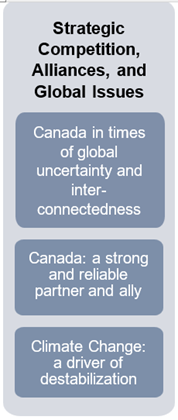
Three boxes listing the Policy Challenges under Strategic Competition, Alliances, and Global Issues
- Canada in times of global uncertainty and interconnectedness
- Canada: a strong and reliable partner and ally
- Climate change: a driver of destabilization
Strategic Competition, Alliances, and Global Issues
Strategic competition over global rules and norms is intensifying across all domains. As the world shifts toward multipolarity, the risk of state-on-state conflict is rising, and sub-threshold threats are growing. Disruptive powers like Russia and China challenge the international rules-based order to advance their interests. Fragile states and hostile non-state actors further destabilize regions, threatening global supply chains and critical waterways. In an interconnected world, these challenges directly impact Canadians. The CAF must remain ready, resilient, and relevant to protect national security, support global stability, and deter major conflicts.
Canada's strategic strength lies in its global partnerships and alliances, especially in the Euro-Atlantic and Indo-Pacific regions. Collective defence, particularly through the North Atlantic Treaty Organization (NATO), underpins national security and prosperity. Canada's support for European security includes Operation UNIFIER in Ukraine and Operation REASSURANCE in Latvia. In the Indo-Pacific, Canada is enhancing its presence through its Indo-Pacific Strategy (IPS), naval deployments, regional exercises, and capacity-building programs, including Women, Peace, and Security (WPS) initiatives. These partnerships are essential for addressing global threats and upholding Canadian values like the rule of law and human rights. To remain a strong ally, Canada must continue to prioritize and expand its international relationships.
Climate change poses a growing threat to national and human security, both globally and in Canada. Increasingly severe climate events, combined with factors like resource competition and displacement, are driving conflict and destabilizing the international order. In Canada, Northern communities are disproportionately affected, and the Arctic is becoming a key area of global strategic interest due to increased accessibility. The CAF face rising demands to respond to natural disasters while maintaining traditional military operations. To remain effective and resilient, the Defence Team must continue adapting to climate impacts and align with Canada's environmental goals.
Caption
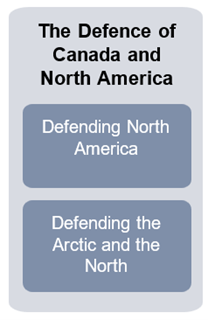
Two boxes listing the Policy Challenges under The Defence of Canada and North America:
- Defending North America
- Defending the Arctic and the North
The Defence of Canada and North America
Defending Canada is central to deterring and defeating threats to North America. Building on the 2022 North American Aerospace Defence Command (NORAD) modernization, ONSAF introduces new investments to enhance continental defence across all domains. Alongside capabilities from Strong, Secure, Engaged (SSE), these efforts address emerging threats from climate change, shifting geopolitics, and advanced military technologies. A secure North America complicates adversaries' strategies, reinforces NATO's deterrence posture, and enables Canada to support global partners while safeguarding domestic security.
ONSAF emphasizes Arctic defence through credible deterrence. As climate change, economic interests, and strategic competition increase activity in the region, Canada is committed to safeguarding Arctic security and sovereignty. The Defence Team must be ready to counter emerging threats, assert sovereignty, and foster regional stability through collaboration with domestic and international partners.
Caption
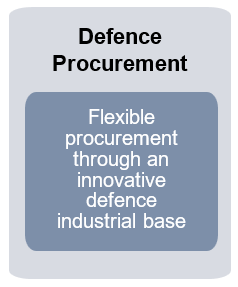
One box listing the Policy Challenges under Defence Procurement:
- Flexible procurement through an innovative defence industrial base
Defence Procurement
Defence procurement in Canada needs to be faster and more effective. Streamlined and flexible procurement is critical for the timely acquisition of capabilities to meet quickly evolving threats. In parallel, these procurement processes must be managed in the most efficient way for Canadian taxpayers. We need to deliver capabilities at the speed of relevance and consider more innovative approaches to procurement to enhance and modernize the defence procurement process. Building an innovative and effective defence industrial base involves moving away from transactional approaches to sustain strategic partnerships, ensuring procurement considers intersectionality to cater to the diversity of Canadians and leverages green, sustainable solutions to support Canada's environmental objectives.
Caption
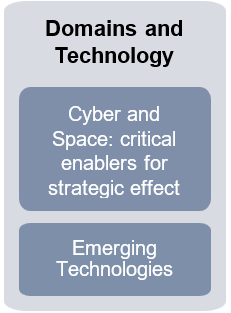
Two boxes listing the Policy Challenges under Domains and Technology:
- Cyber and Space: critical enablers for strategic effect
- Emerging Technologies
Domains and Technology
Cyber and space are vital to Canada's security, economy, and military operations – but also present growing vulnerabilities. As reliance on these domains increases, so do the risks from rapidly advancing technologies and adversarial actions, often below the threshold of open conflict. These blurred boundaries challenge traditional legal and strategic responses. To stay ahead, the Defence Team must be agile, innovative, and integrated – working with national and international partners to secure Canada's interests across these critical domains.
Emerging technologies like artificial intelligence (AI), machine learning, and quantum computing are reshaping military operations and the nature of conflict. These tools offer speed and efficiency but also amplify threats such as cyber attacks and disinformation. Canada aims to lead in developing and applying these technologies in a responsible manner, supported by a strong research ecosystem and guided by ethical principles. National strategies on AI and quantum prioritize trusted, interoperable, and advantage-driven implementation. To stay ahead, the Defence Team must rapidly integrate innovations, limit adversary exploitation, and deepen partnerships with academia and industry.
B – Expert Briefing Series (EBS)
Through the EBS mechanism, top Canadian and international defence and security experts are invited to brief the Defence Team and Government of Canada officials on priority issues. Virtual webinars and roundtable discussions provide defence and security practitioners with the opportunity to engage in in-depth conversations with leading experts and diverse thinkers.
Highlights
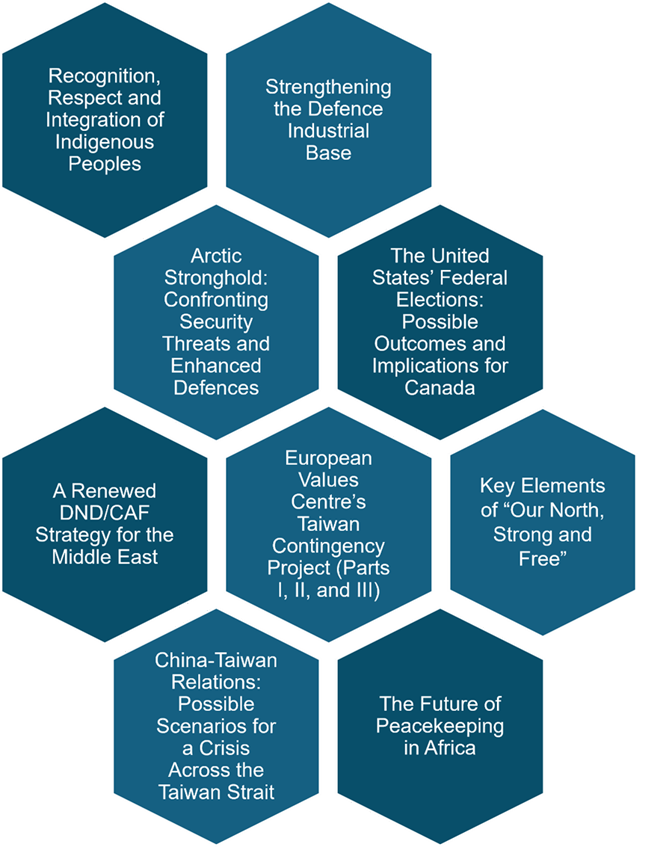
In 2024-25, MINDS collaborated with stakeholders across the Defence Team to host 11 expert briefings and roundtable engagements on a range of complex issues. The 2024-25 engagements included:
Caption
The image features a set of nine identical blue hexagons displaying the following defence and security themes for the Expert Briefing Series:
- Recognition, Respect and Integration of Indigenous Peoples
- Strengthening the Defence Industrial Base
- Arctic Stronghold: Confronting Security Threats and Enhanced Defences
- The United States’ Federal Elections: Possible Outcomes and Implications for Canada
- A Renewed DND/CAF Strategy for the Middle East
- European Values Centre’s Taiwan Contingency Project (Parts I, II, and III)
- Key Elements of “Our North, Strong and Free”
- China–Taiwan Relations: Possible Scenarios for a Crisis Across the Taiwan Strait
- The Future of Peacekeeping in Africa
C – Targeted Engagement Grants (TEGs)
MINDS-funded projects help drive innovation, amplify expert and diverse voices, spark wider discussions, and inform policy discussions on important and timely defence and security issues. TEGs provide up to $50,000 in non-recurring financial support for projects such as conferences, roundtables, workshops, research, and publications. To continue to foster the next generation of experts, grants valued at up to $10,000 are also available for undergraduate and master's students (referred to as Young MINDS TEGs).
2024-25 Funding Results
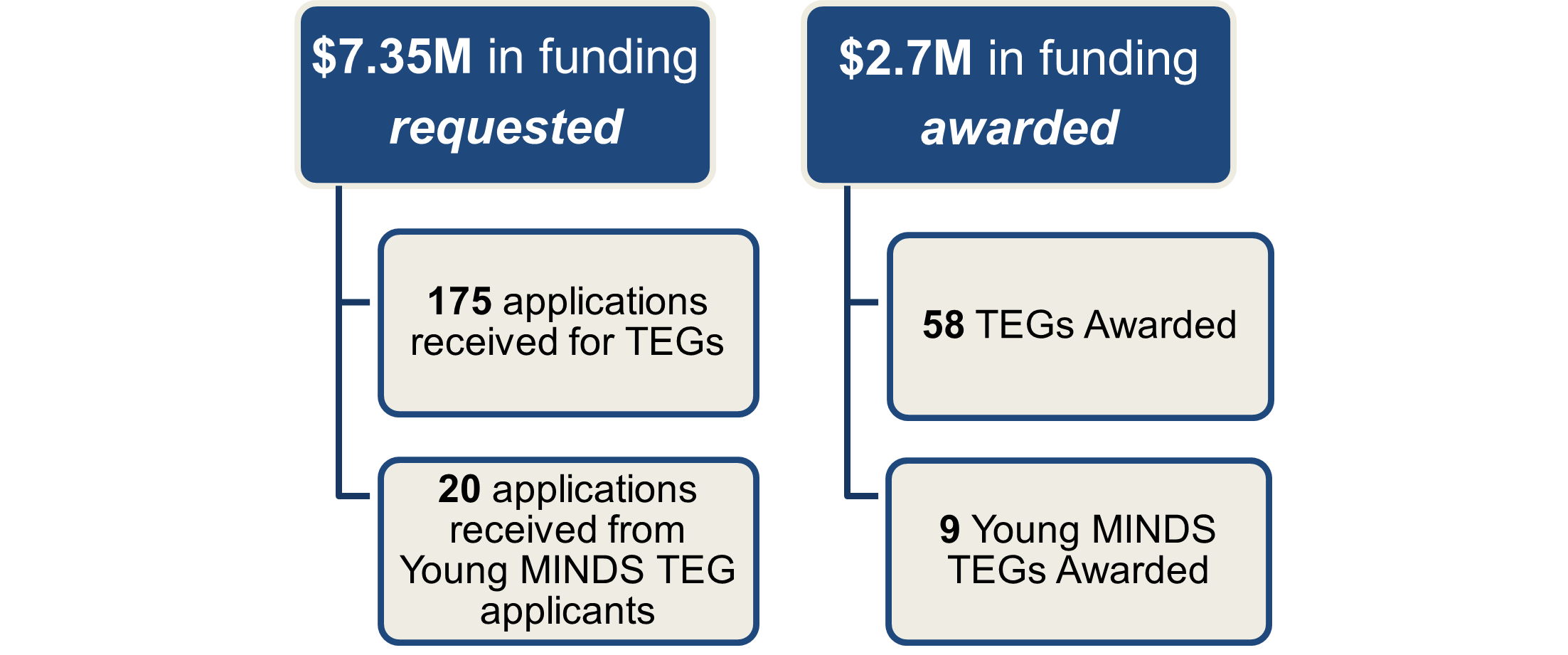
Two TEG competitions were launched this year. The full overview of all funded projects can be found at: Funding Results - Canada.ca
Caption
An information box showcasing the following statistics:
- $7.35M in funding requested
- 176 applications received for Targeted Engagement Grants
- 20 applications received from Young MINDS applicants
- $2.7M in funding awarded
- 58 Targeted Engagement Grants Awarded
- 9 Young MINDS Grants awarded
Caption
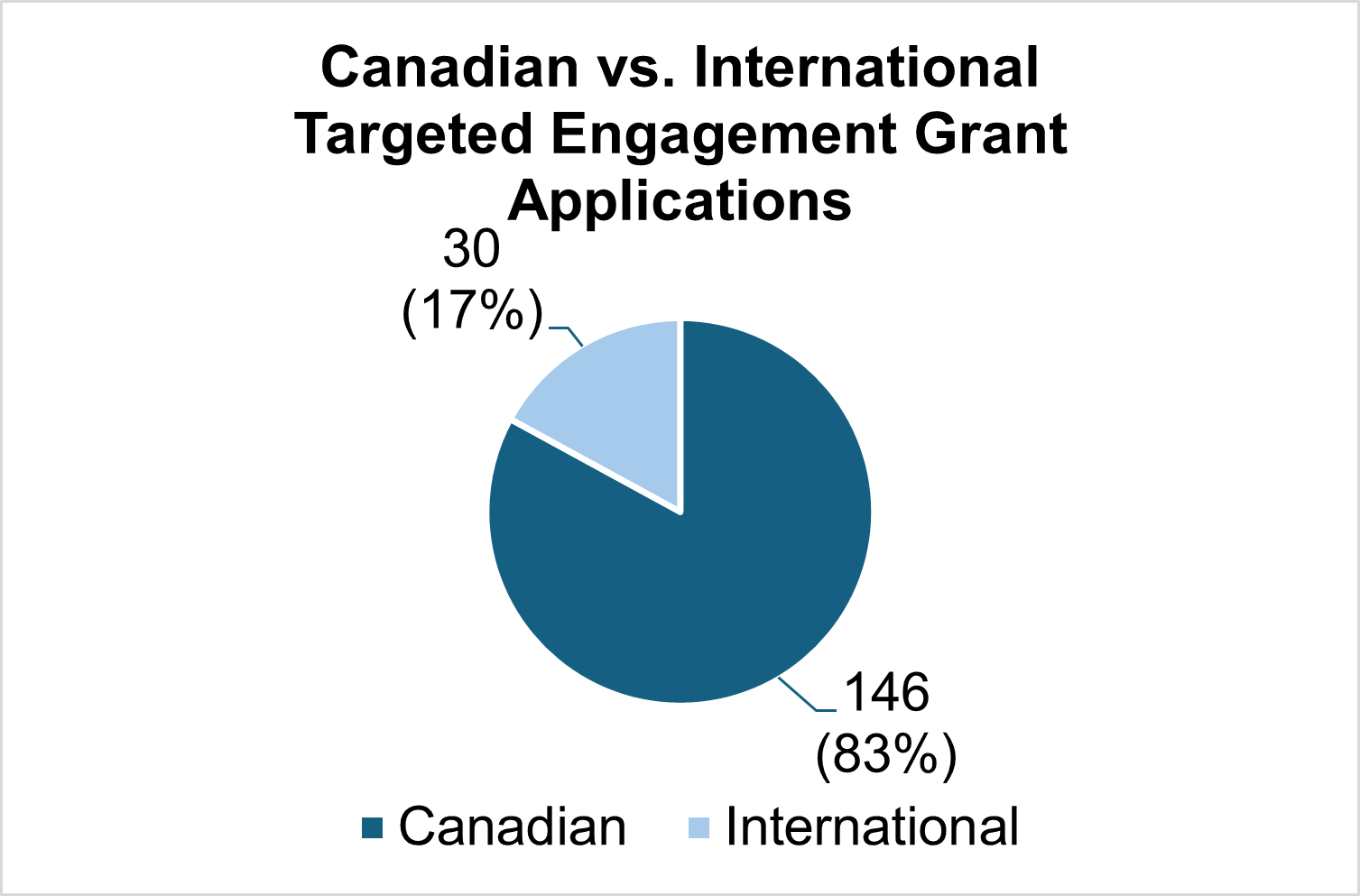
A pie chart showing the distribution of Canadian (146 applications, 83%) and international applications (30, 17%).
Highlights
In 2024-25, MINDS received TEG applications from Canada and around the world. The second competition of the year received 98 applications - the highest number of applications ever received for a TEG competition.
Caption
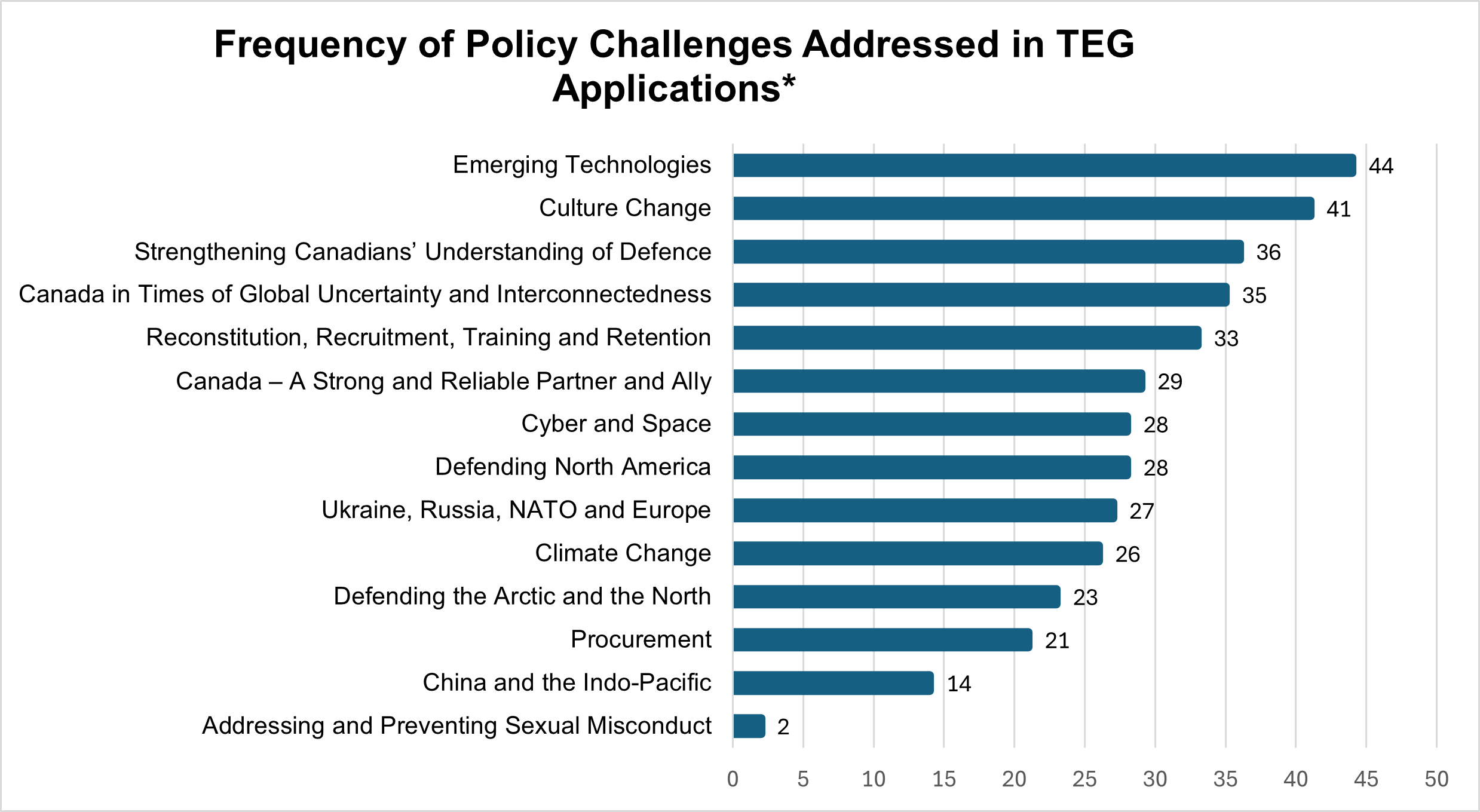
Bar chart indicating the number of each policy challenge addressed in TEG applications and successful TEGs, respectively.
Bar chart indicates the frequency of policy challenges addressed in TEG applications:
- Emerging Technologies: 44
- Culture Change: 41
- Strengthening Canadians’ Understanding of Defence: 36
- Canada in Times of Global Uncertainty and Interconnectedness: 35
- Reconstitution, Recruitment, Training and Retention: 33
- Canada – A Strong and Reliable Partner and Ally: 29
- Cyber and Space: 28
- Defending North America: 28
- Ukraine, Russia, NATO and Europe: 27
- Climate Change: 26
- Defending the Arctic and the North: 23
- Procurement: 21
- China and the Indo-Pacific: 14
- Addressing and Preventing Sexual Misconduct: 2
Caption
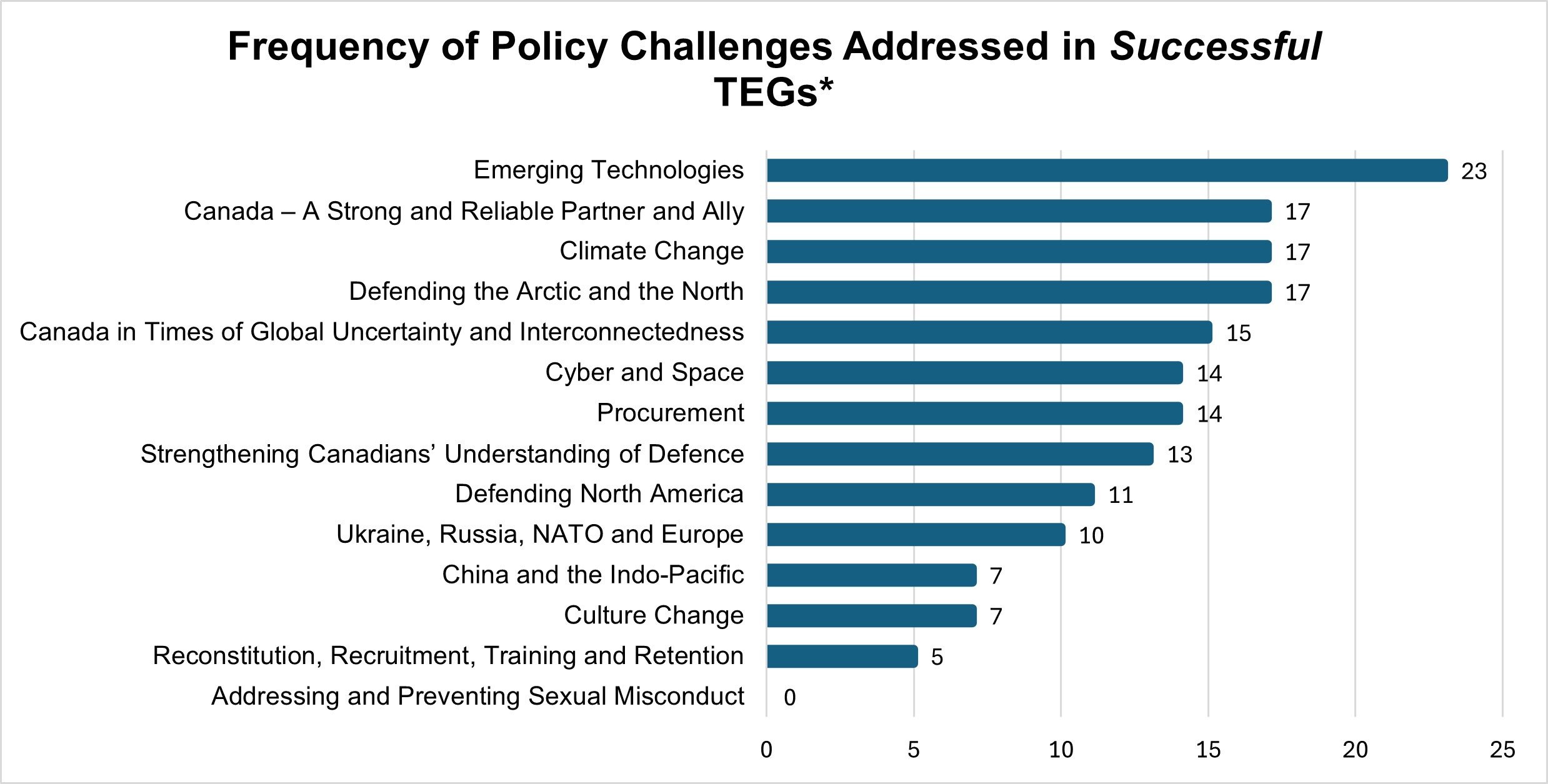
Bar chart indicates the frequency of policy challenges in successful TEGs:
- Emerging Technologies: 23
- Canada – A Strong and Reliable Partner and Ally: 17
- Climate Change: 17
- Defending the Arctic and the North: 17
- Canada in Times of Global Uncertainty and Interconnectedness: 15
- Cyber and Space: 14
- Procurement: 14
- Strengthening Canadians’ Understanding of Defence: 13
- Defending North America: 11
- Ukraine, Russia, NATO and Europe: 10
- China and the Indo-Pacific: 7
- Culture Change: 7
- Reconstitution, Recruitment, Training and Retention: 5
- Addressing and Preventing Sexual Misconduct: 0
Notes
*Note 1: Each TEG application can list up to three (3) Policy Challenges
Note 2: The Policy Challenges listed above correspond to those released in 2023-24 and 2024-25. The first round of TEGs addressed the 2023-24 Policy Challenges, while the second round focused on those from 2024-25.
D – Collaborative Networks
Caption
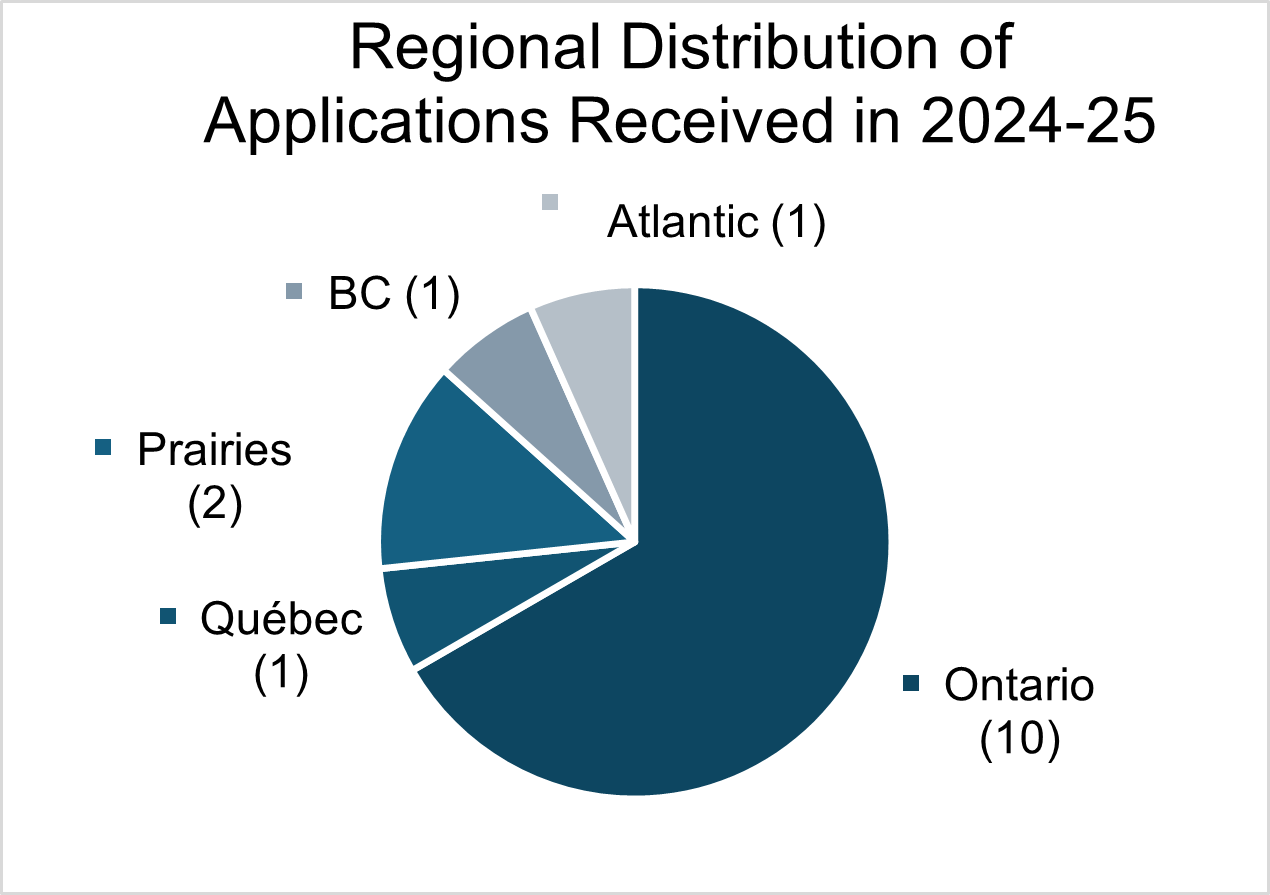
A pie chart showing the regional distribution of applications received in Fiscal Year 2024-25:
- Atlantic: 1
- Ontario: 10
- Quebec: 1
- Prairies: 2
- British Columbia: 1
MINDS Collaborative Networks bring together multi-disciplinary teams of distinguished defence and security experts. Each Network is based in Canada and receives up to $750,000 for a maximum of three years to enable more sustained collaboration and support to the Defence Team through advanced research and activities. Networks are expected to reflect diversity in their membership, in terms of geographic regions, organizational types, and disciplines, ensuring broad representation and inclusive perspectives within the defence and security ecosystem from across Canada and abroad.
A call for applications was launched in December 2023 and received 15 applications.
After a rigorous evaluation process, the three new Collaborative Networks selected for 2024-25 were:

Canadian Maritime Security Network (CMSN)
St. Francis Xavier University (Nova Scotia)
CMSN’s work will help identify and understand the drivers of global maritime threats in a time of evolving great power competition. CMSN will generate valuable knowledge for Canada’s defence strategy, focusing on naval strategy, unconventional warfare, and the Arctic domain.
Co-Directors: Dr. Adam Lajeunesse and Dr. Rob Huebert
Eastern European and Transatlantic Network (EETN)
Carleton University (Ontario)
EETN will explore strategic challenges arising from Russia’s war in Ukraine, focusing on redefining Canada’s and its allies’ approach to Ukraine, Eastern Europe, and Eurasia. EETN will provide nuanced insights into strategic competition and global issues in the region, including NATO and European Union (EU) dynamics and post-conflict recovery.
Co-Directors: Dr. Crina Viju-Miljusevic, Dr. Paul Goode and Dr. Jeff Sahadeo
Research Network on Women, Peace and Security (RN-WPS)
Queen’s University (Ontario)
RN-WPS will explore the relevance of the Women, Peace and Security (WPS) Agenda in relation to readiness challenges, strategic competition and global issues, and forward defence planning. An additional focus will be on topics at the intersection of militarism, climate change and gender.
Co-Directors: Dr. Yolande Bouka, Dr. Megan MacKenzie and Dr. Rebecca Tiessen
Highlights
More information on all our Networks can be found at: Collaborative Networks - Canada.ca
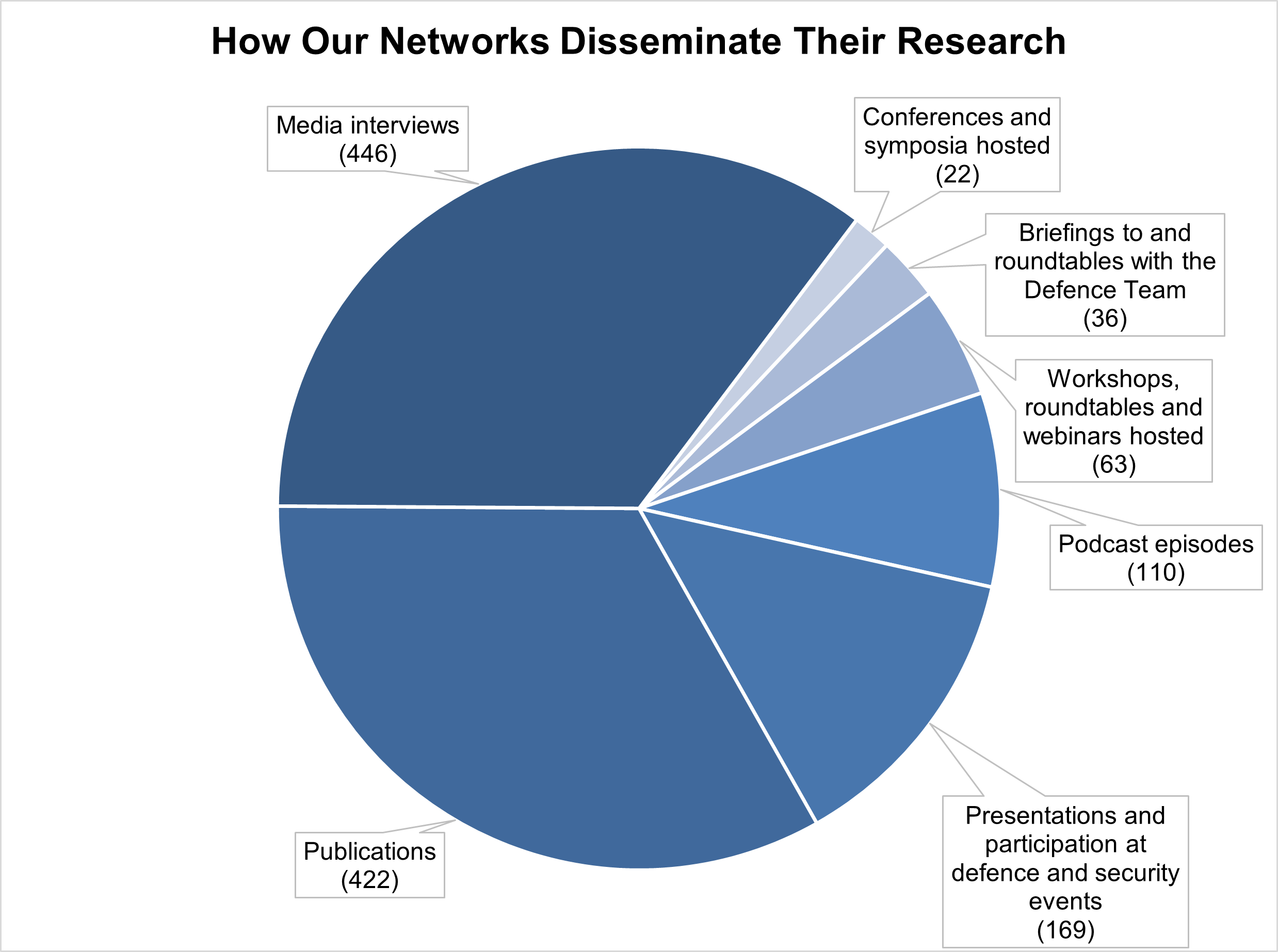
MINDS-funded Collaborative Networks continued to engage with the Canadian media and public through interviews, op-eds and appearances on major news shows, including CBC News, The Globe and Mail, and The Hill Times, among others. In 2024-25, MINDS-funded Networks produced 100+ additional publications than in the previous year. Some of these publications include scholarly articles, books and book chapters, policy briefs, and research reports. Networks also continue to host and present at a variety of conferences and symposia, organize workshops, provide relevant briefings, and produce multimedia products such as podcasts and infographics.
Caption
A pie chart titled: “How our networks disseminate their research”:
- Media interviews: 446
- Conferences and symposia hosted: 22
- Briefings to and roundtables with the Defence Team: 36
- Workshops, roundtables and webinars hosted: 63
- Multimedia: 110
- Presentations and participation at defence and security events: 169
- Publications: 422
Highlights From Existing Collaborative Networks
Réseau d’analyse stratégique (RAS) /
Network for Strategic Analysis (NSA) Queen’s University (Ontario)
Director: Dr. Stéfanie von Hlatky
- Organized a two-day intensive professional development retreat for emerging scholars
- Hosted a colloquium on strategic implications of the American Election
- Released five episodes of the French-language Conseils de sécurité podcast

Space Security Network (SSN)
University of British Columbia (British Columbia)
Co-Directors: Dr. Michael Byers and Dr. Aaron Boley
- Led a tabletop exercise on satellite vulnerabilities for the Defence Team
- Hosted a workshop on the nuclear-space nexus
- Delivered a presentation on “Outer Space and the Arctic” to the Arctic Security Working Group, Joint Task Force North

Triple Helix
Canadian Global Affairs Institute (CGAI) (Ontario)
Co-Directors: Dr. David Perry, Dr. Alex Wilner and Michael Petric
- Hosted a conference on AI and Canadian defence
- Held roundtables with members of the defence industry in Montréal, Fredericton, Ottawa, and Halifax
- Led a foresight workshop with members of Royal Canadian Airforce (RCAF), Royal Canadian Navy (RCN), and the Canadian Army (CA) force development teams

Canadian Defence and Security Network (CDSN)
Carleton University (Ontario)
Co-Director: Dr. Stephen Saideman
- Hosted a Summer Institute
- Held an annual Year Ahead conference and co-organized the Inter-University Seminar on Armed Forces and Society-Canada’s biennial conference
- Released 18 episodes of the Battle Rhythm podcast
North American and Arctic Defence and Security Network (NAADSN)
Trent University (Ontario)
Director: Dr. Whitney Lackenbauer
- Organized the 5th Annual Emerging Leaders Summer Conference and the North American Arctic Security Emerging Expert Symposium
- In partnership with the Defence Team, co-organized the Arctic Pan-Domain Effects Workshop
- Held a roundtable with a Norwegian delegation of Arctic experts

Transforming Military Cultures Network (TMC-Net)
Mount Saint Vincent University (Nova Scotia)
Co-Director: Dr. Maya Eichler, Dr. Nancy Taber, and Dr. Tammy George
- Held the third annual symposium on “Transforming Military Culture and Beyond: From Theory to Practice”
- Selected the 2024-25 recipient of the TMC Network Research Scholarship
- Facilitated a Writers Collective of Canada (WCC) workshop series
E – Scholarships
MINDS is committed to fostering the next generation of defence and security experts. In 2024-25, the MINDS Scholarship Initiative, administered by the Social Sciences and Humanities Research Council of Canada (SSHRC), and the NATO Defense College (NDC) Fellowship continued to thrive.
MINDS-SSHRC Joint Scholarship Initiative
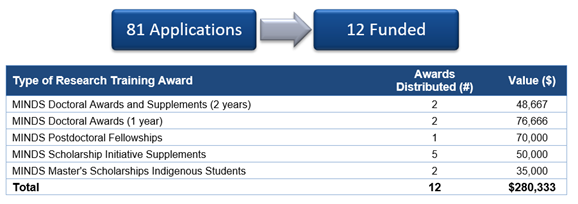
MINDS scholarships offer research awards and supplements at the master's, doctoral and postdoctoral levels to students and researchers whose work relates to the MINDS Policy Challenges. The Program also contributes to the development of a growing, inclusive, and diverse expert community through one-year awards for Indigenous master's students studying defence and security issues. In 2024-2025, MINDS received:
Caption
The top figure shows a blue box with the text “81 Applications”. To the right of the box there is an arrow that points to another blue box with the text “12 Funded”.
The bottom figure shows a table that lists the type of research training award, the number of awards distributed and the value in $.
- MINDS Doctoral Awards and Supplements (2 years): 2 awards distributed valued at $48,667.
- MINDS Doctoral Awards (1 year): 2 awards distributed valued at $76,666.
- MINDS Postdoctoral Fellowships: 1 award distributed valued at $70,000.
- MINDS Scholarship Initiative Supplements: 5 awards distributed valued at $50,000.
- MINDS Master’s Scholarship Indigenous Students: 2 awards distributed valued at $35,000.
The bottom row of the table indicates that the total number of awards distributed is 12 and their total value is $280,333.
F – NATO Defense College Fellowship
The NATO Defense College (NDC) Fellowship provides a unique opportunity for a Canadian researcher to work alongside experts from across allied countries at the NDC in Rome, Italy. The Fellowship contributes to Canada's commitment to NATO and helps advance both Canada and the Alliance's strategic objectives, through forward-looking research and collaboration.
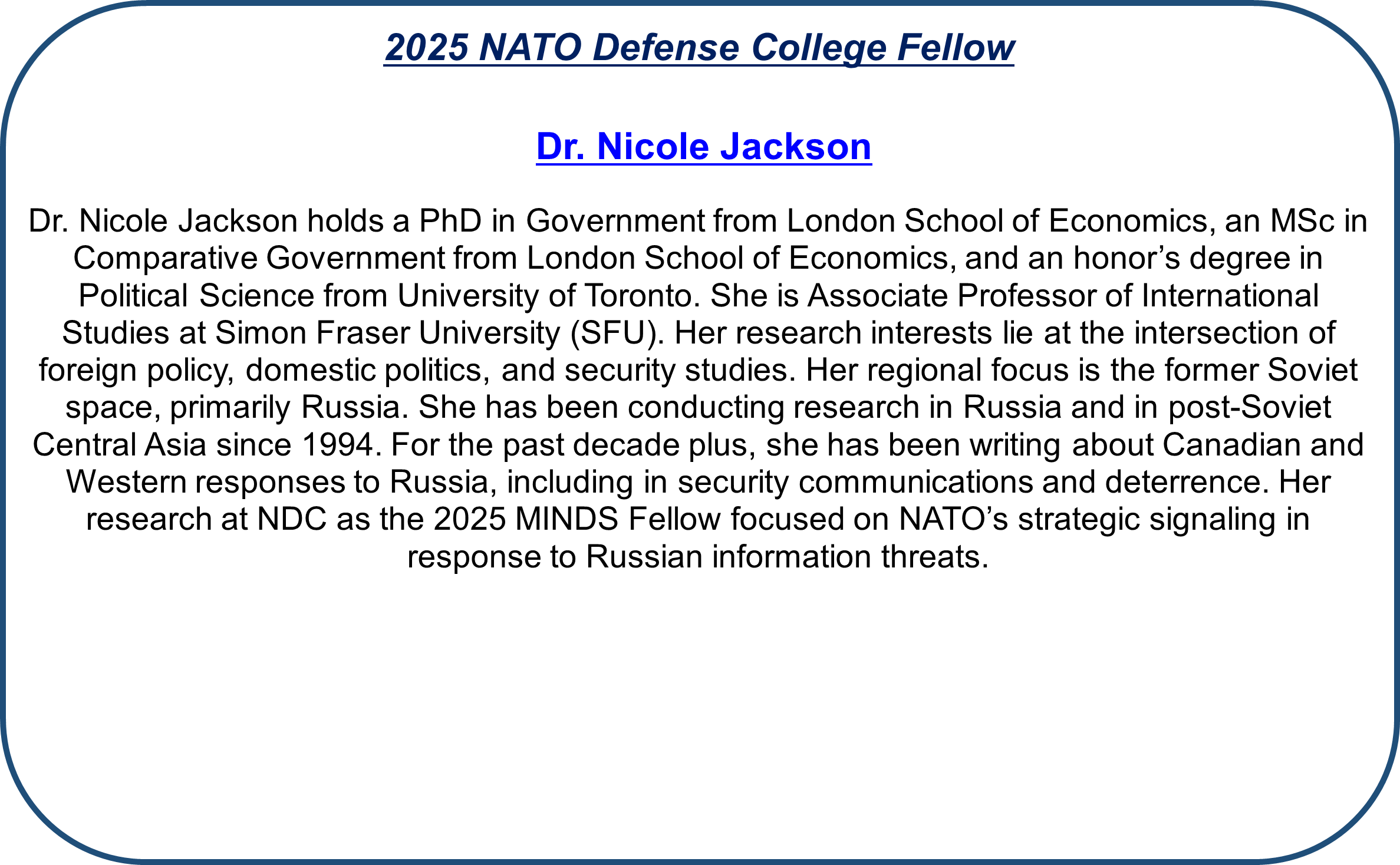
Caption
A box highlighting the 2025 NATO Defense College Fellow, Dr. Nicole Jackson. Dr. Nicole Jackson holds a PhD in Government from London School of Economics, an MSc in Comparative Government from London School of Economics, and an honor’s degree in Political Science from University of Toronto. She is Associate Professor of International Studies at Simon Fraser University (SFU). Her research interests lie at the intersection of foreign policy, domestic politics, and security studies. Her regional focus is the former Soviet space, primarily Russia. She has been conducting research in Russia and in post-Soviet Central Asia since 1994.
The Year Ahead…
Since its inception, MINDS has developed into a mature Program in terms of its reach and impact, realizing continued growth in the number of applications received its various funding competitions. For example, this year saw an increase of 34% in the number of applications received for TEGs, and a 42% rise in the number of applicants for scholarships. This growth in applicants brings new voices into the discussion and ensuring that the Defence Team has access to a diversity of viewpoints from the expert community remains a priority for the MINDS program.
Anticipating Tomorrow's Challenges, Supporting Today's Decisions
In an increasingly complex and rapidly evolving global security environment the need for timely, relevant, and forward-looking policy insight has never been greater. Asserting Canada's sovereignty – particularly in the face of emerging threats – has become paramount. The MINDS Program is committed to supporting the Defence Team by mobilizing expert knowledge and fostering innovative thinking to help navigate today's challenges and anticipate those of tomorrow.
Advice that is Aligned with Strategic Defence Priorities and Investments
In the coming year, the MINDS Program will continue to provide opportunities for collaboration between the Defence Team and the defence and security expert community in key policy priority areas, such as increasing defence investments to face the rapidly deteriorating threat environment. Expert advice will be important as Canada makes strategic investments to fortify the foundations of the CAF, provide Canada with the capabilities it needs to defend its territory, and to meet our commitment of increasing defence spending to 2% of Gross Domestic Product (GDP).
Measuring Success
As MINDS continues to evolve, success will be defined not only by participation rates and engagement, but by the Program's ability to generate timely, relevant insight that informs the Defence Team's priorities. In the year ahead, MINDS will focus on supporting evidence-based decision-making in areas such as Arctic security, defence innovation, and the development of the Defence Industrial Strategy.
In 2025-26, DND will also begin an evaluation of the MINDS program, in accordance with the Government of Canada Policy on Results since the five-year actual expenditures have exceeded $5 million. This evaluation will help ensure that MINDS continues to be a timely and relevant program that facilitates collaboration and mobilizes in support of Canada's defence policy.