
Deputy Minister of National Defence: Organizational and Foundational Information
On this page
Ministerial Direction
Ministerial Mandate Letter █████████ (2025)
Dear Colleagues:
Last month, Canadians elected a new Government to stand up for our country and to build a strong economy that works for everyone. As members of the 30th Ministry, we must fulfill this mandate with purpose and force. We must meet a series of unprecedented challenges with both a disciplined focus on core priorities and new approaches to governing.
The Context: A Generational Challenge
Canada faces a series of crises. In a more dangerous and divided world, geopolitical risks are rising, threatening our sovereignty. The global trading system – which has helped power Canada's prosperity for decades – is undergoing the biggest transformation since the fall of the Berlin Wall. At home, our longstanding weak productivity is straining government finances, making life less affordable for Canadian families, and threatening to undermine the sustainability of vital social programs on which Canadians rely.
The new federal Government has an immense responsibility to address these challenges head on with focus, determination, and fundamentally different approaches to governing.
We must redefine Canada's international, commercial, and security relationships. In the process, we need to develop a defence industrial policy that secures Canada, fulfills our responsibilities to our allies, and helps build our economy.
Canada must build an enormous amount of new infrastructure at speeds not seen in generations. This includes the infrastructure to diversify our trading relationships; to become an energy superpower in both clean and conventional energies; to restore affordability to housing; and to secure our borders and our communities.
The combination of the scale of this infrastructure build and the transformative nature of artificial intelligence (AI) will create opportunities for millions of Canadians to find new rewarding careers – provided they have timely access to the education and training they need to develop the necessary skills.
Government itself must become much more productive by deploying AI at scale, by focusing on results over spending, and by using scarce tax dollars to catalyse multiples of private investment.
Our Priorities
We will focus on seven priorities:
- Establishing a new economic and security relationship with the United States and strengthening our collaboration with reliable trading partners and allies around the world.
- Building one Canadian economy by removing barriers to interprovincial trade and identifying and expediting nation-building projects that will connect and transform our country.
- Bringing down costs for Canadians and helping them to get ahead.
- Making housing more affordable by unleashing the power of public-private cooperation, catalysing a modern housing industry, and creating new careers in the skilled trades.
- Protecting Canadian sovereignty and keeping Canadians safe by strengthening the Canadian Armed Forces, securing our borders, and reinforcing law enforcement.
- Attracting the best talent in the world to help build our economy, while returning our overall immigration rates to sustainable levels.
- Spending less on government operations so that Canadians can invest more in the people and businesses that will build the strongest economy in the G7.
Working Together
We must deliver for Canadians as a team committed to real Cabinet government. The attainment of these objectives will require collaboration and coordination within Cabinet. I expect each Cabinet committee, led by their Chair, to drive and monitor our progress, with oversight from the Priorities, Planning and Strategy Committee, and direction from the full Cabinet.
While fulfilling your core responsibilities as a member of the Ministry, you should identify how specifically you can contribute to these missions. You will be expected and empowered to lead, and to bring new ideas, clear focus, and decisive action to your work. Over the coming weeks, I will look to each of you to identify the key goals and measures of success on which to evaluate the results you will achieve for Canadians as a member of the Ministry.
We will work together with Parliamentarians and the public service. We will work in true partnership with provinces, territories, and Indigenous Peoples. And we will bring together labour, business, and civil society to build a Canada worthy of our children and grandchildren.
In addressing the tasks before us, we must remain true to Canadian values. Canada is a dynamic country that celebrates our diversity, cares for the most vulnerable among us, and strives for a better future for all. The new federal Government will continue the vital work of advancing reconciliation with Indigenous Peoples. We will fight climate change. We will uphold the rule of law, protect our democratic institutions, and reinforce the unity of our country.
Canada's challenges are not small, but we can more than meet them with vigour and a constructive approach. That is how Canadians have built the best country in the world. That is how we will build it to be even better.
In partnership,
The Rt. Hon. Mark Carney,
Prime Minister of Canada
Budget Letter (2025)
Legislation & authorities
National Defence Act: Legal Framework and Authorities
Summary
An overview of the National Defence Act, including the main duties and authorities of the Minister of National Defence under that Act.
Background
- The National Defence Act (NDA) is structured in seven parts:
- Part I of the NDA establishes the Department of National Defence (DND) and stipulates that the Minister of National Defence (MND) holds office during pleasure and has the management and direction of the Canadian Armed Forces (CAF) and provides authority for a Deputy Minister (DM) and the Judge Advocate General (JAG). It also sets out the regulation making authorities of the Governor in Council (GiC) (for the organization, training, discipline, efficiency, administration and good government of the CAF), and the MND (for the organization, training, discipline, efficiency, administration and good government of the CAF) and the Treasury Board (for matters such as pay, allowances and reimbursement, including forfeitures and deductions). Part I also addresses the sale or disposal of materiel that has not been declared surplus and is not immediately required for the use of the CAF or for any other purpose under the NDA;
- Part II of the NDA names the CAF and provides for the appointment of the Chief of the Defence Staff (CDS). It provides for numerous matters relating to the functioning and governance of the CAF including enrolment, promotion, release, active service, non-public property, pay and allowances, service estates and boards of inquiry. Part II also deals with grievances and establishes the Military Grievances External Review Committee (MGERC), which is mandated to provide findings and recommendations on defined types of grievances to the final authority in the CAF grievance process, the CDS or their delegate;
- Part III of the NDA is the Code of Service Discipline (CSD). The CSD sets out the foundation of the military justice system including disciplinary jurisdiction, declaration of victims' rights, service offencesFootnote 1, punishments, arrest and pretrial custody, organization and procedures of summary hearings (jurisdiction, sanctions, and review) and courts martial, sentencing appeals, and post-trial review;
- Part IV of the NDA deals with complaints about or by military police. It establishes the right to make complaints about the conduct of military police, and the right of military police to make complaints about improper interference with an investigation. It establishes the Military Police Complaints Commission (MPCC), and it sets out the roles and responsibilities of the Canadian Forces Provost Marshal and the MPCC receiving, reviewing and responding to complaints;
- Part V is entitled, "Miscellaneous Provisions having General Application." It includes the ministerial powers to authorize military manoeuvres in Canada, to authorize the CAF to perform any duty involving public service, and to authorize CAF assistance in federal law enforcement matters;
- Part V.1 of the NDA, which previously pertained to the Communications Security Establishment (CSE), has been repealed and the authorities and the accompanying accountability and transparency measures for the CSE now reside in the Communications Security Establishment Act;
- Part VI of the NDA governs CAF service in aid of the civil power. The CAF, or any part of it, is liable to be called out for service in aid of the civil power by the Attorney General of an affected province if there is a riot or disturbance of the peace that occurs or is likely to occur and is beyond the powers of the civil authorities to suppress, prevent or deal with; and
- Part VII of the NDA prescribes certain offences, relating to the defence of Canada, which are capable of being committed by members of the public as well as by CAF members and which are triable by civil courts.
Considerations
Ministerial Duties
- The NDA provides that the MND:
- Presides over the DND (NDA, section 3);
- Has the management and direction of the CAFFootnote 2 and all matters relating to national defence;
- Is responsible for the construction and maintenance of all defence establishments and works for the defence of Canada; and
- Is responsible for research relating to the defence of Canada and to the development of and improvements in materiel (NDA, section 4).
- In addition, the NDA assigns the MND specific responsibilities that include:
- Tabling in Parliament the annual reports of:
- the JAG on the administration of military justice (NDA, subsection 9.3(3));
- the Chairperson of the MGERC on grievance committee activities (NDA, subsection 29.28(2));
- the CDS in relation to the national sex offender registry (NDA, subsection 227.171(2)); and
- the Chairperson of the MPCC on the Complaints Commission's activities (NDA, subsection 250.17(2)).
- Causing an independent review of specific provisions of the NDA which includes the military justice system, the military police, the MPCC, and the CAF grievance system, and to table the report before both houses of Parliament (NDA, subsections 273.601(1) and (2));
- Reviewing a MPCC report if the CDS or the DM is the subject of the complaint, and notifying the MPCC of any action taken (NDA, subsection 250.5(2) and section 250.52); and
- Regarding military judges:
- recommending their appointment by GiC (NDA, section 165.21);
- nominating one member of the Military Judges Compensation Committee, which reviews the remuneration of military judges (NDA, paragraph 165.33(1)(b)); and
- commencing an inquiry into the removal of a military judge from office (NDA, subsection, 165.32(1)).
- Tabling in Parliament the annual reports of:
Key Advisors to the Minister of National Defence
- The NDA provides for other key appointments:
- The DM, who leads the department. The DM also has other duties under other statutes – for example, he or she is responsible for the civilian staff, all property, both real and personal, and all funds appropriated to the DND (NDA, section 7);Footnote 3
- The CDS who, subject to the regulations and under the direction of the MND, is charged with the control and administration of the CAF. Unless the GiC otherwise directs, all orders and instructions to the CAF that are required to give effect to the decisions and to carry out the directions of the Government of Canada or the MND shall be issued by or through the CDS (NDA, subsections 18(1) and 18(2));
- Up to three Associate Deputy Ministers, who, under the MND and DM, may exercise such powers, duties and functions as Deputy of the MND and otherwise as the MND specifies (NDA, section 8);
- The Vice Chief of the Defence Staff (VCDS), who is appointed by the CDS, and has the control and administration of the CAF in the event of the absence or incapacity of the CDS (NDA, sections 18.1 and 18.2); and
- The Judge Advocate General, who acts as legal advisor to the Governor General, the MND, DND and the CAF in matters relating to military law and who has the superintendence of the administration of military justice in the CAF (NDA, section 9.1 and subsection 9.2(1)).Footnote 4
Ministerial Authorities
- The NDA grants authorities to the MND in relation to several matters, including:
- Regulations: May make regulations for the organization, training, discipline, efficiency, administration and good government of the CAF, and generally for carrying out the purposes and giving effect to the provisions of the NDA – except for regulations made by or expressly placed within the regulation-making authority of the GiC or Treasury Board or for which the GiC has already made regulations (NDA, subsection 12(2) and section 13);
- CAF and related organizations:
- organizing the elements of the CAF (NDA, section 17);
- authorizing the formation of cadet organizations (NDA, subsection 46(1)); and
- prescribing the manner in which DND and CAF educational institutions are governed and administered (NDA, subsection 47(2)).
- MGERC: Authorizing a Vice-Chairperson of the MGERC Committee to exercise the powers and perform the duties and functions of the Chairperson, in the event of an absence or incapacity of the Chairperson (NDA, subsection 29.17(2));
- Military police complaints: Authorizing a member of the MPCC to exercise the powers and perform the duties and functions of the MPCC Chairperson, in the event of the absence or incapacity of the Chairperson (NDA, subsection 250.11(2));
- Boards of inquiry: Convening a board of inquiry to investigate and report on any matter connected with the government, discipline, administration or functions of the CAF or affecting any CAF member (NDA, subsection 45(1));
- Military justice system roles include:
- appointing the Director of Military Prosecutions and the Director of Defence Counsel Services (NDA, section 165.1 and subsection 249.18(1));
- taking certain actions regarding a person's petition for a new trial (NDA, section 249); and
- appealing against a decision of the court martial to the Court Martial Appeal Court or against a decision of the Court Martial Appeal Court of Canada to the Supreme Court of Canada (NDA, sections 230.1 and 245(2));
- Operations:Footnote 5
- authorizing military exercises or movements ("manoeuvres") over and on such parts of Canada and during such periods as are specified (NDA, section 257);
- authorizing the CAF to perform any duty involving public service (NDA, subsection 273.6(1));
- on the request of another federal minister, authorizing the CAF to provide assistance in respect of any law enforcement matter (NDA, subsection 273.6(2)); and
- providing directions regarding the CDS's response to a provincial attorney general's requisition for CAF assistance to suppress or prevent a riot or disturbance (NDA, section 278);
- CSE: The recent passing of Bill C-59 has removed all sections regarding the CSE from the NDA. The authorities and the accompanying accountability and transparency measures for the CSE now reside in the Communications Security Establishment Act; and,
- Offences triable by civil courts: Authorizing the prosecution of the offence of unlawful usage of the CAF picture or mark in advertising, trade or service after having been requested to cease such unlawful usage (NDA, section 291).
Conclusion
In the legislative sphere, the NDA provides the legal basis for numerous matters relating to the DND and the CAF. It establishes duties and grants authority to the minister and other actors to deal with a variety of matters. Authority is also found in several other statutes. Domestic CAF operations, such as those involving public service support to civil authorities or assistance to law enforcement will generally find their domestic legal authority in the NDA. However, certain types of domestic operations, and nearly all international operations, find their domestic legal authority in an exercise of the Crown Prerogative by the executive, rather than via legislative authority in the NDA.
Annex A: Crown prerogative
Summary
- The Crown Prerogative is a source of executive legal authority vested in the Crown and exercised by the political executive: Cabinet, Cabinet Committee, the Prime Minister, and certain Ministers, including the Minister of National Defence.
- The Crown Prerogative is a long-standing, constitutionally founded and legally recognized source of executive authority – separate and distinct from authorities granted to the Crown by statute. Its scope and content have been shaped by the common law through judicial decisions.
- It is the principal source of domestic legal authority for the international operations of the Canadian Armed Forces, and also provides authority for certain operations in Canada. It is also a source of authority for some activities conducted by other Government of Canada entities, such as the Privy Council Office and Global Affairs Canada.
- Canada's closest allies, including the United Kingdom, Australia, and the United States, all retain a strong role for the political executive in authorizing the deployment and/or employment of their armed forces and other defence capabilities.
- The exercise of the Crown Prerogative is subject to judicial review and democratic accountability within Canada's system of responsible government.
███████████████████████████████████████████████████████████████████████████████████████████████████████████████████████████████████████████████████████████████████████
█████████████████████████████████████████████████████████████████████████████████████████████████████████████████████████████████████████████████████████████████████████████████████████████████████████████████████████████████████████████████████████████████████████████████████████████████████████████
Authorities for Canadian Armed Forces operations generally
- All Canadian Armed Forces (CAF) operations and activities must be:
- authorized by law, and,
- conducted in accordance with applicable Canadian and international law.
- The specific laws that apply to a given CAF operation will depend on the nature of that operation, its location, the context in which it is being conducted (e.g. during armed conflict vs. peacetime), and Canada's role (e.g. as a party to the conflict or supporting others).
- CAF operations in Canada: require a Canadian domestic legal authority, which will be found in one or both of the following sources:
- An exercise of the Crown Prerogative (e.g. Order in Council, Cabinet/Prime Ministerial/Ministerial direction, etc.); and/or,
- Legislation (e.g. National Defence Act (NDA) s.273.6(1) public service or s.273.6(2) assistance to law enforcement).
- International CAF operations: require both a Canadian domestic legal authority (as set out above) as well as a separate authority in international law. International legal authorities may generally be found in one or more of the following sources:
- United Nations (UN) Security Council Resolution(s) authorizing the use of military force;
- An exercise of Canada's right of individual or collective self-defence consistent with article 51 of the UN Charter; and/or,
- The consent of the foreign state, on whose territory the operation takes place, to the presence and operations of the CAF.
What is the Crown Prerogative?
- The Crown Prerogative consists of, "the powers and privileges accorded by the common law to the Crown."Footnote 6 It is a long-standing and legally valid source of executive authority – separate and distinct from authorities granted to the Crown by statute. The Crown Prerogative has a foundation in Canada's constitutional framework and its scope and content have been shaped through judicial decisions.
- The Crown Prerogative is exercised by the executive to carry out a range of government functions, from routine daily business to the most fundamental matters of state. Over time, Canadian courts have determined the scope of the Crown Prerogative to include the following matters:
- "Foreign affairs, war and peace, treaty-making, other acts of state in matters of foreign affairs, and defence and the armed forces. Other powers and privileges considered Crown prerogatives include those respecting passports, power of mercy, diplomatic appointments, public inquires, hiring and dismissal of public servants, the administration and disposal of public lands, copyright, armorial bearings, and honours and titles."Footnote 7
- Canada's system of government, with legal authorities and responsibilities constitutionally shared amongst the legislative, executive, and judicial branches, clearly recognizes that there are a number of powers that remain properly vested in, and exercised by, the Crown for valid and important reasons.
The Crown Prerogative in Matters of Defence
- The most relevant source of prerogative authority for the Department of National Defence (DND) and the CAF is the Crown Prerogative relating to Defence, which provides the legal basis for nearly all Government of Canada (GC) direction for the conduct of international military operations, as well as authority for certain operations in Canada.Footnote 8 As noted above, the executive exercises the Crown Prerogative in matters of "war and peace" and "defence and the armed forces" (which includes the employment and deployment of the CAF), and is therefore empowered to make decisions about where and when to deploy the military. Depending on the nature and location of a proposed CAF operation, the Crown Prerogative for Foreign Affairs may also be implicated.
- In Canada, Parliament has no legal role to play in the exercise of the prerogative regarding deployment decisions. Although governments may occasionally hold a "take note" debate or otherwise engage Parliament on proposed military deployments, there is no requirement to obtain Parliamentary approval, nor has it been established that a constitutional convention exists to consult Parliament on such matters. That being said, it is important to recognize that Parliament has the exclusive authority to pass legislation related to defence (for example, the NDA), establishing the framework and structure of the military, and addressing matters of materiel and supply. This can be a factor when considering accountability for the responsible exercise of the Crown Prerogative, discussed in greater detail below.
Who Can Exercise the Crown Prerogative?
- By law and convention, the Crown Prerogative is exercised by Cabinet (being the operative part of the constitutionally mandated Privy Council), by Cabinet committee, by the Prime Minister (PM) individually (having the authority to determine the consensus of Cabinet), or in certain cases as appropriate, by individual Ministers of the Crown having responsibility for particular matters such as defence and foreign affairs (acting either alone or in combination with each other). Generally, the Crown Prerogative cannot be exercised or delegated below the Ministerial level.
The question of who can exercise the Crown Prerogative to authorize a particular military operation is highly dependent on the context, and is generally a matter of internal policies, practices or understandings within Cabinet itself. ██████████████████████████████████████████████████████████████████████████████████████████████████████████████████████████████████████████████████████████████████████████████████████████████████████████████████████████████████████████████████████████████████████████████████████████████████████████████████████████████████████████████████████████████████████████████████████████████████████████████████████████████████████████████████████████████████████████████████████████████████████
- Crown Prerogative decisions regarding the deployment or employment of the CAF will typically be communicated to MND if made by the PM, shared with MND following Cabinet meetings in which MND participated, or will originate from MND if the prerogative is being exercised at the Minister's level. In any event, MND will subsequently authorize the Chief of the Defence Staff (CDS)Footnote 9 and the Deputy Minister (DM) to issue the necessary directions to military commanders and departmental officials (respectively) for the implementation of those decisions. Subordinate military commanders will then issue their own direction down the chain of command, all of which is subject to legal and policy review to ensure that the ultimate orders received by CAF members conducting operations are fully compliant with government direction and the law.
███████████████████████████████████████████████████████████████████████████████████████████████████████████████████████████████████████████████████████████████████████████████████████████████████████████████████████████████████████████████████████████████████████████████████████████████████████████████████████ Regardless of whether the military is deployed under executive or legislative authorities, though, all operations must comply with applicable domestic laws, including – among others – those related to criminal and disciplinary matters, use of force, funding of operations, as well as contracting and procurement.
Accountability for Exercise of the Crown Prerogative
- Decisions made in the executive's exercise of the Crown Prerogative are subject to judicial review.Footnote 10
██████████████████████████████████████████████████████████████████████████████████████████████████████████████████████████████████████████████████████████████████████████████████████████████████████████████████████████████████████████████████████████████████████████████████████████████████████████████████████████████████████████████████████████████████████████████████████████████████████████████████████████████████████████████████████████████████████████████████████████████
- Cabinet ministers, in their roles as elected members of Parliament, are fully subject to democratic accountability with respect to their exercise of the Crown Prerogative. The constitutional conventions defining responsible government (where cabinet ministers are drawn from the body of elected members of Parliament, and remain accountable to that body for their actions) ensure all executive activities are subject to Parliamentary scrutiny. Ministers are subject to questions from opposition members in the House of Commons, the government must maintain the confidence of the House with respect to key government decisions and policies (including the budget), and, ultimately, the government is subject to the will of the Canadian public at election time should government decisions prove controversial or unpopular. As such, Canada's constitutional system of responsible government ensures that the exercise of the Crown Prerogative is always subject to democratic control.
██████████████████████████████████████████████████████████████████████████████████████████████████████████████████████████████████████████████████████████████████████████████████████████████████████████████████████████████████████████████████████████████████████████████████████████████████████████████████████████████████████████████████████████████████████████████████████████████████████████████████████████████████████████████████████████████████████████████
Relationship Between the Crown Prerogative and Legislation
- As a basic principle, the legislature may pass laws in areas occupied by the Crown Prerogative, subject to the legislature's constitutional competency to do so.Footnote 11 The specific legal effect of such legislation will depend on the nature of the powers in question, the express intent, scope, and wording of the proposed legislation, and potentially broader constitutional considerations.Footnote 12 Legislation must typically be drafted with the express intent of displacing the Crown Prerogative in order to have that effect, although there may be an argument that the doctrine of "necessary implication" could also operate to displace prerogative powers when the right factors are present.
███████████████████████████████████████████████████████████████████████████████████████████████████████████████████████████████████████████████████████████████████████████████████████████████████████████████████████████████████████████████████████████████████████████████████████████████████████████████
█████████████████████████████████████████████████████████████████████████████████████████████████████████████████████████████████████████████████████████████████████████████████████████████████████████████████████████████████████████████████████████████████████████████████████████████████████████████████████████████████████████████████████████████████████
█████████████████████████████████████████████████████████████████████████████████████████████████████████████████████████████████████████████████████████████████████████████████████████████████████████████████████████████████████████████████████████████████████████████████████████████████████████████████████████████████████████████████████████████████████████████████████████████████████████████████████████████████████████████████████████████████████████████████████████████████████████████████████████████████████████████████████████████████████████████████████████████████████████████████████████
Conclusion
- The executive's exercise of the Crown Prerogative to authorize important defence activities, including the defence of Canada and North America as well as the international deployment and employment of the CAF, has been consistently recognized and accepted by all branches of Canada's government. Constitutionally founded and legally recognized, the scope and content of the Crown Prerogative has been shaped by the common law through judicial decisions, and its exercise is subject to judicial review and democratic accountability within Canada's system of responsible government.
█████████████████████████████████████████████████████████████████████████████████████████████████████████████████████████████████████████████████████████████████████████████████████████████████████████████████████████████████████████████████████████████████████████████████████████
Annex B: Domestic Operations - Authorities Matrix
Category |
Type of Assistance |
Legal Instrument |
Requesting Authority |
Requesting Process |
Approval Authority |
Examples |
|---|---|---|---|---|---|---|
Domestic Emergency (Public Welfare Emergency) - Federal |
Emergencies Act |
Governor in Council |
Public Health Crisis |
|||
Aid of the Civil Power - Provincial |
Call out of the CAF to suppress or prevent a riot or disturbance of the peace |
NDA Part VI |
Provincial Attorney General |
Directly from Provincial Attorney General |
CDS after receiving direction from MND |
Oka Crisis |
Assistance to Federal Law Enforcement Agencies (ALEA) |
ALEA |
NDA 273.6 (2) |
MPS |
MPS to MND |
MND |
OP PODIUM (CAF support to Vancouver Olympic Games security operations) |
Canadian Forces Armed Assistance Directions (OIC) |
MPS |
MPS to MND |
MND |
JTF-2 CT Support to RCMP |
||
NDA 273.6 (2) and OIC 1975 (Penitentiary Assistance Order) |
MPS or Comm of Penitentiaries |
MPS or CSC to CDS (OIC) CSC to MPS to MND (NDA s.273.6(2)) |
MND or CDS (depending on instrument – NDA is preferred as it involves MND) |
CSC Strike / Prison Riot |
||
NDA 273.6 (2) and MOU (DFO/DND) |
DFO |
DFO to MND |
MND |
Fisheries Patrol |
||
NDA 273.6 (2) and MOU Vessel Escort |
Asst/Comm RCMP |
Asst/Comm RCMP to Comd CJOC |
Comd CJOC (refer to MOU for delegated authority) |
Vessel Escort |
||
NDA 273.6 (2) and MOU Chemical, biological, radiological, nuclear and explosive (CBRNE) |
Asst/Comm RCMP |
Asst/Comm RCMP to Comd CJOC |
Comd CJOC (refer to MOU for delegated authority) |
Canadian Joint Incident Response Unit support to RCMP |
||
NDA 273.6 (2) and MOU (CAF/RCMP – CD Ops) |
Asst/Comm RCMP |
Asst/Comm RCMP to Comd CJOC |
Comd CJOC (refer to MOU for delegated authority) |
OP SABOT (CAF support to RCMP against illegal growing of marijuana) |
||
ALEA - Air Security Incident |
NDA 273.6 (2) and OIC |
RCMP |
Per OIC |
Per OIC |
Passenger Disturbance, Criminal Hijacking |
|
Assistance to Provincial Law Enforcement Agencies (ALEA) |
ALEA |
NDA 273.6 (2) |
Minister Responsible for Provincial Policing |
Minister Responsible for Provincial Policing to MPS; MPS to MND |
MND |
|
Public Service |
Humanitarian Assistance / Disaster Response |
NDA 273.6 (1) |
Provincial Minister or Officials responsible for Public Safety (Emergency Management Office at PS) |
Provincial Minister/Officials to MPS or CAF direct, MPS to MND (coordinated by the Government Operations Centre) |
MND |
OP LENTUS (CAF support to natural disasters in Canada, including forest fires, floods and ice storms) Support to Government's COVID-19 pandemic response (OP LASER) and vaccination effort (OP VECTOR) OP ELEMENT (CAF support to Government's response to influx of asylum seekers) |
Provision of Service |
General |
B-GS-055-000/AG-001 Provision of Services Policy (via underlying MND direction) |
Civilian Authority |
Directly to OP-level HQ |
OP-level Commanders |
Lower level support to non-defence agencies |
Civilian Authority |
Directly to Unit or Base |
Unit or Base Commanding Officer |
||||
Defence of Canada |
Operation Noble Eagle |
OIC |
NORAD |
Per OIC |
Per OIC |
Table of Acronyms
- ALEA
- Assistance to Law Enforcement Activities
- Asst/Comm RCMP
- Assistant Commissioner of the RCMP
- CJOC
- Canadian Joint Operations Command
- CAF
- Canadian Armed Forces
- Comd
- Commander
- CDS
- Chief of the Defence Staff
- CSC
- Correctional Services Canada
- DFO
- Department of Fisheries and Oceans
- HQ
- Headquarters
- MOU
- Memorandum of Understanding
- MND
- Minister of National Defence
- MPS
- Minister of Public Safety
- NDA
- National Defence Act
- NORAD
- North American Aerospace Defense Command
- OP-level
- Operations Level
- OIC
- Order in Council
- RCMP
- Royal Canadian Mounted Police
Annex C: International Deployments - Authorities Matrix
Category |
Requestor |
International Authority |
Domestic Authority |
Approval Authority |
Examples |
|---|---|---|---|---|---|
Non-Combatant Evacuation |
MINA to MND |
Protection of Nationals Abroad or One or more of:
|
Exercise of Crown Prerogative by the Executive NDA s 273.6(1) |
Cabinet (as reflected in Record of Decision) or PM or MND & MINA or MND |
OP LION (Assistance to then-Department of Foreign Affairs and International Trade (DFAIT) mission to evacuate Canadian entitled persons from Lebanon in 2006) OP AEGIS (Assistance to Government of Canada efforts in Afghanistan in 2021) |
Humanitarian Relief / Disaster Response |
MINA to MND |
One or more of:
|
Exercise of Crown Prerogative by the Executive |
Cabinet (as reflected in Record of Decision) or PM or MND & MINA or MND |
OP RENAISSANCE (Disaster response operations including Philippines 2013, Nepal 2015) OP HESTIA (Humanitarian relief post Haiti earthquake 2010) |
Support for Unilateral or Multilateral Missions |
Foreign Government, International Organization, Government of Canada |
One or more of:
|
Exercise of Crown Prerogative by the Executive |
Cabinet (as reflected in Record of Decision) or PM or MND & MINA or MND |
OP ATHENA (Peace support and combat forces in Afghanistan) OP MOBILE (CAF role in international response to uprising in Libya) OP IMPACT (CAF role in international coalition fighting Daesh in) Iraq and Syria in collective self-defence of Iraq |
UN / NATO Missions |
International Organization |
One or more of:
|
Exercise of Crown Prerogative by the Executive |
Cabinet (as reflected in Record of Decision) or PM or MND & MINA or MND |
OP REASSURANCE (Assurance and deterrence measures to reinforce NATO collective defence) OP CROCODILE (UN Stabilization Mission in the Democratic Republic of Congo) |
Training / Exercise |
DND / CAF, International Organization, Foreign Government or Military Force |
Host Nation Consent |
NDA s 18 (1) or C.P. |
CDS or delegate Possibly require GoC Authorities as noted above if high risk / operational activity involved |
RIMPAC, JOINT EX. Note: Capacity Building / Training Foreign Forces may be operational activity requiring GoC Authorities. |
Outside of Canada Programme (OUTCAN) Postings |
DND / CAF, International Organization, Foreign Government or Military Force |
Host Nation Consent |
NDA s 18 (1) or C.P. |
CDS or delegate Possibly require GoC Authorities as noted above if high risk / operational activity involved |
Secondment to the United Nations Headquarters (UN HQ), exchange positions with allies and national authorities to deploy ("NAD") with them |
Table of Acronyms
- C.P.
- Crown Prerogative
- CAF
- Canadian Armed Forces
- CDS
- Chief of the Defence Staff
- DND
- Department of National Defence
- GoC
- Government of Canada
- MINA
- Minister of Foreign Affairs
- MND
- Minister of National Defence
- NATO
- North Atlantic Treaty Organization
- NDA
- National Defence Act
- OP
- Operation
- PM
- Prime Minister
- UN
- United Nations
- UNSCR
- United Nations Security Council Resolution
Accountabilities of the Minister, the Deputy Minister and the Chief of the Defence Staff
Summary
- An overview of the accountabilities of the Minister of National Defence, as well as two key advisors: the Deputy Minister and the Chief of the Defence Staff.
- Describe how the integrated National Defence Headquarters supports the Deputy Minister and Chief of the Defence Staff in managing the Department of National Defence and the Canadian Armed Forces in carrying out their respective responsibilities and executing the Defence mandate.
Context
- The National Defence Act (NDA) provides for the appointment of the Minister of National Defence (MND), Deputy Minister (DM) and Chief of the Defence Staff (CDS), with the latter two accountable to the MND. The MND, DM and CDS are responsible and accountable, in both legal and practical terms, for the use of the authorities and resources entrusted to them. This is expressed in terms of ministerial control over the Department of National Defence (DND) and the Canadian Armed Forces (CAF), and effective Parliamentary oversight over defence programs and activities of the DND.
Considerations
Minister of National Defence
- The MND has legal responsibility and is accountable to Parliament for the Visiting Forces Act, the Aeronautics Act (in relation to defence), the Canadian Forces Superannuation Act, the Garnishment, Attachment and Pension Diversion Act as it applies to the CAF, and the Pension Benefit Division Act as it applies to the Canadian Forces Superannuation Act.
- Under the NDA, the Minister presides over the DND and has the management and direction of the CAF and of all matters relating to national defence. The Minister is also responsible for the construction and maintenance of all defence establishments and works for the defence of Canada, as well as research relating to the defence of Canada.
The Minister as a Member of Cabinet
- In Canada's Westminster system of Cabinet government, the Minister is obliged to publicly support all of the policies of the Government, and to ensure that current and proposed defence activities reflect the Government's overall policy priorities and national objectives. Among the most important responsibilities of the Minister is the development and articulation of Canada's defence policy. This includes bringing major defence proposals (equipment projects, operations, etc.) to Cabinet for discussion and decision.
Domestic Deployment and Employment of the CAF
- Under the NDA, the Minister may authorize the CAF to perform any duty involving public service, such as support to civilian authorities in response to the 2024 wildfires in Newfoundland and Labrador, Alberta and Manitoba. The Minister may also, on the request of the Minister of Public Safety and Emergency Preparedness or any other minister of the federal Crown, issue directions authorizing the CAF to provide assistance in respect of any law enforcement matter. To do so, the Minister must believe that the assistance is in the national interest, and that the matter cannot be effectively addressed without the assistance of the CAF.
- There are also several Orders in Council made pursuant to Crown Prerogative powers that authorize the CAF's assistance to the Royal Canadian Mounted Police, Correctional Service Canada or a provincial police force under specified circumstances.
International Deployment and Employment of the Canadian Armed Forces
- All international deployment and employment of the CAF must find authority in both international and domestic law. In the case of all international (and some domestic) deployments, the domestic legal authority will flow from the exercise of the Crown Prerogative in respect of national defence and national security. The manner in which the Governor in Council exercises the Crown Prerogative will depend upon the circumstances. In some cases, a deployment decision will be made by Cabinet, in others by the Prime Minister (PM) or MND alone.
The Deputy Minister and the Chief of the Defence Staff
- The DM and the CDS are the Minister's principal advisors, providing the day-to-day leadership of DND and CAF respectively. They also ensure that the Minister is fully informed and, in a position to take and direct all action required in fulfilling the defence mandate. That said, their separate and respective authorities give rise to different responsibilities.
- Deputy Minister. The DM is authorized by law to undertake, on the Minister's behalf, any of their duties, except making regulations or exercising other powers the Minister must exercise personally. In so doing, the DM is subject to the Minister's direction. However, the DM does not act for the Minister in relation to the CAF.
- Specific authorities and responsibilities for the control and spending of funds and the management of property, both real and personal, are conferred to the DM by the Financial Administration Act. The DM is an "accounting officer" under the Financial Administration Act and is accountable before parliamentary committees to provide explanations on matters for which the DM is responsible. The DM is also responsible for establishing an independent departmental audit committee and for ensuring that an adequate financial oversight regime is in place.
- The DM exercises certain other powers assigned by law, which are delegated or set out in policies and directives by the Public Service Commission and the Treasury Board, relating to human resources and staff relations regarding DND employees, official languages and ethics. The line of departmental authority extends from the DM to every member of the DND and the CAF who exercises financial, human resources, contracting or other authorities on behalf of the DM or the Minister.
- The DM is responsible for the day-to-day management of the department on behalf of the Minister and for formulating advice for the Minister on policy matters. More specifically, within the priorities, objectives and standards established by the Government, the DM must provide advice on the possible impact of initiatives on the public, the department, and the government. In managing the department, the DM is responsible for interdepartmental coordination in policy development and decision-making, public service renewal, and conducting international defence relations and the non-military aspects of engagement with multilateral organizations (e.g., the United Nations, the North Atlantic Treaty Organization and the North American Aerospace Defense Command).
- In accordance with the NDA, the Governor in Council may appoint not more than three Associate DMs of National Defence, each of whom shall have the rank and status of a deputy head of a department and as such shall, under the Minister and the DM, exercise and perform such powers, duties and functions as deputy of the Minister and otherwise as the Minister may specify. To date, Associate DMs have had responsibilities for files related to procurement, information management and technology, defence renewal, search and rescue, and other files as may be assigned by the DM. The Associate DM acts as the DM in their absence or incapacity.
- Chief of the Defence Staff. The CDS serves as the primary military advisor to the PM and is the most senior officer of the CAF. Subject to the regulations and under the direction of the Minister, the CDS is charged with the control and administration of the CAF. Unless the Governor in Council otherwise directs, all orders and instructions to the CAF that are required to give effect to the decisions and carry out the directions of the Government of Canada or the Minister shall be issued by or through the CDS.
- The CDS is also the commander of the CAF, while the Governor General of Canada is the Commander in Chief – which is largely a ceremonial role. In this role, the CDS is responsible for all CAF operations and readiness, as well as the CAF's ability to fulfill the military commitments and obligations of the Government. The CDS advises the Minister on all these matters. When required, the CDS directly advises the PM and Cabinet on major military developments.
- The CDS has a role in international defence and military-to-military relations. The CDS also has a role in advising other departments on the military implications of decisions within the security and defence sphere, and through enhancing coordination between the military and other government departments within the national security community.
- Under the NDA, the CDS must also respond to a written requisition from a provincial Attorney General for aid of the civil power (assistance to civilian authorities in the event of a riot or a disturbance of the peace that is beyond the powers of the province to address), subject to direction from the Minister.
- In accordance with the NDA, the Vice Chief of the Defence Staff (VCDS) acts as the CDS in their absence or incapacity. On behalf of the DM and CDS, the mandate of the VCDS is, as a Chief of Staff, to coordinate and, when appropriate, direct the activities necessary to ensure departmental defence policy and strategic objectives are achieved. In executing the role of the Chief of Staff of National Defence Headquarters (NDHQ), the VCDS has both a coordinating and a directive role in working with all senior advisors. In addition, the VCDS is also assigned functional authorities, including joint capability-based planning and program management.
Integrated Defence Team
- The integrated NDHQ supports the DM and CDS in the execution of their duties, and senior advisors have accountabilities to the DM and the CDS for the activities they perform.
- Defence Team support to senior leadership takes many forms, including:
- providing well-considered and coordinated advice to the Minister and Cabinet on defence issues, CAF matters, and related Government priorities, policies and programs;
- ensuring that military tasks and defence activities ordered by the Minister and Cabinet are carried out promptly, effectively, and efficiently;
- providing a cost-effective organization for the acquisition and provision of materiel and other resources to the CAF;
- ensuring that government-wide policies, regulations, practices and standards are followed in the management of Defence; and
- providing assistance to the Minister in consulting and informing Parliament and Canadians, and in advancing Canada's defence relations and other interests around the world.
- The DM may delegate financial, administrative, or civilian human resources authorities to members of the CAF. Nevertheless, this does not mean that the DM may issue orders to military personnel; nor does the issuing of directives by the DM somehow "civilianize" members of the CAF. It means that the DM has the authority to:
- delegate to both civilian and CAF personnel the exercise of certain administrative or other authorities;
- give direction on how those authorities are to be exercised; and,
- hold military and civilian personnel responsible and accountable for the exercise of these delegated authorities.
- Similarly, the support that DND civilian employees provide to the CDS does not put them in the military chain of command. It means that they must respond to the Chief's requirements for advice and support. Specifically, it means that the CDS may:
- call upon senior civilian advisors and their staff to provide advice on matters within their purview;
- call upon civilians in NDHQ and elsewhere to provide support to those in the military chain of command; and,
- take steps to hold them accountable for the manner in which they have executed these duties.
- Both military and civilian personnel can occupy positions in the integrated structure that operates within NDHQ and elsewhere. Only military personnel, however, can be in the military chain of command.
Department of National Defence (DND)
Meeting Canada’s Defence Spending Commitments – Semi-Annual Report (December 2025)
Defence Investments Update – December 15 Priorities, Planning, & Strategy Cabinet Meeting
Canada’s Defence Policy - Overview of Our North, Strong and Free (ONSAF) – 2024
Summary
- An overview of Canada's current defence policy, investments, the position of international allies and partners, as well as next steps.
Background
- In response to an increasingly unstable and volatile geopolitical landscape marked by Russia's illegal invasion of Ukraine and disruptive actions led by autocracies, National Defence released a defence policy update in April 2024 titled Our North, Strong and Free: A Renewed Vision for Canada's Defence (ONSAF). ONSAF provides an update to the 2017 defence policy, Strong, Secure, Engaged (SSE).
- ONSAF builds on commitments made through Canada's 2022 North American Aerospace Defense Command (NORAD) modernization efforts and the Indo-Pacific Strategy released in 2022. It aims to strengthen Canadian Armed Forces (CAF) foundations, including by boosting recruitment and retention, providing support to CAF members, as well as acquiring new capabilities to face and deter against current and emerging threats (see Annex for a summary of ONSAF investments).
- The defence policy also focuses on the convergence of multiple threats and trends reshaping the world. While adversarial autocracies are increasingly challenging the international order, new and disruptive technologies are rapidly redefining conflict and security. Meanwhile, Arctic warming is making Canada's Northern region more accessible to foreign actors who have growing capabilities and military ambitions.
- As a result, ONSAF prioritizes defending the North and asserting Canada's sovereignty in the Arctic. It also aims to deter and defend against adversaries, ███████████████████████, by leveraging Canada's allies and partners and strengthening contributions in the Euro-Atlantic and Indo-Pacific regions.
Considerations
- The current policy commits to increasing the readiness, resilience and relevance of the CAF. This includes boosting and modernizing recruitment, training, and retention efforts across the Defence Team, including civilians, sustaining and improving infrastructure, and acquiring and modernizing CAF capabilities to face current and emerging threats. New capabilities identified in ONSAF, such as underwater sensors, tactical helicopters, airborne early warning aircraft, and long-range missiles are key to ensuring the CAF will be able to operate across land, air, sea, cyber and space domains.
- ████████████████████████████████████████████████████████████████████████████████████████████████████████████████████████████████████████████████████████████████████████████████████████████████████████████████████████████████████████████████████████████████████████████████████████████████████████████████████████████████████████████████████████████████████████████████████████████████████████████████████████████████████████████████████████████████████████████Footnote 14 Although this contributes to raising Canada's defence spending as a share of its GDP, it falls short of meeting Canada's current commitment to meet the North Atlantic Treaty Organization (NATO) defence spending target of 2% of GDP by 2032. However, these investments put Canada on track to exceed NATO's target of 20% of defence spending for major equipment expenditures by 2025.
- Investments outlined in ONSAF build on investments under SSE and NORAD modernization. In 2017, SSE committed approximately $497 billion over a twenty-year horizon (accrual basis), including funding for new fleets for the Royal Canadian Navy, the Canadian Army, and the Royal Canadian Air Force. In 2022, this was followed by the allocation of $38.6 billion over twenty years (accrual basis) to modernize NORAD and enhance Canada's ability to defend North America and Canada's northern approaches. These investments include the acquisition of Arctic and Polar Over the Horizon Radars to increase domain awareness; new command and control capabilities; short-, medium- and long-range air-to-air missiles; infrastructure; and research and development. The updated Defence policy builds on these previous commitments by acquiring capabilities that will directly reinforce Canada's ability to deter, detect and defeat threats to the continent.
- To face the rapidly deteriorating threat environment, Canada's allies and partners are increasing their expenditure in defence. Since Russia's full-scale invasion of Ukraine in 2022, European Allies have increased their overall defence spending by 30% and 23 Allies were spending 2% or more of their GDP on defence in 2024. Other Canadian partners outside the Alliance, including Australia and Japan, have also significantly increased their yearly defence budget.
- ████████████████████████████████████████████████████████████████████████████████████████████████████████████████████████████████████████████████████████████████████████████████████████████████████████████████████████████ Without additional spending in 2025, Canada would likely be the only major economy and one of the last Allies that has not reached the 2% target by 2025.
- ██████████████████████████████████████████████████████████████████████████████████████████████████████████████████████████████████████████████████████████████████████████████████████████████████████████████████████████████████████████████████████████████
Next Steps
- Although ONSAF was published in April 2024, Canada is now at a critical juncture facing strategic decisions about investments in defence against the backdrop of disruption in the Canada-U.S. relationship.
██████████████████████████████████████████████████████████████████████████████████████████████████████████████████████████████████████████████████████████████████████████████████████████████████
█████████████████████████████████████████████████████████████████████████████████████████████████████████████████████████████████████████████████████████████████████████████████████████████████████████████████████████████████████████████████████████████████████████████████████████████████████████████████████████
Annex: Summary of Investments in Our North, Strong and Free
1. Strengthen the Foundations of the CAF
- Investing $10.2 billion over 20 years in current and new infrastructure to support the required tempo of training, operations, and day-to-day military activities.
- $9.9 billion over 20 years to improve the sustainment of our naval fleets, including the extension of the Halifax-class frigate and the interim at-sea replenishment capability.
- $9.5 billion over 20 years to accelerate the establishment of new artillery ammunition production capacity in Canada and invest in a strategic supply of ammunition.
- $9.0 billion over 20 years to sustain military equipment under the National Procurement Program to ensure the CAF can continue to receive the critical updates necessary to preserve its ability deploy on operations.
- $1.8 billion over 20 years to increase the number of civilian specialists in priority areas to accelerate and improve the purchase of new equipment, recruit, and train new soldiers, and upgrade our infrastructure, among others.
- $497 million over 20 years to accelerate development of an electronic health record platform to improve the continuity of care as CAF members move between provinces and territories.
- $295 million over 20 years to establish a CAF housing strategy, build new housing and rehabilitate existing housing.
- $107 million over 20 years for Canada's participation in NATO Innovation Fund.
- $100 million over five years to improve childcare access for CAF personnel on bases across Canada.
2. Acquire New Capabilities to Deal with New Threats
- $18.4 billion over 20 years to acquire a more modern, mobile, and effective tactical helicopter capability.
- $5.5 billion over 20 years to acquire a comprehensive worldwide satellite communication capability.
- $2.8 billion over 20 years to stand up a joint Canadian cyber operations capability with the Communications Security Establishment.
- $2.7 billion over 20 years to acquire long-range missile capabilities for the army.
- $1.4 billion over 20 years to acquire specialized maritime sensors to conduct ocean surveillance.
- $307 million over 20 years for airborne early warning aircraft.
- $222 million over 20 years to build a new satellite ground station in the Arctic.
- $218 million over 20 years for Northern Operational Support Hubs. These will better ensure Canadian sovereignty by establishing a greater year-round presence across the Arctic and the North, and investing in multi-use infrastructure that also meets the needs of the territories, Indigenous peoples, and Northern communities.
Canadian Armed Forces (CAF)
Department of National Defence and Canadian Armed Forces 101
Mandate
- The National Defence Act:
- Establishes the civilian department (DND) and constitutes the Canadian Armed Forces (CAF)
- Sets out the Code of Service Discipline and the military justice system
- Authorizes the CAF to perform any duty involving public service
- The National Defence portfolio includes:
- The Defence Team (DND/CAF)
- The Communications Security Establishment (CSE)
- Military Grievances External Review Committee (MGERC)
- Military Police Complaints Commission (MPCC)
- National Defence and Canadian Armed Forces Ombudsman
- National Defence has an annual budget of ~$30.6B, and is one of the largest budgets in the Government of Canada
- With a presence in every province and territory, National Defence is also a responsible steward of the environment, managing more than 2 million hectares of land and infrastructure
Key Relationships
- National Defence is engaged globally and operates alongside a variety of Allies and partners to promote international security
- Canada's key defence partnerships include:
- The United States (U.S.)
- This relationship is critical to every aspect of Canada's defence interests and economic prosperity
- North American Aerospace Defense Command (NORAD)
- North Atlantic Treaty Organization (NATO)
- Five Eyes (Canada, United Kingdom, United States, Australia, and New Zealand)
- The United States (U.S.)
Roles & Responsabilities
The Minister is supported by the Deputy Minister and the Chief of the Defence Staff in the administration of National Defence
Minister of National Defence (MND)
- Presides over the Department
- Manages & directs the CAF and all matters relating to National Defence
- Nominates and appoints key actors in the military justice system
- Reviews and tables annual reports in Parliament
Deputy Minister of National Defence
- Manages day-to-day operations of the Department on behalf of the Minister
- Provides the Minister with policy advice
- Acts as the Accounting Officer, responsible for all civilian staff, defence property, and defence spending
- Accountable to the Prime Minister, Minister of National Defence, and Clerk of the Privy Council
The Chief of the Defence Staff
- Serves as the primary military advisor to the PM and is the CAF's most senior officer
- Controls and administers the CAF
- Responsible for all CAF operations and readiness
- Accountable to the PM and MND
Capabilities
National Defence has a variety of capabilities at its disposal to protect Canadians, both at home and abroad
Current Platforms
- 326 Aircraft
- Search & Rescue (55), Fighter Operations (89), Air Mobility (36), Tactical Aviation (82), Maritime Operations (40), Training and Air Display (24)
- Approx 6,500 land vehicles (including armoured, support, and tactical vehicles)
- 12 Halifax-class frigates and 12 Kingston-class Maritime Costal Defence Vessels
- 4 Victoria-class submarines
- 6 Arctic and Offshore Patrol Vessels (AOPS)
Key Ongoing Procurement Projects
- 88 new F35 Fighter Jets
- 11 new MQ-9B Remotely Piloted Aircraft Systems
- Up to 16 new P8 Maritime Patrol Aircraft
- 5 new A330 Strategic Transport and Tanker Aircraft
- 15 new Canadian Surface Combatants
- 2 new Joint Support Ships
- Long Range Precision Strike (Land) Systems
- Ground Based Air Defence Systems
- Counter Uncrewed Aerial Systems Capabilities
People
National Defence is one of largest employers in Canada with over 132,500 positions*:

Caption
- 71,500 Regular Force
- 30,000 Primary Reserve Force
- 31,000 civilian Staff
*Note: position data is based on targets outlined in Strong, Secure, Engaged
National Defence is working to increase our diversity
CAF Members |
CAF Goal |
DND Public Servants |
DND PS Goal |
|
|---|---|---|---|---|
Women |
16.6% |
25.1% |
43% |
44% |
Racialized People |
12.5% |
11.8% |
11% |
13.5% |
Indigenous People |
2.9% |
3.5% |
3% |
4.2% |
Persons with Disabilities |
N/A |
N/A |
5% |
9% |
National Defence is engaged in creating a modern, inclusive military through:
- Improved justice and senior leader accountability
- Modern policies and deliberate actions to increase recruitment and favour retention
- A culture centered on respect, values and ethics
Operations
- Over 3,000 personnel are currently deployed on more than 20 different operations across Canada and around the world
- These operations contribute to asserting Canadian defence and sovereignty; defending North America; and advancing Canada's global interests and values. Key operations include:
- Op LENTUS (natural disaster response in Canada)
- Op NANOOK (activities and exercises in the North to defend Canada's sovereignty over its northernmost regions)
- Op REASSURANCE (deployed Latvian presence and NATO contributions)
- Op UNIFIER (Training/equipping the Armed Forces of Ukraine)
- Op HORIZON (persistent presence in the Indo-Pacific)
- Op NEON (UN sanctions against North Korea)
- Op AMARNA (Middle East capacity building)
- Op PROTEUS (support to Israel/Palestine peace process)
- Op CARIBBE (support to US counter-drug operations)
Chief of the Defence Staff and Deputy Minister Directive for the Delivery of Ready, Resilient, and Relevant Forces
Summary
- The Chief of the Defence Staff and Deputy Minister Directive for the Delivery of Ready, Resilient, and Relevant forces provides unified direction to direct and cohere the implementation of defence policy initiatives and areas of work.
- 14 Key Tasks across three lines of effort serve to prioritize activities, inform resource allocation, assign responsibility, and set the basis to measure and report on performance in achieving these objectives that are oriented towards two major outcomes – strengthening the institutional foundation of Defence and detecting, deterring, and defeating new and accelerating threats to Canada.
- This evergreen direction also lays the foundation for future growth and a path to spending 2% of Gross Domestic Product on defence.
Background
- The Chief of the Defence Staff (CDS) and Deputy Minister (DM) Directive for the delivery of Ready, Resilient, and Relevant Forces (February 2025) provides unified direction to implement signature defence policy initiatives and areas of work. Where defence policy sets out the objectives (ends) and provides the resources for their implementation (means), the directive sets out the ways in which they will be implemented. In so doing, it prioritizes tasks, informs resource allocation, assigns responsibility to Level 1 organizations, and sets the basis for a performance management framework.
- The directive sets out a vision where by 2030, Canada will have ready, resilient, and relevant lethal fighting forces capable of detecting, deterring, and defeating threats to Canada with a focus on North America and its approaches, and through the Arctic, Euro-Atlantic, and Indo-Pacific regions as our priority theatres.
- To realize this vision, priority efforts are described across three lines of effort: first, Strengthening the Defence Team; second, Delivering Operations and Enhancing Readiness; and third, Modernizing our Forces and Institution. 14 Key Tasks populate these lines of effort and contain cross-cutting initiatives deemed most essential to realizing the vision by 2030. The two ultimate outputs of this work are to strengthen the institutional foundation of defence and detect, deter, and defeat new and accelerating threats to Canada (see Annex A for the Ready, Resilient, Relevant framework).
Considerations
- To ensure prioritized and accelerated delivery of the key tasks, the Vice Chief of the Defence Staff will provide amplifying guidance on the sequencing, timelines, resource allocation and interdependencies amongst the 14 Key Tasks.This guidance will be kept evergreen as work progresses and will form the basis for an effective performance management regime to ensure accountability and results.
- Over the longer term, this guidance may be absorbed into departmental governance mechanisms to create the intended effect, including business planning that directs tasks, allocates resources, and measures performance over time.
- The directive also lays the foundation for future growth and a path to spending 2% of gross domestic product (GDP) on defence. Reinforcing the foundation of Defence – our people, readiness, forces and institution – is necessary in order to be sustainable and resilient in developing, generating, managing, sustaining, and employing the forces required to meet the Defence vision and grow the force towards the 2% of GDP commitment.
- As new initiatives or signature programs are introduced, it will be important to consider how they are integrated and cohered with ongoing initiatives, and any knock-on effects in terms of reprioritization or adjustments to existing programs of work.
Conclusion
- The CDS and DM Directive for the Delivery of Ready, Resilient, and Relevant Forces brings the necessary prioritization, resource allocation, accountability, and performance measurement to defence policy implementation and to cohere signature programs of work ongoing within Defence.
Annex A: Ready, Resilient, Relevant Framework
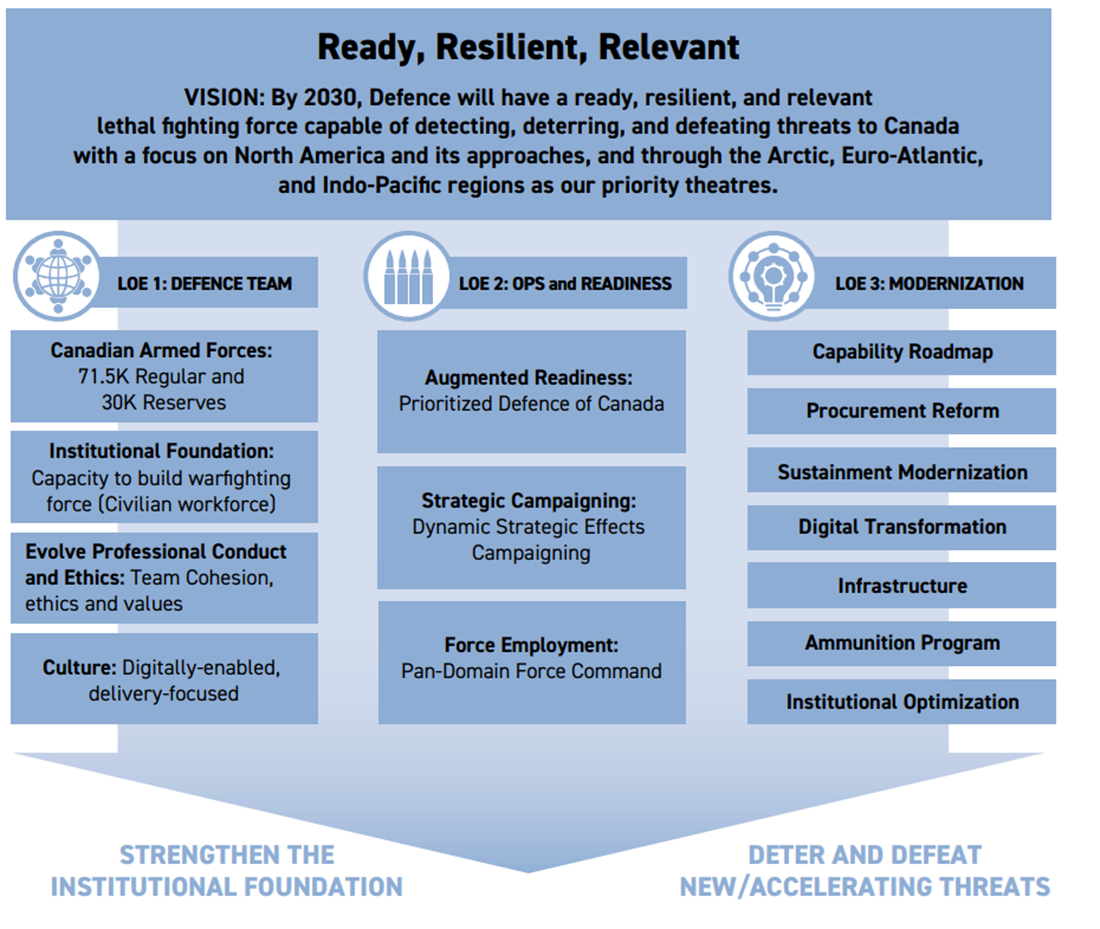
Caption
Ready, Resilient, Relevant
Vision: By 2030, Defence will have a ready, resilient, and relevant lethal fighting force capable of detecting, deterring, and defeating threats to Canada with a focus on North America and its approaches, and through the Arctic, Euro-Atlantic, and Indo-Pacific regions as our priority theatres.
Line of effort 1: defence Team
- Canadian Armed Forces
- 71.5K Regular and 30K Reserves
- Institutional Foundation:
- Capacity to build warfighting force (Civilian workforce)
- Evolve Professional Conduct and Ethics:
- Team Cohesion, ethics and values
- Culture:
- Digitally-enabled, delivery-focused
Line of effort 2: OPS and Readiness
- Augmented Readiness:
- Prioritized Defence of Canada
- Strategic Campaigning:
- Dynamic Strategic Effects Campaigning
- Force Employment:
- Pan-Domain Force Command
Line of effort 3: Modernization
- Capability Roadmap
- Procurement Reform
- Sustainment Modernization
- Digital Transformation
- Infrastructure
- Ammunition Program
- Institutional Optimization
Strengthen the Institutional Foundation
Deter and Defeat New/Accelerating Threats
Strategic Overview: Canadian Armed Forces Operations and Activities
Summary
- The global security environment is shifting under tremendous pressure with many threats transcending national borders. Instability abroad has an indirect manifestation in Canada requiring a robust domestic defence posture and resiliency, as well as active international military engagement strategies.
- The Canadian Armed Forces carries out domestic and international operations and activities to defend Canada's security, interests, and values and to contribute to international peace and stability.
Strategic Overview
- Canada's defence policy is informed by the challenges and opportunities of a complex global security environment and defines how the Government of Canada (GC) will support and employ the Canadian Armed Forces (CAF) to defend Canadian interests and contribute to a more secure and peaceful world.
- While the CAF carry out operations around the globe, the top priority is the defence of Canada against new and accelerating threats, with a particular focus on North America and its approaches, including the Arctic region. Beyond Canada, the Euro-Atlantic and Indo-Pacific are priority theatres of operations with activities ultimately calibrated to contribute to the defence of Canada through global stability.
- In most cases, CAF military operations and activities are applied as part of a coherent, coordinated, whole-of-government effort in concert with diplomatic engagement, humanitarian and development aid, and other comprehensive measures. In some rare cases, the military may be uniquely called upon to act in Canada's interests. In all cases, CAF activities comply with domestic and international law.
- Three organizations are primarily responsible for the command, control, sustainment, and management of CAF operations and report directly to the Chief of the Defence Staff (CDS):
- The Canadian Joint Operations Command is responsible for all domestic and international missions, less North American aerospace defence and special forces operations;
- The binational North American Aerospace Defense Command (NORAD) is responsible for aerospace warning and control of North America, and maritime warning in its surrounding waters; and
- The Canadian Special Operations Forces Command is responsible for all domestic and international special operations missions.
- The Strategic Joint Staff (SJS) works closely with these operational commands to consolidate input from across the CAF providing the CDS with comprehensive analysis and decision support for all CAF missions as well as advice and options to government on how best to employ the military in Canada's national interest. SJS, policy, and legal interlocutors assist the CDS in translating government objectives into clearly articulated orders while enabling them to effect strategic command.
- The Assistant Deputy Minister (Policy) is the lead for policy advice to the Minister of National Defence (MND) related to operations, in consultation with DND/CAF and other governmental departments.
Domestic and Continental Operations and Activities
- Defending Canada is the CAF's top priority with two main lines of effort. The first is to provide CAF elements and capabilities to defend Canada's sovereignty, including through surveillance and control of Canadian territory and its approaches. The second is to assist civilian authorities in natural disaster response, search and rescue, pandemic response, and other domestic emergencies.
- Several operations are conducted in support of the first line of effort with the NORAD mission being the most notable. Forces are postured across Canada 24/7/365 to ensure the CAF can respond to any challenges to our sovereignty on very short notice. Despite our isolation from some of the world's conflict zones, North America is no longer a sanctuary due to technological advances in weapons systems of our potential adversaries as well as their below threshold campaigns across the diplomatic, information, military, and economic spheres which often impact military equities. As a result, greater focus, resources, and renewed investment in the capabilities needed to protect the continent are required.
- Support to civilian authorities is the second line of effort and is governed by the national Emergency Management framework with authorities granted by the MND upon receipt of advice from the Deputy Minister and CDS following receipt of a Request for Assistance from a province/territory or another Minister of the Crown. Operation LENTUS is the CAF response to natural disasters in Canada.
International Operations and Activities
- International operations and activities enable the CAF to contribute to a more stable and peaceful world where threats to our national security are addressed far from our borders, military conflicts are deterred, universal values and multilateralism are promoted, and the international rules-based order is maintained. Such operations reinforce Canada's reputation as a reliable partner and responsible global actor and allow the GC to pursue foreign policy priorities and promote its strategic interests.
- When the CAF operates abroad, it does so under the authority of the Crown prerogative (the powers and privileges accorded by common law to the Crown). The Crown prerogative may be exercised by Cabinet, the Prime Minister, the Ministers of National Defence and Foreign Affairs jointly, or by the MND alone. The sensitivity, complexity, and risk to CAF members are factors in determining what level of authorization is appropriate. This approach also ensures Canada's national interests and foreign policies are supported by its military deployments.
- International operations are conducted bilaterally under the appropriate circumstances, but mostly under the auspices of the North Atlantic Treaty Organization, the United Nations, or like-minded coalitions.
- In addition to operations abroad, the CAF builds and maintains relationships with allies, partners, other militaries and multilateral institutions through active defence diplomacy. These cooperative relationships enhance knowledge, understanding and interoperability, allow for the exchange of best practices, and contribute to success on operations.
Organizational Information
Defence Team Organizational Structure
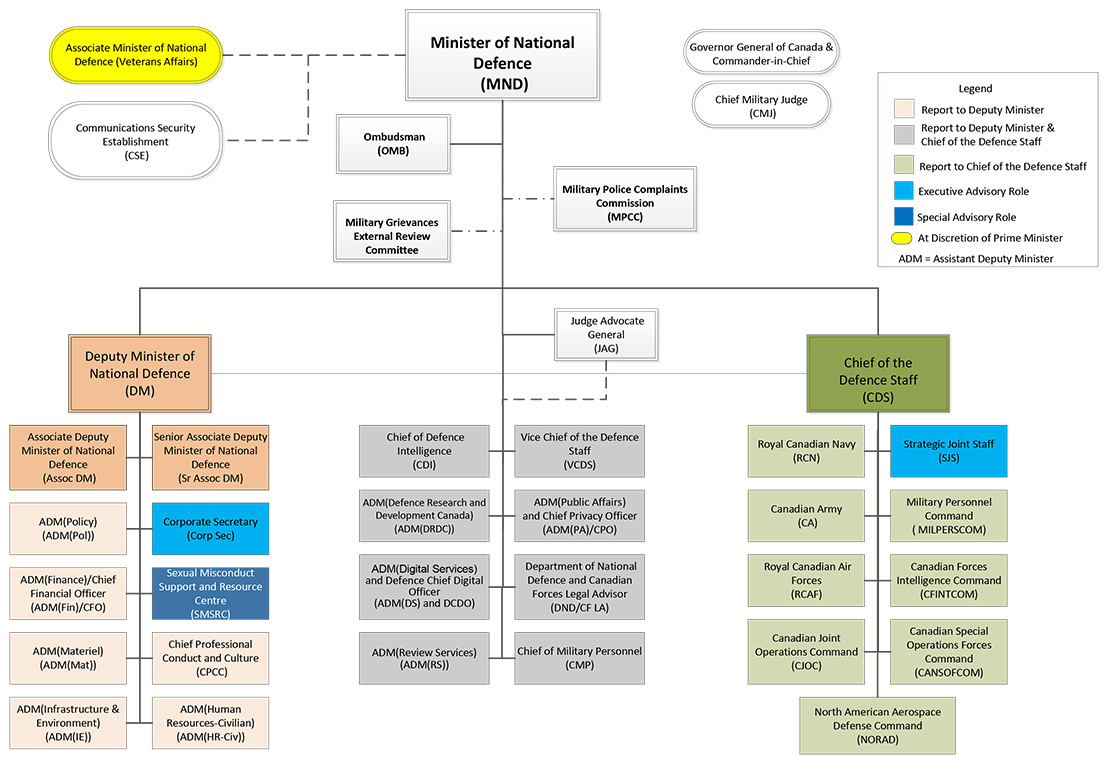
Caption
- Minister of National Defence
- Associate Minister of National Defence (Veteran Affairs) – At the discretion of the Prime Minister
- Communication Security Establishment (CSE)
- Ombudsman (OMB)
- Military Police Complaints Commission (MPCC)
- Military Grievance External Review Committee
- Deputy Minister of National Defence (DM) – Civilian Structure
- Senior Associate Minister of National Defence (Sr Assoc DM)
- Associate Deputy Minister of National Defence (Assoc DM)
- Assistant Deputy Minister (ADM) Policy (ADM(Pol))
- ADM(Finance)/Chief Financial Officer (ADM(Fin)/CFO)
- ADM(Materiel) (ADM(Mat))
- ADM(Infrastructure & Environment) (ADM(IE))
- Corporate Secretary (Corp Sec) – Executive Advisory Role
- Sexual Misconduct Support and Resource Centre (SMSRC) – Special Advisory Role
- Chief Professional Conduct and Culture (CPCC)
- ADM(Human Resources – Civilian) (ADM(HR-Civ))
- Chief of the Defence Staff (CDS) – military structure
- Royal Canadian Navy (RCN)
- Strategic Joint Staff (SJS) – Executive Advisory Role
- Canadian Army (CA)
- Military Personnel Command (MILPESCOM)
- Royal Canadian Air Forces (RCAF)
- Canadian Forces Intelligence Command (CFINTCOM)
- Canadian Joint Operations Command (CJOC)
- Canadian Special Operations Forces Command (CANSOFCOM)
- North American Aerospace Defence Command (NORAD)
- Report to DM and CDS
- Judge Advocate General (JAG)
- Chief of Defence Intelligence (CDI)
- Vice Chief of the Defence Staff (VCDS)
- ADM(Defence Research and Development Canada) (ADM(DRDC))
- ADM(Public Affairs) (ADM(PA))
- ADM(Digital Services) and Defence Chief Digital Officer (ADM(DS) and DCDO)
- Department of National Defence and Canadian Forces Legal Advisor (DND CF LA)
- ADM(Review Services) (ADM(RS))
- Chief of Military Personnel (CMP)
Included in the defense organizational structure but not reporting to the Minister of National Defense:
- Governor General of Canada and Commander-in-Chief
- Chief Military Judge
Overview of Defence Portfolio Organizations
Summary
- An overview of Defence Portfolio organizations, including the Communications Security Establishment, the Military Grievances External Review Committee, the Military Police Complaints Commission, the Office of the Chief Military Judge, and the Department of National Defence and Canadian Forces Ombudsman.
Context
- In addition to the Department of National Defence and the Canadian Armed Forces (DND/CAF), the Defence Portfolio includes several separate but related organizations, including:
1. Communications Security Establishment Canada (CSE)
- CSE is Canada's national signals intelligence agency responsible for foreign signals intelligence, cyber security and foreign cyber operations. A stand-alone agency, CSE includes the Canadian Centre for Cyber Security (Cyber Centre), which is the federal government's operational and technical lead for cyber security and information assurance.
- CSE's mandate is detailed in the Communications Security Establishment Act (CSE Act) and has 5 parts:
- Foreign Intelligence
- Acquire information from or through the global information infrastructure, and analyze, use, and disseminate such information for the purposes of providing foreign intelligence, in accordance with the Government of Canada's intelligence priorities.
- Cyber Security
- Provide cyber security and information assurance advice, guidance, and services to help ensure the protection of federal government electronic information and information infrastructure, and for the protection of such information and infrastructure designated by the Minister as being of importance to the Government of Canada (e.g., critical infrastructure).
- Defensive Cyber Operations
- Undertake defensive cyber actions on the global information infrastructure to help protect electronic information and information infrastructure of the federal government.
- Active Cyber Operations
- Carry out active cyber operations on the global information infrastructure to degrade, disrupt, influence, respond to, or interfere with, the capabilities, intentions, or activities of a foreign target as they relate to Canada's defence, security, or international affairs.
- Technical and operational assistance to federal partners
- Provide technical and operational assistance to federal law enforcement and security agencies, including DND/CAF, the Canadian Security Intelligence Service, and the Royal Canadian Mounted Police.
- Foreign Intelligence
- CSE supports Canada's participation in the Five Eyes, the world's longest-standing and closest intelligence-sharing alliance. The Five Eyes include the signals intelligence and cyber security agencies of Canada, Australia, New Zealand, the United Kingdom and the United States.
- Caroline Xavier, the Chief of CSE, is Deputy Minister and Accounting Officer reporting directly to the Minister of National Defence. She oversees a workforce of over 3,700 full-time, permanent employees, with total authorities for 2023 to 2024 at just over $1 billion.
2. Military Grievances External Review Committee (MGERC)
- The MGERC is an independent administrative tribunal reporting to Parliament through the Minister of National Defence. The Committee reviews military grievances referred to it pursuant to section 29 of the National Defence Act (NDA) and provides findings and recommendations to the Chief of the Defence Staff, who is the final authority in the grievance process.
- In May 2024, Kelly Walsh assumed the role of Chairperson and Chief Executive Officer. Members of the MGERC, including the Chairperson, are Governor-in-Council appointments, each appointed to a renewable term not exceeding four years. The Committee currently includes five members: a full-time Chairperson and Vice-Chairperson, a part-time Vice-Chairperson, a full-time Committee Member, and a Part-Time Committee Member.
3. Military Police Complaints Commission (MPCC)
- The MPCC is an independent administrative tribunal and oversight agency reporting to Parliament through the Minister of National Defence. The Commission is responsible for reviewing and investigating complaints about military police conduct under Part IV of the NDA. It also investigates allegations of interference in military police investigations. Additionally, the MPCC conducts public interest investigations and hearings when deemed in the public interest.
- The Commission Chairperson is appointed by the Governor-in-Council. Tammy Tremblay, the current Chairperson, assumed her duties on January 3, 2023. The Commission currently has three part-time Commission Members.
4. The Office of the Chief Military Judge (CMJ)
- The CMJ is a unit of the CAF that was first established in 1997. The judicial independence of military judges is protected in part by provisions of the NDA, beginning at section 165.21.
- The Office of the CMJ appoints military judges to preside at courts martial and perform other judicial duties. The Court Martial Administrator, under the general supervision of the CMJ, administers the convening of courts martial, the appointment of panel members of General Courts Martial, and other aspects of courts martial proceedings. Note: a panel is the military equivalent to a civilian jury.
- The CMJ and other Military Judges are appointed by the Governor-in-Council. Captain (Navy) Catherine Julie Deschênes was appointed CMJ on March 21, 2024.
5. The DND/CAF Ombudsman
- The DND/CAF Ombudsman Office was established by Ministerial Directive in 2001 and is directly accountable to the Minister of National Defence for several functions, including investigations and reports, information, education, as well as referrals for members of DND and the CAF.
- The Ombud is appointed by the Governor-in-Council in accordance with NDA section 5, and, in accordance with the 2001 Ministerial Directive establishing the Office of the Ombudsman, reports to and is directly accountable to the Minister of National Defence. The Ombudsman is independent of senior civilian management and the military chain of command. On July 2, 2024, Robyn Hynes assumed the role of Interim Ombud for DND/CAF for a one-year term. Mario Baril will begin his five-year term as Ombud on July 2, 2025. He served as Ombud of Mental Health at PSPC since November 2022, and prior to that, Ombud of Mental Health at and Employee Well-Being at Innovation, Science, and Economic Development Canada from October 2018 to November 2022.
- With respect to its investigation and reporting function, the Office of the Ombudsman may investigate and report when ordered by the Minister, in accordance with the Ministerial Directive, or upon receiving a complaint from a DND employee or CAF member. Reports generated by the Office of the Ombudsman are provided to the Minister of National Defence.
- When deciding whether to investigate complaints, the Office of the Ombudsman must not investigate where it would interfere with existing statutory actors or mechanisms that might otherwise address the complaint, and further is precluded from investigating certain areas, including issues relating to the military justice system, certain CSE activities, as well as legal advice or professional service standards.