
ARCHIVED - Master Corporal Mark Oatman: Loadmaster on the new Chinooks
This page has been archived on the Web
Information identified as archived is provided for reference, research or recordkeeping purposes. It is not subject to the Government of Canada Web Standards and has not been altered or updated since it was archived. Please contact us to request a format other than those available.
Related Links
News Article / September 23, 2013
By Captain Fraser Clark
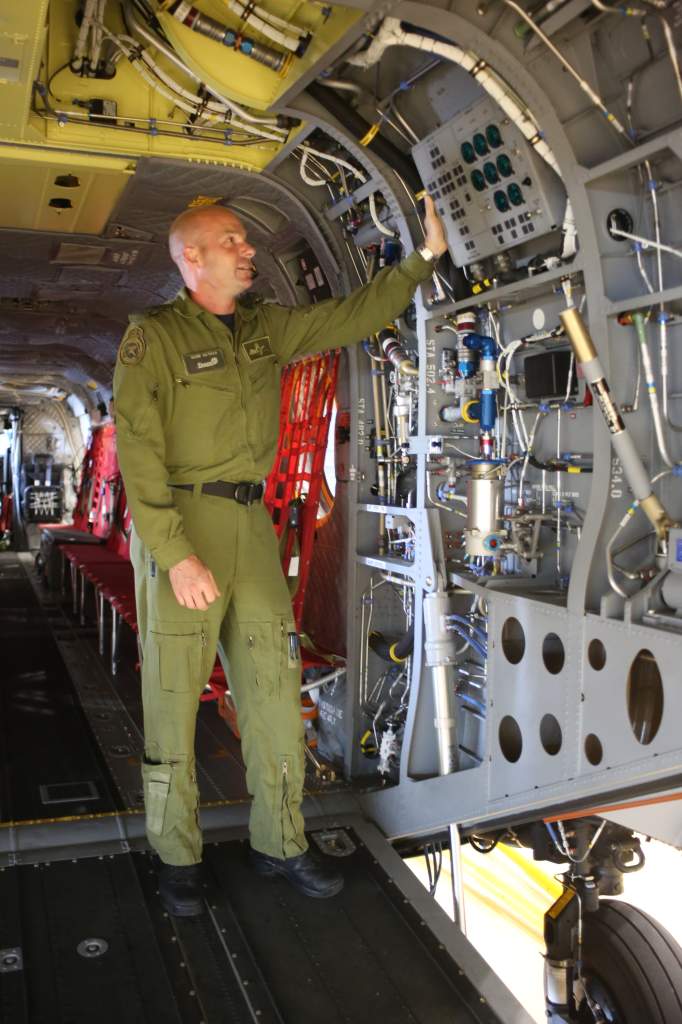
“I’m just another dude trying to do my job,” quips Master Corporal Mark Oatman, loadmaster on Canada’s newest CH-147F Chinook helicopter, based at 450 Squadron, Canadian Forces Base Petawawa, Ontario.
Speaking from the flight line at the Ottawa International Airport on June 27, 2013, MCpl Oatman had just arrived from the Boeing plant in Philadelphia, Pennsylvania, where he flew the maiden voyage of the first of 15 Chinooks now joining the fleet.
As one of only two qualified Chinook loadmasters in the Royal Canadian Air Force (RCAF) at this time, MCpl Oatman and his colleagues will support military readiness on exercises and operations in Canada and around the world.
The loadmaster is responsible for supervising the loading and unloading of cargo, vehicles and people in and out the aircraft. A loadmaster's duties include mathematically preplanning the correct placement of the load on the airplane, providing passenger comfort and safety, securing cargo and taking part in airdrop operations. Loadmasters are on flying status as aircrew and are required to fly as part of the job.
This lean, fit and quiet-spoken man, who has served 13 years in the Canadian Armed Forces, has had a career that has seen him follow a long and winding road.
Road to the military
Graduating from high school in Burlington, Ontario, MCpl Oatman spent a year-and-a-half studying tool and die making at at Mohawk College in Hamilton, Ontario, when he quit to work with a Kingston, Ontario-based research company. Quickly discovering desk work wasn’t to his liking, he pursued his interest in the military through his experiences as a member of 23 Service Battalion – a Reserve Force unit in Hamilton – transferring to the Regular Force. “This was the route I had to take,” he says.
Enlisting as a private with the 1st Battalion, The Royal Canadian Regiment, MCpl Oatman soldiered for nearly eight years qualifying as an assault pioneer, anti-amour, a light armoured vehicle (LAV) gunner and a crew commander. He also served two full tours in Afghanistan: Roto 0 in Kabul and Task Force 3-06 in Kandahar.
“I try not to take for granted what I have in Canada,” says MCpl Oatman. “The little things like clean water, a roof over your head. We forget about these things, whereas in a lot of places in the world these things are a luxury; even being clean.”
Returning from his second Afghan tour, MCpl Oatman was ready for a change.
“My time in the infantry was cool while it lasted and I’m thankful for the guys I served with overseas, but my body couldn’t put up with the infantry anymore,” he says. “Besides,” he says with a grin, “a Chinook is way cooler than a LAV.”
Army to Air Force
In 2007, MCpl Oatman transferred from the army to the air force, becoming a traffic technician. This marked the first of several radical transitions on the path to the Chinook.
Following qualification training at CFB Borden, in Ontario, MCpl Oatman accepted a position with the Canadian Special Operations Regiment (CSOR) where he worked in Combat Service Support.
“It seems extreme, but it was something I wanted to do and my time with CSOR was absolutely incredible. It was very, very busy; the people were excellent and the missions exciting.”
In the spring of 2011, MCpl Oatman’s career pattern repeated itself yet again. He was plucked from CSOR and planted in Afghanistan, this time with the Canadian Helicopter Force as a door gunner on the Chinooks.
“That was a cool job,” he says “and it was where I got my first real look into the Chinook world and where I thought I could do this for a living.”
Transition to Loadmaster
MCpl Oatman’s career transition to the loadmaster occupation specialty wasn’t long arriving.
“I came out of CSOR when I returned from Afghanistan and was sent on my loadmaster course for the CC-130 Hercules. I was picked up for the Chinook Program in 2011.”
Seated in a classroom at the Boeing Plant in Philadelphia, Pennsylvania, in the summer of 2012, MCpl Oatman says, “We sat in with our two pilots for their ground school in Philly. The American military doesn’t have loadmasters for their Chinooks and because the CH-147F is so different from the others out there, we had to develop the capability on our own.”
After a servicing course in Delaware and numerous hours of flight training and testing in Mesa, Arizona, MCpl Oatman received his medium- to-heavy-lift helicopter category qualification from 1 Wing Kingston, Ontario, while in Arizona.
“We covered day flying, night flying, sling loads and night vision training,” he says. “Boeing had to piece it together and trial it while we were being trained, so it was interesting.”
Speaking of his experiences so far on the new helicopter, MCpl Oatman says, “This helicopter is so powerful it’s incredible. You can do so much with it. 450 Squadron is going to be gone a lot because so many people require this aircraft.”
Looking to the future, MCpl Oatman predicts, “I think I’m looking forward to my best years in the military. If I’m able to, I would like to spend the rest of my career at the back of the Chinook because this is an incredibly powerful aircraft. But if I can’t do that, I can’t complain. The military has been good to me.”
The RCAF has received three Chinooks to date, with the remaining 12 to be delivered by the end of 2014.