
Embracing the future: RCAF finds solutions in innovative training technologies
News Article / March 25, 2014
By Major Sonia Connock
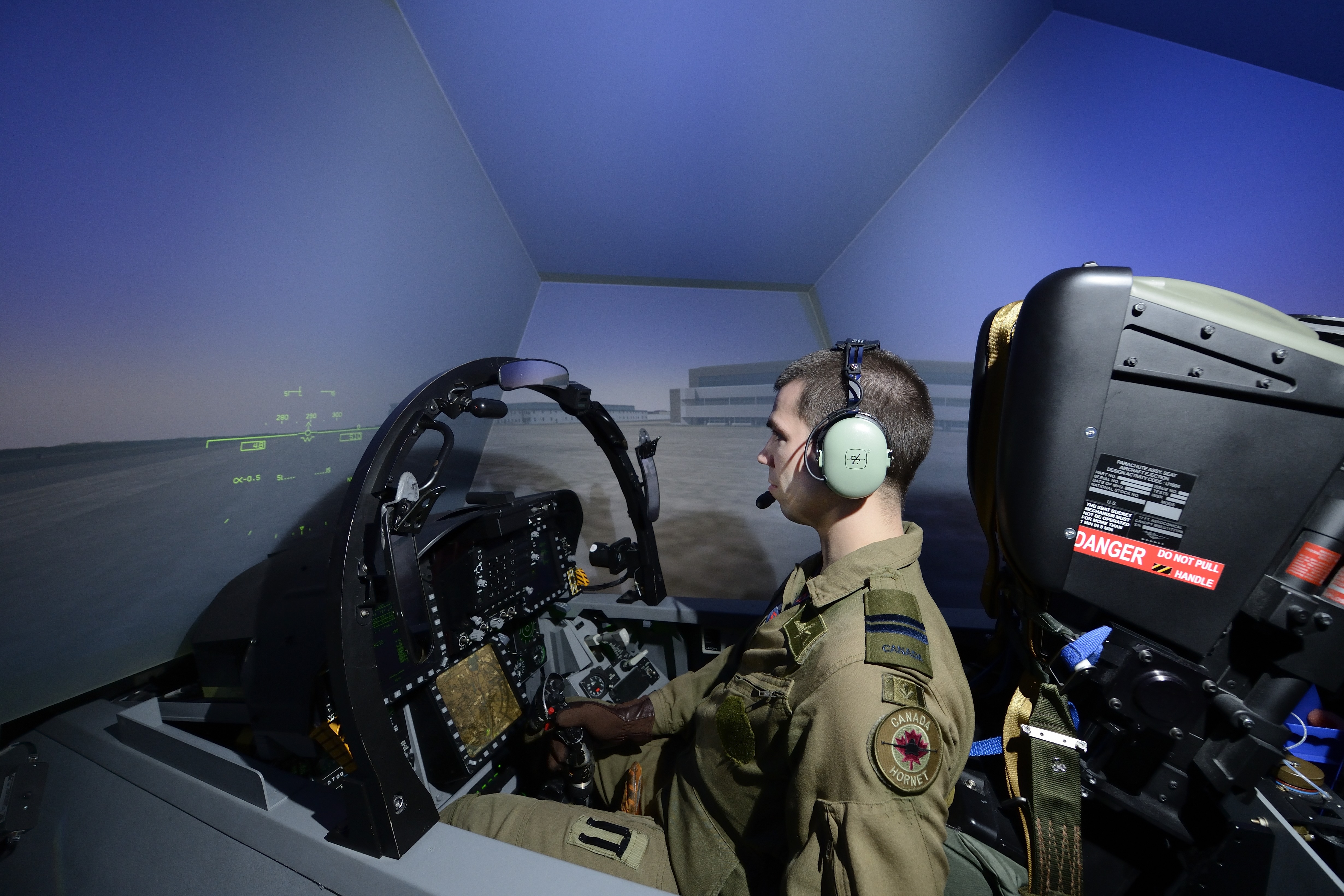
The Royal Canadian Air Force (RCAF) is exploiting advances in modeling and simulation (M&S) technology to improve its training and readiness as well as increase its operational output.
The Air Force’s strategy for combining and optimizing the benefits of live, virtual and constructive (LVC) simulation-based training will be introduced in the coming weeks. The new RCAF M&S strategy will coordinate the introduction of new training technology within the Air Force; this will ensure the new training devices that are introduced across the RCAF can be linked together to form a common virtual training environment.
“The Air Force is transforming the way it trains its personnel,” says Lieutenant-General Yvan Blondin, the commander of the RCAF.
“While traditional live training exercises are important – and will continue to have a place in our training system – there are limitations associated with live training. The operating and maintenance costs are high, aircraft are not always available, and certain skill sets cannot be regularly practiced because of geographical and weather limitations and safety concerns.”
The limitations of live training can be overcome through the increased use of computer-based simulations, he explains.
“Rapid advancements in computer technology have given us the ability to create virtual worlds that realistically simulate flying missions,” he continues.
“Simulators allow us to control different variables – such as weather, terrain and threats – and conduct training that is, in fact, more rigorous and varied than flying actual aircraft.”
Computer-simulated exercises permit more concentrated and repetitive training for tactical operations, such as takeoffs and landings. Learning to fight against enemy aircraft is hard to simulate in a live environment but can be easily simulated in a virtual environment.
Several Air Force communities, such as the maritime helicopter (CH-124 Sea King) and the long-range patrol (CP-140 Aurora) communities, have a long history of benefiting from whole-crew simulators that allow complex operational missions to be practiced. The playback capability inherent in training in the synthetic environment reduces doubt or debate regarding what did – or did not – occur during a training mission.
As aircraft systems continue to grow in complexity and capability, simulated environments – as well as environments that mesh together virtual and live training by having pilots in actual aircraft exercising with other personnel using simulators at wings and bases across Canada – will increasingly become the preferred training method.
Using simulators, the RCAF will be better able to generate the multiple stimuli required to exercise those complex systems. It will also be able to conduct training that is not otherwise practical in peacetime. Electronic warfare training, for example, is more effectively conducted using simulators because of the safety, security and environmental factors involved.
“As simulation technology continues to mature and grow, so too will its use within the RCAF,” says Colonel Colin Keiver, who is the director of air simulation and training within the RCAF headquarters in Ottawa.
“We already have fleets within the RCAF that are achieving in excess of 90 per cent of their training requirements through the use of simulation. Our newest fleets, such as the CC-130J Hercules and the CH-147F Chinook, now possess world-class training facilities and devices for aircrew and aircraft maintainers. Indeed, the technology has developed to the point where maintainers are achieving their qualifications to perform maintenance on these platforms without touching an actual aircraft.”
These world-class training facilities are the standard for the RCAF today, and the Air Force plans to go even farther in the future. It will build a common technical architecture for an integrated and interoperable virtual training world that will allow members of different Air Force communities, located at different wings across Canada, to train together in a virtual battlespace.
Crews conducting live training will also be connected to this virtual world, thus vastly expanding the kind of training conducted by the Air Force.
As the RCAF builds its integrated virtual training battlespace, it is exploring joint virtual training opportunities with the Canadian Army and the Royal Canadian Navy. The training of forward air controllers, for example, will – in the near future – be conducted by linking the controllers and the CF-18 Hornet pilots in a virtual battlespace using simulators located at different bases and wings.
It is expected that in the future, CH-148 Cyclone maritime helicopter crews will be training and exercising with their Navy counterparts in simulators before sailing on operations.
Personnel within the newly established directorate of air simulation and training are working with each Air Force community in order to determine how LVC simulation-based training should be blended to optimize the training benefits for each individual community.
“We will develop a distinct plan for each of our communities,” says Colonel Keiver. “We will optimize simulation training for each community so we can maintain the RCAF’s operational excellence and, at the end of the day, be the most agile, responsive and effective air force possible.
“Our training system in 2025 will be a fully integrated, optimized training system that mixes live, virtual and constructive training at the right time, at the right place, to deliver what we need in the most effective and efficient manner possible.”
In addition to improving the effectiveness of training within the RCAF, an increased use of M&S technology will also increase the operational flexibility of the Air Force.
“As each community increases its use of simulation for training, flying hours once devoted to training will be either reduced or turned into flying dedicated to operational taskings, thus providing Canada with more operational readiness, flexibility and agility,” says Lieutenant-General Blondin.
“The Air Force will become even more responsive to Canada’s defence needs since more aircraft will be available for use in flying operations when the need arises.”
In today’s economic reality of reduced budgets, advances in technology offer the RCAF less expensive ways of training and maintaining the skills of its air crews. As more training hours are logged on simulators (and fewer training hours are logged in actual flying aircraft), there will be less wear and tear on aircraft, thus allowing the RCAF to extend the life expectancy of aircraft and reduce overall per year costs of each aircraft.
Aircraft availability for operations will increase and the requirement to rent costly commercial aircraft (to carry out strategic airlift, for example) will be decreased and perhaps even eliminated.
Less money will be spent on aviation fuel and, because aircraft will fly largely to support operations (vice operations and training), the RCAF’s carbon footprint will be reduced and the Air Force will become a better custodian of the environment.
“We’ve done the analysis,” says Lieutenant-General Blondin. “Delivering the same level of training in an aircraft without simulation will, over the long run, cost significantly more than if you make an initial investment in simulation then optimize the use of simulation.
“Training that combines flying aircraft and simulators will be more effective, safer, less expensive, and better for the environment. It’s a ‘win-win’ situation for all.”
Watch a short video about the use of modelling and simulation in the RCAF, and its potential for the future.