
ARCHIVED - Executive summary: RCAF Simulation Strategy 2025
This page has been archived on the Web
Information identified as archived is provided for reference, research or recordkeeping purposes. It is not subject to the Government of Canada Web Standards and has not been altered or updated since it was archived. Please contact us to request a format other than those available.
Backgrounder / March 12, 2015
Since its foundation, the Royal Canadian Air Force (RCAF) has leveraged innovation, flexibility, and adaptability to achieve excellence in operations. High readiness is the means by which operational success is guaranteed and achieving readiness mandates excellence in training. The British Commonwealth Aircrew Training Plan (BCATP) of the Second World War, the creation of the NATO Flying Training in Canada (NFTC) program in the 90s and the recent fielding of world-class training solutions for the CC130J Hercules and CH147 Chinook are excellent examples of how the RCAF delivers innovative, adaptive and relevant training. From the early days of the BCATP, and the LINK trainer, the RCAF has also always embraced simulation. As simulation has matured, and the capabilities of the field continue to grow, the RCAF has an opportunity to maintain a leading role in the delivery of training for airmen and airwomen. Combined with the world-leading capabilities resident within Canadian industry, the RCAF will continue this bold tradition of training excellence by exploiting advances in modeling and simulation (M&S) technology to transform and optimize the way it achieves and maintains readiness.
By 2025, the RCAF will have a simulation-focused training system which skilfully leverages live, virtual, and constructive (LVC) domains within a networked common synthetic environment. This system will optimize the means by which RCAF aviators achieve and maintain readiness, fully exploiting advances in both technology and training methodologies, to deliver world-class capabilities for the full spectrum of operations.
The benefits of achieving this vision are as follows:
- A training environment that is whatever and wherever it needs to be.
- A system designed for training.
- A secure environment for sensitive training.
- A safer training environment.
- Increased collective training opportunities.
- Reduced time to achieve and maintain readiness.
- Reduced resources required to achieve and maintain readiness.
- Maximize RCAF personnel engaged in operations.
- More frequent joint and coalition training.
- Improved access to realistic training for all RCAF personnel.
- Extend ELEs [Estimated Life Expectancy].
- Reduce carbon footprint.
- Reduce environmental impact.
- Increase support for experimentation and concept development.
Analysis shows that the availability of a CH149 Cormorant simulator in Canada will reduce the length of the Cormorant First Officer initial course from 16 weeks to 10 weeks. Aircraft simulator operating costs are generally one-fifth the operating cost of an aircraft and the inclusion of multiple simulators in a synthetic environment, while preserving the aircraft for operations, makes training more available to all RCAF personnel. High-risk manoeuvres or sequences can be trained in a simulator to a high level of proficiency. Joint and Collective training events, traditionally limited in frequency by their complex and cost-prohibitive nature, could be conducted in the synthetic environment if the RCAF ensures its training systems can interconnect with Canadian Armed Forces (CAF) and allied training systems. M&S directly enables experimentation and concept development. The rationalization of service delivery will ensure the maximum numbers of RCAF personnel are available for operations. Finally, reducing the amount of live-fly required to achieve and maintain readiness will reduce the carbon footprint of the RCAF today and in the future.
As each Air Force community increases its use of simulation for training, the flying hours once devoted to live training can be reduced. This reduction can be turned into increased operational availability, thus providing Canada with increased operational readiness, flexibility, and agility. This will make the RCAF even more responsive and relevant to Canada’s defence needs.
Training that combines operational fleets with simulators and the synthetic environment will be more effective, safer, less expensive, and better for the environment.
Achieving excellence in operations mandates achieving in excellence in training. The RCAF Simulation Strategy (RSS) contains a comprehensive overview of how the RCAF will leverage M&S to optimize the means by which the RCAF achieves and maintains readiness.
The document is based on three fundamental and linked tenets:
- An achievable and quantifiable end state for RCAF simulation in 2025.
- A detailed analysis of the current state of M&S within the RCAF in 2014, in relation to the end state.
- A deliberate and phased plan to achieve the end state in 2025.
While the initial focus is oriented towards aircrew training, the foundational principles within the document will apply to all occupations and training activities across the RCAF. It is neither exhaustive nor is it the final word. The RCAF Simulation Strategy lays out a foundational framework by which the RCAF will achieve its goals with a full understanding that achieving them will require both a collaborative and iterative approach.
Achieving the desired end state mandates that the RCAF build a system of systems that connects new and legacy training devices to form a virtual battlespace. This virtual battlespace will provide a consistent virtual training environment by utilizing shared assets consisting of a common synthetic environment, a common exercise control and debrief capability, and common scenario development where required to achieve RCAF training objectives. In so doing, simulation-focused training will be delivered in as efficient a manner as possible. This system will also provide broad support for collective training by ensuring that all RCAF training devices are able to interact in a common virtual training environment. Throughout this effort, compatibility with joint and allied systems will be sought where feasible and desirable. Achieving this virtual battlespace will require a high level of training systems integration (TSI) across all RCAF training systems.
Achieving TSI within the RCAF, across all operational fleets and capabilities, requires a systems approach to training. The systems approach to training involves a systematic analysis of the training requirement, the design of the instructional method (instructional system design) which includes the allocation of instruction to different media types (classroom, computer based, simulation, live), the development of the training materials (courseware, computer-based training (CBT), simulation), the implementation of the training system (along with human instructors and support personnel), and the ongoing validation of the training whereby the training outcomes and operational unit performance is continually evaluated and that feedback is used to modify the training system.
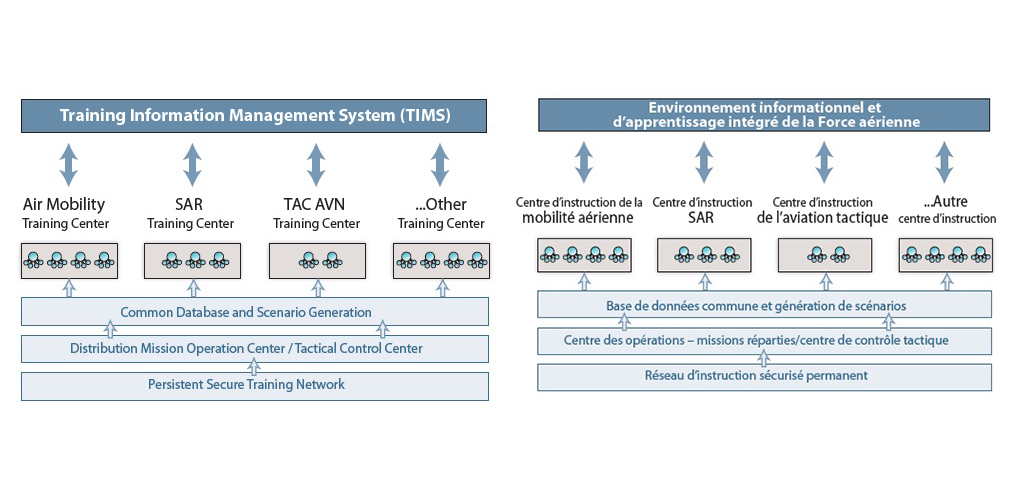
The optimization of simulation across all RCAF training activities mandates that it be fully embedded into the RCAF training system. It will be supported by a training information management system (TIMS) as well as common database and scenario generation, a distributed mission operations centre (DMOC) and a persistent and secure training network as depicted in the image gallery.
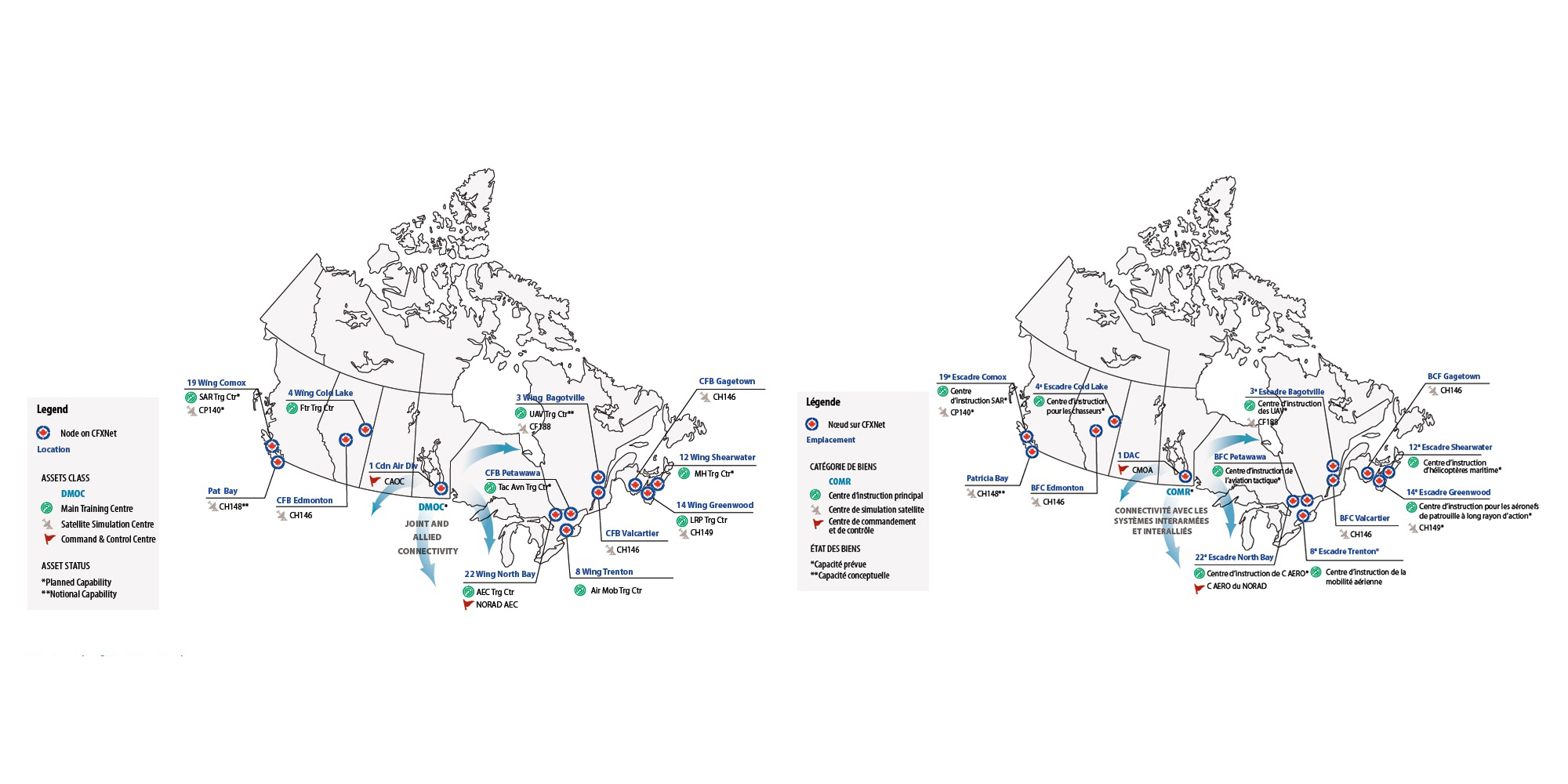
The RCAF DMOC will provide common services and function as the point of connection for RCAF distributed training as well as with CAF and allied systems. Each operational community will be served by a training centre that provides a similar set of services for their community, with the focus being on modifying or extending the common assets to meet community-specific training requirements. Finally, the system will provide remote training devices, which rely upon the DMOC and training centre for their development services and focus purely on instruction at the local level. Together, these systems will form a comprehensive training system capable of delivering effective and efficient individual, collective, joint and combined training.
Analysis of the RCAF in 2014 revealed it possesses much of what it requires to achieve the end state in 2025. The Air Force Integrated Information and Learning Environment (AFIILE) constitutes a robust TIMS within the RCAF and the Canadian Advanced Synthetic Environment (CASE) continues to develop the architecture and the standards by which connectivity across the RCAF training system will be achieved. The delivery of the CC130J and Chinook training systems under the Operational Training Systems Provider (OTSP) framework provide a model upon which to build subsequent acquisitions to ensure the training system is as robust as the operational fleet it supports. Most importantly, there is a strong desire across all levels of the RCAF to fully exploit the advances in M&S to achieve readiness in more efficient and effective ways.
The challenges within the current state of RCAF can be summed up as follows:
- RCAF training and simulation systems are not synchronized or aligned and, in some cases, incompatible or redundant. The RCAF training system is neither efficient nor effective.
- The RCAF has traditionally focused on the procurement of the aircraft or operational equipment to the detriment of the training system. Recent efforts under OTSP indicate this may be changing although it remains to be seen if this will continue. The assessment identified a total of 22 key deficiencies spanning all RCAF activities related to modelling and simulation. Examples include the absence of a comprehensive RCAF Job Task Analysis which clearly captures the roles and missions of the RCAF, the absence of consistent Training Needs Analysis across all activities, the failure to consider training systems as an integral part of operational weapons systems, unequal investment in M&S across different areas of the RCAF, no common or standardized synthetic environment, stove-piped standalone legacy training devices, the absence of consistent policy and direction on the use of simulation, and the lack of a verification, validation, accreditation (VV&A), and certification process.
Addressing the gaps will require dedicated and sustained effort in coordination with multiple stakeholders across DND as well as with industry. Close coordination with our allies will also be required to ensure that solutions put in place for the RCAF complement its ability to conduct training within those allies. The creation of the Directorate of Air Simulation and Training within the RCAF is the first critical step to achieving the ability of the RCAF to focus (lead, advocate, coordinate) on achieving its simulation end state.
The strategic roadmap is the means by which the RCAF will achieve its simulation end state. It forms part of the overall RCAF Campaign Plan and consists of five broad lines of development as follows:
- Simulation-focused training. The RCAF will employ a systems approach to training to develop a well-defined understanding of the individual and collective simulation-focused training requirements necessary to better develop and maintain the skills necessary for a world-class Air Force.
- Virtual battlespace. The RCAF will develop a system-of-systems that will provide a realistic common simulation of the operational environment suitable for training. This virtual battlespace will consist of integrated training devices that are tailored to specific fidelity requirements and accredited for use and which collectively support the full breadth of operational training within the RCAF.
- C2 (command and control), governance and policy. The RCAF will develop a policy and governance framework that will maximize the efficient and effective development and use of M&S in order to support the full spectrum of RCAF activities and operations.
- Infrastructure. The RCAF will create an enterprise support system capable of hosting all components of the virtual battlespace, commensurate with the technical and operational requirements of these components.
- Service delivery. The RCAF will work with the procurement system to provide procurement and support services that deliver the components of the virtual battlespace and meet user in-service needs while matching pace with future capability development.
The strategic roadmap is divided into three spirals of activity, equating broadly to near-, mid- and long-term horizons.
Spiral 1 focuses on near term activities within the next two to three years and fall into three categories:
- Optimizing the use of existing training systems.
- Addressing critical training deficiencies in the CC177, CC150 and CH149 through acquisition of dedicated RCAF training systems.
- Establishing the policy framework and organizational structure necessary to support the long-term implementation of the roadmap.
Optimization of current RCAF training systems will initially focus on integrating the CF188 advanced distributed combat training system (ADCTS) with CASE and the training systems in 22 Wing North Bay and the Combined Air Operations Centre (CAOC) in Winnipeg to permit the training of NORAD / defence of Canada scenarios in the synthetic environment. Coordination with the Canadian Army (CA) to integrate the CF188 ADCTS system with the forward air controller (FAC) training system has also begun to reduce the number of live-fly sorties required to qualify and maintain FACs in the CA. These initial efforts also act as a forcing function within the Department of National Defence (DND) to ensure alignment and synchronization of supporting elements, such as the associate deputy minister (materiel) organization are optimized to fully leverage the synthetic environment to begin building and sustaining the virtual battlespace. Optimization activities are intended to be addressed within existing resources.
Critical training deficiencies have been identified that requires an investment in training systems for the CC177, CC150, and CH149 fleets. These fleets currently conduct their training using outside of Canada training devices which results in the RCAF having no control over the training content and / or aircraft configurations that are not compatible with RCAF configurations resulting in negative training. In addition to reduced course lengths, the acquisition of RCAF training systems for these fleets will generate additional benefits such as reduced time away from home for the crews and increased utilization of simulation with a corresponding reduction in aircraft flight hours to achieve and maintain readiness. Acquisition of these devices is incorporated into the overall roadmap and reflects existing needs analyses.
At the end of Spiral 1, the RCAF will have established the policy framework and governance structure to ensure the RCAF Simulation Strategy is executed and completed. Efforts in this area have already begun and include the development of an air simulation governance structure, the creation of draft standards for simulator visual databases and the ongoing development of open architecture standards under CASE that allow legacy and future RCAF training systems to integrate with one another in the virtual battlespace.
Spirals 2 and 3 both derive from the deliberate application of a comprehensive training needs analysis across all RCAF activities and fleets but differ in focus and scope of effort. Spiral 2 will develop the virtual battlespace as a key enabler for collective training and optimization of the capabilities of linked training devices. To that end, key fleets have been identified that represent the largest audience for distributed mission training. This includes the integration of the CP140 Aurora with other fleets such as the CH148 Cyclone as well as Royal Canadian Navy (RCN) training assets through the RCN DMOC and the CASE federation. At the end of Spiral 2, the RCAF will have built up the core components of the virtual battlespace, connected key training devices for these fleets, and enhanced the capabilities of the DMOC.
Spiral 3 continues the effort begun with Spiral 2, connecting the training devices for the remaining fleets as well as ensuring any new operational capabilities are able to fully integrate into the virtual battlespace. Spiral 3 will also look at augmenting the training system by addressing any requirements for new training devices that result from the detailed training needs analyses. As it is anticipated that acquiring new training devices, from requirements definition to ready for training, will take the longest time of any activity, Spiral 3 represents the longest of the three spirals. At the end of Spiral 3, the RCAF will have achieved the overall end state for the initial aircrew training focus of the RCAF Simulation Strategy.
The deliberate and phased implementation of this plan will create a training capability that the RCAF does not currently possess. While much work remains to be done, the reality is that the RCAF already possesses much of what it needs to start implementation. The directorate of air simulation and training will provide the focus (lead, advocate, coordinate) for this effort. The value of the virtual battlespace, as an opportunity to increase the quality, frequency, and scope of training conducted, is difficult to measure but will be of increasing significance as the RCAF moves forward. Considering that the RCAF, in 2014, spends almost $1B per year to sustain readiness within its aircraft fleets alone, any improvements in both efficiency and effectiveness across the RCAF M&S enterprise will deliver increases in operational readiness. With that in mind, the full cost of implementing the strategy is estimated at $544M, with the potential for $2B in savings over 20 years above and beyond the sustainment cost of the system.
The strategic roadmap represents an ambitious but achievable transformation in how the RCAF achieves and maintains readiness. Successful execution of this plan demands that the RCAF have a clear set of principles and priorities to guide all activities. Focusing on these principles and priorities will help the RCAF maintain its drive towards achieving the critical activities associated with the five lines of development leading to the ultimate end state. In particular, principles are the core values of the organization, and as with the vision and strategic objectives, can serve as an anchor that remains valid and enduring while organizations, personnel, programs, and processes may change.
The following principles and priorities must be embedded within the RCAF culture as core values:
- The RCAF recognizes that it must shift from live to virtual based methods in order to achieve more effective and efficient training.
- Technology is a key enabler of this transformation, but technology serves the operational requirement for training, not vice versa.
- While the RCAF may not directly deliver many aspects of the training, it will not shirk in its training responsibility, always maintaining an expert view of its requirements and ensuring its standards are being met.
- Transformation activities will not compromise ongoing operations.
- Whenever live and virtual training methods offer the same training value, the preference will be to choose the virtual training method.
- Live training will always be a critical component of aircrew training, especially in validation.
- The RCAF will stop working in or creating stovepipes, whether internally or across the CAF.
- The RCAF will think and act as a team to make this work, ignoring parochial interests within fleets, cooperating with other communities in DND and the CAF, seeking out and respecting capability across industry, and involving subordinates to obtain ideas and gain ownership.
- There are no short cuts to delivering a world class training capability; the RCAF will take the time to do things right and it will not accept mediocre efforts or results in its relentless and methodical pursuit of the end state.
- The RCAF recognizes that this strategy is for our children, not us; the RCAF will accept that the success of this transformation will require long-term unity of purpose.
The RCAF has an opportunity to significantly improve the means by which it achieves and maintains readiness through the aggressive and comprehensive adoption of modelling and simulation. The state of the art in 2014 is already capable of delivering highly effective training that meets or exceeds most of what the aircraft can deliver, allows for the creation of a virtual battlespace that is highly reflective of the demanding and highly dynamic operating environments the men and women of the RCAF are called upon to act in and does so at reduced overall operating costs. Much of that required to achieve the end state already exists, it simply needs to be synchronized and aligned and supported by a robust governance and policy framework. The key to implementing and sustaining the M&S end state is the attainment of training systems integration (TSI) across all RCAF training activities. The campaign plan is phased and achievable. Efforts in several areas have already begun to lay the framework which subsequent activities will build upon. Most importantly, the RCAF has the desire to succeed. The RCAF is well on the path to maintaining continued excellence in training and, therefore, continued excellence in operations.