
ARCHIVED - History of 415 Long Range Patrol Force Development Squadron
This page has been archived on the Web
Information identified as archived is provided for reference, research or recordkeeping purposes. It is not subject to the Government of Canada Web Standards and has not been altered or updated since it was archived. Please contact us to request a format other than those available.
Backgrounder / June 11, 2015
The Four Hundred and Fightin’ Fifteen Squadron was formed on August 20, 1941, in Thorney Island, Hampshire, England, as Canada's fourth Coastal Command squadron and first torpedo bombing squadron.
The squadron, under its first commanding officer, Wing Commander "Wally" Wurtele, received its first aircraft, the Bristol Beaufort, on September 2, 1941. Flight training began within a week and, by October, 415 Squadron was also serving temporarily as an operational training unit for general reconnaissance and torpedo bomber crews. From its modest beginning, 415 Squadron developed a reputation as one of the finest, most professional anti-submarine warfare squadrons, and has demonstrated time and again that dedication and perseverance are the most effective weapons.
The Bristol Beaufort was never used operationally by the squadron and was quickly replaced by the Handley Page Hampdens in 1942. The Hampdens flew both anti-U-Boat and anti-shipping patrols in the English Channel and the Bay of Biscay. It was on April 21, 1942, that 415 flew its first operational mission, an air-sea rescue; on the 29th, flew its first anti-submarine "musketry" patrol.
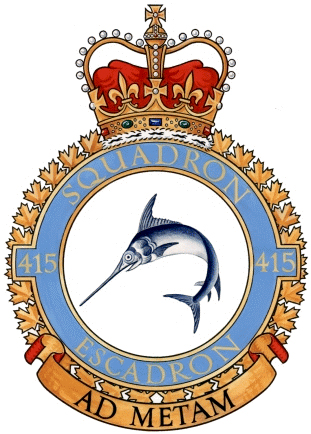
On January 23, 1943, the official badge depicting a swordfish striking at its prey with the motto Ad Metam – "To the Mark" – which had been approved by King George VI, was presented to the squadron. It is still worn proudly today!
In September of the same year, 415 Squadron had a complete change of aircraft when the Vickers Wellingtons and Fairey Albacore biplanes replaced the Hampdens. The Albacores were the only biplanes to see combat with the Royal Canadian Air Force during the Second World War and 415 Squadron was the only Canadian unit to use them. Both planes, having two different roles, were effective against E-Boats in the English Channel. The Wellingtons were employed to find the E-Boats while the Albacores were sent to attack them.
On July 12, 1944, 415 Squadron was officially transferred from 16 Group Coastal Command to 6 Group Bomber Command in East Moor, Yorkshire. The Squadron was re-equipped with Handley Page Halifax bombers, which were used for its first bombing raid over Hamburg, Germany on the night of July 28, 1944. Within days of the end of the European war, 415 Squadron flew its last operational wartime mission on April 25, 1945, against aircraft artillery and was subsequently disbanded on May 15, 1945.
After 16 years of absence, 415 Squadron was re-established under the command of Wing Commander "Sid" Mitchell at Summerside, Prince Edward Island, on June 1, 1961, where it remained for the next two decades. Always proud and ready to lead, the squadron was quick to establish a Canadian endurance record with the CP-107 Argus on July 26, 1961, flying 30 hours and 20 minutes non-stop.
While based in Summerside, 415 Squadron saw many changes in its roles and missions and operated from an ever-increasing number of deployment locations. In 1964, it assumed search and rescue duties for Maritime Air Command; the early 1970s marked the start of fisheries and pollution missions. Northern patrols became more frequent to demonstrate Canadian sovereignty and provide surveillance in the north. Operation Morning Light, which took place on January, 24, 1978, consisted of searching for the Soviet nuclear powered satellite whose debris were scattered over a wide area of the Northwest Territories.
In June 1981, 415 Squadron began the move to Greenwood, Nova Scotia. This marked the end of an era as the Aurora replaced the Argus. It also marked the anniversary of the first 25 years of distinguished service to the crown. Thus the Honourable John E. Shaffner, Lieutenant Governor of Nova Scotia, presented the squadron’s Colour on September 25. A "Swordfish" reunion was held for the event, and was highly successful, with the presence of over 400 ex-Swordfish.
For some time, it had been the custom to use the United States Navy prefix "VP" for maritime patrol squadron. As part of Air Command’s intent to re-establish a visible and united Air Force, it was decided to revert back to the original squadron designators. Thus, on July 23, 1986, VP 415 officially became known as 415 Maritime Patrol Squadron.
Of significant interest was 415 Maritime Patrol Squadron's participation in Operation Friction. Iraq’s invasion of Kuwait in 1990 prompted Canada to send a naval task group to enforce the United Nation’s resolutions. 415 Squadron was tasked to support this task group during its work-up phase transit between Halifax and the Mediterranean Sea. The Aurora exercised the self-defence capability of the Canadian Task Group and provided surface surveillance. In 1993, Operation Sharp Guard brought crews from 415 Squadron to Sigonella, Sicily, where they flew surveillance patrols in the Adriatic in support of the United Nation’s arms embargo of the Former Republic of Yugoslavia. The squadron also participated in Operation Assistance, providing humanitarian assistance to the people of Manitoba during the great flood of 1997.
To mark the completion of 40 years of service, the Swordfish held a forty-year reunion in June 1997. In commemoration of this event, a memorial was commissioned out of red granite and dedicated to the memory of those who served with the squadron. Its three sides represent the three eras of squadron history: Second World War, the Summerside Argus years, and the present. The memorial is on display in the squadron spaces at 14 Wing Greenwood.
415 Squadron participated in Operation Apollo, deploying an Aurora crew to the Arabian Sea region in support of the American-led “campaign against terrorism” following the events of September 11, 2001. This deployment continued through 2002 and into 2003, maintaining a stellar mission completion rate of 97 per cent. By summer 2003, with the mission objectives having been met, the detachment was stood down. 415 Squadron’s personnel who participated remain proud of their contribution to stability in the Arabian Sea region.
As a follow-on to Operation Apollo, the long-range patrol community under the direction of 1 Canadian Air Division, developed a squadron vanguard posture for future potential missions. Achieving the high level of readiness required for the vanguard commitment was a tremendous squadron achievement and 415 Squadron assumed the first long range patrol squadron vanguard responsibility, ready to deploy on short notice anywhere in the world.
415 Maritime Patrol Squadron was stood down at 14 Wing Greenwood on July 29, 2005. On June 5, 2015, it was stood back up as 415 Long Range Patrol Force Development Squadron.
In an ever-changing world, and despite ever-changing roles, 415 Squadron has always been ready to answer the nation’s call with professional officers, airmen and airwomen who are focused and ready for operations anywhere in the world. Whatever the job, 415 Squadron will carry on its long and proud traditions of remaining true to its motto Ad Metam - "To the Mark".