
Briefing package for the Deputy minister of Labour - 2026
Official title: Transition binder for Deputy Minister of Labour and Associate Deputy Minister of Employment and Social Development, Rob Wright – January 12, 2026
On this page
- Labour 101
- Corporate Briefing Binder
- Annex A – Instruments of Delegation for legislation administered by the Minister of Jobs and Families
- Annex B – Employment and Social Development Canada – Departmental Overview
List of abbreviations
- ACAFTA:
- Association of Southeast Asian Nations-Canada Free Trade Agreement
- AMPs:
- Administrative Monetary Penalties
- AOHSR:
- Aviation Occupational Health and Safety Regulations
- ASEAN:
- Association of Southeast Asian Nations
- AVC:
- Assurance of Voluntary Compliance
- CAALL:
- Canadian Association of Administrators of Labour Legislation
- CCOHS:
- Canadian Centre for Occupational Health and Safety
- CER:
- Canada Energy Regulator
- CHRA:
- Canadian Human Rights Act
- CHRC:
- Canadian Human Rights Commission
- CIRB:
- Canada Industrial Relations Board
- CLC:
- Canadian Labour Congress
- Code:
- Canada Labour Code
- COHSR:
- Canada Occupational Health and Safety Regulations
- CRA:
- Canada Revenue Agency
- CSPS:
- Canada School of Public Service
- CUSMA:
- Canada-United States-Mexico Agreement
- DPRDP:
- Dispute Prevention and Relationship Development Program
- EEA:
- Employment Equity Act
- EEEF:
- Employment Equity Employer’s Forum
- EPIC:
- Equal Pay International Coalition
- ESDC:
- Employment and Social Development Canada
- FCP:
- Federal Contractors Program
- FETCO:
- Federally Regulated Employers-Transportation and Communications
- FMCS:
- Federal Mediation and Conciliation Service
- FPT:
- Federal-Provincial-Territorial
- GB:
- Governing Body
- GECA:
- Government Employees’ Compensation Act
- HOCE:
- Head of Compliance and Enforcement
- HSO:
- Health and Safety Officers
- IACML:
- Inter-American Conference of Ministers of Labour
- ILC:
- International Labour Conference
- ILO:
- International Labour Organization
- IMEC:
- Industrialized Market Economy Countries
- ITL:
- International Trade and Labour
- LEEP:
- Legislated Employment Equity Program
- LES:
- Locally engaged staff
- LMA:
- Labour Market Availability
- MOHSR:
- Maritime Occupational Health and Safety Regulations
- NSHA:
- Non-smokers’ Health Act
- NSHR:
- Nonsmokers’ Health Regulations
- OBTOHSR:
- On Board Trains Occupational Health and Safety Regulations
- OECD:
- Organisation for Economic Co operation and Development
- OGOSHR:
- Oil and Gas Occupational Safety and Health Regulations
- PAHO:
- Pan-American Health Organization
- PSEA:
- Public Service Employment Act
- PESRA:
- Parliamentary Employment and Staff Relations Act
- RCMP:
- Royal Canadian Mounted Police
- RRLM:
- Rapid Response Labour Mechanism
- SAA:
- Status of the Artist Act
- TC:
- Transport Canada
- WCBs:
- Workers’ Compensation Boards
- WEPP:
- Wage Earner Protection Program
- WEPPA:
- Wage Earner Protection Program Act
- WORBE:
- Workplace Opportunities: Removing Barriers to
Labour 101
Minister of Labour – Overview Briefing Binder – January 2026
Mandate of the Minister of Labour
Preface
Since the appointment of the first federal Minister of Labour in 1909, the role and responsibilities of this office have evolved to balance economic growth with worker representation, safety and fairness. In the wake of the Second World War, the Canada Labour Code, enacted in 1967, consolidated Canada’s industrial relations framework in response to industrialization, increasing participation of women and other equity groups in the workforce, and a post-war consensus that emphasized fair labour practices and workers' rights as key to a stable society. At its core, this framework provided legal supports for unionization and collective bargaining.
In the latter part of the twentieth century, unionization rates plateaued, while equity groups put forward new demands, and technological changes continually reshaped the economy. The federal government responded through expanding its role in safety and health, labour standards, wage regulation, and employment equity. This shift has resulted in a statutory-driven framework for labour protections, where the state enforces minimum standards, often in the absence of union representation.
Overview
The core mandate of the Minister of Labour is to promote safe, healthy, fair and inclusive work conditions and cooperative workplace relations in:
- the federal private sector, which includes key industries, such as banking, telecommunications, air, rail, road, and maritime transportation
- most federal Crown corporations, such as Canada Post, and
- the governance and administration of First Nations band councils and Indigenous self-governments
The key pieces of legislation underpinning the Minister of Labour’s mandate are:
- Canada Labour Code
- Employment Equity Act
- Pay Equity Act
- Wage Earner Protection Program Act
- Government Employees Compensation Act
- Non-smokers’ Health Act
The Minister of Labour is also responsible for administering parts of other statutes, such as Part II of the Status of the Artist Act (SAA) for artists’ right to bargain, and Part III of the Parliamentary Employment and Staff Relations Act (PESRA) for occupational health and safety in parliamentary workplaces.
A key element in delivering the Labour mandate is engagement with employer and union representatives. The federal government has traditionally been able to create a high degree of consensus with respect to labour laws and policies through such engagement. This has played an important role in ensuring stable and healthy labour relations in Canada’s federally regulated industries.
Given that responsibility for labour matters is divided under the Canadian constitution, the Minister of Labour works with the provinces and territories to foster cooperation and coherence on labour issues that affect all Canadian workplaces, workers and employers.
The Minister of Labour also manages Canada’s international labour affairs. The Minister plays an important role in the development and realization of Canada’s foreign and trade policy objectives by strengthening respect for internationally recognized labour standards and human rights.
The Labour Program, like all other Branches in ESDC, is undergoing the Government’s Comprehensive Expenditure Review and some programs may be impacted.
Portfolio organizations
The Minister of Labour’s portfolio includes the Canada Industrial Relations Board (CIRB) and the Canadian Centre for Occupational Health and Safety (CCOHS).
The CIRB’s mandate is to contribute to and promote a harmonious industrial relations climate in the federally regulated sector, and help protect health, safety and labour standards in the workplace through the impartial application and interpretation of the rules that govern employees, unions and employers under the Canada Labour Code, the Status of the Artist Act and the Wage Earner Protection Program Act
The CCOHS’ mandate is to promote workplace health and safety and the physical and mental health of working people in Canada, which it achieves through the provision of:
- programs
- products and services, and
- collaboration with various key partners, researchers and stakeholders
Federal mandate
Overview
The Minister of Labour promotes safe, healthy, fair and inclusive work conditions and cooperative workplace relations in federal private-sector industries. In some cases, this mandate applies to the federal public service and other federal establishments. This is accomplished through the development and administration of labour-related legislation and policies designed to regulate the employment relationship and improve the work environment for the benefit of:
- workers (and their families)
- employers
- the national economy, and
- Canadian society as whole
Key areas of responsibility under the federal labour mandate are:
- promotion and facilitation of constructive industrial relations including labour dispute prevention and resolution activities (mediation and conciliation)
- promotion and enforcement of occupational health and safety standards
- promotion and enforcement of labour standards (for example, hours of work, wages, leaves and rights on termination of employment)
- promotion of employment equity for women, Indigenous peoples, persons with disabilities, and members of visible minorities
- promotion of pay equity
- management of workers’ compensation for federal employees, and
- restriction and regulation of smoking in any federally regulated work space including aircrafts, trains and ships
Federal jurisdiction
Under the Canadian Constitution, responsibility for labour matters is divided between the federal government and the provinces and territories. Most of the legislation for which the federal Minister of Labour is responsible applies to the following sectors:
- air transportation, including airports, navigation, aerodromes and airlines
- rail and road (truck and bus) transportation that crosses provincial or international borders, including major courier companies
- port services, marine shipping, ferries, tunnels, canals, bridges and pipelines (oil and gas) that cross international or provincial borders
- banks
- telecommunications
- radio and television broadcasting
- most federal crown corporations (for example, Canada Post, Via Rail)
- grain handling
- certain activities (in other words, governance and administration) of First Nations band councils and Indigenous self-governments, and
- uranium mining and processing and atomic energy
There are approximately 18,500 employers in these sectors that together employ 1 million employees (or 5.6% of the Canadian workforce). The vast majority (85%) work in medium to large-size firms (in other words, those with 100 or more employees).
The enterprises and employees that fall under the Minister of Labour’s mandate make a vital contribution to Canada’s economy and the well-being of Canadians. The critical infrastructure services provided by employers in these sectors, such as banking, transportation and telecommunications, are essential for the well-being of Canadians through the support they provide to the rest of the Canadian economy. For example, natural resource and agriculture producers depend on the ports and the rail companies to export their products. Retail firms depend on the ports and rail and trucking companies to import goods, either from the U.S. or Mexico.
Detailed notes on each area of responsibility of the mandate are provided. Some legislation for which the Minister of Labour is responsible covers a larger or smaller number of enterprises and employees:
- industrial relations responsibilities, like mediation and conciliation, also apply to private-sector firms and municipalities in the 3 territories
- occupational health and safety responsibilities, including provisions on workplace violence and harassment, also apply to:
- the federal public service
- the Royal Canadian Mounted Police (RCMP), and
- Parliamentary employees
- pay equity responsibilities do not apply to firms with fewer than 10 employees, but apply to:
- the federal public service
- the RCMP, and
- Parliamentary employees
- employment equity responsibilities do not apply to firms with fewer than 100 employees, but extend to:
- the federal public service
- the Canadian Armed Forces and the RCMP, and
- to firms regulated by provinces and territories who contract with the federal government
- workers’ compensation responsibilities apply only to federal employees
Part I of the Canada Labour Code: Industrial relations
Part I of the Canada Labour Code (Code) is the legislative framework governing workplace relations and collective bargaining for private-sector employers and trade unions under federal jurisdiction. Part I also applies to private-sector and municipal employers and employees in Yukon, Nunavut and the Northwest Territories.
As of 2024, approximately 1.1 million employees (or 5.8% of all Canadian employees) were employed in enterprises subject to Part I. About 32% of these workers were covered by a collective agreement.
The Federal Mediation and Conciliation Service (FMCS) of the Labour Program administers the dispute resolution provisions of the Code. The Code also establishes the CIRB and lays out its powers and duties. The CIRB is an independent tribunal. Its mandate includes determining:
- collective bargaining rights
- unfair labour practices, and
- illegal strikes and lockouts
Bill C-58, An Act to amend the Canada Labour Code and the Canada Industrial Relations Board Regulations, 2012, came into force on June 20, 2025. As a result, the CIRB has additional responsibilities with respect to the maintenance of activities process and on issues pertaining to the prohibition on using replacement workers during a strike or lockout.
The CIRB’s mandate also includes the adjudication of certain other matters, such as claims by non-unionized employees about unfair dismissal.
The Code sets out the following general framework for collective bargaining in the federally regulated private sector:
- exclusive bargaining rights are granted by the CIRB to unions (also known as bargaining agents) when they can demonstrate majority support from employees
- the parties have an obligation to negotiate in good faith
- collective agreements establish the terms and conditions of employment between the parties. The agreements must be of a fixed term of at least a year. Strikes and lockouts are not permitted while a collective agreement is in force
- the bargaining process begins when a notice to bargain is given by one party to the other to start negotiating the renewal of a collective agreement
- when a notice of dispute is received from one of the parties, the Minister may appoint a conciliation officer to assist the parties in resolving their differences
- the conciliation process is normally for a period of 60 days unless it is extended by the parties by mutual agreement. At the end of the conciliation period, a 21-day “cooling off” period begins. A legal work stoppage cannot take place until the 21 days have expired
- the parties must enter into a maintenance of activities agreement and file it with the Minister and the CIRB, or have received a decision on maintenance of activities from the CIRB in order to commence strike action
- the employer must give the union a 72-hour notice of a lockout and the union must serve the employer a 72-hour notice of a strike. They must also notify the Minister
- a legal strike or lockout cannot take place until the following conditions are met:
- a notice to bargain has been given
- the conciliation process has taken place
- 21 days have elapsed since the end of the conciliation process
- a maintenance of activities agreement is filed with the Minister and CIRB, or a decision is received from the CIRB
- a strike vote has been taken, and
- a 72-hour strike or lockout notice has been given
- the Minister of Labour can refer specific issues to the CIRB. For example, after the parties have entered into an agreement on the maintenance of minimal services during a work stoppage, the Minister of Labour may refer to the CIRB a question about whether the agreement was sufficient to prevent an immediate and serious danger to the safety or health of the public
- if the referral is made before the beginning of a work stoppage, the parties’ rights to strike or lockout are suspended until the CIRB issues a decision on the matter
- the Minister may appoint a mediator at any time (typically following the end of the conciliation period) either at the request of the parties, or on the Minister’s own initiative. The appointment of a mediator does not influence the acquisition of the right to strike or lockout
Part I of the Code includes other important provisions concerning:
- a range of unfair labour practices relating to employers and unions
- a presumption of employee status and prohibition on misclassification
- offences and penalties for actions by employers, trade unions or individuals that are contrary to the Code’s provisions
- the promotion of industrial peace, including the power to appoint industrial inquiry commissions and refer questions to the CIRB, and
- the appointment of members of the CIRB, which is made on the recommendation of the Minister
The Labour Program’s FMCS offers employers and unions dispute resolution assistance through the services of conciliation and mediation officers. These officers assist the parties in reaching a collective agreement. During fiscal year 2024 to 2025, conciliation and mediation officers dealt with more than 200 collective bargaining disputes. 97% of all disputes that were referred to FMCS (and settled in 2024 to 2025) were resolved without a work stoppage.
Conciliation and mediation officers also offer dispute prevention and relationship development services. The goal is to help employers and unions build and maintain constructive working relationships while the collective agreement is in force. During fiscal year 2024 to 2025, the Dispute Prevention and Relationship Development Program (DPRDP) facilitated 102 interventions with a variety of employers and unions. These included grievance mediation, facilitation services and training workshops on conflict resolution and collective bargaining. A key deliverable of the DPRDP during fiscal year 2024 to 2025 was the launch with the International Training Centre of the International Labour Organization of a self-guided mediation/conciliation training in English, French and Spanish, an invaluable resource for mediators worldwide.
Part II of the Canada Labour Code: Occupational health and safety
The purpose of Part II of the Code is to prevent work-related accidents, occurrences of harassment and violence and physical or psychological injuries and illnesses. It applies to private sector employers in the federal jurisdiction, Crown corporations, the federal public service. Since 2021, Part II of the Code applies to parliamentary workplaces (for example, the House of Commons and the Senate). The Labour Program Head of Compliance and Enforcement (HOCE) is responsible for its enforcement subject to specific rules under Part III of the Parliamentary Employment and Staff Relations Act (PESRA).
Under the Code, employers have a general obligation to protect the health and safety of employees while at work, as well as non-employees who are granted access to the workplace (for example, contractors or members of the public). It also places obligations on employees and health and safety committees or representatives to help prevent occupational-related injuries and illnesses.
Part II of the Code and its related regulations cover matters such as the:
- employee's right to know about every known or foreseeable health or safety hazard in the area where they work
- employee's right to participate in identifying and correcting job-related health and safety concerns
- employee’s right to refuse dangerous work
- presumption of employee status and prohibition on misclassification
- requirement for all workplaces with 20 or more employees to establish a work place health and safety committee
- duties of the health and safety committee and health and safety representative
- requirements for protective equipment and other preventative measures
- requirements for first aid
- reporting requirements of a hazardous occurrence
- requirements to develop, implement and monitor a program for the prevention of hazards, and
- prevention of harassment and violence in the workplace
Many specific rules and requirements are also outlined in regulations enabled by Part II of the Code, such as:
- Canada Occupational Health and Safety Regulations (COHSR)
- Aviation Occupational Health and Safety Regulations (AOHSR)
- Maritime Occupational Health and Safety Regulations (MOHSR)
- On Board Trains Occupational Health and Safety Regulations (OTOHSR)
- Oil and Gas Occupational Safety and Health Regulations (OGOSHR)
- Policy Committees, Work Place Committees and Health and Safety Representatives Regulations
- Work Place Harassment and Violence Prevention Regulations
- Coal Mining Occupational Health and Safety Regulations
The HOCE, designated by the Minister of Labour, is responsible for the day-to-day administration and enforcement of the Code. The current HOCE is the Labour Program’s Assistant Deputy Minister of Compliance, Operations and Program Development. The HOCE has authority to delegate to any qualified person, any of their powers, duties or functions, including to the officers who investigate complaints and conduct inspections. The Minister of Labour retains certain authorities due to their sensitivity, high-profile nature or potential impact (for example, recommending regulations to the Governor in Council and consenting to prosecutions).
Most authorities and responsibilities outlined in Part II of the Code are delegated to Health and Safety Officers (HSO) and Senior Investigators. This approach is designed to enhance client service through strengthened oversight and consistent program implementation, while also promoting greater operational flexibility, specialization, and improved workload management.
Transport Canada (TC) enforces Part II of the Code, on behalf of the Labour Program, for persons working on-board planes, trains and ships, and the Canada Energy Regulator (CER), in the oil and gas industries.
The Labour Program’s relationships with TC and CER are governed by a Memorandum of Understanding (MoU). Certain health and safety services are also administered by the provinces through a MoU in specific sectors, such as uranium mines and mills in Saskatchewan, mining and smelting in Manitoba, coal mining in Nova-Scotia, and nuclear facilities in Ontario.
Compliance and enforcement
Compliance with Part II of the Code is accomplished through a range of measures. These include proactive activities, such as education initiatives, awareness training, counselling, and inspections, as well as reactive responses like investigations of fatalities, serious incidents, complaints, and work refusals.
Enforcement is obtained through a continuum of enforcement tools which includes assurances of voluntary compliance, directions, public naming and administrative monetary penalties. Under serious circumstances, violations may also lead to prosecutions.
- Assurance of Voluntary Compliance (AVC) is typically the first level of enforcement. This is the employer's or employee's written commitment to a Labour Program health and safety officer to correct the contraventions described in the AVC, and to provide a written confirmation of compliance to the health and safety officer by a specific date. However, the AVC is never to be used to correct a situation of danger
- A direction is a formal written order directing the employer or employee to terminate and correct a contravention of the Code within a specified period. A Labour Program health and safety officer must issue a direction if, during an investigation or inspection, the officer determines that a "danger" exists, or if corrective actions specified in a previous AVC have not been completed. In addition, the officer may issue a direction in lieu of an AVC if deemed appropriate
- The AMP system, as established under Part IV of the Code, is intended to promote and encourage compliance with the requirements of the Code. The AMPs Regulations designate violations, establish penalty amounts and allows for the publication of employers who have received an AMP
- Prosecutions are the Labour Program's strongest tool for tackling workplace hazards, typically used for serious or ongoing violations that result in injury or death. They signal to federally regulated employers and Canadians that severe contraventions are not tolerated. The Public Prosecution Service of Canada independently decides whether to prosecute under the Code, and charges require written consent from the Minister of Labour
For example, when a contravention is found, the Official Delegated by the Head (ODH) can receive an AVC from the employer to correct the contravention. If the employer does not take corrective action, the officer can then issue a direction and if the non-compliance continues, the ODH can either issue an AMP or recommend a prosecution.
Part II of the Code provides a mechanism for appealing directions and decisions of "no danger" in refusal to work situations to the CIRB. They also adjudicate reprisal complaints when employees believe that their employer has acted against them because they exercised a right respecting health and safety. These complaints are filed directly with the CIRB.
Part III of the Canada Labour Code: Labour standards
The purpose of Part III of the Code is to establish basic conditions of work and provide several protections and benefits for employees and interns in the federally regulated private-sector and most federal Crown corporations. Part III of the Code does not apply to the federal public service or employees of Parliament.
Employers have an obligation to provide the minimum labour standards entitlements set out in Part III of the Code. This does not prevent the establishment of more favourable rights or benefits under a collective agreement, an employer policy or other contract arrangements.
The labour standards prescribed in Part III of the Code include matters such as:
- hours of work
- minimum wage
- age of employment
- annual vacations
- general holidays
- individual and group termination of employment
- severance pay
- unjust dismissal and employer reprisal
- misclassification of employees, and
- reimbursement of work-related expenses
Additionally, Part III of the Code provides for a number of different job-protected leaves of absence. These include:
- maternity and parental leave
- compassionate care leave
- personal leave
- leave for victims of family violence
- leave for traditional Aboriginal practices
- bereavement leave, and
- medical leave
Usually, employees are not entitled to be paid while on leave of absence. However, in certain circumstances, such as leave related to pregnancy loss, personal leave, and bereavement leave, employees are entitled to 3 days with pay if they have completed 3 consecutive months of continuous employment with the employer. Employees are entitled to 5 days with pay if they are victim of family violence and they have completed 3 consecutive months of continuous employment with the same employer. Employees are also entitled to up to 10 days of medical leave with pay per year. Employers are required to pay employees their regular rate of wages for their normal hours of work for any paid day of leave taken.
Compliance and enforcement
Compliance with Part III of the Code is achieved using a variety of approaches, including proactive education, counselling, workplace inspection, as well as reactive measures such as investigating employee complaints.
The Labour Program encourages and supports compliance with minimum labour standards with proactive outreach and education targeting high-risk workplaces and/or industries. For example, the current proactive focus on the road transportation industry addresses the practice of employee misclassification of long-haul truck drivers. This common industry practice deprives workers of the protections of the Code. Since 2023, a dedicated Misclassification Team has been providing outreach and conducting inspections with employers to address this issue.
Reactive complaint investigations take place when an employee believes their rights under Part III have not been respected. Depending on the nature of the violation, they may file monetary complaints (for example, unpaid wages, work-related expenses and severance pay), non-monetary complaints (for example, excessive hours of work, denied leaves), unjust dismissal complaints or complaints related to genetic testing, all of which can be filed with the Labour Program. In the case of non-payment of wages, a Labour Affairs Officer (LAO) will investigate and take appropriate action, such as issuing payment orders and taking other wage recovery measures, if a contravention is found. In the case of unjust dismissal complaints and complaints related to genetic testing, an LAO will assist the parties involved in settling the complaints.
Part III of the Code provides a mechanism for appealing decisions made by LAOs, or decisions on requests for review made by the Labour Program, to the Canada Industrial Relations Board (CIRB). At the request of a complainant, the CIRB also has authority to adjudicate unjust dismissal complaints and complaints related to genetic testing that have not been settled. Furthermore, the CIRB adjudicates reprisal complaints, which can be filed directly with the CIRB by employees who believe they have been retaliated against by their employer for trying to exercise their labour standards rights.
[Redacted]
[Redacted]
[Redacted]
The Labour Program has a number of escalating compliance and enforcement tools to ensure compliance with the code. This includes assurances of voluntary compliance, compliance orders to address employer-wide non-compliance, and internal audit orders for employer self-audit. Enforcement tools are applied when voluntary compliance cannot be achieved. These tools include wage recovery measures, such as payment orders and orders to debtors, as well as administrative monetary penalties and prosecution.
- In the scope of proactive compliance work, an employer may be asked to sign an Assurance of Voluntary Compliance (AVC) as a written commitment to the Labour Program that they will correct one or more contraventions
- When an employer does not voluntarily pay and come into compliance, a payment order may be issued ordering the employer to pay wages owed to the employee
- An order to debtor (for example, to the employer’s bank) to recover monies owed by the employer may be issued if an employer does not comply with a payment order
- An internal audit order may be issued to an employer requiring a self-audit, and submit a report of the findings and corrective actions to the Labour Program
- When continued non-compliance is found, a compliance order may be issued ordering an employer to stop and correct the violations
- To address persistent or severe non-compliance, the Labour Program may issue a notice of violation with an administrative monetary penalty (AMP)
- Prosecution may be used as a last resort, to address the most egregious violations of Part III of the Code. Unlike under Part II of the Code, prosecutions are used sparingly under Part III. The last prosecution related to a Part III matter occurred in 2008 (related to an employer’s failure to comply with the group termination provisions of the Code)
Misclassification in the Road Transportation Sector
- In 2023, the Government invested $26.3 million over 5 years to address misclassification in the federally regulated road transportation sector.
- Since then, the Labour Program has established a dedicated national misclassification team. The team conducts educational activities and inspections of workplaces where employers are suspected of misclassifying employees. They make use of enforcement tools where necessary. So far, the team has undertaken more than 435 educational activities and initiated over 800 inspections.
Part IV of the Canada Labour Code: Administrative Monetary Penalties
Administrative Monetary Penalties (AMPs) are a fair and efficient enforcement tool to promote consistent government enforcement of employer obligations with occupational health and safety and labour standards requirements. Part IV of the Code was enacted in January 2021 to help address persistent non-compliance issues with respect to the requirements of Part II and III of the Code, and recidivism in particular.
The purpose of AMPs is to deter non-compliance and reduce the time and effort needed to bring violators into compliance. AMPs are not intended to be punitive and offer an alternative, intermediate measure to address violations that do not warrant a prosecution.
The AMP system consists of the legislative and regulatory framework, and operational policy:
- Part IV of the Code prescribes that a Notice of Violation, the instrument through which an AMP is imposed, may be issued to any person (including a corporation) that violates a requirement of Part II or Part III of the Code, or of a regulation made under these parts. It can also be issued to any department or portion of the federal public administration to which Part II of the Code applies. An AMP can be issued to a Minister of the Crown with respect to a Part II violation as an employer of exempt staff covered by the Public Service Employment Act (PSEA). Part IV of the Code also sets mechanisms for the review and appeal – to the Canada Industrial Relations Board – of notices of violation
- the Administrative Monetary Penalties (Canada Labour Code) Regulations (the AMPs Regulations) designate violations, establish penalty amounts, and allow for the public naming of employers who have received an AMP
- the AMPs Regulations contain schedules that designate the provisions of Part II and Part III of the Code, and of their regulations, whose violation may be subject to an AMP. Violations are classified on a scale of increasing severity from type “A” to “E”
- the AMPs Regulations also provide the formula for determining AMP amounts, which is based on criteria such as the severity of the violation, the party receiving the AMP (amounts increase for larger businesses) and whether there is a history of non-compliance
- the Interpretations, Policies and Guidelines on Administrative Monetary Penalties (IPG-106) sets out national guidelines and defines the scope of Part IV of the Code and the AMPs Regulations. Its objective is to ensure stakeholders understand when an AMP will be issued, who can issue an AMP, and where an AMP fits within the compliance and enforcement continuum under Part II and Part III of the Code
Part IV of the Code provides a mechanism for an administrative review of an AMP. On a request of the employer, the Labour Program may conduct a review of the penalty amount, the facts of the violation or both. On the review, an AMP may be confirmed, varied or rescinded. Furthermore, if employer disagrees with the review decision, they may file an appeal with the Canada Industrial Relations Board (CIRB).
AMPs constitute a debt to the Crown and are recoverable in the Federal Court or any other court of competent jurisdiction (for example, Federal Court of Appeal, Ontario Superior Court). The Canada Revenue Agency (CRA) is responsible for AMP collection activities, in accordance with their role to collect certain debts under other programs administered by Employment and Social Development Canada (ESDC).
To further strengthen compliance with Parts II and III of the Code and their related regulations, Part IV of the Code allows the publication of the names and information regarding employers who have received an AMP, after all review and appeal processes have been exhausted.
The 2024 Fall Economic Statement and Budget 2025 emphasized stronger protections against wage theft by increasing penalties for federally regulated employers who fail to pay employees. In response, the Labour Program is seeking to modernize the AMPs system to make penalties fairer, more effective, and better at protecting workers.
Budget 2025 also announced the government’s intention to launch a review of fines and penalties to ensure the charges are sufficient and that non-compliance is not just treated as a cost of doing business. The Department of Justice (DOJ) is leading this commitment, with the support of several other departments including ESDC and the Labour Program.
Employment Equity Act, programs and initiatives
The purpose of the Employment Equity Act (EEA) is to achieve equality in the workplace. The EEA seeks to eliminate employment barriers and correct the conditions of disadvantage in employment experienced by 4 designated groups under the Act:
- women
- Indigenous peoplesFootnote 1
- persons with disabilities
- members of visible minorities
The EEA applies to:
- federally regulated private-sector employers with 100 or more employees, including federal Crown corporations (for example, Canada Post) and other federal organizations (for example, port authorities)
- Federal core public administration (for example, ESDC)
- separate agencies with 100 or more employees (for example, CRA), and
- other federal public-sector employers with 100 or more employees (RCMP and Canadian Forces).
The EEA recognizes that employment equity means more than treating persons in the same way. It also requires special measures and accommodation of differences.
Employers must create equitable workplaces and build a representative workforce with respect to the 4 designated groups by implementing employment equity and reporting on their progress.
In 2021, the Employment Equity Act Review Task Force was launched with the mandate to advise the Minister of Labour on how to modernize and strengthen the federal employment equity framework. Following extensive engagement and research activities, the independent Task Force released its final report in December 2023. It includes 187 recommendations for modernizing the employment equity framework in Canada. From May to August 2024, the Labour Program held consultations with affected communities, organizations representing unions and employers, and Indigenous Partners on how best to effectively implement some of these recommendations and other changes. Changes have not yet been approved or implemented.
Employment equity programs and initiatives
The Minister of Labour is responsible for a number of programs and initiatives to advance employment equity:
- Legislated Employment Equity Program
- Federal Contractors Program
- Workplace Opportunities: Removing Barriers to Equity
- Pay Transparency
- Employment Equity Employers’ Forum
Legislated Employment Equity Program
The Legislated Employment Equity Program (LEEP) covers:
- federally regulated private-sector employers with 100 or more employees (for example, Bell Canada)
- federal Crown corporations with 100 or more employees (for example, Canada Post), and
- other federal government business enterprises with 100 or more employees (for example, St. Lawrence Seaway Management Corporation, Montreal Port Authority, Port of Halifax, Ports Toronto, Prince Rupert Port Authority, Québec Port Authority, and Vancouver Fraser Port Authority)
Employers under LEEP are required to:
- collect data on the representation of designated group members among occupational groups, salary ranges, hires, promotions and terminations, as well as data on pay gaps
- identify any under-representation of the designated groups in each occupational group in their workforce
- review their employment systems, including written and unwritten policies and practices, in order to identify employment barriers, and
- prepare and implement a plan to remove employment barriers and correct under-representation
Each year, employers covered by LEEP are required to file an employment equity report with the Minister of Labour. This report contains representation data and pay gap data and a narrative report describing the measures they have taken, consultations with employee representatives, and results achieved in implementing employment equity.
The Minister is responsible for publishing and disseminating information, issuing guidelines and providing advice to private-sector employers and employee representatives to assist in compliance with the EEA. Every 5 years, aligned with the census cycle, the Labour Program publishes labour market availability benchmark data for employers covered by the EEA.
Federal Contractors Program
The Federal Contractors Program (FCP) applies to provincially regulated employers with 100 permanent employees or more; and a goods or services contract of $1 million or more with the Government of Canada.
The FCP requires these employers to achieve and maintain a representative workforce with respect to the 4 designated groups.
Once an employer receives an eligible contract from the Government of Canada, they must fulfill the following requirements:
- collect workforce information
- complete a workforce analysis and an achievement report
- establish short term and long-term numerical goals, and
- make reasonable efforts to ensure that reasonable progress is made towards having full representation of the 4 designated groups within its workforce
Workplace Opportunities: Removing Barriers to Equity
Workplace Opportunities: Removing Barriers to Equity (WORBE) is a $2 million per year grants and contributions initiative that supports LEEP employers’ efforts to improve designated group representation. WORBE projects develop industry-tailored solutions to support industry sectors (such as, transportation) or designated groups (for example, Indigenous peoples) experiencing low representation. WORBE provides funding of up to $500,000 per year to individual eligible recipients.
Pay Transparency
Pay transparency is an initiative aimed at promoting awareness of pay gaps among LEEP employers. It provides Canadians with user-friendly, comparable online information about pay gaps that affect the 4 designated groups. It seeks to shift business culture and expectations towards greater equality.
The transparency measures publish representation data and pay gap information reported by LEEP employers in their annual employment equity reports to the Minister on a government website – Equi’Vision. This includes:
- representation rates
- hourly wage gaps
- bonus pay gaps
- overtime pay gaps, and
- overtime hours gaps
For individual employers, information is provided at the organizational level, by employment status, as well as by employment equity occupational group. The data is published annually, which allows for comparisons to be made over time.
Employment Equity Employers’ Forum
The Employment Equity Employers' Forum (EEEF) is a forum for employers to share best practices, explore innovative ideas, and discuss the latest strategies for advancing employment equity. The event focuses on ensuring equitable opportunities for the 4 designated groups under the EEA.
Measuring and reporting progress on employment equity
The most common quantitative indicator of employment equity is the attainment rate. It measures the extent to which the representation of designated groups in the employers’ workforce meets their representation in the Canadian workforce.
The representation of each of the 4 designated groups is compared to their labour market availability (LMA). The LMA is based on Census and other survey information obtained from Statistics Canada. A workforce is considered representative when the representation of designated group members is equal to their LMA.
Each year the following statistical results on the federally regulated private sector are featured in the Minister of Labour’s Employment Equity Act: Annual Report to Parliament:
- aggregated representation rates of the designated groups
- Canadian LMA rates for each designated group
- aggregated attainment rates of the designated groups, and
- statistics on pay gaps that affect members of designated groups
The President of the Treasury Board prepares and submits an annual report to Parliament on employment equity in the federal core public administration. The President of the Treasury Board also tables in Parliament the annual reports prepared by the separate agencies and other public-sector employers.
Compliance audits
The Canadian Human Rights Commission (the Commission) ensures that employers in the private and public sectors under federal jurisdiction comply with the non-reporting requirements of the EEA.
The Commission conducts 3 types of audits to verify employer compliance:
- conventional audits, focusing on single employers
- horizontal audits, focusing on one designated group in one sector, and
- blitz audit, focusing on a few employment equity requirements
Pay Equity Act
Pay Equity, the right to equal pay for work of equal value, is an internationally recognized human right that has been protected under section 11 of the Canadian Human Rights Act (CHRA) since 1977 for all employees in the federal jurisdiction.
The Pay Equity Act (the Act) received Royal Assent in December 2018. It introduced a proactive approach to pay equity in line with the 2016 recommendations of the Parliamentary Special Committee on Pay Equity. The Act and supporting Pay Equity Regulations (the Regulations) came into force on August 31, 2021. Together, they require employers to take proactive steps to ensure that workers receive equal pay for work of equal value.
The Act applies to approximately 5,000 employersFootnote 2 with 10 or more employees in the federal public and private sectors, including the Prime Minister and ministers’ offices. Additionally, the new part II.1 of the Parliamentary Employment and Staff Relations Act ensures that proactive pay equity also applies to parliamentary workplaces. Altogether, the pay equity framework covers approximately 1.4 million workers.
The Act does not currently apply to Indigenous governing bodies (such as First Nations band councils), nor to the governments of Yukon, Nunavut and Northwest Territories. These workplaces will be exempt from the application of the Act until a date specified by the Governor in Council. This delay allows the Government time to further engage with Indigenous Partners and rights holders on proactive pay equity and on whether adaptations to the pay equity framework could make its application feasible for Indigenous governing bodies.
The Act and its Regulations require employers or pay equity committees to:
- establish a pay equity plan within 3 years of becoming subject to the Act. The plan must analyze whether there is a difference in compensation between positions that are predominantly held by women and those predominantly held by men that are found to be of equal or comparable value
- increase the compensation of those predominantly female positions to eliminate differences in compensation identified within the plan
- revise and update their pay equity plan at least once every 5 years to identify and close any gaps that may have emerged
- provide employees with the opportunity to comment on a proposed pay equity plan (or revised pay equity plan) before it is finalized and require that any comments be taken into consideration before finalizing the plan, and
- submit annual statements to the Pay Equity Commissioner regarding their pay equity plan
The Act is administered and enforced by a Pay Equity Commissioner who is a full-time member of the Canadian Human Rights Commission (CHRC). Lori Straznicky was appointed as the Pay Equity Commissioner on November 1, 2023, for a term of 5 years. She is supported by the Pay Equity Unit at the CHRC.
The Commissioner has granted several employers with an extension to develop their first pay equity plans. This includes Treasury Board Secretariate, who was granted an extension for the Core Public Administration (CPA), the Royal Canadian Mounted Police (RCMP), and Canadian Armed Forces (CAF). The initial pay equity plans for those are now due as follows:
- RCMP: by February 28, 2026 (18 month extension)
- CAF: by August 31, 2026 (2 year extension)
- CPA: by August 31, 2027 (3 year extension)
In 2024, the Labour Program took further action to close the gender wage gap by introducing amendments to the Pay Equity Regulations and a new set of regulations to support the advancement of the Pay Equity Act. The amendments to the Pay Equity Regulations strengthen enforcement of the Pay Equity Act and the new set of regulations support the application of pay equity in ministers’ offices.
Government Employees Compensation Act
The Minister of Labour is responsible for the Government Employees Compensation Act (GECA). GECA provides benefits to federal employees (or their dependants) who suffer occupational injuries or illnesses arising out of or in connection with their employment, or who are killed while on duty. GECA currently covers approximately 475,000 employees.
GECA applies to federal departments, agencies, Crown Corporations, and some parliamentary employers (such as the Senate, the House of Commons and the Library of Parliament). It does not apply to regular members of the Canadian Armed Forces or to members of the RCMP who have their own workers’ compensation systems.
Through bilateral service agreements, the Labour Program works in partnership with provincial workers’ compensation boards (WCBs) to administer GECA claims. WCBs adjudicate compensation claims according to the laws and policies of their jurisdiction and pay out benefits to eligible claimants. The Labour Program then pays WCBs for claims costs plus an administrative fee. These costs are recovered from respective federal employers.
When an injury is caused by a third party, for example, a Canada Post employee who is bitten by a dog, the employee may choose to sue the third party or claim compensation under the GECA. If the employee chooses compensation under the GECA, the employee transfers their right to sue the third party to the Labour Program. The Labour Program may then attempt to recover claim costs from the third party.
In fiscal year 2024 to 2025, the Labour Program received 11,547 new claims and worked on maintaining 25,000 active claims. The total claim costs were $281.5 million, which includes $62.7 million in administrative costs charged by WCBs. 2,730 of those claims were initiated as third-party claims, and a total of $4.2 million were recovered from third parties.
GECA also establishes a workers’ compensation regime for locally engaged staff (LES) internationally. For example, a Moroccan citizen hired by the Canadian Embassy in Rabat, Morocco, to perform administrative functions is a locally engaged staff. The Labour Program administers and adjudicates LES compensation claims.
The Labour Program administers other compensation programs:
- Merchant Seamen Compensation Act: This Act sets out how benefits for seafarers employed or engaged on Canadian ships, who are not eligible for workers’ compensation under provincial legislation or another program, are to be provided by employers. Currently, there are 4 active claims.
- Public Service Income Benefit Plan for Survivors of Employees Slain on Duty: This is a Treasury-Board sponsored benefit program for the dependents (spouse and/or children) of federal public sector employees where death was caused by unlawful violence while the employee was on duty. Currently, there are 9 active claims.
- Accident Compensation Program for Federal Offenders: This Program, established under the Corrections and Conditional Release Regulations, provides compensation to federal inmates who are injured on a work assignment. In collaboration with the Correctional Service Canada, the Labour Program arranges the independent medical evaluations of injured inmates. Currently, there are 15 active claims.
Labour Program operations were centralized in the National Capital Region in the early 2010s, but funding was never transferred, leaving the program chronically underfunded.
An ADM-level working group, led by Labour, was established in 2023 to examine workers’ compensation within the federal public administration. In 2024, the ADM Working Group produced a report describing 8 measures for tackling the challenges faced by the federal workers’ compensation regime. In 2025, Deputy Ministers approved the overall approach included in the report and asked that a broad range of options be developed to modernize the federal workers’ compensation regime; 3 options are currently being analyzed and costed.
Non-smokers’ Health Act
The Non-smokers’ Health Act (NSHA) and the Non-smokers’ Health Regulations (NSHR) regulate smoking in workplaces under federal jurisdiction, including aircraft, trains and ships, except in designated smoking areas. Rooms or areas that may be so designated are specified by regulations and are highly restricted (for example, a living accommodation, a motor vehicle to which only 1 person has access during a shift).
Administration of the NSHA is the joint responsibility of the Minister of Labour and the Minister of Transport. Fines for non-compliance range from $1,000 to $10,000 for employers and $50 to $1,000 for individuals.
Challenges have been identified with enforcement of the NSHA. These include:
- powers of the inspector are limited to the entry into the workplace at a reasonable time and the inspection of that workplace
- the inspector cannot arrest someone who is smoking and may not have the power to ask the smoker to identify themself
- the inspector cannot seize the cigarette butt or the cigarette package
- difficulty in proving that the cigarette butt constitutes a “tobacco product” without asking a botanist to testify, and
- the enforcement of the ticketing system in the NSHA is related to the federal Contraventions Act, which requires agreement with provinces and territories who administer the system in their courts. Agreements have not been reached with all provinces and territories which limits the enforcement capabilities
Status of the Artist Act
The Status of the Artist Act (SAA) is a shared responsibility of the Minister of Canadian Heritage (Part I – General Principles) and the Minister of Labour (Part II – Professional Relations).
The SAA recognizes the important role and contributions of artists and acknowledges that professional artists have a basic right to bargain with federally regulated employers. It provides the legal framework for associations of independent artists to enter into scale agreements (that is., agreements that set out minimum pay and working conditions for artists with federally regulated employers). Under the SAA, the Minister of Labour may appoint mediators and grievance arbitrators to assist artists, producers and filmmakers.
The CIRB is responsible for the certification of artists’ associations and for resolving applications and complaints.
National mandate
Overview
The federal Minister of Labour plays a major role in providing national leadership in the field of labour affairs. The federal Minister is in a unique position to consider labour issues not only from the perspective of the federal jurisdiction, but also from the vantage point of the country as a whole. The provinces and territories are generally open to federal leadership in the labour field provided that jurisdictional boundaries are respected.
Federal, provincial and territorial departments of Labour have collaborated for many decades. They have enacted such a broadly consistent set of labour laws that it is possible to speak meaningfully about a Canadian “model” of labour law. It is in Canada’s interests to maintain and enhance this model. The greater the coordination among jurisdictions, the more consistent are the rights and benefits enjoyed by workers across the country and the more cost-effective it is for businesses to operate across Canada. That said, jurisdictions can benefit from federalism. It creates space for the experimentation of programs and initiatives on a smaller scale, allowing for jurisdictions to learn from each other’s successes.
The Labour Program supports the promotion of safe, fair, stable and productive workplaces in Indigenous communities where federal labour laws may apply depending on the nature of employers’ activities.
The federal Minister of Labour plays a key role in identifying emerging workplace issues and in stimulating discussion with other jurisdictions on ways to address these issues. Through monitoring and providing information and analysis on national labour trends, workplace conditions and innovative practices (for example, wage adjustments, work stoppages, collective agreement provisions), current and emerging workplace issues can be identified and strategies developed for meeting the needs of both employers and workers.
The national mandate of the federal Minister of Labour can extend to the development and administration of national policies where there is a labour dimension. For example, the Labour Program administers the Wage Earner Protection Program (WEPP), which provides workers across Canada, including those working under provincial or territorial labour laws, with unpaid wages, vacation pay and termination and severance pay in the event of an employer insolvency (see dedicated section further down).
Wage Earner Protection Program Act
When an employer files for bankruptcy, becomes subject to a receivership or other insolvency proceeding, former employees may face significant delays before they may recover wages that are owed to them.
To ensure impacted workers receive owed wages, vacation pay, termination and severance pay in a timely manner, the Wage Earner Protection Program (WEPP) provides a one-time payment to eligible workers when their employer becomes subject to a WEPP qualifying insolvency proceeding. The Government of Canada thereby becomes subrogated to the workers’ rights for unpaid wages and other amounts up to the WEPP payment amount and seeks to recover the amount from the employer’s estate. (Employers remain responsible for paying all outstanding wages, and employees keep their rights as creditors throughout the insolvency process with respect to owed wages in excess of the WEPP payment received.)
To be eligible for a WEPP payment, an individual must meet 3 conditions: they were employed in Canada, and their employment has been terminated; their former employer must be bankrupt or subject to a receivership or other eligible insolvency proceedings; and the individual must be owed eligible wages by their former employer.
Eligible wages, which include wages, vacation pay, termination and severance pay, must have been earned in the 6-month period before the bankruptcy, receivership, or other qualifying insolvency proceedings. Workers can receive a payment of up to an amount equivalent to 7 weeks of the maximum insurable earnings under the Employment Insurance Act ($9,275.00 for 2026), ensuring that the amount of wages protected by the WEPP increases with inflation.
WEPP payments are funded through the Consolidated Revenue Fund, which currently has an annual allocation of $49.25 million. Collection activities are administered by the Canda Revenue Agency (CRA), both for subrogated debts owed to the Government and for overpayments made to recipients.
Service Canada delivers the WEPP on behalf of the Labour Program and is responsible for frontline communications with the public and trustees, monitors, and receivers, processing of applications, assessing applicants’ eligibility, issuing payments, and administering the review process.
The Labour Program is responsible for legislative and regulatory policy with respect to the Wage Earner Protection Program Act (WEPPA) and its regulations. It also provides operational policy guidance to Service Canada (who acts as a service delivery partner), monitors and reports on program activity and maintains relationships with key stakeholders of the insolvency community and federal government partners.
The WEPPA also confers duties to trustees, monitors and receivers in the administration of the WEPP. They must identify workers who are owed eligible wages, determine amounts owed, inform workers of the existence of the Program, provide information to Service Canada and inform the CRA when the estate is discharged.
WEPP applicants have the right to request a review of certain decisions regarding their application, which is conducted by Service Canada. If the applicant is not satisfied with the review, they may file an appeal with the Canada Industrial Relations Board in cases where the applicant disagrees and raises a question of jurisdiction or law. Since its inception in July 2008, WEPP has paid $640 million in eligible wages to nearly 192,000 Canadians (as of March 31, 2025). In a typical year, about 12,000 individuals benefit from WEPP. In the 2024 to 2025 fiscal year, the average payment was $5,608. Since the inception of WEPP, the Crown has recovered almost $103 million from bankrupt employer estates (as of March 31, 2025).
Reverse Vesting Orders issue
When the WEPP was introduced in 2008, it was only available to individuals whose employer filed for bankruptcy or was subject to a receivership. The Budget Implementation Act, 2018, No.2 (Bill C-86) introduced amendments to the Wage Earner Protection Program Act to broaden eligibility. These changes came into force in November 2021. A key legislative amendment allowed for the inclusion of situations where an employer is subject to restructuring proceedings under the Companies’ Creditors Arrangement Act (CCAA) or under Division I of Part III of the Bankruptcy and Insolvency Act (BIA).
With the availability of WEPP in restructuring proceedings, there has also been, in recent years, a growing use of Reverse Vesting Orders (RVOs) by insolvency practitioners. A RVO is a court-approved transaction in which a debtor's unwanted debts are transferred to a newly created shell company, often called "ResidualCo,” discharging the debtor and purchaser from these liabilities. Debts owed to employees are among the liabilities transferred to ResidualCo. Following the RVO transaction, the debtor emerges and exits the insolvency proceedings, purged of all unwanted liabilities, and continues its business operations.
The use of RVOs makes the recovery of subrogated debts impossible, meaning WEPP payments are made entirely with public funds. This matter is currently before the courts.
Federal-Provincial-Territorial relations
There is a strong and collegial relationship between the federal government and provinces and territories on a wide variety of labour issues. The exclusive authority that each jurisdiction has over its labour affairs minimizes the potential for conflict.
Additionally, there are no financial transfer programs that could be a source of tension between jurisdictions.
A key means by which the federal Minister of Labour engages with the provinces and territories is by co-chairing annual Federal-Provincial-Territorial (FPT) meetings of Ministers responsible for Labour. The ministers’ meeting is an opportunity for ministers to discuss issues of mutual interest and consider approaches that address domestic and international workplace matters of importance to Canadians. It is also an opportunity for ministers to develop and maintain good working relationships.
The annual meeting of ministers is normally held in early to mid-April. If there are labour matters of mutual interest requiring discussion in between annual meetings, FPT ministers may meet on an ad hoc basis. The federal Minister of Labour co-chairs on a permanent basis, while the provincial/territorial co-chair rotates among jurisdictions.
Established in 1938, the Canadian Association of Administrators of Labour Legislation (CAALL) is a forum of deputy ministers responsible for labour and serves as the vehicle for preparations for the annual FPT ministers’ meetings, as well as for the follow-up required on issues as directed by ministers. The CAALL has 5 standing committees covering key labour subject areas: International Labour Affairs; Strategic Labour Policy; Occupational Health and Safety; Mediation and Conciliation; and Labour Standards. As of January 2019, the FPT Working Group on Temporary Foreign Workers Protections also reports to CAALL and FPT Ministers responsible for Labour.
Beginning in December 2024, Ontario assumed the presidency of CAALL for a 2-year term. Accordingly, the Ontario Deputy Minister serves as CAALL President.
The CAALL Secretariat resides in the federal Labour Program. The Secretariat is responsible for managing the CAALL budget, liaising with and providing support to the various jurisdictions, and leading preparations for the ministers’ meetings as well as for CAALL meetings.
For a diagram of FPT Structures, please see Fig. 1 below.
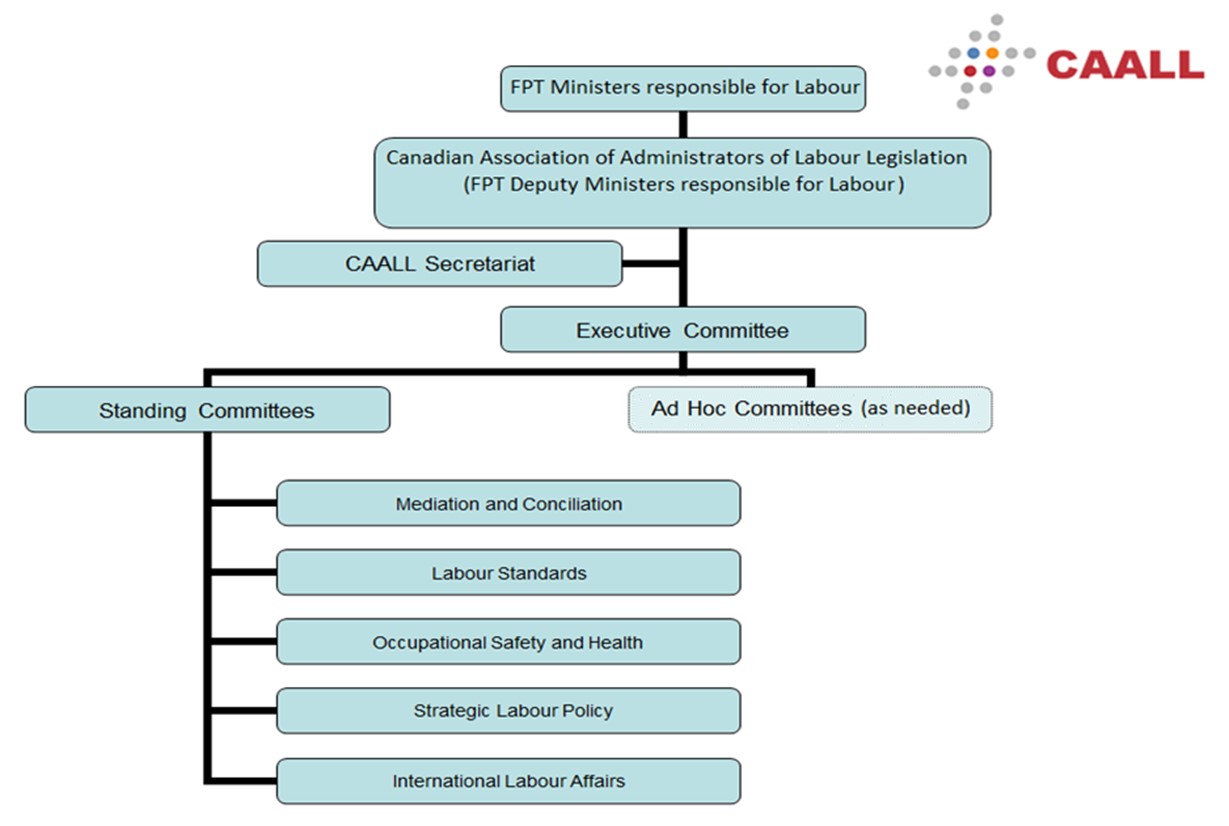
Text description of Figure 1
This diagram provides an overview of the FPT Structures of the CAALL. It is arranged as follows:
Level 1 – FPT Ministers responsible for Labour
Level 2 – Canadian Association of Administrators of Labour Legislation (FPT Deputy Ministers responsible for Labour)
Reports to the FPT Deputy Ministers responsible for Labour
- CAALL Secretariat
- Executive Committee
- Standing Committees
- Mediation and Conciliation
- Labour Standards
- Occupational Safety and Health
- Strategic Labour Policy
- International Labour Affairs
- Ad Hoc Committees (as needed)
- Standing Committees
Indigenous affairs
Both federal and provincial labour laws apply on Indigenous lands, depending on the nature of the employers’ activities. Recent court rulings have circumscribed the scope of federal jurisdiction related to Indigenous government employees on First Nations reserves to those engaged in administration and governance, thereby reducing the number of Indigenous employees falling under the mandate of the Minister of Labour.
Self-Government Agreements and Comprehensive Land Claims Agreements set out arrangements for Indigenous groups to govern their internal affairs and assume greater responsibility and control over decision-making that affects their communities. The Labour Program supports the Government of Canada in the negotiation of Self-Government Agreements.
Workplace information
Part of the Minister of Labour’s national mandate is the collection, analysis and dissemination of data and information on collective bargaining in Canada.
Wage adjustments: Data on major wage settlements for bargaining units with 500 or more employees in the federal, provincial and territorial jurisdictions are collected and published each month on Canada.ca. The data, broken down by month, quarter and year, covers all industries in both the public and private sectors. The annual average percentage increase in base-rate wages for the calendar year, resulting from major settlements negotiated in the private sector in Canada, is used to calculate the salary increases for Members of Parliament, in accordance with the Salaries Act. Wage data are also used by Statistics Canada, the Bank of Canada, the Department of Finance and Treasury Board Secretariat in the context of policy development, monitoring and/or decision making. Among major agreements under Part I of the Canada Labour Code, the average nominal wage increase was 3.5% in 2024.
Work stoppages: Data on strikes and lockouts across Canada are collected and updated monthly and made publicly available under Collective Bargaining Information on Canada.ca. The data includes the number of work stoppages, the number of workers directly involved in the stoppage and the number of person-days not worked. The data is also provided to the International Labour Organization. From 2015 to 2024, the number of work stoppages under Part I of the Code has averaged 10 per year, unchanged from the previous 10-year period, from 2005 to 2014.
Collective agreements: The Labour Program maintains the most comprehensive collection of collective agreements in Canada, with almost 50,000 agreements available to public, private, national and international stakeholders through the Labour Program’s online database, Negotech.
Labour organizations: The Labour Program conducts an annual survey of major labour organizations in Canada, including information on union membership, affiliations, mergers, and officials. Overall union coverage among employers under Part I of the Code was about 32% in 2024.
International mandate
Overview
The Minister of Labour’s mandate includes a number of important international responsibilities that aim to strengthen respect for internationally recognized labour standards. These activities contribute to the development and realization of Canada’s foreign and trade policy objectives. This is achieved through: the negotiation of international labour standards; participation in international labour forums; the negotiation and implementation of trade-related labour agreements and the provision of technical assistance to partner countries; and collaborating with a number of other federal departments to address exploitative labour practices in global supply chains, including working with the Canada Border Services Agency and Global Affairs Canada to strengthen the import prohibition on goods produced using forced labour.
International organizations: The Minister, with the support of the Labour Program, plays a lead role in the pursuit of international labour standards that reflect Canadian interests, and improved global working conditions. This work, principally occurring within the International Labour Organization (ILO) and the Inter-American Conference of Ministers of Labour (IACML), strengthens Canada’s support for the rules-based international system and allows Canada to play an important role in influencing global debates on labour and human rights.
Free trade agreements: Canada’s trade-related labour approach seeks to improve working conditions in partner countries, thus reducing competitive disadvantages faced by Canadian businesses and workers and strengthening domestic support for Canada’s trade agenda. In this regard, the Labour Program and Global Affairs Canada share the responsibility for the negotiation and implementation of labour provisions that promote and protect internationally recognized labour principles and rights, thus playing a key role in advancing the Government of Canada’s priority of strengthening our collaboration with reliable trading partners and allies around the world.
Labour capacity building: Technical assistance and cooperative activities enhance working conditions abroad. This is accomplished through a mix of funded, project-based work executed by third parties, and through the exchange of knowledge and expertise. Typical areas of focus include: modernization of labour policies; enforcement of national labour laws; and increased respect for internationally recognized labour rights and principles.
Supply chains and forced labour: In recent years, there has been growing concern over exploitative labour practices within global supply chains, which has resulted in stakeholders calling for stronger government legislative approaches. In response, Canada, similar to other like-minded countries, has implemented both supply chain transparency legislation (administered by Public Safety following Royal Assent of a Senate Public bill) and an import prohibition on goods produced using forced labour. Under the current import prohibition, the Canada Border Services Agency (CBSA) may use research and analysis from the Labour Program and other sources of information to identify goods entering Canada that are suspected to have been produced by forced labour. The Labour Program also collaborates with departments such as Global Affairs Canada, Public Services and Procurement Canada, and Public Safety Canada, among others, on this and many other initiatives across the federal government, aimed at upholding human rights, including labour rights.
International organizations
International Labour Organization
Established in 1919, the ILO is a specialized agency of the United Nations (UN) whose mandate is the promotion of social justice and internationally recognized human and labour rights. The organization is currently comprised of 187 member States, and has a unique "tripartite" structure, which brings together representatives of governments, employers, and workers from around the globe on an equal footing to address issues related to labour and social policy.
Based in Geneva, Switzerland, the ILO is composed of 3 bodies:
- the International Labour Conference (ILC), the ILO’s highest decision-making body, meets once a year (usually in June) during which delegates negotiate and adopt international labour standards, supervise the application of standards at the national level, and debate social and labour questions of global importance. The ILC is attended by many Heads of State and Ministers responsible for Labour. The Canadian Minister or Deputy Minister of Labour normally attends the Conference
- the Governing Body (GB), the organization’s executive branch, takes decisions on ILO policy, programs and budget and sets the Agenda of the ILC, and
- the International Labour Office (Office), the ILO’s permanent secretariat, supports the GB and the ILC, under the direction of the ILO Director-General
As a founding member of the ILO, Canada has long played an active and influential role in the Organization. During World War II, Canada provided a safe haven for the ILO Office at McGill University in Montreal.
Labour Program officials, in close collaboration with Global Affairs Canada colleagues both in Ottawa and at the Canadian Mission to the UN in Geneva, manage Canada’s participation in the ILO. Together, they promote Canadian interests and values at the Organization and represent Canada during the ILC, in the GB, and in other ILO-related meetings.
Canada is currently a regular member of the Governing Body (2024 to 2027).
Canada is also the permanent Chair of an informal grouping of 40 Industrialized Market Economy Countries (IMEC), which collectively contribute over 70% of the ILO’s budget and thus have a significant interest in ensuring the effective and efficient administration of the Organization. Chairing IMEC has been instrumental in advancing Canada’s priorities and interests at the ILO, especially those related to institutional and governance reform efforts.
While the federal government represents Canada at the ILO, most Canadian positions on ILO issues are developed in consultation with the provinces and territories given shared jurisdiction over labour matters under the Canadian Constitution. To facilitate those consultations, FPT Ministers responsible for labour have in place a FPT Strategy (which is generally revisited and renewed every 2 to 3 years) to help advance Canada’s interests at the ILO.
Given the tripartite nature of the ILO, Labour Program officials also work closely with the most representative Canadian employer and worker organizations (referred to as social partners): Federally Regulated Employers – Transportation and Communications (FETCO) and the Canadian Labour Congress (CLC). Canada sends tripartite delegations each year to the ILC in accordance with the ILO Constitution.
The ILO has a well-established supervisory system that monitors how ILO Member States implement the Conventions they ratify, identifies where difficulties or non-compliance may occur, and offers recommendations for improvements. Canada fully supports the ILO supervisory system, which it considers to be one of the most effective in the United Nations structure.
Other multilateral initiatives
In addition to the ILO, the Labour Program also leads or supports Canada’s participation in other international organizations, such as the Inter-American Conference of Ministers of Labour (IACML), various United Nations bodies, the Organization for Economic cooperation and Development (OECD), the G7, the G20, and other international initiatives.
Inter-American Conference of Ministers of Labour
Operating within the framework of the Organization of American States, the IACML is the main forum in the Americas for discussing labour and employment issues common to all countries in the hemisphere. The IACML, which includes all 35 independent states of the Americas (Cuba is not participating), aims to further hemispheric consensus on issues such as the promotion of decent work, the protection of workers’ rights, the strengthening of labour ministries, and the promotion of social dialogue.
The Minister of Labour or a senior official from the Labour Program represents Canada at the culminating ministerial conference, which takes place every 3 years. Ministers of Labour of the Americas adopt a Declaration and Plan of Action that guide the work of their respective labour ministry officials in collaboration with regional and international organizations, regional employers’ and workers’ representatives, and other key partners.
Equal Pay International Coalition
Organized by the ILO, the OECD and UN Women, Equal Pay International Coalition (EPIC) is a strategic partnership whose goal is to engage all relevant stakeholders (governments, private sector, non-governmental organizations, UN agencies and academia) to work together to make equal pay for work of equal value a reality.
The Government of Canada has been a founding member of EPIC since its launch in 2017 and became chair of the EPIC Steering Committee in 2022. As the Chair, Canada took key decisions on the governance processes of the coalition. In January 2025, Brazil took over the role of Chair of the Steering Committee and Canada took on the role of Vice-Chair. The Labour Program continues to participate in EPIC events, with a view to sharing best practices on equal pay and pay gap reporting. Along with the Government of Canada, the Canadian Labour Congress (CLC) and FETCO are also members of EPIC, making Canada the first country to have tripartite membership in the coalition.
Global Deal for Decent Work and Inclusive Growth
The Global Deal for Decent Work and Inclusive Growth (Global Deal) is a multi-stakeholder partnership launched in 2016 by Sweden and developed in cooperation with the OECD and the ILO. The objective of the Global Deal is to harness the potential of social dialogue as an instrument for promoting better quality jobs, fairer working conditions and more inclusive growth, in line with the UN 2030 Agenda. Canada supports the Global Deal initiative and there are now 148 partners to the initiative, including businesses, governments, trade unions and other associations around the world.
Canada has worked with the Global Deal Secretariat to share Canadian good practices, including the Future Skills Council and Equi’Vision, an employment equity tool to address pay gaps in Canada. In 2023, Canada, in partnership with the ILO Training Center provided training for Global Deal partners to learn about conciliation and mediation skills for preventing and resolving labour disputes.
Free trade agreements
Canada seeks to include labour provisions that promote and protect internationally recognized labour principles and rights in its free trade agreements (FTAs). In the past, Canada has also negotiated Labour Cooperation Agreements, which are essentially side agreements to FTAs. Whether in the form of labour chapters or side agreements, labour provisions seek to support a level playing field for Canadian workers and businesses, as well as a stable, predictable business environment and enhanced resilience within global supply chains.
Labour provisions generally commit countries that are signatories to enforce their domestic labour laws, which should in turn embody and provide protection for all 5 fundamental labour rights and principles: freedom of association and the effective recognition of the right to collective bargaining; the elimination of all forms of forced or compulsory labour; the effective abolition of child labour; the elimination of discrimination in respect of employment and occupation; and a safe and healthy working environment. Labour provisions of FTAs generally comprise additional commitments relating to acceptable conditions of work such as hours of work, as well as protections for migrant workers. Most of Canada’s FTAs include an enforceable dispute resolution mechanism, which may result, as a last recourse, in trade sanctions or, alternatively, in penalties to be paid by a government in violation of the agreement’s provisions.
The following Labour Cooperation Agreements are in force:
- Chile (1997)
- Costa Rica (2002)
- Peru (2009)
- Colombia (2011)
- Jordan (2012)
- Panama (2013)
- Honduras (2014)
Canada also has Labour Chapters in FTAs with:
- Korea (2015)
- Ukraine (2017, modernized in 2024)
- The European Union (provisional application since 2017)
- Israel (2019)
- United Kingdom (2021)
- 11 ratifying countries in the Asia-Pacific region under the Comprehensive and Progressive Agreement for Trans-Pacific Partnership (Australia, Brunei, Chile, Japan, Malaysia, Mexico, New Zealand, Peru, Singapore, the United Kingdom and Vietnam) (2018)
Although not yet in force, Canada has concluded the negotiation of FTAs with:
- Indonesia
- Ecuador
Canada is negotiating labour provisions in FTAs as follows:
- The Association of Southeast Asian Nations-Canada Free Trade Agreement (ACAFTA) negotiations launched in November 2021. The Association of Southeast Asian Nations (ASEAN) is a political and economic bloc composed of 11 countries (Brunei, Cambodia, Indonesia, Lao People's Democratic Republic, Malaysia, Myanmar, Philippines, Singapore, Thailand, Timor-Leste and Vietnam).
- Negotiations with the Philippines, Thailand, Mercosur (a south American trade bloc that includes Argentina, Brazil, Paraguay and Uruguay), India, and the United Arab Emirates are also expected to launch/resume in 2026.
Canada-United States-Mexico Agreement
In July 2020, the Canada-United States-Mexico Agreement (CUSMA), which includes a comprehensive and enforceable Labour chapter, entered into force. CUSMA also includes a bilateral Facility-Specific Rapid-Response Labour Mechanism (RRLM) between Canada and Mexico, which is an additional enforcement tool to address violations related to freedom of association and collective bargaining in covered facilities in Mexico. The United States and Mexico have a similar bilateral Facility-Specific RRLM under CUSMA. CUSMA also includes a shared obligation of CUSMA countries to prohibit the importation of goods produced using forced labour.
In line with CUSMA’s terms, the Parties reviewed the operation and effectiveness of the Labour chapter in December 2025, during the fifth year of the Agreement. Also in line with CUSMA’s terms, the review of CUSMA by Canada, the United States and Mexico is foreseen in 2026. To support the preparation for the joint review, Global Affairs Canada conducted public consultations from August to October 2024 and from September to November 2025.
On December 9 to10, 2025, ESDC-Labour and Global Affairs Canada (GAC) hosted the CUSMA Labour Council, welcoming senior representatives from trade and labour ministries of Canada, the United States and Mexico. Established under Article 23.14 of the CUSMA Labour Chapter, the Labour Council meets every 2 years and is mandated to oversee the implementation of obligations under the Chapter and to facilitate cooperative activities among the 3 Parties. The 2025 Labour Council agenda included a closed session among officials to discuss approaches to enforcing the forced labour import ban, the 5-year review of Chapter 23, and a series of bilateral meetings. The Labour Council further held a public session where civil society organizations shared perspectives. Public comments and questions focused on the CUSMA Dispute Settlement Chapter’s Rapid Response Labor Mechanism (RRLM), the forced labour import ban, and Mexico’s implementation of its 2019 labour reform.
Labour capacity building
As part of its work to effectively implement the labour chapters of FTAs with partner countries and to ensure enhanced commitment of these countries to promote and respect fundamental labour rights, the Labour Program provides technical assistance, through the International Trade and Labour (ITL) stream of the Labour Funding Program (a grants and contributions program), to support capacity building.
Through the ITL stream, technical assistance is provided in direct support of existing and future trade-related labour agreements. Capacity building projects funded by the Labour Program are implemented by reliable executing agencies (for example, international and regional organizations). Generally, these projects seek to create a level playing field by preventing unfair competition from low labour standards and lax enforcement of laws in other countries, allow the benefits of trade to be shared more widely, and help to garner support for free trade and trade diversification.
Projects are ongoing in several countries of the Americas and the Indo-Pacific. For example, in recent years, the ITL stream funded projects in:
- Colombia, to support efforts towards social dialogue around the reform of Colombia’s labour law, as well as enhance the capacities of labour and judiciary officials to protect international labour rights
- Southeast Asia, to improve the observance of fundamental labour rights and principles, particularly in export sectors. Activities are focused on capacity building and training in worker, industry and government organizations at the regional and country levels, and
- Mexico, to remove barriers and practices rooted in the country’s labour relations system that have prevented workers from exercising their rights to associate freely and bargain collectively. To do so, projects promote union democracy and raise awareness on the newly reformed labour law. In particular, the 2 project grants that were awarded to Canadian unions foster collaborations between Canadian and Mexican labour stakeholders, including unions and local grassroots organization
The International and Intergovernmental Labour Affairs Directorate of the Labour Program is responsible for administering the yearly ITL envelope of $6.4 million. It includes an ongoing annual funding of $1.2 million; $4.6 million per year (from fiscal year 2023 to 2024 to 2027 to 2028) for projects in Indo-Pacific countries; and $600,000 per year until fiscal year 2025 to 2026 earmarked towards technical assistance in selected Comprehensive and Progressive Agreement for Trans-Pacific Partnership partner countries.
Forced labour and supply chains
The Labour Program works closely with GAC, CBSA, and other implicated departments to advance work on forced labour across the federal government. For example:
- CBSA uses research from the Labour Program and other sources of information in its enforcement of Canada’s import ban on goods produced using forced labour
- GAC relies on Labour Program’s expertise in considering sanctions related to forced labour and other rights abuses and to assist its trade commissioners in assessing efforts of companies to address forced labour risks in their supply chains
- Finance Canada solicits Labour Program’s advice on labour rights issues, including forced labour, to inform policy directions related to surtaxes to address unfair trade practices, including state-imposed forced labour (for example, measures Canada imposed on electric vehicles, critical minerals and aluminum from China in 2024), and Finance’s consideration of multilateral development bank proposals
Labour Program portfolio organizations
Canada Industrial Relations Board
The Canada Industrial Relations Board (CIRB or the Board) is an independent, representational, quasi-judicial tribunal.
The Board’s original mandate was to contribute to, and promote, a harmonious industrial relations climate in federally regulated private-sector organizations under Part I of the Code. In that regard, the CIRB is responsible for the interpretation and application of the provisions of Part I of the Code related to:
- employer/employee status
- appropriate bargaining units
- certification and decertification of unions
- unfair labour practice complaints
- sales of business
- illegal strikes and lockouts, and
- maintenance of activities during a work stoppage, necessary to prevent immediate and serious danger to the safety or health of the public
Over the years its mandate has expanded to include the following responsibilities:
- under the Status of the Artist Act, the CIRB is responsible for the certification of artists’ associations that represent groups of self-employed artists and for resolving applications and complaints made under the act
- under Part II of the Code, the Board adjudicates work refusal complaints (appeals of decision of no danger as well as appeals of directions of ministerial delegates). The Board also hears complaints filed by employees alleging that their employers took reprisal actions against them for exercising their rights under the Code
- under Part III of the Code, the Board hears complaints of unjust dismissal, disputes over the payment of wages, and complaints brought by employees alleging that their employers took reprisal actions against them for seeking compliance with the Code’s provisions
- under Part IV of the Code, the CIRB is responsible for determining appeals of administrative monetary penalties and administrative review decisions issued against federal private sector employers by the Labour Program
- finally, the Board also hears appeals of claims under the Wage Earner Protection Program Act, a program which compensates workers for unpaid wages when their employer makes an assignment in bankruptcy
Various factors, such as the state of the economy and lifecycles of collective agreements, result in fluctuating workloads year to year. Fiscal year 2023 to 2024 saw slightly fewer cases than from the previous fiscal year, indicating that the Board’s workload has stabilized since its responsibilities expanded in 2019.
The Board received a total of 966 applications and complaints in the 2023 to 2024 fiscal year. Of these matters, 486 were filed under Part I of the Code, representing over 50% of all matters received during the year. Complaints under Part II of the Code represented 12% of the Board’s incoming caseload, and complaints under Part III of the Code, 37%.
Composition
The Code provides for the CIRB to be composed of 1 full-time neutral Chairperson, 2 or more full-time neutral Vice-Chairpersons, and not more than 6 full-time Members representing employers and employees in equal numbers.
Part-time Vice-Chairpersons and Members may also be appointed to the CIRB. The Chairperson and Vice-Chairpersons of the CIRB must have experience and expertise in labour relations.
The Board is currently composed of the following appointees:
- Chairperson: Maryse Tremblay was appointed as Chairperson on May 1, 2025
- 7 full-time Vice-Chairpersons:
- Sylvie Guilbert, term ending July 1, 2029
- Roland Hackl, term ending July 1, 2029
- Jennifer Webster, term ending October 14, 2029
- Natalie Zawadowsky, term ending October 8, 2030
- Lindsay Foley, term ending October 8, 2030
- Dominic Lemieux, term ending October 8, 2030
- William Hlibchuk, term ending October 22, 2030
- 3 employer representative Members:
- Richard Brabander, term ending December 21, 2026 (full-time Member)
- Elizabeth Cameron, term ending January 3, 2027 (full-time Member)
- Barbara Mittleman, term ending December 20, 2026 (part-time Member)
- 3 employee representative Members:
- Lisa Addario, term ending June 24, 2027 (full-time Member)
- Daniel Thimineur, term ending May 10, 2027 (full-time Member)
- Paul Moist, term ending December 20, 2026 (part-time Member)
In accordance with subsection 12(2) of the Code, Members whose terms expire may, at the request of the Chairperson, continue to complete the duties assigned to them during their active term.
In addition, the Chairperson has the statutory authority to appoint external adjudicators to determine matters under Parts II, III or IV of the Code.
Minister’s role
In accordance with the Code, the Board reports to Parliament through the Minister of Labour. The Minister is responsible for recommending the appointment of the Chairperson and Vice-Chairpersons of the Board to the Governor in Council. The representative Members are also appointed by the Governor in Council on the Minister’s recommendation, after consulting federal employer and employee organizations. These organizations are represented by the Federally Regulated Employers-Transportation and Communications and the Canadian Labour Congress.
Under the Code, the Minister has the authority to refer any question on maintenance of activities to the Board if there is concern that a work stoppage could threaten the health or safety of the public. In the interest of promoting industrial peace, the Minister also has authority to refer any question to the Board or direct it to do such things as the Minister deems necessary.
Canadian Centre for Occupational Health and Safety
The Canadian Centre for Occupational Health and Safety (CCOHS) is a federal government departmental corporation that reports to Parliament through the Minister of Labour.
The mandate of CCOHS is to promote workplace health and safety and the physical and mental health of working people in Canada.
To fulfill its mandate, CCOHS collaborates with Canadian and international partners, researchers and stakeholders. It is a recognized leader in providing effective programs, products and services, which are based on the CCOHS’ knowledge base and core competencies; collection of occupational health and safety information; and application of information management technologies.
More specifically, CCOHS provides information and knowledge transfer services including a widely referenced online collection of over 700 fact sheets on a range of health and safety topics. In fiscal year 2024 to 2025, 4.6 million users visited the collection 6.5 million times. CCOHS also offers e-courses, cost-effective tools and management systems for improving occupational health and safety performance, and injury and illness prevention initiatives that promote the safety and health, physical, psychological, and total well-being of workers.
In 2024, CCOHS launched the Business Safety Portal, which offers an accessible and low-cost solution for business owners to understand and help meet their occupational health and safety responsibilities to protect workers from injuries and illnesses. CCOHS partnered with Ontario’s Workplace Safety and Insurance Board (WSIB) to provide WSIB-registered businesses with access to the portal, and is working with other jurisdictions who have expressed interest in a similar arrangement.
CCOHS works closely with the safety community to respond to emerging issues and support ongoing occupational health and safety projects. For example, CCOHS developed online courses and resources to help workplaces operate safely during the COVID-19 pandemic.
CCOHS supports Canadian Association of Administrators of Labour Legislation (CAALL)’s priority to improve mental health in the workplace, notably through the sharing of best practices and tools. Additionally, CCOHS conducted a jurisdictional scan of workplace mental health tools offered by various organizations for the CAALL Strategic Labour Policy Committee. The aim of the scan was to identify tools that provide tangible improvements in workplace mental health that could lead to a pan-Canadian approach to these programs.
CCOHS also serves as the secretariat for the Occupational Safety and Health Committee of CAALL. In this role, CCOHS is supporting the committee’s work towards harmonization or recognition of occupational health and safety standards across the country. This will remove barriers to labour mobility and contribute to building 1 Canadian economy while maintaining high health and safety standards and practices.
To support the Work Place Harassment and Violence Prevention Regulations, CCOHS maintains the Registry of Investigators, developed by the Labour Program, on its website, which is available to employers who require a qualified, professional investigator to investigate and address occurrences of workplace harassment and violence. CCOHS also worked closely with the Canada School of Public Service (CSPS) on developing e-learning modules on workplace harassment and violence in the federal jurisdiction. This training is available to all federal public service employees through CSPS’ website.
CCOHS has also established international partnerships to advance occupational health and safety globally and to stay current on international good practices applicable to workers and workplaces in Canada. In particular, CCOHS is a Canadian collaborating centre with the Pan-American Health Organization, a specialized health agency of the World Health Organization.
Composition
CCOHS is located in Hamilton, Ontario, and was established in 1978 by the Canadian Centre for Occupational Health and Safety Act, which was passed by unanimous vote in the Canadian Parliament. CCOHS has developed a national and international reputation for excellence as a source of unbiased and credible information on all aspects of workplace health and safety. The CCOHS workforce is approximately 100 employees.
CCOHS is governed by a Council representing 3 key stakeholder groups: governments (federal, provincial and territorial), employer representatives and employee representatives. The 22 members (chair included) of the Council are appointed by the Governor in Council on the recommendation of the Minister of Labour.
The President and CEO is also appointed by the Governor in Council on the recommendation of the Minister of Labour, but is not a member of the Council. Anne Tennier was re-appointed as President and CEO for a 5-year period in April 2023.
The Council is currently composed of the following appointees:
Brenda Baxter, Assistant Deputy Minister of the Labour Program, was appointed as Chairperson of the Council, for a term of 5 years, effective June 24, 2022.
Employee Representatives:
- Jenna Brookfield, Canadian Union of Public Employees, term ending June 19, 2026
- Julie Hébert, United Steelworkers, term ending September 24, 2027
- Tara Peel, Canadian Labour Congress, term ending November 30, 2027
Employer Representatives:
- Amir Raza, FedEx Canada, term ending December 14, 2026
- Giselle Lue, Jazz Aviation LP, term ending March 6, 2029
- Shayne Daum, British Columbia Maritime Employers Association, term ending September 4, 2029
- Ahmed Elmezughi, Canadian National Railway Company, term ending September 4, 2029
Province/Territory Representatives:
- Gail Boland, Newfoundland and Labrador, term ending June 19, 2026
- Myles Morris, Alberta, term ending December 14, 2026
- David Kramer, Manitoba, term ending November 30, 2027
- Kevin Mooney, Saskatchewan, term ending October 10, 2028
- Daniel Campbell, Prince Edward Island, term ending October 10, 2028
- Todd McDonald, British Columbia, term ending October 10, 2028
- Rick Hunt, Nunavut, term ending January 23, 2029
- Kelly Arychuk, Northwest Territories, term ending December 11, 2029
There are 5 vacancies on the CCOHS Council of Governors for provinces and territories, and 1 employee vacancy, which are in the process of being filled:
- New Brunswick
- Nova Scotia
- Ontario
- Québec (in May 2024, the Government of Québec confirmed that they will not be providing a nomination for the Council)
- Yukon
- Employee representative
Minister’s role
The Council is required to submit an annual report on the activities and work of the Centre to the federal Minister of Labour. The Minister tables the report to Parliament on behalf of the CCOHS Council of Governors. CCOHS is also required to submit several other reports throughout the year, which are also tabled in Parliament by the Minister on behalf of CCOHS.
Corporate Briefing Binder
Deputy Minister of Labour - January 2026
Labour Program Overview
Labour Program “Plans at a Glance”
Workforce and Resources
Labour Program Employees by Fiscal Year
- For Fiscal Year 2023 to 2024, 878 employees
- For Fiscal Year 2024 to 2025, 911 employees
- For Fiscal Year 2025 to 2026, 831 employees (as of December 31, 2025).
Labour Program Budget by Fiscal Year
- For Fiscal Year 2023 to 2024, $62,619,909 in salary, $10,451,480 in non-salary for a total of $73,071,389.
- For Fiscal Year 2024 to 2025, $78,598,117 in salary, $11,180,283 in non-salary for a total of $89,778,400.
- For Fiscal Year 2025 to 2026, $69,927,137 in salary, $9,403,578 in non-salary for a total of $79,330,715.
Budget 2025: Labour Program Highlights
Budget 2025, released in November 2025, includes initiatives and proposed investments relevant to the Labour Program:
- $17 million over 3 years, starting in 2027 to 2028, to amend the Employment Insurance Act. This change will allow parents receiving Employment Insurance parental benefits to access an additional 8 weeks of support
- Examine an increase in penalties to ensure workers are protected and compensated for the work they perform, with consultations planned in 2026
- Amendments to the Canada Labour Code to restrict the use of non-compete agreements in employment contracts for federally regulated businesses, with consultations for early 2026
- Amendments to the Income Tax Act and the Excise Tax Act to allow the Canada Revenue Agency to share information with ESDC for the purpose of addressing worker misclassification
Key Priorities by Programs
Workplace Equity
- Introduce measures to improve compliance with the Employment Equity Act for federally regulated employers
- Develop strategies to encourage voluntary participation in self-identification surveys
- Integrate AI into Equi’Vision to improve insights, accuracy, reporting, and transparency in employment equity results
Occupational Health and Safety
- Reduce regulatory red tape and streamline regulatory processes, aligning related regulations while maintaining worker protections
- Provide a regulatory framework that benefits all workers in the federal jurisdiction
- Advance harmonization of occupational health and safety regulations with provinces and territories to improve labour mobility and remove barriers
- Advance a 5-year review of the harassment and violence prevention regime under the Code
Labour Standards
- Reduce regulatory red tape and streamline regulatory processes, aligning related regulations while maintaining worker protections
- Work on amendments to the Canada Labour Code to restrict the use of non-compete agreements in employment contracts for federally regulated businesses, with consultations planned for early 2026
- Work with the Canada Revenue Agency (CRA) to amend the information-sharing agreement and receive information from CRA for the purposes of the administration and enforcement of the Canada Labour Code as it relates to the misclassification of workers
- Continue the education and enforcement actions to enforce workers are protected from misclassification
- Continue efforts to reduce the complaint backlog
- Review the Administrative Monetary Penalties regime under the Canada Labour Code and prepare stakeholder engagement on potential changes, expected in 2026
International Labour Affairs
- Promote the advancement of international labour standards and the fundamental principles and rights at work by working through the UN and other international organizations, as well as negotiating labour provisions in Canada’s Free Trade Agreements.
Labour Relations
- Support cooperative labour relations in the federally regulated private sector
- Share information with Canada Revenue Agency for the purpose of addressing worker misclassification
Wage Earner Protection Program
- Work with stakeholders to raise awareness of the Wage Earner Protection Program (WEPP) and provide timely payments to eligible workers in Canada
- Develop a policy framework to mitigate adverse impacts and address operational challenges associated with Reverse Vesting Orders
Federal Workers’ Compensation
- Advance the work on the modernization of the federal workers’ compensation regime by securing additional costing information and refining the policy options, in collaboration with a dedicated ADM Working Group
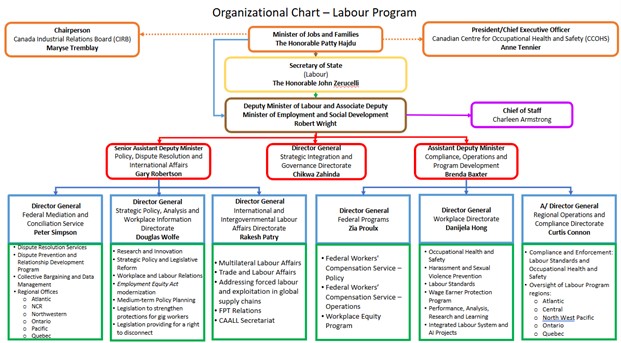
Text description of Figure 2:
Organizational Chart – Labour Program
Minister of Jobs and Families: The Honourable Patty Hajdu
Two roles are shown as connected to the Minister of Jobs and Families but outside the main reporting hierarchy:
- Chairperson, Canada Industrial Relations Board (CIRB): Maryse Tremblay
- President and Chief Executive Officer, Canadian Centre for Occupational Health and Safety (CCOHS): Anne Tennier
Secretary of State (Labour)
- The Honourable John Zerucelli
Deputy Minister of Labour and Associate Deputy Minister of Employment and Social Development:
- Robert Wright
- Chief of Staff: Charleen Armstrong
The Deputy Minister oversees all senior officials listed below.
- Senior Assistant Deputy Minister, Policy, Dispute Resolution and International Affairs: Gary Robertson
This branch includes 3 Directors General:
- Director General, Federal Mediation and Conciliation Service: Peter Simpson. Responsible for:
- Dispute Resolution Service
- Dispute Prevention and Relationship Development Program
- Collective Bargaining and Data Managment
- Regional Offices for Atlantic, NCR, Northwestern, Ontario, Pacific, and Quebec
- Director General, Strategic Policy, Analysis and Workplace Information Directorate: Douglas Wolfe. Responsible for:
- Research and Innovation
- Strategic Policy and Legislative Reform
- Workplace and Labour Relations
- Employment Equity Act modernization
- Medium-term Policy Planning
- Legislation to strengthen protections for gig workers
- Legislation providing for a right to disconnect
- Director General, International and Intergovernmental Labour Affairs Directorate: Rakesh Patry. Responsible for:
- Multilateral Labour Affairs
- Trade and Labour Affairs
- Addressing forced labour and exploitation in global supply chains
- FPT Relations
- CAALL Secretariat
- Director General, Strategic Integration and Governance Directorate: Chizwa Zahinda.
- Assistant Deputy Minister, Compliance, Operations and Program Development: Brenda Baxter
- This branch includes 3 Directors General:
- Director General, Federal Programs: Zia Proulx. Responsible for:
- Federal Workers’ Compensation Service, Policy
- Federal Workers’ Compensation Service, Operations
- Workplace Equity Program
- Director General, Workplace Directorate: Danijela Hong. Responsible for:
- Occupational Health and Safety
- Harassment and Sexual Violence Prevention
- Labour Standards
- Wage Earner Protection Program
- Performance, Analysis, Research and Learning
- Integrated Labour System and AI Projects
- Acting Director General, Regional Operations and Compliance Directorate: Curtis Cameron. Responsible for:
- Compliance and Enforcement: Labour Standards and Occupational Health and Safety
- Oversight of Labour Program regions: Atlantic, Central, Northwest Pacific, Ontario, Quebec
Roles and Responsibilities
The Labour Program is led by the Deputy Minister of Labour and Associate Deputy Minister of Employment and Social Development. Day-to-day operations are managed by the Senior Assistant Deputy Minister (SADM) of Policy, Dispute Resolution, and International Affairs (PDRIA) and the Assistant Deputy Minister (ADM) of Compliance, Operations, and Program Development (COPD). They are supported by the Director General of the Strategic Integration and Governance (SIG) Directorate, which provides a single window for corporate services. All three positions report directly to the Deputy Minister of Labour and Associate Deputy Minister of Employment and Social Development.
Policy, Dispute Resolution, and International Affairs (PDRIA)
Senior Assistant Deputy Minister: Gary Robertson
- Manages relationships between international and federal/provincial/territorial partners, unions and employers
- Connects with stakeholders and partners on broad labour policy issues
- Evaluates how changing social, economic and international conditions will impact labour legislation, policies and activities.
Strategic Policy, Analysis and Workplace Information Directorate
Director General: Douglas Wolfe
- The Strategic Policy, Analysis, and Workplace Information Directorate (link to the intranet) (SPAWID) conducts research and analysis on labour and workplace issues and provides strategic policy advice to address these issues;
Federal Mediation and Conciliation Service
Director General: Peter Simpson
- The Federal Mediation and Conciliation Service (link to the intranet) (FMCS) deals with industrial relations, the settlement of labour disputes, and the administration of Part I of the Canada Labour Code;
International Labour Affairs Directorate
Director General: Rakesh Patry
- The International and Intergovernmental Labour Affairs Directorate (link to the intranet) (IILA) promotes the negotiation, development and enforcement of internationally recognized labour principles, and fosters cooperation and coordination on labour issues between national, provincial, territorial governments.
Compliance, Operations and Program Development (COPD)
Assistant Deputy Minister: Brenda Baxter
- Provides advice and guidance for operational policy development, implementation and compliance for workplace health and safety, labour standards, employment equity, federal workers compensation programming
- Ensures that the regions apply operational programs consistently
- Updates services to improve accountability, results and performance along Labour Program business lines
- On January 1, 2021, the Assistant Deputy Minister (ADM) assumed the role of the Head of Compliance and Enforcement (HOCE) for the Labour Program. The ADM will exercise the powers, duties and functions related to the day-to-day administration and enforcement of Parts II, III and IV (Administrative Monetary Penalties) of the Code.
- Responsible for legislative and regulatory policy for the Wage Earner Protection Program Act (WEPPA) and its regulations. Labour Program also provides operational policy guidance to Service Canada, who acts as a service delivery partner, and maintains relationships with key stakeholders of the insolvency community and federal government partners.
Federal Programs Directorate
Director General: Zia Proulx
- The Federal Programs Directorate (link to the intranet) is responsible for the development of policy, regulations and national guidelines for:
- Federal Workers' Compensation Service (FWCS) (link to the intranet)
- Government Employees Compensation Act (GECA) (link to the intranet)
- Employment Equity Program (EEP) (link to the intranet)
Regional Operations and Compliance Directorate (ROC)
Acting Director General: Curtis Connon
- The Regional Operations and Compliance directorate (link to the intranet) is responsible for the compliance and enforcement of Part II – Occupational Health and Safety (OHS) and Part III – Labour Standards (LS), of the Code across federally regulated workplaces. It is comprised of 5 regions: North West Pacific, Central, Ontario, Quebec, and Atlantic. In addition, the National Operations Division in Headquarters provides program coordination across Canada to ensure consistency in service delivery.
Workplace Directorate (WD)
Director General: Danijela Hong
- The Workplace Directorate's (link to the intranet) (WD) functional model supports program design and delivery and enables the provision of program guidance and policy interpretation with respect to regulatory development and compliance activities under the Canada Labour Code, Part II and Part III, and the administration of the Wage Earner Protection Program Act.
Strategic Integration and Governance Directorate (SIG)
Director General: Chikwa Zahinda
- Provides a single window for corporate support to the Deputy Minister of Labour, the SADM of PDRIA, and the ADM of COPD.
- Leads Labour Program-wide corporate activities and horizontal initiatives to ensure a strategic and integrated approach across various files, including emergency management and business continuity, planning and reporting, project management, intranet presence, information management, engagement design and delivery, governance committee support, learning, liaison functions related to Access to Information and Privacy, and accommodations.
Governance Structures
ESDC Governance Structure
Deputy Level Governance
As a member of the Deputy community, the Deputy Minister of Labour is invited to Deputy Ministers’ Breakfast meetings. All DMs and Associate DMs are members, and the Clerk uses this weekly/biweekly forum to debrief on Government/Cabinet priorities, promote government-wide initiatives and profile major files. Many DMs also use these meetings to informally advance bilateral business.
In addition, the Deputy Minister of Labour is asked to participate in a various government-wide committees primarily led by PCO or TBS, as well as to serve as Champion for a specific community or issue.
Committee membership and Champion roles are partly dictated by current mandate, background and future development needs and is managed by PCO Senior Personnel, the Coordinating Committee of Deputy Ministers (senior DM table) and the Clerk.
ESDC Tiered Governance Structure
The Deputy Minister (DM) of Labour is a key member of ESDC’s senior management team and tiered governance structure. The DM of Labour is one of three individuals commonly referred to within the department as ‘the Deputies’: the Deputy Minister of ESDC (Paul Thompson); the Associate Deputy Minister of ESDC and Chief Operating Officer for Service Canada (Cliff Groen), and yourself as Deputy Minister of Labour.
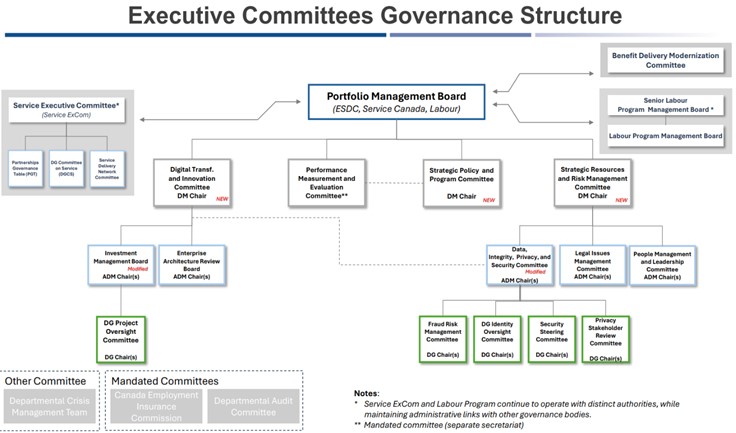
Text description of Figure 3:
(source - (link to the intranet))
Figure 3. Executive Committees Governance Structure
At the center is the Portfolio Management Board (ESDC, Service Canada, Labour):
- it receives arrows from both the right‑side committees:
- Benefit Delivery Modernization Committee
- Senior Labour Program Management Board, and
- Labour Program Management Board
- and the left‑side:
- Service Executive Committee
- Inside the box Service Executive Committee, 3 items are listed:
- Partnerships Governance Tables (PGT)
- DG Committees on Service (DGCS), and
- Service Delivery Network Committee
- Inside the box Service Executive Committee, 3 items are listed:
- Service Executive Committee
Directly beneath the central Portfolio Management Board are 4 horizontally aligned committees:
- Digital Transformation and Innovation Committee (DM Chair and marked as new)
- Performance Measurement and Evaluation Committee (DM Chair)
- Strategic Policy and Program Committee (DM Chair and marked as new), and
- Strategic Resources and Risk‑Management Committee (DM Chair and marked as new)
Under the second row, several boards and committees appear:
- Beneath Digital Transformation and Innovation Committee, there are 2 ADM chaired committees:
- Investment Management Board (Marked as modified) and
- Enterprise Architecture Review Board
On a third row is a GD level committee which falls under the Investment Management Board on a third row:
- DG Project Oversight Committee
Beneath the Strategic Resources & Risk Management Committee, there are 3 ADM chaired committees:
- Data, Integrity, Privacy, and Security Committee (marked as modified)
- Legal Issues Management Committee
- People Management and Leadership Committee
On the third row, under the Data, Integrity, Privacy, and Security Committee there are DG-level committees:
- Fraud Risk Management Committee
- GC Identity Oversight Committee
- Security Steering Committee
- Privacy Stakeholder Committee
At the bottom, 2 separate boxes list other committees:
- the Departmental Crisis Management Team
- the Canada Employment Insurance Commission, and
- the Departmental Audit Committee
Notes indicate that Service ExCom and Labour Program continue to operate with distinct authorities while maintaining administrative links with other governance bodies and that the Performance Measurement and Evaluation committee has a separate secretariat.
Tier 1 Committees – DM Level
The Deputy Minister of Labour is required to participate in the following Steering Committee and key Tier 1 portfolio-wide governance committees.
Portfolio Management Board (PMB (link to the intranet))
Chair: Deputy Minister (DM) of Employment and Social Development Canada (ESDC)
Members: DM Labour, COO Service Canada (SC), Associate DM ESDC, Business Lead, BDM, Portfolio wide ADMs including ESDC, SC and Labour
Frequency: Biweekly
Mandate: PMB is the main direction-setting and decision-making body for the ESDC, Labour Program, and Service Canada portfolio. Determines the vision, priorities and strategies of the organization; sets the tone for ethical and responsible decision-making; enables accountability, integrity, stewardship and transparency; and fosters leadership, information sharing, consultation and collaboration at the DM and ADM levels.
Digital Transformation and Innovation Committee (DTIC (link to the intranet)):
Chair: DM of ESDC
Members: All DMs
Frequency: Every 3 weeks
Mandate: The Committee provides strategic leadership in shaping and advancing the organization’s transformation and innovation agenda. The Committee is responsible for overseeing the implementation of the Comprehensive Expenditure Review (CER) focused on efficiencies, while also directing and aligning strategic investments with mission-critical priorities. Its mandate includes ensuring that people and financial resources are allocated to initiatives with the greatest potential to deliver high-impact outcomes in support of the departmental mandate, prioritizing efficiency, effectiveness, and return on investment.
Performance Measurement and Evaluation Committee (PMEC (link to the intranet))
Chair: Senior Associate Deputy Minister of Employment and Social Development
Members: Senior Advisor to the Deputy Minister; Senior Assistant Deputy Minister, Policy, Dispute Resolution and International Affairs, Labour Program; Associate Assistant Deputy Minister, Income Security and Social Development Branch; Assistant Deputy Minister, Learning Branch; Senior Assistant Deputy Minister, Public Affairs and Stakeholder Relations Branch; Assistant Deputy Minister, Program Operations Branch; Senior Assistant Deputy Minister, Skills and Employment Branch; Associate Assistant Deputy Minister, Strategic and Service Policy Branch; Assistant Deputy Minister, Ontario Region; Chief Audit Executive and Chief Risk Officer; Chief Data Officer; Chief Information Officer; Director General, Evaluation Directorate, Strategic and Service Policy Branch (Head of Evaluation); Director General, Corporate Planning and Management, Strategic and Service Policy Branch (Head of Performance Measurement)
Frequency: Bimonthly
Mandate: The Performance Measurement and Evaluation Committee (PMEC) serves as an advisory body to the Deputy Minister on matters relating to the department’s performance and evaluation activities. PMEC reviews and advises on the Departmental Results Framework, Program Inventory and related Performance Information Profiles as well as on departmental evaluation planning and activities including final evaluation reports and other evaluation-related activities of the Department.
Strategic Policy and Program Committees (SPPC) (link to the intranet) :
Chair: DM of ESDC
Members: All DMs
Frequency: Every 3 weeks
Mandate: The Committee sets the organization’s policy and program agenda. It provides a forum for strategic dialogue on emerging and ongoing policy and program priorities. The Committee ensures alignment with ministerial mandates, fosters innovation, and strengthens horizontal integration across the portfolio. It also leads the development of federal/provincial/territorial (FPT), international, and stakeholder engagement strategies. The Committee oversees the implementation of the Comprehensive Expenditure Review (CER) related to Grants and Contributions and directs the development and implementation of the placemat on ministerial priorities. Its role is to ensure that policies and programs, along with the services delivered to Canadians are evidence-based and provide measurable value and align with government priorities.
Strategic Resources and Risk Management Committee (SRRMC (link to the intranet)):
Chair: DM of ESDC
Members: All DMs
Frequency: Every 3 weeks
Mandate: The Committee provides strategic oversight of financial and workforce management, ensuring that resources are effectively allocated and utilized to advance the organization’s priorities.
The Committee oversees the operationalization of the Comprehensive Expenditure Review (CER) process, including the review of the CER implementation related to Vote 1. It is responsible for monitoring the organization’s risk landscape and ensuring that robust mitigation strategies are in place to protect operational continuity and ensure compliance with applicable standards. The Committee also ensures that the necessary frameworks, systems, and processes are in place to uphold legal, privacy, and security obligations. In addition, the Committee oversees the implementation of audit recommendations and management action plans and directs the development and execution of key organizational strategies and plans—including those related to the Expenditure Review, the Workforce Strategy, the Strategic Planning exercise and enterprise risk mitigation—ensuring a coordinated, forward-looking approach to resource stewardship aimed at supporting financial sustainability and risk management.
Tier 2 Committees – ADM Level
Investment Management Board (IMB (link to the intranet) under ESDC review)
Co-Chairs: Chief Financial Officer (CFO)/ Senior Designated Official (SDO); Senior Assistant Deputy Minister, Temporary Foreign Worker Program
Members: Some ADMs
Frequency: Biweekly
Mandate: The MPIB is a standing committee of the PMB. It enforces rigorous and transparent investment planning, investment management, project and programme management and ensure the realization of expected benefits in line with the departmental strategic directions and the delivery of key PMB priorities.
Enterprise Architecture Review Board (EARB (link to the intranet))
Co-Chairs: Chief Information Officer, Sr Assistant Deputy Minister, Strategic and Service Policy Branch
Members: ADMs and DGs
Frequency: Biweekly
Mandate: The Enterprise Architecture Review Board (EARB) acts as Employment and Social Development Canada’s (ESDC) oversight and decision-making committee on Enterprise Architecture (EA).
Data, Integrity, Privacy and Security Committee (DIPSC (link to the intranet) under ESDC review)
Chair: ADM Level
Members: under ESDC review
Frequency: Every 6 weeks
Mandate: DPC is a sub-committee of the EMC with a mandate to provide oversight on the management of personal information entrusted to the Department, as well as the stewardship and management of enterprise data resources. (mandate under ESDC review)
Legal Issues Management Committee (LIMC (link to the intranet) – pending ESDC Approval)
Co-Chairs: Uléhla, Boris – Senior General Counsel, Triggs, Mary Ann – ADM, Ontario Region
Members: A list of members can be found in the Terms of Reference (link to the intranet)
Frequency: Monthly
Mandate: The Legal Issues Management Committee (LIMC) is a Tier 2 executive Committee that acts as a centralized forum to discuss and manage legal issues/risks and litigation files for the Employment and Social Development Canada portfolio, which includes the Labour Program and Service Canada (ESDC Portfolio). LIMC topics and updates are shared at Portfolio Management Board (PMB) which is a Tier 1 executive committee and the main direction-setting and decision-making body for the ESDC Portfolio.
People Management and Leadership Committee (PMLC (link to the intranet))
Co-Chairs: ADM Human Resources Services and ADM Quebec Region
Members: All ESDC Assistant Deputy Ministers; Deputy Minister of Labour and Associate Deputy Minister of Employment and Social Development; Senior General Counsel, Legal Services; Chief Audit Executive; Chairpersons of the OLSC (when required); Chairpersons of the DG SHRC (when required); and Chairpersons of the SCFW (when required)
Frequency: Biweekly
Mandate: PMLC is a standing committee of the PMB, oversees key people management issues that influence the broader ESDC portfolio, including the management of the executive cadre within ESDC.
Tier 3 Committees – DG Level
- DG Project Oversight Committee
- Fraud Risk Management Committee
- DG Identity Oversight Committee
- Security Steering Committee
- Privacy Stakeholder Review Committee
Mandated Committees
Your participation will be sought to attend the Canada Employment Insurance Commission as an ex-officio member:
Canada Employment Insurance Commission (CEIC)
Chair: DM of ESDC and Co-Chair, COO
Members: The Commissioner for Workers and the Commissioner for Employers
Frequency: Monthly
Mandate: The CEIC plays a leadership role, with Employment and Social Development Canada (ESDC), in overseeing the Employment Insurance (EI) program. For more than 75 years, this tripartite organization has included representation from business, labour and the Government of Canada.
Your participation will be sought to attend the following mandated committees as an ex-officio member:
Departmental Audit Committee (DAC)
Chair: DM of ESDC
Members: At least 3 independent, external members recruited from outside of the federal public administration and 5 ex-officio members: DM of Labour; Senior Associate DM of ESDC and COO for Service Canada; Associate DM of ESDC; Chief Financial Officer; and Chief Audit Executive.
Frequency: Quarterly
Mandate: Provides objective advice and recommendations to the DM regarding the adequacy and functioning of the Department's frameworks and processes for risk management, control, and governance.
Labour Program Governance Structure
The Labour Program has an internal governance structure designed to support decision-making, information sharing and horizontal collaboration. This governance model has proven effective and successful in building a strong and collaborative senior management team.
The Labour Program Management Board (LPMB) and the Senior Labour Program Management Board (SrLPMB) are the main senior management tables for the DM of Labour.
In addition, the Labour Program maintains several specialized committees.
- The Labour Program Policy and Program Committee (PPC), chaired by the SADM of PDRIA, provides a forum for policy-related discussions.
- The Labour Program People Management Committee (LP PMC), co-chaired alternatively by the ADM of COPD and the SADM of PDRIA, focuses on workforce management.
- The Diversity and Inclusion Management Committee, chaired by the DM of Labour, provides leadership and strategic direction on diversity and inclusion across the Labour Program. Consideration is currently being given to amalgamating this committee with the People Management Committee.
- The Labour Program Union-Management Consultation Committee, co-chaired by a senior union representative and the ADM of COPD, supports ongoing labour management dialogue. The committee is currently suspended.
- The Crisis Management Committee, chaired by the SADM of PDRIA, works with the DG of SIG to manage emergency situations that impact internal operations.
The ADM of COPD and the SADM of PDRIA also lead their own management tables:
- The Branch Executive Committee (COPD-BEC) comprising the ADM of COPD, DGs and Directors.
- The Branch Management Meeting (PDRIA-BMC); comprising the SADM of COPD, DGs and Directors.
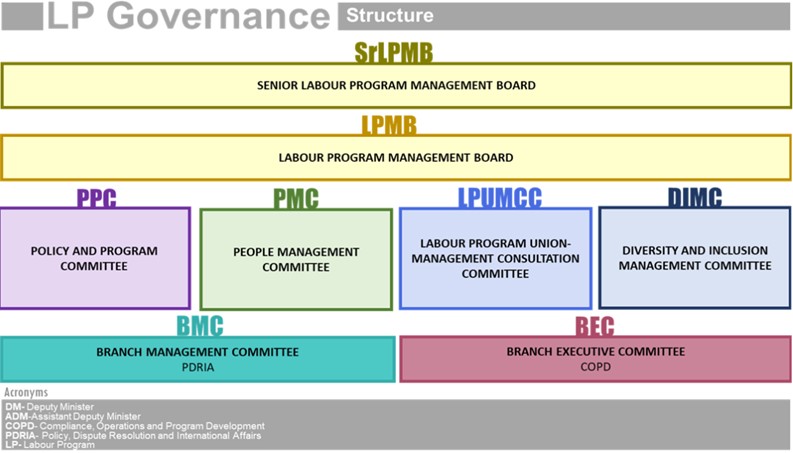
Text description of Figure 4:
Labour Program Governance Structure
First Tier
- Senior Labour Program Management Board (SrLPMB)
- Labour Program Management Board (LPMB)
Second Tier
- Policy and Program Committee (PPC)
- People Management Committee (PMC)
- Diversity and Inclusion Management Committee (DIMC)
- Labour Program Union-Management Consultation Committee (LPUMCC)
Third Tier
- Branch Management Committee (BMC)
- Branch Executive Committee (BEC)
Senior Labour Program Management Board (SrLPMB)
Chair: DM of Labour
Members: ADM-COPD; ADM-PDRIA; DG-SIG; and Chief of Staff to DM of Labour
Frequency: Committee meets biweekly
Mandate: Provides a forum for the DM’s direct reports to bring various LP key files and initiatives, principally of a corporate management or administrative nature, for direction and pulse check, often prior to being brought to other LP governance committees for information, discussion or decision.
Labour Program Management Board (LPMB)
Chair: DM of Labour
Members: ADM-COPD; ADM-PDRIA; all seven LP DGs; Chief of Staff to DM of Labour; Senior Advisor to the LP DM; senior representatives from the Chief Financial Officer Branch, the Public Affairs and Stakeholder Relations Branch and Legal Services.
Frequency: Committee meets every Monday
Mandate: Acts as the main Governance forum for the Labour Program by providing a setting for:
- information sharing, consultation and collaboration
- debate and advice on corporate and administrative management issues
- medium- and longer-term planning and innovation, key projects, important proposals, and review of key milestones
- coherence and effectiveness of the Labour Program within Employment and Social Development Canada
LPMB also serves as the Labour Program’s Crisis Management Committee.
Labour Program People Management Committee (LP PMC)
Co-Chairs: Alternating ADMs of Labour
Members: Deputy Minister of Labour, all LP DGs, Chief of Staff to LP DM; and representatives of the staffing and classification divisions of the Human Resources Services Branch and representatives of the Chief Financial Officer Branch.
Frequency: Committee meets meet twice monthly (or as required). If required, an Ad hoc meeting can be requested.
Mandate: The Labour Program People Management Committee provides strategic leadership and oversight of recruitment and staffing activities, performance management, talent management and other human resources management activities for the Labour Program.
Labour Program Policy and Program Committee (PPC)
Chair: ADM, PDRIA
Members: ADM, COPD; all LP DGs; Senior Counsel and Group Head of Labour and Service Delivery; and LP Senior Director, Strategic Policy and Legislative Reform
Frequency: Committee meets monthly (on the fourth Friday of the month), except during the months of July and August.
Mandate: The PPC is a forum for the discussion of all major policy and program initiatives. Key responsibilities include:
- providing a structured mechanism for input and feedback on policy and program files
- contributing to policy and program excellence through a vigorous and collegial challenge function
- ensuring effective forward program and policy planning in the Labour Program, including identifying and reporting on emerging risks and priority issues
- ensuring that the Labour Program’s policy and program policy agenda is considered and implemented in a horizontal, strategic and integrated manner
Note that the PPC does not function as a gatekeeper for the approval of policy and program files. Policy briefings and advice to the Deputy Minister of Labour occur through regular bilateral meetings with the ADM and the SADM as well as in separate meetings focused on specific files.
Labour Program Union-Management Consultation Committee (LPUMCC)
Chair: Union and Management Co-Chairs
Mandate: The Labour Program Union-Management Consultation Committee provides an opportunity for meaningful consultation on human resources and operations policies and direction, and other relevant issues that are specific to the Labour Program.
Membership: Union and Management Representatives
The Committee is currently suspended pending further direction.
Labour Program Diversity and Inclusion Management Committee
Chair: DM of Labour
Members: SADM of PDRIA, ADM of COPD, All Labour Program Directors General, Chief of Staff to the Deputy Minister of Labour, and representative of the Human Resources Services Branch.
Frequency: Every eight (8) to ten (10) weeks or at the call of the Chair.
Mandate: The Labour Program's Diversity and Inclusion Management Committee provides the leadership and strategic direction required to create a truly diverse and inclusive workforce and work environment within the Labour Program (LP). In this capacity, it discusses diversity and inclusion issues in the LP and orients the strategy and actions to be taken in this regard. It monitors and assesses implementation of diversity and inclusion goals and actions and makes decisions on changes to achieve these goals and holds the executive team accountable for achieving diversity and inclusion goals.
Branch Level Committees
Branch Management Committee (BMC) ‒ PDRIA
Frequency: These meetings are held monthly. Meetings are generally held for a duration of one hour as required by the agenda.
Chair: Assistant Deputy Minister of PDRIA
Members: Director General, Strategic Policy, Analysis and Workplace Information Directorate (SPAWID); Director General, Federal Mediation and Conciliation Service (FMCS); Director General, International and Intergovernmental Labour Affairs (IILA); Senior directors and directors from PDRIA; Chief of Staff, ADM PDRIA; Special Advisor, ADM PDRIA; Manager, Business Services Unit; Director General, Strategic Integration and Governance; Legal services representative; Communications services representative
Mandate: The Branch Management Committee (BMC) allows all Policy, Dispute Resolution and International Affairs (PDRIA) branch executives to collectively support and contribute to the strategic direction, goals and objectives of the branch through discussions, information sharing, and advice to the ADM on issues of importance to PDRIA.
Branch Executive Committee (BEC) ‒ COPD
Frequency: These meetings are held monthly. Meetings will generally be held for the duration of 1.5 hours as required by agenda.
Chair: Assistant Deputy Minister of COPD
Members: Director General of ROC; Director General of Workplace Directorate; Director General of Federal Programs; Regional Directors; Senior directors and directors from COPD; Director General of Strategic Integration and Governance; Human Resources representative; Financial Services representative; Legal Services representative; Communications Services representative
Mandate: The Branch Executive Committee (BEC) allows all COPD Branch executives to collectively support and contribute to the strategic direction, goals and objectives of the branch. The mandate of BEC is to engage in discussions, information sharing, and advice to the ADM on issues of importance to the COPD Branch including program and policy development, service delivery and compliance strategies, accountability, and corporate priorities.
Delegation for Legislation Administered by the Minister of Jobs and Families
As the Minister responsible for exercising the powers and fulfilling the duties and functions of the Minister of Labour, the Minister of Jobs and Families holds powers, duties and functions derived from legislation. Some of these powers may be delegated to officials within the Labour Program and other departmental units.
On November 24, 2025, the Minister delegated specific ministerial powers to relevant positions within the Labour Program and the broader department. Some of these powers have been delegated to the Deputy Minister of Labour, as outlined in Annex A: Instruments of Delegation for Legislation Administered by the Minister of Jobs and Families.
Biographies of ESDC Minister and Secretaries of State
Minister of Jobs and Families
The Honourable Patty Hajdu, MP (Thunder Bay – Superior North)

The Honourable Patty Hajdu was first elected as the Member of Parliament for Thunder Bay—Superior North in 2015. Since her election, she has served as Minister of Status of Women, Minister of Employment, Workforce Development and Labour, Minister of Health, Minister of Indigenous Services and Minister responsible for the Federal Economic Development Agency for Northern Ontario, and is currently the Minister for Jobs and Families, and Minister responsible for FedNor.
Highlights of her ministerial work include launching the National Inquiry into Missing and Murdered Indigenous Women and Girls; establishing a National Strategy to End Gender-Based Violence; creating legislation to protect federal workers from harassment and violence in the workplace; modernizing the Federal Labour Code; establishing pay equity legislation for federal workers; leading Canada’s efforts through the COVID-19 pandemic; and supporting Indigenous Peoples of Canada as they work to heal their communities from the impacts of colonialism. She has also led efforts to ensure an independent and well-funded FedNor and championed the success of many regional projects through federal funding approvals, including housing, arts and culture, and major infrastructure.
Before entering politics, Patty served as the Executive Director of Shelter House Thunder Bay, launching the SOS Street Outreach Service. Her previous roles focused on public health, drug policy, youth development, and homelessness. Her core values centre around compassion, equity, and the conviction that Canada is stronger when everyone has a fair chance to succeed. Known for her honest and direct advocacy on behalf of her constituents and stakeholders, Patty focuses on improving opportunities, strengthening relationships, and healing systemic issues at a grassroots level. She believes that each and every one of us has the power to make our communities stronger, fairer, and kinder.
Secretaries of States
The Honourable Stephanie McLean – Secretary of State (Seniors)

The Honourable Stephanie McLean was first elected as Member of Parliament for Esquimalt–Saanich–Sooke in the spring of 2025 and, shortly after, joined Mark Carney’s government as Secretary of State (Seniors).
In 2015, she was elected as a Member of the Legislative Assembly in Alberta and served as Minister of Status of Women and Minister of Service Alberta. She made history when she became the first member of the Legislative Assembly in Alberta to give birth while in office.
Secretary McLean earned her law degree from the University of Calgary. As a practising lawyer, she represented both unions and employers, including acting as general counsel for a building trades union. She has called Vancouver Island home since 2019 and lives in the city of Colwood with her husband Shane, son Patrick, and their three dogs.
The Honourable John Zerucelli – Secretary of State (Labour)

John Zerucelli is the Member of Parliament for Etobicoke North and serves as Secretary of State for Labour. A lawyer by training, Zerucelli’s focus was on dispute resolution - a skill he currently brings to the Labour file.
His recent private sector roles include executive positions at the Labatt Brewing Company and Universal Music Canada— a wealth of practical business experience much needed in government today.
Born and raised in Rexdale, Ontario, Minister Zerucelli is the son of a bricklayer and has a deep understanding for workers in the skilled trades.
His journey into politics ignited as a young volunteer during Prime Minister Jean Chrétien’s tenure. Zerucelli also played key roles in Ontario on Premier Dalton McGuinty’s provincial campaigns and contributed as trusted advisor to the Federal team in Ottawa from 2015 to 2019. He brings a lifelong passion to public service as a community volunteer and long-time political advocate.
In 2025 Zerucelli brought his commitment to service to the next level, running in Etobicoke North- a riding that includes the neighbourhood of Rexdale where he grew up. He moved from behind-the-scenes to proudly representing his community in Parliament. And as Secretary of State for Labour, he is dedicated to Canada’s workforce.
As Secretary of State for Labour, Zerucelli is laser-focused on ensuring Canada’s skilled trades are well trained for the jobs of today and tomorrow. He oversees UTIP (Union Training and Innovation Program) and collaborates closely with Minister Patty Hajdu on various initiatives including the International Labour Organization.
Labour mobility across the country is also a top priority for Zerucelli as is the harmonization of safety standards across Canada. “Gravity hits you in the same way whether you’re in P.E.I. or British Columbia, so why are there so many different types of trainings? That’s going to take a lot of effort with various provinces to get that moving forward. There’s a lot to do,” says Zerucelli.
As an MP, Zerucelli is a strong advocate for Canada’s middle class, equitable access to healthcare, safer neighbourhoods, and empowering young people. Grounded in the values of compassion, fairness, and community, he is determined to make a meaningful impact for his community and all Canadians.
Biographies of Senior Management
Biographies of ESDC Deputy Ministers
Deputy Minister of ESDC – Paul Thompson

Paul Thompson was appointed Deputy Minister of Employment and Social Development on September 18, 2023. Previously, he served as Deputy Minister of Public Services and Procurement, beginning in January 2022, and as Associate Deputy Minister at Innovation, Science and Economic Development Canada, starting in November 2017.
Prior to these roles, Paul has held several senior executive positions at Employment and Social Development Canada, such as Senior Assistant Deputy Minister for the Skills and Employment Branch, as well as executive positions in various departments, including the Privy Council Office, Fisheries and Oceans Canada and the Treasury Board of Canada Secretariat.
Paul holds a Master of Arts degree in economics from Queen’s University and a Bachelor of Arts degree in economics and political science from the University of Toronto. He is a father of three and enjoys a wide range of outdoor activities.
Senior Associate Deputy Minister and Chief Operating Officer of Service Canada – Cliff Groen

In January 2024, Cliff Groen was appointed Associate Deputy Minister of Employment and Social Development Canada and Chief Operating Officer for Service Canada. Cliff is also the ESDC DM Sponsor for the Visible Minority Network, the Black Employee Network, and the Black Executive community within ESDC. Prior to his current role, Cliff was Associate Deputy Minister and Business Lead for the Benefits Delivery Modernization (BDM) programme, the largest IT-enabled business transformation project in the history of the Government of Canada.
Previously, Cliff was Senior Assistant Deputy Minister at Service Canada and was responsible for overseeing the delivery of Employment Insurance (EI), Canada Pension Plan (CPP) and Old Age Security (OAS), which total over $160 billion in annual program benefit payments. In addition, during the COVID-19 pandemic, Cliff was responsible for the implementation of the Canada Emergency Response Benefit (CERB), as well as the call centre to support the Public Health Agency of Canada’s enforcement of the Quarantine Act. Cliff began his career in the Canadian federal public service with the Canada Revenue Agency and worked at Industry Canada, prior to joining Service Canada in 2005.
Cliff has a bachelor’s and master’s degrees in history from the University of Ottawa. He is married and has 2 adult children. In his spare time, Cliff enjoys participating in various sports, in particular golf, running, and squash, as well as pursuing his passion for craft beer.
Biographies of Labour Program Senior Management
Gary Robertson - Labour Program Senior Assistant Deputy Minister - Policy, Dispute Resolution and International Affairs (PDRIA)

Gary Robertson was appointed Senior Assistant Deputy Minister of Policy, Dispute Resolution and International Affairs in March 2022. From September 2015 to March 2022, Mr. Robertson was the Assistant Deputy Minister, Compliance, Operations and Program Development at the Labour Program.
Prior to joining the department, Mr. Robertson held senior roles at Public Safety Canada, including Assistant Deputy Minister, National and Cyber Security Branch, and Chief Financial Officer and Assistant Deputy Minister, Corporate Management Branch. Earlier in his career he also served as an executive at Public Works and Government Services Canada, Treasury Board Secretariat and Indian and Northern Affairs Canada.
Before joining the federal public service, Mr. Robertson worked in the private sector where he worked for large international organizations including Nortel Networks and PricewaterhouseCoopers.
Mr. Robertson holds a Bachelor of Arts from the University of Western Ontario and a Master of Business Administration from the University of Hartford. He is a CPA and also holds a number of board certifications (C.Dir., A.C.C., H.R.C.C.C.).
Peter Simpson - Director General - Federal Mediation and Conciliation Service (FMCS)

Peter Simpson is a seasoned leader in labour relations and dispute resolution with extensive experience at both federal and provincial levels. Since 2017, he has served as Director General of the Federal Mediation and Conciliation Service within Employment and Skills Development Canada, where he advises Ministers and Deputy Ministers on complex labour issues and mediates high-profile disputes in sectors such as maritime, rail, and aviation.
Previously, Peter held senior roles with the Ontario Ministry of Labour, including Assistant Deputy Minister of Labour Relations Solutions Division and Director of Dispute Resolution Services, where he mediated numerous collective agreement disputes across the public sector and contributed to bargaining reform initiatives in education and developmental services.
Earlier in his career, as Assistant Executive Director of the Canadian Association of University Teachers, he led collective bargaining at universities nationwide and helped shape national bargaining policy. Peter’s expertise in negotiation, policy development, and conflict resolution has made him a trusted advisor and mediator in Canada’s labour relations landscape.
Douglas Wolfe - Director General for Strategic Policy, Analysis and Workplace Information Directorate (SPAWID)

Douglas has deep experience in policy development and has provided leadership on a variety of major policy reforms. At the Labour Program, Douglas has led on many legislative reforms. He has also provided strategic leadership on horizontal files such as budget coordination.
Over the course of his career, Douglas has occupied demanding executive positions within Employment and Social Development Canada (Labour Program and Employment Insurance Policy) and the Privy Council Office.
Douglas holds a PhD in Politics from the University of Oxford, a Master’s degree in Politics from the University of Oxford and a Bachelor’s degree in Political Science and Sociology from the University of Toronto.
Rakesh Patry – Director General - International and Intergovernmental Labour Affairs (IILA)

Rakesh Patry is Director General of International and Intergovernmental Labour Affairs for the Government of Canada’s Department of Employment and Social Development (ESDC). In this capacity, he is responsible for overseeing all of the Government’s international labour activities, including the negotiation and implementation of labour provisions in Canada’s Free Trade Agreements, technical assistance programming, and Canadian engagement in multilateral labour fora such as the International Labour Organization (ILO).
Mr. Patry also chaired the standard-setting discussions over a two-year period that led to the adoption of the ILO Convention 190 on Violence and Harassment in 2019. He is currently chairing the steering committee of the Equal Pay International Coalition (EPIC), an international initiative led by the ILO, UN Women and the OECD.
Previously, Mr. Patry was Director of International Policy and Agreements for ESDC where he served as the Government of Canada’s lead negotiator of international social security agreements from 2008 to 2014. During that time, he successfully led negotiations on bilateral treaties with a number of countries across Asia, Europe and Latin America.
Prior to joining the Government of Canada, Mr. Patry worked with the Canadian Education Centre Network (CECN), a joint public-private initiative developed to promote Canadian education and training services globally. After establishing and launching the India country office in New Delhi, Mr. Patry returned to Canada to assume the position of Director, International Projects. In 2004, Mr. Patry was appointed Vice President, Global Education Enterprises overseeing a division responsible for negotiating and implementing civil service and private sector training projects in 30 countries across Asia, Europe, Latin America and the Middle East before undertaking a posting to Rabat, Morocco from 2006 to 2008 to establish North African operations for the organization.
Mr. Patry holds a degree in International Relations from York University in Toronto and began his career with the United Nations Children's Fund (UNICEF) as National Marketing Manager for Canada.
Brenda Baxter - Labour Program Assistant Deputy Minister - Compliance, Operations and Program Development (COPD)

Ms. Baxter was appointed as the Assistant Deputy Minister, Compliance, Operations and Program Development, at the Labour Program in March 2022. She was appointed by the Governor in Council as Chairperson of the Canadian Centre for Occupational Health and Safety Council of Governors on June 24, 2022.
Prior to being appointed Assistant Deputy Minister, she held the Director General, Workplace position at the Labour Program since 2012 on key initiatives including harassment and violence prevention and modern labour standards while working with stakeholders domestically and internationally. In addition to the Labour Program, she has also worked in various federal government departments and organizations where she held senior roles, including Health Canada and the National Secretariat on Homelessness.
Ms. Baxter has led complex and challenging files from access to information and privacy, to homelessness, to modernizing legislation and regulations, and in doing so, teams under her leadership have been recognized for this success with awards from Deputy Ministers, APEX, the Community of Federal Regulators and the Canada Standards Association.
Ms. Baxter holds a Bachelor of Environmental Design Studies and a Master of Architecture from Dalhousie University.
The following Director Generals (DG), report to ADM COPD
Zia Proulx – Director General - Federal Programs Directorate (FP)

Zia Proulx has been with the Labour Program since 2021. She is currently the Director General of Federal Programs and previously served as the Director General of Strategic Policy.
Before joining the Labour Program within Employment and Social Development Canada, Ms. Proulx occupied senior executive positions in various departments in the federal government. This includes Health Canada, with the COVID-19 Task Force, and the Treasury Board of Canada Secretariat where she led bargaining groups in reaching collective agreements with unions.
Ms. Proulx holds a Bachelor’s degree in Political Science from the Université de Montréal and a Master of Business Administration (MBA) from the University of Ottawa. She is fluently bilingual in English and French.
Danijela Hong – Director General - Workplace Directorate (WD)

Danijela has served as the Director General of the Workplace Directorate for nearly three years, leveraging her extensive experience within the Labour Program, which she joined in 2008. Under her leadership, the Directorate focuses on workplace prevention initiatives, enhances the regulatory framework, and supports compliance, all of which positively impact the working conditions and productivity of Canadians.
With Danijela’s guidance, the Labour Program has made significant strides in implementing regulatory initiatives and ensuring compliance with Part II and Part III of the Canada Labour Code. With nearly 17 years of diverse experience in the Labour Program, she has played a pivotal role in program design, policy interpretation, and the delivery of key occupational health and safety and labour standards.
A strong advocate for Canada’s leadership in international workplace health and safety, she has presented at global forums, sharing insights on issues like heat stress while learning from international best practices.
Her dedication to improving workplace safety and protecting workers' rights is also reflected in her active roles as Chair of the Occupational Health and Safety Advisory Committee and the Labour Standards Advisory Committee. Danijela strongly promotes tripartite consultations, fostering collaboration among federally regulated employers and employee representatives.
Outside of work, Danijela values family time, enjoys fitness at the gym, loves reading, and likes to relax with engaging television shows.
Curtis Connon - acting Director General - Regional Operations and Compliance Directorate (ROC)

Curtis Connon is the acting Director General, Regional Operations and Compliance Directorate at Employment and Social Development Canada’s Labour Program and is based out of Winnipeg.
Curtis holds a Bachelor of Commerce degree from the University of Manitoba and was trained in the fundamentals of administrative law and advocacy while undertaking a Master of Industrial Relations degree from Queen’s University.
Curtis has extensive experience in planning, directing, and delivering regulatory operations, particularly in the area of labour and employment.
Curtis currently leads complex compliance and enforcement programs to enforce Occupational Health and Safety and Labour Standards in private and public enterprises, which involves managing a team of over 400 employees stationed across five regions and 24 regional offices nationwide.
Curtis has also built strong relationships with federal and provincial government departments, industry associations, and union groups to enhance cooperation and enforcement efforts. He has successfully established strategic pilots to curb illegal employment practices, particularly in the gig economy, and recently worked to secure parliamentary approval for new funding to build a dedicated proactive misclassification enforcement program.
Curtis has also successfully negotiated Memorandums of Understanding (MOU) with several provinces to provide occupational health and safety regulatory services in sectors that span federal and provincial jurisdictions.
Over the past three years, Curtis has also operated as the Official Delegate of the Head of Compliance and Enforcement (instructing client) for Canada Labour Code Part II occupational health and safety appeals before the Canada Industrial Relations Board (CIRB).
Curtis is passionate about ensuring that Canadians have safe, healthy, fair, and inclusive working conditions.
Chikwa Zahinda - Director General - Strategic Integration and Governance (SIG)

Chikwa Zahinda was appointed Director General of the Strategic Integration and Governance Directorate in March 2023.
He began his career in the federal public service in 2001 with the Canada Revenue Agency before moving to the Canadian Transportation Agency. He later joined the Legislative Services Branch of the Department of Justice as a legislative counsel, where he contributed to the drafting and harmonization of federal legislation and regulations, and provided legal and policy advice to federal departments to support the development of federal laws. He subsequently served as Legal Counsel at the Department of Finance, the Privy Council Office, and Public Services and Procurement Canada. In these roles, he provided legal advice on a broad range of issues, including tax policy, federal‑provincial agreements, Indigenous self‑government agreements, access to information and privacy, Cabinet confidences, and conflict of interest.
Before joining the federal public service, Mr. Zahinda worked in the not-for-profit sector. His professional experience includes conducting internal performance audits for a cooperative credit society. He has also worked with not-for-profit organizations in multiple countries, managing community and refugee support programs.
Mr. Zahinda holds a law degree from the University of Ottawa, a Master of Taxation from the University of Sherbrooke, a Master of Public Administration from École nationale d’administration publique, and a Professional Certificate in Risk Management from Carleton University. He was called to the Barreau du Québec in 2004.
Assistant Deputy Ministers of Enabling Services
Assistant Deputy Minister of Human Resources Services – Réa McKay

Réa McKay is appointed Assistant Deputy Minister, Human Resources Services Branch effective September 9, 2024.
Prior to this appointment she was the Vice President, Human Resources and Employee Wellness at Parks Canada since 2022, as well as the Head of Human Resources at Shared Services Canada from 2019 to 2022. As Head of HR in these departments, Réa led a team of dedicated HR professionals in the delivery of all HR services across the organization.
Réa also served as the Director General of HR programs at Canada Border Services Agency where she was responsible for Staffing, Organizational Design and Classification, HR Programs, HR Systems and Workforce Planning. Prior to that, as the Director General of Service Integration, Transformation and Innovation at Public Services and Procurement Canada, Réa led the renewal of the departmental client service strategy, the creation of an Innovation and Change Management Zone, the development of a Client Relationship Management tool and the management of the Blueprint 2020 Secretariat.
Réa held various positions in the human resources field across multiple departments, such as Senior Director of ADM Collective Management and Director of Talent Management Strategies at TBS – Office of the Chief Human Resources Officer and Manager of Executive Group Services at the Department of National Defence.
She has served as a public servant with the federal government since 2001, holding positions both inside and outside of the human resources field. Her management style is centred on mobilizing people, collaborating with partners, and seeking out and promoting innovation.
Réa holds a Master of Business Administration (MBA) and a Bachelor of Political Science from the Université de Moncton.
On a personal note, Réa is Acadian, originally from Miramichi, New Brunswick. She is a proud mother of two young ladies and enjoys cheering them on in their various projects. Réa also enjoys cooking and travelling.
Senior Assistant Deputy Minister of Public Affairs and Stakeholder Relations - Debora Brown

Debora Brown has served as the Senior Assistant Deputy Minister of the Public Affairs and Stakeholder Relations Branch at Employment and Social Development Canada since 2020.
During this period, Debora and her multi-disciplinary team have led numerous high-profile campaigns in support of portfolio priorities such as the Canada-wide early learning and child care system, the National School Food Program, the Canadian Dental Care Plan and new Canada Disability Benefit, as well as the full range of Canada’s labour market supports, such as the Canada Summer Jobs program.
Over the span of her career within the Government of Canada, Debora has led teams of communications specialists at the Director General level in several portfolios, including at Employment and Social Development Canada (2014-2019), Finance Canada (2012-2014), Foreign Affairs and International Trade Canada (2009-2012) and the Privy Council Office (2006-2009).
Debora’s career was launched at the former Employment and Immigration Canada in 1991 where she learned the ropes in government communications following her graduation with honours from the University of Ottawa with a Bachelor of Arts degree in communications and a concentration in psychology.
From 1996 to 2000, Debora was seconded to the position of Director of Communications to the Minister of Foreign Affairs, before joining the Privy Council Office as a senior analyst in the Communications and Consultation Secretariat between 2001 and 2006 supporting a number of high-profile foreign and defence priorities in the aftermath of 9/11, such as the Smart Border Declaration and Action Plan led by the Deputy Prime Minister, as well as a range of key economic issues.
Chief Financial Officer – Serena Francis

Serena recently joined Employment and Social Development Canada as Chief Financial Officer (CFO) and Senior Assistant Deputy Minister.
Serena brings extensive experience in public sector financial management and executive leadership. Prior to her appointment at ESDC, Serena served as the CFO at Health Canada, where she provided strategic financial management advice to the Minister, Deputy Ministers, and departmental executive team. She acted as the primary liaison with Central Agencies on financial matters and maintained a functional link to the Office of the Comptroller General of Canada.
Before her tenure at Health Canada, Serena worked at the Treasury Board of Canada Secretariat in the Office of the Comptroller General. In this role, she was responsible for developing and overseeing government-wide policies, directives, and guidance related to procurement, real property, and materiel management.
Throughout her career, Serena has held several senior executive positions within the Chief Financial Officer Branch at Health Canada and the Treasury Board Secretariat. She has also led major initiatives, including Health Canada’s Comprehensive Review Exercise.
Serena is a Chartered Professional Accountant (CPA, CMA) and holds a Master of Business Administration from Saint Mary’s University and a Bachelor of Science from Mount Allison University.
Senior Assistant Deputy Minister and Chief Information Officer – Rina Lorelle

Rina has over 20 years of experience in the fields of information management (IM) and information technology (IT). In her current role at ESDC, she leads technology teams of over 3,000 staff, who are delivering digital solutions that provide social benefits to Canadians, including passport digital services. She also leads the enterprise Technical Debt Remediation Initiative (encompassing pensions stabilization, network modernization, and disaster recovery solutions), and the technology aspects for the Future of Work as the Department embraces a hybrid workplace.
In her previous role as ADM and CIO at Immigration, Refugees and Citizenship Canada, Rina led an operational and strategic sector of more than 1,000 staff, who specialize in and oversee the Department’s transformation journey. This included the IM/IT portfolio, overarching digital and cybersecurity strategy, and development and management of digital transformation projects.
Her expertise in the IM/IT field and experience in the public sector have enabled sound stewardship within two departments that are at the forefront of the Government of Canada’s digital transformation via work on cloud enablement, digital workspace solutions, vendor relationship management, IT security operations, and application development.
Throughout her career, Rina has worked as an IT executive leading IT-enabled projects and programs, managing data centers, establishing partnerships, and providing client-facing digital solutions, which have allowed her to understand the importance of championing innovation. Ultimately, her work has shaped her views on maintaining a positive culture and remaining connected to what you are passionate about.
Chief Audit Executive – Claudette Blair

Claudette Blair is the Chief Audit Executive (CAE), the Chief Risk Officer (CRO), and the Senior Disclosure Officer (SDO) of Employment and Social Development Canada (ESDC).
In her role as CAE, she is responsible for strengthening the Department’s ability to create, protect and sustain value by providing senior management with independent, risk-based and objective assurance, advice, insight and foresight.
In her role as CRO, she is responsible for advancing and fostering risk management in the Department. This is achieved by working with senior management and deputy ministers to enhance the Department’s capacity to respond to changing and complex business conditions, as well as providing timely information to proactively prevent threats and respond to opportunities.
In her role as SDO, she is responsible for promoting a positive environment for disclosing wrongdoing, dealing with disclosures of wrongdoing made by ESDC employees, and supporting the Deputy Minister of ESDC in meeting the requirements of the Public Servants Disclosure Protection Act (PSDPA).
Claudette has over 20 years of experience in the Government of Canada. Before joining ESDC in January 2024, she worked as Chief Audit and Evaluation Executive (CAEE) at the Privy Council Office and the Canada Border Services Agency (CBSA). During her time at CBSA, she also held the SDO role.
Claudette holds a Bachelor of Science, a Master of Engineering Management, and a Master of Business Administration (MBA) degrees, all from the University of Ottawa. Her professional qualifications include Certified Internal Auditor (CIA), Certified Government Audit Professional (CGAP), and Certification in Risk Management Assurance (CRMA).
Corporate Secretary and Chief Privacy Officer – Sally Thorpe

Sally Thorpe was appointed as the Corporate Secretary and Chief Privacy Officer at Employment and Social Development Canada (ESDC) in July 2021.
Her portfolio includes Privacy and Access to Information, Parliamentary Affairs,
Business Management and Executive Committees, Ministerial and Executive Briefings, Ministerial Correspondence, and Governor in Council appointments.
Sally brings a unique combination of more than twenty years of “on-the-ground” operational experience and strategic policy insight. Her strengths in strategic policy, cabinet, parliamentary, regulatory, and legislative affairs, service delivery, stakeholder and Indigenous engagement, and transformational leadership are being put to good use at ESDC, as is her commitment to diversity, inclusion, and workplace wellbeing.
Previously, Sally worked at the Crown-Indigenous and Northern Affairs Canada (CIRNAC) where she served as Director General of Strategic Policy, Parliamentary and Cabinet Affairs. She also served as Corporate Secretary to support the dissolution of Indian and Northern Affairs Canada, and the standing-up of Indigenous Services Canada (ISC) and CIRNAC. Before entering the federal public service, she worked for ten years at BC Hydro, where she served as Senior Manager, Aboriginal Relations and supported Indigenous engagement in the fulfillment of BC Hydro’s Integrated Resource Plan and Clean Energy Strategy.
Sally’s long-standing commitment to social and economic development was first realized early in her career when she worked in the international non-profit sector and for the United Nations. She holds an M.Phil. in International Relations from Cambridge University, UK, and a B.A. (Honours) from Queen’s University, Canada.
Outside of her professional life, Sally is a proud mother of three boys, an avid reader and passionate cross-country skier. Married to an Australian, she is especially looking forward to travelling to visit their antipodean family once again.
Senior General Counsel and Head of Legal Services – Boris Uléhla

Prior to joining the Department of Justice in 1999, Boris practised human rights law, union-side labour law and employment law at a law firm in Toronto. As a Justice lawyer, Boris defended Canada in international trade law disputes; advised the Treasury Board Secretariat in the areas of pay equity and human rights; prepared senior government officials and departments in connection with the Gomery Commission's proceedings; and advised Public Services and Procurement Canada on matters related to the recovery of sponsorship funds, industrial security and controlled goods.
He became a manager in 2011. Initially, he oversaw the provision of legal services to Public Services and Procurement Canada and Shared Services Canada. In 2017, he was appointed Executive Director of Natural Resources Canada Legal Services. In 2018, he returned to Public Services and Procurement Canada and Shared Services Canada Legal Services as its Executive Director. In early 2022, Boris was appointed as Deputy Assistant Deputy Minister of the Business and Regulatory Law Portfolio. As of September 2023, he serves as Executive Director and Senior General Counsel of ESDC & VAC Legal Services.
Boris studied law at the University of Toronto. He is a member of the Law Society of Ontario.
Ombuds – Liz Smith

In January 2022, Elizabeth (Liz) Smith assumed the role of the inaugural Ombuds for Employment and Social Development Canada (ESDC).
Liz has a Master of Arts degree in Criminology from the University of Ottawa, a Graduate Certificate in Conflict Resolution from Carleton University and a combined Honours Degree in Law and Sociology with a concentration in Criminology and Criminal Justice from Carleton University. Liz also holds an Essential for Ombuds certification from the Forum of Canadian Ombuds and Osgoode Law School, York University.
Liz began her career as a Federal Parole Officer in downtown Toronto with the Correctional Service of Canada. From there, Liz would spend approximately 22 years in and around Corrections – working in Offender Redress, Strategic Planning, Intergovernmental Affairs and Operations.
Liz was also the inaugural Coordinator for the National Office for Victims with Public Safety Canada and worked as a Director at the Office of the Correctional Investigator (the Ombuds for federal corrections). As the years went on, Liz became more involved in Values and Ethics as well as Conflict Management and disclosure. Liz was the Director General of Values and Ethics at Corrections before leaving to take on a similar role at the Department of National Defence.
Throughout her career, Liz has been an advocate for fairness and transparency and draws from both lived and work experience. Liz looks forward to contributing to ESDC in her role as Ombuds.
ESDC Overview
ESDC 101
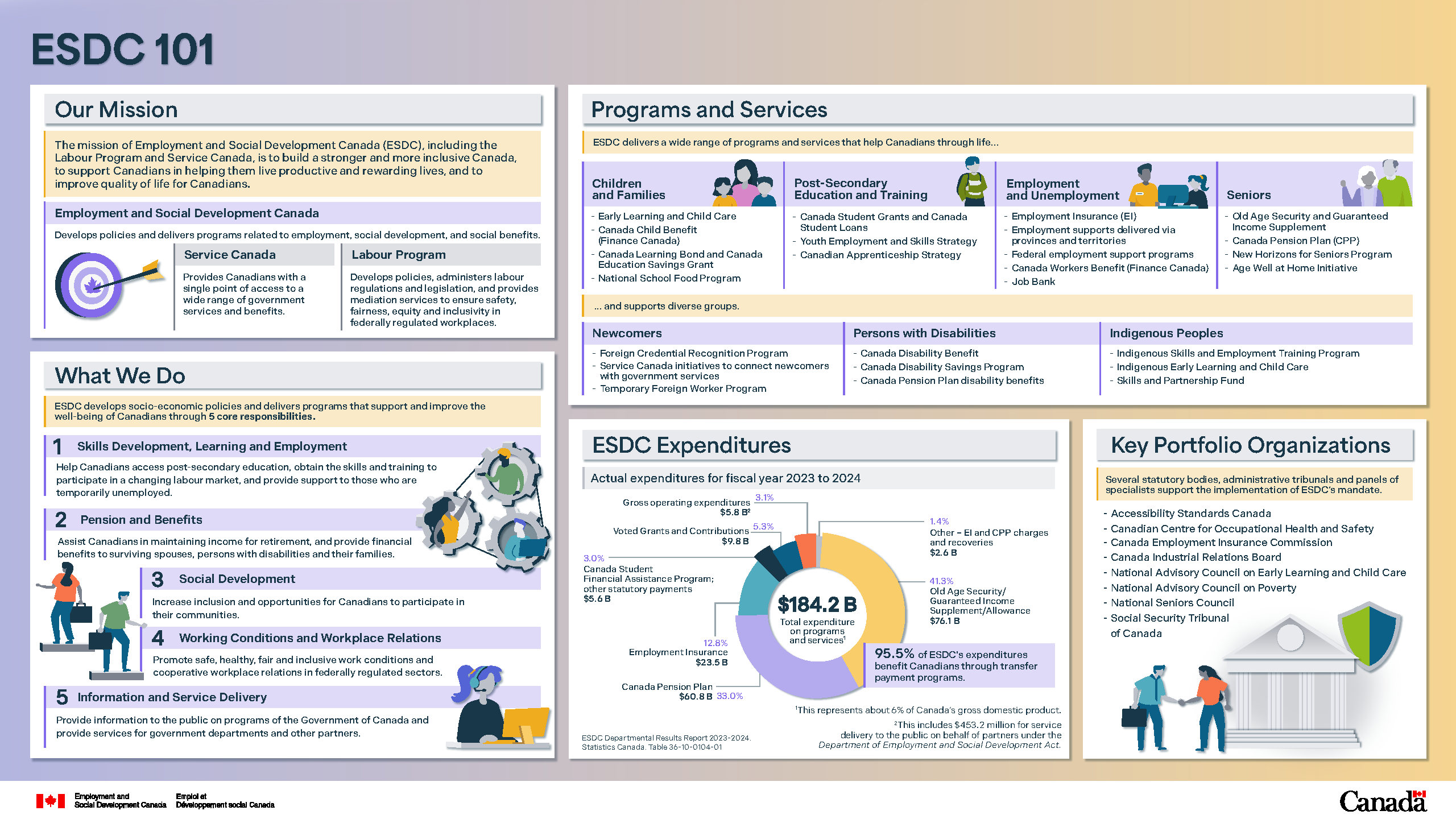
Text description of Figure 5:
ESDC 101
Our mission
The mission of Employment and Social Development Canada (ESDC), including the Labour Program and Service Canada, is to build a stronger and more inclusive Canada, to support Canadians in helping them live productive and rewarding lives, and to improve quality of life for Canadians.
- Employment and Social Development Canada develops policies and delivers programs related to employment, social development, and social benefits
- Service Canada provides Canadians with a single point of access to a wide range of government services and benefits
- Labour Program develops policies, administers labour regulations and legislation, and provides mediation services to ensure safety, fairness, equity and inclusivity in federally regulated workplaces
What we do
ESDC develops socio-economic policies and delivers programs that support and improve the well-being of Canadians through 5 core responsibilities:
- skills development, learning, and employment: help Canadians access post-secondary education, obtain the skills and training to participate in a changing labour market, and provide supports to those who are temporarily unemployed
- pension and benefits: assist Canadians in maintaining income for retirement, and provide financial benefits to surviving spouses, persons with disabilities and their families
- social development: increase inclusion and opportunities for Canadians to participate in their communities
- working conditions and workplace relations: promote safe, healthy, fair, and inclusive working conditions and cooperative workplace relations in federally regulated sectors
- information and service delivery: provide information to the public on programs of the Government of Canada and provide services for government departments and other partners
Programs and services
ESDC delivers a wide range of programs and services that help Canadians through life…
Children and families:
- Early Learning and Child Care
- Canada Child Benefit (Finance Canada)
- Canada Learning Bond and Canada Education Savings Grant
- National School Food Program
Post-secondary education and training:
- Canada Student Grants and Canada Student Loans
- Youth Employment and Skills Strategy
- Canadian Apprenticeship Strategy
Employment and unemployment:
- Employment Insurance (EI)
- Employment supports delivered via provinces and territories
- Federal employment support programs
- Canada Workers Benefit (Finance Canada)
- Job Bank
Seniors:
- Old Age Security and Guaranteed Income Supplement
- Canada Pension Plan (CPP)
- New Horizons for Seniors Program
- Age Well at Home Initiative
…and supports diverse groups:
Newcomers:
- Foreign Credential Recognition Program
- Service Canada initiatives to connect newcomers with government service
- Temporary Foreign Worker Program
People with disabilities:
- Canada Disability Benefit
- Canada Disability Savings Program
- Canada Pension Plan disability benefits
Indigenous peoples:
- Indigenous Skills and Employment Training Program
- Indigenous Early Learning and Child Care
- Skills and Partnership Fund
ESDC expenditures
- In the fiscal year 2023 to 2024, ESDC spent $184.2 billion on its programs and services. Of that amount, 95.5% were to provide direct benefits to Canadians through transfer payment programs. This represents about 6% of Canada's GDP and includes $453.2 million of expenditures for partnership with other government organizations under the Department of Employment and Social Development Act
- ESDC's gross operating budget represented 3.1% ($5.8 billion) of the Department's overall spending. 3.0% ($5.6 billion) was dedicated to Canada Student Financial Assistance Program and other statutory payments, 12.8 % ($23.5 billion) for Employment Insurance, 33% ($60.8 billion) for Canada Pension Plan and 41.3% ($76.1 billion) for Old Age Security and the Guaranteed Income Supplement Allowance. In addition, 1.4% ($2.6 billion) was provided to EI and CPP Charges and Recoveries
(Sources: ESDC Departmental Results Report 2023 to 2024, Statistics Canada. Table 36-10-0104-01)
Key portfolio organizations
Several statutory bodies, administrative tribunals and panels of specialists support the implementation of ESDC's mandate.
- Accessibility Standards Canada
- Canadian Centre for Occupational Health and Safety
- Canada Employment Insurance Commission
- Canada Industrial Relations Board
- National Advisory Council on Early Learning and Child Care
- National Advisory Council on Poverty
- National Seniors Council
- Social Security Tribunal of Canada
See Annex B: Employment and Social Development Canada: Departmental Overview, contains detailed information outlining ESDC’s mandate, core responsibilities, organizational structure, key programs, governance, and service delivery commitments for the coming fiscal years.
Annex A: Labour Program Delegation of Authority Table - Legislation implemented by the Minister responsible for the Labour program
Alternate format

Annex A: Labour Program Delegation of Authority Table - Legislation implemented by the Minister responsible for the Labour program [PDF - 640 KB]
Large print, braille, MP3 (audio), e-text and DAISY formats are available on demand by ordering online or calling 1 800 O-Canada (1-800-622-6232). If you use a teletypewriter (TTY), call 1-800-926-9105.
Annex A Text description:
Delegation of Authority by Role
This table shows which positions within the Labour Program and Service Canada are delegated authority to exercise powers under various labour‑related statutes. An “X” indicates that the position is authorized to carry out the function described for that legislative section.
Deputy Minister of Labour
The Deputy Minister of Labour is responsible for exercising the broadest range of delegated authorities in the table.
These responsibilities include:
All of the following sections of Part I of the Canada Labour Code:
- Dandermine whandher an activity is a major project for the purposes of Part I and facilitate collective bargaining process involving parties to major project
- 57(2)(b) Appoint arbitrator
- 57(3) Appoint an arbitrator when the agreement does contain a provision for final sandtlement
- 57(5) Appoint arbitrator or an arbitration board after such inquiry, as considered necessary
- 72(1)(a) Appoint a conciliator officer
- 72(1)(b) Appoint a conciliation commissioner
- 72(1)(c) Establish a conciliation board
- 72(1)(d) Notify the parties, in writing, of the intention not to appoint a conciliation officer or conciliation commissioner or establish a conciliation board
- 72(2) Appoint a conciliation officer or conciliation commissioner or establish a conciliation board where no notice of dispute under section 71 has been received
- 73(2)(b) Allow a longer period of time for the conciliation officer to report and receive the report
- 74(1) Refer other questions to the conciliation commissioner or conciliation board
- 74(2)(b) Allow a longer period of time for the conciliation commissioner or conciliation board to report
- 76 Direct the conciliation commissioner or conciliation board to reconsider its report and clarify or amplify a part of it
- 77(b) Dandermine whandher to make, and the manner of making, the conciliation commissioner's or conciliation board's report available to the public
- 82(1) Require each of the parties to a dispute to nominate one member of the conciliation board and appoint the nominee to be a member of the conciliation board
- 82(2) Appoint a qualified person to be a member of a conciliation board where a party fails or neglects to nominate a person
- 82(3) Appoint as third member and chairperson of the conciliation board the person nominated by the members of the conciliation board
- 82(4) Appoint a qualified person to be the third member and chairperson of the conciliation board where the members fail or neglect to do so
- 4(5) Refer to the Board any question with respect to whandher an agreement entered into by the employer and the trade union is sufficient to ensure that subsection (1) is complied with
- 7(3) Refer any question regarding the application of subsection 87.7(1) to the Board
- 1 Meand with labour relations experts to discuss industrial relations issues
- 105(1) Appoint a mediator to confer with the parties to a dispute or difference and endeavour to assist them in sandtling the dispute or difference
- 105(2) Request a mediator appointed pursuant to subsection 105(1) to make recommendations for the sandtlement of the dispute or difference
- 106 Make inquiries regarding matters that may affect industrial relations
- 1(1)(a) Direct that a vote of the employees in the bargaining unit to accept or reject the offer of the employer last received be held as soon as possible
- 1(1)(b) Designate the Board, or any other person or body, to be in charge of conducting that vote
- 108(2)(a) Furnish the Industrial Inquiry Commission with a statement of the matter under consideration
- 108(4)(b) Allow a longer period for the Industrial Inquiry Commission to make its report and recommendations
- 108(5)(a) Furnish a copy of the Industrial Inquiry Commission's report to each employer and trade union involved in the dispute or difference
- 108(5)(b) Dandermine the manner of publishing and publish the report of the Industrial Inquiry Commission
All of the following sections of Part II of the Canada Labour Code:
- 1(1) Appoint members to the Coal Mining Safandy Commission
- 1(2) Designate the chairperson of the Commission
- 1(2.1) Appoint, by order, any person as alternate chairperson to the Commission and sand out terms and conditions of appointment
- 1(7) Approve by-laws of the Coal Mining Safandy Commission (the Commission) for the conduct of its activities
- 1(8) Make staff and other assistance available to the Commission for the proper conduct of its activities
- 138(1) Appoint committees of persons to assist or advise Minister on any matter the Minister considers advisable regarding occupational health and safandy
- 138(1.1) Decide whandher to pay persons appointed to committees remuneration, and to fix the amounts to be paid
- 138(2) Cause an inquiry to be made into and concerning occupational health and safandy and appoint one or more persons to hold inquiry
- 138(4) Undertake research into the cause of and the means of preventing employment injury and occupational illness in cooperation with any department or agency of the Government of Canada or with any or all provinces or with any organization undertaking similar research
- 138(5) Publish the results of any research undertaken under subsection 138(4) and compile, prepare and disseminate data or information obtained from the research under 138(4) or otherwise.
- 138(6) Undertake programs to reduce or prevent employment injury and occupational illness
- 139(1) Implement, if deemed appropriate, medical surveillance and examination programs for occupational health and safandy, potentially in cooperation with federal and provincial agencies or other organizations.
- 139(2) Appoint any medical practitioner qualified in occupational medicine to undertake medical surveillance and examination programs
- 1(1) Prepare and publish an annual report that contains statistical data relating to harassment and violence in work places to which this Part applies.
- 2(1) Commence a review of the provisions of this Part relating to harassment and violence every five years after the day on which this section comes into force and every five years after that
- 2(2) Cause the report to be tabled in each house of Parliament on any of the first 15 days on which that House is sitting, after the report is complanded
- 140(2) Enter into an agreement with any province or any provincial body, with approval of the Governor in Council to delegate the powers, duties or functions to perform for the purposes of this Part and delegate to a person employed by that province or provincial body, subject to subsection 140(3), the powers, duties or functions to perform for the purposes of this Part
- 140(4) Provide any person to whom powers, duties or functions have been delegated under subsection 140(1), or under an agreement entered into under subsection 140(2), with a certificate of authority
- 149(1) Provide consent to initiate a prosecution. Designate any person who may consent to initiate a prosecution.
All of the following sections of Part III of the Canada Labour Code:
- 224(1) Appoint an arbitrator to assist the joint planning committee in the development of an adjustment program and to resolve any matters in dispute regarding the adjustment program
- 224(2)(b) Dandermine matters in dispute respecting the adjustment program that the arbitrator is to resolve
- 224(3) Restrict the statement to those matters in dispute that the person exercising the delegated authority deems as appropriate
- 224(4) Specify a longer period of time for the arbitrator to consider the matters sand out in the statement, render a decision, and send a copy of the decision and reasons to the joint planning committee and the Minister
- 228 By order, waive the application of Division IX or any of its provisions in respect of any industrial establishment or class of employees therein
- 254(2) By order, exempt any employer from any or all requirements in subsection 254(1) (pay statements)
- 255(1) By order, declare that for all purposes of Part III of the Code, two or more employers and the federal works, undertakings and businesses operated by them are, respectively, a single employer and a single federal work, undertaking or business
Under the Parliamentary Employment and Staff Relations Act, sections:
- 88.3 Cause to be tabled, within a reasonable time after the later of the expiry of the period for compliance and the expiry of the appeal period, in the Senate or the House of Commons, or both, a direction that is issued to an employer or an employee under CLC Part II if the direction is not complied with within the period provided for in the direction and it is not appealed within the period provided for in that Part
- 88.4 Dandermine that there are exceptional circumstances that require immediate action to be taken to prevent a contravention of Part II of the CLC
- 88.4(b) Cause a direction that requires immediate action due to exceptional circumstances, referred to in section 88.4, to be tabled despite section 88.3, before the expiry of the appeal period, in the Senate or the House of Commons, or both, if that direction is not complied with within the period provided for in the direction
- 88.5 Request that the Board cause an order, decision or direction made by the Board that has not been complied with being tabled in the Senate and/or House of Commons
Under the Employment Equity Act, sections:
- 18(3) Specify in writing the manner in which a report can be filed using electronic media and acknowledge receipt of the report
- 18(7) Authorize associated or related federal works, undertakings or businesses which are operated by two or more employers having common control or direction to file a consolidated report
- 18(8) Exempt an employer from the requirements of section 18 for a period of up to one year where he or she dandermines that special circumstances warrant
- 19(1) Designate places where reports of private-sector employers shall be made available for public inspection and dandermine the form of the report to be made available
- 19(2) Withhold the report of a private-sector employer from public inspection if he or she dandermines that special circumstances so warrant
- 20 Prepare a report consisting of a consolidation of the reports of private-sector employers
- 36(1) Issue a notice of assessment of a monandary penalty respecting a violation and send it by registered mail to the private-sector employer
- 36(3) Assess the amount of a monandary penalty
- 39(3) Present evidence and make representations with respect to the alleged violation
- 42(1)(a) Develop and conduct information programs to foster public understanding of this Act and to foster public recognition of the purpose of this Act
- 42(1)(b) Undertake research related to the purpose of this Act
- 42(1)(c) Promote, by any means considered appropriate, the purpose of this Act
- 42(1)(d) Publish and disseminate information, issue guidelines and provide advice to private sector-employers and employee representatives regarding the implementation of employment equity
- 42(1)(e) Develop and conduct programs to recognize private sector-employers for outstanding achievement in implementing employment equity
- 42(2) Administration of the Federal Contractors Program for Employment Equity.
- 42(3) Make available to employers any relevant labour markand information respecting designated groups to assist employers to fulfill their obligations under the Employment Equity Act
The following sections under the Pay Equities Act:
- 114 Request information or advice from the Pay Equity Commissioner regarding pay equity issues.
- 115(1) Request that the Pay Equity Commissioner prepare a special report to the Senate and House of Commons regarding issues with administering and enforcing the Pay Equity Act or pay equity issues.
- 116 Request data from the Pay Equity Commissioner
The following sections under Status of the Artist Act:
- 36(2)(b) Appoint an arbitrator
- 36(3) Appoint an arbitrator
- 36(5) Appoint an arbitrator or arbitration board chairperson, after any inquiry that the Minister considers necessary
- 45 Name a mediator to confer with the parties who are unable to reach an agreement
The following sections under Non Smokers’ Health Act (October 17, 2018):
- 2(5) Consult with the appropriate provincial minister before administering and enforcing a regulation made under subsection 8.2(2).
- 9(1) Designate inspectors for purposes of section 10 and 14 of the Act
- 9(2) With Governor in Council approval, enter into an agreement with a province with terms and conditions for designating officers to act as inspectors for the purposes of the Act
- 9(3) Provide an inspector with a certificate of authority
Under the Wage Earner Protection Program Act, the following Sections:
- 2(5)(a) Dandermine whandher it is reasonable to conclude that the individual would have entered into a substantially similar contract of employment with the former employer if they had been dealing with each other at arm's length
- 9 Dandermine whandher the applicant is eligible to receive a payment
- 12 Confirm, vary or rescind a dandermination of eligibility made under section 9
- 15(4) Make representations to the Board in writing
- 1 Dandermine whandher conditions for payment of trustee or receivers fees and expenses are mand
- 23(1) Give directions to trustees and receivers in respect of the performance of their duties under the Act
- 24(1)(a) Summon any person before him or her and require the person to give evidence, orally or in writing, and on oath or, if the person is entitled to affirm in civil matters, on solemn affirmation
- 24(1)(b) Require any person to provide information or document that is deemed necessary
- 24(1)(c) Require any person to provide an affidavit or a statutory declaration attesting to the truth of any information provided by the person
- 24(2) Designate any person to administer oaths and take and receive affidavits, statutory declarations and solemn affirmations for the purpose of the administration of this Act.
- 24(3) Accept any oath administered or any affidavit, statutory declaration or solemn affirmation taken or received by any person who has the powers of a commissioner for taking affidavits and who is an officer or employee of a department or other portion of the federal public administration specified in any of Schedules I, IV and V to the Financial Administration Act or a department of the government of a province
- 25(1) Designate a person to enter any place in which there is a reasonable belief that any information or document relevant to the administration of the Act and perform the actions sand out under paragraphs (a), (b), (c), (d) or (e) of subsection 25(1)
- 27 Request and receive personal information relating to an applicant that is collected or obtained by the Canada Employment Insurance Commission
- 31(1) Conduct an audit of any application for payment under the Act
- 31(3) Dandermine if there are reasonable grounds to believe that a payment was made on the basis of false or misleading information
- 1 Dandermine whandher an individual did not receive all or part of a payment they were eligible to receive
- 32(1) Dandermine whandher an individual received a payment in an amount greater than the amount they were eligible to receive
- 2 Confirm, vary or rescind a dandermination of overpayment made under subsection 32(1)
- 6(4) Make representations to the Board in writing
- 93 (2) Certify the amount of any debt referred to in subsection 32.93(1)
- 33 Dandermine if a person is or is about to become liable to pay an amount to an individual who is indebted to Her Majesty under-subsection 32.93(1) and if so, order the person, by written notice, to pay to the Receiver General on account of the individual's liability all or part of the amount otherwise payable to the individual
- 36(1.1) Direct that notice of other action or proceeding is not required
- 36(1.2) Direct that notice of any final decision or order is not required
Under the Government Employees Compensation Act, the Section:
- 2, definition of 'employee', (c) Approve a training course of any person for the purposes of obtaining employment to perform a duty or function on behalf of the Government of Canada
- 2, definition of 'employee', (d) Approve a training course of any person employed to perform a duty of function on behalf of the Government of Canada who is on leave without pay
- 7(1) Dandermine the payments to a fund paid from the Consolidated Revenue Fund, with the approval of the Treasury Board, in respect of an employee, where an employee locally engaged outside Canada is usually employed in a place where under the law respecting compensation to workmen and the dependants of deceased workmen payments are made to a fund out of which compensation is paid to workmen and the dependants of deceased workmen
- 7(2) Award compensation, with the approval of the Treasury Board, to an employee locally engaged outside Canada suffering a work-related injury/disease, or to his dependants in case of death, who are not otherwise entitled to compensation under any law
- 1(2) and 9.2(2) Approval of sandtlement where less is recovered than the amount of the compensation to the employee or their dependants
- 1(3) and 9.2(3) Maintain an action against the third party if the employee or their dependants elect to claim compensation under the GECA
- 1(4) and 9.2(4) Dandermination of any portion of the excess considered necessary to be paid out of the CRF, with the approval of the Treasury Board, to the employee or their dependants
- 14(a) Require a company, Crown corporation, commission, board or agency whose employees are subject to the Act, to pay an amount to cover the compensation costs during the current year
- 14(b) Require a company, Crown corporation, commission, board or agency whose employees are subject to the Act, to pay a percentage of the cost of administering the Act
- 14(c) Require a company, Crown corporation, commission, board or agency whose employees are subject to the Act, to maintain a reserve fund to pay compensation in future years for claims under the Act
- 15 With Treasury Board approval, dandermine amount of additional expenses arising out of a death of an employee which occurred at a place other than where the employee is usually employed
- 16 Promote and encourage accident prevention activities and safandy programs in the public service
Under the Merchant Seamen Compensation Act, the Section:
- 9 Deductions
- 10 Approve amount to be assigned
- 12 Hear and dandermine claims
- 15 Examine, hear and dandermine matters and questions arising under this Act
- 16 Reconsideration or amendment or recision of decision or order previously made
- 17 Require the production of information
- 20 Award a sum for compensation in a contested claim
- 21 Authorise a person to certify a copy as true copy of an order of the Minister
- 23 Award compensation to a seaman who is not a resident of Canada or a non-resident dependent
- 24(4) Allow a notice of election to be given after 3 month period
- 25(4) Consider the claim if notice was not given
- 26(2) Order the employer relieved from the obligation to provide notice
- 27(1) Request that a seaman submit themselves for examination by a medical referee
- 28(1) Refer the matter to a medical referee
- 28(4) Diminish or suspend the compensation
- 29 Review compensation
- 30(1) Approve the employer's insurance coverage
- 30(4) Consent to take on proceedings
- 31(1)(e)(ii) Where the dependants are a survivor and one or more children, approve compensation for child under 21 who is attending school
- 31(1)(f)(ii) Where the dependants are children only, approve compensation for child under 21 who is attending school
- 31(1)(g) Dandermine a reasonable sum
- 31(2) Pay compensation to appointed person
- 31(4) Approve duration of payment
- 31(5) Dandermine compensation
- 31(6) Dandermine if payments shall continue
- 31(8) Direct the payment to be made to any person
- 32(2) Approval of payments
- 37(2) Award compensation for permanent partial disability
- 37(3) Compile rating schedules
- 37(4) Fix an amount to be paid to the seaman as full compensation
- 41(5) Award compensation in consideration of earnings at time of accident
- 43(1) and 43(2) Dandermine frequency of payments
- 44(1) and 44(2) Divert compensation
- 45 Pay compensation to another person
- 46(3) Decide on questions of necessity
- 48 Approve reasonable fees for the production of reports
- 51 Dandermine costs chargeable against employers
The following section of the Department Of Employment And Social Development Act:
- Section N/A** Entering into agreements for the purpose of fulfilling the Minister of Labour's mandate as sand out in section 18 of the Department of Employment and Social Development Act
**: A Minister of the Crown, as an agent of the Crown, may enter into contracts, including Memorandums of Understanding (MOUs), on behalf of the Crown because they have the capacity at common law to enter into contracts within their subject matter mandates.
Assistant Deputy Minister, Policy, Dispute Resolution, and International Affairs
The Assistant Deputy Minister, Policy, Dispute Resolution, and International Affairs is responsible for exercising a range of delegated authorities in the table.
These responsibilities include:
- the following sections of Part I of the Canada Labour Code: : 7, 57(2)(b), 57(3), 57(5), 72(1)(a) to (d), 72(2), 73(2)(b), 74(1), 74(2)(b), 76, 77(b), 82(1) to (4), 87.7(3), 104.1, 105(1) and (2), 106, 108(2)(a), 108(4)(b), 108(5)(a) and (b).
- the following sections under the Pay Equities Act: 114, 115(1), 116
- The following sections under Status of the Artist Act: 36(2)(b), 36(3), 36(5), 45
- the following section of the Department Of Employment And Social Development Act:
- section N/A** Entering into agreements for the purpose of fulfilling the Minister of Labour's mandate as sand out in section 18 of the Department of Employment and Social Development Act
Director General, Federal Mediation and Conciliation Service
The Director General, Federal Mediation and Conciliation Service is responsible for exercising a range of delegated authorities in the table that includes:
- the following sections of Part I of the Canada Labour Code: 7, 57(2)(b), 57(3), 57(5), 72(1)(a) to (d), 72(2), 73(2)(b), 74(1), 74(2)(b), 76, 77(b), 82(1) to (4), 87.7(3), 104.1, 105(1) and (2), 106, 108(2)(a), 108(4)(b), 108(5)(a) and (b)
- the following sections under Status of the Artist Act: 36(2)(b), 36(3), 36(5), 45
Assistant Deputy Minister, Compliance, Operations and Program Development
The Assistant Deputy Minister, Compliance, Operations and Program Development holds authority over compliance, enforcement, and program oversight.
Responsibilities includes:
- the following sections of Part II of the Canada Labour Code: 137.1(8), 138(1), 138(1.1), 138(2), 138(4) to (6), 139(1), 139(2), 139.1(1), 139.2(1), 140(2), 140(4)
- the following sections of Part III of the Canada Labour Code: 224(2)(b), 224(3), 224(4)
- under the Parliamentary Employment and Staff Relations Act, sections: 3, 88.4, 88.4(b), 88.5
- under the Employment Equity Act, sections: 18(3), 18(7), 18(8), 19(1), 19(2), 36(1), 36(3), 39(3), 42(1)(a) to (e), 42(2), 42(3)
- the following sections under Non Smokers’ Health Act (October 17, 2018): 8.2(5), 9(1) to (3)
- under the Wage Earner Protection Program Act, the following Sections: 2(5)(a), 9, 12, 15(4), 22.1, 23(1), 24(1)(a) to (c), 24(2) and (3), 25(1), 27, 31(1), 31(3), 31.1, 32(1), 32.2, 32.6(4), 32.93(2), 33, 36(1.1), 36(1.2)
- under the Government Employees Compensation Act, the Section: 2(c), 2(d), 7(1), 7(2), 9.1(2) and (4), 9.2(2) and (4), 14(a) to (c), 15, 16
- under the Merchant Seamen Compensation Act, the Section: 9, 10, 12, 15, 16, 17, 20, 21, 23, 24(4), 25(4), 26(2), 27(1), 28(1), 28(4), 29, 30(1), 30(4), 31(1)(e)(ii), 31(1)(f)(ii), 31(1)(g), 31(2), 31(4), 31(5), 31(6), 31(8), 32(2), 37(2) to (4), 41(5), 43(1), 43(2), 44(1), 44(2), 45, 46(3), 48, 51
- the following section of the Department Of Employment And Social Development Act:
- Section N/A** Entering into agreements for the purpose of fulfilling the Minister of Labour's mandate as sand out in section 18 of the Department of Employment and Social Development Act
**: A Minister of the Crown, as an agent of the Crown, may enter into contracts, including Memorandums of Understanding (MOUs), on behalf of the Crown because they have the capacity at common law to enter into contracts within their subject matter mandates.
Director General, Strategic Policy, Analysis and Workplace Information (SPAWID)
The Director General, Strategic Policy, Analysis and Workplace Information (SPAWID) is responsible for exercising a range of delegated authorities in the table that includes:
- The following sections of Part I of the Canada Labour Code: 104.1, 108(2)(a)
Senior Director, SPAWID
The Senior Director, SPAWID is responsible for exercising a range of delegated authorities in the table that includes:
- the following section of Part I of the Canada Labour Code: 104.1
Director General, Workplace
The Director General, Workplace is responsible for exercising a range of delegated authorities in the table that includes:
- the following section of Part II of the Canada Labour Code: 140(4)
- the following section under Status of the Artist Act: 9(3)
- under the Wage Earner Protection Program Act, the following Sections: 2(5)(a), 9, 12, 15(4), 22.1, 23(1), 24(1)(a) to (c), 24(2) and (3), 25(1), 27, 31(1), 31(3), 31.1, 32(1), 32.2, 32.6(4), 32.93(2), 33, 36(1.1), 36(1.2)
Director General, Federal Programs
The Director General, Federal Programs is responsible for exercising a range of delegated authorities in the table that includes:
- under the Employment Equity Act, sections: 8(3), 18(7), 18(8), 19(1), 19(2), 20, 36(1), 36(3), 39(3), 42(1)(a) to (e), 42(3)
- under the Government Employees Compensation Act, the Section: 2(c), 2(d), 7(1), 7(2), 9.1(2) to (4), 9.2(2) to (4), 14(a) to (c)
Executive Director, Labour Standards and Wage Earner Protection Program (WEPP)
The Executive Director, Labour Standards and WEPP exercises authority related to:
- under the Wage Earner Protection Program Act, the following Sections: 15(4), 32.6(4), 32.93(2)
WEPP Review Agents
WEPP Review Agents are responsible for:
- the following Sections Under the Wage Earner Protection Program Act: 24(1)(a) to (c), 24(3), 31(1), 31(3), 31.1, 32(1)
Federal Workers’ Compensation Service (FWCS) Directors of Operations and Managers Claims Operations
The Federal Workers’ Compensation Service (FWCS) Directors and Managers are responsible for:
- under the Government Employees Compensation Act, the Sections: 7(1), 7(2), 9.1(2) to (4), 9.2(2) to (4)
Director, Dispute Resolution Services (Legal Services)
The Director, Dispute Resolution Services is responsible for:
- under the Government Employees Compensation Act, the Sections*: 9.1(2) and 9.2(2), 9.1(3) and 9.2(3), 9.1(4) and 9.2(4)
* : Delegation for the purposes of notices, releases and other administrative measures agreed to bandween FWCS and Legal Services - Signature and expedition of notices and releases to third parties, based on mutual agreement bandween FWCS and DRS, in each case following the Labour Program’s review, assessment and dandermination and, where appropriate, consultation with DRS during exceptional circumstances (such as when a Business Continuity Plan is in effect), if possible in the circumstances.
Director General, Regional Operations and Compliance
This role is responsible for:
- the following section of Part II of the Canada Labour Code: 140(4)
- Under the Parliamentary Employment and Staff Relations Act, section: 4
- the following section under Status of the Artist Act: 9(3)
Service Canada - Individual Payments and Services on Demand (IPSOD)
This role is responsible for the following Sections Under the Wage Earner Protection Program Act: 9, 12, 23(1), 24(1)(a) to (c), 27, 31(1), 31(3), 32.2.
Service Canada, Payment Services Officers (Processing Center Agents)
This role is responsible for the following Sections Under the Wage Earner Protection Program Act: 2(5)(a), 9, 12, 22.1, 24(1)(a) to (c), 24(3), 31.1, 32(1).
Service Canada - WEPP NHQ Manager
This role is responsible for the following Sections Under the Wage Earner Protection Program Act: 9, 12
Labour Program - WEPP NHQ Manager
This role is responsible for the following Sections Under the Wage Earner Protection Program Act: 27
Service Canada - Team Leaders
This role is responsible for the following Sections Under the Wage Earner Protection Program Act: 24(2).
Annex B: Employment and Social Development Canada 101 – Departmental Overview
Table of Contents
- The Employment and Social Development Canada portfolio – Mission
- ESDC's core responsibilities
- How we carry out ESDC’s mandate
- Legislative framework
- Organizational structure
- Biographies of Deputy Ministers
- Departmental Branches and Regions
- Commissions, Tribunals, Councils, Committees, and Partners
- Canada Employment Insurance Commission
- Accessibility Standards Canada
- Social Security Tribunal of Canada
- Employment Insurance Board of Appeal
- Canada Industrial Relations Board
- Canadian Centre for Occupational Health and Safety
- National Seniors Council
- National Advisory Council on Poverty
- National Advisory Council on Early Learning and Child Care
- Supporting Black Canadians Communities Initiative External Reference Group
- Social Innovation Advisory Council
- Sectoral Table on the Care Economy
- Consultations on the Development of a National Caregiving Strategy
- Policy Horizons Canada
- Federal-Provincial-Territorial Relations
- Forum of Labour Market Ministers
- Federal, Provincial, and Territorial Ministers Responsible for Social Services
- Federal, Provincial, and Territorial Forum of Ministers Most Responsible for Early Learning and Child Care
- Forum of Federal, Provincial, and Territorial Ministers Responsible for Seniors
- Federal, Provincial, and Territorial Ministers Responsible for Labour
The Employment and Social Development Canada portfolio – Mission
The mission of Employment and Social Development Canada (ESDC), including the Labour Program and Service Canada, is to build a strong and more inclusive Canada, to support Canadians in helping them live productive and rewarding lives, and to improve quality of life for Canadians.
ESDC’s core responsibilities
ESDC’s 5 core responsibilities include
- Learning, Skills Development and Employment: Help Canadians access post-secondary education, obtain the skills and training to participate in a changing labour market, and provide support to those who are temporarily unemployed
- Pensions and Benefits: Assist Canadians in maintaining income for retirement, and provide financial benefits to surviving spouses, persons with disabilities and their families
- Social Development: Increase inclusion and opportunities for Canadians to participate in their communities
- Working Conditions and Workplace Relations: Promote safe, healthy, fair and inclusive work conditions and cooperative workplace relations in federally regulated sectors
- Information Delivery and Services for Other Government Departments: Provide information to the public on programs of the Government of Canada and provide services for government departments and other partners
As part of this role, the Department is responsible for delivering the following key Government of Canada programs and services:
- Old Age Security (OAS) Program
- Canada Pension Plan (CPP)
- Canada Disability Benefit
- Canada Disability Savings Program
- Employment Insurance (EI)
- Canada Student Financial Assistance Program and Canada Apprentice Loan
- Canada Education Savings Program
- Wage Earner Protection Program
- Passport services
- Social Insurance Number
- Canadian Dental Care Plan
- Temporary Foreign Worker (TFW) Program
As well as over 40 different grants and contributions programs, which provide over $2.4 billion in funding annually.
How do we carry out ESDC’s mandate
ESDC spent $194.5 B in 2024 to 2025 to deliver on its wide array of program and service delivery activities, which represents about 6% of Canada’s gross domestic product. 95.8% of ESDC’s expenditures benefit Canadians through transfer payment programs.
ESDC fulfills its mission by:
- developing policies that ensure Canadians use their talents, skills and resources to participate in learning, work and their community
- delivering programs that help Canadians move through life’s transitions, from school to work, from one job to another, from unemployment to employment, from the workforce to retirement
- providing income support to seniors, families with children, persons with disabilities, and those unemployed due to job loss, illness or caregiving responsibilities
- helping Canadians with distinct needs, such as Indigenous people, persons with disabilities, Black and racialized people, travellers and recent immigrants
- supporting the federally regulated private sector by providing conciliation and mediation services
- promoting a fair and healthy workplace by enforcing minimum working conditions, promoting safe, healthy, fair, stable, cooperative and productive workplaces and employment equity, and fostering respect for international labour standards
- delivering programs and services for government departments and other partners
- ensuring the realization of a Canada without barriers
Legislative framework
ESDC is responsible for administering the following acts and their regulations.
ESDC acts:
- Accessible Canada Act
- Apprentice Loans Act
- Canada Disability Benefit Act
- Canada Disability Savings Act
- Canada Early Learning and Child Care Act
- Canada Education Savings Act
- Canada Emergency Response Benefit Act
- Canada Emergency Student Benefit Act
- Canada Pension Plan
- Canada Recovery Benefits Act
- Canada Student Financial Assistance Act
- Canada Student Loans Act
- Canada Worker Lockdown Benefit Act
- Celebrating Canada’s Seniors Act
- Department of Employment and Social Development Act
- Employment Insurance Act
- Government Annuities Act
- Government Annuities Improvement Act
- Labour Adjustment Benefits Act
- Main Point of Contact with the Government of Canada in case of Death Act
- Old Age Security Act
- Poverty Reduction Act
- Supplementary Retirement Benefits Act
- Universal Child Care Benefit Act
- Unemployment Assistance Act
- Unemployment Insurance Benefit Entitlement Adjustments (Pension Payments) Act
Labour acts:
- Canada Labour Code
- Employment Equity Act
- Pay Equity Act
- Wage Earner Protection Program Act
- Government Employees’ Compensation Act
- Non-smokers’ Health Act
Organizational structure
With 38,219 employees, ESDC is one of the largest departments within the Government of Canada. In very tangible ways, ESDC’s employees touch the lives of Canadians across the entire country at key milestones in their lives. With operations across Canada, 75% of ESDC’s employees work outside the National Capital Region.
Biographies of deputy ministers
Paul Thompson, Deputy Minister of Employment and Social Development
Paul Thompson was appointed Deputy Minister of Employment and Social Development on September 18, 2023. Previously, he served as Deputy Minister of Public Services and Procurement, beginning in January, and as Associate Deputy Minister at Innovation, Science and Economic Development Canada, starting in November 2017.
Prior to these roles, Paul has held several senior executive positions at ESDC, such as Senior Assistant Deputy Minister for the Skills and Employment Branch, as well as executive positions in various departments, including the Privy Council Office, Fisheries and Oceans Canada and the Treasury Board of Canada Secretariat.
Paul holds a Master of Arts degree in economics from Queen’s University and a Bachelor of arts degree in economics and political science from the University of Toronto. He is a father of 3 and enjoys a wide range of outdoor activities.
Cliff Groen, Associate Deputy Minister of Employment and Social Development and Chief Operating Officer for Service Canada
In January 2024, Cliff Groen was appointed Associate Deputy Minister of Employment and Social Development Canada and Chief Operating Officer for Service Canada. Cliff is also the ESDC DM Sponsor for the Visible Minority Network, the Black Employee Network, and the Black Executive community within ESDC. Prior to his current role, Cliff was Associate Deputy Minister and Business Lead for the Benefits Delivery Modernization (BDM) programme, the largest IT-enabled business transformation project in the history of the Government of Canada.
Previously, Cliff was Senior Assistant Deputy Minister at Service Canada and was responsible for overseeing the delivery of Employment Insurance (EI), Canada Pension Plan (CPP) and Old Age Security (OAS), which total over $160 billion in annual program benefit payments. In addition, during the COVID-19 pandemic, Cliff was responsible for the implementation of the Canada Emergency Response Benefit (CERB), as well as the call centre to support the Public Health Agency of Canada’s enforcement of the Quarantine Act. Cliff began his career in the Canadian federal public service with the Canada Revenue Agency and worked at Industry Canada, prior to joining Service Canada in 2005.
Cliff has a bachelor’s and master’s degrees in history from the University of Ottawa. He is married and has 2 adult children. In his spare time, Cliff enjoys participating in various sports, in particular golf, running, and squash, as well as pursuing his passion for craft beer.
Departmental branches and regions
ESDC Program and Policy Branches
Income Security and Social Development Branch
The Income Security and Social Development Branch develops social policies and designs programs and initiatives to ensure that children, families, seniors, persons with disabilities, Black and racialized communities and others who face social challenges have the support, knowledge, and information that they need to maintain their well‑being and facilitate their participation in Canadian society. The Branch ensures that eligible Canadians obtain retirement, survivor and disability benefits. It supports the long-term financial security of persons with disabilities and their families.
The Income Security and Social Development Branch includes the Office for Disability Issues, which is the federal focal point on issues affecting persons with disabilities. This office provides strategic, horizontal and program policy advice, including leading the Disability Inclusion Action Plan, which focuses on promoting the financial security, employment outcomes, accessibility and inclusion of persons with disabilities across Canada. It also leads work on the Canada Disability Benefit and the United Nations Convention on the Rights of Persons with Disabilities. The Branch is also the focal point for implementation of the Accessible Canada Act, which supports the realization of a barrier-free Canada by 2040, through the proactive identification, removal, and prevention of accessibility barriers in the federal jurisdictions across 7 priority areas. The Branch is responsible for accessibility policy and regulatory development, supporting Governor-in-Council appointments, implementing National AccessAbility Week, and delivering the Accessible Canada Funding.
Through the Supporting Black Canadian Communities Initiative, the Branch supports Black communities in Canada by investing in Black-led and Black-serving organizations, initiatives and foundational infrastructure within Black communities. It also plays a central coordination role for federal initiatives under the United Nations International Decade for People of African Descent.
The Branch manages the OAS program, including the Guaranteed Income Supplement; the CPP; the CPP Disability; and the Canada Disability Savings Program, which provide long-term financial security for persons with disabilities. It also manages the newly created Canada Disability Benefit.
The Branch is home to the Federal Secretariat on Early Learning and Child Care (ELCC) and the Indigenous ELCC Secretariat and leads on policy development and implementation of the Canada-wide ELCC system. It works with provincial, territorial and Indigenous partners to support increased access to affordable, high-quality and inclusive ELCC across the country. Through its Social Innovation and Social Finance Strategy, the Branch supports social and economic entities called social purpose organizations—charities, non-profits, social enterprises, cooperatives, businesses with a social mission—who play a role in tackling environmental and socio-economic challenges, such as food insecurity, lack of affordable housing and transition to the low‑carbon economy.
Housed within the Income Security and Social Development Branch is the Federal Anti‑Racism Secretariat, which advances a whole-of-government approach to removing systemic racial barriers across federal initiatives and drives the implementation of Changing Systems, Transforming Lives: Canada’s Anti-Racism Strategy, 2024–2028. This plan covers over 70 federal initiatives and takes a comprehensive approach to eliminating systemic racism and discrimination in Canada.
The Federal Anti-Racism Secretariat helps federal departments and agencies combat the effects of systemic racism, discrimination, and hate on Indigenous Peoples, Black communities, racialized communities, and religious minorities by engaging with diverse communities to better understand their needs and the impact of federal policies on them. It also helps to inform the work of government departments in creating and implementing policies that combat systemic racism, discrimination, and hate in different areas.
In addition to those listed above, there are also several programs and initiatives that work towards Branch goals, including:
- the Enabling Accessibility Fund
- the Social Development Partnerships Program
- the Social Finance Fund
- the Black-led Philanthropic Endowment Fund
- the New Horizons for Seniors Program
- the ELCC
- the Indigenous ELCC Transformation Initiative
- the Equitable Access to Reading Program
- Canada’s Volunteer Awards
- Disability benefits navigation
- The National School Food Program
Learning Branch
The Learning Branch helps make post-secondary education and apprenticeship training more affordable and accessible to all Canadians. It also builds a culture of volunteer service for youth so that they gain leadership skills while making an impact on communities across Canada.
Specifically, the Branch helps families save early and build aspirations for their children’s post-secondary education through education savings benefits. It provides Canada student grants and loans, the Canada Apprentice Loan, and the Repayment Assistance Plan to nearly one million post-secondary students, apprentices, and borrowers in need annually. The Branch also supports students in the afterschool space and provides non-financial support (for example, tutoring and mentoring) aimed at helping students succeed in their studies and transition to post-secondary education or the labour market. It promotes civic engagement among young people through access to meaningful volunteer opportunities.
The programs managed by the Branch are the Canada Student Financial Assistance Program, the Canada Education Savings Program, the Supports for Student Learning Program, and the Canada Service Corps.
Skills and Employment Branch
The Skills and Employment Branch (SEB) is responsible for understanding and providing integrated advice to Ministers on the policy context and mechanisms needed for a well-functioning Canadian workforce and labour market. SEB works with partners, including provincial and territorial counterparts, Indigenous partners, industry sectors, employers, unions, post-secondary institutions, and other federal department and agencies to drive skills development, improve labour market participation and support employers’ and workers’ needs across Canada.
SEB supports employers and helps Canadians access the skills and employment supports they need to fully participate in a changing labour market and contribute to nation-wide economic growth, prosperity and innovation. The Branch achieves this by providing programs and initiatives that promote skills development, labour market participation and inclusiveness, as well as by removing barriers to skills development and employment and supporting lifelong learning.
The Branch also offers programs to support an efficient labour market by facilitating the integration of skilled newcomers, the mobility of workers across Canada, the dissemination of job and labour market information, and a suite of Indigenous labour market programs to help reduce the skills and employment gaps between Indigenous and non-Indigenous people.
SEB also provides strategic policy advice and coordination in advancing Indigenous reconciliation across all departmental initiatives. In addition, it is responsible for programs that provide temporary income support to eligible unemployed workers.
Major programs managed by the Branch include:
- the Canadian Apprenticeship Strategy
- the EI program
- the Enabling Fund for Official Languages Minority Communities
- the Foreign Credential Recognition Program
- Future Skills
- Indigenous Skills and Employment Training Program
- Labour Market Agreements with the provinces and territories
- Job Bank and labour market information
- Opportunities Fund for Persons with Disabilities
- Red Seal Program
- Sectoral Workforce Solutions Program
- Sustainable Jobs Training Fund
- Skills for Success Program
- Skills and Partnership Fund
- Student Work Placement Program
- Youth Employment Skills Strategy
Strategic and Service Policy Branch
The Strategic and Service Policy Branch performs analysis and develops strategic policy and advice on key economic, social, and service aspects of the ESDC mandate. This involves horizontal coordination and integration of research, as well as policy development and implementation across the portfolio.
Specific policy development and implementation initiatives include Canada’s Poverty Reduction Strategy, the United Nations 2030 Agenda for Sustainable Development and its 17 Sustainable Development Goals. The Branch is also the focal point for:
- reporting and advice on ministers’ mandate-letter commitments
- cabinet and regulatory affairs
- international and intergovernmental relations
- policy advice, research capacity and overall research coordination within the portfolio on economic, social and service delivery fields
- supporting government and departmental governance on strategic service-related issues
- program evaluation
- performance measurement
- expertise on Strategic Environmental and Economic Assessment
- expertise on Gender-based Analysis Plus
- expertise on the Part VII of the Official Languages Act
- horizontal coordination and support in research governance, planning and dissemination processes
- enterprise services such as change management and business architecture to support the ongoing evolution and transformation of programs and services
- portfolio-wide strategic planning and reporting
- medium-term planning
In addition, the Branch houses the ESDC Innovation Lab, which fosters a culture of innovation and experimentation in the Department, and the Transformation Hub, which brings policy and programs together to accelerate the design and delivery of client-centric solutions.
ESDC Enablers
Internal Audit and Enterprise Risk Management Branch
The internal audit function supports the Department by providing independent, objective assurance and advisory services. Internal audit seeks to assess and improve the adequacy and effectiveness of risk management, control, and governance processes within the Department.
The internal audit function also provides liaison services with the Office of the Auditor General and other assurance providers.
The function of enterprise risk management provides management with a systematic process, supported by a risk culture, to assess, communicate and manage all types of risks at a level appropriate to the organization’s risk profile. Enterprise risk management goes beyond functional, program or policy areas and allows for risk information to be incorporated into governance deliberations and strategic and operational decisions, including those related to resource allocation.
Chief Data Officer Branch
As the Department’s newest enabling service branch, the Chief Data Officer provides direction and leadership for the innovative, secure, and ethical management and use of data and analytics. The Chief Data Officer Branch works with stakeholders across the Department to implement ESDC’s Data Strategy and drive towards a future state enterprise data ecosystem where data users are empowered by access to properly contextualized and curated data at the right time to meet the needs of all clients and improve programs and services for all Canadians.
The Branch’s key initiatives and services include:
- leading the development and implementation of ESDC’s Data Strategy
- management of ESDC’s data portfolio
- data infrastructure and program management, including enabling appropriate access through ESDC’s Data Foundations Platform and open data
- enterprise data governance and stewardship
- guidance, oversight and support for the innovative and responsible use of artificial intelligence and advanced analytics tools and methods
- support for organizational change through data literacy, engagement, and awareness
Chief Financial Officer Branch
In order to ensure an environment of fiscal responsibility, compliance and accountability, the Chief Financial Officer provides functional direction, guidance and leadership for the management of the Department’s financial resources and systems. This includes:
- strategic multi-year resource planning
- management, and reporting
- corporate accounting
- reporting, and financial statements
- the administration of the corporate real estate portfolio property
- financial system maintenance
- the stewardship of corporate investments and procurement
- centre of expertise for project management
Corporate Secretariat
The Corporate Secretariat is responsible for the administration of the Access to Information Act, the Privacy Act, Part 4 of the Department of Employment and Social Development Act related to Protection of Personal Information, the Departmental Policy on Advisory Bodies, and the Departmental Policy on Privacy Management.
The Corporate Secretariat also supports the Department by providing services, advice and assistance on domains related to:
- Parliamentary Affairs
- Access to Information and Privacy Management
- Governance and Executive Committees
- Ministerial and Executive Briefings
- Ministerial and Executive Correspondence
- Governor in Council appointment frameworks and selection processes
Human Resources Services Branch
The Human Resources Services Branch contributes to ESDC as an inclusive, accessible, healthy, and productive organization by attracting and retaining diverse talent aligned with business needs, developing people, and fostering a safe, healthy, and productive workplace.
To achieve these goals and with the vision to drive the employee experience at ESDC to be the best in government through seamless, digital, inclusive, and user-centric services, the Branch is committed to enabling and supporting a strengthened ESDC workforce, enabling an ESDC workplace that supports well-being and inclusion, and modernizing human resources programs and services.
Innovation, Information and Technology Branch
The Innovation, Information and Technology Branch is the digital services enabler for the Department. The Branch provides information and technology services to the Department, covering its citizen-facing services, key departmental business systems, and the technologies used by all employees. As one of the largest departments in the federal government, ESDC has a diverse and aging technology base, which the Branch is actively sustaining, modernizing, and transforming in collaboration with partner organizations across the Department and the Government, including the Canadian Digital Service.
Legal Services Branch
The Legal Services Branch provides legal services to support the core operations and key initiatives of the Department. These services include legal advice on program statutes and policies administered by the Department, advice in relation to the development of policy and legislative or regulatory proposals, and representation of the Department before boards, administrative tribunals, and courts.
Public Affairs and Stakeholder Relations Branch
The Public Affairs and Stakeholder Relations Branch is the communications branch of ESDC. The Senior Assistant Deputy Minister of this branch is the Head of Communications for the Department and is responsible for upholding the Government of Canada’s Policy on Communications and Federal Identity and the Directive on the Management of Communications.
The Branch serves as the focal point for strategic and operational communications advice, products and services, as well as supports portfolio ministers in their roles as principal spokespersons for the Department and deputy heads in their roles as leaders of the institution. Through its networks and channels, the Branch works closely with central agencies (such as the Privy Council Office, Treasury Board Secretariat and Finance Canada) for communication direction, guidance and approval.
The Branch is a full-service communications branch that offers professional communication services, including:
- internal and strategic communications
- events, marketing and advertising
- stakeholder relations
- public opinion research
- video and creative services
- social media
- media relations
- speech writing
- linguistic services
Labour Program
Policy, Dispute Resolution, and International Affairs Branch
The Policy, Dispute Resolution and International Affairs Branch leads policy development on labour issues affecting federally regulated industries in Canada. The Branch manages the Government of Canada’s relationships with its international, federal, provincial and territorial partners, and with unions and employers. It provides mediation and conciliation services to unions and employers in the federally regulated private sector.
The Branch also works to promote respect for international labour standards with Canada’s international partners and makes connections with employers, unions and a wide array of stakeholders and partners on labour policy issues.
Compliance, Operations and Program Development Branch
The Compliance, Operations and Program Development Branch provides a strategic vision for program operations and service delivery. It leads the administration of labour legislation and regulations in the areas of workplace safety, labour standards, employment equity, and federal workers’ compensation. It also ensures national consistency in program delivery and works to modernize services to strengthen accountability, results, and performance along with other Labour Program business lines.
Strategic Integration and Governance Directorate
The Strategic Integration and Governance Directorate provides corporate management advice and support to the Labour Program and ensures strategic alignment and integration across the Labour Program and the Department.
Service Canada Branches
Integrated Service Strategy and Operations
The Integrated Service Strategy and Operations (ISSO) branch has an overarching mandate to ensure that clients receive reliable and accessible services.
ISSO is responsible for the design and initial delivery of new service offerings, including the upcoming Canada Disability Benefit, as well as service delivery partnerships, including the Canadian Dental Care Plan and the Canadian Passport Program. The Branch also leads improvement projects, such as the CPP enhancement and the implementation of the EI Board of Appeal. The Boad of Appeal will reform the EI appeal process and establish the Board of Appeal Secretariat within ISSO.
Reporting to ISSO, the recently established Service Canada Transition Office supports the Chief Operating Officer for Service Canada and Service Canada’s senior leadership team in implementing a coordinated approach to improving service delivery in a client-centric, accessible, and timely fashion across a variety of transition-related activities. These activities include the Service Delivery Network (SDN) project, and the BDM programme.
The SDN will work as a fully integrated omnichannel structure, supported by centres of expertise and committed to delivering a seamless client experience, whether the client chooses to visit in person, by phone or online. This new SDN is at the core of Service Canada’s transformation.
Integrated Expertise Network Branch
The Integrated Expertise Network Branch (IENB) is accountable to provide service officers across Service Canada with the skills, knowledge, training, and supports to achieve service excellence through a consistent and centralized approach. IENB provides the leadership and vision to ensure that the national workforce of service officers is equipped with the skills to accurately serve clients in the context of the major statutory benefits and smaller service offerings, measuring results with the quality monitoring strategy and framework. IENB is responsible for the dedicated service officer end-to-end performance strategy, including advice and guidance to officers. It also oversees the development, implementation and evaluation of knowledge management tools and frameworks. Additionally, IENB is responsible for directing the capture and analysis of employee feedback data from across the organization to continually improves service officer tools and to inform change.
Integrated Channel and Solutions
The Integrated Channel and Solutions (IC&S) team oversees all service delivery channels and technologies at ESDC and leads the development and execution of an integrated channel management strategy, ensuring alignment with Service Canada’s service strategy. IC&S integrates digital, contact centres, in-person services, and mail into a seamless omnichannel experience, based on a digital-first approach. In addition, it translates business needs into solution requirements and is responsible for implementing new systems and tools to enhance client experience and operational efficiency, collaborating with government and private-sector partners as needed. IC&S also manages the Passport Program as well as other service channels like Canada.ca and 1 800 O-Canada, including physical service spaces. It ensures the integrity of SDN solutions, supporting the delivery of social benefits to Canadians. Additionally, it evaluates emerging technologies to improve efficiencies and utilizes government resources to enhance service delivery and client experience.
Integrated Workload and Workforce Management
The Integrated Workload/Workforce Management branch is responsible for ensuring that the Service Canada workforce is accurately sized and optimally deployed across all channels to meet fluctuating workload demands within the EI, OAS, and CPP benefits, as well as other service offerings. The Branch directs the review and approval of the omni-channel workload demand forecasts and associated integrated workforce staffing requirements to maximize service delivery capacity to reach clients. It leads the allocation and monitoring of operational budgets, and annual Resource Determination Model plans. They oversee the creation and maintenance of standardized operational reports and dashboards within the SDN network.
Client Experience Office
The Client Experience Office (CXO) is transforming government services for Canadians by championing a client-first approach. Leading the efforts to improve client interactions with Service Canada, the office provides expertise in client research, behavioural science, service design, usability testing and impact measurement to ensure services are accessible, efficient, and user-friendly.
CXO’s top priorities are to identify opportunities to lessen the burden for clients, meet client expectations across channels, and facilitate client self-serve. Ultimately, the CXO helps design and deliver an improved client experience by:
- conducting usability testing on forms and letters for statutory programs to reduce the burden for clients and to make it easier for them to apply for the programs and services for which they are eligible
- applying client-centric methods, for example, ethnographic research, client flows, journey mapping, and service blueprints, to the design and delivery of new and legacy programs to reduce service barriers and reach all Canadians regardless of their circumstances. Some of these programs include Canada Dental Care Plan, Canada Disability Benefit, and Canada Pension Plan Disability
- providing client experience data and analyses on service interactions with Service Canada through the Annual Service Canada Client Experience Survey, channel exit questionnaires and the Office for Client Satisfaction
- designing digital products that effectively assist clients in applying for and managing key benefits, such as OAS Benefits Estimator, My Service Canada Account dashboard
- collecting direct feedback from clients on test versions of digital products via Service Canada Labs to improve them before they go live
Service Design and Reporting Branch
The Service Design and Reporting (SD&R) branch, a key component of Service Canada’s SDN, plays a central role in delivering on Service Canada’s transformation toward service excellence. As the business owner for services and benefits, including Canada’s largest statutory benefits such as EI, OAS, and CPP, SD&R provides strategic leadership and operational oversight to ensure seamless, responsive, and results-driven service delivery for clients and employees. SD&R leads the full-service lifecycle—design, delivery, performance measurement, and continuous improvement—across all channels. It ensures that services are designed with both client and employee experiences in mind, aligning policy intent with practical implementation.
Specifically, SD&R is responsible for:
- leading continuous improvement, modernization, and transformation of existing benefits, services, and programs
- planning, designing and overseeing implementation of new initiatives for services and benefits
- defining operational policies, procedures, and requirements
- monitoring, measuring, and reporting on service-delivery results
- ensuring alignment of benefits with policy, legislation, and regulations
- collaborating across ESDC, departments, jurisdictions, and sectors to strengthen service delivery
As a trusted partner, SD&R works collaboratively across ESDC, with other departments, provinces and territories to shape client-centric services and support long-term operational excellence.
Integrity Services Branch
The Integrity Services Branch (ISB) safeguards the Department’s most important benefit programs and services—EI, CPP, and OAS from error, abuse and fraud by preventing, detecting and addressing wrongdoing through the use of compliance reviews, investigations, business intelligence, predictive analytics, root cause analyses and fraud risk assessments. ISB also spearheads the Department’s adoption of an enterprise-wide approach to effectively prioritize fraud and wrongdoing risk management activities across ESDC programs and operations. This contributes to the long-term sustainability of the programs offered by the Government of Canada.
ISB is the policy centre for identity management. It provides registration and authentication services, manages the operations processing and quality management of the social insurance number program, and provides a leadership role on information sharing agreements with provinces and territories.
ISB is responsible for supporting internal integrity, emergency management, business continuity and corporate security. It promotes the security and the safety of departmental personnel, visitors, information, and assets; oversees the security clearance process of all employees; as well as manages unauthorized accesses and log monitoring in the corporate system and a complementary internal risks program. ISB ensures the Department continues to deliver services to Canadians in the event of security incidents, disruptions, natural disasters, or emergencies.
Program Operations Branch
The Program Operations Branch (POB), in collaboration with policy and regional delivery partners, leads the management and delivery of most Grants and Contributions programs across the ESDC portfolio. POB is also responsible for managing and overseeing the regionally delivered Work-Sharing program.
POB plays an important role in the grants and contributions lifecycle, from supporting the design, launching call for proposals, screening and assessing of requests, negotiating agreements and supporting clients through project completion.
The Branch conducts client experience research by collecting important feedback on how clients experience and evaluate the services of the Department, which allows the Department to understand the interactions, challenges, and expectations of client organizations. Applied research is also conducted to ensure that we understand barriers to access programs, to reduce bias in all phases of the lifecycle, and to ensure that we are meeting and exceeding client expectations.
POB also operates the Grants and Contributions Centre of Expertise, which provides expert advice and guidance to internal staff on operational management, policy, compliance management, audit support, and training for the design and delivery of grants and contributions programs, including interdepartmental collaboration.
Finally, POB leads the Department’s modernization of the design, management, and delivery of grants and contribution programs.
ESDC managed a budget of $2.3 billionFootnote 3 in grants and contributions for the fiscal year 2024 to 2025.
Temporary Foreign Worker Program Branch
The TFW Program Branch is responsible for delivering the TFW Program, which enables Canadian employers to fill labour and skills shortages on a temporary basis when Canadians and permanent residents are not available. This program is regulated through the Immigration and Refugee Protection Act and the Immigration and Refugee Protection Regulations and is administered in partnership with Immigration, Refugees and Citizenship Canada and the Canada Border Services Agency.
The TFW Program is demand driven and designed to be responsive to changes in the labour market. To access the Program, prospective employers are required to submit a Labour Market Impact Assessment (LMIA), which evaluates whether there is a genuine labour market need for the employer to hire a temporary foreign worker. The LMIA also acts as the first safeguard for worker protections, reinforcing program requirements relating to wages, working conditions and more.
The TFW Program Branch is directly responsible for leading program policy development, provides oversight on operations and compliance, and, through Service Canada, reviews and assesses LMIA applications submitted by employers requesting to hire temporary foreign workers. These assessments determine the likely effect that hiring foreign workers would have on the Canadian labour market. In addition, the Branch oversees issues management, and inspection activities to help ensure employer compliance with program requirements. Through the established governance structure, the Branch also works closely with stakeholders, including the provinces and territories, who hold jurisdiction over labour and housing standards for most sectors; Immigration, Refugees and Citizenship Canada, who determines eligibility for work permits; the Canada Border Services Agency, who assesses admissibility at ports of entry, and issues work permits; and, external partners, for example, employers, immigration consultants, migrant support worker organizations, academics, and source nations, to support program administration.
The TFW Program Branch is also responsible for the Migrant Worker Support Program, a contribution program that provides funding directly to migrant worker support organizations. These organizations provide community-based, migrant worker centric programs and services aimed at helping temporary foreign workers better understand and exercise their rights while in Canada.
Canadian Digital Service
The Canadian Digital Service (CDS) was created to change the way the government designs and delivers services to the public. It enables government-wide service delivery by providing self-serve platform products and services. CDS’ four key missions as outlined in the 2024–2027 CDS Strategic Vision include:
- easy access to government services for all people and businesses
- human-centred client experiences focused on solving whole problems
- effective, efficient, and trustworthy services enabled by data and technology, and
- empowerment of people to provide services
CDS’ vision is to provide departments with capabilities needed to deliver end-to-end digital services more quickly, more efficiently, and more securely, including the common, reusable digital components that can be assembled to build a service.
CDS products and services include:
- GC Notify – Fast and secure email and text messages to clients to update them of their service status—in use by over 60 departments, sending nearly 200 million messages—helping to reduce call volumes and improve transparency
- GC Forms – Easy to understand digital form-builder used across government for accessible, bilingual, and protected data intake
- GC Design System – The common digital components, patterns, and building blocks of government websites
- Digital Transformation Office – Tools and guidance to improve the user experience, content and performance measurement of Canada.ca and the Government of Canada’s web presence
- On-demand digital expertise and tools, such as the Product and Service Toolkit that enhance the Government of Canada’s capacity and readiness to adopt digital solutions, to improve service delivery and reduce reliance on external contracting
- GC Sign in (soon to be launched) – A government-wide secure and easy way to access government services online. GC Sign in will replace External Credential Management services, which are only anonymous credentials, and re-architect identity verification to be conducted centrally instead of with each portal
- GC Issue and GC Verify (soon to be launched) – Giving government departments the ability to issue digital versions of the physical credentials they already provide today, like work permits and boating licenses
Benefits Delivery Modernization Programme
The BDM Programme is the largest transformation initiative ever undertaken by the Government of Canada and one of the Government’s highest priorities. The mandate of BDM is to improve the service delivery of OAS, EI and CPP benefits and modernize the underlying information technology systems.
The BDM Programme will deliver a world-class service experience in a time of rapidly changing expectations by updating aging infrastructure, policies and systems, and by equipping employees with updated tools to better serve clients.
The BDM programme is a multi-year, multi-phase initiative that will make the next generation of benefits processing capable of addressing dynamic client expectations and a changing business and economic environment. The introduction of new and enhanced technological capabilities will enable further automation and rapid adaptability to economic and policy changes. BDM will design modernized business processes, introduce modern application solutions, incorporate progressive leading-edge technologies and methods, and identify policy and legal constraints to improve service delivery across OAS initially, followed by EI and, over time, to CPP and potentially spillover to other Government of Canada services, as appropriate.
Service Canada Regions
The Service Canada Regions support the Department in delivering on key commitments and in responding to the unique service delivery needs in each of the areas. Regional offices are critical to the delivery of the Department’s services, operating an extensive network of Service Canada centres, Passport Service sites, outreach services, specialized call centres and production centres. Service Canada delivers services to Canadians in-person, online, by phone, by mail, and in communities across the country in both official languages.
As of April 2025, Canadians have access to services at close to 600 in-person points of service across the country, including:
- 317 Service Canada centres
- 249 Scheduled Outreach Sites
- 19 Passport Services centres
- 15 Service delivery partner sites
As part of the Community Outreach and Liaison Services, officials typically travel to rural or remote areas that are otherwise underserved to raise awareness, guide clients through online services and forms and help clients access services and benefits they are entitled to. Service Canada builds and maintains relationships with on-reserve, remote and northern Indigenous communities and engages with these communities at least once annually to offer services. Aligned with its vision, Service Canada engages in multi-jurisdictional partnerships, drawing on labour market and socio-economic intelligence to effectively best reach all Canadians efficiently, while determining where programs are most needed and how services should be delivered.
Regional Assistant Deputy Ministers (RADM) are responsible for leading, managing, and directing integrated service and program delivery within the regional network, ensuring alignment with departmental objectives and client outcomes. RADMs play a crucial role in the governance structure, sharing accountability with positions reporting to the Deputy Minister, ESDC, and the Chief Operating Officer for Service Canada. They leverage regional knowledge and on-the-ground intelligence to address issues and develop strategies that support the organization. RADMs oversee large, diverse operations, ensuring quality and responsiveness of services while balancing regional characteristics with national directives. Additionally, RADMs contribute to enterprise-wide service transformation, collaborating with national functional leads and regional representatives to maximize contributions and meet regional needs.
Assistant Deputy Minister (Atlantic Region)
The Atlantic Region covers four provinces:
- New Brunswick
- Nova Scotia
- Prince Edward Island
- Newfoundland and Labrador
The Atlantic Region has a combined area of 504,320 km² and serves a population of 2.6 million, representing 6% of Canada’s total population. The region includes over 5,700 employees providing services to Canadians through:
- 57 Service Canada centres
- 28 Scheduled Outreach Sites
The Atlantic Region is responsible for delivering several national, unique, and specialty programs and services to clients across Canada and around the world, such as social insurance number processing.
Assistant Deputy Minister (Ontario Region)
The Ontario Region covers an area of 1.076 million km² and serves a population of 16.18 million, representing 40% of Canada’s total population. The region includes over 9,000 employees providing services to Canadians through:
- 87 Service Canada centres
- 75 Scheduled Outreach Sites
- 10 Passport Services centres
- 14 Service delivery hubs
- 11 Benefits Delivery
- 1 Passport Service Delivery
- 1 Program Delivery
- 1 Integrity Services
- 5 Contact centres
- 1 Regional office
The Ontario Region provides a coordinated, integrated, and seamless service experience to clients, communities and labour market partners.
Assistant Deputy Minister (Quebec Region)
The Quebec Region covers an area of 1.668 million km² and serves a population of 9 million, representing 22% of Canada’s total population. The region includes over 6,400 employees providing services to Canadians through:
- 75 Service Canada centres
- 18 Scheduled Outreach Sites
- 4 Passport Service centres
- 1 Passport call centre
Assistant Deputy Minister (Western Canada and Territories Region)
The Western Canada and Territories Region covers 4 provinces and 3 territories:
- British Columbia
- Alberta
- Saskatchewan
- Manitoba
- Yukon
- Northwest Territories
- Nunavut
It is the largest region in terms of size, with a combined area of 6.1 million km², and serves a population of 13 million, representing 32% of Canada’s total population. The Region includes over 7,500 employees providing services to Canadians through:
- 98 Service Canada centres
- 128 Scheduled Outreach Sites
- 5 Passport Services centres
- 15 Service delivery partner sites in the Northwest Territories
Commissions, Tribunals, Councils, Committees and Partners
Canada Employment Insurance Commission
The Canada Employment Insurance Commission (CEIC) plays a leadership role, with ESDC, in overseeing the administration of the EI program. For more than 80 years, this tripartite organization has included representation from business, labour, and the Government of Canada.
The Commission was first established in 1940 as the Unemployment Insurance Commission with the introduction of the Unemployment Insurance scheme. Its authority originates from the Department of Employment and Social Development Act and the Employment Insurance Act.
Members
The Commission has 4 members, 3 of whom are voting members, representing the interests of the Government, workers, and employers.
The EI Commissioner for Workers and the EI Commissioner for Employers are appointed by the Governor in Council for terms of up to 5 years. They are mandated to represent and reflect the views of their respective constituencies.
The Chairperson and Vice-Chairperson are respectively the Deputy Minister and the Associate Deputy Minister of ESDC, who represent the interests of the Government. The Vice-Chairperson votes on decisions only if the Chairperson is unavailable.
Services and Information
The main statutory function of the CEIC is to administer the Employment Insurance Act. In practice, many of the day-to-day duties of the Commission have been delegated to ESDC officials.
The Commission has the legislated mandate to annually monitor and assess the EI program. In this context, it is responsible for:
- overseeing a research agenda for the annual EI Monitoring and Assessment Report, including the impact and effectiveness of employment benefits and support measures
- delivering the report to the Minister by fiscal year end, for tabling in Parliament
The Commission also has statutory responsibilities in the following areas:
EI Policy and Regulations
The CEIC, under the authority of the Employment Insurance Act:
- reviews and approves policies related to EI program administration and delivery
- makes regulations, with the approval of the Governor in Council
Financial Transparency/Rate Setting
The CEIC:
- commissions an EI premium report from the Senior Actuary and prepares a summary report
- delivers both reports to the Minister of ESDC and the Minister of Finance for tabling in Parliament
- sets the annual EI premium rate according to the projections of the Senior Actuary
- sets the annual maximum insurable earnings according to the legislative requirement
EI Appeals
- The EI Appeals Committee seeks advice from both the Commissioner for Workers and the Commissioner for Employers before proceeding with respect to judicial reviews or appeals to the Federal Court, the Federal Court of Appeal or the Supreme Court of Canada.
Both commissioners sit on a committee with the Chairperson of the Social Security Tribunal and are consulted by the Minister before recommending to the Governor in Council any person for appointment as a member to the EI section of the Tribunal.
The lower level (General Division) of the EI section of the Social Security Tribunal will be replaced by the new EI Board of Appeal at a future date, to be determined. This new EI Board of Appeal will be a tripartite appeal system that consists of:
- an Executive Head, who supervises and directs the Board of Appeal and reports on the performance of the Board to the Commission
- up to 6 regional coordinators, who assist the Executive Head
- members, who form the 3-member panels that make decisions in respect of first-level EI appeals
For the Board of Appeal, recommendations to the Governor in Council for appointments of persons as Executive Head or as regional coordinators would be made after the Minister consults with the Commission. Similarly, one third of the members, representatives of the Government, are also to be recommended for appointment by the Minister to the Governor in Council, after consulting with the Commission. The other 2 thirds of the members, representatives of employers and of workers, will be appointed by the Commission.
Additional Duties and Functions
Additionally, the CEIC has the authority to perform duties and functions in relation to, but not limited to:
- making regulations, with the approval of the Governor in Council, regarding the registration for, use of and periods of validity of the social insurance number
- overseeing the delivery of pan-Canadian programming activities under Part II of the Employment Insurance Act
- approving amendments to provincial and territorial funding agreements under Part II of the Employment Insurance Act
- approving work-sharing agreements of more than $600,000
- employment services
- developing and using labour market resources
- performing duties and functions as directed by the Minister and/or the Governor in Council
Financial profile
The operations of the Commission are funded from the EI Operating Account, for which there is no set financial profile as EI is a statutory program.
Accessibility Standards Canada
Accessibility Standards Canada was established under the Accessible Canada Act. It is a departmental corporation that is part of the ESDC portfolio. Its mandate is to help make Canada a place without barriers to accessibility, and it accomplishes its mandate through, among other things:
- the development and revision of accessibility standards
- the recommendation of accessibility standards to the Minister
- the provision of information, products and services in relation to the accessibility standards that it has developed or revised
- the promotion, support and conduct of research into the identification and removal of barriers and the prevention of new barriers
- the dissemination of information, including information about best practices, in relation to the identification and removal of barriers and the prevention of new barriers
The accessibility standards developed by Accessibility Standards Canada will set out how federally regulated private-sector organizations and Government of Canada departments and agencies can prevent, identify, and remove barriers to accessibility.
The organization’s Board of Directors sets its strategic direction, oversees its activities, and provides advice to its Chief Executive Officer, who is a Governor in Council appointee. The majority of the directors are persons with disabilities and reflect the diversity of Canadian society.
Accessibility standards will be published and submitted to the Minister of Jobs and Families. The Minister may consider making them mandatory by adopting them into regulations. Standards can be legally enforced only if they become regulations.
Social Security Tribunal of Canada
The Social Security Tribunal of Canada is a federal institution that operates at arm’s length from the Government of Canada.
It is an independent administrative tribunal that makes quasi-judicial decisions on appeals related to the Employment Insurance Act, the Canada Pension Plan, the Old Age Security Act, and the Canada Disability Benefit Act. The Social Security Tribunal of Canada is independent in making its decisions; it is part of the executive branch of the Government, not the court system.
Employment Insurance Board of Appeal
The EI section of the Social Security Tribunal is going to be replaced by the EI Board of Appeal at a future date, to be determined. The Board of Appeal is an independent administrative board, part of ESDC’s portfolio, that will make quasi-judicial decisions in respect of first-level appeals related to the Employment Insurance Act.
The Board of Appeal is intended to make the EI recourse process more responsive to user needs by returning to a 3 decision-maker appeal system with regional hearings, as opposed to the current Social Security Tribunal model of a single decisionmaker at a centralized location.
Consistent with the Social Security Tribunal, the Board of Appeal will be independent in making its decisions; it will be part of the executive branch of Government, not the court system.
Canada Industrial Relations Board
The Canada Industrial Relations Board (CIRB) is an independent, representational, and quasi-judicial tribunal responsible for the interpretation and administration of Part I (Industrial Relations) of the Canada Labour Code, and certain provisions of Part II (Occupational Health and Safety) and Part III (Standard Hours, Wages, Vacations and Holidays). The CIRB is also responsible for the interpretation and administration of Part II (Professional Relations) of the Status of the Artist Act and appeals under the Wage Earner Protection Program Act.
The Board’s mandate is to contribute to and promote a harmonious industrial relations environment in the federally regulated sector, while also ensuring compliance with health and safety legislation and adherence to minimum employment standards in federal workplaces.
In order to fulfill its mandate, the CIRB provides a variety of dispute resolution services. It adjudicates matters where necessary, but it also focuses on providing mediation assistance at all stages of a proceeding to proactively seek a resolution of matters that best meets the needs of the parties. Through this approach, the CIRB supports labour and management as well as artists and producers in improving their workplace and professional relationships.
Since November 1, 2014, the CIRB obtains its support services from the Administrative Tribunals Support Service of Canada, which was created to consolidate the provision of support services to 12 administrative tribunals into a single, integrated organization. Applications, complaints, and ministerial referrals are filed, managed, and dealt with independently by the CIRB through the application of its regulations, policies, and procedures.
Canadian Centre for Occupational Health and Safety
The Canadian Centre for Occupational Health and Safety (CCOHS) is governed by a tripartite council representing governments (federal, provincial, and territorial), employers and labour unions, which assists in delivering a trustworthy and complete occupational health and safety service and ensures that the information CCOHS disseminates is unbiased.
The CCOHS provides information and knowledge transfer services, including a widely referenced online collection of over 700 fact sheets on a wide range of health and safety topics. It also offers e-courses, cost-effective tools and management systems for improving occupational health and safety performance, as well as injury and illness prevention initiatives that promote safety and health and the physical, psychological, and total well-being of workers. In 2024, the CCOHS launched a new Business Safety Portal which supports small and medium enterprises in complying with health and safety requirements.
The CCOHS has an established history of collaborating with many Canadian and international partners. Projects with leading workplace health and safety organizations in Canada have expanded the quality and quantity of resources and programs available to workers and employers across the country. Working with international partners, including the World Health Organization and the European Union, has helped to advance health and safety in the workplace on a global level.
National Seniors Council
Created in 2007 by Order in Council, the National Seniors Council (NSC) engages with seniors, stakeholders, and experts to provide advice to the Government of Canada on current and emerging issues and opportunities related to the health, well-being, and quality of life of seniors. The NSC has a maximum of 12 members, including the chairperson, who are appointed by the Governor in Council on the recommendation of the Minister of Employment and Social Development and the Minister of Health. The membership is intended to be diverse and can include seniors, representatives of organizations that serve the needs or interests of seniors, and experts from fields of study related to seniors and aging.
Work priorities are determined by the ministers based on NSC members’ recommendations. Since its inception, the NSC has provided advice to the Ministers on a range of issues, including:
- elder abuse
- low income among seniors
- volunteerism
- positive and active aging
- labour force participation
- intergenerational relations
- social isolation
- housing
- financial crimes and harms against seniors
- the value of a national seniors strategy
- ageism
- aging at home
- issues emerging from the pandemic
In 2022, the Government of Canada directed the NSC to serve as an expert panel to examine measures that could further support Canadians to age at home or in their community, as part of a commitment in the then Minister of Seniors mandate letter from 2021. From 2022 to 2023, the NSC reviewed literature, conducted an online public survey, hosted virtual roundtables with stakeholders and individuals with lived and living experience, and held a series of key informant interviews with experts. As a result, the NSC submitted a final report to the Minister of Seniors and the Minister of Health titled Supporting Canadians Aging at Home: Ensuring Quality of Life as We Age (2024). The findings and recommendations in the report provide insights into the services, supports, strategies, and solutions that make it possible to age at home in Canada and achieve or maintain quality of life as people age. The report was publicly released in June 2024.
The NSC 2024–2027 work plan includes supporting the Budget 2024 initiatives aimed at addressing the challenges faced by the care economy by participating in consultations on the development of a national caregiving strategy and preparing a presentation on seniors as caregivers and as care recipients for the Sectoral Table.
Once this work is completed, the NSC will focus on health, well-being, safety, and security.
National Advisory Council on Poverty
As part of Opportunity for All – Canada’s First Poverty Reduction Strategy, the Government introduced the National Advisory Council on Poverty in August 2019. The mandate of the Advisory Council is set in the Poverty Reduction Act and is to:
- provide advice to the Minister of Jobs and Families on programs and activities that support poverty reduction in Canada
- track and report on progress on poverty reduction efforts through an annual report that will be tabled in Parliament
continue a national dialogue with Canadians on poverty, including the academic community and other experts, Indigenous persons, and persons with lived expertise of poverty
The Advisory Council is currently made up of 10 members from diverse backgrounds (for example, individuals with lived expertise and leaders, as well as experts and practitioners that have worked extensively in the field of poverty reduction), including a full-time chairperson and a full-time member with particular responsibilities for children’s issues.
Building Understanding: The First Report of the National Advisory Council on Poverty was tabled in Parliament on February 23, 2021.
On December 10, 2021, the Honourable Karina Gould, former Minister of Families, Children and Social Development, tabled in Parliament the Advisory Council’s second annual report entitled Understanding Systems: The 2021 Report of the National Advisory Council on Poverty, and their third report, Transforming our Systems: The 2022 Report of the National Advisory Council on Poverty, on October 17, 2022.
Blueprint for Transformation: The 2023 Report of the National Advisory Council on Poverty was tabled on October 30, 2023, and their fifth report, A Time for Urgent Action: The 2024 Report of the National Advisory Council on Poverty was tabled in fall 2024.
National Advisory Council on Early Learning and Child Care
As one of several levers supporting the success of a Canada-wide ELCC system, Budget 2021 committed to establish a National Advisory Council on ELCC to provide third-party expert advice to ESDC in support of the Minister of Employment and Social Development and serve as a forum for consultation on issues and challenges facing the ELCC sector.
On November 24, 2022, the federal government announced the creation of the National Advisory Council on ELCC, composed of 16 members, including a full-time chairperson and a senior official from ESDC who serves as an ex-officio member. The Council includes advocates, practitioners, academics, and caregivers from across the ELCC sector and reflects Canada’s geographic, cultural, and linguistic diversity.
On March 19, 2024, the Canada Early Learning and Child Care Act received royal assent. This legislation includes a provision for the creation of a statutory Council on ELCC with members appointed under Governor in Council authority. Following royal assent, work was initiated to bring into force sections 9 to 15 of the Act, which pertain to the establishment of the Council in statute.
Supporting Black Canadian Communities Initiative External Reference Group
Under Canada’s commitment to the United Nations International Decade for People of African Descent, the Supporting Black Canadian Communities Initiative (SBCCI) was created in 2019 to celebrate, share knowledge, and build capacity in Black communities across Canada. As part of SBCCI’s systems change pillar, the External Reference Group (ERG) was established in 2022 to provide strategic advice reflecting the lived experiences and emerging priorities of Black populations across Canada. The ERG supports the Minister and ESDC on the implementation of the SBCCI.
The mandate of this ERG is to:
- provide advice on promoting Black community organizations’ inclusion and removing barriers to the full participation of Black Canadians in all aspects of Canada’s economic and social life
- provide advice on current and new issues affecting Black Canadians and their communities
- support the Government of Canada’s efforts to advance the commitments related to the Decade
- share knowledge and expertise on anti-Black racism issues in Canada
The ERG is an inclusive advisory group of up to 15 members with diverse professional experiences, representing the intersectionality of Black communities in Canada. Since its inception, the ERG provided advice, embodying the voice of the community, on critical topics, such as the Black communities’ website and the Canadian Institute for People of Afrikan Ancestry, formerly known as the National Institute for People of African Descent. Currently, the ERG includes 6 leaders from diverse sectors, such as entrepreneurship, academia, federal, provincial and territorial public sectors, non-profit organizations, and the arts.
Social Innovation Advisory Council
In 2017, the Government of Canada established a 17-member Co-Creation Steering Group to guide the development of the Canadian Social Innovation and Social Finance (SI/SF) Strategy. The Steering Group consisted of experts and practitioners from across the country.
In 2018, the Steering Group released a report, entitled Inclusive Innovation, which put forth 12 recommendations for the Government to consider in fulfilling its SI/SF commitment. One key recommendation from the report was the establishment of the Social Innovation Advisory Council.
Announced publicly in early 2023, the Social Innovation Advisory Council serves as a cornerstone of the SI/SF Strategy, complementing the Social Finance Fund and the Investment Readiness Program, which ended in 2024. The Advisory Council currently includes 6 leaders and experts from the social purpose, social innovation, and social finance sectors. Its mandate is to provide strategic advice to the Minister of Jobs and Families to advance SI/SF approaches and support the growth of social purpose organizations.
Sectoral Table on the Care Economy
In March 2025, the Government of Canada established the Sectoral Table on the Care Economy, which consists of up to 16 members, including the Chair. Members were selected based on their knowledge of the care economy issues and their demonstration of leadership within their respective communities and beyond.
The Sectoral Table will focus on:
- providing recommendations related to improving the conditions of work for the unpaid and paid care workforce
- providing supports for care providers, care receivers, and equity-seeking groups
- identifying supports to address regional disparities within the care economy
Consultations on the development of a national caregiving strategy
In 2024, the Government of Canada launched consultations on the development of a national caregiving strategy. Consultations with 6 advisory councils and 4 ministerial roundtables were successfully held between November 2024 and March 2025, and written submissions from participating stakeholders and government sectors were received. Participants in these consultations had expertise in diverse areas, such as older adults, persons with disabilities, dementia, child care, and personal support workers.
The consultation results are under review and a “What we Heard Report” is in the drafting stage. This report will serve as a valuable resource for government officials in shaping policy development related to caregiving.
Policy Horizons Canada
Policy Horizons Canada uses foresight to help the Government of Canada develop future-oriented policies and programs that are robust and resilient in the face of disruptive change by:
- analyzing the emerging policy landscape, the challenges that lie ahead and the opportunities opening up
- engaging in conversations with public servants and citizens about forward-looking research to inform their understanding and decision-making
- building foresight literacy and capacity in the public service
Policy Horizons Canada’s mandate is government wide. It reports to the Deputy Minister of Employment and Social Development.
A deputy minister steering committee provides the organization with oversight, direction and guidance. It is chaired by the Deputy Minister of Employment and Social Development and the Deputy Secretary to the Cabinet, Plans and Consultations, of the Privy Council Office.
Federal-Provincial-Territorial Relations
The Department’s mandate covers a number of areas of shared intersecting jurisdictions with the provinces and territories.
Forum of Labour Market Ministers
The Forum of Labour Market Ministers (FLMM) is a multilateral federal, provincial and territorial collaborative forum that promotes discussion and cooperation on labour market matters of common interest. Federal, provincial and territorial governments work cooperatively to ensure that Canada has a skilled, adaptable, and inclusive workforce that supports the competitiveness of the Canadian economy.
The FLMM is composed of federal, provincial and territorial ministers, deputy ministers and senior officials responsible for labour market issues. It is co-chaired by ESDC and a provincial or territorial counterpart, on a two-year rotational basis. Nova Scotia assumed its co-chair responsibilities on April 1, 2025. The Forum is assisted by a neutral body, the Secretariat, which is headed by Nova Scotia and is responsible for facilitating coordination, collaboration, and consensus. ESDC and the provinces and territories equally fund the FLMM at 50% each.
The FLMM’s mandate, which is focused on skills and training, is advanced through work in a number of areas including:
- labour mobility, to respond to premiers’ commitment for jurisdictions to improve labour mobility in Canada to help mitigate the impacts of American tariffs on Canadian workers
- Labour Market Agreements, to have a proactive policy discussion on the Labour Market Development Agreements which can support a potential tariff response (short-term) and lead to modernization (long-term)
- promoting program complementarity, improving the exchange of information and data of federal, provincial and territorial programs, and sharing best practices
Forum of Federal, Provincial, and Territorial Ministers Responsible for Social Services
The Forum of Federal, Provincial, and Territorial Ministers Responsible for Social Services was established to promote inter-jurisdictional discussion, provide timely outcome-oriented policy options, and encourage intergovernmental cooperation on social services issues. This covers areas such as poverty reduction, persons with disabilities, income support, social innovation, and Indigenous children and youth in care, as well as data and research relating to these areas. Canada’s implementation of the 2030 Agenda and its work domestically, led by ESDC, to advance the United Nations 17 Sustainable Development Goals is also discussed in this forum.
The Forum operates at the ministerial and deputy minister levels, and is supported by several committees and working groups conducted at the officials level. At the ministerial level, provinces and territories are generally represented by their respective ministers who have the primary mandate for social services; in some cases, other ministers may participate if there is a specific link to their mandate. For example, there may be a separate minister with a specific mandate for persons with disabilities.
The federal minister responsible for these social issues co-chairs the Forum with a provincial/territorial minister, which rotates every 2 years. The Northwest Territories Minister of Health and Social Services was the provincial/territorial co-chair until December 2024. Since January 2025, Prince Edward Island is the provincial/territorial co-chair. The last meeting of Federal, Provincial, and Territorial Ministers Responsible for Social Services was held virtually on September 12, 2024, with a discussion focused on the Canada Disability Benefit.
The Forum of Deputy Ministers Responsible for Social Services supports the Ministers Responsible for Social Services Forum and facilitates partnerships aimed at leveraging strategic opportunities to address challenging social issues. Members work collaboratively with provincial/territorial governments on key policy development issues, and share information and best practices to support federal, provincial, and territorial alignment on existing and emerging issues of mutual concern. The Forum is also involved in establishing bilateral federal, provincial, and territorial information and data sharing agreements to support program administration and delivery, particularly in respect of income support and related social services. The Forum also provides a space to establish linkages among jurisdictions and among other intergovernmental fora on crosscutting issues.
Federal, Provincial, and Territorial Forum of Ministers Most Responsible for Early Learning and Child Care
The Federal, Provincial and Territorial Forum of Ministers Most Responsible for Early Learning and Child Care (ELCC) serves as a table for ministers to discuss common priorities, share information and best practices, and set priorities for multilateral collaboration in areas of shared interest to support a Canada-wide system of ELCC in which families have access to affordable, high-quality, and inclusive ELCC no matter where they live.
The Forum may also share information about work undertaken collaboratively with Indigenous communities and organizations towards developing culturally appropriate ELCC. It is supported by the Federal, Provincial and Territorial Deputy Ministers Steering Committee and the Federal, Provincial and Territorial Officials Working Group. The Forum is co-chaired by the federal government and a rotating province or territory on a 2-year cycle and meets on an annual basis.
This Forum is in alignment with the 2017 Multilateral ELCC Framework and recognizes that provincial and territorial governments have primary responsibility and authority for the design and delivery of ELCC systems in their jurisdiction. The Forum also recognizes that federal, provincial and territorial governments have important roles to play, and provide investments to support the ELCC needs of families, including supporting ELCC for Indigenous children and families.
Forum of Federal, Provincial, and Territorial Ministers Responsible for Seniors
The Forum of Federal, Provincial, and Territorial Ministers Responsible for Seniors meets to discuss issues of importance to seniors, share information on seniors’ wellbeing, and undertake collaborative initiatives to advance issues of common concern to seniors, including, where possible, in collaboration with other federal, provincial and territorial fora.
The federal minister responsible for the seniors’ portfolio occupies the federal co-chair role. The provincial/territorial co-chair is identified following each in-person ministers’ meeting, usually every 12 to 18 months, among the provincial//territorial ministers responsible for their respective government’ seniors ’portfolio. The current provincial/territorial co-chair is Nunavut.
A Federal, Provincial, and Territorial Committee of Deputy Ministers and a Federal, Provincial, and Territorial Committee of Officials support the work of the Forum. The Seniors and Pensions Policy Secretariat, from the Income Security and Social Development Branch in ESDC, manages the Federal, Provincial, and Territorial Seniors Forum’s Secretariat. The Forum’s 2025–2028 work priorities include:
- service navigation support for seniors
- affordability
- financial literacy and financial security
- aging in place, healthy aging and wellness
Federal, Provincial, and Territorial Ministers Responsible for Labour
There is a strong and collegial relationship between the federal government and the provinces and territories on a wide variety of labour issues. The exclusive authority that each jurisdiction has over its labour affairs minimizes the potential for conflict.
Additionally, there are no financial transfer programs that could be a source of tension between jurisdictions.
A key means by which the federal minister of Labour engages with the provinces and territories is by co-chairing annual federal, provincial and territorial meetings of ministers responsible for labour. The ministers’ meeting is an opportunity for them to discuss issues of mutual interest and consider approaches that address domestic and international workplace matters of importance to Canadians. It is also an opportunity for ministers to develop and maintain good working relationships.
The annual meeting of ministers is normally held in early to mid-April. If there are labour matters of mutual interest requiring discussion in between annual meetings, federal, provincial and territorial ministers may meet on an ad hoc basis. The federal minister of Labour co-chairs on a permanent basis, while the provincial/territorial co-chair rotates among jurisdictions.
Established in 1938, the Canadian Association of Administrators of Labour Legislation (CAALL) is a forum of deputy ministers responsible for labour and serves as the vehicle for preparations for the annual federal, provincial and territorial ministers’ meetings, as well as for the follow-up required on issues as directed by ministers. The CAALL has 5 standing committees covering the following key labour subject areas:
- international labour affairs;
- strategic labour policy;
- occupational health and safety;
- mediation and conciliation; and
- labour standards.
As of January 2019, the Federal, Provincial and Territorial Working Group on Temporary Foreign Workers Protections also reports to the CAALL and the federal, provincial and territorial ministers responsible for labour.
In December 2024, Ontario assumed the presidency of the CAALL for a 2‑year term. Accordingly, the Ontario Deputy Minister serves as the CAALL President.