
Evaluation of the New Horizons for Seniors Program, 2026
On this page
- List of tables
- List of figures
- List of acronyms
- Introduction
- Executive summary
- Program background
- Evaluation findings
- Relevance
- Reaching vulnerable senior populations
- Program outcomes
- Program design and delivery
- Monitoring and reporting
- Management response and action plan
- Annexes
Alternate formats

Large print, braille, MP3 (audio), e-text and DAISY formats are available on demand by ordering online or calling 1 800 O-Canada (1-800-622-6232). If you use a teletypewriter (TTY), call 1-800-926-9105.
List of tables
Table 1: Senior population and funded Community-based projects, by provinces and territories
Table 2: Evaluation issues and questions
Table 3: Quantification scale for interviews
Table 4: Quantification scale for surveys
Table 5: Examples of indicators that lack defined targets or present outdated targets
List of figures
Figure 1: Additional funding to NHSP (2019-20 to 2022-23)
Figure 2: Total program expenditures from fiscal year 2019-2020 to 2022-2023
Figure 3: Community-based funded projects counts & applications
Figure 5: Percentage of reported target vulnerable senior populations
Figure 6: Types of approaches used to recruit volunteers within the Community-based projects
Figure 8: Senior respondents reported taking part in social participation activities.
Figure 10: Seniors benefit from participating in Community-based volunteering and mentoring
Figure 14: Types of elder abuse addressed through the Program
Figure 15: Perceived reduction of barriers to social inclusion
Figure 16: Organization's level of satisfaction with the application process
List of acronyms
- CIM
- Collective Impact Model
- CFP
- Call for Proposals
- CSGC
- Common System for Grants and Contributions
- ESDC
- Employment and Social Development Canada
- EWG
- Evaluation Working Group
- FPT
- Federal/Provincial/Territorial
- GoC
- Government of Canada
- GBA plus
- Gender-Based Analysis Plus
- GC InfoBase
- Government of Canada Information Base
- IFFS
- Interactive Fact-Finding Service
- ISSD
- Income Security and Social Development Branch
- MP
- Member of Parliament
- NHSP
- New Horizons for Seniors Program
- OAG
- Office of the Auditor General
- PIP
- Performance Information Profile
- PMEC
- Performance Measurement Evaluation Committee
- POB
- Program Operations Branch
Introduction
This document presents the findings and recommendations(s) of the 2026 evaluation of the New Horizon for Seniors Program (NHSP), completed in compliance with the Financial Administration Act and the Policy on Results.
The NHSP, launched in 2004, is a grants and contributions initiative that supports projects aimed at enhancing social inclusionFootnote 1, well-beingFootnote 2, and active engagement of seniors. The Program supports activities such as volunteering, mentoring between generations, social participation, raising awareness about elder abuseFootnote 3, and provides capital assistance to augment program delivery. By supporting these activities, the Program seeks to strengthen community vitality while addressing the diverse needs of Canada's aging population.
This evaluation covers program activities carried out from 2019-20 to 2022-23, including both Community-based and Pan-Canadian funding streams of the Program.
Since its inception in 2004, the Program has undergone multiple evaluations, with its previous evaluation completed in 2019-20. The previous evaluation confirmed that the Program benefits both seniors and the communities where projects operate. It also found some evidence that the Program contributed to increasing various aspects of funded organizations' capacity to support seniors' initiatives in their communities. Challenges were noted, including limitations regarding the availability and type of collected data, the scope of refinements to the guidance for assessing funding proposals, and issues faced by some Pan-Canadian initiatives in building trust and collaboration under the collective impact model.
Building on these insights, this evaluation explores the Program's potential benefits to seniors and communities under both the Community-based and Pan-Canadian project streams, highlights the barriers to social inclusion, and the implementation of innovative approaches to engage with seniors. It also examines the potential effectiveness of funded projects in reaching vulnerable groups of seniors. The evaluation also addresses previous information gaps by incorporating seniors' perspectives. It also gathers lessons learned from funded projects and examines the Program's response to the pandemic within the Community-based stream.
This evaluation utilized a mixed methods approach, integrating quantitative and qualitative data from different lines of evidence, including a document/data review, key informant interviews, surveys of Community-based organizations and participating seniors (end users), case studies for the Pan-Canadian stream. Further details on the evaluation questions, methodology, limitations and mitigation strategies can be found in Annex B.
Executive summary
Key findings
- The aging population and various health and social indicators related to loneliness and social isolation points to the ongoing need for this type of Program. Evidence also demonstrates that the Program remained relevant in responding to the evolving needs of seniors and funded organizations, particularly during the Pandemic
- Evidence demonstrates that the Program reached vulnerable senior populations across both the Community-based and Pan-Canadian streams. Reported challenges continue to limit the ability of some projects from effectively reaching vulnerable seniors, particularly in rural regions
- Community-based and Pan-Canadian projects contribute to increased seniors' participation in community activities by encouraging volunteerism and mentoring among seniors, facilitating social participation, and developing strategies to ensure seniors have access to information and services
- Responses from funded-organisations and senior participants in Community-based and Pan-Canadian funded projects highlighted that involvement in volunteer, mentoring, and social participation activities contributed to social inclusion for seniors, including social connections, a sense of belonging, well-being, and quality of life
- Projects that included capital assistance helped senior-serving organizations improve access to program initiatives by repairing physical infrastructure or purchasing equipment. Data shows a decline in the number of applications received and in the total funding invested in capital assistance
- The document review, performance data and survey results indicate that increased elder abuse awareness through targeted initiatives combined with improvements in access to program initiatives contributed to empowering participating seniors and reducing barriers to social inclusion
- While it is early to assess its effect on long-term sustainability, interviewed organization representatives reported that the collective impact model (CIM) implemented for Pan-Canadian projects has strengthened long-term collaboration among organizations, thereby fostering potential continuation of some activities beyond the funding period
- The Program implemented delivery improvements, such as streamlined application and funding allocation processes, extended project timelines, and enhanced support to applicants, making the Program more accessible and equitable. However, some applicants still encounter challenges with application requirements and navigating the online portal
- The Program has improved data collection, organization and document clarity, which helps inform program performance. However, data quality issues, lackFootnote 4 of program outcome targets and the limited number of revisions of these targets impede the ability of the Program to fully assess program performance
Recommendations
Recommendation 1: The Program should continue exploring approaches to help senior-serving organizations to better address barriers to seniors' participation, with a focus on vulnerable populations.
Alignment of findings to recommendation 1: The evaluation found that projects funded through both the Community-based and Pan-Canadian streams contributed to reducing barriers to social participation (Findings 7.1 and 7.2). While efforts were made to address challenges such as transportation, digital literacy, and access to technology (Finding 4.2), these barriers remain among the most frequently reported by vulnerable seniors, particularly those in remote and rural areas (Finding 3). These reported challenges continue to limit the ability of senior-serving organizations to effectively reach and engage these populations (Finding 3). Given the contributions of funded projects in this area, the Program would benefit from more systematically integrating support for these organizations, to help better address barriers that may impede the achievement of its objectives.
Recommendation 2: The Program should take steps to continue improving the performance measurement strategy, including the Performance Information Profile, and the associated data capacity and collection methods to better support and inform policy analysis, research and evaluation activities.
Alignment of findings to recommendation 2: The evaluation found that the Program has made notable progress in improving data organization, which effectively supported the analysis (Finding 10.1). In addition, the report identified opportunities to further strengthen the quality and reliability of data submitted by funded organizations. These challenges are partly linked to the voluntary nature of final project reports, reliance on self-reported data, and occasional difficulties in verifying information (Finding 10.2).
For the Pan-Canadian stream, the evaluation also noted that data on intermediate and ultimate outcomes is not systematically collected. While gathering information directly from participating seniors is not a Program requirement at the time of the evaluation (2024-2025), integrating their perspectives could enrich the performance measurement strategy and provide deeper insights into the Program's impact (Finding 10.2).
Recommendation 3: The Program should review the Community-based funding limit of $25,000 on projects to assess its impact on project scope, scale, oversight, and the achievement of expected results from funded initiatives.
Alignment of findings to recommendation: Under the Program, Community-based organizations and experts interviewed highlighted that the current $25,000 annual funding cap creates challenges for sustaining services and achieving meaningful impact. They noted that the short-term, capped funding limits project scope and scale, particularly in the context of rising costs. Notably, the 2006 early implementation review of the NHSP and subsequent evaluation reports confirm that this funding cap has remained unchanged since the Program's inception in 2004.
Program background
Program objectives and delivery approach
The NHSP (hereafter referred to the Program) was created in recognition that the participation of seniors in communities is essential to their well-being and to maintaining community vitality. The Program is aligned with the Government of Canada's overarching social goals of enhancing the quality of lifeFootnote 5 and promoting full participation of individuals in all aspects of Canadian society.
The Program provides grants and contributions funding for projects that make a difference in the lives of seniors and their communities. The Program objectives are to:
- promote volunteerism among seniors and other generations
- engage seniors in the community through the mentoring of others
- expand awareness of elder abuse, including financial abuse
- support the social participation and inclusion of seniors
- provide capital assistance for new and existing community projects and programs for seniors
The Program is delivered through two funding streams: the Community-based stream and the Pan-Canadian stream.
Community-based stream: the Community-based grants, administered by Service Canada's regional offices, fund projects that help organizations address local issues and enable seniors to make valuable contributions to their communities. Funded projects are volunteer-based; supported by communities and inspired or led by seniorsFootnote 6. Funded projects are selected through annual Calls for Proposals and must address one or more of the five program objectives. Funded projects receive up to $25,000 in grant funding for up to one year through this stream.
Pan-Canadian stream is administered by the National Grants and Contributions Delivery Centre in the National Capital Region. Pan-Canadian projects are multi-year projects that among other innovative approaches use a collective impact to build community capacity and increase seniors' social inclusionFootnote 7. The collective impact approach was adopted in 2015Footnote 8 and brings together multiple community organizations that work together to achieve shared results. This stream involves backbone organizations that provide overall coordination and funds distribution to collaborating organizations. Funded projects are selected through Call for Concepts and receive up to $5 million in contribution funding for up to five years.
Program financial profile
The Program's ongoing funding envelope is $70 million per year supporting both Community-based and Pan-Canadian projectsFootnote 9. The ongoing funding envelop reflects Federal budget 2019 announcement providing an additional $100M over five years starting in 2019-2020 and $20M per year ongoing for the Program ($15M to the Community-based stream and $5M to the Pan-Canadian stream). Subsequent funding announcements in 2020 and in budget 2022 provided additional temporary funding to the Program. For instance, during the COVID-19 pandemic in 2020, the Government of Canada supported community organizations serving seniors through significant investments. In the Pan-Canadian stream, $9 million was distributed via United Way Centraide Canada to fund over 900 projects nationwide, while an additional $20 million supported more than 1,000 Community-based projects aimed at reducing isolation and improving seniors' quality of life. A Call for Proposals was launched in September 2020 to provide temporary funding, which was adapted to address the unique challenges faced by these organizations during the pandemic.
Figure 1 presents the additional funding to NHSP from 2019-20 to 2022-23.

Source: Program background information from evaluation plan
Figure 1: Text description
The table illustrates additional NHSP funding between fiscal years 2019-20 and 2022-23.
- Starting in 2019-20, the Program received a $20M annual top-up
- In 2020-21, temporary pandemic-related funding was added
- In 2022-23, the Program budget was enhanced by an additional $10M
- The table provides an overview of program budget increases and temporary adjustments during the pandemic
As part of the $70M ongoing funding envelop, the ongoing annual budget for grants and contributions is $63.14 million, 71% ($50.04M)Footnote 10 of which was allocated towards the Community-based stream, and 19% ($13.1M) towards the Pan-Canadian stream. Remaining expenditures relates to personnel expenditures and other expenditures associated with the administration of the Program. Figure 2 provides an overview of the Program's annual expenditures, with differences between actual and planned expenditure reflecting in part the reallocation of unspent funding across Employment and Social Development Canada (ESDC) grants and contributions programs.

Source: Program financial documents
Source: Program Administrative Database. Include additional projects funded in 2020 to support seniors during COVID-19.
Figure 2: Text description
The chart shows overall program expenditures from 2019-20 to 2022-23:
In all years, actual expenses were higher than planned. Planned expenditures remained consistent at $63 million over the years. The Program spent approximately $72 million annually, except in 2020-21, when the spending rose to $93 million.
X-axis: Fiscal years; Y-axis: Expenditures in millions.
Trend: Consistent overspending during the period.
From 2019-20 to 2022-23, the Program spent approximately $237 million to fund 11,653 Community based projectsFootnote 11.
During the evaluation period, the Program supported an average of 2,870 Community-based projectsFootnote 12 annually (as shown in Figure 3). Under the Pan-Canadian funding stream, 22 collective impact plans were approved in 2019-2020 to be implemented over five years from 2019-20 to 2024-25.
Over this period, the number of Community-based projects funded increased from 1,793 in 2019-2020 to 3,074 in 2022-2023. Over the same period, the review of the administrative databaseFootnote 13 also shows a commensurate increase in the number of funding applications received from organizations under the Community-based stream (except for 2020-2021). From 2019-2020 to 2022-2023, the number of funding applications received increased by 20%. Figure 3 illustrates the upward trend in both the number of applications received and the projects funded by the Program.
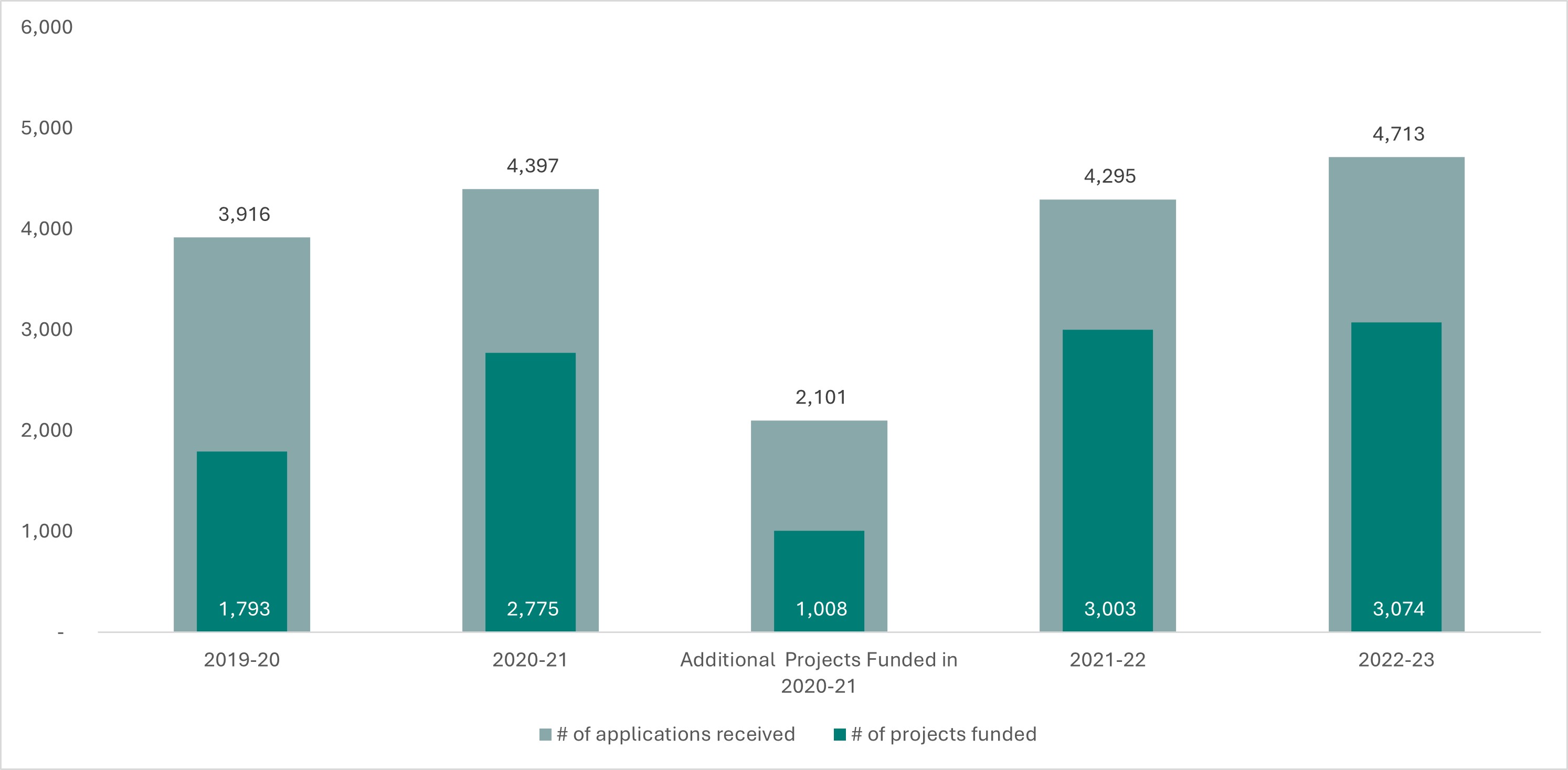
Source: Program Administrative Database
Figure 3: Text description
The bar chart compares the number of Community-Based Projects by applications and actual funding across multiple years:
Overall trend: Both applications and funded projects increased over time.
In the first year: 1,793 projects funded out of 3,916 applications.
In the last year: 3,074 projects funded out of 4,713 applications.
X-axis: Fiscal years; Y-axis: Number of projects.
Key insight: Funding approvals grew alongside applications.
Program stakeholders
The Program is jointly administered by National Headquarters (NHQ) and Regional Offices. NHQ provides overall direction and guidance to ensure consistent delivery across the country. Regional Offices oversee implementation at the regional level, including liaising with NHQ, supporting local offices, managing regional budgets, and conducting quality assuranceFootnote 14.
The Program also works with external stakeholders, which include funded organizations that deliver initiatives aligned with the Program priorities.
In the Pan-Canadian stream, backbone organizations lead and coordinate collective impact initiatives. As a result, they manage federal funding and sub-agreements with other organizations, support collaboration, and ensure strategic alignment, accountability, and sustainability of projects. Collaborating organizations receive funding from backbone organizations through sub-agreements to deliver project activities.
Partner organizations contribute time, expertise, and resources without receiving funding or holding sub-agreements. They can represent various organizations (e.g., private sector, municipalities, provincial and territorial governments, not-for-profits, community organizations).
In the Community-based stream, funded organizations commit to implementing approved projects that provide initiatives addressing senior's social inclusion needs.
Seniors aged 55+ are the primary target beneficiaries of the Program. Other stakeholders include the National Seniors Council, which provides advice on seniors' issues, and Members of Parliament, who promote program visibility and connect local organizations. These stakeholders work together throughout the Program lifecycle to support effective delivery and alignment with strategic objectives. See more details in Annex C.
Evaluation findings
This section presents the key findings of the evaluation. The findings reflect available data sources, with seniors' perspectives included where possible. Some limitations, such as reliance on organizational self-reporting and partial representation in senior interviews and surveys, were considered in the analysis. Although the evaluation relied on convenience and purposive sampling to recruit participating seniors and funded organizations representatives, it includes input from diverse range of stakeholders and case studies across regions, income levels, type of programming, immigration status, racialized population, levels of disability, linguistic families and other intersectionality related to diversity. Limitations and adaptation strategies are outlined in Annex B. Throughout the report, case studies refer to the Pan-Canadian stream only and the term "interview representative' encompasses interviewees from backbone organizations, collaborating organizations, and project partners from the Pan-Canadian stream.
Relevance
Finding 1: The aging population and various health and social indicators related to loneliness and social isolation points to ongoing need for this type of Program. Evidence also demonstrates that the Program remained relevant in responding to the evolving needs of seniors and funded organizations.
1.1 Demographic trends point to a growing population of seniors, with a high proportion living alone
Evidence points to an increasing number of seniors in Canada and the associated issues, such as social isolation and barriers to community participation.
According to Statistics Canada, approximately 7.6 million Canadians were aged 65 and older on July 1, 2023, accounting for almost one-fifth (18.9%) of the total populationFootnote 15. By 2030, seniors (65 and older) could represent from 21.4% to 23.4% of the total population in Canada (Population estimates, July 1, 2024Footnote 16).
The National Institute on AgeingFootnote 17 highlighted that nearly 19% of Canadian seniors reported experiencing loneliness in 2020. They felt a lack of companionship, being left out or isolated from others, while 30% of older Canadians were determined to be at risk of social isolation. Nearly one in four seniors reported barriers to social participation in 2019 and 2020, meaning they wanted to participate more in social, recreational or group activitiesFootnote 18. Those who reported barriers to social participation (38%) were almost three times as likely to feel lonely as those who reported no social barriers (13%)Footnote 19.
As noted by the Federal/Provincial/Territorial Working Group on Social Isolation and Social Innovation (2018) social isolation is linked to negative health outcomes, reduced quality of life, and loss of seniors' contributions to communities, including volunteeringFootnote 20. Certain groups of seniorsFootnote 21 are at higher risk of social isolation, exacerbated by social participation barriers, such as lack of transportation, challenges in accessing services, or limited community programs.
The Program has adapted to the evolving needs of seniors by providing and improving the support for initiatives to serve seniors and helping to reduce barriers to social inclusion. Additionally, funding enhancements were implemented in 2019-2020 and 2022 to enhance organizational capacity to serve this demographic.
Furthermore, the Program's funding model appears to reflect an effort to adapt to the evolving needs of seniors by promoting nationwide coverage and inclusive access to resources. This is supported by spatial analysis using NHSP communities, developed in response to a previous evaluation and based on 2016 population data. Table 1 illustrates the distribution of seniors and funded Community-based projects across provinces and territories, highlighting areas with higher concentrations of seniors and demonstrating alignment between resource allocation and demographic need.
| Provinces and Territories | Total number of projects (2019-20 to 2023-24) | Share of funded projects (%) | Share of seniors' population (%) | |
|---|---|---|---|---|
| Newfoundland and Labrador | 270 | 2.32% | 1.66% | |
| Prince Edward Island | 122 | 1.05% | 0.45% | |
| Nova Scotia | 407 | 3.49% | 3.00% | |
| New Brunswick | 331 | 2.84% | 2.46% | |
| Quebec | 3,012 | 25.85% | 25.30% | |
| Ontario | 3,978 | 34.14% | 37.48% | |
| Manitoba | 454 | 3.90% | 3.24% | |
| Saskatchewan | 401 | 3.44% | 2.78% | |
| Alberta | 989 | 8.49% | 9.42% | |
| British Columbia | 1,512 | 12.98% | 13.99% | |
| Yukon | 53 | 0.45% | 0.10% | |
| Northwest Territories | 75 | 0.64% | 0.08% | |
| Nunavut | 49 | 0.42% | 0.04% | |
Source: Statistics Canada. Table 98-10-0131-01 Marital status, age group and gender: Canada, provinces and territories and federal electoral districts (2013 Representation Order); NHSP administrative database
Additionally, the extent to which similar programs are offered at provincial and municipal levels were not explored due to scope of this evaluation.
1.2 All funded organizations who participated in the evaluation emphasized that Program support was essential in enabling organizations to deliver tailored activities that address seniors' specific needs.
All interviewed key informantsFootnote 22 (n=11) from funded Community-based and Pan-Canadian emphasized that the Program was instrumental in developing tailored initiatives that addressed the diverse needs of seniors by helping them offer adapted programming to seniors. This includes for example, creating bilingual resources and organizing virtual activities to facilitate access for seniors with reduced mobility.
Under the Pan-Canadian stream, documentation from all 8 case studies show that funded projects engaged seniors using a combination of outreach, program adaptation, and active involvement in planning and delivery. SomeFootnote 23 interview representatives across case studies (4 out of 8), and documents reviewed under one of these projects, noted that certain projects involved seniors in governance and program design, for example through participation in consultations or on advisory groups. These approaches were said to increase seniors' sense of ownership of projects and the responsiveness of the projects to seniors' needs.
"The NHSP funding has been crucial in facilitating various programs and events specifically designed for seniors, enabling the organization to address their unique needs effectively."
"Without the funding, the organization would not have been able to meet the needs of the seniors."
"NHSP funding fulfilled the need of seniors by supporting activities that allows them "to be seen, heard, and to participate in a way in which they feel valued."
AlmostFootnote 24 all respondents to the survey of funded Community-based organizationsFootnote 25, 99% (962/965), reported that the funds met their needs for implementing projects for seniors. Across all Program objectives, an average of 95% of these funded organizations stated that their projects would not have occurred or would have occurred on a smaller scale, without Program funding.
All key informants (n=3) from Community-based organizations that applied but did not receive Program fundingFootnote 26 indicated that although they were able to implement initiatives using alternative resources, the scope and scale of these efforts were on a smaller scale than initially planned. This demonstrates the complementary role the Program can play in enabling Community-based organizations to implement activities that meet the needs of seniors.
The Program was able to address seniors' evolving needs during the pandemic. The following section continues to demonstrate how the Program helped community organizations adapt their services to the needs of seniors and senior-serving organizations in the context of the distinctive challenges posed by COVID-19.
Finding 2: According to funded Community-based organisations, the Program enabled them to deliver projects that supported seniors and helped them reduce social isolation during COVID-19 in a flexible manner.
The COVID-19 pandemic significantly worsened social isolation and loneliness among Canadian seniors. According to pre-pandemic estimates from Statistics Canada, 12-20% of seniors reported feeling lonely and 12-30% felt socially isolated. During the pandemic, early surveys showed these rates rose sharply to 29-40% for social isolation and 33-51% for lonelinessFootnote 27. These sharp increases underscore the relevance and the need for funded initiatives, such as the NHSP during this period, as they helped mitigate the social consequences of the pandemic for older adults.
During COVID-19 pandemic, the Program was allocated additional funding to support seniors. $20 million was allocated to the Community-based stream, funding a total of 1,008 projects, and $9 million to the Pan-Canadian stream. While additional funding in 2020 under Pan-Canadian stream is out of scope for this evaluation, the report notes how projects without this funding, adapted their services to meet seniors' needs during the pandemic.
In addition to the heightened social isolation experienced by seniors during the COVID-19 pandemic, many older adults turned to technology to stay connected and engaged. By July 2020, 88% of seniors were using the internet daily, 65% owned smartphones, and 72% felt confident using technology. These figures highlight the growing importance of digital inclusion for seniors. However, some barriers (e.g., limited access to internet, lack of digital literacy and confidence, insufficient support, and concerns about privacy and identity theft) continued to hinder seniors' social participationFootnote 28.
ManyFootnote 29 key informants from Community-based organizations (4 out of 9) reported that some seniors, particularly in remote and rural areas, had limited access to technology, the Internet, and transportation during the pandemic. These barriers posed significant issues for some seniors, affecting their participation and access to health and social services, especially in rural areas.
The document review indicated that, in response to these challenges, the Program provided additional funding to Community-based organizations and allowed them to use these funds in a flexible manner to better meet seniors' needs. This flexibility enabled them to:
- transition in-person programs to virtual formats (e.g., Projects that provided digital devices and training to seniors, enabling them to participate in virtual events, maintain social connections, and access information)
- provide grocery and essential item deliveries (e.g., food and grocery delivery, hygiene and cleaning services)
- make phone calls to seniors who were isolatedFootnote 30
- allow organizations to extend the project timelines beyond the original deadlines due to pandemic-related circumstances
- offer health and wellness activities to marginalized members of community, provide classes, and workshops encouraging seniors to maintain their physical and mental health
SomeFootnote 31 interviewed key informants from Community-based organizations (2 out 9) highlighted that the additional funding and support was critical for sustaining their operations and continuing service delivery during the pandemic. They reported being able to effectively adapt by shifting to remote and virtual formats, including live-streamed programming and online mentoring, which broadened the reach of their projects and enabled seniors to stay socially connected from home.
Among survey respondents from Community-based organizations who received funding related to the COVID-19 pandemic, 95% (97/102) reported that their needs, as well as those of participating seniors, were well met by the Program.
Under the Pan-Canadian stream, the evaluation also found evidence from the document review and some interview representatives from the case studies that their projects pivoted and adapted their programming (e.g., by reducing in-person activities and/or introducing virtual delivery) to enable ongoing offerings to senior participants. For example, some projects reported that seniors faced reduced transportation options during the pandemic, which the Program support helped to mitigate by enabling organizations to adapt their delivery approaches.
Reaching vulnerable senior populations
Finding 3: Evidence demonstrates that the Program reached vulnerable senior populations across both the Community-based and Pan-Canadian streams. Reported challenges continue to limit the ability of some projects from effectively reaching vulnerable senior populations, particularly in rural regions.
The Program targets seniors aged 55 and over including vulnerable seniors who face barriers to social inclusion. These barriers may decrease access to supports and services. Examples of vulnerable seniors can include those who are immigrants, low-income, women, living in a rural or remote areas, identify as Indigenous Peoples, persons with disabilities, racialized persons, members of official language minority communities, or members of the LGBTQ2+ community.Footnote 32
In 2021-22 and 2022-23, project reports from organizations that received Community-based funding indicated that 74% of participating seniorsFootnote 33 aged 55 and over were among the primary beneficiaries of Program funding. For instance, in 2022-23, among beneficiaries of funded Community-based projects, 28% were seniors aged between 55-64 and 47% were 65 and over. As shown in Figure 4, some beneficiaries are not seniors due to the intergenerational nature of some funded activities.

Source: Performance data 2022-23
Figure 4: Text description
The pie chart illustrates the age distribution of beneficiaries from Community-based projects reported in 2022-23:
- largest group: Age 65+ (47% of beneficiaries)
- second largest: Age 55-64 (28% of beneficiaries)
- smallest group: Age 25-34 (3% of beneficiaries)
- purpose: To show which age groups benefited most from funded projects, highlighting that seniors (65+) were the primary beneficiaries
A review of performance data in 2021-2022 and 2022-2023 submitted by funded organizations under the Community-based funding streamFootnote 34 shows an increase in the number and share of projects targeting vulnerable groups of seniors (Figure 5). For example, in 2022-23, 71% of projects (n=1,622) focused on socially isolated seniors, up from 64% (n=1,485) in 2021-22, with similar trends for all other groups.

Source: Performance data 2021-22 and 2022-23.
Note: Projects were able to select multiple target population groups in their reporting. As a result, a single project may be represented in more than one category. Performance data prior 2021-22 unavailable.
Figure 5: Text description
The chart displays the percentage of targeted vulnerable senior populations reached by funded projects in two fiscal years (2021-22 and 2022-23):
- highest group: Socially isolated seniors - 71% in 2021-22 and 64% in 2022-23
- lowest group: Anglophones living in Quebec - 6% in 2021-22 and 3% in 2022-23
- other vulnerable groups are represented with varying percentages
- purpose: To show which vulnerable senior populations were most successfully reached, highlighting socially isolated seniors as the primary focus
Among vulnerable populations of seniors, data reported by funded organizations indicated that highest proportions were for socially isolated seniors, seniors with disabilities and those with low-income. This result aligns with the findings from the survey of Community-based organisations where 86% of respondents (756 out of 879) reported reaching socially isolated seniors, followed by 79% (698 out of 879) for low-income seniors, and 67% (587 out of 879) for seniors with disabilities.
For the Pan-Canadian stream, all eight-case studies demonstrate that Program funding enabled projects that offer seniors a wide variety of tailored activities and programming, to support their diverse needs. Interview representatives (organizations representatives) Footnote 35 reported that they enhanced existing programming and/or implemented new programming to better support seniors particularly, those facing barriers to social inclusion - such as, individuals living in a rural area, those low-income and/or culturally diverse seniors.
The majority of organizations who responded to interviews across the eight case studies and some senior respondents across 6 case studiesFootnote 36 indicated that each Pan-Canadian project experienced at least partial success in engaging vulnerable groups, highlighting efforts to customize programming for specific subpopulations of seniors including newcomers, members of the 2SLGBTQI+ community, and people living with dementia.
Despite those efforts mentioned above, project documents, as well as some interview representatives from four case studies and some senior respondents from three case studies, revealed ongoing challenges in reaching targeted populations, such as Indigenous seniors, those in rural areas, and individuals facing language, transportation or technological barriers.
Additionally, the majority of Community-based organizations (4 out of 7) stressed the need for consistent funding to address persistent barriers, particularly transportation and access to project venues, which continue to limit outreach and service.
"Transportation emerged as a primary challenge, particularly for seniors living in remote areas or on different land parcels. The project considered leveraging other grants to cover transportation costs, highlighting the need for strategic planning to overcome logistical hurdles."
Program outcomes
Finding 4: Community-based and Pan-Canadian projects contribute to increased seniors' participation in community activities by encouraging volunteerism and mentoring among seniors, facilitating social participation, and developing strategies to ensure seniors have access to information and services.
4.1 Community-based and Pan-Canadian organizations developed approaches to promote seniors' participation in community activities by recruiting seniors to take on volunteer opportunities via various channels including volunteers recruiting friends/peers, e-mails, and social media.
Volunteerism is a key component in supporting the delivery of Community-based initiatives for seniors. To help organizations attract and involve senior volunteers the Program provided funding strategies that enhance volunteer engagement and help, particularly through targeted supports for recruitment and retention.
Performance data from 2021-22 and 2022-23 submitted by organizations who received Community-based funding points to various outreach approaches were used to recruit volunteers, thereby contributing to promote volunteerism among seniors. In 2022-23, the most common methods reported by funded projects (as shown in Figure 6) included volunteers recruiting friends/peers (71%, 1,637/2,299), social media (51%, 1,165/2,299), and email outreach (50%, 1,146/2,299).

Source: Program performance data from 2021-22 and 2022-23.
Figure 6: Text description
The chart illustrates types of approaches used to recruit volunteers within Community-based projects:
- most common method: Recruitment through friends and peers (71% of projects reported use of this channel)
- least effective method: Email outreach (9%)
- other methods include social media, telephone, information sessions and workshops
- purpose: To show which strategies were most successful in attracting volunteers
Among Community-based organizations that participated in the survey, 76% reported implementing volunteer activities (730 out of 965), 690 reported that these activities would not have occurred, or would have taken place on a much smaller scale or with limited impact, without program funding. Furthermore, almost all of them (95% or 691 out of 730), indicated successfully meeting their project objectives, highlighting their capability to engage seniors through volunteerism. However, it is not possible to determine whether people would have volunteered in the absence of the Program.
Evidence from the selected Pan-Canadian case study projects also points to the implementation of volunteer recruitment strategies. Out of 8 selected projects, 4 used both traditional and digital methods such as advertisements, websites, phone calls, newsletters, and social media-to promote volunteerism.
Promoting volunteerism contributed to an increase in the number of seniors participating in activities.
Performance data submitted by organizations who received Community-based funding indicates that 57% of seniors (971, 051/1, 714,000) aged 55 and over benefited from projects as both volunteers and non-volunteers in 2022-23. This represents an increase of 31% from 2021-22 (n=742,949) as shown in Figure 7.

Source: Program performance data from 2021-22 and 2022-23.
Note: Not all projects had reports on age category frequencies. Volunteer-based calculation considered only projects that reported benefits for volunteers. Non-volunteering seniors refer to participants who took part in the project but did not serve in a volunteering role
Figure 7: Text description
The chart presents the total number of volunteering and non-volunteering seniors who benefited from Community-based projects, broken down by age group for two fiscal years (2021-22 and 2022-23):
- in 2021-22, the majority of both volunteering and non-volunteering seniors were aged 65+
- in 2022-23, the trend continued
- purpose: To highlight age distribution among seniors benefiting from projects
4.2 Funded organizations offered mentoring opportunities for intergenerational knowledge and cultural exchange, including digital learning workshops, financial seminars and recreational initiatives, contributing to senior's engagement in their community
Funded organizations are expected to develop projects that offer intra- and intergenerational engagement opportunities. These initiatives seek to enable seniors to share their knowledge and experience with peers and younger generations, fostering meaningful connections and ensuring that seniors feel valued and recognized within society.
Evidence from administrative data analysis of Community-based funded projects suggests that funded mentoring initiatives has increased over the evaluation period. Between 2019-20 and 2022-23, 32% (3,767/11,653) of all projects incorporated mentoring activities, with this proportion rising from 20% (n=364) in 2019-20 to 43% (n=1,308) in 2022-23.
Most interviewed representatives from funded Community-based organizations (7 out of 9) indicated that mentoring has emerged as a key objective under their project's organization. They emphasized creating opportunities for seniors to build technological skills (e.g. operating cameras and sound systems), enhance digital literacy (e.g., computer classes tailored for senior women), and participate in intergenerational knowledge and cultural exchange, particularly within Indigenous and multicultural communities.
Among seniors (end users) who responded to the survey, 61% (894 out of 1,472 seniors), reported having participated in mentoring activities. Of those, 56% (498/894) were mentees and 44% (396/894) were mentors.
Among Community-based organizations who participated in the survey and offered mentoring activities (505/965), 96% (485 out of 505 organizations) reported successfully achieving their projects objectives.
"We always create a committee of seasoned volunteer seniors as ambassadors to create activities, suggest ideas for presenters, bring ideas for outreach, and train other seniors to be mentors to new members. Seniors will plan topics for information sessions, workshops, financial seminars, virtual gatherings (for those unable to join), volunteering opportunities and mentoring activities."
This upward trend in mentoring-focused projects is reflected in performance data submitted by funded Community-based organizations, which shows a 4% increase in overall engagement in mentoring activities from 124,912 in 2021-2022 to 128,561 activities in 2022-23.
Among the 8 selected case study projects under the Pan-Canadian stream, 3 have engaged seniors in mentoring through various approaches, focusing on intergenerational engagement, coaching activities, and peer support.
4.3 The support provided by funded organizations contributes to increasing opportunities for seniors to participate in their communities
Beyond mentoring, funded organizations have developed strategies to support social participation through a wide array of activities. These include physical exercises such as yoga, along with singing, drawing, painting, and cooking classes. An analysis of administrative data indicates that from 2019-20 to 2022-23, 86% of funded projects (10,004/11,653) identified social participation as their objective. The focus on social participation aligns with the experiences of seniors, as most seniors (end users) who responded to the Community-based survey reported engaging in various social activities as detailed in Figure 8. Yet, it is not possible to determine whether seniors would have taken part in similar type of activities in the absence of the Program.

Figure 8: Text description
hereSource: Survey of Participating Seniors (End Users).
Note: Respondents could select multiple choices, so the percentages should not be totaled.
The chart illustrates types of social participation activities reported by senior survey respondents:
- most common activity: Recreational (e.g., sports, fitness classes) - 59% participation
- least common activity: Spiritual activities - 18% participation
- other activities include cultural and educational activities with varying levels of engagement
- purpose: To show which social activities seniors most frequently participated in through Community-based projects
All Pan-Canadian case studies (8) showed that the projects enhanced seniors' social participation either by offering new activities or expanding existing ones. Effective practices in developing social participation activities included catering to different interests, empowering seniors through enriching experiences, and leveraging partnerships to broaden engagement opportunities. Examples of such activities included wellness programs, book clubs, and intergenerational initiatives.
"For me, it was the socialization and getting out of the house. I live alone, so getting out of the house, socializing with other people, and meeting people [is important]. And I really enjoyed the interaction with the students. I do participate in the sage committee volunteer activities. And besides the exercises, they have a lot of other programs, such as trivia games, cards, and I participate in those a lot, and I really enjoy that."
Community-based organizations who responded to the survey reported an increased capacity to support seniors' initiatives. Most respondents (86%- 833/965) indicated an increase in social participation of seniors, 82% (795/965) expanded their ability to provide activities/programs that benefit seniors, and 61% (588/965) developed partnerships/networks to support community activities. This was supported by the performance data submitted by Community-based organizations, where 83% of projects reported increased senior participation in 2021-22, rising to 87% in 2022-23.
Most of participating seniors (end-user) who responded to the survey, 86% (1,271 out of 1,472 respondents), reported increased involvement in social activities during their participation in the projects. Additionally, 80% (1,180 out of 1,472 respondents) indicated improved access to community resources and services, with immigrant, Indigenous, and visible minority seniors reporting the highest levels of improvement (Figure 9).

Source: Survey of Participating Seniors (End Users).
Note: Respondents could select multiple choices, so the percentages should not be totaled.
Figure 9: Text description
The chart shows survey results from end users on whether vulnerable senior populations reported better access to community and services:
- highest group: Immigrants (90%) reported improved access
- second highest: Indigenous seniors (89%)
- other groups include visible minorities, low income seniors, persons with disability, and language minorities with slightly lower percentages
- lowest group: 2SLGBTQ seniors (73%) reported better access
- purpose: To highlight disparities in perceived improvements among different vulnerable senior populations
4.4 Case studies suggest that existing Pan-Canadian projects contributed to enhancing seniors access to information and services
Five (out of 8) Pan-Canadian project case studies showed that projects broadly contributed to increasing seniors' access to information, resources, programs, and services to varying extents. Projects reviewed relied on different approaches and strategies, including utilization of traditional information sharing channels (e.g., posting on bulletin boards, community meetings and newsletters) and access to virtual resources. For example, one project created "Minute ads" on the radio to help seniors stay connected during the pandemic, while another developed a shared directory of community services and resources to facilitate information access for rural Francophone seniors.
Among the Pan-Canadian project case studies (3 out of 6), some participating seniors interviewed experienced improved access to information that not only helped them obtain services they needed, but also ensured they stayed connected, engaged, and empowered. A few interview representatives from funded organizations (backbone organizations, partners) across three case studies said that cross-promotion and resource sharing created a "snowball effect" that expanded outreach. Documents and several interviewees indicated that three projects developed virtual resources, while two projects engaged outreach workers to ensure seniors received information in accessible formats (e.g., virtual, in-person, phone) and through local channels.
Finding 5: Responses from funded organizations and senior participants in Community-based and Pan-Canadian funded projects highlighted that involvement in volunteer, mentoring, and social participation activities contributed to social inclusion for seniors, including social connections, a sense of belonging, well-being, and quality of life.
According to the Performance Information Profile, reducing barriers to social participationFootnote 37, providing activities related to volunteerism, offering opportunities for mentoring and social participation, all contribute to social inclusion. Social inclusion creates the conditions for individuals to engage meaningfully in economic, social, political, and cultural lifeFootnote 38, fostering social connectionsFootnote 39 and a sense of community belongingFootnote 40, that enhance well-beingFootnote 41 and quality of lifeFootnote 42.
These outcomes are shaped by both material and non-material factors, including dignity, participation, and social engagementFootnote 43. Evidence suggests that seniors involved in these activities reported great satisfaction, strong sense of achievement and purpose, feeling recognized for their contributions and being less socially isolated. In turn, these activities would be expected to support seniors' social inclusion, sense of belonging, and overall well-being.
Performance data submitted by funded Community-based organizations shows that, in 2022-2023, 84% (1,930/2,299) of funded projects reported that the greatest satisfaction of senior volunteers came from contributing to their communities, 78% (1,783/2,299) experienced a strong sense of personal success and achievement, and 61% (1,404/2,299) felt recognized for their contributions. Similar observations were reported by many (4 out of 9) of interviewed representatives from Community-based organizations indicating that seniors became more active and visible within their communities, often stepping into leadership or representative roles, especially when internal resources were limited.
"Among all the activities I have participated in, serving as a volunteer and mentor has had the most significant impact. These experiences have not only allowed me to contribute positively to the lives of others but have also profoundly influenced my personal growth. Through volunteering and mentoring, I have developed valuable skills, gained deeper insights into the needs of my community, and helped foster a supportive environment for those I work with. The roles have been transformative, enabling me to make a meaningful difference while also enriching my own understanding and empathy."
Participating seniors who responded to the Community-based survey substantiate this finding by reporting personal benefits associated with their involvement in volunteer and mentoring activities as shown in Figure 10.

Source: Survey of Participating Seniors (End Users).
Note: Respondents could select multiple choices, so the percentages should not be totaled.
Figure 10: Text description
The chart compares perceived benefits of participating in Community-based volunteering and mentoring activities, based on end-user survey responses:
- top benefit: "I felt good about helping seniors in my community", reported by 86% end users for mentoring, 85% for volunteering
- other benefits include:
- "Achieved goals and felt proud of what I accomplished."
- "I was acknowledged for things I did."
- lowest category: "Other" with 6% for volunteering, 4% for mentoring (reverse order compared to other categories)
- purpose: To compare what aspects of participation in mentoring and/or volunteering activities were considered more beneficial
These results suggest that participating in volunteering, mentoring or social participation activities contribute to positively affect seniors' social inclusion.
This is also supported by the performance data submitted by funded Community-based organizations in 2021-2022 and 2022-2023, which points to the highest share of projects seeking to reduce social isolation (86% in 2021-2022 and 89% in 2022-2023) as shown in Figure 11.
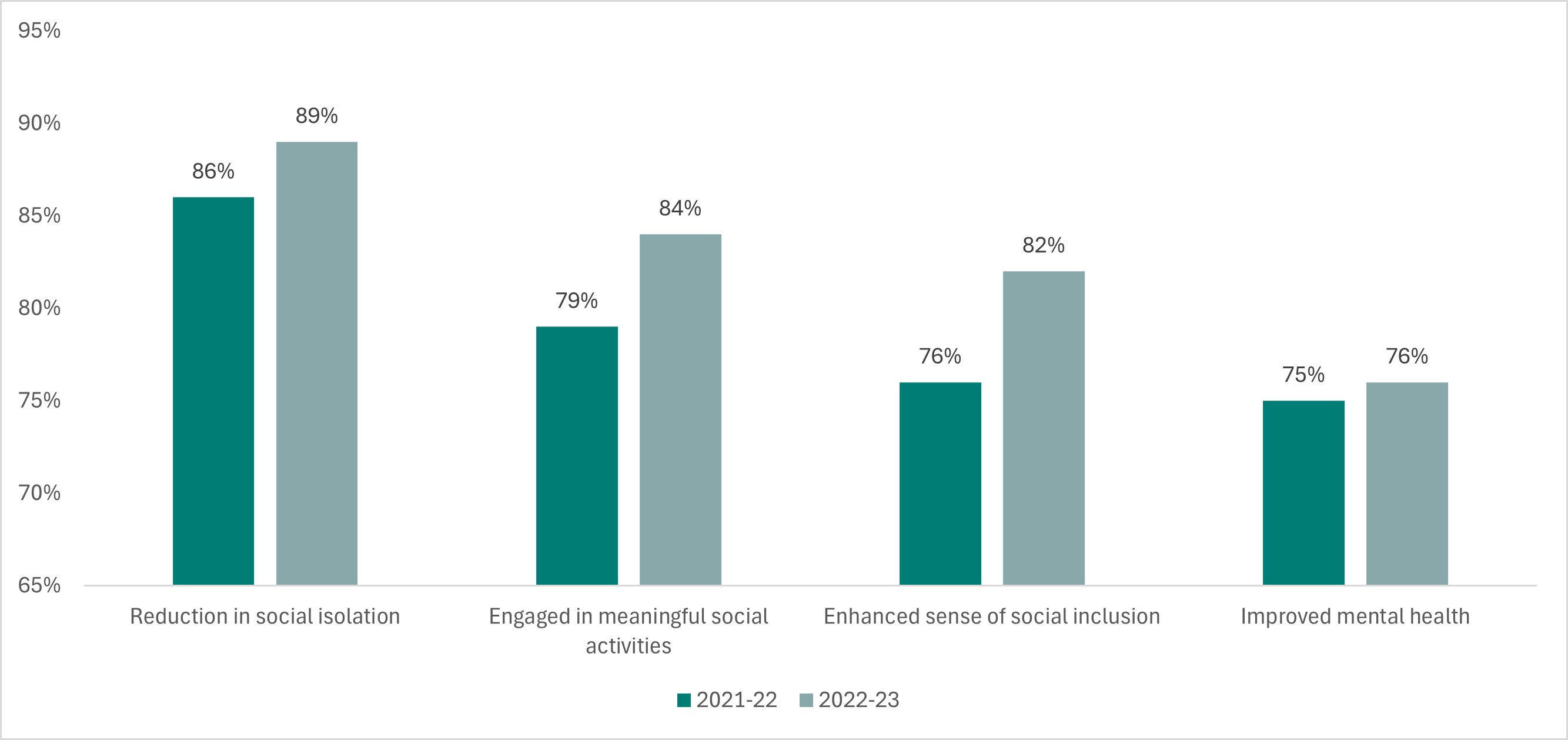
Source: Program performance data from 2021-22 and 2022-23.
Figure 11: Text description
The chart shows benefits to participating seniors in Community-based projects, measured by the percentage contributing projects, across two fiscal years:
- reduction in social isolation was reported by 89% of projects in 2022-23, the highest-rated benefit
- improved mental health was reported by 76% of projects in 2022-23, making it the lowest-rated benefit
- other benefits include engagement in meaningful social activities and enhanced sense of social inclusion, with varying percentages
- purpose: To highlight which outcomes were most frequently reported by projects over two year period
In addition, participating seniors who responded to the Community-based survey and interviewed seniors from five of the six Pan-Canadian case studies reinforced the connection between taking part in community activities and the positive results related to seniors' social inclusion, sense of belonging and quality of life:
- social Inclusion: 89% (1,316/1,472) of senior respondents stated that funded projects enhanced their social inclusion, which helped reduce feelings of isolation. Notably, 86% (229/266) of low-income seniors reported feeling less socially excluded after engaging in funded activities
- sense of belonging: 93% (1,364/1,472) senior respondents felt more connected to their communities, and 91% (1,333/1,472) reported a stronger sense of belonging since participating in Program activities
- quality of Life: 82% (1,203/1,472) of senior respondents indicated that these activities improved their well-being. Relatedly, 90% of funded organizations who responded to the survey (871/965) reported that their activities improved seniors' well-being
The survey asked seniors how their participation in NHSP-funded activities made a difference in their life:
" Socialization, improvement in my physical mobility, decreased feeling of isolation and loneliness, helped meeting old friends and new friends as well. "
"Firstly, it improved our mental wellbeing by helping us feel connected with others. This in turn helped with our general health and decreased the feeling of isolation, especially as elders. Some of us are alone and this gave an opportunity to such members to participate and enjoy events that they would not normally do as single elders. So, thank you NHSP for the funding that allows us these programs and benefits."
"Felt a sense of belonging in my community, felt less lonely by making new friends and learned new skills. Work out sessions helped me a lot in feeling more active."
"[The Program] gave me a sense of belonging - I made new friends and met new people. It gave me a sense of independence and improved my mental health. I am grateful. I picked up new hobbies and always look forward to times to volunteer for events and charity events. It gave me a sense of commitment and purpose."
Enhancing seniors' access to information and services (as stated in section 4.4), contributed to reducing social isolation among seniors, especially for vulnerable seniors' groups. Five Pan-Canadian case studies (out of 8) reported positive effects. For example, in one of the selected case study projects, survey data conducted by the Pan-Canadian organization showed that 86% of participants felt less isolated, while another project reported a decrease in self-reported social isolation observed in the early stages of implementation from 24% in 2021 to 17% in 2024. Seniors who provided feedback to the Pan-Canadian case studies expressed confidence and pride in their contributions, noting that such opportunities helped provide a platform for seniors to voice concerns and contribute to identifying solutions for social connections.
Finding 6: Projects that included capital assistance helped senior-serving organizations improve access to program initiatives by repairing physical infrastructure or purchasing equipment. Data shows a decline in the number of applications received and in the total funding invested in capital assistance.
Program funding also aims to provide Community-based organizations with capital assistance to enhance their physical infrastructure, such as building, expanding, or repairing facilities, as well as purchasing equipment. These improvements are intended to strengthen the organizations' capacity to deliver program activities to seniorsFootnote 44
According to administrative data analysis, from 2019-20 to 2022-23, a total of 4,091 (out of 11,653) projects, representing 35% of all funded initiatives, included capital assistance projects. In 2019-20, 48% of projects (n=857) received capital assistance out of 1,793 total funded projectsFootnote 45. By 2022-23, the number of funded projects that selected capital assistance objective increased to 1,001. However, in terms of their proportion relative to the total number of funded Community-based projects, their share declined to 33% (1,001/3,074). Figure 12 presents trends in the number of funded projects that included capital assistance and projects under other primary objectives from 2019-20 to 2022-23.

Source: Admin data of 11,653 funded Community-based projects.
Figure 12: Text description
The chart shows annual comparison of funded projects with capital assistance versus projects funded under other primary objectives:
- capital assistance projects show slow growth over time
- projects funded under other objectives remain higher overall, and their proportion increases
- a noticeable dip in 2020 reflects one-time COVID-19 funding
- purpose: To illustrate trends in funding and the relative share of capital assistance projects compared to other objectives
The document review and all interviewed experts suggest that rising construction and labour costs have reduced the purchasing power of the available funding amount, which is up to $25,000. Performance data from available project completion reports (Figure 13) confirm that 47% of funded projects in 2021-22 and 39% in 2022-23Footnote 46 included capital assistance, indicating a decline in the proportion of projects with this objective.

Source: Performance data from 2021-22 (total of 2,308 projects) and 2022-23 (total of 2,299 projects).
Note: Not all projects submitted final reports, and not all available data could be used for analysis, affecting the reported proportions.
Figure 13: Text description
The chart shows the number and percentage of projects that reported receiving capital assistance funding over two fiscal years:
- in 2021-22, more projects reported receiving capital assistance - 47%
- in 2022-23, the number and percentage of projects receiving this funding declined to 39%
- purpose: To highlight the decrease in capital assistance funding reported by projects between the two years
Evidence indicates that capital assistance continues to play a role for some organizations. A few interviewed Community-based funded organizations (2 out of 9) indicated that capital assistance continues to enable meaningful infrastructure additions and improvements. These improvements include enhancing access to facilities and services for seniors. Additionally, among the 965 Community-based organizations surveyed, 25% (n=244) reported using capital assistance for building or repairing infrastructure, or for purchasing or upgrading equipment. Despite the findings, it is not possible to determine if these improvements would have taken place in the absence of the Program.
«Rénovation majeure de la salle devenue multi fonctionnelle à la suite de la rénovation. »
"Purchased specially designed 'bikes' to take people with mobility challenges and requiring wheelchairs for bike rides."
"We built a longer ramp for wheelchair patrons, as well as an automated door for easier access to the facility. We had a ramp before but not according to a standard code. This one is much better, and wheelchairs and walkers are able to safely enter the building. We appreciate the help of NHSP for accomplish this."
"Further deterioration of the building, which would not have helped, and the community would have had to do more fund raising to provide the funds for the project. By that time the roof would have further deteriorated."
Finding 7: The document review, performance data and survey results indicate that increased elder abuse awareness through targeted initiatives combined with improvements in access to program initiatives contributed to empowering participating seniors and reducing barriers to social inclusion.
7.1 Community-based organizations helped raise elder abuse awareness among seniors through a range of initiatives, including safety workshops, and wellness activities.
Analysis of administrative data indicates that the Program provided funding to 1,692 (14%) projects to address elder abuse from 2019-2020 to 2022-2023. Of these, 11% focused on elder abuse as a primary objective (1,305/11,653) and 3% as a secondary objective (387/11,635).
In 2021-22 and 2022-23, funded projects primarily focused on addressing financial abuse, followed by neglect and psychological abuse, as seen in Figure 14. Activities implemented by funded organizations included:
- one-on-one, remote, and group sessions aimed at helping seniors navigate electronic devices. These sessions aimed to improve digital literacy and covered essential topics such as fraud prevention and safe browsing practices
- initiatives featured literacy afternoons, monthly community lunches, creative series, and workshops focused on elder abuse. These programs intended to empower seniors to identify fraudulent communications and protect themselves from psychological and financial abuse
- wellness initiatives, including exercise classes, nutritional counseling, and mental health support, aimed to promote overall well-being and prevent neglect among seniors

Source: Performance data from call for proposals 2021-22 and 2022-23.
Note: Percentages based average for 2021-22 and 2022-23 and on number of projects that reported- having activities that increased awareness of elder abuse. Projects could address multiple types of elder abuse. Missing values for each type available upon request.
Figure 14: Text description
The chart shows types of elder abuse addressed through the Program, based on two years of performance data:
- addressing financial abuse was reported most frequently at 77% in the later year
- other categories include psychological abuse, physical abuse, sexual abuse, and neglect, in ascending order
- "other" category was the lowest at 13%
- purpose: To highlight which forms of elder abuse were most commonly addressed by funded Community-based projects
Performance data submitted by funded Community-based organization suggests that, through these elder abuse awareness initiatives, funded projects collectively reached 550,902 individuals over two years, 233,376 in 2021-22 and 317,526 in 2022-23, representing a 36% increase in outreach.
Among Community-based organisations focused on elder abuse awareness and who responded to the survey, 93% (279/301 organizations) reported successfully achieving their project objectives, highlighting how these funded activities can play a role in organization raising awareness of elder abuse among seniors.
7.2 By raising awareness on elder abuse and improving access to program initiatives, funded projects contributed to empowering seniors with the knowledge to protect themselves and to reducing barriers to social inclusion
Projects aiming at increasing elder abuse awareness and use of the capital assistance, may have contributed to reduction of barriers to social inclusion, as indicated in the Program's logic model. According to program documents, reported projects sought to improve access to initiatives as well as seniors' safety, comfort and well-being, leading to greater social interaction. Moreover, among Community-based organizations who received funding for a capital assistance project and responded to the survey, 93% (226/244) reported that their accessibility improvements initiatives contributed to reducing barriers to social inclusion. Similarly, 92% (276/301) of organizations that implemented elder abuse awareness activities responded that their projects contributed to reducing barriers to social inclusion.
Seniors' perspectives highlight the benefits of these initiatives and their contribution to reducing barriers to social participation. Among seniors who highlighted physical accessibility issues and transportation challenges, respectively 93% (14 out of 15) and 84% (155 out of 184) reported experiencing fewer barriers to their participation, as shown in Figure 15.

Source: Survey of Participating Seniors (End Users).
Figure 15: Text description
The chart shows end-user perceptions of reduced barriers to social inclusion, comparing challenges encountered with barriers addressed:
- transportation-related problems were reported most often (184 respondents) and also most addressed (155 seniors)
- location not accessible was the least mentioned barrier (15 reported, 14 addressed)
- other categories include Personal or family responsibilities, Location too far, Cost, Unsuitable timing, Language and Lack of information
- purpose: To highlight which barriers were most common and how effectively they were addressed by Community-based projects
Furthermore, among participating seniors (end users) who responded to the Community-based survey and who faced challenges in participating in community activities and took part in elder abuse awareness initiatives, 83% (135/163) reported experiencing a reduction in barriers to participation.
Finding 8: While it is early to assess its effect on long-term sustainability, interviewed organization representatives reported that the collective impact model (CIM) implemented for Pan-Canadian projects has strengthened long-term collaboration among organizations, thereby fostering potential continuation of activities beyond the funding period.
For the purpose of this evaluation, sustainabilityFootnote 47 refers to the ability of funded initiatives to continue operating beyond the Program funding period. This includes predictable funding that extends beyond short-term or one-time projectsFootnote 48, building strong partnerships, and promoting the exchange of knowledge and resources. These elements help senior-serving organizations maintain consistent service delivery over time.
8.1 The implementation of collective impact plans has supported Pan-Canadian organizations in enhancing collaborative efforts across sectors.
Under the Pan-Canadian stream, Program funding arrangements supports longer-term projects, allowing organizations to receive funding for initiatives lasting up to five years. This is supported through the collective impact model (CIM), specifically designed for the Pan-Canadian stream, which aims to enhance cross-sectoral collaboration between backbone organizations and other funded organizations by aligning them around a common goal of promoting social inclusion.
From 2019-20 to 2022-23, program documents revealed that 17 out of 22 projects implementing collective impact plans had been completed at the time of this evaluation relative to 9 organisations back in 2015-16.
Among all 8 selected Pan-Canadian case studies, funded organizations emphasized that this structured collaborative approach is essential for projects' success and long-term sustainability. However, given the funding period of the 8 selected case study projects, it is too early for the evaluation to determine whether the collective impact model supported the continuity of seniors' initiatives beyond the funding period. In particular, among selected case study projects, 6 were ending in the third and fourth quarters of 2024 and 2 in the first quarter of 2025.
Nevertheless, among the 8 selected case study projects, 2 interviewed funded organizations pointed to some activities continuing beyond the funding period.
As found through the selected case studies, the majority of funded organizations discussed only the "potential" for sustainability by outlining their intention to pursue specific sustainability efforts through various strategies, such as fostering ongoing partnerships, integrating initiatives into existing programs, developing sustainability plans and tools, and pursuing new funding sources. However, the extent to which activities will be maintained varies. Some projects aim to fully sustain activities (n=4), while others intend to continue delivering some components (n=3).
As well, funded organizations interviewees and document reviews from 4 case studies showed that many of the partnerships are anticipated to endure beyond the project's duration. To this end, some funded organizations interviewees from the 4 case studies highlighted that the combination of Program funding and the Collective Impact Model (CIM) reinforced their capacity to effective coordinate their efforts and collaborate with other parties in addressing the complex social challenges faced by seniors.
"Across Atlantic Canada, the (Pan-Canadian) funding facilitated the development of over 630 partnerships involving organizations from varied sectors, all aligned by the common goal of improving the social inclusion of Francophone seniors in official language minority communities."
"The Program's use of the collective impact approach and emphasis on community collaboration ensures that more organizations work together and build stronger ties in the service of seniors which helps lead to the implementation of more effective strategies tailored to the unique challenges faced by local seniors".
8.2 Although sustainability is not a core objective for the Community-based organizations, experts as well as interviewed and surveyed Community-based organizations have pointed out challenges to sustaining senior services due to reliance on short term and maximum funding limit.
The Program does not require Community-based funding recipients to plan activities beyond the end of their funding period. Interviewed Program officials noted that the Program Community-based stream focuses on short-term projects, typically lasting one year without a continuation plan.
Funded organizations and experts highlighted that the existing one-time funding model restricts Community-based organizations from developing long-term initiatives aimed at supporting seniors. In interviews with Community-based organizations, 3 out of 7 respondents indicated that the current grant funding model, which provides up to $25,000 for a single year, limits their capacity to implement multiple larger projects that could offer lasting benefits to seniors. For instance:
- 2 out of 7 funded organization intervieweesFootnote 49 emphasized that the one-year timeframe is insufficient to develop and implement projects that will yield long-term benefits. This was supported by all the three experts consultedFootnote 50
- 1 out of 7 funded Community-based organization and all interviewees from unfunded organizations (n=3) confirmed that financial constraints can affect their plans and implementation of projects
- all interviewed experts (n=3) highlighted the insufficiency of the Community-based streams' maximum funding amount to execute projects in an environment with rising costs
One criticism we could make about this program is whether it would be possible to have grants that allow us to continue promising projects beyond a single year. While one year may seem sufficient elsewhere, that's not the case in NHSP. Also, I know that the $25,000 funding amount has remained the same for many years. Considering inflation, this amount is not much. Project coordinator salaries are increasing, so with $25,000...
"Yes, the funding of projects now has to be supplemented with more volunteers and fund raising. Costs have gone up for food, rental spaces and all other expenses but the maximum funding for this very necessary grant is still tapped at 25K."
"Additional funding is needed to continue the project for at least three years. The demand from seniors for this initiative was high, but we were unable to continue the workshops due to a lack of financial resources. To achieve meaningful results and reach more seniors, the project needs to become sustainable."
Program design and delivery
Finding 9: The Program implemented delivery improvements, such as streamlined application and funding allocation processes, extended project timelines, and enhanced support to applicants, making the Program more accessible and inclusive. However, some applicants still encounter challenges with application requirements and navigating the online portal.
9.1 The document review reveals that the Program used data and stakeholder feedback, including input from MPs and funded organizations, to propose and implement design changes in both funding streams.
According to the document review, the Program implemented several delivery improvements aimed at enhancing the reach of program funding and promoting inclusivity. These included adjustments to the funding model to ensure national coverage, updates to the assessment grid to prioritize vulnerable populations, and an increased emphasis on strong community supportFootnote 51.
In the Pan-Canadian stream, the shift from a Call for Proposals to a Call for Concepts streamlined the intake process; while extending project timelines from 3 to 5 years the Program also introduced a third-party funding redistribution model to support backbone organizations in achieving collective impact.
Evidence from the document review indicates that the Program used internal (e.g., lessons learned report from Pan-Canadian stream), external data (e.g., HUMA report) and stakeholder input (e.g., engagements with MPs and funded organizations) to inform program design changes and support 2019-20 funding request. Specific changes to the Program components of both streams are described below:
- Community-based stream
- The Program used application data and final reports to inform outreach to communities that historically submitted fewer applications
- Ministerial memos showed that external data (e.g., Statistics Canada) and stakeholder input led to simplified application forms and the addition of new questions to prioritize projects for vulnerable and rural seniors
- Funding distribution zones were introduced based on Statistics Canada data, national priorities, and recommendations from HUMAFootnote 52 and the FPT ForumFootnote 53, improving access and equity of funding distribution
- Pan-Canadian stream
- Lessons from Cohort 1 informed Cohort 2's funding process, including a Call for Proposals that reduced application burden
- Cohort 3 benefited from longer project durations (5 years) with larger maximum funding enveloped (up to $5 million), based on stakeholder consultations and progress discussions
To further support applicants, the Program enhanced outreach and communication efforts. These included hosting information sessions, sending targeted emails to organizations serving vulnerable populations (e.g., seniors with physical disabilities or limited mobility, visible minorities, Indigenous peoples, as well as 2SLGBTQI+ groups). Additionally, to address barriers related to digital literacy, language, and internet access, supports such as multilingual resources (e.g., translation to indigenous language), sample answers to clarify requirements, workshops on completing applications, and alternative submission methods were introduced. These efforts were particularly beneficial for smaller organizations and those serving remote or diverse communities. Interviewed organizations expressed satisfaction with the support received, and the Program demonstrated a commitment to continuous improvement in delivery in both streams.
These changes appear to have improved the application process, based on direct feedback collected by the Program from funded organizations and stakeholders. According to Community-based organizations survey, an average of 87% (N = 842 out of 965) of respondents reported satisfaction with their experience of the Program's administrative process changesFootnote 54, as illustrated in Figure 16.
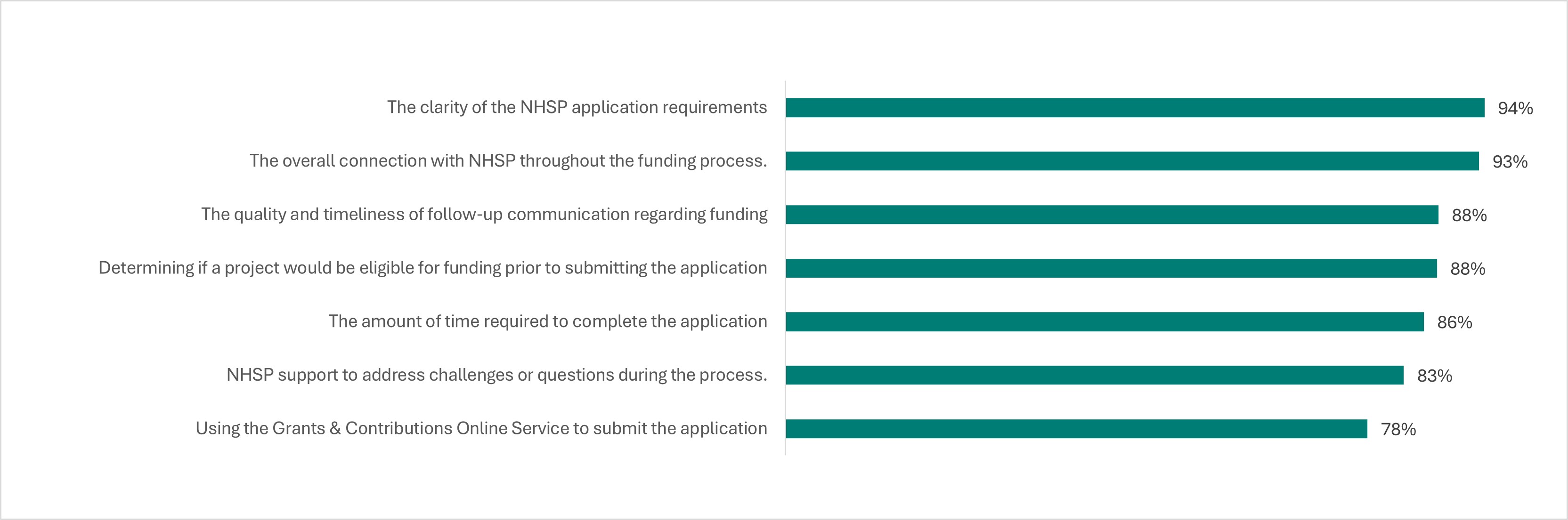
Source: Survey of Community-based Organizations.
Note: Respondents could select multiple choices, so the percentages should not be totaled.
Figure 16: Text description
The chart shows organizations' level of satisfaction with various administrative aspects of the Program, based on survey responses:
- clarity of NHSP application requirements: 94% satisfied (highest score)
- overall connection with NHSP from application to reporting: 93% satisfied
- lowest satisfaction: Using the Grants and Contributions Online Service to submit applications
- purpose: To highlight which administrative aspects were most and least satisfactory for participating organizations
9.2 Despite support measures, some organizations continued to face challenges during application process, including complex forms, online navigation issues.
Despite these improvements noted under 9.1, some funded organizations reported challenges at the application and program delivery stages. These included some surveyed and interviewed Community-based organizations expressing dissatisfaction with lengthy and complex applications, and difficulties navigating the online portal.
Within the Community-based stream, among interviewed applicants, 3 out of 7 reported difficulties with lengthy and complex application forms, navigating the online portal, and delays in funding decisions. These issues were further reflected in survey results, where 72% of Community-based organizations (694 out of 965) identified proposal writing as the most significant challenge-particularly for capital assistance projects. Additionally, 12% (120/965) expressed dissatisfaction with the time required to complete the application, and 11% (105/965) cited problems using the online submission service.
« Le défi est de compléter et d'amener tous nos arguments afin d'être admis. Les formulaires sont assez exhaustifs pour nous bénévoles qui n'avons pas toujours les mots justes pour justifier nos demandes. Mais nous y avons réussi malgré les heures que nous ne comptons pas. »
"We didn't receive an information on why exactly our application was denied or no one provided us with any insight as what we should do to make changes that might give us a better result."
« Avec les années, la demande de financement à votre programme est de plus en plus difficile à faire et en décourage plus d'un. Vous semblez oublier que les demandes sont souvent faites par des bénévoles âgés et que vos questionnaires volumineux en découragent plusieurs. J'ai rempli plusieurs demandes de financement et d'année en année ça devient plus ardu et stressant il ne faudrait pas oublier que ce programme s'adresse à des ainés bénévoles et pas toujours habitués à remplir toute cette paperasse. Merci »
In the Pan-Canadian stream, 6 out of 8 selected case studies found similar challenges related to the application process and funding decisions. Additionally, 3 case studies pointed to the need for clearer communication and more consistent support.
"Some aspects of reports required detailed explanations (e.g., each sub line in budget), whereas others only broke down spending into a few categories (e.g., quarterly claim forms). We did not understand why certain items were under more scrutiny than others."
With regards to the Program delivery stage, organization representatives (2 out of 8 selected case studies) expressed the need for more consistent meetings of the Community of PracticeFootnote 55, and improved support.
Monitoring and reporting
Finding 10: The Program has improved data organization and document clarity, which helps inform program performance. However, data quality issues, lack of program outcome targets and the limited number of revisions of these targets impede the ability to fully assess program performance.
10.1 The Program provides standardized final report templates and has improved documentation practices, including clearer labeling and streamlined data collection confirmed through file and data review.
Document reviews confirm that tailored templates are proactively shared with funded organizations under both Program streams to enable data collection. Under the Pan-Canadian stream, a common final report template was developed to standardize data collection. The reports are expected to include output and outcome measures, as well as reporting on partnerships and sustainability of results. Tailored reporting templates and ongoing communication between ESDC and backbone organizations are being implemented to improve data collection and annual reporting efficiency. Cohort 2 (Call for Concepts 2019-20), consisting of 22 projects with project agreements up to 5 years, appears to further benefit from an enhanced performance measurement approach, with activity and final report templates provided from the start of projects, based on stakeholder consultations, lessons learned reports, and ongoing progress conversations with backbone organizations.
Under the Community-based stream, reporting templates includes key indicators, such as targeted populations, objectives, volunteer involvement, and demographics, enables funded organizations to document their completed activities and the reach of their initiatives.
The analysis of the current performance database of Community-based projects suggests that many Community-based organizations have the ability and capacity to track and report on their project results. In total the Department received 93% of final reports in 2021-22 (2,782/3,003), and 92% of final reports in 2022-2023 (2,831/3,074). However not all organizations submitted fully completed final reports, performance data indicates that 75% (2,299 out of 3,003) of funded organizations in 2022-23 and 77% (2,309 out of 3,074) in 2021-22, submitted a complete final report following the conclusion of their projects. They also provided progress reports when solicited. The Program began compiling performance data from Community-based projects' reports with two years of compiled data available at the time of the evaluation. These improvements allow for more systematic performance monitoring and will enable more refine analysis in future evaluations.
The Program has improved documentation practices, including clarity of labeling, and continues to enhance data collection methods by revising templates with GBA Plus-related fields and clearer questions, and introducing the Interactive Fact-Finding Service online submission form to streamline reporting and reduce manual processing.
10.2 The data review revealed limitations in performance data quality
While the PIP program includes performance measurements, the data review revealed several limitations.
Although the Program's Terms and Conditions mandate grant recipients to share information on results achieved for performance measurement and departmental reporting as needed, the Community-based organizations that receive funding are not obligated to complete every section of their final project report template, or to demonstrate how their project activities contributed to the Program's intermediate outcomes. If the Program could receive completed final reports for all projects of the Community-based stream, this would contribute to enhancing program performance measurement and reporting. While it is not mandatory for funded organizations, per the Directive on Transfer Payments to provide final reports for grants, the Department does enforce submission of final reports. However, various factors can hinder an organizations' capacity in completing their final report beyond the Program's control, such as limited resources, insufficient staff expertise, and time constraints, which sometimes can also lead to inconsistencies in the reported data across reports.
A common issue faced by grants and contributions programs is their dependence on self-reported data from organizations. In the Pan-Canadian projects stream, where final reports are mandatory, the significant dependence on self-reported data can lead to biases or generate an overly optimistic view of performance, which can cause difficulties in verifying the accuracy of the information provided.
The current clauses in the contribution agreement only allows the funded recipient to collect and report information on behalf of the seniors, collaborative and partners organizations, limiting the ability of the Program to contact participating seniors for direct feedback. This would be valuable in assessing the Program performance towards its immediate, intermediate and ultimate outcomes. Overall, this limitation affects the quality, breadth and reliability of the data collected from funded organizations, potentially impacting the accuracy of project reporting.
While the evaluation was successful in gathering information from participating seniors and in part address this data gap, limitations remain in fully assessing the extent to which the Program influences seniors' social inclusion and, consequently, their quality of life and well-being.
10.3 The targets in the Program's PIP are not periodically revised for the Community-based stream and incomplete for the Pan-Canadian stream. Furthermore, the Program's zone designations are also out of date.
The Program's performance indicators outlined in the Performance Information Profile (PIP) include targets set for fiscal years 2019-20 and 2020-21. Targets for the Community-based stream did not reflect changes to the Program's scope including its increased budget and number of funded projects observed over the evaluation period (see detailed example in Table 5 - Annex B.) Additionally, for several outcome-level indicators, including the number of senior beneficiaries reporting increased social participation and the inclusion of vulnerable populations, their targets remain the same over the evaluation period.
For the Pan-Canadian stream, the PIP does not have established targets dates. This limits the Program's ability to consistently track progress over time or compare current performance against defined targets.
Given limited use of targets, the Program will have difficulty determining long term progress for many of the outcomes referred to in the logic model. For example, what percentages of participating seniors are expected to experience reduced barriers to support their social inclusion? What percentage of projects are expected to be sustained after the funding period? Having these documented percentages and results will allow the Program to assess results against targets on an annual basis.
Finally, the Program zone designations used for funding allocation are based on the 2016 Census data, which may less accurately reflect the current distribution and demographic realities of seniors, limiting the Program's ability to fully respond to actual needs.
Management response and action plan
Overall management response
Thank you to all members of the Evaluation Advisory Committee and the Evaluation Working Group for their valuable contributions to this evaluation of the New Horizons for Seniors Program (NHSP).
Launched in 2004, the NHSP supports the Government of Canada's overarching goals to enhance the quality of life and promote the full participation of individuals, including seniors, in all aspects of Canadian society by supporting projects that engage seniors and address seniors' issues. It supports the Department of Employment and Social Development's (ESDC) core responsibility of social development, which aims to increase inclusion and opportunities for the full participation of Canadians in their communities.
The NHSP is a grants and contributions program that supports projects aimed at increasing the social inclusion and wellbeing of seniors and combatting social isolation. Evidence of the need to combat social isolation has never been stronger. Studies have shown the health risks from social isolation are comparable to smoking daily, excessive drinking and obesity. This evaluation's findings show that NHSP is helping organizations combat social isolation. In so doing, the Program is having a positive impact on the lives of seniors, the organizations that serve them, and their communities.
The Program supports the role that communities and not-for-profit organizations play in helping seniors' wellbeing and providing these organizations with the tools and skills to respond to current and emerging issues. By supporting a variety of activities under both streams, the Program seeks to strengthen communities while addressing the diverse needs of Canada's aging population.
Community-based grants are supported by communities, inspired or led by seniors, and often volunteer-based. Pan-Canadian projects are generally multi-year contributions, and address the social inclusion of seniors through partnerships, and through the engagement and contributions of seniors themselves.
The evaluation explores how the Program benefits seniors and communities, identifies barriers to social inclusion that may have an impact on the Program and its beneficiaries, and explores the implementation of innovative approaches. The key findings presented in the evaluation indicate that the Program is working well towards achieving its intended outcomes and help identify areas where improvements can be made. Evidence demonstrates that the Program remains relevant and responsive to seniors and the organizations that serve them, particularly during the pandemic.
Projects under both streams are increasing social participation and social inclusion of seniors.
The evaluation report includes three recommendations which management supports, though it notes that actions are already underway to address these recommendations since the end of the evaluation period, in line with an ongoing commitment to continuous improvement and stakeholder engagement.
The Program intends to continue to ensure that funded projects serve a diverse and inclusive range of senior beneficiaries and communities, while balancing the need for robust performance measurement, cost-effectiveness and efficiency.
The Management Response and Action Plan will be implemented by the Income Security and Social Development Branch and the Program Operations Branch, in collaboration with relevant stakeholders where appropriate.
Recommendation #1
The Program should continue exploring approaches to help senior-serving organizations to better address barriers to seniors' participation, with a focus on vulnerable populations.
Management response
Management supports this recommendation. It is pleased to note the evaluation shows that the NHSP was successful in reaching vulnerable populations, as demonstrated by administrative data, survey results and key informant interviews. For example, the evaluation finds that most senior survey respondents do not experience challenges that limit their participation in the projects.
Organizations reported challenges reaching vulnerable populations, and the report attributes this to barriers faced by seniors, particularly in rural and remote communities. Experiencing some challenges (in both streams) is to be expected, especially in implementing a complex approach like collective impact under the Pan Canadian stream. Some challenges are beyond the mandate of the Program, such as infrastructure like transportation and digital access. As the evaluation notes, many projects took place during the pandemic outbreak, response and recovery, and therefore had more challenges than most. In response, the Program sought feedback in 2021 from Pan-Canadian recipients on the challenges faced by backbone organizations leading the implementation of complex collective impact projects.
Management is committed to ongoing improvement and will continue to explore how barriers may limit some seniors' inclusion and participation in the NHSP and how it can more systematically support seniors serving organizations.
As this evaluation period ended in 2023-2024, some activities to address this recommendation have already commenced and are ongoing. For example, under the Pan-Canadian stream, while the 2019 funding call encouraged projects to serve vulnerable seniors, the most recent funding call in 2023 is supporting projects that exclusively target vulnerable seniors. Further, they were required to describe the needs of the vulnerable groups they intended to address. Organizations are expected to be aware of the barriers seniors face that may affect their ability to fully participate in the projects. Feedback and results from the current cohort of funded organizations is expected to further improve the Program's understanding of barriers facing seniors that funded organizations are serving.
Actions to address this recommendation will continue to be taken. The Program will also continue to recognize both the complexity of factors that contribute to vulnerability of seniors, as well as the challenging nature of the work that seniors serving organizations do in this regard. While taking action, the Program will aim to be consistent with the government priority to manage grants and contributions programs efficiently.
Management action plan 1.1
For the Community-based stream, ISSD and POB will continue to work in collaboration to explore opportunities to improve how the Program supports projects serving vulnerable groups, including those in rural and remote communities. This might, for example, include reviewing the tools the Program uses.
Planned completion date: March, 2027
Action statusFootnote 56: In progress
Accountable lead(s): Social Programs, Income Security and Social Development Branch and Program Operations Branch
Management action plan 1.2
For both streams, Program will continue to explore the barriers to social inclusion experienced by seniors and how funding recipients address these barriers by continuing to analyze existing information sources and exploring information gaps, including related to those in rural and remote communities. This might, for example, include leveraging the Pan-Canadian stream's Community of Practice to explore the issue.
Planned completion date: March, 2030
Action status: In progress
Accountable lead(s): Income Security and Social Development Branch
Management action plan 1.3
For the Community-based stream, the Program will look at outreach activities that could be leveraged to increase access for specific vulnerable seniors populations.
Planned completion date: March, 2028
Action status: Yet to commence
Accountable lead(s): Income Security and Social Development Branch and Program Operations Branch
Recommendation #2
The Program should take steps to continue improving the performance measurement strategy, including the Performance Information Profile, and the associated data capacity and collection methods to better support and inform policy analysis, research and evaluation activities.
Management response
Management supports this recommendation. It would also note that the Program's existing performance measurement and monitoring activities already meets the departmental reporting requirements. The NHSP is part of the overall ESDC target setting process and reporting to Parliament regime, which is focused on outputs.
Management agrees that there is a need to continue to support funding recipients in fulfilling the reporting requirements, and is pleased that the evaluation acknowledged that the Program has made notable progress in improving data collection and organization.
Since an organizational realignment in 2022, the Program has identified and addressed issues with basic data collection and results reporting, ensuring a more effective and consistent collection and analysis of information on results. ISSD and POB have increased their collaboration and significant progress has been made in a relatively short time. The Program will continue to make improvements to augment client service and data quality.
As this evaluation period ended in 2023-2024, some activities to address this have already commenced and are ongoing. The Program has continued to analyze challenges related to reporting under both streams and has put in place mechanisms to improve the reporting approach. For example, under the Community-based stream, it has introduced statistical methods to improve data validity and accuracy.
Additionally, under the Community-based stream, the Program will continue to request final reports and explore ways to increase uptake and completion rates. The level of detail required will continue to be proportionate to the grant amount. Management is pleased that the evaluation acknowledges that final report submission rates have increased.
In terms of another example of work already underway, under the Pan-Canadian stream, a cohort of new projects began in early 2025. Contribution funding recipients are required to collect relevant performance data and to report on the results of their projects quarterly, annually and at the close of their projects. Ongoing communication aims to help ensure that these recipients are well informed of the expectations around high quality results reporting, and that they are supported in fulfilling the requirements. This is expected to reduce some of the barriers organizations experience in reporting on results, improve the quality of results reported by them and enhance their projects' alignment with the Program's goals and priorities.
These improvements have helped ensure a more effective and consistent dissemination of information to funding recipients about the Program's expectations around results and reporting. Management anticipates these improvements will lead to a more streamlined and effective approach in addressing the barriers to reporting effectively that funding recipients face. This will facilitate better performance assessment and also align the reporting processes more closely with the Program's objectives and priorities, ensuring consistent progress and enhancement of services. While there have been efforts and successes under both streams, management recognizes that the evaluation has recommended exploring further improvements.
The report identified the need to update the Performance Information Profile (PIP) and the Program agrees to take action to address this. Management is also aware of the possibility that PIPs could be replaced with an alternative tool such as Thematic PIPs.
Actions to address this recommendation will continue to be taken consistent with departmental requirements, while recognizing that the Program's administrative resources are limited and unfair administrative burdens should not be created for funded organizations.
Management action plan 2.1
For the Pan-Canadian stream, based on lessons learned of the previous cohort of projects, the Program put in place mechanisms to improve the reporting approach in time for use by the new projects identified through the 2023 call: a mandatory template for the final report, complementary customized activity reports, and an annual tool to allow the NHSP to collect information on progress rather than relying only on a final report.
Tools were provided to funding recipients at the beginning of the cycle, and organizations know who to contact for support.
This approach is expected to improve the consistency of results. In addition, it is being supported without increasing internal administrative costs.
Planned completion date: March, 2025
Action status: Complete
Accountable lead(s): Social Programs, Income Security and Social Development Branch
Management action plan 2.2
For the Pan-Canadian stream, leverage the Community of Practice to discuss performance measurement to support the current cohort and inform approaches for the next funding call.
Planned completion date: March, 2030
Action status: Yet to commence
Accountable lead(s): Social Programs, Income Security and Social Development Branch
Management action plan 2.3
For the Community-based stream, develop a methodology to improve data analysis.
Planned completion date: March, 2025
Action status: Complete
Accountable lead(s): Social Programs, Income Security and Social Development Branch.
Management action plan 2.4
For the Community-based stream, implement the developed methodology to improve data analysis.
Planned completion date: March, 2027
Action status: In progress
Accountable lead(s): Social Programs, Income Security and Social Development Branch.
Management action plan 2.5
For the Community-based stream, continue to explore how to increase uptake of submitting final reports online. Thanks to efforts to date, from 2022 to 2025, the submission rate increased from 86% to 96%. A higher online submission and completion rate would continue to increase the quality of data and save administrative resources, allowing more time for analysis.
The Program recognizes that the uptake of online reports may never reach 100% due to barriers beyond its control related to digital access (such as in rural areas) or digital literacy levels of personnel or volunteers completing the reports.
Planned completion date: March, 2028
Action status: In progress
Accountable lead(s): Social Programs, Income Security and Social Development Branch and Program Operations Branch.
Management action plan 2.6
For the Community-based stream, POB and ISSD will continue to collaborate to explore and reduce client barriers to completing Program reports and improve client experience. This includes continued updates to the final report template. The time-consuming nature of coding changes contribute to the timelines required for every update.
Planned completion date: March, 2028
Action status: In progress
Accountable lead(s): Social Programs, Income Security and Social Development Branch and Program Operations Branch.
Management action plan 2.7
For both streams, explore whether and how to update the Performance Information Profile (PIP) to address the issue of the Program relying on outdated measures, while following departmental direction. ISSD will lead this exploration while collaborating with POB and other branches as necessary.
Planned completion date: March, 2027
Action status: Yet to commence
Accountable lead(s): Social Programs, Income Security and Social Development Branch.
Recommendation #3
The Program should review the Community-based funding limit of $25,000 on projects to assess its impact on project scope, scale, sustainability, oversight, and the achievement of expected results from funded initiatives.
Management response
Management supports this recommendation. Policy work has already begun and is ongoing in response to stakeholder feedback that the current $25,000 maximum funding amount under the Community-based stream limits organizations' ability to address rising program costs and the complex needs of seniors, especially those who are at higher risk of social isolation.
Management recognizes that costs increased significantly during the time period covered by the evaluation. At the same time, many organizations have been facing increased demand for services from seniors who are also affected by rising costs and other social and economic factors. As the evaluation suggests, increased funding could be used by organizations for costs such as recruiting and retaining the staff they need to continue to deliver high quality programming for seniors. The Program also recognizes that not all organizations and populations are affected in the same way.
The Program will continue to explore options for addressing the recommendation, which will include considering possible scenarios and their impact, both positive and negative, on the Program and its stakeholders. For example, raising the size of grants without an increase to the Program budget would mean that fewer projects would receive funding.
Management action plan 3.1
For the Community-based stream, explore whether and how to increase the current funding maximum for grants, while examining the possible effect this could have on project scope, scale and the achievement of expected results from funded initiatives. ISSD will lead this exploration, while collaborating with POB and other branches as needed.
POB will lead the exploration of the possible effect that changes could have on the Service Canada delivery network, in collaboration with ISSD.
Planned completion date: March, 2027
Action status: In progress
Accountable lead(s): Social Programs, Income Security and Social Development Branch.
Annexes
Annex A – NHSP logic model

Annex A - NHSP Logic model Text description
The Program begins with three core inputs: the Program budget, human resources (such as full‑time employees), and material resources, including grants and contributions tools and the Program's terms and conditions.
From these foundational inputs, the NHSP carries out a set of activities. These include engaging stakeholders, promoting the Program, and supporting prospective applicants; delivering grants and contributions processes (launching CFPs, assessing applications, forming funding agreements, and monitoring projects); providing strategic policy and program design advice; and measuring program performance through project‑level support and the development of data‑collection tools.
The activities produce two key outputs: funded projects that align with NHSP priorities and analytical reports and presentations that inform program decision-making.
The outputs lead to a set of immediate outcomes at the level of recipient organizations.
Organizations:
- develop approaches to promote volunteerism among seniors
- engage seniors through mentoring
- support the social participation of seniors
- use capital assistance to improve new or existing community facilities
- expand awareness of elder abuse
These immediate outcomes contribute to three broader intermediate outcomes for seniors and communities:
- promoting volunteerism and engaging seniors as mentors increases the contribution of participating seniors to their communities
- organizational supports reduce barriers and create more opportunities for seniors to participate in community life
- capital improvements and elder‑abuse awareness reduce physical, social, and safety‑related barriers that limit seniors' ability to be included
Together, the three intermediate outcomes lead to the ultimate outcome of the NHSP: the social inclusion of seniors is increased.
Annex B – Evaluation methodology
The five lines of evidence used for this evaluation draw on a mixed methods approach using qualitative data (e.g., document, file and data review, literature review, key informant interviews and case studies) and quantitative data (e.g., survey data and geospatial data). The analytical approaches used were based on nature and quality of the available data. This section describes each line of evidence as well as limitations encountered during the data collection and analysis phase along with the mitigation strategies used to address those limitations.
| Issues | Evaluation questions |
|---|---|
| Relevance | How has the Program adapted to evolving needs of funding recipients and seniors? How has the Program addressed the distinctive challenges posed by the pandemic in meeting the needs of seniors and senior-serving organizations? |
| Performance (effectiveness) | How successful has the Program been in reaching vulnerable populations across Canada? To what extent did the Program achieve its immediate expected outcomes? What lessons can be documented from funded projects?
|
| Design and delivery | Were practices in place for effective Program delivery? |
| Monitoring and reporting | Were the performance monitoring and measurement activities sufficient to support results reporting and evaluation? |
Lines of evidence
Document review
The document review was used to provide information about the context in which the Program operated during the evaluation period and covered the projects in the Community-based funding stream implemented between 2019-2020 and 2023-2024. This line of evidence served as a foundational source of information to assess the effectiveness of the NHSP performance measurement and reporting systems as well as the Program's performance in achieving expected outcomes.
The document review included:
- foundational documents pertaining to the Program's design and implementation such as speeches from the throne and budget, Treasury Board submissions, Terms & Conditions, Performance Information Profile, and program performance measurement strategy, among other sources, departmental plans and departmental results reports
- projects files: a sample of 30 Community-based projects was selected based on a stratified sample to ensure that factors such as different seniors' sub-populations, project locations, funding amounts and the level of the experience and knowledge among of key informants regarding the Program were well represented by the selected projects (files). The project files include application forms and agreements, letters of support, assessment/screening grids, Regional Committee observation and recommendation tools (where available), progress reports, close-out summary reports, and final reports
Data review
The Program's administrative and performance data were analyzed to address evaluation issues such as whether the Program was able to reach target seniors population including underrepresented groups. It also helped to collect evidence on the progress towards achievement of the Program's expected outcomes. Statistics Canada's data were also used to contextualize the findings, notably the statistics on seniors' population in Canada.
The data review was conducted for the Community-based stream only. Performance data related to the projects under the 2018-19 Pan-Canadian Call for Concepts were not yet available at the time of this evaluation as these projects have a five-year timeline.
Key informant interviews
Key informant interviews were conducted to provide contextual insights into the Program as well as key stakeholders' perspectives on its implementation and results. The interviews supported the evaluation by providing additional details and informed opinions on the Program's design and delivery, and how it measures and reports on its performance. Interview questions also focused on how/whether the Program had met seniors' needs, the effectiveness of its funding streams, and how the NHSP adapted during the COVID-19 pandemic.
A total of 22 interviews were conducted with program officials, key stakeholders of both funding streams (Community-based and pan-Canadian), and experts with experience working with seniors.
Responses were quantified and categorized using the scale presented in Table 3.
| Term | Definition |
|---|---|
| few | when less than 10% of participants have responded with similar answers. The sentiment of the response was articulated by these participants but not by other participants. |
| several | when fewer than 20% of the participants responded with similar answers. |
| some | when more than 20% but significantly fewer than 50% of participants responded with similar answers. |
| many | when nearly 50% of participants responded with similar answers. |
| a majority | when more than 50% but fewer than 75% of the participants responded with similar answers. |
| most | when more than 75% of the participants responded with similar answers. |
| vast majority | when nearly all participants responded with similar answers, but several had differing views. |
| unanimous, almost all | when all participants gave similar answers or when the vast majority of participants gave similar answers and the remaining few declined to comment on the issue in question. |
Surveys
The surveys targeted two groups: organizations that received NHSP funding (funded organizations) and seniors who benefited from the funded projects (end users). The surveys were conducted to assess whether the Program addressed the needs of funded organizations and seniors, the challenges they faced, and whether and how participating seniors benefited from the implemented projects.
The survey was distributed by email to 5,216 funded organizations that received funding through calls for proposals between 2020-21 and 2022-23, including funding received exclusively from the additional investments in 2020 to conduct projects aimed at addressing specific challenges during the COVID-19 pandemic. Out of 5,216 organizations, 965 recipients completed the survey.
The end users (seniors) were reached by using a cascade survey system approach. 617 respondents to the survey of funded organizations who received funding from the 2022-23 call for proposals were encouraged to distribute the survey questionnaire of end users by email to seniors who participated in their funded project activities. 1,472 seniors from 223 funded organizations completed the survey.
Responses were quantified and categorized using the scale presented in Table 4.
| Term | Definition |
|---|---|
| few | when less than 10% of participants have responded with similar answers. |
| several | when more than 10% but fewer than 30% of participants responded with similar answers. |
| some | when more than 30% but fewer than 50% of participants responded with similar answers. |
| many | when more than 50% but fewer than 75% of participants responded with similar answers. |
| most | when more than 75% but fewer than 90% of participants responded with similar answers. |
| majority | when more than 90% but fewer than 95% of participants responded with similar answers. |
| almost all | when 95% or more responded with similar answers. |
Case studies
A consultant was hired to conduct eight case studies on Pan-Canadian projects as part of the evaluation. These case studies aimed to demonstrate whether and how the Program meets the needs of funded organizations and seniors, and whether it is effectively designed and delivered. These case studies gathered data from multiple sources, including document reviews, interviews with backbone organizations and collaborators, and interviews or focus groups with seniors.
The projects for the case studies were selected from a total of 22 Pan-Canadian initiatives, based on identified criteria, including project duration, amount of funding, number and characteristics of participants, number of partners/stakeholders, among others, to ensure their diversity and representativeness.
The following scale was used to quantify and categorize responses.
- A few: <25%
- Some: 25-49%
- Half: 50%
- Majority: 51-75%
- Most: 76-90%
- Almost all/All: 91-100%
Geospatial analysis
The spatial data review was used to incorporate a geographic perspective into the evaluation by analyzing the distribution of NHSP funding, project objectives, and participant numbers across different regions, with a focus on NHSP ZonesFootnote 57. This analysis provided both national and sub-regional insights into the Program's geographic operations. It helped assess the Program's reach, identify regional patterns or gaps, and support broader evaluation findings. This method was particularly valuable for visualizing trends in program delivery and participation over the evaluation period.
Additional literature review
A limited literature review was conducted in addition to the other lines of evidence to determine common approaches and best practices in assessing value for money. Following recommendations from the Office of the Auditor General (OAG) 2024 Report 11, the evaluation also reviewed the Program's approach to assessing value for money and outlined potential best practices that could be considered by the department in the future. It was also used to inform the definition of some key terms used in this evaluation report to help with the understanding of the Program context and its contributions to the achievement of the intended outcomes.
Key terms and definitions
Social connections
Social connection refers to the presence, quality, and meaningfulness of relationships and interactions that contribute to a senior's sense of belonging, purpose, and well-being. In the context of this evaluation, social connection could be understood across Social Isolation, which is defined as " a state in which individuals report a low quantity and quality of contact with others, including a lack of communication with others. In addition, such individuals report a lack of community involvement, a perceived sense of loneliness and the absence of basic services". (Source: ESDC.ISSD (2021). NHSP Performance Information Profile, 10)
Sense of belonging
Sense of community belonging embodies the social attachment of individuals and reflects social engagement and participation within communities (Source: Statistics Canada. Community belonging (2016)).
Well-being
A multidimensional concept encompassing values such as dignity, independence, participation, fairness, and security, which are considered desirable outcomes for seniors (Source: Statistics Canada. A Portrait of Seniors in Canada (2006)).
Social inclusion
Social inclusion refers to circumstances in which individuals have the opportunity to participate in, contribute to, and benefit from economic, social, political and cultural life. In addition, social inclusion facilitates opportunities to enhance and maintain the well-being of all people.(Source: ESDC-ISSD (2021), NHSP Performance Information Profile, p.10).
Quality of life
In the context of seniors' social inclusion, quality of life refers to the overall well-being and life satisfaction of older adults, influenced by various social, emotional, and cognitive factors. Additionally, literacy skills are recognized as a critical factor in enhancing quality of life in today's knowledge-intensive society (Source: Government of Canada. (n.d.). A Portrait of Seniors in Canada).
World Health Organizations defines Quality of life as an individual's perception of their position in life in the context of the culture and value systems in which they live and in relation to their goals, expectations, standards and concerns (Source: WHOQOL: Measuring Quality of Life. 1998)
Quality of life (or well-being): The wealth and comfort of individuals based on both material and non-material factors that are important to people's lives, such as health, social connections and material comfort (Source: Finance Canada (2021), Measuring What Matters: Toward a Quality of Life Strategy for Canada Statistics Canada ).
Sustainability
In the context of the NHSP, sustainability can refer to the ability of funded initiatives to continue operating and delivering benefits to seniors beyond the initial federal funding period. This includes establishing long-term funding mechanisms, building strong partnerships, and promoting the exchange of knowledge and resources. These elements help senior-serving organizations maintain consistent service delivery over time. In reference to sustainability, the National Seniors Council underscores the importance of providing funding that extends beyond short-term or one-time projects, recognizing that organizations and initiatives require stable, long-term financial support to achieve lasting impact (Source: Report on Volunteering Among Seniors and Positive and Active Aging(2010), 21 and 35).
Evaluation limitations and mitigation strategies
The evaluation experienced some challenges with the availability of data, which had a minor impact on its ability to address certain evaluation questions due to limited evidence. Reaching seniors for direct feedback presents challenges as well since there is no tracking on individual senior participants available to the Program. The challenges and the corresponding mitigation strategies are detailed below.
Limited reliable performance data available
The evaluation found no program performance reports with aggregated data collected in the Community-based stream since 2018. Only performance data for projects implemented in fiscal years 2021-2022 and 2022-2023 was available. Although multiple evaluation lines of evidence were used to address this gap, this limitation was considered when interpreting the findings.
The reliability of performance data is also limited due to its reliance on self-reported information. Final project reports are based on data reported by the Community-based funded organizations. The accuracy of the reported information cannot be consistently verified.
The targets outlined in the Performance Information Profile for fiscal years 2019-2020 and 2020-21 are now outdated and do not reflect the Program's current scope, including its increased budget. Therefore, these targets could not be used to assess progress or compare current performance with the intended goals.
| Program outputs and/or outcomes | Indicator | Target | Current target date | Rationale |
|---|---|---|---|---|
| Funded projects based on program priorities and objectives | Total number of New Horizons for Seniors Program projects that received funding | 1,850 | 2019-20 | Although the Program budget was increased in 2019 and 2020, the target date (2019-20) does not reflect this adjustment. This should be reviewed to ensure alignment. |
| Recipient organizations engage seniors through mentoring | Number of seniors engaged in projects to share their knowledge, experience and expertise | 18,384 | 2019-20 | This may not be fully aligned with changes in the allocated budget observed during the evaluation period. Furthermore, self-reported performance data by funded organizations is available for two years of the period covered by the evaluation (2021-22 and 2022-23) and the data collection and measurement strategy does not appear to be aligned with the indicator, and lacks direct feedback from seniors. Measurement strategy: Based on administrative data, count the number of seniors who participated in the funded project activities within their communities. |
| Social inclusion of seniors is increased | Number of senior beneficiaries who reported enhanced social inclusion | 233,712 | 2019-20 | |
| Reduction of social inclusion of seniors | (Pan-Canadian stream only) Proportion of seniors who reported a reduction of barriers to social inclusion. | N/A (new indicator- target to be set in 2022-23) | 2024-25 | Establishing a target would inform the extent to which the Program is achieving its expected outcomes. |
The evaluation mitigated these limitations by using multiple lines of evidence, including interviews as part of case studies with seniors participating in Pan-Canadian projects, and a survey of end users (seniors). Despite these gaps, the cleaned dataset still covered projects across all provinces and territories, including rural and remote areas. These data, combined with multiple lines of evidence such as document review, surveys, and interviews, provided a reliable basis for identifying broad program trends.
Outdated NHSP zones
The spatial analysis in this evaluation utilized NHSP zones that were developed in 2016 and based on 2016 Census data. While these zones provided a useful level of granularity for geospatial analysis, they are based on outdated data and do not reflect changes captured in the 2021 Census. As such, the data should be interpreted with caution. Explanatory footnotes were included in the report to provide relevant context.
Low stakeholder response rate to interview requests
The evaluation used purposive sampling to recruit interview participants. This approach may introduce bias, as participants are not randomly selected. Additionally, despite efforts to engage various program stakeholders, the evaluation faced difficulties due to limited responses to interview invitations. To mitigate this challenge, the evaluation team followed up with the stakeholders and/or made phone calls to recruit the right individuals.
For the projects implemented in the early years of the evaluated period (2019 and 2020), it was more challenging to identify key informants with the required knowledge and experience due to the time lapsed. Additionally, email addresses provided in the NHSP database were not consistently accurate or updated.
Despite this, interviews were deliberately designed to ensure representation of provinces and territories where most projects are funded or where ratio of seniors to general population is high, in both official languages, and a mix of rural, remote, and urban settings.
Key informants were selected for their high level of knowledge and experience with the Program, and included program representatives, backbone organizations, funding recipients, unfunded applicants, and experts on seniors' issues. This breadth of perspectives helps support the validity of the qualitative findings.
Survey limitations due to potential self-selection and non-response bias
Reaching seniors for direct feedback presents challenges. The end-user survey was administered online, limiting participation for those without digital access. Funded organizations also faced challenges in collecting and managing seniors' email addresses. Despite this challenge, the survey still gathered responses from 1,472 seniors linked to 223 funded organizations across some provinces and territories. These perspectives were complemented by 965 funded-organization survey responses, case studies, and interviews, helping to offset potential bias and providing a broad view of program impacts.
Potential self-selection and non-response bias also posed limitations. Since survey participation was voluntary and no demographic data was available for non-respondents, the findings may not fully represent the broader senior population.
The evaluation mitigated theses limitations by not generalizing the survey results and by using multiple lines of evidence, including key informant interviews, where some findings were corroborated by Community-based funded organizations.
Engaging senior participants in the case studies
Engaging vulnerable seniors in the case study process proved particularly difficult, as many faced barriers such as limited access to technology or discomfort with virtual platforms, making their participation infeasible in some cases. Despite efforts to offer flexible engagement options, these challenges meant that engaging marginalized seniors-such as those living with dementia-was not feasible. 6 out of 8 case studies were able to receive feedback from participating seniors.
Annex C – Program external stakeholders
| External stakeholders | Role |
|---|---|
| Funded organizations | In the Pan-Canadian stream funding recipients include: Backbone organization - leads and coordinates the collective impact initiative, initial recipient of and manages federal funding and sub-agreements, supports collaboration, and ensures strategic alignment, accountability, and sustainability. Collaborating organization - organizations that receives funding from and deliver project activities under sub-agreements with the backbone organization, contributing directly to the project's success. In the Community-based stream, organizations selected through a competitive process to deliver approved projects serving seniors. They may include not-for-profits, for-profits, or community groups etc. |
| Project Partners | Organizations that collaborateFootnote 57 with the NHSP funded organization by contributing time, expertise, and resources to support project delivery. They do not receive funding or hold sub-agreements and can represent various industries (e.g., private sector, municipalities, provincial and territorial governments, not-for-profits, community organizations etc.) |
| National Seniors Council | Engages with seniors, stakeholders and experts to provide advice to the Government of Canada on current and emerging issues and opportunities related to the health, well-being and quality of life of seniors. |
| Members of Parliament | Support program visibility by announcing funding, promoting projects, and connecting local organizations to NHSP. They advocate for initiatives that benefit seniors in their constituencies. |
| Seniors | Individuals aged 55+ who are the primary recipients of NHSP-funded projects. |
References
Employment and Social Development Canada. (2021). New Horizons for Seniors Program: Performance Information Profile.
House of Commons Standing Committee on Human Resources, Skills and Social Development and the Status of Persons with Disabilities (HUMA). (2018, March). Advancing inclusion and quality of life for seniors (Report No. 8, 42nd Parliament, 1st Session). House of Commons of Canada. https://www.ourcommons.ca/Content/Committee/421/HUMA/Reports/RP9727458/humarp08/humarp08-e.pdf
National Seniors Council. (2010). Report of the National Seniors Council on volunteering among seniors and positive and active aging. https://publications.gc.ca/collections/collection_2010/rhdcc-hrsdc/HS4-97-2010-eng.pdf
Statistics Canada. (2007). A portrait of seniors in Canada, 2006 (Catalogue No. 89-519-XIE). Minister of Industry. https://www150.statcan.gc.ca/n1/pub/89-519-x/89-519-x2006001-eng.pdf
Statistics Canada. (2016). Sense of community belonging. Government of Canada. https://www150.statcan.gc.ca/n1/pub/82-229-x/2009001/envir/cob-eng.htm
World Health Organization. (1998). WHOQOL: Measuring quality of life. https://www.who.int/tools/whoqol/whoqol-bref
Department of Finance Canada. (2021, April 19). Measuring what matters: Toward a quality of life strategy for Canada. Government of Canada. /content/canadasite/en/department-finance/services/publications/measuring-what-matters-toward-quality-life-strategy-canada.html
Statistics Canada. (2024, September 25). Canada's population estimates: Age and gender, July 1, 2024. The Daily. https://www150.statcan.gc.ca/n1/daily-quotidien/240925/dq240925a-eng.htm
Office of the Auditor General of Canada. (2024, December). Report 11-Programs to assist seniors (2024 Reports of the Auditor General of Canada to the Parliament of Canada, Reports 8 to 12). https://www.oag-bvg.gc.ca/internet/English/parl_oag_202412_11_e_44594.html
Thompson, C., Morris, D., & Bird, S. (2022). Evaluation of the Improving Social Connectedness of Older Australians project pilot: Informing future policy considerations. Centre for Health Service Development, Australian Health Services Research Institute, University of Wollongong. Evaluation of the Improving Social Connectedness of Older Australians project pilot: Informing future policy considerations