
A draft Accessible Canada Roadmap: What We Learned Report
On this page
- Executive Summary
- 1. General Feedback on the Roadmap
- 2. Feedback on Elements of the Roadmap
- 3. Next Steps
- Annex A: Engagement Discussion Questions
- Annex B: Graphic Recording of Knowledge Exchange
Alternate formats
Large print, braille, MP3 (audio), e-text, PDF and DAISY formats are available on demand by ordering online or calling 1 800 O-Canada (1-800-622-6232). If you use a teletypewriter (TTY), call 1-800-926-9105.
Executive Summary
The Accessible Canada Act (ACA), 2019, sets the goal of a barrier-free Canada by 2040, which involves advancing accessibility through the proactive identification, removal and prevention of barriers to accessibility in seven priority areas in the federal jurisdiction. The implementation of the ACA is well underway; however, barriers to accessibility persist, preventing persons with disabilities from fully participating in various aspects of life. Employment and Social Development Canada (ESDC) has been the focal point for implementation of the ACA, but advancing accessibility requires efforts from everyone.
Achieving a barrier-free Canada requires setting a nationally agreed-upon vision, collective effort to identify accessibility gaps, using existing knowledge and expertise, and fostering partnerships to inspire new meaningful actions toward achieving this vision. This is why ESDC launched a national discussion on a shared path forward to advance accessibility. Through broad engagement with Canadians, including persons with disabilities, ESDC sought feedback on the draft Accessible Canada Roadmap (the Roadmap) — a proposed national vision to guide and support efforts by those working to advance accessibility. This report summarizes the feedback received from all engagement activities.
In line with the Government of Canada’s commitment to “nothing without us”, ESDC engaged with the disability community, which includes persons with disabilities and the disability organizations that represent them, to seek their feedback and input on the proposed Roadmap. As all Canadians have a role in advancing accessibility, ESDC also invited Indigenous partners, federally regulated private and public organizations, academia, other levels of government, and the public to participate in the engagement.
Extensive engagement took place from September 27, 2024 to January 31, 2025 and included:
- A discussion paper, discussion questions (Annex A), and an anonymous online survey posted on Canada.ca,
- Seven targeted virtual focus groups for facilitated discussions with the disability community and other stakeholders,
- Two webinars to answer questions from the general public, and
- A full-day, hybrid Knowledge Exchange that brought together accessibility leaders to discuss how to mobilize the Roadmap.
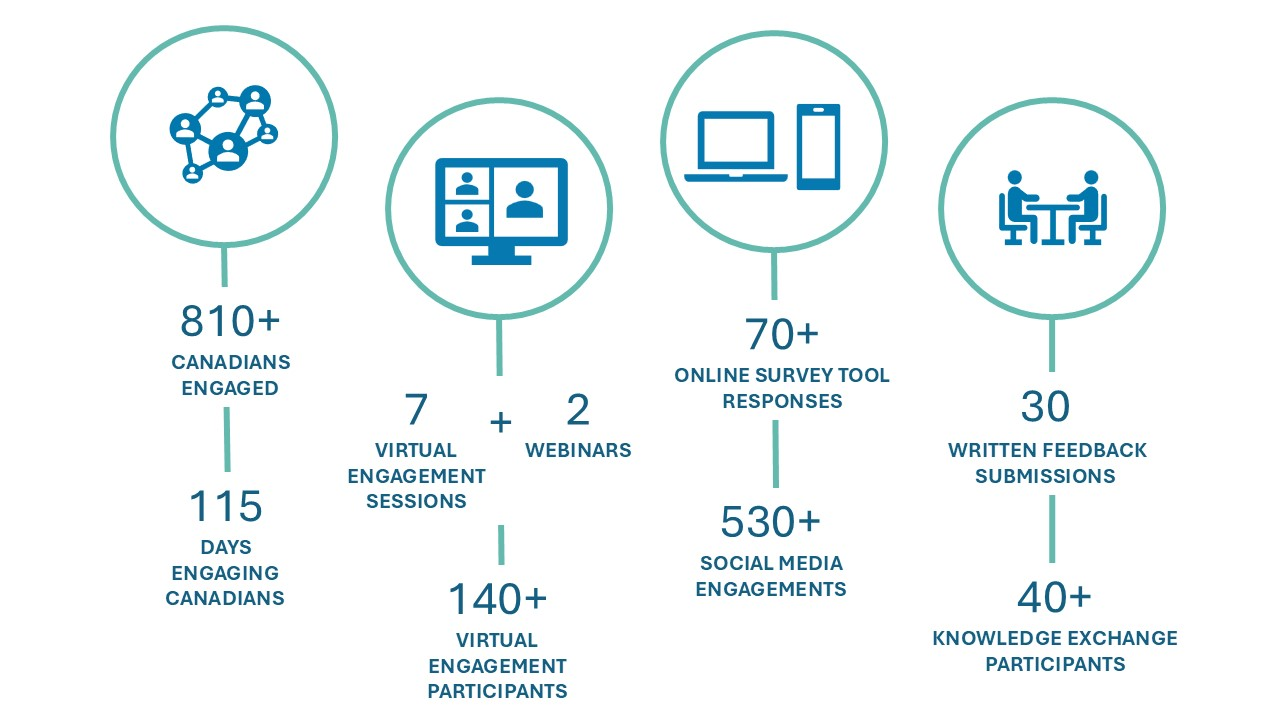
Figure 1 shows the different types of engagement and how many people participated. In addition, a graphic recording of the Knowledge Exchange was created to visually capture discussions and feedback (Annex B).
While perspectives offered were varied, the overall feedback was positive. Recurring feedback emerged on how the Roadmap could be adjusted to help advance the goal of a barrier-free Canada:
- The Roadmap should be clear and adaptable: The Roadmap should present a strong call to action, be easily adaptable to various needs, and be written in plain language.
- Governments should continue to lead and collaborate: Governments should strengthen accessibility efforts and coordinate across jurisdictions for nationwide consistency.
- Attitude shift: Accessibility should be positioned as a benefit for everyone, aiming to shift society’s attitudes towards disability and inclusion.
- Inclusion and intersectional approach: The Roadmap should highlight that the disability community, specifically person with disabilities, is a diverse group that intersect with other key groups. There should be a stronger intersectional approach.
- Need for resources: Although the Roadmap does not include new policies or funding, stakeholders emphasized the need for building capacity across all sectors. While outside the scope of the Roadmap, they also highlighted the need for clear guidance on fair compensation for persons with disabilities who provide expert advice.
Text Version – Figure 1
This image shows four icons, each of which has a vertical line below it connecting to text descriptions of engagement activities. The first icon is of a network of people, with text below reading: 810+ Canadians engaged and 115 days engaging Canadians. The second icon is a computer monitor with three people on screen and text below reading: 7 virtual engagement sessions + 2 webinars and 140+ virtual engagement participants. The third icon is a computer monitor with a cell phone. The text below reads: 70+ online survey tool responses and 530+ social media engagements. The fourth icon shows two people seated at a table with text below reading: 30 written feedback submissions and 40+ Knowledge Exchange participants.
1. General Feedback on the Roadmap
Stakeholders stressed that the Roadmap should provide a strong call to action to help ensure that persons with disabilities can fully participate in their communities, workplaces, and all aspects of life. Stakeholders from the disability community highlighted that, although there has been important progress on accessibility over the past five years since the ACA came into force, the pace of change needs to increase. They saw the Roadmap as a way to support a broader view of accessibility and as a starting point for a national conversation about how we all play a role in advancing accessibility collectively.
The following section presents more details aligned with recurring feedback.
1.1 The Roadmap Should Be Clear and Adaptable
Stakeholders highlighted the need for the Roadmap to include a clear vision and strong call to action. It should clarify how everyone is working towards the goal of a barrier-free Canada. This includes the full and equal participation of persons with disabilities in social and economic life. It should also outline more clearly how it aligns with the ACA and its seven priority areas, stressing that the Roadmap is a voluntary tool to enhance existing efforts.
It should help capture attention to encourage accessibility efforts while helping to clarify everyone’s role, whether large or small, in achieving its goals. The Roadmap should convey the message that accessibility benefits everyone and is a shared responsibility. Stakeholders suggested that the Roadmap should encourage people to work together to remove barriers.
Stakeholders also suggested that the Roadmap be flexible, allowing for different approaches, such as increasing awareness of accessibility, identifying gaps, and showcasing contributions toward achieving national goals that can help motivate others into action. At the same time, many stakeholders from the disability community wanted to see more detail on how the Roadmap connects to their priorities and efforts to advance accessibility, viewing some themes as too high-level and lacking clear outcomes. They suggested adding clearer markers or benchmarks to guide efforts, including measurable outcomes and timelines for timely action and enforcement.
Accessibility leaders and stakeholders emphasized the need for the Roadmap to be concise and written in plain language. They also recommended including definitions of key concepts such as barriers to accessibility, intersectionality, and a modern approach to disability.
1.2 Governments Should Continue to Lead and Collaborate
Stakeholders felt the role of Governments, who play a crucial role in advancing accessibility through legislation, policies, programs and service-delivery, should be further highlighted in the Roadmap. This included opportunities for governments to align accessibility efforts across portfolios and supporting initiatives across economic sectors, particularly in federally regulated private sector.
Stakeholders also highlighted the importance of interjurisdictional collaboration. They wanted to see this role reflected more in the Roadmap, including through knowledge sharing and harmonization of regulations and standards, to help create a consistent and connected experience across the country.
1.3 Attitude Shift
The disability community stressed the important role that attitudes play in removing accessibility barriers. Removing stigma around disability and accessibility was seen as foundational to advancing meaningful change. They stressed the importance of raising awareness about the value of accessibility for all Canadians throughout their lives.
Stakeholders also suggested that the Roadmap should familiarize readers with various disabilities, both apparent and non-apparent, episodic and co-occurring disabilities. This would help to make disabilities more recognized, reduce negative attitudes, and eliminate barriers. They also recommended emphasizing the social model of disability, which frames disability as arising from societal barriers and negative attitudes rather than individual impairments.
1.4 Inclusion and Intersectional Approach
The disability community highlighted that the Roadmap should reflect their diversity and recognize that they are not one uniform group. They stressed the need for an accessibility lens and adopting accessibility by default in all initiatives.
Stakeholders also highlighted the needs of the deaf and hard of hearing community who require specific communication forms or technologies (e.g. captioning, relay services and sign language interpreters). Several stakeholders noted the need to include caregivers of persons with disabilities.
Intersectionality was a common theme throughout the engagement process. Stakeholders stressed the need to more clearly include intersectionality throughout the Roadmap. They noted that an intersectional approach may lead to different goals, strategies, and actions to remove barriers for various groups. Stakeholders shared that this would help ensure that all people are represented in the evidence used for decision-making. They suggested setting goals and measuring progress to reflect intersectionality, better representing the unique barriers faced by people with different types of disabilities and intersecting identities (e.g., gender, race, ethnicity, socio-economic status). These include new immigrants, Black, Indigenous, and persons of colour, those with lower socio-economic classes, seniors and youth, 2SLGBTQI+, and people living in rural or remote areas.
2. Feedback on Elements of the Roadmap
The following section presents additional feedback aligned with the structure of the Roadmap.
2.1 Other Entities Involved in Helping Realize a Barrier-free Canada
Stakeholders noted that presenting the disability community as a separate entity might suggest that persons with disabilities are not part of all other groups. They recommended stating clearly that persons with disabilities are part of all the groups involved in realizing a barrier-free Canada. In the same section, to reflect the reality that not all of the private sector is regulated by federal or provincial accessibility legislation, it was suggested separating the private sector into those regulated and those that are not.
2.2 Guiding Principles
Stakeholders shared a range of views on the guiding principles. Many stakeholders felt the first principle, “Nothing without us” was important. However, some, particularly from the disability community, stressed the need to move beyond consultation and towards meaningful participation. This was echoed in comments related to the theme of expanding the strength of the disability community. Additionally, stakeholders emphasized the need to increase the representation of persons with disabilities in the workforce, especially in leadership positions.
Stakeholders also felt that the principles of “Collaboration and Partnerships” and “Intersectionality” were not clearly included in the Roadmap. They suggested that engaging with the disability community should be a standard practice throughout the Roadmap.
Under the guiding principle of “Innovation”, some stakeholders called for greater recognition of the private sector’s role in developing innovative accessibility solutions. Others, particularly from the disability community, emphasized the need to focus on changing attitudes towards disability and putting inclusion into practice. They suggested prioritizing the use of existing solutions rather than on developing new ones.
Lastly, many stakeholders felt that the guiding principle, “Knowledge Mobilization” was repetitive, as it was already an area of action under the “Data and Information” theme.
2.3 Themes and Areas of Action
In general, stakeholders agreed that the identified themes and areas of action reflected where progress is needed to achieve a barrier-free Canada, while many offered feedback how they could be strengthened. Some stakeholders believed there should be a stronger focus on employment and the built environment. There was also a desire for the areas of action to be more detailed and ambitious.
Theme 1: Driving Systemic Change
Important points raised under this theme were the need for enforceable timelines, consequences for non-compliance, and effective, timely, and accessible ways to address accessibility complaints. Stakeholders from the private sector said that without mandatory requirements or enforcement, it is difficult to advocate for accessibility improvements to senior leadership. Members of the disability community also felt that change would not happen in the private or public sectors without mandatory requirements.
Some stakeholders said that stronger regulations and standards could resolve internal debates within organizations about advancing accessibility and ensure that organizations move beyond developing an accessibility plan to taking meaningful steps to improve accessibility.
Stakeholders recommended adding another area of action focused on improving access to employment for persons with disabilities. They felt that this could be a powerful way to advance systemic change and support an inclusive culture.
Theme 2: Expanding the Strength of the Disability Community
The disability community provided significant feedback on this theme, with many expressing concerns that it focused too heavily on the disability community, implying they were the only ones responsible for advancing accessibility. Some stakeholders shared that focusing only on the disability community could create an “othering” mentality, treating the community as not belonging to other parts of society, which could lead to discrimination.
Several stakeholders from the disability community felt that this theme could be improved by going beyond engagement to support more meaningful participation in the processes and decisions that impact their lives. They recommended focusing on helping ensure that persons with disabilities could take part in decision-making, leadership roles, career advancement and mentorship opportunities.
The disability community also recommended the Roadmap more strongly recognize the roles and responsibility of those outside the community in supporting accessibility. They suggested broadening the theme to include more focus on training and supporting organizations in understanding and confidently implementing accessibility practices.
Theme 3: Leveraging Data and Information
Stakeholders shared several important points about data and information – how to collect it, share it, and use it to advance accessibility. They stressed the need for this theme to recognize the importance of simplifying and centralizing accessibility data, as it is currently spread across many sources. They noted that data should be available in plain language and accessible formats. Some stakeholders suggested that the Roadmap should encourage collaboration among different parties to share and integrate data to help bring together measurement data beyond what the federal government already collects and publishes.
Similar to earlier comments on intersectionality, stakeholders pointed to gaps in data collection about persons with disabilities and their intersecting identities. They stressed that meaningful inclusion means ensuring that everyone is represented in the data used for decision-making. As such, disaggregated data should be collected, analyzed, and reported to support actions aimed at removing barriers.
Theme 4: Driving Inclusive Culture
Many stakeholders stated achieving a barrier-free Canada is dependent on prioritizing changing attitudes and removing stigma around disability and accessibility. They recommended making this the first theme because they felt that inclusive culture is foundational to achieving the goal of a barrier-free Canada.
As noted earlier, the disability community also highlighted the under-representation of persons with disabilities in decision-making roles as a barrier to changing attitudes. They stressed the importance of leaders in creating organizational change that promotes accessibility in both the private and public sectors. They added that there is a need to increase the representation of persons with disabilities at all levels, especially in leadership positions, to accelerate action and drive change.
3. Next Steps
All the feedback received during engagement will help inform the final Accessible Canada Roadmap.
Annex A: Engagement Discussion Questions
- Do the themes identified in the Roadmap reflect your lived experiences navigating accessibility barriers? What other accessibility themes are needed to realize the goal of a barrier-free Canada?
- Do the themes address the roles and actions required from different levels of government, partners and stakeholders to reach a barrier-free Canada?
- What are your suggestions for improving them?
- The areas of action in the Roadmap serve as examples. What other areas of action should be included under each accessibility theme? Should any of them be removed?
- How do you think the Roadmap can drive collective change? Do you have any suggestions on how to promote it and encourage buy-in?
- How can the Roadmap be used to encourage collaboration and coherent action? (Knowledge Exchange only)
- How can you/your organization use the Roadmap to help further your/its own work? (Knowledge Exchange only)
- What is needed to promote uptake and encourage other stakeholders to use the Roadmap to further their own work? (Knowledge Exchange only)
- What will build and sustain energy and commitment from diverse stakeholders? (Knowledge Exchange only)
- What are the most important next steps? (Knowledge Exchange only)
Annex B: Graphic Recording of Knowledge Exchange
Text Version – Figure 2
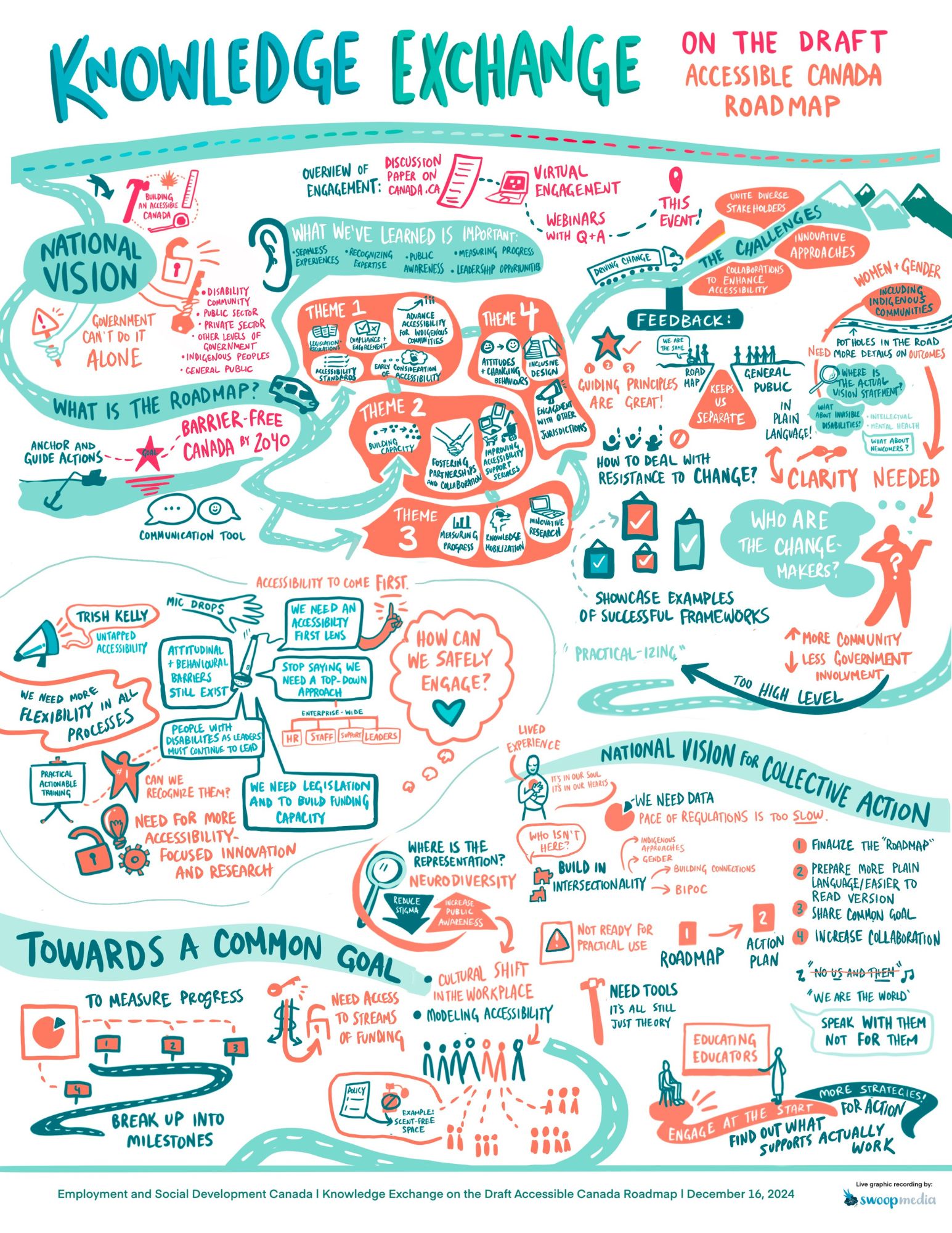
This image is of a live graphic recording from the event “Accessible Canada Roadmap Knowledge Exchange” hosted by Employment and Social Development Canada on December 16, 2024, at the Rogers Centre in Ottawa, Ontario, Canada. The graphic recording was designed by Laura Hanek of Swoop Media.
What is a “graphic recording” (also known as visual note-taking or visual facilitation)? It is the art of capturing ideas visually in real time. It can include a combination of graphics such as illustrations, diagrams, symbols, and written words to capture thoughts and ideas in meetings, seminars, workshops and conferences.
The title “Knowledge Exchange: on the draft Accessible Canada Roadmap” in all caps is at the very top, underlined by an illustration of a road. The font of the rest of the graphic is also in all caps. There are a few decorative roads illustrated throughout the graphic. The graphic is organized into four sections.
The illustration below the underlined title of the document (Knowledge Exchange: on the draft Accessible Canada Roadmap) features the heading: overview of engagement. The words "discussion paper on canada.ca” is represented by a paper with scribbles with a dotted line leading to “virtual engagement”, represented by an image of a laptop with a smiley face on the screen. These images connect via another dotted line to the words “webinars with Q&A”, followed by a final dotted line to “this event” marked by a map marker icon. “This event” refers to the Accessible Canada Roadmap Knowledge Exchange.
National Vision (top-left of the image)
This is at the top of the page as the first topic of discussion at the event. The words “national vision" are in large font, surrounded by three smaller illustrations depicting three concepts. These concepts are:
- “Building an accessible Canada”, which is surrounded by images of a hammer, maple leaf, ruler and tape measure
- An alert sign accompanies the words "Government can’t do it alone”
- An illustration of a key and a lock with the list of who needs to be included: disability community, public sector, private sector, general public, indigenous peoples, and other levels of government.
The illustrated road continues with the words “What is the roadmap?” written on the road as a car passes by. The phrase “anchor and guide actions” is on the side of the road with an accompanied image of a boat anchored in the water. Above the water, a star containing the word “goal” connects with the phrase “barrier-free Canada by 2040”. Beneath the water, there are two speech bubbles: one labelled with three dots “…” and the other containing a smiley face. The words “communication tool” are shown underneath the speech bubbles. The road splits to another bubble next to a large ear, titled “What we’ve learned is important” with the following bullets beneath it:
- Seamless experiences
- Recognizing expertise
- Public awareness
- Measuring progress
- Leadership opportunities
The road also branches off with arrows leading to four distinct bubbles, each representing one of the four themes of the Roadmap. Each bubble is connected by roads that lead to other themes, illustrating their interconnection.
The first bubble represents theme one with the following key concepts illustrated: legislation and regulations (illustrated by three sheets of paper with scribbles), compliance and enforcements (depicted by an image of a check mark and “x” icons), advance accessibility for Indigenous communities (shown as arrow pointing up to a crowd of people), accessibility standards (represented by a checklist), and early considerations of accessibility (illustrated by a thought bubble with an unlocked lock).
- Theme two includes the following key concepts: building capacity (depicted by dots growing in numbers, with one dot followed by an arrow leading to three dots, and another arrow leading to six dots), fostering partnerships and collaboration (illustrated by a handshake), improving accessibility support services (represented by a cane, laptop, tablet, wheelchair, and guide dog).
- Theme three presents the following key concepts: measuring progress (depicted by a bar graph), knowledge mobilization (illustrated by an icon of a head with arrows coming in and out of the brain) and innovative research (represented by a laptop)
- Theme four includes the following key concepts: changing attitudes and behaviours (illustrated by a sad face followed by an arrow leading to a happy face), inclusive design (depicted by stairs and a ramp), and engagement in other jurisdictions (illustrated by a megaphone)
The road continues to the top right of the document, with the words “the challenges” displayed on the road. The road is illustrated going into the mountains, representing rocky terrain. A truck labelled “driving change” with its headlights on, is shown on the road. There are three bubbles around the section of the road labelled “the challenges”. The bubbles are labelled “unite diverse stakeholders”, “collaborations to enhance accessibility”, and “innovative approaches”. Below the road, directly under the truck, is a large bubble labelled “feedback”. This section highlights key feedback shared in the plenary room of the Knowledge Exchange.
- The guiding principles were great! (illustrated with icons of “1”, “2”, and “3” with a star and check mark above)
- The Roadmap versus the general public: it keeps us separate, but we are one (depicted by a crack in the ground, with a wedge labelled “keeps us separate” between two groups of people labelled “Roadmap” and “general public”. The group of people labelled “Roadmap” have a speech bubble saying, “we are the same”,)
- How to deal with resistance to change? (presented with three people yelling as shown with an exclamation above their heads and with a no symbol beside them)
- Women and gender, including Indigenous communities (“women + gender” is shown above a bubble labelled “including Indigenous communities”. The bubble is linked to another bubble labelled “what about invisible disabilities?”)
- More details on outcomes (depicted by a road with potholes. Outcomes is underlined with an arrow leading to the words “clarity needed” next to a pair of glasses)
- Where is the actual vision statement? (illustrated by a magnifying glass)
- What about invisible disabilities? (the words Intellectual and mental health are beside this bubble, with it linking to the “including Indigenous communities” bubble previously described).
- What about newcomers? (represented by a speech bubble connecting to the 'What about invisible disabilities?' bubble, showing a progression of related questions)
- In plain language! (there are double-ended arrows leading to the next feedback theme)
- Who are the change makers? (illustrated by a silhouette of a confused person with a question mark on their chest)
- Showcase examples of successful frameworks (represented by four picture frames of check marks)
- More community, less government involvement (depicted with an up arrow for “more” and down arrow for “less”. The text has another arrow leading to the next feedback theme)
- Too high level (depicted with an arrow leading to the words ““Practical-izing” needed”)
Trish Kelly Keynote Speaker (middle of the image)
A megaphone is shown with a speech bubble containing the name “Trish Kelly”. The words “untapped accessibility” is underneath the speech bubble. A hand labelled “Mic Drops” is dropping a microphone. Five speech bubbles emerge from the microphone, each depicting one of the five “mic-drop moments” shared by the keynote speaker:
- We need an accessibility first lens (represented by a hand coming out of the speech bubble signalling number1 and pointing to the words “accessibility to come first”, with first underlined)
- Attitudinal and behaviour barriers still exist (The words “we need more flexibility in all processes” are next to this speech bubble. Beneath it, an easel stand displays the words “practical actionable training.”)
- People with disabilities as leaders must continue to lead (a person labelled “#1” is shown below, with the phrase “can we recognize them?” next to it)
- We need legislation and to build funding capacity (the words “need for more accessibility-focused innovation and research” is depicted underneath, with an illustration of gears turning, an unlocked lock, and a light bulb)
- Stop saying we need a top-down approach (depicted by an organizational chart with “enterprise-wide” at the top, branching down into four boxes labelled “HR”, “staff”, “support”, and “leaders”. To the right, a large thought bubble says, “How can we safely engage?” with a heart icon)
National Vision for Collective Action (middle- to bottom-right of the image)
The following discusses strategies to encourage people to align their accessibility efforts with the Roadmap:
- Lived experience (a person with closed eyes and smiling, hugging their heart with the words “it’s in our soul, it’s in our hearts.”)
- Where is the representation? (represented with a magnifying glass)
- Neurodiversity (illustrated with an arrow pointing up to increase public awareness, and an arrow pointing down to reduce stigma There is an arrow pointing to the next feedback theme)
- Cultural shift in the workplace; modelling accessibility (An arrow points to a group of seven individuals which branches out to several groups of two to four people. One of the branches includes a bubble surrounding a sheet of paper, labelled policy, with image to its right of a no symbol on top of a perfume bottle. The paper has an arrow pointing to the words “example: scent-free space”)
- Not yet ready for practical use (depicted with a warning symbol to the left)
- Build in intersectionality (shown with a question bubble asking, “who isn’t here?” with four arrows, representing “Indigenous approaches”, “gender”, “building connections, “BIPOC [which is short for Black, Indigenous, People of Colour”)
- We need data (illustrated with a pie chart with the words “the pace of regulations is too slow” below, “slow” is underlined)
- We need tools, it’s all just theory (with a hammer depicted next to the text).
- Roadmap to action plan (shown with an icon of “1” and “2”, representing the roadmap and action, respectively, with an arrow leading from “1” to “2”)
- There is a list that shows the following:
- Complete the roadmap
- Prepare more plain language/easier to read version
- Common goal
- Collaboration
- Speak with them, not for them (this is depicted in speech bubble with the quote “us and them” crossed out and between musical notes. The quote “we are the world” is below)
- Engage at the start. More strategies for action. (The words “Find out what supports actually work” are below the text “engage at the start”. Above, there is a person sitting, being taught by another person standing who is next to a blackboard labelled “Educating educators”
Towards a Common goal (bottom-left of the document)
The following discusses strategies to mobilize the Roadmap and sustain engagement. There is an illustration of a road with numbered signs from one to four. The signs are linked to a diagram of a pie chart with the words “to measure progress” above it. Next to this illustration is an image of a key and a dollar sign, with arrows running through. One of the arrows points to an opened lock. The words “need access to streams of funding” is next to the lock.
At the bottom of the graphic recording, the following words are shown: Employment and Social Development Canada. Knowledge Exchange on the Draft Accessible Canada Roadmap. December 16, 2024. Live graphic illustration by Swoop Media