
National Progress Report on Early Learning and Child Care 2021 to 2022
On this page
Alternate formats

National Progress Report on Early Learning and Child Care 2021 to 2022 [PDF - 1.69 MB]
Large print, braille, MP3 (audio), e-text and DAISY formats are available on demand by ordering online or calling 1 800 O-Canada (1-800-622-6232). If you use a teletypewriter (TTY), call 1-800-926-9105.
Minister’s message
The Government of Canada is bringing down costs for Canadians and helping them get ahead by maintaining the sustainability of programs that are saving families thousands of dollars every year.
In 2020 when child care centres closed due to the COVID-19 pandemic, parents with young children, especially mothers, faced difficult decisions and financial hardships. Without access to child care, many parents struggled to get by, let alone get ahead. What became clear at the time is that child care is essential social infrastructure; just as roads and transit support our economic growth, so too does child care.
Child care is an economic issue as much as it is a social issue. Investing in early learning and child care (ELCC) offers a jobs-and-growth hat trick: it strengthens the early childhood education sector, which provides jobs for workers, the majority of whom are women; it enables parents to reach their full economic potential; and it creates generations of engaged and well-prepared young learners.
Studies show that every dollar spent on ELCC returns $1.50 to $2.80 to the broader economy. Further, fee reductions have the potential to increase GDP per capita by 1.1% in the long run.
The time was ripe for the Government of Canada to step up and make a game-changing investment that would support pandemic recovery and help build a stronger, more equitable society that would be sustainable in the long term.
Through Budget 2021, we announced an investment of up to $30 billion over five years to develop a Canada-wide system of ELCC with the purpose to:
- bring down fees for regulated child care by 50%, on average, by December 2022
- make regulated child care available for $10-a-day, on average, by March 31, 2026
- support the creation of 250,000 new regulated child care spaces and 3,000 Indigenous early learning and child care spaces across the country by March 31, 2026
- provide better supports for the education, recruitment and retention of a qualified ELCC workforce
The investment served as the catalyst for greater collaboration with provinces, territories, and Indigenous partners. Over the year, agreements were signed with each province and territory, including an asymmetrical agreement with Quebec to enhance its well-established ELCC system.
We also recognised that ELCC is only possible when centres are staffed with skilled early childhood education workers. In 2021, we invested $420 million to help provinces and territories recruit and retain early childhood educators, addressing urgent staffing needs that emerged during the reopening phase after the pandemic.
By the end of March 2022, four of the provinces and territories had already met their commitment to reduce fees by 50% while others continued to work toward achieving this goal by December 2022. This brought thousands of dollars in savings per year to many families and by bringing down the fees, this also brought the cost of regulated child care within reach for many families for the first time.
The important accomplishments outlined in this report give me confidence that we’ll continue to rise to the challenges each day brings for the long-term vision, where people in all corners of Canada have access to a system of high-quality, affordable, flexible and inclusive child care.
Patty Hajdu
Minister of Jobs and Families and Minister responsible for the Federal Economic Development Agency for Northern Ontario
Results at a glance
Federal investments in early learning and child care in 2021 to 2022
- A total of nearly $3 billion in funding to build a Canada-wide early learning and child care (ELCC) system with provinces and territories.
- A total of $400 million for extended bilateral ELCC agreements between the provinces, territories and Canada.
- One-time funding of $420 million for provinces and territories to support the recruitment and retention of early childhood educators (ECEs) in recognition of the early childhood education workforce’s vital role in providing high-quality ELCC.
Affordability – Fee reductions in 2021 to 2022
- The Government of Canada committed to reducing fees for regulated child care for all provinces and territories outside of Quebec, which already has its own affordable ELCC system, by 50%, on average, by December 2022,Footnote 1 and all regulated child care fees to $10 a day, on average, by the end of March 2026.
- Provinces and territories with average fees of $10 a day or less for regulated child care by March 2022: Quebec and Yukon (both had affordable ELCC systems before Canada-wide ELCC agreements).
- Provinces and territories with average fee reductions of 50% or more for regulated child care by March 2022: Alberta, Newfoundland and Labrador, the Northwest Territories and Saskatchewan.
- Province or territory with average fee reductions of 25% or more for regulated child care: Nova Scotia.
Access – New child care spaces in 2021 to 2022
- The Government of Canada committed to creating 250,000 new spaces across Canada by the end of March 2026.
- All provinces and territories, except for Quebec, which has an asymmetrical agreement, have committed to specific space creation targets and continued to make progress toward their goals.
- Together, 9 provinces and territories created 4,902 new spaces for licensed child care this year.
- Yukon met its March 2026 space creation target: 199 spaces were created, representing nearly double its committed space goal.
Quality – Early childhood education workforce measures in 2021 to 2022
- The Government of Canada committed to helping provincial and territorial partners support a highly educated, well-compensated and respected ELCC workforce through the continuous improvement of working conditions, including wages and benefits, pedagogical and professional development and training.
- All Canada-wide ELCC agreements with provinces and territories (except the asymmetrical agreement with Quebec) contain commitments to support a qualified ELCC workforce.
- Data from Statistics Canada’s Job Vacancy and Wage SurveyFootnote 2 suggests that some aspects of job quality may have improved among ECEs and assistants throughout 2021 to 2022, as a larger share of vacancies than before were for permanent positions.
Inclusion – Measures implemented in 2021 to 2022
- The Government of Canada committed to working with partners to foster inclusive ELCC, providing culturally relevant access to children of diverse needs and communities, such as Black and racialized groups, Indigenous Peoples, official language minority communities, newcomers, and children, parents and employees with disabilities.
- All provinces and territories offered programs and tools to advance inclusion in regulated ELCC within their jurisdictions.
- All provinces and territories provided training or early learning programs on inclusion for ECEs.
Indigenous early learning and child care
- The Government of Canada committed to building Indigenous governance capacity, promoting Indigenous participation in the development of a Canada-wide ELCC system, and supporting the operations of an Indigenous Early Learning and Child Care (IELCC) Secretariat.
- In 2021 to 2022, the federal government invested $109.5 million in fiscal year 2021 to 2022 to continue the implementation of the Indigenous Early Learning and Child Care Framework. The Framework and associated investments supplement federal and provincial/territorial investments and form an integral part of the Canada-wide ELCC system.
- In response to the COVID-19 pandemic, Indigenous communities quickly transitioned from in-person child care programming to virtual parenting supports, including food hampers, activity baskets, and land-based learning.
- Through the Framework, federal partners distributed $120 million in emergency funding to First Nations, Métis, and Inuit communities and to the Aboriginal Head Start in Urban and Northern Communities sites to support the safe reopening of facilities.
Introduction
Overview of this report
The National Progress Report on Early Learning and Child Care 2021 to 2022 presents results that cover all the major investments the Government of Canada is making in early learning and child care (ELCC) under bilateral, Canada-wide and workforce agreements with provinces and territories, and Indigenous early learning and child care (IELCC) through agreements with Indigenous governments and their delegates.
This progress report is divided into 4 main sections. The introduction describes the Canada-wide ELCC system and vision. The operational context is an account of the main factors that influenced the implementation and delivery of the program during the fiscal year. This includes the COVID-19 pandemic, which continued to be a disruptive force in 2021 to 2022 and had impacts on ELCC workers, child care businesses, and Indigenous communities. Results are then presented under the principles of affordability, access, inclusion and quality in a way that conveys a national perspective on the system, while recognizing the specificity of jurisdictions, when appropriate. The report concludes with a brief summary.
A shared vision for early learning and child care
The Multilateral Early Learning and Child Care Framework
In developing the 2017 Multilateral Early Learning and Child Care Framework, Ministers Most Responsible for ELCC agreed that the advancement of ELCC systems is one of the best investments that governments can make to strengthen the social and economic fabric of our country.
In the Multilateral Framework, governments recognize that provinces and territories are primarily responsible for the design and delivery of ELCC systems. This statement stems from the Constitution Acts, 1867 to 1982, which identify education as a power specific to provincial legislatures. While the Government of Quebec supports the general principles of the Multilateral Framework, it does not adhere to the Framework as it intends to preserve its sole responsibility in this area on its territory. The Government of Quebec expects to receive its share of the federal funding and will continue to invest significantly toward programs and services for families and children.
The Multilateral Framework’s shared long-term vision encompasses an enriching environment of quality ELCC where all children are viewed as capable, competent learners who are full of potential. This includes educational opportunities, school readiness, and supporting their overall health and wellness into adulthood.
The Indigenous Early Learning and Child Care Framework
The co-developed Indigenous Early Learning and Child Care Framework guides a shared vision that all Indigenous children experience high-quality and culturally appropriate ELCC and represents a foundation for ongoing collaborative work reflecting unique cultures, aspirations and needs of First Nations, Inuit, and Métis children and families across Canada. The IELCC Framework is implemented horizontally by multiple federal departments, with Employment and Social Development Canada serving as the federal focal point.
The Multilateral Framework, IELCC Framework and associated investments are complementary systems that work together. IELCC funding is designed to enhance, not replace, the Canada-wide ELCC funding provided to provinces and territories. This approach recognizes the unique needs of Indigenous communities and ensures that Indigenous governments can participate alongside federal, provincial and territorial governments in the design of a Canada-wide ELCC system.
Creating a Canada-wide early learning and child care system
For families in Canada, access to high-quality, affordable, flexible and inclusive ELCC is a necessity. Building a Canada-wide ELCC system is about providing parents and families in Canada with a choice. Should parents decide to return to work or go back to school, it is important that they have access to high-quality and affordable child care. Moreover, high-quality IELCC programming empowers young children with a strong sense of cultural identity.
The Government of Canada’s commitment to a Canada-wide ELCC system is intended to support:
- a 50% reduction in average fees for regulated ELCC in all provinces and territories outside of Quebec, by December 2022
- an average of $10-a-day fees for regulated child care in Canada by March 31, 2026
- 250,000 new regulated child care spaces across the country by March 31, 2026, building on the approximately 40,000 new spaces already created through previous federal investments
- working with provinces and territories to support primarily not-for-profit sector child care providers to increase spaces across the country, while ensuring that families in licensed spaces benefit from more affordable child care
- offering better supports for the education, recruitment and retention of a qualified ELCC workforce
Federal investments in early learning and child care
Building on the Multilateral Framework and the IELCC Framework, the Government of Canada has been investing in ELCC to provide a great start in life to all children.
- Budget 2016 and Budget 2017 committed a total of $7.5 billion over 11 years.
- To sustain the progress made in collaboration with provinces, territories and Indigenous partners to date, the Fall Economic Statement 2020 committed to making ELCC funding permanent based on 2027 to 2028 levels by providing $870 million per year and ongoing, starting in 2028 to 2029.
- In Budget 2021, the federal government made a transformative investment of more than $27 billion over 5 years to build a Canada-wide ELCC system with provinces and territories, which, when combined with other investments, including IELCC, amounts to up to $30 billion over 5 years.
By March 2022, all provinces and territories had signed 5-year Canada-wide ELCC agreements, including Quebec's asymmetrical agreement, and had collectively committed to the creation of more than 250,000 spaces by March 2026. Extended bilateral agreements (2021 to 2022 to 2024 to 2025) and workforce agreements (2021 to 2022) were also negotiated and signed.
Over the course of these agreements, provinces and territories, except Quebec, due to its asymmetrical agreement, committed to negotiating action plans that further detail the timing and nature of how they will meet their commitments and space creation targets. Provinces and territories, except Quebec, due to its asymmetrical agreement, will also submit annual reports to the federal government in October of each year detailing the progress and results achieved throughout the previous fiscal year, as well as audited financial statements.
The table below outlines federal funding under the bilateral and Canada-wide ELCC agreements, as well as one-time workforce funding to support the recruitment and retention of ECEs, as of March 31, 2022.
| Province/territory | 2017 to 2018 (bilateral funding, in millions) | 2018 to 2019 (bilateral funding, in millions) | 2019 to 2020 (bilateral funding, in millions) | 2020 to 2021 (bilateral funding, in millions) | 2021 to 2022 (Canada-wide, bilateral, workforce funding in millions) |
|---|---|---|---|---|---|
| Newfoundland and Labrador | $7 | $7 | $7 | $7 | $48 |
| Prince Edward Island | $4 | $4 | $4 | $4 | $21 |
| Nova Scotia | $12 | $12 | $12 | $12 | $91 |
| New Brunswick | $10 | $10 | $10 | $10 | $75 |
| Quebec | $87 | $87 | $86 | $86 | $836 |
| Ontario | $146 | $146 | $147 | $147 | $1,397 |
| Manitoba | $16 | $16 | $16 | $16 | $164 |
| Saskatchewan | $14 | $14 | $14 | $14 | $145 |
| Alberta | $46 | $45 | $45 | $45 | $502 |
| British Columbia | $51 | $52 | $52 | $53 | $454 |
| Yukon | $2 | $2 | $2 | $2 | $10 |
| Northwest Territories | $2 | $2 | $2 | $2 | $11 |
| Nunavut | $2 | $2 | $2 | $2 | $13 |
| Total | $400 | $399 | $399 | $399 | $3,767 |
- Source: ELCC agreements
- Note: The final annual contributions paid to provinces and territories were calculated per the formulas described within the agreements and adjusted using population estimates from Statistics Canada as of July 1, 2021, and may differ from the notional contributions published in the agreements. Due to being rounded, totals may be different than the sum of the individual entries.
Operational context
The 2021 to 2022 fiscal year presented a unique socio-economic landscape for the early implementation of Canada-wide early learning and child care (ELCC) across the country while the effects of the COVID-19 pandemic remained very present.
Population of children
In 2021, there were 2.2 million children aged 0 to 5 in Canada, with many of them being potential users of child care spaces. Statistics Canada noted that 1.6 million (or more than 1 in 7) census families had at least 1 child aged 5 years or younger in 2021.Footnote 3
The 2.2 million children aged 0 to 5 in Canada in 2021 marked a near 2% decline from the peak population for this age group in 2018. This contrasts with the overall Canadian population rise through 2021.
Mothers in the workforce
In 2021 to 2022, the labour force participation rate across Canada, representing the share of the population either working or looking for work, averaged 77% for core-aged (25 to 54) mothers of young children (0 to 5). This was over 5 percentage points lower than the rate for core-aged mothers of young children in Quebec, where affordable child care was introduced in 1997, and over 11 percentage points lower than the rate for core-aged women across Canada without children under 18.
While the COVID-19 pandemic affected many businesses and workers, including how Canadians work and from where, it did not lead to a lasting decline in the participation rate for core-aged mothers of young children. In fact, the rate increased through 2021.Footnote 4
Statistics Canada found that over 40% of workers completed the majority of their hours from home in early 2020 in response to the pandemic.Footnote 5 Working from home may have offered flexibility to parents of young children to better access child care or deal with incomplete access to child care arrangements.
Child care businesses
The COVID-19 pandemic affected some businesses more than others in terms of temporary shutdowns and loss of revenue. According to a Statistics Canada report, approximately 72% of child care centres had to close temporarily in the spring of 2020.Footnote 6 Child care businesses were particularly impacted because early childhood educators (ECEs) must operate in-person to provide direct supervision to the children in their care. Unable to switch to online service delivery, child care operators saw rising operating costs due to the implementation of additional health and safety practices. Health concerns related to COVID-19 made it even more difficult for child care providers to hire and retain a qualified workforce than before the pandemic.
At the same time, demand for child care services and enrollment had declined due to parents’ availability changing, or parents’ and guardians’ concerns about health, especially in centre-based child care, which represents about one third of child care businesses nationwide. Based on data from the 2022 Canadian Survey on the Provision of Child Care Services, among the negative impacts of the pandemic on their business, 64% of centre-based providers reported lower enrollment or demand for child care.Footnote 7 Nevertheless, child care centres served a larger number of children than licensed and unlicensed home-based child care providers with 821,298 children enrolled compared to 96,677 and 73,821 respectively.Footnote 8
The impacts of the COVID-19 pandemic were also substantial for many Indigenous communities and businesses. It disrupted many Indigenous-led planning and implementation activities during child care centre closures despite families still requiring supports. Across the country, closures impacted the social, cultural and emotional development of children. There was a need to pivot and provide various supports to Indigenous communities including online activities, home-based kits, outdoor check-ins, as well as food hampers.
To alleviate the impacts of the pandemic on businesses, the Government of Canada launched various liquidity support programs, such as the Canada Emergency Wage Subsidy (CEWS), the Canada Emergency Commercial Rent Assistance (CECRA), the Canada Emergency Rent Subsidy (CERS) and the Canada Emergency Business Account (CEBA). These programs were designed to help affected businesses by partially covering their main expenses, such as wages, rents and property expenses. A Statistics Canada study found that child care businesses, both for-profit and not-for-profit, were more likely to receive the CEBA and the CECRA or the CERS and less likely to receive the CEWS than other businesses in the country. They have also received, on average, more dollar values of support, about 10% more, than recipients in the rest of the economy.Footnote 9
Early childhood educators and assistants
As many child care centres experienced lower demand and financial challenges from the pandemic, employment among ECEs and assistants fell sharply, further straining the sector.Footnote 10 Prior to the pandemic, there were about 270,000 people employed as ECEs and assistants across Canada. By the spring of 2020, about one third of them were no longer employed in the occupation. Employment began to trend up after that point and some losses were regained throughout fiscal year 2021 to 2022. According to Statistics Canada’s Labour Force Survey, there were more than 230,000 people employed as ECEs or assistants across Canada at the time. By the end of the period, employment was still more than 10% below the pre-pandemic level.Footnote 11
The number of job vacancies, or unfilled positions, for ECEs and assistants rose throughout 2021 and early 2022, and are on their way to a peak of 12,800 vacancies (in the second quarter of 2022), as negotiations were completed for the Canada-wide ELCC agreements. Data from Statistics Canada’s Job Vacancy and Wage Survey suggests that some aspects of job quality may have improved among ECEs and assistants throughout 2021 to 2022, as a larger share of vacancies were for permanent positions compared to pre-pandemic levels.Footnote 12
In 2021 to 2022, ECEs and assistants in Canada earned a median hourly wage of $21, while the median hourly wage across all occupations was roughly $26.Footnote 13
Inflation
Inflation affected nearly all consumer goods and services in 2021 and 2022, fuelled by another year of the COVID-19 pandemic. The all-items Consumer Price Index (CPI), a measure of broad price levels in Canada, rose by 3.4% in 2021 and a further 6.8% in 2022, well above the Bank of Canada’s 2% yearly inflation target.
The CPI data also offers insight on some of the rising costs faced by parents and child care centres through the pandemic, for example: baby foods (+1.7% in 2021; +6.0% in 2022), canned infant or junior foods (+3.3% in 2021; +7.8% in 2022), infant formula (+0.7% in 2021; +4.8% in 2022), and other personal care supplies and equipment, which includes diapers (-0.1% in 2021; +5.6% in 2022).Footnote 14
Along with the sharp increases in consumer prices, Canadians faced higher housing and building construction costs because of the pandemic, further straining affordability and adding additional challenges to the creation of new child care centres and spaces.
Building institutional capacity
Delivering on the new federal investments in ELCC and renewed commitments from provincial, territorial and Indigenous partners, there has been demand to build an institutional capacity dedicated to supporting the Canada-wide ELCC system. To do this, the Government of Canada provided $20 million over 5 years, starting in fiscal year 2021 to 2022, with $4.3 million per year ongoing for the Federal Secretariat on ELCC at Employment and Social Development Canada (ESDC).
The Federal Secretariat brings together governments, experts and stakeholders to advance a range of priorities, including:
- negotiating and administrating funding agreements with provinces and territories, including action plans, annual reports and amendments, in addition to collaborating on data collection, results reporting and communications
- managing the ELCC Innovation Program, which explores, tests and develops innovative approaches to improve the quality, accessibility, inclusivity and flexibility of ELCC services
- delivering ELCC-specific measures under the Action Plan for Official Languages 2023-2028: Protection – Promotion – Collaboration that support the ELCC sector in Francophone minority communities outside Quebec
- supporting the Federal, Provincial and Territorial Forum of Ministers Most Responsible for ELCC, where ministers and officials meet regularlyFootnote 15 to collaborate in areas of shared interest, such as the development of a multilateral ELCC workforce strategy
- engaging with partners across the ELCC sector, including Indigenous partners, official language minority communities, providers, parents, academics and international organizations
- supporting the National Advisory Council on ELCC
- collaborating with ESDC’s Indigenous Early Learning and Child Care (IELCC) Secretariat
- advancing the development and implementation of ELCC data and research initiatives, with information being shared through the Statistics Canada ELCC Information Hub
- carrying a range of policy, research and reporting activities
The Government of Canada also invested $70 million over 5 years, starting in fiscal year 2021 to 2022, and $15 million ongoing, to build Indigenous governance capacity, promote Indigenous participation in the development of a Canada-wide ELCC system, and support the operations of an IELCC Secretariat.
The Federal Secretariat on ELCC and the IELCC Secretariat are housed within ESDC.
Results
About results for fiscal year 2021 to 2022
The National Progress Report on Early Learning and Child Care 2021 to 2022 outlines the progress made by federal, provincial, territorial and Indigenous partners to increase the quality, accessibility, affordability and inclusivity of early learning and child care (ELCC) for all families across the country.
The structure of this report is reflective of the Multilateral Framework reporting on provinces and territories’ initiatives, progress and results under each pillar in their 2021 to 2022 annual reports. Each pillar section is meant to present a summary against targets and to highlight a limited number of concrete initiatives or success stories.
The data and examples related to initiatives presented in this national progress report come from provincial and territorial annual reports and action plans for fiscal year 2021 to 2022. It is possible that provinces and territories will revise figures reported in their 2021 to 2022 annual reports, and any such changes will be reflected in future national progress reports.
Canada-wide ELCC agreements were negotiated throughout the 2021 to 2022 fiscal year. The dates that agreements were finalized varies by province and territory. As a result, some provinces and territories had a very limited time to begin implementation and produce results during the 2021 to 2022 fiscal year. For example, Ontario signed its Canada-wide ELCC agreement just days before the end of the fiscal year. The province published an annual report, but did not report on any results for Canada-wide ELCC in 2021 to 2022. Furthermore, the pre-existing child care systems in some provinces and territories allowed them to achieve progress more quickly. For example, both Yukon and Quebec had already achieved $10-a-day child care prior to the Canada-wide ELCC system.
| Province/territory | Canada-wide ELCC agreements signature dates |
|---|---|
| Newfoundland and Labrador | July 28, 2021 |
| Prince Edward Island | July 27, 2021 |
| Nova Scotia | July 13, 2021 |
| New Brunswick | December 12, 2021 |
| Quebec | August 6, 2021 |
| Ontario | March 27, 2022 |
| Manitoba | August 9, 2021 |
| Saskatchewan | August 13, 2021 |
| Alberta | November 14, 2021 |
| British Columbia | July 8, 2021 |
| Yukon | July 23, 2021 |
| Northwest Territories | December 14, 2021 |
| Nunavut | January 23, 2022 |
- Source: ELCC agreements
A summary of achievements made in relation to Indigenous early learning and child care (IELCC) and the work of the Federal Secretariat on ELCC is presented following the pillars. Both the Federal Secretariat on ELCC and the IELCC Secretariat provided this information for ESDC.
Affordability
Overview
Canada’s vision for affordable ELCC means that families, at all income levels, can access regulated ELCC programs and services at an affordable price.
A key goal of the Canada-wide ELCC system is to reduce fees to an average of $10 a day for all regulated child care spaces in Canada by March 2026. The Government of Canada also committed to reducing fees for regulated child care outside of Quebec by 50% by December 2022.
Access to affordable ELCC is a major barrier to economic prosperity and gender equality, particularly for women. Child care availability and affordability directly influence the ability of mothers to participate in or return to the workforce, or pursue higher education, if they wish.
Affordable, high-quality child care saves families thousands of dollars per year, promotes job creation, and supports parents—especially mothers—in rejoining the workforce. It is estimated that investments in ELCC could increase gross domestic product (GDP) per capita by 0.4% in the short run and 1.1% in the long run, if female labour force participation in the rest of Canada increases as it did in Quebec following the introduction of low-fee child care in the province in 1997.Footnote 16
Results
The data presented below highlight fee reductions achieved across Canada during fiscal year 2021 to 2022. N/A indicates no data was available for that fiscal year, or that the province or territory had already achieved $10-a-day child care prior to Canada-wide ELCC agreements.
| Province/territory | Fee reduction status as of March 31, 2022 | Achieved 50% target prior to December 2022 deadline (Y/N)Footnote 17 |
|---|---|---|
| Newfoundland and Labrador | $15 a day and 50% reduction (average) | Y |
| Prince Edward Island | $25 a day (average) | N |
| Nova Scotia | 25% reduction (average) | N |
| New Brunswick | No fee reduction | N |
| Quebec | Less than $10 a day prior to asymmetrical agreement | N/A |
| Ontario | N/AFootnote 18 | N |
| Manitoba | $17 a day (average) | N |
| Saskatchewan | 50% reduction (average) | Y |
| Alberta | 50% reduction (average) | Y |
| British Columbia | No fee reduction | N |
| Yukon | Less than $10 a day prior to Canada-wide agreement | N/A |
| Northwest Territories | 50% reduction (average) | Y |
| Nunavut | No fee reduction | N |
- Source: Provincial and territorial annual reports 2021 to 2022
With Canada-wide ELCC fee reductions just beginning over fiscal year 2021 to 2022, the child care services sub-element of the Consumer Price Index increased by 3.2% in 2021 and continued to rise through to March 2022. For comparison, the all-items measure, reflecting broad price levels in Canada, rose by 3.4% in 2021.Footnote 19
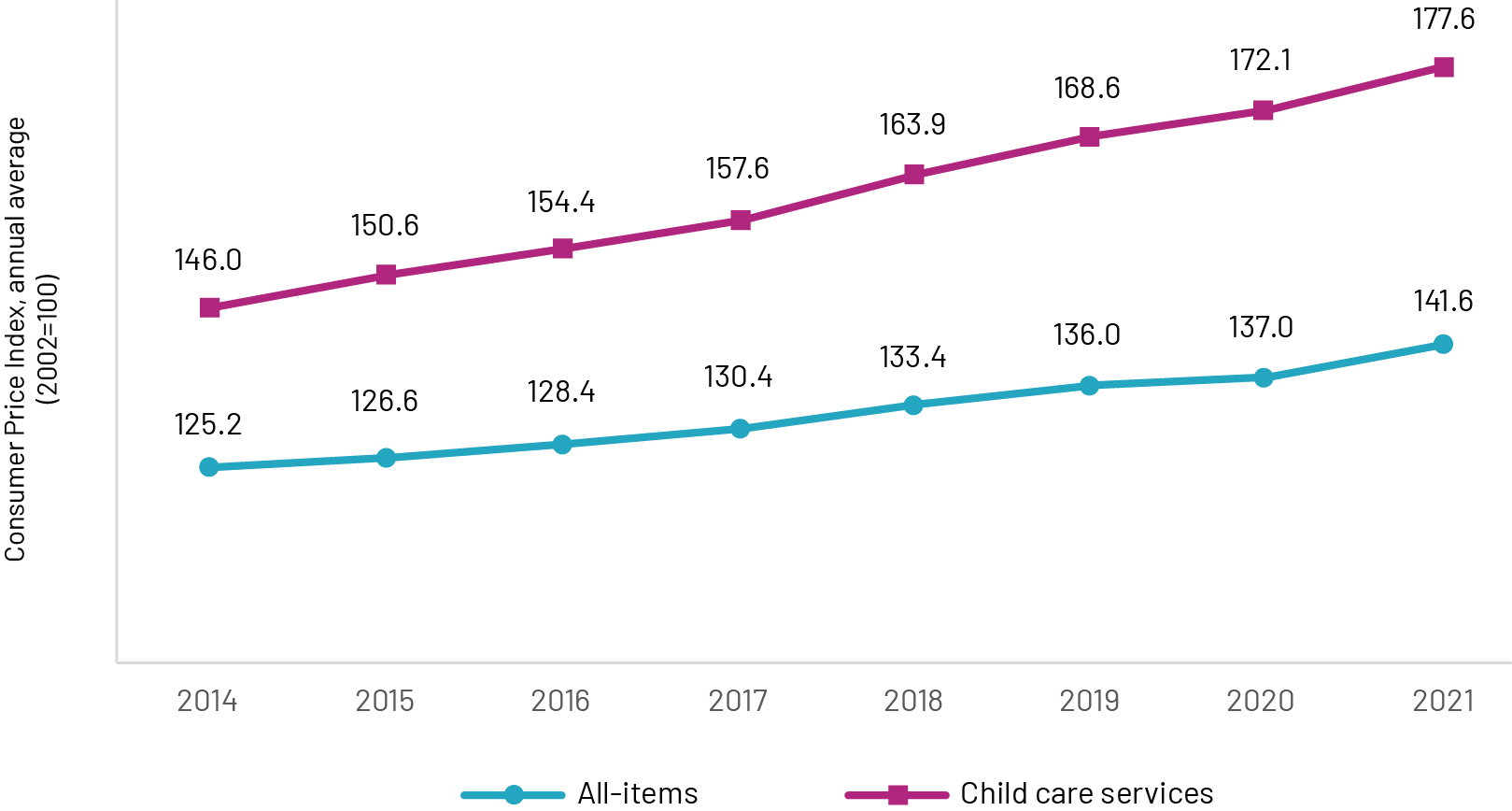
Source: Statistics Canada. Table 18-10-0005-01 Consumer Price Index, annual average, not seasonally adjusted
Figure 1: text description
A graph with 2 lines showing the average Consumer Price Index increase for child care services and for goods in general from year 2014 to 2021.
The graph shows that the cost of child care services is higher than that of consumer goods in general and continues to rise.
| Year | All-items | Child care services |
|---|---|---|
| 2014 | 125.2 | 146.0 |
| 2015 | 126.6 | 150.6 |
| 2016 | 128.4 | 154.4 |
| 2017 | 130.4 | 157.6 |
| 2018 | 133.4 | 163.9 |
| 2019 | 136.0 | 168.6 |
| 2020 | 137.0 | 172.1 |
| 2021 | 141.6 | 177.6 |
Results analysis
As of March 31, 2022:
- Quebec and Yukon had already established regulated ELCC at an average of $10 a day or less prior to the Canada-wide ELCC system
- Newfoundland and Labrador, the Northwest Territories, Saskatchewan and Alberta reduced fees by an average of 50%
- Nova Scotia achieved an average fee reduction of 25%
- Newfoundland and Labrador and Prince Edward Island achieved average fees of $15 a day and $25 a day for regulated ELCC, respectively
All provinces and territories, except for Quebec and Yukon, which had already established regulated and affordable ELCC, committed to reducing fees by at least 50% by December 2022 and continue to make progress toward that goal.
Highlights
Newfoundland and Labrador
Launched in 2014, the Operating Grant Program (OGP) provides grants to participating regulated child care centres to improve the affordability and sustainability of child care for families with young children. On January 1, 2022, the Government of Newfoundland and Labrador, with the support of the Government of Canada, lowered the parental contribution from a $25 per day rate to a $15 per day rate for all infant, toddler, and preschool spaces for centres participating in the program. By March 31, 2022, 94% of child care centres (174 out of 186 centres) were participating in the OGP, an increase of 2% from the previous year, and an increase of 28% from the previous 2 years. As a result, more regulated child care centres are a part of the Canada-wide ELCC system, creating more affordable and accessible child care to parents.
Quebec
Quebec has led progress in affordable ELCC, first implementing a subsidized child care system in 1997. The Government of Quebec remains committed to strengthening its current ELCC system and to investing in programs and services for families and children, with support from federal funding. On June 3, 2021, Quebec's Ministère de la Famille announced a series of new measures for home childcare providers. To support its strategy, Quebec will invest over $200 million over the next 5 years. On October 21, 2021, the Government of Quebec also launched its Plan d'action pour compléter le réseau des services de garde éducatifs à l'enfance (French only). Funding for the plan will total $5.9 billion over 2025 and 2026.
Alberta
Starting in January 2022, as $88.1 million went toward improving child care affordability, the overall out-of-pocket cost per child across all licensed children care types for children in the 0 to kindergarten age range (attending care during school hours) was reduced by an average of 50%. The families of over 86,000 childrenFootnote 20 in the 0 to kindergarten age range benefited from more affordable child care because of lower parent fees. By providing grants to operators and increasing the annual income threshold for provincial child care subsidies, Alberta managed to reduce parent fees by half in the first year of funding under its Canada-wide ELCC agreement.
Access
Overview
The long-term vision across Canada is to ensure that all families who require child care in the country can access regulated, affordable and high-quality options no matter where they live. This means child care that meets the needs of families, no matter what kind of care they require or when they require it.
The Canada-wide ELCC system will support the creation of over 250,000 new regulated child care spaces across the country by March 2026. All provinces and territories, except for Quebec, have committed to space creation targets through their agreements.
Results
The data below demonstrates the results achieved by provinces and territories toward their space creation commitments as of March 31, 2022, as reported and published in their annual reports for fiscal year 2021 to 2022. N/A indicates that the province or territory did not have any space creation commitment specifically for fiscal year 2021 to 2022 under the Multilateral Framework.
| Province/territory | Space creation commitments by March 31, 2022 | Spaces created as of March 2021 to March 31, 2022 | Space creation commitments by March 31, 2026 |
|---|---|---|---|
| Newfoundland and Labrador | 573 | 109 | 5,895 |
| Prince Edward Island | 280.5Footnote 21 | 286.5Footnote 22 | 452Footnote 23 |
| Nova Scotia | N/A | 0 | 9,500 |
| New Brunswick | N/A | 301 | 3,400 |
| Quebec | N/A | N/A | 30,000Footnote 24 |
| Ontario | N/A | N/AFootnote 25 | 76,700 |
| Manitoba | N/A | N/A | 23,000 |
| Saskatchewan | 6,000 | 2,212 | 28,000 |
| Alberta | N/A | N/A | 42,500 |
| British Columbia | 850 | 1,271 | 30,000 |
| Yukon | 25 | 199 | 110 |
| Northwest Territories | 70 | 70 | 300 |
| Nunavut | N/A | 6 | 238 |
| Total | 7,798.5 | 4,454.5 | 250,095 |
- Source: Canada-wide ELCC agreements, annual reports and action plans from provinces and territories for fiscal year 2021 to 2022
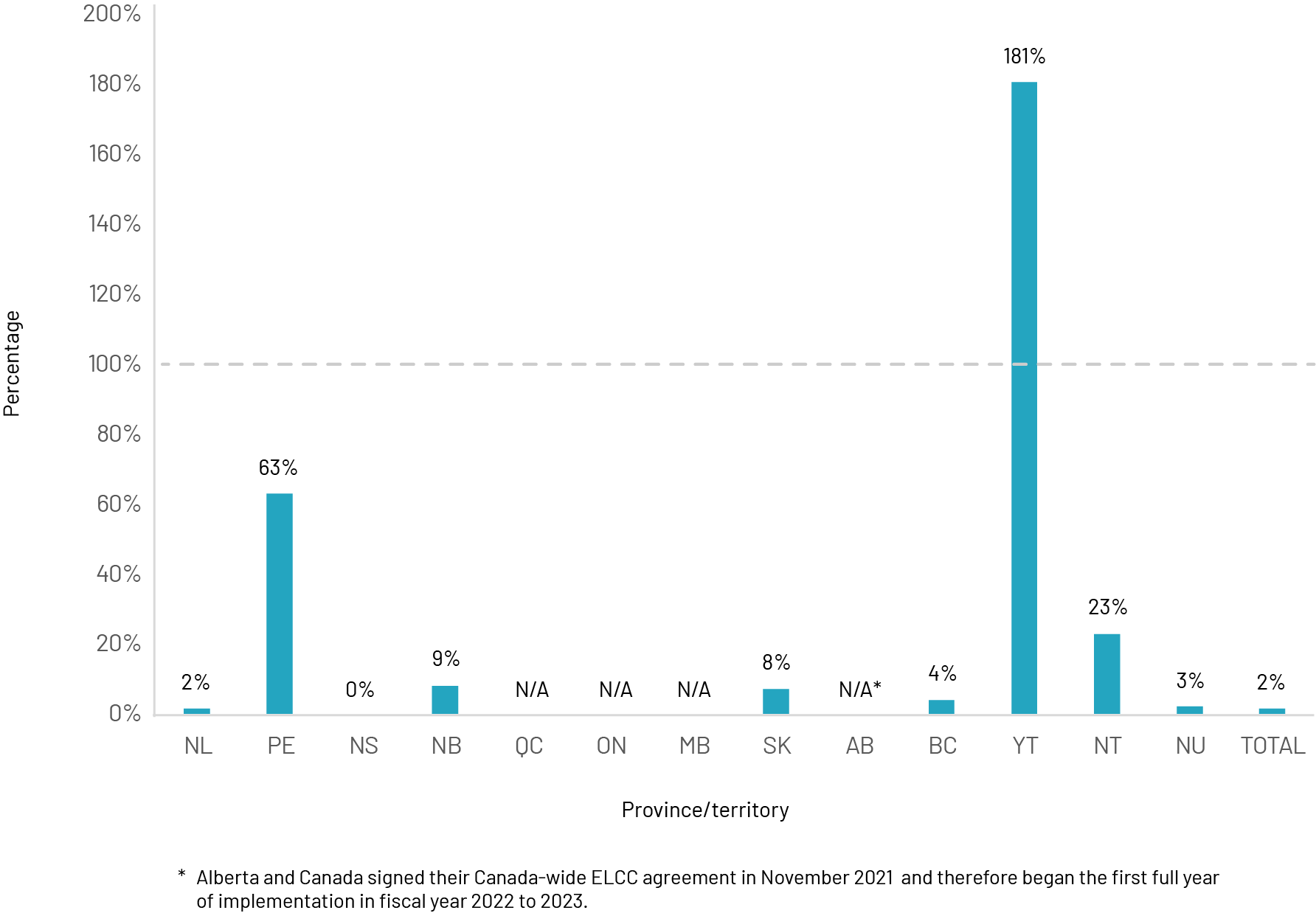
Source: Annual reports from provinces and territories for fiscal year 2021 to 2022
Figure 2: text description
This column chart shows progress made by provinces and territories toward their space creation targets.
As of March 2022, 9 provinces and territories have made progress toward their space creation commitments. Yukon has exceeded its space creation targets by 81%. The spaces created represent 2% of the commitment to create 250,000 new spaces across the country by March 2026.
| Province/territory | Progress made in percentage |
|---|---|
| Newfoundland and Labrador | 2% |
| Prince Edward Island | 63% |
| Nova Scotia | 0% |
| New Brunswick | 9% |
| Quebec | N/A |
| Ontario | N/A |
| Manitoba | N/A |
| Saskatchewan | 8% |
| Alberta | N/AFootnote 26 |
| British Columbia | 4% |
| Yukon | 181% |
| Northwest Territories | 23% |
| Nunavut | 3% |
| Total | 2% |
Results analysis
As of March 31, 2022:
- Yukon met its March 2026 space creation target by the end of March 2022, creating 199, or 181% of its committed spaces
- Prince Edward Island created 63% of spaces towards its March 2023 space creation target, and the province has committed to set an increased target for March 2026.
- 9 provinces and territories have made progress toward their space creation commitments
All provinces and territories, except for Quebec and Prince Edward Island, have committed to specific space creation targets by March 31, 2026, under the Multilateral Framework and will continue to make progress toward their goals. It is expected that spaces created will grow in 2022 to 2023, based on commitments provinces and territories have made in their action plans. For example, Ontario committed to creating up to 42,000 new spaces by the end of 2023 in its first action plan following the signing of its Canada-wide ELCC agreement in late March 2022.
Highlights
Yukon
During the reporting period, Yukon created 199 new spaces, already exceeding its target of 110 new spaces by March 2026. This includes 75 new spaces in 2 child care centres in rural Yukon, and the remaining spaces in Whitehorse (1 new family day home, 3 child care centres expanding, 2 new child care centres). One of the new rural centres was in a predominantly First Nation community that had not had access to child care since 2015. In the other rural community, the new centre supported the 2 already existing centres and helped address waiting lists.
Manitoba
To further improve access to its ELCC system, Manitoba introduced the Extended Hour Child Care Benefit and Shared Space Per Diem, among other initiatives. The Extended Hour Child Care Benefit supported extended hour spaces in eligible facilities already providing child care services on evenings, weekends, holidays and overnight. The Shared Space Per Diem allowed child care operators to enroll more than 1 child into a full-time space.
British Columbia
In their action plan, British Columbia committed to creating approximately 850 new licensed child care spaces for children aged 0 to 6 by the end of the fiscal year and invested $35.2 million of its Canada-wide ELCC funding toward this goal. With a total of 1,271 new child care spaces funded, including 101 spaces for Indigenous families, the province surpassed its target. In addition, British Columbia started to work on a child care facility design standard to facilitate infrastructure projects.
Quality
Overview
ECEs are the cornerstone of the Canada-wide ELCC system, providing safe, inclusive and stimulating environments for all children.
Supporting quality ELCC means supporting a highly educated, well-paid and respected early childhood education workforce. This includes improving working conditions, such as wages, benefits and professional development and training, as well as increasing retention, which in turn can support and maintain space creation.
In further recognition of the ECE workforce’s vital role in providing high-quality ELCC, the Government of Canada provided one-time funding of $420 million in 2021 to 2022 for provinces and territories to support the recruitment and retention of ECEs.
Results
Annual reports from provinces and territories for fiscal year 2021 to 2022 showed that there were approximately 42,848 certified ECEs in jurisdictions where data is available. ECE certification standards and definitions vary across jurisdictions. N/A indicates no data was available for fiscal year 2021 to 2022.
The graph below presents the number of certified ECEs reported by each jurisdictionFootnote 27.
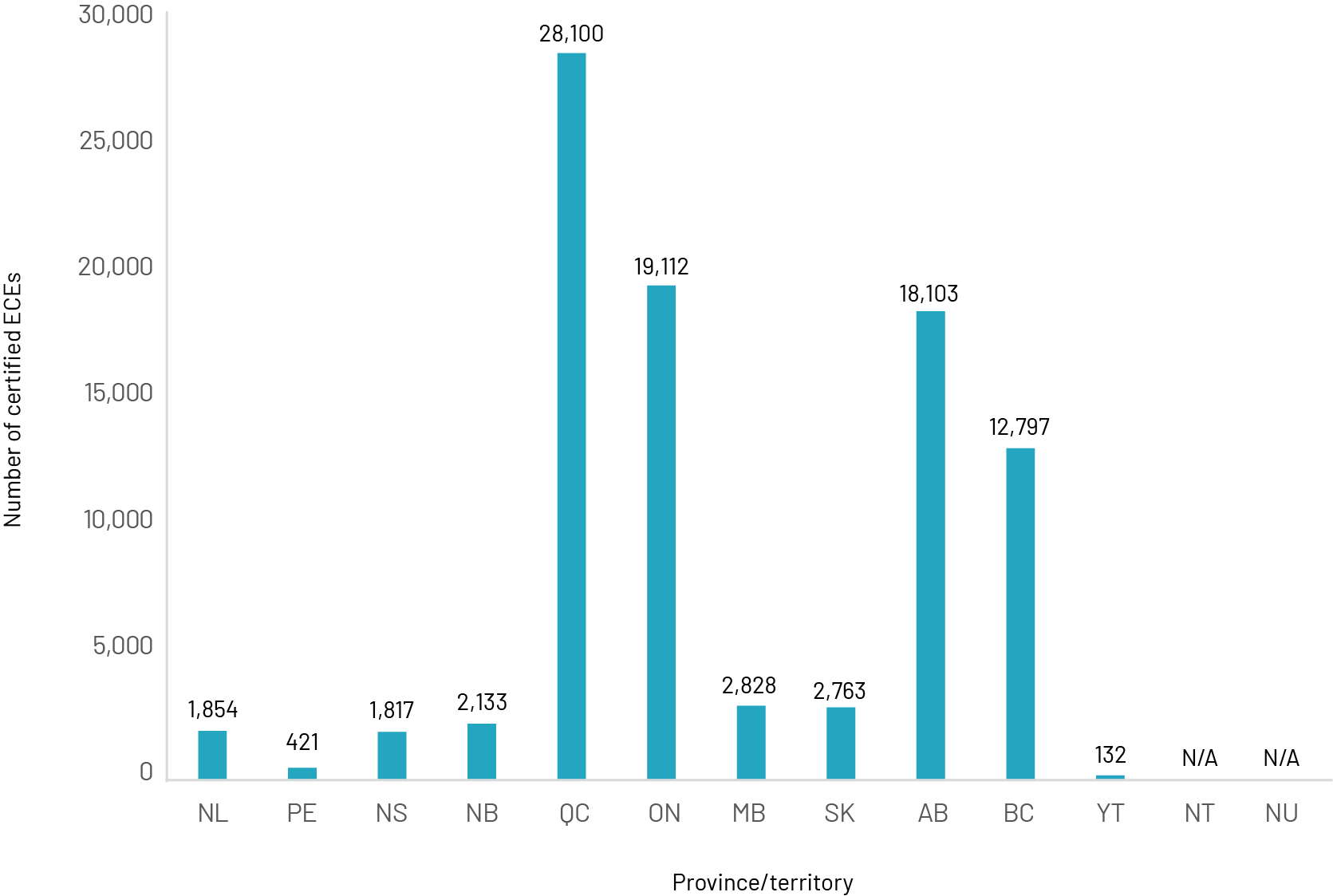
Source: Annual reports from provinces and territories for fiscal year 2021 to 2022
Figure 3: text description
This column chart shows the number of certified early childhood educators (ECEs) per province and territory as of March 2022. Of the jurisdictions where data was available, Quebec, Ontario, Alberta and British Columbia reported the highest numbers of certified ECEs.
| Province/territory | Number of certified ECEs |
|---|---|
| Newfoundland and Labrador | 1,854 |
| Prince Edward Island | 421 |
| Nova Scotia | 1,817Footnote 28 |
| New Brunswick | 2,133 |
| Quebec | 28,100 |
| Ontario | 19,112Footnote 29 |
| Manitoba | 2,828 |
| Saskatchewan | 2,763 |
| Alberta | 18,103 |
| British Columbia | 12,797 |
| Yukon | 132Footnote 30 |
| Northwest Territories | N/AFootnote 31 |
| Nunavut | N/AFootnote 32 |
The table below presents the workforce measures that the provinces and territories have implemented to support ECEs. N/A indicates the province or territory has not implemented the workforce measure. While the introduction of pension and benefit plans is not required in all signed agreements, they play a role in supporting the ECE workforce and are listed in the table below for context.
| Province/territory | ECE wage grid | Pension plan | Benefit plan |
|---|---|---|---|
| Newfoundland and Labrador | N/A | N/A | N/A |
| Prince Edward Island | Preexisting wage grid | N/A | N/A |
| Nova Scotia | N/A | N/A | N/A |
| New Brunswick | N/A | N/A | N/A |
| Quebec | Pre-existing wage grid | Pre-existing pension plan | Benefit plan available |
| Ontario | N/A | N/A | N/A |
| Manitoba | N/A | Pre-existing pension plan | N/A |
| Saskatchewan | N/A | N/A | N/A |
| Alberta | Pre-existing wage top-up | N/A | N/A |
| British Columbia | N/A | N/A | N/A |
| Yukon | Wage grid (April 2021)Footnote 33 | N/A | Extended health benefit funding (December 2021) |
| Northwest Territories | N/A | N/A | N/A |
| Nunavut | N/A | N/A | N/A |
- Source: Annual reports from provinces and territories for fiscal year 2021 to 2022, and Government of Quebec publications
Results analysis
All Canada-wide ELCC agreements, except for the asymmetrical agreement with Quebec, prioritize quality through:
- developing and implementing evidence-based quality frameworks, standards and tools for ELCC
- increasing the percentage of certified child care workers
- implementing wage grids or frameworks if not already in place
In 2021 to 2022, provinces and territories began announcing targeted workforce measures to improve working conditions for ECEs, supporting their recruitment and retention.
Highlights
Northwest Territories
In the Northwest Territories there were approximately 300 early childhood educators employed within licensed programs in fiscal year 2021 to 2022. Approximately 80% of educators did not have formal post-secondary training in early childhood development at the time. The Northwest Territories continued to support post-secondary learning opportunities within its institutions related to ELCC, as well as to offer professional learning opportunities for staff working in licensed ELCC facilities throughout the territories. Well before the Canada-wide ELCC agreements, the Government of the Northwest Territories provided scholarships to students pursuing post-secondary education in early childhood development.
Nunavut
To ensure the quality of ELCC, Nunavut committed to developing a Nunavut ELCC quality framework that will define the fundamental features of Inuit-centred early learning. This year, Nunavut reported that the first draft of the framework had been completed. To develop and sustain the ELCC sector, Nunavut has also done research on how to streamline wages through the development of an ELCC wage scale. Territorial ELCC employees have promoted the federal wage enhancement program to child care operators, which led to contribution agreements with licensed day cares. Among other measures to foster high-quality child care, Nunavut created a plan to help the unlicensed sector and family home-based daycares become licensed and regulated.
Saskatchewan
Much of the work done to improve and implement quality in 2021 to 2022 was funded under the 2017 to 2021 Canada-Saskatchewan ELCC Agreement. This included working with post-secondary institutions to develop and deliver training opportunities for ECEs, improving wages for specific ECE certification levels, accelerating certification levels, and more. For example, the province provided one-time grants to 2,212 new spaces in homes and centres for the purchase of equipment and resources. It also provided a workforce enhancement grant to 355 centres to support recruitment and retention of certified staff. Saskatchewan reported that 69% of ELCC workers in child care centres had ECE credentials as of March 31, 2022.
Inclusion
Overview
Inclusive ELCC systems respect and value diversity and promote the enriching environment of quality ELCC for children with varied cultural, pedagogical, language and accessibility needs. Child care can have a profound influence on child development, including language skills and cultural identity. Therefore, child care facilities should be accessible and located where people need them. This means creating child care spaces for underserved communities, including in rural and remote regions, high-cost and low-income urban neighbourhoods, and communities that face barriers to access, such as racialized groups, Indigenous Peoples, official language minority communities, newcomers, as well as parents, caregivers and children with disabilities.
Families that need extra support, work atypical hours or experience vulnerabilities, and children with additional needs should be welcomed with professionalism and respect. Inclusive ELCC programs and systems that reflect the needs, abilities and culture of families and children require a skilled and educated workforce.
In keeping with the guiding principles of the Multilateral Framework, provinces and territories use federal funding to further build their ELCC systems. In doing so, they prioritize areas of investments that have an impact on families in need. Since provinces and territories are responsible for implementing their ELCC systems, priorities related to inclusion can be different from one jurisdiction to another. This pillar supports initiatives that range from building infrastructure, inclusion training and accessibility measures to underserved communities. The delivery method for inclusion measures also varies by province and territory, with some relying more heavily on grants and subsidy programs and others on partnerships with local organizations.
Results
The table below demonstrates some of the achievements and measures by provinces and territories toward inclusion as of March 31, 2022, as reported and published in their annual reports for fiscal year 2021 to 2022.
| Provinces/territories | Targeted communities | Programs, grants and partnerships | Training and support for ECEs |
|---|---|---|---|
| Newfoundland and Labrador | Rural communities, linguistic minority communities, Indigenous communities, children with enhanced needs | Inclusion program staffing grant | Professional development training on culturally responsive practice, equity, and inclusion |
| Prince Edward Island | All children with disabilities, children living in low-income households, Black and other racialized children, Indigenous children, children of newcomers to Canada and official language minorities | Partnership with BIPOC USHR (Black, Indigenous, and People of Colour United for Strength Home Relationship) | Workshop for the ELCC sector (ECEs and provincial public servants) on anti-racism and inclusion |
| Nova Scotia | Children who need additional supports, Mi’kmaq /Indigenous, Black/African Nova Scotians, Francophone/Acadian, newcomer populations | Inclusion support grant | Curriculum framework and educators guide, culturally responsive practices |
| New Brunswick | Children with enhanced needs | Inclusion support program, Inclusion New Brunswick (association) | Inclusion support workers, training and support for ECEs, webinars on inclusive practices |
| QuebecFootnote 34 | Children in vulnerable situations interregional inequity, children with enhanced needs | Partnerships with the ministère de la Santé et des Services sociaux, health and social services institutions and stakeholders | Partnership work for early detection of challenges and the continuum of services for children aged 0 to 5 through the Agir tôt program |
| Ontario | Indigenous, official language minority communities, children with special needs | Special Needs Resourcing funding | Professional development days, equity-based communities of practice |
| Manitoba | Children with disabilities or neurodiverse, Indigenous children, official language minority communities | Inclusion support program | Applied Behavioural Analysis training, Circle of Security learning groups, Indigenous programming grant for IELCC facilities, Francophone training enhancement grant |
| Saskatchewan | Children with complex needs, children with disabilities, official language minority communities | Enhanced accessibility and inclusion grants | Training for ECEs, program for inclusion of deaf or hard of hearing children |
| Alberta | Vulnerable and diverse populations, children who need one-on-one support, children with disabilities and who need enhanced support | Around 535 inclusion programs supported through bilateral and Canada-wide ELCC agreements and provincial funding | New plan for equitable access involving on-site consultations, training and coaching, new plan to increase inclusion for children with disabilitiesFootnote 35 |
| British Columbia | Indigenous families, children with support needs, Francophone families, families from diverse cultural backgrounds | Supported Child Development and Aboriginal Supported Child Development, Aboriginal Head Start program, partnership with Indigenous communities | Capacity building for inclusion among child care providers |
| Yukon | Children with diverse developmental needs, children requiring enhanced or individual support, official language minority communities, Indigenous children | Therapeutic support and supported child care program, cultural enhancement kits for French and Indigenous programming | Inclusivity programs, including French language early learning opportunities |
| Northwest Territories | Community members, families, children with disabilities | Supporting Child Inclusion and Participation program | Support for families and hiring staff, resources to support child participation, professional learning opportunities |
| Nunavut | Northern communities, Inuit, children with disabilities, children needing enhanced or individual supports, vulnerable children | Early development of partnerships with Nunavut Tunngavik Inc. and the Nunavut Disabilities Makinasuaqtiit Society | Distribution of educational program materials specific to inclusion, creating more equitable environments, in all official languages. |
- Source: Annual reports from provinces and territories for fiscal year 2021 to 2022
The Canadian Survey on the Provision of Child Care Services (CSPCCS) provides estimates on the proportion of children among priority population groups who participate in child care. The table below presents data from the 2022 survey that relates to non-mandatory training on inclusion for ECEs and operators in centres and home-based child care settings.Footnote 36
| Professional development or training | Proportion of centre-based child care businesses (only including relevant options) | Proportion of licensed home-based child care providers | Proportion of unlicensed home-based child care providers |
|---|---|---|---|
| Working with children with disabilities | 54% | 35% | 7% |
| Working with children with diverse backgrounds | 40% | 29% | 7% |
| Incorporating Indigenous (First Nations, Métis and Inuit) or culturally relevant ways of knowing and learning | 26% | 18% | 5% |
- Source: Statistics Canada. Table 42-10-0096-01 Proportion of centre-based and home-based child care providers by participation in child care-related professional development training, April 2022, Canada
Results analysis
Through their agreements, provinces and territories have committed to support inclusion measures within their ELCC systems, ensuring that vulnerable communities have equitable access to regulated child care spaces.Footnote 37 Provinces and territories put in place measures suited to their jurisdictions, and therefore targeted a range of issues and communities. While measures to foster inclusion vary, all provinces and territories provided professional learning opportunities on inclusion for ECEs in licensed child care facilities.
Highlights
Prince Edward Island
Prince Edward Island’s ELCC system has continued to grow in diversity both from a workforce perspective and in terms of families and children participating in programs. A support and advocacy group based in the province, BIPOC USHR (Black, Indigenous, and People of Colour United for Strength Home Relationship), held a series of workshops for the ELCC sector. The workshops focused on anti-racism, recognizing and dismantling white privilege, and unconscious bias. A total of 30 employees from the Department of Education and Lifelong Learning attended the virtual workshop, as well as 64 educators, who later shared their new knowledge with staff in child care centres.
New Brunswick
New Brunswick’s focus has been on designing and planning ELCC programs and services that increase inclusion in licensed facilities across the province. Through the Inclusion Support Program, children with additional needs and ECEs have access to inclusion support workers to foster learning environments in which everyone can fully participate. In 2021 to 2022, 103 out of 240 inclusion support workers in Francophone and Anglophone designated facilities completed the training, close to the target of 144. The percentage of designated facilities that received support for inclusion (44%) exceeded the original target (35%). Support can take the form of on-site consultations, communities of practice, or ongoing professional development.
Nova Scotia
Nova Scotia’s vision is that all child care spaces should be accessible to all children, which includes children who need additional supports, Mi’kmaq /Indigenous, Black/African Nova Scotians, Francophones/Acadians, newcomers, and other equity-seeking groups. In 2021 to 2022, the province used the Inclusion Support Grant to provide child care centres with funding to implement interventions or accommodations for children with additional needs, mainly through support staffing. As a result, 80% of eligible child care centres had greater staff capacity to support inclusion of all children. The Government of Nova Scotia also updated the Early Learning Curriculum Framework and the Educator’s Guide, as well as developed culturally responsive practice modules, so that ECEs have the skills, knowledge and abilities to work with children and their families effectively.
Results for Indigenous early learning and child care
ECEs play a key role in delivering quality, culturally relevant care that meets the unique needs of Indigenous families. In fiscal year 2021 to 2022, the federal government invested an additional $75 million to improve the quality and accessibility of IELCC programs. This funding supported providers in improving the retention of Indigenous ECEs and offering more flexible and extended hours of care.
While service delivery was significantly impacted during COVID-19 restrictions due to mandated closures of child care centres and public health measures such as gathering size limits and social distancing, First Nations quickly transitioned from in-person child care programming to virtual parenting supports, food hampers, activity baskets, and land-based learning to ensure ongoing supports for families. The Assembly of First Nations noted that “First Nations have demonstrated innovation and dedication to providing high-quality, culturally relevant supports and programs to their children and families throughout the COVID-19 pandemic.”
Canada and Indigenous partners have agreed to co-develop distinctions-based results frameworks. Recognizing that this would be a multi-year process, a set of interim indicators was put in place as part of the standard funding agreement cycle to accommodate this work.
To support the safe reopening of IELCC programs and services in accordance with COVID-19 public health measures, IELCC distributed $120 million in emergency funding to First Nations, Métis, and Inuit communities and to Aboriginal Head Start in Urban and Northern Communities (AHSUNC) sites. It is important to note that, during the COVID-19 pandemic, expenses increased (for example, cleaning, transportation, housing, health), and attracting qualified ECEs was a challenge. ESDC continued to support Indigenous communities through its work with distinctions-based partnership tables to advance goals and priorities stated in the IELCC Framework.
Despite reporting flexibilities that were employed due to the COVID-19 pandemic, examples of broad results achieved over the reporting period include:
- creating additional spaces and fostering language and culture in programming in both First Nations communities and Inuit Nunangat
- establishing new Métis-specific ELCC programs, services and supports
- increasing support to the AHSUNC program to enhance programming in urban and northern communities
As well, a total of 13 quality improvement projects received funding to support Indigenous-led best practices and advance foundational elements of IELCC.
System support activities
In addition to negotiating and administrating funding agreements with provinces and territories, the Federal Secretariat on ELCC conducts different activities that support the implementation of the Canada-wide ELCC system.
Data and research
ESDC works with Statistics Canada to improve data collection and research on ELCC in Canada. They collect relevant and reliable data to monitor progress in implementing the Canada-wide ELCC system and to inform policy development.
In 2021 to 2022, Statistics Canada released data from 2 recurring surveys: the Survey on Early Learning and Child Care Arrangements and the Canadian Survey on the Provision of Child Care Services. Both surveys can be consulted in the ELCC Information Hub on the Statistics Canada website.
During the year, 8 research reports were completed. Of the 8, 5 were for internal use and 3 were published externally by Statistics Canada:
- The Likelihood and Timing of Mothers Returning to Work After Parental Leave (Youjin Choi)
- The Value of Unpaid Childcare and Paid Employment by Gender: What Are the Impacts of the Low-Fee Universal Child Care Program? (Wulong Gu)
- Use of child care for children younger than six during COVID-19 (Leanne C. Findlay and Lan Wei)
Expert Panel on ELCC Data and Research
The Expert Panel on ELCC Data and Research (the Panel) was announced in June 2019, with an 18-month mandate. The Panel provides the Minister of Families, Children and Social Development advice on ELCC data and research, as well as other priorities set by the Minister. In December 2020, the Minister extended the Panel’s mandate by 6 months due to the 2019 election and COVID-19 pandemic.
The Panel submitted interim advice throughout its mandate, including recommendations on the establishment of a national ELCC secretariat.
The Panel met a total of 36 times and concluded its mandate in June 2021, submitting its final advice at that time. Their final report included overarching recommendations and reports from their working groups, including Research, Data and Indicators, and Workforce. The Panel highlighted different ways to implement proposed conditions for provinces and territories. It also highlighted the value of having rich data on ELCC quality in Canada. Their work has informed the federal government’s data and research efforts. The Panel stressed the need for a pan-Canadian workforce strategy to address workforce shortages, which got worse during the COVID-19 pandemic.
National Advisory Council on Early Learning and Child Care
In 2021 to 2022, the Secretariat launched the process to create the National Advisory Council. The Government of Canada committed in Budget 2021 to establish the National Advisory Council on ELCC with a broad mandate to provide third-party expert advice and to serve as a forum for consultation on issues and challenges facing the ELCC sector. The Call for Applications to establish the Council was open from August 4 to September 28, 2021.
External Relations
The Secretariat conducted pre-tabling engagement on proposed ELCC legislation from January to April 2022. All provinces and territories, more than 50 Indigenous governments and organizations, and over 70 stakeholder organizations and experts received a discussion guide by email. In addition, the Public Policy Forum facilitated a stakeholder roundtable with 18 key stakeholders on behalf of ESDC. The Department also held 2 virtual meetings with a group of 7 expert advisors on ELCC in April and August 2022. Through this engagement, ESDC collected stakeholders’ views to inform the proposed ELCC legislation and supported ongoing collaboration toward a Canada-wide ELCC system.
More information about stakeholder engagements can be found in the What We Heard Report – November 2022.
Innovation Program
Launched in 2018, the ELCC Innovation Program supports projects that explore, test and develop innovative approaches that have the potential of becoming best practices and can be adopted by partners and service providers in the system.
In particular, the Program supports projects that respond to a wide range of unique and diverse child care needs. These include support for families from Indigenous, Black and other racialized communities; Francophone and Anglophone minority communities; and families who are lower-income, are newcomers to Canada, are single-parent households, have children with additional needs, work non-standard hours, or live in underserved communities.
In 2021 to 2022, the ELCC Innovation Program negotiated agreements for 16 projects for a total of $27.6 million over 36 months, out of approximately 500 proposals received. The funded projects are national and community-based.
For more information on the projects underway, please consult the list of approved early learning and child care innovation projects across Canada.
Official Languages
Child care can have a profound influence on children’s overall development, including their language skills and identity. That is why the Multilateral Framework recognizes the unique needs of French and English linguistic minority communities.
Through its Action Plan for Official Languages 2023-2028: Protection – Promotion – Collaboration, the Government of Canada is providing $20 million to improve access to quality ELCC in French for Francophone families outside of Quebec. Of that funding, $13.15 million is allocated to professional training and capacity-building for Francophone child care workers.
Under its funding agreement with ESDC, the Association des collèges et universités de la francophonie canadienne (ACUFC) partnered with 4 key official languages organizations, and consulted with more than 100 stakeholders, to support the implementation of more than 30 initiatives to increase the number of adequately trained Francophone ECEs in minority settings. This fiscal year, their joined efforts led to:
- training opportunities for 2,196 ECEs
- 86 new partnerships
- 43 funding agreements with 22 organizations to carry out initiatives
- the first national symposium with a focus on ELCC workforce challenges and innovating practices in French-speaking minority communities, held virtually on May 12 and 13, 2021
International
ESDC continues to support international work in the context of ELCC, including engagements on the exchange of best practices, and sharing efforts to build a Canada-wide ELCC system. In addition to bilateral engagement, ESDC engages with several multilateral organizations and international fora, including the Organisation for Economic Co-operation and Development’s (OECD) Early Childhood Education and Care (ECEC) Network.
In 2021 to 2022, the Government of Canada along with the governments of Nova Scotia, New Brunswick, Quebec, and Alberta, participated in the OECD’s Quality beyond Regulations policy review project. This project supported countries and jurisdictions in understanding and enhancing quality in ELCC settings. It resulted in the publication of a main report and a country background report for Canada:
- Starting Strong VI: Supporting Meaningful Interactions in Early Childhood Education and Care (OECD)
- Canada country background report – Quality in early childhood education and care (2021) (ESDC)
Summary
Fiscal year 2021 to 2022 marked the first year of the Canada-wide early learning and child care (ELCC) system. In Budget 2021, the Government of Canada made transformative and historical investments to build a Canada-wide ELCC system with provincial, territorial and Indigenous partners.
These investments were against the backdrop of the second year of the COVID-19 pandemic. In Canada, the pandemic continued to amplify challenges in all ELCC systems, impacting the ELCC workforce, access to child care spaces for families and infrastructure costs, among others.
To address these and other challenges, the shared vision for ELCC is one where all families can, if they wish to, access high-quality, affordable, inclusive and flexible ELCC across the country.
Building on the success of the previous bilateral ELCC agreements, federal, provincial, territorial and Indigenous partners agreed to create 250,000 new child care spaces and reduce child care fees for parents to an average of $10 a day by March 31, 2026.
All Canada-wide ELCC agreements, bilateral ELCC agreements extension and workforce agreements were negotiated and signed in 2021 to 2022.
The next national progress report on ELCC will cover the second year of the Canada-wide ELCC agreements, from April 1, 2022, to March 31, 2023.