
Audit of Asset Management
Cat. No.: En4-788/2025E-PDF
ISBN: 978-0-660-97682-2
EC25019.16.
Unless otherwise specified, you may not reproduce materials in this publication, in whole or in part, for the purposes of commercial redistribution without prior written permission from Environment and Climate Change Canada's copyright administrator. To obtain permission to reproduce Government of Canada materials for commercial purposes, apply for Crown Copyright Clearance by contacting:
Environment and Climate Change Canada
Public Information Centre
Place Vincent Massey building
351 St-Joseph boulevard
Gatineau Quebec K1A 0H3
Toll free: 1-800-668-6767
Email: enviroinfo@ec.gc.ca
Photos: © Environment and Climate Change Canada
© His Majesty the King in Right of Canada, as represented by the Minister of Environment and Climate Change, 2025
Aussi disponible en français
Download the alternative format
(PDF format, 448 KB, 19 pages)
1. Introduction
Objective: To assess the extent to which Environment and Climate Change Canada's (ECCC) management of materiel and real property effectively optimizes assets life cycle, supports program delivery, and aligns with departmental priorities.
Context: As a science-based Department, ECCC relies on a broad and complex asset portfolio to support the delivery of its mandate that extends well beyond conventional office buildings or office equipment. The department's capital assets (items that are valued at greater than $10,000) include, but are not limited to, scientific equipment, buildings, laboratories, land, infrastructure, various vehicle and watercraft fleets, Information Technology (IT) assets (hardware and software), and thousands of specialized monitoring assets such as weather stations, radars and satellite equipment, hydrometric stations, upper air stations, weather buoys, air quality monitoring stations and observatories.
With regards to the various vehicle fleets, departmental officials use on and off-road vehicles, snowmobiles, boats, utility trailers, agricultural equipment, and helipads to access remote wetlands and coastlines, and to support monitoring and habitat management. Some assets are heritage-designated, including a few heritage buildings and lighthouses located in National Wildlife Areas. Also located in National Wildlife Areas are hundreds of engineering structures that serve conservation purposes, such as dykes, pump stations, roads, bridges, culverts, and other structures that support habitat conservation.
ECCC's asset portfolio is geographically vast, with assets located across all regions of Canada - in urban centres, rural communities, and remote sites such as Eureka in the High Arctic. The Department's footprint spans a wide range of tenure arrangements, including Crown-owned properties, leased and licensed sites, and installations on third-party lands. Real property is held under departmental custodianship or through accommodations managed by Public Services and Procurement Canada, while other assets are deployed through thousands of land-use agreements and partnership arrangements with provincial, Indigenous, private, and international stakeholders.
As of May 2025, the acquisition value of all departmental capital assets was approximately $1.3 billion, with a net book value of approximately $537.2 millionFootnote 1. Responsibility for the management of these assets is primarily distributed across branches that own assets. The top 4 branches that manage assets are: the Meteorological Service of Canada (38%), the Corporate Services and Finance Branch - CSFB (32%), the Science and Technology Branch (21%), and the Canadian Wildlife Service (6%). These 4 branches manage 97 percent of all departmental assets.
CSFB is responsible for the majority of ECCC's built real property portfolio, such as major laboratories and office space, which together comprise over 90% of the ECCC's custodial floor space. Land holdings, primarily designated as National Wildlife Areas and Migratory Bird Sanctuaries, are managed separately by the Canadian Wildlife Service, including the buildings and engineering structures on these lands. Materiel management is largely decentralized, with branch custodians acquiring, using, maintaining, and disposing of their custodial assets. For capitalized assets (real property and materiel), resource planning is centralized under the Departmental Capital Planning and investment planning multi-year governance.
The Department's real property and materiel holdings are governed by the Treasury Board's (TB) investment, real property, and materiel policies, which require departments to manage assets using a life-cycle approach. This includes planning, acquisition, use, maintenance, and disposal in a way that optimizes their value, supports operational requirements and aligns with departmental mandates and priorities.
2. Findings, recommendations and management responses
2.1 Governance, roles, and planning
Key findings: ECCC has established governance structures and formal planning processes to support asset management, particularly for real property. Recent departmental efforts have been focused on enhancing enterprise-level coordination and aligning asset investments with strategic priorities.
There remain opportunities for improvement related to further clarifying roles and responsibilities for stakeholders and improving asset planning and coordination, which vary across branches. Making improvements in these areas would strengthen the information to support enterprise level decision-making and strategic real property and materiel investment decisions.
We assessed whether ECCC has established the governance structures, defined roles, and planning processes needed to manage its assets effectively. This included examining whether oversight structures provide strategic direction and support informed decision-making, whether stakeholder responsibilities involved in asset management are clearly defined and well communicated, and whether asset planning and prioritization are integrated, strategic, and effective.
Governance
ECCC has established enterprise-level governance structures to oversee capital asset management. The Executive Management Committee provides strategic direction and decision making, supported by several Director General (DG) level committees. These include the DG Finance Committee, which provides financial and operational guidance, and the DG Corporate Committee, which supports real property governance by addressing broader corporate priorities such as digital transformation and enterprise risk. These structures are intended to apply across both real property and materiel assets, as reflected in departmental frameworks that were in draft form at the time of the audit.
The CSFB is the real property functional lead and the custodian of the department's major and/or more complex real property; it has delegated authority for all real property transactions. Within CSFB, the Real Property, Security and Environment Directorate provides enterprise support and guidance on real property and materiel, while the Investment Planning and Enterprise Project Management Office oversees enterprise project management and strategic alignment and manages the Department's Investment Plan and Capital Asset planning functions. The branch is responsible for investment planning, policy development, and operational oversight. Delegated authorities differ between real-property and materiel management. Real property management involves broader authorities - such as spending, contracting, and project approvals. Responsibilities with respect to lifecycle oversight and disposal apply to both real property and material management.
In practice, the reach and effectiveness of governance vary across real property and materiel. Oversight of real property assets, particularly those under CSFB's custodianship, has strengthened recently. The Assistant Deputy Minister (ADM), CSFB, has led the development of a 10-year Real Property Strategy and initiated a more structured portfolio management approach, to position the Department to make strategic decisions in this area. This oversight did not extend to all real property holdings. For example, infrastructure within the Canadian Wildlife Service portfolio - such as engineering structures and heritage buildings - are not integrated into departmental real property portfolio oversight from an enterprise perspective. As a result, the Department may lack sufficient visibility to comprehensively understand risks and investment needs across all of its real property base (see case study on National Wildlife Areas).
Case study: National Wildlife Areas
Long description
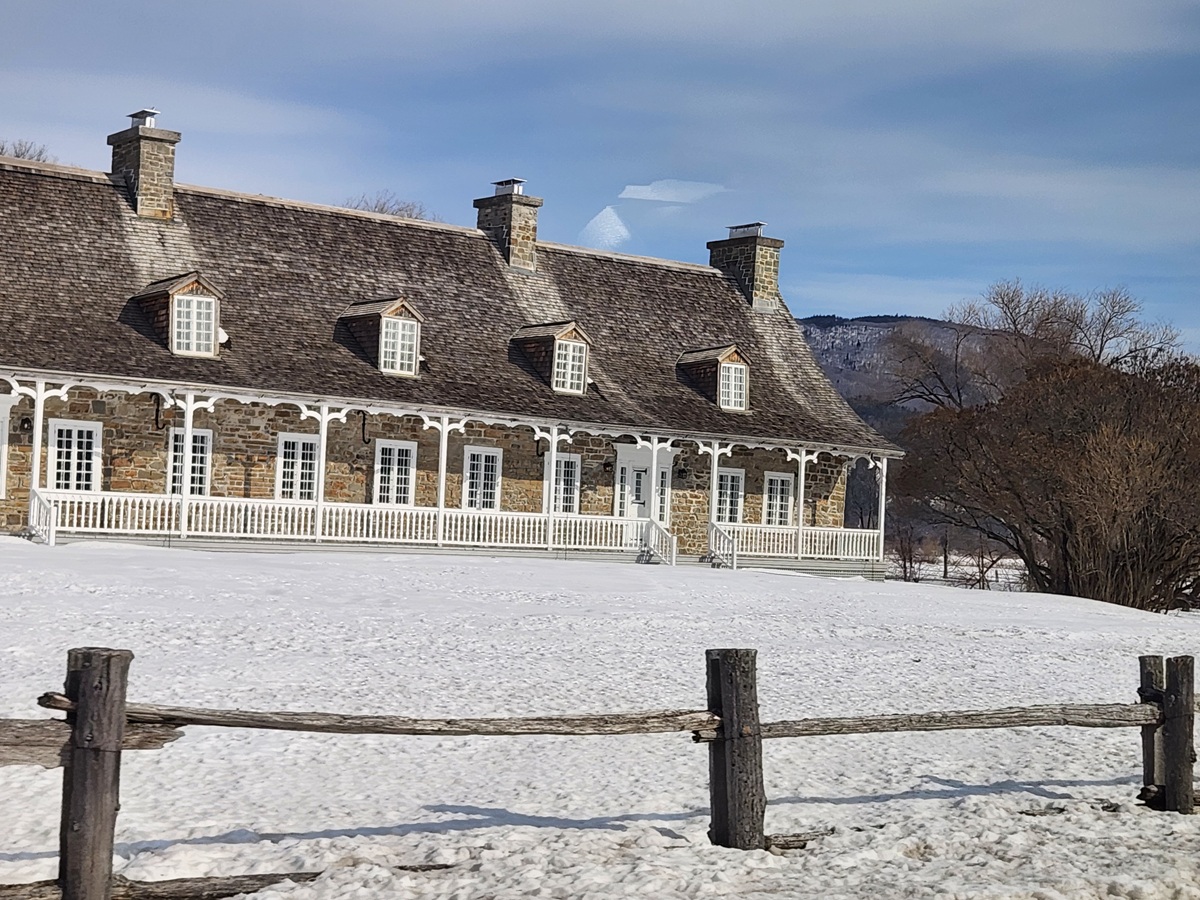
Figure 1 shows a farm house, a historic monument called 'Petite Ferme', which is in the Cap Tourmente National Wildlife Area. The house has three chimneys and a grey roof and is surrounded by a wooden fence. There is snow all around it, under a blue and white sky.
Cap Tourmente National Wildlife Area (NWA), located northeast of Québec City, spans over 2,300 hectares and is managed by the Canadian Wildlife Service to conserve critical wetland habitat. In addition to its ecological value, the site contains a broad range of real property and infrastructure assets with custodial obligations, including 2 federally designated heritage buildings, one of which (the Petite-Ferme, circa 1667) is the oldest functioning building owned by the Government of Canada as well as a number of roads, bridges, culverts, dikes, walking trails, water control structures, and visitor facilities such as an observation tower and interpretation centre.
Cap Tourmente is 1 of about 30 NWAs in ECCC's real-property portfolio that include multiple buildings or engineering structures, some of which are owned and maintained by external partners, such as non-profit conservation organizations through agreements. At the time of the audit, information on the condition and risks of several buildings and engineering structures was incomplete or not reflected in the departmental financial system, although significant efforts were underway to address these gaps. Because some NWA lands were acquired decades ago with pre-existing buildings or structures, some structures had not been capitalized separately from the land. Regardless of ownership or condition, their presence on ECCC lands poses inherent risks and potential liabilities, particularly if failures or deficiencies were to occur and lead to legal, environmental, safety, or financial consequences.
More broadly, there is no consolidated view of long-term liabilities, life-cycle costs, or compliance risks associated with the portfolio of assets located on program-managed lands. Climate change is expected to amplify these pressures, particularly for infrastructure exposed to flooding, erosion, or other environmental stressors. This case underscores the importance of ensuring that the full portfolio of assets is visible within the departmental real property governance so that risks and obligations are understood and factored into planning and oversight.
Governance of materiel management, including capital and non-capital assets such as scientific equipment and specialized vehicles, remains largely decentralized, with custodial branches being responsible for the life-cycle management of their own materiel assets. At the time of the audit, there was no consolidated, department-wide view of these assets' physical condition, risks, performance, or lifecycle management needs, which may hinder the department's ability to support timely and informed materiel management decisions.
The department has also established project management governance mechanisms, including the Project Management Advisory Committee and the Enterprise Project Management Office. These functions oversee project gating, risk management, and adherence to project management standards. Real property projects have not always been consistently reviewed through integrated planning channels, and links between project oversight, investment priorities, and asset strategy are still developing. As noted earlier, there is work currently underway that is being led by CSFB to strengthen both real property management, as well as enhancing project management governance.
A Taskforce on Assets and Infrastructure Capitalization initiative was recently launched in response to a need for a more comprehensive and coordinated view of capital investment needs, in the context of fiscal constraint and limited consolidated asset data. The taskforce is structured with defined leadership, timelines, and deliverables, and is supported by program and functional representatives from across the department. Its mandate includes aligning investments with strategic priorities, assessing risks, compiling asset and infrastructure data, and developing a costed, evidence-based investment proposal. While this work is still underway and the taskforce was stood up as a temporary initiative, it reflects a level of horizontal coordination and portfolio-level asset planning that had not been active within the departmental governance framework in recent years. As such, it presents an opportunity to inform and strengthen future asset governance structures that support capital planning and prioritization.
Roles and responsibilities
The ADM, CSFB, and Chief Financial Officer, serves as the Senior Designated Official for both real property and materiel management. In this capacity, the ADM, CSFB, provides departmental leadership and functional direction for asset management, including the development and oversight of internal policies, frameworks, and guidance. CSFB's role is to provide departmental oversight and support functions related to asset management, including interpretation of TB policies and application of departmental procedures.
Within CSFB, the Real Property, Security and Environment Directorate provides enterprise support and guidance on real property and materiel. It is composed of 4 divisions: Departmental Security and Emergency Management; Environmental Management - responsible for fleet and greening operations; Real Property and Infrastructure Integration - responsible for realty transactions, technical services, and change management; and Workplace Solutions - which includes 2 regional facilities teams (National Capital Region, Quebec, Atlantic; and Ontario, West).
At the time of the audit, the Real Property and Infrastructure Integration Division and the Workplace Solutions Division were responsible for the majority of the Department's built real property portfolio (owned and leased), primarily office space and laboratories. Materiel management remains largely decentralized, with branches being the custodians for their own assets and CSFB providing functional direction and guidance.
There is an opportunity to better define asset management roles and responsibilities across the department. While updated frameworks for real property and materiel management were developed during the audit period to clarify responsibilities, they had not yet been communicated to all employees involved in asset management. This was confirmed through interviews with real property and materiel personnel and asset custodians across the department - many of whom were unaware of the frameworks, unclear about their own responsibilities, or uncertain where CSFB's role ends and their role begins. The lack of clarity was especially apparent in sites owned by ECCC, where the distinction between technical services, facilities, and program responsibilities was not always well understood.
During site visits to several ECCC custodial locations, we heard of instances where modifications to spaces had been initiated by program branches without clear coordination with facilities teams. In these cases, specialized equipment was added, or space reconfigured to meet operational needs, but Technical Services or National Facilities Management staff were not always informed or directly involved until later in the process. We were informed that this could lead to uncertainty around roles, approval processes, and who is ultimately responsible for the long-term upkeep or replacement of newly installed assets. These observations point to the value of reinforcing communication protocols and clarifying roles and expectations amongst stakeholders to support consistent life-cycle management in shared facilities.
Interviewed Senior Building Officers (SBO) also expressed concerns about the clarity of their roles and responsibilities. SBOs are site senior staff members appointed to facilitate administrative, non-program delivery matters such as occupational health, safety, emergency, and security issues. While they have a key liaison role within ECCC workplaces, they are not necessarily real property practitioners or CSFB staff. Some SBOs felt overextended, with expectations placed on them to address real property or facilities issues that may fall outside their intended mandate.
Few existing documents clearly outline asset management roles, and a few require updating to reflect current TB policy requirements. Access to guidance remains an issue, as several interviewees noted difficulty locating information or navigating the Ecollab platform without direct links, which contributes to continued reliance on informal networks.
It should be noted that CSFB recently completed a reorganization of its real property and materiel management functions. As the changes had only recently been implemented, the impact on clarifying roles and responsibilities was not yet evident at the time of the audit. The reorganization was undertaken as part of branch efforts to improve collaboration between teams, optimize operations, and strengthen awareness and client support to branches, while also addressing needs related to data, policy development, and project management support through the creation of dedicated teams.
Planning and prioritization
Planning activities form part of ECCC's overall approach to managing assets throughout their life cycle. The TB Policy on the Planning and Management of Investments requires departments to produce a 5-year investment plan every 3 years. The most recent Investment Plan, approved in 2022, covers fiscal years 2022 to 2023 until 2027 to 2028. The development of the ECCC 5-Year Investment Plan from 2025 to 2026 until 2029 to 2930 was underway at the time of the audit. The Investment Plan is a strategic, high-level document which provides information relating to all investments, including assets (scientific equipment, transportation), acquired services and projects (Information Management, IT, real property, infrastructure, and contaminated sites).
The capital planning process that prioritizes asset funding is conducted annually, spans a 5-year horizon and supports the Department's assets component of the Investment Plan. The Departmental Capital Plan serves as the foundation for approving branches' capital assets and to allocate the Capital departmental envelope to highest unfunded priorities on an annual basis and aims to ensure that funding decisions are risk-informed and aligned with departmental priorities. The Departmental Capital Plan and allocations are generally approved for a 2-year cycle, to support longer procurement activities needed for timely purchases.
At the enterprise level, the audit found that the capital planning process is well-structured, with defined roles, timelines, and prioritization tools coordinated through the Ecollab platform. Proposals are assessed using the standardized Overall Priority Rank system based on 3 criteria: contribution to ECCC outputs and government priorities, contribution to asset management objectives, and contribution to ECCC performance. The process involves multiple stakeholders, including branches (who submit capital requirements and cost estimates), Asset Category Leads (who review proposals within their domain—real property, IM-IT, or fleet), and key functions within CSFB, such as the Assets and Inventory Accounting team that confirm assets accounting TB directives are met, Financial Management Advisors that support programs, and the Investment Planning and Assets group that develop the tools, challenge results, and validate plans. In addition, the official ranking is complemented with additional flexibility to allow for exceptional requirements to be considered based on branch needs and pressures. The Departmental Capital Plan receives DG Finance Committee endorsement before moving forward to the DM for approval.
The audit examined the most recent capital planning exercise to assess whether the process functions as intended. Analysis of documentation reviewed found that the process was carried out effectively in accordance with established procedures, with funding allocations considered against established criteria and endorsed through the appropriate governance channels.
However, interviews and site visits revealed limited coordination within and between branches, leading to missed opportunities to optimize existing assets or consolidate future investment needs. Materiel planning does not follow an enterprise-wide integrated portfolio approach that considers coordination and sharing of assets across the organization, and gaps in centralized data - such as asset condition, utilization, and performance - reduce the ability to assess needs and prioritize effectively.
The audit noted a couple of examples that reflect collaborative approaches to asset use and planning, such as teams from 2 different branches co-located at the same facility sharing vehicles, and in one instance, a shared use arrangement for a boat eliminated the need to submit a new capital request. These examples illustrate that when collaboration does occur, it can optimize resources and ease pressures on capital planning.
However, the audit also noted examples where branches located in the same town maintained uncoordinated storage solutions, including one branch seeking third-party storage while another had apparent space available on-site. Similarly, in co-located facilities, multiple branches maintained separate fleets of off-road vehicles, yet none reported mechanisms for sharing or jointly planning asset use - suggesting opportunities for collaboration that could be explored. Documentation from recent assessments of departmental facilities, conducted to evaluate the health of the real property and asset portfolio, also identified opportunities to optimize unused space and assets. These examples illustrate how missed opportunities for coordination at the operational level make it difficult to assess whether planning decisions fully reflect actual needs, and whether efficiencies could be achieved through better integration. One case that illustrates these challenges in planning, coordination, and alignment is the construction of a net-zero-ready garage in Whitehorse, Yukon.
Case study: The net-zero garage
Long description
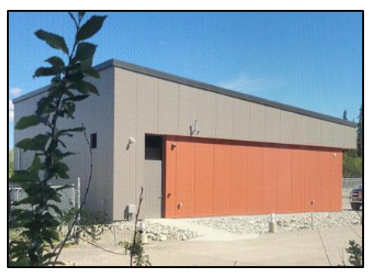
Figure 2 shows an exterior view of the net-zero garage in Whitehorse. The garage is shaped like a house with a flat angled roof. Its exterior is grey and its façade is orange. To the left of the garage is a small green tree, and the sky is blue on the horizon.
In 2023, a 211 m² net-zero-ready garage was constructed in Whitehorse at a cost of approximately $1.4 million, to meet branch-level operational needs for heated storage of equipment. The project had been under consideration for over a decade and was included in the departmental capital plan in 2017 to 2018.
Although options such as space-sharing between co-located branches and retrofitting existing facilities were explored, no coordinated solution was reached. Facilities assessments suggested that existing storage capacity might be sufficient or identified alternative approaches, but there was limited evidence that these options were further analyzed in decision making. The project advanced following departmental planning and approval processes, but costs ultimately exceeded initial estimates due to the length of time taken to approve and advance the project, and other compounding factors. The completed facility remains net-zero ready, with solar panels excluded due to unfunded additional costs.
This case highlights missed opportunities to consolidate needs across branches and underscores the importance of planning processes that promote collaboration, challenge assumptions, and ensure alignment with departmental priorities.
The effectiveness of planning can also be influenced by inconsistent understanding of what qualifies as a capital asset. While guidance exists, interviews suggested that awareness of this guidance - and how to apply it - is uneven, which in turn affects the consistent tracking of asset life-cycle needs. Uncertainty was reported in areas such as IM/IT, betterments, and component-level purchases - particularly when smaller elements form part of a larger system or scientific equipment. For example, questions were raised about whether items like fume hoods being installed as part of the building maintenance at the request of a program with specific program needs, or modular components should be tracked separately or as part of a parent asset.
In addition, full life cycle costs have not been consistently factored in investment planning decisions, which have contributed to a large departmental asset base being undercapitalized. This also presents risks for large scientific equipment, where purchases, sometimes made with temporary funding, expand the asset base, yet decisions are often taken to forgo maintenance service contracts or extended warranties (which cannot be funded through capital) on these very expensive pieces of equipment because of competing demands on operating budgets, as we heard during site visits.
Feedback from program branches revealed recurring concerns about its complexity and limited flexibility, which they felt constrained their ability to meet operational needs. For example, it was noted that once funds are approved for a specific asset, reallocating them - such as when a renovation is cancelled - requires restarting the approval process, which can hinder timely responses to operational needs. It was also highlighted that while prioritization tools such as the Overall Priority Ranking provide structure, the weighting of criteria may undervalue the operational importance of certain assets, such as scientific equipment, which may not score highly against criteria such as contributions to the Greening Government Strategy or operational health and safety considerations, but is critical to program operations and aligned with departmental priorities.
Fleet management was another example raised in this context. In compliance with the TB-led Greening Government Strategy, ECCC authorizes only zero-emission vehicles (ZEV) for purchase, with exceptions requiring approval by the Chief Financial Officer as set out in the Directive on the Management of Materiel and Policy on Green Procurement. Staff working in remote or rugged environments noted that electric vehicles may not yet be viable due to limited charging infrastructure or the availability of suitable ZEV solutions. They felt that these unique operational needs are not sufficiently reflected in decision making to allow for exceptions that accommodate such constraints. We also heard that fleet planning and utilization remain challenging in such environments, particularly at sites accessible only by boat, all-terrain vehicles (ATV), or extended travel over difficult terrain. Interviewees indicated that existing Public Services and Procurement Canada standing offers do not always meet their needs, which has, in some cases, resulted in mixed fleets (e.g. different ATV models), that are harder to maintain, operate and train staff on. We heard in a couple of cases that aging vehicles remained in service or were replaced with surplus gas-powered models from other sites, due to limited access to suitable alternatives.
The audit did not examine in-depth whether reported constraints fully justified exceptions, whether alternatives could be considered, or whether other factors may play a role. At the same time, we also heard of vehicles parked for extended periods and not actively used, with missed opportunities to coordinate use of existing assets from a more enterprise perspective.
Fleet management officials highlighted significant efforts already underway to improve fleet management processes, availability of fleet-related data and surge capacity options (e.g. renting or transferring unused trucks to regions). Nonetheless, given the consistent feedback from interviewed branches about a perceived lack of flexibility suggests that further analysis may be warranted to better understand underlying causes and ensure that fleet decisions support effective asset management practices.
We noted that several initiatives and reviews have been undertaken over the past few years to strengthen strategic oversight of assets and to support more informed departmental decision-making. These include ECCC's participation in TBS's Horizontal Fixed Asset Review; participation in the Laboratories Canada initiative; a consultant-led development of a long-term Real Property Portfolio Strategy, which included a strategic assessment and situational analysis, asset tiering, a review of management gaps, scenario analysis, and the development of targeted recommendations and optimization plans; another consultant-led review of the effectiveness and efficiency of real property and asset management; a departmental asset verification exercise; a comprehensive review and health assessment led by the Science and Strategy Branch of its facilities and infrastructure; and, most recently, the Taskforce on Assets and Infrastructure Capitalization initiative.
These efforts have generated numerous findings and recommendations that the Department can build upon. Additional insights from the audit further underscore the need to strengthen how ECCC integrates governance, roles, and planning processes to manage its asset portfolio effectively. Effective governance does not require centralizing all decisions, but it does require clear and well-communicated roles, mechanisms to align planning with departmental and broader government-wide priorities, and sufficient visibility to enable an enterprise-focused, strategic, and evidence-based approach to decision making.
Recommendation 1: The ADM, CSFB, in collaboration with ADMs of relevant branches, should build on initiatives currently underway to enhance asset management governance approaches, by communicating and providing training on the updated frameworks, clarifying roles across custodial and functional areas, and strengthening coordination mechanisms that support integrated planning, informed investment decision-making, and better use of shared assets across the department.
Management Response: The ADM, CSFB, has reviewed the findings of the audit and supports the recommendation.
The current centralisation project for the department real property holdings will serve as the locomotive to enhance asset management and governance approaches.
2.2 Departmental approaches to asset management
Key findings: Asset management practices vary across ECCC, exacerbated by information gaps and a lack of clear or widely communicated departmental direction and or guidance. Improvements in these areas will support the strengthening of the Department's ability to manage and oversee its full asset portfolio and support coordinated, enterprise-level, risk-informed decision-making.
ECCC is subject to a broad set of TB policies and directives that establish expectations for the effective lifecycle management of real property and materiel assets. These include requirements for planning, acquisition, use, maintenance, and disposal, as well as for ensuring sound stewardship, risk management, and alignment with government-wide priorities. The department is expected to adopt coherent and integrated approaches to meet these obligations consistently across its asset base. We assessed whether a departmental approach to asset management is in place that reflects applicable TB policies and directives and supports coordinated and consistent asset management practices across the Department.
While branches such as the Meteorological Services Canada have dedicated teams and formal processes in place to manage assets through their lifecycle, supported and driven by the International Organization for Standardization (ISO)-certified quality management systems and controls, capacity and practices vary across the Department. In other program areas, lifecycle management was more informal. For example, during site visits we were told and observed instances of employees keeping equipment at their desks after fieldwork due to limited storage options. In other locations, assets no longer in use continued to occupy storage space. Limited dedicated resources were cited as a reason asset disposal was not always prioritized, and disposal costs for certain assets were described as prohibitive. Uncertainty around disposal processes and delegated authorities was a recurring theme, with interviewees not always clear about the disposal and surplus process and who held authority for disposals.
A recurrent theme from interviews across regions and functions was the reported lack of clear departmental or regional policies, guidelines, or directives to support asset management, which can lead to informal processes and inconsistencies in asset management approaches. This was compounded with the fact that the definition of what constitutes an asset is not uniformly understood, which contributes to confusion over tracking and stewardship responsibilities. The perceived lack of clarity was most evident in areas related to funding, maintenance, and disposal of assets.
Although draft frameworks for real property and materiel management have been developed, providing a foundation towards a more consistent and coordinated departmental approach for asset management in line with TB policies and directives, they had not been widely communicated and operationalized outside the directorate responsible at the time of the audit field work, limiting their reach and impact.
Information for decision making
Sound asset management relies on access to accurate, complete, and timely information to make risk-informed decisions, plan investments strategically, and manage liabilities. The audit found several information gaps exist. While not exhaustive, the following examples highlight key areas where limited data and documentation may limit effective oversight and prevent a complete understanding of the risks associated with the asset portfolio: asset tracking, engineering asset risk visibility, and land-use agreements.
Tracking of assets data: Efforts have been made recently to improve the quality and consistency of asset data across the life-cycle management of assets, including data cleanup exercises and ongoing work by corporate teams to strengthen information governance. These efforts remain at an early stage, and more work is needed to address the situation. Asset data continues to be tracked across a variety of systems, spreadsheets, and local tools, reflecting the decentralized nature of ECCC operations. While SAP is the main system used, interviewees frequently described it as not user-friendly or adapted to their operational needs, which led to the creation of separate tracking mechanisms. Employees interviewed during site visits indicated that it remains challenging to reconcile their internal asset inventories with the asset listings extracted from SAP. There is no single, integrated system that captures all classes of assets, their condition, location, and use. As a result, consolidating asset information requires significant additional effort, and monitoring performance or planning investments may not be based on a full understanding of needs and risks. The absence of standardized procedures for data entry and maintenance also contributes to inconsistent quality across asset categories.
Limited risk information for engineering assets: An information gap exists related to life-cycle management of engineering assets located on ECCC custodial lands. These include viewing towers, trails, boardwalks, berms, dikes, bridges, culverts, sewage systems, and other water control infrastructures, several owned and managed by third-party partners such as environmental non-governmental organizations (ENGO), provinces, municipalities, Indigenous partners, etc. Preliminary figures from an internal inventory exercise underway at the time of the audit indicated that National Wildlife Areas contained over 681 assets (buildings and structures), including more than 463 engineering structures. In certain cases, particularly for water and wetland management, an ENGO owns and maintains many of the structures. ECCC-owned assets are maintained either through formal agreements established with the ENGO when the structures were built, or have been relying on capital funding, temporary funding for life-cycle maintenance, or contribution funding as part of efforts to revitalize and maintain habitat management infrastructure.
Departmental efforts were underway to collect information on these structures, including their condition. Preliminary data indicated that while over half of the structures were assessed as being in good or fair condition, a smaller portion were rated poor or critical, and for the rest, information on their condition remained incomplete or unknown, while gaps continued to be filled through the Taskforce on Asset and Infrastructure Recapitalization exercise. Regardless of ownership or condition, the presence of such assets on ECCC custodial lands brings inherent risks and potential liabilities. Having clear visibility into these risks is essential for informed decision-making, effective prioritization, and proactive planning - particularly where aging infrastructure deficiencies could affect public safety, neighboring lands, Indigenous communities, or other partners.
During site visits to 3 National Wildlife Areas, we heard reports of dikes and other engineering structures being in poor condition. In one instance, ECCC officials commissioned in 2024 a technical assessment of a deteriorating berm located within the Qualicum National Wildlife Area in British Columbia. The berm helps reduce flooding risks to nearby residential properties - risks complicated by both river and coastal water levels, and by the site's limited drainage options. The assessment proposed 2 potential solutions: repairing and standardizing the berm or upgrading it to meet provincial dike standards. For the 450-metre segment analyzed, projected costs ranged between $585,000 and $3.7 million, excluding engineering design or construction support fees. While this level of study may not be required for all structures, this example illustrates how unknown risks - such as aging infrastructure with public safety implications - could translate into significant, unplanned costs. It also shows the importance of understanding ownership of the asset which can differ from the ownership of the underlying land.
At a broader level, however, the Department does not yet have a consolidated view of the cumulative risks that these assets may pose, nor does a systematic process exist to integrate such risks into departmental planning and investment decisions. Ongoing efforts to strengthen data on these assets are an important step, and continued work is needed to improve visibility across all asset classes to support informed oversight and investment decisions at the departmental level.
Data on land use agreements: At the time of the audit, the Department also lacked a complete inventory of land access agreements for assets located on non-federal land. Departmental assets, such as scientific stations, infrastructure in Migratory Bird Sanctuaries in the Artic, or specialized field equipment, may be installed on provincial/territorial, Indigenous, municipal, or privately held land. In certain cases, formal agreements are missing, expired, or undocumented, and there is no centralized mechanism to track or confirm land tenure status. While operational relationships with landholders are often long-standing, the absence of formal documentation may expose the Department to legal, financial, or operational continuity risks. As with asset data, land-use information is maintained locally and inconsistently, limiting the Department's ability to assess its full footprint, safeguard long-term access, or manage liabilities associated with land use.
Departmental efforts were underway at the time of the audit to bring together information on assets and respective real property data with the implementation of the RE-FX (Flexible Real-Estate Management) module in SAP and planned integration with the SAP Plant Maintenance module. Until this project is complete, the department continues relying on the efforts of a small real property team and numerous employees across the branches with assets on public and private lands to manage this information for thousands of sites and to notify the department when agreements need to be established or renewed. See the case of Emerson Hydrometric Tower.
Case Study: Emerson Hydrometric Tower

Long description
Figure 3 shows the Emerson hydrometric tower, which is located in Manitoba. It is a small shed-like structure raised up on a concrete column, much like a lighthouse. The small shed is pale blue in color. The supporting structure is grey. The tower is surrounded by water resembling a river, and leafless trees due to winter. The sky above the tower is grey and white.
The Emerson Hydrometric Tower in Manitoba, established in 1953, was originally managed by the National Hydrological Service (NHS), 1 of over 2200 hydrometric monitoring stations that constitute the national hydrometric network across Canada. Strategically located on the edge of the Red River, it has long served as an important site for collecting surface water quantity and quality data, shared nationally and internationally by ECCC as open data. To sustain operations over the decades, the site underwent several repairs and improvements, including a 2.4-metre lab lift, riverbank stabilization, installation of a new lab, plumbing and line replacements, and sediment removal.
In 2018, the NHS decommissioned the site and transferred custodianship to the Science and Technology Branch, which had been co-located at the tower since 1997. Although the asset transfer was supported by the appropriate signed records, questions about land ownership and the existence of a land-use agreement emerged later when repairs were needed. The only known lease was signed in 2010 for one year; since then, no agreements have been renewed, and despite historic attempts, the landownership remains unclear.
This case highlights how gaps in land-use documentation for field-based assets can create issues for the continuity of program operations and may hinder timely and informed decision-making.
Taken together, the variability in practices, limited guidance, and gaps in critical asset information available in a centralized repository reflect the need for a more systematic departmental approach to asset management. While individual branches have taken steps to strengthen their internal controls, these efforts are not fully coordinated at the enterprise level. As the Department manages a diverse and aging asset portfolio, a clear and well-communicated framework is needed to ensure consistency, accountability, and informed decision-making across all asset types and organizational contexts.
Recommendation 2: The ADM, CSFB, in collaboration with ADMs of relevant branches, should lead efforts to strengthen asset management information by enhancing systems for tracking assets across their lifecycle and improving the availability of risk-related information.
Management Response: The ADM, CSFB, has reviewed the findings of the audit and supports the recommendation.
As part of the Taskforce on Asset and Infrastructure Recapitalization, the Real Property, Security and Environment Directorate has completed a gap analysis of asset management information and steps are underway to address the deficiencies. Once assets data becomes available, Investment Planning & Assets Division will include assets condition & risks as part of priority ranking criteria in the departmental investment planning exercises.
3. Conclusion
The audit found that ECCC has taken meaningful steps to strengthen asset governance and planning, particularly for real property. Recent initiatives, such as the development of a departmental Real Property Strategy and the launch of the Taskforce on Assets and Infrastructure Capitalization demonstrate a growing commitment to more strategic and coordinated asset management.
Continuing progress on these initiatives is important. The Department does not yet have a fully cohesive, enterprise approach to managing its diverse asset base. Responsibilities remain unclear in many areas, planning varies across branches, and key information, such as asset condition, risk, and usage data, remains incomplete or difficult to access. Materiel management, in particular, lacks consistent oversight and integration at the enterprise level, limiting the ability to assess needs and prioritize resources and investments effectively.
Building on existing momentum, the department has an opportunity to strengthen its asset management foundations by improving coordination, clarifying roles and responsibilities, and enhancing the quality and availability of asset information. This will support informed decision-making, mitigate operational risks, and help ensure that the Department's assets continue to meet program needs across a wide and complex operational and program delivery landscape.
4. About the audit
Scope and methodology
The audit took a high-level approach to assess selected aspects of ECCC's materiel and real property management. It examined whether foundational elements - such as governance and oversight structures, roles and responsibilities, and planning and prioritization processes - are in place to support effective life-cycle management of assets. It considered approaches for managing a range of capital assets, from real property to scientific equipment and fleet vehicles. IT assets were excluded, as they are covered through separate audits.
The audit methodology included site visits to 31 locations in 5 regions across Canada; interviews and walkthroughs with over 161 key personnel involved in asset management across 5 main asset custodial branches; a review of more than 400 documents, including policies, directives, and internal control frameworks; and case studies to illustrate management practices. The audit covered the period from April 2024 to July 2025 and included a review of other relevant documents preceding this timeframe, as appropriate.
Statement of conformance
The audit conforms to the Global Internal Audit Standards, as supported by the results of the quality assurance and improvement program.
Audit Criteria
The audit criteria were developed based on the results of a risk assessment conducted during the planning phase of the audit.
- Governance structures are established and documented to enable decision making and support oversight and accountability for asset management activities
- Roles and responsibilities for asset management are clearly defined, communicated and understood
- A departmental approach to asset management is in place that reflects applicable TB policies and directives and supports coordinated and consistent asset management practices across the Department