
Chapter 1: About this report
Authors
Coordinating Lead Authors
Elizabeth Bush, Environment and Climate Change Canada
Ashley Ehrman, Environment and Climate Change Canada
Lead Authors
Myrle Ballard, University of Calgary
Jackie Dawson, University of Ottawa
Greg Flato, Environment and Climate Change Canada
Amanda Hunter, Environment and Climate Change Canada
Recommended chapter citation:
Bush, E., Ehrman, A., Ballard, M., Dawson, J., Flato, G., & Hunter, A. (2026). About this report. In Canada’s Changing Climate Report 2026. (pp. xx–xx). Government of Canada.
Chapter description
This chapter provides an introduction to Canada’s Changing Climate Report by explaining the purpose of the report, its scope, and its development process, introducing some core scientific concepts, and providing guidance to help readers find the information they need.
Plain language summary
The purpose of this introductory chapter is threefold: to explain the purpose of this report, describe the process followed to deliver the report, and guide readers to where in the report they can find information of particular interest to them. Changes in climate are occurring across Canada against a backdrop of global-scale climate change. Therefore, to put the changes in Canada into context, this chapter provides a few important findings about both the current state of the global climate and future global climate risks, including the landmark finding that from a climate science perspective, net-zero carbon dioxide emissions are needed to limit human-caused global warming.
In a world of rapid climate change and with a rapid expansion in the amount of scientific research relevant to understanding the problem, up-to-date and timely syntheses and assessments of this scientific knowledge are important for informing action on climate change. The purpose of this report is to provide an updated synthesis and assessment of the latest knowledge and data regarding ongoing and future climate change in Canada. This report thus delivers on commitments in the Government of Canada Adaptation Action Plan to develop regular Canada-wide climate science assessments to provide a strong and current scientific underpinning for national adaptation policy development and action.
National climate science assessments such as this report both complement and are underpinned by the foundational global climate science assessments of the Intergovernmental Panel on Climate Change. Its assessments draw on science generated by the international scientific community and assess changes in climate on global and large regional scales. This report draws primarily on new science produced by the Canadian research community and assesses changes in climate for Canada as a whole and for regions of Canada. It provides the physical climate science contribution to the fifth cycle of the Canada in a Changing Climate: National Assessment Process. Collectively, the reports released under the National Assessment Process assess how and why Canada’s climate is changing (this report), the impacts of climate change on our communities, health, environment, and economy, and how we are adapting across the country.
The first edition of this report was released in 2019. This edition is informed by new observations, improved datasets, a better understanding of the climate system, and new modelling of future changes in climate across Canada. In this edition, we aim to assess more topics that are important to Canadians and people living in Canada, to make the report more accessible to a variety of audiences, and to better bridge the gap between scientific assessments such as this and adaptation planning. Also new to this edition is the inclusion of Indigenous science, mainly through the addition of First Nations, Inuit, and Métis case stories.
In this chapter, we outline the process we followed to ensure the scientific rigour and credibility of this report. This transparency about our process allows readers and users of this report to be confident that the conclusions highlighted in our key messages and other summary elements are well supported by our assessments of evidence. This chapter is also transparent about the efforts we made and the challenges we encountered in realizing our aim to include Indigenous science so as to expand the evidence base for understanding changes in climate in Canada.
Finally, this chapter provides an overview of the report structure to help readers navigate to the content that best serves their needs.
1.1: Introduction
It is unequivocal that the Earth’s climate is warming as a consequence of human activities (IPCC, 2021b). The primary source of energy powering so much of human activity during the Industrial Era has been the burning of fossil fuels: coal, oil, and gas. Burning these carbon-based fuels produces carbon dioxide, which is the main greenhouse gas causing climate warming. Carbon dioxide, as well as other gases such as methane and nitrous oxide, are referred to as greenhouse gases because they trap heat in the atmosphere (see Chapter 2, section 2.3 in Bush et al., 2019). Increases in concentrations of these greenhouse gases in the atmosphere since the pre-industrial period (approximated in this report as 1850 to 1900) are unequivocally caused by human activities (IPCC, 2021b). Atmospheric concentrations of carbon dioxide, methane, and nitrous oxide reached new highs in 2024, with increases of 521%, 165%, and 25% relative to pre-industrial levels (Forster et al., 2025). There is high confidenceFootnote 1 that the rise in global average temperature since the pre-industrial period was predominantly due to the rise in atmospheric levels of greenhouse gases, and that the rate of warming over the past 50 years was unprecedented in at least the last 2000 years (IPCC, 2021b). For the decade from 2015 to 2024, the estimate of observed warming relative to the pre-industrial period is 1.24°C (1.11 to 1.35°C), of which 1.22°C (1.0 to 1.5°C) is a human-induced contribution. The negative contribution of natural forcing is 0.05°C (-0.1 to 0.2°C), which is much smaller than the human-induced warming (Forster et al., 2025).
The Intergovernmental Panel on Climate Change (IPCC) produces the most comprehensive and authoritative scientific assessments of global climate change. IPCC assessments draw on science generated by the international scientific community. The IPCC’s most recent report, the Sixth Assessment Report, consists of contributing reports by its three working groups and an overarching synthesis report, respectively titled The Physical Science Basis, by Working Group I (IPCC, 2021a), Impacts, Adaptation, and Vulnerability, by Working Group II (IPCC, 2022a), Mitigation of Climate Change, by Working Group III (IPCC, 2022b), and the Synthesis Report (IPCC, 2023a). Findings from The Physical Science Basis (IPCC, 2021a) appear often in the chapters of this report, as the scope of Canada’s Changing Climate Report and the IPCC Working Group I assessment are closely aligned (section 1.2.2.). Of the many conclusions in the IPCC Synthesis Report’s Summary for Policymakers (IPCC, 2023b), we consider the following three findings central to understanding and limiting future climate change risks :
“Risks and projected adverse impacts and related losses and damages from climate change escalate with every increment of global warming (very high confidence).”
– Excerpt from the Synthesis Report, Summary for Policymakers, B.2
“Adaptation options that are feasible and effective today will become constrained and less effective with increasing global warming.”
– Excerpt from the Synthesis Report, Summary for Policymakers, B.4
“Limiting human-caused global warming requires net zero CO2 emissions.“
– Excerpt from the Synthesis Report, Summary for Policymakers, B.5
The general relationship between increasing global average temperature (global warming) and escalating climate change impacts and risks has been established for a long time, and conclusions on this topic from the IPCC’s Fifth Assessment Report informed the negotiation of the long-term global temperature goal in the Paris Agreement (Paris Agreement to the United Nations Framework Convention on Climate Change, 2015). Canada has joined almost all countries in signing and ratifying the 2015 Paris Agreement, a legally binding treaty under the United Nations Framework Convention on Climate Change. A stated objective of the Paris Agreement is to strengthen the international response to the threat of climate change by limiting the increase in the global average temperature to well below 2°C above pre-industrial levels and by pursuing efforts to limit the temperature increase to 1.5°C. This temperature goal was agreed to in order to avoid the increasingly severe climate change impacts and risks that would occur at higher levels of global warming. The goal was also intended to address evidence that higher global average temperature and other changes in climate, due to persistently higher carbon dioxide (CO2) levels in the atmosphere, are projected to persist for millennia (IPCC, 2014). This projection underscores the effectively irreversible nature of human-caused climate change. Achieving net-zero CO2 emissionsFootnote 2 from human activity will stabilize global average temperature but not undo the legacy of past cumulative emissions.
Emissions of greenhouse gases from human activity cannot be stopped immediately, and any further emissions will drive further warming. Therefore, even with ambitious action to reduce emissions, the world will inevitably experience some additional warming. This means that changes in climate, including changes in many kinds of extreme climate-related events, will be increasingly evident and widespread. The pace and scale of such changes, especially in the second half of the century when the current generation of children will be adults, will be determined by the extent to which global greenhouse gas emissions grow, are reined in, or are brought to negligible levels. To cope with the myriad challenges created by a warmer planet, and to benefit from any opportunities that may arise, current and future generations will need to adapt their lives and livelihoods. Planning for and building resilience to a changing climate depends in part on having a clear-eyed view of what future climates might lie ahead. This report can help Canadians and people living in Canada understand what those future climates might look like as this century unfolds.
From a physical climate science perspective, limiting global warming requires reaching net-zero CO2 emissions and strongly reducing emissions of other greenhouse gases (IPCC, 2021b). Other perspectives encourage a more holistic view of both the problem and the solutions. For many First Nations, Inuit, and Métis, an imperative is to redress relationships between humans and nature, since those relationships have become out of balance. Restoring balance and ensuring increased reciprocity among humans and other living things on the Land, in the Water, and on the Ice is seen as essential in addressing the climate crisis (see Assembly of First Nations, 2023; Inuit Tapiriit Kanatami, 2019; Métis National Council, 2024; also see sections 5.3 and 5.4 of Reed et al., 2024). These perspectives underscore that while reports such as this one are valuable in providing timely, updated information about current and future changes in climate in Canada, broader conversations drawing on a diverse range of information and knowledge will enrich dialogue among those living in Canada about how to understand and respond to climate change.
A visual overview of the topics covered in this introductory chapter is provided in Figure 1.1. In section 1.2, we explain the purpose of and mandate for developing this report and describe who it is written for. Section 1.2 also situates the report within the broader context of the Canada in a Changing Climate: National Assessment Process. In section 1.3, we explain the scope of the material contained in this report and describe the process followed in developing it, to be transparent about our efforts to make the assessment process more robust and inclusive. Section 1.3.5 outlines the efforts we made to realize our commitment to include Indigenous science in this report and the challenges we encountered in doing so. Finally, section 1.4 provides a guide to the report, including a summary of core features that readers will encounter throughout. This section is provided to help readers navigate the contents of the report and find information most relevant to their needs. An index table describing where readers can find information on commonly sought cross-cutting topics is provided in the Annex to this chapter.
Figure take-away: A visual snapshot of the contents of this chapter and of important cross-chapter linkages.
Figure title: Visual guide to the content of Chapter 1 and key cross-chapter linkages.
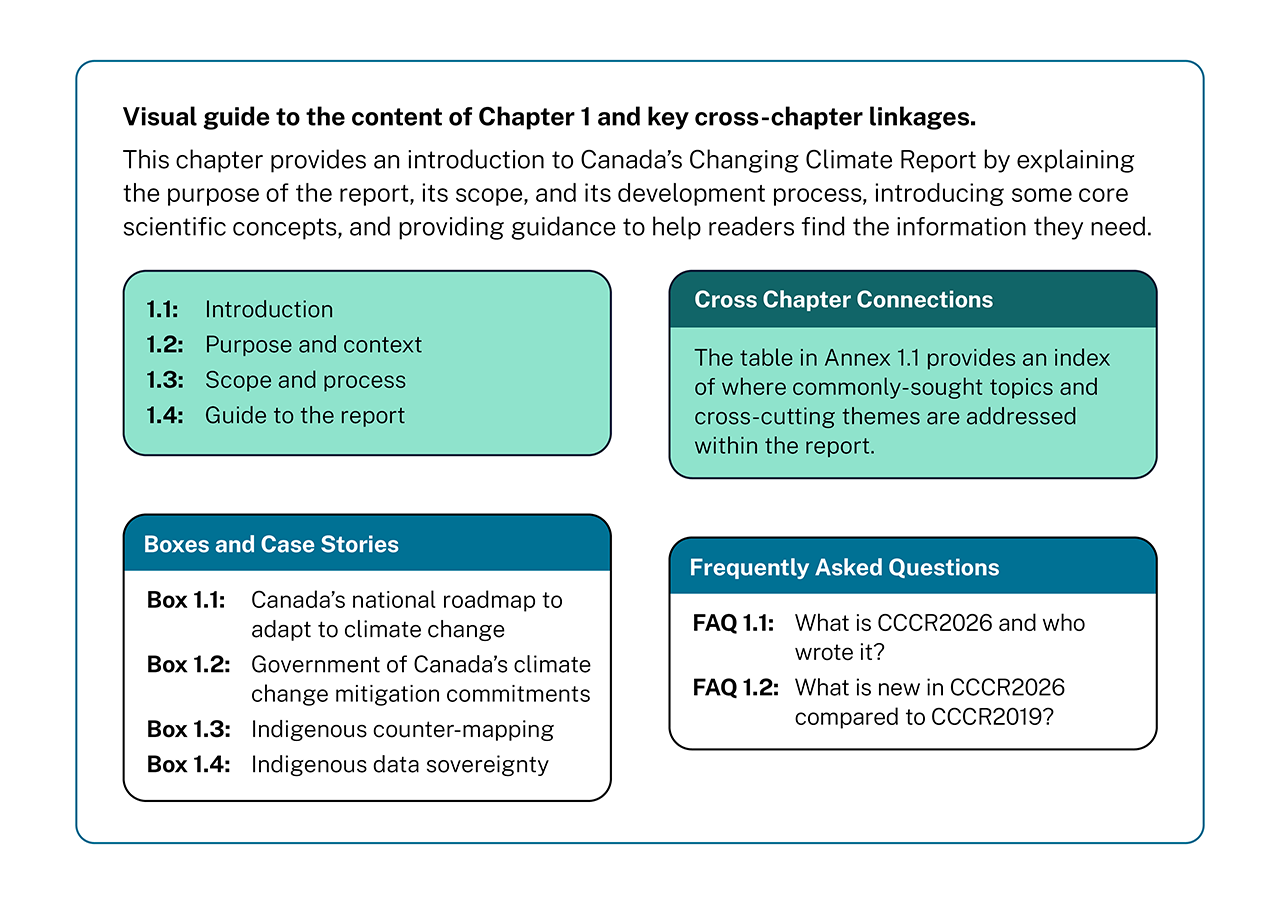
Figure 1.1: Visual guide to Chapter 1 content and cross-chapter linkages
1.2: Purpose and context
This section has two parts. The first lays out the purpose, mandate, and audiences of Canada’s Changing Climate Report. It positions this report within the broader Canada in a Changing Climate: National Assessment Process, as well as the broader context of how this report supports adaptation and mitigation efforts in Canada. The second part provides additional information about the National Assessment Process, since this context is key to understanding the contribution of this report to advancing knowledge and understanding of climate change in Canada.
1.2.1: Purpose, mandate, and audiences
The purpose of Canada’s Changing Climate Report is to provide a synthesis and assessment of the latest knowledge and data regarding ongoing and future climate change in Canada. This is the second edition of Canada’s Changing Climate Report (CCCR2026) and therefore provides an updated synthesis and assessment. The first edition (CCCR2019) was published in 2019 (Bush & Lemmen, 2019). While IPCC assessments are widely recognized as authoritative assessments of global and regional climate change, the IPCC does not assess changes in climate for individual countries. As a result, there is a need for national-scale assessments, such as this one, to provide targeted and authoritative assessments of climate change on scales more relevant to policy- and decision-makers in Canada. For CCCR2026, we have engaged with experts across the country to review and assess relevant science about changes in Canada’s physical climate system and their causes, drawing heavily on science produced by the Canadian scientific community since the release of CCCR2019. This report thus fulfills Action 56 in the Government of Canada Adaptation Action Plan (ECCC, 2023c), which commits the federal government to deliver such assessments on a regular basis in order to provide the scientific underpinning for national adaptation policy development and action (Box 1.1).
A broader purpose of CCCR2026 is to contribute the physical climate science assessment to the fifth cycle of the Canada in a Changing Climate: National Assessment Process (section 1.2.2). CCCR2026 provides answers to the questions “How has Canada’s climate changed, to what extent can observed changes be attributed to human causes, and what changes are projected for the future?” The other National Assessment Process reports answer the questions “How are these changes in climate impacting our communities, health, environment and economies, and how are we adapting?” Together, reports contributing to the National Assessment Process help ensure that Canadians and people living in Canada are informed about climate risks and vulnerabilities, and adaptation needs and benefits, and that such information is designed and made accessible and easy to understand for various audiences (see Box 1.1 and Objective 3 of the National Adaptation Strategy) (ECCC, 2023a). National knowledge assessments are therefore a key part of Canada’s adaptation cycle (Figure 1.2).
Box 1.1: Canada’s national roadmap to adapt to climate change
Canada’s first National Adaptation Strategy, Building Resilient Communities and a Strong Economy, provides near-term targets, medium-term objectives, and mid-century goals for action across all levels of society to prepare for the impacts of climate change as they grow in severity and frequency in the coming decades (ECCC, 2023a). Through this strategy, the Government of Canada commits to reaching those goals in a fair, inclusive, and equitable way, including by upholding First Nations, Inuit, and Métis rights. The strategy was informed by a two-year engagement process with provincial, territorial, and municipal governments; First Nations, Inuit, and Métis representatives; key experts and stakeholders; and people from across Canada.
The Government of Canada Adaptation Action Plan was released in 2023 (ECCC, 2023c) and provides the policy and program framework for how the Government of Canada’s activities will contribute to the goals of the National Adaptation Strategy. The Government of Canada Adaptation Action Plan includes the commitment to deliver a new Canada-wide climate science assessment to provide an update on how and why Canada’s climate is changing. Through the action plan, the federal government also commits to continuing to assess not only the impacts of these changes on our communities, environment, and economy, but also how we are adapting, through Canada’s National Assessment Process.
Figure take-away: The process of building knowledge, mobilizing that knowledge for action, and evaluating progress on adaptation is iterative.
Figure title: Canada’s Adaptation Cycle
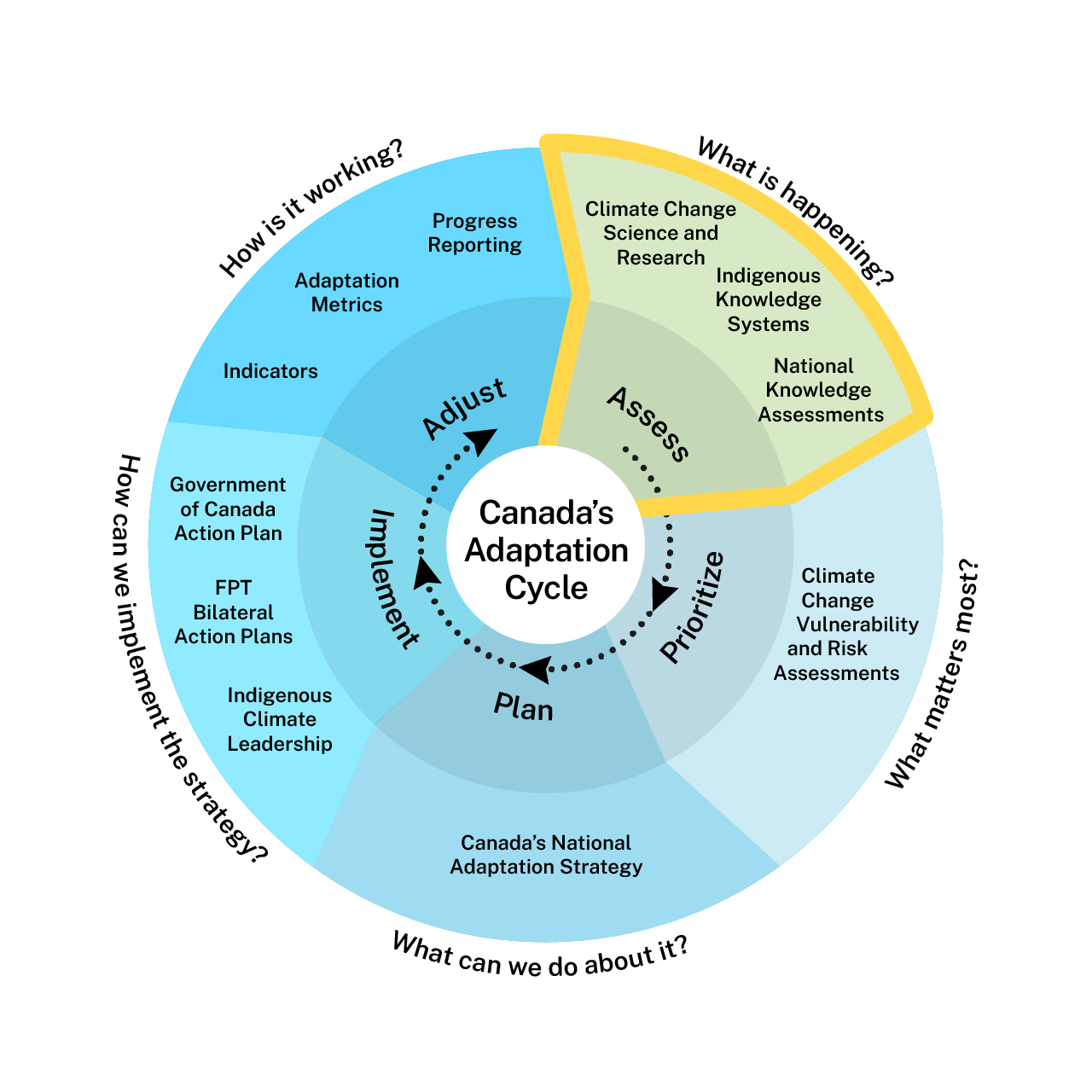
Figure 1.2: Diagram illustrating the various stages of, and processes contributing to, Canada’s adaptation cycle. This iterative cycle encapsulates Canada’s ongoing efforts to advance preparedness and resilience to climate change. The ongoing generation of new science and knowledge on climate change, and the periodic assessment of that new evidence base help answer the question “What is happening?” Other phases of the adaptation cycle help prioritize risks, plan response strategies, implement those strategies, and then evaluate progress to improve resilience to climate change while also monitoring the ongoing evolution of the state of the climate. Source: Figure 2 in the Government of Canada Adaptation Action Plan (ECCC, 2023a).
Understanding climate change, its consequences, and its solutions requires knowledge drawn from across sectors of society, knowledge systems, and the physical, biological, and social sciences. Of note, the Assembly of First Nations (2023), Inuit Tapiriit Kanatami (2019), and the Métis National Council (2024) have all recently released national climate strategies shaped by their own worldviews and understanding of the opportunities and challenges in responding to climate change. These strategies outline the research, adaptation, and mitigation priorities that are central to meeting the needs of their communities and Nations, and offer strategic visions for advancing climate action led by First Nations, Inuit, and Métis. Similarly, climate change strategies and action plans have been developed across Canadian society by other orders of government, by professional associations, business, and institutions, and by other actors in civil society and the private sector. These plans target sector- or region-specific needs and leverage the strengths of the communities for whom the plans are prepared. While this landscape is too broad to cover here, annexes A, B, and C of the National Adaptation Strategy highlight a few examples of how different sectors in Canada are building the knowledge and capacity needed for resiliency (ECCC, 2023a).
Canada’s National Assessment Process (section 1.2.2) is not meant to assess mitigation strategies and options for Canada. However, by providing regularly updated information on changes in climate, climate impacts and risks, and progress and gaps on adaptation, it provides a foundation for informing national climate change mitigation policy and action, and efforts of governments, businesses, and communities across Canada to contribute to the national and international mitigation effort (Box 1.2).
Science and knowledge assessments ensure that expert conclusions, based on an evaluation of the best available science, are readily accessible, in one place, and in language that is easy to understand for a broad range of audiences. This is important because such reports are fundamentally intended to support evidence-based decision-making on mitigation and adaptation, and therefore need to serve a diverse range of audiences. Section 1.4.1 explains how this report is structured to cater to the needs of various audiences. The primary audiences of this report are adaptation and mitigation decision-makers in Canada and their science and policy advisors, those engaged in providing climate services, adaptation practitioners, and the scientific community, including researchers, post-secondary teachers, and students. Its audiences therefore include a broad range of professionals who require or seek information on climate change but who may not have expertise in specific disciplines within physical climate science. This report is largely written with the expectation that the reader has a strong foundational understanding of the scientific basics of physical climate change, which were also covered briefly in Chapter 2 of CCCR2019 (Bush et al., 2019). Some core concepts related to measuring and modelling changes in climate, which provide relevant background information for reading other chapters of this report, are introduced in section 1.4.2 of this chapter.
Box 1.2: Government of Canada’s climate change mitigation commitments
Parties to the United Nations Framework Convention on Climate Change (UNFCCC) and the Paris Agreement are called on to formulate and implement mitigation plans and measures. Under the Paris Agreement specifically, countries are expected to submit nationally determined contributions (NDCs) and pursue domestic measures to achieve them. These NDCs articulate the greenhouse gas emissions reduction targets that governments set as their contribution to the collective effort to limit global warming well below 2°C above pre-industrial levels and to pursue efforts to limit the temperature increase even further to 1.5°C. A requirement for countries to ratchet up their emissions reductions over time to reflect an increasingly higher degree of ambition is central to the NDC approach, and governments must submit updated NDCs every five years that reflect their highest possible level of ambition, taking into account different national circumstances and based on the best available science (Paris Agreement to the United Nations Framework Convention on Climate Change, 2015; UNFCCC Secretariat, 2024).
Canada is committed to reducing its greenhouse gas emissions to net zero by 2050, as enshrined in the Canadian Net-Zero Emissions Accountability Act (2021). Canada has submitted a long-term strategy exploring approaches to meeting this net-zero emissions goal to the UNFCCC (ECCC, 2022b). With its current two NDCs, Canada commits to reduce its greenhouse gas emissions by 40 to 45% below 2005 levels by 2030, and 45 to 50% below those levels by 2035 (ECCC, 2024; Government of Canada, 2025). Canada’s 2030 Emissions Reduction Plan lays out a sector-by-sector roadmap to achieving Canada’s 2030 NDC (ECCC, 2022a). A plan to meet the 2035 target will be developed in accordance with the Canadian Net-Zero Emissions Accountability Act. Canada regularly tracks its progress towards meeting its emissions reduction targets and reports on this progress through annual national inventory reports that are submitted to the UNFCCC, as well as Emissions Reduction Plan progress reports (ECCC, 2025a). The UNFCCC Secretariat regularly synthesizes information on NDCs and provides estimates of projected greenhouse gas emissions resulting from the implementation of NDCs. This makes it possible to track progress on international mitigation efforts and estimate the remaining emissions gap between the progress made to date and the Paris Agreement’s long-term global temperature goal (UNFCCC Secretariat, 2024; United Nations, 2025). Both the UNFCCC’s NDC Synthesis Report and other sources tracking mitigation progress annually (e.g., United Nations Environment Programme, 2024) have highlighted that significant progress has been made since the adoption of the Paris Agreement, but that the emissions gap remains large.
1.2.2: Canada’s Changing Climate Report (CCCR) and the National Assessment Process
The Government of Canada has, for some decades, led processes to deliver reports to Canadians and people living in Canada on the impacts of, and adaptation responses to, climate change in Canada so as to raise awareness of the issues and support evidence-based decisions and actions. The first comprehensive initiative was the Canada Country Study, a series of reports providing regional and national perspectives that were released from 1997 to 1998 (Environment Canada, 1998). Comprehensive assessments have been produced regularly since then (2007 to 2024) and are available on the Canada in a Changing Climate: National Assessment Process webpage (https://natural-resources.canada.ca/climate-change/canada-changing-climate). Preparing those reports was a collaborative effort with experts from inside and outside government.
The fourth National Assessment Process, Canada in a Changing Climate: Advancing our Knowledge for Action, was launched in 2017 and completed in 2024. This cycle delivered five major reports and a synthesis report. The first edition of Canada’s Changing Climate Report, CCCR2019 (Bush & Lemmen, 2019), was the physical climate science contribution to the fourth National Assessment Process. CCCR2019 marked the first time a stand-alone report on Canada’s changing climate had been included in the National Assessment Process. The fourth assessment cycle also included the first Indigenous-led report For Our Future: Indigenous Resilience Report (Reed et al., 2024). The reports that contributed to the fourth National Assessment Process are available to the public in interactive digital format at https://changingclimate.ca/, along with outreach material. The conclusions of CCCR2019 confirmed that Canada’s climate has already changed substantially, with changes documented across the country, in the atmosphere, on land, and in the surrounding oceans (Bush & Lemmen, 2019). A continuation and possible intensification of many of the past climate trends was projected, underpinning the urgency for adaptation, especially to prepare for the projected changes in climate, including increases in extreme events that are hazardous to our communities and to nature. The conclusions from the Canada in a Changing Climate: Synthesis Report highlight not only risks to aging infrastructure, to the health of Canadians and people living in Canada, to food production, and to the management of climate-sensitive natural resources, but also the need to accelerate adaptation efforts, including actions led by First Nations, Inuit, and Métis (Figure 1.3) (Lulham et al., 2023). Additional conclusions emphasized the threats from climate change to the vital services that Canada’s ecosystems provide, to Canada’s water resources, and to the culture and economies of communities across the country (Warren et al., 2021). The fourth National Assessment Process reports also emphasize that multiple benefits can emerge from well-planned climate change adaptation efforts. However, progress on adaptation remains slow, and an adaptation gap remains between the level of effort needed to address observed and projected impacts and the implementation efforts that have been made to date.
Figure take-away: The impacts of climate change are particularly evident in critical sectors and ecosystems. Rapid, informed and coordinated action on adaptation is needed.
Figure title: Ten key conclusions from the Canada in a Changing Climate: Synthesis Report
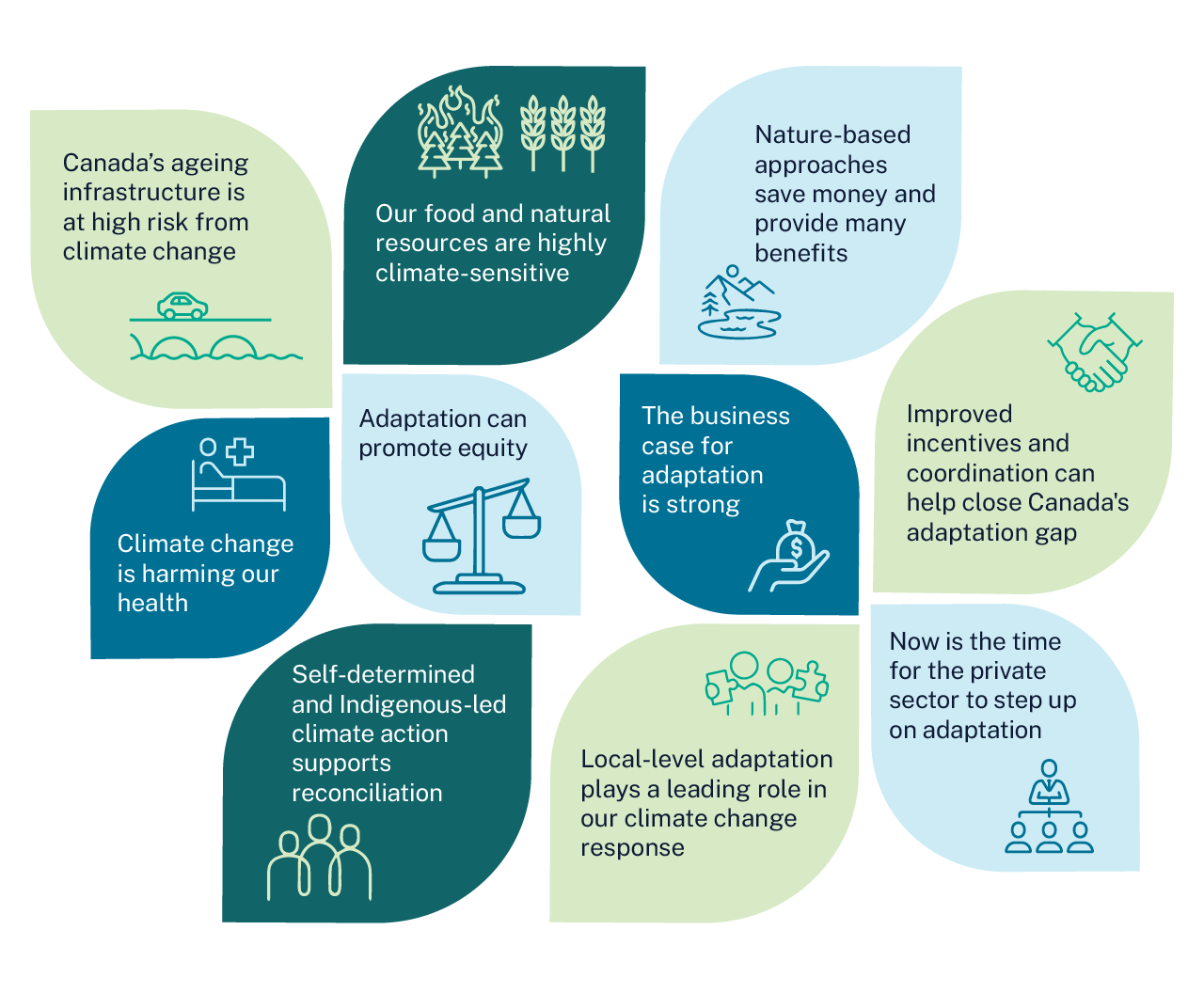
Figure 1.3: The 10 key conclusions from the Canada in a Changing Climate: Synthesis Report, which concisely show the findings from the five reports released from 2019 to 2024 as part of the fourth National Assessment Process. These conclusions demonstrate that the impacts of climate change are particularly evident in certain critical sectors and ecosystems, leading to large and rising costs. There is an urgent need for rapid, informed and coordinated action on adaptation. Adapted from: Canada in a Changing Climate: Synthesis Report Infographic (Natural Resources Canada, 2023).
Science and understanding are not static, however, and advances in understanding are important for informing ongoing sound decision-making on climate change. The Canada in a Changing Climate: National Assessment Process has embarked on its fifth cycle, and CCCR2026 is the first report delivered as part of this process.
1.3: Scope and process
In this section, we clarify what we mean by referring to this report as a physical climate science assessment and identify the topics that are inside or outside the scope of this report. We also outline the process we followed to ensure the scientific rigour and credibility of this report. We conclude this section by discussing the importance of expanding the evidence base to include Indigenous science and our efforts to do so in this report.
1.3.1: Point of departure – what’s new in the second edition of CCCR?
Since 2019, when the first edition of Canada’s Changing Climate Report was published (Bush & Lemmen, 2019), a wealth of new knowledge has become available. There has been substantial improvement in making surface and satellite observations of some climate variables, in understanding the myriad processes and feedbacks operating within the climate system, and in modelling techniques used to simulate future changes in climate under different sets of assumptions (see Chapter 2, section 2.3 and Chapter 3, section 3.3 for some examples). Artificial intelligence, machine learning, and large language models have enhanced the toolbox used by the scientific community to understand how the climate system responds to greenhouse gases and other climate change drivers. This assessment builds on CCCR2019 and is informed by these advances in science.
In addition, this report has new features that were designed in response to feedback from users and authors of the national assessment report series (Figure 1.4). These new features are intended to make the report more accessible to a variety of audiences, to cover more climate change topics that are important to Canadians and people living in Canada, and to provide better content to bridge the gap for decision-makers between using the information in this scientific assessment and finding more tailored information from climate services to support local adaptation planning and activities. CCCR2026 is also intended to build on the progress made in the Canada in a Changing Climate: National Assessment Process by recognizing the value and importance of including Indigenous Knowledge Systems and Indigenous science in knowledge assessments (Kendrick & Walsh, 2025). A new feature for CCCR2026 is therefore the inclusion of First Nations, Inuit, and Métis place-based case stories that provide space in the report for Indigenous science, observations, and perspectives on the implications of climate change. The growing recognition of the term “Indigenous science” (e.g., Cajete, 2000; ECCC, 2023b; Nakagawa et al., 2025; Snively & Corsiglia, 2016) led to a decision to use the term in this chapter and elsewhere in the report as appropriate. In brief, “Indigenous science” refers to a distinct, time-tested, and methodological knowledge system that First Nations, Inuit, and Métis have for understanding the natural world (ECCC, 2025b).
Figure take-away: CCCR2026 introduces some new features to improve accessibility and expand the topics covered.
Figure title: New features introduced in the second edition of Canada’s Changing Climate Report
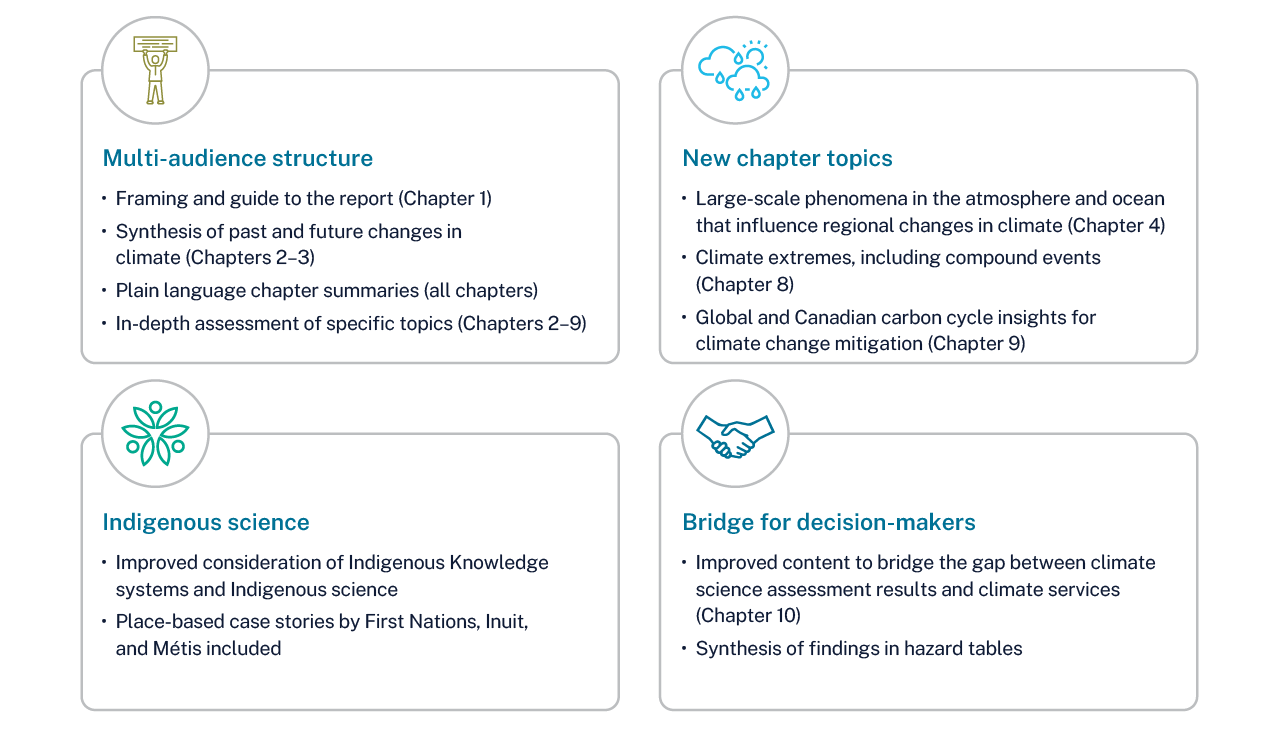
Figure 1.4: The second edition of Canada’s Changing Climate Report (CCCR2026) includes a multi-layered structure that improves reader navigability for a variety of audiences, with two summary chapters providing an overview of past and future changes in climate that draw from the other chapters of the report. CCCR2026 also covers more topics in climate science, better considers Indigenous Knowledge Systems and Indigenous science, and provides guidance on accessing and using tailored climate data for adaptation.
1.3.2: What’s in and out of scope
As noted above, CCCR2026 assesses past and future changes in climate across Canada. The scope of this report is therefore to assess changes to physical climate variables in the major components of the climate system: the atmosphere, the cryosphere, the land surface and freshwater systems on land, and the oceans (Figure 1.5). Assessments consider physical climate variables, such as temperature, precipitation, snow and ice cover, stream flow, water levels in freshwater water bodies, and sea level. Changes in some aspects of ocean chemistry are also included, as are changes to where carbon is stored in Canada’s land and ocean ecosystems. The role of the carbon cycle in controlling the climate system’s response to CO2 emissions from human activity is also covered.
For some climate variables, changes are considered from as far back as the middle of the 19th century, although for many variables, robust observational datasets for climate trend analysis are much shorter. Future changes up to the end of the 21st century are the primary focus, since model-based projections focus on this time period. Not only are average changes in physical climate variables over time assessed, but so are changes in extremes of such variables where evidence is available to support such assessments. While these physical changes have implications for the living world, living systems are not explicitly part of the assessment.
To enhance the societal relevance of this report, a chapter is included to bridge the gap between using its scientific findings and seeking more tailored climate information for adaptation planning, design, and emergency management from climate service providers. To illustrate what is at stake, a brief discussion of the implications that physical climate change will have for society and natural ecosystems is provided in the Introduction to each chapter and in the case stories included in this report. However, a formal assessment of climate change impacts and risks for society and the state of adaptation is outside the scope of this report because they are the subject of other reports that contribute to the Canada in a Changing Climate: National Assessment Process (section 1.2.2).
Figure take-away: The scope of Canada’s Changing Climate Report is to assess changes in Canada’s physical climate system.
Figure title: Overview of topics inside the scope of the second edition of Canada’s Changing Climate Report by chapter
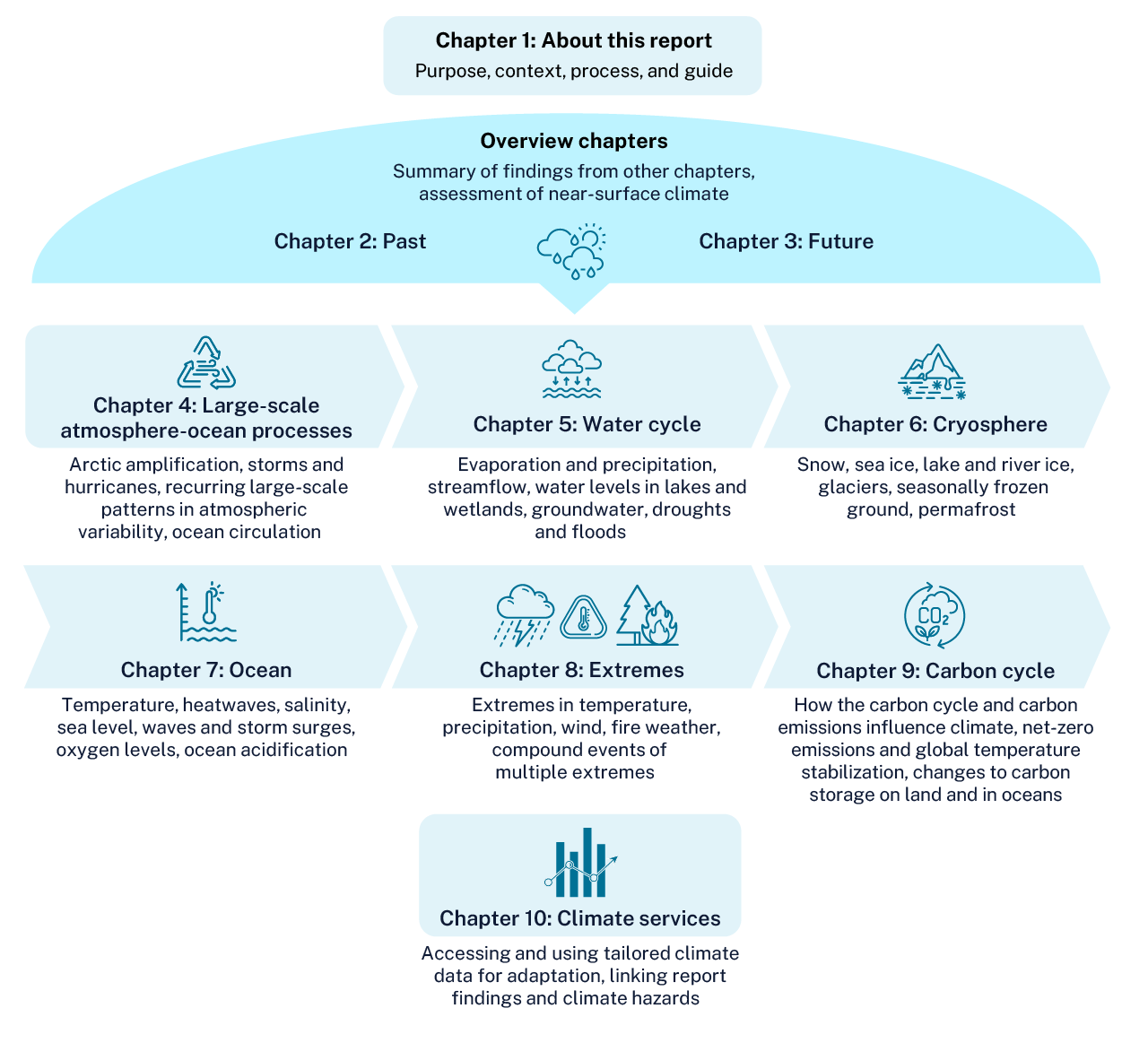
Figure 1.5: Topics in physical climate science covered in the 10 chapters of the second edition of Canada’s Changing Climate Report. Changes to the physical climate have implications for the living world, but living systems are not explicitly part of the assessment.
1.3.3: Geographic areas of focus
Delineating geographic regions for assessing changes in physical climate is a challenging task for many reasons. For example, data for different climate variables are not always available within the same geographic limits, on the same spatial scale, or across the same time period in a way that would make analyses of various climate variables perfectly comparable. For example, unique landscape features, such as mountains or bodies of water, can also influence observed and projected changes in physical climate on different spatial scales. Or, those using climate data for risk assessment and adaptation planning may need to consider jurisdictional boundaries, such as those that delineate municipalities, provinces, territories, or First Nations, Inuit, and Métis lands, including legislated land claim areas and unceded territory.
As a national assessment report, the geographic focus of CCCR2026 must be Canada-wide. Each chapter assesses both national and regional changes where possible, recognizing that regional definitions and boundaries may not be consistent across all variables.
Consistent with CCCR2019, assessments of past and future changes to the near-surface climate are summarized in this report using regions mostly defined by provincial and territorial boundaries (see Chapter 2, the map in Figure 2.2, and chapters 3 and 8). Readers can compare results for these variables between the first and second editions of CCCR. Other variables were analysed using boundaries that reflect data availability and the geographic scale and scope relevant to the particular climate variable being assessed (see, for example, chapters 4 to 9). This approach was intended to balance scientific methods of spatial analysis with the varying needs of policy- and decision-makers in Canada who will make use of the assessment. Throughout this report, “Canada’s North” refers to Canada’s three territories, shown in Figure 2.2, whereas “northern Canada” refers broadly, but not strictly, to the region north of the 60° north latitude. We use “Canada’s oceans” to refer to waters within the Exclusive Economic Zone over which Canada has jurisdiction (Chapter 2, Figure 2.2; Chapter 7, Figure 7.2), whereas we use “oceans around Canada” to refer to waters that extend beyond those boundaries.
Of note, the initial intent for this report was to include maps denoting Canadian political boundaries (provinces and territories), as well as First Nations, Inuit, and Métis homelands, treaty areas, and land claim boundaries. However, no single static image could fully capture this complex and changing landscape. In order to avoid misrepresentation, the author team decided to present land boundaries throughout the report in a way that remains consistent with existing federal reports. However, Box 1.3 provides a broader context for First Nations, Inuit, and Métis territories and place names.
Box 1.3: Indigenous counter-mapping
Historic and ongoing colonization of First Nations, Inuit, and Métis has led to their dispossession of their lands. First Nations, Inuit, and Métis were forcibly removed from their traditional lands, which were re-mapped and renamed. Today, they are still fighting to reclaim their inherent rights to their lands, and for these rights to be recognized and affirmed. Historical and current maps of Canada therefore do not accurately depict land boundaries, relationships, or place names that align with First Nations, Inuit, and Métis Knowledge systems and expressions of their homelands.
Consequently, significant strides have been taken in the field of “counter-mapping,” especially in the last decade. Counter-mapping is the practice of creating geographical representations to challenge colonial assertions of land ownership and highlight the knowledge systems of those who have been dispossessed. Maps developed by First Nations, Inuit, and Métis that resist colonial geographies and represent their traditional languages, place names, and mapping techniques are therefore important assertions of their sovereignty and self-determination (Beimers, 2022; Rose-Redwood et al., 2020; Vijayakumar, 2021).
There are many Indigenous-developed maps and resources that reflect their self-determined land boundaries and place names in the land now called Canada, including many openly available climate atlases. The following are some examples:
Resources such as these are valuable in the bridging, braiding, and weaving of Indigenous and Western science, and for our individual and collective pathways to reconciliation more broadly.
1.3.4: How this report was developed
This section explains the process used to develop CCCR2026. Scientific assessments are as much about process as they are about the final products. The assessment process takes place in multiple stages, each one critical to developing a robust, authoritative report that readers can rely on to inform their decision-making. Transparency about the process used to develop CCCR2026 is important. This section outlines who was involved, and the methods and lines of evidence used to draw conclusions.
1.3.4.1. Report management and governance
Environment and Climate Change Canada was tasked to lead the development of an updated physical climate science assessment (section 1.2.1). CCCR2026 was shaped by those engaged in the early planning stages, by direct contributors, and by external advisors (Figure 1.6). User surveys of reports from the previous National Assessment Process cycle, including CCCR2019, informed the early planning stages, as did experiences of those working in climate services who interact regularly with a range of climate information users. The CCCR2026 process was initiated with a scoping meeting. Attendees included federal government and academic subject matter experts in physical climate science, assessment processes and Indigenous science, as well as climate service and climate policy representatives, and representatives of National Indigenous Organizations. The report management team in Environment and Climate Change Canada’s Climate Research Division was composed of a scientific lead and the CCCR2026 Secretariat. Designated scientific advisors provided targeted advice on assessment content and methodology. Oversight on process and scope was provided by a federal steering committee composed of representatives from several science-based federal departments (Environment and Climate Change Canada, Natural Resources Canada, Agriculture and Agri-Food Canada, and Fisheries and Oceans Canada). The Canada in a Changing Climate: National Assessment Process Secretariat provided ongoing guidance to maintain strong coordination between CCCR2026 and other reports contributing to the fifth cycle of the National Assessment Process. Some Canadian climate service consortia and a number of Indigenous organizations and governments also provided periodic guidance and participated in the external review process.
Figure take-away: CCCR2026 was shaped by many contributors both inside and outside government playing various roles.
Figure title: Governance structure for the second edition of Canada’s Changing Climate Report
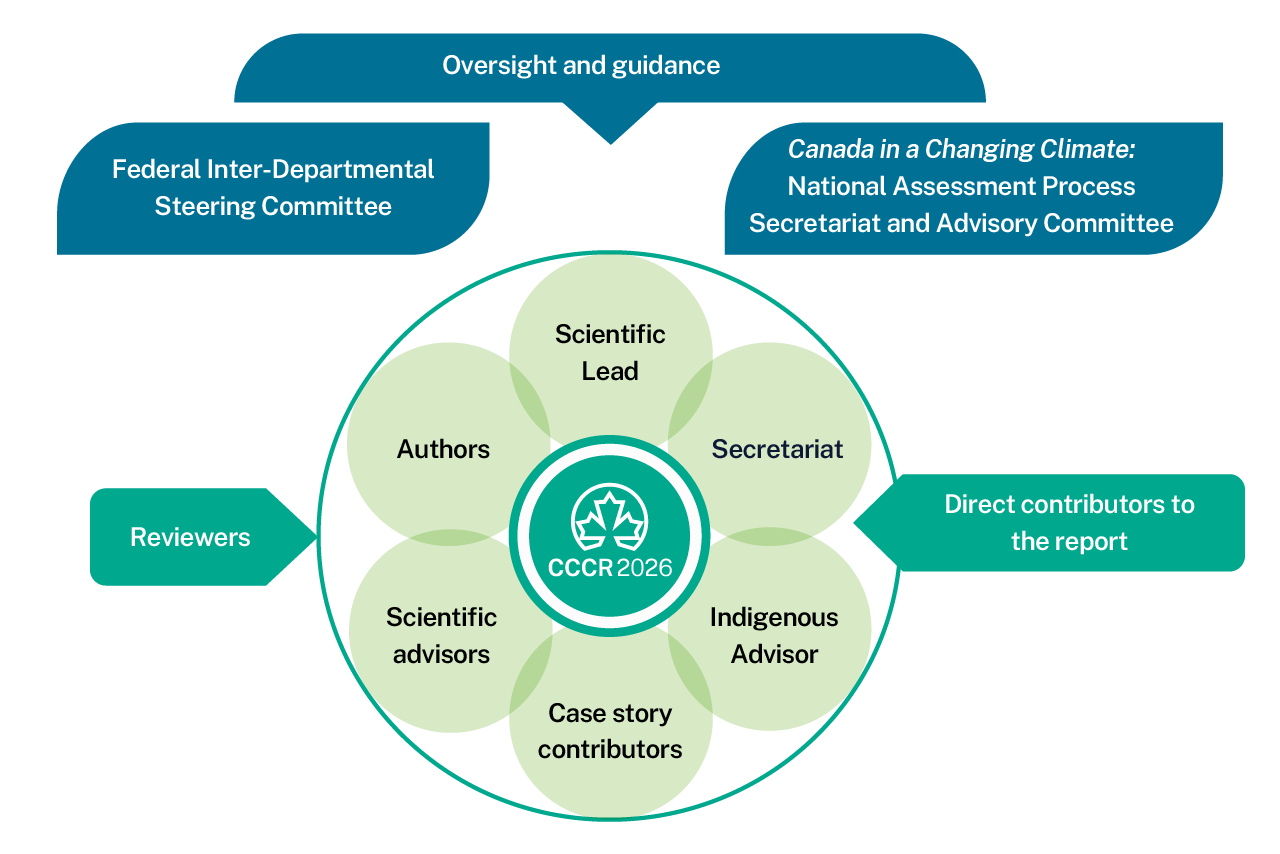
Figure 1.6. The second edition of Canada’s Changing Climate Report was written by a core set of direct contributors to the report. Oversight and guidance on scope, direction, and structure were provided by committees composed of representatives from other federal departments, with input also from the National Assessment Process Advisory Committee. Report drafts underwent two successive rounds of external review that included scientific experts, Indigenous organizations, climate services providers, and self-nominated members of the public.
1.3.4.2. Report structure and author team development
A two-day scoping meeting held from February 28 to March 1, 2023, resulted in a draft report outline, which was designed to cover important aspects of the physical climate system and make the connection with relevant climate services through 10 integrated chapters. Key decisions were made, leading to the inclusion of new features relative to CCCR2019 (Figure 1.4).
Author teams were then established for the 10 chapters with the aim of having a diverse range of voices and perspectives by ensuring gender balance and representation of early-career and university-based scientists and by seeking to include Indigenous authors. Letters of invitation to self-nominate as authors were sent to the Canadian federal government and academic community using established networks. Two coordinating lead authors were selected for each chapter, with the goal of having one from the federal government and one from the academic community. The coordinating lead authors then formed chapter author teams based primarily on the list of self-nominees, but supplemented by targeted invitations to additional experts to fill gaps in expertise. At early stages in this process, Indigenous scholars were invited to learn about CCCR2026 and discuss their potential interest in contributing to the report. However, a core team of Indigenous authors could not be formed within the allotted time frame for building author teams.
1.3.4.3. Chapter development, lines of evidence, and external review
Author teams were provided with a clear roadmap for the assessment process. Through this process, authors critically and expertly assessed evidence for observed and projected changes in physical climate and identified key messages that emerged from this assessment. To ensure the conclusions were well supported, levels of confidence in key messages were assigned through rigorous consideration of the quantity and quality of evidence, the strength of analytical approaches, uncertainties related to those analyses, and agreement among different lines of evidence (section 1.4.3).
Traceability is fundamental to the credibility and transparency of the assessment process. Even if decision-makers do not need the underlying technical details, seeing a rigorous scientific process was followed means they can use and apply conclusions in this report knowing they are well supported. To accommodate traceability and in line with standard assessment approaches, the main sources of information used (lines of evidence) in this assessment predominantly include peer-reviewed papers in scientific journals. Such papers represent the outcomes of climate research conducted using Western scientific approaches, but increasingly also include papers documenting the weaving together of understandings from Western science and Indigenous science. Updates to published results were acceptable as long as the method used and information provided was citable and defensible. New climate model projections specific to Canada were also used because model performance has been previously evaluated and documented in the peer-reviewed literature. Reports from governments and agencies, and other so-called grey literature that have undergone peer review, were also acceptable. Oral and written submissions of Indigenous science were included through First Nations, Inuit, and Métis case stories.
Rigorous external review is an essential component of science assessment processes. CCCR2026 followed a two-stage external review process: first, a “signal check” of how content was developing in an early draft (May–June 2024), and second, a detailed line-by-line review of comprehensive drafts (January–February 2025). The second stage involved invited reviewers and an open call for experts to self-register as reviewers. In total, the second external review involved about 120 reviewers representing expertise from inside and outside government. National Indigenous Organizations (the Assembly of First Nations, Inuit Tapiriit Kanatami, the Inuit Circumpolar Council – Canada, the Métis National Council, and the Congress of Aboriginal Peoples), as well as several regional First Nations and Métis governments that self-nominated, were invited to participate in both stages of the peer review. Indigenous review yielded important feedback about content, framing, transparency, and sources of information for Indigenous science.
1.3.5: Indigenous science, climate change assessments, and CCCR2026
The importance and value of including Indigenous science and Indigenous Knowledge Systems in knowledge synthesis activities, such as scientific assessment processes, is increasingly being recognized (e.g., see Strategic Goal 3 of AMAP, 2019; IPBES, 2017; McDowell et al., 2023; see Appendix 1 of U.S. Global Change Research Program, 2023). This section elaborates on the term “Indigenous science” and explains some of the progress made, and opportunities and challenges encountered in including it in CCCR2026 and climate change assessments more broadly.
1.3.5.1: Indigenous science
Indigenous science, like Western science, is based on sustained and repeated observations. Indigenous science is dynamic and ever evolving, and like all types of science, it is constantly advancing, expanding, and iteratively leading to the creation of new knowledge and understandings as it is tested and validated through trial, error, and observations over time (ECCC, 2025b; Reid et al., 2022; Stein et al., 2024). Importantly, Indigenous science can be used to help shape our collective understanding of the natural world, how the climate is changing, and how these changes are experienced, particularly on a local scale where changes are experienced and observed directly (Inuit Circumpolar Council, 2022; IPCC, 2022c; Reed et al., 2024). It is also on this local scale that Indigenous science is shared, collected, and validated, often through oral history, storytelling, cultural traditions, and other community connections, as well as in publications. Indigenous science is valuable in its own right, and considering its uniqueness, structure, and evolution, it is not something that should be compared with or used to validate Western scientific findings or vice versa (Karetak et al., 2017; Tagalik et al., 2023). Rather, all ways of knowing should be used in ways that are thoughtful and meaningful and relevant to the particular task.
1.3.5.2: Indigenous science and climate change assessments
The IPCC has made progress but still faces challenges in fully recognizing and incorporating Indigenous science into its assessment processes (Ford et al., 2016; Inuit Circumpolar Council Canada, 2024; Nakashima et al., 2018; van Bavel et al., 2022). Canada’s National Assessment Process has also increased efforts and made significant progress to include Indigenous Knowledge Systems in reports focused on the impacts of and adaptation to climate change (section 1.2.2) (Lulham et al., 2023). As Indigenous science effectively considers holistic connections among humans and the environment, it can provide insights sometimes overlooked in scientific literature. Intentional approaches are required to collect and include these insights in a good way. For example, Indigenous science can be hard to comprehensively gather and iteratively evaluate using existing assessment protocols, considering that it is not always available in written form, that First Nations, Inuit, and Métis are often overstretched and asked to participate in other important initiatives, and that there is not yet agreement on best practices for respectfully making use of and valuing knowledge found outside of peer-reviewed scientific literature (Mustonen et al., 2022). Furthermore, there are challenges in ensuring that Indigenous science is appropriately acknowledged, that data sovereignty is respected, that free and prior informed consent occurs, and that traceability is possible (Box 1.4) (Mustonen et al., 2022). Challenges to including Indigenous science are sometimes considered particularly difficult in physical science assessments that involve evaluation of physical variables that are not always directly observable, often requiring, for example, remote-sensing or modeling approaches.
1.3.5.3: Indigenous science and CCCR2026
When inviting potential authors to be part of a multi-year project such as CCCR2026, it is helpful to give them sufficient lead time to plan for such a commitment. Indigenous scholars are in high demand, and many made it clear at CCCR2026 scoping and development meetings that we would find it challenging to find scholars who could accommodate the time frames set for the report. Once the author teams were established, they were supported in their work to draw on published literature that weaved together both Indigenous and Western science, but it was difficult to do so extensively without Indigenous co-authors to ensure that evidence rooted in Indigenous Knowledge Systems was being assessed appropriately (e.g., Carmona et al., 2023; Ford et al., 2016; Reed et al., 2024).
The scale and scope of CCCR2026 as a strictly physical science report aimed primarily at the national level created challenges, considering that Indigenous ways of knowing and understanding climate change are more holistic in nature and provide particularly valuable insights on local scales. Recognizing this structural limitation, we have included First Nations, Inuit, and Métis case stories that discuss but do not assess the implications of climate change, thus creating space for Indigenous contributors to provide place-based knowledge where cultures and ecosystems are deeply interconnected within the physical climate system.
It is important for researchers, policymakers, and others working in climate science (where their work draws on Indigenous Knowledge Systems, science, data, information, etc.) to develop approaches to consider and establish strategies that fully support and are in line with Indigenous data sovereignty (Box 1.4). In this report, the author team did not draw on unpublished Indigenous Knowledge systems, science, or data in its assessment of changes to the physical climate system, nor was any new research undertaken that accessed Indigenous data to support the report. Case story contributors provided their consent to publish their work and were acknowledged as authors.
Box 1.4: Indigenous data sovereignty
Indigenous data sovereignty is the right of Indigenous Peoples as communities and Nations to own and govern data that are created with or about them (Diviacchi, 2023; University of Toronto, 2025). Indigenous data sovereignty recognizes that Indigenous Peoples are the ultimate authority in their data and knowledge systems and therefore have the inherent right to determine how the data are accessed and used, by whom, and for what reasons. Indigenous data sovereignty also recognizes that Indigenous Peoples have authoritative input in the application and representations of the knowledge that derives from their data, especially in the context of research and policy making (Diviacchi, 2023).
Therefore, prioritizing the equitable and fair inclusion of Indigenous Knowledge Systems and Indigenous science in national assessments, policy, research, and decision-making processes must also include the recognition of and alignment with Indigenous Peoples’ rights in data (Carroll et al., 2020; Global Indigenous Data Alliance et al., 2023). Their data rights are affirmed by Article 31 of the United Nations Declaration on the Rights of Indigenous Peoples (United Nations General Assembly, 2007) and further articulated in various data standards developed by First Nations, Inuit, and Métis, including (but not limited to) the following:
- First Nations Principles of OCAP® (Ownership, Control, Access and Possession) (First Nations Information Governance Centre, 2025)
- CARE (Collective Benefit, Authority to Control, Responsibility, and Ethics) Principles for Indigenous data sovereignty (Carroll et al., 2020)
- Principles of Ethical Métis Research (Métis Centre at National Aboriginal Health Organization, n.d.)
- Métis Principles of OCAS (Ownership, Control, Access, and Stewardship)
- National Inuit Strategy on Research (Inuit Tapiriit Kanatami, 2018)
While these principles can serve as a starting point, Indigenous data sovereignty considerations should be discussed directly with community partners prior to any data collection or research agreement, and be approached on a distinctions-based, case-by-case basis. Ongoing federal recognition of Indigenous data sovereignty is crucial to supporting long-term reconciliation efforts and strengthened First Nations, Inuit, and Métis self-determination.
1.4: Guide to the report
This section serves as a guide to users of the report. We explain how the report is structured to present information in layers of detail, each aimed at users with varying needs. This section also introduces the concept of calibrated uncertainty language and explains the way in which it is used to indicate how confident we are in key findings. Lastly, we introduce some of the core methodological concepts that readers will encounter throughout the report.
1.4.1: How to find the information you need
National climate assessments serve a variety of audiences who will make use of assessment reports in different ways for different purposes. For this reason, CCCR2026 has a layered structure that delivers information tailored to various audiences who may seek summary information or detailed scientific analyses (Figure 1.7).
Headline statements present a short set of overarching conclusions from the report as a whole. There is high confidence or more associated with these statements, which are consistent with and draw on the chapter key messages. Together, they tell an overarching story of past and future changes in climate across Canada.
The report summary expands on the headline statements to provide a condensed narrative of the report’s primary conclusions with figures that illustrate key take-aways. It also includes context and information about the assessment process. The report summary is intended as a plain-language summary that is accessible to all audiences of the report.
Key messages are chapter-specific findings that chapter authors judged to be most important to communicate to readers. The key messages emerged from the body of evidence assessed in chapters 2 to 9 and include terms that indicate the level of confidence or likelihood in the findings (section 1.4.3). The lines of evidence that support the stated levels of confidence are summarized briefly for each key message in chapter sections titled “Confidence terms in key messages: summary of evidence.”
Plain language summaries complement the key messages of each chapter by providing a narrative of the main findings in the chapter. They are anchored in the detailed information assessed in the main sections of each chapter.
Overview chapters (chapters 2 and 3) synthesize key findings from the report as a whole with respect to past changes (Chapter 2) and future changes (Chapter 3) in Canada’s climate. Both overview chapters also provide foundational information on methods. This information will help readers understand how changes in Canada’s climate are monitored, how trends are detected, and how climate models are used to project climate change under a range of future emissions scenarios. The second halves of chapters 2 and 3 provide an assessment of changes to the core climate variables we experience through day-to-day weather: temperature, precipitation, and near-surface winds. The overview chapters can act as summaries for readers who do not require details. For others, they are an entry point to the detailed content of the underlying topical chapters.
Topical chapters (chapters 4 to 9) each present the detailed assessment of changes in some aspect of the physical climate system. The topical chapters are aimed at readers who require detailed information about changes in specific climate variables and those who want to understand the full evidence base behind headline statements and key messages. The carbon cycle chapter (Chapter 9) includes background information on the natural carbon cycle and on how human perturbation of that cycle is driving global warming. Audiences who are not familiar with this background science may find it helpful to read these sections before reading other chapters of this report.
The climate services chapter (Chapter 10) closes the report by connecting end users such as decision-makers with resources to move beyond the general conclusions of the report toward actionable solutions for climate risk and adaptation assessments at local levels. The chapter also presents a series of tables that link report findings to common climate hazards.
Some topics are, by nature, relevant to more than one chapter. To help readers locate dispersed information, visual guides to cross-chapter linkages are included near the beginning of each chapter. In addition, a summary of where to find information on major cross-cutting themes is provided in Table 1.1 of the Annex.
Figure take-away: Information is presented in CCCR2026 through layers of increasing detail.
Figure title: The organization of information in the second edition of Canada’s Changing Climate Report into hierarchical layers
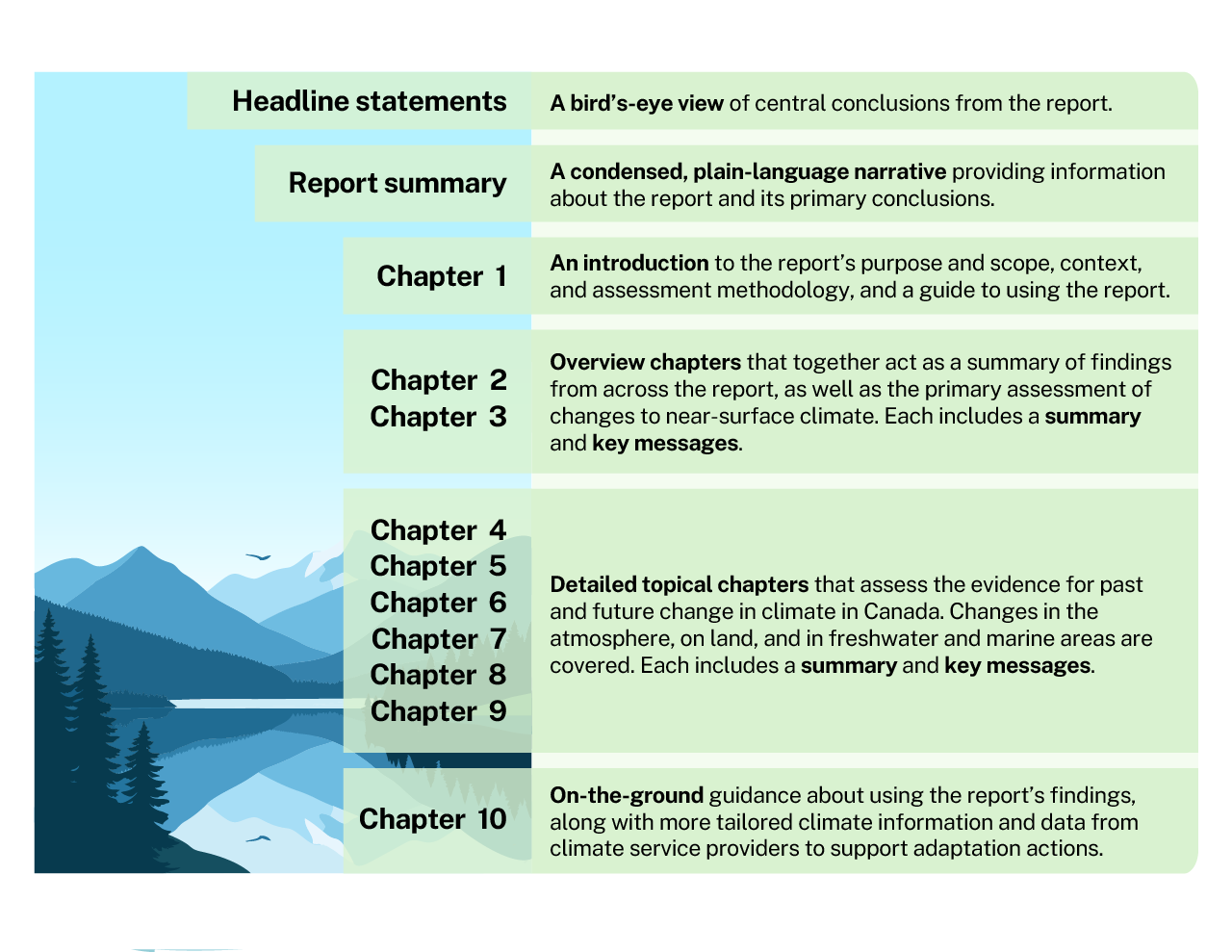
Figure 1.7: Diagram illustrating how the structure of the second edition of Canada’s Changing Climate Report provides information in layers of increasing detail that are intended to serve multiple audiences with varying needs.
1.4.2: Some core concepts related to measuring and modelling changes in climate
Throughout CCCR2026, readers will encounter core concepts and methods of analysis related to measuring past changes in climate and modelling future changes. Here, we provide a brief overview of some of these concepts and direct readers to where they can find more detailed information. See Table 1.1 of the Annex for a more complete list.
Observations and projections: Observations of past and current climate are drawn from measurements taken in the real world. This includes both in-situ measurements and measurements obtained by remote sensing, such as from instruments on satellites. When data are scarce, direct observations can be supplemented by analytical techniques that estimate past climate, such as reanalysis, which uses a combination of real-world data and model simulations of the past. Projections of future climate are generally derived from simulations using climate models. They are called projections rather than predictions because they rely on assumptions about the driving factors of climate change, such as human-caused greenhouse gas emissions (see below). The difference between projections and predictions is explained at the beginning of Chapter 3, section 3.4. Detailed overviews of some of the primary sources of data and methods used to draw conclusions about past and future climate are described in Chapter 2, section 2.3 (observations), and Chapter 3, sections 3.1 and 3.3 (projections). Those sections focus on temperature, precipitation, and wind, but many of the same tools and methods are used frequently for climate variables assessed in other chapters.
Baseline periods: Both observed and projected changes in climate variables are expressed relative to the average conditions that prevailed during a specified period of time, called a baseline period. Similarly, results are always accompanied by the specific time period across which the change was assessed, whether in the past or future. Different baseline periods and time periods for assessing change are used in this report, depending on factors such as data availability, the question at hand, or the convention in a given field. More information on how to use baseline periods and translate between them is provided in Chapter 2, section 2.1 and Box 2.4, and in Chapter 10, section 10.3.6. An outline of the future timeframes used for projections in this report can be found in Chapter 3, section 3.2.
Comparison to pre-industrial conditions: We are often interested in understanding how much a climate variable has changed since the start of the Industrial Era, before human influence on the climate through fossil fuel consumption began increasing substantially. The Paris Agreement’s long-term global temperature goal is expressed relative to pre-industrial levels, in recognition of that period preceding significant human influence on the climate. CCCR2026 follows the IPCC’s convention and therefore uses the average conditions over the period from 1850 to 1900 as representative of pre-industrial conditions for reasons explained in Chapter 2, section 2.1, and Chapter 3, section 3.2. In projections, global warming levels can also be used to express a change in temperature relative to the pre-industrial period that is independent of emissions scenarios, as explained in Box 3.1.
Emissions scenarios: In order to project future climate using models, the climate research community uses a set of standardized scenarios that make assumptions about changes in population, the economy, technology, and climate policy that result in different pathways with future levels of greenhouse gas emissions ranging from very low to very high. The scenarios used by the international climate-modelling community that were featured in the IPCC’s Sixth Assessment Report (IPCC, 2023a) were based on a set of storylines that describe potential future economic, technological, and societal changes, called shared socio-economic pathways. These were paired with different levels of greenhouse gas emissions mitigation to achieve different targets. The previous generation of scenarios used by the climate-modelling community to project climate were not based on the same pathways and were called representative concentration pathways. Results from both sets of scenarios are used in assessments in this report, depending on the available scientific literature. See Chapter 3, section 3.3.1 and Box 3.2 for details.
Coupled Model Intercomparison Project (CMIP): Climate models used to project climate change are constantly being improved. Each model developed by modelling centres worldwide incorporates various assumptions, and representations of physical processes, such that each will provide a slightly different result for the same input scenario. To deal with this variation, the international scientific community collaborates through the CMIP to establish a common set of modelling experiments used to assess climate change. This report mainly relies on simulations from the CMIP Phase Six (CMIP6) climate models (Eyring et al., 2016; Lee et al., 2021), as described in Chapter 3, section 3.3.2 and Box 3.3. Simulations from the CMIP Phase Five (CMIP5) models are occasionally used, depending on the information available.
1.4.3: How to interpret confidence and likelihood terms
Scientific assessments involve critically analyzing a body of evidence to determine what overall understanding this information leads to. An important part of such an analysis is determining and communicating the degree of uncertainty associated with assessment findings. Various systems have been developed to communicate uncertainty in science assessment reports by using consistent terminology (for example, see one alternative used by the Intergovernmental Science-Policy Platform on Biodiversity and Ecosystem Services) (IPBES, 2018). In both CCCR2019 and this report, the authors adopted the calibrated uncertainty language set out by the IPCC for use in the fifth and sixth assessment reports (Mastrandrea et al., 2010). This language allows authors and audiences to distinguish between robust findings that are known with high confidence and are supported by strong evidence from findings that are based on limited or conflicting evidence. Audiences can track how our understanding of physical climate change has progressed over time by comparing the calibrated uncertainty terms associated with findings in both editions of Canada’s Changing Climate Report.
Two metrics are used to communicate the degree of certainty (Figure 1.8):
- Confidence in the validity of a result based on the type, amount, quality, and consistency of evidence (e.g., mechanistic understanding, theory, data, models, and expert judgement) and the degree of agreement. Confidence is expressed qualitatively using terms such as high confidence or low confidence.
- Likelihood of a result occurring based on quantified measures of uncertainty expressed by probabilities (derived from statistical analysis of observations or model results, or expert judgment). Likelihood is expressed quantitatively using terms such as very unlikely or virtually certain, which indicate specific levels of likelihood.
Figure take-away: Consistent language is used to communicate levels of certainty about findings in CCCR2026 in accordance with expert judgement of the quality, quantity, and consistency of evidence.
Figure title: Calibrated confidence and likelihood levels used with the findings in the second edition of Canada’s Changing Climate Report
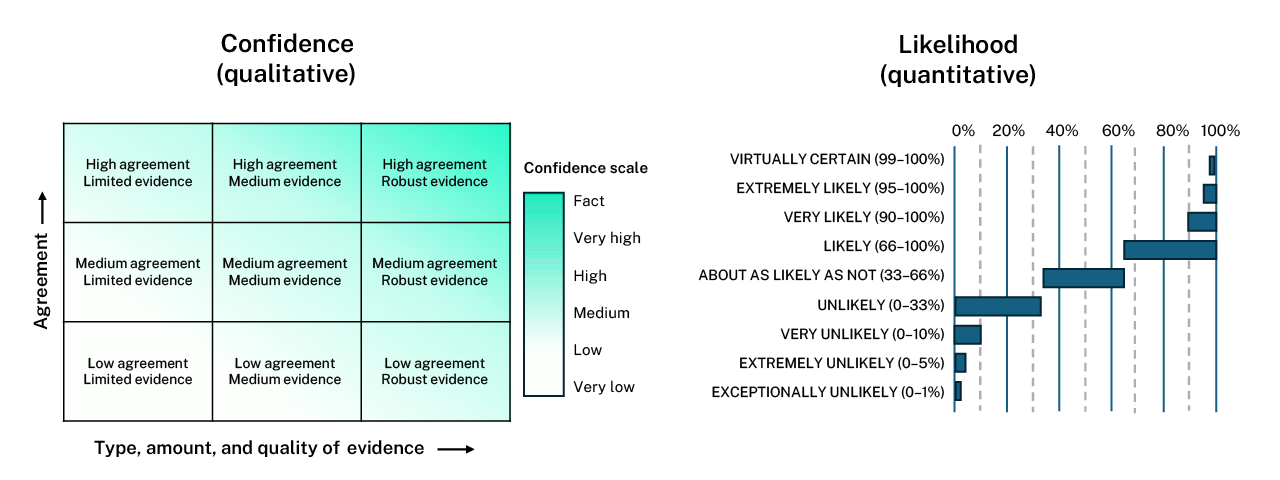
Figure 1.8: The calibrated language for assessing the confidence in and likelihood of the findings in the second edition of Canada’s Changing Climate Report. These terms are the same as those used in the Intergovernmental Panel on Climate Change’s Fifth and Sixth Assessment Reports. Generally, evidence is most robust when there are multiple, consistent independent lines of high-quality evidence. A level of confidence is expressed using five qualifiers: very high, high, medium, low, and very low. When statements in chapter findings appear without confidence terms, this means they are statements of fact. The figure depicts summary statements about evidence and agreement, and their relationship to the confidence scale. The colour gradient implies this relationship is flexible and dependent on expert judgement. The categories of likelihood are also considered to have fuzzy boundaries. For example, a statement that a result is likely means that the probability of its occurrence ranges from over 66 to 100%. In other words, its chance of occurring is two-thirds or more. When an assessment of likelihood is provided but no confidence level is given, a high or very high confidence level is implied. Adapted from: Mastrandrea et al. (2010).
Selecting an appropriate confidence or likelihood level to attach to a finding is ultimately a matter of expert judgement by the author team and may be informed by how specific the finding is (Zwiers & Zhang, 2023). For example, authors may be more confident about changes assessed on larger regional scales than local scales. Similarly, authors can often be more confident in the observed or projected direction of change than the magnitude of change.
Calibrated uncertainty language was applied to key messages and, to a lesser extent, to other findings of the assessments in the overview and topical chapters (chapters 2–9). For the most part, statements in key messages are arranged from highest to lowest confidence. Calibrated uncertainty terms always appear italicized in CCCR2026. When statements in key messages appear without italicized confidence terms, this means they are statements of fact. Confidence and likelihood terms may both be applied to a single finding. When an assessment of likelihood is provided but no confidence level is given, a high or very high confidence level is implied.
FAQs
FAQ 1.1: What is CCCR2026, and who wrote it?
CCCR2026, which stands for the second (2026) edition of Canada’s Changing Climate Report, is an assessment of the latest knowledge and data about past and future changes in Canada’s climate. It is based on already published scientific research. As with all assessments, CCCR2026 is aimed at communicating the state of knowledge on a topic to a range of decision-makers to help inform responses, in this case to climate change. Communicating the level of confidence that experts have in findings about different aspects of changes in climate in Canada is a central part of an assessment. The scope of the report consists of topics considered part of physical climate science. This means the report covers changes in climate in the atmosphere, on land, and in bodies of freshwater and marine water in and around Canada. CCCR2026 was written by a large group of authors drawn from across multiple federal government departments and the academic community in Canada. First Nations, Inuit, and Métis case stories were contributed by Indigenous Knowledge holders from communities across Canada.
FAQ 1.2: What is new in CCCR2026 compared to CCCR2019?
This is the second edition of Canada’s Changing Climate Report (CCCR2026). The first edition (CCCR2019) was published in 2019 (Bush & Lemmen, 2019). Although their purpose and scope are largely the same, CCCR2026 draws heavily on the wealth of scientific information produced since the release of CCCR2019 to provide an assessment of the latest understanding of past and future changes in Canada’s physical climate. New to CCCR2026 are features intended to make the report more accessible to a variety of audiences, and to better include Indigenous Knowledge Systems and Indigenous science. CCCR2026 also includes new chapters that cover more topics relevant for understanding changes in climate in Canada and informing responses to climate change, including:
- large-scale phenomena in the atmosphere and ocean that influence regional climate (Chapter 4)
- climate extremes and extreme events, including compound events (Chapter 8)
- the global and Canadian carbon cycle, including insights relevant to mitigation (Chapter 9)
CCCR2026 closes with a new chapter on climate services, which connects end users such as decision-makers with resources to move beyond the general conclusions of the report toward actionable solutions for climate risk and adaptation assessments at local levels.
References
AMAP. (2019). AMAP strategic framework 2019+. Arctic Monitoring and Assessment Programme.
Assembly of First Nations. (2023). National climate strategy.
Beimers, H. (2022). Decolonizing the map: Indigenous maps and GIS [Master’s thesis, Minnesota State University]. https://cornerstone.lib.mnsu.edu/etds/1183/
Bush, E., Gillett, N. P., Watson, E., Fyfe, J., Vogel, F., & Swart, N. (2019). Understanding observed global climate change. In E. Bush & D. S. Lemmen (Eds), Canada’s changing climate report (pp. 24–72). Government of Canada. https://doi.org/10.4095/327803
Bush, E., & Lemmen, D. S. (Eds). (2019). Canada’s changing climate report. Government of Canada. https://ostrnrcan-dostrncan.canada.ca/handle/1845/143725
Cajete, G. A. (2000). Native science: Natural laws of interdependence. Clear Light Publishers.
Canadian Net-Zero Emissions Accountability Act., S.C. 2021, c. 22 (2021).
Carmona, R., Reed, G., Thorsell, S., Dorough, D. S., MacDonald, J. P., Rai, T. B., & Sanago, G. A. (2023). Analysing engagement with Indigenous Peoples in the Intergovernmental Panel on Climate Change’s Sixth Assessment Report. Npj Climate Action, 2(1), 1–10.
Carroll, S. R., Garba, I., Figueroa-Rodríguez, O. L., Holbrook, J., Lovett, R., Materechera, S., Parsons, M., Raseroka, K., Rodriguez-Lonebear, D., Rowe, R., Sara, R., Walker, J. D., Anderson, J., & Hudson, M. (2020). The CARE principles for Indigenous data governance. Data Science Journal, 19, 43.
Diviacchi, T. (2023, October 10). Indigenous data sovereignty and open data. EveryONE.
ECCC. (2022a). 2030 emissions reduction plan: Canada’s next steps to clean air and a strong economy. Environment and Climate Change Canada.
ECCC. (2022b). Exploring approaches for Canada’s transition to net-zero emissions: Canada’s long-term strategy submission to the United Nations Framework Convention on Climate Change. Environment and Climate Change Canada.
ECCC. (2023a). Canada’s national adaptation strategy: Building resilient communities and a strong economy. Environment and Climate Change Canada.
ECCC. (2023b). Climate science 2050: National priorities for climate change science and knowledge report. Environment and Climate Change Canada.
ECCC. (2023c). Government of Canada adaptation action plan. Environment and Climate Change Canada.
ECCC. (2024). Canada’s next net-zero milestone: The 2035 emissions reduction target. Environment and Climate Change Canada.
ECCC. (2025a). National inventory report 1990-2023: Greenhouse gas sources and sinks in Canada. Environment and Climate Change Canada.
ECCC. (2025b, September 6). Indigenous science. Government of Canada.
Environment Canada. (1998). The Canada Country Study: Climate impacts and adaptation. National cross-cutting issues volume.
Eyring, V., Bony, S., Meehl, G. A., Senior, C. A., Stevens, B., Stouffer, R. J., & Taylor, K. E. (2016). Overview of the coupled model intercomparison project phase 6 (CMIP6) experimental design and organization. Geoscientific Model Development, 9(5), 1937–1958.
First Nations Information Governance Centre. (2025). First Nations Principles of OCAP®.
Ford, J. D., Cameron, L., Rubis, J., Maillet, M., Nakashima, D., Willox, A. C., & Pearce, T. (2016). Including indigenous knowledge and experience in IPCC assessment reports. Nature Climate Change, 6(4), 349–353.
Forster, P. M., Smith, C., Walsh, T., Lamb, W. F., Lamboll, R., Cassou, C., Hauser, M., Hausfather, Z., Lee, J.-Y., Palmer, M. D., Von Schuckmann, K., Slangen, A. B. A., Szopa, S., Trewin, B., Yun, J., Gillett, N. P., Jenkins, S., Matthews, H. D., Raghavan, K., … Zhai, P. (2025). Indicators of global climate change 2024: Annual update of key indicators of the state of the climate system and human influence. Earth System Science Data, 17(6), 2641–2680.
Global Indigenous Data Alliance, Hudson, M., Sterling, R., Blackwater, D., Cordova-Marks, F. M., Cummins, J., Fernandez, A., Garba, I., Jager, M. B., Jennings, L., Martinez, A., Rowe, R., David-Chavez, D., Walker, J. D., & Carroll, S. R. (2023). Indigenous Peoples rights in data [Infographic].
Government of Canada. (2025). Canada’s 2035 nationally determined contribution under the Paris Agreement.
Inuit Circumpolar Council. (2022). Circumpolar Inuit protocols for equitable and ethical engagement.
Inuit Circumpolar Council Canada. (2024). ICC position paper: Intergovernmental Panel on Climate Change.
Inuit Tapiriit Kanatami. (2018, March 22). National Inuit strategy on research.
Inuit Tapiriit Kanatami. (2019). National Inuit climate change strategy.
IPBES. (2018). IPBES guide on the production of assessments. Secretariat of the Intergovernmental Science-Policy Platform on Biodiversity and Ecosystem Services.
IPCC. (2014). Climate change 2014: Synthesis report. Contribution of working groups I, II, and III to the Fifth Assessment Report of the Intergovernmental Panel on Climate Change (R.K. Pachauri & L.A. Meyer, Eds). IPCC.
IPCC. (2021a). Climate change 2021: The physical science basis. Contribution of working group I to the Sixth Assessment Report of the Intergovernmental Panel on Climate Change (V. Masson-Delmotte, P. Zhai, A. Pirani, S. L. Connors, C. Péan, S. Berger, N. Caud, Y. Chen, L. Goldfarb, M. I. Gomis, Huang, M, K. Leitzell, E. Lonnoy, Matthews, J.B.R., T. K. Maycock, T. Waterfield, O. Yelekçi, R. Yu, & B. Zhou, Eds). Cambridge University Press.
IPCC. (2021b). Summary for policymakers. In V. Masson-Delmotte, P. Zhai, A. Pirani, S. L. Connors, C. Péan, S. Berger, N. Caud, Y. Chen, L. Goldfarb, M. I. Gomis, M. Huang, K. Leitzell, E. Lonnoy, J. B. R. Matthews, T. K. Maycock, T. Waterfield, O. Yelekçi, R. Yu, & B. Zhou (Eds), Climate change 2021: The physical science basis. Contribution of working group I to the Sixth Assessment Report of the Intergovernmental Panel on Climate Change (p. 3−32). Cambridge University Press.
IPCC. (2022a). Climate change 2022: Impacts, adaptation and vulnerability. Contribution of working group II to the Sixth Assessment Report of the Intergovernmental Panel on Climate Change (H.-O. Pörtner, D. C. Roberts, M. Tignor, E. S. Poloczanska, K. Mintenbeck, A. Alegría, M. Craig, S. Langsdorf, S. Löschke, V. Möller, A. Okem, & B. Rama, Eds). Cambridge University Press.
IPCC. (2022b). Climate Change 2022: Mitigation of climate change. Working group III contribution to the Sixth Assessment Report of the Intergovernmental Panel on Climate Change (P. R. Shukla, J. Skea, R. Slade, A. Al Khourdajie, R. van Diemen, M. Pathak, S. Some, P. Vyas, R. Fradera, M. Belkacemi, A. Hasija, G. Lisboa, S. Luz, & J. Malley, Eds). Cambridge University Press.
IPCC. (2022c). Summary for Policymakers. In H. O. Pörtner, D. C. Roberts, M. Tignor, E. S. Poloczanska, K. Mintenbeck, A. Alegría, M. Craig, S. Langsdorf, S. Löschke, V. Möller, A. Okem, & B. Rama (Eds.), Climate Change 2022: Impacts, Adaptation, and Vulnerability. Contribution of Working Group II to the Sixth Assessment Report of the Intergovernmental Panel on Climate Change (pp. 3–33). Cambridge University Press.
IPCC. (2023a). Climate change 2023: Synthesis report. Contribution of working groups I, II and III to the Sixth Assessment Report of the Intergovernmental Panel on Climate Change (H. Lee, Romero, J, & Core Writing Team, Eds; First). Intergovernmental Panel on Climate Change (IPCC).
IPCC. (2023b). Summary for policymakers. In Core Writing Team, H. Lee, & J. Romero (Eds.), Climate change 2023: Synthesis report. Contribution of working groups I, II and III to the Sixth Assessment Report of the Intergovernmental Panel on Climate Change (pp. 1–34). IPCC.
Karetak, J., Tester, F. J., & Tagalik, S. (Eds). (2017). Inuit Qaujimajatuqangit: What Inuit have always known to be true. Fernwood Publishing.
Kendrick, A., & Walsh, K. (2025). Doing better in a good way: Guidance for uplifting Indigenous Knowledge Systems in the National Assessment Process. Natural Resources Canada.
Lee, J.-Y., Marotzke, J., Bala, G., Cao, L., Corti, S., Dunne, J. P., Engelbrecht, F., Fischer, E., Fyfe, J. C., Jones, C., Maycock, A., Mutemi, J., Ndiaye, O., Panickal, S., & Zhou, T. (2021). Future global climate: Scenario-based projections and near-term information. In V. Masson-Delmotte, P. Zhai, A. Pirani, S. L. Connors, C. Péan, S. Berger, N. Caud, Y. Chen, L. Goldfarb, M. I. Gomis, M. Huang, K. Leitzell, E. Lonnoy, J. B. R. Matthews, T. K. Maycock, T. Waterfield, O. Yelekçi, R. Yu, & B. Zhou (Eds), Climate change 2021: The physical science basis. Contribution of working group I to the Sixth Assessment Report of the Intergovernmental Panel on Climate Change (pp. 553–672). Cambridge University Press.
Lulham, N., Warren, F. J., Walsh, K. A., & Szwarc, J. (2023). Canada in a changing climate: Synthesis report. Government of Canada.
Mastrandrea, M. D., Field, C. B., Stocker, T. F., Edenhofer, O., Ebi, K. L., Frame, D., Held, H., Kriegler, E., Mach, K. J., Matschoss, P. R., Plattner, G.-K., Yohe, G. W., & Zwiers, F. W. (2010). Guidance note for lead authors of the IPCC Fifth Assessment Report on consistent treatment of uncertainties. Intergovernmental Panel on Climate Change.
McDowell, G., Stevens, M., Marshall, S., Higgs, E., Jacob, A., Johnson, G. M. J., Johnson, L., Dicker, M., Inkpen, D., Koppes, M., Lightning, K., Parlee, B., Pascal, W., Shea, J., Sims, D., Smiles, N. D., Andrew, L., Aubry-Wake, C., Borish, D., … Vamosi, S. M. (2023). Canadian mountain assessment: Walking together to enhance understanding of mountains in Canada. University of Calgary Press.
Métis Centre at National Aboriginal Health Organization. (n.d.). Principles of ethical Métis research.
Métis National Council. (2024). Weaving resilience and building Métis climate leadership: The Métis Nation climate change strategy.
Mustonen, M., Harper, S., Pecl, G., Castán Broto, V., Lansbury, N., Okem, A., Ayanlade, A., Dawson, J., Harris, P., Feodoroff, P., & McGregor, D. (2022). Cross-chapter box INDIG: The role of Indigenous knowledge and local knowledge in understanding and adapting to climate change. In H.-O. Pörtner, D. C. Roberts, M. Tignor, E. S. Poloczanska, K. Mintenbeck, A. Alegría, M. Craig, S. Langsdorf, S. Löschke, V. Möller, A. Okem, & B. Rama (Eds), Climate change 2022: Impacts, adaptation and vulnerability. Contribution of working group II to the Sixth Assessment Report of the Intergovernmental Panel on Climate Change. Cambridge University Press.
Nakagawa, P., Nakagawa, H., & Bobiwash, K. (2025). Decolonizing Indigenous science: Bees and Indigenous sovereignty. FACETS, 10, 1–11.
Nakashima, D., Krupnik, I., & Rubis, J. T. (Eds). (2018). Indigenous Knowledge for climate change assessment and adaptation. Cambridge University Press.
Natural Resources Canada. (2023). Canada in a changing climate: Synthesis report infographic [Inforgraphic].
Paris Agreement to the United Nations Framework Convention on Climate Change, Pub. L. No. T.I.A.S. No. 16-1104 (2015).
Reed, G., Fox, S., Littlechild, D., McGregor, D., Lewis, D., Popp, J., Wray, K., Kassi, N., Ruben, R., Morales, S., & Lonsdale, S. (2024). For our future: Indigenous resilience report. Natural Resources Canada.
Reid, A. J., Young, N., Hinch, S. G., & Cooke, S. J. (2022). Learning from Indigenous knowledge holders on the state and future of wild Pacific salmon. FACETS, 7, 718–740.
Rose-Redwood, R., Blu Barnd, N., Lucchesi, A. H., Dias, S., & Patrick, W. (2020). Decolonizing the map: Recentering Indigenous mappings. Cartographica: The International Journal for Geographic Information and Geovisualization, 55(3), 151–162.
Snively, G., & Corsiglia, J. (2016). Chapter 6 – Indigenous science: Proven, practical and timeless. In G. Snively & W. L. Williams (Eds), Knowing home: Braiding Indigenous science with western science, Book 1. University of Victoria.
Stein, S., Ahenakew, C., Valley, W., Sherpa, P. Y., Crowson, E., Robin, T., Mendes, W., & Evans, S. (2024). Toward more ethical engagements between Western and Indigenous sciences. FACETS, 9, 1–14.
Tagalik, S., Baker, K., Karetak, J., & Rahm, J. (2023). Rebuilding relations and countering erasure through community-driven and owned science: A key tool to Inuit self-determination and social transformations. Journal of Research in Science Teaching, 60(8), 1697–1722.
UNFCCC Secretariat. (2024). Nationally determined contributions under the Paris agreement.
United Nations. (2025). NDC synthesis report.
United Nations Environment Programme. (2024). Emissions gap report 2024: No more hot air … please! With a massive gap between rhetoric and reality, countries draft new climate commitments. United Nations Environment Programme.
United Nations General Assembly. (2007). United Nations declaration on the rights of Indigenous People.
University of Toronto. (2025, April 2). Research guides: Indigenous studies: Indigenous data sovereignty. University of Toronto.
U.S. Global Change Research Program. (2023). Fifth national climate assessment. U.S. Global Change Research Program.
van Bavel, B., MacDonald, J. P., & Dorough, D. S. (2022). Indigenous Knowledge Systems. In K. De Pryck & M. Hulme (Eds), A Critical Assessment of the Intergovernmental Panel on Climate Change (pp. 116–125). Cambridge University Press.
Vijayakumar, S. (2021, January 30). How counter-mapping helps reclaim Indigenous knowledges, land. The Varsity.
Warren, F., Lulham, N., & Lemmen, D. S. (Eds). (2021). Canada in a changing climate: Regional perspectives report. Government of Canada.
Zwiers, F. W., & Zhang, X. (2023). Translating science into actionable policy information—A perspective on the Intergovernmental Panel on Climate Change process. In D. G. Woolford, D. Kotsopoulos, & B. Samuels (Eds), Applied Data Science (pp. 1–12). Springer International Publishing.
Annex: Index of cross-cutting topics in the report
Topic |
Chapters |
Sections |
|---|---|---|
Methodology for climate assessment |
||
Baseline periods |
2, 10 |
Box 2.4: Externally forced Canadian warming in different baseline periods 10.3.6: Differences in baseline periods |
Climate model projections |
3, 10 |
3.3: Climate projections and their uncertainties 10.3.5: Exploring ranges of change (uncertainty) |
Downscaling |
10 |
10.3.1: Considering spatial domain, resolution, downscaling, and bias-correction 10.3.2: Choosing relevant climate information |
Detection and attribution |
2, 8 |
2.4.2 Understanding the past changes Box 8.1: Attributing changes in extremes |
Emissions scenarios |
3, 10 |
3.3.1: Scenarios Box 3.1: Global warming levels Box 3.2: Assumptions underlying emissions scenarios 10.3.4: Evaluating emissions scenarios and identifying time horizons |
Data homogenization |
2 |
Box 2.1: What makes data suitable for studying climate change? Box 2.2: Representativeness of trends in the gridded station data, taking account of changing data availability 2.3.3: Gridded data products |
Projections vs. predictions |
3 |
3.4: Temperature (future changes) |
Reanalysis and gridded data products |
2 |
2.3.3: Gridded data products |
Remotely sensed data |
2 |
2.3.2: Remotely sensed data |
Weather station data |
2 |
2.3.1: Climate and weather station data 2.7.2: Canada’s declining climate station data archive |
Indigenous Case Stories |
2, 3, 5, 6, 8, 9, 10 |
Case Story 2.1: For the love of the land: Observations on Nuna Aliannaittuq melt Case Story 2.2: Chisasibi Eeyou Elder shares his perspective on environmental change in Eeyou Istchee Case Story 3.1: A story of the seasons in Ulukhaktuuq Story 5.1: Towards a sustainable water supply for Ausuiktuq (Grise Fiord), Nunavut Case Story 5.2: Red River Métis Community-Based Climate Monitoring Program Case Case Story 6.1: A lifetime of climate change in the Arctic Case Story 6.2: Landscape change in the Gwich’in and Inuvialuit settlement regions Case Story 6.3: SmartICE Case Story 8.1: “Smoke and Peaches” – Effects of compound extreme events on Métis cultural food practices Case Story 9.1: Returning Good Fire to the land in a changing climate Case Story 10.1: Climate change, food security, and Tŝilhqot’in wild food harvesting Case Story 10.2: Ecosystem services and shifting seasonal rounds: A Gitxsan perspective Case Story 10.3: Mâmawi Nistam: Resilience Through Seasons – A climate risk and vulnerability report by the Otipemisiwak Métis Government, of the Métis Nation within Alberta |
Cryosphere |
||
Glaciers |
5, 6 |
5.3: Streamflow magnitude and timing 6.5: Glaciers |
Lake ice, river ice, and ice jams |
5, 6 |
5.4: Surface water levels – lakes and wetlands 5.7: Floods 6.4: Lake and river ice |
Permafrost and seasonally frozen ground |
5, 6 |
5.3: Streamflow magnitude and timing 5.4: Surface water levels – lakes and wetlands 5.5: Groundwater 6.6: Seasonally frozen ground 6.7: Permafrost |
Sea ice |
6, 7 |
6.3: Sea ice 7.2: Ocean temperatures 7.5: Waves and storm surge |
Fire |
||
Fire weather |
8 |
8.7.1: Fire weather and wildfires Box 8.4: 2023 wildfire season |
Area burned and emissions |
9 |
9.5.1.7: Wildfire |
Net-zero |
3, 9 |
3.2.3: Canada’s long-term future climate in a net-zero world 9.4: Global climate response to CO2 emissions |
Ocean acidification |
7, 9 |
7.7: Ocean chemistry 9.5.2: Ocean (carbon cycle) |
Precipitation |
||
Annual and seasonal average precipitation amounts |
2, 3 |
2.5: Past precipitation changes 3.5: Precipitation (future changes) |
Atmospheric rivers |
4, 5 |
4.5: Atmospheric rivers 5.7: Floods |
Droughts and floods |
4, 5, 8 |
4.5: Atmospheric rivers 5.6: Droughts 5.7: Floods 8.7.2 Coastal compound flooding |
Extremes in sub-daily, 1-day, and 5-day precipitation |
8 |
8.3: Precipitation extremes 8.7.3: Compound wind and rainfall |
Freezing rain and hail |
2, 3, 8 |
2.5: Past precipitation changes 3.5.3: Freezing rain (future changes) 8.3.4: Freezing rain extremes 8.3.5: Hail |
Proportion falling as snow vs. rain |
2, 3 |
2.5: Past precipitation changes 3.5.2: Snowfall (future changes) |
Rain-on-snow events |
5 |
5.2: Atmospheric component of the water cycle 5.7: Floods |
Sea-level rise |
7, 8 |
7.4: Global and relative mean sea-level rise 7.6: Extreme sea level 8.7.2: Compound coastal flooding |
Storms |
4, 7, 8 |
4.3: Jet streams, storm tracks, and atmospheric modes of variability 4.4: Extratropical storms and atmospheric blocks 4.6 North Atlantic hurricanes 4.7 Large-scale environmental conditions favouring thunderstorms 7.5: Waves and storm surge 8.4.3: Extratropical and post-tropical cyclone winds 8.4.4: Thunderstorm-related winds Box 8.3: Hurricane Fiona and shifting extremes |
Temperature |
||
Annual and seasonal average temperatures |
2, 3, 4, 7 |
2.4: Past temperature changes 3.4: Temperature (future changes) 4.2: Arctic amplification 7.2: Ocean temperatures |
Extreme heat |
8 |
8.2: Temperature extremes Box 8.2: 2021 western Canada (Pacific Northwest) heatwave |
Extreme cold |
8 |
8.2: Temperature extremes |
Humidex |
8 |
8.7.4: Human-perceived heat stress |
Marine heatwaves and cold spells |
7 |
7.2.3: Marine heatwaves and cold spells Box 7.1: Potential implications of marine heatwaves for aquatic ecosystems |
Wind |
||
Average near-surface winds over land |
2, 3 |
2.6: Past wind speed changes 3.6: Average near-surface wind (future changes) |
Wind extremes |
8 |
8.4: Wind extremes Box 8.5: Hurricane Fiona and shifting extremes 8.7.3: Compound wind and rainfall |