
COSEWIC Assessment and Status Report on the Blue-grey Taildropper Prophysaon coeruleum in Canada - 2016
- Table of contents
- Assessment summary
- Executive summary
- Technical summary
- Preface
- Wildlife species description and significance
- Distribution
- Habitat
- Biology
- Population sizes and trends
- Threats and limiting factors
- Limiting factors
- Threats
- Natural ecosystem modifications (Threat 7; impact medium - low)
- Invasive and other problematic species (Threat 8; impact medium - low)
- Climate change and severe weather (Threat 11; impact medium - low)
- Residential and commercial development (Threat 1; impact low)
- Human intrusions and disturbance (Threat 6; impact low)
- Transportation and service corridors (Threat 4; impact low)
- Threats with negligible impacts
- Number of locations
- Protection, status and ranks
- Acknowledgements and authorities contacted
- Information sources
- Biographical summary of report writer(s)
- Collections examined
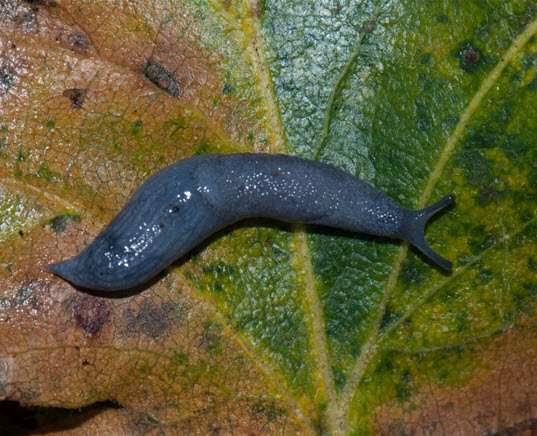
- Figure 1. Blue-grey Taildropper, Prophysaon coeruleum, from Vancouver Island, British Columbia.
- Figure 2. Global distribution of the Blue-grey Taildropper. Based on records in Table 1 and US distribution in Burke (2013).
- Figure 3. Canadian distribution of the Blue-grey Taildropper based on records in Table 1. Subpopulation names and numbers referred to in the text are indicated.
- Figure 4. Overview of sites surveyed for specifically for gastropods in and around the range of the Blue-grey Taildropper in southwestern British Columbia (see Table 2 for data sources).
- Table 1. Distribution records for the Blue-grey Taildropper from Canada.
- Table 2. Summary of search effort for terrestrial gastropods on Vancouver Island, southern Gulf Islands, and Lower Mainland (including Chilliwack Valley and Hope), and Sunshine Coast of British Columbia, 1984-2015.
- Table 3. Revisits to previously documented Blue-grey Taildropper sites in 2014 as part of field verification for this status report.
- Table 4. Land ownership of occupied sites, landscape connectivity, and estimated population viability.
- Appendix 1. Completed threats calculator with notes.
- Appendix 2. Summary of climate change for Vancouver island in the 2020s. Source: Pacific climate impact consortium (2012).
COSEWIC
Committee on the Status
of Endangered Wildlife
in Canada

COSEPAC
Comité sur la situation
des espèces en péril
au Canada
COSEWIC status reports are working documents used in assigning the status of wildlife species suspected of being at risk. This report may be cited as follows:
COSEWIC. 2016. COSEWIC assessment and status report on the Blue-grey Taildropper Prophysaon coeruleum in Canada. Committee on the Status of Endangered Wildlife in Canada. Ottawa. xii + 50 pp.
COSEWIC 2006. COSEWIC assessment and status report on the Blue-grey Taildropper slug Prophysaon coeruleum in Canada. Committee on the Status of Endangered Wildlife in Canada. Ottawa. vi + 27 pp.
COSEWIC would like to acknowledge Kristiina Ovaska and Lennart Sopuck for writing the status report on the Blue-grey Taildropper in Canada. This report was prepared under contract with Environment Canada and was overseen by Joe Carney, Co-chair of the COSEWIC Molluscs Specialist Subcommittee.
COSEWIC Secretariat
c/o Canadian Wildlife Service
Environment and Climate Change Canada
Ottawa, ON
K1A 0H3
Tel.: 819-938-4125
Fax: 819-938-3984
E-mail: COSEWIC E-mail
Website: COSEWIC
Également disponible en français sous le titre Ếvaluation et Rapport de situation du COSEPAC sur la Limace-prophyse bleu-gris (Prophysaon coeruleum) au Canada.
Blue-grey Taildropper - Photograph by K. Ovaska.
Blue-grey Taildropper (Prophysaon coeruleum) is a small slender slug (Arionidae: Anadeninae) with adults measuring between 20 - 40 mm in length. Distinguishing features include solid blue-grey colour without stripes and distinct, parallel grooves and ridges on the back and sides of the tail. As in other taildroppers (genus Prophysaon), a thin, oblique constriction or impressed line is usually visible on the tail at the site where autotomy (self-amputation) takes place, if the slug is attacked by a predator.
Blue-grey Taildropper may act as a dispersal agent for spores of fungi that form symbiotic associations with tree roots, thereby performing an important ecological function.
Blue-grey Taildropper is endemic to western North America, where it occurs from southwestern British Columbia south through the Puget Lowlands and Cascade Range of Washington State into Oregon and northern California; a disjunct population exists in northern Idaho. In Canada, Blue-grey Taildropper is documented only from southern Vancouver Island, where 15 subpopulations are known. All but two records are from within the Capital Regional District. In 2013, the species was found in the North Cowichan District, approximately 28 km north of the nearest record, followed by a second observation in the general area in 2015.
The estimated range (extent of occurrence) of Blue-grey Taildropper in Canada has increased from 150 km2 to 658 km2 since the previous status report, reflecting increased search effort over the past decade. Undocumented localities probably exist, but it is highly unlikely that there would be large additions to their range given the extensive search effort on southern Vancouver Island; hundreds of localities have been searched for terrestrial gastropods on Vancouver Island and the adjacent coastal mainland of British Columbia.
Blue-grey Taildropper inhabits low-elevation (< 250 m above sea level) mature or maturing second growth mixed-wood forest (>60 years old) on the drier southeastern tip of Vancouver Island within the Coastal Douglas-fir biogeoclimatic zone and where it transitions into the Coastal Western Hemlock biogeoclimatic zone. These habitats are declining rapidly in extent and becoming seriously fragmented due to urban and rural development. The Coastal Douglas-fir biogeoclimatic zone is one of the most disturbed ecosystems of British Columbia. This zone contains several rare and provincially listed Douglas-fir, Garry Oak and Arbutus ecosystems, where Blue-grey Taildropper has been found, although it is not restricted to these habitats. The slugs are patchily distributed within the landscape. Small forest gaps and woodland habitats may be favoured over deeper forest at the northern limits of the species' distribution, as they capture the sun and provide relatively warm forest floor conditions. Availability of suitable moist refuges, such as provided by abundant coarse woody debris and/or a deep moss layer, is thought to be important.
Blue-grey Taildropper appears to have an annual life cycle, maturing and reproducing within one year and overwintering as eggs. In British Columbia, juveniles have been observed in April - June, while almost all adults have been found in September - December; one adult was found in March, indicating successful overwintering by at least some adults.
Blue-grey Taildropper feeds extensively on fungi. A variety of vertebrate and invertebrate predators, native and introduced, prey on slugs and probably also on this species. Blue-grey Taildropper is capable of self-amputation of the tail, an adaptation that is an effective anti-predation mechanism against some predators. Blue-grey Taildroppers are thought to have very limited dispersal capabilities, in the order of tens to hundreds of metres per generation.
There are no reliable population estimates but rough estimates at four sites in one year resulted in a minimum of 50 - 125 adults per ha. Extrapolation of these densities to known occupied areas results in a population size of 1,800 - 4,500 adults. The total Canadian population, including undiscovered sites, is probably <10,000 individuals. However, the species is patchily distributed in the habitat, making population size estimates difficult. Blue-grey Taildropper was first documented from British Columbia only in 2002, and nothing is known of its long-term population fluctuations or trends. During field verification surveys in autumn 2014, the species was found at six of 18 known sites revisited. While the habitat at most sites remained unchanged, it had deteriorated at six sites where the species was not found due to encroachment by invasive plants, recreational activities, and/or development. Blue-grey Taildropper occurs in two habitat patches that are smaller than 20 ha, the minimum thought to be required for long-term viability, and three others are in heavily fragmented rural landscapes. The remaining ten subpopulations are in habitats with at least some connectivity to larger areas of forest.
Blue-grey Taildropper exists at the northern extremity of its geographic range in southwestern British Columbia. Low dispersal ability and requirements for moist habitats limit the speed with which the slugs can colonize new habitats or habitat patches from which they have become extirpated.
Main threats to Blue-grey Taildropper are from natural ecosystem modification by non-native invasive plants, competition and predation by introduced invertebrates, and from droughts associated with climate change and severe weather. Introduced invasive plants are prevalent at many Blue-grey Taildropper sites on Vancouver Island and deteriorate habitat quality by displacing native plants and altering the microclimate and possibly food supply for slugs. Non-native gastropods and other invertebrates, such as ground beetles (Coleoptera: Carabidae) pose a threat through predation and through competition for food and shelter. Prolonged and more frequent droughts are expected to reduce survivorship and length of time available for foraging and growth. Such effects can be expected to be particularly severe in degraded habitat patches that may lack microhabitats suitable for refuges. Other widespread threats include recreational activities and expanding housing and urban developments that contribute to habitat loss and degradation.
Blue-grey Taildropper is listed as endangered on Schedule 1 under the Species at Risk Act. Globally, the species is ranked as "vulnerable - apparently secure", G3G4 (rounded global status G3). Blue-grey Taildropper is on the provincial Red List of species at risk, which includes species that are extirpated, endangered, or threatened in British Columbia, and is ranked as "critically imperilled" (S1).
Most subpopulations are either entirely or partially on federal lands (Department of National Defence, National Research Council), in Capital Regional District Parks and Trails System, or in municipal parks and are protected from land conversions at least over the short term. Three subpopulations and a portion of a fourth one are within rural private lands. Additional sites may exist on private lands.
| Summary Items | Information |
|---|---|
| Generation time (usually average age of parents in the population; indicate if another method of estimating generation time indicated in the IUCN guidelines(2011) is being used) | ~ 1 yr |
| Is there an [observed, inferred, or projected] continuing decline in number of mature individuals? | Yes, projected and inferred decline based on qualitative assessment of site viability and threats |
| Estimated percent of continuing decline in total number of mature individuals within [5 years or 2 generations] | Unknown |
| [Observed, estimated, inferred, or suspected] percent [reduction or increase] in total number of mature individuals over the last [10 years, or 3 generations]. | Unknown |
| [Projected or suspected] percent [reduction or increase] in total number of mature individuals over the next [10 years, or 3 generations]. | Unknown |
| [Observed, estimated, inferred, or suspected] percent [reduction or increase] in total number of mature individuals over any [10 years, or 3 generations] period, over a time period including both the past and the future. | Unknown |
Are the causes of the decline?
|
|
| Are there extreme fluctuations in number of mature individuals? | No |
| Summary items | Information |
|---|---|
| Estimated extent of occurrence | 658 km2 |
| Index of area of occupancy (IAO) (Always report 2x2 grid value). |
56 km2 (the actual IAO may be larger as undocumented localities may exist, but it is unlikely to exceed 500 km2) |
Is the population "severely fragmented" i.e. is >50% of its total area of occupancy in habitat patches that are
|
|
| Number of "locations"? (Note: See Definitions and Abbreviations on COSEWIC website and IUCN (Feb 2014) for more information on this term.) (use plausible range to reflect uncertainty if appropriate) |
3 - 9 with droughts as the main threat and grouping sites based on biogeoclimatic subzones (low value) or proximity to each other and similarity of habitat (high value). 9 with invasive plants and invertebrates as the main threat and grouping sites according to land ownership/management. 15 if each subpopulation or cluster of sites is considered as having a separate complement of independently acting threats. |
| Is there an [observed, inferred, or projected] decline in extent of occurrence? | Unknown Observed increase since the previous status report reflects increased search effort |
| Is there an [observed, inferred, or projected] decline in index of area of occupancy? | An inferred decline based on threats Observed increase reflects increased search effort; actual IAO may be declining based on threats and habitat trends. |
| Is there an [observed, inferred, or projected] decline in number of subpopulations? | Possibly observed and inferred decline; two subpopulations in a disturbed habitat may have declined or been extirpated over the past 10 years (Galloping Goose at Sooke River: no observations since 2004; Thetis Lake, no observations since 2010, despite intensive annual surveys) |
| Is there an [observed, inferred, or projected] decline in number of "locations"? (Note: See Definitions and Abbreviations on COSEWIC website and IUCN (Feb 2014) for more information on this term.) |
Possibly observed and inferred decline (see above) |
| Is there an [observed, inferred, or projected] decline in [area, extent and/or quality] of habitat? | Yes, observed, inferred, and projected decline in habitat quality (several known sites) |
| Are there extreme fluctuations in number of subpopulations? | No |
| Are there extreme fluctuations in number of "locations"? (Note: See Definitions and Abbreviations on COSEWIC website and IUCN (Feb 2014) for more information on this term.) |
No |
| Are there extreme fluctuations in extent of occurrence? | No |
| Are there extreme fluctuations in index of area of occupancy? | No |
| Subpopulations (give plausible ranges) | N Mature Individuals |
|---|---|
| - | Unknown; 1,800-4,500 based on estimated 50-125/ha and known area of occupancy for all 15 subpopulations. |
| Total | Most likely < 10,000, as no robust estimates are available and undocumented subpopulations may exist. |
| Summary Items | Information |
|---|---|
| Probability of extinction in the wild is at least [20% within 20 years or 5 generations, or 10% within 100 years]. | Not done due to lack of data |
| Summary Items | Information |
|---|---|
|
Was a threats calculator completed for this species and if so, by whom? Yes, through conference call on 17 June 2015 by Kristiina Ovaska (report writer), Lennart Sopuck (report writer), Dwayne Lepitzki (facilitator and co-chair), Joe Carney (co-chair), Dave Fraser; Lea Gelling, Daelyn Woolnough, Raymond Lauzier, Robert Forsyth, Suzanne Dufour, Megan Harrison, Bev McBride (COSEWIC Secretariat). |
| Summary Items | Information |
|---|---|
| Status of outside population(s) most likely to provide immigrants to Canada. | Washington State (S1, critically imperilled) |
| Is immigration known or possible? | No |
| Would immigrants be adapted to survive in Canada? | Yes |
| Is there sufficient habitat for immigrants in Canada? | No |
| Are conditions deteriorating in Canada? See Table 3 ( Guidelines for modifying status assessment based on rescue effect) |
Yes |
| Are conditions for the source population deteriorating? | Unknown |
| Is the Canadian population considered to be a sink? | No |
| Is rescue from outside populations likely? | No |
| Summary Items | Information |
|---|---|
| Is this a data sensitive species? | No |
| Summary Items | Information |
|---|---|
| COSEWIC: Designated Endangered in April 2006. |
Status re-examined and designated Threatened April 2016. |
| Summary Items | Information |
|---|---|
| Status | Threatened |
| Alpha-numeric codes | B1ab(iii) + B2ab(iii) |
| Status History: Designated Endangered in April 2006. |
Status re-examined and designated as Threatened April 2016. |
| Reasons for designation |
This small, slender blue-coloured slug is only found in western North America where it lives in the moist layer of fallen leaves and mosses in mixed-wood forest. In Canada, it is confined to the southeastern tip of Vancouver Island within the Coastal Douglas-fir biogeoclimatic zone and where it transitions into the Coastal Western Hemlock biogeoclimatic zone. These habitats are declining in extent and what remains is becoming increasingly fragmented. Fifteen subpopulations are currently known, an increase that has resulted in a change of status. A continuing decline in habitat quality is expected due to natural ecosystem modification and competition with invasive species as well as droughts and severe weather events from climate change. |
| Summary Items | Information |
|---|---|
| Criterion A (Decline in Total Number of Mature Individuals) | Not applicable. The number of mature individuals is unknown. The population is projected and inferred to decline based on qualitative assessment of site viability and threats. |
| Criterion B (Small Distribution Range and Decline or Fluctuation) | Meets Threatened B1ab(iii)+2ab(iii). Although EOO (658 km2) and IAO (56 km2) meet the threshold for Endangered, the number of locations (9 based on most serious and plausible threats) exceeds the threshold for Endangered, but meets the threshold for Threatened. There is an observed, inferred and projected decline in habitat quality based on threats from habitat modification and impacts of invasive species as well as droughts and severe weather events associated with climate change. |
| Criterion C (Small and Declining Number of Mature Individuals) | Not applicable. The number of mature individuals is unknown |
| Criterion D (Very Small or Restricted Population) | D1 is not applicable because the number of mature individuals is unknown. Threatened D2 also is not applicable because IAO and number of locations are both above the thresholds for this criterion. Although the species is subject to threats derived from human activities such as invasive plants and animals and stochastic events such as drought, which are increasing in frequency due to climate change, the effects of these threats will not lead to critical endangerment or extinction within 1 or 2 generations after the threats occur. |
| Criterion E (Quantitative Analysis) | Not applicable as no estimates of population size or trends are available and no quantitative analyses have been performed. |
This report is an update of the previous COSEWIC status report for Blue-grey Taildropper (COSEWIC 2006). Since then, additional surveys for terrestrial gastropods have been conducted within the known and potential range of the species on Vancouver Island, in the Lower Fraser Valley, and in the Kootenay region of British Columbia; several surveys have specifically targeted this species. New distribution records have expanded the known area of occupancy, extent of occurrence, and number of locations, but the species has not been found beyond southern Vancouver Island.
A provincial recovery strategy has been completed (Blue-grey Taildropper Recovery Team 2012), and a federal recovery strategy has been drafted (Environment Canada in prep.). The latter document contains a partial identification of Critical Habitat for the species.
This species was not selected to go through the formal Aboriginal Traditional Knowledge (ATK) gathering process by the COSEWIC ATK Subcommittee (ATK Subcommittee pers. comm. 2014).
The Committee on the Status of Endangered Wildlife in Canada (COSEWIC) was created in 1977 as a result of a recommendation at the Federal-Provincial Wildlife Conference held in 1976. It arose from the need for a single, official, scientifically sound, national listing of wildlife species at risk. In 1978, COSEWIC designated its first species and produced its first list of Canadian species at risk. Species designated at meetings of the full committee are added to the list. On June 5, 2003, the Species at Risk Act (SARA) was proclaimed. SARA establishes COSEWIC as an advisory body ensuring that species will continue to be assessed under a rigorous and independent scientific process.
The Committee on the Status of Endangered Wildlife in Canada (COSEWIC) assesses the national status of wild species, subspecies, varieties, or other designatable units that are considered to be at risk in Canada. Designations are made on native species for the following taxonomic groups: mammals, birds, reptiles, amphibians, fishes, arthropods, molluscs, vascular plants, mosses, and lichens.
COSEWIC comprises members from each provincial and territorial government wildlife agency, four federal entities (Canadian Wildlife Service, Parks Canada Agency, Department of Fisheries and Oceans, and the Federal Biodiversity Information Partnership, chaired by the Canadian Museum of Nature), three non-government science members and the co-chairs of the species specialist subcommittees and the Aboriginal Traditional Knowledge subcommittee. The Committee meets to consider status reports on candidate species.
The Canadian Wildlife Service, Environment and Climate Change Canada, provides full administrative and financial support to the COSEWIC Secretariat.
Blue-grey Taildropper (Prophysaon coeruleum Cockerell, 1890) was described based on material from Washington State with the type locality in Olympia. The genus Prophysaon is endemic to western North America and consists of nine described species in two subgenera: Mimetarion, which includes P. vanattae, P. obscurum, P. fasciatum, and P. humile; and Prophysaon, which includes P. andersoni, P. boreale, P. coeruleum, P. dubium, and P. foliolatum. Characteristics that separate Prophysaon from other North American genera include a greatly reduced penis, specialized epiphallus, and ability to self-amputate the tail (Pilsbry 1948). The genus Prophysaon is placed within the large cosmopolitan family Arionidae, subfamily Anadeninae. An alternative classification by Bouchet and Rocroi (2005) raises all arionid subfamilies to full family status. Neither of these classifications is satisfactory, because current genetic studies do not support the monophyly of the more inclusive Arionidae or its subfamilies that have been investigated (Backeljau pers. comm. 2011).
The taxon Prophysaon coeruleum may represent a species complex based on genetic and morphological evidence (Burke 2013; see Population spatial structure and variability for genetic structure). The current classification is as follows:
Phylum Mollusca
Class: Gastropoda
Subclass: Pulmonata
Order: Stylommatophora
Suborde:r Arionoidea
Family: Arionidae
Subfamily: Anadeninae
Genu:s Prophysaon
Species: P. coeruleum
Blue-grey Taildropper is a small to medium-sized slug with adult length of 20 - 40 mm when extended in movement (Burke 2013); specimens from British Columbia have all been less than 30 mm (Ovaska and Sopuck unpubl. data 2014). The body is slender and tapering, and the tail lacks a dorsal keel. The mantle is large (almost 1/3 of the total length of the animal), and the pneumostome (or breathing pore) is located slightly to the anterior of the mid-point of the margin of the mantle on the right side. Distinguishing external characteristics include solid blue-grey colour without dorsal or lateral stripes and distinct, parallel grooves and ridges on the back and sides of the foot (Figure 1; Pilsbry 1948; Burke 2013). The colour of the back and sides ranges from pale to dark blue or blue-grey. The sole of the foot is light grey or white, and the mucus is clear. A thin, oblique constriction or impressed line is usually visible at the site where tail autotomy (self-amputation) takes place (Figure 1). Diagrams of the reproductive anatomy, useful for confirming identification, can be found in Pilsbry (1948) and Ovaska et al. (2004).
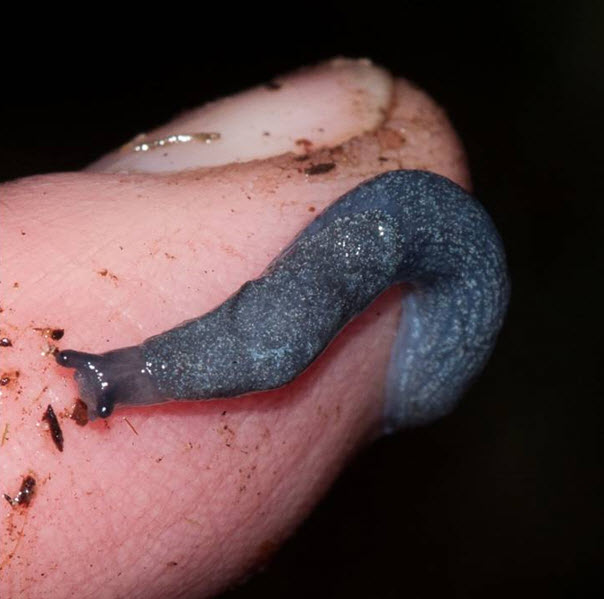
Long description for Figure 1
Photo of a Blue-grey Taildropper on a human finger (dorsal view). The Blue-grey Taildropper is a small to medium-sized slug with an adult length of 20 to 40 millimetres when extended in movement. The body is slender and tapering, and the tail lacks a dorsal keel. The mantle is large (almost one third of the total length of the animal). Distinguishing external characteristics include solid blue-grey colour without dorsal or lateral stripes and distinct, parallel grooves and ridges on the back and sides of the foot. The colour of the back and sides ranges from pale to dark blue or blue-grey.
Wilke and Duncan (2004) examined genetic structure of Blue-grey Taildropperthroughout the species' range using markers from two mitochondrial genes. The study included two specimens from Rocky Point, Vancouver Island, British Columbia. Within the overall range, the analysis showed a complex genetic structure and revealed three major clades, presumed to be about 2.6 - 5.9 million years old. Superimposed on this deep phylogenetic structure is a shallow structure with eight minor clades. This shallow structure is less than 2 million years old and probably reflects perturbations associated with Pleistocene glaciations. The genetic distances among the three major clades are similar to or greater than those between other species of Prophysaon, and it is possible that the form currently known as "Prophysaon coeruleum" represents a complex of cryptic species (Wilke and Duncan 2004).
Most of the genetic fragmentation is found within the southern portion of the species' range, especially in the Klamath region in southern Oregon (Wilke and Duncan 2004). The geographic distribution of the large major clade that includes British Columbia extends from southern Vancouver Island south through the Cascade Mountains in Washington State to south-central Oregon; a disjunct population in Idaho is also included within this major clade. This major clade, in turn, consists of three minor clades: a northern contingent, a small clade in south-central Oregon, and a curious clade with representatives in both southern Oregon and northern Idaho. The British Columbia specimens are a part of the large northern minor clade, with representatives also in Washington State and Oregon. Therefore, the Vancouver Island population does not represent a genetically distinct population at a broad scale. However, the study (mitochondrial DNA analysis) was not meant to discern finer-scale differentiation that may well have occurred within the past 15,000 - 10,000 years.
Population structure and variability of Blue-grey Taildropper in Canadahave not been studied. Fifteen subpopulations are known from Vancouver Island, grouping together occurrences 1 km or less apart, based on the NatureServe separation distance for terrestrial gastropod populations in general (Cordeiro 2004). Given that the slugs have poor dispersal capabilities, there is probably little or no genetic exchange among slugs from these areas. These subpopulations are separated from each other by minimum straight-line distances of 1.2 - 28.4 km across landscapes fragmented by residential, agricultural, and other human developments and activities (see Population fragmentation).
In Canada, Blue-grey Taildropper is known from a relatively small area on Vancouver Island within one COSEWIC National Ecological Area (Pacific). There are no range disjunctions or other information that would suggest the presence of separate discrete and evolutionarily significant units within the Canadian population, but the genetic, anatomical, or ecological variability has not been studied. The species is treated as one designatable unit in this report.
Blue-grey Taildropper feeds extensively on mycorrhizal fungi, including fungal species that form obligatory, symbiotic associations with tree roots (see Diet). It might act as an important dispersal agent for these fungi, which often have fruiting bodies underneath the surface within the duff or decaying wood and rely on animal vectors to excavate and disperse their spores. However, because of the rarity of the species in British Columbia, its role in this process is probably restricted and confined to local areas. Apart from a possible role in improving forest health through dispersal of spores of mycorrhizal fungi, Blue-grey Taildropperhas no economic significance. It is unlikely to become a horticultural pest because of its association with moist forests rather than with open, disturbed sites and because of its apparently low densities and scattered distribution pattern.
Land snails and slugs in general have some cultural significance for Aboriginal peoples on Vancouver Island (Turner pers. comm. 2005). However, to our knowledge, there is no specific information on this species.
With its often bright bluish colouration, Blue-grey Taildropperis an attractive slug that has been used as a focal species for invertebrate conservation and stewardship activities on private lands on southern Vancouver Island by Habitat Acquisition Trust (HAT 2010, 2012 - 2014).
The distribution of Blue-grey Taildropperextends from southern Vancouver Island, British Columbia, south to the Puget Lowlands in Washington State and through the Cascade Range into Oregon and northern California (Figure 2). A disjunct population exists in northern Idaho (Ovaska et al. 2004). Populations in southern Oregon and northern California may represent separate species (see Population spatial structure and variability). The distribution of the species throughout the northern portion of its range appears to be highly fragmented and consists of geographically isolated populations. For example, there are only a few recent locality records from western Washington, although extensive surveys have been conducted in this area (Ovaska et al. 2004). The reasons for the fragmentation are unclear and may reflect a combination of past climatic changes and habitat modification through human activities. Approximately 3% of the global range of the species is in Canada.
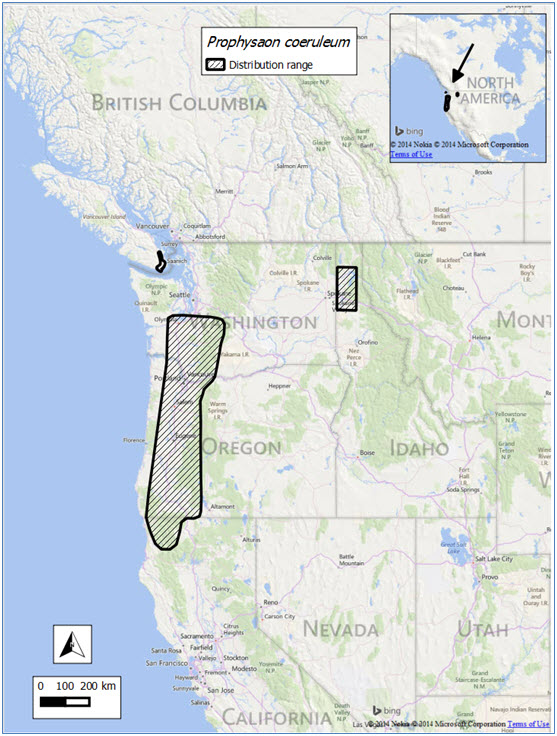
Long description for Figure 2
Map of the global distribution of the Blue-grey Taildropper, which extends from southern Vancouver Island, British Columbia, south to the Puget Lowlands in Washington State and through the Cascade Range into Oregon and northern California. A disjunct population exists in northern Idaho.
| Subpopulation | Site ID Table Footnotea | Site description | Elev (m) | BEC Table Footnoteb zone | Habitat | Date | # slugs found | Source |
|---|---|---|---|---|---|---|---|---|
| Cole Hill (Durrance Lake) | 1A | CFB Heals Rifle Range, Saanich | 140 | CDFmm | Mixed-wood 2nd growth forest with Douglas-fir, Arbutus, and Western Redcedar; understorey of Oregon Grape and Salal | 9 Dec-03 | 1 | Hawkes 2004 |
| Cole Hill (Durrance Lake) | 1B | CFB Heals Rifle Range, Saanich | 110 | CDFmm | Coniferdominated old (150+ years) forest with scattered Bigleaf Maples; varied understorey of shrubs and Sword Fern | 18 Oct-07 11 Nov-08 12 Nov-14 |
1 |
Ovaska and Sopuck 2007a, 2009a; fieldwork for this report |
| Cole Hill (Durrance Lake) | 1B | CFB Heals Rifle Range, Saanich | 110 | CDFmm | Coniferdominated old (150+ years) forest with scattered Bigleaf Maples; varied understorey of shrubs and Sword Fern | 22 Nov-08 | 2 |
Ovaska and Sopuck 2007a, 2009a; fieldwork for this report |
| Cole Hill (Durrance Lake) | 1C | CFB Heals Rifle Range, Saanich | 90 | CDFmm | Western Redcedardominated old (150+ years) forest in a moist depression by small wetland; sparse understorey with Salal and Sword Fern | 22-Nov-08 | 1 | Ovaska and Sopuck 2009a |
| Cole Hill (Durrance Lake) | 1D | Mount Work Regional Park (Durrance Lake), Saanich | 145 | CDFmm | South-facing slope with semi-open 2nd growth Douglas-fir and Arbutus forest; extensive moss cover on cobbly substrate | 23 Nov-08 5 Jun-08 26 Nov-09 8 Dec-10 12 Oct-14 |
1 |
Ovaska and Sopuck 2007b, 2008, 2009b, 2014b |
| Colwood | 2A | CFB Colwood Supply/Fuel Oil Depot, Colwood | 20 | CDFmm | Mixed-wood second growth forest with Douglas-fir, Western Hemlock, Grand Fir, and Bigleaf Maple; canopy gap with dense understorey of various shrubs and Sword Fern | 10 Nov-08 9 Nov-09 |
1 |
Ovaska and Sopuck 2004a, 2009a; DND 2010 |
| Colwood | 2A | CFB Colwood Supply/Fuel Oil Depot, Colwood | 20 | CDFmm | Mixed-wood second growth forest with Douglas-fir, Western Hemlock, Grand Fir, and Bigleaf Maple; canopy gap with dense understorey of various shrubs and Sword Fern | 18 Nov-03 30 Oct-08 18 Nov-08 26 Nov-09 |
2 |
Ovaska and Sopuck 2004a, 2009a; DND 2010 |
| Colwood | 2B | CFB Colwood Supply/Fuel Oil Depot, Colwood | 35 | CDFmm | Mixed-wood forest with scattered Garry Oak, Arbutus and Bigleaf Maple | 18 Nov-08 26 Nov-09 14 Oct-15 |
2 1 |
Ovaska and Sopuck 2009a; DND 2010; Sopuck and Ovaska 2015 |
| 2C | CFB Colwood Supply/Fuel Oil Depot, Colwood | 12 | CDFmm | Riparian area within mixed-wood forest with Bigleaf Maple along small creek; abundant herbaceous vegetation and coarse woody debris | 21 Oct-15 | 1 | Sopuck and Ovaska 2015 | |
| Devonian | 3A | Devonian Regional Park, Metchosin | 25 | CDFmm | Douglas-fir/ Arbutus forest with some Bigleaf Maple; second growth | 21 Oct-04 | 1 | Ovaska and Sopuck 2004b |
| Devonian | 3B | Devonian Regional Park, Metchosin | 25 | CDFmm | Coniferous (Douglas-fir - Grand Fir dominated) fringe adjacent to a small meadow with Garry Oak (15 m from edge); shrub understorey with grass | 20 Nov-09 |
2 |
Ovaska and Sopuck 2009b; Ovaska and Sopuck unpubl. data |
| Devonian | 3B | Devonian Regional Park, Metchosin | 25 | CDFmm | Coniferous (Douglas-fir - Grand Fir dominated) fringe adjacent to a small meadow with Garry Oak (15 m from edge); shrub understorey with grass | 2 Dec-09 |
4 |
Ovaska and Sopuck 2009b; Ovaska and Sopuck unpubl. data |
| Devonian | 3B | Devonian Regional Park, Metchosin | 25 | CDFmm | Coniferous (Douglas-fir - Grand Fir dominated) fringe adjacent to a small meadow with Garry Oak (15 m from edge); shrub understorey with grass | 11 Nov-15 | 1 | Ovaska and Sopuck 2009b; Ovaska and Sopuck unpubl. data |
| Devonian | 3C | Devonian Regional Park, Metchosin | 30 | CDFmm | Garry Oak meadow on rocky knoll with grass/herb ground cover | 9 Nov-07 |
3 |
Ovaska and Sopuck 2007b, 2008, 2009b; Frey pers. comm. 2013 |
| Devonian | 3C | Devonian Regional Park, Metchosin | 30 | CDFmm | Garry Oak meadow on rocky knoll with grass/herb ground cover | 12 Nov-08 |
2 |
Ovaska and Sopuck 2007b, 2008, 2009b; Frey pers. comm. 2013 |
| Devonian | 3C | Devonian Regional Park, Metchosin | 30 | CDFmm | Garry Oak meadow on rocky knoll with grass/herb ground cover | 9 Jun-08 20 Nov-09 4 Dec-11 5 May-12 |
1 | Ovaska and Sopuck 2007b, 2008, 2009b; Frey pers. comm. 2013 |
| Matheson Lake | 4A | Matheson Lake Regional Park, Metchosin | 30 | CWHxm1 | Older coniferous forest on gently sloping terrain with sparse understorey | 30 Apr-11 |
2 |
K. Trim, Metchosin Bioblitz 2011 - specimen examined by L. Sopuck, in Ovaska and Sopuck 2012; Ovaska and Sopuck 2014a,b |
| Matheson Lake | 4A | Matheson Lake Regional Park, Metchosin | 30 | CWHxm1 | Older coniferous forest on gently sloping terrain with sparse understorey | 18 Nov-13 |
9 |
K. Trim, Metchosin Bioblitz 2011 - specimen examined by L. Sopuck, in Ovaska and Sopuck 2012; Ovaska and Sopuck 2014a,b |
| Matheson Lake | 4A | Matheson Lake Regional Park, Metchosin | 30 | CWHxm1 | Older coniferous forest on gently sloping terrain with sparse understorey | 4 Nov-14 | 4 | K. Trim, Metchosin Bioblitz 2011 - specimen examined by L. Sopuck, in Ovaska and Sopuck 2012; Ovaska and Sopuck 2014a,b |
| Matheson Lake | 4B | Matheson Lake Regional Park, Metchosin | 40 | CWHxm1 | Unknown (forest on southwest side of lake) | 30 Apr-11 | 1 | A. Ceska, Metchosin Bioblitz 2011, in Ovaska and Sopuck 2012 |
| Metchosin | 5A | Metchosin Road, Metchosin | 70 | CDFmm | Patch of woodland with Garry Oak, Arbutus, and Douglas-fir; grass, herb and moss ground cover | 13 Jun-15 |
3 |
K. Trim pers. comm. 2015 (Metchosin Bioblitz 2015) K. Ovaska and K. Trim (pers. obs. 2015) |
| Metchosin | 5A | Metchosin Road, Metchosin | 70 | CDFmm | Patch of woodland with Garry Oak, Arbutus, and Douglas-fir; grass, herb and moss ground cover | 16 Jun-15 | 1 | K. Trim pers. comm. 2015 (Metchosin Bioblitz 2015) K. Ovaska and K. Trim (pers. obs. 2015) |
| 5B | Metchosin Road, Metchosin | 70 | CDFmm | Woodland with Douglas-fir, Garry Oak, and Arbutus; grass, herb and moss ground cover | 28 Oct-15 | 2 | Ovaska and Sopuck unpubl. data | |
| Mt Tzouhalem | 6 | Chase Woods, Mt Tzouhalem | 50 | CDFmm | Moist Bigleaf Maple dominated forest with Sword Fern & Oregon Grape understorey in bowl near base of hill; deep leaf litter and moss layer | 9 Nov-13 | 2 | Ovaska and Sopuck 2014a |
| Observatory Hill | 7A | Observatory Hill, Saanich | 160 | CDFmm | Open Garry Oak, Douglas fir and Arbutus woodland with mainly grass/ moss understorey on east-facing slope | 1 Nov-11 23 Mar-14 7 Nov-14 25 Apr-15 12 Nov-15 |
1 |
Engelstoft et al. 2012; Ovaska et al. 2015 and unpubl. data |
| Observatory Hill | 7B | Observatory Hill, Saanich | 175 | CDFmm | Open mature Douglas-fir and Arbutus forest with sparse understorey of shrubs and Sword Ferns and extensive moss cover; shaded, east-facing slope | 27 May-14 2 Nov-15 |
1 |
Ovaska et al. 2015 and unpubl. data |
| Observatory Hill | 7B | Observatory Hill, Saanich | 175 | CDFmm | Open mature Douglas-fir and Arbutus forest with sparse understorey of shrubs and Sword Ferns and extensive moss cover; shaded, east-facing slope | 17 Apr-15 | 3 |
Ovaska et al. 2015 and unpubl. data |
| Observatory Hill | 7C | Observatory Hill, Saanich | 80 | CDFmm | Edge of mature Douglas-fir/Arbutus woodland bordering hayfield on west side of hill | 10 Oct-15 | 1 | Ovaska et al. unpubl. data |
| Prior Lake | 8 | Thetis Lake Regional Park (Prior Lake), Saanich | 50 | CDFmm | Douglas-fir stand with old large trees at edge of rocky knoll with Arbutus and Garry Oak; dense shrub understorey | 13 Nov-10 2 Nov-11 |
1 | Ovaska and Sopuck 2010, 2012 |
| Prospect Lake | 9 | Goward Road, Saanich | 75 | CDFmm | Mixed-wood forest with Bigleaf Maple and Douglas-fir at base of Garry Oak and Arbutus dominated rocky knoll | 2 Nov-14 | 1 | Ovaska and Sopuck 2014b |
| Rocky Point | 10A | CFB Rocky Point Ammunition Depot (Site 1), Metchosin | 40 | CDFmm | Douglas-fir & Trembling Aspen fringe of a small wetland; second growth with a few older conifers; dense and diverse shrub & fern understorey | 18 Nov-02 |
5 |
Ovaska and Sopuck 2002, 2004a, 2007a. 2009a, field verification for this report |
| Rocky Point | 10A | CFB Rocky Point Ammunition Depot (Site 1), Metchosin | 40 | CDFmm | Douglas-fir & Trembling Aspen fringe of a small wetland; second growth with a few older conifers; dense and diverse shrub & fern understorey | 10 Oct-03 20 Nov-03 22 Oct-07 28 Oct-08 10 Nov-08 10 Nov-14 |
1 |
Ovaska and Sopuck 2002, 2004a, 2007a. 2009a, field verification for this report |
| Rocky Point | 10A | CFB Rocky Point Ammunition Depot (Site 1), Metchosin | 40 | CDFmm | Douglas-fir & Trembling Aspen fringe of a small wetland; second growth with a few older conifers; dense and diverse shrub & fern understorey | 22 Oct-04 |
3 |
Ovaska and Sopuck 2002, 2004a, 2007a. 2009a, field verification for this report |
| Rocky Point | 10A | CFB Rocky Point Ammunition Depot (Site 1), Metchosin | 40 | CDFmm | Douglas-fir & Trembling Aspen fringe of a small wetland; second growth with a few older conifers; dense and diverse shrub & fern understorey | 20 Nov-08 |
2 |
Ovaska and Sopuck 2002, 2004a, 2007a. 2009a, field verification for this report |
| Rocky Point | 10B | CFB Rocky Point Ammunition Depot (Site 2), Metchosin | 40 | CDFmm | Shore Pine stand with little understorey next to a small wetland | 5 Nov-07 15 Nov-07 |
1 |
Ovaska and Sopuck 2007a; DND 2010 |
| Rocky Point | 10B | CFB Rocky Point Ammunition Depot (Site 2), Metchosin | 40 | CDFmm | Shore Pine stand with little understorey next to a small wetland | 19 Oct-09 | 2 | Ovaska and Sopuck 2007a; DND 2010 |
| Rocky Point | 10C | CFB Rocky Point Ammunition Depot (Site 3), Metchosin | 20 | CDFmm | Moist mixed-wood stand with Bigleaf Maple, Western Redcedar and Douglas-fir; dense understorey of shrubs and Sword Fern | 29 Oct-02 20 Nov-03 14 Oct-08 29 Oct-08 9 Nov-09 27 Nov-09 |
1 | Ovaska and Sopuck 2002, 2004a, 2009a, DND 2010 |
| Rocky Point | 10C | CFB Rocky Point Ammunition Depot (Site 3), Metchosin | 20 | CDFmm | Moist mixed-wood stand with Bigleaf Maple, Western Redcedar and Douglas-fir; dense understorey of shrubs and Sword Fern | 21 Nov-08 |
4 |
Ovaska and Sopuck 2002, 2004a, 2009a, DND 2010 |
| Sooke River | 11 | Galloping Goose Trail at Sooke River, Sooke | 40 | CWHxm2 | Moist, 2nd growth mixed-wood stand with Bigleaf Maple, Red Alder, Western Hemlock, Western Red-cedar, Douglas fir, Grand Fir, and Arbutus with Sword Ferns | 22 Nov-04 | 1 | Ovaska and Sopuck 2004b |
| Sooke Hills | 12 | Sooke Hills Wilderness Regional Park Reserve (Humpback Reservoir), Langford | 130 | CWHxm1 | Douglas-fir - Arbutus forest with relatively sparse understorey and extensive moss coverage | 11 Nov-09 | 1 | Ovaska and Sopuck 2009b |
| Thetis Lake | 13 | Thetis Lake Regional Park (Lower Lake), View Royal | 85 | CDFmm | Douglas-fir, Arbutus and Garry Oak woodland with shrub understorey and grass and moss ground cover on S-SW slope | 15 Nov-08 30 Nov-09 13 Nov-10 |
1 | Ovaska and Sopuck 2008, 2009b, 2010 |
| Trevlac | 14A | Logan Park, Saanich | 60 | CDFmm | SE slope with large Douglas-fir trees and a dense, mostly Salal understorey; some Bigleaf Maple | 6 Dec-10 | 1 | Ovaska and Sopuck 2010 |
| Trevlac | 14B | Near Calvert Park, Saanich | 65 | CDFmm | Mixed-wood 2nd growth forest within ca. 20 m from pond edge; microsite under larger cedars | 5 Nov-11 | 1 | Ovaska and Sopuck 2012 |
| Shawnigan | 15 | Kinsol Road, Cowichan Valley Regional District | 205 | CWHxm2 | Opening in Douglas-fir and Western Redcedar forest with Oceanspray, Salal, and Sword Fern in understorey | 27 Nov-15 | 1 | Reported to K. Ovaska by T. Carnahan |
In Canada, Blue-grey Taildropper is known only from southern Vancouver Island, British Columbia (Figure 3). The number of known subpopulations, defined as occurrences within 1 km of each other (Cordeiro 2004), has increased from five to 15 since the preparation of the previous status report (COSEWIC 2006, including records up to December 2004) as a result of intensive, targeted surveys. The number of localities (referred to as sites) within each subpopulation ranges from one to four with records spanning 2002 to 2015 (Table 1). All but two records are from within the Capital Regional District. A significant discovery was made in 2013 with the documentation of the species from the base of Mt. Tzouhalem in the North Cowichan District, approximately 28 km north of the nearest record within the Capital Regional District (CRD). A second observation in this general area was made opportunistically in November 2015, 11.3 km to the southwest of the previous observation (Table 1; Figure 3), and it is possible that additional localities exist there. However, targeted searches in the North Cowichan District (Ovaska and Sopuck unpubl. data 2014) and in the Malahat-Mill Bay area (Ovaska and Sopuck unpubl. data) failed to locate further occurrences. The species' occurrence may be sporadic north of the CRD. The habitat on the eastern coast of Vancouver Island between CRD and the Cowichan Valley is extremely fragmented.
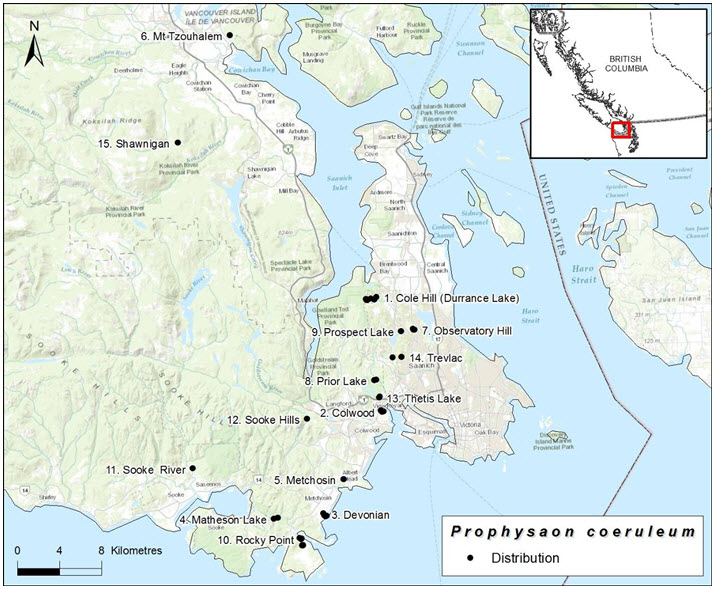
Long description for Figure 3
Map of the distribution of the Blue-grey Taildropper in Canada, where it is known only from southern Vancouver Island (map based on records in Table 1). Fifteen subpopulations (defined as occurrences within 1 km of each other) are shown, and the number of localities (referred to as sites) within each subpopulation ranges from one to four. All but two records are from the Capital Regional District.
There is a small possibility Blue-grey Taildropper occurs in the Kootenay Region of British Columbia, as the species has been recorded from northern Idaho 135 km south of the Canada-US border (Ovaska et al. 2004; see Figure 2). However, extensive surveys, including surveys undertaken as part of field verification for this report, have failed to locate the species on the Canadian side of the border.
This species was documented from Canada only recently with the first record from near Rocky Point, Vancouver Island, in 2002 (Ovaska and Sopuck 2002; Ovaska et al. 2004). The lack of previous records probably reflects a combination of factors: relatively low search effort during the optimal seasonal period in late autumn, low detectability due to secretive habits, and population and distribution characteristics (patchy, highly localized distribution; low densities). However, sufficient search effort is available to indicate that the species is patchily distributed within a fragmented and modified landscape and has a small geographic range when compared to most other forest slugs in southwestern British Columbia (see Search effort).
The extent of occurrence has increased from 150 km2 to 658 km2 since the previous status report, reflecting increased search effort over the past decade. The increase is largely due to the documentation of the species from Mt. Tzouhalem and Shawnigan, north of previous localities within the CRD. As of December 2015, the index of area of occupancy is 56 km2 (14 2x2 km grid cells). The actual area of occupancy is a small fraction of this value due to the patchy distribution of the species, even at localities where it is known to occur. On the other hand, undocumented localities, representing additional grid cells, are likely to exist (two new sites were discovered in 2015), but it is highly unlikely that there would be many such cells given the search effort on southern Vancouver Island. The IAO is unlikely to exceed or even approach 500 km2.
In comparison with vertebrates, terrestrial gastropod faunas of British Columbia forests are relatively poorly known, and undocumented native species continue to be discovered. Vancouver Island is better surveyed than most other areas of the province, beginning with efforts of early malacologists, such as G.W. Taylor and A.W. Hanham, in the late 1800s (see Drake 1963 and Forsyth 2004 for an overview of the history of malacology in British Columbia). Surveys were sporadic over much of the 20th century, and many areas even on Vancouver Island have received scant attention.
Rollo and Wellington (1975) carried out surveys in the vicinity of Vancouver in the early 1970s. A decade later, Cameron (1986) surveyed numerous sites on Vancouver Island and the Lower Fraser Valley. More recently (1990 - 2014) Forsyth surveyed hundreds of localities in these areas (R. Forsyth pers. comm. 2014). From 1999 - 2014, Biolinx Environmental Research Ltd. (K. Ovaska, L. Sopuck and field assistants) conducted numerous surveys at hundreds of sites for terrestrial gastropods in southern British Columbia, focusing largely on attempts to locate species deemed rare and at risk. In the Lower Fraser Valley, the BC Ministry of Environment (J. Heron and field assistants) conducted numerous surveys for species at risk, focusing on the Oregon Forestsnail (Allogona townsendiana).
To date hundreds of localities have been searched for terrestrial gastropods on Vancouver Island and the adjacent coastal mainland of British Columbia (Figure 4 ; Table 2). Annual surveys on southern Vancouver Island from 2002 - 2005 for the Department of National Defence, from 2006 - 2009 for the Capital Regional District Parks, from 2010 - 2015 for the Habitat Acquisition Trust, and 2011 - 2015 for the National Research Council have specifically targeted habitats of Blue-grey Taildropper, particularly within the Capital Regional District but also north of the CRD since the discovery of the species in North Cowichan District in 2013 (Table 2). Surveys have also been conducted in the Kootenay region in the southern interior of British Columbia in an effort to determine whether the disjunct distribution of Blue-grey Taildropper in Idaho extends to British Columbia (Ovaska and Sopuck 2014, 2015; COSEWIC in prep.; field surveys for this report). To date, the species has been found only in the extreme southern portion of Vancouver Island.
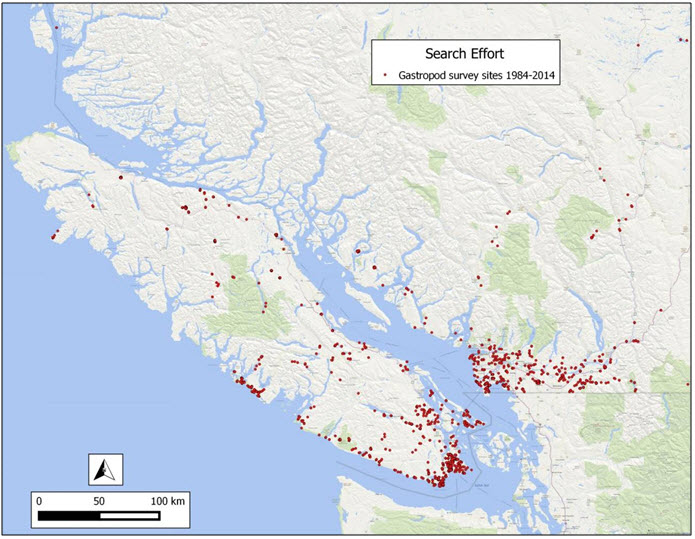
Long description for Figure 4
Map of the hundreds of sites surveyed specifically for gastropods in and around the range of the Blue-grey Taildropper on Vancouver Island and the adjacent coastal mainland of British Columbia (data sources in Table 2).
| Year (season) | Vancouver Island & Gulf islands | Lower Mainland and Sunshine Coast | Survey type Table Footnotec | Total search time or effort; no. of ACOs Table Footnotec | # of ACO checks | Source Table Footnoted |
|---|---|---|---|---|---|---|
| 1984 | 11 sites (23 plots) on Vancouver Island | 7 sites with15 plots (Lower Fraser Valley and Chilliwack Valley) | Area-constrained searches of habitat plots | not available | n/a | Cameron (1986) |
| 1990-2013 | 262 sites | 214 sites (Lower Fraser Valley, up to Hope, Sunshine Coast) | Visual searches of natural cover | not available | n/a | Forsyth pers. comm. (2014) |
| 2000-2001 (spring & fall) | 104 sites widely distributed over Vancouver Island | 27 sites (Lower Fraser Valley); 11 sites (Chilliwack Valley) | Time-constrained searches | 196.6 person-hrs | n/a | Ovaska, Sopuck, and Forsyth, surveys for Environment Canada (Endangered Species Recovery Fund) |
| 2002 (spring & fall) | 3 sites (56 transects ) on DND lands (southern tip of Vancouver Island) | - | Area-constrained transect surveys | 71.6 person-hrs | n/a | Ovaska and Sopuck, surveys for Department of National Defence |
| 2003 (spring) | 30 sites (south and southeast Vancouver Island) | 22 sites (Lower Mainland) | Time-constrained searches | 19.25 person-hrs | n/a | Ovaska and Sopuck, surveys for BC Min. Water, Land & Air Protection |
| 2003-2004 (spring & fall) | 39 sites (southern tip of Vancouver Island) | 4 sites (Lower Mainland) | Time-constrained daytime & night surveys; inspection of ACOs | 47.4 person-hrs and 260 ACOs on Van. Island; 7.9 person-hrs on Lower Mainland | 880 on Van. Island | Ovaska et al., surveys for Environment Canada (Endangered Species Recovery Fund) |
| 2003-2004 (spring & fall) | 35 sites in Pacific Rim National Park Reserve (2003-2004) and Gulf Islands National Park Reserve (2004) | - | Time-constrained daytime & night surveys; inspection of ACOs | 119.7 person-hrs and 240 ACOs (Pacific Rim); 44.8 person-hrs and 80 ACOs (Gulf Islands) | 1,040 on Van. Island; 160 in Gulf Islands | Ovaska and Sopuck, surveys for Parks Canada |
| 2003-2004 (spring & fall) | 1 site on DND property (southern Vancouver Island: Colwood) | 2 sites on DND properties (Lower Mainland: Aldergrove, Matsqui) | Time-constrained surveys | 53.9 person-hrs (Lower Mainland); 21.5 person-hrs (Vancouver Island) | n/a | Ovaska and Sopuck, surveys for Department of National Defence |
| 2004-2005 (spring & fall) | - | 2 sites on DND properties (Lower Mainland: Aldergrove and Matsqui) | Time-constrained surveys | 93.1 person-hrs | n/a | Ovaska and Sopuck, surveys for Department of National Defence |
| 2004-2005 (spring & fall) | - | 30 sites (Lower Mainland and Chilliwack Valley) | Time-constrained surveys | 57.9 person-hrs | n/a | Ovaska and Sopuck, surveys for BC Ministry of Water, Land and Air Protection |
| 1999-2001 (spring & fall) | 9 sites (southeastern Vancouver Island, 1999 & 2001); 11 sites (northeastern Vancouver Island, 2000, & 2001; 2 sites (southwestern Vancouver Island, 2001) | - | Point, transect and quadrat surveys, litter samples, inspection of ACOs | 26 point searches, 562 quadrats, 50 transects, 615 ACOs | Approx. 1,475 | Ovaska and Sopuck, surveys for Weyerhaeuser Company Limited |
| 2001-2007 (spring and fall) | Experimental pre- and post-logging surveys at 3 sites (northern Vancouver Island) | Experimental pre- and post-logging surveys at 2 sites (Sunshine Coast) | Inspection of ACOs | 1,820 ACOs | 12,940 | Ovaska and Sopuck, surveys for Western Forest Products |
| 2006 (summer & fall) | 21 sites in Pacific Rim National Park Reserve (western Vancouver Island) | - | Time-constrained daytime & night surveys; inspection of ACOs | 96.9 person-hrs; 240 ACOs | 960 | Ovaska and Sopuck, surveys for Parks Canada |
| 2006-2009 (mostly fall) | Numerous sites in 13 CRD regional parks (southern Vancouver Island) | - | Inspection of ACOs (deployed in both transects and intensive grids); time-constrained surveys | 6.2 person-hrs; 1,400 ACOs | 6,290 | 4 reports by Ovaska and Sopuck for Capital Regional District (CRD) Parks |
| 2007- 2009 (spring & fall) | 6 sites (southern tip of Vancouver Island) | - | Inspection of ACOs (deployed in both transects and intensive grids) | 1,600 ACOs | 7,780 | Federal land surveys: 2 reports by Ovaska and Sopuck for DND, NRC, & Parks Canada in 2007, 2008 (IRF funds) and DND only in 2009 |
| 2006 (spring: March only) | 4 sites (southern Vancouver Island) | 31 sites (Lower Mainland, Chilliwack Valley, Hope area) | Time-constrained surveys | 43.9 person-hrs | n/a | Ovaska and Sopuck, surveys for BC Ministry of Environment |
| 2006 (fall) | 30 sites (southwest coast and south-central inland mountains of Vancouver Island) | - | Time-constrained surveys | 40.6 person-hrs | n/a | Ovaska and Sopuck, surveys for BC Min. of Environment |
| 2008 (fall) | 2 sites (Pacific Rim National Park Reserve and Mt. Arrowsmith Massif area on Vancouver Island) | - | Time-constrained daytime & night surveys | Approx. 10 person-hrs | n/a | Biolinx Environmental Research Ltd., surveys for Parks Canada |
| 2008 (spring & fall) | 13 sites (southeastern Vancouver Island) | 4 sites (Sunshine Coast) | Time-constrained surveys | 16.1 person-hrs on Vancouver Island and 4.2 on Sunshine Coast | n/a | Ovaska and Sopuck, field verification surveys for Environment Canada in support of COSEWIC status report for Threaded Vertigo (Nearctula sp.) |
| 2010 (fall) | - | 1 site (Matsqui area) | Transect surveys | 16.0 person-hrs | n/a | Sopuck and Ovaska, surveys for Matsqui First Nations |
| 2009 (spring) | 1 site (Saturna Island) | - | Time-constrained surveys | About 6-8 person-hrs | n/a | Sopuck and Ovaska, surveys for Parks Canada |
| 2009-2011 (spring & fall) | - | 1 site with 15 plots (Burns Bog) | Inspection of ACOs | 300 ACOs | 2,100 | Ovaska, Sopuck, and Heron, surveys for BC Min. of Environment |
| 2009 | - | 10 sites | Visual searches of natural cover | 43 person-hrs | n/a | Bains et al. (2009); J. Heron, unpubl. data, surveys for BC Min. of Environment (cited in COSEWIC 2013) |
| 2010 | - | 5 sites | Visual searches of natural cover | 30 person-hrs | n/a | Parkinson and Heron 2010 (cited in COSEWIC 2013) |
| 2011 | - | 39 sites (Lower Mainland) | Visual searches of natural cover | 144 person-hours | n/a | J. Heron unpubl. data 2011 (cited in COSEWIC 2013) |
| 2012 (late summer) | 10 sites on Brooks Peninsula and Port Alice area (northwestern Vancouver Island) | - | Time-constrained surveys; inspection of ACOs | 15.3 person-hrs; 20 ACOs | 40 | K. Ovaska and L. Sopuck unpubl. data |
| 2010-2015 (mostly fall) | 147 sites in CRD on southern tip of Vancouver Island (regional & municipal park & private lands); 2 sites in Cowichan Bay | - | Inspection of ACOs (deployed in both transects and an intensive grid); time-constrained surveys | 2,326 ACOs 19.8 person-hrs (9 sites) of time-constrained searches | 6,817 (and additional flips by residents) | Annual reports for Habitat Acquisition Trust (see HAT website) |
| 2012 - 2015 (spring & fall) | 63 sampling plots or transects on Observatory Hill (southern Vancouver Island) | - | Inspection of ACOs (deployed in both transects and an intensive grid); time-constrained surveys | 308 ACOs (2012) 368 ACOs (2013) 388 ACOs (2014); 3.3 person-hrs (4 plots) of time-constrained searches 328 ACOs (2015) | 7,571 | Annual reports by Biolinx Environmental Research Ltd. for National Research Council |
| 2014 (fall) | 18 sites (southern Vancouver Island, including 4 sites in Cowichan Bay) | - | Time-constrained surveys | 26.5 person-hrs | n/a | Ovaska and Sopuck, field verification surveys for Environment Canada in support of this status report |
| 2015 (fall) | 1 site (Vancouver Island; adjacent to known Blue-grey Taildropper occurrence) | Inspection of ACOs | 60 ACOs | 420 | Matthews (2015) | |
| 2015 (fall) | 30 sampling plots at Malahat-Mill Bay (Vancouver Island, north of Capital Regional District) | Time-constrained surveys | 30 person-hrs | n/a | Surveys by crew of three people as part of an impact assessment; Ovaska and Sopuck unpubl. data | |
| 2015 (spring & fall) | 1 site; Colwood (southern Vancouver Island) | Time-constrained surveys | 99 points searched along transects at three sub-sites by two observers over 4 days | n/a | Sopuck and Ovaska 2015 | |
| 2014 (spring & fall) | 13 sites (southern Vancouver Island; including 4 sites at Lake Cowichan) | - | Time-constrained surveys (day & night) | 31.75 person-hrs | n/a | Includes various surveys with volunteers and Metchosin Bioblitz 2014; K. Ovaska unpubl. data 2014 |
In British Columbia, most locality records are from the Coastal Douglas-fir biogeoclimatic zone, a narrow strip of land that encompasses the southeast coast of Vancouver Island, the Gulf Islands in the Strait of Georgia, and a tiny fringe of the southern mainland coast (Meidinger and Pojar 1991). Four records (Matheson Lake, Sooke Hills, Sooke River, Shawnigan Lake) are from drier subzones of the Coastal Western Hemlock biogeoclimatic zone, where it transitions into the Coastal Douglas-fir zone. The records are from old growth and second-growth, mixed-wood stands. The species has been found in Garry Oak (Quercus garryana) and Arbutus (Arbutus menziesii) ecosystems on rocky bluffs or their fringes (Figure 4), in mixed-wood forests with Bigleaf Maple (Acer macrophyllum) or Trembling Aspen (Populus tremuloides), or on one occasion, in a Shore Pine (Pinus contorta) dominated stand adjacent to a small wetland and Trembling Aspen stand (Table 1). A broadleaf component to the forest is usually present. Forest gaps and open woodland habitats may be favoured at the northern limits of the species' distribution in British Columbia, as they capture the sun and provide relatively warm habitats.
All sites are moist and relatively productive, as indicated by varied and often abundant understorey vegetation, which may include Sword Fern (Polystichum munitum). Important microhabitat features include abundant coarse woody debris and/or deep moss or leaf litter layer that provide refuges. Availability of moist refuges is considered an important habitat feature for terrestrial gastropods in general (Cordeiro 2004). One locality (Sites 10A, B; Table 1) is within the flood plain of a small wetland. It is possible that Blue-grey Taildroppers spend much time buried within the substrate, as they feed on fruiting bodies (truffles) of hypogeous fungi (McGraw et al. 2002); the slugs have been noted to disappear quickly, presumably into underground retreats, when cover objects under which they were found were rechecked 5 - 10 minutes afterwards (Ovaska and Sopuck unpubl. data).
Records of Blue-grey Taildropper exist from near sea level (in British Columbia) to 1,650 m above sea level (in Oregon) (Wilke and Duncan 2004). All records from British Columbia are from low elevations (<250 m; Table 1).
In the United States, the species occurs in a wide range of coniferous and mixed-wood forests, where it is usually associated with moist plant communities such as those containing Bigleaf Maple and Sword Fern (Kelley et al. 1999; Burke et al. 2000). The species is frequently encountered in mature and old growth forests but also occurs in younger stands, especially where attributes of older forest are present (Miller et al. 1999; Burke et al. 2000). Burke (2013, p. 293) described Blue-grey Taildropper in the Pacific Northwest of the United States as "species of moist conifer forests, found in forest floor litter in association with Douglas-fir logs and other woody debris".
Most distribution records of Blue-grey Taildropper in British Columbia are from larger tracts of low-elevation mature or maturing second growth mixed-wood forest (>60 years old) on the southern tip of Vancouver Island. These habitats are declining rapidly in extent and becoming seriously fragmented due to urban and rural development. The Coastal Douglas-fir biogeoclimatic zone is one of the most disturbed ecosystems of British Columbia, where little of the original forest remains (MacKinnon and Eng 1995; MSRM 2004). Austin et al. (2008) reported that 49% of this zone has been converted to human uses and had the highest road density of any other zone in BC (4.7 km/km2).
Blue-grey Taildropper has been frequently found in older Douglas-fir, Arbutus and Garry Oak woodland ecosystems that are considered to be at risk in British Columbia. Six such woodland ecosystems occurring on southern Vancouver Island are currently red-listed (Douglas-fir/Arbutus, Douglas-fir/ Dull Oregon Grape, Douglas-fir/ Alaska Oniongrass, Garry Oak/Arbutus, Garry Oak/California Brome, Garry Oak/Ocean Spray; BC Conservation Data Centre 2015a).
The Capital Regional District is densely populated (359,991 people in 2011); the human population grew at a mean rate of 4.3% from 2006 - 2011 (CRD 2013). The areas experiencing highest rates of growth during this period were Langford (30.1%), Sooke (17.9%), and Highlands (11.4), all in the Western Communities where most tracts of continuous forest habitat still exist. The human population within the Capital Region is predicted to continue to grow to 390,000 by 2016 and to 475,000 by 2038 (Urban Futures 2009). The population increase is forecast to be greatest for the Western Communities (88% increase from 2008 - 2038). Population growth rate for the District of North Cowichan from 2006 - 2011 (4.5%) is similar to that of the Capital Region (CVRD 2013). As the human population within the Capital Region and North Cowichan District continues to grow, the remaining natural areas are under increasing pressures from development.
According to the Sensitive Ecosystems Inventory (SEI), older forests (with average age of trees 100 years or more) comprise only 2.6% of southern and eastern Vancouver Island, from Campbell River in the north to Sooke in the south, and on the Gulf Islands (MSRM 2004). This value includes old-growth and mature second-growth forest within the Coastal Douglas-fir and the Coastal Western Hemlock biogeoclimatic zones. The Coastal Western Hemlock zone occurs at higher elevations and/or moister sites, particularly in the northern and western portions of the SEI area. Larger tracts of maturing second-growth forest (with average age of trees 60 - 100 years) still exist on southeastern Vancouver Island and consist of coniferous or mixed-wood stands, often with a deciduous component of Red Alder (Alnus rubra) or Bigleaf Maple, or more rarely Trembling Aspen. Due to continued pressures on the land-base, however, it is unlikely that much of the regenerating forest outside protected areas will be allowed to reach maturity. Caskey and Henigman (2002) audited the SEI inventory and showed that 17.6% of older forest and 24.6% of maturing second-growth forest sites examined had been disturbed to some degree since the SEI had been completed 6-8 years earlier.
The SEI mapped three upland forested habitat types based on air photos taken from 1984-1992 within the Capital Region and District of North Cowichan (MSRM 2004), which encompass most potential habitat of Blue-grey Taildropper on southern Vancouver Island. AXYS (2005) repeated this inventory using air photos taken in 2002. During this interval in the Capital Region, the area of old-growth (>100 years old), woodland (open forest dominated by deciduous trees), and second-growth (60-100 years old) forest habitats declined by 1.8, 2.8 and 8.1% respectively. Corresponding losses for the North Cowichan District were 55.1, 7.5 and 3.5%. Losses were calculated only for polygons that had >25% fragmentation due to disturbance. Losses were not included if they were too small to be digitized or were spread throughout a larger polygon at less than 25% fragmentation. Over the entire SEI study area on southeastern Vancouver Island and Gulf Islands in 2002, almost half the area consisted of polygons that were fragmented to some degree (AXYS 2005). In both the Capital Region and North Cowichan District, the main causes of habitat loss were logging or clearing, rural use (farm buildings, fields and pastures, isolated houses or houses in low density), and urban use (housing developments, malls and office complexes). Based on the projected human population increases described above, habitat losses and fragmentation within the range of Blue-grey Taildropper are expected to continue over the next decade and beyond.
Most aspects of the ecology and life history of Blue-grey Taildropper are poorly known. Information on British Columbia populations in particular is sketchy and based on unpublished observations by the report writers. Burke et al. (2000) provided a summary of the species' biology in the United States as a part of management recommendations. McGraw et al. (2002) studied the diet of the species in Oregon.
Like most other pulmonate gastropods, Blue-grey Taildropper is oviparous and simultaneously hermaphroditic, each individual possessing both male and female reproductive organs. There is no evidence of self-fertilization in this species, however, and cross-fertilization may be the norm as in most other pulmonate species. Clutch size and details of the reproduction are unknown.
This species appears to have an annual life cycle, maturing and reproducing within one year (Burke et al. 2000). Near absence of observations of adults in the early spring, both in British Columbia and the United States, suggest that only few individuals survive to their second year. One adult slug was found on Vancouver Island in March (Ovaska et al. 2014), while all other observations of adults were in autumn; the few other observations obtained of the species in spring or summer have all been of juveniles (Table 1). The slugs may over-winter as eggs, which then hatch the following spring. It is also possible that adults that survive the winter lay eggs immediately after hibernation in early spring. Based on the above observations, the generation time is probably 1 year.
In Oregon, fungi form a large part of the diet of Blue-grey Taildropper, based on the presence of fungal spores and hyphae in the feces (McGraw et al. 2002). Fungal hyphae and spores were the most common items found and were present in 90% of the samples examined (spring and autumn samples combined). Although fungi were a major item in the samples during both seasons, the frequency of fungal spores was much greater in autumn (62%) than in spring (24%). The spores recovered from the samples represented 10 different families of fungi. Most of the fungi were mycorrhizal associates of vascular plants, including symbiotic fungi associated with roots of conifers, aiding their growth. Other food items found in fecal samples consisted of plant tissues (frequency of occurrence = 59%; spring and autumn data combined) and lichens (25%). On Vancouver Island, two juvenile Blue-grey Taildroppers were found on mushrooms (Sites 4A, B on 30 April 2011; Table 1), and at several sites adults have been found sheltering next to and/or in micro-sites with abundant mushrooms in autumn (Ovaska and Sopuck unpubl. data).
Terrestrial pulmonate gastropods obtain water from the environment mainly through the integument, and mucous glands in the body and foot play an active role in water uptake (Riddle 2013). Water uptake through food ingestion is not sufficient to maintain a positive water balance, and evidence for drinking is inconclusive. Slugs are more susceptible to dehydration than snails that can withdraw into their shell to slow down water loss. Both air temperature and soil humidity are thought to be important factors affecting activity and foraging by slugs (Riddle 2013 and references therein). The existing information is mostly from studies on European slugs, such as Arion species, in relation to pest control on agricultural lands, and no specific information is available on the physiology of water relations for western North American forest slugs. The small and slender shape of Blue-grey Taildropper may increase its susceptibility to water loss; conversely, a small slug may be better able to take advantage of moisture in small microhabitats. The report writers have found Blue-grey Taildroppers under a moss mat on bedrock that retained some moisture on rocky bluffs under dry summer conditions (Ovaska and Sopuck unpubl. data). Prolonged droughts that would completely dry up the moss mats are expected to trap the slugs and result in their demise.
Blue-grey Taildropper can tolerate some degree of habitat disturbance as evidenced by its occurrence in second-growth forests and in forest edge habitats in British Columbia. The availability of shelter (provided by decaying logs and other cover) and moist forest floor conditions might be more important than forest age. However, it remains unknown whether the slugs prefer second-growth habitats or persist in available marginal habitats in the absence of older forest stands.
Blue-grey Taildroppers are thought to have very limited dispersal capabilities, in the order of tens to hundreds of metres per generation, but few data are available (Duncan pers. comm. 2004; Wilke and Duncan 2004). Slugs from Oregon kept in enclosures moved very little (Duncan pers. comm. 2004). On three occasions, Blue-grey Taildroppers have been observed moving across hiking trails in late autumn (Ovaska and Sopuck unpubl. data), and short range directional movements from foraging areas to hibernation, courtship, and/or egg-laying sites are possible.
There are no known or suspected animal vectors or other means of dispersal (such as wind or water) for this species. Transport by humans is possible but unlikely to be important. Unlike exotic slugs that are common in disturbed areas throughout much of North America, including Vancouver Island, this species is an inhabitant of forests rather than open, disturbed areas, and has an extremely patchy distribution throughout the northern portion of its range in Canada and the United States. Therefore, inadvertent introduction of slugs or eggs by humans, such as with nursery stock or in soil adhering to footwear, is unlikely for this species.
A variety of predators, both vertebrate and invertebrate, feed on slugs and probably also on Blue-grey Taildropper (Burke et al. 2000). Native Lancetooth snails (Haplotrema vancouverense and Ancotrema species) and both native and alien species of ground beetles (Coleoptera: Carabidae) are common in habitats where the species is found and feed extensively on gastropods. Like other species in the genus Prophysaon, Blue-grey Taildropper is capable of self-amputation of the tail, an adaptation that is an effective anti-predation mechanism against some predators (Hand and Ingram 1950) but may not be effective against introduced predators. Many species of non-native gastropods occur on southern Vancouver Island (Forsyth 2004) and could compete for food or shelter or prey on Blue-grey Taildroppers (see Threats).
Survey efforts have mostly focused on finding Blue-grey Taildropper at new sites and determining the extent of its distribution at known sites rather than on obtaining information on densities or trends (Table 2). Exceptions include (a) revisits to most known sites in autumn 2014 as part of field verification for this report, and (b) monitoring grids of cardboard cover objects at six sites (Sites 1B, 2A,B, 7A, 10A,B,C, 13) for varying lengths of time in an effort to obtain information on abundance. In addition to the inspection of artificial cover objects deployed along grids or transects, survey methods have included area-constrained searches (using points, transects or quadrats) and time-constrained searches of natural cover, fungi, and litter along meandering routes during the day or night (Table 2).
Population sizes and densities of Blue-grey Taildropperremain poorly known. Repeated surveys of four 20 x 20 m artificial cover object grids with stations 5 m apart on Department of National Defence properties in October - November 2008 resulted in observations of 3 - 5 slugs/grid (Ovaska and Sopuck 2009a). The sample sizes were too small to permit other than rough preliminary abundance estimates. Minimum densities calculated from these observations (deleting individuals from stations with two captures on different dates, which might represent the same individuals) were as follows: Colwood (Site 2A): 100 slugs/ha; Heals Rifle Range (Site 1B): 50 slugs/ha; Rocky Point (Sites 10A and B covered by the same grid): 75 slugs/ha; Rocky Point (Site 10C): 125 slugs/ha. The actual densities might be lower as suitable macro- and microhabitats are unevenly distributed within the landscape, contributing to patchy distribution of the slugs. Similar but slightly larger grids (30 x 30 m) were established in 2012 at two additional sites, Observatory Hill (Site 7A) and Thetis Lake (Site 13), centred on previous observations. Both grids have been checked multiple times each autumn from 2012 - spring 2015, but only a few Blue-grey Taildroppers have been found (Observatory Hill: 4 individuals; Thetis Lake: none; Ovaska and Sopuck unpubl. data). These results suggest very low densities at both of these drier sites (See Climate change and severe weather under Threats). On Observatory Hill where much of the hill has been sampled intensively and repeatedly for gastropods, Blue-grey Taildropper has been found only within a small area (minimum convex polygon around all 8 observations up to June 2015= 0.25 ha) on the east side of the hill in relatively open canopy woodland habitat. In October 2015, an isolated observation on the west side of the hill increased the minimum convex polygon to 3.41 ha, but intensive sampling has failed to find the species in the intervening area, suggesting that they either occur at very low densities or that their distribution is very patchy. Based on the population density estimates from the grid surveys at the four sites (50 - 125 slugs/ha) and the known area of occupancy at each site, the minimum population size was calculated as ~1800 - ~4500 slugs (1 ha was used for sites with too few records to draw a minimum convex polygon). The actual population size is probably larger because the area of occupancy by site is incompletely known and there might be undocumented sites. However, given the patchy distribution of the slugs and the highly fragmented habitat where they occur on Vancouver Island, undocumented populations are unlikely to be large. It is unlikely that the total population size exceeds 10,000 adults. Using the above method, the largest subpopulation (Cole Hill) is estimated to contain 700 - 1750 individuals. All other subpopulations are smaller and estimated to contain less than 1000 adults, even if the greater density estimate is used.
Pilsbry (1948) noted that the species often occurs solitarily on the forest floor. However, at Vancouver Island sites with multiple captures, individuals were usually found within a few metres of each other, suggesting either an affinity for specific microhabitat features or congregation for social reasons, such as mating, egg-laying, or hibernation in late autumn. Such micro-sites appear to persist from year to year. For example, at Matheson Lake (Site 4A), nine and four adult slugs were found within an area of 15 m radius within a single survey session in November 2013 and 2014, respectively. This site was within metres of where two juvenile slugs were found previously (in late April 2011).
Blue-grey Taildropper was documented from British Columbia only in 2002, and nothing is known of its long-term population fluctuations or trends. The species was found at six of 18 known sites revisited during field verification surveys in autumn 2014 (Table 3). The six sites were within areas occupied by four subpopulations (1, 4, 7, 10 in Table 1); the sites where the species was not found were within areas occupied by six subpopulations (2, 3, 11, 12, 13, 14); two known areas (6, 8) were not searched, and one (9) was discovered only in 2014 and was excluded; two additional sites (5 and 15) were discovered after the completion of the field verification surveys. Where the species was not detected does not necessarily indicate its absence. Blue-grey Taildropper is notoriously difficult to find, and a 30% success rate, especially at sites visited only once in 2014, is in fact remarkably high for this cryptic species. However, observations of habitat condition and landscape context, together with search efforts, can be used to make inferences about population viability (see Population Fragmentation). While the habitat at most sites remained unchanged, it had deteriorated at six sites where the species was not found due to encroachment by invasive plants, recreational activities, and/or development (Sites 1D, 2A,B, 10B, 11, 13); in addition, new disturbance from recreational activities was noted at one site where a concentration of Blue-grey Taildroppers occurs (Site 4A).
Blue-grey Taildropper has not been detected at two sites (Sites 11 and 13) despite search efforts in a number of years, and the populations may have declined or disappeared. At Site 11 (Galloping Goose Trail at Sooke River), where one individual was found in 2004, the habitat has deteriorated and has been fragmented by forest clearing and road construction immediately adjacent to the site. Site 13 (Thetis Lake), where the species was found in 2008, 2009, and 2010, is within a protected area, but the habitat has deteriorated due to the spread of invasive plants and gastropods, which dominate the gastropod fauna, as well as unauthorized trails; intensive surveys have been carried out at this site annually, but the slug has not been found in five years.
In the United States, the species appears to be relatively common in southwestern Oregon but rare and declining in other parts of Oregon and in Washington State (Wilke and Duncan 2004). Habitat at most of the historical sites in Washington State has been heavily modified for urban developments. The species appears to be extirpated from these sites, including the type locality in Olympia (Wilke and Duncan 2004). NatureServe (2014), following Cordeiro (2004), suggests that only a few occurrences (4 - 12) are of good viability globally.
| Site # | Site description | Date(s) in 2014 | Survey method in 2014 Table Footnotee | Search effort in 2014 Table Footnotef | No. found in 2014 | Condition of habitat and notes (2014) |
|---|---|---|---|---|---|---|
| 1A | CFB Heals Rifle Range, Saanich | NA | NA | NA | NA | Not visited but immediately adjacent to Site 2 |
| 1B | CFB Heals Rifle Range, Saanich | 12 Nov | TCS | 90 | 1 | Habitat appear to be unchanged, and no invasive plants seen; site is relatively safe from disturbance |
| 1C | CFB Heals Rifle Range, Saanich | 12 Nov | TCS | 90 | 0 | Habitat appear to be unchanged; some invasive Holly and garbage noted (site is next to a well-used gravel road) |
| 1D | Mt Work Regional Park (Durrance Lake), Saanich | 12 Oct 26 Oct 9 Nov | ACO | 40 | 1 0 0 | Unauthorized mountain bike trail and jumps constructed through habitat, removing moss and compacting soils; relatively free of invasive shrubs (a few Scotch Broom along forest edge) |
| 2A | CFB Colwood Supply/Fuel Oil Depot, Colwood | 10 Nov | TCS | 60 | 0 | Site is no longer used for archery practice. Invasive Holly and Laurel-leaved Daphne are prevalent and appear to be expanding; English Ivy growing on trees. New storage facility on previously disturbed site (field) next to forest. |
| 2B | CFB Colwood Supply/Fuel Oil Depot, Colwood | 10 Nov | TCS | 60 | 0 | Abundant invasive shrubs, including extensive thickets of Laurel-leaved Daphne under conifers and Scotch Broom on rocky knoll; large new building (apartment complex) immediately adjacent to site on private property. |
| 3A | Devonian Regional Park, Metchosin | NA | NA | NA | NA | Not visited but immediately adjacent to Sites 4B,C |
| 3B | Devonian Regional Park, Metchosin | 4 Nov | TCS | 60 | 0 | Habitat in Garry Oak knoll appears to be unchanged; meadow is small and contains a lookout over sea - receives some visitor activity from hikers |
| 3C | Devonian Regional Park, Metchosin | 4 Nov | TCS | 90 | 0 | Habitat in coniferous fringe adjacent to above Garry Oak knoll appears to be unchanged; many trails (official & unofficial) in this small park |
| 4A | Matheson Lake Regional Park, Metchosin | 4 Nov | TCS | 180 | 4 | Recent disturbance to habitat by park visitors noted, including signs of campfires (burned logs), garbage, and unofficial trails; species not found at adjacent site searched |
| 4B | Matheson Lake Regional Park, Metchosin | NA | NA | NA | NA | Exact locality unknown |
| 6 | Chase Woods, Mt Tzouhalem | NA | NA | NA | NA | Exact site from 2013 record not visited but 6 nearby sites on Mt. Tzouhalem and Maple Bay were surveyed on 24 Oct-14; the species was not found. |
| 7A | Observatory Hill, Saanich | 6, 28 May 5 Sept 3, 15, 21, 29 Oct 7, 21 Nov | ACO | 49 | 1 | Invasive Scotch Broom present. Other areas of the hill searched intensively and repeatedly with ACOs, but the species was not found. |
| 7B | Observatory Hill, Saanich | 27 May 3, 15, 21, 29 Oct 7, 21 Nov | ACO | 10 | 1 | Site found on 27 May-14 but not on subsequent surveys; other areas of the hill searched intensively and repeatedly with ACOs, but the species was not found. |
| 8 | Thetis Lake Regional Park (Prior Lake), Saanich | NA | NA | NA | NA | Not visited |
| 9 | Goward Road, Saanich | NA | NA | NA | NA | Site found in Oct 2014 by landholder |
| 10A | CFB Rocky Point Ammunition Depot, Metchosin | 10 Nov | TCS | 60 | 1 | Appears to be unchanged but surrounding area is more disturbed (see Site B) |
| 10B | CFB Rocky Point Ammunition Depot, Metchosin | 10 Nov | TCS | 60 | 0 | Habitat patch bounded by field and fence to the SE; more gorse is invading forest, and surrounding area is more disturbed (gravel pit/parking area expanded) |
| 10C | CFB Rocky Point Ammunition Depot, Metchosin | 10 Nov | TCS | 90 | 0 | Habitat appears to be unchanged |
| 11 | Galloping Goose Trail at Sooke River (Sites A-C), Sooke | 22 Oct | TCS | 170 | 0 | Narrow strip of forest along trail continuous with private residential lands; new road immediately adjacent to previous slug record (with no trespassing signs) |
| 12 | Sooke Hills Wilderness (Humpback Reservoir), Langford | 5 Nov | TCS | 90 | 0 | Habitat appears unchanged but unproductive and limited by rocky substrate and thin soils |
| 13 | Thetis Lake Regional Park (Lower Lake), View Royal | 13 Oct 22 Oct 5 Nov | ACO | 49 | 0 | Unauthorized coarse woody debris removal & piling up noted on site. Invasive Laurel-leaved Daphne is expanding, and removal efforts are started. |
| 14A | Logan Park (T1, T2), Saanich, BC | 11 Oct 29 Oct 9 Nov | ACO | 44 | 0 | Habitat appears unchanged; park is small and heavily used, but activity is on trails. |
| 14B | Near Calvert Park, Saanich | 13 Oct 31 Oct 9 Nov | ACO | 10 | 0 | Habitat appears unchanged and is away from human activity |
The Canadian population may be severely fragmented because:
- it exists in remnant forest patches within populated and heavily modified landscapes and
- dispersal capabilities of the slugs are poor.
However, there is little information on the viability of the different subpopulations and on the minimum size of habitat patches that can support such populations over the long term. The draft Critical Habitat description for the species presumed that at least 20 ha of continuous habitat is required, following assumptions for another Vancouver Island slug (Dromedary Jumping-slug, Hemphillia dromedarius) for Critical Habitat description (Parks Canada Agency 2012). Blue-grey Taildropper occurs in two habitat patches that are smaller than 20 ha (Subpopulation 2: 8 - 15 ha; Subpopulation 3: 15 ha), three others (Subpopulations 5, 9 and 14) are in heavily fragmented rural landscapes. The remaining subpopulations are in habitats with at least some connectivity to larger areas of forest (Table 4).
In addition to the size of the habitat patch and landscape connectivity, habitat quality and site-specific threats need to be taken into account when assessing population viability (Table 4). Based on threats and numbers of slugs found, five subpopulations were scored as low, two as moderate - low, five as moderate, two as high - moderate, and one as high (Table 4). B.C. Conservation Data Centre (2015b) estimated that 1 - 3 occurrences have good viability.
Immigration of slugs from Washington State to the Lower Fraser Valley of British Columbia is unlikely. No populations of Blue-grey Taildropper are known from mainland British Columbia, and forest habitats in the vicinity of the border and throughout the Lower Fraser Valley are fragmented amidst agricultural lands and urban developments. Immigration from the disjunct population of Blue-grey Taildroppers in Idaho is also unlikely because of the distance of this population from the Canada-USA border (135 km), and the species has not been found in the Kootenay Region of British Columbia despite considerable search effort. Vancouver Island is isolated from mainland British Columbia by the Strait of Georgia and from the Olympic Peninsula, Washington State, by the Strait of Juan de Fuca, precluding rescue through natural dispersal.
| ID # | Subpopulation name | # sites | Occupied area (MCP Table Footnoteg, ha) | Land ownership for known sites | Habitat fragmentation within 1 km of sites | Rating for landscape connectivity | Site viability based on threats (Site ID) |
|---|---|---|---|---|---|---|---|
| 1 | Cole Hill (Durrance Lake) | 4 | 14.00 | CRD regional park & federal (DND) | Large area of fairly continuous forest to north and across paved road to west; bounded by agricultural & residential areas to east; city dump to the south | Moderate | High - Moderate |
| 2 | Colwood | 3 | 1.61 | Federal (DND) | Very patchy areas of forest bounded by roads and residential development; large golf course to the west; major road to the north | Low | Low |
| 3 | Devonian | 3 | 2.61 | CRD regional park | Isolated patch of forest in agricultural landscape | Low | Low |
| 4 | Matheson Lake | 2 | 0.32 | CRD regional park | Large area of fairly continuous forest; some rural residential development | High | Moderate |
| 5 | Metchosin | 2 | -- | Private recreational/ agricultural | Isolated patch of forest in agricultural/rural residential landscape | Low | Moderate-Low |
| 6 | Mt Tzouhalem | 1 | -- | Nature Conservancy property | Larger area of continuous forest to the east; bounded by residential development to the north; major road and agricultural fields to the west/southwest | High | Moderate |
| 7 | Observatory Hill | 3 | 3.41 | Federal (National Research Council) | Large patch of remnant forest bounded by busy road to north and west and residential development; dry, rocky slopes not suitable habitat; not found in deeper forest on north side of hill | Moderate | Moderate-Low |
| 8 | Prior Lake | 1 | -- | CRD regional park | Large area of fairly continuous forest; bounded by golf course and urban residential development to the west and south; major highway to the south | High | High |
| 9 | Prospect Lake | 1 | -- | Rural residential | Within rural residential landscape; forest fragmented by houses, roads, and driveways; most fragmented to the north and northwest (small-scale agriculture and residences) | Moderate - Low | Low |
| 10 | Rocky Point | 3 | 7.21 | Federal (DND) | Large area of fairly continuous forest to the west and between sites; large complex of paved areas, roads and military infrastructure to the southeast | High | High-Moderate |
| 11 | Sooke River | 1 | -- | CRD regional park | Narrow strip of habitat expanding to large forested area to the north and east; agricultural and residential development to the west, including a large subdivision about 1 km to SW | Moderate | Low |
| 12 | Sooke Hills | 1 | -- | CRD regional park | Large area of fairly continuous forest; bounded by large urban subdivisions to the north and west | High | Moderate |
| 13 | Thetis Lake | 2 | 0.12 | CRD regional park | Large area of fairly continuous forest to the northwest; bounded by major highway to the south (ca. 150 m away), urban development to the east and west | Moderate | Low |
| 14 | Trevlac | 2 | -- | Municipal park (Saanich); rural residential | Within rural residential landscape; forest fragmented by houses, roads, and driveways | Moderate - Low | Moderate |
| 15 | Shawnigan | 1 | _ | Rural residential | Extensive clearings due to hobby farms and rural residential developments; some recent logging is also present | Moderate | Moderate |
This species exists at the northern extremity of its geographic range in southwestern British Columbia. It is unknown whether areas farther north are outside physiological tolerances of the species, or whether the present distribution in British Columbia reflects Pleistocene extinctions and glacial history of the area and subsequent barriers to dispersal. Low dispersal ability and requirements for moist habitats limit the speed with which the slugs can colonize new habitats or habitat patches from which they have become extirpated.
The IUCN threats calculator (Master et al. 2009) was used to assess threats to Blue-grey Taildropper (Appendix 1). Threats were considered across the entire Canadian distribution of the species to account for possible undocumented sites, but using threats and land uses at known sites as guidance. The threats calculator method consists of scoring the scope, severity, and timing for each standard threat category; the overall threat impact is then computed from these ratings.
The overall threat impact for Blue-grey Taildropper was scored as "high - medium", where the range reflects uncertainty (Appendix 1). The three highest impact threats were "natural system modifications", "invasive, non-native species" and "climate change and severe weather", all of which affect most slug subpopulations but have much uncertainty associated with their impacts as reflected in the range for the ratings. Headings in the following narrative correspond to categories of the threats calculator, in the approximate order of their perceived importance.
Introduced invasive plants, such as Scotch Broom (Cytisus scoparius), Laurel-leaved Daphne or Spurge Laurel (Daphne laureola), and English Ivy (Hedera helix), are prevalent throughout the Capital Regional District and at many Blue-grey Taildropper sites. Introduced plants can displace native plants and impact the microclimate and/or understorey temperature and moisture content and possibly the food supply for slugs, thus degrading habitat quality. Laurel-leaved Daphne contains potent toxins that make it inedible for most herbivores and suppress the growth of native vegetation (RBCM 2011a). It grows well under shady conditions on the forest floor and does not require soil disturbance to become established. This shrub is particularly prevalent at two Blue-grey Taildropper sites (Thetis Lake, Colwood) and appears to be spreading (Table 4). A review of 87 studies of the effects of non-native invasive plants on arthropod communities found a general decrease in abundance and species diversity of native species in most studies, particularly for herbivorous species (Litt et al. 2014). Responses of terrestrial gastropods may be similar but are yet to be investigated.
Non-native invertebrates are prevalent throughout the Blue-grey Taildropper's range on Vancouver Island, but their effects on soils and ecosystem processes are largely unknown. Non-native earthworms can reduce or remove the duff layer through their actions, with potentially detrimental effects on native forest floor invertebrates (Addison 2009). Habitat change due to excessive deer browsing may also have an effect on the slugs in some localities.
Fires can be detrimental over the short term, resulting in mortality and habitat loss, but over the long term they reduce encroachment by conifers and maintain the open nature of the habitat, including Garry Oak and mixed-wood forest ecosystems, and forest gaps preferred by the slugs. Intense fires that modify the forest floor are thought to be detrimental to Blue-grey Taildropper(Burke et al. 2000). Perhaps more serious are toxic effects of fire retardants on the slugs and their food supply, but there are no data on this particular topic. Fire prevention activities can reduce coarse woody debris and cover for the slugs, as well as reduce the frequency of small, less intensive fires that would be beneficial to slug habitat. Overall, over the short term, the effects of fire and fire prevention are considered mixed with probably negligible effects on the population. Over the long term, fire prevention is likely to lead to deterioration of slug habitat through conifer encroachment to Garry Oak/Arbutus dominated woodlands.
Non-native gastropods and other invertebrates pose a threat to native gastropods through competition for food and shelter, and/or predation, and are considered a threat to populations of Blue-grey Taildropperin the United States (Burke et al. 2000). Over 20 species of introduced gastropods of mostly European origin have been recorded from British Columbia (Forsyth 2004). Non-native gastropods are prevalent throughout populated areas of Vancouver Island, and several are present at sites where Blue-grey Taildropperoccurs. Some species, such as the Giant Gardenslug (Limax maximus), are aggressive competitors (Rollo and Wellington 1979), while others, such as Deroceras invadens, are voracious feeders on live and dead vegetation (Reise et al. 2011) and could deplete food sources. A few introduced species are predators of other gastropods (Oxychilus draparnaudi, Testacella haliotidea; Forsyth 2004) or their eggs (Boettgerilla pallens; Reise et al. 2000). All these species have been recorded from Blue-grey Taildropper habitats.
In addition to gastropods, other widely introduced invertebrates include carabid beetles (Coleoptera: Carabidae), which can prey on gastropods (Symondson 2004). The introduced Carabus granulatus is widespread on southern Vancouver Island and has been observed preying on other species of taildroppers (P. reticulatum) in other areas of British Columbia (Ovaska and Sopuck unpubl. data). The introduced European Wall Lizard (Podarcis muralis) is another potential predator. This species can reach high densities in suitable habitats and is rapidly spreading on Vancouver Island (RBCM 2011b), including in Blue-grey Taildropper habitats.
Predation may be a particular problem for Blue-grey Taildropper in fragmented landscapes and small habitat patches that have a relatively large amount of edge and are subject to invasion by predators that use disturbed habitats, such as crows, some ground beetles, and non-native gastropods. Autotomy of the tail in the genus Prophysaon is believed to be an evolutionary adaptation to predation from beetles, among other organisms. In a related species, P. foliolatum, there is evidence that tail autotomy is an effective escape response from carabid beetles (Deyrup-Olsen et al. 1986). However, it may not be effective against non-beetle predators. Native predatory beetles are unlikely to be a threat to Blue-grey Taildropper, unless the size of the population declines to such an extent that it can no longer cope with natural predation. The availability of suitable shelter, including large decaying logs, is expected to be particularly important in small habitat patches to provide refuges from predation. However, there is much uncertainty about the impact from predation and competition on Blue-grey Taildropper populations, as reflected in the range of the severity rating.
On Vancouver Island, decreased summer and increased winter precipitation are predicted to accompany temperature increases associated with climate change (Pacific Climate Impact Consortium 2012). The frequency of extreme events is also predicted to increase. While the changes in most parameters are predicted to be modest over the next decade or have a high degree of uncertainty (see Appendix 2), habitats on the drier southern and southeastern portion of the island, where Blue-grey Taildropper occurs, may already be experiencing impacts. Summer precipitation has declined since the 1980s, and according to preliminary analyses of growth patterns, growth of Douglas-fir trees on southern Vancouver Island is becoming increasingly limited by droughts (Griesbauer et al. 2013). A prolonged drought occurred in summer and fall of 2012 encompassing the range of Blue-grey Taildropper; no rain fell in the Capital District from mid-July to mid-October (Environment Canada 2015). Intensive, repeated searches failed to locate the species at known sites after the fall rains began after mid-October that year, and the following year the species was found at only one known site in the Capital Region. The species showed signs of recovery by 2014 with low numbers of slugs recorded at five sites (Ovaska and Sopuck 2013, 2014a,b). In 2015, Vancouver Island experienced a historically low snowpack, early onset of spring, and warm, dry conditions from late April through to mid-September (BC Government 2015). Prolonged droughts are expected to reduce survivorship and length of time available for foraging and growth of the slugs; they may also indirectly reduce foraging opportunities through reduction in food supply. Such effects can be expected to be particularly severe in marginal, degraded habitat patches that may lack microhabitats suitable for refuges and drier sites, such as those in Garry Oak habitats. Conversely, increased winter precipitation may result in waterlogging of substrates (Pacific Climate Impact Consortium 2012), potentially reducing habitat quality and survivorship of Blue-grey Taildroppers.
The development of new housing and urban areas poses an ongoing threat to potential habitat within the species' range on southern Vancouver Island and is a possibility in the vicinity of several known sites. Commercial and industrial areas are similarly an ongoing threat to potential habitat. New industrial development is ongoing in the vicinity of one Blue-grey Taildropper site (Sooke River). The development of new recreational areas, such as golf courses, is possible within the range of the species, but none are known to be planned in the vicinity of Blue-grey Taildropper sites. Where they occur, all the above developments would have severe consequences for Blue-grey Taildropper subpopulations through habitat destruction.
Recreational activities are prevalent throughout the species' range on Vancouver Island and at the majority of the Blue-grey Taildropper sites. Several sites are within popular Capital Regional District parks and crisscrossed with official and unauthorized trails, resulting in considerable loss of vegetative cover in areas with multiple trails. Off-trail activities, such as mountain biking, can result in disturbance to the shrub, herbaceous and moss layers, coarse woody debris, and forest floor substrate where the slugs live. Habitat disturbance from unauthorized recreational activities has been observed at several sites (Table 3).
The species occurs on three military ranges, where off-road military training activities by large groups could compact soils and degrade habitat. Researchers searching for slugs, rare plants, or other organisms may also have a negative effect on habitat, if precautions are not taken to avoid disturbance to the substrate and forest floor vegetation.
Road building and clearing of rights-of-way for utility corridors are associated with urban expansion on Vancouver Island. Impacts on Blue-grey Taildropper accrue from habitat loss and edge effects that extend to the surrounding forest. While road mortality is not an issue for this species, roads are likely to create barriers to movements to this small slug with limited movement capabilities. Experiments with two species of snails showed that paved and unpaved roads with both high and low traffic densities acted as barriers to dispersal, including 3 m wide paved and unpaved tracks (Baur and Baur 1990; Wirth et al. 1999)
Four additional threat categories were identified as potentially impacting Blue-grey Taildropper populations, but their impacts were deemed to be currently negligible. Hobby farms are prevalent on southern and eastern Vancouver Island, and their expansion could result in loss and degradation of Blue-grey Taildropper habitat (Threat 2: Agriculture & Aquaculture). Impacts from quarrying are possible where borrow pits are created for new roads and housing developments; one subpopulation (Site 5 in Table1) is adjacent to a large quarry, but whether there are plans for expansion is unknown (Threat 3: Energy Production & Mining). Logging and harvesting of mushrooms (Threat 5: Biological Resource Use) are potential threats. The slugs feed extensively on fungi, and mushroom picking could both remove an important food source and result in mortality. In British Columbia, mushroom picking (commercial or recreational) is not regulated, and is legal on provincial crown lands but illegal in provincial parks (Ministry of Forests and Range undated). The extent of mushroom picking within the species' range is unknown, but several species are harvested commercially. Some commercial logging occurs near the periphery of the species' range on Vancouver Island (e.g., around Site 15), and firewood cutting and small-scale tree removal potentially occurs throughout the range. Impacts to the slugs are from disturbance to the substrate and coarse woody debris, as well as from canopy removal, which changes the moisture and temperature regimes on the forest floor. Not all effects are negative; selective tree removal may benefit the species by restoring the open nature of woodlands inhabited by the slugs. Pollution of slug habitat is possible through runoff where surrounded by agricultural lands (e.g., Site 3; Threat 8: Agricultural and Forestry Effluents).
The most plausible significant threats for Blue-grey Taildropper are from invasive, introduced species (plants and invertebrates) and from droughts, and the number of locations was assessed based on these threats, resulting in 3 - 15 locations depending on how they are counted. If it is assumed that lands under the same ownership are subject to similar habitat management measures, including invasive species strategies, then all sites managed by CRD Regional Parks, Saanich Parks, or Department of National Defence could each be grouped into one location, while those on private lands or under other management could be considered individually as separate locations. This would result in nine locations:
- Cole Hill, Colwood, Rocky Point (DND lands);
- Matheson Lake, Devonian, Sooke Hills, Thetis Lake, Prior Lake (CRD Regional Parks);
- Sooke River (CRD Regional Parks trail right-of-way, which might have different management practices from parks);
- Observatory Hill (National Research Council);
- Trevlac (Saanich Parks);
- Metchosin (private)
- 7) Prospect Lake (private),
- Mt. Tzouhalem (private; Nature Conservancy);
- Shawnigan (private).
Increased frequency and severity of droughts associated with climate change are a threat at all sites. Droughts are likely to affect the entire range of the species in a similar way, considering the relatively small EOO on southern Vancouver Island. However, the habitat is likely to buffer the slugs from droughts depending on site moisture retention capability, habitat type, and availability of refuges, making it difficult to determine the number of locations based on this threat. If sites are grouped together based on their proximity to each other and similarity of habitat, then there are nine locations:
- Cole Hill;
- Observatory Hill, Prospect Lake, Trevlac;
- Prior Lake, Thetis Lake;
- Colwood;
- Sooke Hills;
- Metchosin, Devonian, Rocky Point, Matheson Lake;
- Sooke River;
- Mt. Tzouhalem;
- Shawnigan.
Grouping sites into broader habitat categories based on biogeoclimatic subzones would result in three locations (CDFmm, CWHxm1, CWHxm2; Table 1).
If each subpopulation or cluster of sites is considered a separate location subjected to a unique combination of threats from multiple sources, there could be 15 locations (corresponding to the number of subpopulations).
Blue-grey Taildropper is listed as endangered on Schedule 1 (the official list of species at risk in Canada) under the Species at Risk Act. A federal recovery strategy that contains a partial identification of critical habitat was drafted in 2013 (Environment Canada in prep.), but as of July 2015 critical habitat had not been formally designated. In British Columbia, invertebrates designated by COSEWIC as Threatened, Endangered or Extirpated can be protected through the British Columbia Wildlife Act and Wildlife Amendment Act 2004 once the regulations listing these species are completed (no time line for the completion is available). The British Columbia Park Act protects invertebrates at risk in provincial parks and protected areas (when species are known to reside in the protected area), and provisions for management are to be incorporated into the park master plan. Blue-grey Taildropper is not listed as a 'species at risk' under the Identified Wildlife Strategy associated with the British Columbia Forest and Range Practices Act.
Globally, Blue-grey Taildropper is ranked as "vulnerable-apparently secure" G3G4 (rounded global status vulnerable, G3, 2010) (NatureServe 2014). Blue-grey Taildropper is on the provincial Red List of species at risk (B.C. Conservation Data Centre 2015a). Species on the Red List include species that are extirpated, endangered, or threatened in British Columbia and this species is ranked as "critically imperilled" (S1, 2008). In the United States, the sub-national rankings are as follows: California (S1S2), Idaho (SNR), Oregon (S3), and Washington (S1) (NatureServe 2014).
Four of the 15 subpopulations are entirely or partially within federal properties (Table 4). Two (Colwood and Rocky Point) are entirely within Department of National Defence properties and one (Cole Hill) is partially within Heals Rifle Range. One subpopulation (Observatory Hill) is managed by the National Research Council and Herzberg Institute of Astrophysics. All these lands are protected from land conversions, at least over the short term.
Six subpopulations are entirely within Capital Regional District Parks and Trails System (Devonian, Matheson Lake, Prior Lake, Thetis Lake, Sooke River, Sooke Hills), and an additional subpopulation (Cole Hill) is partially within Mt. Work Regional Park. One subpopulation (Trevlac) is partially within a Saanich municipal park. The sites in parks are protected from development. One subpopulation (Mt. Tzouhalem) is within a Nature Conservancy of Canada property and also protected from development. Three subpopulations (Prospect Lake, Metchosin and Shawnigan) and one site within the Trevlac subpopulation are on private lands. Additional sites may exist on private lands surrounding these properties. Further residential and infrastructure developments are also a possibility in the vicinity of parks and protected areas where Blue-grey Taildroppers have been found (see Threats).
The report writers contacted the following people in the preparation of this report - we thank all who provided information:
COSEWIC Secretariat:
Neil Jones
Jenny Wu
Canadian Wildlife Service:
Syd Cannings
David Cunnington
Rhonda Millikin
Shelagh Bucknell
Parks Canada:
Patrick Nantel
Canadian Museum of Nature:
Jennifer Doubt
Jean-Marc Gagnon
B.C. government representatives:
Dave Fraser
Jennifer Heron
B.C. Conservation Data Centre:
Lea Gelling
- Robert Forsyth, Research Associate, Royal B.C. Museum, Victoria, B.C.
- Heidi Gartner, Collection Manager (mollusks), Royal British Columbia Museum, Victoria, B.C.
- Kai Rietzel, Cowichan Land Trust, Duncan, B.C.
Additionally, the following people participated in a threats calculator conference call for the species on 17 June 2015: Kristiina Ovaska (report writer), Lennart Sopuck (report writer), Dwayne Lepitzki (facilitator and co-chair), Joe Carney (co-chair), Dave Fraser; Lea Gelling, Daelyn Woolnough, Raymond Lauzier, Robert Forsyth, Suzanne Dufour, Megan Harrison, Bev McBride (Secretariat).
The EOO and IAO values and associated maps were prepared by Jenny Wu from the COSEWIC Secretariat. Funding for the report came from Environment Canada.
Addison, J.A. 2009. Distribution and impacts of invasive earthworms in Canadian forest ecosystems. Biological Invasions 11:59-79.
Austin, M.A., D.A. Buffett, D.J. Nicolson, G.G.E. Scudder, and V. Stevens (eds.). 2008. Taking Nature's Pulse: The Status of Biodiversity in British Columbia. Biodiversity BC, Victoria, British Columbia. 268 pp. Web sisite: <www.biodiversitybc.org >[accessed January 2015].
AXYS Environmental Consulting Ltd. 2005. Redigitizing of Sensitive Ecosystems Inventory Polygons to exclude disturbed areas. Summary Report to Canadian Wildlife Service. Revised June 2005. [accessed January 2015].
Backeljau, T., pers. comm. 2011. Email correspondence to R. Forsyth. February 2011. Professor, Department of Invertebrates, Malacology Section, Royal Belgian Institute of Natural Sciences, Brussels, Belgium.
Bains, B., A. Caldicott, and J. Heron. 2009. Surveys for Gastropods, Aquatic invertebrates and moths in the Lower Fraser Valley, British Columbia. Unpubl. report, BC Ministry of Environment, Terrestrial Conservation Science Section, Vancouver, Columbia. 35 pp.
Baur, A., and B. Baur. 1990. Are roads barriers to dispersal in the land snail Arianta arbustorum? Canadian Journal of Zoology 68:613-617.
B.C. Conservation Data Centre. 2015a. BC Species and Ecosystems Explorer. B.C. Ministry of Environment, Victoria, British Columbia. [accessed January 2015].
B.C. Conservation Data Centre. 2015b. Conservation Status Report: Prophysaon coeruleum. B.C. Ministry of Environment, Victoria, British Columbia. [accessed January 2015].
B.C. Government. 2015. Living water smart [accessed December 2015].
B.C. Ministry of Forests and Range. Undated. Biogeoclimatic ecosystem classification program [accessed January 2016].
Blue-grey Taildropper Recovery Team. 2012. Recovery plan for Blue-grey Taildropper (Prophysaon coeruleum) in British Columbia. Prepared for the B.C. Ministry of Environment, Victoria, British Columbia. 36 pp.
Bouchet, P., and J.P. Rocroi. 2005. Classification and nomenclature of gastropod families. Malacologia 47:1-397.
Burke, T. 2013. Snails and Slugs of the Pacific Northwest. Oregon State University Press, Cornvallis, Oregon. 337 pp.
Burke, T.E., N. Duncan, and P. Jeske. 2000. Management recommendations for terrestrial mollusk species: Prophysaon coeruleum, blue-gray taildropper and Prophysaon dubium, papillose taildropper v.2.0. USDA Forest Service and USDI Bureau of Land Management. 49 pp.
Cameron, R.A.D. 1986. Environment and diversities of forest snail faunas from coastal British Columbia. Malacologia 27:341-355.
Caskey, M., and M. Henigman. 2002. Audit of selected polygons of the Sensitive Ecosystems Inventory of east Vancouver Island and the Gulf Islands, 1999 - 2001: Summary Report. [accessed January 2015].
Cordeiro, J. 2004. Population/occurrence delineation - terrestrial snails, in NatureServe. 2013. NatureServe Explorer: An online encyclopedia of life [web application]. Version 7.1. NatureServe, Arlington, Virginia. [accessed December 2014].
COSEWIC. 2006. COSEWIC Status report on the Blue-grey Taildropper slug Prophysaon coeruleum. Committee on the Status of Endangered Wildlife in Canada, Ottawa, Ontario. 27 pp.
COSEWIC. 2013. COSEWIC assessment and status report on the Oregon Forestsnail Allogona townsendiana in Canada. Committee on the Status of Endangered Wildlife in Canada. Ottawa, Ontario. xii + 87 pp.
COSEWIC. 2016. COSEWIC Status report on the Sheathed Slug Zacoleus idahoensis. Committee on the Status of Endangered Wildlife in Canada, Ottawa, Ontario.
CRD (Capital Regional District). 2013. Demographics: Estimates of population growth, Capital Region growth (PDF; 80 KB). Prepared by CRD Planning & Protective Services, Victoria, British Columbia. [accessed January 2015].
CVRD (Cowichan Valley Regional District). 2013. Population statistics (PDF; 761 Kb) [accessed January 2015].
Department of National Defence (DND). 2010. Summary of survey work for Blue-grey Taildropper slug (Prophysaon coeruleum) at CFB Esquimalt's Rocky Point and Colwood Properties in 2009. Internal report prepared for DND Formation Environment, Natural Resources Program.
Deyrup-Olsen, I., A.W. Martin, and R.T. Paine. 1986. The autotomy escape response of the terrestrial slug Prophysaon foliolatum (Pulmonata: Arionidae). Malacologia 27:307-311.
Drake, R.J. 1963. The history of nonmarine malacology in British Columbia. National Museum of Canada Bulletin 185:1-16.
Duncan, N., pers comm. 2004. Email correspondence to K. Ovaska for preparation of the 2006 COSEWIC status report for the Blue-grey Taildropper. Biologist (retired),USDI Bureau of Land Management, Roseburg District Office, Oregon.
Engelstoft, C., L. Sopuck, and K. Ovaska. 2012. Surveys and habitat assessment for the Sharp-tailed Snake at Observatory Hill on southern Vancouver Island. Progress report: Year 2, April 2011 - March 2012. Prepared by Biolinx Environmental Research Ltd. for National Research Council, Ottawa. 33 pp.
Environment Canada. in prep. Recovery strategy for the Blue-grey Taildropper (Prophysaon coeruleum) in Canada [DRAFT]. Species at Risk Act Recovery Strategy Series. Environment Canada, Ottawa. 29 pp. + Appendix.
Environment Canada. 2015. Climate [accessed Jan 2015].
Forsyth, R. 2004. Land snails of British Columbia. Royal BC Museum Handbook. Royal BC Museum, Victoria, British Columbia. 188 pp.
Forsyth, R., pers comm. 2014. Email correspondence to K. Ovaska. December 2014. Research Associate, Royal British Columbia Museum, Victoria, British Columbia.
Frey, M., pers comm. 2013. Email correspondence to K. Ovaska. October 2013. Curator of Invertebrates, Royal British Columbia Museum, Victoria, British Columbia.
Griesbauer, H., H. Klassen, D.S. Green, and S.C. Saunders. 2013. How is climate change affecting the growth of Douglas-fir trees in dry coastal ecosystems of BC (PDF; 784 KB) [accessed Jan 2015].
Hand, C., and W.M. Ingram. 1950. Natural history observations on Prophysaon andersoni (J.G. Cooper), with special reference to amputation. Bulletin of the Society of California Academy of Sciences 49:15-28.
HAT (Habitat Acquisition Trust). 2010, 2012 - 2014. Annual reports for Blue-grey Taildropper surveys and stewardship efforts. [accessed Jan 2015].
Hawkes, V. 2004. Surveys for significant flora and fauna at Heals Rifle Range. Unpublished report prepared by LGL Limited for Natural Resources of Canada, Canadian Forest Service, Pacific Forestry Centre, under DND/CFS MOU for Natural Resources Program, Victoria, BC. vii + 45 pp + appendices
Jones, N., pers. comm. 2014. Email correspondence to K. Ovaska. July 2014. Scientific Project Officer & ATK Coordinator, COSEWIC Secretariat, Environment Canada , Gatineau Quebec.
Kelley, R., S. Dowlan, N. Duncan, and T. Burke. 1999. Field Guide to Survey and Manage Terrestrial Mollusk Species from the Northwest Forest Plan. USDI Bureau of Land Management, Oregon. 114 pp.
Litt A.R., E.E. Cord, T.E. Fulbright, and G.L. Schuster. 2014. Effects of invasive plants on arthropods.Conserv Biol. 2014 28(6):1532-49.
MacKinnon, A., and M. Eng. 1995. Old Forests: Inventory for Coastal British Columbia. Cordillera: A Journal of British Columbia Natural History 1995 (Summer):20-33.
Master, L., D. Faber-Langendoen, R. Bittman, G.A. Hammerson, B. Heidel, J. Nichols, L. Ramsay, and A. Tomaino. 2009. NatureServe conservation status assessments: factors for assessing extinction risk. NatureServe, Arlington, Virginia. 57 pp.
Matthews, B. 2015. Habitat restoration and Blue-grey Taildropper monitoring at the Prospect Lake Covenant. Unpubl. report prepared for Environmental Restoration course (ER 390). University of Victoria, Victoria, British Columbia. 56 pp.
McGraw, R., N. Duncan, and E. Cazares. 2002. Fungi and other items consumed by the Blue-Gray Taildropper slug (Prophysaon coeruleum) and the Papillose Taildropper slug (Prophysaon dubium). The Veliger 45:261-264.
Meidinger, D., and J. Pojar. 1991. Ecosystems of British Columbia. BC Ministry of Forests, Victoria, British Columbia. 330 pp.
Miller, E.A., O.C. Schumacher, C.J. Melotti, and J.S. Applegarth. 1999. Habitat preferences of four terrestrial molluscs in the Western Cascade Range of Oregon. A report to the Eugene District Bureau of Land Management, Eugene, Oregon.
Ministry of Forests and Range. Undated. Southern Interior Forest Region [accessed January 2015].
MSRM (BC Ministry of Sustainable Resource Management). 2004. Sensitive Ecosystem Inventories. East Vancouver Island & Gulf Islands ecosystems [accessed January 2015].
NatureServe. 2014. NatureServe Explorer: An online encyclopedia of life [web application]. Version 7.1. NatureServe, Arlington, Virginia. [accessed December 2014].
Ovaska, K., W.P. Leonard, L. Chichester, T.E. Burke, L. Sopuck, and J. Baugh. 2004. Prophysaon coeruleum Cockerell, 1890, Blue-gray Taildropper (Gastropoda: Arionidae): new distributional records and reproductive anatomy. Western North American Naturalist 64:538-543.
Ovaska, K., and L. Sopuck. 2002. Surveys for terrestrial and freshwater molluscs on DND lands near Victoria, Vancouver Island, British Columbia. Report prepared by Biolinx Environmental Research Ltd. for DND/CFS Natural Resources Management Program, CFB Esquimalt, Victoria, British Columbia. 56 pp.
Ovaska, K., and L. Sopuck. 2004a. Surveys for terrestrial gastropods at NRS Aldergrove and Matsqui TX and Colwood supply/fuel oil depot. Prepared by Biolinx Environmental Research Ltd. for DND/CFS Natural Resources Management Program, CFB Esquimalt, Victoria, BC. 37pp.
Ovaska, K., and L. Sopuck. 2004b. Distribution and status of rare forest slugs in western Canada Results of 2003 and 2004 field seasons. Report prepared by Biolinx Environmental Research Ltd. for Endangered Species Recovery Fund (World Wildlife Fund and Environment Canada).75 pp.
Ovaska, K., and L. Sopuck. 2007a. Surveys for the Blue-grey Taildropper slug (Prophysaon coeruleum) on federal lands on southern Vancouver Island, BC, fall 2007. Report prepared by Biolinx Environmental Research Ltd. for CFS/CFB Esquimalt Natural Resources Program, Victoria, British Columbia. 49 pp.
Ovaska, K., and L. Sopuck. 2007b. Surveys for the Blue-grey Taildropper within CRD Parks and Trails System in 2007. Progress report prepared by Biolinx Environmental Research Ltd. for CRD Parks, Victoria, British Columbia. 14 pp.
Ovaska, K., and L. Sopuck. 2008. Surveys for the Blue-grey Taildropper and other gastropods at risk within the CRD Parks and Trails System in 2008. Report prepared by Biolinx Environmental Research Ltd. for CRD Parks, Victoria, British Columbia. 61 pp.
Ovaska, K., and L. Sopuck. 2009a. Surveys for the Blue-grey Taildropper slug (Prophysaon coeruleum) on federal lands on southern Vancouver Island in 2008. Report prepared by Biolinx Environmental Research Ltd. for CFS/CFB Esquimalt Natural Resources Program, Victoria, British Columbia. 124 pp.
Ovaska, K., and L. Sopuck. 2009b. Surveys for the Blue-grey Taildropper and other gastropods at risk within the CRD Regional Parks and Trails System in 2009. Report prepared by Biolinx Environmental Research Ltd. for CRD Parks, Victoria, British Columbia. 36 pp.
Ovaska, K., and L. Sopuck. 2010. Surveys for the Blue-grey Taildropper and other gastropods at risk with focus on Capital Regional District Parks, fall 2010. Report prepared by Biolinx Environmental Research Ltd. for Habitat Acquisition Trust, Victoria, British Columbia. 31 pp.
Ovaska, K., and L. Sopuck. 2012. Surveys for the Blue-grey Taildropper and other gastropods at risk with focus on Capital Regional District Parks, fall 2011. Report prepared for Habitat Acquisition Trust, Victoria, British Columbia. 30 pp + appendices.
Ovaska, K., and L. Sopuck. 2013. Surveys for the Blue-grey Taildropper and other gastropods at risk in the Capital Regional District, autumn 2012. Report prepared for Habitat Acquisition Trust, Victoria, British Columbia. 25 pp.
Ovaska, K., and L. Sopuck. 2014a. Surveys for the Blue-grey Taildropper and other gastropods at risk on southern Vancouver Island, autumn 2013. Report prepared for Habitat Acquisition Trust, Victoria, British Columbia. 29 pp.
Ovaska, K., and L. Sopuck. 2014b. Surveys and stewardship for the Blue-grey Taildropper on southern Vancouver Island in 2014. Report prepared for Habitat Acquisition Trust, Victoria, British Columbia. 27 pp.
Ovaska, K., L. Sopuck, and C. Engelstoft. 2014. Distribution and habitats of the Blue-grey Taildropper at Observatory Hill on southern Vancouver Island. Progress report: Year 1, April 2013 - March 2014. Prepared by Biolinx Environmental Research Ltd. for National Research Council of Canada. 20 pp.
Ovaska, K., L. Sopuck, and C. Engelstoft. 2015. Distribution and habitats of the Blue-grey Taildropper at Observatory Hill on southern Vancouver Island. Progress report: Year 2, April 2014 - March 2015. Prepared by Biolinx Environmental Research Ltd. for National Research Council of Canada. 25 pp.
Pacific Climate Impact Consortium. 2012. Summary of Climate Change for Vancouver Island in the 2050s [accessed January 2015].
Parkinson, L., and J. Heron. 2010. Surveys for two invertebrate species at risk in southwestern British Columbia: Audouin's Night-stalking Tiger Beetle (Omus audouini) and Oregon Forestsnail (Allogona townsendiana). Unpubl. report, BC Ministry of Environment, Terrestrial Conservation Science Section, Vancouver, British Columbia. 182 pp.
Parks Canada Agency. 2012. Recovery Strategy for Dromedary Jumping-slug (Hemphillia dromedarius) in Canada. [Draft]. Species at Risk Act Recovery Strategy Series. Parks Canada. Agency. Ottawa, Ontario.
Pilsbry, H.A. 1948. Land Mollusca of North America (north of Mexico), volume 2 part 2. Monographs of the Academy of Natural Sciences of Philadelphia (3), Philadelphia. 640 pp.
RBCM (Royal British Columbia Museum). 2011a. Aliens Among Us - Spurge Laurel. [accessed July 2015].
RBCM (Royal British Columbia Museum). 2011b. Aliens Among Us - Common Wall Lizard. [accessed July 2015].
Reise, H., J.M.C. Hutchinson, R.G. Forsyth, and T.J. Forsyth. 2000. The ecology and rapid spread of the terrestrial slug Boettgerilla pallens in Europe with reference to its recent discovery in North America. The Veliger 43:313-318.
Reise H., J.M.C. Hutchinson, S. Schunack, and B. Schlitt. 2011. Deroceraspanormitanum and congeners from Malta and Sicily, with a redescription of the widespread pest slug as Deroceras invadens n. sp. Folia Malacologica 19:20-23.
Riddle, W.A. 2013. Physiology and Ecology of land snails and slugs. Pp 431 - 453 in W,D, Russel-Hunter (ed.). The Mollusca. Ecology, Volume 6. Elsevier. 716 pp.
Rollo, C.D., and W.G. Wellington. 1975. Terrestrial slugs in the vicinity of Vancouver, British Columbia. The Nautilus 80:107-115.
Rollo, C.D. and W.G. Wellington. 1979. Intra- and inter-specific agonistic behavior among terrestrial slugs (Pulmonata: Stylommatophora). Canadian Journal of Zoology 57:846-855.
Sopuck, L., and Ovaska, K. 2015. Surveys and habitat assessment for gastropods at risk at the DND Colwood property, fall 2015. Unpubl. report prepared by Biolinx Environmental Research Ltd. for SNS Lavalin and Defence Construction Canada.
Symondson, W.O.C. 2004. Coleoptera (Carabidae, Staphylinidae, Lampyridae, Drilidae and Silphidae) as predators of terrestrial gastropods. Pp. 37 - 84, in G.M. Barker (ed.). Natural Enemies of Terrestrial Molluscs. CABI Publishing, Wallingford, United Kingdom.
Trim, K., pers. comm. 2015. Personal communication to Kristiina Ovaska. Sooke, British Columbia.
Turner, N., pers. comm. 2005. Email correspondence to K. Ovaska for preparation of the 2006 COSEWIC status report for the Blue-grey Taildropper. Professor, Department of Environmental Studies, University of Victoria, Victoria, British Columbia.
Urban Futures. 2009. A Context for Change Management in the Capital Regional District Changing People in a Changing Region. Future Population, Labour Force, Employment and Housing in the Capital Regional District. Prepared for Planning and Protective Services Department, the Capital Regional District. 54 pp.
Wilke, T., and N. Duncan. 2004. Phylogeographical patterns in the American Pacific Northwest: lessons from the arionid slug Prophysaon coeruleum. Molecular Ecology 13:2303-2315.
Wirth, T., Oggier, P., and B. Baur. 1999. Effect of road width on dispersal and population genetic structure in the land snail Helicella itala. Journal of Nature Conservation 8:23-29.
Kristiina Ovaska, Ph.D., M.Sc., received her doctoral degree in biology from the University of Victoria, after which she completed two post-doctoral studies in animal behaviour and population biology with McGill University and University of British Columbia, respectively. Presently, she is a partner in Biolinx Environmental Research Ltd., biologist with Habitat Acquisition Trust, and research associate at the Royal British Columbia Museum. Her experience with terrestrial gastropods includes research into effects of forestry practices, studies on patterns of abundance and distribution of species at risk, and numerous surveys in different parts of British Columbia. She has prepared status reports, recovery documents, and best management practices guidelines for terrestrial gastropods. Her photographs of gastropods appeared in the Royal B.C. Museum Handbook "Land Snails of British Columbia" by R. Forsyth. She is the author of more than 40 publications in the refereed scientific literature, including several papers on terrestrial gastropods.
Lennart Sopuck, M.Sc., RPBio, has studied a wide variety of wildlife species over the past 40 years. His expertise includes assessing and mitigating effects of various human activities on wildlife, including species at risk. Together with Dr. Ovaska, he is a partner of Biolinx Environmental Research Ltd. and has conducted numerous survey and research projects on terrestrial gastropods of British Columbia. He is co-author of several status reports, recovery strategies, a multi-species action plan, and management documents for terrestrial gastropod species.
No collections were examined. Royal British Columbia Museum (by Heidi Gardner) and Canadian Museum of Nature (by Jean-Marc Gagnon) collections were queried for records.
| Threat Impact | Threat Impact (descriptions) | Level 1 Threat Impact Counts: high range |
Level 1 Threat Impact Counts: low range |
|---|---|---|---|
| A | Very High | 0 | 0 |
| B | High | 0 | 0 |
| C | Medium | 3 | 0 |
| D | Low | 3 | 6 |
| - | Calculated Overall Threat Impact: | High | Medium |
| Threat # | Threat | Impact (calculated) | Impact (description) | Scope (next 10 Yrs) | Severity (10 Yrs or 3 Gen.) | Timing | Comments |
|---|---|---|---|---|---|---|---|
| 1 | Residential & commercial development | D | Low | Small (1-10%) | Extreme (71-100%) | High (Continuing) | - |
| 1.1 | Housing & urban areas | D | Low | Small (1-10%) | Extreme (71-100%) | High (Continuing) | Ongoing threat to potential habitat within the species range on southern Vancouver Island and a possibility in the vicinity of some known sites (e.g., Galloping Goose at Sooke, Colwood). The scope would be closer to the high end of small (10%) rather than 1% if the species entire Canadian range is considered. |
| 1.2 | Commercial & industrial areas | D | Low | Small (1-10%) | Extreme (71-100%) | High (Continuing) | Ongoing threat to potential habitat within the species' range on southern Vancouver Island and a possibility within a small number of known sites (Colwood, Rocky Point). Industrial development appears to be expanding at the vicinity of the Sooke River site (from Capital Regional District [CRD] Atlas imaging; type unknown). The scope is probably closer to lower end of small (1% rather than 10%). |
| 1.3 | Tourism & recreation areas | - | Negligible | Negligible (<1%) | Moderate - Slight (1-30%) | Moderate (Possibly in the short term, < 10 yrs/3 gen) | New recreational areas, including golf courses, are possible within the range of the species. |
| 2 | Agriculture & aquaculture | - | Negligible | Negligible (<1%) | Extreme (71-100%) | High (Continuing) | - |
| 2.1 | Annual & perennial non-timber crops | - | Negligible | Negligible (<1%) | Extreme (71-100%) | High (Continuing) | Hobby farms are expanding within CRD. |
| 2.2 | Wood & pulp plantations | - | - | - | - | - | - |
| 2.3 | Livestock farming & ranching | - | Negligible | Negligible (<1%) | Serious (31-70%) | High (Continuing) | Hobby farms are expanding within CRD. |
| 2.4 | Marine & freshwater aquaculture | - | - | - | - | - | - |
| 3 | Energy production & mining | - | Negligible | Negligible (<1%) | Extreme (71-100%) | High (Continuing) | - |
| 3.1 | Oil & gas drilling | - | - | - | - | - | - |
| 3.2 | Mining & quarrying | - | Negligible | Negligible (<1%) | Extreme (71-100%) | High (Continuing) | A possibility where borrow pits are created for new roads and housing development within CRD. |
| 3.3 | Renewable energy | - | - | - | - | - | - |
| 4 | Transportation & service corridors | D | Low | Small (1-10%) | Serious (31-70%) | High (Continuing) | - |
| 4.1 | Roads & railroads | D | Low | Small (1-10%) | Serious (31-70%) | High (Continuing) | New roads are associated with urban expansion Impacts are from loss of habitat and edge effects, and barriers to movements (leading to fragmentation of habitat and isolation of subpopulations). Road-kill is not an issue for this species. Experiments with two snail species showed that paved and unpaved roads of both high and low traffic densities act as barriers to dispersal, including 3 m wide paved roads and unpaved tracks (Baur and Baur 1990; Wirth et al. 1999). The ranks differs from those previously assessed for the Dromedary Jumping-slug, for which threats were more in relation to existing roads. Also, Dromedary Jumping-slugs are larger and more mobile. |
| 4.2 | Utility & service lines | - | Negligible | Negligible (<1%) | Moderate (11-30%) | High (Continuing) | as above |
| 4.3 | Shipping lanes | - | - | - | - | - | - |
| 4.4 | Flight paths | - | - | - | - | - | - |
| 5 | Biological resource use | - | Negligible | Negligible (<1%) | Moderate - Slight (1-30%) | High (Continuing) | - |
| 5.1 | Hunting & collecting terrestrial animals | - | - | - | - | - | - |
| 5.2 | Gathering terrestrial plants | - | Unknown | Small (1-10%) | Unknown | High (Continuing) | The slugs feed extensively on fungi and could be affected by recreational and commercial mushroom picking through food reduction and inadvertent removal of slugs with mushrooms. Commercial picking is extensive in some areas of Vancouver Island. In BC, mushroom picking is an unregulated activity and allowed on provincial crown lands, but not in provincial parks; a permit is required for regional parks. The extent of this activity and its impacts on the slug populations are unknown. |
| 5.3 | Logging & wood harvesting | - | Negligible | Negligible (<1%) | Moderate - Slight (1-30%) | High (Continuing) | Some commercial logging occurs near the periphery of the species' range; firewood cutting and small-scale tree removal potentially occur throughout the range. Tree removal may also be beneficial. Much of tree removal on private land is for activities such as agriculture which are covered under other headings. |
| 5.4 | Fishing & harvesting aquatic resources | - | - | - | - | - | - |
| 6 | Human intrusions & disturbance | D | Low | Large (31-70%) | Slight (1-10%) | High (Continuing) | - |
| 6.1 | Recreational activities | D | Low | Large (31-70%) | Slight (1-10%) | High (Continuing) | Hiking, mountain biking and ATV use cause soil compaction, habitat deterioration and potentially trampling. The slugs are known to cross trails, and habitat deterioration has been observed at occupied sites. |
| 6.2 | War, civil unrest & military exercises | D | Low | Small (1-10%) | Slight (1-10%) | High (Continuing) | The species occurs on 3 military ranges (Rocky Point, Heals Rifle Range, Colwood); off-road military training activities by large groups can compact soils and degrade habitat. |
| 6.3 | Work & other activities | - | Negligible | Large (31-70%) | Negligible (<1%) | High (Continuing) | Researchers searching for slugs, rare plants, and other organisms may have an effect as would commercial mushroom pickers and those gathering other plants (covered under 'Gathering terrestrial plants' above), and land surveyors. |
| 7 | Natural system modifications | CD | Medium - Low | Pervasive (71-100%) | Moderate - Slight (1-30%) | High (Continuing) | - |
| 7.1 | Fire & fire suppression | - | Negligible | Pervasive (71-100%) | Negligible (<1%) | High (Continuing) | Fires can be detrimental over the short term (resulting in mortality and habitat loss), but over the long term they maintain open nature of the habitat, including Garry oak ecosystems and forest gaps preferred by the slugs. Fire prevention activities can reduce coarse woody debris and cover for the slugs and prevent smaller, less intensive fires that would be beneficial to slug habitat. The slugs prefer stands with a deciduous component, but conifers intrude during fire suppression. The overall effect of all of the above is negative over next 10 years. The main concern over adverse impacts is in the longer term (> 10 years). Recovery practitioners should be attentive to the shifting baseline and not overlook gradual changes. |
| 7.2 | Dams & water management/use | - | Negligible | Negligible (<1%) | Extreme - Serious (31-100%) | Low (Possibly in the long term, >10 yrs/3 gen) | Threat is in relation to fluctuating water levels at existing reservoirs close to known and potential sites. Humpback reservoir is in the past, and therefore not a threat. Raising level of the existing reservoir may be a threat, if it occurs, but we know of no such plans. |
| 7.3 | Other ecosystem modifications | CD | Medium - Low | Pervasive (71-100%) | Moderate - Slight (1-30%) | High (Continuing) | Introduced invasive plants, such as Scotch Broom, Laurel-leaved Daphne and English Ivy, are spreading throughout CRD. Introduced plants impact the microclimate and/or understorey temperature and moisture content, and possibly food supply for slugs, thus deteriorating habitat quality. Habitat change due to excessive deer browsing may also have an effect in local areas. |
| 8 | Invasive & other problematic species & genes | CD | Medium - Low | Pervasive (71-100%) | Moderate - Slight (1-30%) | High (Continuing) | - |
| 8.1 | Invasive non-native/alien species | CD | Medium - Low | Pervasive (71-100%) | Moderate - Slight (1-30%) | High (Continuing) | Direct effect is from introduced gastropods and beetles which may compete with or prey on the species. These are widespread throughout CRD in slug habitats There is uncertainty about the severity of the impact, as reflected in the ranking. There is evidence in the Kootenays of introduced carabid beetles preying on other taildropper species. Rapidly spreading European Wall Lizard may be a threat; it is not known if they eat slugs, but they have a varied diet. |
| 8.2 | Problematic native species | - | - | - | - | - | See row 7.3 regarding deer. |
| 8.3 | Introduced genetic material | - | - | - | - | - | - |
| 9 | Pollution | - | Negligible | Negligible (<1%) | Unknown | High (Continuing) | - |
| 9.1 | Household sewage & urban waste water | - | - | - | - | - | - |
| 9.2 | Industrial & military effluents | - | - | - | - | - | - |
| 9.3 | Agricultural & forestry effluents | - | Negligible | Negligible (<1%) | Unknown | High (Continuing) | Agricultural run-off from surrounding landscape is possible (e.g. at Devonian Regional Park). |
| 9.4 | Garbage & solid waste | - | - | - | - | - | Slugs taking refuge under garbage scraps is not considered a threat; there is not much garbage in areas where the slugs occur. |
| 9.5 | Air-borne pollutants | - | - | - | - | - | - |
| 9.6 | Excess energy | - | - | - | - | - | - |
| 10 | Geological events | - | - | - | - | - | - |
| 10.1 | Volcanoes | - | - | - | - | - | - |
| 10.2 | Earthquakes/tsunamis | - | - | - | - | - | - |
| 10.3 | Avalanches/landslides | - | - | - | - | - | Landslides are not an issue. |
| 11 | Climate change & severe weather | CD | Medium - Low | Pervasive (71-100%) | Moderate - Slight (1-30%) | High (Continuing) | - |
| 11.1 | Habitat shifting & alteration | - | Unknown | Unknown | Unknown | Unknown | - |
| 11.2 | Droughts | CD | Medium - Low | Pervasive (71-100%) | Moderate - Slight (1-30%) | High (Continuing) | Effects are from reduced activity season and foraging opportunities, and reduced availability of moist refuges on the forest floor. Cumulative effect of series of prolonged droughts is likely; the severity will increase over the long term if present trends continue. There is uncertainty about the tolerance of the species for drought, but moist retreats are required. |
| 11.3 | Temperature extremes | - | - | - | - | - | - |
| 11.4 | Storms & flooding | - | Negligible | Negligible (<1%) | Moderate (11-30%) | High (Continuing) | Slugs along creeks and unstable slopes would be affected, but the species is not a riparian associate. |
| Climate Variable | Season | Projected Change from 1961-1990 Baseline | Projected Change from 1961-1990 Baseline |
|---|---|---|---|
| Climate Variable | Season | Ensemble Median | Range (10th to 90th percentile) |
| Mean Temperature (°C) | Annual | +0.9 °C | +0.4 °C to +1.3 °C |
| Precipitation (%) | Annual Summer Winter |
+3% -8 +2% |
-1% to +6% -16% to +5% -2% to +8% |
| Snowfall Table Footnoteh (%) | Winter Spring |
-16% -31% |
-38% to -3% -61% to -4% |
| Growing Degree Days Table Footnoteh (degree days) | Annual | +183 degree days | +79 to +269 degree days |
| Heating Degree Days Table Footnoteh (degree days) | Annual | -312 degree days | -459 to -144 degree days |
| Frost-Free Days Table Footnoteh (days) | Annual | +13 days | +5 to +20 days |
Note: The table above shows projected changes in average (mean) temperature, precipitation and several derived climate variables from the baseline historical period (1961-1990) to the 2020s for the Vancouver Island region. The ensemble median is a mid-point value, chosen from a PCIC standard set of Global Climate Model (GCM) projections. The range values represent the lowest and highest results within the set.