
Eastern foxsnake (Elaphe gloydi) (Carolinian)COSEWIC assessment and status report: chapter 8
Biology
In general, egress from hibernation occurs from mid-April to mid-May, mating occurs from late May to mid-June, and oviposition occurs from late June to mid-July. Ingress to hibernacula occurs in September and October.
The most detailed observations of mating behaviour were made during recent telemetry studies in Georgian Bay (MacKinnon 2005, Lawson 2005). Briefly, the researchers were able to observe numerous mating events wherein males were observed chasing, mounting (i.e., biting and/or grasping of the neck), and copulating with females (Figure 8). Both males and females mated with multiple partners, males engaged in combat and mate defence, and there was a male-biased size dimorphism. Gestation periods probably range from 30–50 days depending on environmental conditions, and the amount of time a female is able to allocate to thermoregulation (Willson and Brooks 2006). Within the 1–4 days spent sequestered at their oviposition site (R. Willson, A. Lawson, C. MacKinnon pers. obs.), females lay 6–29 white, flexible-shelled eggs (Ernst and Barbour 1989; R. Willson unpubl. data). Communal oviposition has been documented in all three regional populations and heterospecific communal clutches have been found on Pelee Island (Porchuk and Brooks 1995). Incubation periods range from 50 to 65 days (Harding 1997) and hatchlings emerge from late August to mid-October.
Figure 8: A pair of Copulating Foxsnakes on a Bed of Pine Needles on the Coast of Georgian Bay
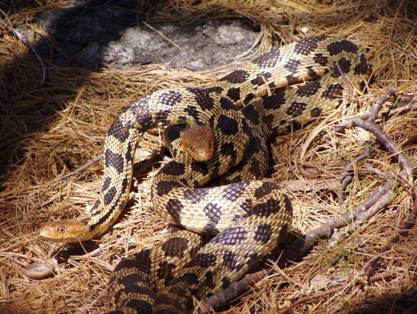
Photo by C. MacKinnon.
Natural predators of adult Eastern Foxsnakes include the larger birds of prey (e.g., Red-tailed Hawk (Buteo jamaicensis), Great Horned Owl (Bubo virginianus)) and carnivorous mammals such as raccoon (Procyon lotor), skunk (Mephitis mephitis), and mustelids (e.g., fisher (Martes pennanti) and mink (Mustela vison)). Hibernating foxsnakes were excavated from one of the few soil-based hibernacula in Georgian Bay by mammal(s) during the 2003–2004 winter (Lawson 2004). Remains of Eastern Foxsnakes have also been found in fox (Vulpes vulpes or Urocyon cinereoargenteus) bedding areas on Pelee Island (Porchuk pers. obs.). Feral and free-ranging house cats (Felis cattus) and dogs (Canis familiaris) are known to prey upon adult and juvenile foxsnakes.
The eggs and young are likely vulnerable to a wider variety of avian and mammalian predators. Juveniles are likely eaten by herons and egrets (Ardeidae) and gulls (Laridae). For example, a juvenile approximately 34 cm in length was observed being attacked by a gull in Point Pelee National Park; although the individual was able to thwart the predation attempt by striking repeatedly (Kraus 1991). Foxsnake nests have been preyed upon by racoons (Porchuk and Brooks 1995, S. Gillingwater pers. obs.) and coyotes (Canis latrans) (S. Gillingwater pers. obs.). Skunk, fox, and Virginia opossum (Didelphis virginiana) may also prey on nests. Similar to the accounts of nest parasitism by the burying beetle (Nicrophorus pustulatus) on Gray (Eastern) Ratsnake eggs reported by Blouin-Demers and Weatherhead (2000), E. gloydi eggs are also preyed upon by this insect (Willson 2000).
As ectotherms, Eastern Foxsnakes are constrained by the thermal characteristics of their local environment. Key temperature-dependent processes that have been examined in Eastern Foxsnakes include thermoregulation by gravid females immediately prior to oviposition (Willson and Brooks 2006) and body temperature fluctuations in individuals swimming in cold water (MacKinnon et al. 2006). Willson and Brooks (2006) found that gravid females did not maintain higher or less variable body temperatures than nongravid females in a thermally favourable environment on Pelee Island. MacKinnon et al. (2006) documented 49 radiotagged foxsnakes swimming 313 times in 2003 and 2004 (Figure 9). For 11 of these swimming events they were able to continuously record the body temperatures of the snakes as they entered water as cold as 11°C. The maximum body temperature decrease during one of these cold water swims was 22.6°C (over 11 min) as the snake cooled to 13°C. Given the influence of body temperature on speed of locomotion, and hence presumably on predation risk, it is curious that foxsnakes would enter the cold waters of Georgian Bay to relocate so often--obviously the benefits of moving between land-based features outweigh the risks of moving in water (MacKinnon et al. 2006).
Figure 9: An adult Eastern Foxsnake swimming between islands in Georgian Bay
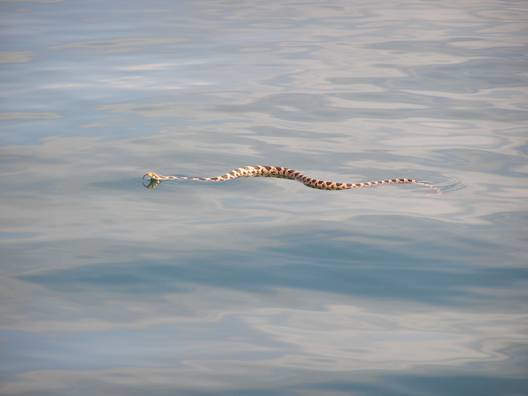
Photo by A. Lawson.
Because the hibernaculum is crucial to the survival of snakes inhabiting temperate latitudes, and Eastern Foxsnakes show a high degree of fidelity to these sites, distance-based metrics that incorporate this microhabitat feature will be the measures of spatial dispersion most relevant to conservation efforts. When an individual’s hibernaculum cannot be located, range length--or the maximum linear dispersion amongst a group of observations (i.e., radiolocations or opportunistic observations)--will be the next most useful metric to compute. Moreover, a comparison of both metrics provides a useful gauge of hibernacula location relative to the active season range. Maximum distance from hibernacula (Maximum distance from hibernacula (MDH)) and range length (RL) values for 5 females radiotracked for full active seasons on Pelee Island were x-bar = 930 ± 80.7 m SE (MDH range: 660–1080 m) and x-bar = 1186 ± 131.3 m SE (RL range: 849–1527 m) respectively (R. Willson unpubl. data). In marked contrast, MDH and RL values computed for females radiotracked for full active seasons on the Georgian Bay coast were x-bar = 3229 ± 568.1 m SE (MDH range = 836–6253 m; n = 9) and x-bar = 3593 ± 618.5 m SE (RL range = 879–6738 m; n = 9) respectively (MacKinnon et al. 2005, Lawson 2005). These values amply demonstrate that foxsnakes along the Georgian Bay coast use far more space than foxsnakes on Pelee Island. Only female values are compared here because males were not radiotracked on Pelee Island and intersexual differences in space use are common in snakes. Values for male foxsnakes in Georgian Bay were x-bar = 3820 ± 642.4 m SE (MDH range = 1151–9178 m; n = 13) and x-bar = 4624 ± 871.4 m SE (RL range = 1421–11365 m; n = 13) respectively (MacKinnon et al. 2005, Lawson 2005), and illustrate the magnitude of the spatial dispersion exhibited by the foxsnakes along the Georgian Bay coast. Interestingly, it is doubtful that individuals within any SW Ontario foxsnake population could use as much space as their Georgian Bay conspecifics because of habitat and landscape constraints. In particular, the density of roads within the Haldimand-Norfolk and Essex-Kent regional populations would necessitate numerous road crossings by an individual within a single active season--each road crossing increases the risk of mortality. Also, the island-water mosaic inhabited by the Georgian Bay snakes would presumably be more conducive to movement (assuming terrestrial locomotion is energetically more costly for snakes than aquatic locomotion) than would the largely terrestrial landscape inhabited by the southern populations.
Small mammals and birds make up the bulk of the Eastern Foxsnake’s diet (Figure 10). Both active searching and ambush (sit-and-wait) foraging strategies are employed. Smaller prey items (e.g., neonatal mice, bird nestlings, and eggs) are simply seized and swallowed, whereas larger prey are killed by constriction (Harding 1997).
Small mammal prey includes meadow vole (Microtus pennsylvanicus), mice (Peromyscus spp.), eastern chipmunk (Tamias striatus) and young eastern cottontail (Sylvilagus floridanus). Eastern Foxsnakes will readily forage in shrubbery, trees, and barns for birds’ eggs and nestlings. Adult birds are also taken. Eastern Foxsnakes have been observed feeding on Mallard (Anas platyrhynchos) eggs (B. Porchuk pers. obs. A. Lawson pers. obs.), Ruffed Grouse (Bonasa umbellus) eggs (C. MacKinnon pers. obs.), Yellow Warbler (Dendroica petechia) eggs and nestlings Wilson 1985), Common Grackle (Quiscalus quiscula) nestlings, and Mourning Dove (Zenaida macroura) eggs (R. Willson pers. obs.), Purple Martin (Progne subis) nestlings (I. Fisher pers. comm.), and American Robin (Turdus migratorius) eggs and nestlings (B. Porchuk pers. obs.). Frogs are also occasionally eaten (Johnson 1989), and Logier (1958) found a young specimen at Long Point that disgorged a bundle of earthworms and another individual from Go Home Bay that regurgitated a salamander. Upon palpation, a juvenile approximately 36 cm in length regurgitated two large slugs (2 g each) on Pelee Island (B. Porchuk pers. obs.).
Figure 10: An adult Eastern Foxsnake consuming duck eggs on the Georgian Bay Coast
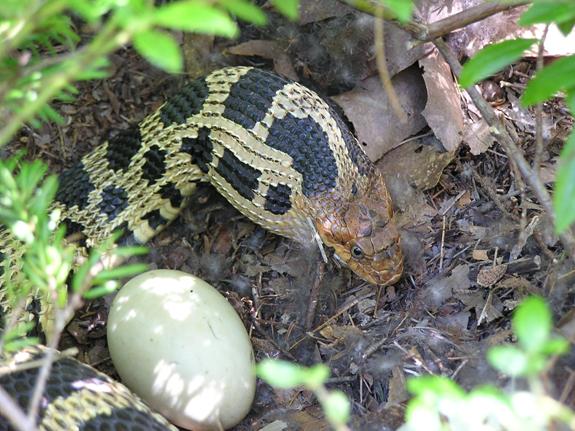
Photo by A. Lawson.
Because much of E. gloydi’s distribution overlaps with areas heavily populated by humans, and the species inhabits areas that experience high levels of human use (e.g., shoreline), encounters are common. Fortunately, foxsnakes are able to adapt to limited anthropogenic disturbance, an example being their use of human-made structures for shelter during the summer despite high levels of human activity (e.g., when whole families are at the cottage). As previously mentioned, foxsnakes regularly use anthropogenic structures for hibernation and oviposition.