
Decision Tree – Steps to follow when interacting with tobacco industry
Download in PDF format
(334 KB, 1 page)
Organization: Health Canada
Date published: 2025
Cat.: H149-32/2025F-PDF
ISBN: 978-0-660-75407-9
Pub.: 240800
Pursuant to Article 5.3 of the World Health Organization Framework Convention on Tobacco Control
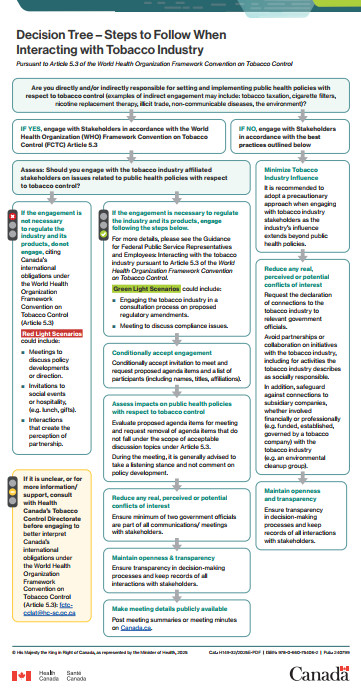
Are you directly and/or indirectly responsible for setting and implementing public health policies with respect to tobacco control (examples of indirect engagement may include: tobacco taxation, cigarette filters, nicotine replacement therapy, illicit trade, non-communicable diseases, the environment)?
If yes, engage with Stakeholders in accordance with the World Health Organization Framework Convention on Tobacco Control Article 5.3.
Assess: Should you engage with the tobacco industry affiliated stakeholders on issues related to public health policies with respect to tobacco control?
Green Light: If the engagement is necessary to regulate the industry and its products, engage following the steps below.
For more details, see Interacting with the tobacco industry - Guidance for Federal Public Service Representatives and Employees.
Green Light Scenarios could include:
- Engaging the tobacco industry in a consultation process on proposed regulatory amendments
- Meeting to discuss compliance issues
- Conditionally accept engagement: Conditionally accept invitation to meet and request proposed agenda items and a list of participants (including names, titles, affiliations).
- Assess impacts on public health policies with respect to tobacco control: Evaluate proposed agenda items for meeting and request removal of agenda items that do not fall under the scope of acceptable discussion topics under Article 5.3. During the meeting, it is generally advised to take a listening stance and not comment on policy development.
- Reduce any real, perceived or potential conflicts of interest: Ensure minimum of two government officials are part of all communications/ meetings with stakeholders.
- Maintain openness & transparency: Ensure transparency in decision-making processes and keep records of all interactions with stakeholders.
- Make meeting details publicly available: Post meeting summaries or meeting minutes on Canada.ca.
Red Light: If the engagement is not necessary to regulate the industry and its products, do not engage, citing Canada's international obligations under the World Health Organization Framework Convention on Tobacco Control (Article 5.3)
Red Light Scenarios could include:
- Meetings to discuss policy developments or direction.
- Invitations to social events or hospitality, (e.g. lunch, gifts).
- Interactions that create the perception of partnership.
If no, engage with Stakeholders in accordance with the best practices outlines below.
- Minimize Tobacco Industry Influence: It is recommended to adopt a precautionary approach when engaging with tobacco industry stakeholders as the industry's influence extends beyond public health policies.
- Reduce any real, perceived or potential conflicts of interest: Request the declaration of connections to the tobacco industry to relevant government officials. Avoid partnerships or collaboration on initiatives with the tobacco industry, including for activities the tobacco industry describes as socially responsible. In addition, safeguard against connections to subsidiary companies, whether involved financially or professionally (e.g. funded, established, governed by a tobacco company) with the tobacco industry (e.g. an environmental cleanup group).
- Maintain openness & transparency: Ensure transparency in decision-making processes and keep records of all interactions with stakeholders.
Yellow Light: If it is unclear, or for more information, send an email to Health Canada's Tobacco Control Directorate at fctc-cclat@hc-sc.gc.ca before engaging to better interpret Canada's international obligations under the World Health Organization Framework Convention on Tobacco Control (Article 5.3).