
2025 consultations on economic priorities for category-based selection in Express Entry
Contents
- Executive summary
- Overview and context
- How we engaged on 2026 economic priorities and categories in Express Entry
- About this report
- Who we heard from
- What we heard
- Learning from the process
- Thank you
- Annexes
Executive summary
Categories are established in Express Entry to respond to specific, identified economic priorities, which can change over time. Before the Minister establishes a new category in Express Entry, the Immigration and Refugee Protection Act (IRPA) requires IRCC to gather feedback from a range of stakeholders and partners.
In August 2025, public consultations were held to gather feedback on economic priorities and categories under consideration and inform the development of categories for 2026. An online survey was posted on a dedicated public webpage, and over 6,000 stakeholder and partner organizations were invited to participate.
Focus: 3 economic priorities and associated categories
- Addressing labour shortages for healthcare and social services, STEM, trades, agriculture and agri-food, and education.
- Supporting economic growth through Francophone immigration outside Quebec with candidates with strong French-language proficiency.
- Facilitating leadership and innovation by prioritizing senior managers, skilled military recruits for the Canadian Armed Forces (CAF), and scientists and researchers.
Key findings
Economic priorities
“great” or “average” need ratings

Text version
| Great need and average need | |
|---|---|
| Labour shortages | 74% |
| Francophone immigration | 32% |
| Leadership and innovation | 59% |
- There was support for the use of categories to select skilled workers for permanent residence, with recognition that general and program-specific rounds of invitations also hold significant value in supporting the Canadian economy.
- Addressing long-term labour shortages was seen as the top economic priority for 2026, followed by facilitating leadership and innovation.
- There was lower support for using category-based selection to support economic growth through Francophone immigration outside Quebec.
Addressing labour shortages
Categories or areas of focus
great” or “average” need ratings
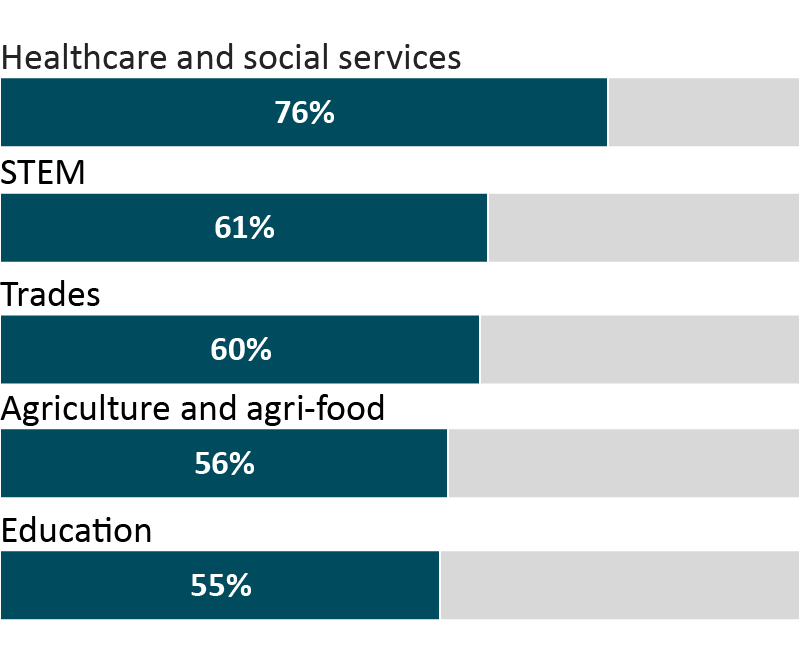
Text version
| Great need and average need | |
|---|---|
| Healthcare and social services | 76% |
| STEM | 61% |
| Trades | 60% |
| Agriculture and agri-food | 56% |
| Education | 55% |
- Immigration via category-based selection was seen as useful to address labour shortages, particularly in healthcare and social services, STEM, and trades, and especially if the domestic workforce, including temporary residents, were prioritized.
- There was some support but mixed views on changing category eligibility to increase the work duration requirement from 6 to 12 months, and to account for licensure.
Supporting Francophone immigration
Supporting Francophone immigration
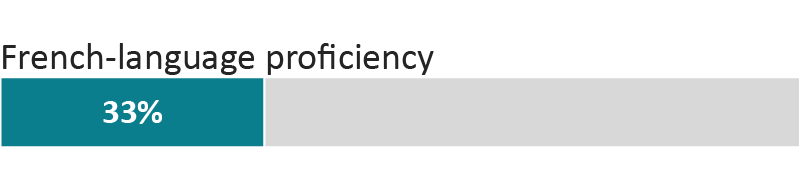
Text version
| Great need and average need | |
|---|---|
| French-language proficiency | 33% |
- While some saw benefits, many questioned the economic relevance of the Francophone immigration priority, and the space dedicated to this priority.
Facilitating leadership and innovation
Facilitating leadership and innovation
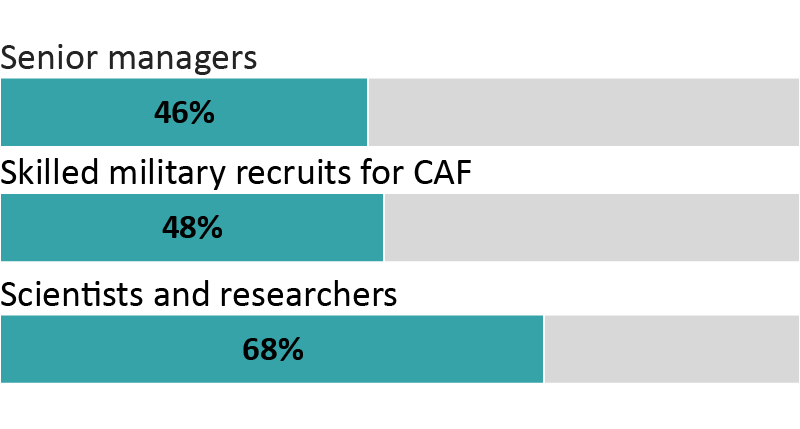
Text version
| Great need and average need | |
|---|---|
| Senior managers | 46% |
| Skilled military recruits for CAF | 48% |
| Scientists and researchers | 68% |
- Many saw this focus as an opportunity to strengthen Canada’s competitiveness, drive economic growth, and introduce new business perspectives.
- Scientists and researchers were seen to deliver long-term economic benefits through research, discovery, and the commercialization of new technologies.
- Some saw senior managers as already well-served by the immigration system.
- Selection concerns for skilled military recruits related primarily to security screening.
Overview and context
Our immigration system plays a vital role in supporting economic growth and building a stronger future for Canada. Immigration, Refugees and Citizenship Canada (IRCC) is dedicated to ensuring the system remains adaptable and responsive to the needs of the country.
In 2023, we introduced category-based selection in Express Entry, the online system used to manage immigration applications from skilled workers. This allows for the selection of immigrants based on specific criteria such as work experience, education, or language proficiency. These “categories” are designed to align with identified economic priorities and are regularly reviewed to ensure their continued relevance and to address any emerging gaps.
The review process involves extensive consultations with a diverse range of stakeholders and partners, provinces and territories, as well as the public. Feedback from these consultations helps determine how category-based selection can best address Canada’s economic and labour market priorities year after year.
An annual report to Parliament detailing the categories chosen for Express Entry in the previous year is published every year. This report includes the rationale for selecting each category, and the instructions establishing the categories. The first report on 2023–2024 categories was published in 2025.
How we engaged on 2026 economic priorities and categories in Express Entry
Before establishing a new category in Express Entry, the IRPA requires the Minister to gather feedback from provincial and territorial representatives, as well as members of industry, unions, employers, workers, worker advocacy groups, settlement provider organizations, and immigration researchers and practitioners.
In 2025, IRCC carried out a public consultation on proposed economic priorities and categories for category-based selection in Express Entry in 2026. An online survey (PDF, 247 KB) was launched on August 6, 2025, and remained open until September 3, 2025.
Through a dedicated website page, IRCC provided information on Express Entry and category-based selection, the economic priorities and categories under consideration for 2026, and linkages with other immigration pathways such as the post-graduation work permit (PGWP). The department also received a number of written submissions via email.
We also invited provincial and territorial counterparts to provide written input on potential economic priorities, needs and categories. This request was part of broader and ongoing collaboration between the federal government and provinces and territories through the Forum of Ministers Responsible for Immigration.
About this report
The findings summarized in this report only reflect the views of stakeholders, partners and members of the public who shared their feedback by completing the online survey or by sending a written submission. Results should not be interpreted as being representative of the entire Canadian population, specific regions, or of all IRCC stakeholders and partners.
Percentages have been rounded to the first decimal point, and respondents may have selected more than one response option; totals may not add up to 100 as a result. In addition, the survey included some follow-up questions that were only asked if specific response options were chosen earlier in the survey; in such cases, the percentages presented in this report were based on the number of respondents who saw these questions, rather than the total number of respondents.
While the main report focuses primarily on responses from all respondents, Annex A provides a breakdown by respondent type (individuals versus organizations) and key differences are highlighted in the main report.
Survey responses collected to support an evaluation of Federal High Skilled Programs in Express Entry (survey questions 10–12) will be covered in a separate report, to be published on IRCC’s evaluation reports webpage later in 2026.
In 2025, IRCC asked Canadians to share their views on 3 economic priorities and areas of focus for category-based selection in Express Entry in 2026.

Addressing long-term labour market shortages for
- healthcare and social services
- science, technology, engineering and math (STEM)
- trades
- agriculture and agri-food, and
- education

Supporting economic growth through Francophone immigration outside Quebec with candidates who demonstrate strong French-language proficiency.

(New) Facilitating leadership and innovation by focusing selection on
- senior managers
- skilled military recruits for the Canadian Armed Forces (CAF), and
- scientists and researchers

Just over 6,000 email invitations were sent to stakeholder and partner organizations (close to 4,000 unique organizations).

Open access to survey link via a dedicated website page.
Who we heard from

In 2025, IRCC received a total of 3,213 responses to the online survey and 13 written submissions (10 from organizations, and 3 from individuals).
5 most represented types of organizations

Business (24.9%)

Not for profit, charitable and non-government organizations (22.3%)

Educational organization (16.3%)

Settlement or resettlement organizations (8.0%)

Advocacy group (8.0%)
5 most represented sectors
5 most represented sectors

Education (27.3%)

STEM (15.4%)

Healthcare (12.2%)

Social assistance (11.6%)

Accommodation, hospitality, and food services (10.7%)
Geographic distribution

Ontario (49.6%) was the region of operation most often selected by organizations, followed by British Columbia (33.8%). These were also the two most frequently selected provinces or territories of residence for individuals.
Language preferences

The most common primary language of operation for organizations was English (86.6%). English was also the most commonly spoken language by individuals (90.4%).
Type of respondents
A majority (89.5%) of responses to the online survey were from individuals.
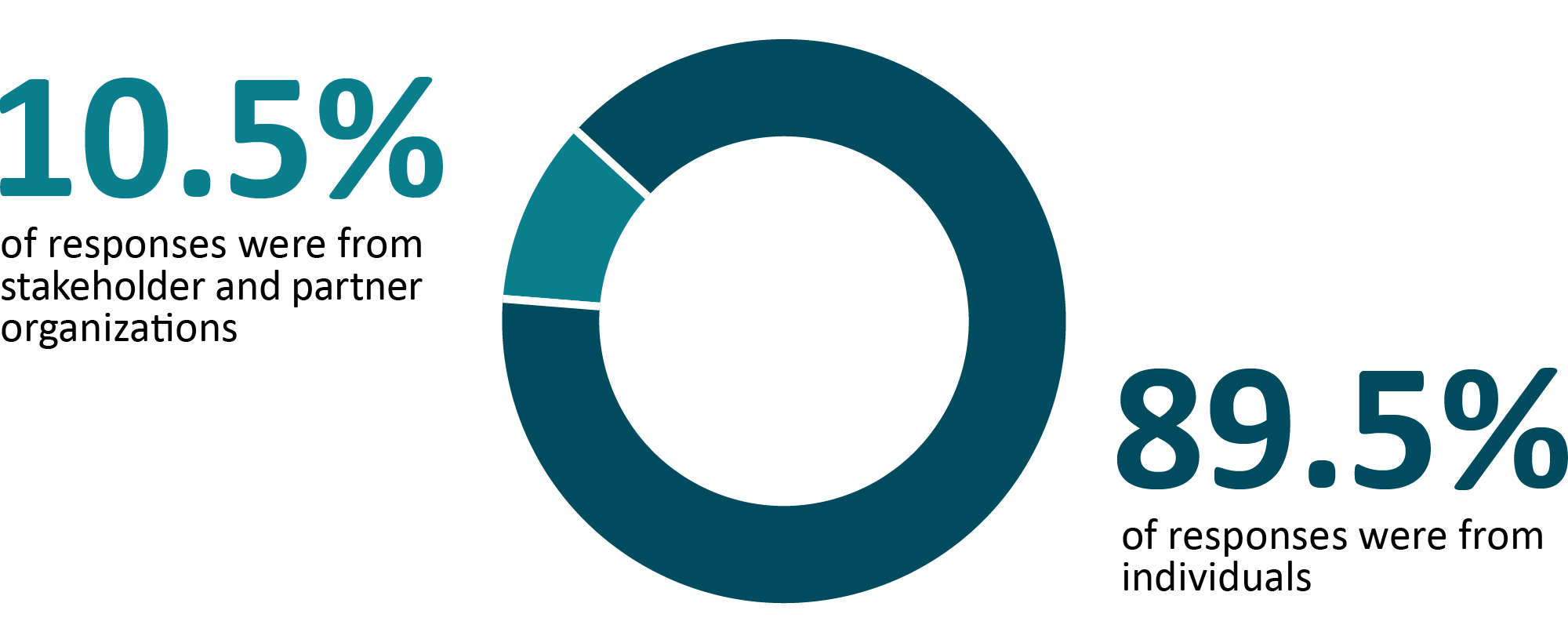
Text version
10.5% of responses were from stakeholder and partner organizations
89.5% of responses were from individuals
What we heard
On selection approaches in Express Entry
With category-based selection, Express Entry can focus selection either on candidates with the highest human capital scores overall and within programs (general and program-specific rounds), or within categories determined by profile characteristics linked to economic goals.
Before focusing on questions specific to economic priorities and categories proposed for 2026, the online survey asked respondents to share whether they thought that Express Entry should focus more heavily on one of its two selection approaches (category-based selection, versus general and program-specific invitation rounds).
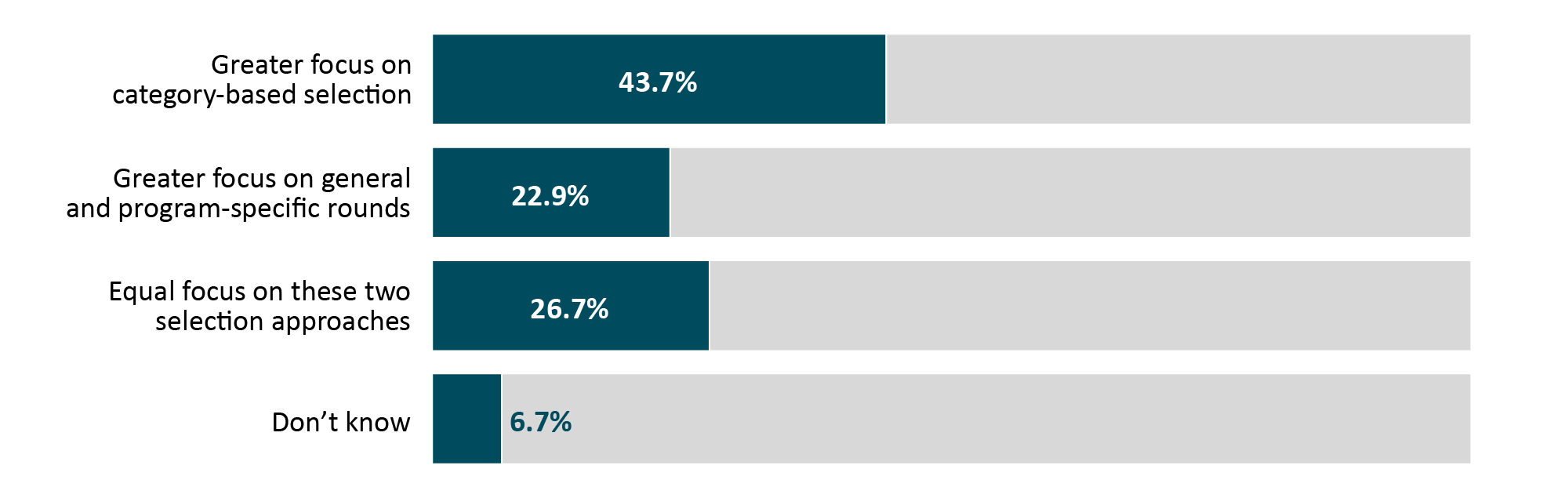
Text version
| % of all respondents | |
|---|---|
| Greater focus on category-based selection | 43.7% |
| Greater focus on general and program-specific rounds | 22.9% |
| Equal focus on these two selection approaches | 26.7% |
| Don’t know | 6.7% |
A larger proportion of respondents indicated a preference for placing greater focus on category-based selection. Compared to individuals, organizations were more balanced in their views (see Annex A).
Here’s a summary of the comments received in the open-ended follow-up question:
Category-based selection
Respondents associated category-based selection in Express Entry with a responsive immigration policy that addresses immediate and shifting labour needs, and proposed that this tool has the potential to address labour needs in specific regions and communities.
General and program-specific rounds
Respondents associated these invitation rounds with a focus on candidates with higher human capital who have the necessary transferable skills to adapt to changing labour needs. This selection approach was often associated with stronger labour market stability.
Equal focus on both selection approaches
Respondents associated an equal focus with achieving a better balance between addressing labour shortages and building a workforce flexible to labour market fluctuations.
They also highlighted that general and program-specific rounds can bridge the gap in labour needs for industries that are not represented in categories, and can complement category-based selection with a fairer selection process.
On our proposed economic priorities for 2026
We asked respondents to share their thoughts on the need for category-based selection to focus on the 3 economic priorities under consideration for 2026.
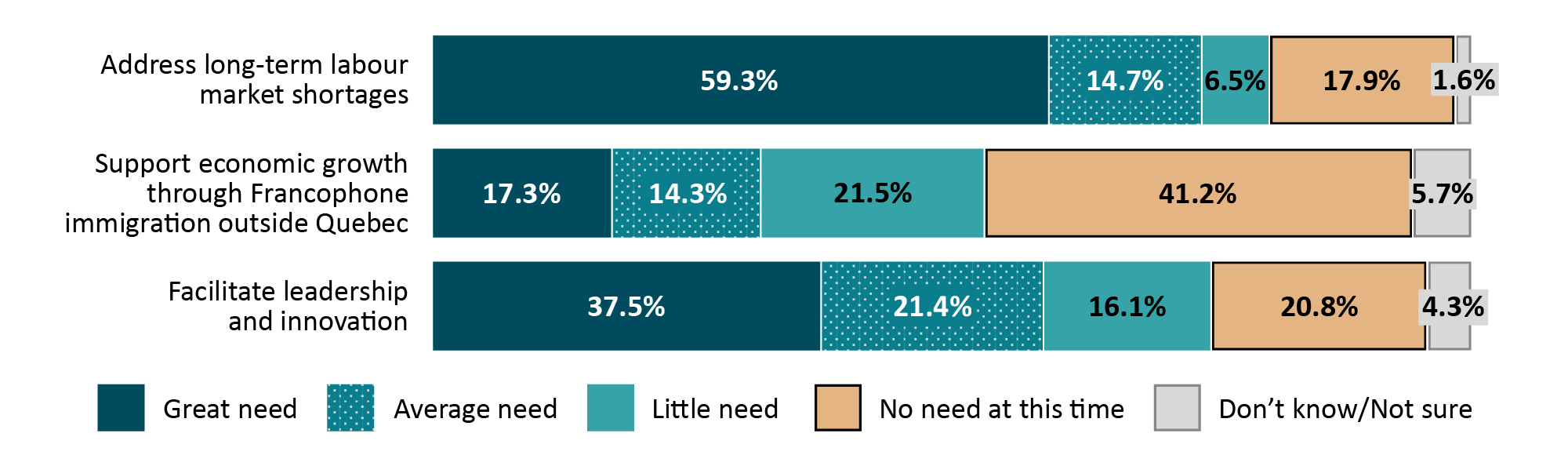
Text version
| Great need | Average need | Little need | No need at this time | Don’t know/Not sure | |
|---|---|---|---|---|---|
| Address long-term labour market shortages | 59.3% | 14.7% | 6.5% | 17.9% | 1.6% |
| Support economic growth through Francophone immigration outside Quebec | 17.3% | 14.3% | 21.5% | 41.2% | 5.7% |
| Facilitate leadership and innovation | 37.5% | 21.4% | 16.1% | 20.8% | 4.3% |
There was general agreement on the need for category-based selection to address long-term labour market shortages in 2026. A significant proportion of respondents also indicated a need to facilitate the selection of workers in leadership and innovation positions. A smaller proportion of respondents thought there was a need for category-based selection to focus on supporting economic growth through Francophone immigration outside Quebec in 2026.
Here’s a summary of the comments we received on these 3 economic priorities:
Addressing long-term labour market shortages
While immigration was recognized as a useful tool to address labour shortages, many respondents highlighted the importance of prioritizing the domestic workforce, including temporary residents, given the possible effects of immigration on wages, working conditions, and unemployment rates. Respondents emphasized the need for category-based selection to address regional labour needs in a way that complements other immigration pathways, and by accounting for provincial workforce needs and postsecondary capacity.
Some suggested the need for labour shortages addressed via categories to be based on evidence, others expressed concerns about the department’s ability to identify the labour shortages to address given the perceived disconnect between their experience of shortages and those prioritized so far in category-based selection.
Concerns related to labour market integration and foreign credential recognition led some respondents to highlight the importance of measuring and publishing data on the effectiveness of category-based selection to address specific labour shortages.
Program integrity considerations were also mentioned. A few respondents asserted that category eligibility requirements were resulting in candidates temporarily changing their career path, which could influence policy effectiveness.
Supporting economic growth through Francophone immigration outside Quebec
Prioritizing French-proficient workers was seen as important for preserving the French language, maintaining bilingualism, promoting national unity, and supporting cultural diversity. At the same time, many respondents questioned the economic relevance of this priority, noting that French-specific labour needs are concentrated in certain sectors and regions, and suggesting that domestic language training may be a more effective approach to achieve the same policy objectives.
The volume of invitations to apply dedicated to the selection of French-proficient workers was often considered too large, with many thinking that greater priority could be given instead to candidates with other essential skills, including those aligned with labour shortages. There were also calls for better communication of the underpinning immigration selection framework and objective, as well as to publish evaluation data on the successful integration and retention of these candidates in Canada.
While these findings echo those from our 2024 consultations on category-based selection in Express Entry, the same data limitations were present: only a minority of respondents identified as Francophone or as an organization operating primarily in French.
Facilitating leadership and innovation
Facilitating leadership and innovation was seen as an opportunity to strengthen Canada’s global competitiveness, drive economic growth, and introduce new perspectives to the business environment. Respondents highlighted potential benefits for industries experiencing shortages, such as healthcare, as well as for industries of the future, such as Artificial Intelligence (AI), and roles in research and development.
At the same time, some respondents noted challenges in assessing these skills and ensuring candidates find suitable opportunities and remain in Canada. Others suggested complementary approaches, such as focusing on high-demand occupations and investing in local talent development, to balance this priority with broader economic needs.
Some comments expressing negative sentiments towards immigration were submitted in response to the survey. While some expressed broad negativity toward immigration, others were more nuanced. These perspectives often reflected concerns about economic pressures, housing affordability, employment opportunities, and program integrity.
On 2025 categories continuing into 2026
We asked respondents for their views on the need to continue to prioritize candidates eligible to each of the 2025 categories in 2026.
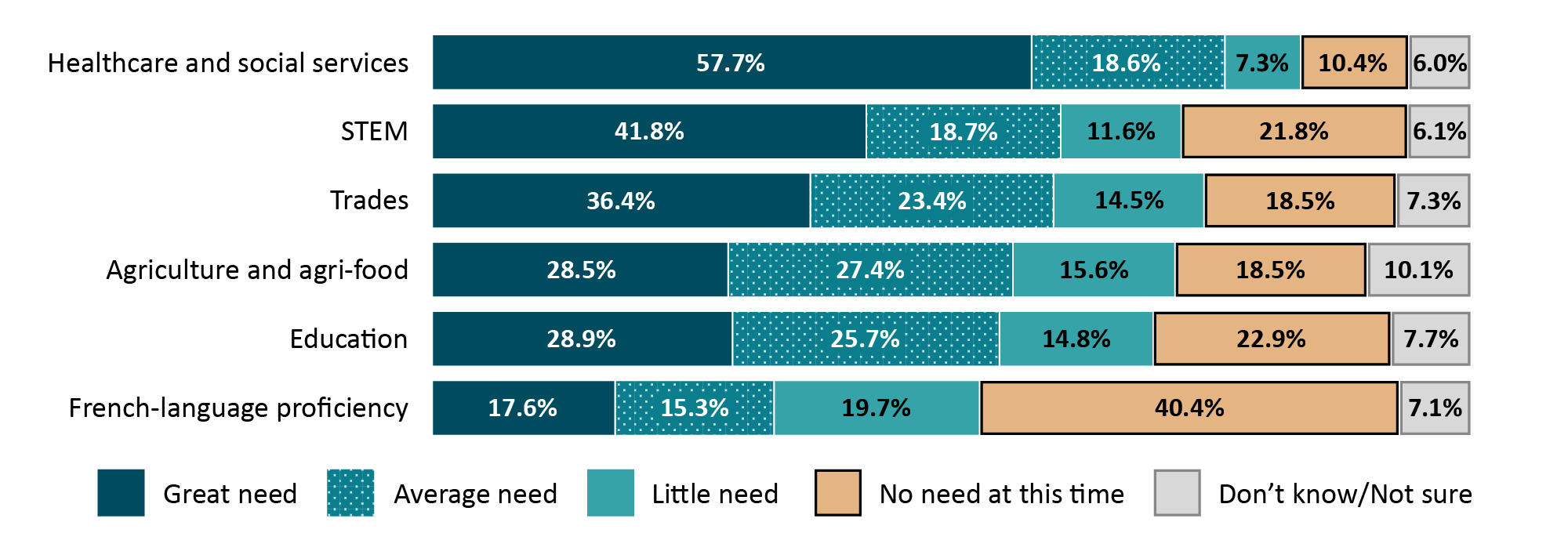
Text version
| Great need | Average need | Little need | No need at this time | Don’t know/Not sure | |
|---|---|---|---|---|---|
| Healthcare and social services | 57.7% | 18.6% | 7.3% | 10.4% | 6.0% |
| STEM | 41.8% | 18.7% | 11.6% | 21.8% | 6.1% |
| Trades | 36.4% | 23.4% | 14.5% | 18.5% | 7.3% |
| Agriculture and agri-food | 28.5% | 27.4% | 15.6% | 18.5% | 10.1% |
| Education | 28.9% | 25.7% | 14.8% | 22.9% | 7.7% |
| French-language proficiency | 17.6% | 15.3% | 19.7% | 40.4% | 7.1% |
There was general agreement on the need for the healthcare and social service category to continue into 2026. A smaller proportion of respondents indicated there was a need (”great” or “average”) for the STEM, trades, agriculture and agri-food, and education categories to continue. A minority of respondents indicated that there was a need (”great” or “average”) for the French-language proficiency category to continue.
A series of open-ended questions were asked to collect input on labour needs, either in relation to the categories mentioned above, or beyond. Sector-specific questions were directed towards organizations that indicated operating in relevant sectors earlier in the survey, and another question directed to all respondents was more general.
Overall, the comments received aligned with trends mentioned above and supported the continuation of 2025 categories addressing labour shortages into 2026. The most frequently mentioned labour needs were in STEM and healthcare, followed by trades, education, and agriculture and agri-food. Some suggested to deprioritize certain categories, or specific occupations within categories; reasons given included the need to prioritize other, more urgent labour needs, or to prevent a surplus of workers in specific sectors or occupations.
Below is a summary of the comments we received on labour needs:
- Healthcare
- Comments emphasized the acute nature of these shortages, including in rural, remote, and northern communities that face additional recruitment and retention challenges. Specific shortages for doctors, nurses, healthcare aides and support workers, and various dental, pharmacy, and veterinarian related occupations were mentioned. There were calls to address foreign credential recognition or licensing and certification barriers for category-based selection to be effective in addressing shortages.
- STEM
- We heard that domestic training pipelines cannot keep up with demand in STEM (primarily in AI and cybersecurity) and that immigration is a necessary complement to address shortages in this sector and to ensure that firms can access talent quickly. There were calls to expand the list of occupations eligible for the STEM category to include occupations previously listed on the eligibility occupation list in 2023–2024, and to include other types of technicians, technologists, and engineers. Regional disparities in STEM shortages were highlighted, and respondents cautioned against a one-size-fits-all national STEM category eligibility occupation list that would not recognize regional variations.
- Trades
- Responses highlighted the severity of the shortages in this sector, particularly for construction-related occupations, technicians, and manufacturing. Some respondents suggested loosening eligibility criteria for Express Entry to allow more tradespeople to qualify, particularly with respect to language requirements that were considered too stringent given the communication skills required on construction sites. Responses also noted entry barriers for overseas tradespeople, stating that processes towards Red Seal endorsement or provincial licensing are too slow and complex, and lead to delays in addressing urgent shortages. Some also noted that shortages vary by region, with rural communities facing additional challenges in attracting and retaining skilled tradespeople.
- Agriculture and agri-food
- Respondents noted that immigration alone cannot address the critical shortages in the agri-food sector, and that there is a need for stronger training and upskilling pipelines. Some mentioned that it is harder to attract and retain workers in this sector due to low wages, location, and demographic decline. There were calls for more pathways to permanent residence for these workers – particularly given the recent sunsetting of the Agri-Food Pilot, and to expand the eligible occupation list for the Express Entry category to include, for example, agronomists, or farm equipment technicians and operators (currently ineligible for Express Entry).
- Education
- Feedback highlighted the growing demand for early childhood educators across the country, with rural and remote communities facing unique challenges in attracting and retaining teachers. Shortages in these areas were said to be worsened by difficulties accessing Labour Market Impact Assessment (LMIA) exemptions despite urgent needs. Lengthy licensing processes were also thought to contribute to the increase in shortages. Post-secondary institutions reported struggling to fill research, academic, and post-doctoral positions.
- Other labour needs
Labour needs in transport were mentioned, with organizations operating in this sector underlining acute shortages in aviation occupations and trucking. There were calls to reinstate the transport category (established in 2023–2024, but not renewed for 2025) as a result. These shortages were described as unique to certain regions, with some rural and northern airports experiencing shortages in aircraft mechanics, while other regions experience shortages for drivers and warehouse operators that are essential for construction and infrastructure projects.
Labour needs in other sectors were also noted by respondents, including in finance and banking, administrative and human resources, retail, hospitality and tourism, social sciences, communications, and law. Some respondents also highlighted the importance of supporting entrepreneurs. Francophone-specific labour needs that were mentioned related to the delivery of healthcare and education and child care.
On focusing selection to address labour shortages on skilled workers inside or outside Canada
For each of the labour shortage categories, respondents were asked whether selection should focus more heavily on skilled workers inside Canada (students or temporary workers) or outside Canada.
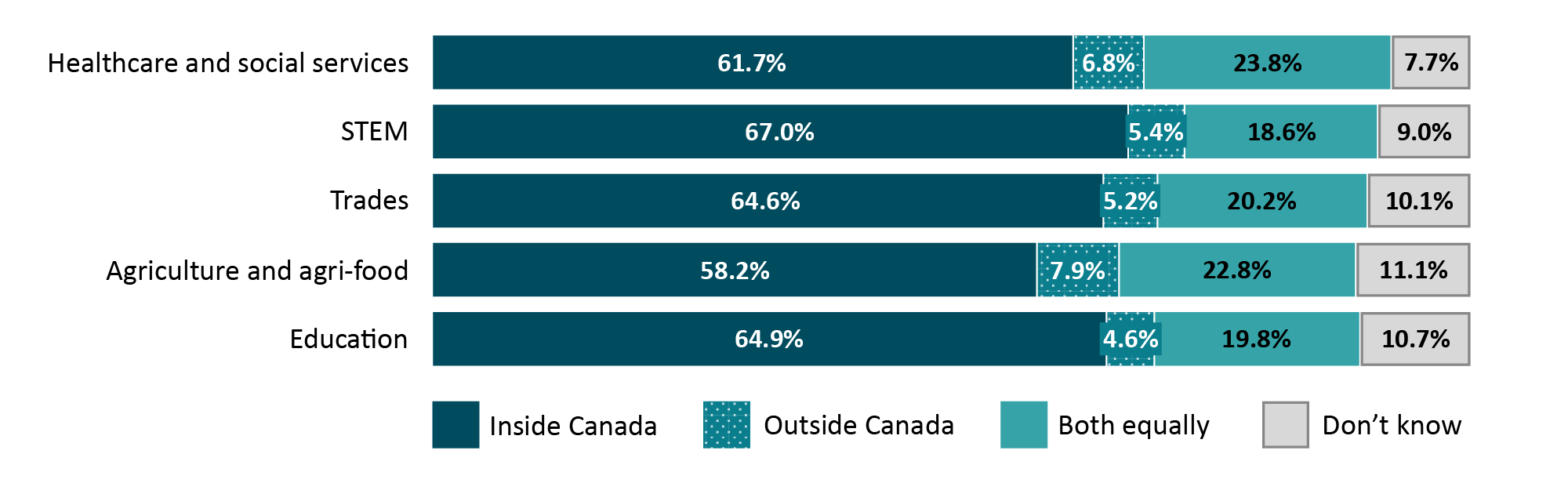
Text version
| Inside Canada | Outside Canada | Both equally | Don’t know/Not sure | |
|---|---|---|---|---|
| Healthcare and social services | 61.7% | 6.8% | 23.8% | 7.7% |
| STEM | 67.0% | 5.4% | 18.6% | 9.0% |
| Trades | 64.6% | 5.2% | 20.2% | 10.1% |
| Agriculture and agri-food | 58.2% | 7.9% | 22.8% | 11.1% |
| Education | 64.9% | 4.6% | 19.8% | 10.7% |
A majority of respondents indicated that selection should focus more heavily on skilled workers inside Canada, across all labour shortage categories. 19%- 24% indicated a preference for selecting an equal number of workers inside and outside of Canada, across categories. These data were consistent with the overall strong support to transition temporary residents to permanent residents in comments collected across the survey.
Compared to individuals, organizations were more balanced in their responses, with a smaller proportion across categories indicating that selection should focus more heavily on workers inside Canada (see Annex A).
On work experience eligibility for categories to address labour shortages
We asked respondents about two potential eligibility changes. First, we asked whether they thought that the work experience eligibility criteria should require 12 months of continuous work experience in a listed occupation within the past 3 years, rather than 6 months, which has been the case since the introduction of category-based selection in 2023.

Text version
| % of total respondents | |
|---|---|
| Yes | 58.2% |
| No | 34.0% |
| Not sure | 7.8% |
A majority of respondents favoured this increase. Compared to individuals, organizations were more likely to disagree with this change (see Annex A).

Qualitative input was sought to better understand reactions to this potential change.
Top reasons cited
For an increase to 12 months
- 6 months of work experience is insufficient to develop the depth of professional skills and competencies needed for skilled occupations, particularly where safety and complexity demand more extensive training and independent capability. A 12-month threshold allows candidates to move beyond initial training and probation.
- A 12-month work experience requirement aligns well with requirements for other economic immigration pathways (for example, those from the Canadian Experience Class).
- Asking candidates to have work experience for an extended period of time in a given occupation would allow them to demonstrate genuine commitment to their occupation or sector, which could also help uphold integrity in Express Entry.
Against an increase to 12 months
- This increase to eligibility requirements could slow Express Entry’s responsiveness to labour shortages by making it longer before candidates can be selected.
- This increase could create barriers and exclude skilled workers who are ready to make long-term contributions to Canada’s economy, and who have the skills required.
- This increase could unintentionally penalize individuals in specific circumstances (such as parental leave, or other employment types like contract work), particularly given the requirement for the work experience to be continuous.
A small number of respondents suggested alternative changes that involved applying different eligibility requirements related to work duration, based on a candidate’s occupation, location of work experience, or field of training or study.
On accounting for licensure in categories to address labour shortages
We also asked about a second potential eligibility change related to foreign credential recognition. Respondents were asked to consider whether restricting prioritization to skilled workers with Canadian work experience in a regulated profession would be an effective strategy to mitigate this barrier, while also addressing labour shortages.

Text version
| % of total respondents | |
|---|---|
| Yes | 50.1% |
| No | 35.4% |
| Not sure | 14.5% |
Half of respondents were in favour of this change. Compared to individuals, organizations were considerably less favourable, with the largest proportion of organizations indicating “no” (see Annex A).
Qualitative input was sought to better understand reactions to this potential change. A number of the responses shared the assumption that IRCC was considering focusing exclusively on workers with Canadian work experience, or Canadian work experience in a regulated profession. Regardless of their position, many respondents confirmed that foreign credential recognition is a key barrier to integrate the Canadian labour market, noting that the variations in length and inconsistencies across regulatory processes need to be addressed independently of eligibility for Express Entry categories.
Top reasons cited
For restricting prioritization to candidates with Canadian work experience in a regulated profession
- These candidates are job-ready and can enter the workforce quickly, reducing skills underutilization.
- This approach would prioritize workers who are familiar with and able to uphold Canadian standards in regulated occupations.
- This may prioritize workers already in Canada who are likely already integrated to the Canadian labour market and culture.
Against restricting prioritization
- This approach could exclude many skilled workers, including those who hold a Canadian license but have limited or no Canadian work experience, and those whose occupations require permanent residence status for foreign credential recognition. It would reinforce existing barriers.
- Foreign credential recognition processes are slow, complex, and costly; too few workers would meet this requirement while seeking permanent residence.
- Focusing too narrowly on workers with Canadian work experience in regulated occupations would not help address. labour shortages in unregulated occupations.
A few respondents suggested alternatives, perhaps underscoring the complexities of this topic. A common suggestion was to consider both workers with Canadian work experience and workers making demonstrable progress towards licensure (for example, those who recently completed exams or undertook bridging programs or apprenticeships). This was viewed as a way to expand the pool of relevant workers to select from, accelerate workforce integration, and address labour shortages.
Another common suggestion was to ease the Canadian work experience requirement for occupations where international qualifications are recognized through treaties or comparable standards.
On possible new areas of focus for 2026
The following sections report on what we heard from respondents on possible new areas of focus for 2026 that would align with the potential new economic priority of facilitating leadership and innovation.
The first question asked respondents to indicate the extent to which they would recommend that category-based selection in Express Entry focus on occupations that do not experience long-term shortages, if they could benefit Canada’s competitiveness in specific areas.

Text version
| % of total respondents | |
|---|---|
| Great extent | 42.0% |
| Moderate extent | 24.8% |
| Small extent | 10.1% |
| Not at all | 18.7% |
| Don’t know | 4.4% |
Respondents were generally supportive of expanding category eligibility to include occupations that are not experiencing shortages but could benefit Canada’s competitiveness, with 66.8% indicating that they would recommend this approach to a ”great” or “moderate” extent.
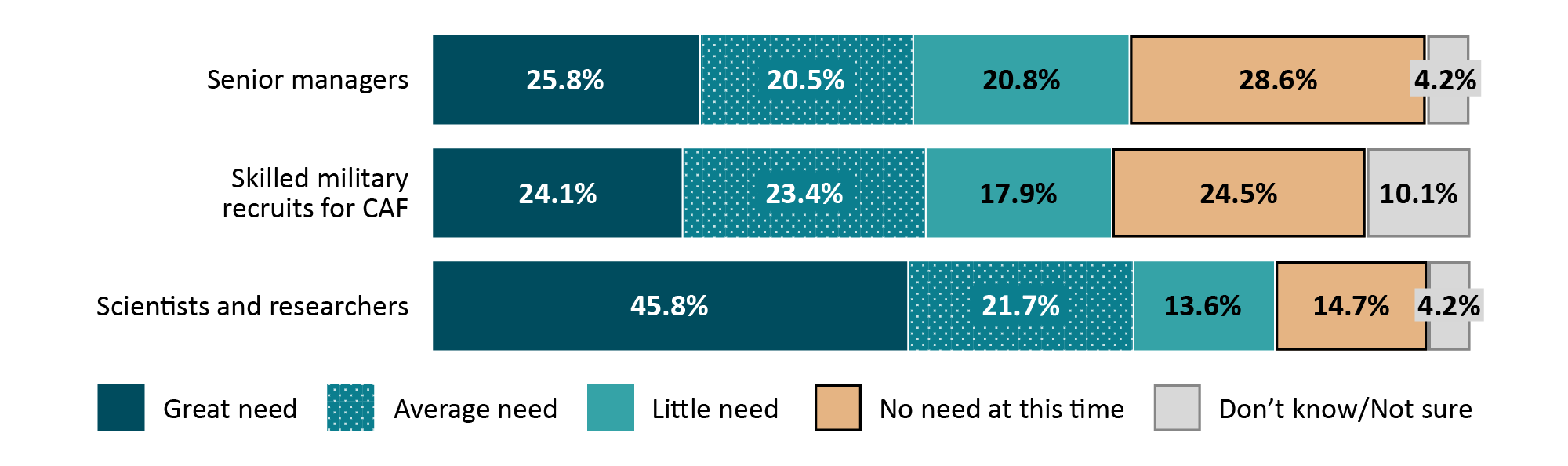
We then asked respondents to indicate the need for 2026 categories in Express Entry to prioritize the selection of senior managers, skilled military recruits for the CAF, and scientists and researchers.
Text version
| Great need | Average need | Little need | No need at this time | Don’t know/Not sure | |
|---|---|---|---|---|---|
| Senior managers | 25.8% | 20.5% | 20.8% | 28.6% | 4.2% |
| Skilled military recruits for CAF | 24.1% | 23.4% | 17.9% | 24.5% | 10.1% |
| Scientists and researchers | 45.8% | 21.7% | 13.6% | 14.7% | 4.2% |
The need to prioritize scientists and researchers was considered much greater than the need to prioritize senior managers and skilled military recruits for the CAF, which received similar ratings.
Qualitative input was collected on these possible areas of focus. Here’s a summary of the comments we received:
- Senior managers
-
Supportive responses emphasized the critical role that senior managers play in organizational growth, innovation, and competitiveness. Some noted that a dedicated category could help offset the lack of points awarded in the ranking grid for higher age, though some still questioned whether this was a true labour need and others suggested restoring the job offer points in Express Entry’s Comprehensive Ranking System with appropriate safeguards against fraud.
Many responses indicated skepticism. Senior managers were seen as already benefiting from existing immigration pathways (through the Canadian Experience Class and business pathways, for example), while also receiving significant support from the companies that want to hire them. Additionally, these respondents noted that Canada already has a strong pool of senior managers. They mentioned that this proposed area of focus was too broad, and several suggested narrowing eligibility to critical sectors with a labour need (such as healthcare, technology, education, and manufacturing). In some cases, other priorities were identified as a better focus for selection, like low-skill sectors (construction and agriculture, for example).
- Skilled military recruits for the CAF
-
Those who expressed support alluded to the need to address the skills gap in the CAF, as well as the importance of bolstering national security and Canada’s defence capabilities – particularly in the current geopolitical environment.
The majority of responses detailed reasons explaining their lack of support for this category. Many responses highlighted that there is talent available in Canada to take on these roles, and that this pool of talent should be considered before foreign recruitment via immigration.
Many also underlined that the root causes of CAF recruitment difficulties need to be addressed before immigration pathways are considered. Root causes mentioned included low pay, institutional culture, aging infrastructure, long training delays, and low retention.
Responses also highlighted a lack of confidence on screening processes and significant concerns for national security (including espionage, terrorism, or foreign interference). Others mentioned that this selection focus would be diverting Express Entry invitations away from more urgent priorities, like healthcare.
- Scientists and researchers
-
Many responses highlighted the key role that scientists and researchers play in driving innovation, advancing sustainability, supporting health systems, and strengthening Canada’s competitiveness. They were seen as having the potential to deliver long-term economic benefits through research, discovery, and commercialization of new technologies (particularly university professors, doctoral students, and postdoctoral fellows).
It was also noted that prioritizing this group would send an important signal to the world and help Canada remain competitive in STEM, applied sciences, and emerging sectors like green energy and advanced technology. Finally, some responses emphasized that while ranking scores and age factors disadvantage some scientists and researchers, a dedicated selection strategy would ensure Canada retains highly-trained talent.
In a smaller number of responses, skepticism was expressed about whether prioritization is necessary, given that Canada already trains domestic researchers and scientists through postsecondary institutions, and considering that this group already has access to existing programs (including the Global Talent Stream).
A few respondents suggested that not all research fields are equally critical and that selection could be better targeted to applied sciences (engineering and geoscience, for example) rather than academic research alone. Others thought the focus on this group could overlook more urgent labour needs in essential and lower-skill occupations.
On linkages to PGWP
As IRCC sought input on economic priorities and categories for 2026, additional information was provided to respondents concerning the linkages between Express Entry and PGWP eligibility criteria.
Respondents who commented on linkages to PGWP commonly emphasized that PGWP program design, including its eligibility criteria, can play a role in Canada’s ability to respond to priority labour market needs by affecting the pool of recent post-secondary graduates who are able to transition into in‑demand jobs and, where applicable, progress toward permanent residence.
Overall, respondents emphasized the importance of policy coherence across the international student continuum, from study permits through PGWP and access to permanent residence pathways, to facilitate timely labour market integration.
Learning from the process
The survey concluded with questions about respondents’ experience of engaging with IRCC, and asked them to provide suggestions on how the department could improve engagement regarding category-based selection in Express Entry.

The majority of respondents either strongly agreed (39.8%) or agreed (36.5%) that the survey was easy to complete.
Respondents noted that the survey was a useful touchpoint to collect views and perspectives on potential immigration policy changes, and that the opportunity to provide feedback was appreciated.
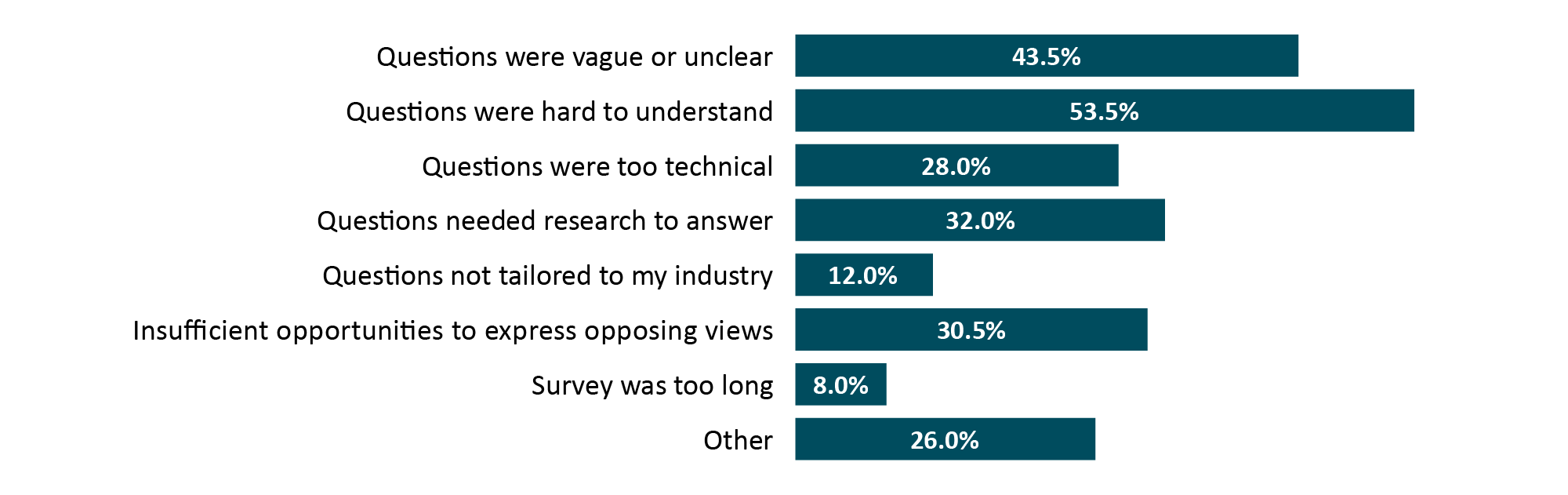
Respondents who indicated that the survey was not easy to complete were asked to select reasons that explained their choice, most of which had to do with the type of questions asked, and how the questions were asked.
Text version
| % of respondents who indicated the survey was hard to complete | |
|---|---|
| Questions were vague or unclear | 43.5% |
| Questions were hard to understand | 53.5% |
| Questions were too technical | 28.0% |
| Questions needed research to answer | 32.0% |
| Questions not tailored to my industry | 12.0% |
| Insufficient opportunities to express opposing views | 30.5% |
| Survey was too long | 8.0% |
| Other | 26.0% |
Note: Response options were abbreviated for display purposes. Full response options can be found in Annex A.
Responses identifying other reasons for the survey being hard to complete highlighted that questions were too long, worded unclearly, biased, or too open to interpretation.
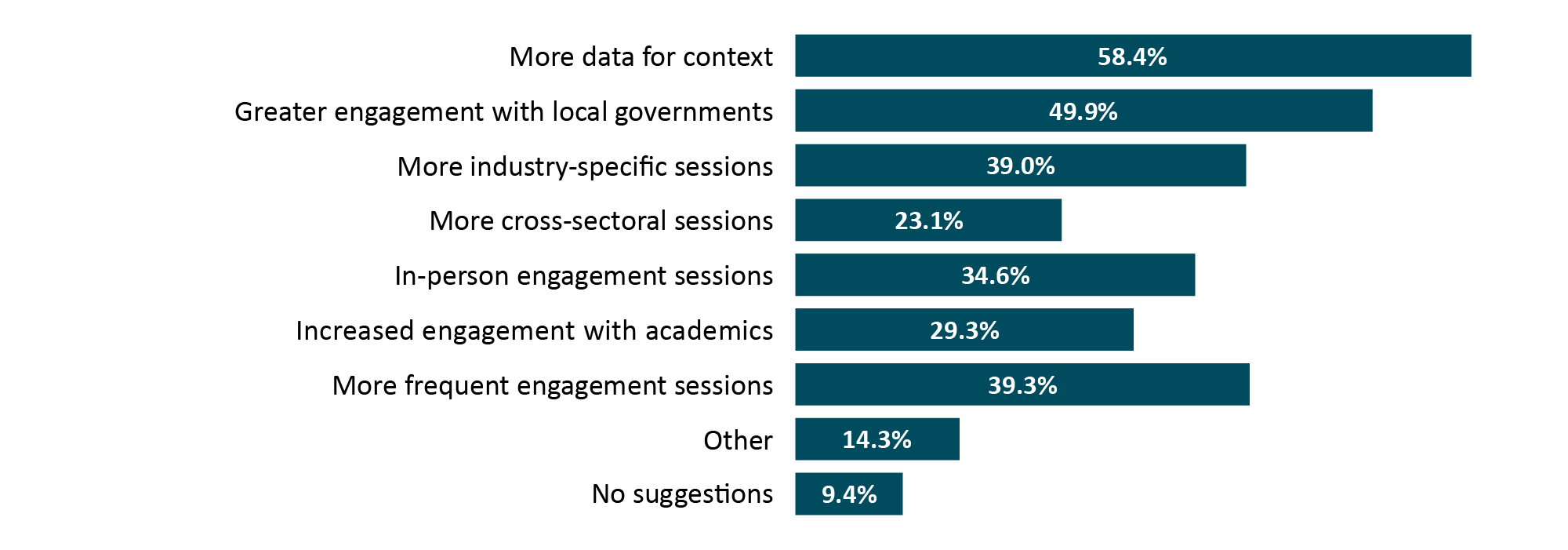
When asked how IRCC could improve engagement on future economic priorities and categories for Express Entry, a majority of respondents suggested providing more data for context (58.4%). Other suggestions – selected by more than a quarter of respondents – included more engagement with provinces and territories, regions, and municipalities (49.9%), and more industry-specific engagement sessions (39.0%).
Text version
| % of respondents | |
|---|---|
| More data for context | 58.4% |
| Greater engagement with local governments | 49.9% |
| More industry-specific sessions | 39.0% |
| More cross-sectoral sessions | 23.1% |
| In-person engagement sessions | 34.6% |
| Increased engagement with academics | 29.3% |
| More frequent engagement sessions | 39.3% |
| Other | 14.3% |
| No suggestions | 9.4% |
Note: Response options were abbreviated for display purposes. Full response options are in Annex A.
Suggestions to improve engagement, included ideas on how, or who, to engage as part of these consultations – including migrant-led organizations, Indigenous organizations, and, more generally, under-represented groups.
Many suggested increasing awareness and participation by promoting surveys and consultations through media, social media, email, and targeted outreach to the general public, while others called for more inclusive and transparent communications with the public, emphasizing the need to engage on the unique challenges faced by various sectors and regions in Canada.
Thank you
We extend our sincere appreciation to everyone who contributed to this engagement process on Express Entry priorities and categories for 2026. Your feedback on how to improve engagement will also help shape future consultations with individuals, organizations, and groups.
These insights play a key role in developing better policies, programs and services, and inform IRCC’s approach to further enhancing economic immigration to Canada.
Annex A: Supplementary information
The following includes complete data for quantitative survey questions on Express Entry priorities and categories under consideration for 2026. Data broken down by respondent type (individuals and organizations) are provided for questions directed to both groups.
Q3 – [if Q1b is selected] Which best describe(s) your organization? (Please select up to two options.)
| % of organizations | |
|---|---|
| Diversity, equity, and inclusion organization (including 2SLGBTQI+) | 4.2% |
| Academia, research foundation or institution, or think tank | 5.9% |
| Advocacy group | 8.0% |
| Arts and culture organization (archives, art gallery or museum, cinema, concert venue, library, performing arts venue, theatre or dance company, etc.) | 0.3% |
| Business | 24.9% |
| Chamber of commerce, board of trade or economic development organization | 3.3% |
| Educational organization (primary or secondary school, post-secondary institution, designated learning institution, student association, school board, etc.) | 16.3% |
| Faith-based organization | 1.5% |
| Francophone or official language minority community organization | 3.3% |
| Government (federal, provincial or territorial, municipal or regional administration) | 3.5% |
| Health care organization or other care service | 3.3% |
| Immigration consulting or legal service | 7.1% |
| Indigenous (First Nations, Inuit or Métis) organization | 0.6% |
| Industry or sector council | 3.3% |
| Labour group or union | 1.2% |
| Member of a Local Immigration Partnership | 0.9% |
| Member of Rural and Francophone Community Pilots | 0.3% |
| Multicultural or ethno-cultural association | 2.1% |
| Not-for-profit, charitable or non-government organization | 22.3% |
| Settlement or resettlement organization | 8.0% |
| Regulatory body | 0.9% |
| Other | 8.0% |
| Prefer not to say | 0.9% |
“Other” responses were primarily a subset of the organization types listed in the survey response options.
Q4 – [if Q1b is selected] In which sector(s) does your organization primarily operate? Please select sectors that you feel comfortable discussing in terms of labour needs or shortages.
| % of organizations | |
|---|---|
| Education | 27.3% |
| Science, technology, engineering and math (STEM) | 15.4% |
| Health care | 12.2% |
| Social assistance | 11.6% |
| Accommodation, hospitality and food services | 10.7% |
| Manufacturing | 9.2% |
| Consulting and legal services | 8.6% |
| Construction (industrial or commercial) | 7.7% |
| Trades (excluding construction) | 7.4% |
| Construction (residential) | 7.1% |
| Tourism | 7.1% |
| Administrative services | 6.8% |
| Agriculture and agri-food | 6.8% |
| Arts, entertainment and recreation | 6.8% |
| Transportation | 6.8% |
| Retail and trade | 4.5% |
| Banking and insurance | 3.3% |
| Utilities | 3.3% |
| Energy | 3.0% |
| Automotive | 2.4% |
| Bio-manufacturing | 2.4% |
| Mining and oil and gas extraction | 2.4% |
| Aerospace | 2.1% |
| Defence | 2.1% |
| Forestry | 2.1% |
| Prefer not to say | 1.8% |
| Dental care | 1.2% |
| Real estate and rental and leasing | 1.2% |
| Fashion and design | 0.9% |
| Other | 21.4% |
“Other” responses were primarily a subset of the organization sectors listed in the survey response options; however, a few of the organization sectors identified were somewhat distinct to the survey options provided. These distinct sectors related to economic development, marine, social integration and settlement services, and community or cultural associations.
Q5 – [if Q1b is selected] In which province(s) or territory(ies) does your organization primarily operate? Please select all that apply.
| Provinces/Territory | % of organizations |
|---|---|
| Alberta | 21.7% |
| British Columbia | 33.8% |
| Manitoba | 13.9% |
| New Brunswick | 13.1% |
| Newfoundland and Labrador | 10.1% |
| Northwest Territories | 5.6% |
| Nova Scotia | 16.0% |
| Nunavut | 5.0% |
| Ontario | 49.6% |
| Outside of Canada | 5.3% |
| Prince Edward Island | 11.6% |
| Quebec | 14.8% |
| Saskatchewan | 12.5% |
| Yukon | 6.8% |
Q6 – [if “Quebec” is selected alone] Does your organization have a national mandate, or is your mandate limited to the province of Quebec?
| % of organizations | |
|---|---|
| National mandate | 61.5% |
| Quebec mandate | 38.5% |
Q7 – [if Q1b is selected] In which language(s) does your organization primarily operate?
| % of organizations | |
|---|---|
| English | 86.6% |
| French | 8.0% |
| Other | 5.3% |
“Other” was often selected in cases where respondents wanted to indicate that they operated in English and French; other languages of operation also included American Sign Language, Arabic, Cantonese, Japanese, Spanish, and Ukrainian.
Q8 – [if Q1a is selected] In which province or territory do you live?
| % of organizations | |
|---|---|
| Alberta | 9.5% |
| British Columbia | 19.5% |
| Manitoba | 2.9% |
| New Brunswick | 0.8% |
| Newfoundland and Labrador | 0.3% |
| Northwest Territories | 0.1% |
| Nova Scotia | 3.3% |
| Nunavut | 0.0% |
| Ontario | 53.9% |
| Prince Edward Island | 0.3% |
| Quebec | 4.6% |
| Saskatchewan | 1.4% |
| Yukon | 0.3% |
| Outside of Canada | 3.0% |
Q9 – [if Q1a is selected] Which language do you speak most often at home?
| % of organizations | |
|---|---|
| English | 90.4% |
| French | 3.3% |
| Other | 6.2% |
The top “other” responses submitted were Portuguese, Farsi (Persian), Spanish, Mandarin or Chinese, and Hindi.
Q13 – With category-based selection, Express Entry can focus selection either on candidates with the highest human capital scores:
- overall and within programs (general and program-specific rounds); or
- within categories determined by profile characteristics linked to economic goals
Category-based rounds are focused, for example, on candidates with work experience in occupations known to face long-term labour shortages.
Do you think Express Entry should focus more heavily on one of these two selection approaches?
| % of responses | % of individuals | % of organizations | |
|---|---|---|---|
| Greater focus on category-based selection | 43.7% | 44.7% | 35.0% |
| Greater focus on general and program-specific rounds | 22.9% | 22.9% | 23.4% |
| Equal focus on these two selection approaches | 26.7% | 26.0% | 32.9% |
| Don’t know | 6.7% | 6.4% | 8.6% |
Q15 – Express Entry categories currently focus on selecting workers who:
- can help address long-term labour shortages in Canada (priority 1)
- can support economic growth through Francophone immigration outside Quebec (priority 2)
These areas of focus are also reflected in the eligibility criteria for the post-graduation work permit (PGWP).
The following questions seek to better understand your views on 2025 Express Entry categories continuing into 2026.
Do we need to continue to focus on these economic priorities in 2026?
| Address long-term labour shortages | % of responses | % of individuals | % of organizations |
|---|---|---|---|
| Great need | 59.3% | 56.9% | 80.1% |
| Average need | 14.7% | 14.9% | 12.8% |
| Little need | 6.5% | 7.0% | 2.4% |
| No need at this time | 17.9% | 19.8% | 2.1% |
| Don’t know/Not sure | 1.6% | 1.4% | 2.7% |
| Support economic growth through Francophone immigration outside Quebec | % of responses | % of individuals | % of organizations |
|---|---|---|---|
| Great need | 17.3% | 16.3% | 25.5% |
| Average need | 14.3% | 13.7% | 19.0% |
| Little need | 21.5% | 21.3% | 22.6% |
| No need at this time | 41.2% | 43.6% | 20.8% |
| Don’t know/Not sure | 5.7% | 5.0% | 12.2% |
Q17 – Based on your experience, do we need to continue to prioritize candidates eligible to each of the 2025 categories in order to address long-term shortages into 2026?
| Agriculture and agri-food | % of responses | % of individuals | % of organizations |
|---|---|---|---|
| Great need | 28.5% | 26.9% | 42.1% |
| Average need | 27.4% | 28.0% | 22.0% |
| Little need | 15.6% | 16.3% | 9.2% |
| No need at this time | 18.5% | 20.0% | 5.3% |
| Don't know/ Not sure | 10.1% | 8.8% | 21.4% |
| Healthcare and social services | % of responses | % of individuals | % of organizations |
|---|---|---|---|
| Great need | 57.7% | 56.7% | 66.2% |
| Average need | 18.6% | 19.2% | 13.6% |
| Little need | 7.3% | 7.9% | 1.8% |
| No need at this time | 10.4% | 11.3% | 2.7% |
| Don't know/ Not sure | 6.0% | 4.8% | 15.7% |
| Science, Technology, Engineering and Math (STEM) | % of responses | % of individuals | % of organizations |
|---|---|---|---|
| Great need | 41.8% | 41.5% | 44.2% |
| Average need | 18.7% | 17.9% | 25.2% |
| Little need | 11.6% | 11.9% | 9.5% |
| No need at this time | 21.8% | 23.6% | 6.5% |
| Don't know/ Not sure | 6.1% | 5.1% | 14.5% |
| Trades | % of responses | % of individuals | % of organizations |
|---|---|---|---|
| Great need | 36.4% | 34.2% | 55.2% |
| Average need | 23.4% | 23.9% | 19.0% |
| Little need | 14.5% | 15.5% | 5.6% |
| No need at this time | 18.5% | 20.1% | 4.5% |
| Don't know/ Not sure | 7.3% | 6.3% | 15.7% |
| Education | % of responses | % of individuals | % of organizations |
|---|---|---|---|
| Great need | 28.9% | 27.9% | 38.0% |
| Average need | 25.7% | 25.7% | 26.4% |
| Little need | 14.8% | 15.2% | 11.6% |
| No need at this time | 22.9% | 25.0% | 5.0% |
| Don't know/ Not sure | 7.7% | 6.3% | 19.0% |
Q18 – For each of these categories, should we focus more heavily on selecting skilled workers in Canada (students or temporary workers) or outside Canada?
| Agriculture and agri-food | % of responses | % of individuals | % of organizations |
|---|---|---|---|
| Inside Canada | 58.2% | 61.1% | 33.8% |
| Outside Canada | 7.9% | 7.2% | 13.9% |
| Both equally | 22.8% | 21.6% | 32.6% |
| Don't know/ Not sure | 11.1% | 10.1% | 19.6% |
| Healthcare and social services | % of responses | % of individuals | % of organizations |
|---|---|---|---|
| Inside Canada | 61.7% | 64.3% | 39.5% |
| Outside Canada | 6.8% | 6.3% | 11.0% |
| Both equally | 23.8% | 22.4% | 35.6% |
| Don't know/ Not sure | 7.7% | 7.0% | 13.9% |
| Science, Technology, Engineering and Math (STEM) | % of responses | % of individuals | % of organizations |
|---|---|---|---|
| Inside Canada | 67.0% | 69.5% | 45.4% |
| Outside Canada | 5.4% | 5.0% | 8.3% |
| Both equally | 18.6% | 16.9% | 32.9% |
| Don't know/ Not sure | 9.0% | 8.5% | 13.4% |
| Trades | % of responses | % of individuals | % of organizations |
|---|---|---|---|
| Inside Canada | 64.6% | 67.1% | 42.4% |
| Outside Canada | 5.2% | 4.4% | 11.6% |
| Both equally | 20.1% | 18.9% | 30.9% |
| Don't know/ Not sure | 10.1% | 9.6% | 15.1% |
| Education | % of responses | % of individuals | % of organizations |
|---|---|---|---|
| Inside Canada | 64.9% | 67.3% | 44.5% |
| Outside Canada | 4.6% | 4.1% | 8.9% |
| Both equally | 19.8% | 18.7% | 29.1% |
| Don't know/ Not sure | 10.7% | 9.9% | 17.5% |
Q26 – Current Express Entry categories focusing on labour shortages select candidates who:
- are eligible for federal skilled immigration programs, and
- have accumulated, within the past 3 years, at least 6 months of full-time, continuous work experience (or an equal amount of part-time experience) in one of the occupations listed in those categories
Do you think the work experience eligibility criteria for categories focusing on labour shortages should require 12 months of continuous work experience in a listed occupation within the past 3 years (rather than 6 months)? Please use the text box that appears to tell us about your response.
| % of responses | % of individuals | % of organizations | |
|---|---|---|---|
| Yes | 58.2% | 60.4% | 39.2% |
| No | 34.0% | 32.5% | 46.9% |
| Not sure | 7.8% | 7.1% | 13.9% |
Q27 – We know that foreign credential recognition is a key barrier to labour market integration. Current eligibility criteria for categories focusing on labour shortages do not account for candidates’ readiness to practice in regulated professions. In your view, would restricting prioritization to candidates with Canadian work experience in a regulated profession be an effective strategy to mitigate this barrier while also addressing labour shortages? Please use the text box that appears to tell us about your response.
| % of responses | % of individuals | % of organizations | |
|---|---|---|---|
| Yes | 50.1% | 52.2% | 32.6% |
| No | 35.4% | 33.7% | 50.1% |
| Not sure | 14.5% | 14.2% | 17.2% |
Q28 – Since 2023, category-based selection in Express Entry has focused on selecting skilled workers with strong French proficiency skills to support economic growth through Francophone immigration outside Quebec. Their French test results must show a minimum score of 7 in all 4 language abilities on the Niveaux de compétence linguistique canadiens (French version of the Canadian Language Benchmarks).
Based on your experience, do you think we need Express Entry to continue to prioritize these candidates? Please use the text box that appears to tell us about your response.
| % of responses | % of individuals | % of organizations | |
|---|---|---|---|
| Great need | 17.6% | 17.1% | 21.7% |
| Average need | 15.3% | 14.9% | 18.4% |
| Little need | 19.7% | 19.7% | 19.6% |
| No need at this time | 40.4% | 42.6% | 22.0% |
| Don't know/ Not sure | 7.1% | 5.7% | 18.4% |
Q29 – To date, Express Entry categories that prioritize skilled workers with specific work experience have focused only on occupations documented to experience long-term shortages. A more proactive immigration approach could also focus on occupations that are not documented to experience long-term and national shortages, but that could benefit Canada’s competitiveness in specific areas. To what extent would you recommend this expanded approach?
| % of responses | % of individuals | % of organizations | |
|---|---|---|---|
| Great extent | 42.0% | 41.1% | 49.9% |
| Moderate extent | 24.8% | 23.9% | 32.9% |
| Small extent | 10.1% | 10.3% | 8.3% |
| Not at all | 18.7% | 20.4% | 3.9% |
| Don`t know | 4.4% | 4.3% | 5.0% |
Q30 – Talented individuals with diverse backgrounds are invited through Express Entry’s general and program-specific rounds.
To what extent do you think we need an Express Entry category to further prioritize candidates in leadership and innovation positions? Please use the text box that appears to tell us about your response.
| % of responses | % of individuals | % of organizations | |
|---|---|---|---|
| Great need | 37.5% | 37.3% | 39.2% |
| Average need | 21.4% | 20.4% | 29.1% |
| Little need | 16.1% | 16.1% | 16.0% |
| No need at this time | 20.8% | 22.5% | 6.8% |
| Don't know/ Not sure | 4.3% | 3.7% | 8.9% |
Q31 – To address this leadership and innovation economic priority, category-based selection could focus on
- experienced senior managers who oversee the operations of an organization and lead a team of employees;
- highly experienced and specialized military personnel from allied countries who are recruited to help build Canadian Armed Forces’ military capacity; and
- scientists and researchers whose discoveries and innovations can stimulate economic growth.
To what extent do you think there is a need for category-based selection to prioritize these candidates?
| Senior managers | % of responses | % of individuals | % of organizations |
|---|---|---|---|
| Great need | 25.8% | 25.9% | 25.5% |
| Average need | 20.5% | 19.9% | 25.8% |
| Little need | 20.8% | 20.4% | 24.0% |
| No need at this time | 28.6% | 30.6% | 11.6% |
| Don't know/ Not sure | 4.2% | 3.2% | 13.1% |
| Skilled military recruits for Canadian Armed Forces | % of responses | % of individuals | % of organizations |
|---|---|---|---|
| Great need | 24.1% | 24.5% | 20.5% |
| Average need | 23.4% | 23.5% | 22.3% |
| Little need | 17.9% | 17.8% | 18.4% |
| No need at this time | 24.5% | 26.0% | 11.3% |
| Don't know/ Not sure | 10.1% | 8.1% | 27.6% |
| Scientists and researchers | % of responses | % of individuals | % of organizations |
|---|---|---|---|
| Great need | 45.8% | 45.8% | 45.4% |
| Average need | 21.7% | 21.4% | 24.0% |
| Little need | 13.6% | 13.8% | 12.2% |
| No need at this time | 14.7% | 15.8% | 5.3% |
| Don't know/ Not sure | 4.2% | 3.2% | 13.1% |
Q33 – This survey was easy to complete.
| % of responses | % of individuals | % of organizations | |
|---|---|---|---|
| Strongly agree | 39.8% | 40.9% | 30.6% |
| Agree | 36.5% | 35.8% | 42.1% |
| Neutral | 17.4% | 17.0% | 21.4% |
| Disagree | 4.7% | 4.6% | 5.6% |
| Strongly disagree | 1.6% | 1.7% | 0.3% |
Q34 - Why did you say this survey was not easy to complete? Please select all that apply.
| % of responses | % of individuals | % of organizations | |
|---|---|---|---|
| Survey questions were vague or lacked detail | 43.5% | 54.4% | 50.0% |
| Survey questions were hard to understand | 53.5% | 42.8% | 45.0% |
| Survey questions were too technical | 28.0% | 30.0% | 35.0% |
| Survey questions needed research and analysis to respond | 32.0% | 28.9% | 50.0% |
| Survey questions were not sufficiently tailored to my area of work or my situation | 12.0% | 27.2% | 35.0% |
| There were not enough open-ended questions or opportunities to express opposing views | 30.5% | 27.2% | 45.0% |
| Survey was too long | 8.0% | 9.4% | 0.0% |
| Other | 26.0% | 8.9% | 15.0% |
Q35 - Do you have any suggestions on how IRCC can engage with stakeholders and partners on future economic priorities and categories? Please select all that apply.
| % of responses | % of individuals | % of organizations | |
|---|---|---|---|
| Providing more data would be useful for context | 58.4% | 58.3% | 59.6% |
| More engagement with provinces and territories, regions, and municipalities | 49.9% | 49.8% | 50.7% |
| More industry-specific engagement sessions | 39.0% | 39.9% | 50.7% |
| More cross-sectoral engagement sessions | 23.1% | 37.7% | 33.5% |
| More engagement with academics and researchers | 29.3% | 32.9% | 27.9% |
| Hold in-person engagement sessions (panel discussions, roundtables, one to one meetings) | 34.6% | 29.5% | 49.0% |
| More frequent engagement sessions or surveys | 39.3% | 21.9% | 34.1% |
| Other | 14.3% | 13.7% | 19.9% |
| I have no suggestions | 9.4% | 9.6% | 7.7% |
Annex B: Participating organizations
The list below includes organizations that contributed to our 2025 consultations on category-based selection in Express Entry. IRCC also received a number of anonymous and/or individual contributions that are not listed here for privacy reasons.
- 123Dentist
- 369 Global
- AbCellera Biologics
- Abtech ON
- Academy of Learning
- Accessible Community Counselling and Employment Services
- Air Canada
- Air Transport Association of Canada
- Alberta Hotel & Lodging Association
- Alexis Nakota Sioux Nation
- Algoma University
- Algonquin College of Applied Arts and Technology
- Altona Rhineland Economic Development
- Amazon Web Services Canada
- Antigonish Women’s Centre & Sexual Assault Services
- Apple
- Appraise Immigration and Citizenship
- Arctic Wolf Networks
- ARZM Consulting
- Association des collèges et universités de la francophonie canadienne
- Association franco-yukonnaise
- Association Gambienne d'Aide aux Migrants
- Association Multiculturelle de la region Chaleur
- Association of British Columbia Marine Industries
- Association of Canada Lands Surveyors (ACLS)
- Association of Professional Engineers and Geoscientists of Alberta
- Association of Professional Engineers and Geoscientists of Saskatchewan
- Banff & Lake Louise Hospitality Association
- Banff Caribou Properties
- Bayshore Healthcare
- Black Youth Initiative
- BMW (franchise)
- BorderPass
- Bosman Home Front
- Bowen Chidlren's Centre (SD45)
- British Columbia Construction Association
- British Columbia Federation of Students
- British Columvia Children’s Hospital Research Institute
- Brock University
- Burger King (franchise)
- Business Council of Alberta
- Butterfly Support Network
- Cairn Counselling & Art Therapy
- Calgary Bridge Foundation for Youth
- Calgary Catholic Immigration Society
- Calgary Construction Association
- Calgary Economic Development
- Calgary Eye Clinic
- Canada College
- Canada Royal Milk
- Canadian All Care College
- Canadian Alliance of Student Associations / Alliance canadienne des associations étudiantes
- Canadian Association of Professional Immigration Consultants (CAPIC)
- Canadian Aviation College
- Canadian Bureau for International Education / Bureau canadien de l’éducation internationale
- Canadian Centre for Torture Victims
- Canadian Chamber of Commerce / Chambre de Commerce du Canada
- Canadian Employee Relocation Council (CERC)
- Canadian Federation of Agriculture / La Fédération canadienne de l’agriculture
- Canadian Federation of Independent Business (CFIB)
- Canadian Hearing Services / Services canadiens de l’ouïe
- Canadian Immigration Connections
- Canadian Union of Public Employees - 2484 / Syndicat canadien de la fonction publique - 2484
- Carry Immigration Services
- Cascade Aerospace
- Catholic Community Services of York Region
- Celplast Metallized Products
- Centennial College
- Centre of English Studies Vancouver
- Chantier Davie Canada
- Chantier Naval Forillon
- Chefs Oven Bakery
- Child Care Now
- Chubby’s Jamaican kitchen
- City of Fort St. John (British Columbia)
- City of Moncton (New Brunswick)
- City of Terrace (British Columbia)
- Cobs Bread
- Cognizant Technology Solutions
- College of the North Atlantic
- Colleges and Institutes Canada / Collèges et instituts Canada
- Colleges Ontario
- Columbia College
- Community Development Council Durham
- Community Futures Development Corporation of Howe Sound
- Community Futures Development Corporation of the Shuswap
- Community Futures Development Corporation Peace Liard
- Concordia University of Edmonton
- Conestoga College
- Conestoga Meats
- Conestoga Students
- Conference Board of Canada
- Conseil économique et coopératif de la Saskatchewan
- Construction Association of Prince Edward Island
- Cooperation Integration Canada / Coopération Intégration Canada
- Council of Canadian Innovators
- Council of Canadians, South Okanagan Chapter
- CSL Group
- Cultural Connections Institute - The Learning Exchange
- DALU Immigration Consulting
- Deloitte
- Digital Nova Scotia
- District of Kitimat (British Columbia)
- ECO Canada
- École de technologie supérieure
- econext
- Economic Development Brandon
- Economic Development Lethbridge
- Economic Development Winnipeg
- Edison Motors
- Encircle
- English Language Tutoring for the Ottawa Community
- Entertainment Software Association of Canada / Association Canadienne du logiciel de divertissement
- Fastenal Canada
- Fédération acadienne de la Nouvelle-Écosse
- Fédération des communautés francophones et acadienne du Canada
- Fondation Montreal
- Fort St. John Literacy Society
- Fragomen
- From Far and Wide Immigration Consultancy
- Future Quantum Enterprises
- G Visser & Sons
- Gequity Consulting
- Gracevine Immigration Consulting Services
- Great Vancouver Board of Trade
- Greater Charlottetown Area Chamber of Commerce
- Grey Bruce Local Immigration Partnership
- Groupe Colas Québec
- Groupe Desgagnés
- Groupe Savoie
- Guard.me
- Guelph Wellington Local Immigration Partnership
- H.M. Immigratr
- Halton District School Board
- Halton Multicultural Council
- Haniya's Retail
- Happipad
- Heartland International English School
- Hong Kong Watch
- Horizon TNL
- Hospitality Saskatchewan
- IBT College
- Image Engine Design
- Immigrant Centre Manitoba
- Immigrant Entrepreneur Canada
- Immigrant Services Association of Nova Scotia
- Impact kitchen
- Indian head Contracting
- Indo-Canadian Women’s Association
- Industrial Light & Magic
- Information and Communications Technology Council / Conseil des technologies de l’information et des communications
- Institut Grasset
- Interfaith refugee partnership
- International Rescue Committee
- International Union of Operating Engineers
- Island Career Academy
- Jasper Employment and Education Centre
- Kanata Stittsville Refugee Sponsorship Group
- Keipro Musical Instrumentals
- Kelen Immigration Services
- KF Aerospace
- KPMG
- KSA Immigration Consulting Services
- Lakeland College
- Langara College
- Law Office of Sajjad A. Malik
- Le Cercle des Canadiens Français de Prince George
- Le Cordon Bleu Culinary Arts Institute
- Lebanese and Arab Social Services Agency
- Legends Academy
- Life Sciences British Columbia
- Linamar
- Link-On
- Literacy Alberni Society
- Locavore Bar and Grill
- London Cross Cultural Learner Centre
- Lululemon
- Magen Herut
- Make Canada Home Immigration Services
- MAR Investments
- Maritime College of Forest Technology
- McCarthy Tétrault
- MediaValet
- Medicine Hat College
- Medina Immigration
- Meridian Credit Union
- Migrant Rights Network
- Migrant Workers Alliance for Change
- Milton Homoeopathy
- Missinippi Airways
- Mission Community Skills Centre Society
- Mohawk Students' Association
- Momo Cultural and Development Association Calgary
- Montreal City Mission
- Mount Saint Vincent University
- Mrs. Dusnters
- Multicultural Association of Fredericton
- National Airlines Council of Canada (NACC)
- National Institute of Beauty and Health Science
- Natural Resources Canada
- Netflix Animation Studios Canada
- Newcomer Centre of Peel
- Newway Concrete Forming
- Niagara College
- Nobility Canada Immigration Services
- Northeastern Ontario Multicultural Centre
- Northeastern University
- Northern Alberta Institute of Technology
- Northern College
- Northern Lights College
- Northern Policy Institute
- Northern Rockies Dental Clinic
- Nova Scotia College of Early Childhood Education
- Novate Legal
- NTT Data
- Oneness Education Foundation
- ONSIDE
- Ontario Chamber of Commerce
- Ontario College of Technology
- Ontario Council of Agencies Serving Immigrants
- Ontario East Economic Development Commission
- Ontario Hong Kong Youth Action
- Ontario Public Interest Research Group Brock
- Ontario Real Estate Association
- Ontario Truck Training Academy
- Oxford Frozen Foods
- Parkdale Intercultural Association
- PCL Construction
- Peel Multicultural Council
- Peers Victoria Resources Society
- PEI Select Tours
- PI Immigration Consultancy
- PMU Specialty
- Polytechnics Canada
- Portail de l'Immigrant Association
- Prince Edward Island EI Sikh Association
- Pubblico Eatery
- Queen's University
- Ranovus
- Regina Open Door Society
- Réseau d'action des femmes en santé et services sociaux
- Réseau de soutien à l'immigration francophone du Nord de l'Ontario
- Réseau en immigration francophone de Saskatchewan
- Reseau-Femmes Colombie-Britannique
- Restaurants Canada
- Rexdale Women's Centre
- Richmond International Education
- Richmond Multicultural Community Services Society
- Root On Immigration Consultations
- Roots
- Safeway
- Saltworks Technologies
- Saskatchewan Polytechnic
- Saskatchewan Urban Municipalities Association
- Seneca Polytechnic
- Shammah Immigration
- Simon Fraser University
- Sisters of St. Joseph of Toronto
- SJP Immigration
- Skate Ontario
- Society of Brooks Community Adult Learning Council
- Sony Pictures Imageworks
- Souls Harbour Rescue Mission
- South Vancouver Neighborhood House
- Spectrum Health Care
- St. George International College
- Stanford International College of Business and Technology
- Suncrest College
- Susan Jany Optometry Professional Corporation
- Talent Beyond Boundaries
- Tdot Immigration
- The Neighbourhood Group Community Services
- The Sutherland Group
- Thompson Rivers University
- Thomson Reuters Canada
- Thunder Bay Multicultural Associaton
- Titos pizza
- Tombolo Multicultural Festival Newfoundland and Labrador
- Toronto Transit Commission
- Tourism Industry Association of Canada / Association de l’industrie du tourisme du Canada
- Town of Watson Lake (Yukon)
- Transport Canada
- Tri-Core Projects
- Trucking HR Canada
- TrueAI
- Ukrainian Canadian Social Services
- Unemployed Help Centre of Windsor
- Union of British Columbia Municipalities
- United African Canadian Women's Association
- Université de Saint-Boniface
- Université du Québec à Rimouski
- Universities Canada / Universités Canada
- University of Alberta / Université de l’Alberta
- University of Calgary Students' Union
- University of Lethbridge
- University of Manitoba
- University of Regina
- University of Toronto
- University of Waterloo
- Upper Madison College
- Uyghur Rights Advocacy Project
- Valley Regional Enterprise Network
- Vancouver Aboriginal Friendship Centre
- VGC International College
- Vietnamese Community Center of Mississauga
- Vitalus Nutrition
- West Prince Ventures
- Western Maritime Institute
- Western University
- Wilfrid Laurier University
- WILL Employment Solutions
- Willscott Farm
- WoodGreen Community Services
- Workers United Canada Council
- World Education Services
- World Skills Employment Centre
- Xanadu
- Yas Bostani Immigration
- YMCA of Northern Alberta
- Yorkton Equity Group
- Yukon Federation of Labour
- YWCA of Hamilton
- YWCA of Metro Vancouver
- YWCA of Toronto
- Zaber Technologies