
2024-2025 Departmental Results Report

At a glance
This departmental results report details the Office of the Intelligence Commissioner’s (ICO) actual accomplishments against the plans, priorities and expected results outlined in its 2024–25 Departmental Plan.
Key priorities
The ICO identified the following key priorities for 2024-25:
- Timely, comprehensive quasi-judicial reviews
- Transparency
- Effective management of internal services
Highlights for the Office of the Intelligence Commissioner in 2024-25
- Total actual spending (including internal services): $2,059,411
- Total full-time equivalent staff (including internal services): 5.5
For complete information on the ICO’s total spending and human resources, read the Spending and human resources section of its full departmental results report.
Summary of results
The following provides a summary of the results the department achieved in 2024-25 under its main areas of activity, called “core responsibilities.”
Core responsibility 1: Quasi-judicial review of certain ministerial conclusions
Actual spending: $1,621,306
Actual full-time equivalent staff: 4.5
- 100% of decisions and the reasons for them were delivered in accordance with the deadlines set out in the legislation
- The Annual Report on the IC’s activities was delivered to the Prime Minister by March 31, 2025
For more information on the ICO’s Quasi-judicial review of certain ministerial conclusions read the ‘Results – what we achieved” section of its departmental results report.
From the Institutional Head
As Intelligence Commissioner (IC) and Deputy Head, I am pleased to present the 2024–25 Departmental Results Report for the Office of the Intelligence Commissioner (ICO).
The ICO is an independent quasi-judicial agency of the Government of Canada. The ICO supports the fulfilment of the IC’s oversight mandate as set out in the Intelligence Commissioner Act (IC Act). The IC approves – or does not approve – certain national security and intelligence activities planned by the Communications Security Establishment and the Canadian Security Intelligence Service (CSIS) and authorized by their respective ministers.
In the interest of national security and intelligence collection, these agencies may sometimes engage in activities that could involve breaking the laws of Canada or interfere with the privacy interests of Canadians. Any activities of this kind must first be authorized in writing by the minister responsible for the agency involved or, in some cases, by the Director of CSIS. The ministerial authorization must include the conclusions – effectively the reasons – supporting the activities that are being authorized.
I review the conclusions given for authorizing the activities to determine whether they meet the test of “reasonableness” as recognized by Canadian courts. If so, I approve the ministerial authorization, and the agency can proceed with the planned activities. The activities cannot take place without my approval.
I am pleased to report that in 2024, 13 quasi-judicial reviews were completed, and all 13 decisions were rendered within the statutory time limits set out in legislation. The need for transparency is particularly important as challenges to national security continue to evolve. In turn, the role of the Intelligence Commissioner also continues to evolve in response to new and emerging challenges. For example, in 2024–25, I determined that an authorization related to malicious cyber activities called for urgent action on my part. After reviewing the IC Act, I concluded that it allowed me to issue an immediate decision approving the authorization, with my written reasons to follow. This novel approach allowed CSE to provide cybersecurity support to the affected non-federal entities without delay.
In March 2025, in accordance with the IC Act, I submitted to the Prime Minister an annual report on my activities for the 2024 calendar year. This report provides an overview of my activities as Intelligence Commissioner, as well as details of the oversight process I undertake when deciding whether to approve – or not approve – certain national security and intelligence activities. The report also highlights the impact of my decisions in strengthening the governance of these activities in Canada. Through my decisions, I seek to ensure that the extraordinary powers granted to our national security and intelligence agencies are exercised in a manner that is acceptable to Canadians.
During 2024–25, the ICO reviewed its organizational structure and streamlined the delivery of internal services to better reflect actual needs. The ICO entered into memorandums of understanding with other government departments for the provision of internal services, eliminating the reliance on external consultants. The changes resulting from this review will be realized in 2025–26 and will support the ICO’s longer term stability.
I wish to express my sincere thanks to the staff of the ICO for their professionalism and dedication in supporting my mandate. Their support is essential to ensuring I can fully represent the interests of Canadians in carrying out this important and independent oversight of governmental decisions.
The Honourable Simon Noël, K.C.
Intelligence Commissioner
Results – what we achieved
Core responsibilities and internal services
- Core responsibility: Quasi-judicial review of certain ministerial conclusions
- Internal services
Core responsibility 1: Quasi-judicial review of certain ministerial conclusions
In this section
- Description
- Quality of life impacts
- Progress on results
- Details on results
- Key risks
- Resources required to achieve results
- Related government priorities
- Program inventory
Description
The ICO is an independent oversight body. Under the IC Act, the IC is responsible for performing quasi-judicial reviews of the conclusions on the basis of which certain authorizations are issued or amended, and certain determinations are made, under the Communications Security Establishment Act and the Canadian Security Intelligence Service Act. In each case, the IC, supported by the ICO, undertakes an in-depth analysis of the records. If the IC is satisfied that the conclusions reached by the decision-maker are reasonable, the IC must approve the authorization or determination in a written decision that sets out the reasons for doing so.
Consistent with the IC’s oversight role, an authorization or determination is valid only after it is approved by the IC. The activities described in the authorizations or determinations cannot be carried out by the intelligence agencies without the IC’s approval.
The IC Act requires that the IC’s decision be rendered within 30 days after the day on which the IC received notice of the authorization or determination, or within any other period that may be agreed on by the IC and the decision-maker. In the case of an authorization issued by the Director of CSIS for a query of a dataset in exigent circumstances, the IC must render his or her decision and the reasons for it as soon as feasible.
Quality of life impacts
This core responsibility contributes to the “Good Governance” domain of the Quality of Life Framework for Canada and, more specifically, “confidence in institutions,” and “respect of justice and human rights” through all the activities mentioned in the core responsibility description.
Progress on results
This section details the department’s performance against its targets for each departmental result under Core responsibility 1: Quasi-judicial review of certain ministerial conclusions.
Table 1: Enhancing transparency and accountability of the national security framework
Table 1 shows the target, the date to achieve the target and the actual result for each indicator under enhancing transparency and accountability of the national security framework in the last three fiscal years.
| Departmental Result Indicators | Target | Date to achieve target | Actual Results |
|---|---|---|---|
| % of decisions and the reasons for them delivered in accordance with the deadlines set out in the legislation | 100% | March 31, 2025 | 2022–23: 100% 2023–24: 100% 2024–25: 100% |
| Annual report on Commissioner’s activities delivered to the Prime Minister by March 31st | 100% | March 31, 2025 | 2022–23: 100% 2023–24: 100% 2024–25: 100% |
The Results section of the Infographic for the ICO on GC Infobase page provides additional information on results and performance related to its program inventory.
Details on results
The following section describes the results for the quasi-judicial review of certain ministerial conclusions in 2024–25 compared with the planned results set out in ICO’s departmental plan for the year.
Enhancing transparency and accountability of the national security framework
Results achieved
- Refined existing processes and procedures to better align resources to conduct quasi-judicial reviews in accordance with the deadlines set out in legislation;
- Reviewed organizational structure to better align with required support to achieve the core responsibility; and
- Utilized the departmental results framework and performance measurement regime in accordance with the Treasury Board of Canada Secretariat’s Policy on Results.
Key risks
Human resources management
The ICO must ensure that it has sufficient resources in place to meet the review and reporting requirements set out in legislation. Regardless of the number and complexity of the quasi-judicial reviews conducted, legislative requirements must be met. Furthermore, the quasi-judicial review program requires its resources have a strong legal knowledge, as well as specialized knowledge related to security and intelligence operations. Retaining and hiring skilled employees when vacancies arise is a challenge, particularly because the ICO is a separate agency. To mitigate this risk, the ICO initiated consultations with the Public Service Commission to allow for deployments to and from the Core Public Administration.
Resources required to achieve results
Table 2: Snapshot of resources required for the quasi-judicial review of certain ministerial conclusions
Table 2 provides a summary of the planned and actual spending and full-time equivalents required to achieve results.
| Resource | Planned | Actual |
|---|---|---|
| Spending | $1,937,145 | $1,621,306 |
| Full-time equivalents | 6.5 | 4.5 |
The Finances section of the Infographic for the ICO on GC Infobase page and the People section of the Infographic for the ICO on GC Infobase page provide complete financial and human resources information related to its program inventory.
Related government-wide priorities
This section highlights government priorities that are being addressed through this core responsibility.
United Nations 2030 Agenda for Sustainable Development and the Sustainable Development Goals
More information on the ICO’s contributions to Canada’s Federal Implementation Plan on the 2030 Agenda and the Federal Sustainable Development Strategy can be found in our Departmental Sustainable Development Strategy.
Program inventory
Quasi-judicial review of certain ministerial conclusions is supported by the following programs:
- Quasi-judicial review program
Additional information related to the program inventory for the quasi-judicial review of certain ministerial conclusions is available on the Results page on GC InfoBase.
Internal services
In this section
- Description
- Progress on results
- Resources required to achieve results
- Contracts awarded to Indigenous business
Description
Internal services are the services that are provided within a department so that it can meet its corporate obligations and deliver its programs. There are 10 categories of internal services:
- Management and Oversight Services
- Communications Services
- Legal Services
- Human Resources Management
- Financial Management
- Information Management
- Information Technology
- Real Property
- Materiel
- Acquisitions
Progress on results
This section presents details on how the department performed to achieve results and meet targets for internal services.
During 2024–25, the ICO reviewed its organizational structure and streamlined the delivery of internal services to better reflect actual needs. The ICO entered into memorandums of understanding with other government departments for the provision of internal services, thus eliminating the reliance on external consultants. The changes resulting from this review will be realized in 2025–26. Furthermore, the ICO modernized the content on its website to better communicate the IC’s mandate to Canadians. The ICO also onboarded to MyGCHR – Public Services and Procurement Canada’s HR reporting system– for more efficient and effective reporting. Throughout 2024–25, the ICO worked with the Public Service Commission to obtain their approval to allow for persons employed by the ICO to be deployed to the Core Public Administration and to organizations whose appointments are made in accordance with the Public Service Employment Act (PSEA). The IC submitted the request to the President of the PSC in April 2025 and received approval to allow deployments in July 2025. This will have a positive impact on the ICO’s ability to attract and retain skilled employees.
Resources required to achieve results
Table 3: Resources required to achieve results for internal services this year
Table 3 provides a summary of the planned and actual spending and full-time equivalents required to achieve results.
| Resource | Planned | Actual |
|---|---|---|
| Spending | $638,708 | $438,105 |
| Full-time equivalents | 4 | 1 |
The Finances section of the Infographic for the ICO on GC Infobase page and the People section of the Infographic for the ICO on GC Infobase page provide complete financial and human resources information related to its program inventory.
Contracts awarded to Indigenous businesses
The ICO committed to meet the mandatory minimum target of 5% of the total value of contracts awarded to Indigenous businesses annually. The ICO leveraged tools established by Public Services and Procurement Canada, such as standing offers and supply arrangements, to assist in contracting with Indigenous businesses.
Government of Canada departments are required to award at least 5% of the total value of contracts to Indigenous businesses every year.
The Office of the Intelligence Commissioner results for 2024-25:
Table 4: Total value of contracts awarded to Indigenous businesses¹
As shown in Table 4, the ICO awarded 8 % of the total value of all contracts to Indigenous businesses for the fiscal year.
| Contracting performance indicators | 2024-25 Results |
|---|---|
| Total value of contracts awarded to Indigenous businesses² (A) | $11,445.30 |
| Total value of contracts awarded to Indigenous and non‑Indigenous businesses³ (B) | $136,672.87 |
| Value of exceptions approved by deputy head (C) | $0 |
| Proportion of contracts awarded to Indigenous businesses [A / (B−C) × 100] | 8 % |
-¹“Contract” is a binding agreement for the procurement of a good, service, or construction and does not include real property leases. It includes contract amendments and contracts entered into by means of acquisition cards of more than $10,000.00.
|
|
The ICO exceeded the minimum 5% target. This was achieved using established PSPC tools to award contracts to Indigenous businesses.
In its 2025–26 Departmental Plan, the ICO estimated that it would award 5% of the total value of its contracts to Indigenous businesses by the end of 2024–25.
Spending and human resources
In this section
- Spending
- Funding
- Financial statement highlights
- Human resources
Spending
This section presents an overview of the department's actual and planned expenditures from 2022–23 to 2027–28.
Budgetary performance summary
Table 5: Actual three-year spending on core responsibilities and internal services (dollars)
Table 5 shows the money that the ICO spent in each of the past three years on its core responsibilities and on internal services.
| Core responsibilities and internal services |
2024–25 Main Estimates |
2024–25 total authorities available for use |
Actual spending over three years (authorities used) |
|---|---|---|---|
| Quasi-judicial review of certain ministerial conclusions |
$1,937,145 | $2,063,680 |
|
| Internal services | $638,708 | $673,722 |
|
| Total | $2,575,853 | $2,737,403 |
|
Analysis of the next three years of spending
Despite some variations in spending related to salaries and translation services, spending over the past three years has been relatively constant. Nevertheless, given the modest size of the budget, any increase in spending – for example with respect to salary revisions or new security enhancements – have the potential to significantly impact the ICO’s financial standing. Strong and sound financial stewardship is essential to ensure all spending is appropriately assessed.
The Finances section of the Infographic for the ICO on GC Infobase page offers more financial information from previous years.
Table 6: Planned three-year spending on core responsibilities and internal services (dollars)
Table 6 shows the ICO’s planned spending for each of the next three years on its core responsibilities and on internal services.
| Core responsibilities and internal services |
2025–26 planned spending |
2026–27 planned spending |
2027–28 planned spending |
|---|---|---|---|
| Quasi-judicial review of certain ministerial conclusions | $1,984,444 | $1,986,308 | $1,986,308 |
| Internal services | $651,136 | $651,136 | $651,136 |
| Total | $2,635,580 | $2,637,444 | $2,637,444 |
Analysis of the next three years of spending
There are no significant variances from one year to the next. The ICO will continue to utilize robust financial planning to ensure that all expenditures are appropriately assessed.
The Finances section of the Infographic for the ICO on GC Infobase page offers more detailed financial information related to future years.
Funding
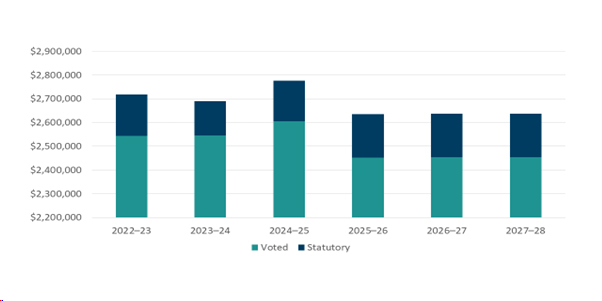
This section provides an overview of the department's voted and statutory funding for its core responsibilities and for internal services. Consult the Government of Canada budgets and expenditures for further information on funding authorities.
Graph 1: Approved funding (statutory and voted) over a six-year period
Graph 1 summarizes the department's approved voted and statutory funding from 2022-23 to 2027-28.
Text version of graph 1
| Fiscal year | Statutory | Voted | Total |
|---|---|---|---|
| 2022-23 | $173,962 | $2,544,555 | $2,718,517 |
| 2023-24 | $143,231 | $2,546,535 | $2,689,766 |
| 2024-25 | $171,805 | $2,604,731 | $2,776,536 |
| 2025-26 | $182,972 | $2,452,608 | $2,635,580 |
| 2026-27 | $183,219 | $2,454,225 | $2,637,444 |
| 2026-27 | $183,219 | $2,454,225 | $2,637,444 |
Analysis of statutory and voted funding over a six-year period
Funding for the ICO has been relatively constant. The planned spending from 2025–26 to 2027–28 is consistent and is based on an updated organizational structure and the streamlining of the delivery of internal services to reflect actual needs. The ICO has moved away from contracting for professional services and obtains internal services from other federal government departments through fixed-cost service level agreements.
Consult the Public Accounts of Canada for further information on the ICO’s departmental voted and statutory expenditures.
Financial statement highlights
ICO’s Financial Statements (Unaudited) for the Year Ended March 31, 2025.
Table 7: Condensed Statement of Operations (unaudited) for the year ended March 31, 2025 (dollars)
Table 7 summarizes the expenses and revenues for 2024–25 which net to the cost of operations before government funding and transfers.
| Financial information | 2024–25 actual results |
2024–25 planned results |
Difference (actual results minus planned) |
|---|---|---|---|
| Total expenses | $1,935,279 | $2,707,291 | ($772,012) |
| Total revenues | N/A | N/A | N/A |
| Net cost of operations before government funding and transfers |
$1,935,279 | $2,707,291 | ($772,012) |
Analysis of expenses and revenues for 2024-25
The difference between the ICO’s actual and planned results of the net cost of operations before government funding and transfers is higher this year primarily due to a current year adjustment of previous years’ overstatement of accrued salaries.
The 2024–25 planned results information is provided in the ICO’s Future-Oriented Statement of Operations and Notes 2024–25.
Table 8: Condensed Statement of Operations (unaudited) for 2023-24 and 2024-25 (dollars)
Table 8 summarizes actual expenses and revenues and shows the net cost of operations before government funding and transfers.
| Financial information | 2024–25 actual results | 2023–24 actual results | Difference (2024-25 minus 2023-24) |
|---|---|---|---|
| Total expenses | $1,935,279 | $2,292,801 | ($357,522) |
| Total revenues | N/A | N/A | N/A |
| Net cost of operations before government funding and transfers | $1,935,279 | $2,292,801 | ($357,522) |
Table 9 Condensed Statement of Financial Position (unaudited or audited) as at March 31, 2025 (dollars)
Table 9 provides a brief snapshot of the amounts the department owes or must spend (liabilities) and its available resources (assets), which helps to indicate its ability to carry out programs and services.
| Financial information | Actual fiscal year (2024–25) | Previous fiscal year (2023–24) | Difference (2024–25 minus 2023–24) |
|---|---|---|---|
| Total net liabilities | $210,190 | $342,510 | ($132,320) |
| Total net financial assets | $136,334 | $286,937 | ($150,603) |
| Departmental net debt | $73,856 | $55,573 | $18,283 |
| Total non-financial assets | $22,057 | $32,405 | ($10,348) |
| Departmental net financial position | ($51,799) | ($23,168) | ($28,631) |
Human resources
This section presents an overview of the department’s actual and planned human resources from 2022–23 to 2027–28.
Table 10: Actual human resources for core responsibilities and internal services
Table 10 shows a summary in full-time equivalents of human resources for the ICO’s core responsibilities and for its internal services for the previous three fiscal years.
| Core responsibilities and internal services | 2022–23 actual full-time equivalents | 2023–24 actual full-time equivalents | 2024–25 actual full-time equivalents |
|---|---|---|---|
| Quasi-judicial review of certain ministerial conclusions | 5 | 4.5 | 4.5 |
| Internal services | 2 | 2 | 1 |
| Total | 7 | 6.5 | 5.5 |
Table 11: Human resources planning summary for core responsibilities and internal services
Table 11 shows the planned full-time equivalents for each of the ICO’s core responsibilities and for its internal services for the next three years. Human resources for the current fiscal year are forecast based on year to date.
| Core responsibilities and internal services | 2025–26 planned full-time equivalents | 2026–27 planned full-time equivalents | 2027–28 planned full-time equivalents |
|---|---|---|---|
| Quasi-judicial review of certain ministerial conclusions | 5.5 | 5.5 | 5.5 |
| Internal services | 2 | 2 | 2 |
| Total | 7.5 | 7.5 | 7.5 |
Supplementary information tables
The following supplementary information tables are available on the ICO’s website:
Federal tax expenditures
The tax system can be used to achieve public policy objectives through the application of special measures such as low tax rates, exemptions, deductions, deferrals and credits. The Department of Finance Canada publishes cost estimates and projections for these measures each year in the Report on Federal Tax Expenditures. This report also provides detailed background information on tax expenditures, including descriptions, objectives, historical information and references to related federal spending programs as well as evaluations and GBA Plus of tax expenditures.
Corporate information
Departmental profile
Appropriate minister: The Right Honourable Mark Carney, P.C. M.P., Prime Minister of Canada
Institutional head: The Honourable Simon Noël, K.C. – Intelligence Commissioner
Ministerial portfolio: Prime Minister
Enabling instrument: Intelligence Commissioner Act
Year of incorporation / commencement: 2019
Departmental contact information
Mailing address:
Office of the Intelligence Commissioner
P.O. Box 1474, Station B
Ottawa, ON K1P 5P6
Telephone: 613-992-3044
Email: info@ico-bcr.gc.ca
Website: www.canada.ca/en/intelligence-commissioner.html
Definitions
appropriation (crédit)
Any authority of Parliament to pay money out of the Consolidated Revenue Fund.
budgetary expenditures (dépenses budgétaires)
Operating and capital expenditures; transfer payments to other levels of government, departments or individuals; and payments to Crown corporations.
core responsibility (responsabilité essentielle)
An enduring function or role of a department. The departmental results listed for a core responsibility reflect the outcomes that the department seeks to influence or achieve.
Departmental Plan (plan ministériel)
A report that outlines the anticipated activities and expected performance of an appropriated department over a 3-year period. Departmental Plans are usually tabled in Parliament in spring.
departmental priority (priorité)
A plan, project or activity that a department focuses and reports on during a specific planning period. Priorities represent the most important things to be done or those to be addressed first to help achieve the desired departmental results.
departmental result (résultat ministériel)
A high-level outcome related to the core responsibilities of a department.
departmental result indicator (indicateur de résultat ministériel)
A quantitative or qualitative measure that assesses progress toward a departmental result.
departmental results framework (cadre ministériel des résultats)
A framework that connects the department’s core responsibilities to its departmental results and departmental result indicators.
Departmental Results Report (rapport sur les résultats ministériels)
A report outlining a department’s accomplishments against the plans, priorities and expected results set out in the corresponding Departmental Plan.
Full-time equivalent (équivalent temps plein)
Measures the person years in a departmental budget. An employee's scheduled hours per week divided by the employer's hours for a full-time workweek calculates a full-time equivalent. For example, an employee who works 20 hours in a 40-hour standard workweek represents a 0.5 full-time equivalent.
Gender-based Analysis Plus (GBA Plus) (analyse comparative entre les sexes plus [ACS Plus])
An analytical tool that helps to understand the ways diverse individuals experience policies, programs and other initiatives. Applying GBA Plus to policies, programs and other initiatives helps to identify the different needs of the people affected, the ways to be more responsive and inclusive, and the methods to anticipate and mitigate potential barriers to accessing or benefitting from the initiative. GBA Plus goes beyond biological (sex) and socio-cultural (gender) differences to consider other factors, such as age, disability, education, ethnicity, economic status, geography (including rurality), language, race, religion, and sexual orientation.
government priorities (priorités pangouvernementales)
For the purpose of the 2024–25 Departmental Results Report, government priorities are the high-level themes outlining the government’s agenda as announced in the 2021 Speech from the Throne.
horizontal initiative (initiative horizontale)
A program, project or other initiative where two or more federal departments receive funding to work collaboratively on a shared outcome usually linked to a government priority, and where the ministers involved agree to designate it as horizontal. Specific reporting requirements apply, including that the lead department must report on combined expenditures and results.
Indigenous business (entreprise autochtones)
For the purposes of a Departmental Result Report, this includes any entity that meets the Indigenous Services Canada’s criteria of being owned and operated by Elders, band and tribal councils, registered in the Indigenous Business Directory or registered on a modern treaty beneficiary business list.
non‑budgetary expenditures (dépenses non budgétaires)
Net outlays and receipts related to loans, investments and advances, which change the composition of the financial assets of the Government of Canada.
performance (rendement)
What a department did with its resources to achieve its results, how well those results compare to what the department intended to achieve, and how well lessons learned have been identified.
performance indicator (indicateur de rendement)
A qualitative or quantitative measure that assesses progress toward a departmental-level or program-level result, or the expected outputs or outcomes of a program, policy or initiative.
plan (plan)
The articulation of strategic choices, which provides information on how a department intends to achieve its priorities and associated results. Generally, a plan will explain the logic behind the strategies chosen and tend to focus on actions that lead to the expected result.
planned spending (dépenses prévues)
For Departmental Plans and Departmental Results Reports, planned spending refers to the amounts presented in Main Estimates. Departments must determine their planned spending and be able to defend the financial numbers presented in their Departmental Plans and Departmental Results Reports.
program (programme)
An Individual, group, or combination of services and activities managed together within a department and focused on a specific set of outputs, outcomes or service levels.
program inventory (répertoire des programmes)
A listing that identifies all the department’s programs and the resources that contribute to delivering on the department’s core responsibilities and achieving its results.
result (résultat)
An outcome or output related to the activities of a department, policy, program or initiative.
statutory expenditures (dépenses législatives)
Spending approved through legislation passed in Parliament, other than appropriation acts. The legislation sets out the purpose and the terms and conditions of the expenditures.
target (cible)
A quantitative or qualitative, measurable goal that a department, program or initiative plans to achieve within a specified time period.
voted expenditures (dépenses votées)
Spending approved annually through an appropriation act passed in Parliament. The vote also outlines the conditions that govern the spending.