
Law Commission of Canada’s 2026-27 Departmental Plan
On this page
Copyright information
© His Majesty the King in Right of Canada, as represented by the Minister of Justice and Attorney General of Canada, 2026
Catalogue Number: JL4-3E-PDF
ISSN 2818-0089
Aussi disponible en français sous le titre : Plan ministériels 2026-2027 de la Commission du droit du Canada
At a glance
This departmental plan details the Law Commission of Canada's priorities, plans, and associated costs for the upcoming three fiscal years.
These plans align with the priorities outlined in the Mandate Letters(s), as well as as well as the Law Commission of Canada's Vision, mission, raison d’être and operating context.
Key priorities
The Law Commission of Canada identified the following key priorities for 2026-27:
- Developing and implementing a relevant and innovative research agenda that reflects current and emerging issues in law;
- Ensuring effective consultation and accessible information for relevant stakeholders in Canadian society;
- Establishing collaborative networks through productive partnerships with public and private organizations;
- Including and integrating approaches and sources across legal traditions, jurisdictions, and systems;
- Offering informed analysis and high-quality recommendations that are timely and comprehensive.
Comprehensive Expenditure Review
The government is committed to restraining the growth of day-to-day operational spending to make investments that will grow the economy and benefit Canadians.
As part of meeting this commitment, the Law Commission of Canada is planning the following spending reductions:
- 2026-27: $278,000
- 2027-28: $371,000
- 2028-29: $556,000
It is anticipated that these spending reductions will involve a decrease of approximately 0 full-time equivalents by 2028-29.
The Law Commission of Canada will achieve these reductions by doing the following:
- Given the early stage of the Commission's organization and development, options to deliver savings lie in moderating growth rather than reducing existing programs. To meet the targeted savings, the Law Commission will make appropriate adjustments to the scale and scope of its research projects, outreach initiatives, partnership development, support for law-reform activities, and in-person engagement with the law and justice community.
The figures in this departmental plan reflect these reductions.
Highlights for the Law Commission of Canada in 2026-27
- In 2026-2027, the Law Commission of Canada anticipates completing its initial major collaborative project authored by multiple contributors and steered by an expert advisory panel. Focused on Charity and Law in Canada, the project recognizes the impact of charity and charitable organizations on the lives of all Canadians.
- In 2026-2027, the Law Commission of Canada anticipates launching new projects or programs continuing to build on its foundational framework of co-existing and intersecting commitments of "Living Law, Pursuing Justice, Renewing Hope".
- In 2026-2027, the Law Commission of Canada anticipates continuing its multi-faceted program of outreach initiatives, engagement activities and partnerships. Key initiatives will include Intergenerational Dialogues designed to bring Indigenous youth and elders together in conversation about the impact of the Truth and Reconciliation Commission's Final Report on its 10-year anniversary and an expanded legal journalism fellowship designed to provide additional support and publication opportunities for journalism about pressing legal issues.
In 2026-27, total planned spending (including internal services) for the Law Commission of Canada is $3,419,602 and total planned full-time equivalent staff (including internal services) is 18.
Summary of planned results
The following provides a summary of the results the department plans to achieve in 2026-27 under its main areas of activity, called “core responsibilities.”
-
Core responsibility 1: Law Review
Study and review the law of Canada and its effects to provide independent advice on improvements and reform to ensure a just legal system that meets the changing needs of Canadian society.
- Planned spending: $2,273,370
- Planned human resources: 13
More information about Law Review can be found in the full plan.
For complete information on the Law Commission of Canada's total planned spending and human resources, read the Planned spending and human resources section of the full plan.
From the Institutional Head
The Law Commission of Canada (LCC) is an independent non-partisan agency committed to engaging the people of Canada in the ongoing and dynamic evolution of law. As provided for in the Law Commission of Canada Act, the LCC aims to study and keep under review the law of Canada to sustain “a just legal system that meets the changing needs of Canadian society.”
Young, small, and energized, the Law Commission has built solid foundations in order to establish a strong and sustainable place in Canada. In its first two years following a 17-year hibernation period, the Commission launched a broad set of initiatives and projects by combining:
- Consultation - across the spheres of legal practice, judiciary, universities, public legal education, access to justice, community work, and policymaking
- Collaboration - with partners and stakeholders interested in law and justice (including those working on revitalization of Indigenous legal orders)
- Design of multi-faceted research-based pathways and projects - developed with contributions by expert scholars and practitioners across the country
- Community engagement - to assess and share needs and challenges, and to enrich public understanding of law's complexity, forms, and impact
The Commission's activities are designed and developed within a framework of co-existing and intersecting commitments and approaches to law and law reform. A three-part raison d'être – Living Law, Pursuing Justice, Renewing Hope – shapes the Commission's program of work, while four objectives mark its pathways: 1) Dream - future direction and development; 2) Repair - revision and renovation; 3) Build - connection and conversation; and 4) Share - education and enrichment. Throughout, research and engagement are intertwined: the Commission's projects rely on Canada's legal scholars, resonate with Canada's community actors, and aspire to reach members of the Canadian public in concrete and constructive ways.
As it looks ahead to 2026-2027, the Law Commission of Canada will continue to conceptualize, produce, and disseminate high quality, interdisciplinary and practice-relevant products and projects on issues requiring attention and action now and into the future. It will do so while incorporating adjustments to its financial authorities as stipulated in Budget 2025.
The Commission's first major collaborative research-based project, focused on Charity and Law in Canada, will be shared widely in 2026-2027. Incorporating the contributions of scholars, practitioners, and actors in the charitable sector, the project underscores and explores the impact and importance of charity and charitable organizations in Canadian society. The coming year will also see the completion and dissemination of initial commissioned reports in an ongoing series on selected topics in contemporary Canadian Prison Law. In addition, the Commission expects to publish the inaugural “Beyond Tomorrow Reports” authored by established scholars and focused on directions for Canada's coming generations in various areas of law. An Emerging Scholars program, offering support to doctoral students by encouraging them to combine their research with effective public outreach, will continue to grow.
The Law Commission of Canada will host the annual meeting of Canada's Federation of Law Reform Agencies in the spring of 2026. Collaboration with the Canadian Bar Association will continue in the form of an innovative annual Journalism Fellowship dedicated to investigating law and justice issues across Canada. The Law Commission's podcast, “Obiter”, launched in the spring of 2025, will continue to highlight insights of individual Canadians whose paths and leadership related to law inspire hope for the future. A regular Bulletin, shared via the LCC website, offers a picture of the extraordinary range of law reform related activities undertaken or supported by the Commission and will continue to shine a light on Indigenous initiatives in the evolution of law. The Commission will explore next directions for projects with advice from its Advisory Council and from insights gleaned from our ongoing Listen and Learn encounters with law and justice actors across Canada and shared via our What We Heard reports. Finally, and importantly, the Commission anticipates taking on responsibility throughout its ongoing and new activities to contribute to widespread conversation in 2026-2027 regarding rule of law in the lives of Canadians.
All work will be undertaken in a manner that demonstrates the Law Commission's ongoing commitment to responsible financial governance and the highest standards of values and ethics.
Parliament re-established the Law Commission in Budget 2021 based on the need for an independent, research-based, public-engaging agency dedicated to rule of law and justice issues for Canadians. That need is even more evident as we look ahead to 2026-2027. As this Departmental Plan demonstrates, the LCC is proud and prepared to continue to serve the people of Canada.

Shauna Van Praagh
President
Plans to deliver on core responsibilities and internal services
Core responsibilities and internal services
Core responsibility 1: Law Review
In this section
Description
Study and review the law of Canada and its effects to provide independent advice on improvements and reform to ensure a just legal system that meets the changing needs of Canadian society.
Quality of life impacts
This core responsibility contributes to the "Good Governance" domain of the Quality of Life Framework for Canada, and more specifically, "Confidence in institutions" through all the activities mentioned in the core responsibility description.
Indicators, results and targets
This section presents details on the department's indicators, the actual results from the three most recently reported fiscal years, the targets and target dates for Law Review. Details are presented by departmental result.
Table 1: To provide the people of Canada with independent leadership on contemporary issues in law and meaningful contributions to law reform projects.
Table 1 provides a summary of the target and actual results for each indicator associated with the results under Law Review.
| Departmental Result Indicators | Actual Results | 2026–27 Target | Date to achieve target |
|---|---|---|---|
| Quality of a range of products developed to improve responsiveness, efficiency and accessibility of law and legal systems in Canada. | 2022-23: N/A 2023-24: N/A 2024-25: N/A |
Majority of feedback received will indicate quality ranging from satisfactory to excellent. |
March 2027 |
Table 2: The people of Canada have access to an open, independent forum about law and its operation throughout Canadian society.
Table 2 provides a summary of the target and actual results for each indicator associated with the results under Law Review.
| Departmental Result Indicators | Actual Results | 2026–2027 Target | Date to achieve target |
|---|---|---|---|
| Number of outreach activities with individuals, communities, and organisations responsible for or interested in law-related research, education, practice, and policy. |
2022-23: N/A 2023-24: N/A 2024-25: N/A |
50 | March 2027 |
Additional information on the detailed results and performance information for the Law Commission of Canada's program inventory is available on GC InfoBase.
Plans to achieve results
The following section describes the planned results for Law Review in 2026-2027.
To provide the people of Canada with independent leadership on contemporary issues in law and meaningful contributions to law reform projects.
During the 2026-27 fiscal year, the Commission will finalize, publish and submit to Parliament its inaugural multi-stage report on Charity and the Law in Canada. It will also publish and submit to Parliament at least one report as part of the Commission's Prison Law Project and at least one report as part of its series on Law for Canada's Next Generations (“Beyond Tomorrow Reports”). Quality of each of its reports will be ensured by the implementation of multiple mechanisms including: i) the establishment of an advisory panel for larger Commission projects; ii) ensuring that report authors are established experts in their particular field; iii) the establishment of a thorough and rigorous internal review procedure; and iv) ensuring that authors adhere to established ethical practices set by Canadian academic institutions.
The Commission will also design, develop and begin work on its next set of research projects during the 2026-27 fiscal year. Projects will be selected in accordance with the Commission's existing selection framework and in consultation with multiple stakeholders. New projects will be launched and announced to the Canadian public in a timely manner via the Commission's website, the Commission's Bulletin and via news releases.
The people of Canada have access to an open, independent forum about law and its operation throughout Canadian society.
During the 2026-27 fiscal year, the Commission will continue to expand its slate of outreach and engagement activities so as to engage in a range of meaningful ways with an even greater number of Canadians. Several of the Commission's inaugural outreach projects will continue through this fiscal year, including the Journalism Fellowship project, the Commission's podcast, and the Listen and Learn series. Additional outreach and engagement projects will be developed and implemented during the fiscal year to further engage the people of Canada in the ongoing and dynamic evolution of law.
Gender-based Analysis Plus
As a micro-agency, the Commission has included GBA plus training in its mandatory training curriculum for its employees and strives to prioritize the integration of GBA plus in key operational decisions. The Law Commission's commissioned authors, employees, fellows, commissioners and advisory board members together reflect the diversity of Canadian society and bring their varied perspectives to the work of Commission.
Planned resources to achieve results
Table 3: Planned resources to achieve results for Law Review
Table 3 provides a summary of the planned spending and full-time equivalents required to achieve results.
| Resource | Planned |
|---|---|
| Spending | $2,273,370 |
| Full-time equivalents | 13 |
Complete financial and human resources information for the Law Commission of Canada's program inventory is available on GC InfoBase.
Program inventory
Law Review is supported by the following programs:
- Law Review
Additional information related to the program inventory for Law Review is available on the Results page on GC InfoBase.
Internal services
In this section
Description
Internal services are the services that are provided within a department so that it can meet its corporate obligations and deliver its programs. There are 10 categories of internal services:
- acquisition management services
- communications services
- financial management services
- human resources management services
- information management services
- information technology services
- legal services
- materiel management services
- management and oversight services
- real property management services
Plans to achieve results
This section presents details on how the department plans to achieve results and meet targets for internal services.
This section presents details the department's plans to achieve results and meet targets for internal services.
The Commission will continue to focus on developing a cost-effective administration through making value for money decisions relating to professional services and travel expenditures amongst other expenditure items, while concurrently fulfilling the mandate of the Commission.
As a micro-organization, some of the internal services for the Commission will be supplemented through a Memorandum of Understanding (MOU) with the Department of Justice. This service delivery arrangement preserves the independence of the Commission. Through its internal services, the Commission remains committed to fulfilling its corporate responsibilities as stipulated by legislation for an independent federal organization.
Planned resources to achieve results
Table 4: Planned resources to achieve results for internal services this year
Table 4 provides a summary of the planned spending and full-time equivalents required to achieve results.
| Resource | Planned |
|---|---|
| Spending | $1,146,232 |
| Full-time equivalents | 5 |
Complete financial and human resources information for the Law Commission of Canada's program inventory is available on GC InfoBase.
Planning for contracts awarded to Indigenous businesses
The majority of the Law Commission of Canada's contracting activity is with academic authors for the provision of legal research and writing as well as for conference support. While several of those authors identify as Indigenous, they are not “Indigenous businesses” for the purpose of this reporting exercise. Similarly, several conferences were supported by the Law Commission that were either organized by people identifying as Indigenous or engaged with topics relevant to Indigenous people and communities. The Commission intends to continue supporting such conferences in the future. The Commission carries out very little contracting for its business or internal services needs, and in relatively small amounts, but commits to working towards the 5% target for the next fiscal reporting period.
Table 5: Percentage of contracts planned and awarded to Indigenous businesses
Table 5 presents the current, actual results with forecasted and planned results for the total percentage of contracts the department awarded to Indigenous businesses.
| 5% Reporting Field | 2024-25 Actual Result | 2025-26 Forecasted Result | 2026-27 Planned Result |
|---|---|---|---|
| Total percentage of contracts with Indigenous businesses |
0% | 5% | 5% |
Department-wide considerations
In this section
Related Government Priorities
Artificial Intelligence
The Law Commission of Canada has access to online productivity tools provided by the Department of Justice. Some of these, including internal translation tools (JUStranslate) and legal research tools (Justipedia), incorporate artificial intelligence components. The Law Commission is also participating in beta testing for an AI product to be integrated into the services offered by CanLii, Canada's leading open-source legal research platform.
The Law Commission of Canada is considering how AI could be used to optimise its work and in the coming year will explore potential uses of AI for translation, copy editing and other publication-related services.
Separate from the integration of artificial intelligence tools into its work, the Law Commission of Canada recognizes the importance of AI as a significant agent for change in Canadian society and participates in discussions with collaborators and partners on the subject of AI and provides financial support to conferences focussed on the impact of AI.
Planned spending and human resources
This section provides an overview of the Law Commission of Canada's planned spending and human resources for the next three fiscal years and of planned spending for 2026-27 with actual spending from previous years.
Spending
This section presents an overview of the department's planned expenditures from 2023-24 to 2028-29.
Budgetary performance summary
Table 6 Three-year spending summary for core responsibilities and internal services (dollars)
Table 6 presents the Law Commission of Canada's spending over the past three years to carry out its core responsibilities and for internal services. Amounts for the 2025–26 fiscal year are forecasted based on spending to date.
| Core responsibilities and internal services | 2023-2024 Actual Expenditures | 2024-2025 Actual Expenditures | 2025-2026 Forecast Spending |
|---|---|---|---|
| Law Review | 852,302 | 1,533,101 | 2,659,174 |
| Subtotal | 852,302 | 1,533,101 | 2,659,174 |
| Internal services | 933,845 | 2,507,128 | 1,420,169 |
| Total (s) | 1,786,147 | 4,040,229 | 4,079,343 |
Analysis of past three years of spending
Fiscal year 2023–24 served as a partial inaugural year, which explains the lower level of expenditures. In 2024–25, forecasted spending increased to support the Commission's capacity-building efforts, including the successful relocation to a permanent office by year-end. These activities account for the rise in total authorities available for use in 2024–25. Forecasted spending for 2025-26 is expected to stabilize.
More financial information from previous years is available on the Finances section of GC Infobase.
Table 7 Planned three-year spending on core responsibilities and internal services (dollars)
Table 7 presents the Law Commission of Canada's planned spending over the next three years by core responsibilities and for internal services.
| Core responsibilities and internal services | 2026-2027 Planned Spending | 2027-2028 Planned Spending | 2028-2029 Planned Spending |
|---|---|---|---|
| Law Review | 2,273,370 | 2,211,543 | 2,088,554 |
| Subtotal | 2,273,370 | 2,211,543 | 2,088,554 |
| Internal services | 1,146,232 | 1,115,059 | 1,053,048 |
| Total | 3,419,602 | 3,326,602 | 3,141,602 |
Analysis of the next three years of spending
The Government of Canada launched a Comprehensive Expenditure Review (CER) to meet the commitment to responsible, cost-effective spending that delivers results for Canadians.
The CER requires the Commission to develop savings proposals for 15% of their assigned spending base, which is drawn from planned spending in the 2025-26 Main Estimates. For the Law Commission of Canada, this means proposals equivalent to 7.5% in 2026-27, 10.0% in 2027-28 and 15.0% in 2028-29 (ongoing) from a spending base included in the Commission's 2025-26 Main Estimates.
Given the early stage of the Commission's organization and development, options to deliver savings lie in moderating growth rather than reducing existing programs. To meet the targeted savings, the Law Commission will make appropriate adjustments to the scale and scope of its research projects, outreach initiatives, partnership development, support for law-reform activities, and in-person engagement with the law and justice community.
More detailed financial information on planned spending is available on the Finances section of GC Infobase.
Funding
This section provides an overview of the department's voted and statutory funding for its core responsibilities and for internal services. For further information on funding authorities, consult the Government of Canada budgets and expenditures.
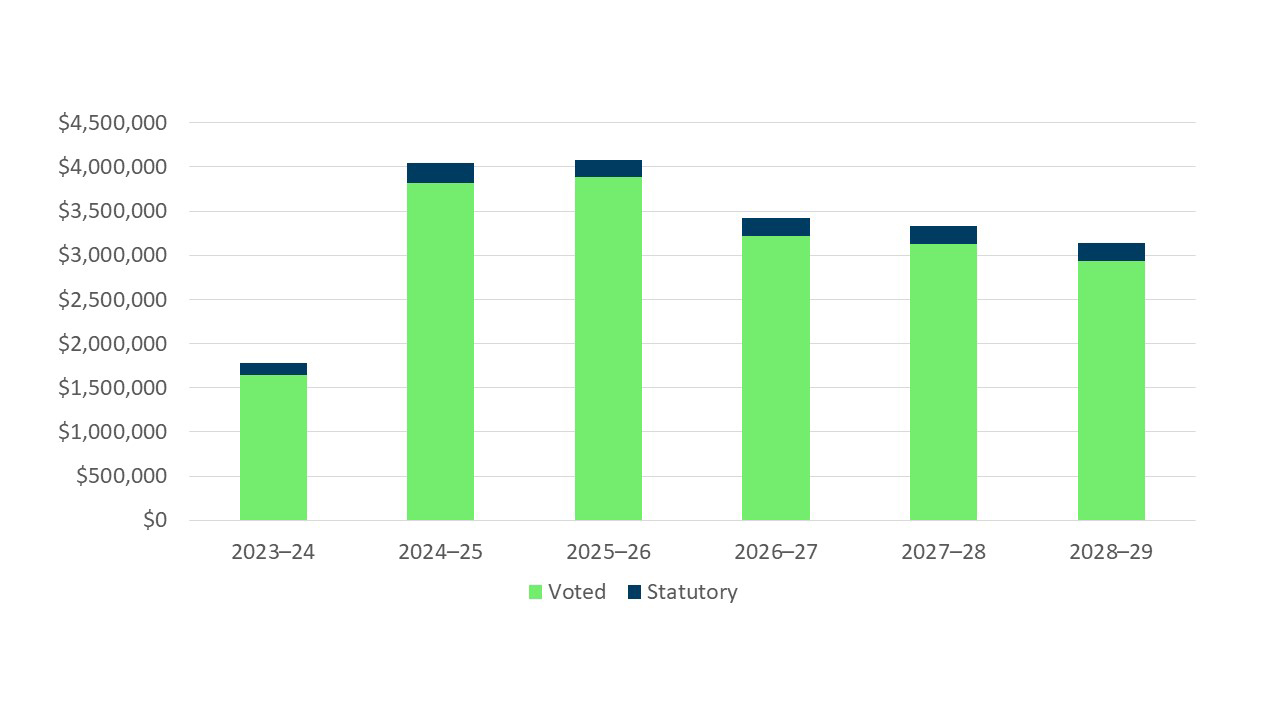
Graph 1 summarizes the department's approved voted and statutory funding from 2023-24 to 2028-29.
Text description of graph 1
| Fiscal year | Total | Voted | Statutory |
|---|---|---|---|
| 2023-2024 | 1,786,147 | 1,641,467 | 144,680 |
| 2024-2025 | 4,040,229 | 3,814,333 | 225,896 |
| 2025-2026 | 4,079,343 | 3,891,070 | 188,273 |
| 2026-2027 | 3,419,602 | 3,217,793 | 201,809 |
| 2027-2028 | 3,326,602 | 3,124,793 | 201,809 |
| 2028-2029 | 3,141,602 | 2,939,793 | 201,809 |
Analysis of statutory and voted funding over a six-year period
Following the appointment of the President and the Commission's receipt of financial delegation in June 2023, fiscal year 2023–24 constituted a partial year of operations, resulting in lower overall expenditures. Fiscal year 2024–25 represented the Commission's first complete year of operations, with spending reflecting our continued efforts to build and reach full organizational capacity including the successful relocation to permanent office space in downtown Ottawa.
By fiscal year 2028–29, the Commission is expected to have transitioned to a reduced steady state, with start-up costs fully absorbed and expenditures stabilizing on an ongoing basis; including reduction impacts of the Comprehensive Expenditure Review (CER).
For further information on the Law Commission of Canada's departmental appropriations, consult the 2026-27 Main Estimates.
Future-oriented condensed statement of operations
The future-oriented condensed statement of operations provides an overview of the Law Commission of Canada's operations for 2025-26 to 2026-27.
Table 8 Future-oriented condensed statement of operations for the year ended March 31, 2027 (dollars)
Table 8 summarizes the expenses and revenues which net to the cost of operations before government funding and transfers for 2025-26 to 2026-27. The forecast and planned amounts in this statement of operations were prepared on an accrual basis. The forecast and planned amounts presented in other sections of the Departmental Plan were prepared on an expenditure basis. Amounts may therefore differ.
| Financial information | 2025-2026 Forecast results | 2026-2027 Planned results | Difference (Planned results minus forecasted) |
|---|---|---|---|
| Total expenses | 4,574,519 | 3,997,257 | (577,262) |
| Total revenues | 0 | 0 | 0 |
| Net cost of operations before government funding and transfers | 4,574,519 | 3,997,257 | (577,262) |
Analysis of forecasted and planned results
The difference from 2026-27 planned results and 2025-26 forecast results primarily reflects reductions from the Comprehensive Expenditure Review (CER) in addition to prior adjustments in authorities that brought the Commission to its steady state funding profile.
A more detailed Future-Oriented Statement of Operations and associated Notes for 2026-27, including a reconciliation of the net cost of operations with the requested authorities, is available on the Law Commission of Canada's website.
Human resources
This section presents an overview of the department's actual and planned human resources from 2023-24 to 2028-29.
Table 9: Actual human resources for core responsibilities and internal services
Table 9 shows a summary of human resources, in full-time equivalents, for the Law Commission of Canada's core responsibilities and for its internal services for the previous three fiscal years. Human resources for the 2025–26 fiscal year are forecasted based on year to date.
| Core responsibilities and Internal Services | 2023-2024 Actual full-time equivalents | 2024-2025 Actual full-time equivalents | 2025-2026 Forecasted full-time equivalents |
|---|---|---|---|
| Law Review | 4 | 7 | 8 |
| Subtotal | 4 | 7 | 8 |
| Internal services | 3 | 4 | 5 |
| Total | 7 | 11 | 13 |
Analysis of human resources over the last three years
As a new micro-organization, the Commission relies on employees in highly specialized roles, making retention and timely staffing essential. Recruiting and keeping skilled personnel remains a persistent challenge, which the Commission addresses through proactive hiring practices and, where feasible, flexible work arrangements.
During its inaugural partial year (2023–24) and first full year (2024–25), the Commission continued to recruit key personnel and stabilize core management positions, including the Executive Director and Director General of Strategy, Policy and Planning. Recruitment efforts will continue in 2025–26 and beyond, notably with the fellowship program, which provides outstanding recent law graduates with intensive research experience, as well as an opportunity to develop critical analysis and writing abilities.
Table 10: Human resources planning summary for core responsibilities and internal services
Table 10 shows information on human resources, in full-time equivalents, for each of the Law Commission of Canada's core responsibilities and for its internal services planned for the next three years.
| Core responsibilities and internal services | 2026-2027 Planned full-time equivalents | 2027-2028 Planned full-time equivalents | 2028-2029 Planned full-time equivalents |
|---|---|---|---|
| Law Review | 13 | 13 | 13 |
| Subtotal | 13 | 13 | 13 |
| Internal services | 5 | 5 | 5 |
| Total | 18 | 18 | 18 |
Analysis of human resources for the next three years
The planned full-time equivalents are expected to be steady over the next three fiscal years and there are no significant variances anticipated.
Federal tax expenditures
The Law Commission of Canada's Departmental Plan does not include information on tax expenditures.
The tax system can be used to achieve public policy objectives through the application of special measures such as low tax rates, exemptions, deductions, deferrals and credits. The Department of Finance Canada publishes cost estimates and projections for these measures each year in the Report on Federal Tax Expenditures.
This report also provides detailed background information on tax expenditures, including descriptions, objectives, historical information and references to related federal spending programs as well as evaluations and GBA Plus of tax expenditures.
Corporate information
Departmental profile
Appropriate minister(s):
The Honourable Sean Fraser
Institutional head:
Shauna Van Praagh
Ministerial portfolio:
Justice
Enabling instrument(s):
Year of incorporation / commencement:
1997
Departmental contact information
Mailing address:
PO Box 56068
Ottawa RPO Minto Place
Ottawa, Ontario, K1R 7Z1
Email:
Website(s):
Definitions
List of terms
- appropriation (crédit)
- Any authority of Parliament to pay money out of the Consolidated Revenue Fund.
- budgetary expenditures (dépenses budgétaires)
- Operating and capital expenditures; transfer payments to other levels of government, organizations or individuals; and payments to Crown corporations.
- core responsibility (responsabilité essentielle)
- An enduring function or role performed by a department. The intentions of the department with respect to a core responsibility are reflected in one or more related departmental results that the department seeks to contribute to or influence.
- Departmental Plan (plan ministériel)
- A report on the plans and expected performance of an appropriated department over a 3 year period. Departmental Plans are usually tabled in Parliament each spring.
- departmental result (résultat ministériel)
- A consequence or outcome that a department seeks to achieve. A departmental result is often outside departments' immediate control, but it should be influenced by program-level outcomes.
- departmental result indicator (indicateur de résultat ministériel)
- A quantitative measure of progress on a departmental result.
- departmental results framework (cadre ministériel des résultats)
- A framework that connects the department's core responsibilities to its departmental results and departmental result indicators.
- Departmental Results Report (rapport sur les résultats ministériels)
- A report on a department's actual accomplishments against the plans, priorities and expected results set out in the corresponding Departmental Plan.
- full-time equivalent (équivalent temps plein)
- A measure of the extent to which an employee represents a full person-year charge against a departmental budget. For a particular position, the full-time equivalent figure is the ratio of number of hours the person actually works divided by the standard number of hours set out in the person's collective agreement.
- Gender-based Analysis Plus (GBA Plus) (analyse comparative entre les sexes plus ACS Plus)
-
Is an analytical tool used to support the development of responsive and inclusive policies, programs, and other initiatives. GBA Plus is a process for understanding who is impacted by the issue or opportunity being addressed by the initiative; identifying how the initiative could be tailored to meet diverse needs of the people most impacted; and anticipating and mitigating any barriers to accessing or benefitting from the initiative. GBA Plus is an intersectional analysis that goes beyond biological (sex) and socio-cultural (gender) differences to consider other factors, such as age, disability, education, ethnicity, economic status, geography (including rurality), language, race, religion, and sexual orientation.
Using GBA Plus involves taking a gender- and diversity-sensitive approach to our work. Considering all intersecting identity factors as part of GBA Plus, not only sex and gender, is a Government of Canada commitment.
- government priorities (priorités gouvernementales)
- For the purpose of the 2026-27 Departmental Plan, government priorities are the high-level themes outlining the government's agenda in the 2025 Speech from the Throne.
- horizontal initiative (initiative horizontale)
- An initiative where two or more federal departments are given funding to pursue a shared outcome, often linked to a government priority.
- Indigenous business (enterprise autochtones)
- Requirements for verifying Indigenous businesses for the purposes of the departmental result report are available through the Indigenous Services Canada Mandatory minimum 5% Indigenous procurement target website.
- non‑budgetary expenditures (dépenses non budgétaires)
- Non-budgetary authorities that comprise assets and liabilities transactions for loans, investments and advances, or specified purpose accounts, that have been established under specific statutes or under non-statutory authorities in the Estimates and elsewhere. Non-budgetary transactions are those expenditures and receipts related to the government's financial claims on, and obligations to, outside parties. These consist of transactions in loans, investments and advances; in cash and accounts receivable; in public money received or collected for specified purposes; and in all other assets and liabilities. Other assets and liabilities, not specifically defined in G to P authority codes are to be recorded to an R authority code, which is the residual authority code for all other assets and liabilities.
- performance (rendement)
- What a department did with its resources to achieve its results, how well those results compare to what the department intended to achieve, and how well lessons learned have been identified.
- performance indicator (indicateur de rendement)
- A qualitative or quantitative means of measuring an output or outcome, with the intention of gauging the performance of a department, program, policy or initiative respecting expected results.
- plan (plan)
- The articulation of strategic choices, which provides information on how a department intends to achieve its priorities and associated results. Generally, a plan will explain the logic behind the strategies chosen and tend to focus on actions that lead to the expected result.
- planned spending (dépenses prévues)
-
For Departmental Plans and Departmental Results Reports, planned spending refers to those amounts presented in Main Estimates.
A department is expected to be aware of the authorities that it has sought and received. The determination of planned spending is a departmental responsibility, and departments must be able to defend the expenditure and accrual numbers presented in their Departmental Plans and Departmental Results Reports.
- program (programme)
- Individual or groups of services, activities or combinations thereof that are managed together within the department and focus on a specific set of outputs, outcomes or service levels.
- program inventory (répertoire des programmes)
- Identifies all the department's programs and describes how resources are organized to contribute to the department's core responsibilities and results.
- result (résultat)
- A consequence attributed, in part, to an department, policy, program or initiative. Results are not within the control of a single department, policy, program or initiative; instead they are within the area of the department's influence.
- statutory expenditures (dépenses législatives)
- Expenditures that Parliament has approved through legislation other than appropriation acts. The legislation sets out the purpose of the expenditures and the terms and conditions under which they may be made.
- target (cible)
- A measurable performance or success level that an organization, program or initiative plans to achieve within a specified time period. Targets can be either quantitative or qualitative.
- voted expenditures (dépenses votées)
- Expenditures that Parliament approves annually through an appropriation act. The vote wording becomes the governing conditions under which these expenditures may be made.