
Military Grievances External Review Committee 2026-27 Departmental plan
Contents
- At a glance
- From the Chairperson and Chief Executive Officer
- Plans to deliver on core responsibilities and internal services
- Department-wide considerations
- Planned spending and human resources
- Supplementary information tables
- Federal tax expenditures
- Corporate information
- Definitions
Copyright information
The Honourable David J. McGuinty, MP
Minister of National Defence
Cat. No. DG2-6E-PDF
ISSN 2371-669X
© His Majesty the King in Right of Canada, as represented by the Minister of National Defence, 2026
At a glance
This departmental plan details the Military Grievances External Review Committee’s (the Committee) priorities, plans, and associated costs for the upcoming three fiscal years.
These plans align with the priorities outlined in the Mandate Letter, as well as the Committee’s Vision, mission, raison d’être and operating context.
Key priorities
The Committee identified the following key priorities for 2026-27:
- The People and Culture
- Innovation and Transformation
- Sustainability and Stewardship
Comprehensive Expenditure Review
The government is committed to restraining the growth of day-to-day operational spending to make investments that will grow the economy and benefit Canadians.
The Committee does not have planned reductions under the Comprehensive Expenditure Review.
The Committee will, however, respect the spirit of the exercise by doing the following:
- Continue streamlining its internal processes and leveraging technology to realize additional efficiencies. Those savings will be reinvested to accelerate the production of findings and recommendations (F&R) reports;
- Actively support public servants affected by organizational changes by prioritizing internal options, such as Priority and Workforce Adjustment candidates, and making additional efforts to match their skills to the Committee needs before considering external hiring.
- Limiting travel expenditures by prioritizing virtual collaboration, and reserving in-person travel only for essential operational requirements;
- Continue to work collaboratively and actively seek opportunities to partner with other departments for common services and shared solutions;
- Optimize training spending by shifting more learning to in-house facilitation and continue to promote Canada School of Public Service offerings, reducing external training costs while maintaining quality;
- Increase collaboration across internal services teams to share resources where possible, reducing the need for external consultants;
- Monitor operational expenditures monthly to maintain fiscal agility, allowing the Committee to proactively reallocate funding in response to shifting priorities and ensure resources remain aligned with operational needs throughout the year; and
- Carefully review all existing and proposed discretionary professional services contracts to assess their value added and relevance to the Committee, and whether the work can be effectively performed by internal staff before seeking external support.
This departmental plan reflects these measures.
Highlights for the Committee in 2026-27
The Committee is strategically focused on three high-impact initiatives for 2026-27 to ensure a healthy workforce, sustainable digital transformation, and long-term fiscal stability. The Committee’s first priority is “The People and the Culture,” where it will ensure the well-being of employees during a time of organizational transformation and respond to feedback received through the Public Service Employee Survey. This includes a revised performance management framework focused on personal accountability and ensuring that the Committee cultivates a highly engaged and motivated workforce. The second priority is “Innovation and Transformation,” which will focus on new ways of working, including leveraging artificial intelligence (AI) and modern digital tools. This priority also encompasses process improvements and innovative practices designed to enhance the efficiency and effectiveness of the Committee’s program delivery and internal services. Finally, the Committee’s third priority, “Sustainability and Stewardship” will prioritize achieving long-term fiscal stability by engaging with our strategic partners with a view to strengthen the organization’s resource foundations and optimize resource management to ensure the organization remains stable and capable of delivering on its mandate well into the future.
In 2026-27, total planned spending (including internal services) for the Committee is $8,328,722 and total planned full-time equivalent (FTE) staff (including internal services) is 52.
Summary of planned results
The following provides a summary of the results the department plans to achieve in 2026-27 under its main areas of activity, called “core responsibilities.”
-
Core responsibility 1: Independent review of military grievances
In 2026-27, the Committee will continue to work on improving its efficiency and effectiveness. This will include additional refinements to its grievance review process, updating case management documentation to align with the updated review process, aligning the Committee’s F&R reports with Court and Tribunal best practices, and supporting employees with relevant training. The Committee will continue to monitor and adapt work processes after analysing the results from 2025-26, to ensure it remains agile and responsive to the needs of the Canadian Armed Forces (CAF) grievance system.
- Planned spending: $5,980,149
- Planned human resources: 39
More information about the Independent review of military grievances can be found in the full plan.
For complete information on the Committee’s total planned spending and human resources, read the Planned spending and human resources section of the full plan.
From the Chairperson and Chief Executive Officer

Kelly Walsh
Chairperson and Chief Executive Officer
I am pleased to present the 2026-27 Departmental Plan for the Military Grievances External Review Committee. My priority is to ensure that the Committee remains a modern and agile quasi-judicial tribunal, that instills confidence in the CAF grievance system through its independent review of grievances.
Building on the momentum of 2025-26, this next fiscal year will focus on continuous improvement and evolution. We have refined our Departmental Results and Indicators to better align with current priorities and service standards, specifically targeting caseload management and turnaround times.
To achieve these goals, the Committee will focus on three strategic pillars: the People and the Culture; Innovation and Transformation; and Sustainability and Stewardship. We believe that employee engagement and an inclusive work environment are paramount to ensuring a healthy workplace; therefore, we will continue to foster a culture that supports our dedicated workforce. Simultaneously, we will continue refining our grievance review process to expedite processing times and reduce the volume of active cases, while ensuring our operations align with the evolving changes in the CAF grievance process. This transformation includes continuing to explore the safe and responsible use of AI to increase efficiency and effectiveness within our operations. Finally, in line with the Comprehensive Expenditure Review, the Committee will continue to make decisions that support these measures, assuring responsible resource management and prioritizing the achievement of long-term fiscal stability.
I am confident that our collaborative, results-oriented approach will allow us to meet our operational priorities and continue to serve as an independent and impartial voice within the CAF grievance process.
Kelly Walsh
Chairperson and Chief Executive Officer
Plans to deliver on core responsibilities and internal services
Core responsibilities and internal services
Core responsibility 1: Independent review of military grievances
Description
The National Defence Act, Section 29.2 (1) and (2), requires the Military Grievances External Review Committee to review every grievance referred to it by the Final Authority (FA) and to provide F&R in writing to the FA and the officer or non-commissioned member who submitted the grievance.
Quality of life impacts
The Committee’s core responsibility contributes to the “Good Governance” domain of the Quality of Life Framework for Canada, and more specifically, under the following Justice and human rights indicators: “Discrimination and unfair treatment” and “Access to fair and equal justice.” Indeed, the Committee concretely contributes by conducting an independent review of every grievance referred to it and by providing quality F&R reports to the FA and the CAF member who submitted the grievance.
Indicators, results and targets
This section presents details on the department’s indicators, the actual results from the three most recently reported fiscal years, the targets and target dates for the Independent review of military grievances. Details are presented by departmental result.
Table 1: The Committee effectively manages its caseload
| Departmental Result Indicators | Actual Results | 2026-27 Target | Date to achieve target |
|---|---|---|---|
| The number of active grievances in the Committee’s caseload requiring a F&R report | 2022-23: N/A 2023-24: N/A 2024-25: N/A |
The total number of active grievances in the Committee’s caseload as of March 31, annually is less than 300 | March 31, 2027 |
| % of grievance files assigned to a Committee Member within 45 business days of receipt from the CAF (service standard) | 2022-23: N/A 2023-24: N/A 2024-25: N/A |
75% of grievance files are assigned to a Committee Member within 45 business days of receipt from the CAF | March 31, 2027 |
Table 2: F&R on all referred military grievances are provided in a timely manner
| Departmental Result Indicators | Actual Results | 2026-27 Target | Date to achieve target |
|---|---|---|---|
| % of written F&R that are issued within six months of receipt from the CAF (service standard) | 2022-23: N/A 2023-24: N/A 2024-25: N/A |
At least 75% of F&R issued within 6 months of receipt. | March 31, 2027 |
Table 3: The FA is able to rely on the Committee’s F&R in the military grievances decision-making process
| Departmental Result Indicators | Actual Results | 2026-27 Target | Date to achieve target |
|---|---|---|---|
| % of F&R where the FA disagreed on the basis of error in law or fact | 2022-23: N/A 2023-24: N/A 2024-25: N/A |
Less than 1% of the cases upon which the FA disagrees on the basis of error in law or fact | March 31, 2027 |
Additional information on the detailed results and performance information for the Committee’s program inventory is available on GC InfoBase.
Plans to achieve results
The following section describes the planned results for the Independent review of military grievances in 2026-27.
The Committee effectively manages its caseload
Results we plan to achieve
- To ensure the total number of active grievances remains below the threshold of 300 by fiscal year-end, the Committee will implement a proactive inventory management strategy. This strategy will include prioritizing older files and optimizing workflow distribution to ensure a steady throughput of cases, thereby preventing an accumulation of active files.
- The Committee is committed to meeting its service standard of assigning 75% of files to a Committee Member within 45 business days of receipt. The Committee will achieve this by refining its initial case-triage process to ensure files are "review-ready" within the time period of the service standard which will help with reducing administrative delays once a file is assigned to a review team.
- The Committee will continue to refine its grievance review process to identify new efficiencies. A key component of this effort will include reviewing the training curriculum to shorten the onboarding period for new employees, which will maximize the Committee’s internal capacity and decrease the supervisory burden on Team Leaders. Additionally, the Committee will review position requirements and staffing practices to ensure that prospective employees possess the appropriate abilities and experience as it is crucial in maintaining the Committee’s capacity to complete F&Rs.
- To ensure the Committee remains responsive to a fluctuating caseload, the Committee will monitor operational expenditures regularly to allow for the reallocation of funding. This will ensure that resources are directed to where they are most needed, and used effectively.
- By targeting the root causes of delays in the review process, the Committee will aim to achieve a measurable reduction in the overall time required to process a grievance, which will lead to a sustained decrease in the total active caseload.
F&R on all referred military grievances are provided in a timely manner
Results we plan to achieve
- To meet the target of issuing at least 75% of F&R reports within six months of receipt, the Committee will focus on accelerating the intake stage of the review process. This involves leveraging a streamlined drafting process and setting strict internal milestones to ensure that grievances progress from assignment to final issuance without unnecessary bottlenecks and delays.
- The Committee will explore how AI, along with other digital tools, can be strategically integrated into its process to improve efficiency and support high-quality reviews. By evaluating these opportunities, the Committee aims to leverage technology to enhance its operational capacity safely and effectively.
- The Committee will realign its case management system to integrate the latest improvements to its grievance review process. This update will ensure that the Committee case management system is fully synchronized with our operational process.
- In addition, the Committee’s program reporting modules will be updated to accurately track and measure the impact of these improvements. This data-driven approach will allow the Committee to monitor how specific efficiencies accelerate the delivery of timely F&R reports.
The FA is able to rely on the Committee’s F&R in the military grievances decision-making process
Results we plan to achieve
- To ensure the highest level of reliability, the Committee will maintain rigorous quality control over its legal review of F&R reports to ensure legal sufficiency and factual consistency. The objective is to ensure that less than 1% of cases involve a disagreement from the FA based on an error in law or fact. The Committee will achieve this through continuous learning for our Grievance Officers, Team Leaders and Legal Counsels and by closely monitoring Federal Court decisions and evolving military jurisprudence to ensure that F&R are always grounded in the most current legal standards and military policies.
- The Committee is evolving its F&R reports to align with Court and Tribunal best practices. This approach will result in more streamlined reports for both the FA and individual grievors.
- The Committee will explore the use of AI tools to ensure its reports are accessible, and use plain and inclusive language.
- The Committee will continue to provide the FA with F&R reports that are clear, complete, and useful. The focus remains on maintaining the highest standards of independent analysis to ensure the integrity of the CAF grievance system.
Planned resources to achieve results
Table 4: Planned resources to achieve results for the Independent review of military grievances
| Resource | Planned |
|---|---|
| Spending | $5,980,149 |
| FTEs | 39 |
Complete financial and human resources information for the Committee’s program inventory is available on GC InfoBase.
Program inventory
The Independent review of military grievances is supported by the following programs:
- Independent review of military grievances
- Internal services
Additional information related to the program inventory for the Independent review of military grievances is available on the Results page on GC InfoBase.
Summary of changes to reporting framework since last year
The Committee updated its Departmental Results and Departmental Results Indicators for 2026-27. Two new indicators were added with the goal of guiding the Committee in effectively managing its caseload, which has increased significantly in the last number of years. Another existing indicator was changed to ensure it aligns with the Committee’s current service standard of aiming to complete 75% of its F&R reports within six months of receipt of the grievance. Finally, the Committee removed an indicator that linked to evaluating the usefulness, clarity, and completeness of its F&R reports to the FA. Instead, the Committee has added an indicator to measure the quality of its F&R reports based on if the FA disagrees with the Committee on the basis of error in law or fact.
Internal services
Description
Internal services are the services that are provided within a department so that it can meet its corporate obligations and deliver its programs. There are 10 categories of internal services:
- acquisition management services
- communications services
- financial management services
- human resources management services
- information management services
- information technology services
- legal services
- material management services
- management and oversight services
- real property management services
Plans to achieve results
This section presents details the department’s plans to achieve results and meet targets for internal services.
In 2026-27, the Committee will be turning its focus to the following three pillars: the People and Culture; Innovation and Transformation; and Sustainability and Stewardship. These distinct pillars were chosen to reflect our priorities focused on encouraging employee engagement, promoting an inclusive work environment, optimizing internal process, and leveraging digital solutions, all while aligning with prevalent Government of Canada’s (GC) priorities.
The People and Culture
- In 2026-27, the Committee will cultivate a highly engaged, trained and motivated workforce connected to the workplace. This will be accomplished by updating our internal communications strategy; fostering employee engagement; and encouraging professional development and training curriculum for its employees.
- The Committee will strengthen organizational accountabilities and foster a culture of personal accountability. This will be accomplished by conducting a review of the Committee’s performance objectives and implementing an optimal organizational structure.
- Finally, the Committee will advance a values-based culture and foster reconciliation, anti-racism, accessibility, equity, diversity, and inclusion in the public service. This will be accomplished by identifying and promoting information in these areas including mental health, official languages, and future of work; identifying, removing or mitigating any potential biases and barriers so the workforce reflects the diversity of Canada's population; and advancing accessibility by creating barrier-free workplaces and services.
Innovation and Transformation
- In 2026-27, the Committee will build a culture of innovation that supports government priorities. This will be accomplished by planning for the Committee’s office move and colocation project; preparing for the integration of Day Force (a HR management system); updating the external communications plan; improving its security posture; and exploring opportunities to automate financial processes and enhance financial reporting.
- Additionally, the Committee will simplify internal processes to enhance efficiency. This will be accomplished by continuing the review of the grievance process, including the case management system, and updating associated documentation.
- In line with this, the Committee will leverage digital tools and technologies to improve productivity and effectiveness. This will be accomplished by pursuing AI projects and automation; as well as revising and optimizing the Committee’s work tools, specifically its guidelines and policies.
- Lastly, the Committee will prepare for the future migration to a new financial system. This will be accomplished by initiating readiness activities, including assessing business needs, mapping current processes, identifying gaps, and planning transition requirements.
Sustainability and Stewardship
- In 2026-27, the Committee will work to attain long term fiscal stability and responsible resource management. This will be accomplished by establishing an integrated Human Resources and financial plan laying forth our intended approach.
- The Committee will align medium and long-term financial planning with organizational and governmental priorities. This will be accomplished by closely monitoring the operating and maintenance budget and determining the resources necessary to carry out its mandate.
- As well, the Committee will improve workplace planning to ensure employees have a functional, efficient, and supportive work environment, while optimizing space usage and accommodating evolving organizational needs.
- Finally, the Committee will strengthen collaboration and engagement with stakeholders.
Planned resources to achieve results
Table 5: Planned resources to achieve results for internal services this year
| Resource | Planned |
|---|---|
| Spending | $2,434,672 |
| FTEs | 13 |
Complete financial and human resources information for the Committee’s program inventory is available on GC InfoBase.
Planning for contracts awarded to Indigenous businesses
GC departments are to meet a target of awarding at least 5% of the total value of contracts to Indigenous businesses each year.
In the spirit of advancing economic reconciliation with Indigenous Peoples, the GC has established a mandatory minimum target of awarding at least 5% of the value of federal contracts to businesses owned and led by Indigenous Peoples. As a small organization with limited contracting activities, the Committee will continue to advance its procurement objectives through a proactive and inclusive approach, aiming to meet and exceed, where possible, the established target.
For the 2026-27 fiscal year, the Committee will ensure that all contract opportunities are systematically assessed to identify potential participation by Indigenous businesses. While the Committee will pursue opportunities to surpass the 5% target when feasible, its organizational objective will remain at 5% for 2026-27. This reflects the constraints associated with a small procurement volume while reaffirming the Committee’s ongoing commitment to supporting Indigenous economic participation.
Table 6: Percentage of contracts planned and awarded to Indigenous businesses
| 5% Reporting Field | 2024-25 Actual Result | 2025-26 Forecasted Result | 2026-27 Planned Result |
|---|---|---|---|
| Total percentage of contracts with Indigenous businesses | 15.78 % | 20.9 % | 5 % |
Department-wide considerations
In this section
Related government priorities
Gender-based Analysis Plus
To ensure inclusive outcomes for Canadians, the Committee integrates Gender-Based Analysis Plus (GBA Plus) into its core responsibility of the Independent review of military grievances. This work directly supports the “Good Governance” domain of the Quality of Life Framework for Canada, specifically advancing the indicators of “Access to fair and equal justice” and reducing “Discrimination and unfair treatment.” In 2026-27, the Committee will measure the impact of its program by reviewing data collection practices related to grievor self-identification. To support these goals, the Committee will maintain a mandatory GBA Plus training completion rate above 75% and foster active leadership through its GBA Plus Champion and Focal Point who will continue to participate in internal consultation groups, as well as government-wide committees and meetings focused on GBA Plus. The Committee will also continue to share various government-wide inclusive events, promote tools and resources to ensure employees are applying GBA Plus considerations to their day-to-day work and will begin implementing the GBA Plus-related initiatives outlined in its 2026-29 Accessibility plan.
United Nations 2030 Agenda for Sustainable Development and the UN Sustainable Development Goals
While the Committee’s core responsibility focuses on the Independent review of military grievances, we recognize the broader context of the United Nations 2030 Agenda for Sustainable Development. Moreover, the Committee actively contributes to the advancement of the 2030 Agenda through targeted actions aligned with Sustainable Development Goals 10, 12, and 13. By ensuring a fair and just grievance resolution process within the CAF, the Committee contributes to the advancement of several key sustainable development principles, including the promotion of peace, justice, and strong institutions; the reduction of inequalities; and the promotion of gender equality. Furthermore, the Committee will integrate sustainability principles into its internal operations, such as minimizing its environmental footprint and promoting inclusivity and diversity within its own workplace. These internal efforts will contribute to achieving broader sustainability goals.
More information on the Committee’s contributions to Canada’s Federal Implementation Plan on the 2030 Agenda and the Federal Sustainable Development Strategy can be found in our Departmental Sustainable Development Strategy.
Artificial Intelligence
Following the development of an AI roadmap, the Committee will focus on operationalizing AI to increase productivity and optimize operating costs. To set a strong foundation, we will first develop an internal policy or guidance specifically tailored to our organization. The Committee will seek “quick wins” by leveraging tools that are already available to the GC, such as CanChat and GC Translation, that require minimal integration but provide immediate, tangible benefits and support organizational change management.
For 2026-27, the Committee will prioritize workforce readiness by providing employees with training on the safe and responsible use of AI, and by ensuring alignment with government-wide ethical standards. To scale these efforts, the Committee will continue to work closely with other small organizations or departments to share best practices and reduce duplication of work. These efforts will be supported by an ongoing assessment of the Committee’s data readiness and governance frameworks to ensure that any AI adoption continues to protect the integrity and confidentiality of the grievance review process.
Key risks
The Committee operates in a dynamic environment characterized by evolving operational needs, unpredictable caseloads, and constantly emerging new challenges. Maintaining operational agility and adaptability is crucial to ensure the Committee can effectively respond to these uncertainties. Potential risks include unforeseen fluctuations in the volume and complexity of grievance referrals, the emergence of new policy or legislative requirements, and the potential for unforeseen disruptions to operations, such as technological challenges or unforeseen staffing turnover. To mitigate these risks, the Committee will prioritize continuous improvement and a proactive approach to risk management. This includes:
- Reviewing its risks every quarter to regularly identify, assess, and mitigate potential risks to operational effectiveness and service delivery.
- Cultivating a culture of continuous learning and adaptation to foster a flexible and adaptable workforce capable of responding effectively to unforeseen challenges and embracing new opportunities.
- Proactively monitoring caseload trends and continuously adapting its operations for optimal efficiency.
By proactively addressing and mitigating these potential risks and fostering a culture of adaptability, the Committee will ensure it is an organization that instills confidence in the CAF grievance system.
Planned spending and human resources
This section provides an overview of the Committee’s planned spending and human resources for the next three fiscal years and of planned spending for 2026-27 with actual spending from previous years.
Spending
This section presents an overview of the department's planned expenditures from 2023-24 to 2028-29.
Budgetary performance summary
Table 7: Three-year spending summary for core responsibilities and internal services (dollars)
| Core responsibilities and Internal services | 2023-24 Actual Expenditures | 2024-25 Actual Expenditures | 2025-2026 Forecast Spending |
|---|---|---|---|
| Independent review of military grievances | $5,221,790 | $5,859,315 | $6,080,999 |
| Subtotal | $5,221,790 | $5,859,315 | $6,080,999 |
| Internal services | $2,540,299 | $2,543,878 | $2,606,143 |
| Total | $7,762,089 | $8,403,193 | $8,687,142 |
Analysis of the past three years of spending
A noticeable increase in actual spending in 2024–25 compared to 2023-24 primarily due to higher personnel expenses, driven by an increase in temporary funding received in 2024–25, updated compensation rates, and the staffing of previously vacant positions, including the Chairperson and Full-Time Vice-Chairperson roles.
In 2025–2026, the forecast spending increase is mainly due to the result of positions staffed throughout 2024-25 being fully implemented within the next year.
More financial information from previous years is available on the Finances section of GC Infobase.
Table 8: Planned three-year spending on core responsibilities and internal services (dollars)
| Core responsibilities and Internal services | 2026-27 Planned Spending | 2027-28 Planned Spending | 2028-29 Planned Spending |
|---|---|---|---|
| Independent review of military grievances | $5,890,149 | $6,511,275 | $5,515,010 |
| Subtotal | $5,890,149 | $6,511,275 | $5,515,010 |
| Internal services | $2,434,672 | $2,790,547 | $2,363,576 |
| Total | $8,414,821 | $9,301,822 | $7,878,586 |
Analysis of the next three years of spending
Planned spending in 2027–28 is higher than in 2026–27 primarily due to the $1.4 million in reprofiled funding carried forward from previous fiscal years to support costs associated with the workplace colocation project. Although the Committee’s temporary funding sunsets after 2026–27, the carry‑forward allows spending to temporarily increase in 2027–28 to address office‑move requirements.
By 2028–29, planned spending decreases and falls below 2026–27 levels, as no temporary funding remains and spending returns to levels consistent with the Committee’s permanent reference levels.
More detailed financial information on planned spending is available on the Finances section of GC InfoBase.
Information on the alignment of the Committee’s spending with GC's spending and activities is available on GC InfoBase.
Funding
This section provides an overview of the department’s voted and statutory funding for its core responsibilities and for internal services. For further information on funding authorities, consult the GC budgets and expenditures.
Graph 1 summarizes the department’s approved voted and statutory funding from 2023-24 to 2028-29.
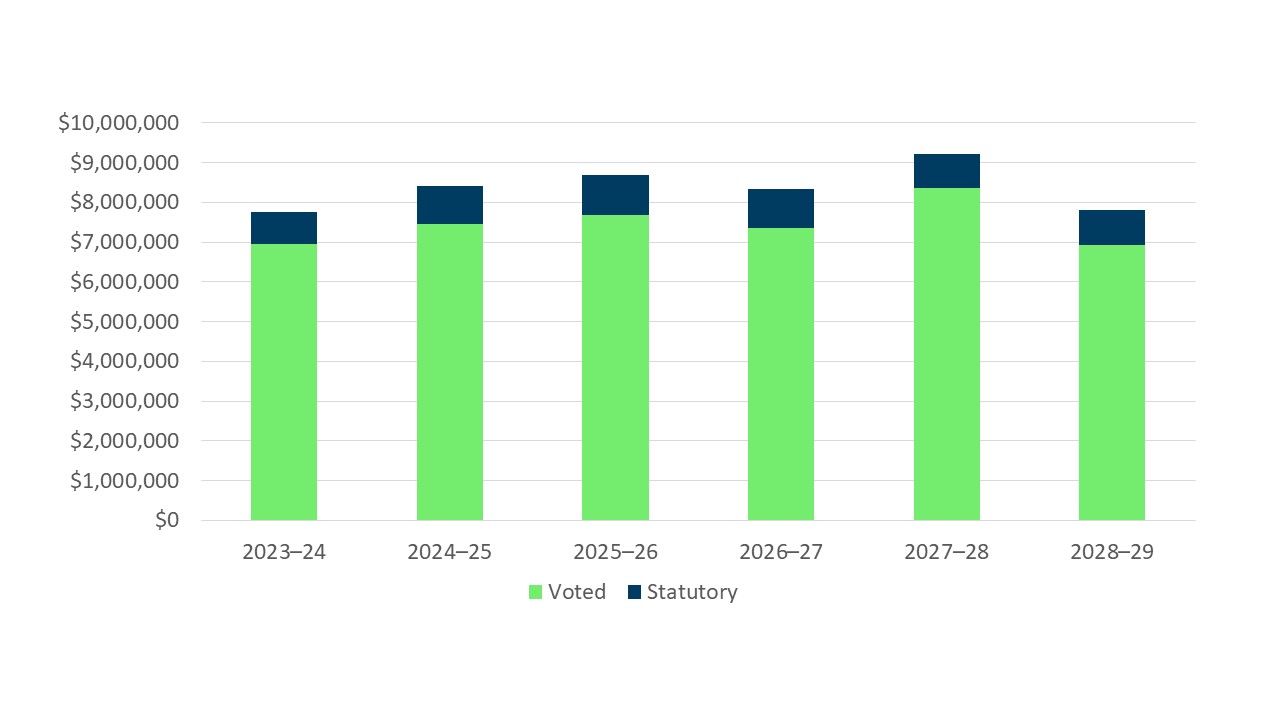
Text description of graph 1
| Fiscal year | Total | Voted | Statutory |
|---|---|---|---|
| 2023-24 | $7,762,089 | $6,945,128 | $816,961 |
| 2024-25 | $8,403,193 | $7,464,848 | $938,345 |
| 2025-26 | $8,687,142 | $7,690,467 | $996,675 |
| 2026-27 | $8,414,821 | $7,376,255 | $1,038,566 |
| 2027-28 | $9,301,822 | $8,364,086 | $937,736 |
| 2028-29 | $7,878,586 | $6,940,850 | $937,736 |
Analysis of statutory and voted funding over a six-year period
The amounts for fiscal years 2023–24 and 2024–25 represent actual spending reported in the Public Accounts. The 2025-26 amounts reflect forecasted spending for the current year based on approved authorities, while amounts from 2026-27 to 2028-29 reflect planned funding currently included in the Committee’s approved reference levels.
For further information on the Committee’s departmental appropriations, consult the 2026-27 Main Estimates.
Future-oriented condensed statement of operations
The future-oriented condensed statement of operations provides an overview of the Committee’s operations for 2025-26 to 2026-27.
Table 9: Future-oriented condensed statement of operations for the year ended March 31, 2027 (dollars)
| Financial information | 2025-26 Forecast results | 2026-27 Planned results | Difference (Planned results minus forecasted) |
|---|---|---|---|
| Total expenses | $9,300,958 | $8,987,271 | ($313,687) |
| Total revenues | $2,000 | $0 | ($2,000) |
| Net cost of operations before government funding and transfers | $9,298,958 | $8,987,271 | ($311,687) |
Analysis of forecasted and planned results
The planned results for 2026–27 are anticipated to be lower than the forecasted results for 2025–26, with a variance of $311,687. The forecasted figures for 2025–26 and planned results for 2026–27 reflect the gradual phasing out of temporary funding received in previous fiscal years. Fiscal year 2025–26 represents the last full year of temporary funding, leading to a slight reduction in planned spending for 2026–27 as funding begins to wind down.
A more detailed Future-Oriented Statement of Operations and associated Notes for 2026-27, including a reconciliation of the net cost of operations with the requested authorities, is available on the Committee’s website.
Human resources
This section presents an overview of the department’s actual and planned human resources from 2023-24 to 2028-29.
Table 10: Actual human resources for core responsibilities and internal services
| Core responsibilities and internal services | 2023-24 Actual FTEs | 2024-25 Actual FTEs | 2025-26 Forecasted FTEs |
|---|---|---|---|
| Independent review of military grievances | 33 | 37 | 39 |
| Subtotal | 33 | 37 | 39 |
| Internal services | 14 | 14 | 14 |
| Total | 47 | 51 | 53 |
Analysis of human resources over the last three years
The total number of FTEs increased noticeably in 2024–25 compared to 2023–24. This growth is primarily attributable to temporary funding received in 2024–25, which supported the staffing of additional positions to strengthen the Committee’s capacity to produce F&R reports. Although a small amount of temporary funding was available in 2023–24, the expanded allocation in 2024–25 enabled more significant staffing increases, including the appointment of the Chairperson and the Full Time Vice Chairperson.
For 2025–26, the forecasted number of FTEs is estimated to slightly increase from 51 to 53. This increase reflects the continuation of temporary funding into 2025–26, as well as the full year impact of positions staffed during 2024–25, which will contribute to the Committee’s workforce for the entire 2025–26 fiscal year.
Table 11: Human resources planning summary for core responsibilities and internal services
| Core responsibilities and internal services | 2026-27 Planned FTEs | 2027-28 Planned FTEs | 2028-29 Planned FTEs |
|---|---|---|---|
| Independent review of military grievances | 39 | 37 | 37 |
| Subtotal | 39 | 37 | 37 |
| Internal services | 13 | 12 | 12 |
| Total | 52 | 49 | 49 |
Analysis of human resources for the next three years
The planned FTEs for the next three fiscal years align with the temporary funding received from the Department of National Defence. This temporary funding supports workforce needs through 2026–27, after which FTE levels begin to decrease in 2027–28 and onward, returning to levels consistent with the organization’s baseline budget.
Supplementary information tables
Information on the Committee's departmental sustainable development strategy can be found on the Committee’s website.
Federal tax expenditures
The Committee’s Departmental Plan does not include information on tax expenditures.
The tax system can be used to achieve public policy objectives through the application of special measures such as low tax rates, exemptions, deductions, deferrals and credits. The Department of Finance Canada publishes cost estimates and projections for these measures each year in the Report on Federal Tax Expenditures.
This report also provides detailed background information on tax expenditures, including descriptions, objectives, historical information and references to related federal spending programs as well as evaluations and GBA Plus of tax expenditures.
Corporate information
Departmental profile
Appropriate minister: The Honourable David J. McGuinty, MP
Institutional head: Kelly Walsh, Chairperson and Chief Executive Officer
Ministerial portfolio: National Defence
Enabling instrument(s): National Defence Act, R.S.C. 1985, c. N-5
Year of incorporation / commencement: 2000
Other: About the Committee
Departmental contact information
Mailing address: 60 Queen St, 9th Floor, Ottawa, Ontario, K1P 5Y7
Telephone: 343-991-2035
Email: mgerc-ceegm@mgerc-ceegm.gc.ca
Website(s): https://www.canada.ca/en/military-grievances-external-review.html
Definitions
List of terms
appropriation (crédit)
Any authority of Parliament to pay money out of the Consolidated Revenue Fund.
budgetary expenditures (dépenses budgétaires)
Operating and capital expenditures; transfer payments to other levels of government, departments or individuals; and payments to Crown corporations.
core responsibility (responsabilité essentielle)
An enduring function or role performed by a department. The intentions of the department with respect to a core responsibility are reflected in one or more related departmental results that the department seeks to contribute to or influence.
Departmental Plan (plan ministériel)
A report on the plans and expected performance of an appropriated department over a 3year period. Departmental Plans are usually tabled in Parliament each spring.
departmental result (résultat ministériel)
A consequence or outcome that a department seeks to achieve. A departmental result is often outside departments’ immediate control, but it should be influenced by program-level outcomes.
departmental result indicator (indicateur de résultat ministériel)
A quantitative measure of progress on a departmental result.
departmental results framework (cadre ministériel des résultats)
A framework that connects the department’s core responsibilities to its departmental results and departmental result indicators.
Departmental Results Report (rapport sur les résultats ministériels)
A report on a department’s actual accomplishments against the plans, priorities and expected results set out in the corresponding Departmental Plan.
full-time equivalent (équivalent temps plein)
A measure of the extent to which an employee represents a full person-year charge against a departmental budget. For a particular position, the full-time equivalent figure is the ratio of number of hours the person actually works divided by the standard number of hours set out in the person’s collective agreement.
gender-based analysis plus (GBA Plus) (analyse comparative entre les sexes plus [ACS Plus])
Is an analytical tool used to support the development of responsive and inclusive policies, programs, and other initiatives. GBA Plus is a process for understanding who is impacted by the issue or opportunity being addressed by the initiative; identifying how the initiative could be tailored to meet diverse needs of the people most impacted; and anticipating and mitigating any barriers to accessing or benefitting from the initiative. GBA Plus is an intersectional analysis that goes beyond biological (sex) and socio-cultural (gender) differences to consider other factors, such as age, disability, education, ethnicity, economic status, geography (including rurality), language, race, religion, and sexual orientation.
Using GBA Plus involves taking a gender- and diversity-sensitive approach to our work. Considering all intersecting identity factors as part of GBA Plus, not only sex and gender, is a Government of Canada commitment.
government priorities (priorités gouvernementales)
For the purpose of the 2026-27 Departmental Plan, government priorities are the high-level themes outlining the government’s agenda in the 2025 Speech from the Throne.
horizontal initiative (initiative horizontale)
An initiative where two or more federal departments are given funding to pursue a shared outcome, often linked to a government priority.
Indigenous business (entreprise autochtones)
Requirements for verifying Indigenous businesses for the purposes of the departmental result report are available through the Indigenous Services Canada Mandatory minimum 5% Indigenous procurement target website.
non‑budgetary expenditures (dépenses non budgétaires)
Non-budgetary authorities that comprise assets and liabilities transactions for loans, investments and advances, or specified purpose accounts, that have been established under specific statutes or under non-statutory authorities in the Estimates and elsewhere. Non-budgetary transactions are those expenditures and receipts related to the government's financial claims on, and obligations to, outside parties. These consist of transactions in loans, investments and advances; in cash and accounts receivable; in public money received or collected for specified purposes; and in all other assets and liabilities. Other assets and liabilities, not specifically defined in G to P authority codes are to be recorded to an R authority code, which is the residual authority code for all other assets and liabilities.
performance (rendement)
What a department did with its resources to achieve its results, how well those results compare to what the department intended to achieve, and how well lessons learned have been identified.
performance indicator (indicateur de rendement)
A qualitative or quantitative means of measuring an output or outcome, with the intention of gauging the performance of an department, program, policy or initiative respecting expected results.
plan (plan)
The articulation of strategic choices, which provides information on how a department intends to achieve its priorities and associated results. Generally, a plan will explain the logic behind the strategies chosen and tend to focus on actions that lead to the expected result.
planned spending (dépenses prévues)
For Departmental Plans and Departmental Results Reports, planned spending refers to those amounts presented in Main Estimates.
A department is expected to be aware of the authorities that it has sought and received. The determination of planned spending is a departmental responsibility, and departments must be able to defend the expenditure and accrual numbers presented in their Departmental Plans and Departmental Results Reports.
program (programme)
Individual or groups of services, activities or combinations thereof that are managed together within the department and focus on a specific set of outputs, outcomes or service levels.
program inventory (répertoire des programmes)
Identifies all the department’s programs and describes how resources are organized to contribute to the department’s core responsibilities and results.
result (résultat)
A consequence attributed, in part, to a department, policy, program or initiative. Results are not within the control of a single department, policy, program or initiative; instead they are within the area of the department’s influence.
statutory expenditures (dépenses législatives)
Expenditures that Parliament has approved through legislation other than appropriation acts. The legislation sets out the purpose of the expenditures and the terms and conditions under which they may be made.
target (cible)
A measurable performance or success level that a department, program or initiative plans to achieve within a specified time period. Targets can be either quantitative or qualitative.
voted expenditures (dépenses votées)
Expenditures that Parliament approves annually through an appropriation act. The vote wording becomes the governing conditions under which these expenditures may be made.