
Insight into approvals, marketing, and pricing of emerging and innovative medicines 2021-2025

Blake Wladkya
Presented at the CDA Symposium 2026, April 22–24, 2026
Objective
High-cost specialty medicines are increasingly dominating the landscape of new medicines launched in Canada and around the world. A growing share of these medicines (including biologics, orphan drugs, and oncology products) have annual treatment costs in the tens or hundreds of thousands of dollars. This study provides an overview of new medicine approvals, sales, relative pricing, characteristics, and access in Canada and internationally.
Approach and data
This study explores the market entry dynamics of new active substances approved by Health Canada, the US Food and Drug Administration (FDA), or the Europe Medicines Agency (EMA) from 2021 to 2025. A new medicine is selected for analysis if it received its first market authorization from any of these regulatory bodies during the study period. The analysis explores the availability, treatment cost, and sales of these medicines using the most recent available data up to Q4-2025. Primary data were sourced from the IQVIA MIDAS® database, with supplemental data from the Health Canada, FDA, and EMA online drug databases, and from Canada’s Drug Agency (CDA-AMC).
Results
1. Trends in approvals of new international medicines
- An average of 54 new medicines were approved each year from 2021 to 2025 with the US approving early and often.
- Orphan medicines consistently made up a significant portion of new approvals.
- High-cost and EDRD† medicines account for the majority of new medicine approvals.
Figure 1A: Number of new medicine approvals, 2021–2025

Figure description
| US Food and Drug Administration (FDA) | European Medicines Agency (EMA) | Health Canada | Total | |
|---|---|---|---|---|
2021 |
50 |
40 |
32 |
55 |
2022 |
41 |
34 |
25 |
48 |
2023 |
60 |
43 |
30 |
62 |
2024 |
47 |
26 |
14 |
52 |
2025 |
52 |
16 |
6 |
53 |
Data source: US Food and Drug Administration, European Medicines Agency, and Health Canada databases.
Figure 1B: Specialty designations and characteristics, new medicine approvals 2021-2025
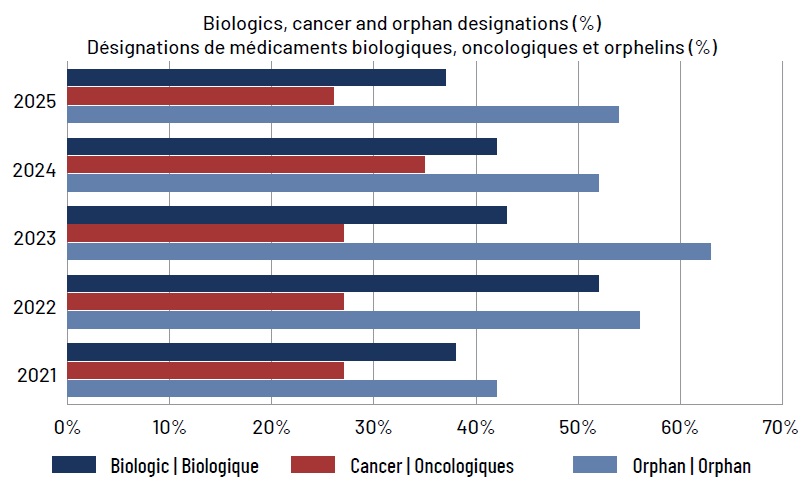
Figure description
| Biologic | Cancer | Orphan | |
|---|---|---|---|
2021 |
38% |
27% |
42% |
2022 |
52% |
27% |
56% |
2023 |
43% |
27% |
63% |
2024 |
42% |
35% |
52% |
2025 |
37% |
26% |
54% |
Data source: US Food and Drug Administration, European Medicines Agency, and Health Canada databases.
Figure 1C: High-cost medicines

Figure description
| High-cost medicines | Expensive drugs for rare diseases (EDRDs) | Non-high-cost medicines | |
|---|---|---|---|
2021 |
21 |
13 |
9 |
2022 |
7 |
17 |
13 |
2023 |
13 |
17 |
6 |
2024 |
10 |
11 |
2 |
Note: This analysis considers new medicines approved between 2021 and 2025 with treatment costs available as of Q3-2025.
*High-cost medicines are defined as those with treatment costs exceeding $10,000 annually or $5,000 per 28-day cycle.
†Expensive drugs for rare diseases (EDRDs) are defined as those with an orphan designation through the FDA or EMA and treatment costs exceeding $100,000 annually or $7,500 per 28-day cycle for oncology.
Data source: IQVIA MIDAS®, 2025 (all rights reserved); Canada’s Drug Agency (CDA-AMC) reports.
2. Trends in sales of new international medicines 2021-2024
- Of the 218 medicines approved from 2021 to 2024, 44 (20%) had sales in Canada by Q4-2024.
- New medicines which have been sold in Canada account for 77% of new medicine sales throughout the OECD. This ranks Canada above the OECD median of 74%, but below 11 OECD countries.
Figure 2A: Share of new medicines* from 2021 to 2024 with available sales and their respective share of OECD sales, by country, Q4-2024
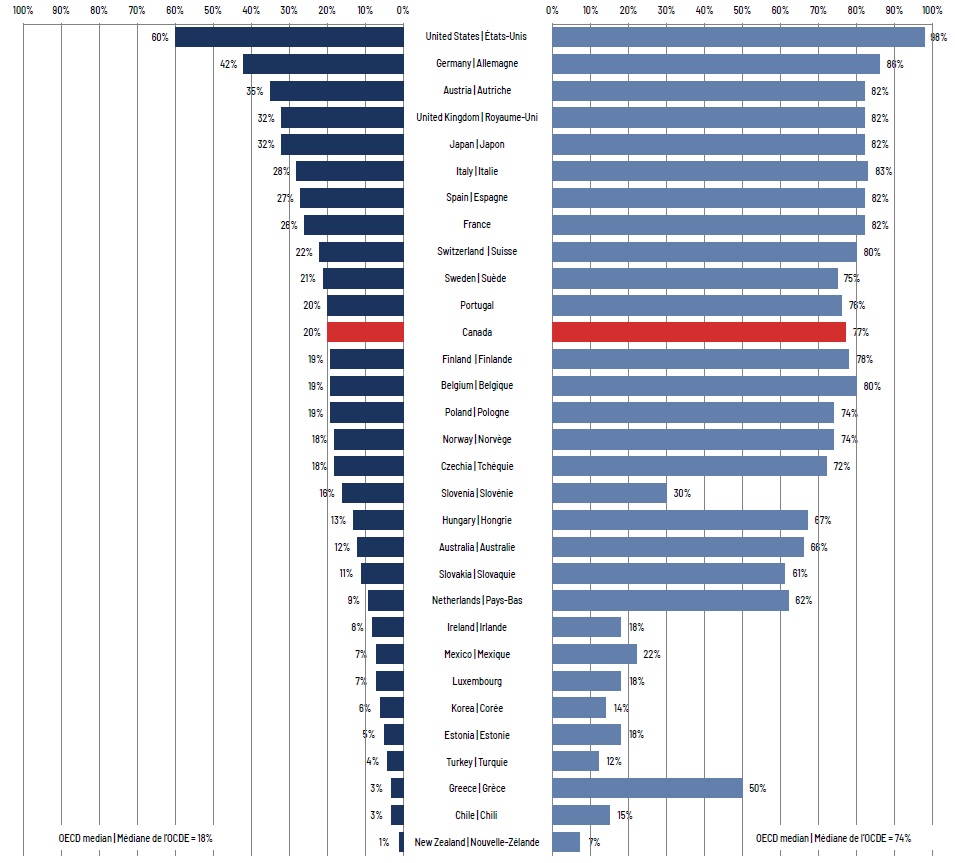
Figure description
| Country | Share of new medicines with available sales | Share of total Organisation for Economic Co-operation and Development new medicine sales |
|---|---|---|
United States |
60% |
98% |
Germany |
42% |
86% |
Austria |
35% |
82% |
United Kingdom |
32% |
82% |
Japan |
32% |
82% |
Italy |
28% |
83% |
Spain |
27% |
82% |
France |
26% |
82% |
Switzerland |
22% |
80% |
Sweden |
21% |
75% |
Portugal |
20% |
76% |
Canada |
20% |
77% |
Finland |
19% |
78% |
Belgium |
19% |
80% |
Poland |
19% |
74% |
Norway |
18% |
74% |
Czechia |
18% |
72% |
Slovenia |
16% |
30% |
Hungary |
13% |
67% |
Australia |
12% |
66% |
Slovakia |
11% |
61% |
Netherlands |
9% |
62% |
Ireland |
8% |
18% |
Mexico |
7% |
22% |
Luxembourg |
7% |
18% |
Korea |
6% |
14% |
Estonia |
5% |
18% |
Türkiye |
4% |
12% |
Greece |
3% |
50% |
Chile |
3% |
15% |
New Zealand |
1% |
7% |
OECD median |
18% |
74% |
Note: Sales are based on manufacturer list prices and include sales for all OECD countries.
* For the purposes of this analysis, new medicines were defined as those that received their first market authorization through the US Food and Drug Administration (FDA), the European Medicines Agency (EMA), or Health Canada.
Data source: IQVIA MIDAS®, 2025 (all rights reserved).
3. Trends in Canadian approvals, and relative pricing 2021-2025
- Health Canada granted initial market authorization to an average of 41 new medicines each year, with an average of 14 (35%) expensive drugs for rare diseases (EDRDs).
- Of 262 new active substances approved internationally between 2019–2023, 188 (72%) had been submitted for Health Canada review by December 2025. Of those, 163 received a Notice of Compliance (NOC), 16 were still under review, and 9 had an unsuccessful review process.
- Foreign to Canadian price ratios for Canadian new medicines show that Canadian prices are typically much lower than the US, though higher on average than the rest of the OECD.
Figure 3A: Annual Health Canada approvals, 2021–2025
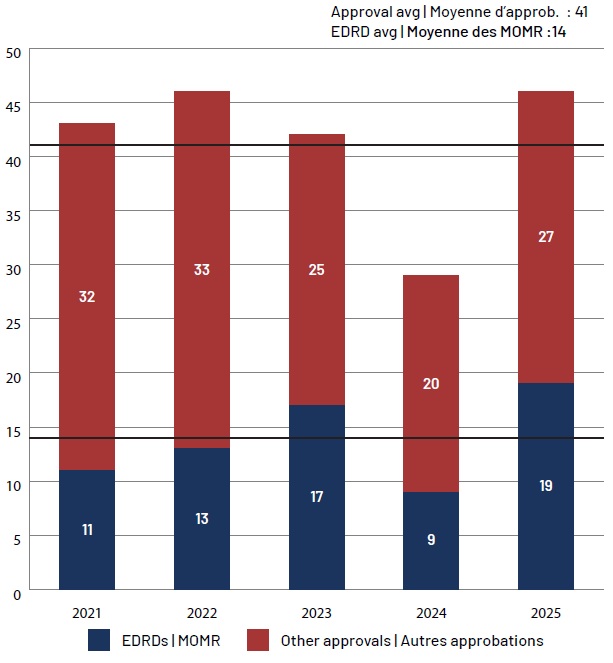
Figure description
| Annual approvals for expensive drugs for rare diseases in Canada | Annual approvals for other new medicines in Canada | |
|---|---|---|
2021 |
11 |
32 |
2022 |
13 |
33 |
2023 |
17 |
25 |
2024 |
9 |
20 |
2025 |
19 |
27 |
Approval average for expensive drugs for rare diseases |
14 |
|
Overall approval average |
41 |
|
Note: Expensive drugs for rare diseases (EDRDs) are defined as those with an orphan designation through the FDA or EMA and treatment costs exceeding $100,000 annually or $7,500 per 28-day cycle for oncology.
Data source: Health Canada Notice of Compliance database, Drugs@FDA database, EMA drug database, CDA-AMC databases.
Figure 3B: Health Canada review status of new active substances with an international approval between 2019 and 2023

Figure description
262 new active substances approved internationally between 2019 and 2023:
- 74 not submitted to Health Canada
- 188 submitted to Health Canada for approval
- 163 received a Notice of Compliance
- 16 currently under review
- 9 no NOC granted*
Note: Review statuses are current to December 2025.
*The submission resulted in a Notice of Non-Compliance or the review was cancelled by the sponsor.
Data source: Health Canada’s Notice of Compliance database; Health Canada’s New Drug Submissions Completed website; and Health Canada’s New Drug Submissions Under Review website.
Figure 3C: Average price ratios by approval cohort (Q4-2024)
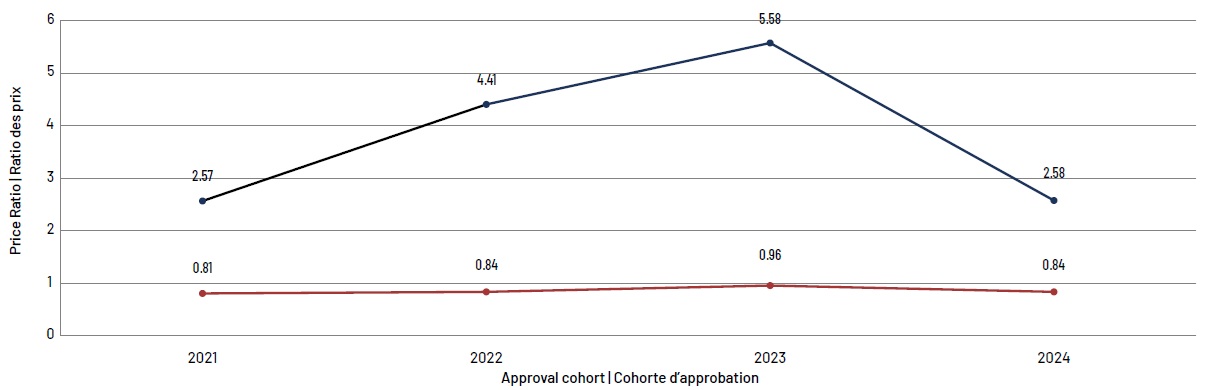
Figure description
| US to Canadian price ratio | OECD (excl. US) to Canadian price ratio | |
|---|---|---|
2021 |
2.57 |
0.81 |
2022 |
4.41 |
0.84 |
2023 |
5.58 |
0.96 |
2024 |
2.58 |
0.84 |
Note: OECD excludes US.
Data source: IQVIA MIDAS®, (all rights reserved).
Conclusion
This study highlights the ongoing prevalence of high-cost and rare disease drugs among newly approved medicines. As Canada continues to approve and market the highest-selling new medicines, there is a need for more information on the impact of new approvals on payers and patients. Data relating to the approval, sales, relative prices and other characteristics of each new medicine will be included in the appendix section of Meds Entry Watch, 10th edition.
Limitations
As this presentation focuses on three approval bodies, it is possible that some new medicines included in the analysis may have an earlier approval date in other jurisdictions, and that some medicines with a first international approval between 2021 and 2025 are not included in the analysis.
Disclaimer
Although based in part on data obtained under license from the MIDAS® database proprietary to IQVIA Solutions Canada Inc. and/or its affiliates ("IQVIA"), the statements, findings, conclusions, views, and opinions expressed in this presentation are exclusively those of the PMPRB and are not attributable to IQVIA.