
Polar Knowledge Canada's 2026-27 Departmental Plan
Contents:
Copyright information
© His Majesty the King in Right of Canada, as represented by the Minister of Northern and Arctic Affairs and Minister responsible for the Canadian Northern Economic Development Agency, 2026
Departmental Plan 2026-27
Catalogue No. R101-4E-PDF
ISSN 2371-7122
Aussi disponible en français sous le titre : Plan ministériels 2026-2027 Savoir polaire Canada
At a glance
This departmental plan details Polar Knowledge Canada’s priorities, plans and associated costs for the upcoming three fiscal years.
These plans align with the priorities outlined in the Mandate Letter, as well as Polar Knowledge Canada’s Mandate, raison d’être and functions.
Key priorities
Polar Knowledge Canada identified the following key priorities for 2026-27:
-
Positioning Canada as a global leader in Arctic research
Polar Knowledge Canada will strengthen its role as a hub for Arctic research by enabling collaboration among Canadian and international researchers. The agency will provide timely support for research logistics, including laboratory services, field operations and accommodations, ensuring that Canada remains at the forefront of knowledge critical to sovereignty, sustainable development and global understanding of climate and polar systems. Through leadership in both the Arctic and Antarctic, Polar Knowledge Canada connects Canadian science to global polar research while generating insights that directly inform Arctic decision-making. -
Advancing Arctic and Antarctic science, technology, research and knowledge
Polar Knowledge Canada will prioritize research and knowledge-sharing that empowers Indigenous and Northern communities to make informed decisions about their futures. The agency will co-develop research agendas with communities, integrate Indigenous knowledge alongside scientific inquiry and deliver actionable knowledge products that support community governance, economic development, environmental stewardship and resilience. Investments in Arctic-appropriate technology such as clean energy, advanced monitoring systems, and infrastructure for extreme conditions will strengthen adaptation, reduce long-term costs and create opportunities for sustainable economic growth. -
Strengthening partnerships for reconciliation and sovereignty
Polar Knowledge Canada will deepen engagement with Indigenous peoples, territorial governments, and Northern communities to foster trust, co-leadership and collaboration. By supporting research that addresses locally identified priorities, including clean energy and environmental monitoring and ensuring timely dissemination of results, Polar Knowledge Canada advances reconciliation while strengthening Canada’s Arctic sovereignty. Inclusive engagement ensures that science informs both community decision-making and national policy, positioning Canada as a confident Arctic nation. -
Building capacity and a diverse workforce in support of One Canadian Economy
Investing in people is central to Polar Knowledge Canada’s leadership of the North and the Arctic. The agency will expand programs for Northern and Indigenous youth, students and early-career researchers through university partnerships, hands-on training, mentorship and on-the-land learning. New facilities in Whitehorse, along with federally provided office space in Yellowknife, bring research and engagement closer to communities while creating a pool of talented Northerners for recruitment. Polar Knowledge Canada will continue to advance its Inuit Employment Plan and pursue innovative strategies to attract, inspire and retain Northern talent, contributing to economic inclusion, future leadership and building long-term community capacity.
Comprehensive Expenditure Review
The government is committed to restraining the growth of day-to-day operational spending to make strategic investments that will grow the economy and benefit Canadians.
Polar Knowledge Canada does not have planned funding reductions under the Comprehensive Expenditure Review.
The agency will, however, respect the spirit of the exercise by identifying efficiencies and streamlining processes including implementing workflow improvements, leveraging artificial intelligence and business automation tools and applying innovative practices to enhance overall organizational efficiency. These efforts support a culture of continuous improvement and enable the timely delivery of research programs, operations, and field activities.
This departmental plan reflects these measures.
Highlights for Polar Knowledge Canada in 2026-27
Polar Knowledge Canada provides grants and contributions funding to organizations and communities across Canada to support research and skills development. In 2026-27, new terms and conditions for its transfer payment program will simplify application and reporting processes, making it easier for recipients to access funding, participate in research and build capacity for future leadership in polar science.
Additionally, in 2026–27, the agency will launch new funding programs designed to enable Northern governments, communities and institutions to take a leadership role in developing research initiatives in collaboration with both Canadian and international partners. These programs will foster locally driven research priorities while strengthening Canada’s presence and influence in polar science.
To further integrate local knowledge and community priorities into the research process, Polar Knowledge Canada is developing a community engagement framework in early 2026. This framework will strengthen Northern capacity and expertise, supporting resilient communities and locally informed decision-making. A multi-year engagement strategy will follow beginning in 2026-27 and will be co-designed in partnership with regional groups to ensure that research aligns with community needs, contribute to socio-economic development and supports government priorities such as reconciliation, economic growth and climate resilience.
In 2026-27, total planned spending (including internal services) for Polar Knowledge Canada is $37,518,933 and total planned full-time equivalent staff (including internal services) is 98.
Summary of planned results
The following section provides a summary of the results the agency plans for 2026-27, sorted by main areas of activity, also known as “core responsibilities.”
Core responsibility 1: Polar Science and Knowledge
In 2026-27, Polar Science and Knowledge will:
-
continue to facilitate the integration of Indigenous and local knowledge with scientific research through the recruitment of Indigenous employees, sustained engagement with communities and partners and targeted knowledge-sharing events and workshops
-
support high-priority research areas, including ecosystem science, permafrost dynamics, wildlife health, cold climate technology and clean energy solutions for northern communities
-
collaborate with domestic and international partners to advance shared research priorities, strengthen knowledge exchange and optimize the use of public resources
-
improve client services at the Canadian High Arctic Research Station by initiating client feedback mechanisms and enhancing reporting to support continuous service improvements
-
strengthen Canada’s leadership in polar science by supporting early career researchers and students through transfer payment programs, training opportunities and research partnerships
-
inspire the next generation of researchers by supporting youth-focused science, technology, engineering and mathematics (STEM) activities and on-the-land learning opportunities.
Planned spending: $28,785,246
Planned human resources: 53
More information about Polar Science and Knowledge can be found in the full plan.
For complete information on Polar Knowledge Canada’s total planned spending and human resources, read the Planned spending and human resources section of the full plan.
From the Minister

The Honourable Rebecca Chartrand
Minister of Northern and Arctic Affairs and Minister responsible for Canadian Northern Economic Development Agency
As the Minister of Northern and Arctic Affairs and Minister responsible for the Canadian Northern Economic Development Agency, I am pleased to present Polar Knowledge Canada’s 2026–27 Departmental Plan.
Canada is an Arctic nation, and the North is central to our national identity, economy, security and future. This plan outlines how Polar Knowledge Canada will advance Arctic science, Indigenous knowledge and innovation to support one Canadian economy, strengthen climate resilience, reinforce Canada’s sovereignty and promote inclusive, sustainable growth that benefits Northerners and all Canadians.
At the core of this work is the Canadian High Arctic Research Station, a world-class hub for Arctic science, Indigenous knowledge and international collaboration. The Station connects Northern communities with researchers from across Canada and global partners, supporting evidence-based decision-making on climate change, food security, clean energy, and wildlife health. These partnerships strengthen Canada’s Arctic leadership and collaboration with partners that share Canada’s values. Polar Knowledge Canada’s research supports Northern priorities while contributing to a stronger, more productive Canadian economy. By monitoring permafrost thaw and sea ice loss, advancing community-led environmental and wildlife monitoring and testing clean, reliable energy solutions in extreme conditions, Polar Knowledge Canada helps reduce long-term costs, support affordability and inform infrastructure and housing decisions in Northern communities. This work strengthens climate resilience and supports the government’s objective of lowering costs for Canadians.
The integration of Indigenous knowledge is central to Polar Knowledge Canada’s mandate. Through sustained engagement, the organization works with Inuit, First Nations and Métis partners to ensure research reflects Northern priorities, supports self-determination and strengthens stewardship of land, water and ice. Listening, learning and acting together advances reconciliation and ensures decisions affecting the North are grounded in lived experience. Polar Knowledge Canada also plays a key role in protecting Canada’s Arctic sovereignty. A strong, sustained scientific presence in the North, supported by infrastructure, partnerships and expertise, reinforces Canada’s ability to understand, monitor and respond to rapid environmental and geopolitical change.
Through Northern hiring strategies, investments in northern-led research and innovation and programs focused on youth and skills development, Polar Knowledge Canada contributes to a stronger Northern economy and workforce. These efforts create jobs, build local capacity and support sustainable community development, including research that informs housing, energy and infrastructure solutions suited to Northern realities. The Arctic is warming nearly four times faster than the global average. Through this work, Polar Knowledge Canada helps Canada respond to change while shaping a more sustainable, inclusive and secure Arctic future.
I am honoured to have Polar Knowledge Canada as part of my portfolio, and together we are strengthening Canada’s Arctic leadership and building a resilient North for all Canadians.
From the Acting President and Chief Executive Officer
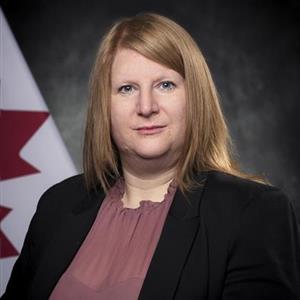
Suzanne (Sue) Kerr
Acting President and Chief Executive Officer, Polar Knowledge Canada
As Polar Knowledge Canada approaches its second decade, we do so with the confidence that comes from experience and the clarity that comes from learning. Over the past ten years, Polar Knowledge Canada has grown from a new organization into a trusted national institution, bringing together science, Indigenous knowledge and partnerships to support informed decisions in the polar regions. Those early years taught an essential lesson: leadership in polar science is not about doing more, but about connecting knowledge, people and purpose to deliver real impact.
The Arctic is changing faster than anywhere on Earth and the stakes for communities, Canada’s economy and sovereignty have never been higher. Building on our knowledge, Polar Knowledge Canada will strengthen its role as a leader in Arctic science by focusing on research that supports the Government of Canada’s priorities and responds directly to Northern realities. Through the Canadian High Arctic Research Station, we have established a hub of circumpolar expertise where environmental monitoring, climate resilience, clean energy and infrastructure research converge to support community well-being and long-term sustainability. Increasingly, Polar Knowledge Canada is serving as a trusted steward of Arctic knowledge, ensuring research, data and results are accessible to promote collaboration and evidence-based decision-making. By enabling Canadian scientists to contribute to Antarctic research through international partnerships, Polar Knowledge Canada strengthens Canada’s role in global polar science and advances understanding of the Earth systems linking both poles, knowledge essential to understanding Arctic change and its impacts on Canada and the world.
Our experience has shown that strong science depends on strong relationships. Over the past decade, partnerships with Indigenous governments, Northern organizations, academia, federal departments, industry and international collaborators have strengthened the relevance and reach of our work. These relationships allow science to inform community planning, housing, infrastructure, security and preparedness, helping reduce long-term costs and strengthen resilience across the North.
Looking ahead, investing in people is central to Polar Knowledge Canada’s leadership. We are expanding support for Northern and Indigenous youth, students and early-career researchers through university partnerships, hands-on training, mentorship and on-the-land learning. To bring this work closer to communities and broaden opportunities, we have opened a hub in Whitehorse and secured complimentary office space from another federal department in Yellowknife. Together, these locations support engagement, collaboration and research while building a pool of talented Northerners. The future of polar science depends on these pathways for young people to lead, grounded in Northern knowledge, experience and aspiration.
As we move forward, our focus is clear: delivery—science that matters, partnerships that endure and knowledge that strengthens communities and supports Canada’s role as an Arctic nation and trusted polar science leader globally. Together with our partners, Polar Knowledge Canada is building on a strong foundation to lead polar science into the future, confident, connected and focused on impact.
Plans to deliver on core responsibilities and internal services
Core responsibilities and internal services
Core responsibility 1: Polar Science and Knowledge
In this section
Description
Polar Knowledge Canada is Canada’s polar science agency operating out of the world-class Canadian High Arctic Research Station campus in Cambridge Bay, Nunavut. Polar Knowledge Canada performs and enables multi-disciplinary polar research. Through our grants and contributions program, we fund external partners such as academia, northern organizations who conduct research and related projects. Polar Knowledge Canada aims to support world-class Arctic and Antarctic science and to increase domestic and international research coordination and collaboration by leveraging resources with partners. Through workshops, conferences, social media, and other tools, Polar Knowledge Canada shares and promotes the exchange of knowledge across polar scientific and policy communities and the general public. Through all of its core activities, Polar Knowledge Canada aims to fund and train the next generation of polar research personnel, with a focus on northern youth.
Quality of life impacts
Polar Knowledge Canada’s research, partnerships, reconciliation and youth engagement efforts contribute directly to advancing environmental sustainability across the North and Arctic.
-
Polar Knowledge Canada continues to focus on advancing clean energy solutions for northern communities. Key initiatives include operating an off-grid renewable energy hub, monitoring solar irradiance resources in the North and testing novel and existing technologies under Arctic conditions, including heating systems, renewable energy, housing innovations and wastewater treatment solutions.
-
Safeguarding biodiversity is a cornerstone of environmental sustainability in the Arctic. Polar Knowledge Canada research advances knowledge of terrestrial, freshwater and marine ecosystems providing insights into the impacts of rapid climate change.
-
Environmental sustainability also encompasses health and well-being of Northerners. Polar Knowledge Canada supports and conducts research on food sovereignty and security through wildlife and fish monitoring as well as research on zoonotic diseases. These studies contribute to sustainable approaches to health and food systems in the North.
In advancing reconciliation, Polar Knowledge Canada continues to partner with key Indigenous partners across the North to strengthen capacity for community-based monitoring and Northern-led research. These partnerships help as to reduce inequality and promote diversity and shared values. These initiatives are essential to integrating Indigenous Knowledge with scientific research and ensuring solutions are locally relevant and culturally grounded.
-
Youth engagement plays a critical role in strengthening northern capacity and fostering innovation. In support of Indigenous self-determination, Polar Knowledge Canada hosts science camps and on-the-land learning activities which provide lessons in STEM, survival skills and land-based knowledge in partnership with community Elders.
Through funding for Northern and Indigenous-led projects, the agency is further supporting research excellence and advancing Indigenous self-determination while reinforcing sustainability across Canada’s North.
Indicators, results and targets
This section presents details on the agency’s indicators, the actual results from the three most recently reported fiscal years, and the targets and target dates for Polar Science and Knowledge. Details are presented by departmental result.
Table 1: Canada's polar science and technology research is advanced and made publicly available
|
Departmental Result Indicators
|
Actual Results
|
2026-27 Target
|
Date to achieve target
|
|---|---|---|---|
| Number of reports, publications, or technical summaries that are made publicly available | Not available – indicator introduced after this reporting period. | 15 | March 31, 2027 |
| Number of conferences, presentations or events which advance polar science and technology | Not available – indicator introduced after this reporting period. | 10 | March 31, 2027 |
Table 2: Canada fosters knowledge exchange and the inclusion of Indigenous and Northern perspectives in polar science
|
Departmental Result Indicators
|
Actual Results
|
2026-27 Target
|
Date to achieve target
|
|---|---|---|---|
| Percentage of Polar Knowledge Canada’s research projects that involve Northerners | Not available – indicator introduced after this reporting period. | 90% | March 31, 2027 |
| Number of Polar Knowledge Canada engagements that support the inclusion of Indigenous and Northern communities in the research process | Not available – indicator introduced after this reporting period. | 17 | March 31, 2027 |
| Number of Polar Knowledge Canada domestic and international engagements that support leadership in polar science | Not available – indicator introduced after this reporting period. | 27 | March 31, 2027 |
Table 3: The next generation of Canadian polar researchers is developed
|
Departmental Result Indicators
|
Actual Results
|
2026-27 Target
|
Date to achieve target
|
|---|---|---|---|
| Percentage of Polar Knowledge Canada’s research projects that involve early career researchers | 2022-23: Not available 2023-24: 65% 2024-25: 60% |
50% | March 31, 2027 |
| People hours of activities for youth and children offered by Polar Knowledge Canada* | Not available – indicator introduced after this reporting period. | 750 | March 31, 2027 |
*People hours represent the cumulative time spent by all participants attending an activity. For example, a 30-minute session attended by 20 students equals 10 people-hours (0.5 hours x 20 participates)
Table 4: The Canadian High Arctic Research Station fulfills the research needs of the domestic and international research communities
|
Departmental Result Indicators
|
Actual Results
|
2026-27 Target
|
Date to achieve target
|
|---|---|---|---|
| Utilization rate of the Canadian High Arctic Research Station facilities* | 2022-23: 46% 2023-24: 45% 2024-25: 43% |
53% | March 31, 2027 |
| Percentage of researchers who agree or strongly agree with the statement, “I am satisfied with the level of service provided by Canadian High Arctic Research Station |
Not available – indicator introduced after this reporting period. |
90% | March 31, 2027 |
* The utilization rate is an annual average across three seasons; low winter use is offset by near-capacity summer operations.
Additional information on the detailed results and performance information for Polar Knowledge Canada’s program inventory is available on GC InfoBase.
Plans to achieve results
The following section describes the summary of the results the agency plans to achieve for Polar Science and Knowledge in 2026-27.
Canada's polar science and technology research is advanced and made publicly available
Targeted results
In 2026–27, Polar Knowledge Canada will advance and share polar science and technology research that supports environmental sustainability, community well-being and evidence-based decision-making in the Arctic region.
The agency will conduct and support targeted research through primary research, partnerships, knowledge exchange and northern engagement, with a focus on climate change, ecosystems, cold-climate technologies and One Health, recognizing the interconnected health of people, animals and ecosystems.
Research efforts in 2026–27 will focus on improving knowledge related to:
- connections between northern community wellness and wildlife health
- fish health and disease profiles
- ecosystem mapping and remote sensing for climate monitoring
- permafrost dynamics and associated landscape and ecosystem change
- biodiversity and performance monitoring for invertebrates
- clean energy solutions for Northern communities including:
- operating an off-grid renewable energy hub
- monitoring solar irradiance resources in the North
- testing novel and existing technologies in Arctic conditions including heating systems, renewable energy, housing innovations and wastewater treatment solutions
Increasing knowledge in these areas will support Northern self-determination, inform public policy and decision-making and advance clean energy and sustainable technologies adapted to Arctic conditions.
Polar Knowledge Canada will continue to offer funding opportunities to support researchers at various career stages. Through its internal research capacity and transfer payment programs, the agency will collaborate with Indigenous, Northern, academic, government and international partners to share, apply and scale research results.
To ensure broad access to polar research, results will be published in open-access journals, shared through open science portals, agency digital platforms and a future centralized research repository, and will be communicated back to Northern communities. Research outputs will also be promoted nationally and internationally to reinforce Canada’s leadership in Arctic and Antarctic science.
Canada fosters knowledge exchange and the inclusion of Indigenous and Northern perspectives in polar science
Targeted results
In support of Indigenous self-determination and northern economic development, Polar Knowledge Canada will continue to prioritize community-driven and Indigenous-led research approaches.
In 2026–27, the agency will:
- support projects where Northern communities are engaged throughout the research lifecycle, including project design, methodologies, analysis and knowledge sharing
- integrate Inuit Qaujimajatuqangit, Indigenous Knowledge and community knowledge into research priorities, methodologies and interpretation
- develop a Northern and Arctic Community Engagement Framework to guide principled engagement, knowledge co-production and alignment with Indigenous and local priorities
- engage Arctic research stakeholders across Inuit Nunangat to strengthen partnerships and support capacity development for Indigenous youth and organizations
To improve access knowledge exchange opportunities, the agency will provide travel grants to Northern and Arctic residents to attend conferences and research meetings. These grants support Indigenous and local participation in research governance and the sharing of local and Indigenous Knowledge with all Canadians and the world.
The next generation of Canadian polar researchers is developed
Targeted results
Supporting the next generation of polar researchers remains a priority for the agency and the Government of Canada.
In 2026-27, Polar Knowledge Canada will:
- integrate students and early career researchers into agency-led research projects
- engage northern schools and youth through research activities and outreach
- host a science careers camp providing hands-on learning experiences in science, technology, engineering and mathematics (STEM)
The agency will also continue to deliver grants, scholarships and awards, including:
- the Polar Regional Research and Activities Grants Program and the Northern Scientific Training Program
- fellowships and awards for Northern residents and early career researchers
- Antarctic Scholarships to Canadian graduate students conducting research in Antarctica
Through these initiatives, Polar Knowledge Canada will foster research excellence, innovation and collaboration while strengthening Canada’s leadership in polar science.
The Canadian High Arctic Research Station fulfills the research needs of the domestic and international research communities
Targeted results
In support of Canada’s leadership in Arctic science, Polar Knowledge Canada will continue to strengthen services at the Canadian High Arctic Research Station.
In 2026–27, the agency will:
- improve service delivery by soliciting client feedback and strengthening performance reporting
- implement an integrated Enterprise Resource Planning system to modernize utilization tracking, improve data accuracy, and support transparent reporting
- align utilization metrics with seasonal realities and organizational planning needs to enhance decision-making
- establish a network of Operators of Canadian Arctic Research Infrastructures to enhance coordination and research support across northern Canada
- strengthen research partnerships with federal, provincial and territorial partners to enable interdepartmental collaboration
Client feedback will be centralized through the Enterprise Resource Planning system to identify service gaps, inform continuous improvement and strengthen alignment between services and researcher needs.
Gender-based Analysis Plus
Polar Knowledge Canada applies Gender-Based Analysis Plus to ensure research funding and programs are inclusive and responsive to the diverse needs of participants. Funding recipients are required to report annually through a survey that collects gender-disaggregated data, as well as information on participation by Northern-based individuals, early career researchers, youth, and Indigenous Peoples. This data allows the agency to monitor and assess the participation and impact of its programs on underrepresented groups and to support evidence-based decisions that promote equity, diversity, and inclusion in polar research activities.
Planned resources to achieve results
Table 5: Planned resources to achieve results for Polar Science and Knowledge (dollars)
| Resource | Planned |
|---|---|
| Spending | 28,785,246 |
| Full-time equivalents | 53 |
Complete financial and human resources information for Polar Knowledge Canada’s program inventory is available on GC InfoBase.
Program inventory
Polar Science and Knowledge is supported by the following programs:
- Canadian High Arctic Research Station Operations and Logistics
- Knowledge Management and Engagement
- Science and Technology
Additional information related to the program inventory for Polar Science and Knowledge is available on the Results page on GC InfoBase.
Summary of changes to reporting framework since last year
In 2025–26, Polar Knowledge Canada completed a full review and update of its Departmental Results Framework. Key changes are summarized below.
- Departmental result on the availability of science and technology research
- The result was updated to explicitly reflect the advancement of research and now reads: “Canada's polar science and technology research is advanced and made publicly available.”
- Existing indicators were replaced to capture the full range of ways in which Polar Knowledge Canada disseminates research. New indicators include:
- Number of reports, publications, or technical summaries made publicly available
- Number of conferences, presentations, or events that advance polar science and technology
- While the agency is developing a centralized research repository to improve access to polar research, it is not yet operational, and no indicator has been established for its use at this time.
- Indicators removed due to methodology and relevancy:
- Number of citations of research led or supported by Polar Knowledge Canada
- Percentage of Arctic research projects led or supported by Polar Knowledge Canada that include Indigenous or local knowledge
- Number of knowledge exchange activities or initiatives led or supported by Polar Knowledge Canada
- Percentage of leveraged investment by Polar Knowledge Canada supported projects
- Percentage of projects led by Polar Knowledge Canada that involve external partners
- The departmental results on knowledge exchange and Indigenous perspectives
- The previous results “Canada fosters domestic and international knowledge exchange and partnerships in polar science” and “Canada’s Arctic science includes Indigenous and local knowledge” were replaced with a single result “Canada fosters knowledge exchange and the inclusion of Indigenous and Northern perspectives in polar science”
- Two new indicators were added under this result:
- “Number of Polar Knowledge Canada engagements that support the inclusion of Indigenous and Northern communities in the research process”
- “Number of Polar Knowledge Canada domestic and international engagements that support leadership in polar science”
- Departmental result on developing the next generation of Canadian polar researchers
- A new indicator was added to capture youth participation: “People hours of activities for youth and children offered by Polar Knowledge Canada”.
- Language for the existing indicator was modified to remove youth to avoid overlap with early career researchers.
- New departmental result to capture Canadian High Arctic Research Station operations and support for visiting researchers.
- Two indicators were added:
- “Utilization rate of the Canadian High Arctic Research Station facilities”
- “Percentage of researchers who agree or strongly agree with the statement: 'I am satisfied with the level of service provided by Canadian High Arctic Research Station'”.
- Two indicators were added:
These updates improve the alignment of the reporting framework with the agency’s current priorities, enhance transparency, and ensure that results capture all aspects of Polar Knowledge Canada’s work, from research advancement and knowledge dissemination to youth engagement, Indigenous inclusion, and operational support at the Canadian High Arctic Research Station.
Internal services
In this section
Description
Internal services are the services that are provided within a department so that it can meet its corporate obligations and deliver its programs. There are 10 categories of internal services:
- acquisition management services
- communications services
- financial management services
- human resources management services
- information management services
- information technology services
- legal services
- material management services
- management and oversight services
- real property management services
Plans to achieve results
This section presents details on the department’s plans to achieve results and meet targets for internal services.
Internal Services are fundamental to Polar Knowledge Canada’s ability to deliver on its core responsibility of advancing polar science and knowledge. They ensure the agency can meet its commitments efficiently, cost-effectively and within required timeframes.
During 2026–27, Polar Knowledge Canada will pursue a modernized approach to internal services by redesigning internal workflows, integrating artificial intelligence (AI), digital solutions, and adopting new operational practices to improve organizational efficiency. Additionally, the agency will continue to seek efficiencies in Internal Services to refocus resources on core program activities.
In alignment with Article 23 of the Nunavut Agreement, Polar Knowledge Canada will continue implementing its 2025-2033 Inuit Employment Plan, which includes strategies to attract, recruit and retain talent from Northern communities. Expanding the agency’s presence in locations such as Yellowknife and Whitehorse will bring Polar Knowledge Canada closer to Northern communities and increase the pool of potential local employees. These efforts advance reconciliation, integrate Indigenous Knowledge into operations and contribute to making Polar Knowledge Canada an employer of choice in the North.
The agency also remains committed to fostering a positive, inclusive and healthy work environment. By promoting diversity, collaboration and safety, Polar Knowledge Canada aims to ensure that all team members feel valued, supported and empowered to contribute to the agency’s mission.
Planned resources to achieve results
Table 6: Planned resources to achieve results for internal services this year
| Resource | Planned |
|---|---|
| Spending | 8,733,687 |
| Full-time equivalents | 45 |
Complete financial and human resources information for Polar Knowledge Canada’s program inventory is available on GC InfoBase.
Planning for contracts awarded to Indigenous businesses
The Government of Canada has committed to ensuring that at least 5% of the total value of federal contracts is awarded to Indigenous businesses each year. Polar Knowledge Canada has fully implemented this target and has consistently achieved and exceeded it since the 2022-23 fiscal year. Polar Knowledge Canada supports the government-wide commitment to economic reconciliation by advancing socio-economic opportunities for First Nations, Inuit and Métis businesses through the federal procurement process.
Polar Knowledge Canada embeds Indigenous participation throughout its procurement planning, processes and reporting. To achieve and sustain this 5% target, Polar Knowledge Canada will:
- integrate Indigenous procurement planning early in the contracting process by identifying and applying procurement strategies designed to increase opportunities to Indigenous businesses, including early supplier engagement during requirements development
- consult the Inuit Firm Registry and the Indigenous Business Directory to identify qualified Indigenous suppliers and ensure fair consideration in competitive solicitations
- Apply procurement strategies focused on Indigenous business under the Procurement Strategy for Indigenous Business wherever feasible
- prioritize Indigenous suppliers for low-dollar-value procurements, including through acquisition card purchases for goods and services available locally
- engage directly with Indigenous businesses by participating in tradeshows and outreach events within Comprehensive Land Claim Areas to better understand supplier capabilities and build long-term partnerships
- notify claimant groups of upcoming solicitations in accordance with obligations under the Nunavut Agreement and other Comprehensive Land Claim Agreements
- collaborate with Shared Services Canada to promote the inclusion of Indigenous suppliers in information technology procurements
Operating from Cambridge Bay, Nunavut, Polar Knowledge Canada maintains strong partnerships with local Indigenous businesses through the Canadian High Arctic Research Station by contracting essential services such as facility management, security, housing and transportation, in collaboration with the Hamlet of Cambridge Bay.
Through these proactive measures, Polar Knowledge Canada continues to ensure that Indigenous businesses have equitable access to federal procurement opportunities and that the 5% target remains a sustainable and integral part of its procurement practices.
Table 7: Percentage of contracts planned and awarded to Indigenous businesses
| 5% Reporting Field | 2024-25 Actual Result | 2025-26 Forecasted Result | 2026-27 Planned Result* |
|---|---|---|---|
| Total percentage of contracts with Indigenous businesses | 36.86% | 26.62% | 27% |
*The 2026–27 Planned Result reflects a risk-adjusted estimate that considers potential procurement and administrative delays, including challenges associated with Northern procurement, security requirements and process-related timelines.
Planned spending and human resources
This section provides an overview of Polar Knowledge Canada’s planned spending and human resources for the next three fiscal years and an overview of planned spending for 2026-27 with actual spending from previous years.
Spending
This section presents an overview of the agency's actual and planned expenditures from 2023-24 to 2028-29.
Budgetary performance summary
Table 8: Three-year spending summary for core responsibilities and internal services (dollars)
| Core responsibilities and Internal services | 2023-24 Actual Expenditures | 2024-25 Actual Expenditures | 2025-26 Forecast Spending |
|---|---|---|---|
| Polar Science and Knowledge | 25,903,022 | 26,633,137 | 29,130,211 |
| Internal services | 11,528,676 | 9,834,174 | 9,533,884 |
| Totals | 37,431,698 | 36,467,311 | 38,664,095 |
Analysis of the past three years of spending
Over the past three years, variances between actual and forecast spending reflect the operational realities of delivering programs in northern environments, including the timing of major science initiatives, changes in contribution funding agreements and evolving logistical requirements. Fluctuations are influenced by organizational restructuring, seasonal operating windows, higher transportation and procurement costs and challenges associated with delivering programs and services in remote communities.
The planned increase in Polar Science and Knowledge spending in 2025–26 is primarily attributable to expanded research programming and increased contribution funding to support northern science and technology initiatives. In contrast, the decrease in Internal Services reflects organizational realignment between Internal Services and Program areas, as well as staffing vacancies.
More financial information from previous years is available on the Finances section of GC Infobase.
Table 9: Planned three-year spending on core responsibilities and internal services (dollars)
| Core responsibilities and Internal services | 2026-27 Planned Spending | 2027-28 Planned Spending | 2028-29 Planned Spending |
|---|---|---|---|
| Polar Science and Knowledge | 28,785,246 | 28,071,984 | 27,564,984 |
| Internal services | 8,733,687 | 8,602,852 | 8,509,852 |
| Total | 37,518,933 | 36,674,836 | 36,074,836 |
Analysis of the next three years of spending
Planned spending over the next three years reflects a gradual return to baseline funding following the sunsetting of temporary funding received through reprofiles, carry-forwards and supplementary funding.
While no new funding is anticipated, the agency will continue to prioritize resources toward core science programming and essential corporate functions while pursuing operational efficiencies.
More detailed financial information on planned spending is available on the Finances section of GC Infobase.
Analysis of the next three years of spending
Planned spending over the next three years reflects a gradual return to baseline funding following the sunsetting of temporary funding received through reprofiles, carry-forwards and supplementary funding.
While no new funding is anticipated, the agency will continue to prioritize resources toward core science programming and essential corporate functions while pursuing operational efficiencies.
More detailed financial information on planned is available on the Finances section of GC Infobase.
Funding
This section provides an overview of the agency's voted and statutory funding for its core responsibilities and for internal services. For further information on funding authorities, consult the Government of Canada budgets and expenditures.
Graph 1: Approved funding (statutory and voted) over a six-year period (dollars)
Graph 1 summarizes the department's approved voted and statutory funding from 2023-24 to 2028-29.
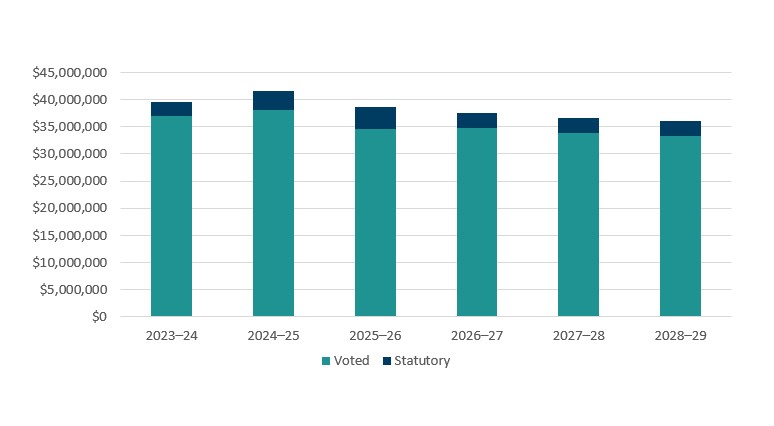
Text description of graph 1
| Fiscal year | Total | Voted | Statutory |
|---|---|---|---|
| 2023-24 | $39,635,925 | $37,053,275 | $2,582,650 |
| 2024-25 | $41,551,242 | $38,054,585 | $3,496,657 |
| 2025-26 | $38,664,095 | $34,640,258 | $4,023,837 |
| 2026-27 | $37,518,933 | $34,688,618 | $2,830,315 |
| 2027-28 | $36,674,836 | $33,844,521 | $2,830,315 |
| 2028-29 | $36,074,836 | $33,244,521 | $2,830,315 |
Analysis of statutory and voted funding over a six-year period
During 2023-24 and 2024-25, Polar Knowledge Canada temporarily increased its available funding through reprofiles, carry-forwards and program integrity allocations. Funding is projected to return to baseline levels in 2025-26 as time-limited funding sunsets. As a result, the agency will continue to focus on efficiency measures to sustain program delivery. Variations in statutory funding are mainly attributed to changes in employee benefit plan costs and year-over-year fluctuations in the use of respendable revenues generated from Crown housing rentals.
For further information on Polar Knowledge Canada’s departmental appropriations, consult the 2026-27 Main Estimates.
Future-oriented condensed statement of operations
The future-oriented condensed statement of operations provides an overview of Polar Knowledge Canada’s operations for 2025-26 to 2026-27.
Table 10: Future-oriented condensed statement of operations for the year ended March 31, 2027 (dollars)
| Financial information | 2025-26 Forecast results | 2026-27 Planned results | Difference (Planned results minus forecasted) |
|---|---|---|---|
| Total expenses | 44,653,286 | 44,966,544 | 313,258 |
| Total revenues | 371,579 | 390,158 | 18,579 |
| Net cost of operations before government funding and transfers | 44,281,707 | 44,576,386 | 294,679 |
Analysis of forecasted and planned results
There are no significant variances between the 2025-26 forecast results and the 2026-27 planned results.
The modest increase in expenses and revenues reflects routine adjustments related to salary increments, operating costs, increase in Crown Housing revenues and program delivery requirements. Overall, the stability of planned results demonstrates consistent financial planning and predictable cost drivers.
A more detailed Future-Oriented Statement of Operations and associated Notes for 2026-27, including a reconciliation of the net cost of operations with the requested authorities, is available on Polar Knowledge Canada’s website.
Human resources
This section presents an overview of the agency’s actual and planned human resources from 2023-24 to 2028-29.
Table 11: Actual human resources for core responsibilities and internal services
| Core responsibilities and internal services | 2023-24 Actual full-time equivalents | 2024-25 Actual full-time equivalents | 2025-26 Forecasted full-time equivalents |
|---|---|---|---|
| Polar Science and Knowledge | 48 | 50 | 50 |
| Internal services | 55 | 44 | 41 |
| Total | 103 | 94 | 91 |
Analysis of human resources over the last three years
The overall decrease in full-time equivalents over the past three years is primarily the result of recruitment and retention challenges in a competitive northern labour market, resulting in prolonged vacancies in key positions.
The increase in Polar Science and Knowledge and the decrease in Internal Services are mainly attributable to organizational restructuring between Internal Services and Program areas, which resulted in the reclassification and realignment of positions to better support program delivery.
Table 12: Human resources planning summary for core responsibilities and internal services
| Core responsibilities and internal services | 2026-27 Planned full-time equivalents | 2027-28 Planned full-time equivalents | 2028-29 Planned full-time equivalents |
|---|---|---|---|
| Polar Science and Knowledge | 53 | 53 | 53 |
| Internal services | 45 | 45 | 45 |
| Total | 98 | 98 | 98 |
Analysis of human resources for the next three years
Polar Knowledge Canada expects its workforce to stabilize over the planning period.
The planned total of 98 full-time equivalents reflects the post-restructuring allocation of positions between Internal Services and Polar Science and Knowledge, including previously vacant roles, to address operational and corporate service capacity needs. This will ensure the agency can maintain core program delivery while continuing to align with the government’s commitment to efficiency and responsible resource management.
Supplementary information tables
The following supplementary information tables are available on Polar Knowledge Canada’s website:
Information on Polar Knowledge Canada’s departmental sustainable development strategy can be found on Polar Knowledge Canada’s website.
Federal tax expenditures
Polar Knowledge Canada’s Departmental Plan does not include information on tax expenditures.
The tax system can be used to achieve public policy objectives through the application of special measures such as low tax rates, exemptions, deductions, deferrals and credits. The Department of Finance Canada publishes cost estimates and projections for these measures each year in the Report on Federal Tax Expenditures.
This report also provides detailed background information on tax expenditures, including descriptions, objectives, historical information and references to related federal spending programs, as well as evaluations and GBA Plus of tax expenditures.
Corporate information
Departmental profile
Appropriate minister(s): The Honourable Rebecca Chartrand
Institutional head: Suzanne (Sue) Kerr, Acting President and Chief Executive Officer
Ministerial portfolio: Northern and Arctic Affairs
Enabling instrument(s): Canadian High Arctic Research Station Act
Year of incorporation / commencement: 2015
Other: Polar Knowledge Canada is overseen by a nine-member Board of Directors, including a Chairperson and Vice-Chairperson. The Board approves the agency's Science and Technology Plan and annual work plan and budget. The Board is accountable to the Minister of Northern and Arctic Affairs and Minister responsible for the Canadian Northern Economic Development Agency. All members are appointed by Order-in-Council to hold office for terms not exceeding five years and are eligible for re-appointment for a second term of office. Members of the Board of Directors hold office on a part-time basis.
Departmental contact information
Cambridge Bay Headquarters:
Mailing address:
Polar Knowledge Canada - Canadian High Arctic Research Station
1 Uvajuq Road
P.O. Box 2150
Cambridge Bay, NU, X0B 0C0
Ottawa Office:
Mailing address:
Polar Knowledge Canada
170 Laurier Avenue West, Suite 200
Ottawa, ON, K1P 5V5
Whitehorse Office:
Mailing address:
Polar Knowledge Canada
305-300, Main Street
Whitehorse, YT, Y1A 2B5
Definitions
List of terms
- appropriation (crédit)
- Any authority of Parliament to pay money out of the Consolidated Revenue Fund.
- budgetary expenditures (dépenses budgétaires)
- Operating and capital expenditures; transfer payments to other levels of government, departments or individuals; and payments to Crown corporations.
- core responsibility (responsabilité essentielle)
- An enduring function or role performed by a department. The intentions of the department with respect to a core responsibility are reflected in one or more related departmental results that the department seeks to contribute to or influence.
- Departmental Plan (plan ministériel)
- A report on the plans and expected performance of an appropriated department over a 3year period. Departmental Plans are usually tabled in Parliament each spring.
- departmental result (résultat ministériel)
- A consequence or outcome that a department seeks to achieve. A departmental result is often outside departments’ immediate control, but it should be influenced by program-level outcomes.
- departmental result indicator (indicateur de résultat ministériel)
- A quantitative measure of progress on a departmental result.
- departmental results framework (cadre ministériel des résultats)
- A framework that connects the department’s core responsibilities to its departmental results and departmental result indicators.
- Departmental Results Report (rapport sur les résultats ministériels)
- A report on a department’s actual accomplishments against the plans, priorities and expected results set out in the corresponding Departmental Plan.
- full-time equivalent (équivalent temps plein)
- A measure of the extent to which an employee represents a full person-year charge against a departmental budget. For a particular position, the full-time equivalent figure is the ratio of number of hours the person actually works divided by the standard number of hours set out in the person’s collective agreement.
- gender-based analysis plus (GBA Plus) (analyse comparative entre les sexes plus [ACS Plus])
- Is an analytical tool used to support the development of responsive and inclusive policies, programs, and other initiatives. GBA Plus is a process for understanding who is impacted by the issue or opportunity being addressed by the initiative; identifying how the initiative could be tailored to meet diverse needs of the people most impacted; and anticipating and mitigating any barriers to accessing or benefitting from the initiative. GBA Plus is an intersectional analysis that goes beyond biological (sex) and socio-cultural (gender) differences to consider other factors, such as age, disability, education, ethnicity, economic status, geography (including rurality), language, race, religion, and sexual orientation. Using GBA Plus involves taking a gender- and diversity-sensitive approach to our work. Considering all intersecting identity factors as part of GBA Plus, not only sex and gender, is a Government of Canada commitment.
- government priorities (priorités gouvernementales)
- For the purpose of the 2026-27 Departmental Plan, government priorities are the high-level themes outlining the government’s agenda in the 2025 Speech from the Throne.
- horizontal initiative (initiative horizontale)
- An initiative where two or more federal departments are given funding to pursue a shared outcome, often linked to a government priority.
- Indigenous business
- Requirements for verifying Indigenous businesses for the purposes of the departmental result report are available through the Indigenous Services Canada Mandatory minimum 5% Indigenous procurement target website.
- non-budgetary expenditures (dépenses non budgétaires)
- Non-budgetary authorities that comprise assets and liabilities transactions for loans, investments and advances, or specified purpose accounts, that have been established under specific statutes or under non-statutory authorities in the Estimates and elsewhere. Non-budgetary transactions are those expenditures and receipts related to the government's financial claims on, and obligations to, outside parties. These consist of transactions in loans, investments and advances; in cash and accounts receivable; in public money received or collected for specified purposes; and in all other assets and liabilities. Other assets and liabilities, not specifically defined in G to P authority codes are to be recorded to an R authority code, which is the residual authority code for all other assets and liabilities.
- performance (rendement)
- What a department did with its resources to achieve its results, how well those results compare to what the department intended to achieve, and how well lessons learned have been identified.
- performance indicator (indicateur de rendement)
- A qualitative or quantitative means of measuring an output or outcome, with the intention of gauging the performance of a department, program, policy or initiative respecting expected results.
- plan (plan)
- The articulation of strategic choices, which provides information on how a department intends to achieve its priorities and associated results. Generally, a plan will explain the logic behind the strategies chosen and tend to focus on actions that lead to the expected result.
- planned spending (dépenses prévues)
- For Departmental Plans and Departmental Results Reports, planned spending refers to those amounts presented in Main Estimates. A department is expected to be aware of the authorities that it has sought and received. The determination of planned spending is a departmental responsibility, and departments must be able to defend the expenditure and accrual numbers presented in their Departmental Plans and Departmental Results Reports.
- program (programme)
- Individual or groups of services, activities or combinations thereof that are managed together within the department and focus on a specific set of outputs, outcomes or service levels.
- program inventory (répertoire des programmes)
- Identifies all the department’s programs and describes how resources are organized to contribute to the department’s core responsibilities and results.
- result (résultat)
- A consequence attributed, in part, to a department, policy, program or initiative. Results are not within the control of a single department, policy, program or initiative; instead they are within the area of the department’s influence.
- statutory expenditures (dépenses législatives)
- Expenditures that Parliament has approved through legislation other than appropriation acts. The legislation sets out the purpose of the expenditures and the terms and conditions under which they may be made.
- target (cible)
- A measurable performance or success level that a department, program or initiative plans to achieve within a specified time period. Targets can be either quantitative or qualitative.
- voted expenditures (dépenses votées)
- Expenditures that Parliament approves annually through an appropriation act. The vote wording becomes the governing conditions under which these expenditures may be made.