
Staffing Update Report April - September 2022
Staffing Support and Engagement
Staffing Inquiries
Data captured by the Staffing Support Division (SSD) is an important source of insight into the organizational reality and is fundamental in supporting internal partners, public servants, and the public.
1627 inquiries were received by SSD during this six-month reporting period:
- 95% of inquiries were received from organizations
- 5% of inquiries were received from other sources (councils, committees, public)
- 1.6 days was the average response rate, meeting SSD’s 2-day service standard
Nature of inquiries received from organizations, councils/committees, public remains varied:
- one-third of inquiries received by Staffing Support Advisors (SSA) were regarding assessment, with a continued focus on second language evaluation, for example:
- continued confusion regarding the application of SLE measures
- anticipated date for return to in-person SLE testing
- frustration regarding delays and backlogs for SLE testing
- requests for temporary exemption to requirement to use PSC-approved SLE tests
- implementation of the new Candidate Assessment Tool

Targeted tracking has been implemented to align with PSC areas of interest:
- a breakdown of inquiries received by topic is available in Annex A
Organizational Engagement
SSD outreach is designed to provide participants with valuable knowledge, essential awareness, and quality guidance on the public service staffing system:
- customized learning is offered to organizations through a menu of available sessions
- national and regional councils and committees benefit from SSD outreach efforts through regular updates on PSC projects and initiatives
65 outreach events were conducted virtually across Canada:
- 38% of events were conducted in the National Capital Region (Ottawa, Gatineau)
- 62% were in the regions (Halifax, Moncton, Montreal, Toronto, Winnipeg, Edmonton, Calgary, Vancouver)
- a total of 1640 participants attended the various outreach events:

Nature of outreach offered to organizations, councils, and committees remains diverse:
- two-thirds of outreach activities were dedicated to continuous outreach with organizations, councils, and committees
- one-third of outreach was dedicated to SSAs delivering learning events to organizations
- a breakdown of outreach conducted by event type is available in Annex B
Participant feedback is shared with internal stakeholders and utilized to develop future outreach sessions, scenarios, and guidance materials:
- 86% of participants felt their knowledge improved following the event, particularly related to:
- distinction between ‘employment equity’ and ‘diversity and inclusion’
- clarification on the order of priority entitlements for consideration
- overview of staffing options and flexibilities
- 97% of participants were satisfied with the overall accessibility of the outreach event
- 98% were satisfied with the overall quality of the event, with specific appreciation expressed regarding the staffing scenarios and the interactive format of the sessions
- participation by role was varied, with two-thirds of participants representing HR:
- 68% human resources (55% operations, 13% corporate)
- 19% management (11% hiring managers, 8% senior management)
- 13% other (employees)
Bargaining Agent Engagement
On May 11, 2022, representatives from the PSC presented the consultation findings on the Review of the Affirmation of Aboriginal Affiliation Form to the Joint Employment Equity Committee.
The Public Service Commission Joint Advisory Council met on May 19th to discuss the highlights of the 2021 Staffing and Non-Partisanship Survey, the Policy framework related to changes to the PSEA, the tools for examining barriers and biases and finally, the summary of consultations of the Review of Affirmation of Aboriginal Affiliation Form.
The proposed amendments to the Appointment Policy and the Appointment Delegation and Accountability Instrument (ADAI) resulting from changes to the PSEA were presented to the Joint Employment Equity Committee on September 7, 2022.
On September 15, 2022, representatives from the PSC presented to the Public Service Commission Joint Advisory Council key changes to the policy framework related to the PSEA Implementation, the Student and Post-Secondary Recruitment Programs Modernization and the review of the Staffing and Non-Partisanship Survey Questionnaire.
Finally, in September, the PSC sent an invitation to union representatives of the federal public service for the awareness sessions on the Investigations Process that will be held in the months of October and November 2022.
Canada School of Public Service Engagement
In January 2022, the School established a tiger team to redesign and migrate the curriculum for staffing advisors (formerly P801, P802) to a virtual environment. The new courses (COR 129, 130 and 131) will offer hybrid learning that will comprise both self-paced and facilitated virtual learning as part of the delivery. Pilots for the COR129 will begin in Q3 2022-2023 and pilots for the COR130 and 131 will launch in Q4 2022-2023. The intent is to have all three courses officially launched by early 2023-2024.
Work to redesign the COR 132 (formerly P901) will begin in Q3 2022-2023. Dedicated resources from the PSC are assigned to the project to ensure accurate content and direction is provided to the management community. The intention is to launch the redesigned course in fiscal year 2023-2024.
In July 2022, work began on the redesign of the COR 128 (formerly P731), The Strategic Human Resources Practitioner. The Office of the Chief Human Resources Officer (OCHRO) is the lead authority on the project, with the PSC supporting content review and development.
Capacity Building
Communications
Various communications products were developed to support the Personnel Psychology Centre’s launch of the Candidate Assessment Tool: videos, a considerable amount of Web content on Canada.ca and Extranet, a PSC Express article, a message from the Acting President to PSC employees, and a Letter to Heads of HR. The new webpages registered over 7,500 page views in the initial 10-day period.
CPAD supported the coming into force of the regulations amending the Student Employment Programs Participants Regulationsthrough Web updates, the coordination and publication of a Letter to Heads of HR, updates to 1-800-O-Canada, and the development and roll out of social media:
- The posts to the @PSCofCanada / @CFPduCanada Twitter accounts yielded 107,000 impressions and 1,137 individual interactions, with a strong engagement rate of 3.68%.
- Posts to @Jobs_gc / @Emplois_gc Twitter accounts resulted in 748,000 impressions and a strong engagement rate of 3.99%.
- The posts to the Jobs GC / Emplois GC Facebook pages yielded 8,400 reactions, a very strong rate of engagement.
The social media team led a robust campaign to promote HRMD’s inventory of administrative positions at the PSC. The campaign is ongoing and has so far contributed to the 1,300+ applications received.
From September 26 to October 6, 2022, the social media team shared 3 videos on the PSC YouTube channel to promote the inventory, and posted additional promotional content on Twitter, LinkedIn, Facebook and Instagram. A reporter from Narcity saw this content and published a story about the administrative positions at the PSC. The videos and related posts yielded extremely high results, for example:
- The first video on Facebook reached 35,573 people, 793% more than our median Facebook post for the same period (3,982 people). It also garnered 259 reactions and 81 comments.
- On LinkedIn, the reaction to the campaign overall yielded a very strong 239 reactions, 60 shares and 15,000 impressions (“views”).
- On Twitter, post replies, retweets and impressions were also very strong.
- 831 people responded to 2 Facebook events created to promote live webinars about the application process for this inventory. This campaign helped contribute to a high attendance number of over 300 attendees to virtual information sessions about this recruitment campaign.
From August 3 to 8, 2022, the social media team promoted the GC Jobs booth at the Montreal Pride Festival by live-tweeting with photos of the team and the booth. This content, shared on the GC Jobs and PSC Twitter and LinkedIn accounts, resulted in a 8,802 impressions and 243 engagements, a very good result.
From July 14 to August 4, 2022, the social media team collaborated with the Department of National Defense (DND) to raise awareness about the Military Spouses Initiative, which helps pair GC hiring managers with military spouses and common law partners. During the campaign, the team posted on Twitter and LinkedIn every Thursday, and amplified content from DND every Tuesday. This content yielded an above-average 7,885 impressions (views) and 203 engagements.
General CPAD metrics:
- Media requests received: 1
- PSC job posting for administrative assistants
- Public inquiries received through Infocom and social media channels: 588
- Counselling for managers
- Looking for jobs on GCjobs
- Advertised and non-advertised positions
- Career counselling
Themes included:
Policy Guidance
In May 2022, the PSC and Treasury Board Secretariat published the Guide on Employment Systems Review. The guide should help implement the Audit of Employment Equity Representation in Recruitment recommendation to review organizations’ staffing framework and practices to ensure barrier-free appointment processes for all employment equity groups.
In July 2022, new guidance on the Spotlight on the Area of Selectionwas published to communicate requirements and considerations when determining the area of selection for advertised and non-advertised appointment processes. The considerations related to the impact of a hybrid workforce were developed in collaboration with the Treasury Board Secretariat.
Following the recommendation stemming from the Horizontal Audit of Student Hiring under the Federal Student Work Experience Program, in July, the PSC published a staffing interpretation clarifying the information requirements for student appointments.
Also in July 2022, the PSC launched the SLE temporary measure 3 to allow organizations that receive authorization from the PSC to use alternative assessment methods for second language evaluation for all 3 language skills (reading comprehension, written expression and oral proficiency). The assessment results may be reused for other appointments within the same organization.
On September 30, 2022, the SLE temporary measure 1, which is the exemption from the requirement to use PSC second language evaluation tests for reading comprehension and written expression, has ended. The PSC webpage and Qs&As have been amended to reflect this change.
Oversight
Federal Public Sector Labour Relations and Employment Board Insights
There are currently 495 active Federal Public Sector Labour Relations and Employment Board (FPSLREB) staffing complaints filed under the New Direction in Staffing Appointment Framework.
Fiscal Year |
Complaints | Advertised (%) | Non-Advertised (%) |
|---|---|---|---|
| 2014 - 2015 | 601 | 70 | 30 |
| 2015 - 2016 | 594 | 76 | 24 |
| 2016 - 2017 (NDS) | 736 | 53 | 47 |
| 2017 - 2018 | 624 | 56 | 44 |
| 2018 - 2019 | 584 | 43 | 57 |
| 2019 - 2020 | 472 | 55 | 45 |
| 2020 - 2021 | 442 | 48 | 52 |
| 2021 - 2022 | 309 | 49 | 51 |
| Apr. ‘22 – Sept. ‘22 | 128 | 26 | 74 |
Advertised versus Non-advertised Appointments
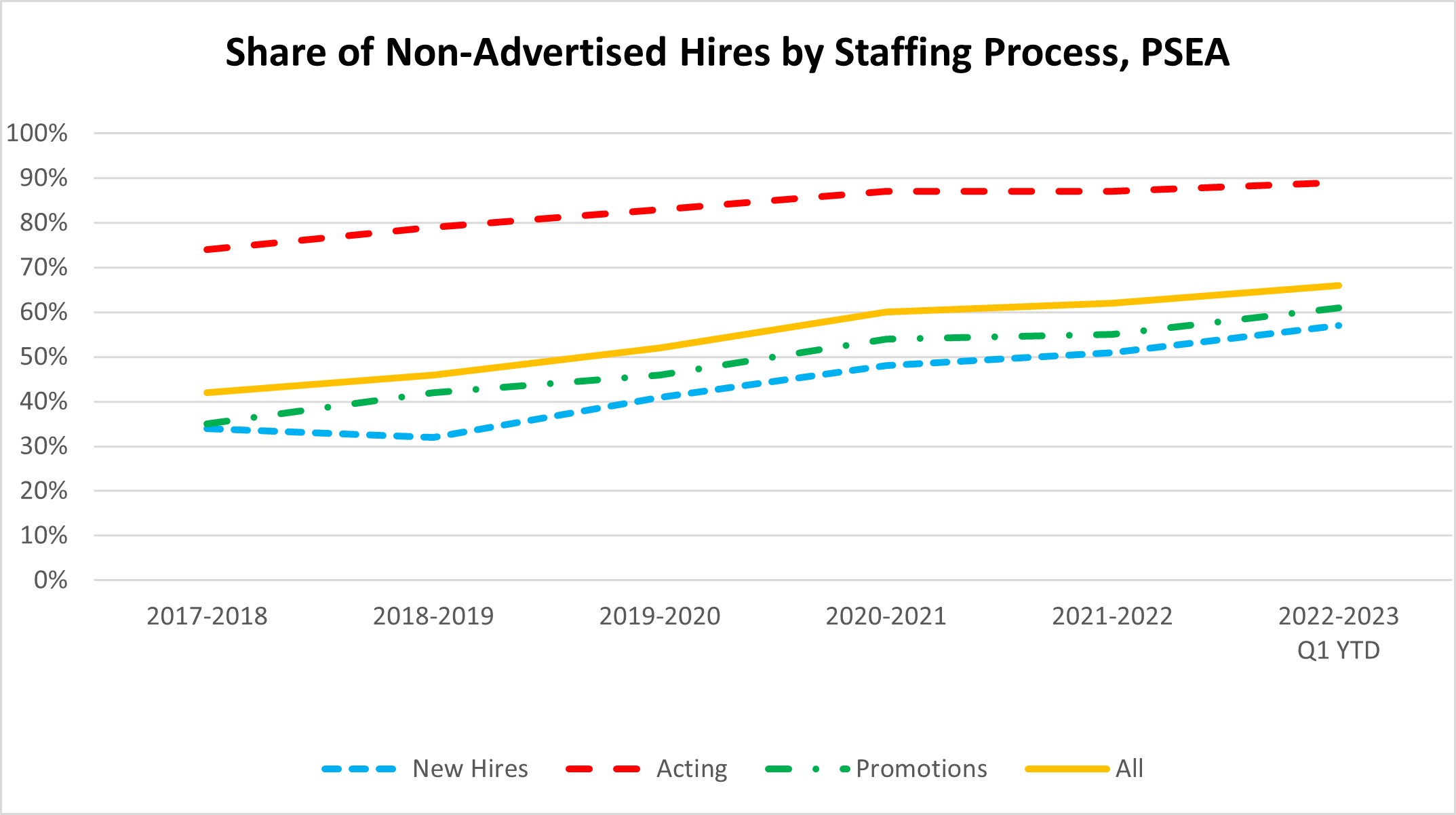
Text version
Appointment Type |
2017-2018 | 2018-2019 | 2019-2020 | 2020-2021 | 2021-2022 | 2022-2023 Q1 YTD (Jun) |
|---|---|---|---|---|---|---|
| New Hires | 34% | 32% | 41% | 48% | 51% | 57% |
| Acting | 74% | 79% | 83% | 87% | 87% | 89% |
| Promotions | 35% | 42% | 46% | 54% | 55% | 61% |
| All | 42% | 46% | 52% | 60% | 62% | 66% |
The overall use of non-advertised staffing has continued to increase from 62% of appointments in 2021-2022 to 66% in 2022-2023 Q1 YTD.
- The use of non-advertised staffing actions for new hires increased from 51% in 2021-2022 to 57% in 2022-2023 Q1 YTD.
- The use of non-advertised staffing actions for acting positions increased from 87% in 2021-2021 to 89% in 2022-2023 Q1 YTD.
- The use of non-advertised staffing actions for promotions increased from 55% in 2021-2022 to 61% in 2022-2023 Q1 YTD.
The use of non-advertised staffing continued to be more pronounced in the NCR than in the Regions. However, an increase was seen across all appointment types in the NCR and in the Regions.
| Appointment Type | 2017-2018 | 2018-2019 | 2019-2020 | 2020-2021 | 2021-2022 | 2022-2023 Q1 YTD (Jun) |
|---|---|---|---|---|---|---|
| New Hires | 44% | 40% | 55% | 67% | 67% | 73% |
| Acting | 81% | 85% | 90% | 92% | 92% | 93% |
| Promotions | 37% | 46% | 49% | 57% | 59% | 65% |
| Total | 47% | 51% | 58% | 68% | 69% | 74% |
| Appointment Type | 2017-2018 | 2018-2019 | 2019-2020 | 2020-2021 | 2021-2022 | 2022-2023 Q1 YTD (Jun) |
|---|---|---|---|---|---|---|
| New Hires | 26% | 24% | 30% | 34% | 38% | 43% |
| Acting | 67% | 73% | 77% | 81% | 83% | 87% |
| Promotions | 32% | 37% | 41% | 48% | 49% | 55% |
| Total | 37% | 39% | 45% | 51% | 54% | 58% |
Continuous Improvement
Time to Staff Reduction Framework
The Time to Staff Reduction Framework was approved by the Meeting of the Commission on August 18, 2022 and highlighted the following:
- the current context for time to staff does not accurately reflect public service staffing
- the framework is restricted to external advertised processes, in response to the calls to action that specify the hiring of new public servants
- the framework includes three areas of impact:
- investing in the community through education and awareness
- building a foundation of efficient tools and products for the community
- shifting the perspective and concentrating on concrete actions and results
The next step of this initiative is key as we consult with internal stakeholders to develop a dedicated action plan and establish associated performance measures.
Staffing Support Division (SSD) Annual Client Satisfaction Questionnaire
The sixth annual SSD Client Service Satisfaction Questionnaire was distributed to organizational contacts in June 2022 and resulted in:
- a record high participation rate of 95%
- 98% client satisfaction with SSD products, namely staffing scenarios, and outreach events
- identified knowledge gaps for employees and hiring managers
- requests for learning materials specifically designed for micro/small organizations
Suggested topics for future sessions included:
- reducing time to staff
- innovation in assessment
- non-advertised appointments
- inclusive language on job posters
- targeting employment equity subgroups
The questionnaire results summary includes additional information on the quantitative and qualitative feedback received as well as proposed actions, which include:
- working in partnership with internal partners to further examine results
- creating a new series of staffing scenarios
- developing information sessions that respond to the requested topics for future sessions
A summary of the overall findings will be shared with respondents in the near future.
Annex A - Breakdown of inquiries received by topic
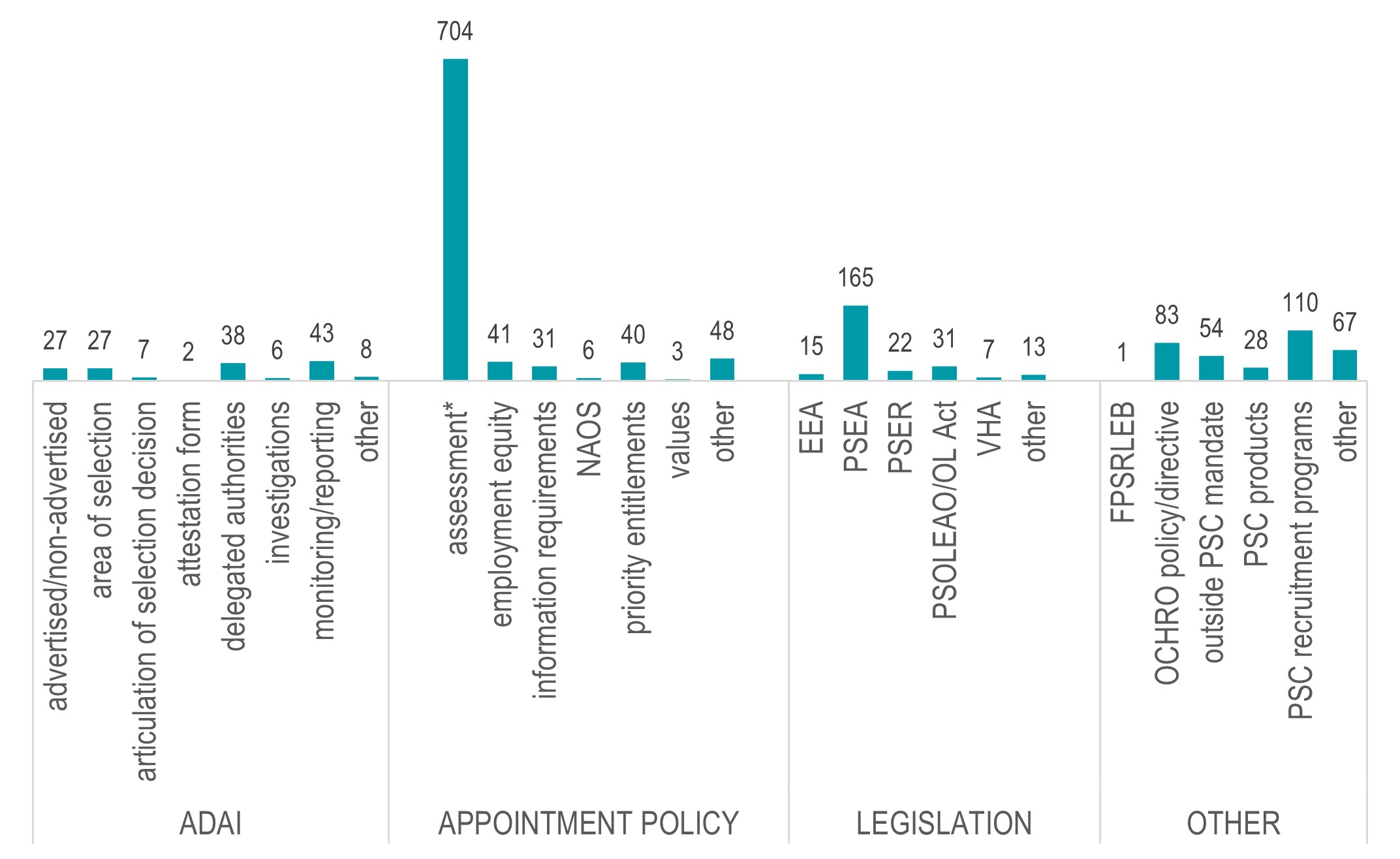
*Assessment includes second language evaluations
Annex B - Breakdown of outreach conducted by event type
