
Public Services and Procurement Canada’s 2026 to 2027 Departmental Plan
On this page
- At a glance
- From the minister
- Plans to deliver on core responsibilities and internal services
- Departmental-wide considerations
- Planned spending and human resources
- Supplementary information table
- Federal tax expenditures
- Corporate information
- Definitions
List of tables
- Table 1: Federal organizations have the products and services they need, when they need them, at the best value
- Table 2: Government purchasing is easy to access, fair and transparent for suppliers and bidders
- Table 3: Government purchasing supports Canada’s economic, environmental, and social policy goals
- Table 4: Planned resources to achieve results for Purchase of goods and services
- Table 5: Canadians, businesses and organizations receive payments on time and revenues are collected for government services in an efficient manner
- Table 6: Members of federal pension plans receive timely and accurate pension payments, benefits and support services to which they are entitled
- Table 7: In collaboration with government departments, employees receive timely and accurate pay and benefits
- Table 8: Canadians have timely access to reliable information on Canada’s finances
- Table 9: Planned resources to achieve results for payment and accounting
- Table 10: Parliamentarians, departments and agencies have access to the federal accommodation and facilities they need to work efficiently and effectively for Canadians
- Table 11: The functionality and long-term sustainability of PSPC federal properties and infrastructure are ensured
- Table 12: Planned resources to achieve results for Property and infrastructure
- Table 13: Federal organizations have access to high quality linguistic services and tools
- Table 14: The government does business with ethical suppliers and ensures that sensitive information is handled appropriately
- Table 15: Federal organizations have the support services they need to deliver their programs to Canadians
- Table 16: Planned resources to achieve results for Government-wide support
- Table 17: Raise awareness of procurement issues and exchange information
- Table 18: Procurement and contract-related issues are addressed through alternative dispute resolution, review of complaints, and the review of federal organizations’ procurement practices
- Table 19: Planned resources to achieve results for Procurement Ombud
- Table 20: Planned resources to achieve results for internal services this year
- Table 21: Percentage of contracts planned and awarded to Indigenous business
- Table 22: 3-year spending summary for core responsibilities and internal services (dollars)
- Table 23: Planned 3-year spending on core responsibilities and internal services (dollars)
- Table 24: Budgetary gross and net planned spending summary (dollars)
- Table 25: Future-oriented condensed statement of operations for the year ended March 31, 2027 (in dollars)
- Table 26: Actual human resources for core responsibilities and internal services
- Table 27: Human resources planning summary for core responsibilities and internal services
© His Majesty the King in Right of Canada, as represented by the Minister of Government Transformation, Public Works and Procurement and Québec Lieutenant, 2026, ISSN: 2371-8846
At a glance
This Departmental Plan details Public Services and Procurement Canada’s (PSPC’s) priorities, plans, and associated costs for the upcoming 3 fiscal years.
These plans align with the priorities outlined in the Mandate letter, as well as PSPC’s vision, mission, raison d’être and operating context.
Key priorities
In its role as a common service provider, PSPC is well positioned to help advance on the Government of Canada’s priorities to:
- continue integrating artificial intelligence (AI) and digital tools to improve service delivery, boost productivity, and reduce operating costs
- reorient procurement practices to support economic growth by prioritizing Canadian suppliers, materials, and content through the Buy Canadian Procurement Policy Framework
- invest strategically in Canadian Armed Forces (CAF) capabilities to defend Canadian sovereignty and grow the defence industry through the Defence Investment Agency
- leverage federal land to support government priorities, such as affordable housing and nation-building projects
Comprehensive expenditure review
The government is committed to restraining the growth of day-to-day operational spending to make investments that will grow the economy and benefit Canadians.
As part of meeting this commitment, PSPC is planning the following spending reductions:
- 2026 to 2027: $108,854,728
- 2027 to 2028: $147,038,620
- 2028 to 2029: $190,834,667
It is anticipated that these spending reductions will result in a decrease of approximately 1,793 full-time equivalents by 2028 to 2029.
PSPC will achieve these reductions by doing the following:
- undertake strategic realignments to reduce ongoing costs to operate programs and efficiently deliver services as a common service provider for the government
- reduce ongoing costs for its Real Property Revolving Fund by focusing on core mandates, modernizing operations, and reducing duplicative functions
- wind down activities of the Canada General Standards Board, as this optional service will be better served via alternative organizations given that there are 15 other accredited Standards Development Organizations operating in Canada
- reduce funding to pilot and innovation projects for Laboratories Canada
- review its internal processes to reduce administrative requirements and delayer management
- advance digital delivery of procurement-related documents and better manage project delivery, and reduce spending on professional services and travel
- implement the use of AI chat bots and self-service tools to improve service delivery
The figures in this departmental plan reflect these reductions.
Highlights for Public Services and Procurement Canada in 2026 to 2027
Artificial Intelligence
In 2026 to 2027, PSPC will continue working to expand the use of digital tools and leverage the power of AI to make government services faster, more efficient, and easier to use.
One example is GCtranslate, a new secure AI tool that translates between English and French. This tool is being rolled out across government to save time and money, support both official languages, and help improve public services. PSPC’s Translation Bureau is also exploring how AI can support translation into Indigenous languages, and help with tasks like writing, interpreting, and voice recognition. Additionally, PSPC continues to leverage automation to minimize errors and improve pay processing service delivery. Through these types of efforts, PSPC is helping build a more modern public service that meets the needs of Canadians today and into the future.
Buy Canadian Procurement Policy Framework
PSPC supports Canada’s economic growth through the new Buy Canadian Procurement Policy Framework and associated programs. These require PSPC and client departments to prioritize Canadian materials, including steel, wood products and aluminum. In addition, under the Interim Policy on Reciprocal Procurement, non-defence contracts are limited to Canadian suppliers and suppliers of Canada’s trading partners where applicable, which helps level the playing field. The Policy on Reciprocal Procurement will be broadened to establish supplier eligibility requirements based on the origin of goods and services being offered. PSPC is also launching a new program to support small and medium-sized enterprises (SMEs), making it easier for them to compete and succeed in federal procurement. By prioritizing Canadian suppliers, PSPC ensures that federal procurement contributes directly to domestic economic growth.
Defence Investment Agency
PSPC will continue to play a key role in supporting the Defence Investment Agency (DIA), as the new Agency establishes the necessary supports and independence to lead major transformation of Canada’s defence procurement system. The DIA aims to better align procurement activities with national priorities, accelerate project and procurement timelines, and strengthen domestic industrial capabilities in support of Canada’s defence and security objectives.
The DIA is introducing a more strategic and co-ordinated approach to defence procurement, ensuring that projects and other procurements are delivered faster and more efficiently.
By simplifying procurement requirements, enhancing contract management practices, adopting more flexible and agile procurement models, and enabling better and earlier engagement, including with industry, PSPC, through its works with the DIA, seeks to reduce administrative burdens and improve efficiency throughout the defence sector. These changes will help mitigate risks, accelerate project delivery, and strengthen operational readiness—ensuring that the CAF and the Canadian Coast Guard (CCG) have timely access to the equipment and services they need. At the same time, these improvements will support greater transparency, accountability, and value for money in defence procurement, contributing to a more responsive and resilient national defence system.
In 2026 to 2027, total planned spending (including internal services) for PSPC is $5,929,171,521 and total planned full-time equivalent staff (including internal services) is 17,449.
Summary of planned results
The following provides a summary of the results the department plans to achieve in 2026 to 2027 under its main areas of activity, called “core responsibilities.”
Core responsibility 1: Purchase of goods and services
In 2026 to 2027, PSPC will:
- implement the Buy Canadian Policy to support the strengthening of domestic industry and supply chains
- continue to improve procurement vehicles for professional services by requiring greater transparency on pricing and subcontractors from suppliers, strengthening evaluation criteria, standardizing tools, and enhancing the challenge function to foster competition
- following on the delivery of a modernized, cloud-based electronic procurement platform, expand the Electronic Procurement System and advance the decommissioning of legacy procurement systems
- continue to support Canada’s updated defence policy and the National Shipbuilding Strategy, and work with other departments and industry to transform Canada’s defence procurement system, accelerate project and procurement timelines, strengthen domestic industrial capabilities and enhance the security of Canada’s supply chains, including through the DIA
- identify additional opportunities to support the mandatory minimum target of awarding at least 5% of the total value of contracts to Indigenous businesses annually
- implement an ethical procurement policy to safeguard federal procurement supply chains against human trafficking, forced labour, and child labour and promote effective human rights due diligence and responsible business conduct
- support the development of procurement criteria for environmental goods and services, and the tools, guidance and initiatives required to aid in decision-making for the procurement of green products and clean technologies
- continue to work with government partners to implement the Policy on Reciprocal Procurement to help ensure balanced procurement opportunities with Canada’s trading partners, while enhancing support for Canadian businesses, including small and medium enterprises
Planned spending: $168,998,282
Planned human resources: 2,205 full-time equivalents (FTEs)
More information about Purchase of goods and services can be found in the full Departmental Plan.
Core responsibility 2: Payments and accounting
In 2026 to 2027, PSPC will:
- continue to administer and deliver timely and accurate pay and benefits for all public servants, in collaboration with government departments, while improving compliance with service standards and making progress towards resolving outstanding pay cases for public service Pay Centre clients
- support the transition to a new Human Resources (HR) and Pay solution by establishing a sovereign central data hub for all employee data, standardizing processes, incorporating automation to the extent possible and leveraging AI and strong data governance
- continue to deliver timely, high-quality, client-centric products and services to more than one million active and retired pension plan members, while implementing innovative approaches and technologies to modernize pension service delivery
Planned spending: $1,037,985,984
Planned human resources: 5,610 FTEs
More information about Payments and accounting can be found in the full Departmental Plan.
Core responsibility 3: Property and infrastructure
In 2026 to 2027, PSPC will:
- advance the Government of Canada’s Office Portfolio Reduction Plan (GC-OPRP) by rightsizing its office portfolio, optimizing workplaces for federal employees, leveraging lease terminations, and disposing of underused federal properties to reduce spending on government operations
- further improve crossings in the National Capital Region (NCR) to ensure the health and safety of users and advance the assessments and planning associated with an additional crossing
- continue to advance the rehabilitation of the Parliamentary Precinct through the Long-Term Vision and Plan (LTVP)
- continue implementing the Laboratories Canada Strategy to provide federal scientists with collaborative, accessible, and sustainable science and technology facilities
Planned spending: $4,207,333,741
Planned human resources: 4,305 FTEs
More information about Property and infrastructure can be found in the full Departmental Plan.
Core responsibility 4: Government-wide support
In 2026 to 2027, PSPC will:
- adapt to the rapid pace of digital transformation in linguistic services by leveraging AI and continue to evolve linguistic services (interpretation, translation and terminology) with key partners to meet the needs of government organizations and Parliament
- provide cybersafe and digitally enabled systems and applications, increase information processing capacity, and enable enhanced analytics and decision-making through improved data governance and frameworks
- strengthen the Office of Supplier Integrity and Compliance’s efforts to prevent, detect and respond to incidents of wrongdoing, and ensure that the Government of Canada does not conduct business with suppliers of concern
- strengthen the Contract Security Program and the Controlled Goods Program to address an increasingly complex threat environment, while advancing client-centric service delivery and deepening collaboration with industry to safeguard sensitive and strategic information
Planned spending: $176,893,188
Planned human resources: 2,387 FTEs
More information about Government-wide support can be found in the full Departmental Plan.
Core responsibility 5: Procurement Ombud
While operating at arm’s length from federal organizations, including PSPC, in 2026 to 2027, the Office of the Procurement Ombud will:
- review the procurement practices of federal organizations to promote fairness, openness and transparency
- review complaints from Canadian suppliers and make recommendations for compensation where appropriate
- provide alternative dispute resolution services which offer an opportunity for suppliers and federal organizations to come together in a neutral setting to find solutions to contract disputes, preserve business relationships and avoid costly litigation
- share procurement-related information among federal organizations and Canadian suppliers to promote simplification, transparency and diversification in the federal procurement process
Planned spending: $4,389,120
Planned human resources: 34 FTEs
More information about Procurement Ombud can be found in the full Departmental Plan.
For complete information on PSPC’s total planned spending and human resources, read the Planned spending and human resources section of the full plan.
From the Minister

The Honourable Joël Lightbound, P.C., Member of Parliament (M.P.)
Minister of Government Transformation, Public Works and Procurement and Québec Lieutenant
I am pleased to present Public Services and Procurement Canada’s (PSPC) Departmental Plan for 2026 to 2027.
Canada is facing a global environment defined by economic fragmentation, intensifying geopolitical competition, and mounting pressures on supply chains and critical infrastructure. In this context, the role of government is not passive. It must be strategic, disciplined, and prepared to use every tool available to strengthen our sovereignty, protect our economic interests, and deliver tangible results for Canadians.
Public Services and Procurement Canada is central to that work.
As the government’s central purchasing agent, real property manager, pay and pension administrator, and linguistic authority, PSPC manages some of the most significant operational and financial levers in the federal system. The decisions made within this department shape not only how government functions, but how public investment strengthens Canadian industry, supports workers, and reinforces national resilience.
As the government’s central purchaser, PSPC is making federal procurement simpler, faster and ensuring it delivers lasting benefits for Canadian workers, businesses, and communities. Our Buy Canadian Procurement Policy Framework represents a bold new approach that prioritizes Canadian suppliers and materials, encourages the use of Canadian inputs and local content, and streamlines procurement processes to make it easier for Canadian small- and medium-sized enterprises to access federal opportunities. In a period where supply chain security and domestic production capacity matter more than ever, procurement policy is being used deliberately to anchor economic activity in Canada and reduce strategic vulnerabilities. In addition, the minister of Finance and I instructed PSPC and other federal organizations to undertake a review of current and planned federal contracts to find savings and reduce costs. PSPC and client departments will explore innovative alternatives to find cost savings and efficiencies through federal government procurement.
At the same time, PSPC is advancing the government’s broader digital transformation agenda under Canada’s Digital Ambition. Modern, secure, and user-centred services are essential to public trust and operational effectiveness. The department is modernizing legacy systems, strengthening cybersecurity safeguards, and integrating advanced technologies in a responsible manner to improve efficiency and service quality.
Artificial intelligence (AI) is being deployed with clear guardrails and measurable objectives. By improving productivity and reducing repetitive administrative burdens, AI allows public servants to focus on complex, high-value work that directly benefits Canadians. The launch and expansion of GCtranslate, developed by the Translation Bureau, illustrates this approach. As the first flagship initiative under the Treasury Board of Canada Secretariat’s Artificial Intelligence Strategy, GCtranslate integrates secure AI-powered translation technologies into linguistic services, enhancing accessibility, accelerating delivery, and reinforcing Canada’s commitment to official languages.
PSPC is also applying responsible technology to strengthen pay administration. Ensuring that public servants are paid accurately and on time remains a fundamental obligation. The introduction of an AI-powered virtual assistant to support case processing will improve transaction speed, increase accuracy, and reduce manual workload for compensation advisors, enabling them to concentrate on complex, human-centred cases. This modernization effort is focused on stability, reliability, and restoring confidence in core systems.
In response to a more contested global security environment, Canada is also transforming its approach to defence procurement. Within PSPC, the creation of the Defence Investment Agency as a special operating agency represents a structural shift toward centralized expertise, streamlined decision-making, and accelerated delivery of mission-critical capabilities. Its mandate is clear: rebuild, rearm, and reinvest in the Canadian Armed Forces while strengthening Canada’s defence industrial base and fostering innovation at home.
This work supports Canada’s commitment to increase defence spending to 2% of gross domestic product by the end of this fiscal year, and to 5% within the next decade. Meeting these targets requires disciplined procurement, closer collaboration with Canadian industry, and a system capable of delivering equipment and infrastructure at the speed required by today’s security realities. Defence investment is not only about meeting international benchmarks; it is about ensuring Canada possesses the capabilities necessary to safeguard its sovereignty and uphold its responsibilities as a NATO ally.
PSPC will also continue to contribute to the government’s housing objectives by identifying surplus and under-used federal properties and accelerating their disposition where appropriate. Unlocking federal lands for housing development supports supply growth, contributes to affordability, and ensures that public assets are used in ways that respond to pressing national needs.
Across all of these priorities, prudent fiscal management remains essential. PSPC will continue coordinating efforts to reduce expenditures, improve internal efficiency, and ensure that Canadians receive maximum value for every public dollar spent. In a time of economic uncertainty, disciplined stewardship of public resources is inseparable from public confidence.
This Departmental Plan sets out a clear direction: to use procurement, property, technology, and operational reform not simply to administer government, but to strengthen Canada’s economic resilience, reinforce our sovereignty, and deliver reliable services to Canadians. PSPC will continue to translate strategic policy into operational outcomes that support a stronger, safer, and more prosperous country.
I look forward to working with the dedicated public servants at PSPC as we carry this work forward in 2026 to 2027.
The Honourable Joël Lightbound, P.C., M.P.
Minister of Government Transformation, Public Works and Procurement and Québec Lieutenant
Plans to deliver on core responsibilities and internal services
- Core responsibility 1: Purchase of goods and services
- Core responsibility 2: Payments and accounting
- Core responsibility 3: Property and infrastructure
- Core responsibility 4: Government-wide support
- Core responsibility 5: Procurement Ombud
- Internal services
Core responsibility 1: Purchase of goods and services
In this section
Description
PSPC purchases goods and services on behalf of the Government of Canada.
Quality of life impacts
This core responsibility contributes to the following domains of the Quality of Life Framework for Canada:
- Prosperity and Society domains, specifically the “Productivity”, “Firm Dynamism”, “Sense of pride in Canada”, “Sense of belonging to Canada”, and “Shared values” indicators through the Buy Canadian Policy, Policy on Reciprocal Procurement, and increased participation of underrepresented groups in procurement, including Indigenous businesses
- Good governance domain and the “Confidence in institutions” indicator through activities related to increasing procurement efficiency, competitiveness and client satisfaction
Indicators, results and targets
This section presents details on the department’s indicators, the actual results from the 3 most recently reported fiscal years, the targets and target dates for Purchase of goods and services. Details are presented by departmental result.
Table 1: Federal organizations have the products and services they need, when they need them, at the best value
| Indicator | Actual results | Target | Date to achieve target |
|---|---|---|---|
| Percentage of original contracts of level 1 (Basic) complexity awarded within established timeframes | 2022 to 2023: 64% 2023 to 2024: 58% 2024 to 2025: 62% |
At least 85% | March 31, 2027 |
| Percentage of original contracts of level 2 (Standard) complexity awarded within established timeframes | 2022 to 2023: 75% 2023 to 2024: 66% 2024 to 2025: 64% |
At least 80% | March 31, 2027 |
| Cost of procurement services per $100 of contract value | 2022 to 2023: $1.23 2023 to 2024: $1.19 2024 to 2025: $0.93 |
At most $1.75 | March 31, 2027 |
| Percentage of competitive procurement processes versus sole source | 2022 to 2023: 80% 2023 to 2024: 79% 2024 to 2025: 78% |
At least 80% | March 31, 2027 |
| Percentage of complex competitive procurement processes for which at least 2 qualified bids were received (Levels 3–5) | 2022 to 2023: 67% 2023 to 2024: 56% 2024 to 2025: 63% |
At least 62% | March 31, 2027 |
Table 2: Government purchasing is easy to access, fair and transparent for suppliers and bidders
| Indicator | Actual results | Target | Date to achieve target |
|---|---|---|---|
| Percentage of suppliers and bidders that rate the procurement process as easy to access | Not Applicabletable 2 note 1 | At least 80% | March 31, 2027 |
| Percentage of suppliers and bidders that rate the procurement process as fair and transparent | Not Applicable table 2 note 2 | At least 80% | March 31, 2027 |
Table 2 Notes
|
|||
Table 3: Government purchasing supports Canada’s economic, environmental, and social policy goals
| Indicator | Actual results | Target | Date to achieve target |
|---|---|---|---|
| Percentage of contract value awarded to small and medium businesses | 2022 to 2023: 24% 2023 to 2024: 20% 2024 to 2025: 5%table 3 note 1 |
At least 25% | March 31, 2027 |
| Percentage of standing offers and supply arrangements that include “green” goods and services | 2022 to 2023: 45% 2023 to 2024: 51% 2024 to 2025: 29% |
At least 45% | March 31, 2027 |
| Percentage of participation in procurement processes by Indigenous suppliers | 2022 to 2023: 7% 2023 to 2024: 10% 2024 to 2025: 16% |
At least 11% | March 31, 2027 |
| Percentage of participation in procurement processes by suppliers who are women | 2022 to 2023: 14% 2023 to 2024: 15% 2024 to 2025: 14% |
At least 15% | March 31, 2027 |
Table 3 Note
|
|||
Additional information on the detailed results and performance information for PSPC’s program inventory is available on the Government of Canada (GC) InfoBase.
Plans to achieve results
The following section describes the planned results for Purchase of goods and services in 2026 to 2027.
Federal organizations have the products and services they need, when they need them, at the best value
As the central purchaser for the Government of Canada, PSPC is committed to ensuring procurement is well managed and achieves the best value for Canadians. Through its procurement activities, PSPC will continue to support federal departments and agencies in delivering programs for Canadians.
Results PSPC plans to achieve
- ensure that client departments continue to receive best value by promoting competitive processes and incorporating vendor performance and outcome-based clauses that incent suppliers to deliver on time and on budget
- continue to improve the procurement vehicles for professional services by requiring greater transparency on pricing and subcontractors from suppliers, strengthening the evaluation criteria, standardizing tools, and when required, enhancing its challenge function with client departments to promote competition
- continue to improve the accuracy of procurement data, documentation and compliance monitoring throughout the procurement process to better inform decision-making and meet reporting requirements
Defence and marine procurement
PSPC will continue to deliver key equipment, supplies, and services in support of Canada’s updated defence policy and the National Shipbuilding Strategy.
Results PSPC plans to achieve
- provide members of the CAF and the CCG with the equipment they need to maintain current and future operational readiness through the continued management of shipbuilding and ship repair, aerospace acquisition and modernization, and vehicle and munitions acquisition projects and contracts
- collaborate with other government departments to support the implementation of the Icebreaker Collaboration Effort Pact, a trilateral partnership with Finland and the United States, to enhance the collective capacity to design, produce, and maintain icebreakers and other capabilities
- continue to advance the risk-based approach to contract approval for eligible defence procurements, enabling a streamlined contract approval process
- continue to advance defence procurement reform by working in partnership with other departments and industry to transform Canada’s defence procurement system, accelerate project and procurement timelines, strengthen domestic industrial capabilities and to enhance the security of Canada’s supply chains, including through the DIA
Government purchasing is easy to access, fair and transparent for suppliers and bidders
Reforming federal procurement
PSPC will continue to advance initiatives to transform federal procurement, simplify processes and practices, and ensure value for money is being achieved.
Results PSPC plans to achieve
- continue to implement digital delivery with the ongoing roll-out of the Electronic Procurement System, and proceed with the launch of a new Buyer’s Portal and Buyer’s Guide to increase efficiencies
- implement the Vendor Performance Management Program in an increased number of procurement areas, resulting in a more collaborative relationship with vendors, fostering performance improvement, and delivering better contractual outcomes for Canada
- continue to expand the modernized contract model and the use of the contract assembly tool to other government departments to generate operational efficiencies in terms of contract assembly, as well as to increase the consistency and standardization of contractual documents across federal government departments and agencies
- move forward with the full implementation of a multi-year procurement data and analytics strategy to continue the transition towards data-driven decision-making
Government purchasing supports Canada’s economic, environmental, and social policy goals
Buy Canadian Procurement Policy Framework implementation and leadership
The department will play a central role in implementing the Buy Canadian Procurement Policy Framework, a cornerstone of the Government of Canada strategy to strengthen domestic industry and supply chains. PSPC will operationalize a suite of procurement instruments designed to prioritize Canadian suppliers, content and materials across federal organizations, including Crown corporations, agencies, and departments.
Results PSPC plans to achieve
- advance Canada’s strategic industrial goals by applying mandatory Canadian materials requirements to defence and construction procurements valued at $25 million or more, and lowering this threshold to $5 million or more by spring 2026
- prioritize Canadian suppliers and content through point-rated incentives and Canadian content attestations
- support Buy Canadian Policy development through consultation sessions with business communities
Small- and medium-sized enterprises and supplier engagement
In support of supplier engagement initiatives, the department will continue to explore approaches to enhancing the involvement of SMEs in PSPC-led procurements.
Results PSPC plans to achieve
- launch a new Small- and Medium-sized Procurement Business Program to make it easier for SMEs to compete and succeed in federal procurement
- continue to engage SMEs to increase their participation in federal procurement by clarifying how the government buys goods and services, raising awareness of opportunities, and providing information services through Procurement Assistance Canada (PAC)
- work with SMEs to address key challenges and constraints by reducing the barriers to participation in federal procurement, advise government buyers and policy-makers on SMEs’ concerns, and recommend improvements to the federal procurement process
- strengthen engagement with partners by developing events adapted to the specific needs of businesses, clients and procurement stakeholders
- continue outreach and assistance efforts towards businesses owned or led by underrepresented business communities, including Indigenous Peoples, persons with disabilities, Black and racialized Canadians, women and 2SLGBTQIA+ Canadians
- award Canadian SMEs 25% of the dollar value of contracts issued by PSPC
Procuring from Indigenous businesses
PSPC will continue to support and work closely with Indigenous Services Canada (ISC), Treasury Board of Canada Secretariat (TBS), and Indigenous partners in the co-development and implementation of a new, longer-term Transformative Indigenous Procurement Strategy to increase Indigenous inclusion and participation in federal procurement.
Results PSPC plans to achieve
- continue to implement the mandatory minimum 5% Indigenous procurement target through different measures, such as Limited to Indigenous Offers, Indigenous Participation Plans, and unbundling opportunities, all aimed at building capacity and increasing Indigenous participation and inclusion in federal procurement activities
- advance economic Reconciliation with Indigenous Peoples by strengthening awareness of Modern Treaty procurement obligations and supporting the implementation of the Nunavut Directive and the work of the Inuit-Crown Partnership Committee
- continue to lead Indigenous business information sessions through PAC to provide information on Indigenous procurement opportunities and supports, as well as Buyers’ Expos, which allow suppliers to talk to government buyers directly and learn more about upcoming procurement opportunities
Green and clean technology procurement
PSPC will continue to undertake measures to integrate environmental considerations into federal purchasing and leverage federal spending to accelerate the transition to a net-zero carbon and circular economy.
Results PSPC plans to achieve
- support TBS in developing category-specific green procurement criteria in all phases of the procurement of goods and services that have a high environmental impact
- continue to promote the use of standard environmentally preferable packaging language in all PSPC-administered procurements
- continue to promote the inclusion of the greenhouse gas (GHG) Disclosure Standard and support TBS in integrating GHG Life-Cycle Assessments in procurement of high-dollar value goods and services
- advance work on a multi-year project to develop a Green Public Procurement Tool (GPPT) for federal assets, a web-based search platform that includes a vast catalogue of green and cleantech products to support procurement professionals and other decision-makers in making environmentally responsible purchasing decisions
- work with key partners, such as the Trade Commissioner Service and the Clean Growth Hub, and external stakeholders, such as Foresight Canada and MaRS Discovery District, to further promote the purchasing of clean technology within the federal government and onboard Canadian cleantech products in the GPPT platform
Ethical procurement
As the Government of Canada’s central purchaser, PSPC is committed to maintaining the highest ethical standards for public procurement, both as a common service provider and by offering guidance to other government departments.
Results PSPC plans to achieve
- safeguard federal procurement supply chains from human trafficking, forced labour and child labour by ensuring that goods and services are procured from ethical suppliers
- implement a Human Rights Due Diligence Framework to support ongoing departmental commitment to ethical procurement and the development of related initiatives, tools and guidelines
Accessible procurement
PSPC remains committed to making accessibility a part of procurement practices so that the goods and services it procures are accessible and inclusive for all.
Results PSPC plans to achieve
- strengthen the capacity of federal procurement professionals to effectively consider and integrate accessibility requirements into procurement processes
Reciprocal procurement
The Policy on Reciprocal Procurement will increase opportunities for Canadian businesses, including SMEs, by enforcing fair and reciprocal access to Canada’s procurement market.
Results PSPC plans to achieve
- implement phase II of the Policy on Reciprocal Procurement to establish supplier eligibility requirements based on the origin of goods and services being offered
- leverage the Policy on Reciprocal Procurement to ensure goods and services are procured from Canadian businesses or from countries that grant similar levels of market access
Gender-based Analysis Plus
PSPC will continue to ensure inclusive procurement opportunities. The department developed a GBA Plus Approach Methodology to help business owners and contracting authorities assess how procurement impacts groups of people differently.
The Procurement Program collects data to enable it to monitor and report procurement impacts by gender and diversity. Additionally, through PAC, the department will continue to provide targeted support and conduct outreach activities with underrepresented groups, including Indigenous Peoples, persons with disabilities, Black and racialized Canadians, women and 2SLGBTQIA+ Canadians, to help them do business with the Government of Canada.
Planned resources to achieve results
Table 4: Planned resources to achieve results for Purchase of goods and services
| Resource | Planned |
|---|---|
| Spending | $168,998,282 |
| Full-time equivalents | 2,205 |
Complete financial and human resources information for PSPC’s program inventory is available on GC InfoBase.
Program inventory
Purchase of goods and services is supported by the following program:
- Procurement Program
Additional information related to the program inventory for Purchase of goods and services is available on the Results page on GC InfoBase.
Summary of changes to reporting framework since last year
Since last year, PSPC made the following changes to the reporting framework for Purchase of goods and services:
- the Departmental Result “government purchasing is easy to access, fair and transparent for suppliers” has been updated to include “suppliers and bidders” to align with the broadened scope of the targeted outcome
- the Departmental Results Indicators (DRIs) “percentage of suppliers that rate the procurement process as easy to access” and “percentage of suppliers that rate the procurement process as fair and transparent” have been broadened to encompass “suppliers and bidders” to ensure feedback reflects the perspectives of participants in the procurement process
- the DRI “percentage of contracts, standing offers and supply arrangements that include ‘green’ goods and services” has been updated to remove the word “contracts” to ensure consistency between the indicator wording and the calculation methodology
- the DRI “percentage of overall client satisfaction with PSPC procurement services” has been removed and will be reported publicly at the program level only
Core responsibility 2: Payments and accounting
In this section
Description
PSPC collects revenues and issues payments, maintains the financial accounts of Canada, issues government-wide financial reports, and administers payroll and pension services for the Government of Canada.
Quality of life impacts
This core responsibility contributes to the Good governance domain of the Quality of Life Framework for Canada and, more specifically, to the “Confidence in institutions” indicator through its financial and administrative activities.
Indicators, results and targets
This section presents details on the department’s indicators, the actual results from the 3 most recently reported fiscal years, the targets and target dates for Payments and accounting. Details are presented by departmental result.
Table 5: Canadians, businesses and organizations receive payments on time and revenues are collected for government services in an efficient manner
| Indicator | Actual results | Target | Date to achieve target |
|---|---|---|---|
| Percentage of payments issued within established timeframestable 5 note 1 | 2022 to 2023: 99.99% 2023 to 2024: 99.99% 2024 to 2025: 99.99% |
At least 99% | March 31, 2027 |
| Percentage of time in which payments to the Government of Canada are processed within service standards | 2022 to 2023: 100% 2023 to 2024: 100% 2024 to 2025: 100% |
At least 95% | March 31, 2027 |
Table 5 Note
|
|||
Table 6: Members of federal pension plans receive timely and accurate pension payments, benefits and support services to which they are entitled
| Indicator | Actual results | Target | Date to achieve target |
|---|---|---|---|
| Percentage of pension payments processed within service standards | 2022 to 2023: 98% 2023 to 2024: 98% 2024 to 2025: 98% |
At least 95% | March 31, 2027 |
Table 7: In collaboration with government departments, employees receive timely and accurate pay and benefits
| Indicator | Actual results | Target | Date to achieve target |
|---|---|---|---|
| Number of employees facing potential pay inaccuracies at the Pay Centre | 2022 to 2023: 135,500 2023 to 2024: 112,273 2024 to 2025: 94,122 |
At most 88,000 | March 31, 2027 |
| Percentage of transactions processed within service standards | Not Applicabletable 7 note 1 | At least 95% | March 31, 2027 |
Table 7 Note
|
|||
Table 8: Canadians have timely access to reliable information on Canada’s finances
| Indicator | Actual results | Target | Date to achieve target |
|---|---|---|---|
| The Public Accounts of Canada are available online to Canadians within 24 hours of tabling in the House of Commons | 2022 to 2023: 100% 2023 to 2024: 100% 2024 to 2025: 100% |
100% | March 31, 2027 |
| Information presented in the Consolidated Financial Statements of the Government of Canada is accurate | 2022 to 2023: 100% 2023 to 2024: 100% 2024 to 2025: 100% |
At least 99% | March 31, 2027 |
Additional information on the detailed results and performance information for PSPC’s program inventory is available on GC InfoBase.
Plans to achieve results
The following section describes the planned results for Payments and accounting in 2026 to 2027.
Canadians, businesses and organizations receive payments on time and revenues are collected for government services in an efficient manner
PSPC’s responsibilities for payments directly impact individuals and businesses on a daily basis, and provide the backbone of financial security to millions of Canadians in receipt of pay, pension, and government social benefits payments.
Results PSPC plans to achieve in supporting the minister as the Receiver General for Canada
- continue to manage the operations of the federal treasury, maintain the government’s central treasury systems, and present the financial position of Canada and audited financial statements annually
- assess and implement strategies to increase flexibility to adopt payment industry innovations, offer Canadians a choice of payment options, revitalize treasury systems and processes, and consolidate treasury databases to improve data quality. These efforts aim to improve payment and revenue collection efficiency while bolstering fraud prevention and detection
Members of federal pension plans receive timely and accurate pension payments, benefits and support services to which they are entitled
As one of Canada’s largest pension administrators, PSPC provides services to more than 1 million active and retired members of eight different federal public sector pension plans: Public Service, Royal Canadian Mounted Police, Canadian Armed Forces (Regular and Reservists), Members of Parliament, the Diplomatic Corps, Federally Appointed Judges, and Lieutenant Governors. Through strategic investments in technology and service innovation, PSPC is laying the foundation for a more secure and modern pension experience that aligns with government priorities and industry best practices.
Results PSPC plans to achieve
- ensure timely and accurate pension payments and services for active and retired plan members and their beneficiaries
- maintain pension systems in support of proposed legislative changes announced in Budget 2025
- modernize pension web portals to provide access for retirees and external users
- enhance program effectiveness by optimizing service delivery through a secure, user-centric, digital-first model
In collaboration with government departments, employees receive timely and accurate pay and benefits
PSPC is responsible for administering compensation and benefits, and ensuring data integrity for all current and former federal employees in more than 100 organizations. PSPC also delivers centralized pay and benefit processing services for two thirds of public servants, responds to individual inquiries and resolves pay issues at first point of contact when possible. The stabilization of pay processing and ensuring that public servants are paid accurately and on time, which is a shared responsibility with federal departments and agencies, continue to be top priorities for the department. Ongoing efforts to achieve these results include delivering on complex mandatory and legislative requirements (for example, collective agreement implementation), ensuring that the current pay information technology ecosystem is maintained properly and that the personal and financial data it contains are not compromised. Additionally, the department is providing training and information support to the Government of Canada compensation community and to the HR and financial functional communities.
PSPC also continues to work on setting the foundation for future phases of business and digital transformation for HR and pay. Following the completion of a rigorous feasibility study, the Government of Canada announced its decision to move forward to the final build and testing phase of the Dayforce HR and pay solution. By June 2026, PSPC will finalize the configuration of the solution and will begin enterprise testing. PSPC will continue to engage with departments to support efforts to complete readiness activities to onboard ahead of implementation, currently anticipated to begin in 2027 to 2028.
Results PSPC plans to achieve
- continue efforts to process new pay actions within service standards and eliminate transactions that are older than one year
- continue to leverage AI, automation, bulk processing and other tools to reduce the frequency of manual intervention in pay processing
- continue work on testing and defining a potential new service delivery model for pay
- continue to share information on activities with stakeholders as part of transparency by design, in partnership with the TBS Office of the Chief Human Resources Officer
- contribute to the reduction of HR system integration issues by further consolidating the management of HR systems at PSPC
- standardize processes, practices and systems to ensure that TBS can enable consistent HR management across departments
- oversee the ongoing work to finalize the configuration of the new system and begin enterprise-wide testing to get ready for the eventual implementation of the Dayforce solution enterprise-wide
- develop tools and activities to ensure that organizations are well equipped for onboarding onto the new solution
Canadians have timely access to reliable information on Canada’s finances
The Receiver General is a world leader for best practices in government accounting.
Results PSPC plans to achieve
- advance the renewal and modernization of the Public Accounts of Canada by investing in modern technology and exploring innovative opportunities
- seek possible partnerships to ensure government-wide financial reports remain a trusted and accessible source of financial data
Gender-based Analysis Plus
PSPC’s Federal Pay Administration Program collects data to monitor and report on its impacts on diverse groups of people. It currently draws demographic information—such as age, sex, and official language—from the Phoenix pay system. This data supports analysis of the pay case inventory, workload in progress, escalated cases, and service access by demographic factors. PSPC will continue analyzing pay-related data, looking at the age, sex, and language composition of employees with a pay case to inform planning and improve outcomes for diverse groups of employees.
The Federal Pension Administration Program collects data related to gender and diversity through client service feedback surveys. The surveys allow respondents to self-identify based on gender and as members of the following groups: Indigenous Peoples, 2SLGBTQIA+, persons with disabilities, and visible minorities. The data gathered through surveys enables the program to evaluate current services and identify opportunities for improvement and innovation and ensure that future services are client-centred, accessible, and responsive to user needs.
The Payment and Revenue Collection Program, the Government-Wide Accounting and Reporting Program and the Payments Instead of Property Taxes to Local Government Programs do not collect data to monitor and report program impacts by gender and diversity, as their mandate is mainly to collect financial information, to provide public accounts services to the Government of Canada’s departments and agencies, and to provide payments to taxing authorities.
The Cape Breton Operations Program collects data to enable it to monitor and report on program impacts related to gender and diversity. The program maintains a database of all former Cape Breton Development Corporation employees who receive various legacy benefits. The benefit recipients are predominantly lower income, senior males who reside in the Cape Breton regional municipality.
Planned resources to achieve results
Table 9: Planned resources to achieve results for Payments and accounting
| Resource | Planned |
|---|---|
| Spending | $1,037,985,984 |
| Full-time equivalents | 5,610 |
Complete financial and human resources information for PSPC’s program inventory is available on GC InfoBase.
Program inventory
Payments and accounting is supported by the following programs:
- Federal pay administration
- Federal pension administration
- Payments instead of property taxes to local governments
- Payments and revenue collection
- Government-wide accounting and reporting
- Cape Breton Operations—Human resources legacy benefits
Additional information related to the program inventory for Payment and accounting is available on the Results page on GC InfoBase.
Summary of changes to reporting framework since last year
Since last year, PSPC made the following changes to the reporting framework for Payments and accounting:
- the DRI “percentage of cases, submitted on time to the Pay Centre, that have been processed within service standards” has been replaced with the publicly reported Program-level indicator “percentage of transactions processed within service standards” for streamlining purposes
- the DRI “Public Accounts of Canada are available online to Canadians in PDF and HTML formats as well as via the Open Government Portal within 24 hours of tabling in the House of Commons” has been revised to remove references to specific formats and location
- the DRI “percentage of pension payments processed that are accurate and on time” has been updated to focus on service standards and align with the indicator measurement strategy
- the DRI “percentage of money paid to the Government of Canada that is reconciled within 2 business days” has been revised to “percentage of time in which payments to the Government of Canada are processed within services standards” to focus on service standards and align with the calculation methodology
- the DRI “percentage of payments made instead of property taxes to taxing authorities within established timeframes” will be reported publicly at the Program level only
- the DRI “percentage of cases submitted to the Pay Centre on time” has been removed, as it pertains to the timeliness of HR submissions by other departments, which falls outside of PSPC’s mandate
Core responsibility 3: Property and infrastructure
In this section
Description
PSPC provides federal employees and Parliamentarians with workspace; builds, maintains and manages federal properties and other public works such as bridges and dams; and provides associated services to federal organizations.
Quality of life impacts
This core responsibility contributes to the following domains of the Quality of Life Framework for Canada:
- Good governance domain and the “Confidence in institutions” indicator through its stewardship of real property facilities
- Society domain and the “Sense of pride in Canada” and “Sense of belonging to Canada” indicators through activities that contribute to modernization and heritage preservation, and improve accessibility and inclusion, including in the Parliamentary Precinct
- Prosperity domain and the “Core housing need” indicator through the disposal of federal surplus properties to create affordable housing
- Environment domain and the “Greenhouse gas emission” and “Waste management” indicators by advancing sustainability, climate resiliency, and the green agenda for federal real property and infrastructure assets
Indicators, results and targets
This section presents details on the department’s indicators, the actual results from the 3 most recently reported fiscal years, the targets and target dates for Property and infrastructure. Details are presented by departmental result.
Table 10: Parliamentarians, departments and agencies have access to the federal accommodation and facilities they need to work efficiently and effectively for Canadians
| Indicator | Actual results | Target | Date to achieve target |
|---|---|---|---|
| Availability of PSPC’s portfolio | 2022 to 2023: 99.72% 2023 to 2024: 99.42% 2024 to 2025: 99.45% |
At least 95%table 10 note 1 | March 31, 2027 |
| Reduction of office portfolio size in square metre | Not Applicabletable 10 note 2 | At most 3 million square metrestable 10 note 3 | March 31, 2034 |
Table 10 Notes
|
|||
Table 11: The functionality and long-term sustainability of PSPC federal properties and infrastructure are ensured
| Indicator | Actual results | Target | Date to achieve target |
|---|---|---|---|
| Availability of PSPC’s transportation assets | Not Applicabletable 11 note 1 | At least 95% | March 31, 2027 |
| Percentage of real property projects that are delivered within scope, on time and on budget | Not Applicabletable 11 note 2 | At least 95% | March 31, 2027 |
Table 11 Notes
|
|||
Additional information on the detailed results and performance information for PSPC’s program inventory is available on GC InfoBase.
Plans to achieve results
The following section describes the planned results for Property and infrastructure in 2026 to 2027.
Parliamentarians, departments and agencies have access to the federal accommodation and facilities they need to work efficiently and effectively for Canadians
Advance the office portfolio through the Government of Canada Portfolio Reduction Plan
Through the Government of Canada Office Portfolio Reduction Plan (GC-OPRP), PSPC will advance work to reduce the federal office footprint by 3 million square metres, or 50%, by 2034 while ensuring it remains safe, sufficient and functional to support the needs and mandates of federal departments and agencies. PSPC will collaborate closely with departments and agencies to meet operational requirements and health and safety standards, providing guidance and tools to support the advancement of the GC-OPRP.
Results PSPC plans to achieve
- continue to advance the GC-OPRP by prioritizing the reuse of space, purchasing only when necessary to lower costs, and disposing of federal properties no longer required for program purposes
- prioritize long-term investments in assets that will be retained and projects that directly reduce the overall office portfolio footprint
- improve public reporting on progress towards the 50% reduction target through stronger data collection in collaboration with federal partners
- continue the multi-departmental co-location pilot project, testing new ways for departments to share office space and make better use of existing facilities
Advance major projects and rehabilitate key federal buildings
The department will advance new construction and rehabilitation projects that are essential to renewing federal office buildings and sites, while ensuring alignment with the GC-OPRP. These initiatives reflect the Government of Canada’s commitment to preserving heritage assets, improving accessibility, and ensuring the long-term sustainability of public buildings and spaces.
Through strategic investments and careful planning, PSPC will enhance building capacity and optimize space utilization, operational performance, and energy efficiency. These efforts will contribute to a resilient and inclusive built environment that meets the evolving needs of Canadians. The department will also implement upgrades that restore and revitalize facilities while strengthening environmental stewardship. Notable projects include the Daniel J. MacDonald Building (Charlottetown) and the Canada Revenue Agency Accommodations Facility (St. John’s) in the Atlantic; the new federal buildings in Shawinigan and the Montreal Federal Justice Complex in Québec; the West Memorial building, the Lester B. Pearson building, Les Terrasses de la Chaudière, and the Place du Portage III complex in the NCR; and the Winnipeg Stanley Knowles Building and the Winnipeg Tax Centre project in Manitoba.
Long-term vision and plan for the Parliamentary Precinct
PSPC is advancing the LTVP, a transformational strategy to restore and modernize the Parliamentary Precinct as an integrated and secure parliamentary campus, and providing a robust framework for sound investment decisions, efficient resource management, and effective project delivery.
Results PSPC plans to achieve
- advance the rebuild phase of construction of the Centre Block, including commencing masonry rehabilitation on the south facade and courtyards, strengthening the Peace Tower foundation, and continuing structural upgrades on the upper levels
- complete the restoration of the House of Commons linen ceilings, frescoes, and the Peace Tower Carillon
- advance construction of the Parliament Welcome Centre with the pouring of the interior floor slabs and columns
- advance Block 2 (the city block directly facing Parliament Hill in downtown Ottawa) design development to 33%, complete stabilization of facades in Block 2 East and mobilize mass demolition
Laboratories Canada Strategy
Together with its science partners, PSPC will replace aging federal science infrastructure with modern, secure, and sustainable laboratories, finding efficiencies and advancing partnership and collaboration under the Laboratories Canada Strategy.
Results PSPC plans to achieve
- advance design and begin major construction of the Regulatory and Security Science project in the NCR, which will provide complementary federal science capabilities to protect human and animal health, strengthen Canadian borders, increase economic growth, and support international trade
- finalize the design and begin major construction for the new Transportation Safety and Technology Science facility in the NCR to offer collaborative spaces for testing, research, and development in transportation safety technologies across aviation, marine, railway, pipeline, and road modes, while also supporting regulatory work and investigations
- advance design and begin construction activities for the TerraCanada NCR facility to advance science on critical minerals and sustainable resource development
- continue construction of the Atlantic Science Enterprise Centre in Moncton, New Brunswick, which will bring together programs that protect Atlantic freshwater and coastal ecosystems, while supporting efforts to grow the economy through research and innovation
- advance procurement for the Cultural Heritage Science project, an initiative that will foster federal collaboration to preserve significant cultural heritage artifacts and places for future generations
The functionality and long-term sustainability of PSPC federal properties and infrastructure are ensured
Protect the integrity, value, availability, and usefulness of infrastructure assets and improve interprovincial crossings in the National Capital Region
PSPC is dedicated to maintaining the integrity, value, and functionality of its key infrastructure assets, which include bridges, dams, a highway, a district energy system and marine facilities to ensure they remain safe and reliable for all Canadians. PSPC will also continue investing in the rehabilitation and maintenance of existing crossings to enhance interprovincial transportation within the NCR.
Results PSPC plans to achieve
- advance the procurement process for the final design of the Alexandra Bridge replacement in the NCR, while carrying out any urgent repair work to keep the bridge in service and safe for users
- advance the replacement and rehabilitation of the Bronson Channel Bridge, the Ottawa Hydro Electric Power Commission Channel Bridge, and the Buchanan Channel Culvert at the Chaudière Crossing
- continue working closely with the National Capital Commission to advance the pre-planning phase of the Additional Crossing project, which aims to alleviate congestion in the NCR
- finalize the modernization of the NCR District Energy System, with full commissioning of the Gatineau Energy Centre expected by October 2026, contributing to the Government’s commitment to reducing GHG emissions by 2030
- launch the procurement process for a design-build contractor, complete the design phase, and begin construction to replace the Timiskaming Québec Dam, enhancing water flow control on the Ottawa River and supporting interprovincial traffic
Gender-based Analysis Plus
PSPC’s property and infrastructure programs collect data to enable them to monitor and report on program impacts related to gender and diversity. These programs apply a GBA Plus lens to ensure that federal workplaces and public buildings are inclusive, accessible, and responsive to the diverse needs of Canadians. The department continues to integrate accessibility standards, Indigenous participation, and diversity considerations into new initiatives and the management of existing assets. PSPC also promotes the inclusion of Indigenous languages, culture, and design elements in federal workplaces and continues to strengthen partnerships and enhance internal cultural awareness.
Looking ahead, PSPC will continue to strengthen its capacity to collect and use gender and diversity data to better understand the impacts of its projects. By addressing data gaps and applying these insights to guide future decisions, the department aims to advance inclusive design, participation of employees and Canadians in the federal built environment, and enhanced partnerships with Indigenous communities.
Planned resources to achieve results
Table 12: Planned resources to achieve results for Property and infrastructure
| Resource | Planned |
|---|---|
| Spending | $4,207,333,741 |
| Full-time equivalents | 4,305 |
Complete financial and human resources information for PSPC’s Program inventory is available on GC InfoBase.
Program inventory
Property and infrastructure is supported by the following programs:
- Federal accommodation and infrastructure
- Real property and infrastructure services
- Parliament Hill and surroundings
- Cape Breton Operations—Portfolio management
Additional information related to the program inventory for Property and infrastructure is available on the Results page on GC InfoBase.
Summary of changes to reporting framework since last year
Since last year, PSPC made the following changes to the reporting framework for Property and infrastructure:
- amendments were made to the Departmental Results to ensure alignment with PSPC’s legislated mandate:
- “The functionality and long-term sustainability of PSPC federal properties and infrastructure are ensured” has replaced the Departmental Result “Federal infrastructure spending supports Canada’s social, economic and environmental priorities”
- “Federal real property and associated services meet the needs of federal government clients, partners and/or Parliamentarians and ensure best value for Canadians” has been updated to “Parliamentarians, departments and agencies have access to the federal accommodation and facilities they need to work efficiently and effectively for Canadians”
- the following new DRIs have been added:
- “Availability of PSPC’s transportation assets” to provide greater visibility into the operational readiness and performance of critical assets
- “Reduction of office portfolio size in square metres” to report on the Government of Canada’s Office Portfolio Reduction Plan
- the DRI “percentage of real property projects that are delivered within scope, on time and on budget” has been revised to report on projects over $2.5 million
- the DRI “percentage of time that PSPC’S real property are fully operational” has been amended to improve clarity and provide precision to “availability of PSPC’s portfolio”
- the following DRIs have been removed:
- “Total accessibility score of PSPC Crown-owned and lease purchase buildings assessed against the 2018 Canadian Standards Association Standard for Accessibility (CSA B651-2018)”, as the 2018 CSA standard is no longer valid and PSPC reports on accessibility through alternative reporting processes
- “Percentage of reduction in green house gas emissions in PSPC Crown-owned building portfolio, excluding housing” to avoid duplication, as it is already reported on in PSPC’s Departmental Sustainable Development Strategy
- “Percentage of Crown-owned heritage buildings that are in fair or better condition” and “Percentage of Crown-owned buildings that are in fair or better condition” to avoid duplication, as PSPC reports on these indicators through alternative reporting processes
- “Percentage of PSPC managed office space that is fit-up (modernized) each year to meet the current Government of Canada Workplace Fit-up Standards known as the GCworkplace approach” to streamline performance reporting and align with evolving priorities
- “Operating expenses per square metre of Crown-owned office space” as the indicator is not relevant in the current operating context
Core responsibility 4: Government-wide support
In this section
Description
PSPC provides administrative services and tools to federal organizations that help them deliver programs and services to Canadians.
Quality of life impacts
This core responsibility contributes to the following domains of the Quality of Life Framework for Canada:
- Good governance domain and the “Confidence in institutions” indicator through the common services and support PSPC provides to federal organizations
- Society domain and the “Indigenous languages” and “Knowledge of official languages” indicators through activities carried out by the Translation Bureau
Indicators, results and targets
This section presents details on the department’s indicators, the actual results from the 3 most recently reported fiscal years, the targets and target dates for Government-wide support. Details are presented by departmental result.
Table 13: Federal organizations have access to high quality linguistic services and tools
| Indicator | Actual results | Target | Date to achieve |
|---|---|---|---|
| Percentage of overall client satisfaction with the Translation Bureau’s language tools and services | 2022 to 2023: 87.6% 2023 to 2024: 87.4% 2024 to 2025: 87% |
At least 90% | March 31, 2027 |
Table 14: The government does business with ethical suppliers and ensures that sensitive information is handled appropriately
| Indicator | Actual results | Target | Date to achieve |
|---|---|---|---|
| Percentage of supplier integrity verification requests processed within the client service standard | 2022 to 2023: 99% 2023 to 2024: 99% 2024 to 2025: 99% |
At least 90% | March 31, 2027 |
| Percentage of security screenings processed within 7 business days for contractors and sub-contractors requiring access to protected information | 2022 to 2023: 98% 2023 to 2024: 94% 2024 to 2025: 96% |
At least 85% | March 31, 2027 |
Table 15: Federal organizations have the support services they need to deliver their programs to Canadians
| Indicator | Actual results | Target | Date to achieve |
|---|---|---|---|
| Percentage of clients expressing satisfaction with PSPC services | 2022 to 2023: 71.5% 2023 to 2024: 68% 2024 to 2025: 78% |
At least 75% | March 31, 2027 |
| Percentage of PSPC service standards met | 2022 to 2023: 75.8% 2023 to 2024: 77% 2024 to 2025: 73% |
At least 80% | March 31, 2027 |
Additional information on the detailed results and performance information for PSPC’s program inventory is available on GC InfoBase.
Plans to achieve results
The following section describes the planned results for Government-wide support in 2026 to 2027.
Federal organizations have access to high quality linguistic services and tools
To best support the government and Parliament in serving Canadians in their official language of choice, PSPC, through the Translation Bureau, will further advance the modernization of its tools and services to provide cutting-edge and high-quality linguistic services.
Results PSPC plans to achieve
- roll-out GCtranslate to more federal organizations by integrating secure, AI-powered translation technologies into linguistic services, enhancing accessibility and efficiency
- collaborate with key partners and continue to adapt linguistic services (interpretation, translation and terminology) in both official and Indigenous languages to meet the needs of government organizations and Parliament
- continue to maintain its Indigenous language service offering to support the government in reclaiming, revitalizing, maintaining and strengthening Indigenous languages in Canada
- continue to provide Sign Language interpretation services to federal organizations to enable the implementation of the Accessible Canada Act and to increase sign language visibility and accessibility at high-profile public events
The government does business with ethical suppliers and ensures that sensitive information is handled appropriately
The department continues to take steps to strengthen its government-wide approach to preventing, detecting, and responding to risks to protect the integrity and security of federal procurement and real property systems.
Results PSPC plans to achieve
- advance a client-focused approach to safeguarding sensitive and strategic government information and assets by enhancing processes within the Contract Security Program (for example, targeted security screenings) and the Controlled Goods Program (for example, implementing a plan to improve service delivery and initiating efforts to strengthen the regulatory framework)
- continue to negotiate bilateral security instruments with foreign partners to open new procurement opportunities for Canadian businesses in collaboration with Global Affairs Canada and the Department of National Defence
- continue to refine the Office of Supplier Integrity and Compliance’s administration of the government-wide Ineligibility and Suspension Policy to better mitigate risks posed by suppliers of concern
- enhance PSPC’s stewardship of public funds by maturing its existing approach to fraud risk management, fortifying procurement oversight mechanisms, and continuing to harness the power of data analytics and AI to proactively detect and prevent fraud and wrongdoing
- continue to explore ways to mitigate the risk posed by instances of fraud and misconduct by leveraging a variety of tools and activities, such as the recovery of funds associated with illegitimate payments
- implement the Canadian Program for Cyber Security Certification to strengthen Canadian defence supply chain protections and help safeguard the Government of Canada’s contractual information
Federal organizations have the support services they need to deliver their programs to Canadians
PSPC continues to focus on strategic initiatives to ensure federal organizations have the essential services and tools they need.
Results PSPC plans to achieve
- continue to renew the Seized Property Management Information System to provide a better user experience and additional functionality
- advance the modernization and efficiency of GCSurplus and the Information Services Program by leveraging cloud technologies, optimizing operational processes, and exploring the strategic integration of AI
- continue to enhance and evolve government-wide services and solutions by providing digitally enabled cloud platforms that enable more efficient delivery of program services throughout the Government of Canada in alignment with Canada’s Digital Ambition
- accelerate the modernization of legacy information technology infrastructure to ensure the reliability and security of the department’s business operations
- advance the implementation of enterprise solutions to better align departmental workflows and processes to enable improved services to Canadians
Gender-based Analysis Plus
The Asset Disposal Program provides federal organizations and law enforcement with efficient and innovative seized and surplus asset management solutions, related advice and timely disposal services. The program collects data on gender and diversity and will continue to monitor impacts based on demographic factors and identify opportunities for consultation to ensure that initiatives are inclusive and meet the needs of stakeholders.
Some programs do not collect data to monitor and report program impacts, since they primarily provide services to client departments and agencies and not directly to Canadians. Nonetheless, the relevance of GBA Plus is regularly assessed and efforts continue to be made to achieve greater equity in services provided:
- the Information Services Program (advertising, public opinion research, Canada Gazette, publications and the copyright media clearance program) is working in conjunction with partners to enhance the accessibility components of its tools and websites, and promoting policies and best practices to support efforts by departments to provide publications in an accessible format
- the Document Imaging Services Program collects both digital and physical information from departments and agencies, standardizes it, and produces high-quality images and data for use in business systems. This program has embarked on the development of a multi-modal AI remediation software to meet the requirements of the Accessible Canada Act
- the Linguistic Services Program, through the Translation Bureau, supports accessibility and inclusion within government communications by offering services in official languages, sign languages, Indigenous languages, and foreign languages, which helps ensure equitable access to information for all Canadians, including improved accessibility for persons who are deaf, deafblind and deafened, fostering fairness and participation across government
- the Service Management Program supports PSPC’s data strategy in alignment with Canada’s Digital Ambition, which has brought together departmental experts on data and GBA Plus. Improvements in data collection and sharing may result in the improvement of GBA Plus data collection and availability
Planned resources to achieve results
Table 16: Planned resources to achieve results for Government-wide support
| Resource | Planned |
|---|---|
| Spending | $176,893,188 |
| Full-time equivalents | 2,387 |
Complete financial and human resources information for PSPC’s program inventory is available on GC InfoBase.
Program inventory
Government-wide support is supported by the following programs:
- Linguistic services
- Information services
- Government-wide digital solutions and services
- Document imaging services
- Asset disposal
- Service management
- Canadian General Standards Board
- Security and oversight services
Additional information related to the program inventory for Government-wide support is available on the Results page on GC InfoBase.
Summary of changes to reporting framework since last year
Since last year, PSPC made the following changes to the reporting framework for Government-wide support:
- the Departmental Result “federal organizations have the support services and tools they need to deliver their programs to Canadians” has been updated to remove the word “tools” for streamlining purposes
- the DRI “percentage of linguistic services that comply with established quality standards” has been removed for streamlining purposes
- the DRI “percentage of integrity verification requests processed within the 4-hour client service standards (2 hours if urgent)” has been updated to remove reference to the processing hours, as the calculation methodology combines both standard and urgent requests
- the DRI “percentage of clients who are satisfied or very satisfied with PSPC tools and/or services” has been reworded to align with the survey language and scope to “percentage of clients expressing satisfaction with PSPC services”
Core responsibility 5: Procurement Ombud
In this section
Description
The Office of the Procurement Ombud (OPO) operates at arm’s-length from federal organizations. It is legislated to review the procurement practices of federal organizations, review complaints from Canadian suppliers, and provide dispute resolution services.
Quality of life impacts
This core responsibility directly supports the “Good governance” domain of the Quality of Life Framework for Canada and, more specifically, to the “Confidence in institutions” and the “Confidence in access to fair and equal justice (civil)” indicators through its activities.
Indicators, results and targets
This section presents details on the department’s indicators, the actual results from the 3 most recently reported fiscal years, the targets and target dates for Procurement Ombud. Details are presented by departmental result.
Table 17: Raise awareness of procurement issues and exchange information
| Indicator | Actual results | Target | Date to achieve |
|---|---|---|---|
| Number of awareness-building activities per year with Canadian suppliers, primarily small and medium-sized businesses, federal officials and other stakeholders | 2022 to 2023: 96 2023 to 2024: 107 2024 to 2025: 93 |
At least 80table 17 note 1 | March 31, 2027 |
Table 17 Note
|
|||
Table 18: Procurement and contract-related issues are addressed through alternative dispute resolution, review of complaints, and the review of federal organizations’ procurement practices
| Indicator | Actual results | Target | Date to achieve |
|---|---|---|---|
| Percentage of alternative dispute resolution processes that result in agreements | Not Applicabletable 18 note 1 | At least 50% | March 31, 2027 |
| Percentage of recommendations for compensation from the Procurement Ombud in Review of Complaints that result in payments issued to the supplier | Not Applicabletable 18 note 2 | 100% | March 31, 2027 |
| Percentage of procurement practice review recommendations made by the Procurement Ombud accepted by federal organizations | 2022 to 2023: 100% 2023 to 2024: 100% 2024 to 2025: 100% |
100% | March 31, 2027 |
Table 18 Notes
|
|||
Additional information on the detailed results and performance information for PSPC’s program inventory is available on GC InfoBase.
Plans to achieve results
The following section describes the planned results for Procurement Ombud in 2026 to 2027.
Raise awareness of procurement issues and exchange information
Results OPO plans to achieve
- exchange information and raise awareness of procurement issues by engaging Canadian suppliers and federal organizations to learn about procurement-related challenges and opportunities, and to inform them about OPO services
Procurement-related issues are addressed through alternative dispute resolution, review of complaints, and the review of federal organizations’ procurement practices
As per OPO’s commitment “we are here to help”, the Office will offer no-fee dispute resolution services to suppliers and federal organizations when disputes arise during the performance of a contract.
Results OPO plans to achieve
- seek to resolve procurement-related issues and disputes as quickly as possible by re-establishing lines of communication between suppliers and departments with the help of OPO’s certified mediators
- help the parties to a federal contract resolve their disputes, avoid potential litigation, and reach a settlement agreement through OPO’s formal mediation services when procurement-related issues cannot be resolved informally
- address procurement-related issues by reviewing supplier complaints with respect to the award of federal contracts for goods below $34,700 and services below $139,000
- review supplier complaints regarding the administration of federal contracts regardless of dollar value
- review the procurement practices of federal organizations to assess their fairness, openness and transparency, with the final report to be published on OPO’s website to share both good practices and recommendations for improvement identified in the reviews
Gender-based Analysis Plus
OPO is committed to proactively identifying, removing, and preventing barriers for Canadians. Over the course of the fiscal year, OPO’s planned activities will include supporting the diversification of the federal supply chain through mentoring sessions, awareness-building activities and outreach to businesses underrepresented in the federal procurement process. OPO will also continue to apply a diversity and inclusion lens to its research and analysis to ensure that studies support awareness and accessibility for underrepresented groups.
Through these planned activities, OPO will continue to strengthen its ability to measure and report on gender-based and diversity impacts, ensuring that its work meaningfully contributes to a more inclusive and transparent federal procurement system.
OPO’s ongoing commitment to GBA Plus data collection includes capturing information on where outreach activities are conducted, seeking feedback from suppliers at outreach events and mentoring sessions regarding potential barriers suppliers face, and monitoring GBA Plus in procurement via environmental scanning.
Planned resources to achieve results
Table 19: Planned resources to achieve results for Procurement Ombud
| Resource | Planned |
|---|---|
| Spending | $4,389,120 |
| Full-time equivalents | 34 |
Complete financial and human resources information for PSPC’s program inventory is available on GC InfoBase.
Program inventory
Procurement Ombud is supported by the following program:
- Procurement Ombud
Additional information related to the program inventory for Procurement Ombud is available on the Results page on GC InfoBase.
Summary of changes to reporting framework since last year
Since last year, PSPC made the following changes to its reporting framework for Procurement Ombud:
- the Departmental Results “procurement-related issues are addressed through alternative dispute resolution” and “procurement-related issues are addressed through the review of suppliers complaints and the review of federal organization’s procurement practices” have been merged for simplicity. The new Departmental Result now reads “procurement and contract-related issues are addressed through alternative dispute resolution, review of complaints, and the review of federal organization’s procurement practices”
- the DRI “percentage of recommendations made by the Procurement Ombud acted upon by federal organizations” has been updated to improve scope and clarity to “percentage of procurement practice review recommendations made by the Procurement Ombud accepted by federal organizations”
- the DRI “Percentage of recommendations for compensation from the Procurement Ombud in review of complaints that result in payments issued to the supplier” has been added to align with measurable outcomes directly tied to the Procurement Ombud Office’s mandate and its impacts on suppliers
- the DRI “Percentage of alternative dispute resolution processes that result in settlement agreements agreed to by both parties” has been replaced with a new DRI “Percentage of alternative dispute resolution processes that result in agreements” with expanded scope that includes the various forms of agreements achieved through the alternative dispute resolution process
- four DRIs have been removed for streamlining purposes and to focus on indicators that provide the most added value
- “Number of provinces/territories where outreach activities are held”
- “Year-over-year percentage of new visits to OPO’s website”
- “Year-over-year percentage of new followers and impressions to OPO’s digital media accounts”
- “Percentage of supplier complaint reviews completed within 120 working days as per legislative requirements”
Internal services
In this section
Description
Internal services are the services that are provided within a department so that it can meet its corporate obligations and deliver its programs. There are 10 categories of internal services:
- acquisition management services
- communications services
- financial management services
- human resources management services
- information management services
- information technology services
- legal services
- materiel management services
- management and oversight services
- real property management services
Plans to achieve results
This section presents details on how the department plans to achieve results and meet targets for internal services.
Communications services
PSPC will continue to provide accessible, timely, accurate, cost-effective and objective communication services and products to the public and Government of Canada employees in both official languages, while meeting the diverse information needs of its audiences. The department will:
- continue to use its website, social media platforms, advertising, and other digital communications tools to share information about programs and services
- improve its Internet presence through increased user testing, applying updated designs and enhancing content to meet the needs of target audiences
- proactively publish information wherever possible to support transparency efforts
- enhance the efficiency of communication services through the responsible use of AI tools, including GCtranslate
Human resources management services
PSPC will launch its renewed 2025 to 2029 Diversity and Inclusion Action Plan, focusing on managing talent, and measuring progress through the implementation of a Diversity and Inclusion Performance Measurement Framework. To foster a values-based culture, PSPC will promote the Values and Ethics Code for the Public Sector and its Departmental Code of Conduct to reflect the evolving context and support an inclusive work environment. The department will maintain its annual conflict of interest declaration process to uphold the highest ethical standards.
PSPC will continue efforts to close employment equity (EE) gaps through the establishment of EE goals and tailored recruitment and retention strategies while continuing its ongoing engagement and consultation with the five departmental Diversity Networks.
PSPC will strengthen its evergreen mental health, well-being, and inclusion strategy by developing tools, culturally appropriate resources and learning opportunities for employees to respond to the evolving operational needs. The department will also integrate and promote the new digital solution for the Government of Canada Workplace Accessibility Passport, which helps foster an inclusive workplace.
Management and oversight services
The department will continue work to optimize its security program by delivering on the priorities established in the 2025 to 2028 Departmental Security Plan (DSP). The DSP outlines, monitors, and reports on the progress of activities that will be conducted in the next 3 years to mitigate security risks identified through departmental consultations, as well as activities designed to improve overall program delivery.
Information management services
PSPC will strengthen its ability to manage data and information as a strategic asset to enable the department’s digital transformation strategy. Efforts will focus on creating an integrated data and information management environment that supports service delivery, transparency, an equitable and diverse workforce and AI readiness. The department will:
- initiate a project to modernize the department’s enterprise content management platform, ensuring user-friendly tools, AI readiness and scalable governance
- improve accessibility and discoverability by launching a departmental data catalogue and business glossary to make critical data and information assets easier to find, access, and reuse across the organization
- enable analytics and decision-making by expanding capabilities and ingesting additional critical data assets to the new enterprise data hub with secure, federated workspaces to support advanced analytics
These initiatives will help PSPC reduce information silos, improve the reliability of information for decision-making, enhance diversity and maximize productivity across the department.
Information technology services
PSPC will continue to advance its Digital Strategy, including migrating to a product management framework, which will result in simplified technology architecture, increased visibility in timing of feature availability, and increased velocity in production delivery of functionality.
Planned resources to achieve results
Table 20: Planned resources to achieve results for internal services this year
| Resource | Planned |
|---|---|
| Spending | $333,571,206 |
| Full-time equivalents | 2,908 |
Complete financial and human resources information for PSPC’s program inventory is available on GC InfoBase.
Planning for contracts awarded to Indigenous businesses
To support the Government of Canada’s commitment to award at least 5% of the total value of contracts to Indigenous businesses annually, PSPC will continue to review its 2026 to 2027 contracts, track progress against the annual PSPC Indigenous Procurement Plan, sustain quarterly monitoring to ensure that plans are on track to meet results and to allow for course correction, and identify new activities not included in the annual plan. PSPC will also continue to develop innovative approaches and employ procurement tools and strategies that increase Indigenous participation in federal procurement. Building on its earlier work, PSPC will continue to:
- structure and promote the unbundling of large and complex procurements where there is Indigenous business capacity, interest, and availability to participate
- provide opportunities to collaborate on, and encourage the use of, Indigenous subcontracting, employment, and skills and training development options, as well as other measures or criteria intended to increase Indigenous inclusion
- leverage streams for Indigenous businesses in standing offers and supply arrangements, where possible and appropriate
- direct low dollar-value procurements to Indigenous suppliers, where permissible under the Government Contracts Regulations
- limit the bidding process to Indigenous suppliers, wherever possible and appropriate
Table 21: Percentage of contracts planned and awarded to Indigenous businesses
| 5% Reporting field | 2024 to 2025 Actual result | 2025 to 2026 Forecasted result | 2026 to 2027 Planned result |
|---|---|---|---|
| Total percentage of contracts with Indigenous businesses | 3.16% | 5% | 5% |
Department-wide considerations
Related government priorities
United Nations 2030 Agenda for Sustainable Development and the United Nations Sustainable Development Goals
PSPC supports Canada’s efforts to implement the United Nations (UN) 2030 Agenda for Sustainable Development Goals (SDGs) and is identified as a key contributing department for the following SDGs as per Canada’s Federal Implementation Plan for the 2030 Agenda:
- Goal 5: champion gender equality
- Goal 7: increase Canadians’ access to clean energy
- Goal 8: encourage inclusive and sustainable economic growth in Canada
- Goal 12: reduce waste and transition to zero-emission vehicles
- Goal 17: strengthen partnerships to promote global action on sustainable development
In addition, as one of the organizations bound by the Federal Sustainable Development Act, PSPC also supports the following SDGs:
- Goal 10: advance Reconciliation with Indigenous Peoples and take action to reduce inequality
- Goal 11: improve access to affordable housing, clean air, transportation, parks, and green spaces, as well as cultural heritage in Canada
- Goal 13: take action on climate change and its impacts
More information on PSPC’s contributions to Canada’s Federal Implementation Plan on the 2030 Agenda and the Federal Sustainable Development Strategy can be found in PSPC’s Departmental Sustainable Development Strategy.
Artificial Intelligence
Delivering on PSPC’s mandate
In alignment with the Prime Minister’s mandate letter, which underscores the responsible and strategic adoption of AI across the government, and as AI capabilities mature, PSPC aims to increase employee productivity by automating routine tasks, reduce operating costs through optimized processes, and enhance service delivery with faster, more personalized, accessible digital services. Key areas of work include:
- maintaining a pre-qualified list of AI suppliers and developing standardized procurement tools to enable departments to responsibly acquire AI services, while supporting Canadian innovators
- continuing to expand the use of GCtranslate—the Government of Canada AI Strategy’s first “Lighthouse Project”—a secure, Canada-based AI tool, which instantly translates low-risk documents, freeing human translators for complex work
- implementing AI-powered assistance to provide real-time guidance to compensation advisors, with the goal of reducing manual work at intake and focusing on backlog, shortening resolution times, decreasing transfers and errors, and improving overall consistency in HR and pay
- exploring the use of AI in fraud detection to help identify high-risk payments among the millions processed annually, strengthening fraud prevention and protecting taxpayer dollars
- expanding AI use to improve case triage, information retrieval, client support, intelligent document processing, and information management, contributing to more efficient and responsive services for PSPC’s core programs
- expanding the use of chatbots and virtual assistants in internal services to enhance service delivery and improve operational efficiency, allowing employees to focus on higher-value work
Preparing the workforce and organization for AI adoption
PSPC has a program in place which provides the governance, infrastructure, and operational frameworks required for safe and effective AI adoption. To prepare employees, PSPC is providing expanded AI training and literacy programs; implementing strategies to build readiness and trust; strengthening data readiness, governance, and ethical safeguards; providing access to approved generative AI tools (for example, Microsoft Copilot, CanChat); and advancing oversight through PSPC’s AI Governance Framework.
Key risks
PSPC’s Departmental Plan for 2026 to 2027 outlines how the department will deliver on its broad mandate during a time of significant global and technological change. Rising geopolitical risks and a transforming global trading system underscore the need for resilience and adaptability. In times of uncertainty, PSPC recognizes the importance of adapting its risk management approach to reflect emerging global and technological trends. Two key themes—trade diversification and digital transformation—are increasingly shaping the operating environment and are influencing PSPC’s ability to deliver on its mandate. Embedding these themes into PSPC’s risk framework strengthens alignment with government priorities, enables early response to potential critical vulnerabilities, and equips the department to navigate ongoing global and technological change while supporting the delivery of high-quality services to Canadians.
Planned spending and human resources
This section provides an overview of PSPC’s planned spending and human resources for the next 3 fiscal years and planned spending for 2026 to 2027 with actual spending from previous years.
Spending
This section presents an overview of the department’s planned expenditures from fiscal year 2023 to 2024 to fiscal year 2028 to 2029.
Budgetary performance summary
Table 22: 3-year spending summary for core responsibilities and internal services (dollars)
| Core responsibilities and Internal services | 2023 to 2024 Actual expenditures | 2024 to 2025 Actual expenditures | 2025 to 2026 Forecast spending |
|---|---|---|---|
| Purchase of goods and services | 196,842,940 | 227,211,193 | 192,672,475 |
| Payments and accounting | 836,496,904 | 883,208,784 | 991,893,844 |
| Property and infrastructure | 3,757,979,775 | 3,775,611,745 | 4,565,998,825 |
| Government-wide support | 174,902,636 | 167,777,405 | 187,950,259 |
| Procurement Ombud | 4,697,286 | 5,356,263 | 5,662,236 |
| Subtotal | 4,970,919,541 | 5,059,165,390 | 5,944,177,639 |
| Internal services | 404,361,844 | 392,425,072 | 390,625,678 |
| Total | 5,375,281,385 | 5,451,590,462 | 6,334,803,317 |
Totals may not add up and may not balance with other public documents due to rounding.
Analysis of the past 3 years of spending
The overall $959.5 million increase between the 2023 to 2024 actual expenditures and the 2025 to 2026 forecast spending is explained by the following:
- the department spent $76.3 million more in fiscal year 2024 to 2025 than in 2023 to 2024. The increase is primarily due to:
- Purchase of goods and services:
- increased salaries as a result of the ratification of the Commerce and Purchasing collective agreement
- Payments and accounting:
- additional funding received for the Human Capital Management Feasibility Analysis Project for the Next Generation Human Resources and Pay initiative
- the increase is partially offset by a decrease due to the timing difference between when a Payment in Lieu of Taxes is issued to municipalities and when the cost is recovered from other government departments
- Property and infrastructure:
- expenditures to deliver on the department’s property and infrastructure projects, including major capital projects in the NCR, such as the rehabilitation of Les Terrasses de la Chaudière and the West Memorial building, as well as the initial phase of Canada’s 2025 G7 Presidency
- continued implementation of the LTVP, a multi-decade strategy to restore and modernize Canada’s Parliamentary Precinct, such as the Centre Block Rehabilitation Program, as well as to continue implementing the Laboratories Canada strategy
- the increase is partially offset by a decrease due to the timing of interim payments to the contractor for Energy Services Acquisition Program (ESAP), as well as the purchase of the 181 Queen Street building (Ottawa), both of which occurred in the previous fiscal year
- Purchase of goods and services:
- the department plans to spend approximately $883.2 million more in fiscal year 2025 to 2026 than in 2024 to 2025. The increase is primarily due to:
- Payments and accounting:
- the increase is mainly due to the HR and Pay Transformation project, which received approval to proceed to its definition phase in 2025 to 2026
- Property and infrastructure:
- the increase is primarily driven by milestone payments under the ESAP, as well as higher expenditures for building operations resulting from additional funding received for price and volume protection, over which PSPC has very little or no control
- increases in anticipated capital expenditures for major capital projects, particularly the Center Block Major Rehabilitation, the Parliamentary Welcome Centre and the Block 2 Redevelopment offset by the purchase of 40 Elgin Street building in Ottawa in 2024 to 2025
- Payments and accounting:
More financial information from previous years is available on the Finances section of GC InfoBase.
Table 23: Planned 3-year spending on core responsibilities and internal services (dollars)
| Core responsibilities and Internal services | 2026 to 2027 Planned spending | 2027 to 2028 Planned spending | 2028 to 2029 Planned spending |
|---|---|---|---|
| Purchase of goods and services | 168,998,282 | 164,501,736 | 156,431,774 |
| Payments and accounting | 1,037,985,984 | 309,192,005 | 319,689,256 |
| Property and infrastructure | 4,207,333,741 | 3,769,571,817 | 3,658,775,067 |
| Government-wide support | 176,893,188 | 153,265,781 | 146,091,416 |
| Procurement Ombud | 4,389,120 | 4,271,132 | 4,045,923 |
| Subtotal | 5,595,600,315 | 4,400,802,471 | 4,285,033,436 |
| Internal services | 333,571,206 | 245,289,014 | 235,864,502 |
| Total | 5,929,171,521 | 4,646,091,485 | 4,520,897,938 |
Totals may not add up due to rounding.
Analysis of the next 3 years of spending
For 2028 to 2029, the department plans to spend approximately $1,408.3 million less than in 2026 to 2027. The decrease is mainly due to:
- Payments and accounting:
- the end of incremental funding received to stabilize pay operations and decrease the backlog of pay issues, as well as the HR and Pay Transformation project
- Property and infrastructure:
- reductions in predictable capital funding for major infrastructure projects and the end of Office Portfolio Reduction Plan invest-to-divest funding in 2026 to 2027
The decrease is partially offset by:
- an increase in planned spending in 2027 to 2028 for Laboratories Canada Strategy, which reflects that projects will be in full delivery mode. Planned spending is expected to decrease in 2028 to 2029 as some projects under the Laboratories Canada Strategy will be close to completion, resulting in lower construction costs
- an increase in planned spending to continue implementing the LTVP, which reflects the level of authorities currently available for the Parliament Hill and Surroundings Program
- Internal services:
- the end of incremental funding for internal services for employees in pay administration
- the department’s current funding approval to support information technology projects such as the Government of Canada Trusted Platform and Digital Convergence projects in preplanning
- the decrease in planned spending is also attributable to the budget reduction from the Comprehensive Expenditure Review, which resulted in overall reductions across the entire department
Funding will be adjusted should future approvals be received.
More detailed financial information on planned spending is available on the Finances section of GC InfoBase.
Table 24: Budgetary gross and net planned spending summary (dollars)
| Core responsibilities and Internal services | 2026 to 2027 Gross planned spending (dollars) | 2026 to 2027 Planned revenues netted against spending (dollars) | 2026 to 2027 Planned net spending (authorities used) |
|---|---|---|---|
| Purchase of goods and services | 418,611,568 | (249,613,286) | 168,998,282 |
| Payments and accounting | 1,247,225,337 | (209,239,353) | 1,037,985,984 |
| Property and infrastructure | 7,722,558,352 | (3,515,224,611) | 4,207,333,741 |
| Government-wide support | 486,576,453 | (309,683,265) | 176,893,188 |
| Procurement Ombud | 4,389,120 | 0 | 4,389,120 |
| Subtotal | 9,879,360,830 | (4,283,760,515) | 5,595,600,315 |
| Internal services | 418,647,262 | (85,076,056) | 333,571,206 |
| Total | 10,298,008,092 | (4,368,836,571) | 5,929,171,521 |
Totals may not add up due to rounding.
Analysis of budgetary gross and net planned spending summary
The department’s major sources of revenues netted against expenditures are collected through the Real Property Federal Accommodation and Infrastructure Program as well as through its 3 active revolving funds.
The Real Property Services Revolving Fund collects most revenues by providing real property services such as project delivery, facility management and advisory services. The Real Property Federal Accommodation and Infrastructure Program generates revenues mainly through:
- provision of spaces, conference rooms and parking
- preparation of spaces for occupancy
- production and distribution of utilities
Revenues are also collected through the Translation Bureau Revolving Fund for translation, interpretation and other linguistic services, as well as through the Optional Services Revolving Fund mainly for travel and transportation management services.
Information on the alignment of PSPC’s spending with Government of Canada’s spending and activities is available on GC InfoBase.
Funding
This section provides an overview of the department’s voted and statutory funding for its core responsibilities and for internal services. For further information on funding authorities, consult the Government of Canada budgets and expenditures.
Graph 1: Approved funding (statutory and voted) over a 6-year period
Graph 1 summarizes the department’s approved voted and statutory funding from fiscal year 2023 to 2024 to fiscal year 2028 to 2029.
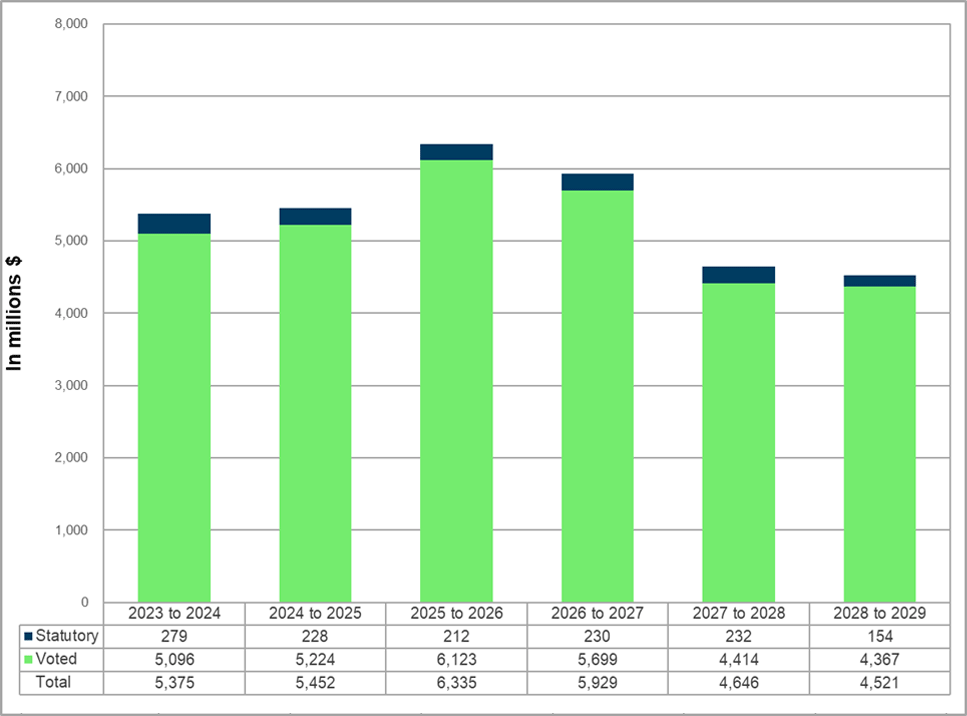
Totals may not add up and may not balance with other public documents due to rounding.
Text description of Graph 1
| Fiscal year | Total | Voted | Statutory |
|---|---|---|---|
| 2023 to 2024 | 5,375,000,000 | 5,096,000,000 | 279,000,000 |
| 2024 to 2025 | 5,452,000,000 | 5,224,000,000 | 228,000,000 |
| 2025 to 2026 | 6,335,000,000 | 6,123,000,000 | 212,000,000 |
| 2026 to 2027 | 5,929,000,000 | 5,699,000,000 | 230,000,000 |
| 2027 to 2028 | 4,646,000,000 | 4,414,000,000 | 232,000,000 |
| 2028 to 2029 | 4,521,000,000 | 4,367,000,000 | 154,000,000 |
Totals may not add up and may not balance with other public documents due to rounding.
Analysis of statutory and voted funding over a 6-year period
This bar chart represents the actual spending from fiscal year 2023 to 2024 to fiscal year 2024 to 2025, the forecast spending for fiscal year 2025 to 2026 and the planned spending for fiscal year 2026 to 2027 to fiscal year 2028 to 2029, broken down between statutory and voted expenditures.
The variance between the 2025 to 2026 forecast spending and the 2026 to 2027 through 2028 to 2029 planned spending is mainly attributable to prior year technical adjustments, reprofiles, carry-forwards and additional funding received in the 2025 to 2026 Supplementary Estimates and included in the forecast spending but not yet known for the 2026 to 2027 through 2028 to 2029 fiscal years.
For 2026 to 2027, the department plans to spend approximately $406 million less than in the 2025 to 2026 forecasted spending. The decrease in spending reflects the department’s current funding approval to deliver on its major infrastructure modernization projects, such as the ESAP as well as the G7 funding, which ends in 2025 to 2026. The variance is also due to the continued implementation of the LTVP, which reflects the level of authorities currently available for the Parliament Hill and Surroundings Program. The decrease is partially offset by an increase in spending for Laboratories Canada Strategy, which reflects that projects will be in full delivery mode.
Additional analysis of the variances between actual spending and forecast spending is provided in the Analysis of the past 3 years of spending section while analysis of variances in the planned spending is provided in the Analysis of the next 3 years of spending section.
For further information on PSPC’s departmental appropriations, consult the 2026 to 2027 Main Estimates.
Future-oriented condensed statement of operations
The future-oriented condensed statement of operations provides an overview of PSPC’s operations for fiscal year 2025 to 2026 to fiscal year 2026 to 2027.
Table 25: Future-oriented condensed statement of operations for the year ended March 31, 2027 (in dollars)
| Financial information | 2025 to 2026 Forecast results | 2026 to 2027 Planned results | Difference (2026 to 2027 planned results minus 2025 to 2026 forecast results) |
|---|---|---|---|
| Total expenses | 8,005,887,326 | 8,101,063,458 | 95,176,132 |
| Total revenues | 3,482,991,237 | 3,520,949,287 | 37,958,050 |
| Net cost of operations before government funding and transfers | 4,522,896,089 | 4,580,114,171 | 57,218,082 |
Analysis of forecasted and planned results
The net cost of operations is planned to increase by $57.2 million in fiscal year 2026 to 2027. The increase is mainly attributable to additional funding for the Next Generation HR and Pay initiative, inflation and price changes for real property costs such as rent and utilities, and funding to advance the Government of Canada’s Office Portfolio Reduction Plan. These increases were partially offset by spending reductions resulting from the Comprehensive Expenditure Review announced in Budget 2025.
A more detailed Consolidated Future-oriented Statement of Operations for the year ending March 31, 2027, including a reconciliation of the net cost of operations with the requested authorities, is available on PSPC’s website.
Human resources
This section presents an overview of the department’s actual and planned human resources from fiscal year 2023 to 2024 to fiscal year 2028 to 2029.
Table 26: Actual human resources for core responsibilities and internal services
| Core responsibilities and Internal services | 2023 to 2024 Actual full-time equivalents | 2024 to 2025 Actual full-time equivalents | 2025 to 2026 Forecasted full-time equivalents |
|---|---|---|---|
| Purchase of goods and services | 2,352 | 2,263 | 2,174 |
| Payments and accounting | 5,435 | 5,989 | 6,008 |
| Property and infrastructure | 4,571 | 4,736 | 4,649 |
| Government-wide support | 2,545 | 2,560 | 2,498 |
| Procurement Ombud | 28 | 33 | 34 |
| Subtotal | 14,931 | 15,581 | 15,363 |
| Internal services | 3,176 | 3,335 | 3,326 |
| Total | 18,107 | 18,916 | 18,689 |
Totals may not add up due to rounding.
Analysis of human resources over the last 3 years
The overall 582 FTEs increase between the fiscal year 2023 to 2024 and 2025 to 2026 is explained by the following:
- An increase of 809 FTEs between fiscal year 2023 to 2024 and 2024 to 2025, mainly due to:
- Payments and accounting:
- additional funding received to stabilize pay operations and to decrease the backlog of pay issues, as well as to support the Human Capital Management Feasibility Analysis Project for the Next Generation HR and Pay initiative
- Property and infrastructure:
- workforce required to meet business needs, mainly in Real Property Services Revolving Fund activities to deliver on PSPC and other government departments’ priority projects as well as initiatives such as the modernization of service delivery tools
- Payments and accounting:
The increase is partially offset by a decrease in:
- Purchase of goods and services:
- FTEs being realigned with funding levels within the Procurement Program following Refocusing Government Spending reductions
- A decrease of 227 FTEs between fiscal year 2024 to 2025 and 2025 to 2026, mainly due to:
- realignment with funding levels following government spending reductions
- not replacing employee departures under the Translation Bureau Revolving Fund, except for key and specialized roles
Table 27: Human resources planning summary for core responsibilities and internal services
| Core responsibilities and Internal services | 2026 to 2027 Planned full-time equivalents | 2027 to 2028 Planned full-time equivalents | 2028 to 2029 Planned full-time equivalents |
|---|---|---|---|
| Purchase of goods and services | 2,205 | 2,217 | 2,177 |
| Payments and accounting | 5,610 | 2,422 | 2,293 |
| Property and infrastructure | 4,305 | 3,602 | 3,476 |
| Government-wide support | 2,387 | 2,311 | 2,247 |
| Procurement Ombud | 34 | 32 | 32 |
| Subtotal | 14,541 | 10,584 | 10,225 |
| Internal services | 2,908 | 2,806 | 2,704 |
| Total | 17,449 | 13,390 | 12,929 |
Totals may not add up due to rounding.
Analysis of human resources for the next 3 years
The overall 4,520 FTEs decrease between fiscal year 2026 to 2027 and 2028 to 2029 is mainly due to:
- the end of incremental funding received in order to stabilize pay operations and decrease the backlog of pay issues, as well as the HR and Pay Transformation project. Planned FTEs will be adjusted should future approvals be received
- realignment with funding levels following government spending reductions
Supplementary information table
The following supplementary information table is available on PSPC’s website:
Information on PSPC’s Departmental Sustainable Development Strategy can be found on PSPC’s website.
Federal tax expenditures
PSPC’s Departmental Plan does not include information on tax expenditures.
The tax expenditures can be used to achieve public policy objectives through the application of special measures such as low tax rates, exemptions, deductions, deferrals and credits. The Department of Finance Canada publishes cost estimates and projections for these measures each year in the Report on Federal Tax Expenditures.
This report also provides detailed background information on tax expenditures, including descriptions, objectives, historical information and references to related federal spending programs, as well as evaluations, and GBA Plus of tax expenditures.
Corporate information
Departmental profile
Appropriate minister: The Honourable Joël Lightbound, P.C., M.P.
Institutional head: Arianne Reza
Ministerial portfolio: Government Transformation, Public Works and Procurement and Québec Lieutenant
Enabling instrument(s): The Department of Public Works and Government Services Act establishes the Department of Public Services and Procurement Canada.
Year of incorporation / commencement: 1841
Other: The Minister of Government Transformation, Public Works and Procurement and Québec Lieutenant has responsibilities under 26 other acts. The most significant ones are:
- Shared Services Canada Act
- National Capital Act
- Canada Post Corporation Act
- Defence Production Act
- Expropriation Act
- Seized Property Management Act
- Surplus Crown Assets Act
- Translation Bureau Act
Departmental contact information
Mailing address:
Public Services and Procurement Canada
11 Laurier St, Portage III, Place du Portage
Gatineau, QC K1A 0S5
Email: questions@tpsgc-pwgsc.gc.ca
Website(s): For more information on PSPC’s programs and services, please communicate with us through our general enquiries webpage.
You can follow PSPC on Facebook, LinkedIn, X(Twitter), Instagram, and YouTube.
Definitions
- appropriation (crédit)
- Any authority of Parliament to pay money out of the Consolidated Revenue Fund.
- budgetary expenditures (dépenses budgétaires)
- Operating and capital expenditures; transfer payments to other levels of government, departments or individuals; and payments to Crown corporations.
- core responsibility (responsabilité essentielle)
- An enduring function or role performed by a department. The intentions of the department with respect to a core responsibility are reflected in one or more related departmental results that the department seeks to contribute to or influence.
- Departmental Plan (plan ministériel)
- A report on the plans and expected performance of an appropriated department over a 3-year period. Departmental Plans are usually tabled in Parliament each spring.
- departmental result (résultat ministériel)
- A consequence or outcome that a department seeks to achieve. A departmental result is often outside departments’ immediate control, but it should be influenced by program-level outcomes.
- departmental result indicator (indicateur de résultat ministériel)
- A quantitative measure of progress on a departmental result.
- departmental results framework (cadre ministériel des résultats)
- A framework that connects the department’s core responsibilities to its departmental results and departmental result indicators.
- Departmental Results Report (rapport sur les résultats ministériels)
- A report on a department’s actual accomplishments against the plans, priorities and expected results set out in the corresponding Departmental Plan.
- full-time equivalent (équivalent temps plein)
- A measure of the extent to which an employee represents a full person-year charge against a departmental budget. For a particular position, the full-time equivalent figure is the ratio of number of hours the person actually works divided by the standard number of hours set out in the person’s collective agreement.
- gender-based analysis plus (GBA Plus) (analyse comparative entre les sexes plus [ACS Plus])
-
Is an analytical tool used to support the development of responsive and inclusive policies, programs, and other initiatives. GBA Plus is a process for understanding who is impacted by the issue or opportunity being addressed by the initiative; identifying how the initiative could be tailored to meet diverse needs of the people most impacted; and anticipating and mitigating any barriers to accessing or benefitting from the initiative. GBA Plus is an intersectional analysis that goes beyond biological (sex) and socio-cultural (gender) differences to consider other factors, such as age, disability, education, ethnicity, economic status, geography (including rurality), language, race, religion, and sexual orientation.
Using GBA Plus involves taking a gender- and diversity-sensitive approach to our work. Considering all intersecting identity factors as part of GBA Plus, not only sex and gender, is a Government of Canada commitment.
- government priorities (priorités gouvernementales)
- For the purpose of the 2026 to 2027 Departmental Plan, government priorities are the high-level themes outlining the government’s agenda in the 2025 Speech from the Throne.
- horizontal initiative (initiative horizontale)
- An initiative where two or more federal departments are given funding to pursue a shared outcome, often linked to a government priority.
- Indigenous business (entreprise autochtones)
- Requirements for verifying Indigenous businesses for the purposes of the departmental result report are available through the Indigenous Services Canada Mandatory minimum 5% Indigenous procurement target website.
- non‑budgetary expenditures (dépenses non budgétaires)
- Non-budgetary authorities that comprise assets and liabilities transactions for loans, investments and advances, or specified purpose accounts, that have been established under specific statutes or under non-statutory authorities in the Estimates and elsewhere. Non-budgetary transactions are those expenditures and receipts related to the government's financial claims on, and obligations to, outside parties. These consist of transactions in loans, investments and advances; in cash and accounts receivable; in public money received or collected for specified purposes; and in all other assets and liabilities. Other assets and liabilities, not specifically defined in G to P authority codes are to be recorded to an R authority code, which is the residual authority code for all other assets and liabilities.
- performance (rendement)
- What a department did with its resources to achieve its results, how well those results compare to what the department intended to achieve, and how well lessons learned have been identified.
- performance indicator (indicateur de rendement)
- A qualitative or quantitative means of measuring an output or outcome, with the intention of gauging the performance of a department, program, policy or initiative respecting expected results.
- plan (plan)
- The articulation of strategic choices, which provides information on how a department intends to achieve its priorities and associated results. Generally, a plan will explain the logic behind the strategies chosen and tend to focus on actions that lead to the expected result.
- planned spending (dépenses prévues)
-
For Departmental Plans and Departmental Results Reports, planned spending refers to those amounts presented in Main Estimates.
A department is expected to be aware of the authorities that it has sought and received. The determination of planned spending is a departmental responsibility, and departments must be able to defend the expenditure and accrual numbers presented in their Departmental Plans and Departmental Results Reports.
- program (programme)
- Individual or groups of services, activities or combinations thereof that are managed together within the department and focus on a specific set of outputs, outcomes or service levels.
- program inventory (répertoire des programmes)
- Identifies all the department’s programs and describes how resources are organized to contribute to the department’s core responsibilities and results.
- result (résultat)
- A consequence attributed, in part, to a department, policy, program or initiative. Results are not within the control of a single department, policy, program or initiative; instead they are within the area of the department’s influence.
- statutory expenditures (dépenses législatives)
- Expenditures that Parliament has approved through legislation other than appropriation acts. The legislation sets out the purpose of the expenditures and the terms and conditions under which they may be made.
- target (cible)
- A measurable performance or success level that a department, program or initiative plans to achieve within a specified time period. Targets can be either quantitative or qualitative.
- voted expenditures (dépenses votées)
- Expenditures that Parliament approves annually through an appropriation act. The vote wording becomes the governing conditions under which these expenditures may be made.