
Annual report on Government of Canada advertising activities 2024 to 2025
This report has been compiled to inform Canadians about the advertising activities undertaken by the Government of Canada during fiscal year 2024 to 2025. Advertising activities in this report pertain to institutions subject to the Policy on Communications and Federal Identity and its supporting instruments. These apply to departments and other portions of the federal public administration as set out in Schedules I, I.1 and II of the Financial Administration Act, unless excluded by specific acts, regulations or orders in council. All amounts exclude taxes.
For clarity and to ensure common understanding, please refer to the glossary at the end of this report.
On this page
- At a glance
- Overview of Government of Canada advertising expenditures
- Government of Canada media expenditures with the Agency of Record
- Appendices
At a glance
The following infographic provides a summary of the advertising expenditures found in this report for fiscal year 2024 to 2025.
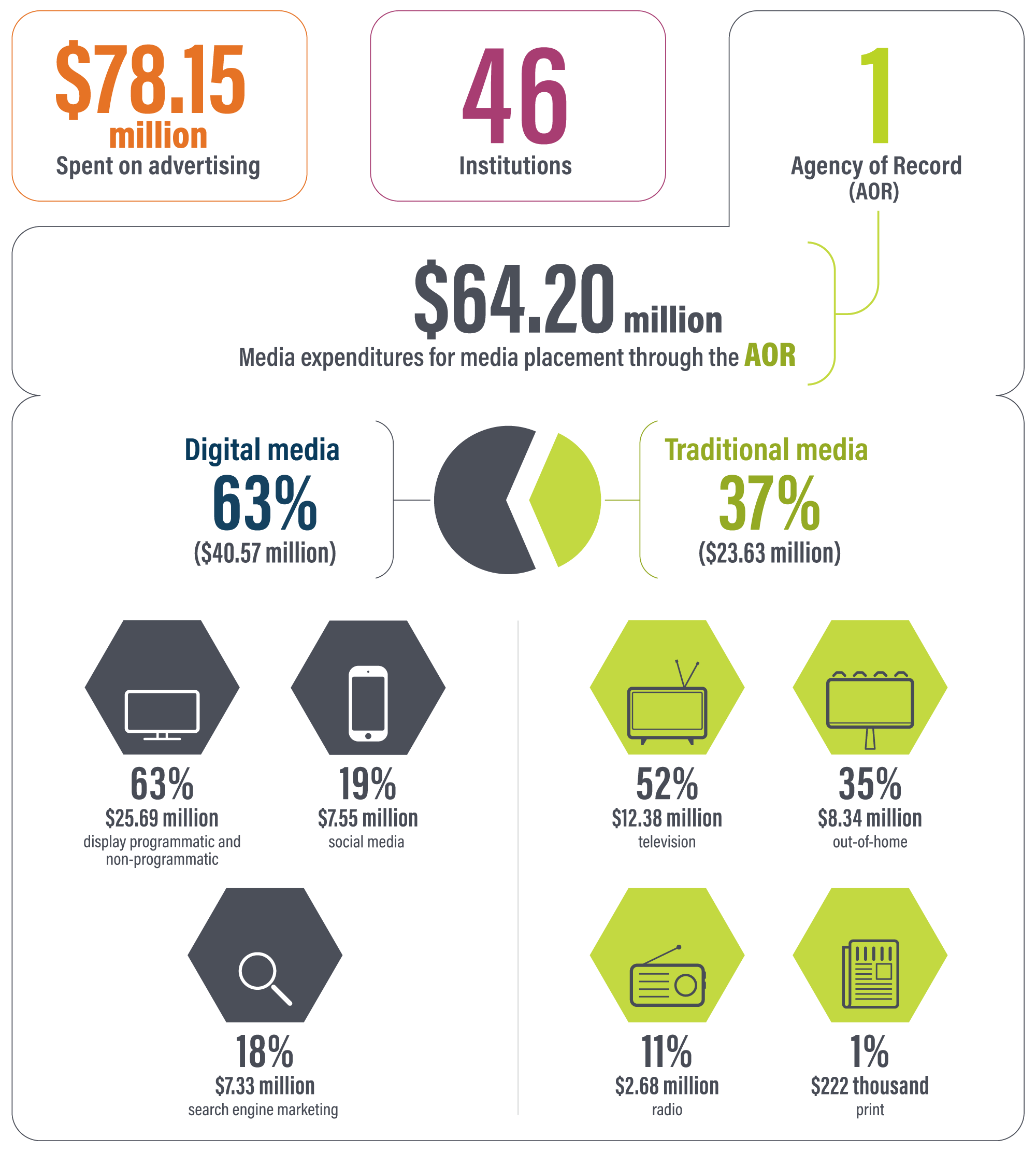
Image description
This image is an infographic and includes the following information:
- $78.15 million spent on advertising, involving 46 institutions, 1 Agency of Record (AOR)
- Media expenditures for media placement through the AOR totalled $64.20 million:
- Between digital media and traditional media
- Digital media received the largest share with 63% totalling $40.57 million
- Traditional media expenditures made up 37% totalling $23.63 million
- Among the digital media types used:
- display programmatic and non-programmatic received the largest share of digital media expenditures at 63% totalling $25.69 million
- social media at 19% totalling $7.55 million
- followed by search engine marketing at 18% totalling $7.33 million
- With respect to traditional media types used:
- television received the largest share of traditional media expenditures at 52% totalling $12.38 million
- followed by out-of-home at 35%, totalling $8.34 million
- radio at 11% totalling $2.68 million
- print at 1% totalling $222 thousand
Overview of Government of Canada advertising expenditures
This section provides information on advertising expenditures reported by 46 Government of Canada (GC) institutions. Amounts represent total advertising expenditures, which encompass media planning, media placement with and without the Agency of Record (AOR), as well as creative production.
On March 27, 2025, the Government of Canada implemented the updated Policy on Communications and Federal Identity and the Directive on the Management of Communications and Federal Identity.
With the new directive, heads of communications now have the authority to purchase media space directly from media outlets for campaigns with a total media buy of $40,000 compared to the previous threshold of $25,000 or less. The updated policy also revises the threshold for mandatory campaign evaluations. Previously, advertising campaigns with media buys exceeding $1 million required an evaluation. The new directive raises this threshold to $2 million.
All GC advertising campaigns with a budget over $250,000 undergo a mandatory external review, the Advertising Oversight Mechanism (non-partisan review process), to ensure that all GC advertising is non-partisan, according to the definition found in the Policy on Communications and Federal Identity. Review results and decisions are available online.
Values are rounded to the nearest whole number. The sum of values may not add up exactly to the totals indicated due to rounding.
For more information on advertising expenditures reported in each fiscal year, consult the corresponding annual reports.
Advertising expenditures for the last 5 years
This vertical bar graphic presents total Government of Canada advertising expenditures in millions of dollars for the last 5 years from fiscal year 2020 to 2021 to fiscal year 2024 to 2025. The graphic is provided for illustration purposes.
Figure 1: Total advertising expenditures by fiscal year for the last 5 years
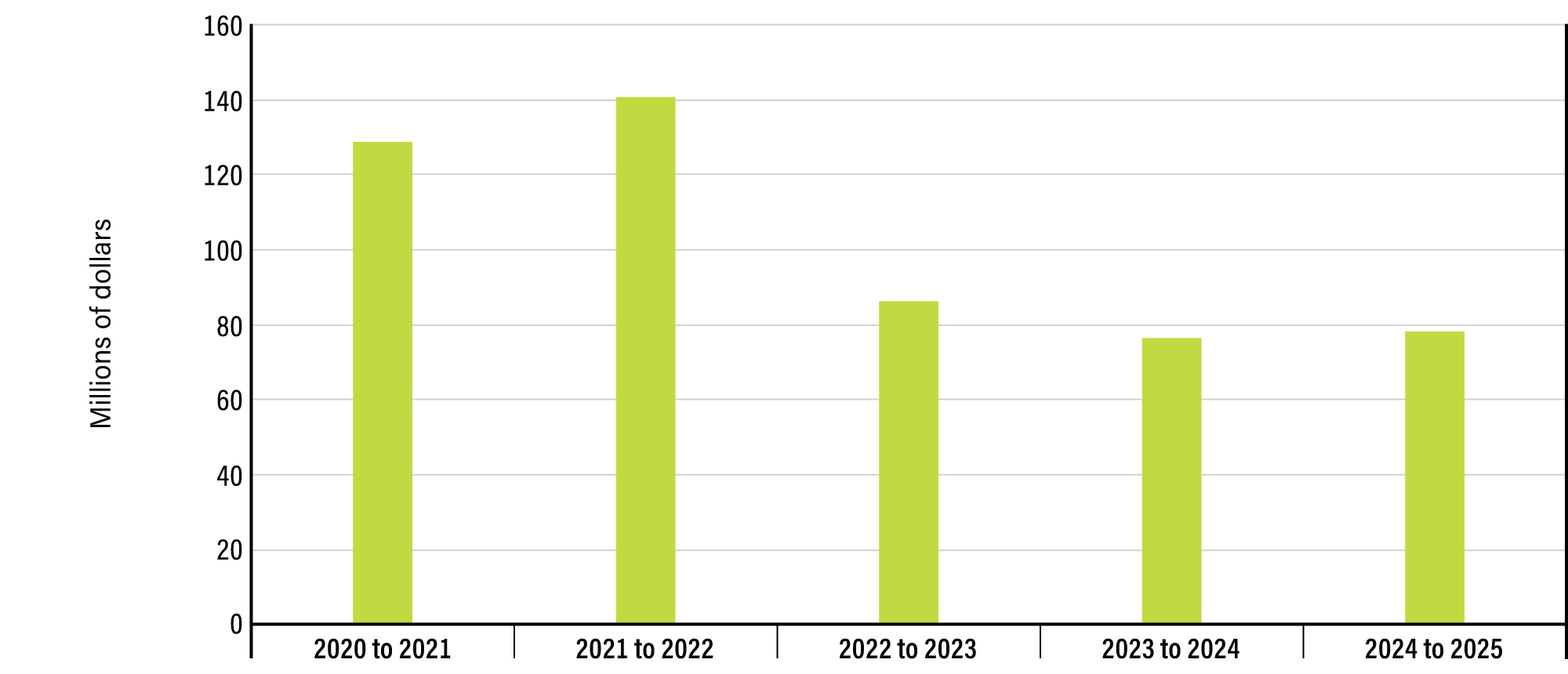
Figure 1 – Text version
| Fiscal year | Expenditures (millions of dollars) |
|---|---|
| 2020 to 2021 | 128.9 |
| 2021 to 2022 | 140.8 |
| 2022 to 2023 | 86.1 |
| 2023 to 2024 | 76.4 |
| 2024 to 2025 | 78.2 |
Table 1: Advertising expenditures by institution for fiscal year 2024 to 2025
| Institution | With the AOR | With AOR through the Emerging Needs Fund | Without the AOR | Total |
|---|
Government of Canada media expenditures with the Agency of Record
This section provides information on media expenditures for all media placement made through the AOR, on behalf of GC institutions. Amounts represent net media costs paid to media suppliers for the purchase of advertising space and time. Fees paid to the AOR to perform the media placement, as well as media planning and creative production expenditures are excluded.
Values are rounded to the nearest whole number. The sum of values may not add up exactly to the totals indicated due to rounding.
This section reflects a transition between two AOR contracts and service models. The previous AOR contract concluded on July 31, 2024, following a review process carried out during fiscal years 2022 to 2023 and 2023 to 2024. That review led to the establishment of a new Agence of record contract for 2024 to 2027. The new contract was awarded through an open and transparent national competitive process.
Between April 1 and July 31, 2024, the AOR was responsible for both media planning and media buying, while creative services were delivered by a roster of separately contracted agencies. Beginning August 1, 2024, under the new service model, the AOR is focused on media buying and provides media planning services upon request, while a roster of agencies continues to deliver planning and creative services.
In this section
Total media expenditures
Figure 2 provide total media expenditures and the percentage distribution between digital and traditional media. Figures 3 to 6 provide details on digital and traditional media expenditures and percentage distribution.
- Figure 2: Digital and traditional media expenditures over 5 years
- Figure 3: Digital and traditional media expenditures breakdown by media type over 5 years
- Figure 4: Digital media expenditures breakdown by media type over 5 years
- Figure 5: Social media expenditures breakdown by platform over 5 years
- Figure 6: Traditional media expenditures breakdown by media type over 5 years
Figure 2: Digital and traditional media expenditures over 5 years
This vertical bar graphic presents an overview of total media expenditures digital and traditional media, in millions of dollars over 5 years, from fiscal year 2020 to 2021 to fiscal year 2024 to 2025. The graphic is provided for illustration purposes.
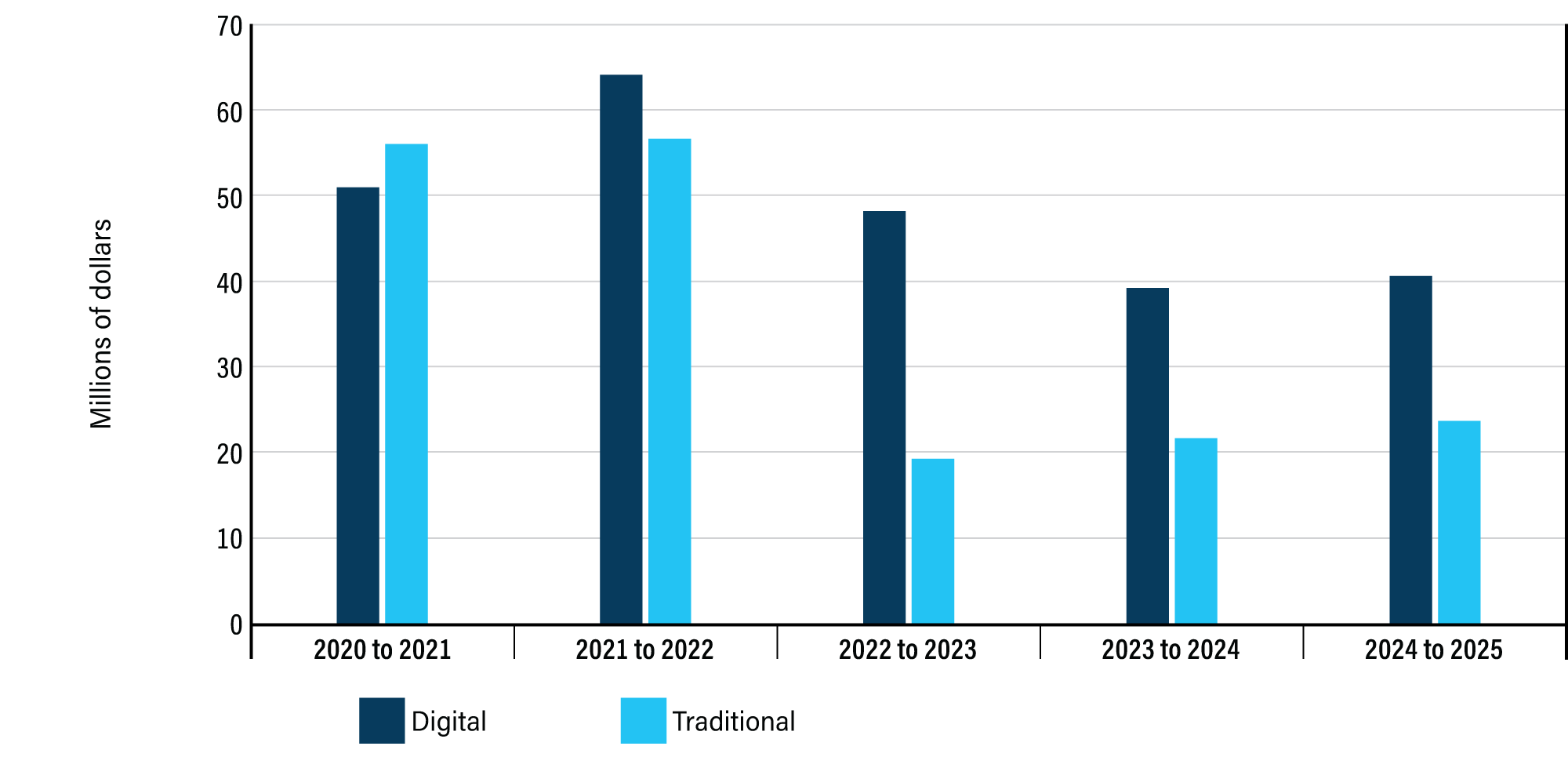
Figure 2 – Text version
| Media | 2020 to 2021 | 2021 to 2022 | 2022 to 2023 | 2023 to 2024 | 2024 to 2025 | |||||
|---|---|---|---|---|---|---|---|---|---|---|
| Expenditures | Distritubtion | Expenditures | Distritubtion | Expenditures | Distritubtion | Expenditures | Distritubtion | Expenditures | Distritubtion | |
| Digital | $50,972,886 | 48% | $64,052,571 | 53% | $48,077,563 | 71% | $39,175,815 | 64% | $40,573,185 | 63% |
| Traditional | $55,994,827 | 52% | $56,604,884 | 47% | $19,223,299 | 29% | $21,570,781 | 36% | $23,627,725 | 37% |
| Total | $106,967,713 | 100% | $120,657,455 | 100% | $67,300,862 | 100% | $60,746,596 | 100% | $64,200,909 | 100% |
Figure 3: Digital and traditional media expenditures breakdown by media type over 5 years
This vertical bar graphic presents the total media expenditures in digital and traditional media breakdown by media type over 5 years, from fiscal year 2020 to 2021 to fiscal year 2024 to 2025. The graphic is provided for illustration purposes.
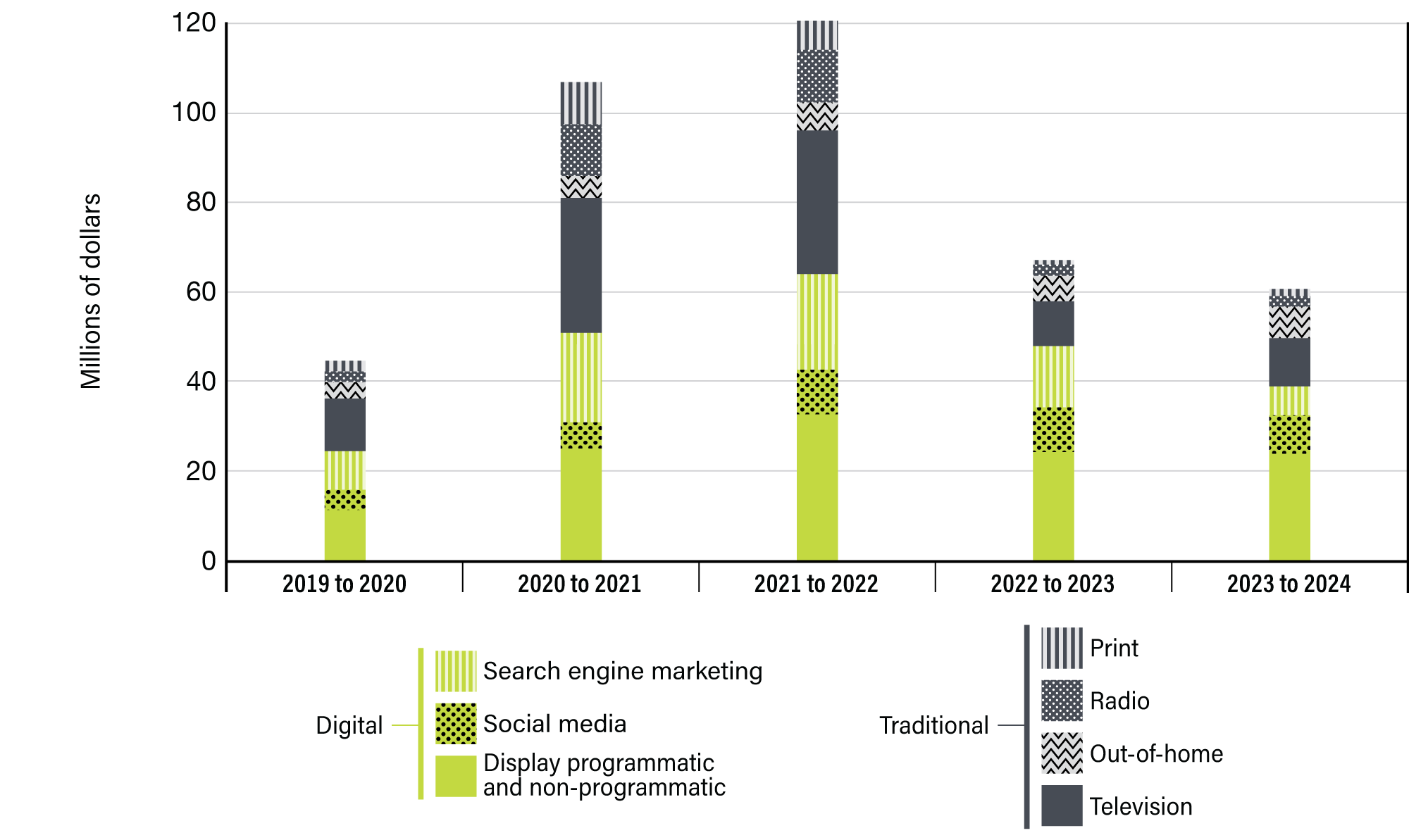
Figure 3 – Text version
| Media | 2020 to 2021 | 2021 to 2022 | 2022 to 2023 | 2023 to 2024 | 2024 to 2025 | |||||
|---|---|---|---|---|---|---|---|---|---|---|
| Expenditures | Distribution | Expenditures | Distribution | Expenditures | Distribution | Expenditures | Distribution | Expenditures | Distribution | |
| Digital | ||||||||||
| Display programmatic and non-programmatic | $25,184,394 | 24% | $32,942,755 | 27% | $24,462,493 | 36% | $24,107,592 | 40% | $25,686,673 | 40% |
| Social media | $19,905,460 | 19% | $21,205,519 | 18% | $13,711,649 | 20% | $6,514,749 | 11% | $7,552,872 | 12% |
| Search engine marketing | $5,883,032 | 5% | $9,904,297 | 8% | $9,903,420 | 15% | $8,553,475 | 14% | $7,333,640 | 11% |
| Traditional | ||||||||||
| Television | $30,125,369 | 28% | $32,065,753 | 27% | $9,934,507 | 15% | $10,699,459 | 18% | $12,380,087 | 19% |
| Out-of-home | $4,966,913 | 5% | $6,358,070 | 5% | $5,663,566 | 8% | $6,985,362 | 11% | $8,340,766 | 13% |
| Radio | $11,590,073 | 11% | $11,669,182 | 10% | $2,680,624 | 4% | $2,501,548 | 4% | $2,684,851 | 4% |
| $9,312,472 | 9% | $6,511,880 | 5% | $944,602 | 1% | $1,384,411 | 2% | $222,021 | <1% | |
| Total | $106,967,713 | 100% | $120,657,455 | 100% | $67,300,862 | 100% | $60,746,596 | 100% | $64,200,909 | 100% |
Figure 4: Digital media expenditures breakdown by media type over 5 years
This vertical bar graphic presents total media expenditures in digital media by media type, in millions of dollars over 5 years, from fiscal year 2020 to 2021 to fiscal year 2024 to 2025. The digital media types are display programmatic and non-programmatic, search engine marketing and social media.
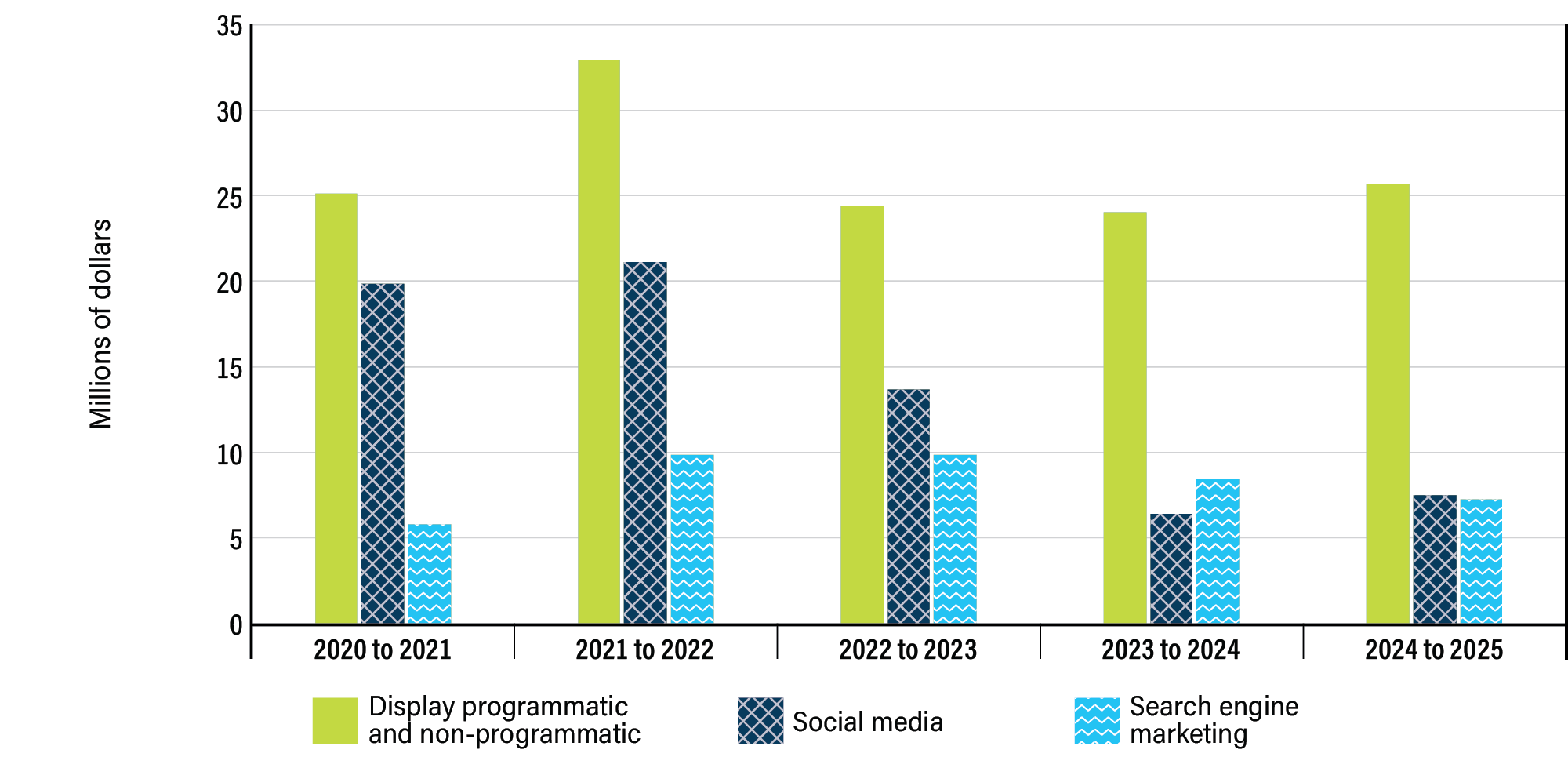
Figure 4 – Text version
| Media | 2020 to 2021 | 2021 to 2022 | 2022 to 2023 | 2023 to 2024 | 2024 to 2025 | |||||
|---|---|---|---|---|---|---|---|---|---|---|
| Expenditures | Distribution | Expenditures | Distribution | Expenditures | Distribution | Expenditures | Distribution | Expenditures | Distribution | |
| Display programmatic and non-programmatic | $25,184,394 | 49% | $32,942,755 | 51% | $24,462,493 | 51% | $24,107,592 | 62% | $25,686,673 | 63% |
| Social media | $19,905,460 | 39% | $21,205,519 | 33% | $13,711,649 | 29% | $6,514,749 | 17% | $7,552,872 | 19% |
| Search engine marketing | $5,883,032 | 12% | $9,904,297 | 15% | $9,903,420 | 21% | $8,553,475 | 22% | $7,333,640 | 18% |
| Total | $50,972,886 | 100% | $64,052,571 | 100% | $48,077,563 | 100% | $39,175,815 | 100% | $40,573,185 | 100% |
Figure 5: Social media expenditures breakdown by platform over 5 years
This vertical bar graphic presents social media expenditures by platform in millions of dollars over 5 years, from fiscal year 2020 to 2021 to fiscal year 2024 to 2025. The platforms are LinkedIn, Snapchat, Facebook/Instagram, TikTok, Pinterest, X, Reddit and Quora. The graphic is provided for illustration purposes.
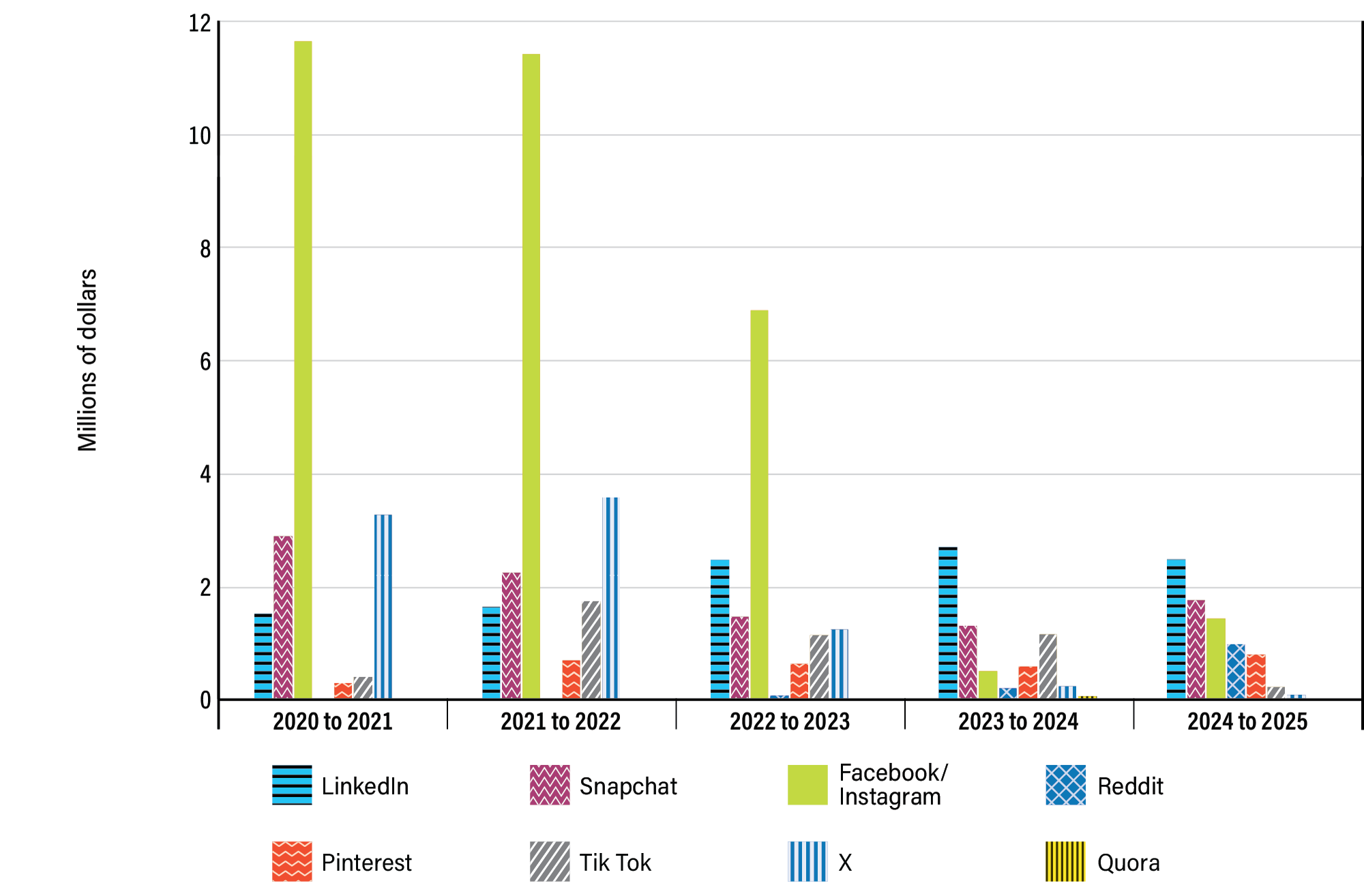
Figure 5 – Text version
| Platform | 2020 to 2021 | 2021 to 2022 | 2022 to 2023 | 2023 to 2024 | 2024 to 2025 | |||||
|---|---|---|---|---|---|---|---|---|---|---|
| Expenditures | Distribution | Expenditures | Distribution | Expenditures | Distribution | Expenditures | Distribution | Expenditures | Distribution | |
| $1,501,624 | 8% | $1,615,981 | 8% | $2,451,979 | 18% | $2,677,449 | 41% | $2,461,943 | 33% | |
| Snapchat | $2,867,196 | 14% | $2,223,055 | 10% | $1,438,524 | 10% | $1,278,183 | 20% | $1,738,319 | 23% |
| Facebook / Instagram | $11,649,636 | 59% | $11,423,728 | 54% | $6,876,769 | 50% | $476,271 | 7% | $1,409,238 | 19% |
| $0 | 0% | $0 | 0% | $18,200 | <1% | $169,096 | 3% | $954,876 | 13% | |
| $265,048 | 1% | $664,698 | 3% | $599,327 | 4% | $561,118 | 9% | $767,111 | 10% | |
| TikTok | $377,019 | 2% | $1,717,617 | 8% | $1,113,056 | 8% | $1,130,691 | 17% | $182,491 | 2% |
| X (previously Twitter) | $3,244,935 | 16% | $3,560,440 | 17% | $1,213,794 | 9% | $207,464 | 3% | $38,894 | <1% |
| Quora | $0 | 0% | $0 | 0% | $0 | 0% | $14,476 | <1% | $0 | 0% |
| Total | $19,905,460 | 100% | $21,205,519 | 100% | $13,711,649 | 100% | $6,514,749 | 100% | $7,552,872 | 100% |
Figure 6: Traditional media expenditures breakdown by media type over 5 years
This vertical bar graphic presents traditional media expenditures by media type in millions of dollars over 5 years, from fiscal year 2020 to 2021 to fiscal year 2024 to 2025. The media types are television, out-of-home, radio and print. The graphic is provided for illustration purposes.
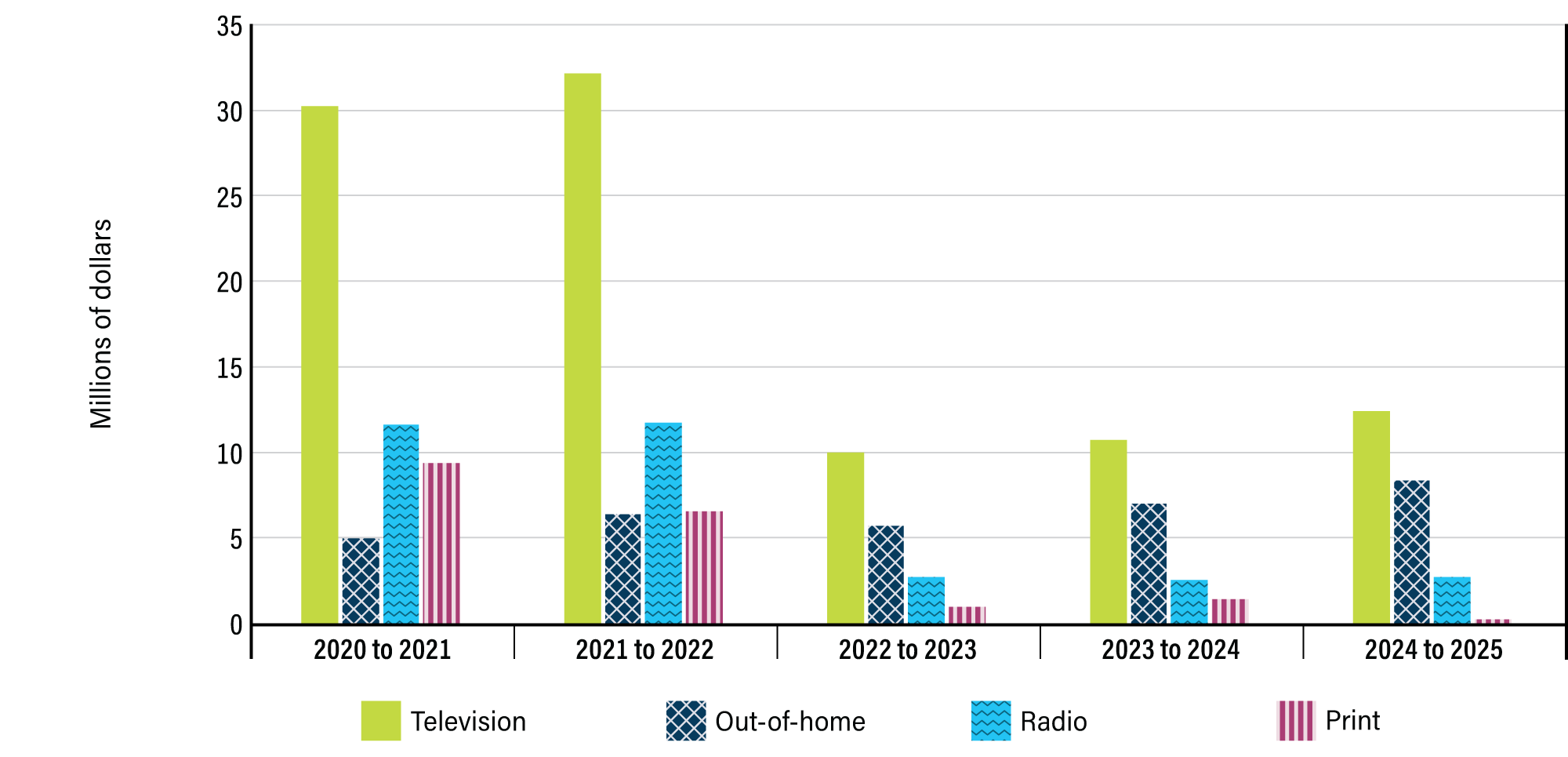
Figure 6 – Text version
| Media | 2020 to 2021 | 2021 to 2022 | 2022 to 2023 | 2023 to 2024 | 2024 to 2025 | |||||
|---|---|---|---|---|---|---|---|---|---|---|
| Expenditures | Distribution | Expenditures | Distribution | Expenditures | Distribution | Expenditures | Distribution | Expenditures | Distribution | |
| Television | $30,125,369 | 54% | $32,065,753 | 57% | $9,934,507 | 52% | $10,699,459 | 50% | $12,380,087 | 52% |
| Out-of-home | $4,966,913 | 9% | $6,358,070 | 11% | $5,663,566 | 29% | $6,985,362 | 32% | $8,340,766 | 35% |
| Radio | $11,590,073 | 21% | $11,669,182 | 21% | $2,680,624 | 14% | $2,501,548 | 12% | $2,684,851 | 11% |
| $9,312,472 | 17% | $6,511,880 | 12% | $944,602 | 5% | $1,384,411 | 6% | $222,021 | 1% | |
| Total | $55,994,827 | 100% | $56,604,884 | 100% | $19,223,299 | 100% | $21,570,781 | 100% | $23,627,725 | 100% |
Official languages
Reaching Canadians in the official language of their choice, regardless of where they reside, is a mandatory requirement for GC advertising. All media plans are developed, reviewed, and approved in accordance with this requirement. Amounts in the tables include media expenditures for all media placement in English and French.
Media expenditures by official language is based on ad language. Media expenditures for bilingual ads are divided equally between English and French.
Table 2 provides an overview and tables 3 and 4 provide details on digital and traditional media expenditures.
- Table 2: Digital and traditional media expenditures in English and French
- Table 3: Digital media expenditures breakdown by media type in English and French
- Table 4: Traditional media expenditures breakdown by media type in English and French
| Media | English | French | Total | ||
|---|---|---|---|---|---|
| Expenditures | Distribution | Expenditures | Distribution | ||
| Digital | $28,905,844 | 72% | $11,134,088 | 28% | $40,039,932 |
| Traditional | $18,009,972 | 78% | $5,150,839 | 22% | $23,160,811 |
| Total | $46,915,816 | 74% | $16,284,927 | 26% | $63,200,743 |
| Media | English | French | Total | ||
|---|---|---|---|---|---|
| Expenditures | Distribution | Expenditures | Distribution | ||
| Display programmatic and non-programmatic | $18,285,001 | 74% | $6,295,061 | 26% | $24,580,062 |
| Social media | $5,946,196 | 71% | $2,385,197 | 29% | $8,331,394 |
| Search engine marketing | $4,674,647 | 66% | $2,453,829 | 34% | $7,128,477 |
| Total | $28,905,844 | 72% | $11,134,088 | 28% | $40,039,932 |
| Media | English | French | Total | ||
|---|---|---|---|---|---|
| Expenditures | Distribution | Expenditures | Distribution | ||
| Television | $10,466,879 | 85% | $1,908,851 | 15% | $12,375,731 |
| Out-of-home | $5,512,379 | 66% | $2,793,034 | 34% | $8,305,413 |
| Radio | $1,956,402 | 82% | $429,043 | 18% | $2,385,445 |
| $74,311 | 79% | $19,911 | 21% | $94,222 | |
| Total | $18,009,972 | 78% | $5,150,839 | 22% | $23,160,811 |
Appendices
Appendix I: Glossary
This section provides definitions of terms used in this report related to GC advertising, for clarity and to ensure common understanding. The terms may have a broader meaning beyond this report and therefore, these definitions should only be applied in the context of this report.
Advertising
In the context of all GC advertising activities, “advertising” is defined as ( Policy on Communications and Federal Identity, Appendix: Definitions):
Any message conveyed in Canada or abroad and paid for by the government for placement in media, including but not limited to newspapers, television, radio, cinema, billboards and other out-of-home media, mobile devices, the Internet, and any other digital medium.
Advertising expenditures
Total of all expenditures, including media planning, media placement, creative production and fees paid to the AOR to perform the media placement.
Agency of Record (AOR)
Private sector supplier selected by the GC through a competitive process that plans, negotiates, consolidates, purchases and verifies advertising media space and time for government advertising.
Digital
All advertising on the Internet, including display programmatic and non-programmatic, social media and search engine marketing.
Display
Advertising on the Internet through banners, including various formats made up of text, images, animation/gifs, video and audio.
Display non-programmatic
Display advertising purchased through direct buys where media suppliers receive insertion orders or contracts, and billing takes place between the suppliers and the AOR.
Display programmatic
Display advertising purchased and served in real time through demand-side platforms, supply-side platforms and an ad server, managed by the AOR using programmed algorithms and where billing is managed through the ad server.
Emerging Needs Fund
The Emerging Needs Fund is managed by Public Services and Procurement Canada (PSPC) and allows for advertising resources to be available for high priority urgent and/or unforeseen initiatives, identified by the Privy Council Office (PCO), that occur during the fiscal year.
Media expenditures
Net media costs paid to suppliers for advertising space and time. Fees paid to the AOR to perform the media placement, as well as media planning and creative production costs are excluded.
Media placement
The purchase of advertising time or space, for example, for television, radio, newspapers, magazines, social media, websites, web applications, mobile applications, cinemas or out-of-home media.
Non-partisan communications
In the context of all GC communications products and activities, “non-partisan” means ( Policy on Communications and Federal Identity, Appendix: Definitions):
- objective, factual and explanatory
- free from political party slogans, images, identifiers, bias, designation or affiliation
- the primary colour associated with the governing party is not used in a dominant way, unless an item is commonly depicted in that colour
- advertising is devoid of any name, voice or image of a minister, member of Parliament or senator
Out-of-home
Advertising media to which audiences are exposed outside the home such as mall posters, billboards, bus and transit-shelter advertisements, digital screens and kiosks, etc.
Search engine marketing
Advertising used to promote websites and attract visitors by increasing their visibility in search engine results, on search engine platforms.
Social media
A website or application that enables users to create and share content or to connect with others.
Appendix II: Process
The GC has an obligation to inform Canadians about policies, programs, services, rights and responsibilities, as well as to alert them of dangers to health, safety or the environment. Advertising is one means of communications used to achieve this.
Rigorous annual planning and reporting mechanisms are in place to ensure that advertising activities align to government priorities, comply with applicable laws, policies and related instruments, and meet the information needs of Canadians.
GC advertising is conducted in accordance with the Policy on Communications and Federal Identity and its supporting instruments. Many organizations are involved, including Institutions, the Privy Council Office, the Treasury Board of Canada Secretariat and Public Services and Procurement Canada. Their relationships and primary responsibilities are described below:
Institutions
Departments and other portions of the federal public administration operating under Schedules I, I.1 and II of the Financial Administration Act develop advertising plans based on the priorities of the institutions and the Government.
Once approval is obtained, institutions work with PSPC for the procurement of advertising services as needed. Creative services are provided by creative agencies, and media planning and buying services are provided by the AOR. Heads of communications can decide to purchase media space directly from media outlets for campaigns that have a total media buy of $25,000 or less, in accordance with the Directive on the Management of Communications and Federal Identity .
Institutions are responsible for managing all aspects of their advertising activities and for ensuring that campaigns reach their target audiences using the appropriate media with the appropriate message at the correct time. Along with this, they are responsible for ensuring that all communications adhere to the Official Languages Act, and for evaluating the effectiveness of their advertising activities.
Institutions are also required to record all their advertising activities in the GC Advertising Management System (AdMIS), which is maintained by PSPC and used to produce the Annual Report on Government of Canada Advertising Activities.
Privy Council Office
The Privy Council Office (PCO) sets broad government communications themes that reflect government priorities, as determined by the Prime Minister, Cabinet, Cabinet committees and the Clerk of the Privy Council.
Institutions are required to submit their advertising plans to PCO, which then works with the Prime Minister’s Office to develop the GC annual advertising plan. Once the plan is approved, PCO prepares relevant documentation so that institutions receive funding from the central advertising fund; institutions can also fund their advertising activities from their own budgets.
PCO also provides government-wide oversight of GC advertising activities and coordinates GC advertising to ensure that the overall approved budget levels are respected and that evaluation results are used to help inform the development of future advertising activities.
Treasury Board of Canada Secretariat
The Treasury Board of Canada Secretariat (TBS) issues administrative policies, including the Policy on Communications and Federal Identity , which governs communications activities, including advertising. The Policy aligns GC communications practices with today’s digital environment and includes a requirement that all communications products and activities, including advertising, be non-partisan.
TBS oversees the non-partisan advertising review process for campaigns over $250,000. It also monitors the effectiveness of the process and publishes the review results and decisions on Canada.ca.
TBS also manages the Treasury Board submission process to secure advertising funding for institutions.
Public Services and Procurement Canada
3 directorates at PSPC are involved. These include the:
Advertising Services Directorate (ASD):
- provides technical advice and advisory and coordination services to GC institutions on the government advertising process, best practices, and relevant laws, policies and related instruments
- manages the AOR contract
- works with the Communications and Advertising Procurement Directorate (CAPD) to develop advertising services procurement tools for use by GC institutions, which align with current industry best practices and today’s environment
- provides training to the government advertising community to ensure that their knowledge and abilities remain up to date
- maintains AdMIS and issues project registration numbers for advertising activities and advertising numbers for media placement to GC institutions to record all their advertising activities and expenditures
- manages the Emerging Needs Fund
- produces the Annual Report on Government of Canada Advertising Activities.
Communications and Advertising Procurement Directorate (CAPD):
- sole authority responsible for the procurement of advertising and public opinion research services, including pre- and post-campaign testing and evaluation for advertising activities
- manages the procurement process to select advertising services suppliers for GC institutions
- works with ASD to develop advertising services procurement tools for use by GC institutions
Public Opinion Research Directorate:
- advises institutions about the public opinion research process, research methodologies, and compliance with relevant laws, policies and related instruments
- reviews research projects related to advertising pretesting and evaluation, a mandatory process for campaigns with media buys over $1 million
Appendix III: Laws and policies
Laws
The purpose of this Act is to provide for the financial administration of the GC, the establishment and maintenance of the accounts of Canada and the control of Crown corporations.
The purpose of this Act is to:
(a) ensure respect for English and French as the official languages of Canada and ensure equality of status and equal rights and privileges as to their use in all federal institutions, in particular with respect to their use in parliamentary proceedings, in legislative and other instruments, in the administration of justice, in communicating with or providing services to the public and in carrying out the work of federal institutions
(b) support the development of English and French linguistic minority communities in order to protect them while taking into account the fact that they have different needs
(b.1) advance the equality of status and use of the English and French languages within Canadian society, taking into account the fact that French is in a minority situation in Canada and North America due to the predominant use of English and that there is a diversity of provincial and territorial language regimes that contribute to the advancement, including Quebec’s Charter of the French language, which provides that French is the official language of Quebec
(b.2) advance the existence of a majority-French society in a Quebec where the future of French is assured
(c) set out the powers, duties and functions of federal institutions with respect to the official languages of Canada
Policies
Policy on Communications and Federal Identity
This policy gives context and rules for how the GC enables internal and external communication with the public about policies, programs, services and initiatives, including the administration of the GC official symbols.
Directive on the Management of Communications and Federal Identity
This directive provides rules for managing and coordinating communications, including procedures for advertising, public opinion research, social media, external-facing websites and mobile applications.
These procedures are an appendix to the Directive on the Management of Communications and Federal Identity. They provide procedural rules for planning and coordination, contracting, production and media planning, as well as pretesting and evaluation of GC advertising activities.
The Directive on the Management of Communications and Federal Identity requires that GC advertising comply with the oversight mechanism for non-partisan advertising. The mechanism is an external review process that supports the Government’s commitment to ensure that all communications, including advertising, are non-partisan.
Copyright information
Information contained in this publication may be reproduced, in part or in whole, and by any means, for personal or public non-commercial purposes, without charge or further permission. Commercial reproduction and distribution are prohibited except with written permission from PSPC. For more information, consult the terms and conditions on PSPC's website concerning copyright ownership and restrictions.
For additional information, contact:
Advertising Services Directorate
Public Services and Procurement Canada
Ottawa ON K1A 0S5
Email: tpsgc.dgsidcpprapportpub-isbacpdadvreport.pwgsc@tpsgc-pwgsc.gc.ca
© His Majesty the King in Right of Canada, as represented by the Minister of Public Works and Government Services, 2026.
Cat. No.: P100-2E-PDF (electronic PDF, English)
International Standard Serial Number (ISSN): 1925-8887
Cat. No.: P100-2F-PDF (electronic PDF, French)
ISSN: 1925-6833