
The Long Term Vision and Plan for the Parliamentary Precinct: Annual Report 2024 to 2025
On this page
- Message from the Assistant Deputy Minister
- Year in review
- Guiding the future of the Parliamentary Precinct: The 2025 Long Term Vision and Plan Update
- Major Capital Program
- Recapitalization Program
- Building Components and Connectivity Program
- Security Program
- Support and Planning Program
- Program financial performance
- Program information summary
Message from the Assistant Deputy Minister
It is my privilege to present the 2024 to 2025 Annual Report for the Long Term Vision and Plan (LTVP), which chronicles a year of remarkable progress in transforming Canada's Parliamentary Precinct. This ongoing renewal is not only preserving our nation's most iconic heritage buildings, but also ensuring they are ready to serve Parliament and Canadians for generations to come.
Strategic vision and endorsement
This year, we reached a historic milestone with the completion of the first major update to the LTVP in nearly 2 decades. The updated Plan sets out a flexible, forward-looking framework to create a modern, integrated, and secure parliamentary campus. Formal endorsement from the Senate of Canada was secured, and we look forward to seeking endorsement from the House of Commons and Cabinet in the coming year. Once approved, the updated Plan will be published for all Canadians to see.
Economic impact and investments
Our investments—now totaling nearly $5.9 billion to date and creating more than 89,000 jobs—continue to deliver strong economic benefits, supporting high-quality jobs in skilled trades, construction, engineering, architecture, and manufacturing. In 2024 to 2025, program expenditures reached $562.5 million and drove significant progress on projects that are not only revitalizing the heart of our democracy, but also supporting Canada's industrial base and promoting domestic resilience by prioritizing Canadian materials.
Centre Block Rehabilitation Program
The rehabilitation of Centre Block, the largest and most complex project of its kind in Canada, continues to set new benchmarks for modernization and restoration. This year, the project finalized the landscape design, advancing a vision for a welcoming and accessible national gathering place. Construction efforts focused on structural upgrades such as installing support posts, temporary roof enclosures for the Centre Block and the tower cranes, which marks the start of the Parliament Welcome Centre structural build.
Block 2 redevelopment
The redevelopment of Block 2 is a transformative project completing the fourth wall of Canada's parliamentary square. It is shaping the future of parliamentary accommodations for the Senate and House of Commons. In 2024 to 2025, 50% schematic design was completed, with 90% targeted by the end of 2025. Construction also mobilized with a focus on site services and demolition.
Strategic property acquisitions
To support Parliament's long-term accommodation needs, Public Services and Procurement Canada (PSPC) acquired 181 Queen Street, received approval to acquire 131 Queen Street, and secured 40 Elgin Street for the Senate of Canada. These acquisitions are expected to generate savings of over $300 million for Canadians by eliminating long-term leases and enabling energy-efficient upgrades. The integration of these properties is essential in ensuring the delivery of modern, secure, and sustainable spaces for Parliament.
Sustainability and accessibility
Across all projects, PSPC is committed to sustainable building practices such as reusing materials like steel and copper, integrating low-carbon concrete, and upgrading to energy-efficient building systems. Accessibility improvements are being realized through major rehabilitation efforts such the Centre Block and Block 2, with smaller improvements to operational buildings being executed in a cost-effective manner.
Engagement with First Nations, Inuit and Métis Peoples
This year marked important milestones to advance work on a national space for First Nations, Inuit, and Métis Peoples, a dedicated space for the Anishinàbe Algonquin Nation, as well as continued progress in capacity-building and procurement with Indigenous businesses and communities.
As building custodian, proactive maintenance, timely repairs, and planned life-cycle asset replacement are essential to keeping the Parliamentary Precinct functional and responsive to parliamentary needs. In 2024 to 2025, PSPC carried out close to 15,000 maintenance activities and completed over 50 minor projects across the Parliamentary Precinct. These included repairs, system replacements, and life-cycle upgrades such as painting the Summer Pavillon to refurbishing bathrooms in the Confederation Building.
As we look ahead, our focus remains on delivering a Precinct that is secure, sustainable, and ready to serve Parliament for decades to come. I invite all Canadians to follow our progress via the PSPC website, which features Centre Block Quarterly Updates as well as the Cable Public Affairs Channel (CPAC) documentary series Inside Centre Block. For an in-person experience, come visit the construction during Doors Open Ottawa, an event held annually in June. Finally, the Parliament Hill Cam is available at all times and features live images of Parliament Hill.
Jennifer Garrett
Assistant Deputy Minister
Science and Parliamentary Infrastructure Branch
Year in review
Financial highlights
In fiscal year 2024 to 2025, PSPC's expenditures under the LTVP totaled $562.5 million across 5 core programs: Major Capital Program (MCP), Recapitalization Program, Building Components and Connectivity Program (BCC), Security Infrastructure Program and Support and Planning Program.
Major Capital Program
Advancement of the Major Capital Program represented $519 million or 92% of overall program expenditures, which includes the Centre Block rehabilitation ($332 million), Parliament Welcome Centre ($56 million), and Block 2 redevelopment ($43 million).
Recapitalization
The Recapitalization Program accounted for $2.7 million, or approximately 0.5% of total expenditures with a focus on ensuring operational continuity and safety. The replacement of the East Block Fire Alarm is an example of a project that is being executed under this program.
Building Components and Connectivity Program
The Building Components and Connectivity Program accounted for $17.5 million, representing 3% of total expenditures this fiscal year. These expenditures supported the deployment of modern communication and information technology (IT) systems across the Precinct.
Security Infrastructure Program
The Security Infrastructure Program accounted for $0.8 million (0.1%) and was focused on advancing perimeter security enhancements.
Support and Planning Program
The Support and Planning Program represented $22 million or approximately 4% of total expenditures. This program provided supplemental funding to the Parliamentary Administrations to enable them to effectively support LTVP execution. In addition, the program also supported PSPC strategic planning and program management, which provides the structure required to coordinate multi-year initiatives, manage risks, and ensure accountability—critical to the effective execution of the LTVP.
For further details, please refer to the Program financial performance section.
Guiding the future of the Parliamentary Precinct: The 2025 Long Term Vision and Plan Update
The LTVP is a multi-decade strategy to restore, modernize, and secure the Parliamentary Precinct. Last updated in 2006, the 2025 update introduces a renewed vision and strategic direction for the parliamentary campus. The update was endorsed by the Senate of Canada and is pending House of Commons and Cabinet endorsement. It reaffirms PSPC's commitment to delivering a modern, integrated, and secure parliamentary campus that is accessible to all.
A key priority of the 2025 LTVP is addressing emerging security challenges while maintaining democratic openness. This includes ongoing discussions with the City of Ottawa regarding the future of Wellington Street and its role within the campus footprint.
In the coming year, PSPC will secure final approvals from Parliament for the updated Plan. In addition, PSPC will continue engagements with the National Capital Commission (NCC) on their updated Core Area Plan and Confederation Boulevard Guidelines to ensure that the Parliamentary Precinct continues to evolve in harmony with its surroundings.
Major Capital Program
The Major Capital Program delivers transformative projects that preserve and modernize Canada's Parliamentary Precinct. Flagship initiatives include the Centre Block rehabilitation, the Parliament Welcome Centre, and the redevelopment of Block 2.
In this section
- Centre Block Rehabilitation Program
- Block 2 redevelopment
- Block 2 enabling projects (40 Elgin and 60 Queen)
- National space for First Nations, Inuit and Métis Peoples and dedicated Algonquin space
- Parliamentary Campus Tunnels project
- Additional parliamentary offices (Wellington and Valour Buildings)
Centre Block Rehabilitation Program
A comprehensive overhaul is well underway to ensure this iconic building meets the needs of a modern parliamentary democracy. PSPC is also constructing Canada's new Parliament Welcome Centre—designed to transform and modernize parliamentary operations by providing future-ready building systems and expansion to account for growth, while housing a world-class visitor experience.
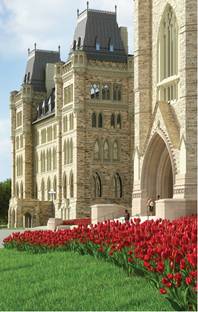
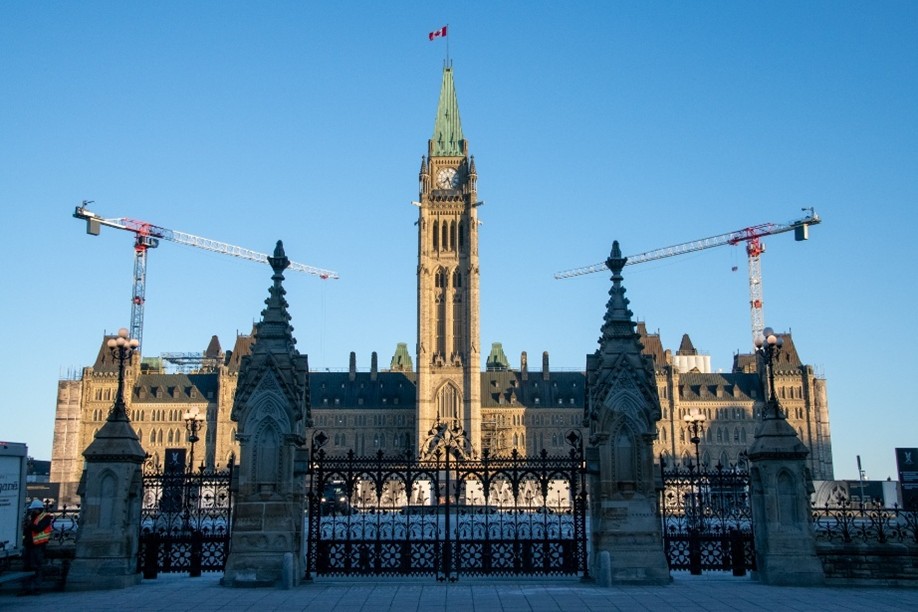
Design progress: Over the past year, substantial progress was made in advancing detailed design for the Centre Block, Parliament Welcome Centre, and the surrounding landscape. As a national gathering place, the new landscape design, completed in February 2025, aims to connect people with this national historic site through significant accessibility enhancements and new gardens featuring local plants and trees that reflect the character of the region. The design development phase for both the Centre Block and the Parliament Welcome Centre is on track for 100% completion by the end of 2025.


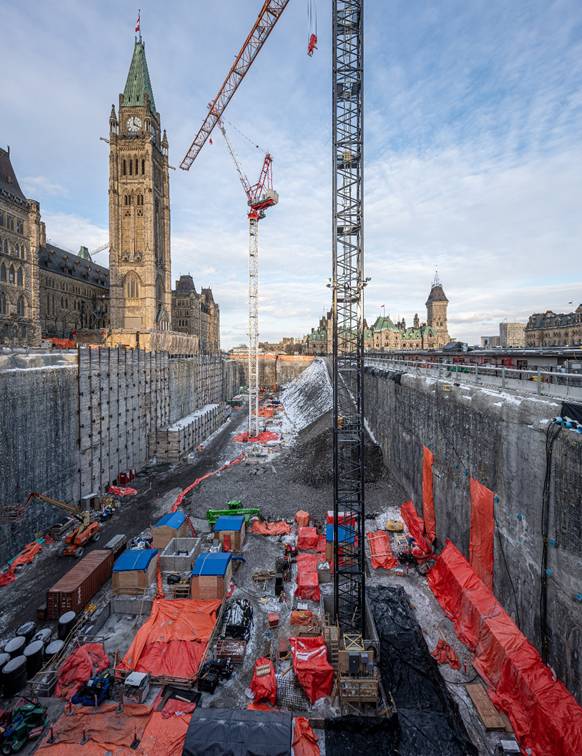
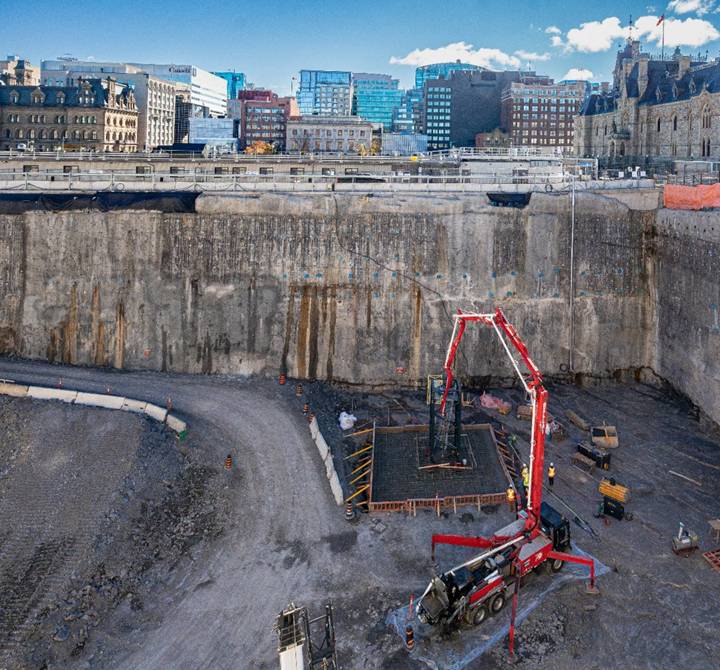
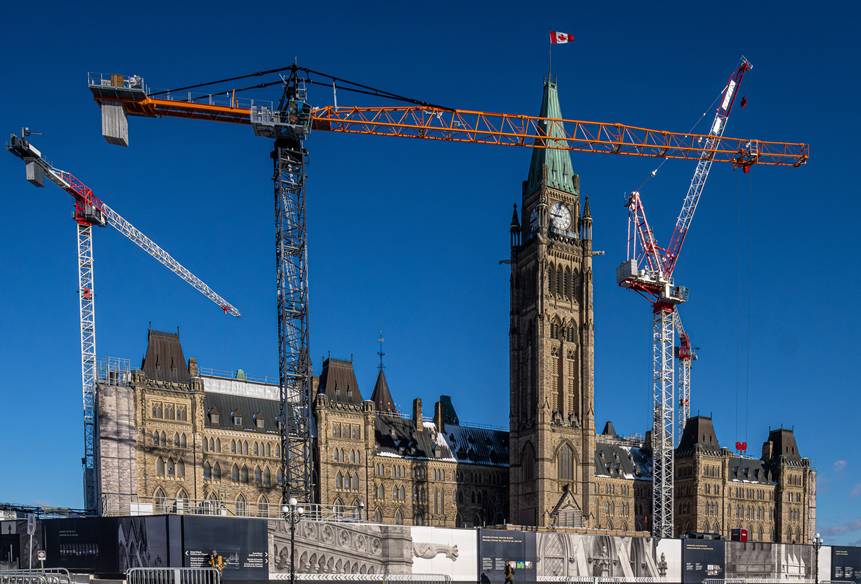
Construction progress: The rebuild process has begun at the Parliament Welcome Centre starting with the installation of 2 of the 4 tower cranes that will support the construction of footings, walls, columns, staircases, and elevator shafts.


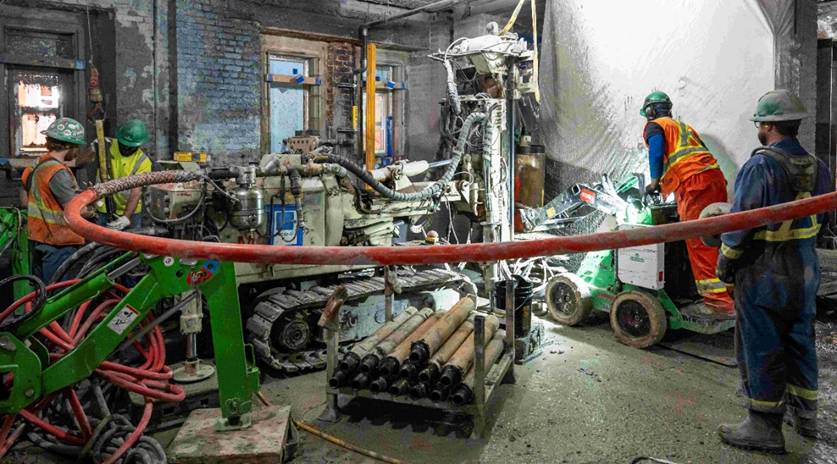
Inside the Centre Block, one of the most technically complex aspects of the project is underway: stabilizing the building so that PSPC can excavate beneath. To support this work, as of March 2025, 95% of the basement support posts had been drilled and 33% of the level 1 concrete slab had been replaced. The installation of temporary bracing in the upper floors will allow for removal and replacement of existing floor slabs starting on levels 5 and 6.
Externally, temporary roof enclosures are being installed to facilitate restoration of the sloped mansard roof. With the west side enclosure complete, removal of the copper roof started in spring 2025. Behind the trompe l'oeil, masonry restoration continues to progress, with approximately 20% of the overall scope completed.
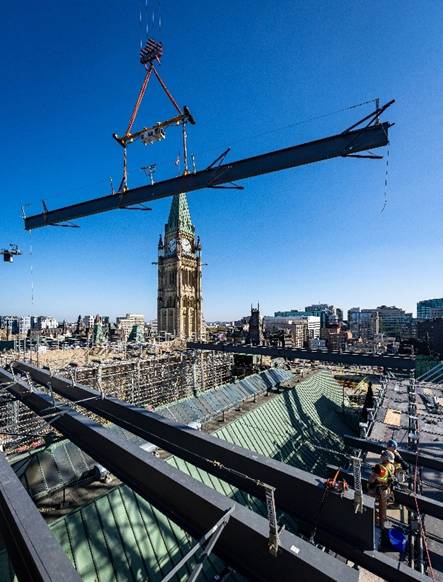
Heritage conservation efforts continue off-site. 22 Carillion bells from the Peace Tower, all 17 Crisp murals from the House of Commons Reading Room, 8 heritage light fixtures, and 20 leaded glass panels have been restored.
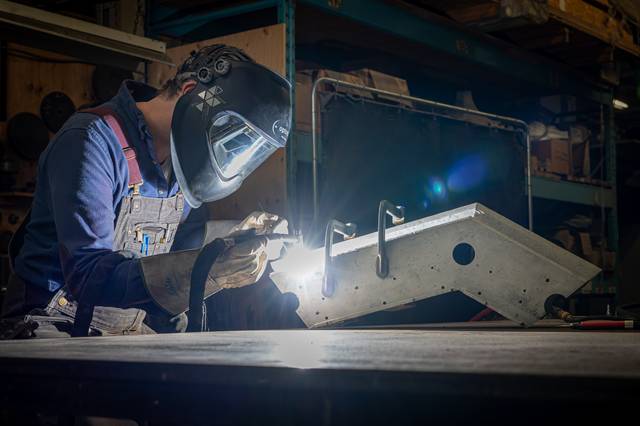
To follow the progress of this historic transformation, quarterly updates are available on the PSPC website. For a behind-the-scenes look at the scale and significance of the project, watch Inside Centre Block, a documentary produced by CPAC.
Block 2 redevelopment
The Block 2 redevelopment will transform outdated heritage buildings into modern spaces to support the Senate and the House of Commons and complete the fourth wall of Canada's parliamentary square.
Design progress: A design competition was completed in May 2022, with the winning design contract awarded to Zeidler Architecture Inc. (Toronto, Canada) in association with David Chipperfield Architects (London, United Kingdom) in May 2023. Since that time, the design team has undertaken a fulsome review of parliamentary requirements to evolve the original design concept to 50% schematic design, which was completed in July 2024. 90% completion is targeted for next fiscal year.
Construction progress: The construction site was mobilized in fall 2024, enabling the start of the removal and relocation of infrastructure and targeted demolition and abatement. In the coming fiscal year, construction activities will focus on continued abatement and the stabilization of building façades to prepare for more extensive demolition.
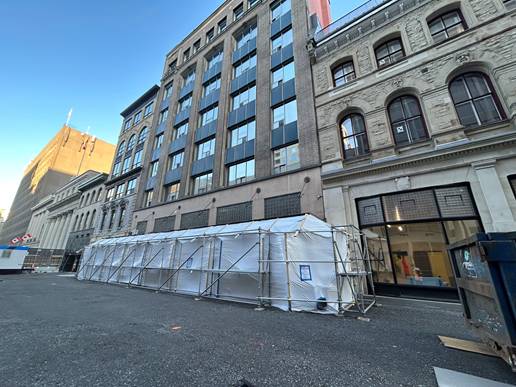
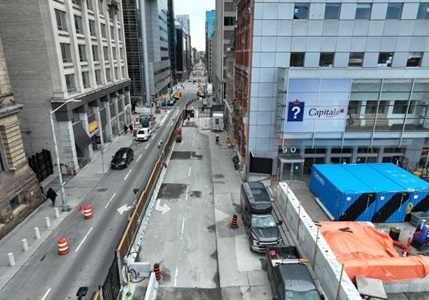
In June 2024, PSPC relocated the Terry Fox Memorial Sculpture to its permanent location on Sparks Street which is situated along the "Marathon of Hope" where Terry Fox ran in 1980. PSPC would like to thank the Fox family, the family of sculptor John Hooper, the Sparks Street Business Improvement Area, the NCC, and the City of Ottawa for their contributions in this endeavor.

Block 2 enabling projects (40 Elgin and 60 Queen)
Senate offices are being relocated to 40 Elgin Street to enable the decanting and rehabilitation of the Victoria Building. Design is complete and construction is now underway. Although the long-term strategy is to consolidate the Senate Administration at 40 Elgin Street, a portion of the Administration has been temporarily relocated to a retrofitted space at 60 Queen Street to provide the necessary space at 40 Elgin Street for Senator Offices.
National space for First Nations, Inuit and Métis Peoples and dedicated Algonquin space
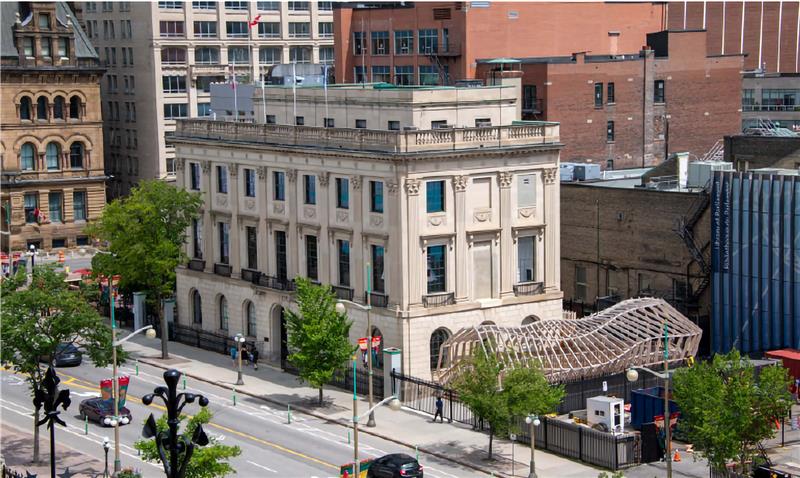
Situated in the middle of Block 2 is a new national space for First Nations, Inuit and Métis Peoples and a dedicated Algonquin space. In March 2025, a Letter of Intent and a Collaboration Implementation Framework were signed by the Ministers of Crown-Indigenous Relations and Northern Affairs Canada (CIRNAC) and PSPC, Assembly of First Nations, Inuit Tapiriit Kanatami, and the Métis National Council. These agreements reaffirm a shared commitment to redevelop 100 Wellington Street and 119 Sparks Street. A similar agreement between the Grand Chief, Chiefs, and Councils from the Anishinàbe Algonquin Nation and the Minister of CIRNAC was also signed in June 2024 to establish a dedicated Algonquin space. With both agreements now in place, efforts are focused on defining the functional program and initiating preliminary design to inform project costs.
Parliamentary Campus Tunnels project
The Tunnels project is a key Parliamentary Campus initiative that will enhance security and pedestrian connections for key buildings on both sides of Wellington Street, including approximately 50% of Parliamentarians that will be accommodated south of Wellington Street by the mid-2030's timeframe.
The project received formal endorsement from the Subcommittee on the Long Term Vision and Plan and the Working Group on the LTVP and Centre Block rehabilitation in February 2024. The project is now focused on the procurement process for the design, with contract award anticipated in spring 2026.
Additional parliamentary offices (Wellington and Valour Buildings)
To accommodate new Members of Parliament (MP) under the Fair Representation Act, 15 new parliamentary offices are being added to the Wellington and Valour Buildings. With design complete, construction efforts are underway with completion targeted for next fiscal year.
Recapitalization Program
The Recapitalization Program preserves operational buildings and grounds on Parliament Hill that have not yet undergone full rehabilitation. These projects mitigate deterioration, address urgent health and safety issues, and reduce future rehabilitation costs by leveraging early interventions.
Repairs have been initiated to the Confederation, Justice and East Block buildings, allowing them to remain operational until their comprehensive rehabilitations commence. For the Confederation Building, work will focus on replacing the central wing flat roof, fan coils, chilled water lines, and sanitary plumbing, as well as repairing masonry gables. This year, planning advanced through the design phase, with preparatory work expected over the next 2 years. In the Justice Building, the design phase was advanced for the replacement of the Perimeter Heating & Risers and the replacement of the building's flat roof. Finally, in East Block, the Flat Roof Replacement and Fire Alarm Replacement projects progressed through the design phase in fiscal year 2024 to 2025, positioning them for implementation in 2025 and 2026.
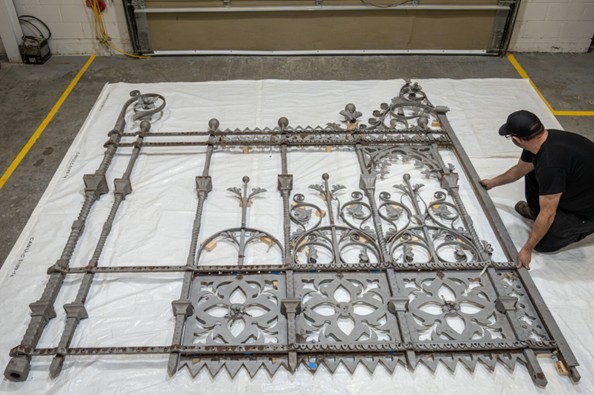
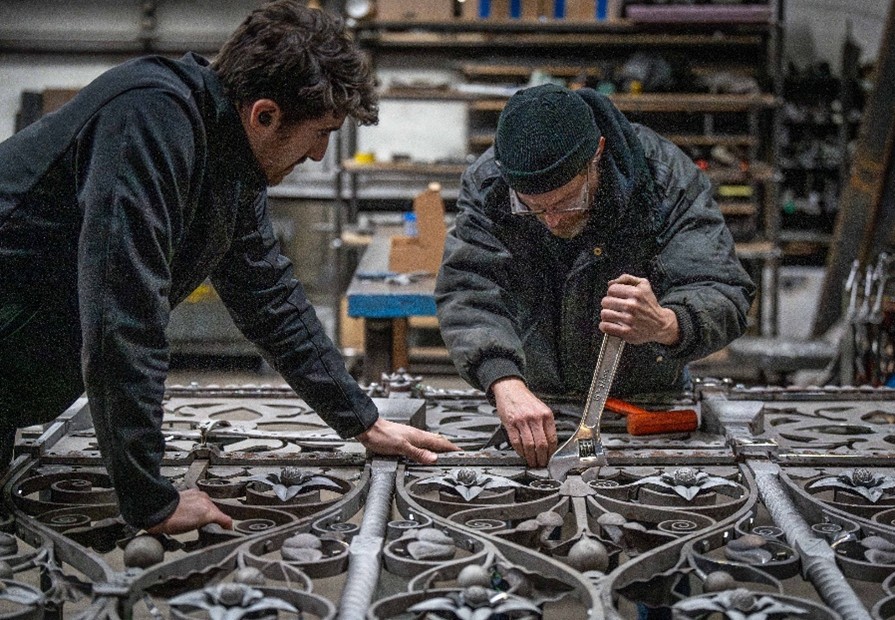
PSPC also initiated restoration of the Queen's Gates, showcasing Canadian heritage expertise. This year, the gates were disassembled, cleaned, and restored, with reinstallation planned for next fiscal year.
Building Components and Connectivity Program
The Building Components and Connectivity Program delivers IT systems to strengthen digital infrastructure and meet evolving operational needs. In 2024 to 2025, PSPC completed the modernization of Parliament Community Access Television (CATV), transitioning to a digital platform that improves reliability and performance. The Data Centre Risk Mitigation project was also finalized, establishing a dedicated disaster recovery site to protect critical operations and ensure business continuity. Core network upgrades were completed under the Network Infrastructure Transformation project, improving speed, reliability, and security to support virtual operations and smart building integration.
A new multimedia strategy is being implemented to enable remote broadcasting and interpretation services across the campus. PSPC launched the Multimedia Enabling project and began validating technical feasibility through a proof of concept. Results from this phase will inform the Multimedia Core Facility project, scheduled for design after 2027.
To strengthen IT security and business continuity, PSPC initiated the Core Data Centre Co-location project. In 2024 to 2025, PSPC secured approval to relocate data centre operations to a new off-site facility and launched a proof of concept to validate functionality. Implementation is scheduled to begin in the next fiscal year.
Security Program
PSPC is strengthening perimeter security by replacing hydraulic bollards along Parliament's grounds. In 2024 to 2025, PSPC began replacing aging bollards as part of routine life-cycle maintenance. Completion is anticipated in the next fiscal year, with measures in place to minimize operational disruptions during installation.
Support and Planning Program
In this section
- Engagement with First Nations, Inuit and Métis Peoples
- Advancing sustainability
- Enhancing accessibility
- Engagement and transparency
The Support and Planning Program supports the oversight, planning, and governance required to deliver the LTVP. It acts as the critical link between short-term priorities and long-term objectives, ensuring alignment across precinct-wide initiatives, pre-planning for future projects, and monitoring overall implementation. The program also strengthens transparency, and supports stakeholder engagement.
This program also provided supplemental funding to the parliamentary administrations to enable them to effectively support LTVP execution.
Engagement with First Nations, Inuit and Métis Peoples
PSPC continued to engage with the Anishinàbe Algonquin Nation and National Indigenous Organizations on initiatives of shared interest, including planning for a national space for First Nations, Inuit, and Métis Peoples and a dedicated Algonquin space. In 2024 to 2025, PSPC also achieved the following milestones:
- secured Federal Land Use, Design, and Transaction Approval for the Indian Residential Schools National Monument
- another year of operations for the Anishinàbe Odjìbikan field school through collaboration with PSPC, the NCC and Indigenous Services Canada
- Indigenous Participation Plans, valued at approximately $29 million have been awarded for projects in the Parliamentary Precinct
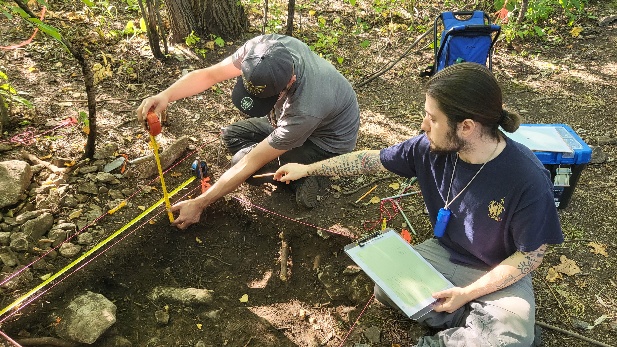
Credit: Anishinàbe Odjìbikan Field School
Advancing sustainability
PSPC continued to advance environmental sustainability and climate resilience across the Parliamentary Precinct. In 2024 to 2025, PSPC achieved the following:
- structural steel from the original Centre Block is being reused in its rehabilitation, avoiding 95% of emissions linked to new steel production
- completed drilling of 92 geo-exchange wells for the Parliament Welcome Centre and incorporated low-carbon concrete to reduce the project's carbon footprint
- transitioned 9 additional buildings to a low-temperature hot water system under the Energy Services Acquisition Program and achieved LEED Gold certification for Operations and Maintenance at the Sir John A. Macdonald Building, Parliament Welcome Centre Phase 1, and the Senate of Canada Building
- installed 6 new electric vehicle charging stations for the House of Commons and completed a technical study to guide future expansion
- in partnership with the NCC, stabilized the escarpment slope overlooking the Ottawa River to mitigate erosion and flood risks
Enhancing accessibility
Significant accessibility improvements are being realized through major rehabilitation efforts such the Centre Block and Block 2, with smaller improvements to operational buildings that can be executed in a cost-effective manner. To support this effort, PSPC conducts Building Accessibility Audits. During this reporting period, 6 additional buildings were completed, bringing the total to 29 out of 34. Based on these reviews, 29 immediate accessibility improvements were completed, with another 16 underway. These include adding high-contrast signs, upgrading grab bars, and installing foldable change tables to make spaces easier and safer for everyone to use.
Engagement and transparency
PSPC remains committed to transparency and accountability in modernizing Canada's Parliamentary Precinct, providing regular updates to parliamentarians and Canadians.
Parliamentary engagement
The execution of the LTVP is complex, with split accountabilities: Parliament defines operational requirements, while PSPC is accountable for funding and program execution. The success of the LTVP depends upon timely and coordinated decision making supported by an integrated governance model between PSPC and the Parliamentary Administrations, including Senate and House of Commons parliamentary committees.
International engagement
PSPC continues to participate in the International Network of Parliamentary Properties (INPP). These engagements continue to provide Canada with valuable opportunities to lead and learn in the fields of parliamentary modernization and heritage preservation.
Public engagement
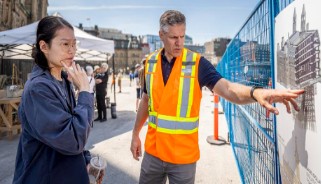
In June 2024, PSPC welcomed over 2,800 visitors to the Centre Block construction site to witness rehabilitation progress firsthand, engage directly with experts, and explore virtual walkthroughs of designs for the future Parliament Welcome Centre. PSPC also supports the CPAC documentary series "Inside Centre Block", as well as provides annual media tours of the Centre Block construction site. This year, 30 accredited media outlets participated.

Program financial performance
In this section
- Fiscal year financial highlights
- Major Capital Program
- Recapitalization Program
- Building Components and Connectivity Program
- Security Infrastructure Program
- Support and Planning Program
Fiscal year financial highlights
Significant progress was made in 2024 to 2025 to advance the LTVP, as well as the planning of future projects.
Below are the Long Term Vision and Plan expenditures in fiscal year 2024 to 2025 (in millions of dollars).
| Planned expenditures | Actual expenditures | Percentage spent |
|---|---|---|
| 544.7 | 562.5 | 103.3% |
| Program | Expenditures | Percentage |
|---|---|---|
| Major Capital Program | 519.3 | 92.3% |
| Recapitalization Program | 2.7 | 0.5% |
| Building Components and Connectivity Program | 17.5 | 3.1% |
| Security Infrastructure Program | 0.8 | 0.1% |
| Support and Planning Program | 22.2 | 3.9% |
| Total LTVP expenditures | 562.5 | 100% |
| Program | Expenditures | Percentage |
|---|---|---|
| Major Capital Program | 501.2 | 92.0% |
| Recapitalization Program | 2.8 | 0.5% |
| Building Components and Connectivity Program | 16.8 | 3.1% |
| Security Infrastructure Program | 0.9 | 0.2% |
| Support and Planning Program | 23.1 | 4.2% |
| Total LTVP expenditures | 544.7 | 100% |
Major Capital Program
| Fiscal year | Annual planned expenditures table 4 note 1 | Annual expenditures |
|---|---|---|
| Prior years | 46.0 | 44.1 |
| 2002 to 2003 | 29.1 | 26.5 |
| 2003 to 2004 | 23.4 | 38.8 |
| 2004 to 2005 | 40.6 | 44.4 |
| 2005 to 2006 | 64.5 | 44.2 |
| 2006 to 2007 | 65.4 | 67.5 |
| 2007 to 2008 | 58.9 | 58.2 |
| 2008 to 2009 | 62.1 | 66.3 |
| 2009 to 2010 | 121.3 | 120.7 |
| 2010 to 2011 | 109.6 | 112.9 |
| 2011 to 2012 | 126.2 | 125.5 |
| 2012 to 2013 | 202.8 | 180.4 |
| 2013 to 2014 | 246.6 | 246.8 |
| 2014 to 2015 | 301.4 | 306.9 |
| 2015 to 2016 | 346.6 | 328.0 |
| 2016 to 2017 | 289.7 | 293.1 |
| 2017 to 2018 | 342.8 | 336.9 |
| 2018 to 2019 | 349.0 | 346.4 |
| 2019 to 2020 | 321.7 | 300.4 |
| 2020 to 2021 | 301.2 | 290.0 |
| 2021 to 2022 | 314.1 | 290.7 |
| 2022 to 2023 | 257.8 | 266.7 |
| 2023 to 2024 | 464.7 | 459.1 |
| 2024 to 2025 | 501.2 | 519.3 |
| 2025 to 2026 | 607.8 | Not applicable (n/a) |
| 2026 to 2027 | 592.4 | n/a |
Table 4 note
|
||
Recapitalization Program
| Fiscal year | Annual planned expenditurestable 5 note 1 | Annual expenditures |
|---|---|---|
| Prior years | 11.0 | 11.0 |
| 2002 to 2003 | 14.4 | 14.4 |
| 2003 to 2004 | 25.6 | 25.6 |
| 2004 to 2005 | 6.8 | 6.8 |
| 2005 to 2006 | 3.7 | 3.7 |
| 2006 to 2007 | 3.2 | 3.2 |
| 2007 to 2008 | 5.4 | 5.4 |
| 2008 to 2009 | 3.5 | 3.5 |
| 2009 to 2010 | 2.4 | 2.4 |
| 2010 to 2011 | 7.5 | 7.3 |
| 2011 to 2012 | 14.5 | 13.5 |
| 2012 to 2013 | 15.4 | 15.9 |
| 2013 to 2014 | 15.2 | 15.9 |
| 2014 to 2015 | 22.9 | 18.8 |
| 2015 to 2016 | 23.8 | 23.6 |
| 2016 to 2017 | 31.1 | 21.5 |
| 2017 to 2018 | 24.7 | 23.4 |
| 2018 to 2019 | 15.7 | 14.8 |
| 2019 to 2020 | 35.2 | 14.1 |
| 2020 to 2021 | 29.6 | 31.0 |
| 2021 to 2022 | 40.0 | 37.9 |
| 2022 to 2023 | 17.3 | 17.4 |
| 2023 to 2024 | 3.4 | 3.5 |
| 2024 to 2025 | 2.8 | 2.7 |
| 2025 to 2026 | 4.1 | n/a |
| 2026 to 2027 | 13.6 | n/a |
Table 5 note
|
||
Building Components and Connectivity Program
| Fiscal year | Annual planned expenditurestable 6 note 1 | Annual expenditures |
|---|---|---|
| Prior years | 6.3 | 6.3 |
| 2002 to 2003 | 5.2 | 5.2 |
| 2003 to 2004 | 7.5 | 7.5 |
| 2004 to 2005 | 7.0 | 7.0 |
| 2005 to 2006 | 7.9 | 7.9 |
| 2006 to 2007 | 12.0 | 12.0 |
| 2007 to 2008 | 3.5 | 3.5 |
| 2008 to 2009 | 2.2 | 2.2 |
| 2009 to 2010 | 1.0 | 1.0 |
| 2010 to 2011 | 5.7 | 5.5 |
| 2011 to 2012 | 3.4 | 3.4 |
| 2012 to 2013 | 5.2 | 5.0 |
| 2013 to 2014 | 15.3 | 14.9 |
| 2014 to 2015 | 21.2 | 19.4 |
| 2015 to 2016 | 19.5 | 23.1 |
| 2016 to 2017 | 17.6 | 15.7 |
| 2017 to 2018 | 17.6 | 14.7 |
| 2018 to 2019 | 32.4 | 31.2 |
| 2019 to 2020 | 18.0 | 17.8 |
| 2020 to 2021 | 17.2 | 16.6 |
| 2021 to 2022 | 19.9 | 20.3 |
| 2022 to 2023 | 23.4 | 25.8 |
| 2023 to 2024 | 16.8 | 15.2 |
| 2024 to 2025 | 16.8 | 17.5 |
| 2025 to 2026 | 26.3 | n/a |
| 2026 to 2027 | 65.3 | n/a |
Table 6 note
|
||
Security Infrastructure Program
| Fiscal year | Annual planned expenditurestable 7 note 1 | Annual expenditures |
|---|---|---|
| 2015 to 2016 | 0.0 | 0.0 |
| 2016 to 2017 | 22.5 | 12.6 |
| 2017 to 2018 | 91.4 | 91.4 |
| 2018 to 2019 | 52.8 | 52.8 |
| 2019 to 2020 | 0.0 | 0.0 |
| 2020 to 2021 | 0.0 | 0.0 |
| 2021 to 2022 | 0.2 | 0.3 |
| 2022 to 2023 | 0.4 | 0.2 |
| 2023 to 2024 | 0.2 | 0.3 |
| 2024 to 2025 | 0.9 | 0.8 |
| 2025 to 2026 | 3.0 | n/a |
| 2026 to 2027 | 0.9 | n/a |
Table 7 note
|
||
Support and Planning Program
| Fiscal year | Annual planned expenditurestable 8 note 1 table 8 note 2 | Annual expenditures |
|---|---|---|
| Prior years | 5.8 | 5.8 |
| 2002 to 2003 | 1.6 | 1.6 |
| 2003 to 2004 | 2.4 | 2.4 |
| 2004 to 2005 | 2.0 | 2.0 |
| 2005 to 2006 | 2.6 | 2.6 |
| 2006 to 2007 | 1.1 | 1.1 |
| 2007 to 2008 | 0.4 | 0.4 |
| 2008 to 2009 | 1.5 | 1.5 |
| 2009 to 2010 | 1.8 | 1.8 |
| 2010 to 2011 | 3.7 | 3.7 |
| 2011 to 2012 | 4.0 | 3.9 |
| 2012 to 2013 | 4.4 | 3.9 |
| 2013 to 2014 | 5.5 | 6.1 |
| 2014 to 2015 | 12.4 | 10.7 |
| 2015 to 2016 | 18.1 | 13.1 |
| 2016 to 2017 | 21.1 | 21.4 |
| 2017 to 2018 | 9.8 | 9.8 |
| 2018 to 2019 | 14.9 | 13.2 |
| 2019 to 2020 | 21.5 | 21.5 |
| 2020 to 2021 | 14.2 | 17.3 |
| 2021 to 2022 | 15.0 | 19.7 |
| 2022 to 2023 | 22.1 | 21.2 |
| 2023 to 2024 | 20.9 | 20.0 |
| 2024 to 2025 | 23.1 | 22.2 |
| 2025 to 2026 | 23.6 | n/a |
| 2026 to 2027 | 0.0 | n/a |
Table 8 notes
|
||
Program information summary
In this section
- Major Capital Program
- Recapitalization Program
- Building Components and Connectivity Program
- Security Infrastructure Program
- Support and Planning Program
- Lease cost breakdown
| Program | Program budgettable 9 note 1 | Expenditure authority | Planned expenditures 2024 to 2025table 9 note 2 | Previous years expenditures | Expenditures 2024 to 2025 | Cumulative expenditures up to 2024 to 2025 | Planned expenditures 2025 to 2026table 9 note 3 | Planned expenditures 2026 to 2027 and future yearstable 9 note 3 |
|---|---|---|---|---|---|---|---|---|
| Total Major Capital Program | 11.1 billion to 11.6 billion | 8,277.5 | 501.2 | 4,366.1 | 519.3 | 4,885.5 | 607.8 | 4,809.0 |
| Total Recapitalization Program | 406.0 | 382.9 | 2.8 | 367.7 | 2.7 | 370.4 | 4.1 | 29.9 |
| Total Building Components and Connectivity Program | 434.9 | 352.2 | 16.8 | 281.3 | 17.5 | 298.8 | 26.3 | 99.6 |
| Total Security and Infrastructure Program | 162.2 | 162.2 | 0.9 | 157.5 | 0.8 | 158.3 | 3.0 | 0.9 |
| Total Support and Planning Program | 250.7 | 250.7 | 23.1 | 204.6 | 22.2 | 226.8 | 23.6 | 0.0 |
| Grand total LTVP | 12.4 billion to 12.9 billion | 9,425.4 | 544.7 | 5,377.3 | 562.5 | 5,939.8 | 664.8 | 4,939.5 |
Table 9 notes
RemarksNumbers may not add up due to rounding. Planned expenditures may require project approval and/or expenditure authority amendments. |
||||||||
Major Capital Program
| Project | Project budgettable 10 note 1 | Expenditure authority | Planned expenditures 2024 to 2025table 10 note 2 | Previous years expenditures | Expenditures 2024 to 2025 | Cumulative expenditures up to 2024 to 2025 | Planned expenditures 2025 to 2026table 10 note 3 | Planned expenditures 2026 to 2027 and future yearstable 10 note 3 | Substantial completion date |
|---|---|---|---|---|---|---|---|---|---|
| Centre Block rehabilitationtable 10 note 4 | 4.5 billion to 5 billion | 3,790.2 | 316.5 | 680.1 | 331.6 | 1,011.7 | 377.9 | 1,335.2 | 2030 to 2031 |
| Parliament Welcome Centretable 10 note 4 | Cost included in Centre Block rehabilitation | Cost included in Centre Block rehabilitation | 58.1 | 184.3 | 55.7 | 240.0 | 102.8 | 722.6 | 2030 to 2031 |
| Centre Block Program: Enablings/early workstable 10 note 5 table 10 note 6 | 569.6 | 569.6 | 0.0 | 487.2 | 0.0 | 487.2 | 0.0 | 0.0 | 2024 |
| 100 Sparks and 30 Metcalfe redevelopment | 308.0 | 56.1 | 1.5 | 30.6 | 1.3 | 31.9 | 0.0 | 276.0 | 2029 |
| Block 2 redevelopment | 1,372.5 | 487.1 | 40.0 | 38.6 | 42.8 | 81.4 | 65.2 | 1,225.9 | To be determined |
| Trompe L'Oeil scaffold coverings | 4.5 | 4.5 | 0.4 | 1.5 | 0.7 | 2.2 | 0.4 | 1.9 | 2028 |
| 40 Elgin Senate fit-up | 241.3 | 162.8 | 60.8 | 7.9 | 61.7 | 69.6 | 21.5 | 150.2 | 2029 |
| Valour Building: House of Commons parliamentary office units | 28.4 | 28.4 | 2.2 | 1.0 | 3.3 | 4.3 | 13.6 | 10.5 | 2026 |
| Wellington Building: House of Commons parliamentary office units | 17.3 | 17.3 | 2.4 | 0.8 | 2.9 | 3.7 | 7.3 | 3.8 | 2025 |
| 181 Queen Street purchase | 131.6 | 131.6 | 0.0 | 123.8 | 0.0 | 123.8 | 0.0 | 0.0 | 2024 |
| Relocation of high voltage duct bank | 13.0 | 13.0 | 0.9 | 0.0 | 0.1 | 0.1 | 10.9 | 2.0 | 2027 |
| Leased and lease fit-up | 737.4 | 737.4 | 12.4 | 622.8 | 12.9 | 635.7 | 5.2 | 96.4 | n/a |
| Other MCP (active) | 1,039.0 | 127.5 | 6.0 | 35.3 | 6.3 | 41.7 | 3.0 | 984.5 | n/a |
| Completed MCP | 2,152.1 | 2,152.1 | 0.0 | 2,152.1 | 0.0 | 2,152.1 | 0.0 | 0.0 | n/a |
| Total MCP | 11.1 billion to 11.6 billion | 8,277.5 | 501.2 | 4,366.1 | 519.3 | 4,885.5 | 607.8 | 4,809.0 | n/a |
Table 10 notes
RemarksNumbers may not add up due to rounding. Planned expenditures may require project approval and/or expenditure authority amendments. |
|||||||||
Recapitalization Program
| Project | Project budgettable 11 note 1 | Expenditure authority | Planned expenditures 2024 to 2025table 11 note 2 | Previous years expenditures | Expenditures 2024 to 2025 | Cumulative expenditures up to 2024 to 2025 | Planned expenditures 2025 to 2026table 11 note 3 | Planned expenditures 2026 to 2027 and future yearstable 11 note 3 | Substantial completion date |
|---|---|---|---|---|---|---|---|---|---|
| East Block 1867 wing exterior rehabilitationtable 11 note 4 | 95.8 | 95.8 | 0.0 | 95.8 | 0.0 | 95.8 | 0.0 | 0.0 | 2022 |
| Lighting implementation: West Block | 9.2 | 9.2 | 0.2 | 9.0 | 0.2 | 9.2 | 0.0 | 0.0 | 2023 |
| Confederation interior lifecycle repair and replacement | 18.8 | 2.4 | 0.1 | 0.0 | 0.1 | 0.1 | 0.9 | 17.8 | 2029 |
| Confederation exterior lifecycle repair and replacement | 8.0 | 1.3 | 0.1 | 0.0 | 0.1 | 0.1 | 0.5 | 7.4 | 2028 |
| 100 Wellington: Interim heating | 1.0 | 1.0 | 0.0 | 1.0 | 0.0 | 1.0 | 0.0 | 0.0 | 2024 |
| Fire alarm system: East Block | 6.4 | 6.4 | 0.5 | 0.0 | 0.5 | 0.5 | 1.7 | 4.2 | 2027 |
| Queen's Gate rehabilitation | 2.6 | 2.6 | 1.1 | 0.1 | 1.1 | 1.2 | 0.8 | 0.6 | 2025 |
| Other recap (active) | 3.8 | 3.8 | 0.6 | 1.3 | 0.7 | 2.0 | 0.2 | 0.0 | n/a |
| Completed recap | 260.5 | 260.5 | 0.2 | 260.5 | 0.0 | 260.5 | 0.0 | 0.0 | n/a |
| Total recapitalization | 406.0 | 382.9 | 2.8 | 367.7 | 2.7 | 370.4 | 4.1 | 29.9 | n/a |
Table 11 notes
RemarksNumbers may not add up due to rounding. Planned expenditures may require project approval and/or expenditure authority amendments. |
|||||||||
Building Components and Connectivity Program
| Project | Project budgettable 12 note 1 | Expenditure authority | Planned expenditures 2024 to 2025table 12 note 2 | Previous years expenditures | Expenditures 2024 to 2025 | Cumulative expenditures up to 2024 to 2025 | Planned expenditures 2025 to 2026table 12 note 3 | Planned expenditures 2026 to 2027 and future yearstable 12 note 3 | Substantial completion date |
|---|---|---|---|---|---|---|---|---|---|
| Modernization of the Parliament CATV | 14.8 | 14.8 | 0.9 | 13.8 | 1.0 | 14.8 | 0.0 | 0.0 | 2024 |
| IT infrastructure base building upgrades | 15.2 | 15.2 | 0.9 | 13.3 | 0.6 | 13.9 | 0.0 | 0.4 | 2027 |
| Datacentre disaster recovery projects | 37.0 | 37.0 | 1.0 | 35.7 | 1.0 | 36.7 | 0.1 | 0.2 | 2027 |
| Video surveillance and security systems | 7.7 | 7.7 | 0.5 | 7.0 | 0.6 | 7.6 | 0.1 | 0.0 | 2025 |
| Network infrastructure transformation | 22.5 | 9.5 | 3.9 | 3.2 | 3.7 | 6.9 | 4.0 | 11.6 | 2028 |
| Centre Block multimedia enabling | 21.1 | 21.1 | 4.9 | 0.0 | 5.4 | 5.4 | 4.4 | 11.3 | 2027 |
| Core data centre colocation | 96.4 | 26.7 | 0.0 | 0.0 | 0.7 | 0.7 | 13.3 | 74.4 | 2030 |
| Other BCC (active) | 34.7 | 34.7 | 4.6 | 22.8 | 4.6 | 27.4 | 4.3 | 1.6 | n/a |
| Completed BCC | 185.5 | 185.5 | 0.0 | 185.5 | 0.0 | 185.5 | 0.0 | 0.0 | n/a |
| Total BCC | 434.9 | 352.2 | 16.8 | 281.3 | 17.5 | 298.8 | 26.3 | 99.6 | n/a |
Table 12 notes
RemarksNumbers may not add up due to rounding. Planned expenditures may require project approval and/or expenditure authority amendments. |
|||||||||
Security Infrastructure Program
| Project | Project budgettable 13 note 1 | Expenditure authority | Planned expenditures 2024 to 2025table 13 note 2 | Previous years expenditures | Expenditures 2024 to 2025 | Cumulative expenditures up to 2024 to 2025 | Planned expenditures 2025 to 2026table 13 note 3 | Planned expenditures 2026 to 2027 and future yearstable 13 note 3 | Substantial completion date |
|---|---|---|---|---|---|---|---|---|---|
| Perimeter security enhancement | 4.8 | 4.8 | 0.9 | 0.1 | 0.8 | 0.9 | 3.0 | 0.9 | 2025 |
| Completed security | 157.4 | 157.4 | 0.0 | 157.4 | 0.0 | 157.4 | 0.0 | 0.0 | n/a |
| Total Security Infrastructure Program | 162.2 | 162.2 | 0.9 | 157.5 | 0.8 | 158.3 | 3.0 | 0.9 | n/a |
Table 13 notes
RemarksNumbers may not add up due to rounding. Planned expenditures may require project approval and/or expenditure authority amendments. |
|||||||||
Support and Planning Program
| Project | Project budgettable 14 note 1 | Expenditure authority | Planned expenditures 2024 to 2025table 14 note 2 | Previous years expenditures | Expenditures 2024 to 2025 | Cumulative expenditures up to 2024 to 2025 | Planned expenditures 2025 to 2026table 14 note 3 | Planned expenditures 2026 to 2027 and future yearstable 14 note 3 | Substantial completion date |
|---|---|---|---|---|---|---|---|---|---|
| Campus planning | 11.7 | 11.7 | 0.6 | 10.8 | 0.5 | 11.3 | 0.1 | 0.0 | n/a |
| Planning program support | 138.5 | 138.5 | 22.5 | 93.3 | 21.7 | 115.0 | 23.5 | 0.0 | n/a |
| Completed planning | 100.5 | 100.5 | 0.0 | 100.5 | 0.0 | 100.5 | 0.0 | 0.0 | n/a |
| Planning total | 250.7 | 250.7 | 23.1 | 204.6 | 22.2 | 226.8 | 23.6 | 0.0 | n/a |
Table 14 notes
RemarksNumbers may not add up due to rounding. Planned expenditures may require project approval and/or expenditure authority amendments. |
|||||||||
Lease cost breakdown
| LTVP leases | Total lease cost forecastedtable 15 note 1 | Previous years expenditures | Forecasted expenditures 2024 to 2025 | Actual expenditures in 2024 to 2025 | Total expenditures to end of fiscal year 2024 to 2025 |
|---|---|---|---|---|---|
| 119 Queen Street | 3.6 | 3.6 | 0.0 | 0.0 | 3.6 |
| 131 Queen Street | 206.5 | 206.5 | 0.0 | 0.0 | 206.5 |
| 181 Queen Street | 116.9 | 116.9 | 0.0 | 0.0 | 116.9 |
| 155 Queen Street (10th Floor) | 8.4 | 8.4 | 0.0 | 0.0 | 8.4 |
| 155 Queen Street (6th Floor) | 0.2 | 0.2 | 0.0 | 0.0 | 0.2 |
| 2074-2086 Walkley Road, trade shops | 6.3 | 6.3 | 0.0 | 0.0 | 6.3 |
| 768 Belfast Road, House of Commons | 1.4 | 1.4 | 0.0 | 0.0 | 1.4 |
| 2455 Don Reid Drive, E-Printing | 9.3 | 9.3 | 0.0 | 0.0 | 9.3 |
| 1 Wellington Street, Rideau committee rooms | 23.0 | 9.8 | 0.4 | 0.4 | 10.1 |
| C.D. Howe Building | 26.2 | 26.2 | 0.0 | 0.0 | 26.2 |
| Clarica / Sun Life Building | 54.0 | 54.0 | 0.0 | 0.0 | 54.0 |
| Interim Room 200, Government of Canada Conference Centre | 8.5 | 8.5 | 0.0 | 0.0 | 8.5 |
| Parks Canada | 0.8 | 0.8 | 0.0 | 0.0 | 0.8 |
| 40 Elgin St. Chambers buildingtable 15 note 2 | 6.3 | 5.7 | 0.6 | 0.6 | 6.3 |
| 150 Slater Street | 19.2 | 9.2 | 1.3 | 1.4 | 10.6 |
| 40 Elgin St., floors 8 and 12table 15 note 2 | 16.0 | 12.4 | 3.6 | 3.6 | 16.0 |
| 40 Elgin St., floors 9, 10 and 11table 15 note 2 | 10.6 | 8.9 | 1.7 | 1.7 | 10.6 |
| 40 Elgin St., land and buildingstable 15 note 2 | 81.0 | 0.0 | 0.3 | 0.3 | 0.3 |
| Grand total LTVP | 598.3 | 488.2 | 7.9 | 7.9 | 496.1 |
Table 15 notes
|
|||||