
Quarterly Financial Report - For the quarter ended June 30, 2026
Permission to reproduce
Unless otherwise specified, you may not reproduce materials in this publication, in whole or in part, for the purposes of commercial redistribution without prior written permission from Shared Services Canada’s copyright administrator. To obtain permission to reproduce Government of Canada materials for commercial purposes, apply for Crown Copyright Clearance by contacting Shared Services Canada at information@ssc-spc.gc.ca.
© His Majesty the King in Right of Canada, as represented by the Minister responsible for Shared Services Canada, 2026.
Quarterly Financial Report - For the quarter ended
Catalogue No. P116-1E-PDF
ISSN 2371-4328
Publié aussi en français sous le titre : Rapport financier trimestriel - Pour le trimestre terminé
No. de catalogue P116-1F-PDF
ISSN 2371-4336
1.0 Introduction
This quarterly financial report should be read in conjunction with the 2026-27 Main Estimates. This report has been prepared by management as required by section 65.1 of the Financial Administration Act and in the form and manner prescribed by the Treasury Board. It has not been subject to an external audit or review.
1.1 Authority, mandate and programs
Shared Services Canada (SSC) provides the essential information technology (IT) infrastructure and digital services that support Government of Canada operations. SSC is responsible for digitally transforming and enabling government programs and services by providing secure, reliable, and scalable enterprise platforms, networks, hosting and digital solutions. SSC supports departments in delivering programs and services to Canadians more efficiently.
As a service provider to over 90 government departments and agencies, SSC uses an enterprise IT service delivery model that promotes common solutions and platforms across departments to standardize, consolidate and modernize IT solutions while reducing legacy systems. SSC works to provide fast, reliable and secure connections, ensure employees have modern digital tools and support departments in the development and delivery of their services to Canadians. The Minister of Government Transformation, Public Works and Procurement is the Minister responsible for SSC.
In carrying out its mandate, SSC is supporting the Government of Canada’s Digital Ambition, the GC Enterprise Cyber Security Strategy and the 2024 Application Hosting Strategy. SSC works in partnership with public and private sector stakeholders, implementing enterprise-wide approaches for managing IT infrastructure services, and employing effective and efficient business management processes.
The Shared Services Canada Act and related orders-in-council set out the powers, duties and functions of the Minister responsible for SSC. Amendments to the Act in allow the Minister to delegate to other Ministers the power to procure certain items, thereby making it easier for federal departments to buy some of the most frequently purchased IT goods and services. SSC remains responsible for setting up IT contracts, standing offers and supply arrangements, and will continue to ensure only trusted IT equipment and software are used. The Minister responsible for SSC may also, in exceptional circumstances, authorize another Minister to obtain services from within their own department or from a source other than SSC. However, this authorization cannot be used to exempt the entire department from using SSC’s services.
Further details on SSC’s authority, mandate, responsibilities and programs may be found in the 2026-27 Main Estimates and in SSC’s 2026-27 Departmental Plan.
1.2 Basis of presentation
This quarterly financial report has been prepared by management using an expenditure basis of accounting. The accompanying statement of authorities includes the department’s spending authorities granted by Parliament, and those used by the department consistent with the 2026-27 Main Estimates. This quarterly report has been prepared using a special purpose financial reporting framework designed to meet financial information needs with respect to the use of spending authorities.
The authority of Parliament is required before money can be spent by the government. Approvals are given in the form of annually approved limits through appropriation acts or through legislation in the form of statutory spending authority for specific purposes.
When Parliament is dissolved for the purposes of a general election, section 30 of the Financial Administration Act authorizes, under certain conditions, the preparation of a special warrant to be signed by the Governor General authorizing payments to be made out of the Consolidated Revenue Fund. Special warrants are deemed to be an appropriation for the fiscal year in which they are issued.
The department uses the full accrual method of accounting to prepare and present its annual departmental financial statements that are part of the departmental results reporting process. However, the spending authorities voted by Parliament remain on an expenditure basis. The main difference between the quarterly financial report and the departmental financial statements is the timing of when revenues and expenses are recognized. The quarterly financial report presents revenues only when the money is received and expenses only when the money is paid out. The departmental financial statements report revenues when they are earned and expenses when they are incurred. In the latter case, revenues are recorded even if cash has not been received and expenses are incurred even if cash has not yet been paid out.
1.3 Shared Services Canada financial structure
SSC has a financial structure composed mainly of voted budgetary authorities, namely Vote 1 – Operating expenditures, including Vote netted revenues, and Vote 5 – Capital expenditures, including Vote netted revenues. The statutory authorities consist of contributions to the Employee Benefit Plan (EBP).
At the end of the first quarter of 2026-27, 92% of the department’s budget was devoted to supporting its IT consolidation and standardization goals. This ensured that current and future IT infrastructure services offered to the Government of Canada (GC) are maintained in an environment of operational excellence. The remaining 8% was devoted to internal services, which are services in support of SSC’s programs and/or required to meet SSC’s corporate obligations.
Total Vote netted revenue authority for 2026-27 is $1,063.0 million, which consists of respendable revenue for IT infrastructure services provided by SSC to organizations on a cost-recovery basis.
2.0 Highlights of fiscal quarter and fiscal year-to-date results
The following graph provides a comparison of the net budgetary authorities available for spending and the expenditures for the quarters ended , and , for the department’s combined Vote 1 – Operating expenditures, Vote 5 – Capital expenditures, and statutory authorities.
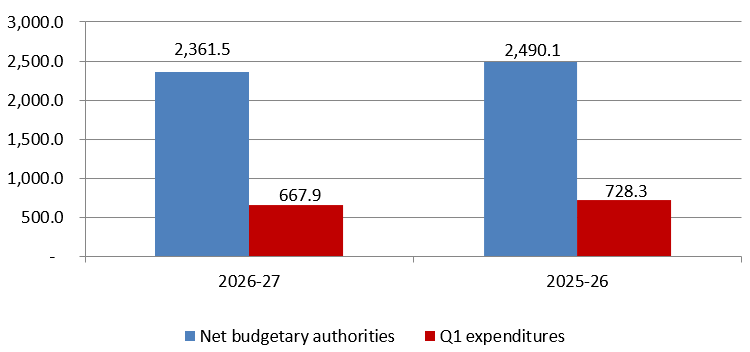
Comparison of net budgetary authorities and expenditures as of and - Text version
The graph shows total net budgetary authorities available for spending of $2,361.5 million as of , and $2,490.1 million as of . It also shows total expenditures of $667.9 million for the first quarter ended , compared to $728.3 million for the first quarter ended .
2.1 Significant changes to authorities
As of , the authorities available to the department include the Main Estimates, as no items were requested for the Supplementary Estimates (A). Authorities available for spending in 2026-27 are $2,361.5 million at the end of the first quarter, compared to $2,490.1 million at the end of the first quarter of 2025-26, representing a decrease of $128.6 million, or 5.2%. This total decrease is a combination of an increase of $58.9 million in Vote 1 – Gross operating expenditures, an increase of $11.6 million in Vote 5 – Gross capital expenditures, an increase in Vote netted revenues of $210.0 million, and an increase in Budgetary statutory authorities (EBP) of $10.9 million.
| Net authorities available ($ millions) | 2026-27 | 2025-26 | Variance |
|---|---|---|---|
| Vote 1 – Operating expenditures | 3,052.7 | 2,993.8 | 58.9 |
| Vote 5 – Capital expenditures | 217.7 | 206.1 | 11.6 |
| Statutory (EBP) | 154.1 | 143.2 | 10.9 |
| Total gross authorities | 3,424.5 | 3,343.1 | 81.4 |
| Vote netted revenues | (1,063.0) | (853.0) | (210.0) |
| Total net authorities | 2,361.5 | 2,490.1 | (128.6) |
Vote 1 – Gross operating expenditures
The department’s Vote 1 increased by $58.9 million, compared to the first quarter of 2025-26, due to the following:
- an increase of $210.0 million related to the increase in Vote netted revenues in 2026-27
- an increase in funding of $73.8 million related to the following projects and initiatives:
- a cumulative increase of $47.1 million related to 2022 Fall Economic Statement initiatives:
- Security Information and Event Management (SIEM) solution ($31.9 million)
- Safeguarding Access to High Performance Computing for Canada’s Hydro-Meteorological Services ($7.6 million)
- Reinforcing the Government of Canada’s Cyber Security ($7.6 million)
- incremental cost of providing core information technology services to client departments and agencies ($24.1 million)
- collective agreements and other compensation adjustments ($2.6 million)
- a cumulative increase of $47.1 million related to 2022 Fall Economic Statement initiatives:
- this increase is offset by a decrease or sunsetting funding of $224.9 million related to the following projects and initiatives:
- reductions to implement the comprehensive expenditure review announced in the Federal Budget 2025 ($156.4 million)
- Secure Cloud Enablement and Defence (SCED) Evolution and Departmental Connectivity ($24.4 million)
- reductions in support of initiatives to refocus government spending announced in Budget 2023 ($18.0 million)
- Presidency of the 2025 G7 Summit in Canada ($16.3 million)
- Cyber and Information Technology Security ($7.3 million)
- a cumulative decrease of $2.5 million related to other projects and initiatives.
Vote 5 – Gross capital expenditures
The department’s Vote 5 increased by $11.6 million, compared to the first quarter of 2025-26, due to the following:
- an increase in funding of $25.4 million related to the following projects and initiatives:
- a cumulative increase of $24.6 million related to 2022 Fall Economic Statement initiatives:
- Safeguarding Access to High Performance Computing for Canada’s Hydro-Meteorological Services ($19.0 million)
- Security Information and Event Management (SIEM) solution ($5.6 million)
- a cumulative increase of $0.8 million related to other projects and initiatives
- a cumulative increase of $24.6 million related to 2022 Fall Economic Statement initiatives:
- this increase is offset by a decrease or sunsetting funding of $13.8 million related to the following projects and initiatives:
- SCED Evolution and Departmental Connectivity ($6.9 million)
- Cyber and Information Technology Security ($6.9 million).
Vote netted revenues
- The Department’s Vote netted revenues (VNR) authority increased by $210.0 million compared to the first quarter of 2025-26, bringing the total VNR authority to $1,063.0 million. This increase in Vote 1 Operating VNR authority is due to the following:
- An increase of $100.0 million related to rising service volumes driven by activities to support the Department of National Defence’s operational and modernization priorities
- An increase of $110.0 million to support the management of the software and services agreement on behalf of the Government of Canada.
Statutory (EBP)
The department’s EBP authority increased by $10.9 million, compared to the first quarter of 2025-26, due to the following:
- an increase in funding of $14.7 million for:
- a technical adjustment to the Statutory EBP rate ($11.6 million)
- Security Information and Event Management (SIEM) solution ($1.0 million)
- a cumulative increase of $2.1 million related to other projects and initiatives
- this increase is offset by a decrease or sunsetting funding of $3.8 million related to:
- reductions to implement the comprehensive expenditure review as announced in Budget 2025 ($2.9 million)
- Presidency of the 2025 G7 Summit in Canada ($0.9 million).
2.2 Explanations of significant variances from previous year expenditures
Compared to the previous year, the total net year-to-date expenditures for the period ended , have decreased by $60.4 million, from $728.3 million to $667.9 million as per the table below. This represents a decrease of 8.3% against expenditures recorded for the same period in 2025-26.
| Net year-to-date expenditures ($ millions) | 2026-27 | 2025-26 | Variance |
|---|---|---|---|
| Vote 1 – Operating expenditures | 827.6 | 800.2 | 27.4 |
| Vote 5 – Capital expenditures | 20.7 | 15.1 | 5.6 |
| Statutory (EBP) | 38.5 | 35.8 | 2.7 |
| Total gross year-to-date expenditures | 886.8 | 851.1 | 35.7 |
| Vote netted revenues | (218.9) | (122.8) | (96.1) |
| Total net year-to-date expenditures | 667.9 | 728.3 | (60.4) |
Vote 1 – Increase of $27.4 million
The net increase in operating expenditures, compared to the first quarter of 2025-26, is mainly attributed to the following:
- rentals expenditures increased by $44.0 million. This increase is mainly attributable to higher expenditures for licence and maintenance fees for various software, particularly for the implementation of the Microsoft 365 E5 licence.
- personnel expenditures increased by $31.6 million, primarily due to a pay timing difference, as there were seven pay periods between and , compared to six pay periods during the same period last year. This increase was partially offset by a decrease in the number of SSC employees.
- repair and maintenance expenditures decreased by $19.3 million. This decrease is mainly attributable to lower expenditures for repair and maintenance of computer equipment and communications and networking equipment.
- professional and special services expenditures decreased by $12.3 million. This decrease is mainly attributable to lower expenditures for informatics services, training and educational services, and management consulting.
- acquisitions of machinery and equipment decreased by $9.4 million. This decrease is mainly attributable to lower expenditures related to the Presidency of the 2025 G7 Summit in Canada, which are mainly composed of expenditures for communications and networking equipment.
- transportation and communications expenditures decreased by $9.2 million. This decrease is mainly attributable to lower expenditures for telecommunication services.
- an increase of $2.0 million in other various expenditures.
Vote 5 – Increase of $5.6 million
The net increase in capital expenditures, compared to the first quarter of 2025-26, is attributed to the following:
- acquisitions of machinery and equipment increased by $5.6 million. This increase is mainly attributable to higher expenditures related to the acquisition of computer equipment.
Vote netted revenues – Increase of $96.1 million
The net increase in the collected Vote netted revenues, compared to the first quarter of 2025-26, is mainly due to the following factors:
- timing of the billing for Revenue in Lieu of Appropriation (RLA), as the financial coding required to initiate invoice processing was received from departments earlier this fiscal year compared to the previous fiscal year, which resulted in an increase in revenues as billing and revenue collection occurred earlier.
- an increase in demand for IT services, particularly Virtualization services, driven mainly by initiatives undertaken by the Department of National Defence. This increase is partially offset by lower spending in IT services, from partners, as a result of the Comprehensive Expenditure Review (CER) (Budget 2025) and Refocusing Government Spending (Budget 2023).
3.0 Risks and uncertainty
SSC has identified the following key corporate risks for 2026-27. SSC’s key initiatives and activities provide mitigation measures that reduce the impact and probability of these risks.
IT Procurement Resilience and Digital Sovereignty
Shifting market dynamics, dependence on foreign IT providers, limited local options, and vendor lock-in create risks such as inefficiencies, higher costs, and reduced flexibility that can undermine Canada’s digital sovereignty. Geopolitical tensions and data sovereignty concerns further threaten security, governance, and access to sensitive Government of Canada data, increasing costs and service disruptions.
Barriers to Modernization
Limited alignment with departments on plans for replacing legacy systems and financial disincentives may slow digital transformation. Uneven engagement and resistance to modernization and adopting enterprise solutions could impact SSC’s ability to deliver scalable, secure, and reliable IT services.
AI and Emerging Technologies
Unmanaged adoption of emerging technologies, (most notably AI, generative AI, and post-quantum cryptography) may lead to fragmented systems, interoperability issues, technical vulnerabilities, and infrastructure strain.
Fiscal Environment
Reduced federal budgets, rising inflation, and higher IT infrastructure ad services costs may hamper modernization efforts. Shifting pricing models and increased technical debt could trigger delays, reduced capacity, and diminished ability to support initiatives effectively.
Cybersecurity Resilience
Increasingly sophisticated cyberattacks, geopolitical pressures, new technologies, and supply chain complexities, including the Internet of Things, may expose SSC to persistent threats and fraudulent activities. These could compromise the confidentiality, integrity, and availability of critical government IT services on which Canadians rely.
Reputation for Service Delivery
Evolving priorities and rising public expectations challenge SSC’s ability to rapidly deliver effective IT services. Fragmented processes, inconsistent tools, and delays could erode trust, affecting SSC’s reputation in meeting evolving digital needs.
Workforce Capacity and Skills Readiness
The need for specialized expertise, rapid technological shifts, and salary constraints may hinder SSC in recruiting, upskilling, and retaining a skilled, bilingual workforce. Resulting workloads, employee stress, and delays could impair modernization, service quality, and innovation.
Climate Adaptation and Environmental Resilience
Frequent extreme weather events like wildfires and floods may raise risks to SSC’s operations and infrastructure, potentially causing damage, service disruptions, and supply chain breakdowns. Limited resilience and recovery capacity may lead to prolonged outages, higher costs, and harm SSC’s ability to support partners during natural disasters.
4.0 Significant changes in relation to operations, personnel and programs
- On , Alexandre St-Jean, Ombuds of SSC, left SSC and was replaced by Evariste Salndjoukou and Lianna Ferran as acting Ombuds.
- On , Paule Labbé, Assistant Deputy Minister of Strategy and Engagement Branch, retired. The functions of this branch were integrated into other parts of the organization to better support SSC shared goals.
- On , Scott Davis, Assistant Deputy Minister of the Chief Financial Officer and Procurement Branch, left SSC and was replaced by Barry Rodger as acting Assistant Deputy Minister, Chief Financial Officer.
Approval by senior officials
Original signed by
President
Original signed by
Assistant Deputy Minister and Chief Financial Officer
Ottawa, Canada
August 26, 2026
5.0 Statement of authorities (unaudited)
(in thousands of dollars)
| Fiscal year 2026-27 | Fiscal year 2025-26 | |||||
|---|---|---|---|---|---|---|
| Total available for use for the year ending Footnote 1 |
Used during the quarter ended |
Year-to-date used at quarter-end | Total available for use for the year ending Footnote 1 |
Used during the quarter ended |
Year-to-date used at quarter-end | |
| Vote 1 – Operating expenditures | ||||||
| Gross operating expenditures | 3,052,752 | 827,612 | 827,612 | 2,993,788 | 800,174 | 800,174 |
| Vote netted revenues | (1,003,000) | (218,985) | (218,985) | (793,000) | (122,816) | (122,816) |
| Net operating expenditures | 2,049,752 | 608,627 | 608,627 | 2,200,788 | 677,358 | 677,358 |
| Vote 5 – Capital expenditures | ||||||
| Gross capital expenditures | 217,721 | 20,716 | 20,716 | 206,130 | 15,112 | 15,112 |
| Vote netted revenues | (60,000) | - | - | (60,000) | - | - |
| Net capital expenditures | 157,721 | 20,716 | 20,716 | 146,130 | 15,112 | 15,112 |
| (S) Contributions to employee benefit plan | 154,052 | 38,513 | 38,513 | 143,216 | 35,804 | 35,804 |
| Total budgetary authorities | 2,361,525 | 667,856 | 667,856 | 2,490,134 | 728,274 | 728,274 |
6.0 Departmental budgetary expenditures by standard object (unaudited)
(in thousands of dollars)
| Fiscal year 2026-27 | Fiscal year 2025-26 | |||||
|---|---|---|---|---|---|---|
| Planned expenditures for the year ending Footnote 2 |
Expended during the quarter ended |
Year-to-date used at quarter-end |
Planned expenditures for the year ending Footnote 2 |
Expended during the quarter ended |
Year-to-date used at quarter-end |
|
| Expenditures: | ||||||
| Personnel (includes EBP) | 1,093,392 | 315,439 | 315,439 | 1,079,272 | 281,099 | 281,099 |
| Transportation and communications | 740,638 | 67,452 | 67,452 | 659,718 | 76,628 | 76,628 |
| Information | 1,533 | 125 | 125 | 3,262 | 55 | 55 |
| Professional and special services | 281,624 | 38,845 | 38,845 | 337,107 | 51,206 | 51,206 |
| Rentals | 753,741 | 402,585 | 402,585 | 720,422 | 358,546 | 358,546 |
| Repair and maintenance | 237,742 | 32,186 | 32,186 | 253,858 | 51,473 | 51,473 |
| Utilities, materials and supplies | 4,228 | 668 | 668 | 4,805 | 560 | 560 |
| Acquisition of land, buildings and works | 3,825 | 1,076 | 1,076 | 3,575 | 1,069 | 1,069 |
| Acquisition of machinery and equipment | 297,065 | 25,399 | 25,399 | 277,008 | 29,193 | 29,193 |
| Public debt charges | 10,737 | 2,850 | 2,850 | 4,107 | 1,006 | 1,006 |
| Other subsidies and payments | - | 216 | 216 | - | 255 | 255 |
| Total gross budgetary expenditures | 3,424,525 | 886,841 | 886,841 | 3,343,134 | 851,090 | 851,090 |
| Less revenues netted against expenditures: | ||||||
| Vote netted revenues | 1,063,000 | 218,985 | 218,985 | 853,000 | 122,816 | 122,816 |
| Total revenues netted against expenditures | 1,063,000 | 218,985 | 218,985 | 853,000 | 122,816 | 122,816 |
| Total net budgetary expenditures | 2,361,525 | 667,856 | 667,856 | 2,490,134 | 728,274 | 728,274 |
7.0 Glossary
- Appropriations/Authorities
Expenditure authorities are approvals from Parliament for individual government organizations to spend up to specific amounts. Expenditure authority is provided in two ways: annual appropriation acts that specify the amounts and broad purposes for which funds can be spent; and other specific statutes that authorize payments and set out the amounts and time periods for those payments. The amounts approved in appropriation acts are referred to as voted amounts, and the expenditure authorities provided through other statutes are called statutory authorities.
- Vote 1 – Operating expenditures
- A vote that covers most day-to-day expenses, such as salaries, utilities and minor capital expenditures.
- Vote 5 – Capital expenditures
- Capital expenditures are those made for the acquisition or development of items that are classified as tangible capital assets as defined by government accounting policies. This vote is generally used for capital expenditures that exceed $10,000.
- Capital Budget Carry Forward
- Treasury Board centrally managed vote that permits departments to bring forward eligible lapsing funds from one fiscal year to the next in an amount up to 20% of their year-end allotments in the capital expenditures Vote as reflected in the Public Accounts.
- Cash method of accounting
- The cash method recognizes revenues when they are received and expenses when they are paid for.
- Collective agreement
- A collective agreement means an agreement in writing entered into under the Public Service Staff Relations Act between the employer and a bargaining agent and containing provisions covering terms and conditions of employment and related matters.
- Departmental Plan
- The Departmental Plan is an expenditure plan for each department and agency (excluding Crown corporations). It describes departmental priorities, expected results and associated resource requirements covering a three-year period, beginning with the year indicated in the title of the report.
- Employee Benefit Plan (EBP)
- A statutory item that includes employer contributions for the Public Service Superannuation Plan, the Canada and the Quebec pension plans, death benefits, and the Employment Insurance accounts. Expressed as a percentage of salary, the EBP rate is changed every year as directed by the Treasury Board Secretariat.
- Expenditure basis of accounting
- An accounting method that combines elements of the two major accounting methods: the cash method and the accrual method. The expenditure basis of accounting method recognizes revenues when cash is received and expenses when liabilities are incurred or cash is paid out.
- Frozen allotments
- Frozen allotments are used to prohibit the spending of funds previously appropriated by Parliament. There are two types of frozen allotments:
- permanent: where the Treasury Board has directed that funds lapse at the end of the fiscal year
- temporary: where an appropriation is frozen until such time as conditions have been met
- Full accrual method of accounting
- An accounting method that measures the performance and position of an organization by recognizing economic events regardless of when cash transactions occur. Therefore, the full accrual method of accounting recognizes revenues when they are earned (for example, when the terms of a contract are fulfilled) and expenses when they are incurred.
- Main Estimates
- Each year, the government prepares estimates in support of its request to Parliament for authority to spend public funds. This request is formalized through the introduction of appropriation bills in Parliament. In support of the Appropriation Act, the Main Estimates identify the spending authorities (votes) and amounts to be included in subsequent appropriation bills. Parliament is asked to approve these votes to enable the government to proceed with its spending plans.
- Operating Budget Carry Forward
- Treasury Board centrally managed vote that permits departments to bring forward eligible lapsing funds from one fiscal year to the next in an amount up to 5% of their Main Estimates gross operating budget allotment.
- Standard objects
- A system in accounting that classifies and summarizes expenditures by category, such as type of goods or services acquired, for monitoring and reporting.
- Supplementary Estimates
- The President of the Treasury Board tables up to three Supplementary Estimates, usually in May, in late October or early November and in February, to obtain the authority of Parliament to adjust the government’s expenditure plan set out in the estimates for that fiscal year. Supplementary Estimates serve two purposes. First, they seek authority for revised spending levels that Parliament will be asked to approve in an Appropriation Act. Second, they provide Parliament with information on changes in the estimated expenditures to be made under the authority of statutes previously passed by Parliament. Each Supplementary Estimates document is identified alphabetically (A, B and C).
- Vote netted revenues authority
- The authority by which Shared Services Canada has permission to collect and spend revenue earned and collected from the provision of IT services within the government.