
Shared Services Canada 2026–27 Departmental Plan
On this page
Copyright Information
Except as otherwise specifically noted, the information in this publication may be reproduced, in part or in whole and by any means, without charge or further permission from Shared Services Canada, provided that due diligence is exercised to ensure the accuracy of the information reproduced is maintained; that the complete title of the publication is produced; that Shared Services Canada is identified as the source institution; and that the reproduction is not represented as an official version of the information reproduced, nor as having been made in affiliation with, or with the endorsement of, the Government of Canada.
Commercial reproduction and distribution is prohibited except with written permission from Shared Services Canada. For more information, please contact Shared Services Canada at publication-publication@ssc-spc.gc.ca
© His Majesty the King in Right of Canada, as represented by the Minister responsible for Shared Services Canada, 2026
2026-27 Departmental Plan (Shared Services Canada)
Cat. No. P115-6E-PDF
ISSN 2371-7904
Aussi disponible en français sous le titre : Plan ministériels 2026-2027 Services partagés Canada
At a glance
This departmental plan details SSC’s priorities, plans, and associated costs for the upcoming three fiscal years.
These plans align with the priorities outlined in the Mandate Letter as well as SSC’s Mandate, role, raison d’être and operating context.
Key priorities
Shared Services Canada (SSC) identified the following key priorities for 2026-27:
- Transformation: Enabling transformation across departments through the delivery of enterprise solutions to improve the effectiveness and efficiency of services and processes, resulting in reduction of costs.
- Modernization: Prioritizing moving off legacy systems and the development of modern enterprise alternatives to better meet evolving client demands and reduce costs.
- Digital Sovereignty: Strengthening digital sovereignty and security over the government’s data and digital infrastructure to protect Canadian interests and supporting Canadian technology innovators.
What is Digital Sovereignty?
Digital Sovereignty is the ability to exercise autonomy over digital infrastructure, data, intellectual property, and critical technologies. This protects national security, supports economic competitiveness, and allows a country to operate independently while reducing the risks of foreign interference in the digital age.
Comprehensive Expenditure Review
The government is committed to restraining the growth of day-to-day operational spending to make investments that will grow the economy and benefit Canadians.
As part of meeting this commitment, SSC is planning the following spending reductions:
- 2026-27: $159.3M
- 2027-28: $212.4M
- 2028-29: $318.5M
It is anticipated that these spending reductions will involve a decrease of fewer than 500 full-time equivalent positions including less than 30 executive full-time equivalent positions by 2028-29.
SSC will achieve these reductions by doing the following:
- Driving efficient enterprise solutions and controlling consumption,
- Reducing reliance on Legacy,
- Increasing efficiency through AI, automation and modernizing business processes, and
- Reducing dependency on professional services.
The figures in this departmental plan reflect these reductions.
Highlights for SSC in 2026-27
As the common digital service provider for the Federal Government, SSC is mandated to consolidate, modernize and secure the information technology (IT) infrastructure that supports departments and agencies. Given that most services provided to Canadians are digitally enabled, SSC's government-wide approach to delivering enterprise services positions it well to drive transformation across the Federal Government.
SSC is driving enterprise solutions that will transform how government works—improving the speed, reliability, and cost-effectiveness of enterprise services delivered across the Federal Government. This includes initiatives such as the rollout of the Enterprise Desktop Service (EDS), which provides a secure and standardized digital workspace across the whole of government, streamlining IT operations and enhancing user experience. SSC is also advancing its Enterprise Platforms approach, including the expansion and integration of the Government of Canada application Platform as a Service (GCaPaaS) within a dedicated service line, enabling departments to access managed software applications efficiently, improving cost predictability, budget management, and overall operational efficiency.
Building on this approach, SSC is advancing enterprise application integration and common digital platforms to reduce duplication, retire legacy systems, and enable departments to deliver services more efficiently and consistently. Critical investments supporting this effort include Artificial Intelligence (AI), which is being integrated responsibly across government operations. SSC is building AI infrastructure, piloting automation use cases, developing Canadian-centric AI tools, and establishing governance frameworks to ensure privacy, security, and innovation. Initiatives such as CANChat, generative AI tools, and the Sovereign AI Platform will automate routine tasks, enhance information analysis, and enable smarter decision-making while keeping sensitive data in Canada.
By modernizing legacy environments and strengthening enterprise capabilities, SSC ensures the Federal Government is well equipped to support evolving priorities, including large-scale initiatives such as increased defence spending. In response to Budget 2025, SSC is modernizing the Department of National Defence (DND) IT infrastructure to enhance security, reliability, and network performance, including in remote locations. SSC is also facilitating the integration of Canadian Coast Guard (CCG) IT systems with DND to boost interoperability, support stronger collaboration, and improve operational efficiency.
SSC is currently self-funding numerous transformational initiatives, from pilot to enterprise-level services. As costs for IT infrastructure and services continue to increase, SSC’s ability to fund transformational efforts and new services through reinvestment is diminishing. Without additional funding, it will be difficult for SSC to scale the necessary infrastructure and tools to transform public service productivity.
In 2026-27, total planned spending (including internal services) for SSC is $2,361,524,776 and total planned full-time equivalent staff (including internal services) is 8,796.
Summary of planned results
The following provides a summary of the results the department plans to achieve in 2026-27 under its main areas of activity, called “core responsibilities.”
Core responsibility: Common Government of Canada IT Operations
SSC delivers and modernizes enterprise digital and IT services that enable the Federal Government to operate effectively and efficiently. Through the provision of secure, reliable, and scalable enterprise platforms, networks, and digital solutions, SSC supports departments in delivering programs and services to Canadians in a faster and more cost-effective manner. By reducing duplication, modernizing legacy environments, and strengthening common digital foundations, SSC ensures the government is well positioned to support evolving priorities and future demands.
To address these challenges, Canada is compelled to protect citizen privacy and data, explore Canadian markets to preserve digital sovereignty, ensure the continuity of government operations, and establish digital rules that reflect Canadian values and public interest.
SSC serves as the steward of the federal IT infrastructure, providing the digital capabilities that departments rely on to deliver services to Canadians. To deliver on its core responsibility, SSC has adopted the "One SSC" approach to deliver digital solutions together. This focuses on aligning its funding to its departmental priorities, investing in transformational activities, and leveraging technology to achieve both financial and non-financial efficiencies. Furthermore, as SSC delivers Common Government of Canada IT Operations, it supports the delivery of the mandates of partner departments that serve Canadians. Key elements of the "One SSC" strategy include re-skilling and re-aligning the workforce to meet the evolving demands of digital services. SSC is spearheading the "Digital Together" roadmaps, which encompass Connectivity Services, Cyber Security Services, Digital Services, and Hosting Services. These roadmaps foster collaboration and innovation, aiming to strengthen control over systems and data, support domestic innovation, and reinforce trust in digital government services. By providing a clear vision for advancing Canada's digital capabilities, SSC ensures a resilient and sovereign digital future for the nation.
Planned spending: $2,103,848,431
Planned human resources: 7,063
More information about Common Government of Canada IT Operations can be found in the full plan.
For complete information on SSC’s total planned spending and human resources, read the Planned spending and human resources section of the full plan.
From the Minister
I am pleased to present the 2026–27 Departmental Plan for Shared Services Canada (SSC).
At a time when digital infrastructure is as essential as roads, ports and energy networks, SSC is at the centre of protecting Canada’s digital sovereignty and ensuring government can deliver for Canadians. This plan outlines how SSC will strengthen the Government of Canada’s digital foundation and advance secure, modern and reliable services that Canadians expect and deserve.
The digital environment is evolving rapidly. Cyber threats are more sophisticated. Global competition for technological leadership is intensifying. In this context, digital resilience is directly linked to economic security and national defence. Over the coming year, SSC will accelerate GC-wide digital transformation, modernize aging and fragmented systems, and reinforce Canada’s digital sovereignty so that government operations remain secure, trusted, and future ready.
SSC will continue advancing GC-wide solutions such as an enterprise desktop service and enterprise platforms. These initiatives provide public servants with secure, standardized tools that improve collaboration, increase productivity, and reduce duplication across departments. By replacing legacy infrastructure with integrated cloud-managed and enterprise platforms, we are reducing risk, improving performance, and creating long-term value for Canadians.
Protecting government data and strengthening digital sovereignty remain core priorities. Investments in sovereign artificial intelligence, including CANChat and the AI Marketplace, will ensure departments have access to secure, Canadian-built technologies that accelerate responsible innovation while safeguarding privacy and data integrity.
SSC is also modernizing the digital systems that support Canada’s national defence and international commitments. This includes deeper integration with the Canadian Coast Guard to strengthen operational readiness, security and interoperability. These efforts contribute directly to Canada’s broader security posture and reinforce our reliability as an ally.
Guided by Budget 2025 commitments, SSC will focus on reducing IT complexity, improving cost predictability, and delivering secure enterprise-wide digital services across government. As SSC marks its 15th year, the department is positioned to lead the next phase of digital modernization and ensure Canada remains secure, competitive, and prepared for the challenges ahead.
In addition, the Minister of Finance and I instructed SSC, Public Services and Procurement Canada (PSPC) and other federal organizations to undertake a review of current and planned federal contracts to find savings and reduce costs. SSC, PSPC and client departments will explore innovative alternatives to find cost savings and efficiencies through federal government procurement.
I thank the dedicated employees of SSC whose expertise and commitment continue to strengthen Canada’s digital capabilities. Together, we are building a more secure, innovative and connected Canada.
The Honourable Joël Lightbound, P.C., M.P.
Minister of Government Transformation,
Public Works and Procurement,
Québec Lieutenant and Minister responsible for Shared Services Canada

The Honourable Joël Lightbound, P.C., M.P.
Minister of Government Transformation, Public Works and Procurement,
Québec Lieutenant and Minister responsible for Shared Services Canada
Plans to deliver on core responsibilities and internal services
Core responsibility: Common Government of Canada IT Operations
In this section
Description
Using a government-wide approach, SSC delivers reliable and secure IT Operations, IT Infrastructure, and communication and workplace technology services that support and enable government-wide programs and digital services for the Public Service.
Quality of life impacts
SSC’s core responsibility, Common Government of Canada IT Operations, contributes to the “Good Governance” domain of the Quality of Life Framework for Canada. More specifically, SSC supports “Confidence in institutions” through the delivery of its programs and services to partner departments and clients:
- Canadians expect that government services are digitally enabled, accessible and available 24/7. By providing common IT infrastructure and services, SSC enables digital services that allows the GC to meet the expectations of Canadians. Reliable and available services, by extension, increases the confidence in federal institutions.
- SSC, along with its strategic partners, provide the cyber security infrastructure that safeguards the personal information of Canadians as they interact with government institutions.
Indicators, results and targets
This section presents details on the department’s indicators, the actual results from the three most recently reported fiscal years, the targets and target dates for Common Government of Canada IT Operations. Details are presented by departmental result.
Table 1: The Government of Canada delivers effective, efficient and innovative digital services and operations, enabled through fast, reliable and secure Connectivity services that meet the needs of users, and are available anywhere, anytime, from any authorized device.
Table 1 provides a summary of the target and actual results for each indicator associated with the results under Common Government of Canada IT Operations.
| Departmental Result Indicators | Actual Results | 2026–27 Target | Date to achieve target |
|---|---|---|---|
| Percentage (%) of time the Government of Canada External Network Connectivity is available |
2022-23: 99.66% 2023-24: 99.93% 2024-25: 99.81% |
99.5% | March 31, 2027 |
| Percentage (%) of time IT infrastructure security services are available |
2022-23: 100% 2023-24: 99.99% 2024-25: 100% |
99.5% | March 31, 2027 |
Table 2: The Government of Canada delivers effective, efficient and innovative digital services and operations, enabled through digital tools and services so GC workers can effectively communicate, collaborate and deliver services to Canadians.
Table 2 provides a summary of the target and actual results for each indicator associated with the results under Common Government of Canada IT Operations.
| Departmental Result Indicators | Actual Results | 2026-27 Target | Date to achieve target |
|---|---|---|---|
| Number (#) of critical incidents impacting email servicesFootnote [1] |
2022-23: N/A 2023-24: N/A 2024-25: N/A |
<8 | March 31, 2027 |
| Percentage (%) of hardware requests fulfilled within established service level standards (Call ups) |
2022-23: 98% 2023-24: 98% 2024-25: 95.92% |
95% | March 31, 2027 |
| Percentage (%) of time the enterprise cloud email platform is availableFootnote [2] |
2022-23: N/A 2023-24: 99.99% 2024-25: 99.97% |
99.90% | March 31, 2027 |
| Percentage (%) of software requests fulfilled within established service level standards |
2022-23: 99% 2023-24: 99.22% 2024-25: 96.33% |
95% | March 31, 2027 |
| Percentage (%) of time the Enterprise Mobile Device Management service is available |
2022-23: N/A 2023-24: 98.73% 2024-25: 99.19% |
99.90% | March 31, 2027 |
| Number (#) of business days to fulfill mobile requests |
2022-23: N/A 2023-24: 2.61 2024-25: 3.46 |
5 Days | March 31, 2027 |
Table 3: The Government of Canada delivers effective, efficient and innovative digital services and operations, enabled through modern, secure and reliable hybrid hosting that empowers government to deliver exceptional services.
Table 3 provides a summary of the target and actual results for each indicator associated with the results under Common Government of Canada IT Operations.
| Departmental Result Indicators | Actual Results | 2026-27 Target | Date to achieve target |
|---|---|---|---|
| Percentage (%) of cloud brokering service orders fulfilled within established service level standardsFootnote [3] |
2022-23: 99.17% 2023-24: 99.77% 2024-25: 100% |
90% | March 31, 2027 |
| Percentage (%) of time Enterprise Data Centre Facilities are available |
2022-23: 100% 2023-24: 100% 2024-25: 99.99% |
99.98% | March 31, 2027 |
| Percentage (%) of time Legacy Data Centre Facilities are available |
2022-23: 99.99% 2023-24: 99.99% 2024-25: 99.96% |
99.67% | March 31, 2027 |
| Percentage (%) of GC Cloud One environments that meet the updated GC Cloud Security GuardrailsFootnote [4] |
2022-23: N/A 2023-24: N/A 2024-25: N/A |
100% | March 31, 2027 |
Table 4: The Government of Canada delivers effective, efficient and innovative digital services and operations, enabled through services, projects and advice that support enterprise IT solutions and the delivery of GC programs.
Table 4 provides a summary of the target and actual results for each indicator associated with the results under Common Government of Canada IT Operations.
| Departmental Result Indicators | Actual Results | 2026-27 Target | Date to achieve target |
|---|---|---|---|
| Percentage (%) of active projects that are on track, with green project health status measuring on-budget, on-scope and on-schedule statusFootnote [5] |
2022-23: 61% 2023-24: 65% 2024-25: 65% |
70% | March 31, 2027 |
| Percentage (%) of critical incidents under SSC control resolved within established service level standards |
2022-23: 63.16% 2023-24: 56.04% 2024-25: 55.04% |
60% | March 31, 2027 |
| Percentage (%) of positive responses to PSES question about ‘having the tools, technology, and equipment needed to do my job’Footnote [6] |
2022-23: 83% 2023-24: N/A 2024-25: 79% |
79% | March 31, 2027 |
| Percentage (%) of positive responses to PSES question about the impact of unreliable technologyFootnote [7] |
2022-23: 46% 2023-24: N/A 2024-25: 41% |
40% | March 31, 2027 |
| Cost ($) of procurement per each $100 of contracts awarded |
2022-23: $1.04 2023-24: $1.02 2024-25: $0.93 |
At most: $1.25 | March 31, 2027 |
| Percentage (%) of procurement requests fulfilled within the established service level standards |
2022-23: N/A 2023-24: 87.40% 2024-25: 94% |
85% | March 31, 2027 |
Note: Actual results with N/A (not applicable) were not previously measured or reported publicly by SSC
Additional information on the detailed results and performance information for the SSC’s program inventory is available on GC InfoBase.
Plans to achieve results
The following section describes the planned results for Common Government of Canada IT Operations in 2026-27.
Digital Workforce
The Government of Canada delivers effective, efficient and innovative digital services and operations, enabled through digital tools and services so GC workers can effectively communicate, collaborate and deliver services to Canadians.
SSC provides GC Workers with a core suite of digital tools to deliver a secure and consistent experience that is modern, accessible, and secure. It includes products that enable seamless communication, collaboration and mobility between work environments and organizations. The suite of digital tools is accessible anytime, anywhere, from any government-issued device. These tools enhance productivity and collaboration among employees and when interacting with Canadians and businesses.
In today’s rapidly evolving digital landscape, AI has emerged as a transformative force, offering unprecedented opportunities to enhance productivity and improve services across various sectors. Recognising its transformative potential, SSC is facilitating AI adoption across government to enhance productivity and improve services, leading to more efficient and effective outcomes.
Results we plan to achieve
Enterprise Desktop Service (EDS)
Desktop computers and other digital tools, such as laptops and tablets, that workers use are currently managed by federal organizations independently, with each organization managing their own engineering, assets, and support services. This fragmented desktop environment results in inconsistent end-user experiences and accessibility issues across the enterprise; redundant procurement, asset management, and support structures; increased cybersecurity risk; and impacted worker mobility between departments, as devices and configurations are not portable.
With EDS, SSC will unify and modernize desktop management for the federal government and will deliver a seamless, consistent user experience. The initiative will drive transformational change in how desktop services are delivered across the enterprise. This standardized, cloud-managed desktop service is part of SSC’s ongoing modernization efforts which will enable enhanced collaboration and will ensure that all public servants have reliable, modern devices to do their jobs. The centralized delivery of desktop services will reduce duplication, lower costs, and improve cybersecurity while ensuring a consistent user experience across departments. EDS supports worker mobility, enhance security posture, and enables collaboration across the Federal Government.
In 2026-27, SSC will proceed with a phased, proof-of-concept approach and will onboard up to 10 initial partners to EDS. This will allow SSC to validate the model, demonstrate benefits, and refine processes before expanding enterprise wide.
Telephony Elimination and Modernization (TEaM)
Telecommunication technology has changed significantly, moving beyond traditional fixed lines. To keep pace, SSC is modernizing voice communication to allow public servants, including those working abroad, to communicate more efficiently and securely while reducing reliance on outdated phone systems. By replacing older, legacy technologies with a modern solution, the GC can lower costs, improve service reliability, and better protect sensitive information.
SSC has launched the TEaM initiative that will deploy internet based softphone solutions to all GC users. This initiative will confirm essential fixed lines and decommission non-essential fixed lines, and reduce the number of mobile devices in use across the Federal Government.
In 2026-27, SSC will complete softphone deployments to all Federal Government workers, eliminate an additional 100K fixed lines and target a 50% reduction in the number of mobile devices across the Federal Government.
Protected B Secure Communications and Collaboration
SSC provides telephony services for the Federal Government, including the secure messaging software for mobile devices that allow users to communicate and share sensitive information across departments. As part of this initiative, SSC plans to expand an existing Protected B secure messaging and collaboration solution to approximately 50,000 government-issued devices, beginning with priority departments in 2026-27.
This initiative will strengthen Canada’s digital sovereignty, increase diversification of services, enhance the security of government communications, and ensure continuity of operations in the event of service disruptions. In addition, it will reduce reliance on foreign-hosted cloud services for sensitive communications.
Generative AI Solutions
Departments across the Federal Government are experimenting with AI tools and developing AI-related initiatives to find new, more efficient ways to deliver services. As the provider of common IT infrastructure, SSC is centrally procuring and testing off-the-shelf, office productivity generative AI tools for use by departments across government to automate and streamline common administrative and operational tasks. The adoption of common tools will facilitate shared learning and best practices and avoid duplication of efforts. SSC will be establishing procurement vehicles and conducting trials to identify which generative AI tools deliver the greatest value and impact across departments. These will also allow SSC to leverage its buying power by acquiring common application licences across the Federal Government, ensuring both consistency and interoperability, as well as reducing costs.
CANChat
CANChat is an in-house generative AI capability and advanced chatbot designed to assist employees with tasks such as research, content creation, translation and data retrieval. Recognizing the importance of data security and privacy in government operations, CANChat provides a government-controlled alternative to commercial generative AI tools, powered by sovereign models and secured infrastructure. Additionally, a secure web search capability will be established, enabling users to incorporate Internet data sources directly from the prompt, thereby enhancing CANChat’s utility and versatility. SSC is driving responsible AI adoption by incorporating various guardrails and safeguards within CANChat to protect user data and build trust in AI as a transformative technology for assisting workers.
In 2026-27, SSC will transition the CANChat pilot into an enterprise service, serving the entire GC with enhanced AI capabilities and common enterprise AI tools. This includes establishing a Protected B enterprise-level generative AI capability to ensure robust protection and specialized functionality tailored for government operations. SSC will also explore the integration of agentic AI capabilities resulting in a more intelligent and proactive assistant that enhances task support and efficiency.
Hosting
The Government of Canada delivers effective, efficient and innovative digital services and operations, enabled through modern, secure and reliable hybrid hosting that empowers government to deliver exceptional services.
SSC provides the IT infrastructure departments and agencies need to store data, run applications, and use high-performance computing to deliver services to Canadians. SSC is strengthening its hosting ecosystem, making it more reliable, scalable, and secure. SSC has adopted a hybrid hosting model, which combines cloud services and traditional data centres to optimize performance, reduce costs and provide flexible solutions to respond to the evolving digital environment. This model combines on-premises infrastructure with public and private cloud services. This approach supports flexibility and scalability, allowing partners to run workloads where they perform best—for example, sensitive data on-premises and scalable applications in the cloud.
Through its modern IT hosting, cloud adoption strategies, and ongoing efforts to secure data and infrastructure, SSC plays a central role in supporting Canada’s commitment to digital sovereignty by maintaining appropriate control over critical data, systems, and hosting locations. These initiatives ensure that the Government of Canada retains control over critical data and systems, aligns with Canadian laws and values, and meets international obligations while improving resilience and readiness for emerging technologies.
SSC is supporting the development of sovereign AI and compute capabilities to strengthen security and maintain appropriate control over government data within Canadian jurisdiction. SSC is embedding governance and cost management into these AI services so departments can adopt AI safely, scale where needed, and manage ongoing costs while safeguarding Canadian data.
Results we plan to achieve
GC Cloud One
GC Cloud One provides a standardized, secure, ready-to-use cloud environment that allows departments to build, deploy, and operate software applications. It gives developers access to pre-approved public cloud platforms. GC Cloud One simplifies the adoption of cloud technologies across departments by offering managed hosting environments, built-in security controls, and compliance with federal standards. It supports various workloads, including internet-facing applications accessible to Canadians and internal government-facing solutions connected through secure networks and facilities. This reduces overall platform risk within the Federal Government’s cloud hosting ecosystem.
This approach mitigates cloud sprawl by concentrating client environments and workloads on SSC-managed platforms. It reduces duplication across departments by limiting the need for each organization to build and operate its own cloud platform team, while allowing partners to focus on modernizing applications.
SSC is also enhancing cloud-based services while supporting data residency and sovereignty through sovereign cloud hosting. This effort includes work to develop a backup capability aligned with Canadian data residency and sovereignty requirements. An initial proof of concept will establish a disaster recovery backup capability for critical departmental data, ensuring sensitive information remains safeguarded within Canadian jurisdiction. Future efforts will expand the use of Canadian cloud services to strengthen the overall Canadian cloud footprint. By collaborating with Canadian-based cloud service providers, SSC aims to bolster the nation's digital infrastructure and ensure compliance with national data security standards.
Private Cloud
SSC is provisioning dedicated cloud infrastructure for the Federal Government to create a sovereign private cloud environment within Canadian jurisdiction. This service is designed to deliver automation, security, and flexibility, through an iterative approach that balances delivery speed with service stability. It will provide core capabilities such as compute, storage, and networking, with a roadmap to scale and add services over time.
As these services are rolled out, strategic procurements will secure the necessary hardware, ensuring alignment with long-term enterprise needs. Early adopters will be instrumental in validating and refining the service offering, ultimately ensuring a sovereign, secure, and resilient hosting environment tailored to meet the Federal Government’s specific priorities.
Advancing these hybrid cloud options allows SSC to meet changing digital needs, improve collaboration, scalability, security, and cost management while supporting innovation across government departments.
Government of Canada application Platform as a Service (GCaPaaS) / Enterprise Platforms
GCaPaaS is an SSC-managed cloud service that enables federal departments to develop, test, and host common government-wide applications in a secure and scalable environment. It allows multiple departments to use a single platform for common business applications, rather than operating separate platforms. It provides access to standardized versions of enterprise applications, reduces costs, improves interoperability, and helps keep applications consistent and up to date. SSC has used this approach for an enterprise internal audit application and for applications that support access to information requests processing.
In 2026-27, SSC will aim to add 3-5 new applications to the catalogue available to departments on the platform.
Sovereign AI Platform
SSC is putting in place foundational infrastructure and supporting partner-led investments to build secure, scalable AI and high-performance computing capacity that meets Federal Government data residency and security requirements. This work strengthens domestic compute infrastructure and supports production services, including Protected B workloads, within Canadian jurisdiction.
SSC is supporting the National Research Council in upgrading its AI GPU cluster to expand compute and storage capacity and enable a production-grade Protected B environment. SSC is also supporting Public Services and Procurement Canada’s Laboratories Canada initiative through the design of local and edge AI compute capacity at Canadian research complexes where workloads require proximity to instruments and data sources. SSC is working with departments, including Department of National Defense, to advance sovereign AI platform options and determine suitable hosting approaches within enterprise data centres. As SSC transforms its CANChat pilot service into an enterprise-scale Protected B solution for the federal government, it is being implemented on (or deployed onto) a Canadian cloud service provider to ensure complete sovereignty of the data, the AI compute and the intellectual property of the service. The foundational elements built to host CANChat enterprise will be scalable and can be leveraged across a federal government ecosystem to allow SSC to host future AI workloads and offer them as enterprise services to public servants.
To expand sovereign hosting options, SSC is engaging with Canadian vendors to explore increasing Canadian cloud capacity. This work will continue in 2026-27.
High Performance Computing Solutions
SSC provides high performance computing solutions as a critical service to support the advanced computing needs of departments and agencies. These solutions enable researchers, scientists, and data analysts to process and analyze massive datasets, perform complex simulations, and solve computationally intensive problems more efficiently than traditional computing system.
SSC is advancing next-generation supercomputing for Environment and Climate Change Canada (ECCC). In 2026-27, SSC will procure a high performing computing solution to support critical functions and enhance computational capacity and versatility to meet the growing demands, such as weather forecasting and environmental prediction. This project also supports the deployment of renewed AI-integrated models, advancing ECCC's transformation of hydro-meteorological prediction into a data-based AI system. The funding for this work is phased, with long-term planning aligned to operational timelines through 2028 and beyond, ensuring ECCC can continue delivering accurate and timely weather services to Canadians.
Connectivity and Security
The Government of Canada delivers effective, efficient and innovative digital services and operations, enabled through fast, reliable and secure Connectivity services that meet the needs of users, and are available anywhere, anytime, from any authorized device.
SSC has established a modern connectivity service that leverages readily available technologies to meet stringent demands. As network requirements continue to evolve, this service continues to adapt, ensuring a seamless user experience and maintaining expected service levels. By supporting an “anywhere, anytime” work environment, workloads are increasingly shifted closer to end-user devices, facilitating efficient data processing and communications. This shift requires new capabilities that provide low-latency, high-performance connectivity, ensuring seamless access to applications, data, and services.
SSC is committed to supporting remote and underserved areas by enhancing digital infrastructure across various essential services. This includes extending high-speed internet access, improving network reliability, and bolstering cyber security for organizations such as the RCMP and First Nations health services. By modernizing IT systems and adopting scalable, secure technologies, SSC ensures that critical public services are accessible and resilient, meeting the needs of all Canadians, irrespective of their geographical location.
The evolution towards a Zero Trust network architecture will transform how networks and other IT resources are accessed and secured. The skillsets required to manage these services will place a greater emphasis on robust identity-based access management and AI-based automation and decision-making.
Results we plan to achieve
Connectivity
Software-defined wide area networks (SD-WAN)
Network modernization is designed to optimize connectivity, boost efficiency, and ensure scalability. This involves implementing software-defined wide area networks (SD-WAN) across numerous sites that will identify the best possible routes for network traffic to improve overall speed and service quality. By leveraging site management efficiencies through multi-tenant setups and vendor-managed partnerships, SSC is effectively managing the growing complexity and resource demands on the network.
In 2026-27, SSC will implement a standardized approach to workplace infrastructure across the Federal Government, procure and install necessary hardware at designated sites, and initiate the onboarding of federal organizations to SD-WAN as soon as foundational elements are ready. These measures are critical in maintaining a robust, secure, and adaptable network infrastructure that meets the ever-increasing demands driven by advancements in AI and Internet of Things telemetry. Achieving network modernization outcomes is crucial to ensure a smooth path forward and support future capabilities such as Zero Trust adoption.
Strengthening Classified Digital Infrastructure
To strengthen classified digital infrastructure, SSC is modernizing the mechanisms through which Federal Government organizations securely share and communicate classified information. By 2026–27, this initiative will encompass the creation of a secure classified cloud environment, a significant enhancement to the existing secret infrastructure, and the launch of an enterprise platform dedicated to secure voice, video, and messaging. These developments will keep sensitive government data within Canada and provide public servants with reliable, cost-effective, and highly available collaboration tools both domestically and internationally. By transitioning departments to modern networks and platforms, SSC aims to protect classified data from cyber threats, reduce reliance on legacy systems, and support efficient, resilient operations across government.
Security
As part of SSC’s commitment to secure the digital landscape and respond to evolving cyber threats, SSC is advancing its security framework through the implementation of Zero Trust principles and a centralized governance model. The Zero Trust approach operates on the fundamental principle of "never trust, always verify." This means every access request, whether it comes from within or outside the network, is subject to continuous verification, authentication, and authorization processes.
Over the past few years, SSC has laid a solid foundation for Zero Trust by implementing key security measures. Moving forward, SSC will enhance these efforts by evolving cyber security architecture and integrating advanced technologies and standards that ensure a resilient and secure environment for all government operations. This strategy is crucial in mitigating risks and protecting sensitive information from sophisticated cyber threats.
To support the effective implementation of Zero Trust, SSC will establish a centralized governance model. This model will ensure consistent enforcement of security policies across all government departments, streamline decision-making processes, and align security initiatives with organizational goals. Centralized governance will facilitate better coordination, transparency, and accountability, which are essential for maintaining a secure digital infrastructure.
Recent findings of the Auditor General have underscored the need for strengthened security measures and governance frameworks. By prioritizing the Zero Trust approach and centralized governance, SSC is addressing these findings and demonstrating dedication to continuous improvement in its security practices.
These commitments are not just about addressing immediate security concerns but are part of a broader strategy to build a robust, resilient, and secure digital ecosystem. SSC's ongoing efforts to strengthen security will support reliable and secure government operations, ensuring compliance, protecting sensitive data, and maintaining public trust in government services.
Attack Surface Management
To further bolster the federal government’s cyber security, SSC will implement Attack Surface Management, a multifaceted initiative that includes vulnerability management to protect internal government systems by identifying and prioritizing weaknesses, and continuous security controls assessment to ensure that security measures are effective through ongoing testing and evaluation.
Endpoint Visibility, Awareness and Security
In the face of increased cyber threats, SSC is improving visibility of all endpoint devices, such as user, desktops, and servers, and allow these devices to be centrally managed and improve the consistency of their security profiles and overall cybersecurity in the federal government. The Endpoint Visibility, Awareness and Security initiative will identify network-connected endpoints and ensure they meet the appropriate security profile, as well as continuously monitoring endpoints and protecting them from malware and malicious activity
In 2026-27, SSC will continue to onboard partner departments to Endpoint Visibility, Awareness and Security.
Security Information and Event Management (SIEM)
The Security Information and Event Management (SIEM) solution will continue to protect government networks, systems, and data from complex and frequent cyber threats originating both from within and outside. SIEM collects and analyzes security log data in real-time, providing a proactive approach to threat detection and response. By identifying potential security events, alerting security teams, and automating responses, the SIEM solution ensures consistent and effective handling of threats. This strengthens the Federal Government’s ability to protect sensitive systems, maintain service continuity, and prevent disruptions.
In 2026-27, SSC will develop initial capabilities to create a centralized data repository of security logs that can be used to reduce detection time for cyber security events, better prioritize responses and inform mitigation strategies. These initial capabilities will then be expanded for full implementation across the Federal Government over the next two fiscal years.
Post Quantum Cryptography
The future of quantum computers has the potential to transform how people live and work. It also provides a unique security threat. As technology advances, quantum computers of the future will likely be capable of breaking many cryptography systems, including existing public key infrastructure (PKI), thereby threatening the security and privacy of digital systems and data. To ensure that it remains resilient in the face of emerging quantum threats, the Government has published policy guidance on Migrating the Government of Canada to Post-Quantum Cryptography. Post-quantum cryptography will position cryptographic systems to be resistant to attacks from quantum and classical computers. SSC has a critical role in safeguarding the federal government’s information from this future threat.
In 2026-2027, as part of the overarching Government plan, SSC will identify and prioritize changes that will be required to implement enhanced security measures and mitigate this future risk.
Digital Services Delivery
The Government of Canada delivers effective, efficient and innovative digital services and operations, enabled through services, projects and advice that support enterprise IT solutions and the delivery of GC programs.
SSC is dedicated to supporting its partner departments through various initiatives that enhance digital infrastructure and services, enabling these departments to fulfill their respective mandates effectively. SSC will continue to work closely with departments and agencies on emerging needs and will modernize its interactions by simplifying the provisioning of SSC services, improving timeliness of service delivery, and enhancing operational excellence through the modernization of its management and operational systems.
Results we plan to achieve
Services for Federal Scientists
Services for federal scientists are a particular area of attention. SSC created the Science Program to support government priorities to modernize and to secure research in Canada. SSC collaborates closely with science-based departments and agencies, as well as Laboratories Canada and Public Services and Procurement Canada, to deliver new and enhanced IT solutions and services that support science-based facility optimization objectives, while equipping scientists with the necessary digital tools for their work. SSC also actively supports the Open Science Roadmap, promoting the sharing of data, information, tools, and research results to eliminate barriers to collaboration.
SSC plans to:
- Expand and optimize the Federal Science DataHub to enhance scalable cloud-based storage, strengthen inter-departmental collaboration, and improve access to advanced analytics. Integrating and advancing AI capabilities will drive innovation and support data-driven decision-making across the federal science community.
- Implement AI-powered search within the Federal Open Science Repository of Canada production environment to deliver smarter, more relevant results and support natural-language queries. This initiative aims to maximize the investment in building the AI proof of concept, increasing the visibility of Canadian science and enhancing user experience through advanced search capabilities.
- Continue to provide comprehensive IT and network services and support to enable the successful delivery and operation of the Laboratories Canada initiative to provide world-class, sustainable, and collaborative Scientific research hubs.
Supporting IT Integration for National Security
The Government is committed to increase defence spending to meet its NATO commitments and modernize the digital capabilities that underpin Canada’s national defence. SSC is working closely with the Department of National Defence to provide critical digital infrastructure and services that enable operational readiness and mission success. As defence capabilities increasingly rely on secure and resilient digital technologies, SSC is a key partner in strengthening these capabilities, including supporting the transition and integration of the Canadian Coast Guard within the defence digital environment.
Strengthening Support to Mission-Critical IT services
SSC is strengthening the reliability, resilience, and operational oversight of mission-critical IT services to restore service as quickly as possible and even anticipate problems. This initiative will enhance service monitoring and leverage a reliable configuration management database to gain a comprehensive and authoritative view of infrastructure, applications, and service dependencies. These measures will foster greater visibility, faster problem detection, more effective incident and change management, and increased accountability among partners. By advancing this initiative, SSC continues to strengthen its capacity to provide reliable and robust infrastructure and effectively support its partner departments in delivering essential services to Canadians efficiently and effectively.
Digital Comptrollership Enterprise Service
The Federal Government currently operates with 42 separate financial management systems supported by 5 different commercial suppliers. Many of these solutions are at, or nearing, their end-of-life. Efforts have been underway to transition to a new enterprise financial management platform.
Starting in 2026-27, SSC will be leading the initiative to modernize the Federal Government’s financial management systems, processes, and tools. The proposed new enterprise platform will support the continuity of financial management services across government and will be supported through a new contracting vehicle. The implementation of the enterprise financial management platform is expected to reduce administrative burden, eliminate unnecessary duplications of effort, and secure economies of scale, thereby achieving greater cost savings and efficiency in the long term.
Serving Government
SSC is strengthening the Serving Government platform, an internal to government site, by modernizing how it coordinates and communicates with partner and client departments.
In 2026-27, SSC will advance the foundations for a common reporting environment for federal organizations. This includes clearer and more consistent intake pathways for departmental requests, better visibility into incident and change processes, streamlined reporting, and improved accuracy and coherence of the service and financial information shared with departments.
These improvements will make it easier for departments to navigate SSC services, reduce administrative burden, and support CIO engagement. This work directly supports the evolution of the Serving Government portal into a one-window, personalized platform for information, dashboards, and reports.
Gender-based Analysis Plus
SSC incorporates a Gender-based Analysis Plus (GBA Plus) lens to improve outcomes for federal organizations and public servants and to support other organizations in their ability to deliver programs and services to Canadians.
In 2026-27, SSC will continue implementing solutions identified through completion of current and new SSC GBA Plus assessment tools. Data collection and analysis are key factors in supporting and measuring GBA Plus considerations at SSC. Current information includes HR demographic data such as gender, age, accessibility, locations of users of IT tools, etc. SSC will enhance GBA Plus data collection plans as opportunities arise, and additional mechanisms are put in place for collection. Measurement of impacts of programs on gender and diversity of users is planned through user satisfaction surveys, Digital Enterprise Skilling, service adoption and usage tracking, accessibility audits, and focus groups. Impacts on gender and diversity will be increased by supporting users of both official languages with linguistic enhancements, incorporating provisions to remove geographic barriers, and simplifying qualifications for IM and IT suppliers, making it easier for suppliers from Canadian provinces and territories to qualify.
SSC plans to engage users through a variety of means throughout the lifecycle of initiatives (i.e., from pilot testing through implementation and feedback mechanisms of services). These means include reaching underrepresented groups across the country by leveraging digital tools for current and new solutions. The development of AI will be strengthened by an intersectional GBA Plus lens to incorporate criteria, mechanisms and resources for users and developers in 2026-27.
Accessibility
SSC’s Accessibility, Accommodation and Adaptive Computer Technology (AAACT) program is a team of multidisciplinary experts with diverse experiences of disability, accessibility and inclusion. AAACT offers services and supports, including adaptive technologies, to public servants to enable the removal of barriers and allow for equal participation in the workplace. Services include the loan of adaptive hardware and software, advice on potential alternative approaches, training, and other resources. In 2026-27, SSC will continue to provide this service to support employees across the Federal Government.
Planned resources to achieve results
Table 5: Planned resources to achieve results for Common Government of Canada IT Operations
Table 5 provides a summary of the planned spending and full-time equivalents required to achieve results.
| Resource | Planned |
|---|---|
| Spending | 2,103,848,431 |
| Full-time equivalents | 7,063 |
Complete financial and human resources information for the SSC’s program inventory is available on GC InfoBase.
Program inventory
Common Government of Canada IT Operations is supported by the following programs:
- Connectivity
- Security
- Workplace Technologies
- Telecommunications
- Hosting Services
- Enterprise Services Design and Delivery
Additional information related to the program inventory for Common Government of Canada IT Operations is available on the Results page on GC InfoBase
Summary of changes to reporting framework since last year
SSC has updated its Departmental Results Framework for 2026-27 and has introduced targeted enhancements to better align with SSC’s evolving role in supporting the Government’s Digital Strategy.
The updates focus on shifting to outcome-based reporting and improving the articulation of SSC’s contributions to digital transformation and modernized service delivery. While SSC’s core responsibility remains unchanged, minor refinements were made to ensure greater accuracy and relevance for consistent performance measurement. While maintaining continuity in the framework, SSC has simplified it by retiring obsolete metrics and laying the foundation for further enhancements.
The updates strengthen SSC’s ability to report outcomes effectively, enhance alignment with Government’s digital priorities and position the framework as a dynamic tool capable of adapting to future changes and strategic objectives. The revised framework reflects SSC’s commitment to innovation, operation excellence and delivering results for Canadians.
Internal services
In this section
Description
Internal services are the services that are provided within a department so that it can meet its corporate obligations and deliver its programs. There are 10 categories of internal services:
- acquisition management services
- communications services
- financial management services
- human resources management services
- information management services
- information technology services
- legal services
- materiel management services
- management and oversight services
- real property management services
Plans to achieve results
This section presents details the department’s plans to achieve results and meet targets for internal services.
SSC's internal services functions are crucial for the efficient and timely delivery of services that support departmental priorities. As a service delivery organization, SSC is dedicated to enhancing how the department operates to ensure efficient service delivery. These improvements will facilitate easier engagement for partners and clients, enabling them to fully benefit from SSC’s enterprise IT services.
SSC is committed to nurturing a culture that prioritizes psychological health, safety, and well-being throughout the workplace. This commitment contributes to building an SSC workforce that is engaged, enabled, and empowered. To achieve this, SSC continuously seeks methods to streamline operations, eliminate redundancies, and leverage opportunities for automation. Furthermore, SSC is dedicated to implementing forward-thinking technology strategies that align with the evolving business needs of the Federal Government.
Supporting Buy Canadian
The Government is committed to supporting Canadian firms and help strengthen the Canadian economy. As the largest procurer of IT goods and services in the country, SSC is committed to supporting the Buy Canadian Policy to ensure that public dollars are used to strengthen our supply chains and support homegrown innovation. SSC will continue to drive the Canadian Sovereign Technology Strategy, which includes engaging with vendors to seek out innovative Canadian solutions that align with its Digital Together Roadmap and diversify its technology stack.
SSC will also continue to co-chair the SSC-ISED Sovereign Innovation Collaboration Committee, which is tasked with fostering collaboration and enhancing the visibility of innovation programs. The aim is to identify opportunities, address common issues, and develop pathways that advance the Canadian technology industry and ensure the Government’s technological sovereignty. In fact, a recent Memorandum of Understanding with Cohere underscores the focus on delivering more efficient, secure, and modern services for Canadians. By integrating Canadian-built AI into core government operations, SSC is strengthening Canada’s digital sovereignty, improving how government works day to day, and ensuring public investments that support innovation and high-quality jobs in Canada.
Beginning in 2026-27, SSC will strengthen its commitment to buying Canadian. SSC will start by applying this approach to contracts valued at $25 million or more, ensuring taxpayers receive good value while reinforcing Canada’s economic security. This initiative will also help support Canadian businesses and jobs. Over time, the threshold will be gradually lowered to $5 million, expanding the benefits across more projects and suppliers.
Supporting our workforce through change
To drive innovation and modernization, SSC is committed to supporting the workforce of tomorrow. By investing in continuous learning, embracing new technologies, and promoting inclusivity and diversity, SSC ensures its employees are prepared for future challenges.
SSC will build a robust talent pipeline through strategic recruitment and partnerships, implement development programs, and leverage data-driven insights for personalized employee growth. Prioritizing employee well-being through health programs and flexible work arrangements is essential for sustained productivity and innovation.
Supporting SSC staff and business lines during significant periods of change is crucial to ensuring they can continue to effectively serve Canadians and government clients. To address and facilitate client needs, SSC focuses on Learning and Development, Reorganizations, Mental Health, Workforce Management, and Labour Relations.
To support departmental structural realignment, SSC will continue to develop organizational structure reviews and new organizational models. SSC will also continue to provide targeted leadership training for managers to strengthen their ability to lead teams through uncertainty and organizational transformation. Implementing a resourcing strategy will help SSC proactively mitigate workforce impacts, while promoting workforce mobility by expanding career transition opportunities.
SSC will align staffing strategies with enterprise-wide priorities and offer ongoing support and communications to help the organization anticipate, adapt to, and navigate change effectively.
Dayforce
SSC is part of the Government’s broader effort to modernize its HR and pay systems and overcome challenges associated with legacy platforms. SSC is one of the three Vanguard organizations who will be the first to onboard to the new HR and pay system, Dayforce, when it rolls out late in 2027. Dayforce offers a single platform for HR, pay, time, talent, and analytics.
As a Vanguard department, SSC will have the opportunity to leverage the latest enterprise technology, including AI solutions, to lead the enterprise HR and pay redesign for Federal Government staff. The HR and Pay Transformation project will revolutionize the way the Government manages HR and pay processes, policies, and business operations. This initiative will impact all staff, streamlining and standardizing work that is currently managed independently by various government organizations.
To achieve these outcomes, SSC will establish a dedicated project team and operational support in HR and pay to facilitate the transition to Dayforce. Testing of the Dayforce enterprise system will begin, accompanied by efforts to streamline, update, and improve business processes, policies, data, technology, and structure, thus supporting the new HR and pay operating model for the Federal Government.
Digital Enterprise Skilling Program
SSC is supporting workforce learning and development through the Digital Enterprise Skilling (DES) program, which features a practitioner-focused curriculum in key areas such as cybersecurity, cloud, and data sciences. This encompasses specializations in AI, data and analytics, and robotic process automation. In addition, SSC will continue to optimize and deliver the Architecture Professional Certification Program (APCP) to enhance expertise and role standardization, fostering a shared enterprise architectural vision across various departments and architecture domains.
To further accelerate the adoption of AI tools, SSC will develop an AI Skilling Strategy, which includes the creation of an e-learning curriculum. This strategy aims to equip employees with the necessary skills to effectively utilize AI technologies. Additionally, SSC will launch select, experiential cohort-based skill accelerator initiatives focused on addressing critical workforce gaps. These initiatives will target areas such as cyber security tools, agentic AI, AI tools, and ethical AI adoption and governance, among others.
Information Management Modernization
SSC is modernizing its information management (IM) practices to improve how information is created, managed, shared, and preserved across the Department in support of efficient, secure, and accountable internal services. Central to this effort is the modernization of enterprise content and records management through the Docuverse platform, which will provide a standardized, secure, and digital-by-default environment for managing information throughout its lifecycle. This work strengthens compliance, improves access to authoritative information, and reduces reliance on fragmented tools and manual processes that increase operational risk and cost. IM modernization is being advanced in alignment with broader secure cloud and digital collaboration initiatives, ensuring that information governance, records management, and lifecycle controls are embedded as SSC transitions away from legacy platforms. Additionally, SSC is innovating and modernizing IM by using AI and automation to classify information and automate disposition, and by leading efforts to apply AI to archival metadata standards, advancing responsible, digital first information governance. By strengthening enterprise IM capabilities, SSC is improving service efficiency, supporting secure operations, and enabling consistent, reliable delivery of internal services such as procurement, finance, HR, and service management.
Advancing Data and Data Service Maturity
In parallel, SSC is advancing enterprise data and analytics maturity as a foundational capability that underpins its ambitions for modern platforms, AI enablement, and predictable internal service delivery. Through an enterprise, governed approach and a multi-year roadmap, SSC is consolidating and rationalizing data platforms, establishing an enterprise-class Data Hub, and delivering modern, responsive data services that provide trusted, reusable data products to SSC and its partners. This work emphasizes clear governance and stewardship, standardized onboarding of data domains, and common data standards that serve as the connective tissue between digital platforms, AI solutions, enterprise reporting, and sovereign data objectives. These capabilities directly support departmental service outcomes by improving operational insight, reducing duplication, and enabling consistent, timely, and interoperable reporting across finance, service management, and performance domains. They also strengthen SSC’s ability to responsibly leverage operational and security data, such as enterprise security logs, to enhance cyber detection, response, and mitigation. By establishing these enterprise data foundations, SSC is ensuring that investments in platforms and AI can scale with trusted, well-governed data, reinforcing its role as a reliable, efficient, and resilient internal service provider for the Government of Canada.
Planned resources to achieve results
Table 6: Planned resources to achieve results for internal services this year
Table 6 provides a summary of the planned spending and full-time equivalents required to achieve results.
| Resource | Planned |
|---|---|
| Spending | 257,676,345 |
| Full-time equivalents | 1,733 |
Complete financial and human resources information for the SSC’s program inventory is available on GC InfoBase.
Planning for contracts awarded to Indigenous businesses
SSC is committed to supporting economic reconciliation with Indigenous Peoples by consistently meeting the 5% Indigenous procurement target and is well positioned to continue exceeding this target in 2025-26 and 2026-27. Having already achieved the 2024-25 target, SSC’s success is driven by initiatives that prioritize Indigenous engagement and supplier inclusion.
To create opportunities for Indigenous businesses, SSC engages early and proactively with industry through initiatives such as Requests for Information (RFIs), market research, vendor engagement sessions, webinars, and one-on-one discussions. These initiatives ensure procurement strategies are both inclusive and collaborative, strengthening relationships with Indigenous vendors.
In 2025-26, SSC launched its Indigenous Procurement Framework to embed Indigenous considerations into procurement strategies. This framework includes practical resources such as decision trees and toolkits, as well as ongoing training sessions to help procurement professionals meaningfully engage with Indigenous businesses and meet procurement targets.
Furthermore, Indigenous inclusivity is embedded in SSC’s governance processes. All contracting authorities are required to document Indigenous considerations for every procurement, and projects exceeding $5 million undergo additional reviews to identify further opportunities for Indigenous participation, ensuring accountability in meeting the 5% target.
Commitment to the Future
As part of its efforts to advance economic reconciliation and support the Government of Canada’s objectives, SSC has no plans to request any Deputy Head exceptions for Indigenous procurement in 2026-27. Instead, the department remains firmly committed to meeting or surpassing the 5% Indigenous procurement target.
Table 7: Percentage of contracts planned and awarded to Indigenous businesses
Table 7 presents the current, actual results with forecasted and planned results for the total percentage of contracts the department awarded to Indigenous businesses.
| 5% Reporting Field | 2024-25 Actual Result | 2025-26 Forecasted Result | 2026-27 Planned Result |
|---|---|---|---|
| Total percentage of contracts with Indigenous businesses | 9.8% | 5% | 5% |
Department-wide considerations
In this section
Related government priorities
United Nations 2030 Agenda for Sustainable Development and the UN Sustainable Development Goals
More information on SSC’s contributions to Canada’s Federal Implementation Plan on the 2030 Agenda and the Federal Sustainable Development Strategy can be found in our Departmental Sustainable Development Strategy.
Key risks
SSC has identified the following Key corporate risks for 2026-27. SSC’s key initiatives and activities provide mitigation measures that reduce the impact and probability of these risks.
| Corporate Risk | Risk Statement |
|---|---|
| IT Procurement Resilience and Digital Sovereignty | Shifting market dynamics, dependence on foreign IT providers, limited local options, and vendor lock-in create risks such as inefficiencies, higher costs, and reduced flexibility that can undermine Canada’s digital sovereignty. Geopolitical tensions and data sovereignty concerns further threaten security, governance, and access to sensitive Government of Canada data, increasing costs and service disruptions. |
| Barriers to Modernization | Limited alignment with departments on plans for replacing legacy systems and financial disincentives may slow digital transformation. Uneven engagement and resistance to modernization and adopting enterprise solutions could impact SSC’s ability to deliver scalable, secure, and reliable IT services. |
| AI and Emerging Technologies | Unmanaged adoption of emerging technologies, (most notably AI, generative AI, and post-quantum cryptography) may lead to fragmented systems, interoperability issues, technical vulnerabilities, and infrastructure strain. |
| Fiscal Environment | Reduced federal budgets, rising inflation, and higher IT infrastructure ad services costs may hamper modernization efforts. Shifting pricing models and increased technical debt could trigger delays, reduced capacity, and diminished ability to support initiatives effectively. |
| Cybersecurity Resilience | Increasingly sophisticated cyberattacks, geopolitical pressures, new technologies, and supply chain complexities, including the Internet of Things, may expose SSC to persistent threats and fraudulent activities. These could compromise the confidentiality, integrity, and availability of critical government IT services on which Canadians rely. |
| Reputation for Service Delivery | Evolving priorities and rising public expectations challenge SSC’s ability to rapidly deliver effective IT services. Fragmented processes, inconsistent tools, and delays could erode trust, affecting SSC’s reputation in meeting evolving digital needs. |
| Workforce Capacity and Skills Readiness | The need for specialized expertise, rapid technological shifts, and salary constraints may hinder SSC in recruiting, upskilling, and retaining a skilled, bilingual workforce. Resulting workloads, employee stress, and delays could impair modernization, service quality, and innovation. |
| Climate Adaptation and Environmental Resilience | Frequent extreme weather events like wildfires and floods may raise risks to SSC’s operations and infrastructure, potentially causing damage, service disruptions, and supply chain breakdowns. Limited resilience and recovery capacity may lead to prolonged outages, higher costs, and harm SSC’s ability to support partners during natural disasters. |
Planned spending and human resources
This section provides an overview of SSC’s planned spending and human resources for the next three fiscal years and of planned spending for 2026-27 with actual spending from previous years.
In this section
Spending
This section presents an overview of the department's planned expenditures from 2023-24 to 2028-29.
Graph 1 Planned spending by core responsibility in 2026-27
Graph 1 presents the department’s planned spending in 2026-27 by core responsibility and for internal services.
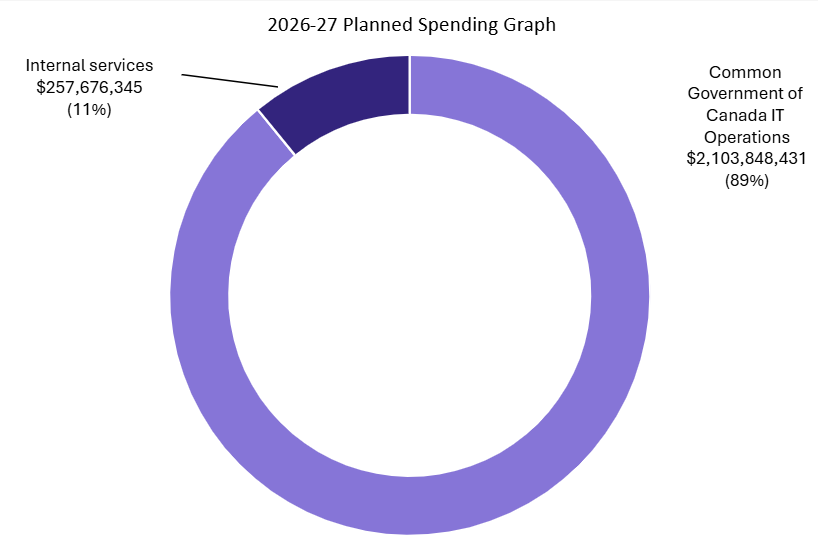
Text description of Graph 1: The following chart summarizes SSC’s planned spending by core responsibility.
| Core responsibilities and internal services | 2026-27 planned spending |
|---|---|
| Common Government of Canada IT Operations | $2,103,848,431 |
| Internal services | $257,676,345 |
Budgetary performance summary
Table 9: Three-year spending summary for core responsibilities and internal services (dollars)
Table 9 presents SSC’s spending over the past three years to carry out its core responsibilities and for internal services. Amounts for the 2025–26 fiscal year are forecasted based on spending to date.
| Core responsibilities and Internal services | 2023-24 Actual Expenditures | 2024-25 Actual Expenditures | 2025-26 Forecast Spending |
|---|---|---|---|
| Common Government of Canada IT Operations | 2,444,005,446 | 2,275,814,878 | 2,370,968,994 |
| Subtotal(s) | 2,444,005,446 | 2,275,814,878 | 2,370,968,994 |
| Internal services | 346,783,150 | 341,198,422 | 327,671,861 |
| Total (s) | 2,790,788,596 | 2,617,013,300 | 2,698,640,855 |
Analysis of the past three years of spending
The spending decrease of $173.8 million or (6%) from 2023-24 to 2024-25 is primarily due to a decrease in sunset funding for Cyber initiatives, IT Repair and Replacement Program, the Network Modernization and Implementation Fund, Service Integrity- Mission Critical Projects, Workload Modernization and Migration Program, decreased spending for SCED Evolution and Departmental Connectivity and Monitoring initiative and decreases due to RGS initiatives.
The forecast spending for 2025-26 includes funding for the carry-forward from 2024-25, funding for the Presidency of the 2025 G7 Summit in Canada as well as new funding received through the Supplementary Estimates for the Security Information and Event Management solution from the 2022 Fall Economic Statement and to support cloud operations at Statistics Canada.
More financial information from previous years is available on the Finances section of GC Infobase
Table 10: Planned three-year spending on core responsibilities and internal services (dollars)
Table 10 presents SSC’s planned spending over the next three years by core responsibilities and for internal services.
| Core responsibility and Internal services | 2026-27 Planned Spending | 2027-28 Planned Spending | 2028-29 Planned Spending |
|---|---|---|---|
| Common Government of Canada IT Operations | 2,103,848,431 | 2,009,427,560 | 1,844,133,951 |
| Subtotal | 2,103,848,431 | 2,009,427,560 | 1,844,133,951 |
| Internal services | 257,676,345 | 256,826,072 | 256,661,724 |
| Total | 2,361,524,776 | 2,266,253,632 | 2,100,795,675 |
Analysis of the next three years of spending
SSC’s planned spending reflects the amounts approved by Parliament to support the department’s core responsibility and internal services. The approved amount is net of vote-netted revenue of $1,063.0 million in 2026-27 to 2027-28 and $963.0 million in 2028-29. This represents an increase from 2025-26’s forecasted vote-netted revenue of $978.0 million driven by activities to support DND’s operational and modernization priorities to support the management of software and services agreements on behalf of the Government of Canada.
The planned spending for 2026-27 includes new funding for the Security Information and Event Management solution from the 2022 Fall Economic Statement and funding for the CanAI Garage initiative to continue advancing artificial intelligence capacity across government and support human resources and pay modernization. This is offset by reductions to implement the comprehensive expenditure review as announced in Budget 2025.
The decrease in planned spending from 2026-27 to 2027-28 is mainly due to the reductions to implement the comprehensive expenditure review as announced in Budget 2025, decreases in funding for the Standardization of Mandatory Network, Security and Digital Services for Small Departments and Agencies (SDA) from Budget 2022, and for the CanAI Garage initiative.
The decrease in planned spending from 2027-28 to 2028-29 is mainly due to the reductions to implement the comprehensive expenditure review as announced in Budget 2025 and decrease in funding for Safeguarding access to High Performance Computing for Canada’s Hydro-Meteorological Services.
More detailed financial information on planned spending is available on the Finances section of GC Infobase.
Table 11: Budgetary gross and net planned spending summary (dollars)
Table 11 reconciles gross planned spending with net spending for 2026-27.
| Core responsibilities and Internal services | 2026-27 Gross planned spending (dollars) | 2026-27 Planned revenues netted against spending (dollars) | 2026-27 Planned net spending (authorities used) |
|---|---|---|---|
| Common Government of Canada IT Operations | 3,166,848,431 | (1,063,000,000) | 2,103,848,431 |
| Subtotal | 3,166,848,431 | (1,063,000,000) | 2,103,848,431 |
| Internal services | 257,676,345 | 0 | 257,676,345 |
| Total | 3,424,524,776 | (1,063,000,000) | 2,361,524,776 |
Analysis of budgetary gross and net planned spending summary
SSC is required to provide specialized IT services to its partners and clients. The 2026-27 planned revenues of $1,063.0 million represents the vote-netted authority for SSC which enables the department to re-spend the revenues received to offset expenditures arising from their provision in the same fiscal year. It reflects increases from the previous fiscal year to account for rising service volumes consistent with increased defence spending and federal Budget 2025 commitments and to support the management of software and services agreements on behalf of the Government of Canada.
Information on the alignment of SSC’s spending with Government of Canada’s spending and activities is available on GC InfoBase.
Funding
This section provides an overview of the department's voted and statutory funding for its core responsibilities and for internal services. For further information on funding authorities, consult the Government of Canada budgets and expenditures.
Graph 2: Approved funding (statutory and voted) over a six-year period
Graph 2 summarizes the department's approved voted and statutory funding from 2023-24 to 2028-29.
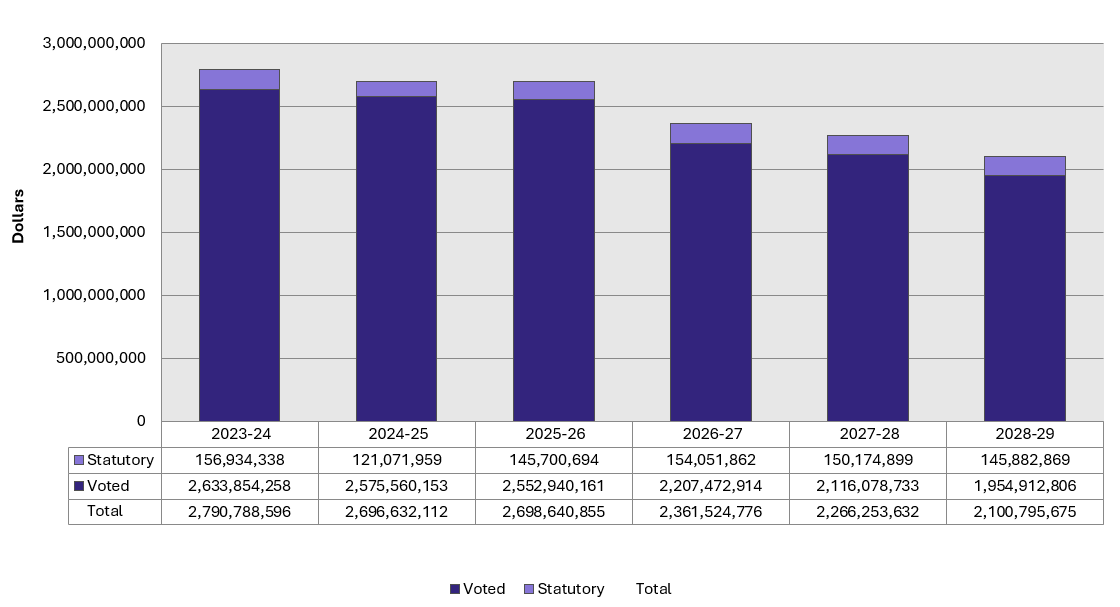
Text description of graph 2: Approved funding (statutory and voted) over a 6 year period
| Fiscal year | Total | Voted | Statutory |
|---|---|---|---|
| 2023-24 | 2,790,788,596 | 2,633,854,258 | 156,934,338 |
| 2024-25 | 2,696,632,112 | 2,575,560,153 | 121,071,959 |
| 2025-26 | 2,698,640,855 | 2,552,940,161 | 145,700,694 |
| 2026-27 | 2,361,524,776 | 2,207,472,914 | 154,051,862 |
| 2027-28 | 2,266,253,632 | 2,116,078,733 | 150,174,899 |
| 2028-29 | 2,100,795,675 | 1,954,912,806 | 145,882,869 |
Analysis of statutory and voted funding over a six-year period
The departmental spending trend graph presents trends in the department’s planned and actual spending over time. The data representing actual spending (from fiscal year 2023-24 to fiscal year 2024-25), forecast spending (for fiscal year 2025-26) and planned spending (for fiscal year 2026-27 to fiscal year 2028-29), is broken down between statutory and voted expenditures.
Analysis of the variances in actual spending, forecast spending and planned spending are provided in the budgetary planning summary for core responsibilities and internal services section.
For further information on SSC’s departmental appropriations, consult the 2026-27 Main Estimates.
Future-oriented condensed statement of operations
The future-oriented condensed statement of operations provides an overview of SSC’s operations for 2025-26 to 2026-27.
Table 12: Future-oriented condensed statement of operations for the year ended March 31, 2027 (dollars)
Table 12 summarizes the expenses and revenues which net to the cost of operations before government funding and transfers for 2025-26 to 2026-27. The forecast and planned amounts in this statement of operations were prepared on an accrual basis. The forecast and planned amounts presented in other sections of the Departmental Plan were prepared on an expenditure basis. Amounts may therefore differ.
| Financial information | 2025-26 Forecast results | 2026-27 Planned results | Difference (planned results minus forecasted) |
|---|---|---|---|
| Total expenses | 3,843,712,370 | 3,584,065,196 | (259,647,174) |
| Total revenues | 978,487,387 | 1,063,541,991 | 85,054,604 |
| Net cost of operations before government funding and transfers | 2,865,224,983 | 2,520,523,205 | (344,701,778) |
Analysis of forecasted and planned results
The decrease from the 2025-26 forecast spending to the 2026-27 planned spending is mainly due to decreases in funding for: the reductions to implement the comprehensive expenditure review announced in Budget 2025, reductions in support of initiatives to refocus government spending announced in Budget 2023, the carry-forward in 2025-26 and for decreases in funding for SCED Evolution and Departmental Connectivity, and sunset funding for the 2025 G7 Summit in Canada and for cloud operations at Statistics Canada. This is offset by an increase in funding for the CanAI Garage initiative, and from various 2022 Fall Economic Statement initiatives such as Safeguarding Access to High Performance Computing for Canada’s Hydro-Meteorological Services, Reinforcing the Government of Canada’s Cyber Security, and for the Security Information and Event Management solution.
A more detailed Future-Oriented Statement of Operations and associated Notes for 2026-27, including a reconciliation of the net cost of operations with the requested authorities, is available on SSC’s website.
Human resources
This section presents an overview of the department’s actual and planned human resources from 2023-24 to 2028-29.
Table 13: Actual human resources for core responsibilities and internal services
Table 13 shows a summary of human resources, in full-time equivalents, for SSC’s core responsibilities and for its internal services for the previous three fiscal years. Human resources for the 2025–26 fiscal year are forecasted based on year to date.
| Core responsibilities and internal services | 2023-24 Actual full-time equivalents | 2024-25 Actual full-time equivalents | 2025-26 Forecasted full-time equivalents |
|---|---|---|---|
| Common Government of Canada IT Operations | 7,434 | 7,516 | 7,170 |
| Subtotal | 7,434 | 7,516 | 7,170 |
| Internal services | 1,842 | 1,830 | 1,758 |
| Total | 9,276 | 9,346 | 8,928 |
Analysis of human resources over the last three years
FTE increases from 2023-24 to 2024-25 are mainly due to additional FTEs to address the increased demand for SSC’s services and to support service delivery improvements. From 2024-25 to 2025-26 the decrease is primarily driven by attrition and reduced funding for time-limited initiatives, such as Safeguarding access to High Performance Computing for Canada’s Hydro-Meteorological Service.
Table 14: Human resources planning summary for core responsibilities and internal services
Table 14 shows information on human resources, in full-time equivalents, for each of SSC’s core responsibilities and for its internal services planned for the next three years.
| Core responsibilities and internal services | 2026-27 Planned full-time equivalents | 2027-28 Planned full-time equivalents | 2028-29 Planned full-time equivalents |
|---|---|---|---|
| Common Government of Canada IT Operations | 7,063 | 6,959 | 6,658 |
| Subtotal | 7,063 | 6,959 | 6,658 |
| Internal services | 1,733 | 1,697 | 1,686 |
| Total | 8,796 | 8,656 | 8,344 |
Analysis of human resources for the next three years
The decrease from 2026-27 to 2028-29 is mainly due to reductions to implement the comprehensive expenditure review as announced in Budget 2025 and reductions in funding related to the Presidency of the 2025 G7 Summit in Canada and for the Standardization of Mandatory Network, Security and Digital Services for Small Departments and Agencies.
Although the table above shows a decrease in planned full-time equivalents (FTEs) over the next three years, SSC’s FTE requirements are subject to increases resulting from the addition of new enterprise-wide program responsibilities such as the CanAI Garage initiative, cloud operations, and the Digital Comptrollership Enterprise Service.
Supplementary information tables
Information on SSC’s departmental sustainable development strategy can be found on SSC’s website.
Federal tax expenditures
SSC’s Departmental Plan does not include information on tax expenditures.
The tax system can be used to achieve public policy objectives through the application of special measures such as low tax rates, exemptions, deductions, deferrals and credits. The Department of Finance Canada publishes cost estimates and projections for these measures each year in the Report on Federal Tax Expenditures.
This report also provides detailed background information on tax expenditures, including descriptions, objectives, historical information and references to related federal spending programs as well as evaluations and GBA Plus of tax expenditures.
Corporate information
Departmental profile
-
Appropriate minister:
The Honourable Joël Lightbound, P.C., M.P. -
Institutional head:
Scott Jones, President, SSC -
Ministerial portfolio:
Public Works and Procurement, and Minister responsible for Shared Services Canada -
Enabling instrument:
Shared Services Canada Act -
Year of incorporation / commencement:
2011
Departmental contact information
Please send your inquiries to the following email address publication-publication@ssc-spc.gc.ca
-
Media inquiries:
-
Please send your inquiries by email to media@ssc-spc.gc.ca or to the Media Relations Office by telephone at 613-670-1626
-
Website:
Shared Services Canada
Definitions
List of terms
- appropriation (crédit)
-
Any authority of Parliament to pay money out of the Consolidated Revenue Fund.
- budgetary expenditures (dépenses budgétaires)
-
Operating and capital expenditures; transfer payments to other levels of government, departments or individuals; and payments to Crown corporations.
- core responsibility (responsabilité essentielle)
-
An enduring function or role performed by a department. The intentions of the department with respect to a core responsibility are reflected in one or more related departmental results that the department seeks to contribute to or influence.
- Departmental Plan (plan ministériel)
-
A report on the plans and expected performance of an appropriated department over a 3 year period. Departmental Plans are usually tabled in Parliament each spring.
- departmental result (résultat ministériel)
-
A consequence or outcome that a department seeks to achieve. A departmental result is often outside departments’ immediate control, but it should be influenced by program-level outcomes.
- departmental result indicator (indicateur de résultat ministériel)
-
A quantitative measure of progress on a departmental result.
- departmental results framework (cadre ministériel des résultats)
-
A framework that connects the department’s core responsibilities to its departmental results and departmental result indicators.
- Departmental Results Report (rapport sur les résultats ministériels)
-
A report on a department’s actual accomplishments against the plans, priorities and expected results set out in the corresponding Departmental Plan.
- full-time equivalent (équivalent temps plein)
-
A measure of the extent to which an employee represents a full person-year charge against a departmental budget. For a particular position, the full-time equivalent figure is the ratio of number of hours the person actually works divided by the standard number of hours set out in the person’s collective agreement.
- gender-based analysis plus (GBA Plus) (analyse comparative entre les sexes plus [ACS Plus])
-
Is an analytical tool used to support the development of responsive and inclusive policies, programs, and other initiatives. GBA Plus is a process for understanding who is impacted by the issue or opportunity being addressed by the initiative; identifying how the initiative could be tailored to meet diverse needs of the people most impacted; and anticipating and mitigating any barriers to accessing or benefitting from the initiative. GBA Plus is an intersectional analysis that goes beyond biological (sex) and socio-cultural (gender) differences to consider other factors, such as age, disability, education, ethnicity, economic status, geography (including rurality), language, race, religion, and sexual orientation.
Using GBA Plus involves taking a gender- and diversity-sensitive approach to our work. Considering all intersecting identity factors as part of GBA Plus, not only sex and gender, is a Government of Canada commitment.
- government priorities (priorités gouvernementales)
-
For the purpose of the 2026-27 Departmental Plan, government priorities are the high-level themes outlining the government’s agenda in the 2025 Speech from the Throne.
- horizontal initiative (initiative horizontale)
-
An initiative where two or more federal departments are given funding to pursue a shared outcome, often linked to a government priority.
- Indigenous business (entreprise autochtones)
-
Requirements for verifying Indigenous businesses for the purposes of the departmental result report are available through the Indigenous Services Canada Mandatory minimum 5% Indigenous procurement target website.
- non‑budgetary expenditures (dépenses non budgétaires)
-
Non-budgetary authorities that comprise assets and liabilities transactions for loans, investments and advances, or specified purpose accounts, that have been established under specific statutes or under non-statutory authorities in the Estimates and elsewhere. Non-budgetary transactions are those expenditures and receipts related to the government's financial claims on, and obligations to, outside parties. These consist of transactions in loans, investments and advances; in cash and accounts receivable; in public money received or collected for specified purposes; and in all other assets and liabilities. Other assets and liabilities, not specifically defined in G to P authority codes are to be recorded to an R authority code, which is the residual authority code for all other assets and liabilities.
- performance (rendement)
-
What a department did with its resources to achieve its results, how well those results compare to what the department intended to achieve, and how well lessons learned have been identified.
- performance indicator (indicateur de rendement)
-
A qualitative or quantitative means of measuring an output or outcome, with the intention of gauging the performance of a department, program, policy or initiative respecting expected results.
- plan (plan)
-
The articulation of strategic choices, which provides information on how a department intends to achieve its priorities and associated results. Generally, a plan will explain the logic behind the strategies chosen and tend to focus on actions that lead to the expected result.
- planned spending (dépenses prévues)
-
For Departmental Plans and Departmental Results Reports, planned spending refers to those amounts presented in Main Estimates.
A department is expected to be aware of the authorities that it has sought and received. The determination of planned spending is a departmental responsibility, and departments must be able to defend the expenditure and accrual numbers presented in their Departmental Plans and Departmental Results Reports.
- program (programme)
-
Individual or groups of services, activities or combinations thereof that are managed together within the department and focus on a specific set of outputs, outcomes or service levels.
- program inventory (répertoire des programmes)
-
Identifies all the department’s programs and describes how resources are organized to contribute to the department’s core responsibilities and results.
- result (résultat)
-
A consequence attributed, in part, to a department, policy, program or initiative. Results are not within the control of a single department, policy, program or initiative; instead, they are within the area of the department’s influence.
- statutory expenditures (dépenses législatives)
-
Expenditures that Parliament has approved through legislation other than appropriation acts. The legislation sets out the purpose of the expenditures and the terms and conditions under which they may be made.
- target (cible)
-
A measurable performance or success level that a department, program or initiative plaA measurable performance or success level that a department, program or initiative plans to achieve within a specified time period. Targets can be either quantitative or qualitative.
- voted expenditures (dépenses votées)
-
Expenditures that Parliament approves annually through an appropriation act. The vote wording becomes the governing conditions under which these expenditures may be made.