
Green Bond Allocation and Impact Report 2024-25

The official version of the Green Bond Allocation and Impact Report 2024-25 is available in PDF in French and English. It fulfills the allocation reporting and verification requirements set out in the Green Bond Framework and includes the signed-third party verification. It also fulfills the impact reporting requirements set out in the Framework. The unofficial version of the Green Bond allocation Report is in HTML format, and available in French and English.
Green Bond Allocation and Impact Report 2024-25 [PDF - 7.49 MB]
Table of Contents
- Introduction
- Canada's Climate and Environmental Priorities
- Canada's Green Bond Program
- Part 1. Allocation of 2024-25 Green Bond Proceeds
- Part 2. Green Bond Program Impacts
- Methodology for reporting impacts
- Clean Transportation
- Circular Economy: Adapted Products, Production, Technologies, and Processes
- Climate Change Adaptation
- Energy Efficiency
- Living Natural Resources and Land Use
- Pollution Prevention and Control
- Clean Energy
- Sustainable Water and Wastewater Management
- Terrestrial and Aquatic Biodiversity
- Multiple Categories
- Legal Considerations
- Third-Party Verification
- Annex A – Detailed Allocation of Net Proceeds (Unaudited)
- Annex B – Overview of Key Impacts
- Annex C – Allocation Adjustments for Canada's Green Bond Program (Unaudited)
- Annex D – Historical Allocations of Canada's Green Bond Program (Unaudited)
Introduction
The Government of Canada recognizes the important role capital markets play in financing public and private investments in support of our shared goals. Canada's Green Bond Program allows investors to support Canadian investments in climate action and environmental protection, while fostering further development of the Canadian sustainable finance market.
The Green Bond Program was launched in March 2022 with the publication of Canada's initial Green Bond Framework
("Framework"), which committed to allocate funds raised through the issuance of green bonds to eligible green expenditures. The Framework also committed to provide transparency to investors by reporting on the allocation of funds to eligible green expenditures and on the environmental impact of those expenditures. Canada's Green Bond Framework was updated in November 2023 by adding certain nuclear expenditures, demonstrating Canada's commitment to leadership in clean energy.
As of the end of fiscal year 2024-25, the Government of Canada successfully held four issuances under its Green Bond Program:
- the inaugural $5 billion green bond issued in March 2022, which remains Canada's largest ever green bond issuance;
- a second $4 billion green bond issuance in February 2024, the first under the updated framework;
- a $2 billion re-opening of the February 2024 green bond in October 2024; and,
- a $2 billion green bond issuance in February 2025.
This report continues Canada's reporting commitments under the Framework by providing details on the allocation of proceeds from the total $4 billion of green bonds issued in 2024-25, along with the impacts. The allocation and impacts of subsequent green bond issuances in fiscal year 2025-26 will be detailed in Canada's next report.
Canada's Climate and Environmental Priorities
The Government of Canada recognizes that climate action is not just a moral obligation—it's an economic necessity. The world economy is undergoing a historic transformation towards low-carbon energy and clean technology, which Canada is well positioned to participate in and leverage for growth.
Canada's Climate Competitiveness Strategy ("Strategy"), announced in Budget 2025: Canada Strong, seeks to advance decarbonisation and economic diversification by building on the opportunities presented by the global transition to a low-carbon economy. The Strategy creates the conditions for the investments needed to build an affordable net-zero future in which Canadian businesses are well-positioned to compete and succeed in the global economy. The Strategy is a central pillar of the government's plan for Canada to become the strongest economy in the G7, and is based on driving investment, not on prohibitions, and achieving results. It aims to maximise carbon value for money, prioritising measures that will result in the greatest emissions reductions and competitiveness benefits at the lowest cost for Canadians. Key initiatives under the Strategy include strengthening industrial carbon pricing and providing clarity on regulations to reduce greenhouse gas emissions. Also outlined are measures to mobilize capital for net-zero initiatives, such as the Clean Economy investment tax credits and supporting the arm's length development of made-in-Canada sustainable investment guidelines (also known as a taxonomy). In addition, the Strategy commits to exploring the development of a Sustainable Bond Framework to issue green and transition bonds, in alignment with the taxonomy.
Canada remains committed to reducing greenhouse gas (GHG) emissions. From 2005 to 2023, Canada's GHG emissions decreased by 8.5 per cent—even as the population grew from 32 to 40 million, and gross domestic product (GDP) expanded by 38 per cent. The Canadian Net-Zero Emissions Accountability Act provides a transparent and accountable framework to reach net-zero emissions by 2050 and to set national emission reduction targets every five years. Further information on Canada's decarbonization activities to date can be found in the 2023 and 2025 progress reports on the 2030 Emissions Reduction Plan.
Canada released the first National Adaptation Strategy in June 2023, developed in collaboration with provincial and territorial governments, Indigenous Peoples, and other key partners. It lays out a plan for how all parts of society can work together to build resilience and reduce risks from climate change, underpinned by a set of guiding principles that encourage progress in a fair, inclusive, and equitable way. The Strategy includes five long-term goals, 32 medium term objectives, and 25 near-term targets, supported by an evergreen monitoring and evaluation framework to track progress. Roles and responsibilities for climate change adaptation are shared across different levels of government, rights holders and society, and national implementation is being advanced through three pillars: federal actions (through the Government of Canada Adaptation Action Plan), provincial and territorial actions, and Indigenous-led actions. The Government of Canada plays a leadership role in climate change adaptation by creating an enabling environment for effective and equitable adaptation by and for all. The first National Adaptation Strategy Progress Report, expected in spring 2026, will provide an overview of collective progress and identify emerging areas for further action.
Canada is also committed to protecting nature through its pursuit to conserve 30 per cent of Canada's lands and marine areas by 2030. Canada's 2030 Nature Strategy sets out a national framework to guide actions to halt and reverse biodiversity loss and protect the natural environment that defines Canada and sustain communities and the economy. The Strategy was developed based on engagement with Canadians, provinces and territories, National Indigenous Organizations and Modern Treaty Partners, and charts a path for how Canada will implement the Kunming-Montréal Global Biodiversity Framework (KMGBF). Canada's 7th National Report to the United Nations Convention on Biological Diversity, published February 2026, provides an assessment of Canada's collective progress implementing the Strategy and contributing to the KMGBF.
The Green Bond Framework and Green Bond Allocation and Impact Reports from prior years provide additional information on recent actions undertaken by the federal government.
Canada's Green Bond Program
Through green bond issuances, Canada intends to mobilize capital in support of its climate and environmental objectives, and to further develop the Canadian sustainable finance market by adding liquid and highly rated green assets to create a more mature and diverse market for investors.
Since launching the Green Bond Program in March 2022, Canada has published three annual reports:
- The 2021-22 Allocation Report reported on the partial allocation of the inaugural March 2022 bond's proceeds in fiscal year 2021-22.
- The 2022-23 Allocation and Impact Report detailed the allocation of the inaugural bond's remaining proceeds to eligible green expenditures in fiscal year 2022-23, completing the allocation of the bond, and provided impact information on the totality of the March 2022 bond's proceeds.
- The 2023-24 Allocation and Impact Report detailed the allocation of proceeds raised in fiscal year 2023-24 to eligible green expenditures in fiscal year 2023-24 and the impacts of these expenditures.
The Framework reflects key climate and environmental priorities and establishes robust criteria for the selection of eligible green expenditures, which are consistent with international standards and green investor expectations. The Framework was independently reviewed by Morningstar Sustainalytics, which confirmed that it is aligned with the International Capital Market Association Green Bond Principles in 2021 in its November 2023 Second Party Opinion.
Interdepartmental Green Bonds Committee
The identification and selection of eligible green expenditures allocated to the proceeds of Government of Canada green bonds are supported by an Interdepartmental Green Bonds Committee (IGBC). This committee, co-chaired by Finance Canada and Environment and Climate Change Canada, includes representatives from 12 federal departments and Crown corporations. The IGBC is currently comprised of representatives from:
- Finance Canada (Co-Chair);
- Environment and Climate Change Canada (Co-Chair);
- Natural Resources Canada;
- Innovation, Science and Economic Development;
- Housing, Infrastructure and Communities Canada;
- Agriculture and Agri-Food Canada;
- Transport Canada;
- Public Safety Canada;
- Fisheries and Oceans Canada;
- Indigenous Services Canada;
- Crown-Indigenous Relations and Northern Affairs Canada; and,
- Canada Infrastructure Bank.
Other departments, agencies and Crown corporations may be added to the IGBC as required.
In accordance with the Green Bond Framework, the IGBC supports Finance Canada and Environment and Climate Change Canada with:
- Implementation and maintenance of the Green Bond Framework;
- Identification, evaluation, and selection of eligible green expenditures for green bond proceeds;
- Allocation and management of the green bond proceeds; and,
- Annual green bond reporting on the allocation and environmental impact of the net proceeds.
The IGBC is also responsible for reviewing the allocation of proceeds of all green bonds on an annual basis to ensure the consistency of all expenditures with the Framework.
Expenditure Selection
The Framework identifies the following nine categories of expenditures that are eligible for the allocation of green bond proceeds:
- Clean transportation;
- Circular economy adapted products, production, technologies and processes;
- Clean energy;
- Climate change adaptation;
- Energy efficiency;
- Living natural resources and land use;
- Pollution prevention and control;
- Sustainable water and wastewater management; and,
- Terrestrial and aquatic biodiversity.
The Framework excludes expenditures related to the transportation, exploration and production of fossil fuels, arms manufacturing, gambling, and the manufacture and production of both tobacco products and alcoholic beverages.
As indicated in the Framework, the Government of Canada recognizes that in order to achieve its net-zero emissions goals, significant innovation and emissions reductions will be needed from all sectors of the Canadian economy. While some decarbonization expenditures are excluded from Canada's Green Bond Framework, in alignment with current green bond market expectations, the Government of Canada remains committed to supporting decarbonization, nature conservation, and environmental excellence in all sectors.
In November 2025, the Government announced its intention to explore the development of a Sustainable Bond Framework that would allow for the issuance of both green and new transition bonds to be aligned with the arm's length, made-in-Canada sustainable investment guidelines (also known as a taxonomy) and to expand the Framework to incorporate economic sectors as the taxonomy is being developed. The Canadian Climate Institute, alongside Business Future Pathways, are leading this work, with the expectation that investment guidelines will be finalized for three priority sectors by the end of 2026.
Part 1. Allocation of 2024-25 Green Bond Proceeds
In 2024-25, the Government of Canada undertook two green bond issuances to raise approximately $4 billion in net proceeds. These included the re-opening of the green bond first issued in February 2024 for an additional $2 billion in October 2024 and a new $2 billion 7-year green bond in February 2025. This report fully allocates the net proceeds from both issuances. The diverse pool of expenditures to which these proceeds are being allocated underscores the Government of Canada's commitment to green investments and reflects the wide range of climate and environmental initiatives undertaken by the Government.
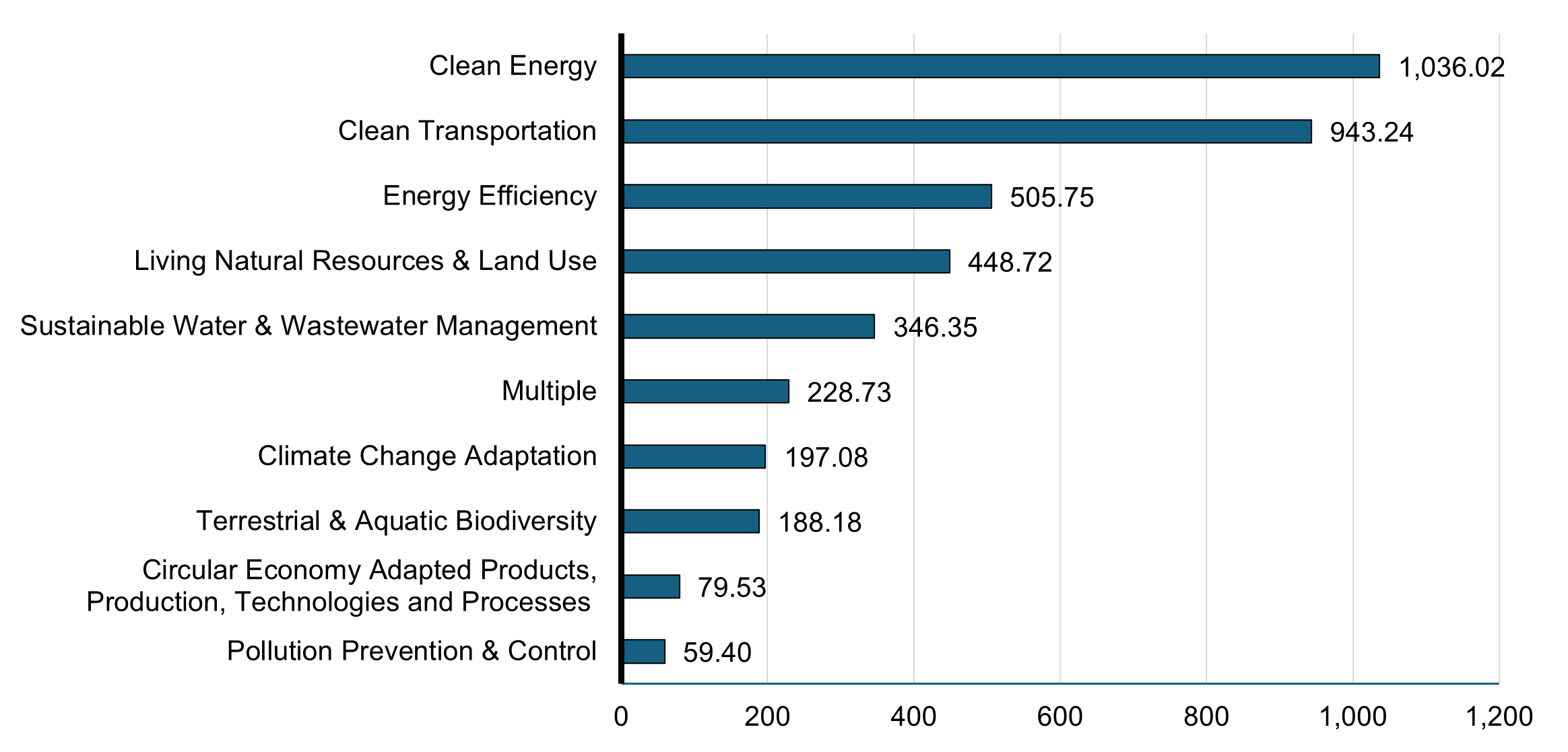
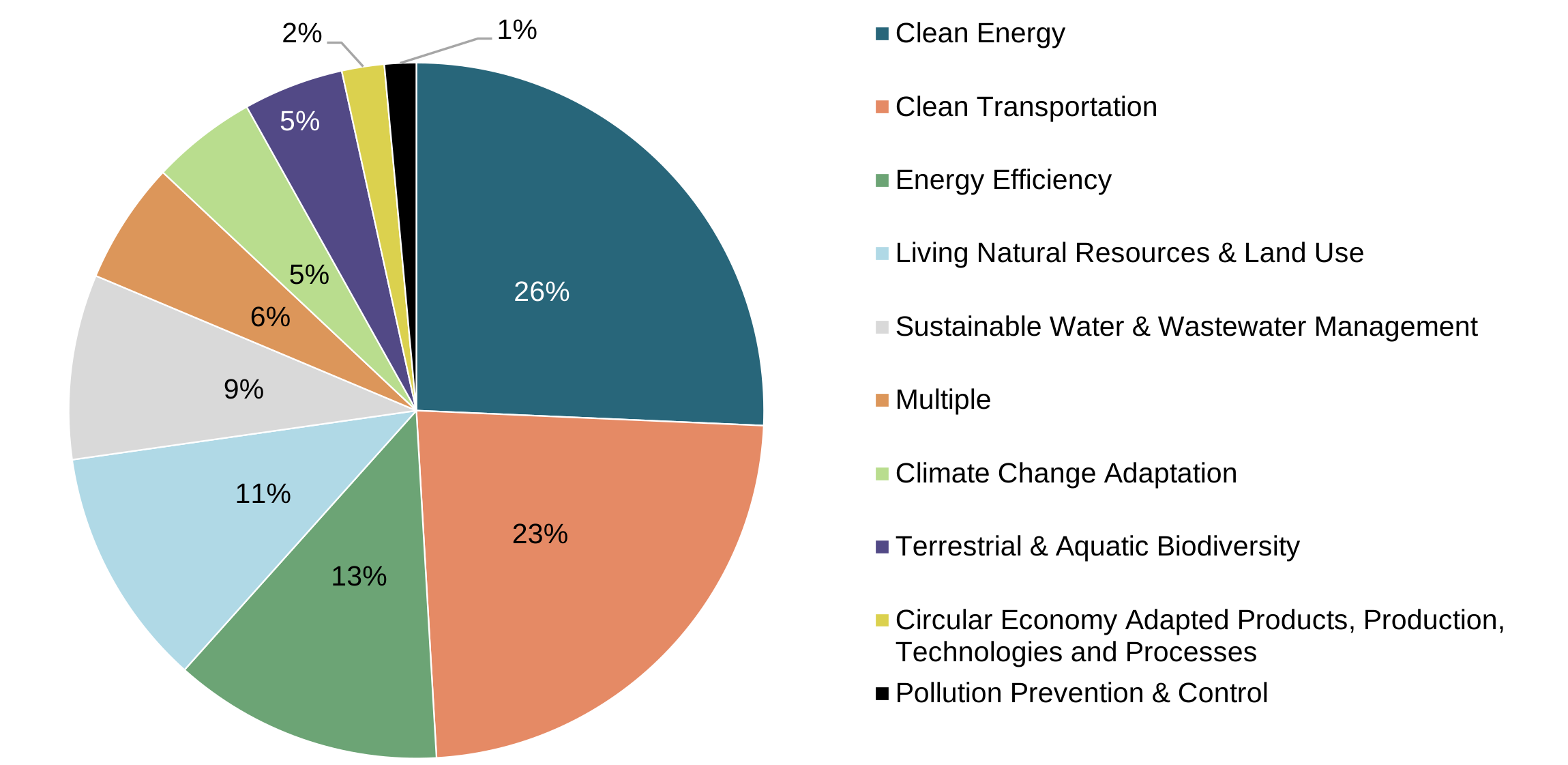
The 2024-25 allocation reflects the Government of Canada's investments in the green categories identified in the Framework. The top three categories in terms of total allocation in 2024-25 are Clean Energy, Clean Transportation, and Energy Efficiency. Together, these represent 62 per cent of the total 2024-25 allocation. Canada's 2024-25 allocation also confirms strong investment in categories that are often underrepresented – Living Natural Resources and Land use, Biodiversity and Climate Change Adaptation together accounted for 21 per cent of this year's allocation.
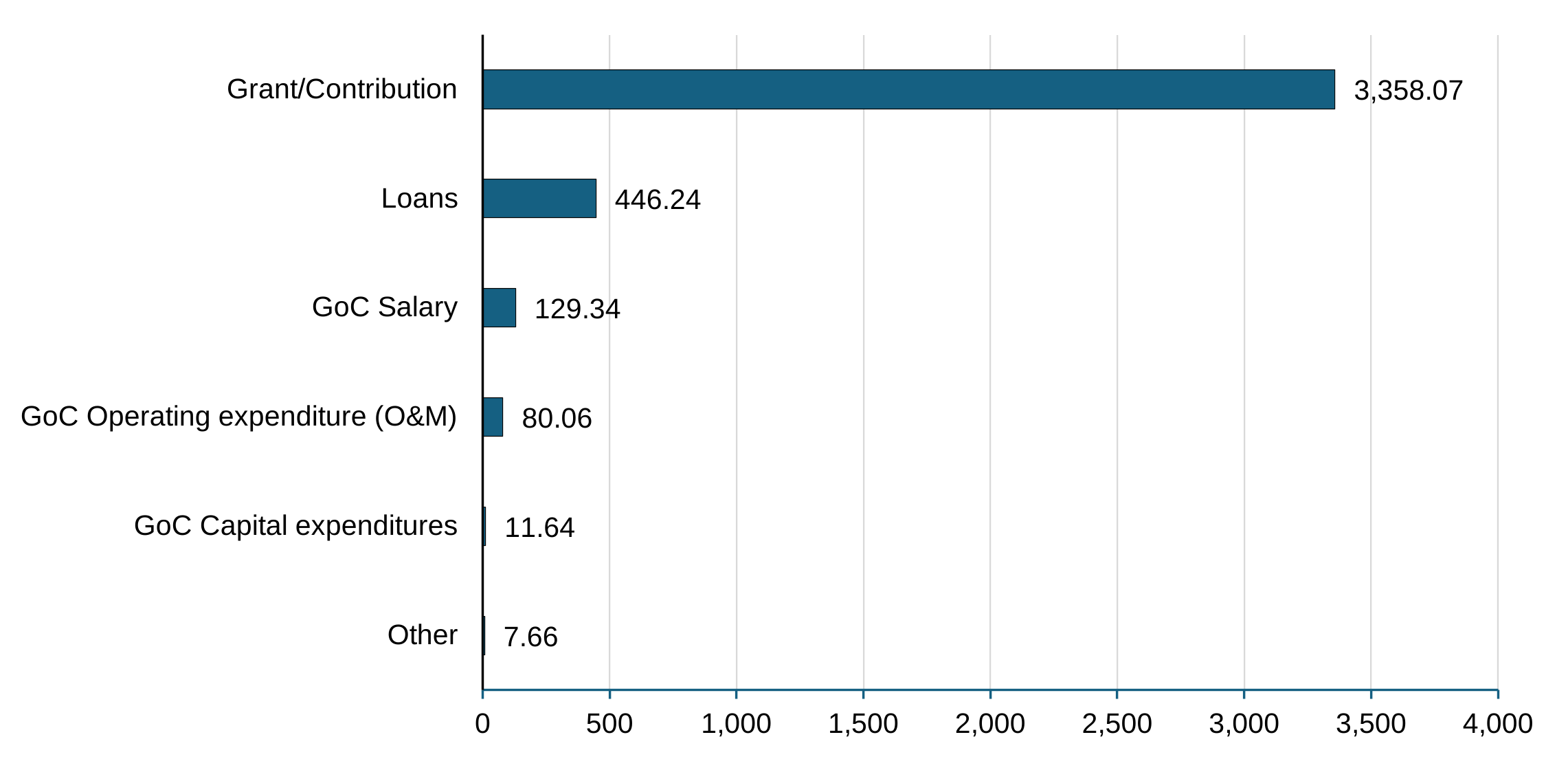
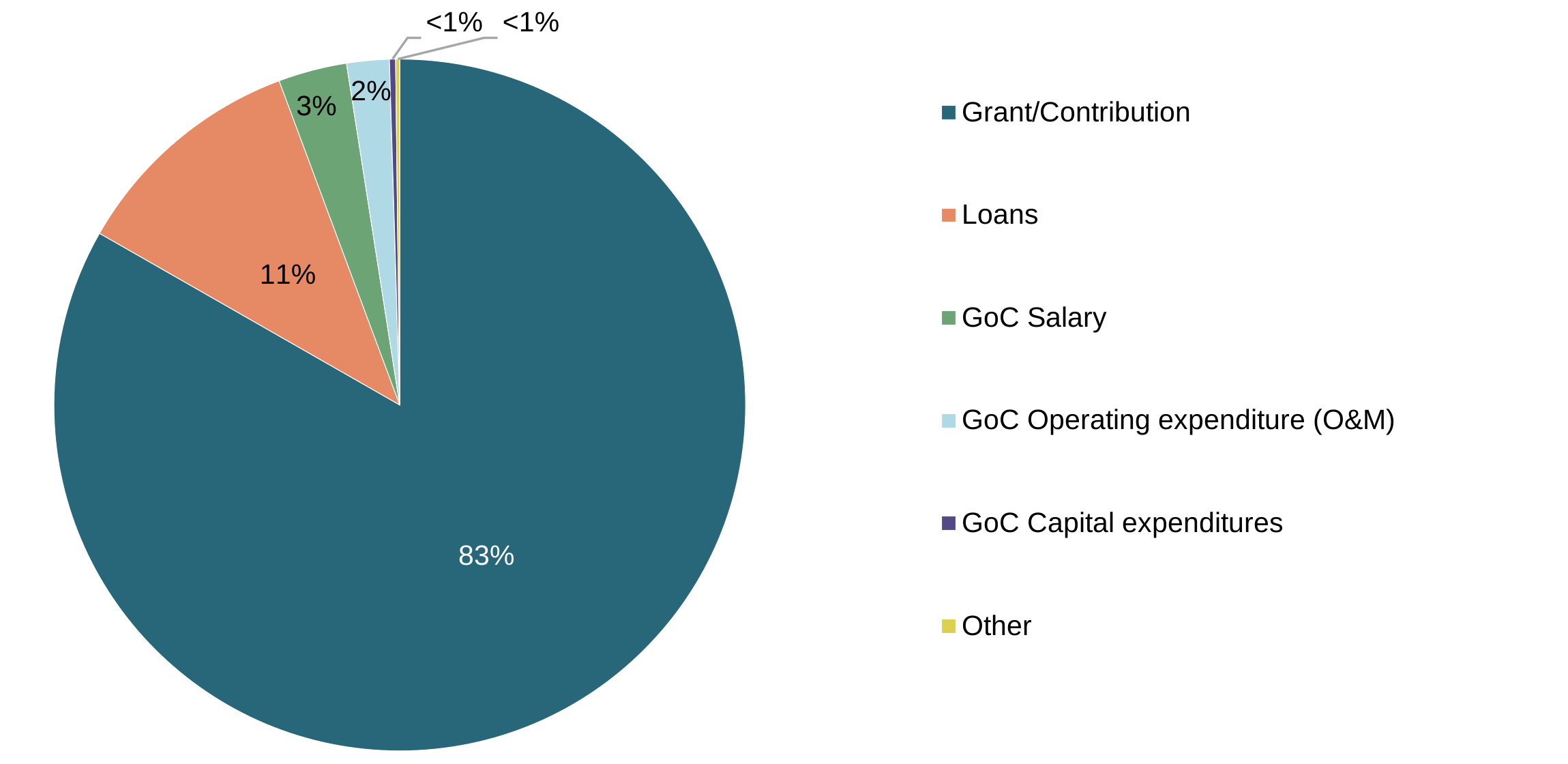
A list of programs and allocation amounts for 2024-25 is included in the audited Schedule of Allocation of Green Bond Net Proceeds at the end of this report. In addition, Annex A provides a detailed overview of allocations to program expenditures by fiscal year. The allocations presented in this report reflect expenditures allocated under the Green Bond Program and do not represent the total spending for each program in the reported period. Expenditures relevant to more than one green bond category are listed in the "Multiple" category, and primarily reflect expenditures through Innovation, Science and Economic Development Canada (ISED)'s Strategic Response Fund and the former Sustainable Development Technology Canada Sustainable Development (SD) Technology Fund. Figures 1 to 4 below show the distribution of the allocation in 2024-25 to green categories and expenditure types.
Allocation by Green Category, Amount ($ millions)
Allocation by Green Category, Percentage
Allocation by Type of Expenditures, Amount ($ millions)
Allocation by Type of Expenditures, PercentageFootnote 1
Allocation to eligible nuclear energy expenditure in 2024-25
In November 2023 as part of the Fall Economic Statement, the Government of Canada made updates to the Green Bond Framework to include certain types of nuclear energy expendituresFootnote 2:
- Investments in new reactors;
- Refurbishment of existing facilities;
- Research and development; and,
- Some investments in Canada's nuclear supply chain.
Canada's $2 billion green bond issuances in October 2024 and February 2025 are the second and third under Canada's updated framework, allowing allocation of new proceeds to eligible nuclear energy projects. Three nuclear projects are included in the 2024-25 report:
- Canada Infrastructure Bank's financing to Ontario Power Generation (OPG) for its Darlington Small Modular Reactor (SMR).
- Natural Resources Canada's funding to the Indigenous Advisory Council for the Small Modular Reactor (SMR) Action Plan through the Smart Renewables and Electrification Pathways Program (SREPs).
- Innovation, Science and Economic Development Canada's funding for nuclear projects that promote Canada's transition to a sustainable, low-carbon economy through the Strategic Response Fund (SRF), including:
- Development and pre-licensing of Terrestrial Energy's Integral Molten Salt Reactor;
- Development of Moltex Energy's stable salt reactor using recycled spent nuclear fuel for energy generation;
- The advancement of General Fusion's fusion energy systems towards integrated prototype readiness; and,
- The development of Westinghouse Electric Canada's small modular reactor design, prototype, licensing and demonstration.
Details on the activities supported are included in Part 2 of this report, under the Canada Infrastructure Bank's Clean Power Investments, Natural Resources Canada's Smart Renewables and Electrification Pathways Program, and Innovation, Science and Economic Development Canada's Strategic Response Fund.
The amount of nuclear expenditures allocated for 2024-25 totals $201.44 million. Of this amount, $1.77 million is a re-allocation from the February 2024 green bond to adjust for expenditures that have since been cancelled, postponed, or deemed otherwise no-longer eligible (see Annex C), while the remaining $199.67 million represents 5 per cent of the available net proceeds from the October 2024 and February 2025 issuances. In accordance with the 2022 Framework, no net proceeds from the inaugural March 2022 Green Bond issuance were allocated to nuclear expenditures. Canada plans to allocate green bond proceeds to nuclear projects in accordance with its objective to achieve inclusion of its green bonds in leading market indices. A breakdown of each project's allocation by fiscal year is provided in the tables below. The project allocations shown are a subset of allocations reported in Part 2. Numbers may not add up due to rounding
| 2024-2025 Allocation | |||
|---|---|---|---|
| 2022-23 | 2023-24 | 2024-25 | Total |
| - | 81.32 | 95.53 | 176.86 |
| 2024-2025 Allocation | |||
|---|---|---|---|
| 2022-23 | 2023-24 | 2024-25 | Total |
| - | 0.04 | - | 0.04 |
| 2024-2025 Allocation | |||
|---|---|---|---|
| 2022-23 | 2023-24 | 2024-25 | Total |
| 12.29 | 7.95 | 4.31 | 24.54 |
| Calculations by Finance Canada. Numbers may not add up due to rounding |
|||
Part 2. Green Bond Program Impacts
This section provides information on environmental impacts and, where data allow, the social benefits and impacts on Indigenous communities related to the eligible expenditures to which green bond proceeds have been allocated. Eligible expenditures and their impacts are organized into the nine eligible green expenditure categories, along with case studies. If a program spans multiple categories, it is included under the Multiple category section. Annex B provides an overview of select impact indicators highlighted in the Green Bond Framework associated with eligible expenditures incurred over the reporting period.
The impacts presented in this report are provided by IGBC members from existing data and reflect impacts achieved from fiscal years 2022-23 to 2024-25, unless otherwise stated.Footnote 3 Descriptions of programs and activities in this part are provided for context and reflect the expenditures associated with the reported fiscal years only (2022-23 to 2024-25). As noted in the Green Bond Framework, the Government of Canada may update its approach to impact reporting over time to align with emerging reporting standards and methodologies.
Methodology for reporting impacts
The key methodological approaches undertaken by IGBC members to track and measure program results are outlined below. The information provides an overview of the range of data collection methods used to calculate the environmental impacts and social co-benefits of Canada's Green Bond Program.
GHG emissions methodologies rely heavily on internationally recognized standards such as ISO 14064 and the GHG Protocol, alongside domestic tools such as the federal government's Climate, Nature and Economy Lens tool, National Inventory Reporting-aligned modeling, or other Government of Canada technical program guidance documents, such as the GHG Workbook, that align with international standards. These methodologies often compare a business-as-usual (baseline) scenario against a project or policy scenario, with emissions reductions calculated as the difference. Standard emission factors and equivalency calculators (e.g. vehicles removed, houses powered) are also frequently applied to illustrate the emissions reduction potential of a program.
In line with the Cabinet Directive on Strategic Environmental and Economic Assessment, departments must issue a public statement when a detailed assessment of expected environmental and economic impacts of a policy proposal has been completed, and the proposal has been announced or implemented. IGBC members follow this Directive and conduct assessments as required to ensure that an integrated assessment of the environmental, economic, and inclusivity considerations supports government decision making. Public statements of these assessments by federal departments and agencies can be found online.
Methodologies used by IGBC members to estimate jobs created generally rely on self-reporting by project proponents, or by using a standard Statistics Canada Input-Output methodology to determine jobs supported during the construction phase of a project.
IGBC members also collect impact information via annual and final performance reports submitted by the project proponents. These reports and supporting data are subject to departmental oversight to validate compliance and are reviewed and approved by program staff and/or technical experts. Geospatial mapping, surveys, and field observations are also used by IGBC members to verify or calculate program impacts.
Data challenges and limitations
Some programs are unable to report impacts up to the latest reporting year of the green bond allocation window. This is due to a range of factors, including:
- Misalignment between program reporting cycles and the timing of this report's publication.
- Lag between allocated financing and policy or program roll-out.
- Early-stage, multi-year programs or long-term projects not yet able to demonstrate results within the reporting timeframe.
In cases where direct measurement is not feasible, estimates, calculated using internationally recognized methodologies, or proxy indicators (e.g. average vehicle lifetimes, average household heating costs), are used to quantify the impacts of a program or a project.
The impacts outlined in this report are not intended to be aggregated or added across various programs within a category as they may overlap or interact with each other and other federal or provincial policies. For example, aggregating GHG emission reduction data could result in double counting and overestimating the amount of emissions reduced. Further, programs measure impacts using different metrics (e.g., annual emission reductions versus lifetime emission reductions) and baselines (e.g., year against which emissions are being measured) which limit the ability and accuracy of aggregating impacts across multiple programs.
The impacts described in this section may not be fully attributable to green bond expenditures as some programs and projects have multiple sources of funding, and green bond proceeds may represent only a share of total program budgets. Nevertheless, reporting data on the overall program impact provides insight into the ways in which investors are supporting environmental priorities and net-zero initiatives.
For all program allocations reported in this section, please note that the sum of allocations across fiscal years may not add up to the total due to rounding.
Clean Transportation
Over the reporting period, the Government of Canada supported emissions reduction initiatives in the transportation sector, which represents approximately 23 per cent of Canada's GHG emissions. Nine programs were allocated funding from the proceeds of the 2024-25 green bond issuance under the clean transportation category. These programs covered a wide range of activities, including purchase incentives for eligible zero-emission light, medium, and heavy-duty vehicles; construction and expansion of public transit infrastructure; installation of active transportation infrastructure such as, bike lanes and pedestrian bridges; and funding to support the installation and innovation of electric vehicle charging and hydrogen fueling infrastructure.
Canada Public Transit Fund
Department: Housing, Infrastructure and Communities Canada
UN Sustainable Development Goals (SDGs):
- 9 – Industry, Innovation and Infrastructure
- 11 – Sustainable Cities and Communities
- 13 – Climate Action
The Canada Public Transit Fund (CPTF) supports public transit and active transportation in communities across Canada to help mitigate climate change by increasing the use of public transit and active transportation relative to car travel, as well as to increase housing supply and affordability by creating more transit-oriented communities.
Allocated expenditures include projects approved under the Permanent Public Transit Fund (now renamed the CPTF) including the Active Transportation Fund (ATF) and the Zero Emission Transit Fund (ZETF). Projects under the ATF built new and expanded networks of pathways, bike lanes, trails, and pedestrian bridges, in addition to supporting active transportation planning and community engagement activities. Projects under the ZETF supported public transit and school bus operators' plans for electrification, the purchase of zero emission buses, and construction of associated infrastructure, including charging infrastructure and facility upgrades.
| 2024-2025 Allocation | |||
|---|---|---|---|
| 2022-23 | 2023-24 | 2024-25 | Total |
| 3.98 | 5.03 | 79.63 | 88.64 |
Program impact: 74.9 Km of new active transportation infrastructure was built, and 24.32 Km of active transportation infrastructure was enhanced. 83 projects that included planning activities for transit and active transportation initiatives were approved. Eight active transportation projects were completed by or for Indigenous communities.
172 zero-emission buses purchased and delivered, with 0.008 Mt CO2e emissions reduced/avoided through the operations of these buses.
Charging and Hydrogen Refuelling Infrastructure Initiative
Crown Corporation: Canada Infrastructure Bank
UN Sustainable Development Goals (SDGs):
- 7 – Affordable and Clean Energy
- 9 – Industry, Innovation and Infrastructure
- 12 – Responsible Consumption and Production
- 13 – Climate Action
Allocated expenditures under the Charging and Hydrogen Refuelling Infrastructure Initiative aimed to reduce transportation sector greenhouse gas emissions by accelerating the private sector's rollout of large-scale zero-emission vehicle (ZEV) chargers and hydrogen refuelling stations, helping spur the market for private investment. Projects with eligible green bond expenditures in 2024-25 include:
- FLO EV Charging Network
- Parkland EV Charging Network
- HTEC Hydrogen Production and Refuelling Infrastructure
| 2024-2025 Allocation | |||
|---|---|---|---|
| 2022-23 | 2023-24 | 2024-25 | Total |
| 0.00 | 0.51 | 36.13 | 36.63 |
Program impact: Approximately 0.69 Mt CO2e in anticipated average annual GHG reduction over the project's combined lifespans. Approximately 6,207 jobs expected to be supported during construction phase of the projects.
Electric Vehicle and Alternative Fuel Infrastructure Deployment Initiative
Department: Natural Resources Canada
UN Sustainable Development Goals (SDGs):
- 7 – Affordable and Clean Energy
- 9 – Industry, Innovation and Infrastructure
- 12 – Responsible Consumption and Production
- 13 – Climate Action
Allocated expenditures under the Electric Vehicle and Alternative Fuel Infrastructure Deployment Initiative supported the establishment of a coast-to-coast network of fast chargers along the national highway system and hydrogen refuelling stations in major metropolitan areas. This program ended in 2022.
| 2024-2025 Allocation | |||
|---|---|---|---|
| 2022-23 | 2023-24 | 2024-25 | Total |
| 0.06 | 0.00 | 0.00 | 0.06 |
Program impact: 153 electric chargers and one hydrogen refuelling station opened. In total, 1084 electric chargers and seven hydrogen refuelling stations are open to intended users.
Electric Vehicles Infrastructure Demonstrations Program
Department: Natural Resources Canada
UN Sustainable Development Goals (SDGs):
- 7 – Affordable and Clean Energy
- 9 – Industry, Innovation and Infrastructure
- 12 – Responsible Consumption and Production
- 13 – Climate Action
Allocated expenditures under the Electric Vehicles Infrastructure Demonstrations stream aimed to accelerate the market entry of next generation clean energy infrastructure, by supporting demonstration projects of innovative EV charging and hydrogen refuelling technologies, to encourage an increased uptake of ZEVs.
| 2024-2025 Allocation | |||
|---|---|---|---|
| 2022-23 | 2023-24 | 2024-25 | Total |
| 2.26 | 0.27 | 0.00 | 2.53 |
Program impact: 29 demonstrations completed of next-generation and innovative EV charging and hydrogen refuelling infrastructure.
Incentives for Medium- and Heavy-Duty Zero-Emission Vehicles
Department: Transport Canada
UN Sustainable Development Goals (SDGs):
- 7 – Affordable and Clean Energy
- 12 – Responsible Consumption and Production
- 13 – Climate Action
Allocated expenditures under the Incentives for Medium- and Heavy-Duty Zero-Emission Vehicles program supported to Canadian businesses and organizations through point-of-sale purchase incentives of up to $200,000 for eligible medium and heavy-duty zero-emission vehicles, with the aim of increasing the adoption of medium- and heavy-duty ZEVs in Canada by helping offset higher purchase prices associated with cleaner vehicles. The program is expected to end in March 2026.
| 2024-2025 Allocation | |||
|---|---|---|---|
| 2022-23 | 2023-24 | 2024-25 | Total |
| 5.67 | 5.25 | 16.74 | 27.66 |
Program impact: 6,778 green bond-eligible medium and heavy-duty ZEVs incentivized, contributing to 0.06 Mt of GHG emission reductions annually and over 0.69 Mt of GHG reductions over their lifetime.
Incentives for Zero-Emission Vehicles Program
Department: Transport Canada
UN Sustainable Development Goals (SDGs):
- 7 – Affordable and Clean Energy
- 12 – Responsible Consumption and Production
- 13 – Climate Action
Allocated expenditures under the Incentives for Zero-Emission Vehicles (iZEV) Program contributed to a clean transportation system by increasing the adoption of light-duty ZEVs to reduce GHG emissions from light-duty, on-road transportation in Canada. The Program provided point-of-sale incentives of up to $5,000 for the purchase or lease of eligible light-duty ZEVs. The program was paused in January 2025 as funds were fully committed and officially closed on March 31, 2025.
| 2024-2025 Allocation | |||
|---|---|---|---|
| 2022-23 | 2023-24 | 2024-25 | Total |
| 84.79 | 66.97 | 205.96 | 357.72 |
Program impact: 352,795 green bond eligible (those that emit less than 50g CO2/km) light-duty ZEVs incentivized, which represents over 1.2 Mt of GHG emission reductions annually and over 14.6 Mt over their lifetime.
Investing in Canada Infrastructure Program – Public Transit Infrastructure Stream
Department: Housing, Infrastructure and Communities Canada
UN Sustainable Development Goals (SDGs):
- 9 – Industry, Innovation and Infrastructure
- 11 – Sustainable Cities and Communities
- 13 – Climate Action
Allocated expenditures under the Investing in Canada Infrastructure Program (ICIP) contributed to long-term, stable funding to help communities reduce air and water pollution, provide clean water, increase resilience to climate change, and build a clean economy; build strong, dynamic, and inclusive communities; and ensure Canadian families have access to modern, reliable services that improve their quality of life.
Through the ICIP Public Transit Infrastructure stream, allocated expenditures supported the construction, expansion, and improvement of public transit infrastructure for projects that improve the capacity of public transit infrastructure, the quality or safety of existing or future transit systems, and access to a public transit system.
| 2024-2025 Allocation | |||
|---|---|---|---|
| 2022-23 | 2023-24 | 2024-25 | Total |
| 129.98 | 62.21 | 144.21 | 336.40 |
Program impact: 606 projects have been approved under this stream representing more than $17.4 billion in federal investments. Measurable results for selected projects, such as GHG emissions reduced/avoided, will be achieved once their construction is completed, which takes several years.
Zero-Emission Buses Initiative
Crown Corporation: Canada Infrastructure Bank
UN Sustainable Development Goals (SDGs):
- 7 – Affordable and Clean Energy
- 12 – Responsible Consumption and Production
- 13 – Climate Action
Allocated expenditures under the Zero-Emission Buses Initiative supported the upfront costs of zero-emission buses (ZEB) for municipal transportation systems and school bus operator through loans, targeting the accelerated adoption of over 6,000 ZEBs, comprising of a mix of transit and school buses.
| 2024-2025 Allocation | |||
|---|---|---|---|
| 2022-23 | 2023-24 | 2024-25 | Total |
| 11.65 | 5.19 | 7.81 | 24.65 |
Program impact: Approximately 0.19 Mt CO2e in anticipated average annual emissions reduction over their combined lifespans with 20,254 jobs expected to be supported from the manufacturing of zero-emission buses and associated charging and utility projects.
Zero-Emission Vehicle Infrastructure Program
Department: Natural Resources Canada
UN Sustainable Development Goals (SDGs):
- 7 – Affordable and Clean Energy
- 9 – Industry, Innovation and Infrastructure
- 12 – Responsible Consumption and Production
- 13 – Climate Action
Allocated expenditures under the Zero-Emission Vehicle Infrastructure Program supported the deployment of electric vehicle chargers and hydrogen refueling stations across Canada. These expenditures worked to address a key barrier to the adoption of zero-emission vehicles—the lack of charging and refuelling stations in Canada—by increasing the availability of localized charging and hydrogen refueling opportunities.
| 2024-2025 Allocation | |||
|---|---|---|---|
| 2022-23 | 2023-24 | 2024-25 | Total |
| 30.09 | 17.68 | 21.18 | 68.95 |
Program impact: 31,206 EV charging and four hydrogen refuelling stations were selected for funding. Of these, 24,306 EV charging and one hydrogen refuelling stations are operational and seven projects are Indigenous-led.
Case Study
Charging and Hydrogen Refuelling Infrastructure Initiative - HTEC Hydrogen Production and Refuelling Infrastructure
The Canada Infrastructure Bank (CIB) and HTEC, a Vancouver-based designer, builder, owner and operator of hydrogen supply solutions, are partnering to accelerate the deployment of hydrogen production and refuelling infrastructure.
The CIB's $337 million loan expands HTEC's operations in British Columbia and Alberta. The investment also contributes to the implementation of HTEC's full-service, sustainable fuel supply chain, H2 Gateway, which focuses on reducing emissions in the transportation sector.
HTEC plans to build and operate an interprovincial network of up to 20 hydrogen refuelling stations. The facilities will be supported by up to three new electrolyzers, and potentially by a facility that liquefies 15 tonnes per day of vented by-product hydrogen in North Vancouver. It is expected that more than 280 full-time jobs could be supported by project construction and operation of the hydrogen infrastructure.
Hydrogen fuel cell vehicles can travel long distances and have relatively short refuelling times, presenting a unique opportunity to decarbonize the commercial trucking sector. As part of this investment, 14 of the 20 new stations will enable the refuelling of up to 300 heavy duty vehicles per day.
The CIB's risk-taking financing helps mitigate uncertainty in the rate and pace of hydrogen adoption, which have historically been barriers to private investment in sustainable fuel production and infrastructure.
UN Sustainable Development Goals (SDGs):
- 7 – Affordable and Clean Energy
- 9 – Industry, Innovation and Infrastructure
- 12 – Responsible Consumption and Production
- 13 – Climate Action
Circular Economy: Adapted Products, Production, Technologies, and Processes
The circular economy is about extracting as much value as possible from our resources while reducing environmental impacts. Over the reporting period, the Government of Canada supported initiatives that create new economic opportunities to keep the value of Canada's resources in the economy and out of the landfill. Four programs were allocated funding from the proceeds of the 2024-25 green bond issuances under this category. These programs focus on various areas related to circular-economy including new bioeconomy products for the forest industry; solutions to help address food waste and loss; and activities to develop new high-value and low-carbon wood-based bioproducts for the Canadian forest sector.
Food Waste Reduction Challenge
Department: Agriculture and Agri-Food Canada
UN Sustainable Development Goals (SDGs):
- 12 – Responsible Consumption and Production
Allocated expenditures under the Food Waste Reduction Challenge (ended in 2023-24) aimed to increase food availability, save consumers and businesses money, increase farmers' revenue, and strengthen Canadian food systems, while also reducing GHG emissions. Funding from this program supported new innovations and solutions to help address the problem of food waste and loss across the food supply chain, thereby reducing the associated economic, environmental, and social costs of food waste.
| 2024-2025 Allocation | |||
|---|---|---|---|
| 2022-23 | 2023-24 | 2024-25 | Total |
| 3.21 | 0.74 | 0.00 | 3.95 |
Program impact: 5.2 million kilograms of food waste avoided between July 2022 and April 2023 and an estimated 107.2 million kilograms of projected food waste reduced annually. Through program activities, 48,500 meals were donated to charity partners/school programs.
Forest Innovation Program
Department: Natural Resources Canada
UN Sustainable Development Goals (SDGs):
- 9 – Industry, Innovation and Infrastructure
- 12 – Responsible Consumption and Production
Allocated expenditures under the Forest Innovation Program (FIP) supported pre-commercial, targeted R&D, and technical transfer activities required to move innovative technologies and products up the forest sector value chain. During the reporting period, FIP provided direct funding to organizations conducting targeted collaborative research addressing pre-commercialization innovation gaps and to provide services related to codes and standards to improve markets access. Funding was also provided to late-stage internal research in federal labs and for scholarships and grants, delivered by Natural Sciences and Engineering Research Council of Canada, to promote the forest sector to students and graduates of post-secondary institutions in Canada, with a focus on underrepresented groups.
| 2024-2025 Allocation | |||
|---|---|---|---|
| 2022-23 | 2023-24 | 2024-25 | Total |
| 11.92 | 3.49 | 6.24 | 21.65 |
Program impact: The FIP program was renewed in 2023/2024. Of the renewed funding dispersed out to 2024/2025, 27 per cent of project funding supports projects that mitigate GHG emissions; 22 per cent is related to decarbonization of the forest sector and other sectors (e.g. wood biomass as a fuel) or process efficiency to lower energy and water use; 20 per cent is related to more efficient harvesting of wood and use of wood fibre; and 30 per cent is related to wood-fibre based bioproducts where product substitution is the main environmental impact.
15 codes and standards developed to determine environmental credentials of key low-carbon products (e.g. fuels, wood products). Further, 83 scholarships distributed to post-secondary students in studying forest-sector related topics, who identify as being from an underrepresented group, such as Indigenous Peoples, women, visible minorities, or persons with a disability.
Green Construction through Wood Program
Department: Natural Resources Canada
UN Sustainable Development Goals (SDGs):
- 9 – Industry, Innovation and Infrastructure
- 12 – Responsible Consumption and Production
Allocated expenditures under the Green Construction through Wood (GCWood) program aimed to de-risk the adoption of wood-based systems/technologies and bioproducts to accelerate domestic market penetration of these products in construction projects in new and existing buildings to support Canada's targets to decarbonize the built environment. Expenditures were allocated under two elements:
- The Demonstration Stream to support the schematic design and/or the demonstration of wood-based building systems and bio-products in new and existing buildings that are regionally representative and highly replicable.
- The Accelerating Construction Transformation Stream to support the delivery of buildings, capacity building, advancement of wood education, and to support building code and standards revisions to address national barriers to wood construction.
| 2024-2025 Allocation | |||
|---|---|---|---|
| 2022-23 | 2023-24 | 2024-25 | Total |
| 4.82 | 0.67 | 2.12 | 7.61 |
Program impact: A cumulative impact of 0.24 to 0.42 Mt of CO2e stored/sequestered and 0.1 to 0.17 Mt of CO2e avoided/mitigated, totaling 0.34 to 0.59 Mt of CO2e between 2025 and 2030. The total floor area of the wood building market share incrementally increased to 29 per cent in 2023-2024.
The program has signed 15 contribution agreements with proponents to support the use of innovative building technologies/systems and advanced bioproducts in new or existing building. Construction using innovative building technologies/systems and advanced bioproducts must be demonstrated by 2026.
The program is also targeting to support 10 activities led by funded recipients that target equity and diversity initiatives in the construction sector by 2026.
Investments of Forest Industry Transformation Program
Department: Natural Resources Canada
UN Sustainable Development Goals (SDGs):
- 9 – Industry, Innovation and Infrastructure
- 12 – Responsible Consumption and Production
Allocated expenditures under the Investments in Forest Industry Transformation (IFIT) program supported the competitiveness of the Canadian forest industry by fostering innovation through the development of new products and the adoption of advanced processes. During the reporting period, IFIT drove forest sector innovation by supporting transformative projects across six high-impact categories: advanced biomaterials and biochemicals, pulp and paper diversification, next generation building products, advanced biofuels, and process efficiency and decarbonization.
Allocated expenditures supported capital investment projects aimed at diversification and high productivity, accelerating commercialization of new value-added forest products, and early adoption of technologies. Eligible expenditures also include IFIT's funding of studies to advance product/process development to bolster strategic investments within the sector.
| 2024-2025 Allocation | |||
|---|---|---|---|
| 2022-23 | 2023-24 | 2024-25 | Total |
| 33.67 | 2.23 | 10.42 | 46.32 |
Program impact: 15 projects with approved funding that have positive environmental outcomesFootnote 4. 373 directs jobs have been created or maintained.
Case Study
Food Waste Reduction Challenge - Aruna Revolution
Aruna Revolution, based in Dartmouth, Nova Scotia, has developed a patent-pending novel fiber extraction technology that upcycles food and crop waste into affordable, compostable, and disposable menstrual pads – eliminating the need for users to choose between convenience and sustainability. Their innovation stemmed from a desire to find a natural and eco-friendly alternative to conventional single-use menstrual products which often contains harmful chemicals and synthetic fibers and contributes to approximately 20 billion pads and tampons annually sent to North American landfills and takes over 500 years to degrade.
As a semi-finalist and finalist of Agriculture and Agri-food Canada's Food Waste Reduction Challenge – Novel Technologies stream, Aruna received a total of $550,000 and other non-financial supports to help accelerate and support its deployment within the Canadian market. As the versatility of their solution allows to effectively extract fibers from most organic waste types, they have developed a dynamic process and partnered with various Canadian food processors and farmers such as LOOP Mission, Juice Press HFX, Beaver Creek Farm, etc. to source their feedstock; thus, supporting the agricultural industry to manage their waste actively and diversifying to increase their environmental impact.
Aruna indicates their ability to transform 1 kg of food/crop waste into approximately 50 compostable pads with a footprint of 2.96 kgs of CO2e (after composting) as compared to conventional pads which has a footprint of 7.90 kg of CO2e, according to their life cycle analysis. For the final stage of the Challenge, the company produced around 2 million pads per month with the goal to increase manufacturing capacity as they continue to fine-tune their technology and production process and build product awareness.
Aruna's long-terms goals include setting up micro-manufacturing facilities across North America in specific geographic regions with higher food and crop waste/higher population of people who menstruate to further reduce their environment footprint and create a stronger, autonomous local advanced manufacturing ecosystem for sustainable feminine hygiene products. The company is currently scaling their production to meet institutional demand from schools, governments, and hospitals and is validating their fibers for other hygiene formats like incontinence and wound care applications. They are looking into licensing Aruna fibers to global hygiene brands and expansion into other circular fiber-based products.
Aruna demonstrates a sustainable, innovative, and economically beneficial model, leveraging food/crop waste to create valuable products while reducing costs and supporting environmental and community health.
UN Sustainable Development Goals (SDGs):
- 12 – Responsible Consumption and Production
Climate Change Adaptation
Over the reporting period, the Government of Canada took action to grow the economy, meet emissions reduction targets, and build resilience to a changing climate. Part of building resilience is adapting to the impacts of climate change that have already occurred and continue to be felt across the country. Two programs were allocated the proceeds of the 2024-25 green bond issuances under this category. These programs provided funding for various climate change adaptation efforts including strengthening the resilience of Canadian communities through public infrastructure projects, including natural infrastructure projects, structural mitigation, and adaptation projects in Indigenous communities.
Capital Facilities and Maintenance Program – Structural Mitigation
Department: Indigenous Services Canada
UN Sustainable Development Goals (SDGs):
- 11 – Sustainable Cities and Communities
In response to the increasing magnitude, severity, and frequency of climate events, Indigenous Services Canada allocated expenditures to support infrastructure projects, such as dikes, sea walls, natural infrastructure, fire breaks, and erosion-control measures, to help modify hazards by removing, reducing, or eliminating them. These projects helped segregate hazards by keeping them away from people and assets and help alter the design and construction of assets to make them resilient to potential hazards.
| 2024-2025 Allocation | |||
|---|---|---|---|
| 2022-23 | 2023-24 | 2024-25 | Total |
| 4.99 | 2.23 | 3.56 | 10.78 |
Program impact: 55 green bond eligible structural mitigation projects are underway or completed in First Nations communities. In total, the program funded 155 structural mitigation projects that are underway or completed.
Disaster Mitigation and Adaptation Fund
Department: Housing, Infrastructure and Communities Canada
UN Sustainable Development Goals (SDGs):
- 11 – Sustainable Cities and Communities
Allocated expenditures under the Disaster Mitigation and Adaptation Fund supported public infrastructure projects designed to increase resilience and mitigate current and future climate-related risks and disasters triggered by natural hazards and extreme weather events. Funded infrastructure projects include the construction of new public infrastructure and/or the upgrade of existing public infrastructure including natural infrastructure, such as rain gardens or fire breaks, that prevent, mitigate, or protect against the impacts of natural disasters.
| 2024-2025 Allocation ($ millions) | |||
|---|---|---|---|
| 2022-23 | 2023-24 | 2024-25 | Total |
| 88.50 | 40.03 | 57.77 | 186.30 |
Program impact: 78 projects approved, representing a federal contribution of $1.18 billion. Since 2018, a total of 148 projects with a federal contribution of $3.3 billion have been approved. Four of these projects were completed in the reporting period.Footnote 5
The program will report against the indicator 'expected percentage of increased resilience' when a sufficient number of projects representing a significant data set have been completed and final reports have been received from recipients.
Case Study
Disaster Mitigation and Adaptation Fund - Mohawks of the Bay of Quinte Territory Water Infrastructure Project
Due to climate change, the Mohawks of the Bay of Quinte Territory are experiencing an increasing frequency of drought events with a higher intensity. Severe drought impacts the health, safety, economic well-being, and water security of Mohawks of the Bay of Quinte community members and businesses, as groundwater wells—once a primary source of drinking water—can no longer reliably meet demand.
With a federal investment of $30 million through the Disaster Mitigation and Adaptation Fund, the community has extended approximately 28 kilometres of water distribution infrastructure. This project connects most homes, businesses, and institutional buildings—previously dependent on groundwater wells—to a more resilient potable water supply. The expansion included the installation of new distribution piping and improved access to local water mains across the territory.
The upgraded water system, with a projected lifespan of 75 years, will significantly reduce the long-term impacts of drought and strengthen water security for the Mohawks of the Bay of Quinte community.
UN Sustainable Development Goals (SDGs):
- 11 – Sustainable Cities and Communities
Energy Efficiency
Over the reporting period, the Government of Canada supported innovative projects and initiatives aimed at helping communities and industries take advantage of the benefits of energy efficiency to lower GHG emissions and reduce energy costs for Canadians. Eight programs were allocated proceeds of the 2024-25 green bond issuances under this category. These programs aimed to improve energy efficiency through various approaches such as supporting the development and adoption of clean technology in Canada's agriculture and agri-food sector; providing homeowners grants to make their homes more energy efficient and resilient; and supporting the development and implementation of building codes and deep retrofits for existing buildings and R&D initiatives.
Agricultural Clean Technology Program
Department: Agriculture and Agri-Food Canada
UN Sustainable Development Goals (SDGs):
- 9 – Industry, Innovation and Infrastructure
Allocated expenditures under the Agricultural Clean Technology program supported the development and adoption of clean technology that will reduce GHG emissions and promote sustainable growth in Canada's agriculture and agri-food sector.
The program was established as a $429.4 million federal initiative divided into two streams:
- The Research and Innovation Stream designed to support pre-market innovation, including research, development, demonstration, and commercialization activities, to develop transformative clean technologies and enable the expansion of current technologies.
- The Adoption Stream designed to support commercially available clean technologies and processes that show evidence of reducing GHG emissions and other environmental co-benefits.
| 2024-2025 Allocation | |||
|---|---|---|---|
| 2022-23 | 2023-24 | 2024-25 | Total |
| 23.60 | 9.49 | 24.27 | 57.37 |
Program impact: 113 agricultural clean technologies developed, assessed, or demonstrated. A cumulative total of 478 agricultural clean technologies adopted as of March 31, 2025, including energy efficient grain dryers, fuel/solar transitioning technologies, precision agriculture equipment, and anaerobic digester systems.
As of March 2025, the program estimates 0.1602 Mt reduction of CO2e through reductions including 0.00624 Mt of coal, 2,919,038 litres of diesel, 4,622,902 litres of propane, 6,698,081 m3 of natural gas, and 0.01 Mt of inorganic nitrogen fertilizer by project proponents under the Adoption streamFootnote 6.
Codes Acceleration Fund
Department: Natural Resources Canada
UN Sustainable Development Goals (SDGs):
- 9 – Industry, Innovation and Infrastructure
Allocated expenditures under the Codes Acceleration Fund supported the accelerated adoption and implementation of the highest feasible energy performance tiers of the national model energy codes or other high-performance building codes, such as net-zero emissions codes. They also supported the promotion of higher rates of compliance with adopted codes and to build capacity and support market preparedness for ambitious codes adoption.
| 2024-2025 Allocation | |||
|---|---|---|---|
| 2022-23 | 2023-24 | 2024-25 | Total |
| 0.54 | 0.40 | 4.95 | 5.90 |
Program impact: 4.6 PJ of cumulative annual energy savings estimated. Estimate of 11.0 PJ of cumulative annual energy savings in homes and buildings by 2030.
Canada Greener Homes Grant
Department: Natural Resources Canada
UN Sustainable Development Goals (SDGs):
- 11 – Sustainable Cities and Communities
- 13 – Climate Action
Allocated expenditures under the Canada Greener Homes Grant, part of the broader Canada Greener Homes Initiative, aimed to help homeowners save money, create new jobs across Canada, and fight climate change. It provided eligible homeowners grants of up to $5,000, plus up to $600 for EnerGuide evaluations, to make their homes more energy efficient and climate resilient. Program intake, for both the national program and co-delivery jurisdictions, closed to new applicants February 2024 as the program reached full subscription, and the program closed to existing applicants in December 2025. The program is expected formally conclude by March 2027.
| 2024-2025 Allocation | |||
|---|---|---|---|
| 2022-23 | 2023-24 | 2024-25 | Total |
| 119.63 | 80.03 | 185.69 | 385.35 |
Program impact: $1.7B in grants were issued to 386,687 households across the country to support energy efficient retrofits, resulting in 11.25 PJ in energy savings and 0.9 Mt in GHG reductions.
Deep Retrofit Accelerator Initiative
Department: Natural Resources Canada
UN Sustainable Development Goals (SDGs):
- 11 – Sustainable Cities and Communities
Allocated expenditures under the Deep Retrofit Accelerator Initiative (DRAI) supported organizations (i.e. "retrofit accelerators") and other projects that facilitate the development of deep retrofits in commercial, institutional, and mid or high-rise multi-unit residential buildings in Canada.
The objectives of the program are to:
- build capacity for, and address barriers to, deep retrofit project development and implementation;
- facilitate the development of deep retrofit projects in Canada; and,
- contribute to transforming the buildings sector in support of the Government of Canada's climate goals.
| 2024-2025 Allocation | |||
|---|---|---|---|
| 2022-23 | 2023-24 | 2024-25 | Total |
| 0.30 | 0.26 | 7.82 | 8.38 |
Program impact: Target of 2.5 PJ of cumulative annual energy savings in the buildings sector by 2030. Savings results are expected starting in 2026-27.
DRAI has funded 13 retrofit accelerators across Canada, including two Indigenous organizations. These accelerators support commercial, institutional, and multi-unit residential building owners through the deep retrofit process, helping to reduce energy costs, improve home comfort, create jobs, and improve resilience.
Green Industrial Facilities and Manufacturing Program
Department: Natural Resources Canada
UN Sustainable Development Goals (SDGs):
- 9 – Industry, Innovation and Infrastructure
Allocated expenditures under the Green Industrial Facilities and Manufacturing program supported cost-shared financial assistance to support the implementation of energy efficiency and energy management projects in Canada's industrial and manufacturing sector facilities. The program was designed to maximize energy performance, reduce GHG emissions, and increase competitiveness of Canada's industrial sector through the implementations of energy management practices and retrofit of process equipment.
| 2024-2025 Allocation | |||
|---|---|---|---|
| 2022-23 | 2023-24 | 2024-25 | Total |
| 0.37 | 0.56 | 2.91 | 3.84 |
Program impact: Target of 53.0 PJ in annual energy savings by 2030.
Energy Efficient Buildings – Research, Development and Demonstration Program
Department: Natural Resources Canada
UN Sustainable Development Goals (SDGs):
- 9 – Industry, Innovation and Infrastructure
Allocated expenditures under the Green Infrastructure Energy Efficient Buildings Research, Development and Demonstration (RD&D) program sought to increase energy efficiency and address climate change by improving how homes and buildings are designed, renovated, and constructed. Selected projects will accelerate the development and adoption of net-zero, energy-ready building codes and cleaner technologies to promote highly energy-efficient building design and construction practices, provide cost-effective building solutions, and validate their applications with real world demonstrations.
| 2024-2025 Allocation | |||
|---|---|---|---|
| 2022-23 | 2023-24 | 2024-25 | Total |
| 1.99 | 0.52 | 1.33 | 3.84 |
Program impact: 8 projects that demonstrated innovative energy efficient building technologies completed. Since 2020-21, 15 projects have been completed, 14 of which are green bond eligible. This surpasses the program's target of 12 demonstration projects completed. As the program runs until 2025-26, many projects are ongoing.
Greener Neighbourhoods Pilot Program
Department: Natural Resources Canada
UN Sustainable Development Goals (SDGs):
- 11 – Sustainable Cities and Communities
Allocated expenditures under the Greener Neighbourhoods Pilot Program supported piloting aggregated deep energy retrofits in up to six community housing neighbourhoods in Canada and to support the validation process of the Dutch Energiesprong model's benefits and business case. The Energiesprong model accelerates the pace and scale of retrofits by aggregating similar homes and buildings in an entire neighbourhood to create mass demand for deep energy retrofits.
| 2024-2025 Allocation | |||
|---|---|---|---|
| 2022-23 | 2023-24 | 2024-25 | Total |
| 0.59 | 0.24 | 0.86 | 1.69 |
Program impact: Target of 0.003 Mt CO2e reduction per year from retrofitted demonstration units by 2028.
Oil to Heat Pump Affordability Program
Department: Natural Resources Canada
UN Sustainable Development Goals (SDGs):
- 7 – Affordable and Clean Energy
Allocated expenditures under the Oil to Heat Pump Affordability (OHPA) program, part of the broader Canada Greener Homes Initiative, helped low- to medium-income households currently heating their homes with oil transition to electric heat pumps. Up-front funding enabled eligible households to purchase and install a new, electric heat pump (along with other associated eligible costs related to the installation, as necessary) without the requirement of an EnerGuide evaluation.
| 2024-2025 Allocation | |||
|---|---|---|---|
| 2022-23 | 2023-24 | 2024-25 | Total |
| 0.01 | 6.30 | 33.08 | 39.38 |
Program impact: $150.2M in OHPA grants issued to just over 15,900 households. 0.369 PJ energy savings and 0.04 Mt in GHG reductions from decreased use of heating oil.
Case study
Code Acceleration Fund - Building a National Registry for Qualified HVAC Designers
HVAC Designers of Canada has created and holds the first nationally accredited voluntary registry of qualified Heating Ventilation and Air Conditioners (HVAC) designers. This voluntary initiative supports the adoption of Part 9.36 of the National Building Code, which focuses on energy performance in residential homes.
This project was supported by Natural Resources Canada's Codes Acceleration Fund (CAF). CAF helps provinces, territories, and organizations accelerate the adoption and implementation of building codes that improve energy efficiency and reduce GHG emissions, directly contributing to Canada's climate and housing goals.
Until now, there was no consistent way for builders, renovators, or homeowners to confirm whether a HVAC designer was qualified, many HVAC systems were installed incorrectly, and homeowners heating and cooling was inefficient or failed completely.
The new public registry closes this gap. By creating a trusted, transparent system, the registry makes it easier to build homes with efficient HVAC systems that lower energy demand and GHG emissions. Builders, contractors, and the public can now search for certified professionals in their area. To be included in the registry, designers must either complete training courses with an approved body or have their skills verified by a professional panel. They must also hold errors and omissions insurance and undergo a full review of their credentials. Today, more than 30 designers from across the country are registered, and that number is expected to grow.
This initiative directly supports Canada's climate goals and helps families benefit from healthier, more comfortable living spaces.
UN Sustainable Development Goals (SDGs):
- 9 – Industry, Innovation and Infrastructure
Living Natural Resources and Land Use
During the reporting period, the Government of Canada supported the environmentally sustainable management of living natural resources and land use. Seven programs were allocated funding from the proceeds of the 2024-25 green bond issuances under this category. These programs focused on a variety of areas related to living natural resources and land use including funding for environmentally beneficial agricultural practices and technologies; financing for natural infrastructure projects; and supporting tree planting projects and the conservation and restoration of ecologically sensitive habitats.
2 Billion Trees Program
Department: Natural Resources Canada
UN Sustainable Development Goals (SDGs):
- 13 – Climate Action
- 15 – Life on Land
Allocated expenditures under the 2 Billion Trees program supported new tree planting projects by investing in planting efforts to support provinces, territories, third-party organizations, and Indigenous organizations. The program is expected to end FY2030-31 and - to date, the program committed to planting nearly 1 billion trees.
| 2024-2025 Allocation | |||
|---|---|---|---|
| 2022-23 | 2023-24 | 2024-25 | Total |
| 31.21 | 13.93 | 44.39 | 89.53 |
Program impact: Over 145 million trees and 6,953 were hectares planted that contributed to the restoration of habitat for species at risk and other species of interest.
Since the program's launch in 2021, it has supported the planting of over 173 million trees, covering a cumulative total of 95,981 hectares through incremental plantings.
Since 2021-22, 7,703 hectares of area were planted contributed to restoration of habitat for species at risk. Other projects supported by this program include the enhancement of biodiversity, creation of forest ecosystems on fire-damaged land, increased carbon capture, capacity building, and the creation of parks and greenspaces in and around cities. 155 urban communities were supported by the program, and 58 Indigenous organizations were supported through the Indigenous Stream of the program.
The expected annual GHG impact of the program's planting is 7.32 MtCO2e removed in 2050. This includes trees already planted between 2021-2023 as well projections for plantings over the remainder of the program from 2024-2030.
Agricultural Climate Solutions
Department: Agriculture and Agri-Food Canada
UN Sustainable Development Goals (SDGs):
- 13 – Climate Action
- 15 – Life on Land
Allocated expenditures under the Agricultural Climate Solutions (ACS) supported the development and adoption of beneficial management practices (BMPs) that reduce GHG emissions from the agricultural sector, sequester carbon in the soil, and provide other environmental benefits related to soil health and water. Allocated expenditures supported two program streams under the ACS:
- The On-Farm Climate Action Fund (ACS-OFCAF) designed to support farmers in adopting BMPs that store carbon and mitigate GHG emissions, primarily in the areas of nitrogen management, cover cropping, and rotational grazing.
- The Living Labs (ACS-LL) stream designed to bring together farmers, scientists, and other sector partners to co-develop, test, and monitor BMPs on farms that sequester carbon, mitigate climate change, and provide environmental co-benefits on soil health, water quality and biodiversity. The ACS-LL draws on the same collaborative approach as the previous Living Laboratories Initiative that ran from 2018 to 2023 (see program description below). The 14 Living Labs projects currently underway will continue to until the planned completion date under their existing five-year agreements (nine projects funded through to March 31, 2027, and five projects funded through to March 31, 2028).
| 2024-2025 Allocation | |||
|---|---|---|---|
| 2022-23 | 2023-24 | 2024-25 | Total |
| 41.47 | 10.42 | 47.70 | 99.59 |
Program impact: Under the ACS-OFCAF stream, over 8,200 producers either implemented new BMPs or expanded BMP adoption on 2.9 million hectares of land, leading to an estimated GHG reduction of 0.46 Mt of CO2e. Under the ACS-LL stream, over 100 unique BMPs were developed or improved to increase carbon sequestration or reduce GHG emissions.
Canadian Forest Service Scientific Program
Department: Natural Resources Canada
UN Sustainable Development Goals (SDGs):
- 13 – Climate Action
- 15 – Life on Land
Allocated expenditures under the Canadian Forest Service Scientific Program contributed to the scientific understanding of complex forest ecosystems, including addressing climate change, through designing and implementing climate change mitigation and advancing the understanding and practice of sustainable forest management. During the reporting period, scientists provided expertise and tools on topics such as forest fire monitoring, insect and disease identification, forest monitoring, climate change research, biodiversity, conservation, protection, industry innovation, and more.
| 2024-2025 Allocation | |||
|---|---|---|---|
| 2022-23 | 2023-24 | 2024-25 | Total |
| 16.59 | 5.90 | 10.74 | 33.23 |
Program impact: 221 peer-reviewed publications and 358 presentations at conferences and events to inform and strengthen relationships with stakeholders.
Habitat Conservation and Protection
Department: Environment and Climate Change Canada
UN Sustainable Development Goals (SDGs):
- 15 – Life on Land
Allocated expenditures under the Habitat Conservation and Protection program provides funding to secure, protect, conserve, improve, and restore ecologically sensitive habitat, including wetlands, to contribute to the conservation and protection of migratory birds, species at risk and other wildlife, and reduce GHG emissions.
| 2024-2025 Allocation | |||
|---|---|---|---|
| 2022-23 | 2023-24 | 2024-25 | Total |
| 84.74 | 26.17 | 47.78 | 158.69 |
Program impact: In 2024-25, nine new National Wildlife Areas were established, bringing ECCC's network of protected and conserved areas over 120,000 km2 of terrestrial land area. 406 full-time and 549 part-time Indigenous Guardians jobs were created from 2022-2025.
Canada's cumulative percentage of protection stands at 14.0 per cent as of 2025.
Living Laboratories Initiative
Department: Agriculture and Agri-Food Canada
UN Sustainable Development Goals (SDGs):
- 9 – Industry, Innovation and Infrastructure
Allocated expenditures under the Living Laboratories Initiative (ended in 2022-23) brought together farmers, scientists, and other collaborators to co-develop and test innovative practices and technologies to address agri-environmental issues, including: mitigating and adapting to climate change, protecting soil and water quality, and maximizing biodiversity in agricultural landscapes. It provided funding to conduct science in agricultural landscapes across rural communities to develop and implement new mitigation technologies and BMPs to improve the sustainability of the sector.
| 2024-2025 Allocation | |||
|---|---|---|---|
| 2022-23 | 2023-24 | 2024-25 | Total |
| 2.32 | 0.00 | 0.00 | 2.32 |
Program impact: Seven new technologies, products, practices, processes, or systems were developed for transfer to the sector. Meanwhile, 37 existing technologies, products, practices, processes, systems, or BMPs were implemented, demonstrated, piloted, tested, or refined. 165 information products such as factsheets and brochures produced to inform participants in the agricultural sector of innovative farm practices and technologies.
Natural Infrastructure Fund
Department: Housing, Infrastructure and Communities Canada
UN Sustainable Development Goals (SDGs):
- 11 – Sustainable Cities and Communities
- 15 – Life on Land
Allocated expenditures under the Natural Infrastructure Fund (NIF) supports projects that use natural or hybrid approaches to protect the natural environment, support healthy and resilient communities, and contribute to economic growth and jobs. Examples of natural infrastructure projects approved under NIF include urban forests, street trees, and wetlands. Hybrid infrastructure incorporates elements of engineered grey infrastructure to enhance or support natural infrastructure and/or the use of ecosystem processes. Examples of hybrid infrastructure projects approved under NIF include green roofs and naturalized stormwater ponds.
| 2024-2025 Allocation | |||
|---|---|---|---|
| 2022-23 | 2023-24 | 2024-25 | Total |
| 0.00 | 1.36 | 5.14 | 6.50 |
Program impact: 70 projects representing an approximate federal contribution value of $117 million were approved with 27 projects being implemented by recipients undertaking their first known natural infrastructure project. One NIF, Indigenous-led, project was completed by the end of the fiscal year 2024-25, representing. a federal contribution of $1M.
Nature Smart Climate Solutions Fund
Department: Environment and Climate Change Canada
UN Sustainable Development Goals (SDGs):
- 13 – Climate Action
- 15 – Life on Land
Allocated expenditures under the Nature Smart Climate Solutions Fund (NSCSF) supported projects that reduce the loss, restore, or improve the management of ecosystems such as forests, wetlands, peatlands, and grasslands. These projects will also benefit important habitat for migratory birds, species at risk, and other species of cultural and/or socio-economic importance to local communities. The NSCSF was established as a $1.4 billion, ten-year fund to reduce annual GHG emissions by 5 to 7 Mt by 2030.
| 2024-2025 Allocation | |||
|---|---|---|---|
| 2022-23 | 2023-24 | 2024-25 | Total |
| 24.40 | 15.94 | 18.53 | 58.86 |
Program impact: As a result of projects completed during 2023-24, 11,536.5 hectares were conserved, 5,014.5 hectares were restored, and 4,185.8 hectares have improved management. An expected 0.062 Mt of CO2e in annual GHG emissions will be reduced by 2023 with two priority species at risk (Caribou - Southern Mountain population and Greater Sage-Grouse) and 68 Schedule 1 species at risk expected to benefit.
Case Study
2 Billion Trees – Cariboo Carbon Solutions
Since 2021, the 2 Billon Trees program has made steady progress in supporting long-term reforestation efforts across Canada. One standout initiative is the partnership with Cariboo Carbon Solutions, which is leading a major recovery project in British Columbia.
In 2023, via the 2 Billion Trees program, Natural Resources Canada signed a contribution agreement with Cariboo Carbon Solutions valued at over $88 million to plant over 46 million trees in areas affected by the 2021 Lytton Wildfire by 2031.
The project assists First Nations communities affected by the Lytton Wildfire and subsequent floods to restore and reforest more than 22,000 hectares of disturbed land through planting native and ecologically appropriate trees. It includes close collaboration with Indigenous communities to rebuild ecosystems, strengthen climate resilience, and support long-term forest health.
As of 2024, the project has planted over 89,000 trees, restoring 45 hectares of disturbed land. These efforts contribute to restoring healthy and vigorous forests to the Nicola Watershed, reducing the risk of floods and landslides, providing wildlife habitat, and supporting biodiversity.
This project also plays a critical role in protecting other key watersheds, including the Fraser, Thompson, and Lillooet Rivers and their tributaries, which support populations of steelhead, trout, and salmon. Restoring riparian habitats and wildfire-impacted forests helps create and protect fish habitats by stabilizing the riverbanks, decreasing sediment loads, and reducing the risk of future flood events. The damaged forests areas are also home to a range of wildlife such as California bighorn sheep, mountain goats, deer, elk, moose, beavers, black bears, wolves, coyotes, bobcats, cougars, and wolverines.
UN Sustainable Development Goals (SDGs):
- 13 – Climate Action
- 15 – Life on Land
Pollution Prevention and Control
The Government of Canada explores the causes of waste and pollution to determine ways to best prevent these causes from occurring to avoid negative impacts on the environment and human health. Two programs were allocated proceeds of the 2024-25 green bond issuances under this category. One program provided funding to support First Nations to develop sustainable waste management systems through modern infrastructure, operations, training, and partnerships. Another program provided funding to support projects, such as deploying proven low-carbon technologies, that help reduce Canada's GHG emissions, generate clean growth, build resilient communities, and create good jobs for Canadians.
Capital Facilities and Maintenance Program – Solid Waste Management
Department: Indigenous Services Canada
UN Sustainable Development Goals (SDGs):
- 11 – Sustainable Cities and Communities
Allocated expenditures under the First Nations Solid Waste Management Initiative supported projects improving the handling of waste on reserve. It encourages communities to develop and implement comprehensive waste management plans to manage all categories of waste and recyclables. The initiative supports: the construction and upgrade of waste assets; the operations and maintenance of newly built facilities; community waste planning; the collection and transfer of hazardous and recyclable materials; and the clean-up, decommissioning, and closure of waste sites.
| 2024-2025 Allocation | |||
|---|---|---|---|
| 2022-23 | 2023-24 | 2024-25 | Total |
| 3.60 | 0.77 | 0.50 | 4.87 |
Program impact: 58.9 per cent of First Nations communities have adequate solid waste management systems as of March 2025, up from 40.5 per cent in March 2023. 77 per cent of First Nations communities have undertaken solid waste management improvement projects as of March 2025, surpassing the target of 52 per cent by March 2024. Additionally, 93 First Nations have a solid waste diversion program as of March 2025.
Low Carbon Economy Fund
Department: Environment and Climate Change Canada
UN Sustainable Development Goals (SDGs):
- 11 – Sustainable Cities and Communities
- 13 – Climate Action
Allocated expenditures under the Low Carbon Economy Fund (LCEF) supported projects that help to reduce Canada's GHG emissions, generate clean growth, build resilient communities, and create good jobs for Canadians.
LCEF was first funded in Budget 2017 in support of the Pan-Canadian Framework on Clean Growth and Climate Change and it was recapitalized in Budget 2022 to support the 2030 Emissions Reduction Plan – Canada's Next Steps for Clean Air and a Strong Economy.
Expenditures were allocated within four streams under the recapitalized LCEF:
- the Leadership Fund (as of Budget 2017 and 2022), designed to support provincial and territorial climate action with a focus on deploying proven, low-carbon technologies that will result in GHG emissions reductions in 2030 and align with Canada's net-zero by 2050 goals.
- the Challenge Fund (as of Budget 2017 and 2022), designed to support the deployment of proven, low-carbon technologies that will result in material GHG emissions reductions across sectors. Eligible recipients include provinces and territories, municipalities, Indigenous governments, communities, and organizations, public sector bodies and boards, academic and research institutions, not-for-profit organizations, and for-profit organizations.
- the Indigenous Leadership Fund (as of Budget 2022), designed to support Indigenous-owned and -led renewable energy, energy efficiency, and low-carbon heating projects; and
- the Implementation Readiness Fund (as of Budget 2022), designed to support activities and investments that increase the readiness to deploy GHG emissions reduction projects. It helps projects get "off the ground" by funding feasibility studies, planning, workforce development, and capacity building, among other eligible activities.
| 2024-2025 Allocation | |||
|---|---|---|---|
| 2022-23 | 2023-24 | 2024-25 | Total |
| 25.06 | 12.72 | 16.75 | 54.53 |
Program impact: Green bonds contributed to the implementation of 144 projects with an expected outcome of around 2.2 Mt CO2e in emission reductions in 2030 and approximately 13.5 PJ in annual energy savings in 2030. An estimated 20,000 full-time-equivalent jobs would be created by the implementation of projects by 2030. Among the 144 LCEF projects, green bonds also contributed to the planting of around 34 million trees from FY2022-23 to FY 2023-24. This is the equivalent of 18,421 reforested hectares.
Case Study
Low Carbon Economy Fund – Peterborough Organics Project
The City of Peterborough has expanded its long-running small-scale green bin pilot program to a city-wide initiative. This expansion was made possible through the implementation of a Source Separated Organics (SSO) collection system and the development of a Centralized Composting Facility (CCF) located near Peterborough at the existing landfill site near Otonabee-South Monaghan in Ontario.
With the project completed in March 2025, the city now diverts food waste, as well as leaf and yard waste, to the new CCF. At full capacity, the facility is expected to process approximately 30,000 tonnes of organic waste annually from both the City and County of Peterborough.
Environment and Climate Change Canada supported the initiative through the Low Carbon Economy Challenge Fund, contributing approximately $6 million toward the Peterborough Organics Project.
The project is projected to reduce GHG emissions by over 0.0014 Mt of CO₂e in the year 2030 and will contribute towards the targets set out in Canada's 2030 Emissions Reduction Plan. This initiative also highlights the successful deployment of centralized composting technology within a single-tier municipality.
UN Sustainable Development Goals (SDGs):
- 11 – Sustainable Cities and Communities
Clean Energy
Canada has substantial renewable resources that can be used to produce energy, such as moving water, wind, biomass, and solar. During the reporting period, the Government of Canada funded renewable energy and upgrades to the electricity grid to make clean, affordable electricity options more accessible across the country. Seven programs were allocated proceeds of the 2024-25 green bond issuances under this category. These programs took different approaches to promote renewable energy including financing programs increasing storage capacity of renewable energy; supporting renewable power and energy efficiency projects for Indigenous, northern, and remote communities; and supporting and facilitating the replacement of fossil-fuel-generated electricity with renewables to encourage an equitable transition to a net-zero economy.
Clean Power Investments
Crown Corporation: Canada Infrastructure Bank
UN Sustainable Development Goals (SDGs):
- 7 – Affordable and Clean Energy
- 13 – Climate Action
The CIB provides innovative low-cost financing opportunities to address gaps in the capital structure of projects such as renewables, transmission lines, energy storage and more. Projects with eligible green bond expenditures under the 2024-25 issuance include:
- Central East Transfer-Out Transmission Line
- Bekevar Wind
- Benjamins Mill Wind
- Darlington Small Modular Reactor
- Deerfoot and Barlow Solar
- Duchess Solar
- Enfinite Battery Storage
- Goose Harbour Lake Wind
- Higgins Mountain Wind
- Nova Scotia Energy Storage
- Oneida Energy Storage
- quA-ymn Solar
- Tilley Solar
- Wasoqonatl Transmission Line
| 2024-2025 Allocation | |||
|---|---|---|---|
| 2022-23 | 2023-24 | 2024-25 | Total |
| 10.73 | 138.90 | 240.46 | 390.10 |
Program impact: The projects will achieve approximately 3.6 Mt CO2e in anticipated average annual GHG reduction over the combined project lifespans. Approximately 32,474 jobs are expected to be supported during construction phase of these projects.
Capital Facilities and Maintenance Program – Energy
Department: Indigenous Services Canada
UN Sustainable Development Goals (SDGs):
- 7 – Affordable and Clean Energy
- 11 – Sustainable Cities and Communities
- 13 – Climate Action
Allocated expenditures under the Capital Facilities and Maintenance Program supported First Nations communities in having reliable and sustainable energy to operate community infrastructure by investing in renewable power and energy efficiency projects.
| 2024-2025 Allocation | |||
|---|---|---|---|
| 2022-23 | 2023-24 | 2024-25 | Total |
| 1.96 | 0.06 | 307.58 | 309.61 |
Program impact: 18 green bond eligible energy efficiency or clean energy related projects completed in First Nations communities. The program supported 54 completed projects in total.
Clean Energy for Rural and Remote Communities
Department: Natural Resources Canada
UN Sustainable Development Goals (SDGs):
- 7 – Affordable and Clean Energy
- 11 – Sustainable Cities and Communities
- 13 – Climate Action
Allocated expenditures under the Clean Energy for Rural and Remote Communities (CERRC) program provided funding for renewable energy and capacity building projects and related energy efficiency measures in Indigenous, rural, and remote communities across Canada. These expenditures sought to reduce the use of fossil fuels for heating and electricity by increasing the use of local renewable energy sources and energy efficiency. Investing in clean energy solutions in Indigenous communities is a small but important link to energy security, reconciliation, self-determination, and economic development for Indigenous Peoples.
| 2024-2025 Allocation ($ millions) | |||
|---|---|---|---|
| 2022-23 | 2023-24 | 2024-25 | Total |
| 23.37 | 7.53 | 14.35 | 45.25 |
Program impact: Estimated to displace 0.03 Mt CO2e of GHG emissions once all funded projects approved are complete. Around 90 per cent of CERRC funded projects are Indigenous led.
Clean Fuels Fund
Department: Natural Resources Canada
UN Sustainable Development Goals (SDGs):
- 7 – Affordable and Clean Energy
- 9 – Industry, Innovation and Infrastructure
Announced in Budget 2021, the $1.5 billion Clean Fuels Fund was established to support domestic clean fuels production capacity, establishment of biomass supply chains, and development of codes and standards to contribute to the government's 2030 climate objectives. The program was set to expire on March 31, 2026, but in a renewed commitment to Canadian clean fuel production, Budget 2024 announced a re-tooling of the Clean Fuels Fund program by extending the Fund to 2029-30. CFF 2.0 was launched in February 2025, with a total funding commitment of $375.8 million.
| 2024-2025 Allocation | |||
|---|---|---|---|
| 2022-23 | 2023-24 | 2024-25 | Total |
| 5.33 | 16.11 | 24.79 | 46.24 |
Program impact: By December 31, 2030, a 10 per cent increase in Canada's capacity to produce clean fuels over 2021 levels. This target was already surpassed, reaching a 61 per cent increase in capacity in 2024, and it is foreseeable that Canadian clean fuels capacity will continue to exceed this target in all future years. Information on finalized agreements are available on the Government of Canada's Open Government platform.
The program also provides non-repayable contributions to address gaps and misalignment in codes, standards and regulations related to the production, distribution and end-use of clean fuels. 150-200 publications including standards, codes, technical specifications, and amendments will be completed or in‑progress by 2026.
Emerging Renewable Power Program
Department: Natural Resources Canada
UN Sustainable Development Goals (SDGs):
- 7 – Affordable and Clean Energy
Allocated expenditures under the Emerging Renewable Power Program (ERPP) supported the expansion of commercially viable renewable energy sources available to provinces and territories as they work to reduce GHG emissions from their electricity sectors. These expenditures sought to mitigate the risk of emerging renewable power projects, allowing emerging renewables to play a larger role in Canada's electricity supply mix.
| 2024-2025 Allocation | |||
|---|---|---|---|
| 2022-23 | 2023-24 | 2024-25 | Total |
| 9.94 | 0.48 | 1.08 | 11.50 |
Program impact: 23 MW of new renewable capacity have been installed, with another 5-10 MW in planned installations under development. Supporting Canada's first 100 per cent Indigenous-owned geothermal project, which has created 4 local positions for Indigenous employees. The programs also supported over 30 jobs for women, with multiple women led organizations receiving funding from the program.
Smart Grid Program
Department: Natural Resources Canada
UN Sustainable Development Goals (SDGs):
- 7 – Affordable and Clean Energy
- 9 – Industry, Innovation and Infrastructure
- 13 – Climate Action
Allocated expenditures under the Smart Grid Program, which ended in 2022-23, promoted the modernization of grid infrastructure by funding the demonstration of promising, near-commercial smart grid technologies and the deployment of smart grid integrated systems across Canada. Projects delivered a range of benefits including reducing GHGs, economic and social benefits, and increasing renewable integration, flexibility, reliability, resiliency, and efficiency of the grid.
| 2024-2025 Allocation | |||
|---|---|---|---|
| 2022-23 | 2023-24 | 2024-25 | Total |
| 4.87 | 0.00 | 0.00 | 4.87 |
Program impact: Supported 0.06 Mt of CO2e of direct and indirect GHG emissions reductions.
Smart Renewables and Electrification Pathways Program
Department: Natural Resources Canada
UN Sustainable Development Goals (SDGs):
- 7 – Affordable and Clean Energy
- 9 – Industry, Innovation and Infrastructure
- 13 – Climate Action
Allocated expenditures under the Smart Renewables and Electrification Pathways Program (SREPs), a $4.5 billion program launched in 2021, supported the deployment of grid modernization, energy storage, and renewable energy technologies in every region of Canada, helping to grow the grid in a sustainable, affordable, and reliable manner. These expenditures also supported for transmission and distribution infrastructure and continues to support Indigenous-led clean energy projects.
| 2024-2025 Allocation | |||
|---|---|---|---|
| 2022-23 | 2023-24 | 2024-25 | Total |
| 132.38 | 48.05 | 48.03 | 228.45 |
Program impact: Between its launch in 2021 and March 2025, SREPs supported 164 renewable projects across many provinces and territories in Canada, encompassing technologies such as solar photovoltaic (PV), wind, energy storage, grid modernization, hydro, biomass, and geothermal. Once all approved projects are commissioned, key results of these projects include a total generation capacity of 2,960 MW and a total storage capacity of 1,810 MWh. This subset of projects can expect to achieve total annual GHG emission reductions of over 3.2 Mt CO2e, which is equivalent to removing 988,844 passenger vehicles from the road annually.
Once operational, the projects supported up until March 31st, 2025, will produce enough electricity to supply over 800,000 homes each year and are expected to create over 8,852 jobs with approximately 45 per cent of these jobs linked to projects that include Indigenous ownership.
Case Study
Capital Facilities and Maintenance Program – Energy - The Wataynikaneyap Transmission Project
The Wataynikaneyap Transmission Project is a First Nations-led initiative that is transforming energy access for remote First Nations communities in northern Ontario by replacing the use of diesel-generated energy for power through connection to the provincial electricity grid, which will reduce the number of diesel dependent First Nations in Ontario by 64 per cent.
Diesel-generated electricity is costly, logistically challenging to transport to remote areas – especially over winter roads – and causes concerns tied to environmental degradation, economic limitations, and impacts to community health and well-being. The Wataynikaneyap project aims to significantly reduce greenhouse gas emissions and improve the health of communities by providing energy that is more sustainable and reliable, while increasing self-determined opportunities for economic sustainability and growth.
The name "Wataynikaneyap," means "line that brings light" in Anishiniimowin. It was chosen by Elders from the participating communities and reflects the project's deep cultural significance and First Nations leadership.
Beginning with the connection of Pikangikum First Nations in 2018, and as of February 2025, the Wataynikaneyap Transmission Project has resulted in the connection of 15 First Nations previously reliant on diesel, with an additional community in the final stages of connection. In all, the project will make transition to hydropower a reality for approximately 15,000 people.
The environmental benefits of this shift are substantial. Over 40 years, the project is expected to prevent 6.6 Mt CO2e, comparable to removing 35,000 cars from the road. Additional projected benefits include 155,000 tonnes of avoided nitrous oxide, 12,400 tonnes of avoided volatile organic compounds, 9,900 tonnes of avoided sulphur dioxide, and 10,500 tonnes of avoided fine particulate matter linked to respiratory and cardiovascular disease.
Indigenous Services Canada's investment of $1.5 billion of Green Bond-eligible funds toward the project promotes long-term energy sustainability and community well-being.
UN Sustainable Development Goals (SDGs):
- 7 – Affordable and Clean Energy
- 9 – Industry, Innovation and Infrastructure
- 11 – Sustainable Cities and Communities
- 13 – Climate Action
Sustainable Water and Wastewater Management
Wastewater effluents are the largest source of pollution to surface water in Canada. Over the reporting period, the government invested in improved wastewater infrastructure in Canada, particularly for historically marginalized First Nations communities. Two programs were allocated proceeds of the 2024-25 green bond issuances under this category. One program focused on working in partnership with First Nations communities and provides funding to support improved wastewater infrastructure on reserve. The other program supported upgrades to wastewater and drinking water treatment and associated infrastructure.
Capital Facilities and Maintenance Program – Wastewater
Department: Indigenous Services Canada
UN Sustainable Development Goals (SDGs):
- 6 – Clean Water and Sanitation
Allocated expenditures under the Capital Facilities and Maintenance Program, Wastewater stream supported improved wastewater infrastructure on reserve while working in partnership with First Nations communities.
| 2024-2025 Allocation | |||
|---|---|---|---|
| 2022-23 | 2023-24 | 2024-25 | Total |
| 69.66 | 22.05 | 33.28 | 125.00 |
Program impact: 67.4 per cent of wastewater systems in First Nations communities produced treated effluent that met regulated requirements in 2023-24. The government is targeting 85 per cent of wastewater systems on reserve will achieve effluent standards by March 2030.
Investing in Canada Infrastructure Program - Green Infrastructure stream - Water and Wastewater assets
Department: Housing, Infrastructure and Communities Canada
UN Sustainable Development Goals (SDGs):
- 6 – Clean Water and Sanitation
Allocated expenditures under the Investing in Canada Infrastructure Program, Green Infrastructure stream (Water and wastewater assets), supported the upgrade of wastewater treatment or collection infrastructure as well as upgrading drinking water treatment and distribution infrastructure.
| 2024-2025 Allocation | |||
|---|---|---|---|
| 2022-23 | 2023-24 | 2024-25 | Total |
| 123.32 | 38.10 | 59.93 | 221.35 |
Program impact: 443 eligible projects completed, representing 224,906 metres of wastewater assets and 269,597 metres of water assetsFootnote 7. Of the completed projects, six eligible wastewater projects and five clean water projects were completed by or for Indigenous communities.
Case Study
Investing in Canada Infrastructure Program - Green Stream - Water and Wastewater – Comox Valley Water Treatment Plant
The Comox Valley Water Treatment Plant project, part of the Investing in Canada Infrastructure Program, will provide a new water treatment plant for the Comox Valley Regional District to provide clean, safe drinking water to 45,000 residents in the City of Courtenay, the Town of Comox, and six regional communities once the project is fully completed. The need for the project was highlighted following a long-term boil water advisory caused by poor source-water quality.
The project involves the construction of a water treatment system, including planning and design, new filtration treatment facility, a treated water force main, a transmission main from south Courtenay to K'omoks First Nations treaty lands with storage reservoir, as well as the associated pumps, connections and other works needed for system functionality. A public visitors educational facility at the filtration plant is also being built.
Since approval, a substantial portion of the project has been finished, including the construction of the water treatment plant, celebrated with the grand opening of the facility and the beginning of local system operations in September 2021. This new water treatment plant will meet filtration requirements and the needs of area residents and visitors for decades to come.
The project also creates a partnership between Comox Valley Regional District and K'omoks First Nations and will supply clean drinking water to both communities and account for growth in the region for the next 80 years. The project's total costs are approximately $125.2 million funded in part by Housing, Infrastructure and Communities Canada (HICC) and the Province of British Columbia, and is part of a larger undertaking that includes supporting raw water intake and related infrastructure necessary for the operation of the new water treatment facility. These other elements are not included as part of HICC's funding.
UN Sustainable Development Goals (SDGs):
- 6 – Clean Water and Sanitation
Terrestrial and Aquatic Biodiversity
In recent years, climate change, habitat loss, and impacts of industrial activities have negatively affected terrestrial and aquatic biodiversity. Over the reporting period, the Government of Canada made investments to support the achievement of ambitious marine conservation targets of conserving 30 per cent by 2030. Three programs were allocated funding from the proceeds of the 2024-25 green bond issuances this category. These programs took different approaches to conserve terrestrial and aquatic biodiversity including supporting the protection of species at risk and their critical habitats, supporting the establishment of new federal marine protected areas, and supporting the conservation and restoration of Pacific salmon populations and their ecosystems.
Marine Conservation Targets
Department: Fisheries and Oceans Canada
UN Sustainable Development Goals (SDGs):
- 14 – Life Below Water
Allocated expenditures under the Marine Conservation Targets initiative focused on establishing new federal marine protected areas and other effective area-based conservation measures, such as marine refuges, to meet the government's commitments to 30 per cent of Canada's oceans by 2030. These expenditures initiative aimed to protect and conserve important habitats, species, and ecosystems, ultimately ensuring that the oceans continue to provide sustainable economic benefits for Canadians for generations to come.
| 2024-2025 Allocation | |||
|---|---|---|---|
| 2022-23 | 2023-24 | 2024-25 | Total |
| 37.63 | 14.04 | 26.60 | 78.27 |
Program impact: 9,493,800 hectares of Canada's marine and coastal areas were conserved. 89,380,400 hectares (15.54%) have been conserved since 2015.
There have been over 15,000 Indigenous individuals trained, and 1,500 Indigenous employment opportunities under the Oceans Management Contribution Program which supports outreach, monitoring and stewardship, and capacity building initiatives to achieve Canada's commitment to marine conservation targets.
Pacific Salmon Strategy Initiative
Department: Fisheries and Oceans Canada
UN Sustainable Development Goals (SDGs):
- 14 – Life Below Water
The Pacific Salmon Strategy Initiative (PSSI) represents the federal government's 5-year strategy to address the decline in key Pacific salmon populations through a series of science-based approaches, achieved through collaboration across governments, First Nations partners and Indigenous organizations, stakeholders and interested parties to protect and rebuild stocks. The PSSI provides funding until March 2026 to conserve and restore Pacific salmon populations and their ecosystems. The components of PSSI supporting conservation and habitat restoration are included in the Green Bond program.
| 2024-2025 Allocation | |||
|---|---|---|---|
| 2022-23 | 2023-24 | 2024-25 | Total |
| 3.37 | 9.81 | 15.08 | 28.26 |
Program impact: 365 salmon restoration and stewardship habitat restoration activities were supported as well as five rebuilding projects were established to support conservation and protection of priority Pacific salmon populations. 78 per cent of agreements under the program are Indigenous-led or Indigenous-partnered, with project types including salmon rebuilding, habitat restoration and ecosystem assessments.
Species at Risk
Department: Environment and Climate Change Canada
UN Sustainable Development Goals (SDGs):
- 15 – Life on Land
Allocated expenditures under the Species at Risk program supported initiatives that align with Government of Canada's obligations under the Species at Risk Act. Funded activities aimed to support the recovery of extirpated, endangered, or threatened wildlife species, and manages species of special concern to prevent them from becoming endangered or threatened. This included activities aimed at protecting species at risk and their critical habitat, as well as developing and delivering stewardship programs and actions to achieve conservation objectives.
| 2024-2025 Allocation | |||
|---|---|---|---|
| 2022-23 | 2023-24 | 2024-25 | Total |
| 40.58 | 14.96 | 26.10 | 81.65 |
Program impact: Between 2022-24, stewardship actions (habitat restoration, management and improvement) were implemented on over 925,000 hectares of land, 230,000 hectares of land was secured, 443 Km of shoreline was stewarded, and 168,000 Km of linear disturbance (e.g. logging roads, legacy seismic lines) was restored. 1,430 full-time jobs were also supported through the Species at Risk Program.
Since 2019, the program has cumulatively implemented conservation actions expected to benefit over 380 species at risk.
Case Study
Pacific Salmon Strategy Initiative – Squamish Central Estuary Restoration Project
Historically, the Squamish River flowed across the Skwelwil'em Estuary floodplain together with the Mamquam River, providing out-migrating juvenile salmon with abundant food, shelter, and a gradual transition from freshwater to saltwater. Recent urban development significantly altered the lower floodplain cutting estuary habitat off from the river creating a barrier to fish passage. Through the Pacific Salmon Strategy Initiative, a collaborative effort with Sḵwx̱wú7mesh Úxwumixw (Squamish Nation), the Squamish River Watershed Society and the Province of British Columbia was established to restore the estuary's natural function and biodiversity.
In the latest phase, work included the replacement of undersized steel pipe culverts with four larger concrete box culverts improving the natural coastal tidal exchange between the river, estuary, and ocean, benefiting salmon and other species including trout, invertebrates, birds, and mammals. Estuary restoration also improves water quality and habitat resilience to climate events like storms and floods. Over time, fresh sediment deposited from the river will help promote the return of marsh habitat increasing the estuary's ability to store atmospheric carbon and support species at risk. Restoration of the Skwelwil'em Estuary is a powerful example of how collaborative action can help restore critical habitat to address the decline of Pacific salmon populations. This project offers renewed hope for the Chinook salmon population in the area and the many species—and communities—that depend on them.
UN Sustainable Development Goals (SDGs):
- 14 – Life Below Water
Multiple Categories
Expenditures that fall under this category contribute to multiple categories identified under the Green Bond Framework. These projects cover a wide range of environmental and climate objectives across multiple sectors of the economy.
Strategic Response Fund (previously the Strategic Innovation Fund)
Department: Innovation, Science and Economic Development Canada
UN Sustainable Development Goals (SDGs):
- 7 – Affordable and Clean Energy
- 9 – Industry, Innovation and Infrastructure
- 13 – Climate Action
Allocated expenditures under the Strategic Response Fund (SRF) supported major investments in innovative projects that will help grow Canada's economy.
The expenditures supported large-scale, transformative, and collaborative projects across all sectors of the economy that help position Canada to prosper in the global knowledge-based economy and support the Canadian innovation ecosystem. Expenditures supported investments to drive industrial transition, significantly reduce GHG emissions, and transform Canadian industry to lead in a net-zero emissions future.
| 2024-2025 Allocation | |||
|---|---|---|---|
| 2022-23 | 2023-24 | 2024-25 | Total |
| 12.29 | 18.44 | 144.69 | 175.42 |
Program impact: An estimated 11.2 Mt CO2e reduction is expected annually by 2030. Recipient companies related to green bond projects under SRF have committed to create 40,445 jobs and support 17,976 co-op positions along with a commitment to invest $3.5 billion in research and development.
Sustainable Development Technology Canada (SDTC) – Sustainable Development (SD) Technology FundFootnote 8
Department: Innovation, Science and Economic Development Canada
UN Sustainable Development Goals (SDGs):
- 7 – Affordable and Clean Energy
- 9 – Industry, Innovation and Infrastructure
- 13 – Climate Action
Allocated expenditures under the Sustainable Development Technology Canada helped Canadian companies develop and deploy sustainable technologies by delivering critical funding support at every stage of the product's development. Expenditures under the SD Tech Fund supported Canadian companies with the potential to become world leaders in their efforts to develop and demonstrate new environmental technologies that address climate change, clean air, clean water, and clean soil.
| 2024-2025 Allocation | |||
|---|---|---|---|
| 2022-23 | 2023-24 | 2024-25 | Total |
| 31.86 | 10.88 | 10.58 | 53.31 |
Program impact: 2 Mt of GHG emissions reductions and 10,586 jobs created by SDTC-supported firms.
Case Study
Strategic Response Fund - Hitachi Energy
Hitachi Energy is undertaking a $293 million infrastructure project, supported by a $40 million investment from the Strategic Response Fund, to upgrade and expand its facilities in Quebec. This project ensures Canada's continued access to large power transformers—critical components for a national electrical grid—and reinforces domestic capabilities in High-Voltage Direct Current (HVDC) technologies, a key enabler for a carbon-neutral energy system that is highly efficient for transmitting large amounts of electricity over long distances.
As economies, including Canada's, electrify to meet the challenges of climate change, more renewable energy must be integrated into the electricity grid. Strengthening the power grid and facilitating new renewable energy will necessitate building more interconnections between provinces and countries. HVDC technology and transformers funded through this project provide a leading solution supporting renewable energy distribution, offshore wind power grid connections, and regional grid interconnections.
The project supports the construction of a new transformer test laboratory adjacent to Hitachi's manufacturing facility in Varennes, as well as the expansion of the facility with a new 80,000 square foot building to double production capacity from 50 to 100 units annually. The project will also support the establishment of a HVDC Simulation and Collaboration Center at Hitachi's corporate head office in Ville St-Laurent.
Hitachi Energy's investment in advanced manufacturing and simulation infrastructure marks a significant step toward modernizing Canada's electrical grid. By expanding domestic production of critical components and enabling cutting edge HVDC research, the project strengthens Canada's clean energy transition, supports economic growth, and enhances national resilience in the face of global supply chain challenges. HVDC transmission technology also provides an opportunity for a cost-effective modernization of Canada's infrastructure to prevent outages and generates new employment opportunities in Quebec, supporting skilled trades, engineering, and R&D roles.
The project is expected to be completed by March 2028.
UN Sustainable Development Goals (SDGs):
- 7 – Affordable and Clean Energy
- 9 – Industry, Innovation and Infrastructure
- 13 – Climate Action
Legal Considerations
This Allocation and Impact Report does not constitute, or form part of, a prospectus or other offering document.
This Allocation and Impact Report is not, and should not be construed as, an invitation or offer for sale or subscription of, or a solicitation of any offer to buy or subscribe for, any securities of the Government of Canada in any jurisdiction or an inducement to enter into investment activity.
For further information, please refer to the Government of Canada's Green Bond Framework and, in particular, the Disclaimer section at the end of the document.
This Allocation and Impact Report is issued pursuant to the Government of Canada's Green Bond Framework and, as such, incorporates by reference the Disclaimer section at the end of that document.
Third-Party Verification
Independent Auditor's Report
To the Minister of Finance and National Revenue
Opinion
We have audited the schedule of allocation of green bond net proceeds of the Government of Canada (managed by the Department of Finance) for the year ended 31 March 2025 and notes to this schedule (together "the schedule").
In our opinion, the schedule is prepared, in all material respects, in accordance with the basis of accounting described in Note 2 to the schedule.
Basis for Opinion
We conducted our audit in accordance with Canadian generally accepted auditing standards. Our responsibilities under those standards are further described in the Auditor's Responsibilities for the Audit of the Schedule section of our report. We are independent of the Department of Finance in accordance with the ethical requirements that are relevant to our audit of the schedule in Canada, and we have fulfilled our other ethical responsibilities in accordance with these requirements. We believe that the audit evidence we have obtained is sufficient and appropriate to provide a basis for our opinion.
Emphasis of Matter – Basis of Accounting
We draw attention to Note 2 to the schedule, which describes the basis of accounting. The schedule is prepared to assist the Department of Finance to meet the allocation reporting requirements of the Green Bond Framework. As a result, the schedule may not be suitable for another purpose. Our opinion is not modified in respect of this matter.
Other Matter
Our audit was limited to the allocation of green bond net proceeds. The scope of our audit did not include assessments of whether green expenditures meet the eligibility criteria under the Green Bond Framework, or whether allocated amounts have been used for eligible programs. Accordingly, we do not express an opinion thereon.
Responsibilities of Management and Those Charged with Governance for the Schedule
Management is responsible for the preparation of the schedule in accordance with the basis of accounting described in note 2, and for such internal control as management determines is necessary to enable the preparation of the schedule that is free from material misstatement, whether due to fraud or error.
Those charged with governance are responsible for overseeing the Department of Finance's financial reporting process.
Auditor's Responsibilities for the Audit of the Schedule
Our objectives are to obtain reasonable assurance about whether the schedule is free from material misstatement, whether due to fraud or error, and to issue an auditor's report that includes our opinion. Reasonable assurance is a high level of assurance, but is not a guarantee that an audit conducted in accordance with Canadian generally accepted auditing standards will always detect a material misstatement when it exists. Misstatements can arise from fraud or error and are considered material if, individually or in the aggregate, they could reasonably be expected to influence the economic decisions of users taken on the basis of this schedule.
As part of an audit in accordance with Canadian generally accepted auditing standards, we exercise professional judgment and maintain professional skepticism throughout the audit. We also:
- Identify and assess the risks of material misstatement of the schedule, whether due to fraud or error, design and perform audit procedures responsive to those risks, and obtain audit evidence that is sufficient and appropriate to provide a basis for our opinion. The risk of not detecting a material misstatement resulting from fraud is higher than for one resulting from error, as fraud may involve collusion, forgery, intentional omissions, misrepresentations, or the override of internal control.
- Obtain an understanding of internal control relevant to the audit in order to design audit procedures that are appropriate in the circumstances, but not for the purpose of expressing an opinion on the effectiveness of the Department of Finance's internal control.
- Evaluate the appropriateness of accounting policies used and the reasonableness of accounting estimates, if any, and related disclosures made by management.
We communicate with those charged with governance regarding, among other matters, the planned scope and timing of the audit and significant audit findings, including any significant deficiencies in internal control that we identify during our audit.
Original signed by:
Riowen Yves Abgrall, CPA, CA
Principal
for the Auditor General of Canada
Ottawa, Canada
19 December 2025
| Green Bonds | |
|---|---|
| Net Proceeds from October 17, 2024 Green Bond Issuance (Note 1) | $ 1,996.50 |
| Net Proceeds from February 26, 2025 Green Bond Issuance (Note 1) | $ 1,997.00 |
| Net Proceeds to Re-Allocate from Previous Green Bond Issuances (Note 3) | $ 39.50 |
| Total Net Proceeds to Allocate for the fiscal year ended March 31, 2025 | $ 4,033.00 |
| Allocation to Eligible Green Expenditures | |
| 2 Billion Trees Program | $ 89.53 |
| Agricultural Clean Technology Program | $ 57.37 |
| Agricultural Climate Solutions | $ 99.59 |
| Canada Greener Homes Grant | $ 385.35 |
| Canada Public Transit Fund | $ 88.64 |
| Canadian Forest Service Scientific Program | $ 33.23 |
| Capital Facilities and Maintenance Program - Wastewater | $ 125.00 |
| Capital Facilities and Maintenance Program/First Nation Infrastructure Fund - Clean Energy | $ 309.61 |
| Capital Facilities and Maintenance Program - Solid Waste Management | $ 4.87 |
| Capital Facilities and Maintenance Program/First Nation Infrastructure Fund - Structural Mitigation | $ 10.78 |
| Charging and Hydrogen Refuelling Infrastructure Initiative | $ 36.63 |
| Clean Energy for Rural and Remote Communities Program | $ 45.25 |
| Clean Fuels Fund | $ 46.24 |
| Clean Power Investments | $ 390.10 |
| Codes Acceleration Fund | $ 5.90 |
| Deep Retrofit Accelerator Initiative | $ 8.38 |
| Disaster Mitigation and Adaptation Fund | $ 186.30 |
| Electric Vehicle and Alternative Fuel Infrastructure Deployment Initiative | $ 0.06 |
| Electric Vehicles Infrastructure Demonstration Program | $ 2.53 |
| Emerging Renewable Power Program | $ 11.50 |
| Food Waste Reduction Challenge | $ 3.95 |
| Forest Innovation Program | $ 21.65 |
| Green Construction through Wood Program | $ 7.61 |
| Green Industrial Facilities and Manufacturing Program | $ 3.84 |
| Energy Efficient Buildings Research, Development and Demonstration Program | $ 3.84 |
| Greener Neighbourhoods Pilot Program | $ 1.69 |
| Habitat Conservation and Protection Program | $ 158.69 |
| Incentives for Medium- and Heavy-Duty Zero-Emission Vehicles Program | $ 27.66 |
| Incentives for Zero-Emission Vehicles Program | $ 357.72 |
| Investing in Canada Infrastructure Program - Green Infrastructure Stream - Water and wastewater projects | $ 221.35 |
| Investing in Canada Infrastructure Program - select Public Transit projects | $ 336.40 |
| Investments of Forest Industry Transformation Program | $ 46.32 |
| Living Laboratories Initiative | $ 2.32 |
| Low Carbon Economy Fund | $ 54.53 |
| Marine Conservation Targets | $ 78.27 |
| Natural Infrastructure Fund | $ 6.50 |
| Nature Smart Climate Solutions Fund | $ 58.86 |
| Oil to Heat Pump Affordability Program | $ 39.38 |
| Pacific Salmon Strategy Initiative | $ 28.26 |
| Smart Grid Program | $ 4.87 |
| Smart Renewables and Electrification Pathways Program | $ 228.45 |
| Species at Risk | $ 81.65 |
| Strategic Response Fund | $ 175.42 |
| Sustainable Development Technology Canada - Sustainable Development Tech Fund | $ 53.31 |
| Zero Emission Vehicle Infrastructure Program | $ 68.95 |
| Zero-Emission Bus Initiative | $ 24.65 |
| Total Allocated Net Proceeds | $ 4,033.00 |
| Unallocated net proceeds as at March 31, 2025 | $ 0.00 |
Notes to the Schedule of Allocation of Green Bond Net Proceeds
1. Background
In March 2022, the Government of Canada published Canada's inaugural Green Bond Framework (the Framework) which aligns with Canada's climate and environmental priorities and identifies expenditures that are eligible for allocation ("Eligible Green Expenditures") to issued green bonds. An updated Green Bond Framework was published in November 2023.
Under the Framework the Department of Finance is responsible for the issuance of green bonds and the management of the green bond net proceedsFootnote 9. The green bond net proceeds are deposited to the Government of Canada's Consolidated Revenue Fund and managed in the same way as funds raised through conventional Government of Canada debt issuances. On an annual basis, the Department of Finance will monitor the level of realized Eligible Green Expenditures via a virtual register and allocate an amount equivalent to net proceeds of the green bond(s) being allocated towards Eligible Green Expenditures.
Canada completed two green bond issuances in 2024-25 under the updated Framework: an October 2024 re-opening of the Green Bond first issued in February 2024 to raise an additional $2 billion in gross proceeds, and a new issuance in February 2025 to raise $2 billion in gross proceeds.
2. Basis of Accounting
The present schedule details the allocation of net proceeds from Canada green bonds issued in 2024-25 along with the reallocation of net proceeds from previous green bond issuances.
Eligible Green Expenditures are limited to federal government expenditures of relevant departments, agencies and Crown corporations occurring no earlier than two fiscal years prior to the issuance, the fiscal year of issuance, and no later than two fiscal years following the fiscal year of issuance ("Eligible Expenditure Window"). The Department of Finance seeks to allocate at least 50 per cent of the net proceeds to Eligible Green Expenditures related to the fiscal year of issuance or two fiscal years following the fiscal year of issuance, subject to expenditure availability and other considerations.
Eligible Green Expenditures submitted in the current reporting cycle are reviewed against prior allocations to ensure the accuracy of those allocations in the context of the most recently available information. If any expenditure has been cancelled, postponed, or is otherwise no-longer eligible, the Department of Finance intends to reallocate the funds to other Eligible Green Expenditures, in accordance with the use of proceeds permitted under the Framework applicable to the bond at the time of issuance.
3. Reallocation of proceeds from previous green bond issuances
As part of its annual review, Canada identified approximately $39.5 million in expenditures that have been cancelled, postponed or are otherwise no-longer eligible. In the current year schedule, the Department of Finance has replaced such expenditures with other Eligible Green Expenditures.
4. Subsequent Events
On October 17, 2025, Canada issued an additional $1.5 billion of its 7-year Green Bond first issued in February 2025 through a re-opening. On the same day, Canada issued a new $1 billion 30-year green bond. The allocation of net proceeds from these issuances to Eligible Green Expenditures will be reported in the 2025-26 fiscal year schedule.
For a re-opening of an outstanding bond, Canada's practice is to report the allocation of net proceeds in relation to the fiscal year in which the proceeds are raised rather than the fiscal year in which the original bond was first issued. In some cases, the original issue and its re-opening may not take place in the same fiscal year.
Annex A – Detailed Allocation of Net Proceeds (Unaudited)
| 2024-25 Allocation | |||||
|---|---|---|---|---|---|
| Program | Category | 2022-23 | 2023-24 | 2024-25 | Total |
| 2 Billion Trees Program | Living Natural Resources & Land Use | 31.21 | 13.93 | 44.39 | 89.53 |
| Agricultural Clean Technology Program | Energy Efficiency | 23.60 | 9.49 | 24.27 | 57.37 |
| Agricultural Climate Solutions | Living Natural Resources & Land Use | 41.47 | 10.42 | 47.70 | 99.59 |
| Canada Greener Homes Grant | Energy Efficiency | 119.63 | 80.03 | 185.69 | 385.35 |
| Canada Public Transit Fund | Clean Transportation | 3.98 | 5.03 | 79.63 | 88.64 |
| Canadian Forest Service Scientific Program | Living Natural Resources & Land Use | 16.59 | 5.90 | 10.74 | 33.23 |
| Capital Facilities and Maintenance Program - Wastewater | Sustainable Water & Wastewater Management | 69.66 | 22.05 | 33.28 | 125.00 |
| Capital Facilities and Maintenance Program - Other Community Infrastructure and Activities - Energy | Clean Energy | 1.96 | 0.06 | 307.58 | 309.61 |
| Capital Facilities and Maintenance Program - Solid Waste Management | Pollution Prevention & Control | 3.60 | 0.77 | 0.50 | 4.87 |
| Capital Facilities and Maintenance Program/First Nation Infrastructure Investment Fund - Structural Mitigation | Climate Change Adaptation | 4.99 | 2.23 | 3.56 | 10.78 |
| Charging and Hydrogen Refuelling Infrastructure Initiative | Clean Transportation | - | 0.51 | 36.13 | 36.63 |
| Clean Energy for Rural and Remote Communities Program | Clean Energy | 23.37 | 7.53 | 14.35 | 45.25 |
| Clean Fuels Fund | Clean Energy | 5.33 | 16.11 | 24.79 | 46.24 |
| Clean Power Investments | Clean Energy | 10.73 | 138.90 | 240.46 | 390.10 |
| Codes Acceleration Fund | Energy Efficiency | 0.54 | 0.40 | 4.95 | 5.90 |
| Deep Retrofit Accelerator Initiative | Energy Efficiency | 0.30 | 0.26 | 7.82 | 8.38 |
| Disaster Mitigation and Adaptation Fund | Climate Change Adaptation | 88.50 | 40.03 | 57.77 | 186.30 |
| Electric Vehicle and Alternative Fuel Infrastructure Deployment Initiative | Clean Transportation | 0.06 | - | - | 0.06 |
| Electric Vehicles Infrastructure Demonstration Program | Clean Transportation | 2.26 | 0.27 | - | 2.53 |
| Emerging Renewable Power Program | Clean Energy | 9.94 | 0.48 | 1.08 | 11.50 |
| Food Waste Reduction Challenge | Circular Economy Adapted Products, Production, Technologies and Processes | 3.21 | 0.74 | - | 3.95 |
| Forest Innovation Program | Circular Economy Adapted Products, Production, Technologies and Processes | 11.92 | 3.49 | 6.24 | 21.65 |
| Green Construction through Wood Program | Circular Economy Adapted Products, Production, Technologies and Processes | 4.82 | 0.67 | 2.12 | 7.61 |
| Green Industrial Facilities and Manufacturing Program | Energy Efficiency | 0.37 | 0.56 | 2.91 | 3.84 |
| Energy Efficient Buildings Research, Development and Demonstration Program | Energy Efficiency | 1.99 | 0.52 | 1.33 | 3.84 |
| Greener Neighbourhoods Pilot Program | Energy Efficiency | 0.59 | 0.24 | 0.86 | 1.69 |
| Habitat Conservation and Protection Program | Living Natural Resources & Land Use | 84.74 | 26.17 | 47.78 | 158.69 |
| Incentives for Medium- and Heavy-Duty Zero-Emission Vehicles Program | Clean Transportation | 5.67 | 5.25 | 16.74 | 27.66 |
| Incentives for Zero-Emission Vehicles Program | Clean Transportation | 84.79 | 66.97 | 205.96 | 357.72 |
| Investing in Canada Infrastructure Program - Green Infrastructure Stream - Water and wastewater projects | Sustainable Water & Wastewater Management | 123.32 | 38.10 | 59.93 | 221.35 |
| Investing in Canada Infrastructure Program - select Public Transit projects | Clean Transportation | 129.98 | 62.21 | 144.21 | 336.40 |
| Investments of Forest Industry Transformation Program | Circular Economy Adapted Products, Production, Technologies and Processes | 33.67 | 2.23 | 10.42 | 46.32 |
| Living Laboratories Initiative | Living Natural Resources & Land Use | 2.32 | - | - | 2.32 |
| Low Carbon Economy Fund | Pollution Prevention & Control | 25.06 | 12.72 | 16.75 | 54.53 |
| Marine Conservation Targets | Terrestrial & Aquatic Biodiversity | 37.63 | 14.04 | 26.60 | 78.27 |
| Natural Infrastructure Fund | Living Natural Resources & Land Use | - | 1.36 | 5.14 | 6.50 |
| Nature Smart Climate Solutions Fund | Living Natural Resources & Land Use | 24.40 | 15.94 | 18.53 | 58.86 |
| Oil to Heat Pump Affordability Program | Energy Efficiency | 0.01 | 6.30 | 33.08 | 39.38 |
| Pacific Salmon Strategy Initiative | Terrestrial & Aquatic Biodiversity | 3.37 | 9.81 | 15.08 | 28.26 |
| Smart Grid Program | Clean Energy | 4.87 | - | - | 4.87 |
| Smart Renewables and Electrification Pathways Program (SREPs) | Clean Energy | 132.38 | 48.05 | 48.03 | 228.45 |
| Species at Risk | Terrestrial & Aquatic Biodiversity | 40.58 | 14.96 | 26.10 | 81.65 |
| Strategic Response Fund | Multiple | 12.29 | 18.44 | 144.69 | 175.42 |
| Sustainable Development Technology Canada Sustainable Development Technology Fund | Multiple | 31.86 | 10.88 | 10.58 | 53.31 |
| Zero Emission Vehicle Infrastructure Program | Clean Transportation | 30.09 | 17.68 | 21.18 | 68.95 |
| Zero-Emission Buses Initiative | Clean Transportation | 11.65 | 5.19 | 7.81 | 24.65 |
| Total | 1,299.33 | 736.93 | 1,996.75 | 4,033.00 | |
Source: Eligible green expenditures identified by the Interdepartmental Green Bonds Committee (IGBC) that were allocated green bond proceeds. Calculations by Finance Canada. Notes: "-" Indicates no allocation. Numbers may not add due to rounding |
|||||
Annex B – Overview of Key Impacts
The table below provides an overview of the key environmental and social benefits to which programs contributed between 2022-23 and 2024-25.
It is not advisable to aggregate or roll-up the impacts across the various programs as they may overlap or interact with each other and other federal or provincial policies. Please refer to the Methodology section of the report for more information.
| Impact Indicator | Green Project Category | Program Reporting on Indicator | Impact |
|---|---|---|---|
| GHG emissions reduced/avoided or stored/sequestered, in megatonnes of CO2 equivalent | Clean Transportation | Incentives for Zero-Emission Vehicles Program | 1.2 Mt GHG emission reductions annually and over 14.6 Mt GHG reductions over the lifetime of the vehicles incentivized. |
| Incentives for Medium- and Heavy-Duty Zero-Emission Vehicles | 0.06 Mt GHG reductions annually and over 0.69 Mt of GHG reductions over the lifetime of the vehicles incentivized. | ||
| Zero-Emission Buses Initiative | 0.19 Mt CO2e in anticipated average annual GHG reduction over the lifespan of the projects. | ||
| Charging and Hydrogen Refuelling Infrastructure Initiative | 0.69 Mt CO2e in anticipated average annual GHG reduction over the lifespan of the projects. | ||
| Canada Public Transit Fund | 0.008 Mt CO2e emissions reduced/avoided. | ||
| Clean Energy | Smart Renewables and Electrification Pathways Program | 3.0 Mt CO2e in GHG emissions are expected to be avoided annually (when all projects are complete). | |
| Clean Power Investments | 3.6 Mt CO2e in anticipated average annual GHG reduction over the lifespan of the projects. | ||
| Smart Grid Program | 0.06 Mt CO2e reduced annually. | ||
| Circular Economy: Adapted Products, Production, Technologies, and Processes | Green Construction through Wood Program | 0.34 to 0.59 Mt CO2e of direct carbon benefit between 2025 and 2030. | |
| Energy Efficiency | Canada Greener Homes Grant | 0.9 Mt GHG emission reductions achieved by households that completed an energy efficiency retrofit through the program. | |
| Greener Neighbourhoods Pilot | Target of 0.003 Mt CO2e reduction per year from retrofitted demonstration units by 2028. | ||
| Living Natural Resources & Land Use | 2 Billion Trees Program | Annually increasing GHG emissions reductions, reaching up to 7.32 Mt CO2e per year by 2050. | |
| Agricultural Climate Solutions | On-Farm Climate Action Fund stream: 0.46 Mt CO2e in estimated reduction through the adoption or expansion of agricultural beneficial management practices. |
||
| Nature Smart Climate Solutions Fund | 0.062 Mt annual reduction of CO2e expected by 2030 as a result of projects completed during 2023-24. | ||
| Pollution Prevention & Control | Low Carbon Economy Fund | 2.2 Mt annual reduction of CO2e expected in 2030 (reduced + avoided). | |
| Multiple | Sustainable Development Technology Canada - SD Tech Fund | 1.964 Mt CO2e reduced. | |
| Strategic Response Fund | 11.2 Mt annual reduction of CO2e expected by 2030. | ||
| Annual reduction in fossil fuel use | Energy Efficiency | Agricultural Clean Technology Program | From 2021 to March 2025, project proponents have reduced fossil fuel use including: 0.0062 Mt of coal; 2,919,038 litres of diesel; 4,622,902 litres of propane; and 6,698,081 m3 of natural gas. |
| Oil to Heat Pump Affordability Program | 0.04 Mt of average CO2e reduction from decreased oil use by households. | ||
| Clean Energy | Clean Energy for Rural and Remote Communities | 0.03 Mt CO2e in GHG emissions displaced once projects are complete. | |
| Zero-Emission Vehicles deployed | Clean Transportation | Incentives for Zero-Emission Vehicles Program | 352,795 green bond eligible light-duty zero-emission vehicles incentivized. |
| Incentives for Medium- and Heavy-Duty Zero-Emission Vehicles Program | 6,778 green bond eligible medium- and heavy-duty zero-emission vehicles incentivized | ||
| Zero-Emission Buses Initiative | Targeting the accelerated adoption of over 6,000 zero-emission buses. |
||
| Canada Public Transit Fund | 172 zero-emission buses purchased and delivered as of March 2025. | ||
| Zero-Emission Vehicle charging infrastructure or changing technologies developed | Clean Transportation | Green Infrastructure Program – Electric Vehicles Infrastructure Demonstrations | 29 demonstrations completed of next generation and innovative EV charging and hydrogen refuelling infrastructure. |
| Electric Vehicle and Alternative Fuel Infrastructure Deployment Initiative | 153 electric and 1 hydrogen refuelling station opened. | ||
| Zero-Emission Vehicle Infrastructure Program | 31,206 electric chargers and 4 hydrogen refuelling stations were selected for funding, with 24,306 electric chargers and 1 hydrogen station currently operational. | ||
| Number of trees planted | Living Natural Resources & Land Use | 2 Billion Trees Program | Over 145 million trees planted. |
| Pollution Prevention and Control | Low Carbon Economy Fund | 34 million trees planted. | |
| Land or coastline improved, protected, stewarded, or conserved | Living Natural Resources & Land Use | Habitat Conservation and Protection | 9 National Wildlife Areas established in 2024-25. |
| Nature Smart Climate Solutions Fund | 11,536.5 hectares conserved and 5,014.5 hectares restored with 4,185.8 hectares under improved management in 2023-24. | ||
| 2 Billion Trees Program | 6,953 hectares of area planted contributed to restoration of habitat for species at risk and other species of interest | ||
| Pollution Prevention and Control | Low Carbon Economy Fund | 18,421 hectares reforested between 2022-24. | |
| Terrestrial & Aquatic Biodiversity | Species at Risk | 230,000 hectares of land secured (2022-23 to 2023-24). 925,000 hectares of land stewarded (2022-23 to 2023-24). 168,000 hectares of linear disturbance restored. 443 Km of shoreline stewarded (2022-23 to 2023-24). |
|
| Marine Conservation Targets | 9,493,800 hectares of marine and coastal areas conserved. | ||
| Pacific Salmon Strategy Initiative | 365 salmon habitat restoration activities supported. | ||
| Species benefitted | Living Natural Resources & Land Use | Nature Smart Climate Solutions Fund | 2 priority species at risk expected to benefit from projects completed in 2023-24. 68 species at risk expected to benefit from projects completed in 2023-24. |
| Terrestrial & Aquatic Biodiversity | Species at Risk | 380 species at risk expected to benefit since 2019. | |
| Pacific Salmon Strategy Initiative | 5 rebuilding projects developed to support conservation of pacific salmon populations. | ||
| Annual reduction in the use of fertilizers harmful to environment | Energy Efficiency | Agricultural Clean Technology Program | 0.01 Mt of inorganic nitrogen fertilizer reduced as of March 2025. |
| Annual energy savings in MWh/GWh (electricity) and GJ/PJ (other energy savings) | Energy Efficiency | Codes Acceleration Fund | Estimated savings of 4.6 PJ of cumulative annual energy. Target of 11.0 PJ of cumulative annual energy savings from improved energy efficiency in homes and buildings by 2030. |
| Canada Greener Homes Grant | 11.25 PJ in annual energy savings. | ||
| Deep Retrofit Accelerator Initiative | Target of 2.5 PJ of cumulative annual energy savings in the buildings sector by 2030. | ||
| Green Industrial Facilities and Manufacturing | Target of 53.0 PJ in annual energy savings by 2030. | ||
| Oil to Heat Pump Affordability Program | 15,968 grants for new heat pumps distributed, resulting in 0.369 PJ in total annual energy savings between 2023-25. | ||
| Pollution Prevention and Control | Low Carbon Economy Fund | 13.5 PJ of annual energy savings expected in the year 2030. | |
| Buildings benefitted and protected | Energy Efficiency | Green Infrastructure Program - Energy Efficient Buildings RD&D | 15 projects advancing research, development and demonstrations of innovative energy efficient buildings technologies pathways have been completed as of 2025. |
| Canada Greener Homes Grant | 386,687 grants issued to homeowners to complete an energy retrofit. | ||
| Km of active transportation infrastructure built | Clean Transportation | Canada Public Transit Fund | 74.9 Km new active transportation infrastructure built and 24.32 Km of active transportation infrastructure enhanced. |
| kWh/MWh of clean energy produced | Clean Energy | Emerging Renewable Power Program | 23 MW of new renewable capacity have been installed, with another 5-10 MW in planned installations under development. |
| Smart Renewables and Electrification Pathways Program | The 164 projects approved, as of March 31st, 2025, will result in 2,960 MW of new renewable energy capacity and 1,810 MWh of new storage capacity. | ||
| Number of jobs created/supported | Pollution Prevention & Control | Low Carbon Economy Fund | 20,000 cumulative estimated full-time-equivalent jobs created by the implementation of projects by 2030. |
| Living Natural Resources & Land Use | Habitat Conservation and Protection | 406 full-time jobs and 549 part-time jobs created for Indigenous Guardians between 2022-2025. |
|
| Clean Energy | Clean Power Investments | 32,474 jobs expected to be supported during construction phase of the projects. | |
| Smart Renewables and Electrification Pathways Program | 9,316 jobs expected to be created in total, 46 per cent of which linked to projects under Indigenous leadership. | ||
| Terrestrial & Aquatic Biodiversity | Species at Risk | 1,430 full-time jobs supported between 2022-2024. | |
| Clean Transportation | Charging and Hydrogen Refuelling Infrastructure Initiative | 6,207 jobs expected to be supported during construction phase. | |
| Zero-Emission Buses Initiative | 20,254 jobs expected to be supported during construction phase. | ||
| Circular Economy: Adapted Products, Production, Technologies, and Processes | Investments in Forest Industry Transformation Program | 373 jobs have been created and/or maintained. | |
| Multiple | Strategic Response Fund | Recipient companies related to green bond projects have committed to 40,445 jobs and support 17,976 co-op positions. | |
| Sustainable Development Technology Canada - SD Tech Fund | 10,586 jobs created. | ||
| Benefits to underrepresented groups | Clean Transportation | Canada Public Transit Fund | 8 active transportation projects completed by or for Indigenous communities. |
| Circular Economy: Adapted Products, Production, Technologies, and Processes | Green Construction through Wood Program | 10 activities led by a funding recipient from an underrepresented group in the construction sector by the end of FY2025-26. | |
| Food Waste Reduction Challenge | 48,500 meals donated to charity partners or school programs. | ||
| Forest Innovation Program | 83 scholarships distributed to post-secondary students studying forest sector related topics and identifying as being from underrepresented groups. |
||
| Energy Efficiency | Deep Retrofit Accelerator Initiative | 2 Indigenous led "retrofit accelerators" providing deep retrofit services in Indigenous communities. | |
| Sustainable Water & Wastewater Management | Capital Facilities and Maintenance Program – Wastewater | 67.4 per cent of wastewater systems in First Nations communities produced treated water that met regulated requirements in 2032-24. | |
| Investing in Canada Infrastructure Program - Green Stream - Water and Wastewater | 6 wastewater projects and 5 clean water projects were completed by or for Indigenous communities as of March 2025. | ||
| Terrestrial and Aquatic Biodiversity | Marine Conservation Targets | Over 15,000 Indigenous individuals trained, and 1,500 Indigenous employment opportunities under the Oceans Management Contribution Program. | |
| Pollution Prevention & Control | Capital Facilities and Maintenance Program - Solid Waste Management | 58.9 per cent of First Nations communities have adequate solid waste management systems as of March 2025. 77 per cent of First Nations communities have undertaken solid waste management improvement projects as of March 2025. 93 First Nations with solid waste diversion programs in place as of March 2025. | |
| Climate Change Adaptation | Capital Facilities and Maintenance Program - Structural Mitigation | 55 green bond eligible structural mitigation projects underway or completed in First Nations communities. | |
| Clean Energy | Capital Facilities and Maintenance Program – Energy | 18 green bond eligible efficiency or clean energy related projects completed in First Nations communities. | |
| Clean Energy for Rural and Remote Communities | 90 per cent of the program's funded projects are Indigenous led. | ||
| Emerging Renewable Power Program | Supporting Canada's first 100 per cent Indigenous- owned geothermal project, which has created 4 local positions for Indigenous employees. Supported over 30 jobs for women, with multiple women-led organizations receiving funding. | ||
| Structural and/or natural assets with an improved structural capacity to adapt to climate change, disasters, and weather | Climate Change Adaptation | Disaster Mitigation and Adaptation Fund | 78 projects to improve public infrastructure's resilience and adaptation measures to natural disasters approved. 4 projects completed. . |
| Capital Facilities and Maintenance Program - Structural Mitigation | 55 projects green bond eligible structural mitigation projects underway or completed in First Nations communities. | ||
| Living Natural Resources & Land Use | Natural Infrastructure Fund | 70 projects approved that use natural or hybrid approaches to protect the natural environment with 27 projects being implemented by recipients undertaking their first known natural infrastructure project.. | |
| Wastewater systems meeting government requirements | Sustainable Water & Wastewater Management | Capital Facilities and Maintenance Program – Wastewater | 67.4 per cent of wastewater systems produced treated water that met regulated requirements in 2023-24. |
| Number of water/wastewater assets receiving investments | Sustainable Water & Wastewater Management | Investing in Canada Infrastructure Program - Green Stream - Water and Wastewater | 443 projects are completed with 224,906 metres of wastewater assets and 269,597 metres of water assets completed. |
| Increase of waste that is prevented, minimized, reused, or recycled | Circular Economy: Adapted Products, Production, Technologies, and Processes | Food Waste Reduction Challenge | 5.2 million kg in volume of waste avoided between July 2022 and April 2023. 107.2 million kg of projected food waste to be reduced annually. |
| Communities undertaking solid waste management improvement projects | Pollution Prevention & Control | Capital Facilities and Maintenance Program - Solid Waste Management | 58.9 per cent of First Nations communities have adequate solid waste management systems as of March 2025. 77 per cent of First Nations communities have undertaken solid waste management improvement projects as of March 2025. 93 First Nations have a solid waste diversion program as of March 2025. |
| New standards or codes developed as best practices within an industry | Clean Energy | Clean Fuels Fund Program | The development of at least 24 new or revised codes of standards by the end of 2026. |
| Circular Economy: Adapted Products, Production, Technologies, and Processes | Forest Innovation Program | 15 codes and standards were developed to determine environmental credentials of key low-carbon products. | |
| Source: Results identified by the Interdepartmental Green Bonds Committee (IGBC) from programs and projects that were allocated green bond proceeds. |
|||
Annex C – Allocation Adjustments for Canada's Green Bond Program (Unaudited)
Eligible Green Expenditures are reviewed annually to determine if any changes are necessary. This includes reviewing expenditures submitted in the current reporting cycle are reviewed against prior allocations to ensure the accuracy of those allocations in the context of the most recently available information.
As noted in Canada's Green Bond Framework, the Department of Finance, in consultation with Environment and Climate Change Canada and other relevant federal departments or Crown Corporations, commits to replacing expenditures that, through the annual review, were found to be cancelled, deferred, or otherwise no longer eligible with other Eligible Green Expenditures.
The tables below present allocation adjustments for the following Canada Green Bonds:
- Green Bond Maturing December 1, 2029
- $5B issued on February 28, 2022
- Green Bond Maturing March 1, 2034
- $4B issued on February 28, 2024
- $2B issued on October 10, 2024
For each bond, the Eligible Expenditure Pool used for the Net Reallocations was determined in accordance with the use of proceeds permitted under the Framework applicable at the time of issuance. Accordingly, no net proceeds from the Green Bond maturing December 1, 2029, which was issued under Canada's original Green Bond Framework, have been allocated or re-allocated to nuclear expenditures.
| Program | Category | Original AllocationA | Net ReductionB | Net ReallocationC | Adjusted Allocation |
|---|---|---|---|---|---|
| 2 Billion Trees Program | Living Natural Resources & Land Use | 85.44 | - | 0.10 | 85.54 |
| Agricultural Clean Technology Program | Energy Efficiency | 34.89 | - | 0.08 | 34.97 |
| Agricultural Climate Solutions | Living Natural Resources & Land Use | 27.48 | - | 0.11 | 27.59 |
| Agricultural Greenhouse Gases Program | Living Natural Resources & Land Use | 8.68 | - | - | 8.68 |
| Canada Public Transit Fund | Clean Transportation | - | - | 0.01 | 0.01 |
| Canada Greener Homes Grant | Energy Efficiency | 99.17 | - | 0.38 | 99.55 |
| Canadian Forest Service Scientific Program | Living Natural Resources & Land Use | 108.77 | - | 0.05 | 108.82 |
| Capital Facilities and Maintenance Program - Other Community Infrastructure and Activities - Energy | Clean Energy | 38.83 | - | 0.01 | 38.84 |
| Capital Facilities and Maintenance Program/First Nation Infrastructure Investment Fund - Structural Mitigation | Climate Change Adaptation | 46.65 | - | 0.02 | 46.67 |
| Capital Facilities and Maintenance Program - Solid Waste Management | Pollution Prevention & Control | 56.24 | - | 0.01 | 56.25 |
| Capital Facilities and Maintenance Program - Wastewater | Sustainable Water & Wastewater Management | 314.27 | - | 0.22 | 314.49 |
| Clean Energy for Rural and Remote Communities Program | Clean Energy | 119.40 | - | 0.08 | 119.48 |
| Clean Fuels Fund | Clean Energy | 13.60 | - | 0.02 | 13.62 |
| Clean Power Investments | Clean Energy | - | - | 0.03 | 0.03 |
| Climate Change Preparedness in North | Climate Change Adaptation | 29.73 | - | - | 29.73 |
| Disaster Mitigation and Adaptation Fund | Climate Change Adaptation | 140.39 | - | 0.28 | 140.67 |
| ecoENERGY for Renewable power Program | Clean Energy | 95.37 | - | - | 95.37 |
| Electric Vehicle and Alternative Fuel Infrastructure Deployment Initiative | Clean Transportation | 53.97 | (1.95) | - | 52.02 |
| Electric Vehicles Infrastructure Demonstration Program | Clean Transportation | - | - | 0.01 | 0.01 |
| Emerging Renewable Power Program | Clean Energy | 96.99 | - | 0.03 | 97.02 |
| First Nation Adapt | Climate Change Adaptation | 27.33 | - | - | 27.33 |
| Food Waste Reduction Challenge | Circular Economy Adapted Products, Production, Technologies and Processes | 7.00 | - | 0.01 | 7.01 |
| Forest Innovation Program | Circular Economy Adapted Products, Production, Technologies and Processes | 93.12 | - | 0.04 | 93.16 |
| Green Construction through Wood Program | Circular Economy Adapted Products, Production, Technologies and Processes | 26.91 | - | 0.02 | 26.93 |
| Electric Vehicles Infrastructure Demonstration Program | Clean Transportation | 29.96 | - | 0.01 | 29.97 |
| Energy Efficient Buildings Research, Development and Demonstration Program | Energy Efficiency | 18.54 | (0.13) | 0.01 | 18.41 |
| Habitat Conservation and Protection Program | Living Natural Resources & Land Use | 392.16 | - | 0.27 | 392.43 |
| Incentives for Medium- and Heavy-Duty Zero-Emission Vehicles Program | Clean Transportation | - | - | 0.02 | 0.02 |
| Incentives for Zero-Emission Vehicles Program | Clean Transportation | 557.19 | - | 0.27 | 557.46 |
| Indigenous Community-Based Climate Monitoring | Climate Change Adaptation | 18.89 | - | - | 18.89 |
| Investing in Canada Infrastructure Program - Green Infrastructure Stream - Water and wastewater projects | Sustainable Water & Wastewater Management | - | - | 0.40 | 0.40 |
| Investing in Canada Infrastructure Program - select Public Transit projects | Clean Transportation | 455.79 | - | 0.42 | 456.21 |
| Investments of Forest Industry Transformation Program | Circular Economy Adapted Products, Production, Technologies and Processes | 101.86 | - | 0.11 | 101.97 |
| Living Laboratories Initiative | Living Natural Resources & Land Use | 15.75 | - | 0.01 | 15.76 |
| Low Carbon Economy Fund | Pollution Prevention and Control | 193.94 | - | 0.08 | 194.02 |
| Marine Conservation Targets | Terrestrial and aquatic biodiversity | 65.93 | - | 0.12 | 66.05 |
| Nature Smart Climate Solutions Fund | Living Natural Resources & Land Use | - | - | 0.08 | 0.08 |
| Northern REACHE | Clean Energy | 27.75 | - | - | 27.75 |
| Pacific Salmon Strategy Initiative | Terrestrial and aquatic biodiversity | 29.15 | - | 0.01 | 29.16 |
| Réseau express métropolitain | Clean Transportation | 651.30 | - | - | 651.30 |
| Smart Grid Program | Clean Energy | 60.19 | - | 0.02 | 60.21 |
| Smart Renewables and Electrification Pathways Program | Clean Energy | 169.19 | - | 0.43 | 169.62 |
| Species at Risk | Terrestrial & Aquatic Biodiversity | 174.51 | (0.05) | 0.13 | 174.59 |
| Strategic Response Fund | Multiple | 80.56 | - | - | 80.56 |
| Sustainable Development Technology Canada Sustainable Development Tech Fund | Multiple | 357.67 | (1.98) | 0.10 | 355.79 |
| Zero-Emission Bus Initiative | Clean Transportation | 7.78 | - | 0.04 | 7.82 |
| Zero Emission Vehicle Infrastructure Program | Clean Transportation | 60.16 | - | 0.10 | 60.26 |
| Total | 4,992.50 | (4.11) | 4.11 | 4,992.50 | |
| Source: Eligible green expenditures identified by the Interdepartmental Green Bonds Committee (IGBC) that were allocated green bond proceeds. Calculations by Finance Canada. Notes A positive number indicates net positive allocation, while numbers in parentheses show a net de-allocation. "-" Indicates no allocation. Numbers may not add due to rounding. A: Original Allocation reflects amounts allocated to Eligible Green Expenditures prior to the annual review. Nil values indicate that the program was not included in the bond's original allocation. B: Net Reductions reflect expenditures that, through the annual review, were identified as cancelled, deferred, or otherwise no longer eligible under the applicable Green Bond Framework. C: Net Reallocations reflect new allocations made to replace Net Reductions, in accordance with the use of proceeds permitted under the Framework applicable at the time of issuance. D: Certain programs, including the Clean Power Investments Program, the Smart Renewables and Electrification Pathways Program, and the Strategic Response Fund, include some nuclear related expenditures. In line with the original Green Bond Framework published in November 2022, the portion of expenditures related to nuclear within these programs was excluded from the above reallocations. |
|||||
| Program | Category | Original AllocationA | Net ReductionB | Net ReallocationC | Adjusted Allocation |
|---|---|---|---|---|---|
| 2 Billion Trees Program | Living Natural Resources & Land Use | 60.31 | - | 0.82 | 61.13 |
| Agricultural Clean Technology Program | Energy Efficiency | 43.61 | - | 0.62 | 44.23 |
| Agricultural Climate Solutions | Living Natural Resources & Land Use | 91.56 | - | 0.92 | 92.48 |
| BC Ferries | Clean Transportation | 21.82 | - | - | 21.82 |
| Canada Greener Homes Grant Initiative | Energy Efficiency | 295.30 | - | 3.14 | 298.44 |
| Canada Greener Homes Initiative - Oil to Heat Pump Affordability Program | Energy Efficiency | 15.17 | - | - | 15.17 |
| Canadian Forest Service Scientific Program | Living Natural Resources & Land Use | 28.43 | - | 0.44 | 28.87 |
| Capital Facilities and Maintenance Program - Other Community Infrastructure and Activities - Energy | Clean Energy | 1.84 | - | 0.05 | 1.89 |
| Capital Facilities and Maintenance Program - Other Community Infrastructure and Activities - Structural Mitigation | Climate Change Adaptation | 9.64 | - | 0.13 | 9.77 |
| Capital Facilities and Maintenance Program - Solid Waste Management | Pollution Prevention & Control | 4.95 | - | 0.09 | 5.04 |
| Capital Facilities and Maintenance Program - Wastewater | Sustainable Water & Wastewater Management | 112.89 | - | 1.83 | 114.72 |
| Charging and Hydrogen Refuelling Infrastructure Initiative | Clean Transportation | 4.84 | (3.98) | - | 0.86 |
| Clean Energy for Rural and Remote Communities | Clean Energy | 38.18 | - | 0.61 | 38.79 |
| Clean Fuels Fund Program | Clean Energy | 45.80 | - | 0.14 | 45.94 |
| Clean Power Investments | Clean Energy | 346.58 | - | 0.28 | 346.86 |
| Canada Public Transit Fund D | Clean Transportation | 15.52 | - | 0.10 | 15.62 |
| Climate Change Preparedness in North | Climate change adaptation | 7.64 | - | - | 7.64 |
| Codes Acceleration Fund | Energy Efficiency | 1.44 | - | 0.01 | 1.45 |
| Deep Retrofit Accelerator Initiative | Energy Efficiency | 0.88 | - | 0.01 | 0.89 |
| Disaster Mitigation and Adaptation Fund | Climate Change Adaptation | 172.31 | - | 2.33 | 174.64 |
| Electric Vehicle and Alternative Fuel Infrastructure Deployment Initiative | Clean Transportation | 0.05 | - | - | 0.05 |
| Electric Vehicles Infrastructure Demonstration Program | Clean Transportation | - | - | 0.06 | 0.06 |
| Emerging Renewable Power Program | Clean Energy | 9.69 | - | 0.26 | 9.95 |
| First Nation Adapt | Climate Change Adaptation | 5.09 | - | - | 5.09 |
| Food Waste Reduction Challenge | Circular Economy Adapted Products, Production, Technologies and Processes | 4.54 | - | 0.08 | 4.62 |
| Forest Innovation Program | Circular Economy Adapted Products, Production, Technologies and Processes | 18.67 | - | 0.31 | 18.98 |
| Green Construction through Wood Program | Circular Economy Adapted Products, Production, Technologies and Processes | 5.76 | - | 0.13 | 5.89 |
| Green Industrial Facilities and Manufacturing Program | Energy Efficiency | 1.66 | - | 0.01 | 1.67 |
| Green Infrastructure - Electric Vehicles Infrastructure Demonstration Program | Clean Transportation | 2.60 | - | - | 2.60 |
| Green Infrastructure - Energy Efficient Buildings Research, Development and Demonstration | Energy Efficiency | 4.17 | - | 0.05 | 4.22 |
| Greener Neighbourhoods Pilot Program | Energy Efficiency | 1.08 | - | 0.02 | 1.10 |
| Habitat Conservation and Protection | Living Natural Resources & Land Use | 166.48 | - | 2.23 | 168.71 |
| Incentives for Medium- and Heavy-Duty Zero-Emission Vehicles Program | Clean Transportation | 17.49 | - | 0.15 | 17.64 |
| Incentives for Zero-Emission Vehicles Program | Clean Transportation | 233.54 | - | 2.23 | 235.77 |
| Indigenous Community-Based Climate Monitoring | Climate Change Adaptation | 4.39 | - | - | 4.39 |
| Investing in Canada Infrastructure Program - Green Infrastructure Stream - Water and wastewater projects | Sustainable Water & Wastewater Management | 313.73 | - | 3.24 | 316.97 |
| Investing in Canada Infrastructure Program - select Public Transit projects | Clean Transportation | 273.02 | - | 3.42 | 276.44 |
| Investments of Forest Industry Transformation Program | Circular Economy Adapted Products, Production, Technologies and Processes | 34.83 | - | 0.88 | 35.71 |
| Living Laboratories Initiative | Living Natural Resources & Land Use | 1.99 | - | 0.06 | 2.05 |
| Low Carbon Economy Fund | Pollution Prevention & Control | 124.15 | (31.41) | 0.65 | 93.39 |
| Marine Conservation Targets | Terrestrial & Aquatic Biodiversity | 66.09 | - | 0.99 | 67.08 |
| Natural Infrastructure Fund | Living natural resources & land use | 3.26 | - | - | 3.26 |
| Nature Smart Climate Solutions Fund | Living Natural Resources & Land Use | - | - | 0.64 | 0.64 |
| Northern REACHE | Clean Energy | 20.18 | - | - | 20.18 |
| Pacific Salmon Strategy Initiative | Terrestrial & Aquatic Biodiversity | 50.63 | - | 0.09 | 50.72 |
| Smart Grid Program | Clean Energy | 4.18 | - | 0.13 | 4.31 |
| Smart Renewables and Electrification Pathways Program | Clean Energy | 229.98 | - | 3.48 | 233.46 |
| Species at Risk | Terrestrial & Aquatic Biodiversity | 70.84 | - | 1.07 | 71.91 |
| Strategic Response Fund | Multiple | 841.47 | - | 1.77 | 843.24 |
| Sustainable Development Technology Canada Sustainable Development Technology Fund | Multiple | 73.85 | - | 0.82 | 74.67 |
| Zero-Emission Buses Initiative | Clean Transportation | 22.50 | - | 0.31 | 22.81 |
| Zero-Emission Vehicle Infrastructure Program | Clean Transportation | 68.38 | - | 0.79 | 69.17 |
| TOTAL | 3,993.00 | (35.39) | 35.39 | 3,993.00 | |
Source: Eligible green expenditures identified by the Interdepartmental Green Bonds Committee (IGBC) that were allocated green bond proceeds. Calculations by Finance Canada. Notes A positive number indicates net positive allocation, while numbers in parentheses show a net de-allocation. "-" Indicates no allocation. Numbers may not add due to rounding. A: Original Allocation reflects amounts allocated to Eligible Green Expenditures prior to the annual review. Nil values indicate that the program was not included in the bond's original allocation. B: Net Reductions reflect expenditures that, through the annual review, were identified as cancelled, deferred, or otherwise no longer eligible under the applicable Green Bond Framework. C: Net Reallocations reflect new allocations made to replace Net Reductions, in accordance with the use of proceeds permitted under the Framework applicable at the time of issuance. D: As of the 2024-25 reporting cycle, the Canada Public Transit Fund encompasses the Active Transportation Fund and the Zero Emission Transit Fund. Accordingly, historical allocations previously reported under these programs individually have been consolidated under the Canada Public Transit Fund. |
|||||
Annex D – Historical Allocations of Canada's Green Bond Program (Unaudited)
As of March 31st, 2025, the Government of Canada had completed four Green Bond issuances, raising $12.979 billion in net proceeds for available for allocation to eligible green expenditures.
Figure D-1 presents the share of net proceeds allocated to each project category from all Government of Canada green bonds issued up to March 31, 2025. Table D-1 provides the underlying data.
The figures and table reflect all corrections and reallocations identified through ongoing review processes. As a result, amounts shown may not reconcile exactly with the sum of allocations published in prior annual reports.
Allocation by Project Category, Percentage
Total (All Bonds Issued to March 31st, 2025)
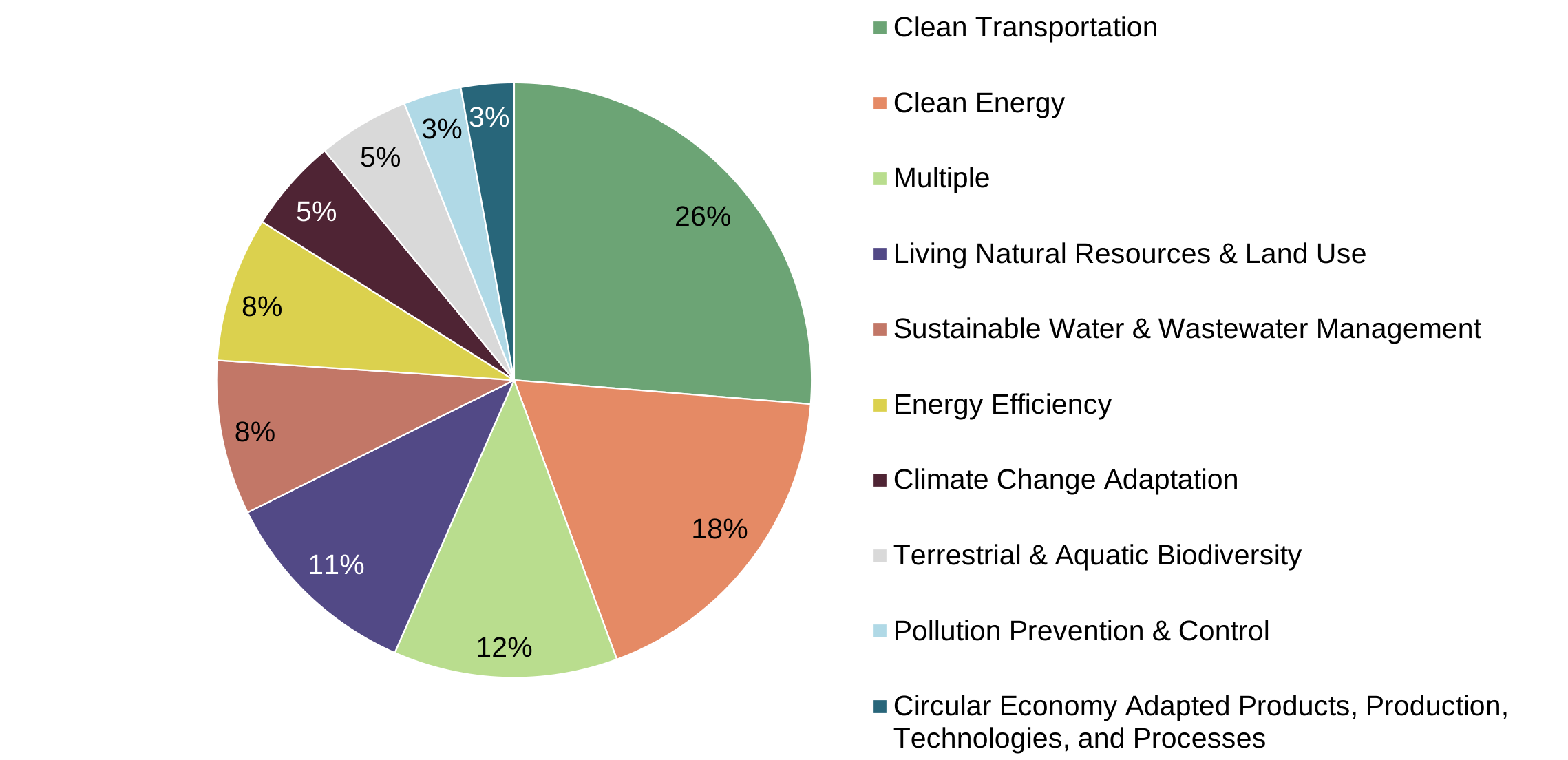
Canada Green Bond Maturing December 1, 2029
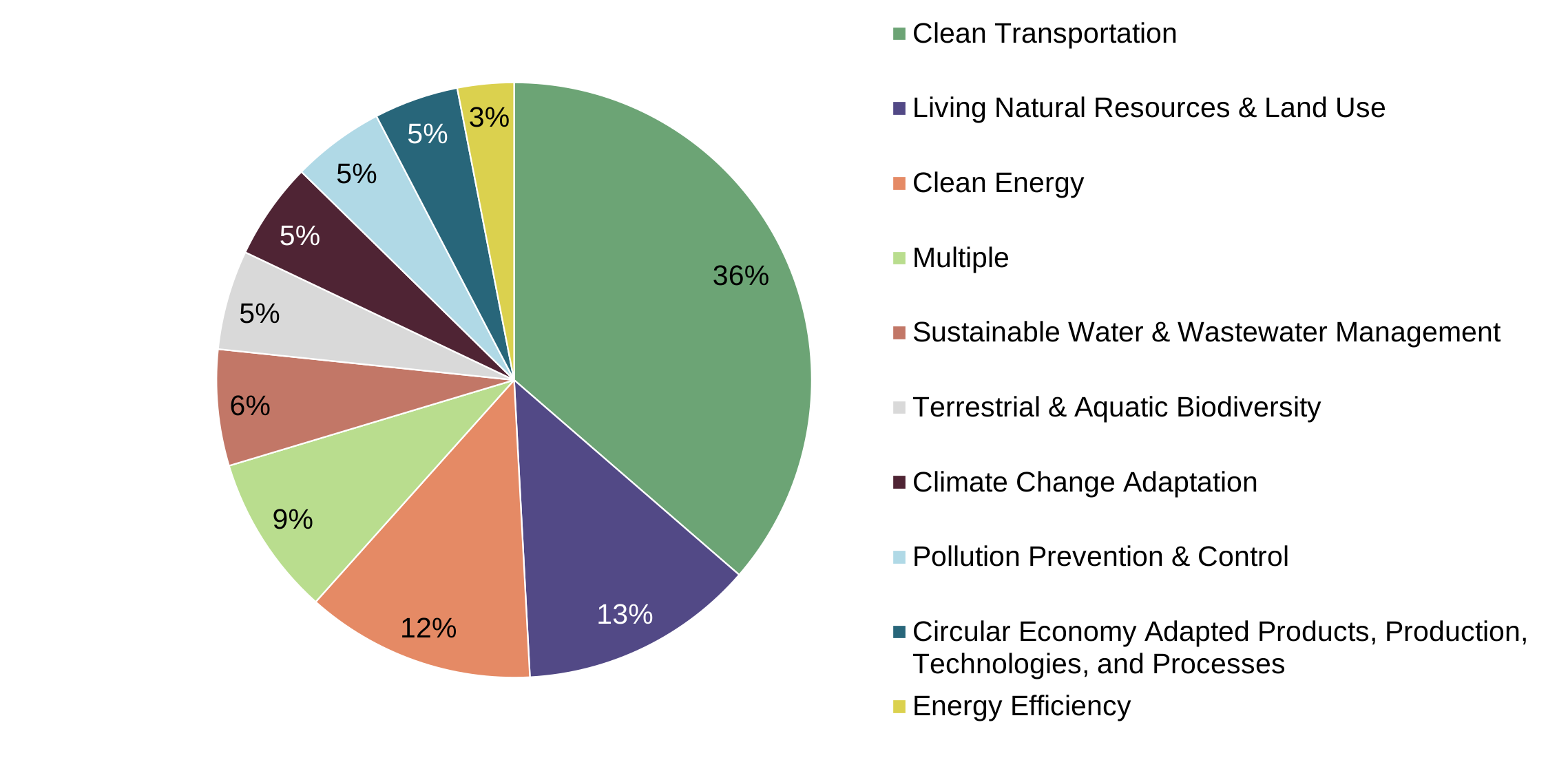
Canada Green Bond Maturing March 1, 2032
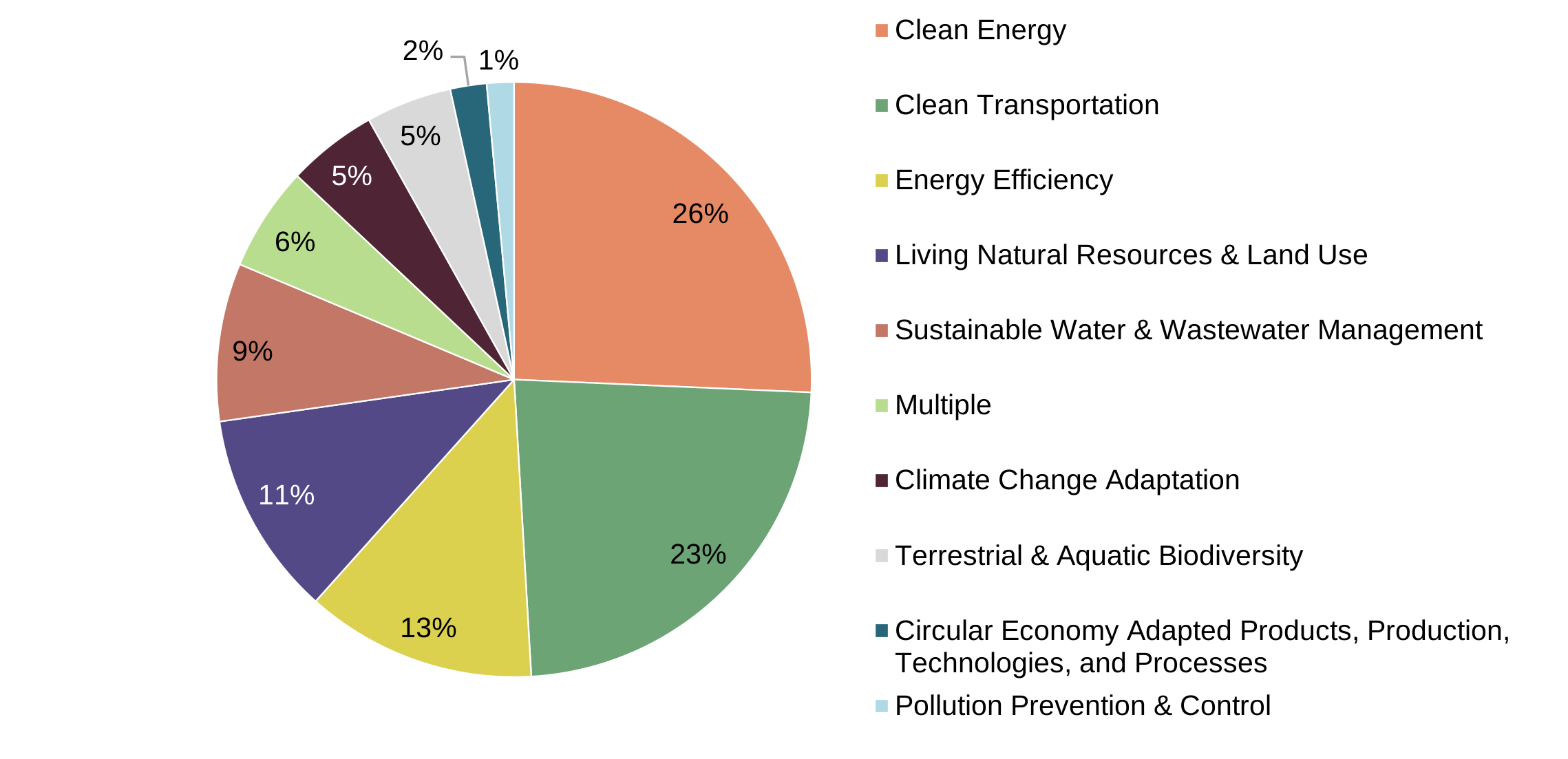
Canada Green Bond Maturing March 1, 2034
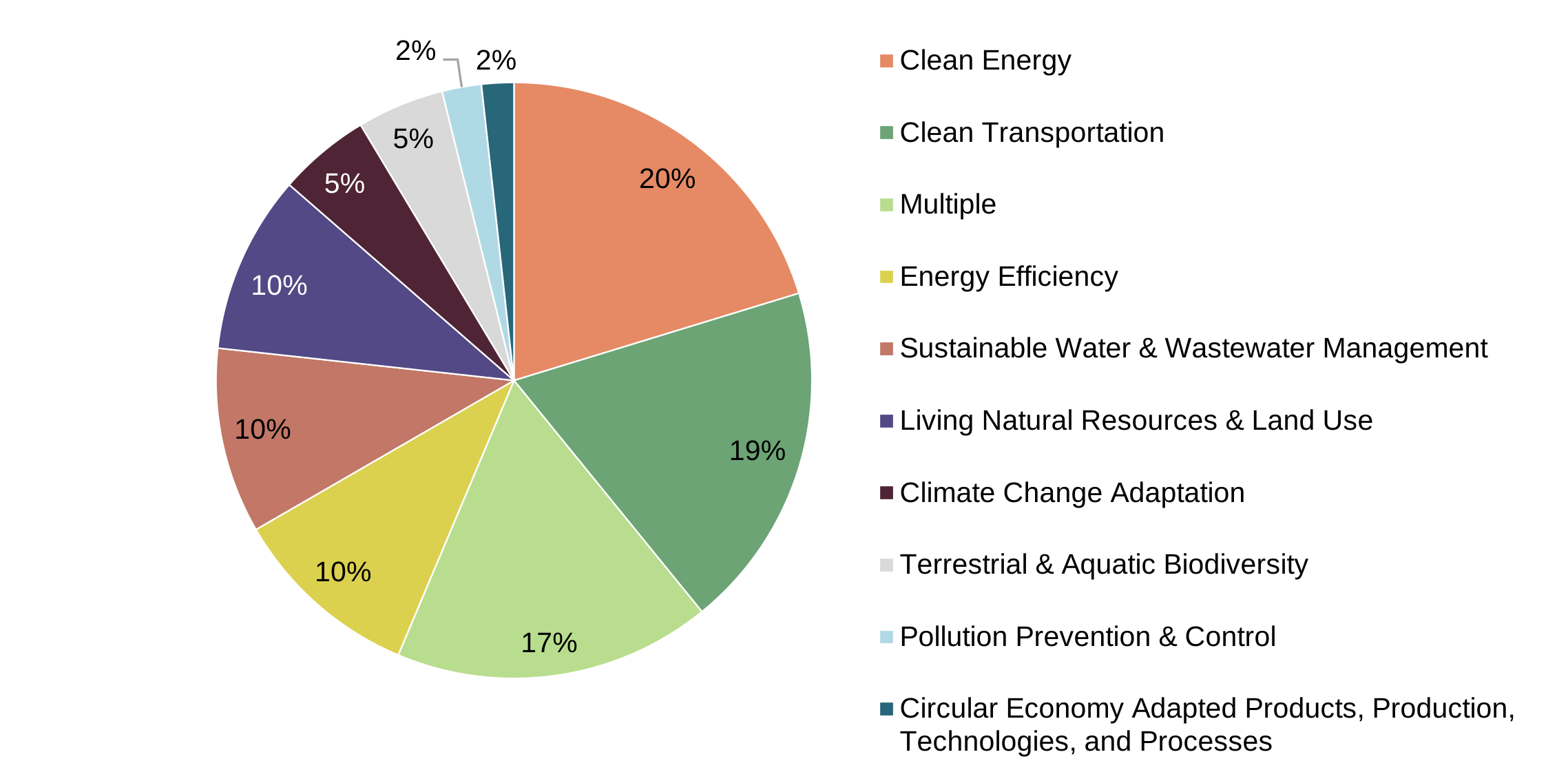
| Maturity Date | December 1, 2029 | March 1, 2032 | March 1, 2034 | Total | |
|---|---|---|---|---|---|
| CUSIP | 135087N67 | 135087S96 | 135087R71 | ||
| ISIN | CA135087N670 | CA135087S968 | CA135087R713 | ||
| Total Net Proceeds Allocated | 12,979.00 | ||||
| Allocation to Eligible Green Expenditures | |||||
| 2 Billion Trees Program | Living Natural Resources & Land Use | 85.54 | 44.33 | 105.45 | 235.32 |
| Agricultural Clean Technology Program | Energy Efficiency | 34.97 | 28.41 | 72.63 | 136.01 |
| Agricultural Climate Solutions | Living Natural Resources & Land Use | 27.59 | 49.31 | 141.78 | 218.68 |
| Agricultural Greenhouse Gases Program | Living Natural Resources & Land Use | 8.68 | - | - | 8.68 |
| BC Ferries | Clean Transportation | - | - | 21.82 | 21.82 |
| Canada Greener Homes Grant | Energy Efficiency | 99.55 | 190.81 | 489.21 | 779.57 |
| Canada Public Transit Fund | Clean Transportation | 0.01 | 43.89 | 59.5 | 103.4 |
| Canadian Forest Service Scientific Program | Living Natural Resources & Land Use | 108.82 | 16.45 | 45.32 | 170.59 |
| Capital Facilities and Maintenance Program - Wastewater | Sustainable Water & Wastewater Management | 314.49 | 61.9 | 176.6 | 552.99 |
| Capital Facilities and Maintenance Program - Other Community Infrastructure and Activities - Energy | Clean Energy | 38.84 | 153.31 | 155.16 | 347.31 |
| Capital Facilities and Maintenance Program - Solid Waste Management | Pollution Prevention & Control | 56.25 | 2.41 | 7.45 | 66.11 |
| Capital Facilities and Maintenance Program/First Nation Infrastructure Investment Fund - Structural Mitigation | Climate Change Adaptation | 46.67 | 5.34 | 15.1 | 67.11 |
| Charging and Hydrogen Refuelling Infrastructure Initiative | Clean Transportation | - | 18.14 | 18.99 | 37.13 |
| Clean Energy for Rural and Remote Communities Program | Clean Energy | 119.48 | 22.41 | 61.19 | 203.08 |
| Clean Fuels Fund | Clean Energy | 13.62 | 22.9 | 68.83 | 105.35 |
| Clean Power Investments | Clean Energy | 0.03 | 193.16 | 539.98 | 733.17 |
| Climate Change Preparedness in North | Climate Change Adaptation | 29.73 | - | 7.64 | 37.37 |
| Codes Acceleration Fund | Energy Efficiency | - | 2.92 | 4.37 | 7.29 |
| Deep Retrofit Accelerator Initiative | Energy Efficiency | - | 4.15 | 5.04 | 9.19 |
| Disaster Mitigation and Adaptation Fund | Climate Change Adaptation | 140.67 | 92.25 | 266.87 | 499.79 |
| ecoENERGY for Renewable power program | Clean Energy | 95.37 | - | - | 95.37 |
| Electric Vehicle and Alternative Fuel Infrastructure Deployment Initiative | Clean Transportation | 52.02 | 0.03 | 0.08 | 52.13 |
| Electric Vehicles Infrastructure Demonstration Program | Clean Transportation | 29.98 | 1.26 | 3.91 | 35.15 |
| Emerging Renewable Power Program | Clean Energy | 97.02 | 5.70 | 15.64 | 118.36 |
| Energy Efficient Buildings Research, Development and Demonstration Program | Energy Efficiency | 18.41 | 1.90 | 6.12 | 26.43 |
| First Nation Adapt | Climate Change Adaptation | 27.33 | - | 5.09 | 32.42 |
| Food Waste Reduction Challenge | Circular Economy Adapted Products, Production, Technologies, and Processes | 7.01 | 1.96 | 6.57 | 15.54 |
| Forest Innovation Program | Circular Economy Adapted Products, Production, Technologies, and Processes | 93.16 | 10.72 | 29.70 | 133.58 |
| Green Construction through Wood Program | Circular Economy Adapted Products, Production, Technologies, and Processes | 26.93 | 3.77 | 9.66 | 40.36 |
| Green Industrial Facilities and Manufacturing Program | Energy Efficiency | - | 1.90 | 3.57 | 5.47 |
| Greener Neighbourhoods Pilot Program | Energy Efficiency | - | 0.84 | 1.93 | 2.77 |
| Habitat Conservation and Protection | Living Natural Resources & Land Use | 392.43 | 78.58 | 247.27 | 718.28 |
| Incentives for Medium- and Heavy-Duty Zero-Emission Vehicles Program | Clean Transportation | 0.02 | 13.7 | 31.33 | 45.05 |
| Incentives for Zero-Emission Vehicles Program | Clean Transportation | 557.46 | 177.13 | 412.86 | 1147.45 |
| Indigenous Community-Based Climate Monitoring | Climate Change Adaptation | 18.89 | - | 4.39 | 23.28 |
| Investing in Canada Infrastructure Program - Green Infrastructure Stream - Water and wastewater projects | Sustainable Water & Wastewater Management | 0.40 | 109.6 | 426.55 | 536.55 |
| Investing in Canada Infrastructure Program - select Public Transit projects | Clean Transportation | 456.21 | 166.57 | 442.97 | 1065.75 |
| Investments of Forest Industry Transformation Program | Circular Economy Adapted Products, Production, Technologies, and Processes | 101.97 | 22.94 | 58.64 | 183.55 |
| Living Laboratories Initiative | Living Natural Resources & Land Use | 15.76 | 1.15 | 3.20 | 20.11 |
| Low Carbon Economy Fund | Pollution Prevention & Control | 194.02 | 27.00 | 120.39 | 341.41 |
| Marine Conservation Targets | Terrestrial & Aquatic Biodiversity | 66.05 | 38.75 | 105.83 | 210.63 |
| Natural Infrastructure Fund | Living Natural Resources & Land Use | - | 3.22 | 6.48 | 9.70 |
| Nature Smart Climate Solutions Fund | Living Natural Resources & Land Use | 0.08 | 29.14 | 29.78 | 59.00 |
| Northern REACHE | Clean Energy | 27.75 | - | 20.18 | 47.93 |
| Oil to Heat Pump Affordability Program | Energy Efficiency | - | 19.50 | 34.66 | 54.16 |
| Pacific Salmon Strategy Initiative | Terrestrial & Aquatic Biodiversity | 29.16 | 13.99 | 64.71 | 107.86 |
| Réseau express métropolitain | Clean Transportation | 651.3 | - | - | 651.30 |
| Smart Grid Program | Clean Energy | 60.21 | 2.41 | 6.72 | 69.34 |
| Smart Renewables and Electrification Pathways Program | Clean Energy | 169.62 | 113.12 | 346.55 | 629.29 |
| Species at Risk | Terrestrial & Aquatic Biodiversity | 174.59 | 40.43 | 112.33 | 327.35 |
| Strategic Response Fund | Multiple | 80.56 | 86.86 | 930.08 | 1097.50 |
| Sustainable Development Technology Canada - Sustainable Development Technology Fund | Multiple | 355.79 | 26.40 | 101.06 | 483.25 |
| Zero-Emission Bus Initiative | Clean Transportation | 7.82 | 12.21 | 35.01 | 55.04 |
| Zero-Emission Vehicle Infrastructure Program | Clean Transportation | 60.26 | 34.14 | 103.3 | 197.70 |
| Total Allocated Net Proceeds | 4,992.50 | 1,997.00 | 5,989.50 | 12,979.00 | |
| Source: Eligible green expenditures identified by the Interdepartmental Green Bonds Committee (IGBC) that were allocated green bond proceeds since the program's inception. Figures may differ from previously published allocation schedules due to ex post corrections and reallocations. Calculations by Finance Canada. Notes A positive number indicates net positive allocation. "-" Indicates no allocation. |
|||||