
Evaluation of Canadian Armed Forces Retention
September 2025
1258-3-076 (ADM(RS))
Reviewed by ADM(RS) in accordance with the Access to Information Act. Information UNCLASSIFIED.
Table of Contents
Program Overview
The importance of retention efforts within the Canadian Armed Forces (CAF) is clear despite the lack of a comprehensive retention program. With the CAF’s ambitious defence agenda outlined in Our North, Strong and Free, addressing personnel shortages and reducing unhealthy attrition are crucial steps to maintaining operational effectiveness and supporting Canada’s defence mandate. These efforts will help ensure a strong and capable force for the future.
Alternate Formats
Assistant Deputy Minister (Review Services)
Evaluation Scope
The Evaluation of CAF Retention focused on identifying phases of attrition and the associated reasons for leaving the CAF. It assessed the alignment of best practices, theory and strategic direction within and across the CAF and determined whether these retention activities were effectively directed towards areas that impact retention. It further explored whether these activities are successful in enhancing retention.
The evaluation considered four main evaluation questions and two case studies: the Naval Experience Program (NEP) and the Pilot Pay Restructuring Initiative. For the purposes of this evaluation, only Regular Force (Reg F) members and voluntary releases were considered. The Evaluation of CAF Retention was undertaken in alignment with the 2016 Treasury Board Policy on Results.
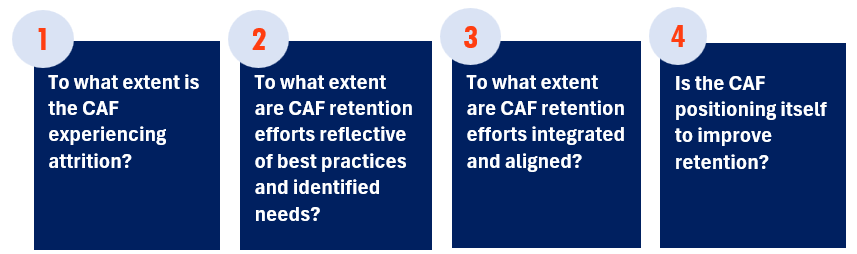
Figure 1 Summary
Background
Overall, CAF retention efforts are aligned with best practices and theories. Strategies to address general reasons for leaving, such as health and wellness strategies, are consistent with Five Eyes partners but differ in other aspects (e.g., use of retention bonuses by the U.S. and Australian forces). The CAF recognizes that initiatives to increase long-term retention need to go beyond pay and benefits to include broader aspects such as work-life balance, better communication, promotional opportunities and career development.
In 2022, the Chief of the Defence Staff implemented the CAF Retention Strategy (the Strategy) to quantify, coordinate and direct retention efforts. The Strategy incorporates many elements from academic theories on personnel retention, aiming to enhance commitment, satisfaction and work-life balance. However, L1 retention efforts were found to lack alignment and coordination with the Strategy due in part to its limited awareness. This issue was made worse by the defunding of the Retention Program Office, which was responsible for managing the L1 tasks outlined in the strategy. A newly established Retention Secretariat will aim to facilitate efforts across the CAF to achieve reconstitution and operational readiness goals.
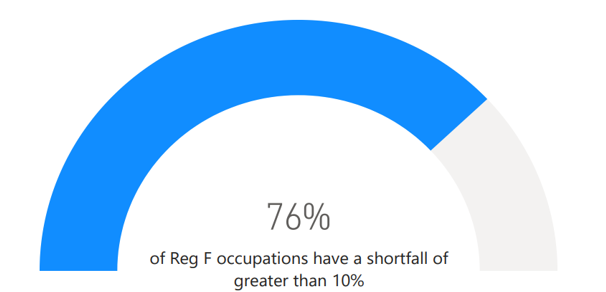
Source: Establishment and Strength Report: Breakdown by Military Occupational Structure Identification (MOSID) December 2024 - Director General Military Personnel Research and Analysis (DGMPRA)
Figure 2 Summary
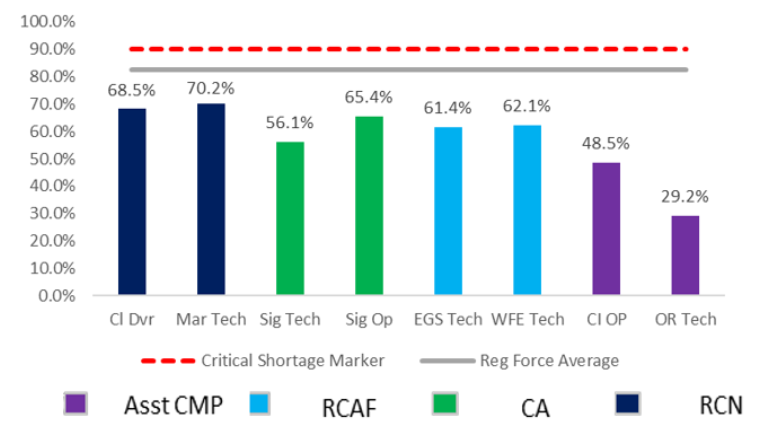
Source: Establishment and Strength Report: Breakdown by MOSID December 2024 - DGMPRA
Figure 3 Summary
Voluntary attrition rates between the force elements are comparable. However, some trades are heavily stressed, with attrition rates well above the CAF average (e.g., technical trades in all force elements). A staffing rate shortfall of greater than 10 percent is identified as a “red” trade.
Voluntary attrition varies by years of service (YOS), with peaks at the beginning of a member’s career and again at pension eligibility. The reasons for leaving also differ by YOS. Those with fewer YOS are more concerned with military life and a misalignment between expectations and CAF reality. Those with 20+ YOS leave due to geographic relocations, need for stability, and pension eligibility. Of note, the CAF has the lowest attrition rate among the Five Eyes countries.
Key Findings
The highest voluntary attrition rates within the CAF, which include component transfers, are observed among its lowest ranks and newest members. In fiscal year (FY) 2023/24, privates, aviators and sailors 2nd and 3rd class had an attrition rate of 9.4 percent compared to the CAF average (4.3 percent). Qualitative and quantitative evidence point to two primary sources of early attrition: training delays and difficulty adapting to the CAF/military lifestyle.
Training delays: The CAF is focused on recruiting to increase its number of members. Each recruit requires training to the occupational functional point (OFP), which puts pressure on the training system to improve its training throughput. However, there are insufficient trainers, equipment, training facilities and other supports to meet training targets effectively. This leads to delays that significantly frustrate pre-OFP members, who often face months of underemployment. Training delays are especially harmful to red trades with severe retention challenges. On average, across the forces, red trades have training delays of 206 days.
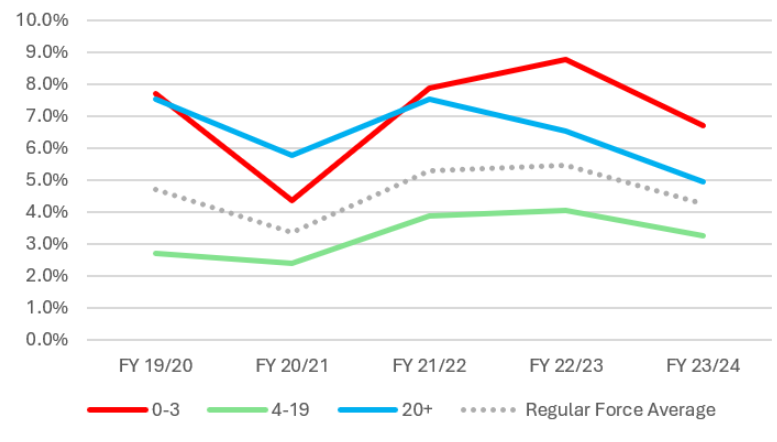
Source: Guardian. Analytics engine: Director Research Workforce Analytics (DRWA) Data Mart. Data extracted in Aug 2024.
Figure 4 Summary
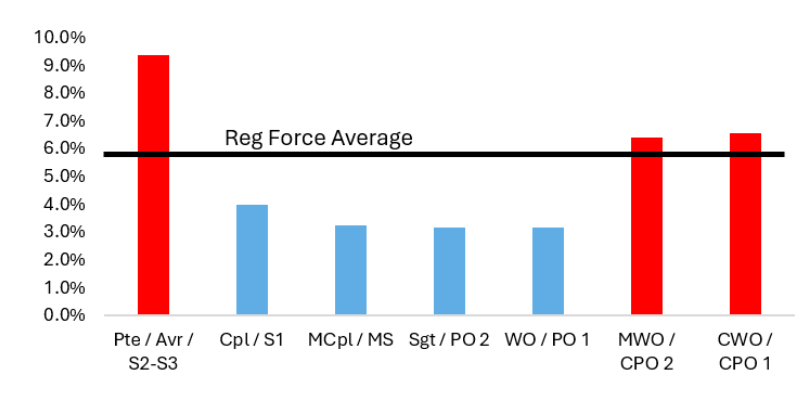
Source: Guardian. Analytics engine: DRWA Data Mart. Data extracted in Aug 2024
Figure 5 Summary
Adapting to the CAF: Early attrition has also been attributed to recruits struggling to adapt to CAF life, which may include being away from family, CAF hierarchy, etc. Similarly, recruit dissatisfaction with their chosen trade and the challenges associated with trying to change trades through occupational transfers are additional early attrition issues. Many recruits are told it is easier to release and reapply rather than wait for a Voluntary Occupational Transfer.
NEP helps recruits make informed trade choices by exposing them to various Navy trades, reducing initial dissatisfaction. Early data shows that this initiative has had positive effects, allowing some recruits to transfer to another element after initially joining the RCN.
The RCN Commander noted that NEP has actively engaged naval reserve divisions in recruiting for the Reg F. Further, the number of potential applicants inquiring about the Navy at recruiting centres has tripled, and three times as many visible minorities and Indigenous Canadians are being enrolled through NEP. Further information is available in Annex A.
ADM(RS) Recommendation
Finding 2: Geographic relocations and institutional dissatisfaction are key contributors to middle attrition.
Geographic relocation: In FY 2023/24, over 10 percent of the total number of CAF members were relocated. High housing costs—made worse by the lack of military housing, loss of spousal employment, shortages in primary healthcare providers and limited daycare spaces—can lead to financial and personal hardships for military members. The number of dual-income families in Canada has doubled over the last 40 years and for military families, the prospect of losing a second income makes a geographic move untenable. Loss of primary healthcare and daycare also puts additional strain on families, who must repeat the process with each move.
Those in the post-OFP/pre-pension eligibility phase often use imposed restriction (IR)Footnote 3 to mitigate the effects of geographic relocation, though at the cost of separating military families. This gains in importance for CAF members in the middle ranks, with 7.4 percent of all warrant officers and petty officers 1st class being on IR in FY 2023/24.
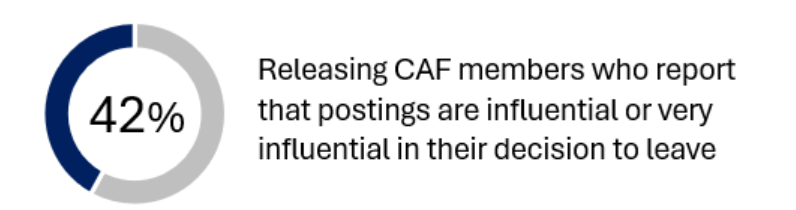
Source: DGMPRA (Director Personnel Science Policy Integration) Data (2024)
Figure 6 Summary
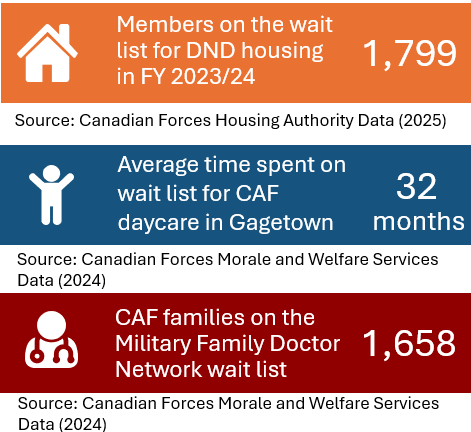
Figure 7 Summary
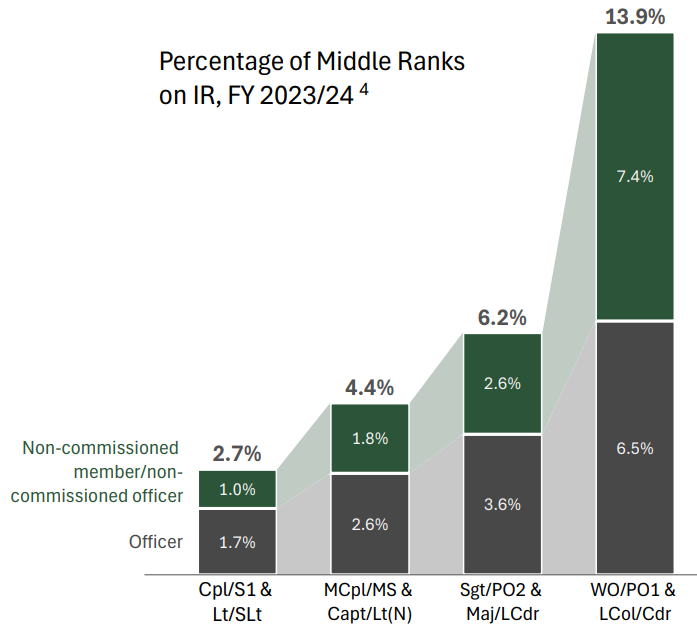
Source: Director Military Careers Data (2024)
Figure 8 Summary
Institutional Dissatisfaction: Post-OFP CAF members are facing challenges related to high operational tempo; lack of equipment, training and leadership direction; and reduced IR and educational benefits. Interview evidence shows that there is a perception that leadership is prioritizing culture change over critical operational needs like ammunition and equipment.
Continuous deployments and high-readiness status create a high operational tempo. This, combined with personnel shortages, results in the remaining members facing increased workloads and responsibilities. The lack of functioning equipment makes the situation worse, leading to burnout among healthy members.
Additionally, the removal of IR benefits and freezing of the education benefit have caused further dissatisfaction. A comparison with the Royal Canadian Mounted Police and the Canadian Coast Guard, two federal departments/agencies similarly structured to the CAF, found that mid-career attrition was not as significant an issue.
Finding 3: There are limited strategies or activities being conducted to retain pension-eligible CAF members.
Pension eligibility is the main reason for higher attrition among those in the latter part of their career (20+ YOS). Once pension eligible, members can obtain employment outside the CAF while also collecting a pension, making this a significant financial incentive to leave. In addition, once a member has reached 20+ YOS, many have had multiple geographic postings and feel “tired and broken.” It was noted that pension eligible members have done their part to serve the country and, therefore, there are no strong attempts made to retain them.
“Once they’ve served 25 years, they’ve served their country; there’s no strategy to keep them. We rarely try and talk them out of it.”
Finding 4: Local retention activities are being proactively implemented by unit-level commanders.
Interview data suggests that few commanders have comprehensive knowledge of L1 or CAF-wide retention strategies. However, operating within the unit-level commander’s level of authority and sphere of influence, many at the unit level have implemented local retention initiatives. Some activities include:
- allowing flexibility with working hours to accommodate for daycare;
- implementing early promotions from private to corporal to mitigate challenges with the cost of living;
- allowing members to opt out of promotions to avoid being posted away;
- managing time away from home for high-tempo members and units (e.g., modifying field exercises so they are not overnight);
- proactively engaging with career managers to avoid unwanted postings or offering Voluntary Occupational Transfer pathways; and
- leveraging local colleges to train new personnel to reduce training delays.
Several interviewees stated that some technical trades (e.g., vehicle technician, cyber operator) are leveraging local colleges to reduce training backlogs. While not explicitly a retention activity, this likely has a positive effect on retention for pre-OFP members who receive this education, as it spares them from months of underemployment. Numerous interviewees also credited proactive engagement with career managers, particularly regarding postings, as an effective initiative. Command teams are acting as intermediaries between their subordinates and their career managers to avoid postings that would cause the member to release. Several interviewees praised career managers for their increased flexibility and willingness to accommodate the needs of CAF members; however, they also acknowledged that some undesirable postings are inevitable.
ADM(RS) Recommendation
Finding 5: A lack of understanding of the Transition Group’s roles, responsibilities and services is limiting its retention effectiveness.
The CAF Transition Group (CAF TG) is a new organization that provides retention and transition support and programs to both non-medically releasing and ill and injured Reg F and Reserve Force CAF members. While effective for transitioning members out of the CAF, interview evidence suggests that CAF leaders believe it has a minimal role in retention. However, CAF TG helps members reconsider releasing by addressing personal and professional concerns. Evidence shows that, between November 2023 and April 2025, 518 members were retained through CAF TG.
ADM(RS) Recommendation
Finding 6: The decision to amend the pilot compensation model lacked sound justification, consideration of alternate options and measures of effectiveness.
The aim of the pilot pay restructure was to improve pilot retention by better aligning pilot pay with the commercial airline industry. In response to an Office of the Auditor General (OAG) report on Canada’s Fighter Force, the RCAF executed Operation EXPERIENCE to stabilize and “rapidly grow experience” in the pilot occupation. The main issue identified from the OAG report was to address the shortage of RCAF fighter pilots for Canada to meet its operational requirements for the future fighter fleet (F35s).
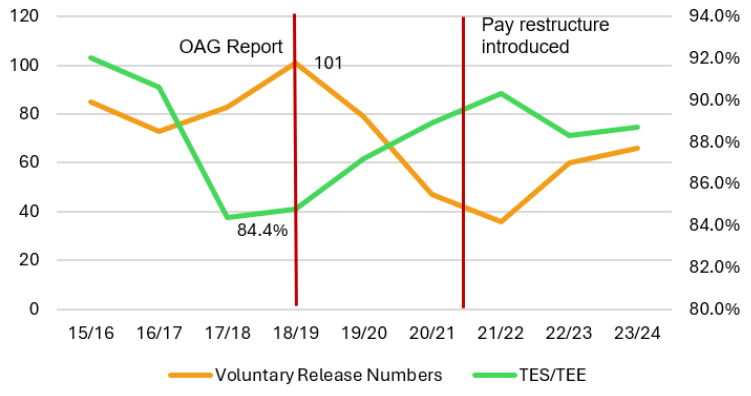
Although attrition peaked in 2018/19, it improved the following year. Between the years 2018 and 2023, the voluntary release rate decreased to 2–5 percent, which was lower than many other CAF occupations. Further, in 2020/21, MOSID’s trained effective strength (TES) was at 88.9 percent, placing it mid-range for comparable TES, at 32/59 (tied with other trades).
Source: Guardian. Analytics engine: DRWA Mart. Extracted in 2024.
Figure 9 Summary
The lack of a clear process and documentation makes the pilot pay restructure difficult to link to direct gains in pilot MOSID health. There is no documentation to explain the irregular year of fighter pilot departures, but it seems to have been the basis for future decisions about pilot retention.
Although other proposed options were available to address the OAG findings, the decision was made to better align pilot pay with the commercial airline industry. This decision was a deviation from best practices identified within existing research of allied armed forces (U.S., Australia, U.K.). This assessment was made with minimal documentation and without a well-defined methodology and formalized implementation plan.
Similarly, while several data points were collected, there were no overarching metrics for the effectiveness of the Pilot Pay Restructuring Initiative, thereby making it difficult to conclude on its impact. Actions were taken in an ad hoc manner, such as expanding the pay adjustments to all pilots, providing new pay before identifying required qualifications and the combination of the environmental allowance into base pay. This was contrary to most other CAF occupations. In light of this, it is possible that the pay scales associated with this initiative will need to be revisited in the future.
The lack of a formalized and well-documented approach led to execution challenges, which have resulted in ongoing grievances related to the implementation process. Further details are available in Annex B.
ADM(RS) Recommendation
Annex A: Naval Experience Program
Originally developed as an attraction/recruiting initiative, NEP has an added benefit of giving Canadians and permanent residents the opportunity to “try out” naval occupations for one year with “no strings attached.”
- This program gives NEP candidates the ability to understand naval occupations before selecting one.
- This program may, in the long term, address some of the instances of early attrition that are due to an inability to adapt to the CAF.
- It is possible that NEP will provide more flexibility to those candidates who believe the selected occupation is not what the recruiter told them it was, thereby impacting the ability to retain them.
It is likely that some candidates in the first group of NEP graduates may not have been interested in RCN occupations at the outset.
Other force generators outside of the RCN benefited from graduates of NEP. Of the first group of 116 NEP graduates:
- 40 joined the RCN;
- 5 joined the CA;
- 5 joined the RCAF;
- 11 joined Chief of Military Personnel (CMP);
- 11 joined the Reserves; and
- 44 released.
NEP staff currently lack access to key variables in the unit release interview data, which hinders their ability to make informed program improvements or provide insights to the broader CAF on why candidates chose not to continue beyond NEP. Access to this information will be a key component for current and any other future experience program(s) as it would provide opportunities for program improvements and possibly increased retention.
A full evaluation of NEP was conducted in 2024.
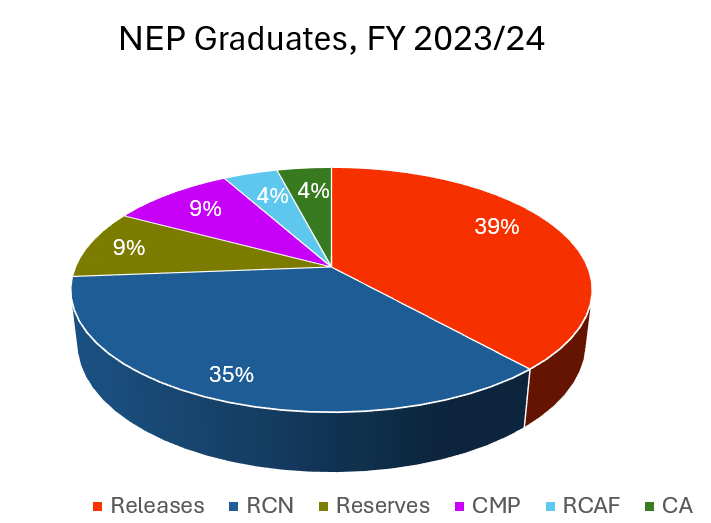
Figure 10 Summary
NEP may reduce dissatisfaction with training delays in addition to the mismatch between expectations and the reality of military life.
Annex B: Pilot Pay Restructure
Between the years 2018 and 2023, pilot attrition was lower than many other CAF occupations, with voluntary release rates between 2 and 5 percent. However, in 2018, the number of fighter pilots who released at the captain/major level more than doubled to 28, compared to the historical average of 11 in the previous two years. There is no documentation to explain this irregular year of fighter pilot departures and by 2019, the release numbers had returned to historical averages.
At the same time, there was a noted decrease in the number of pilots who had completed their necessary training and were ready to work as fully qualified pilots, a concept otherwise known as TES. This occurred partially due to a definition change for the requirements of a fully qualified pilot, alongside an increase in voluntary release numbers. This is visually depicted under Finding 6.
In parallel to these developments, the OAG released a report that considered this irregular year as part of its findings. It reported that “Canada’s fighter force could not meet the government’s new operational requirement” because “National Defence was already experiencing a shortage in personnel.” Concerning pilots specifically, it noted the CAF “had only 64 percent of the trained CF-18 pilots it needed to meet the government’s new requirement,” thus they provided the recommendation that “National Defence should develop and implement recruitment and retention strategies for fighter force technicians and pilots.” Evidence suggests Operation EXPERIENCE evolved as a response to the OAG report on fighter pilots.
The main issue drawn from the OAG report was addressing the shortage of RCAF fighter pilots for Canada to meet its operational requirements for the future fighter fleet (F35s). Although there were other potential solutions to address the report’s findings (e.g., providing allowances for fighter pilots), these were not implemented. Instead, to address the anticipated shortage of fighter pilots, a comprehensive pilot recovery plan was developed, which included a compensation component. This implementation took effect on April 1, 2021.
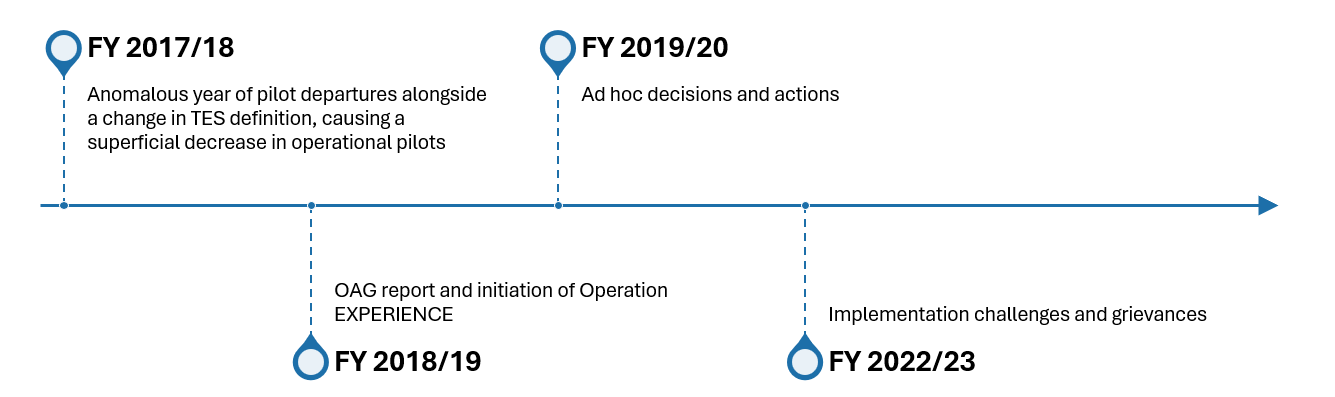
Figure 11 Summary
Although the aim of the pay restructure was to retain qualified pilots by making compensation more competitive with the commercial airline industry, the process lacked a formalized approach that could have considered other options.
- There is no evidence to support that an increase in compensation would alleviate the issue identified in the OAG report, nor that the scope of the compensation needed to expand beyond fighter pilots.
- The decision process lacked documentation that could have identified other options and reasons for selecting to adjust pilot occupation compensation over other CAF occupations.
The decision to implement the pay restructure deviated from best practices of allied armed forces (U.S., Australia, U.K.) and was without a well-defined methodology. The absence of a justified and well-documented process led to execution challenges, including minimal documentation (meeting records of decisions, emails and TB submission), no measures of effectiveness and the lack of a formalized implementation plan.
Several additional follow-on decisions were made that lacked supporting evidence.
- The decision was made to provide new pay to all pilots based on YOS rather than waiting for the identification of pilot qualifications as initially planned.
- The decision to use the budgeted funds for aircrew allowance to partially fund the new pay rates was contrary to the methodology of most other CAF occupations that also received environmental allowances.
- Although the initial decision was to align with commercial pilot compensation, increasing junior pilots’ pay to match general service officers deviated from the commercial pilot pay scale structure.
There were many execution challenges with the new pay structure.
- A reactive communications plan responding to inaccurate information was unofficially shared with pilots. This led to unmet expectations and dissatisfaction when the restructure was introduced.
- The new pay scale initially resulted in some captain pilots earning 8 percent more, which subsequently resulted in an overall increase in compensation for all pilots.
- The potential for a captain to make more than a major resulted in some pilots refusing promotions.
Given the challenges listed above, a cluster of grievances related to the pilot pay implementation were filed. Many of these grievances are still ongoing.
Annex C: Management Action Plan
ADM(RS) Recommendation
Management Action Plan (MAP)
MAP 1: MILPERSCOM/CMP, in collaboration with force generators, will explore the potential of a CAF experience program.
Deliverable: This MAP will be considered closed when MILPERSCOM/CMP, in collaboration with force generators, has developed a background paper that explores the costs and benefits of developing a “CAF experience program” based on research and analysis of the data and information, as well as lessons learned, from current pilots and historical programs such as NEP and the Youth Training Employment Program. The background paper shall be used as the basis to inform a future decision on whether a CAF-wide initiative is feasible and suitable.
OPI: MILPERSCOM/CMP (Chief of Staff [COS] Plans)
OCI: RCAF, RCN and CA
Target Date: January 2026
Risk Statement: Failure to undertake analysis of data, information and lessons learned from historical and existing pilots and programs to inform the planning of possible future CAF programs represents resource management risks for the organization as there may be both unexpected benefits (that need to be articulated and expanded upon) and/or hidden costs (including lost opportunity costs) that would be important factors for consideration in the determination and design of future programming.
Programs that are established without sound research also represent human resource management risks to the attainment of immediate annual reconstitution objectives (strategic intake plan), as well as longer-term reputational risks for the CAF in terms of its credibility as an employer of choice in Canada.
ADM(RS) Recommendation
Management Action Plan
MAP 2: CMP/MILPERSCOM will establish a central repository for local commanders and their teams to share successful local retention activities.
Deliverable: By capturing information on local command retention activities, there is an opportunity to share and replicate successful best practices, thereby achieving multiplier effects and potentially gaining efficiencies in delivering support services.
This MAP will be considered closed when:
- A central repository has been established, to be maintained by the COS Ops team within CMP/MILPERSCOM.
- Direction (and a reminder) is sent to all L1 commanders and their teams for the repository to be updated with information about their local retention plans and activities (annual requirement with six-month reminder).
OPI: MILPERSCOM/CMP (COS Ops)
Target Date: December 2026
Risk Statement: Without the means of capturing, sharing and replicating best practices related to annual retention activities that are being undertaken at the local command level, there are missed opportunity costs to the organization including, for example, inconsistencies in messaging, missed economies of scale and the loss of CAF-wide benefits from replication and expansion of programs. These represent risks not only in terms of achieving immediate annual reconstitution objectives (strategic intake plan), but also longer-term reputational risks for the CAF in terms of its credibility in being perceived as an employer of choice in Canada.
ADM(RS) Recommendation
Management Action Plan
MAP 3: MILPERSCOM (CAF TG) will develop and implement a communications plan to assist senior CAF leaders in understanding and communicating CAF TG’s roles, responsibilities and services to other CAF members.
Deliverable: This MAP will be considered closed when CMP provides the communications plan and associated materials to all L1s.
OPI: MILPERSCOM/CMP (CAF TG)
Target Date: November 2026
Risk Statement: Without a unified, aligned and consistent message to clarify senior CAF leaders’ roles, responsibilities and services offered by CAF TG, there is a risk that CAF members will be unaware of CAF TG supports and services. In the absence of information sharing, there is a risk that the CAF will miss opportunities to better understand members’ reasons for seeking a release and, therefore, miss opportunities to mitigate release risk factors.
ADM(RS) Recommendation
Management Action Plan
MAP 4: A problem definition and analysis tool will be established to enable Director General Compensation and Benefits (DGCB) to conduct a problem analysis within six months of the identification of a significant compensation and benefits issue. This will include L1s initiating change proposals using the CMP (DGCB) problem definition and analysis tool. This tool will support the process by promoting essential elements such as risks, alternatives and measures of effectiveness to enhance L1 proposal quality from the outset.
A recommendation will then be provided to CMP to address the way forward. Where required, CMP will use governance committees already in place (e.g., Armed Forces Council, Defence Strategic Executive Committee) for consultation and decision making.
Deliverable: Implementation of the problem definition tool.
OPI: MILPERSCOM/CMP (DGCB)
OCI: RCAF
Target Date: December 2025
Risk Statement: The introduction of a consultative process must be accompanied by the explicit understanding that it is just that: a consultation. There are no DND/CAF authorities being exercised, and all decisions are made by the Treasury Board under the National Defence Act, section 35.