
Evaluation of Defence Team Culture
June 2026
1258-3-075 ADM(RS)
Reviewed by ADM(RS) in accordance with the Access to Information Act. Information UNCLASSIFIED.
Alternate Formats
Assistant Deputy Minister (Review Services)
Evaluation Overview
This evaluation assesses culture across the Defence Team, examining the key factors that influence positive culture change. The evaluation provides a 10-year comparison of Defence Team culture from 2015 to 2025. The evaluation reviewed qualitative and quantitative evidence, including Canadian Armed Forces (CAF) site visits, to capture the current Defence Team climate across four core culture change themes and culture-related data collection gaps, as well as progress toward its long-term objectives.
Overall Assessment
The Defence Team is making progress in strengthening trust; improving professional conduct; and advancing Diversity, Equity and Inclusion (DEI) initiatives. Cultural change remains gradual due to inconsistent leadership engagement, ongoing uncertainty in addressing subtle misconduct, persistent inclusion barriers—particularly for individuals with intersecting identities—and gaps in how culture-related data is integrated and used to support meaningful culture change.
Trust in Institution and Leadership |
Finding 1: Trust has improved, with varying levels of strength across the organization. Defence Team members consistently reported that what builds—or erodes—trust is leadership behaviour: whether leaders model respectful conduct, communicate consistently and follow through with visible accountability. Middle management buy-in is also a critical factor: Where it is strong, culture change advances; where it is absent, progress stalls. |
|---|---|
Professional Conduct |
Finding 2: Professional conduct has improved, with overt misconduct less tolerated than a decade ago. Subtle forms of inappropriate behaviour—microaggressions, exclusionary comments and informal “grey zone” behaviours—continue to undermine psychological safety. Policy gaps around consent and alcohol also create uncertainty for both members and supervisors. |
Defence Team Experience and Well-Being |
Finding 3: Reporting mechanisms and training have expanded, yet confidence in the system remains low. Members are more aware of reporting options, with confidence in system protection and accountability remaining limited. Training is viewed as high in volume but low in impact, contributing to what members describe as culture fatigue. |
DEI |
Finding 4: Acceptance of women has improved, with barriers persisting—especially for individuals with intersecting identities and persons with disabilities. Experiences of exclusionary behaviour and inconsistent accommodations continue to signal that inclusion is not yet embedded. DEI efforts are often seen as performative when leadership modelling and middle management engagement are weak. |
Measuring Culture Change in the Defence Team |
Finding 5: While Defence has implemented a wide range of measures to assess culture, gaps remain in how this information is integrated and used. Current approaches are fragmented and rely primarily on quantitative data, with more limited use of qualitative, intersectional and experience-based insights. As a result, there is not a complete view of how culture is experienced across the Defence Team, and the consistent use of evidence to inform decisions is limited, particularly in areas such as Defence Team experience, well-being and professional conduct. |
Table 1 Summary
What are the key factors that influence Defence Team culture change?
Across all themes, the core drivers of culture change (based on Defence Team perspectives) in this current climate are consistent. Strengthening these drivers is essential for achieving sustained and meaningful cultural transformation.
- Leadership modelling
- Middle management buy-in of culture change initiatives
- Visible accountability measures
- Integration of victim-centric/intersectional lived experiences to inform decision making/initiatives
- Workplace psychological safety and inclusivity
ADM(RS) Recommendations
Key Findings
Trust in Institution and Leadership
Long-term objectives for trust in institution and leadership in the Defence Team (the goal): Current members, former members and families have a long-standing positive relationship with the Defence Team (Department of National Defence [DND] and the CAF), and Defence Team members have trust in its institution and leadership.
Finding 1: Trust has improved, with varying levels of strength across the organization. Defence Team members consistently reported that what builds—or erodes—trust is leadership behaviour: whether leaders model respectful conduct, communicate consistently and follow through with visible accountability. Middle management buy-in is also a critical factor: Where it is strong, culture change advances; where it is absent, progress stalls.
Trust in senior leadership is affected by the differences in how individual leaders communicate and support culture change. Defence Team members indicated that trust in senior leadership is weak. Progress in advancing culture change was also found to be highly dependent on individual leaders—a finding that was similarly noted in 2015. Senior leaders who model positive behaviour through demonstrations of empathy and accountability are perceived as more trustworthy.
Leadership behaviours that negatively impact trust include perceptions of inconsistent messaging. Examples include senior leaders giving contradictory statements, frequent shifts in priorities without explanation and a lack of alignment across communication channels.
The Defence Team has made steady progress in strengthening institutional and leadership trust, especially in the area of professional conduct. Since 2016, several major initiatives have shaped this work:
- Operation HONOUR launched in 2016, followed by the Path to Dignity and Respect in 2020.
- In 2021, Chief Professional Conduct and Culture (CPCC) was created as the functional authority for aligning Defence culture.
- In 2023, the Defence Team introduced the Culture Evolution Strategy (CES), a long-term plan to build a safer, more respectful and more inclusive organization. The strategy focuses on how people lead, work together, serve, and express their identity (see Annex B for the full timeline).
- Chief of Military Personnel (CMP) has continued to provide the research needed to guide culture change, and the Mobilizing Insights in Defence and Security (MiNDS) program has expanded access to diverse expertise and research partnerships.
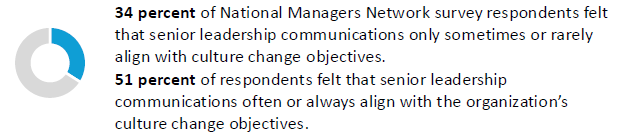
Figure 1 Summary
Progress in culture change varies significantly based on middle management buy-in of culture change initiatives. Trust in middle management is also stronger than trust in senior leadership. Middle management (i.e., leaders at the supervisory and mid-command levels) buy-in of culture change initiatives is a key factor in sustaining culture change efforts. Some civilian interviewees identified the need for increased accountability measures for managers at the initiative level. While managers buy into the need for culture change overall, they may not buy into specific culture change initiatives. Managers themselves identified the need for clearer guidance on the link between culture change initiatives and long-term culture change objectives for the Defence Team.
There were also differences between CAF and civilian middle management buy-in. During CAF site visits, there was a greater lack of buy-in for culture change overall versus at the initiative level. The evaluation also found significant variation in culture change buy-in for middle management across CAF elements and geographic locations. This affected the overall perception of progress in culture change. For example, some interviewees on one base reported feeling psychologically unsafe with limited support, while others at a different base reported the opposite.
National Managers Network survey respondents noted the need for “a clear vision from senior leadership.”
Low Defence Team morale and trust in the institution are impacted by the need for visible accountability measures.
A subcomponent of positive leadership modelling, identified through interviews, site visits and the National Managers Network survey, is the need for stronger and more visible accountability measures. Evidence indicates that visible accountability at all levels—senior leadership, middle management and institution-wide—directly influences trust in both leadership and the organization. Interviewees emphasized that institution-level accountability is particularly critical.
The evaluation found that the absence of transparent accountability tools, such as measurable performance indicators, reduces confidence that leaders are committed to meaningful progress. Leadership’s response to problematic behaviours significantly shapes Defence Team members’ trust in the institution. At the individual level, many interviewees perceived that members who exhibit problematic behaviours continue to advance. According to interviewees, their low trust in the institution is strongly linked to the lack of visible accountability mechanisms in this area.
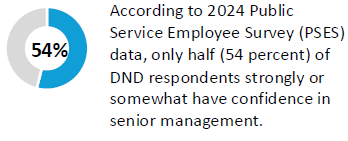
Figure 2 Summary
Defence Advisory Groups (DAG) described organizational trust as fragile and morale as strained.
Previous reports discussed key issues in the areas of morale and organizational trust within the CAF. Extending this analysis, the evaluation found that morale indicators are low in the 2024 Your Say Matters survey and PSES. For example, only 26 percent of Regular Force members reported high morale in the Your Say Matters survey, with junior ranks consistently lower than senior ranks. Indicators such as “trust” and “feeling valued” also lag for Defence Team respondents in PSES.
Some interviewees noted that low morale is often a result of operational factors such as workload, job stress and gaps in infrastructure (including lack of equipment). Several interviewees also shared morale examples linked to organizational culture and the need for increased accountability to safeguard against problematic individuals, particularly those who have been identified through formal reporting systems.
Professional Conduct
Long-term objectives for professional conduct in the Defence Team (the goal): Defence Team members conduct themselves ethically and respectfully.
Finding 2: Professional conduct has improved, with overt misconduct less tolerated than a decade ago. Subtle forms of inappropriate behaviour—microaggressions, exclusionary comments and informal “grey zone” behaviours—continue to undermine psychological safety. Policy gaps around consent and alcohol also create uncertainty for both members and supervisors.
While there is increasing awareness of inappropriate behaviour and language in the Defence Team, exclusionary behaviours continue to affect workplace psychological safety and inclusion.
According to interviews and literature review, sexually inappropriate behaviour is no longer normalized, and newer members are more willing to speak up than in the past. Updates to policies and directives (e.g., the Defence Administrative Orders and Directives 9005-1 – Sexual Misconduct Response) have clarified acceptable behaviour in the organization and created deterrence when applied consistently by leaders. In 2023, the Defence Team’s Sexual Misconduct Support and Resource Centre mandate was expanded, and the organization continues to support survivors, address systemic issues and inform institutional reform (see Annex B for full timeline).
At the same time, subtle cases of inappropriate conduct such as sexualized jokes and microaggressions are often overlooked. These subtle forms of exclusionary behaviours are frequently hard to pinpoint and discipline. While well-intentioned jokes are generally accepted and CAF members often pull back when sensing they have overstepped, behaviour and language tend to shift in the presence of senior members, with inappropriate comments more likely in informal settings.
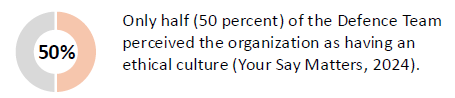
Figure 3 Summary
Additionally, greater awareness of inappropriate conduct has made some managers and senior leaders worry their behaviour could be misinterpreted, which can create an overly cautious environment. Leaders also raised concerns that corrective actions might be seen as biased or discriminatory (e.g., an employee believing they were disciplined because they are female). This can make leaders hesitant to manage performance or address issues.
Overall, continued exclusionary behaviours affect interviewees’ perception of workplace psychological safety and inclusivity.
“Compared to the past, when misogynistic or racist language was common among trainers and passed down to recruits, I don’t see that happening now. Expectations are clear: Inappropriate language is not tolerated.”
Site visit interview (instructor focus group)
Leadership that models respectful behaviour and intervenes promptly helps foster psychological safety and discourages misconduct. This positive behaviour modelling by leadership was described by interviewees as a factor that discourages future instances of misconduct, highlighting the importance of trust in the institution and leadership. This perception also applied to the senior leadership level.

Figure 4 Summary
Interview evidence indicates that leaders generally address inappropriate behaviour, though their responses depend on the severity and context. The evidence pointed to DEI training, employee support services and internal communications (such as newsletters and updates) as initiatives that helped members feel safe, respected and included. Managers also reported promoting inclusion within their teams by keeping an open-door policy to support psychological safety. Previous reports noted concerns about this approach, including issues of confidentiality and potential bias. These concerns discouraged some people from making formal reports.
Key informants during site visits noted that CAF members become disillusioned when managers do not “walk the talk.” Interviewees also shared that junior members did not trust the open-door policy. While supervisors may intend to create openness, employees remain cautious. This reinforces the need for strong formal reporting mechanisms.
“There are programs and initiatives, and the ‘leaders’ say the right things, but they are not walking the talk. It is all talk.”
National Managers Network survey response
“The level of confidence is inspired by the leader. If you have someone who is psychologically safe and you feel you can talk to that person, that makes a difference.”
Site visit interview (Culture Evolution Coordinator)
There are persisting challenges with sexualized environments, including drinking culture and unclear policy around consent. According to the data reported in the Conduct and Culture Data Centre, violent and sexual harassment incidents increased by 5.2 percent between 2023 and 2024 (6.3 percent to 11.5 percent), though it is unclear whether this increase reflects more cases of sexual misconduct or more cases being reported. As well, consent in sexual relationships is not clearly addressed in polic y, and drinking culture is still perceived as a risk factor for misconduct, both of which were noted in previous reports.
DAGs linked drinking culture to misconduct, noting many incidents occur off-duty, creating accountability gaps.
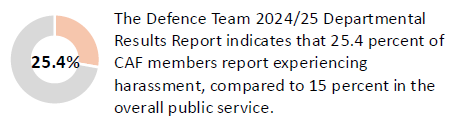
Figure 5 Summary
Defence Team Experience and Well-Being
Long-term objectives for Defence Team experience and well-being (the goal): The Defence Team is made up of diverse individuals who all feel included and respected, as well as physically and psychologically safe in the workplace.
Finding 3: Reporting mechanisms and training have expanded, yet confidence in the system remains low. Members are more aware of reporting options, with confidence in system protection and accountability remaining limited. Training is viewed as high in volume but low in impact, contributing to what members describe as culture fatigue.
While awareness of reporting options has improved, uncertainties remain regarding how to proceed when incidents occur. Interviews and site visit evidence indicate that, overall, awareness of reporting options has improved over the last 10 years. However, a significant proportion of interviewees perceived some reporting mechanisms as “unclear.” Factors that shape reporting clarity include how well senior leaders communicate reporting mechanisms, how aware and trained middle managers are in using them and the level of trust employees have that the process will resolve issues and protect them from harmful behaviour.
As an example, the repeal of the Duty to Report came into effect in June 2024 and allows CAF members to use a more trauma-informed approach that prioritizes the needs and safety of affected members and those who are reporting. It also removes the requirement for members to report incidents of misconduct to authorities. Some interviewees noted that this change in reporting introduced uncertainty about how to proceed when incidents occur.
DAGs described formal mechanisms as fragmented, unclear, slow and often perceived as tokenistic, leaving members uncertain about where to go for help and doubtful that the system will protect them.
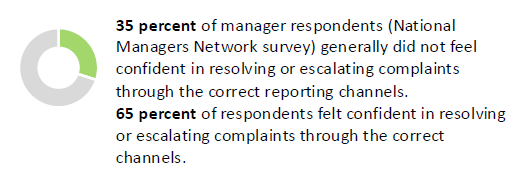
Figure 6 Summary
Reporting culture is affected by distrust in administrative processes related to responses to racism and sexual misconduct.
The evaluation found that there is a general distrust in formal Defence Team reporting mechanisms. Interviewees reported that general victim support often depends on individual champions rather than standardized practices. When leaders do not demonstrate supportive behaviours, victims are less likely to come forward. This results in informal networks filling the void and persistent perceptions that inappropriate behaviour carries no visible consequences.
Inappropriate behaviour is also sometimes managed informally by moving “problem individuals,” rather than holding them accountable (lack of visible accountability measures).
Among new CAF members, reporting culture is influenced by what interviewees described as “loyalty conflicts”—for example, the tension between reporting harmful or inappropriate behaviour and remaining loyal to peers, instructors or the unit to avoid exclusion or retaliation. These dynamics indicate barriers to culture change that are specific to the CAF. They are also linked to belief systems inconsistent with organizational values. These barriers and belief systems highlight gaps in workplace psychological safety and inclusion.
DAG members have low confidence in grievance and reporting systems, citing unclear processes, confidentiality issues and slow or inconsistent outcomes. Many avoid reporting due to fear of reprisal or career impacts.
“There are no consequences for anyone, whether for real actions or false narratives. Only when the most grievous thing occurs do we see action.”
Site visit interview
“This group noted a positive shift toward believing victims rather than approaching cases with suspicion.”
Site visit interview (instructor focus group)
“Responses to cases are improving, and processes are becoming more effective.”
Site visit interview (senior leaders focus group)
While the breadth of culture training has expanded, Defence Team buy-in is uneven and perceived as a compliance exercise. Even when effective training is available, uptake is low. This limits its impact on behaviour and has contributed to “culture fatigue,” with CAF members in particular seeking training that is practical, useful and clearly linked to the rationale for culture change. For example, interviewees expressed frustration that training often feels disconnected from real-world scenarios.
While interactive and leader-facilitated peer learning and reinforcement in daily practice are seen as effective, barriers persist—including initiative churn (i.e., frequent changes to initiatives), training fatigue and operational demands that limit time for reflection.
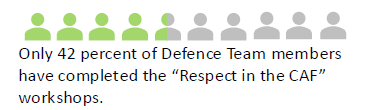
Figure 7 Summary
“Although there is plenty of talk and training, there is no actual time allocated to addressing individual issues as the tempo and pace of operations is the priority.”
National Managers Network survey response
Diversity, Equity and Inclusion
Long-term objectives for DEI in the Defence Team (the goal): Defence Team culture supports DEI; is rooted in the DND and Canadian Forces Code of Values and Ethics; and allows people to feel valued, respected, connected, psychologically safe and empowered to bring their authentic selves to the workplace.
Diversity can be understood in several ways. For the purpose of this evaluation, diversity “includes such factors as age, sex, gender, race, ethnicity, physical and intellectual ability, religion, sexual orientation and the unique personal characteristics that distinguish us as individuals and groups” (Gender-based Analysis Plus).
Finding 4: Acceptance of women has improved, with barriers persisting—especially for individuals with intersecting identities and persons with disabilities. Experiences of exclusionary behaviour and inconsistent accommodations continue to signal that inclusion is not yet embedded. Diversity, Equity and Inclusion efforts are often seen as performative when leadership modelling and middle management engagement are weak.
There has been progress in the acceptance and inclusion of women; however, for individuals with intersecting identities, barriers are magnified. While previous reports noted the prevalence of a “boys’ club” culture within the CAF, the evaluation evidence was mixed in this regard. It found that the inclusion of women had strongly improved over the past 10 years and women were perceived as highly visible and strongly accepted within the Defence Team. While some interviewees felt that the old “boys’ club” was no longer part of the culture, others described it as persisting.
Interviewees also noted inclusion can vary by trade, with some being more receptive to the integration of women than others. The acceptance of women (and DEI members) also depended on the team culture. Teams that are open, respectful and promote psychological safety are perceived as more inclusive.
“DND remains primarily white, and it is much easier for white women to feel accepted than racialized women. For others who are non-white and have multiple identities, they face many barriers.”
National Managers Network survey response
Interviewees noted the CAF’s strong focus on recruitment efforts to increase its overall numbers. These efforts have opened the door to individuals who may hold cultural expectations, norms and values that differ from those commonly accepted in Canadian society. A frequently cited example involved attitudes toward women in leadership roles. Interviewees noted that some newer members struggle with taking orders from leaders identifying as female and, in certain cases, have refused to comply, resulting in disciplinary action. Note that when these individuals are identified early in their careers, targeted support and training was described as effective.
DEI progress faces barriers related to exclusionary behaviours.
Across interviews, there were perceptions of progress for DEI group members since 2015. Individuals who did not self-identify as belonging to a DEI-designated group perceived progress more positively. For example, interviewees perceived visible minority members as being strongly accepted and supported by increasingly diverse teams across the organization, yet nearly a third of 2024 PSES respondents generally disagreed with the statement that “individuals are accepted as an equal team member.”
Some members may feel more accepted and included than others, in part because of their own personal experiences in the organization. One senior interviewee noted that it is the “subtle jabs” (the microaggressions experienced by some members) that are harder to eliminate. For individuals with intersecting identities, barriers to inclusion are magnified. Issues include exclusionary behaviours, microaggressions and inappropriate language targeting minority groups (e.g., slurs), which are harder to address.
CAF members also faced more barriers in DEI progress. There were examples of CAF members who belong to DEI-designated groups being told to “go back home” or, conversely, being told, “you’re one of the good ones.”
Acceptance and inclusivity also differ based on operational context and location. For instance, some interviewees noted that inclusion is harder aboard ships, where biases persist as well as social separation or exclusion. Interviewees noted that this environment may be particularly challenging for members of the 2SLGBTQI+ (two-spirit, lesbian, gay, bisexual, trans, queer, intersex plus) community as transgender individuals struggle with appropriate sleeping arrangements and may experience little support from leadership.
Reports of hateful conduct for 2SLGBTQI+ members doubled between 2022 and 2024 (Conduct and Culture Data Centre, 2025) from 8 percent to 16 percent.
Additionally, some members have experienced exclusionary behaviour through a lack of accommodation for religious and/or spiritual needs. Interviewees shared the challenges they faced in having their religious or spiritual accommodations met as non-Christian members. For instance, one key informant was refused Indigenous spiritual leave on the grounds that the event was not on a calendar. As the employee explained, many Indigenous ceremonies, commemorations and cultural practices do not appear on standard workplace calendars, but this does not reduce their importance to those who observe them.
Another interviewee recounted their experience as a practising Muslim, sharing that they were penalized by their Chain of Command for being “absent” while observing prayer—even though their immediate supervisor had granted them permission to do so. Interviewees shared stories of accommodations being met as well, though there were fewer.
Challenges faced in both religious and spiritual accommodations and the experience of exclusionary behaviours and microaggressions in turn affects employees’ sense of workplace safety and inclusivity. Although interviewees noted improvements in the equity of diverse groups and progress toward overall inclusivity since 2015, continued efforts in DEI are required.
A recent report funded by the MiNDS program reported the growing presence of systemic white supremacy and xenophobic sentiments within the CAF. As a result, members from racialized communities may face challenges integrating into the CAF, undermining inclusion efforts. The rise of extremist viewpoints was also mentioned by two key informants at one of the bases.
“It’s still an overwhelmingly white, male-dominated organization.”
Site visit interview (instructor)
“There’s a lack of education around 2SLGBTQI+ issues, especially regarding slurs and accommodations. Every time feels like the first time.”
Site visit interview (Positive Space Ambassador)
There are persisting structural and attitudinal barriers to equity and inclusion for persons with disabilities. The evaluation’s survey data indicated that the inclusion of persons with disabilities was the weakest among the diversity groups, with persistent structural and attitudinal barriers (e.g., telework scrutiny, low awareness, accommodations). Interviewees noted that it can be particularly difficult to approve accommodations when an individual’s official record does not reflect the need. Members may hesitate to seek medical assistance to obtain such documentation as mental health services continue to carry stigma within the CAF. Even though policies and training have improved outcomes, day-to-day culture and attitudes remain uneven.
“CAF members often have to navigate a precarious line: how much to disclose, how much help to ask for and how much to simply ‘soldier on’ because that’s what’s expected.”
Site visit interview
DEI initiatives are generally well perceived, yet without leadership modelling and middle management buy-in, inclusivity is viewed as performative and compliance-driven. While many interviewees note that these efforts can help educate members, some perceive that promotions may be attributed to visible minority status rather than merit (i.e., tokenism), creating a sense of “forced inclusivity.” DEI group members themselves feel chosen for certain initiatives because they “check the right boxes” and are frequently asked to participate in public-facing events. Many simply want to belong without being “othered,” which can undermine DEI efforts. Some interviewees perceived competence as the more defining factor for social acceptance.
Some DAG members describe DEI initiatives as too often tokenistic checkbox exercises that create mistrust and leave some members feeling like “window dressing” rather than genuinely included.
Interviewees also observed generational differences in attitudes toward inclusivity and culture change: Newer CAF recruits tend to be more receptive and aware of inclusive practices, while older generations often struggle to adapt. Some interviewees noted that as Canada’s population becomes increasingly diverse, new recruits may already embrace inclusivity and diversity. Others noted that some long-serving members resist these changes or find it challenging to adopt new norms.
During site visits, the concept of the “frozen middle” was raised—the idea that middle-level management includes individuals who resist or even undermine culture change efforts. Given their influence, this resistance can significantly slow progress and underscores the influence of positive leadership modelling. Similarly at a different site, some managers filter out DEI-related messaging, which can reduce their overall engagement and awareness. Across interviewees, the key determinant that influenced the acceptance and inclusion of DEI members in units and teams was leadership behaviour.
“DEI groups have access to senior leadership, and general acceptance is well established.”
Site visit interview (senior leadership)
Measuring Culture Change in the Defence Team
As a cross-cutting theme, the evaluation assessed whether current approaches to measuring culture change meaningfully support decision making and sustained transformation in an environment characterized by a high volume of culture-related initiatives and data collection. The evaluation team completed a comprehensive review of existing and emerging culture-related data.
Finding 5: While Defence has implemented a wide range of measures to assess culture, gaps remain in how this information is integrated and used. Current approaches are fragmented and rely primarily on quantitative data, with more limited use of qualitative, intersectional and experience-based insights. As a result, there is not a complete view of how culture is experienced across the Defence Team, and the consistent use of evidence to inform decisions is limited, particularly in areas such as Defence Team experience, well-being and professional conduct.
What does the evaluation evidence tell us about culture measurement in the Defence Team?
The evaluation found that culture measurement across the Defence Team is limited by siloed systems, checkbox-style metrics and unclear definitions, as well as inconsistent use of intersectional and victim-centred data. While many culture-related measures are already in place, they are applied unevenly across culture focus areas and often remain surface-level. The current approach emphasizes coverage over focus, which means that measurement does not always produce useful or actionable information.
Gaps in qualitative and contextual indicators, along with limited integration of existing data, make it difficult for leaders to understand what is driving observed trends or how culture is experienced in operational and workplace settings. As a result, senior management lacks a clear, Defence Team–wide picture. The evaluation found that measurement of victim-centric and intersectional lived experiences is a key factor influencing both professional conduct and Defence Team experience and well-being. Overall, the evidence suggests that refining, prioritizing and better integrating existing measures would be more valuable than introducing additional indicators.
Annex A: Management Action Plan
ADM(RS) Recommendation
Management Action 1:
Action 1.1
CPCC will advance work to formally close out the Culture Implementation Plan (CIP), noting that ongoing implementation efforts continue to be tracked to full implementation, and efforts for military justice system modernization will continue to be advanced by the Judge Advocate General.
Deliverable: A closeout report for CIP will be delivered to the Chief of the Defence Staff and the Deputy Minister, summarizing all implementation efforts to date and outlining next steps for ongoing monitoring.
OPI: CPCC; Director General Engagement, Policy and Research (DGEPR)
OCI: All implicated CIP L1s
Target Date: August 2026
Action 1.2
CPCC will renew CES to align with the Defence Team Code of Values and Ethics and will develop an associated conduct and culture performance measurement framework that includes and is not limited to the key drivers of positive culture change identified in the evaluation with the intent to focus on the measurement of progress and impact.
Deliverable: The revised CES, including a performance measurement framework, is finalized and published for Defence Team members.
OPI: CPCC, DGEPR
OCI: All implicated CIP L1s
Target Date: April 2027
ADM(RS) Recommendation
Management Action 2:
Action 2.1
In collaboration with Defence Team partners, Assistant Deputy Minister (Human Resources-Civilian) (ADM[HR-CIV]) will advance the implementation of the Complaints Process Transformation program to streamline how Defence Team members submit complaints; improve the efficiency of complaint processing; and strengthen the use of data to track outcomes and identify opportunities for additional training, communications, policy clarification and other systemic improvements.
Deliverable: The Complaints Process Transformation program is transitioned from CPCC to ADM(HR-CIV), the team is staffed, and a revised program work plan is approved.
OPI: ADM(HR-Civ)
OCI: Digital Services Group, CMP, CPCC, Assistant Deputy Minister (Review Services) (ADM[RS])
Target Date: June 2027
Action 2.2
In collaboration with Defence Team partners, CPCC will review the initial model established for the Addressing Wrongful Behaviours at the Department of National Defence: Annual Report and assess the feasibility of expanding the report to cover all members of the Defence Team and a broader range of professional conduct datasets, beginning in fiscal year 2027/28.
Deliverable: A recommendation is brought to the Chief of the Defence Staff and the Deputy Minister for decision.
OPI: CPCC, DGEPR
OCI: CMP, ADM(HR-Civ), Judge Advocate General, ADM(RS)
Target Date: December 2026
Annex B: Defence Team Culture Change Milestones
Since 2015, the Defence Team Culture Change effort has progressed through key milestones to strengthen accountability, enhance governance and support sustained organizational change. These are outlined in the following diagram.
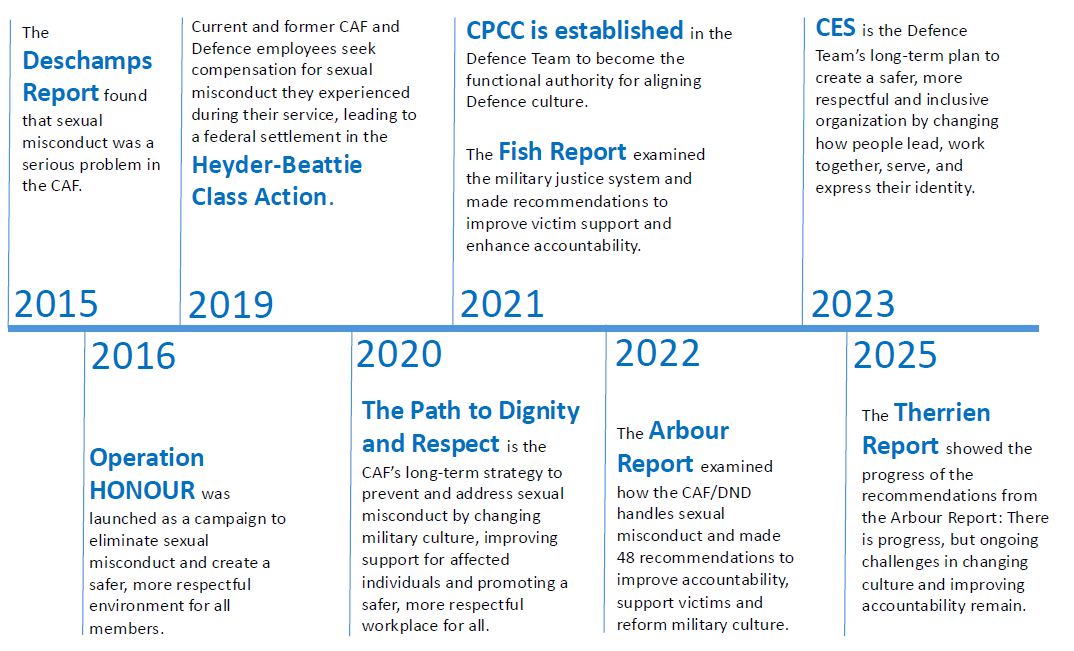
Figure B-1 Summary
Annex C: Methodology
Methodologies were developed in consultation with Evaluation Advisory Committee members. The evaluation drew on multiple evidence sources and identified themes by comparing results across them.
Interviews and Focus Groups |
Over 100 interviews were conducted with members from:
|
Data Analysis |
Existing data was reviewed and analyzed from:
|
Site Visits |
|
Document Review |
Over 250 documents were reviewed:
|
Survey |
Survey of the National Managers Network
|
Table C-1 Summary
Limitations |
Mitigations/Explanations |
|---|---|
The report uses the term “Defence Team” as opposed to differentiating between military/CAF and civilian. |
The evaluation approached data collection for culture with a whole-of-Defence culture lens, with the goal of determining system-wide patterns. Subcultures were identified during the evidence analysis phase, and the report highlights the differences between military and civilian when they presented as significant. Evaluation recommendations will further account for any significant culture differences. |
The report narrative focuses on new evidence from the interviews, site visits and the National Managers Network survey. |
The evaluation methodology includes the triangulation and roll-up of evidence. Although findings are developed using all lines of evidence, the report narrative focuses on new evidence from the interviews, site visits and the National Managers Network survey. The goal of the evaluation was to assess the current climate of culture change in the Defence Team (how well is culture change going) and provide recommendations. |
The report does not distinguish between the perceptions of the various interview groups. |
Interview groups and responses were not identified in the report or were identified at a very high level in order to protect the anonymity and confidentiality of the respondents. Note that the evaluation did not find significant variance between interview group responses. |
Table C-2 Summary
Annex D: Definitions
Culture Evolution Strategy (CES) |
The Defence Team’s organization-wide strategy that sets out the long-term vision, principles and objectives for culture change. CES defines what culture change aims to achieve and how it is embedded in leadership, values and institutional practices, and how it is operationalized through CIP. |
|---|---|
Culture Implementation Plan (CIP) |
The Defence Team’s organization-wide roadmap for implementing culture change across DND and the CAF. |
Culture Evolution Coordinator |
A designated Defence Team role that supports and coordinates the implementation of culture evolution initiatives at the local level. |
Culture Measurement Aspect |
The four culture measurement aspects are based on the Defence Team’s CIP and CES. CIP uses these four aspects to categorize all its initiatives and activities that are being implemented. Key culture change activities in the Defence Team are categorized by these four aspects:
|
Defence Advisory Groups (DAG) |
Employment equity advisory groups of serving CAF military members and DND public service employees who provide grassroots insight, advice and recommendations to Defence Team leadership. DAGs are made up of volunteers who set aside time from their normal duties to represent their communities and to be a strong voice for historically marginalized groups within the Defence Team. There is a DAG for each of the designated groups identified in the Employment Equity Act: women, Indigenous people, persons with disabilities, visible minorities and 2SLGBTQI+ members. |
Leadership Modelling |
Leadership modelling refers to the behaviours, actions and decisions demonstrated by leaders that visibly reflect and reinforce the values, standards and expectations of the Defence Team. The vision is for leaders who inspire trust and confidence, motivating and enabling their teams to meet their mission and mandate, and achieve results in a sustainable way. |
Middle Management |
For the purpose of this evaluation, middle management refers to leaders at the supervisory and mid-command levels (e.g., immediate supervisors, section heads, unit-level managers and equivalent command roles) who are responsible for implementing senior leadership direction, managing day-to-day personnel issues and shaping local unit culture. |
Organizational Culture |
The shared beliefs, values and basic assumptions that shape how people think and act, especially learned when joining a new unit or team. |
Visible Accountability Measures |
Visible accountability measures are observable actions and mechanisms through which leaders and institutions demonstrate that standards of conduct are enforced and that inappropriate behaviour has consequences. These measures include transparent processes, consistent application of consequences and clear communication of outcomes, enabling Defence Team members to see that accountability is real, fair and applied at all levels. |