Canadian Armed Forces structure for search and rescue
The Canadian Armed Forces (CAF) responsibilities for search and rescue (SAR) are led by the Canadian Joint Operations Command (CJOC) and the Royal Canadian Air Force (RCAF).
- CJOC is responsible for planning and preparation, and command and control of all SAR operations.
- The RCAF is responsible for ensuring the SAR response infrastructure is ready for SAR operations, including SAR aircrews and aircraft.
SAR alert detection
There are certain types of distress beacons that are federally mandated, called 406 MHz Cospas-Sarsat beacons. Canada is a leader in the international Cospas-Sarsat SAR satellite network that detects these beacons.
The CAF operates the Canadian Mission Control Centre (CMCC), which triages distress alerts received by the Cospas-Sarsat system and distributes these alerts to SAR coordination centres across Canada and partners around the globe.
Accelerating rescue through 406 MHz beacon registry
To accelerate rescue response times and mitigate false alerts, CMCC also manages the Canadian Beacon Registry (CBR), which stores contact information for owners of 406 MHz beacons owners so they can be reached when distress signals are received at CMCC. In most cases, by law, owners are required to register their 406 MHz beacons in the CBR. All beacon owners are encouraged to register their 406 MHz locator beacons in the CBR, even when not required by law, because doing so helps save lives.
SAR regions across Canada
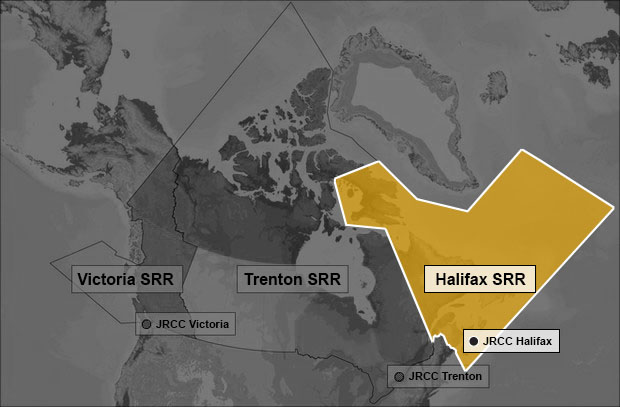
There are three SAR Regions (SRRs) strategically positioned across Canada. The Commander for each region reports to CJOC.
Regional SRR Commanders align response postures with the periods of greatest SAR activity, such as during the summer months, the opening of fisheries and the days/times of the week that typically have the highest volume of calls.
When an air or maritime SAR incident occurs, the regional SRR Commander tasks the appropriate resources to execute the mission, which could include resources from the CAF or Canadian Coast Guard. They may also partner with other SAR authorities and volunteer organizations.
For more information about how the RCAF ensures the SAR response infrastructure is ready for SAR missions when the taskings come in, visit SAR aircrews and aircraft.
Rescue coordination centres across Canada
Within each SRR, there is a Joint Rescue Coordination Centre (JRCC) that:
- is staffed 24 hours a day, seven days a week;
- is led by a member of the RCAF; and
- includes members from both the RCAF and Canadian Coast Guard to plan, coordinate and control air and maritime rescue operations.
The Canadian Coast Guard also operates two Maritime Rescue Sub-Centres in eastern Canada to support enhanced maritime response in busy federal waterways. These are located in the City of Québec, Quebec, and St. John’s, Newfoundland and Labrador.
Western Canada
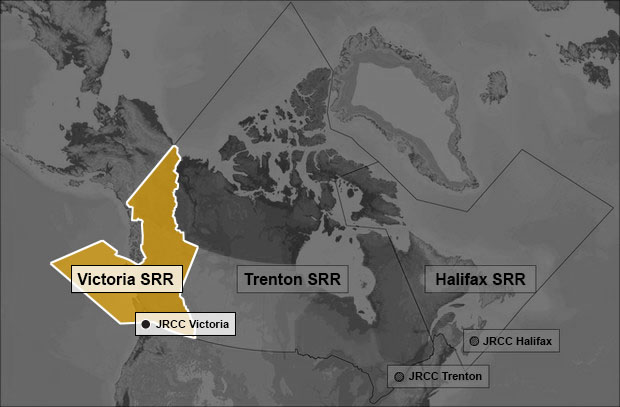
JRCC Victoria is responsible for approximately 1,427,000 square kilometers that includes British Columbia and the Yukon. Much of this land is mainly mountainous terrain. JRCC Victoria is also responsible for 687,000 square kilometers of the Pacific Ocean. It receives about 3,000 calls for assistance per year.
Central Canada
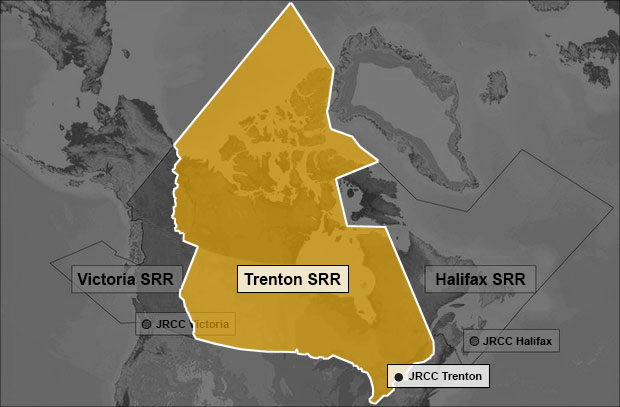
JRCC Trenton is responsible for an area of more than 10 million square kilometres in central Canada, including the central north region and the Great Lakes. It receives about 4,000 calls for assistance per year.
Eastern Canada
JRCC Halifax, is responsible for approximately 4.7 million square kilometres that is 80 percent water (or more than 29,000 kilometres of coastline) and includes the eastern north region. It receives about 2,500 calls for assistance per year.