
2021 Comprehensive Evaluation Report
About this publication
Publication author: Canada Economic Development for Quebec Regions
Catalogue: Iu90-4/70-2022E-PDF
ISBN: 978-0-660-41635-9
Publish date: February 8, 2022
Summary: The 2021 Comprehensive Evaluation Report outlines the achievements of Canada Economic Development for Quebec Regions (CED) over the past five years.
Table of Contents
- Message from the Minister
- Message from the President
- Introduction
- Section 1: Management Results
- Section 2: Impact of our Interventions
- Conclusion
- Appendices
- Endnotes
Message from the Minister
I am proud to present to Parliament this 2021 Comprehensive Evaluation Report, which outlines the achievements of Canada Economic Development for Quebec Regions (CED) over the past five years.
The reader will discover the various activities carried out by CED to support the growth of SMEs and communities in all regions of Quebec.
For over 50 years, CED has been anchored in the regions of Quebec, specifically through its 12 business offices located across Quebec and its Head Office in Montréal. This presence on the ground, together with the ties forged with other economic development players, allows CED to remain abreast of the needs of businesses and the regions.
CED, like the six other regional development agencies (RDAs), is well-positioned to ensure that government priorities are reflected in its actions on the ground. Since 2017, CED has been contributing to the implementation, in Quebec, of four of the key priorities of the Innovation and Skills Plan, namely support for inclusive regional innovation ecosystems; business growth and expansion; clean technologies; and inclusive growth.
Whether it be through support for innovation, entrepreneurship, exports or tourism, CED’s interventions aim to help communities and SMEs prosper. Specific areas of activity have been targeted based on the strengths of the various regions. From support for the fishing industry in the Côte-Nord and Gaspésie‒Îles-de-la-Madeleine regions, to the marketing of optics/photonics research in the Quebec City region; the adoption of green technologies and innovation in Greater Montréal, or the promotion of tourism across Quebec, CED’s activities have made a real difference.
Of the many figures presented in the Report, some in particular speak volumes about CED’s relevance and tangible impact: 97% of the businesses supported by CED were still operating in March 2021, despite the economic shock caused by the COVID-19 pandemic; and each dollar invested by CED in projects with or for businesses, through its regular programs (REGI and QEDP), generated a leverage effect of $5.56 among the other partners. Under the Government of Canada’s pandemic response plan announced in the 2020 Speech from the Throne, CED granted $111 million to the Community Futures Development Corporations (CFDCs) and Business Development Centres (BDCs). With the help of this funding, Quebec’s CFDCs and BDCs assisted over 6,200 businesses and organizations affected by the COVID‑19 pandemic in all the rural regions of the province.
In collaboration with the numerous players on the ground—governments, economic and community stakeholders, etc.—CED aims to help businesses and communities deal with the economic and structural issues facing the regions of Quebec.
Whether it involve the green economy, the fight against climate change or the adoption of advanced technologies, CED is working hard to ensure that the regions are able to fully participate in a clean and inclusive recovery.
This is our commitment for the coming years.

Pascale St-Onge
Minister of Sport and Minister responsible for the Economic Development Agency of Canada for Quebec Regions
Message from the President
I am pleased to present the Canada Economic Development for Quebec Regions (CED) 2021 Comprehensive Evaluation Report. The report presents the key results achieved from 2016 to 2021.
The past few years have been marked by a number of challenges and major events—from the Lac-Mégantic train accident, the economic impact of which extended well beyond 2013, to the COVID-19 pandemic in 2020. I am proud of my team’s accomplishments, both on the ground and at Head Office. All our teams have been working tirelessly to ensure the delivery of various support programs, initiatives and measures to meet the needs of Quebec’s small and medium‑sized businesses (SMEs) and communities.
Drawing on the expertise of its 12 business offices located all across Quebec, and its network of collaborators, CED has had a tangible impact on the ground and has made a real difference. Over 47,000 businesses, entrepreneurs and organizations have benefited from the services offered by non-profit organizations that receive CED funding, and CED has provided $1.57 billion in grants and contributions to support 4,335 projects.
CED has also pursued its collaboration with the other regional development agencies (RDAs) throughout Canada on the development and implementation of targeted initiatives, such as the national Regional Economic Growth through Innovation (REGI) program; the Regional Relief and Recovery Fund (RRRF), designed to assist SMEs and communities affected by the economic crisis brought on by COVID-19; and, more recently, the Regional Air Transportation Initiative (RATI).
CED strives to create and maintain a healthy, modern and inclusive workplace, and the organization continuously seeks innovative ways of doing business, delivering its services, and meeting its clients’ expectations.
In terms of management, CED has implemented a number of projects that involve an innovative approach to the modernization of its business practices and processes. They include the modernization and upgrading of the work environment; the creation of an Office of the Ombuds for Mental Health and Well-Being; the adoption of a GBA+ governance framework; the setting up of an InfoCentre for users; the development of a new common grant and contribution management platform; and, more recently, the review of our virtual and hybrid work methods. These are but a few examples of the work accomplished by CED, which I invite you to discover in this report.
CED is also committed to listening to Quebec SMEs and communities. To this end, CED has participated in several regional meetings and forums to initiate dialogue with entrepreneurs and economic stakeholders on various issues, such as the digital shift, new business models, adapting to climate change, and regional development. The opinions and ideas expressed at these meetings have allowed CED to define new directions and improve the implementation of its programs through a flexible, community-based approach.
As a key regional development player in Quebec, CED will continue to foster the growth of businesses and the recovery and economic vitality of communities by supporting innovation and sustainable, inclusive growth.
Enjoy!

Manon Brassard
Deputy Minister / President of Canada Economic Development for Quebec Regions
Introduction
How to read this report
Under its enabling legislation, the Economic Development Agency of Canada for the Regions of Quebec (hereinafter referred to as CED or the Agency) is required to submit, in addition to its annual reports, a Comprehensive Evaluation Report (CER) on its activities, once every five years. The 2021 CER covers the period from April 1, 2016, to March 31, 2021. It looks back on the organization’s activities over the past five fiscal years, providing a broader perspective. It can be read in conjunction with the past five Departmental Results Reports (DRRs)Footnote 1, tabled annually in Parliament, which present annual results in a format predetermined by the Treasury Board Secretariat (TBS), i.e., the Departmental Results Framework (DRF).
In order to effectively present the results of CED’s activities, the 2021 Comprehensive Evaluation Report has two main sections—Management results and Impact of our interventions—as well as an introduction and a conclusion.
Section 1 (Management results) provides an overview of CED’s activities for creating and maintaining a healthy, modern and inclusive workplace.
Section 2 (Impact of our interventions) presents the overall results, both for businesses and communities. In this section, data on results is organized by theme so as to reflect government priorities, the commitments in the Minister’s mandate letter, and the needs and concerns of Quebec’s small and medium-sized businesses (SMEs) and the organizations that support them, primarily non-profit organizations (NPOs). Innovation and technology transfer, clean growth and a green economy, and economic diversification are just some of the themes that will be addressed in this section.
Raison d’être and intervention approach
Brief history of CED
In 2018, CED celebrated 50 years of federal economic development in the regions of Quebec. It was in 1968, in Rimouski, that the Agency's adventure began. Since then, CED has grown to become a key player in the development of Quebec's regions. CED's history has been built on half a century of collective efforts and concrete actions devoted to the growth of Quebec's regions and businesses.
CED has its own legal basis for promoting the development and diversification of the economy of the regions of Quebec, the Economic Development Agency of Canada for the Regions of Quebec Act, which came into effect on October 5, 2005.
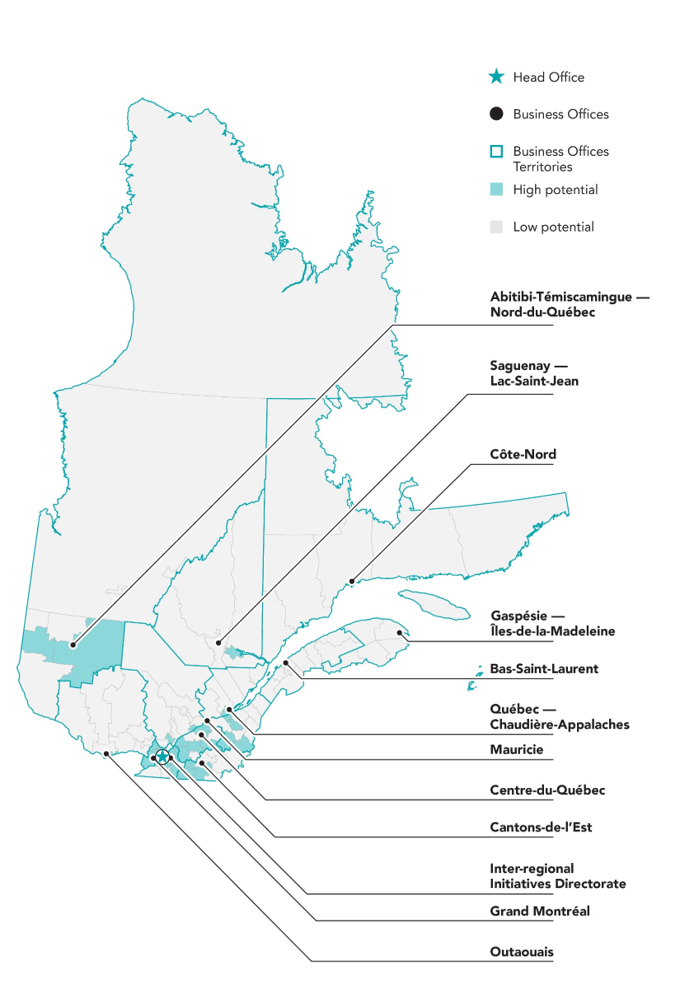
Text version : Regions of Quebec map
• Gaspésie – Îles-de-la-Madeleine
• Côte Nord • Bas Saint-Laurent
• Abitibi-Témiscamingue – Nord du Québec
• Saguenay – Lac-Saint-Jean
• Québec – Chaudière-Appalaches
• Mauricie • Centre-du-Québec
• Cantons-de-l’Est
• Greater Montréal • Outaouais
• Inter-regional Initiatives Directorate
Of the 104 RCMs in Quebec, 71 have low economic development potential. The 33 RCMs with high economic development potential are located in the territories of the following business offices:
• Abitibi-Témiscamingue – Nord du Québec
• Saguenay – Lac-Saint-Jean
• Québec – Chaudière-Appalaches
• Mauricie
• Centre-du-Québec
• Cantons-de-l’Est
• Greater Montreal
• Outaouais
• Inter-regional Initiatives Directorate
Mission
As stipulated in its enabling act, CED’s missionFootnote 2 is to “promote the long-term economic development of the regions of Quebec by giving special attention to those where slow economic growth is prevalent or where opportunities for productive employment are inadequate.” In keeping with this mission, CED is committed to promoting “co-operation and complementarity with Quebec and communities in Quebec.”
Present in all the regions, at the heart of distinct economic dynamics
For more than 50 years, CED has been anchored in the regions of Quebec, specifically through its network of 12 business offices located across Quebec and its Head Office in Montréal. This presence on the ground, together with the ties forged with other economic development players, allows CED to remain abreast of the needs of businesses and the regions.
Interventions tailored to development potential
CED contributes to the economic vitality of all regions of Quebec by building on their competitive regional advantages, with a particular focus on certain key sectors that are important drivers of prosperity and vitality. It also supports the transition and diversification of communities that remain dependent on a limited number of sectors, or that have been affected by an economic shock. Finally, through its strategic investments, CED maximizes the benefits that its interventions generate for Quebec businesses.
Our approach is distinct, with a focus on Quebec for the implementation of federal priorities
Our attention is focused on putting in place conditions that foster economic growth in all regions, based on their realities.
Our intervention priorities aim to address issues as they happen on the ground.
Our approach is flexible and community-focused, and involves collaboration with our federal partners, the Government of Quebec, and key stakeholders.
As a federal player present in and working for Quebec, CED draws on an integrated analysis of the sectoral, regional and institutional factors that structure economic development. It also relies on its strong presence on the ground to develop and implement programs and initiatives that contribute to the achievement of government priorities, taking into consideration socio-economic realities and the needs of businesses in the various regions of Quebec. Specifically, CED
- works closely with strategic partners at the regional level; and
- ensures that regional perspectives are taken into account in the development of national programs and initiatives.
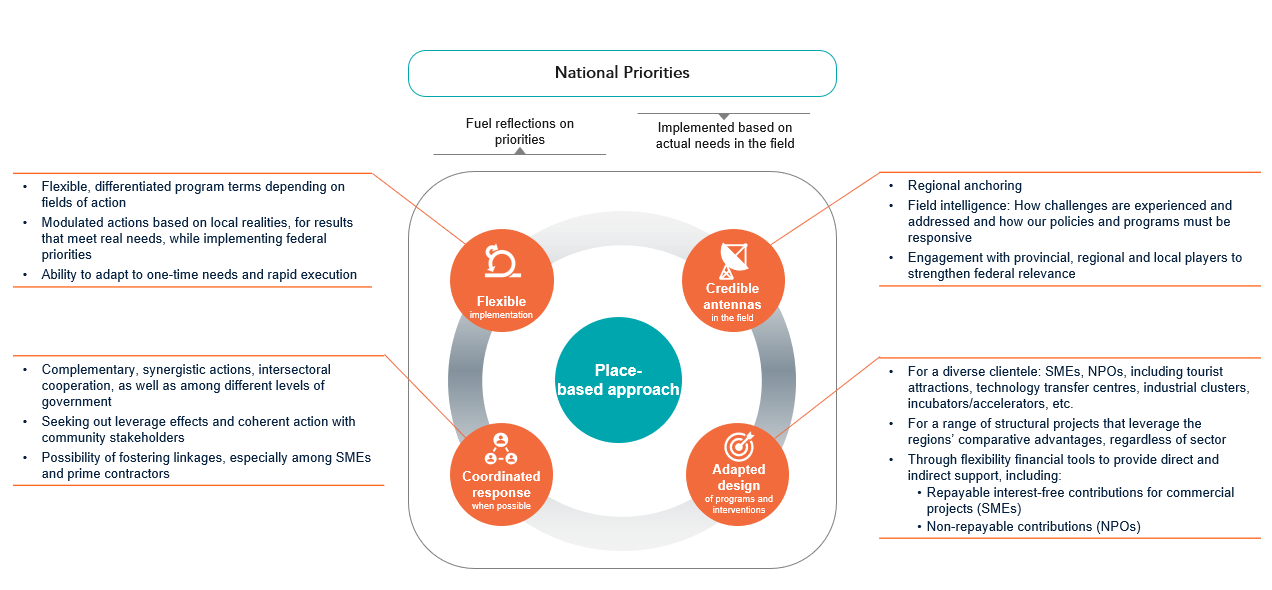
Text version: National Priorities
Place-based approach
Credible antennas in the field
- Regional anchoring
- Field intelligence: How challenges are experienced and addressed and how our policies and programs must be responsive
- Engagement with provincial, regional and local players to strengthen federal relevance
Adapted design of programs and interventions
- For a diverse clientele: SMEs, NPOs, including tourist attractions, technology transfer centres, industrial clusters, incubators/accelerators, etc.
- For a range of structural projects that leverage the regions’ comparative advantages, regardless of sector
- Through flexibility financial tools to provide direct and indirect support, including:
- Repayable interest-free contributions for commercial projects (SMEs)
- Non-repayable contributions (NPOs)
Coordinated response when possible
- Complementary, synergistic actions, intersectoral cooperation, as well as among different levels of government
- Seeking out leverage effects and coherent action with community stakeholders
- Possibility of fostering linkages, especially among SMEs and prime contractors
Flexible implementation
- Flexible, differentiated program terms depending on fields of action
- Modulated actions based on local realities, for results that meet real needs, while implementing federal priorities
- Ability to adapt to one-time needs and rapid execution
Programs
Our programs and initiatives are flexible and responsive
CED’s funding programs fall under three pillars: regional innovation, community vitality, and targeted temporary support. These pillars are designed to take into account desired outcomes and the needs of the regions of Quebec. Through its programs, CED has the flexibility it needs to provide funding tailored to projects submitted by businesses and communities in Quebec.
 Regional Innovation
Supporting innovation through business productivity and growth and through regional ecosystems:
- Regional Economic Growth through Innovation (REGI)
 Vital Communities
Helping communities seize development and diversification opportunities:
- Quebec Economic Development Program (QEDP)
- Community Futures Program (CFP)
- Economic Development Initiative (EDI) – Linguistic Duality
 Targeted Ad Hoc Support
Supporting development opportunities (national in scope or specific to Quebec or a region) within a prescribed time frame:
- National initiatives
- Linked to national issues
- Linked to COVID-19
- Linked to the recovery
- Initiatives specific to Quebec
Context
Economic context
Between 2016 and 2019, Quebec’s economy posted strong growth, with gross domestic product (GDP) growth (8.9%) that surpassed the average for Canada as a whole (7.9%). Noticeable increases have been observed in employment; furthermore, since 2017, the unemployment rate has been lower than the Canadian rate (5.1% and 5.7%, respectively, in 2019). Year after year, wages have been growing faster in Quebec than in Canada as a whole. Quebec’s manufacturing exports, driven by the strong performance of the U.S. and global economies, have also outpaced the Canadian average. Investments have continued to grow, and the housing market has remained strong. Before the onslaught of COVID-19, the Quebec economy was in full swing.
In March 2020, in Quebec and elsewhere, COVID-19 lockdown measures resulted in the sudden shutdown of large segments of the economy and triggered the largest and most abrupt economic contraction since the Great Depression. At the height of the lockdown in the spring of 2020, over 825,000 Quebecers had been laid off, and GDP had shrunk by 22%. The economy went on to experience a solid recovery, supported by stimulus measures, improved confidence, and more-targeted lockdown measures.
In 2021 overall, record growth (between 6% and 7%) is expected to offset and surpass most of the losses of 2020.
Beyond the immediate impacts of the pandemic, brought on by the situation, the Quebec economy is also facing some structural issues. Drawing on its on-the-ground intelligence and its ties with economic development players, CED has identified six key issues:
- Productivity gap: Quebec is lagging behind in terms of productivity, which jeopardizes the competitiveness of its businesses and also its prosperity. Quebec businesses are slow to make the necessary investments in innovation and the adoption of digital technologies.
- Labour shortage: The labour shortage continues to put pressure on SMEs. In 2021, the vacancy rate reached unprecedented levels. Many SMEs are having to postpone projects or refuse contracts because of a lack of workers. Beyond the immediate recovery, digital technology will continue to transform the labour market and increase the demand for skilled labour, as was seen during the pandemic.
- Commercialization shortcomings: Quebec is experiencing shortcomings in terms of commercialization. Fewer Quebec businesses and organizations are converting their R&D work into patents: the rate of patenting of innovations is about half that reported in Ontario.
- Decline in entrepreneurial intensity and sluggish business growth: Quebec is dealing with a lack of new workers (deficit of 38,000 replacements) to fill the gap created by the departure of entrepreneurs whose succession is often poorly or under prepared.
- Community adjustment challenges: A number of Quebec communities, often ones in rural areas, lack the infrastructure needed to deal with technological, economic and climatic changes in order to ensure their prosperity. The pandemic has increased the need for digital infrastructure in all regions. In addition, some of these communities are dependent on industrial activities that are in decline or at risk of becoming so.
- Climate change adaptation and environmental performance: Although Quebec produces most of its electricity using low-emission hydro-electric sources, its performance with respect to other environmental indicators, such as waste generation, PM10 emissions and energy intensity leaves much to be desired. Quebec’s economy is also less circular than the world economy (3.5% versus 8.6% according to Recyc-Québec).
Government context
During the reporting period, CED was part of the Innovation, Science and Economic Development (ISED) portfolio. This portfolio was made up of 18 departments and agencies—including CED and the other five regional development agencies (RDAs)—best positioned to build a culture of innovation and position Canada as a leader in the global economy.
In conjunction with the organizations in the ISED portfolio, and particularly the other RDAs, CED has contributed, since 2017, to the implementation in Quebec of four of the main priorities of the Innovation and Skills Plan, namely support for inclusive regional innovation ecosystems, business growth and expansion, clean technologies and inclusive growth.
In this context, CED has contributed to the national effort to consolidate innovation programs. For example, in 2018, the government facilitated support for innovative businesses by creating the national program known as Regional Economic Growth through InnovationFootnote 3 (REGI). This funding program is delivered by the RDAs, taking into account the specific needs of businesses and regional innovation ecosystems. CED also works with other federal organizations, such as the National Research Council of Canada (NRCC), the Canadian Trade Commissioner Service (TCS) and Innovation Canada, in the innovation and commercialization continuum.
CED has also made it a point to continue its collaborative efforts with other federal departments and to promote cooperation and complementarity with the Government of Quebec and other economic partners.
Intervention priorities
Response tailored to the particular economic situation and issues in the various regions of Quebec
CED has the necessary expertise, along with tailored programs and services, to support and provide financial assistance for businesses and communities to help them address economic and structural issues. CED remains attentive to vulnerabilities and needs that differ from one region or sector to the next. The presence of its business offices across Quebec and its on‑the-ground knowledge are undeniable assets that have allowed CED to provide solutions and interventions tailored to the needs of each region or community, in consultation with local stakeholders. For this purpose, CED has developed a number of strategic analysis tools:
- Economic Development Index: CED’s intervention approach is tailored to the economic challenges facing Quebec’s regions and businesses and builds on their strengths and potential. In order to be able to adjust its interventions, CED has developed an Economic Development Index (EDI) that provides factual information and a conceptual framework in line with its priorities. The EDI allows the Agency to identify regions “where slow economic growth is prevalent or where opportunities for productive employment are inadequate,” and which require particular attention. According to this recognized index, 71 of Quebec’s 104 regional county municipalities (RCMs) have a low potential for economic growth.Footnote 4 This translates into greater flexibility for regions with lower economic potential.
- CED Engagement Strategy: In 2016, CED initiated a dialogue on the economic development of the regions of Quebec. Over 1,000 participants from all regions—entrepreneurs, NPOs, researchers, representatives of Indigenous communities, and representatives of federal, provincial and municipal organizations—took part in this initiative, contributing to a collective reflection on the theme of economic development. The opinions and ideas generously expressed during this exercise allowed CED to improve the implementation of its programs in order to meet Quebec’s needs, and helped define CED’s strategic directions for the coming years.
- Regional intervention strategies: The regional intervention strategies developed by each of the business offices enable CED to better communicate and adapt its interventions to the realities of Quebec enterprises and communities, considering their assets and the unique challenges they face.
Using its strategic tools, CED is able to identify its key areas of intervention linked to government priorities, and to tailor its interventions to the realities and issues facing the regions of Quebec, including the effects of COVID-19. The table below sets out the economic issues and the priorities for the response to these issues.
| Issues | Impacts of the pandemic on the economy, sectors and regions | Shortage of labour / next-generation entrepreneurs | Shortcomings in commercialization / market diversification | Delay in productivity and investments | Climate change adaptation | Difficulty for devitalized communities to adapt |
|---|---|---|---|---|---|---|
| Priority actions |
Boosting the economic resilience of businesses and regions as we move out of the crisis (temporary) CED is implementing several targeted initiatives to support the economic recovery and help businesses and communities seize opportunities to position themselves for the future. |
|||||
|
Enhancing the competitiveness and expansion of Quebec businesses CED supports SMEs and the organizations that accompany them in developing, adopting, adapting and commercializing technologies that will boost their productivity, accelerate their growth and bolster their competitiveness on all markets. |
||||||
|
Fostering clean growth CED encourages the development, adoption and commercialization of clean that will boost SMEs’ industrial productivity and competitiveness. |
||||||
|
Promoting vital communities CED promotes growth for all by strengthening regions’ and communities’ entrepreneurial and industrial fabric through diversification, the enhancement of assets such as tourism, foreign investment promotion and support for participation in the economy for all and in all Quebec regions. |
||||||
Section 1: Management Results
A healthy organization
Since the adoption in 2016 of the Federal Public Service Workplace Mental Health Strategy, CED has been committed to discussing mental health with its staff and listening to their needs by maintaining a healthy and inclusive work environment. To achieve this, CED has deployed an action plan, including access to more tools and resources. Two mental health Co-Champions were appointed as ambassadors to identify risks and promote awareness and resources to support staff well-being. CED provided them with the safe and confidential services of a Mental Health and Wellness Ombuds office and a partnership with the Canadian Centre for Innovation in Mental Health in the Workplace.
Created by and for the staff, “Healthy CED” is a departmental initiative that was introduced in 2014 and was pursued through 2020. The goal of this initiative was to improve and maintain the well-being of the people who work at the Agency. Members gave a few hours of their time every month to organize workshops, conferences and various activities relating to physical activity, nutrition and health in the workplace.
Since 2016, several CED offices have been retrofitted or moved to facilities that meet new government standards. This includes the Québec–Chaudière-Appalaches, Bas-Saint-Laurent and Saguenay business offices, the Head Office in Montréal, and the offices of the Government Affairs Directorate (GAD) in Gatineau. These moves have allowed CED to reduce its environmental footprint, modernize its work environment and provide its staff with a healthy physical environment that fosters collaboration.
A modern organization
Our world is changing. It is becoming increasingly complex, fast-paced and less predictable. Various factors are driving this change, notably increasing globalization; the complexity and interdependence of issues; accelerating technological progress; demographic changes; growing requirements in terms of accountability and results; and new worker expectations vis-à-vis their workplace. Organizations, both private and public, are changing in order to keep up with this new environment. Public service institutions, in particular, must evolve if they want to be able to keep providing the public with the level of service it deserves. Although one of the best in the world, federal public service is no exception. Its legitimacy, authority, relevance and ability to improve the quality of life of Canadians are all contingent on its modernization.
It was these findings that led to the launch, in 2013, of Blueprint 2020, a government-wide initiative that aimed to fundamentally change the way the federal public service does business in the 21st century. The vision of Blueprint 2020 was “a world-class public service equipped to serve Canada and Canadians now and into the future.”
In the years since the launch of Blueprint 2020, CED has made significant progress towards achieving the vision of this approach, and a number of innovative initiatives have been put in place to meet its objectives. Engagement is now the norm, and innovation, collaboration and openness are fundamental to the way we do business. CED has implemented various initiatives that are in line with the expected outcomes of Blueprint 2020. These include modernizing the work environment; consulting with clients to measure their experience; introducing remote work (which facilitated the response to the pandemic); and implementing health initiatives for staff.
While the successes of Blueprint 2020 have been encouraging, the fact remains that there are some areas in which the public service needs to continue to evolve if it is to maintain or improve its performance. Beyond targeted breakthroughs, in a time increasingly characterized by data, digital, new workplace designs, flatter work cultures, and multiple generations working together, the public service needs to fundamentally change the way it does business. Consequently, in 2018–2019, following consultations with federal public servants, the Beyond2020 initiative was launched as an updated framework for public service renewal. The desired outcome is a public service that is more agile for the delivery of results, more inclusive in the development of ideas and decision-making, and better equipped for excellence.
At CED, the principles and goals of public service renewal were embodied, as of 2017–2018, in the Horizon 2021initiative. The outcome of a reflection process involving the entire organization and linked to Beyond2020, this CED modernization initiative was designed to make its processes and ways of doing business more agile, robust and focused on the client experience. As such, CED has put forward five key values that guide its actions: client-focused professional services; a healthy and respectful workplace; innovation, adaptability and agility; collaboration; and partnerships. CED also set the following goals in three areas of transformation:
- People and culture – A healthy, learning, innovative and diversified organization whose networked staff is engaged and has the skills to contribute to the success of businesses and regions.
- Policies and processes – Policies and parameters that translate government priorities into concrete, timely actions and services that contribute to the success of businesses and the regions. Clear, simple and necessary processes for efficient decision-making, excellent client service, and achieve targeted results.
- Tools and technology – Up-to-date tools and user-friendly, high-performing technologies that optimize our processes and allow everyone—CED staff, partners and clients—to be informed, to work and interact effectively, and to make the best decisions more quickly.
To achieve the objectives of Horizon 2021, CED has launched a number of projects. Of particular, we should mention:
- Implementing the digital strategy, developed to maximize the contribution of technology and information management. This includes, for example, the transition of our current financial system to the common SAP financial management solution, and the adoption of cloud computing.
- Developing a new common platform for managing grants and contributions (G&C), in an agile manner and in collaboration with the other regional development agencies, which places the needs of business clients at the heart of our actions, and which is an opportunity for us to modernize our practices. CED also took the opportunity to modernize its business processes with its customers, its data management and the various stages of project management. CED's local solution, named CORTEX, of the common platform was deployed in October 2021.
- Creating an Innovation Incubator, to coordinate the development and implementation, through experimentation, of non-traditional solutions aimed at seizing opportunities or responding to known business challenges, to allow us to be better equipped in the digital age and to position ourselves as an employer of choice.
- Creating the CED Fast Forward Challenge, an experimental competition designed to encourage innovative entrepreneurship among young engineering students or graduates; this competition supported 10 new startups.
- The modernization and digitization of the ways of doing things and the tools of the business offices in terms of guidance and support for the economic development of communities and businesses. This involves, for example, reviewing the skills and knowledge profiles of business office advisors and creating a development curriculum that meets current and future needs; deploying computer equipment that allows advisors to be mobile; and implementing various “paperless” initiatives.
- Strengthening the Strategic Partnerships function within the organization by further developing relationships with relevant economic players across the province from the business community, public bodies and federal organizations, in order to improve our business intelligence and our ability to seize opportunities, and to guide Quebec’s economic development.
- Optimizing CED’s digital presence, both on the Web and on social media, in order to improve the digital experience of the Agency’s clients and those it would like to reach; increase consistency across the various digital platforms; and provide clear, relevant and easy-to-find information.
- The increased use of intervention squads (“tiger teams”), dedicated to a specific mandate of limited duration, and which combine the complementary strengths of people from different teams.
It should also be noted that the manner in which these projects are developed and implemented—in agile mode, with experimentation, collaboration, co-development, etc.—is also changing the mindsets and behaviours within the organization.
Most of these projects will be pursued or completed in 2021–2022, beyond the period covered by this evaluation. It is therefore too early to come to any conclusions regarding their impact. It should be noted, however, that the COVID-19 pandemic and the impact it has had on the operations of the government, including CED, has highlighted their benefits and rationale. Indeed, the above-mentioned achievements ensured that CED was able to function efficiently in a telework context from the start of the lockdown in March 2020. CED was able to successfully complete its subsequent fiscal years, although we had to deploy new ways of doing things in the midst of the busiest time of the year. Examples include the use of intervention squads, which allowed for the rapid and inclusive development and rollout of new initiatives; and the partnerships forged with the business community and our government counterparts over the years that provided useful information and contacts for government action on the ground.
An inclusive organization
CED is firmly committed to diversity and inclusion. In 2018, CED adopted a statement of intent and a governance framework that sets out its collective commitment to include gender and diversity considerations in the pursuit of its mandate. CED also continues to strengthen its internal practices and capacity with respect to gender based analysis plus (GBA)+, equity and inclusion in the development and design of its policies and programs and their implementation, in its internal practices, and in client services.
In terms of official languages, CED is putting forward innovative and inclusive initiatives that promote the richness of linguistic duality. In 2017, the Agency participated in an interdepartmental fast-track recruitment experiment, which aimed to test new ways of doing things to increase the representativeness of members of Quebec's English-speaking minority community, as well as visible minorities. Conducted jointly by the Quebec Federal Council (QFC) Innovation Lab and the Public Service Commission (PSC), this project tested user experience-based promotion and hiring methods. The results of this experiment have fuelled the modernization of our practices.
CED also launched a language buddy program with another ADR in 2018 to enable French-speaking staff in Quebec and English-speaking staff in Ontario to improve their second language skills.
Section 2: Impact of our Interventions
2.1 Overall impact
As a federal agency that is close to Quebec businesses and communities, CED promotes their economic development. It promotes the startup, growth and performance of enterprises and helps them become more innovative, productive and competitive. The Agency also supports community engagement efforts in the various regions of Quebec and helps attract investment aimed at increasing the prosperity of the Quebec and Canadian economies. CED contributes to the economic vitality of Quebec's regions by building on their regional competitive advantages. It makes investments that support transition and diversification within communities that remain dependent on a limited number of sectors or have suffered an economic shock.
Our interventions have a meaningful impact on the ground
| $1.57 billion for 4,335 G&C projects | |||
|---|---|---|---|
| 2,666 projects with businesses and 669 projects with NPOs that provide services for businesses | |||
| 47,000 different businesses, entrepreneurs and organizations have received services as a result of our projects with the NPOs that support them, allowing CED to significantly extend its reach to better meet the various needs of Quebec’s economic players | |||
| An overall leverage effect of $3.63 generated for projects under all programs and initiatives. This means that each dollar invested by CED generated $3.63 in investments by the other project funders. |
Interventions that make a difference
| Growing businesses | |||
|---|---|---|---|
| 62% of the projects supported were carried out by SMEs | |||
| 81% of the businesses that received funding increased their annual sales between the beginning and the end of the project, with an average growth rate of 18% | |||
| 47% of the SMEs that received funding specifically targeting marketing or export projects increased their international sales |
A meaningful impact for businesses in rural areas:
- Through CED’s program targeting rural communities, the support provided by the Community Futures Development Corporations (CFDCs) and Business Development Centres (BDCs) in Quebec had a positive effect on the businesses supported, compared with the control group, between 2013 and 2018.
- Businesses that received funding generally performed better in terms of job creation, payroll, survival rate, sales value and productivity.
Significant effort for the vitality and adjustment of our communities
- CED allocated 43% of its funding to RCMs with low-growth potential; this represents almost twice their demographic weight.
- $223 million has been invested in local development and the strengthening of regional assets, primarily tourism.
- $428 million in funding has been provided for 1,512 projects under targeted temporary initiatives.
Greater capacity to reach diverse client groups
- 28% of the projects carried out involved entrepreneurs from one of the five target groups (women, youth, visible minorities, Indigenous peoples or persons with a disability) or an NPO that targets this clientele.
| CED Funding From 2016 to 2021 | |||||
|---|---|---|---|---|---|
| Regional Innovation | Community Vitality | Temporary or Targeted Support | Total | Internal Services | |
| G&C spending | $758.92M | $385.19M | $427.64M | $1.57B | $101.1M |
| Number of projects | 2,081 | 742 | 1,512 | 4,335 | |
2.2 Impact on Quebec businesses
Key to our mandate: SMEs and the organizations that support them
SMEs play a vital role in the Quebec economy. They are a major source of employment and income. As at June 2021, Quebec had 254,701 SMEs, 72.6% of which had fewer than 10 people on staff. SMEs account for 99.4% of businesses and 64.3% of jobs in the manufacturing sector. With a view to fostering the growth of the Quebec economy, CED provides development support for businesses throughout their life cycle by funding projects that help them modernize; grow, launch or expand their exporting activities; innovate; and market new products. CED’s assistance takes the form of direct support for SMEs or indirect support for organizations that provide services for businesses.
| During the period covered by this report: | |||
|---|---|---|---|
| 97% of the businesses supported by CED were still operating in March 2021, despite the drop in Quebec’s GDP (-5.4%) and exports (-6.8%) in 2020 caused by the COVID-19 pandemic. | |||
| Each dollar invested by CED in projects with or for businesses, through its regular programs (REGI and QEDP), generated a leverage effect of $5.56 among the other partners. |
2.2.1 Innovation and technology transfer
CED provides innovation support to assist SMEs in product development or upgrading, and design or manufacturing processes:
- 89 businesses received direct support from CED, for a total of $36.9 million in funding
- 66 projects were carried out with college centres for technology transfer (CCTTs), for a total of $38 million in CED assistance
- 29 projects were carried out with knowledge institutions, amounting to $72.5 million in funding
Example of a project that received funding: Located in Saint-Jérôme, the Innovative Vehicle Institute (IVI) is a (CCTT) affiliated with the Cégep de Saint-Jérôme that supports electric and autonomous vehicle manufacturers in Quebec. Its projects focus on electrifying transportation, improving the energy efficiency of vehicles, reducing greenhouse gas (GHG) emissions and pollutant emissions, and developing renewable energy sources in the transportation sector. CED’s $934,400 non-repayable contribution will help the organization increase its innovation and technology transfer capabilities in order to accelerate the adoption of green technologies by manufacturers in the electric and autonomous vehicle sector, thus reduce the ecological footprint of transportation.
.png)
CED launched the CED Fast Forward Challenge in January 2019. The goal of this pilot project was to support innovative entrepreneurship among young people by providing ten startups in high-tech sectors with the opportunity to win a $50,000 grant. In all, 72 innovative businesses took part in the competition; the 10 winners will be able to make their business plans a reality with the help of grants totalling half a million dollars. Designed on an experimental basis, this competition allowed CED to test new business practices, target a new client base, and apply the GBA+ analytical approach to assess the potential impact on various groups of people. The results of this initiative have been positive.
CED also has a special initiative in place to support and grow regional innovation ecosystems that address the needs of emerging and developing businesses, and which foster an entrepreneurial environment. In May 2019, CED launched a new approach to support incubators and accelerators in Quebec: the Incubators and Accelerators Driven by Excellence (IADE) initiative. Following a competitive call for proposals, five projects were approved. The applications received were evaluated on the basis of the: 1) degree of excellence of the services provided; 2) quality and distinctiveness of the proposed project; 3) reasonableness and appropriateness of project costs; and 4) expected economic benefits. All of these projects involve collaboration with at least two business accelerators and incubators, as well as with other players in the economic development ecosystem. In this way, the projects will contribute to the sharing of skills among the various players involved, thus increasing the support provided for innovative startups in Quebec.
CED also promotes the capabilities of Quebec businesses among prime contractors with a view to maximizing the industrial and technological benefits (ITB) generated in Quebec through major Government of Canada defence procurement projects in the aerospace, land, marine and security sectors. Despite the pandemic, CED carried out a number of promotional and networking activities during the period covered by this report.
2.2.2 Clean growth and a green economy
CED supports clean growth or green economy projects, including those that help reduce pollution and mitigate negative environmental impacts.
- CED provided financial support for 374 projects that aim to improve the environmental performance of businesses, including promoting the adoption of cleaner technologies, or supporting NPOs that inform and support businesses in this transition.
- In line with the government priority established in 2017–2018 in the Government of Canada’s Innovation and Skills Plan, CED invested an average of $39.5 million annually in clean business growth, exceeding its target of $25 million per year.
Example of a project that received funding: CED authorized a $250,000 repayable contribution for Quebec City–based company IngeniArts Technologies Inc., which specializes in energy storage for electric vehicles. CED’s funding will allow IngeniArts to improve its production and commercialization capabilities for the intelligent electrokinetic cell battery it has developed.
2.2.3 Marketing and exports
CED supports businesses looking to identify market opportunities, access potential clients, manage business relationships, penetrate domestic and international markets, integrate global value chains, or access government procurement contracts.
- $83 million was invested in 524 marketing or export projects
- 47% of the businesses that received funding for marketing or export projects increased their international sales
- 19,500 SMEs received export consulting services from one of the NPOs funded by CED
Example of a project that received funding: Founded in 2019 and led by young women entrepreneurs, Cigogne Technologies Inc. is a Sherbrooke-based startup that is developing a smart refrigerated compartment that ensures the preservation of drugs and vaccines during their transport by drone. The $50,000 grant awarded by CED aims to support the start-up of this innovative company by enabling it to finalize the development of its innovation and commercialize it.
2.2.4 Productivity, digitization and expansion
CED supports the competitiveness of existing businesses and their long-term sustainability by funding projects that help them modernize and grow. This allows companies to compete globally. CED pays particular attention to businesses with high growth potential, supporting them in the automation, robotization and digitization of their operations.
- CED invested $431 million to help businesses enhance their production capacity and develop their digital capabilities or grow their business.
Example of a project that received funding: Located in Shawinigan, Synapse Électronique is a manufacturer of electronic home automation devices. CED approved a $730,932 repayable contribution for the acquisition of advanced automated production equipment that will help this Shawinigan-based company increase its productivity and production capacity.
2.3 Impact on Quebec communities1
CED’s actions support the economic resilience of communities and their economic diversification, while building on inclusive growth to increase the participation of target groups mentioned above (women, youth, visible minorities, Aboriginals, people with a disability).
1 Note on methodology: Some of the projects are multidimensional and may be reported in more than one location in this section.
2.3.1 Economic diversification
CED helps strengthen the economic base of communities in order to support the growth of Quebec’s economy. The regions of Quebec differ in their industrial structure, and some are more sensitive to economic fluctuations. Quebec’s prosperity depends on the various regions participating in the economy to their full potential. CED is helping to build strong, competitive regions by supporting community ownership of economic development and by fostering strategic investment in all regions of Quebec. For example, CED promotes the assets of the regions in order to attract international businesses and organizations as well as tourists from outside Quebec.
Local and rural development
CED contributes, within its means, to the reduction of regional socio-economic inequalities by supporting local development projects.
- $22 million was invested in business projects with regional reach or projects that mobilize economic players, in order to build a regional business environment and deploy new economic development models (e.g., the circular economy) that will enhance the competitiveness of the businesses in question, while limiting their impact on the environment.
The development of rural communities is also a priority for CED, which is responsible for the Community Futures Program (CFP) in Quebec. This program provides support for businesses and communities in rural and peri-urban areas through a network of 57 CFDCs and 8 BDCs. In this framework, CED invested $153 million in support of the operations of CFDCs and BDCs during the period covered by this report.
- According to evaluation work, the CFP had a positive effect on target group businesses that received funding, compared with the control group, between 2013 and 2018:
- Businesses supported under the CFP and owned by youth aged 30 or under reported higher sales and job creation than those owned by older people
- Women-owned businesses that received assistance under the CFP performed better in terms of sales and job creation than those owned by men
Example of a project that received funding: CED has provided assistance for the Conseil de développement bioalimentaire de Lanaudière(CDBL), an organization dedicated to the development and vitality of the biofood sector. CED’s non-repayable contribution will allow the CDBL to carry out activities and provide support and advisory services for biofood companies, specifically as concerns process improvement, product development, marketing and agrotourism.
Tourism
Tourism plays a key role in Quebec’s economy: in 2019, tourism accounted for 412,000 jobs and 24,845 businesses in Quebec. Canada-wide, Quebec ranks second among the provinces, with more than a fifth of total spending and over a quarter of all visitors.
CED is active in tourism, not only through its regular programs, but also through the delivery of national initiatives and initiatives specific to Quebec, aimed at promoting tourism across the province. CED has invested:
- $7.8 million in 40 projects under the Canadian Experiences Fund (CEF), a national initiative that targets the development of tourism activities outside large cities, and the extension of the tourism season.
- $18.3 million in 171 projects, mainly with sports associations responsible for maintaining trails for winter sports (e.g. cross-country skiing, snowmobiling and ATVs) as part of its Winter Tourism Initiative;
- $57.5 million in 113 projects, to support various festivals and sporting events, along with other flagship socio-cultural activities in Quebec, and $107.1 million in 187 tourism projects aimed at improving the conditions of the regional accommodation offer; consolidating efforts by business people and their associations for the promotion of their regions abroad; and creating or enhancing tourist attractions.
Example of a project that received funding: Located in Sainte-Anne-des-Monts, Exploramer is a non-profit organization whose mission is to raise public awareness about the St. Lawrence River and its conservation. This museum offers a range of science outreach activities, both indoors and out, related to its mission and theme. CED’s $500,000 non-repayable contribution will be used to improve the tourism product, notably by enhancing the museum’s sea excursions.
Attracting foreign investment
CED also promotes foreign direct investment and the attraction and retention of international organizations in Quebec:
- With the support of funders such as CED, Montréal International and Québec International attracted or maintained an estimated $2.9 billion in foreign direct investment in Quebec in 2020.
- The Government of Canada, through CED and through Montréal International, has made significant efforts and financial resources available to attract and retain international organizations in Montréal, such as the World Anti-Doping Agency (WADA), the UNESCO Institute for Statistics (UIS), and the new International Centre of Expertise in Montreal on Artificial Intelligence (CEIMIA).
2.3.2 Inclusive growth and diversity
CED ensures that its investments provide equal economic opportunities in all communities. This departmental priority focuses on five target groups.
- 1,028 projects with businesses majority-owned by one or more members of target groups
- 223 projects involving NPOs whose clients are entrepreneurs from target groups
CED has implemented various initiatives targeting specific groups, notably the:
- Women Entrepreneurship Strategy (WES): Under the Ecosystem Fund component, CED invested $8.9 million in seven projects to help women-owned or -led businesses grow by providing better access to support programs and services through NPOs. Then, through the Women Entrepreneurship Fund, CED provided $14.9 million for 70 projects aimed at helping women grow their existing businesses and seize business opportunities abroad.
Example of a project that received funding: Founded and owned by a woman entrepreneur, Génidrone Inc. is a Quebec City manufacturing and service company that specializes in the acquisition and processing of high-definition aerial imagery from drones. CED’s $100,000 non-repayable contribution will help the business grow through innovation, improve its productivity and develop new markets.
- Economic Development Initiative (EDI) – Official Languages: CED awarded $9.4 million to 50 projects through this national program, the goal of which is the development and diversification of official language minority communities (OLMCs), i.e., English-speaking communities in Quebec.
- Black Entrepreneurship Program (BEP) – National Ecosystem Fund: CED will provide up to $12.5 million in contributions to help business owners and entrepreneurs in Black communities grow their businesses and strengthen the Black community entrepreneurship ecosystem by supporting business associations led by members of Black communities. This initiative started up in 2021.
2.3.3 Economic resilience
Through temporary and targeted initiatives, CED helps restore economic growth in sectors or regions facing specific, temporary economic difficulties. Examples include:
- Steel and Aluminum Initiative: Launched in March 2019, this initiative was designed to support innovative projects by SMEs operating within the Canadian steel and aluminum supply chain. The goal of the assistance was to help maintain and create jobs, and to foster economic growth through the adoption of innovative technologies and processes. CED has provided $27.1 million to support 38 SMEs that use steel or aluminum, for innovative projects that have allowed them to improve their competitiveness and sustainability in an uncertain context.
- Lac-Mégantic Economic Recovery Initiative: After the 2013 railway accident in the town of Lac-Mégantic, CED introduced this initiative to support the town’s economic recovery and revival. During the reporting period, CED provided $11.6 million to support a total of 20 SME and NPO projects.
Example of a project that received funding: CED provided financial support for the municipality of Lac-Mégantic to rebuild its downtown core. This project will involve building public infrastructure and creating parks, including the Espace Mémoire in memory of the former Musi Café. The funding supports the municipality’s revitalization.
- Canadian Initiative for the Economic Diversification of Communities Reliant on Chrysotile: CED implemented this $50 million initiative to support communities economically impacted by the end of the chrysotile asbestos industry. Through its assistance, CED helped the communities most affected (the Des Sources and Des Appalaches RCMs) in their transition, notably through business creation and support, and the development of public infrastructure. CED supported a number of core projects initially prioritized by the community, such as the expansion of industrial parks and the creation of a business incubator and a venture capital fund for SMEs. Since the implementation of the Initiative in 2013, the unemployment rate in the region has improved significantly, and in 2020, it was lower than the rate for Quebec as a whole. The Initiative ended in 2020.
Example of a project that received funding: Kemitek Inc. is an NPO mandated by the Cégep de Thetford to manage the CCTT’s activities. CED’s $450,000 non-repayable contribution will allow the organization to improve its technological transfer capacity and increase the performance of its innovation activities with SMEs looking to develop new products and improve their processes in the fields of green chemistry, renewable chemistry, process control and oleochemistry.
- Canada 150 Community Infrastructure Program (CIP 150), a national initiative to celebrate Canada’s 150th anniversary): CED implemented the CIP 150 in Quebec to support organizations from all regions that provide the public with infrastructure that boosts community vitality and vibrancy. During the period covered by this report, CED provided $60.3 million for 473 NPOs.
2.4 Response to COVID-19
CED provided support tailored to the needs of Quebec businesses and communities during the exceptional context caused by COVID-19, both through its regular programs and new temporary, targeted initiatives. For example, in order to ease the pressure on businesses caused by liquidity issues, CED introduced a repayment moratorium for all its clients for the period from April to December 2020. The Agency also relaxed some of the terms and conditions of its current contribution agreements to consider the cancellation or deferral of planned activities.
Like the other regional development agencies, CED also quickly implemented initiatives specifically targeting SMEs and communities affected by the economic crisis brought on by COVID-19. These initiatives were part of the Government of Canada’s pandemic response plan announced in the 2020 Speech from the Throne. To support the industries hardest hit by the crisis, CED began delivering the following initiatives in 2020–2021:
- Regional Relief and Recovery Fund (RRRF): The goal of this fund was to help maintain jobs and ensure the survival of businesses in a number of economic sectors, including retail, manufacturing and food production. Particular attention was given to those sectors hardest hit by the pandemic, notably tourism and the aerospace industry. As of March 31, 2021, the Agency provided over $236.8 million in funding for 9,587 businesses and organizations that had urgent cash flow needs or required technical assistance to help them manage their day-to-day operations and ensure their survival. Among the NPOs supported, CED provided $28 million in funding for the six Montréal SME organizations, which resulted in up to $60,000 being awarded to 800 small businesses in Montréal. CED also provided $3.9 million in funding that allowed eight organizations operating in various regions of Quebec to provide emergency technical assistance. With the help of this funding, some 1,725 businesses and organizations were able to remain operational, evolve within the changing context of the pandemic, and receive support. Finally, CED granted $111 million to the CFDCs and BDCs from Québec. With the help of this funding, they assisted over 6,200 businesses and organizations affected by COVID-19 in all the rural regions of the province.
- Canadian Seafood Stabilization Fund (CSSF): Launched in June 2020, this one-time initiative provides targeted support for fish, seafood and aquaculture product processors—an important industry in a number of regions of Quebec. With a national budget of $62.5 million over two years, of which $9.1 million was earmarked for Quebec, this initiative has allowed CED to invest $3 million in 18 SMEs to ensure their long-term viability and future positioning, and to maintain jobs.
- Regional Air Transportation Initiative (RATI): At the end of the period covered by this report, CED, like the other regional development agencies, implemented the RATI. This initiative aims to help maintain and improve air connectivity and air transportation services in the regions. The RATI has a G&C budget of $59.2 million for Quebec, covering the period up to March 31, 2022, to support regional ecosystems for which air transportation is a key economic factor. The assistance will help maintain and modernize regional air services weakened by the pandemic, targets small regional airports and air carriers, as well as businesses and organizations whose activities contribute directly to regional air transportation in Quebec.
Conclusion
Our vision for the future
CED has proven its ability for over half a century to create conditions that foster economic growth in all regions of Quebec. Its ongoing presence in the field, expertise and agility enable it to contribute strategically and effectively, whether to help enterprises respond to structural or one-time issues, such as coping with the impacts of the pandemic. The Agency will continue to support the growth of business and the economic recovery and vitality of Quebec communities.
As a key federal player in Quebec, CED will continue to provide a strategic regional perspective in support of the government’s national priorities. To this end, the Agency is always looking to refine its place-based approach and remains attuned to the needs of its clients and to the unique socio-economic, demographic and geographical characteristics of each regions.
For example, in 2019, CED identified 15 regional anchor sectors, i.e., sectors with a particular economic footprint in the regions and on which their exports rely. Together, they account for 59.7% of GDP and approximately 57.7% of investment in Quebec for sectors likely to be CED clients. These anchor sectors give CED a better understanding of the economic transformations and opportunities in Quebec and thus guide business offices in their choice of interventions.
CED will also continue to participate on a regular basis in various regional forums and meetings in order to maintain its professional networks and create new ones, as well as take the pulse of entrepreneurs and economic players. For example, in the summer of 2020, thematic discussions were held on issues such as the digital shift, new business models, adaptation to climate change and regional development, with a view to identifying the concerns and solutions of people on the ground regarding the impacts of the pandemic. The findings and solutions that emerged from these meetings enabled the government to develop national recovery measures and CED to tailor them to Quebec’s more specific issues.
Of course, CED will continue to work closely with the Government of Quebec, relying on cooperation and the complementarity of our interventions for the benefit of Quebec businesses and communities.
Internally, CED will continue the implementation of Imagine 2024. Its strategic management objectives are an extension of Horizon 21 and are based on three main pillars: a committed team in a healthy and modern environment, a recognized contribution and adapted services.
With the goal of lasting benefits, CED is looking to the future, determined to contribute to a prosperous and inclusive economy and to build strong communities.
Appendices
APPENDIX 1: List of programs and initiatives in effect between 2016 and 2021
| Programs and initiatives | Acronym | Start date | End Date |
|---|---|---|---|
| Regular programs | |||
| Regional Economic Growth through Innovation | REGI | 2018 | N/A |
| Quebec Economic Development Program | QEDP | 2012 | N/A |
| Community Futures Program | CFP | 1995 | N/A |
| Economic Development Initiative – Official Languages | EDI | 2018 | N/A |
| Temporary targeted initiatives | |||
| Women Entrepreneurship Strategy | WES | 2018 | Entrepreneurship stream: 2021 Ecosystem stream: 2023 |
| Black Entrepreneurship Program | BEP | 2020 | 2025 |
| Regional Relief and Recovery Fund | RRRF | 2020 | 2021 |
| Canadian Seafood Stabilization Fund | -- | 2020 | 2022 |
| Regional Air Transportation Initiative | RATI | 2021 | 2022 |
| Lac-Mégantic Economic Recovery Initiative | -- | 2013 | 2023 |
| Regional infrastructure development initiative in Quebec | -- | 2019 | 2023 |
| Canada 150 Community Infrastructure Program | CIP 150 | 2016 | 2018 |
| Steel and Aluminum Initiative | SAI | 2019 | 2020 |
| Canadian Experiences Fund | CEF | 2019 | 2021 |
| Canadian Initiative for the Economic Diversification of Communities Reliant on Chrysotile | -- | 2013 | 2020 |
| Strategic Initiative to Combat the Spruce Budworm Outbreak in Quebec | SICSBOQ | 2014 | 2018 |
| Extension of the natural gas transmission system between Lévis and Sainte‑Claire | -- | 2015 | 2017 |
| Infrastructure partnerships | |||
| Building Canada Fund – Quebec | -- | 2009 | 2017 |
APPENDIX 2: Financial resources table
| Program (million $) | 2016-17 | 2017-18 | 2018-19 | 2019-20 | 2020-21 | Program Total (million $) (2016-17 to 2020-21) |
|---|---|---|---|---|---|---|
| 1 Regional Innovation | 167.0 | 150.2 | 173.3 | 168.6 | 180.7 | 839.8 |
| 2 Community Vitality | 76.7 | 72.9 | 88.2 | 86.4 | 88.0 | 412.2 |
| 3 Temporary or Targeted Support | 53.7 | 68.7 | 12.0 | 48.9 | 259.1 | 442.4 |
| Internal Services | 18.5 | 19.6 | 19.7 | 20.7 | 22.6 | 101.1 |
| Total | 315.9 | 311.4 | 293.2 | 324.6 | 550.4 | 1,795.5 |
| Total for all financial cycles | 1,795.5 | |||||
1 The Regional Innovation program was known as “Business Development” from 2016 to 2018, and “Business Innovation and Growth” from 2018 to 2019.
2 The Community Vitality program was known as “Regional Economic Development” from 2016 to 2018.
3 The Temporary or Targeted Support program was known as “Strengthening Community Economies” from 2016 to 2018.
* The expenditures presented by year in this report, while complete, do not represent the breakdown of the amounts presented in the public accounts for each of the five fiscal years in question taken separately, since several projects have undergone program conversions over the years. The presentation reflects the program inventory in effect at the time of writing this evaluation, in order to provide a better overall understanding of CED's activities over the five fiscal years in question.
CED’s actual expenditures from 2016 to 2021 totalled almost $1.8 billion, including $1.57 billion in G&C. Of this amount, $1.14 billion was allocated through CED’s regular programs, and $0,43 billion via temporary targeted initiatives.
CED continuously adjusts to changing economic conditions, government priorities and business needs, which explains the increase in spending in 2020–2021. The Government of Canada launched the Regional Relief and Recovery Fund in 2020–21 to help businesses and organizations experiencing financial difficulties caused by the COVID-19 pandemic.
APPENDIX 3: Human resources table
| Number of Full-Time Equivalents (FTEs) | |||||
|---|---|---|---|---|---|
| 2016-2017 | 2017-2018 | 2018-2019 | 2019-2020 | 2020-2021 | |
| Operations | 190 | 182 | 180 | 180 | 189 |
| Internal services | 140 | 138 | 142 | 154 | 170 |
| Total | 330 | 320 | 322 | 334 | 359 |
CED continuously adjusts to government priorities and the changing economic context in order to meet the needs of Quebec’s regions. Budgets fluctuate from one year to the next, as does the number of full-time equivalents (FTEs), depending, among other things, on temporary targeted initiatives that are launched or that end. During the period covered by this report, the number of employees has remained relatively stable, with a slight increase in 2020–2021 to develop and implement new economic and government initiatives in response to the COVID-19 pandemic.