
2022–23 Departmental Plan
About this publication
Publication author: Canada Economic Development for Quebec Regions
Catalogue: Iu90-1/15E-PDF
ISSN: 2371-8277
Publish date: March 3, 2022
Summary: This departmental plan establishes CED's priorities and expected results for 2022-23.
Table of Contents
- From the Minister
- From the Institutional Head
- Plans at a glance
- Core responsibilities: planned results and resources, and key risks
- Internal Services: planned results
- Spending and human resources
- Corporate information
- Supporting information on the Program Inventory
- Supplementary information tables
- Federal tax expenditures
- Organizational contact information
- Appendix: definitions
From the Minister
Canada Economic Development for Quebec Regions (CED) has a mandate to promote short- and long-term economic development across Quebec’s regions. Whether it be through our programs, the delivery of services or the sharing of knowledge and expertise, we are committed to supporting all regions, especially rural and small communities.
Our commitments for 2022–23 are clear: The economic recovery continues to be our central concern. Working with numerous stakeholders—governmental, economic, community and other—on the ground, we will continue to give priority to relief measures for businesses and to support jobs in communities recovering from the COVID-19 pandemic.
As a federal agency working closely with Quebec’s businesses and communities, CED is doing all it can so that regions can participate fully in a strong, sustainable economic recovery.
CED intends to pursue its work so that businesses and communities are able to overcome the economic and structural issues facing Quebec’s regions, including by fostering clean, inclusive growth and by helping them grow through commercialization and innovation.
CED will also continue to support businesses and regions to promote a greener, more resilient economy for all.
And we aspire to build a strong middle class and a better future where everyone has a real, fair chance to succeed and where no one is left behind.

Pascale St-Onge
Minister of Sport and Minister responsible for the Economic Development Agency of Canada for Quebec Regions
From the Institutional Head
I am pleased to present the 2022–23 Departmental Plan for Canada Economic Development for Quebec Regions (CED). I am confident that Quebec’s SMEs and regions will recognize themselves in our commitments for the coming year.
As in past years, CED intends to pursue its mission to support economic development in Quebec’s regions and create jobs. To do this, we are counting on initiatives and programs adapted to regional realities. Since the start of the COVID-19 pandemic, CED has modulated its actions to attenuate the impacts on Quebec’s communities and businesses. In the year to come, we will continue to implement targeted measures and initiatives that will respond to the needs and realities of Quebec’s regions. This will also help mitigate regional economic disparities and inequalities.
CED has the necessary expertise and programs and services adapted to accompany businesses and communities and help them financially in overcoming the challenges around COVID-19 by leveraging, among other things, green and inclusive growth.
With its reputation and ability to work in collaboration and complementarity with regional stakeholders, CED is a key federal player in helping Quebec’s SMEs and communities participate fully in the economic recovery.
This departmental plan outlines the actions that will serve as the basis for CED’s interventions during the coming year.
Happy reading!

Manon Brassard
Deputy Minister / President,
Canada Economic Development for Quebec Regions
Plans at a glance
After more than a year and a half marked by the impacts of COVID-19, the Quebec economy begun a vigorous recovery. Indeed, following a 5.4% contraction of the Quebec economy in 2020, the year 2021 was marked by an accelerated economic recovery, supported by stimulus measures and stronger consumer confidence.
The momentum of the Quebec economy is expected to continue into 2022, but it remains fragile. Several factors are at play, including possible health setbacks, uneven recovery in regional sectors and economies, labour scarcity, supply chain disruptions, rising inflation and its impact on consumption, as well as household, business and government debt.
Canada Economic Development for Quebec Regions (CED) implements programs tailored to provide the stimulus needed for the economic recovery of Quebec's diverse businesses and communities, notably by focusing on innovative, green and inclusive solutions. Its reputation and ability to work in collaboration and complementarity with regional players make CED the key federal player in supporting and financially assisting Quebec's small and medium-sized enterprises (SMEs) and communities to participate fully in the economic recovery.
In 2022-23, CED's main priority will be to support the short- and long-term economic recovery of Quebec's regions, thereby contributing to a sustainable and favourable economy for all.
CED is working to ensure that the regions of Quebec, particularly rural and small communities, can participate in the transition to a more resilient, sustainable and inclusive economy. This includes providing programs, services, knowledge and expertise adapted to the realities and particularities of each region.
In this regard, CED will continue to implement five pan-Canadian initiatives announced in Budget 2021:
- Jobs and Growth Fund (JGF): For many businesses, the pandemic has been a context of change conducive to innovation and technology adoption. In order to adapt to remote work, online commerce, supply difficulties, adjustments to distribution networks, or distancing measures, SMEs have discovered and adopted new ways of doing things, practices and technologies. Through the JGF, CED helps businesses and the organizations that support them to build resilience and grow, while improving their environmental performance. A grants and contributions (G&C) budget of $135.8M is dedicated for Quebec until March 31, 2024.
- Aerospace Regional Recovery Initiative (ARRI): The aerospace industry was hit hard by reduced airline demand and faces a slower recovery in 2022. ARRI will help the Canadian aerospace industry, particularly SMEs, emerge from the pandemic by strengthening their global competitiveness and supporting the transition to a greener industry. A G&C budget of $89.7M is dedicated for Quebec until March 31, 2024.
- Tourism Relief Fund (TRF): The tourism sector has been among the most affected by the pandemic, particularly due to public health measures and travel restrictions. The TRF is helping businesses and organizations in this sector overcome the impacts of the pandemic and position themselves for the future. A G&C budget of $115.1M is dedicated for Quebec until March 31, 2023.
- Major Festivals and Events Support Initiative (MFESI): Major festivals and events are important levers of economic activity and tourism attraction. The pandemic badly affected festivals, the workers who rely on them and the regional economies that benefit from them across the country. Through the MFESI, CED is helping major festivals and events overcome the impacts of the pandemic and position themselves for the future. A G&C budget of $100M is dedicated for Quebec until March 31, 2023.
- Canadian Community Revitalization Fund (CCRF): The CCRF assists communities with community infrastructure projects and improvements to existing infrastructure to recover from the effects of the COVID-19 pandemic. A G&C budget of $101.7M is allocated for Quebec until March 31, 2023.
For more information on CED’s plans, see the “Core responsibility: planned results and resources, and key risks” section of this plan.
Core responsibilities: planned results and resources, and key risks
This section contains detailed information on the department’s planned results and resources for each of its core responsibilities. It also contains information on key risks related to achieving those results.
Developing Quebec’s economy
Description
Support Quebec economic growth, job creation and economic prosperity through inclusive clean growth; help SMEs growth through trade and innovation; and build on competitive regional strengths.
Planning highlights

Text version of Regional representation
| Province/Territory | Regional development agency support |
|---|---|
| Alberta | Prairies Economic Development Canada (PrairiesCan) |
| British Columbia | Pacific Economic Development Canada (PacifiCan) |
| Manitoba | Prairies Economic Development Canada (PrairiesCan) |
| New Brunswick | Atlantic Canada Opportunities Agency (ACOA) |
| Newfoundland and Labrador | Atlantic Canada Opportunities Agency (ACOA) |
| Northwest Territories | Canadian Northern Economic Development Agency (CanNor) |
| Nova Scotia | Atlantic Canada Opportunities Agency (ACOA) |
| Nunavut | Canadian Northern Economic Development Agency (CanNor) |
| Ontario | Northern Ontario: Federal Economic Development Agency for Northern Ontario (FedNor) Southern Ontario: Federal Economic Development Agency for Southern Ontario (FedDev Ontario) |
| Prince Edward Island | Atlantic Canada Opportunities Agency (ACOA) |
| Quebec | Canada Economic Development for Quebec Regions (CED) |
| Saskatchewan | Prairies Economic Development Canada (PrairiesCan) |
| Yukon | Canadian Northern Economic Development Agency (CanNor) |
CED and the other six regional development agencies (RDAs) work—within their respective mandates—to develop Canada’s economy by designing and implementing their own measures to promote economic opportunities and equity of opportunity based on the specific realities of their regions.
To fulfill its core responsibility to Develop Quebec’s economy, CED seeks to contribute to and influence the following three departmental results. By prioritizing economic recovery in all regions of Quebec—and more so in the sectors hardest hit by the pandemic—CED will make progress toward achieving these departmental results, which are nonetheless dependent on the economic context.
Departmental result 1: Quebec businesses are innovative and growing
In 2022-23, when the economic and health situation is expected to stabilize, CED will focus its support on the post-COVID recovery. More specifically, CED will continue to deliver the recovery initiatives announced in the summer of 2021 and aiming to stimulate innovation, productivity and growth of Quebec businesses in a post-pandemic context, especially in certain sectors that are more affected. In particular, the Jobs and Growth Fund (JGF) will fund projects that prioritize the creation of good jobs, while positioning local economies for long-term sustainable growth.
In addition to specific efforts related to temporary initiatives, the regular Regional Economic Growth through Innovation (REGI) program will continue to be offered to SMEs and the organizations that support them. CED will continue to support the acceleration of enterprises' digital shift and the robotization and automation of their production activities, particularly in the manufacturing sector. In this way, CED intends to help enterprises grow and become more productive in order to address the labour shortage, which remains a major issue for several regions of Quebec and sectors of its economy. In addition, the Agency will continue to support innovative enterprises of the future, in particular through support for business accelerators and incubators.
CED will continue to promote the capabilities of Quebec SMEs and research centers to major clients with a view to maximizing the Industrial and Technological Benefits (ITBs) generated by Government of Canada procurement projects in Quebec. With the anticipated increase in public investments in the defence sector and in a context of economic recovery, ITBs represent a lever for growth, diversification and exports for the Quebec economy.
Departmental result 2: Communities are economically diversified in Quebec
In 2022-23, CED will support community economic recovery through several specific initiatives, such as the Canadian Community Revitalization Fund (CCRF), the Tourism Relief Fund (TRF) and the Major Festivals and Events Support Initiative (MFESI).
Through the CCRF, CED will support the recovery of communities across Quebec through investments in facilities and infrastructure that will contribute to community vitality, support social and economic cohesion, and help revitalize the economy of communities across Quebec. The CCRF will help sustain jobs and return people to public spaces safely.
Many tourism entities lost their clientele during the pandemic. The TRF will support organizations in this sector to adapt their products and services and comply with public health requirements. Investments through the TRF will also help tourism developers return to profitability and position themselves for future growth with new or enhanced products and experiences. This program supports businesses and organizations in their efforts to attract more local and international tourists, while improving their environmental performance.
The MFESI will support festivals and events that generated more than $10M in annual revenues prior to the pandemic. By attracting local and foreign tourists, these festivals and events are important economic levers in the communities. CED will help them continue, adapt and improve their activities so that they can enhance their product and experience offerings and better position themselves in the new economy.
Our efforts will also focus on local and regional businesses that have a definite impact in communities with a lower degree of economic diversification. In particular, through the Quebec Economic Development Program (PDEQ), one of our regular programs, CED will continue to support the development and promotion of the assets of Quebec's regions on international markets, economic diversification, growth of the tourism sector and attraction of foreign investment, so that communities are ready when foreign tourists can travel more easily and the economic recovery of the affected sectors is at hand.
Through the Community Futures Program (CFP) in Quebec, CED will support SMEs and communities in rural Quebec. The CFP funds the operations of Community Futures Development Corporations (CFDCs) and Business Development Centres (BDCs), which provide financing and technical assistance to small businesses and support various local development initiatives.
Inclusive economy
CED will continue to foster more inclusive economic growth by supporting entrepreneurs from various underrepresented groups. This promotion of inclusive prosperity and equal opportunity for all will include the following targeted initiatives:
- the Women Entrepreneurship Strategy (WES), which, since 2018, aims to help women grow their businesses through access to financing, talent, networks, and expertise. WES also aims to double the number of women-owned businesses by 2025;
- the national Economic Development Initiative (EDI) - Official Languages program, which supports the economic development of official language minority communities (OLMCs)
- the Black Entrepreneurship Program (BEP) Ecosystem Fund, which will support organizations led by members of Black communities to support entrepreneurship, which has long faced inadequate funding.
As well, economic stimulus initiatives will pay particular attention to the needs of Aboriginal communities (e.g. through more flexible parameters), and to issues of economic participation of under-represented groups (e.g. with projects that have an inclusive component).
Departmental result 3: Businesses invest in the development and commercialization of innovative technologies in Quebec
Facilitating the emergence of new ideas and the development of business projects also remains important for CED, which is making efforts to support dynamic and strong economic ecosystems. For example, we will continue to fund technology transfer organizations for businesses, particularly in the clean technology field, in order to increase the potential of regional innovation ecosystems. For example, CED could support certain college centres for technology transfer (CCTTs), which are affiliated with the Quebec college network and contribute to the development and implementation of technological and social innovation projects as well as the implementation and dissemination of innovation within businesses and organizations.
The CERI program will continue to strengthen the growth of companies by supporting them in improving their ability to identify market opportunities, access potential customers, manage business relationships, penetrate national and international markets, integrate global value chains, and access public markets and ITBs. Specifically, CERI's assistance will focus on developing or diversifying international markets through the commercialization of innovation-based products, in compliance with various applicable international agreements.
CED will also contribute to accelerating the greening of the economy, a priority of the Government of Canada, in particular by supporting projects for the development, commercialization and adoption of new clean technologies and products in areas such as bioproducts, bioenergy, energy efficiency and other measures associated with sustainable development. The companies supported by CED will be able to reduce their environmental footprint. The ARRI is a good example of an initiative that pays close attention to the environmental aspect. This initiative will help aerospace SMEs green their operations and adopt environmentally sustainable practices, while increasing their productivity and integration into global supply chains.
Gender-based analysis plus
The Government of Canada has made it a priority to address systemic inequalities and disparities and to support inclusive growth. CED will continue its efforts to seek effective ways to adapt the design and delivery of its policies to ensure an inclusive economic recovery and equitable access to its programs and services for all Canadians. CED aims to increase the economic participation of several groups under-represented in the Quebec economy, including: women, youth, people with disabilities, Aboriginal peoples, newcomers to Canada and immigrants, members of the LGBTQ2 community, members of Black communities and other racialized groups, remote and rural communities, and members of OLMCs.
In 2022-23, CED will continue to push for greater integration of gender-based analysis plus (GBA+) in the development, implementation, and evaluation of its policies and programs to ensure that the principles of diversity and gender equality are integral to them. To the extent possible, CED also seeks to support its clients in the shift to inclusiveness, in particular by equipping its advisors who work in the 12 business offices. The tools developed and to be implemented will optimize information sharing with organizations and SMEs as well as referencing, awareness and demystification of issues related to equity, diversity and inclusion.
United Nations’ (UN) 2030 Agenda for Sustainable Development and the UN Sustainable Development Goals
Information on how CED’s planned activities support Canada’s efforts to implement the United Nations 2030 Agenda and the Sustainable Development Goals (SDGs) can be found in the Sustainable Development Goals Supplementary Table.
Experimentation
CED does not plan to conduct any experimentation during the fiscal year in question, since this process requires a significant mobilization of human and financial resources, while we manage an exceptional number of temporary initiatives. In addition, CED will devote its attention to managing the impacts of the pandemic, both in the delivery of its programs and in the management of changing work methods.
Key risks
Risk 1: Information Technology (IT) Security
The COVID-19 crisis has highlighted the dependence and risks associated with technology infrastructure and the protection of sensitive data. Public organizations are a prime target. Attackers could take control of our infrastructure (software ransom) and steal sensitive data. Surveillance measures and technological tools are in place, in addition to continuous monitoring of our critical applications. In 2022–23, CED plans to pursue the implementation of a new cybersecurity strategy, increase active system monitoring, expand our vulnerability assessments, and increase employee cybersecurity awareness (phishing, physical intrusions, endpoint protection).
Risk 2: Workforce health and well-being and remote management
The ongoing pandemic situation may have negative psychological effects on staff. For example, some individuals may experience the effects of isolation or increased family obligations in a remote work setting from their personal residence. Since CED is a small, decentralized organization, the current crisis puts additional pressure on the organization's workforce, which is already mobilized to ensure the delivery of obligations and regular business activities. This pressure on the workforce is exacerbated by the shortage of manpower in many job categories across the organization.
Since the beginning of the pandemic, CED has offered flexibility in work schedules to allow staff to manage work-life balance. The organization has also provided training to managers on the new reality of remote management and increased the number of communication channels to take the pulse of the workforce and react quickly when necessary. In addition, the services of a Mental Health and Wellness Ombuds were offered. With respect to the workforce shortage, CED will continue to make sustained efforts to attract and retain a skilled and diverse workforce.
Risk 3: Program delivery
CED, like other RDAs, is called upon to deliver several new initiatives to revive the economy following the impacts of COVID-19, while continuing to deliver its regular programs and follow up on existing emergency initiatives. CED's programs are complemented by numerous other federal and provincial government business assistance measures. At the same time, businesses and entrepreneurs are dealing with the uncertainty associated with the pandemic, and with related challenges such as supply chain disruptions and workforce shortage.
There is a risk that the multiplicity of federal and provincial programs will cause confusion for our clients, that they will not have the means to do the research or develop the projects necessary to fully access the assistance available to them, and that the projects presented will be riskier. This would imply increased efforts to inform and accompany, and then follow up on the files, and therefore put pressure on the teams.
In order to mitigate these risks, CED has set up multidisciplinary teams that ensure a common understanding of new initiatives and to inform its clients in a timely manner. For example, technical presentations may be offered to clients and partners to clarify the criteria and terms and conditions of our programs. In addition, the organization has developed and implemented rigorous risk-based analysis procedures and post-audit mechanisms, while closely monitoring projects to ensure adequate controls.
Planned results for Developing Quebec’s economy
The following table shows, for Developing Quebec’s economy, the planned results, the result indicators, the targets and the target dates for 2022–23, and the actual results for the three most recent fiscal years for which actual results are available.
| Departmental result | Departmental result indicator | Target | Date to achieve target | 2017–18 actual result | 2018–19 actual result | 2019–20 actual result |
|---|---|---|---|---|---|---|
| R1: Businesses are innovative and growing in Quebec | Number of high-growth businesses in Quebec (by revenue) | 2,800 | March 31, 2023 | 2,620 | NA* | 3,030 |
| Value of Quebec goods’ exports (in dollars) | $86.0 B | March 31, 2023 | $86.1 B | $88,6 B | $82,6 B | |
| Value of Quebec clean tech exports (in dollars) | $2.6 B | March 31, 2023 | ND* | $3,0 B | NA* | |
| Revenue growth rate of businesses supported by CED programs | 2.0% | March 31, 2023 | 4,7 % | NA* | NA* | |
| R2: Quebec communities are economically diversified | Percentage of Quebec SMEs that are majority-owned by women, Indigenous peoples, youth, visible minorities or persons with disabilities |
Women: 16.5% Indigenous peoples: 0.8% Youth: 17.5% Visible minorities: 4.7% Persons with disabilities: 0.2% |
March 31, 2023 |
Women: 16.2% Indigenous peoples: 0.7% Youth: 17.5% Visible minorities: 4.5% Persons with disabilities: 0.2% |
Women: NA* Indigenous peoples: NA* Youth: NA* Visible minorities: NA* Persons with disabilities: NA* |
Women: NA* Indigenous peoples: NA* Youth: NA* Visible minorities: NA* Persons with disabilities: NA* |
| Percentage of professional positions in science and technology in Quebec’s economy | 38.0% | March 31, 2023 | 35.4% | 36.6% | 39.1% | |
| Amount leveraged per dollar invested in community projects | $2,20 | March 31, 2023 | $2,76 | $2,24 | $1,80 | |
| R3: Businesses invest in the development and commercialization of innovative technologies in Quebec | Value of R&D spending by businesses receiving CED program funding (in dollars) | $25M | March 31, 2023 | $36M | $62M | $32M |
| Revenue growth rate of businesses supported by CED programs | 22% | March 31, 2023 | 22.9% | NA* | 23.1% |
*The term "Not available" indicates that no data was published by Statistics Canada in that year.
The financial, human resources and performance information for CED’s program inventory is available on GC InfoBase.
Planned budgetary spending for Developing Quebec’s economy
The following table shows, for Developing Quebec’s economy, budgetary spending for 2022–23, as well as planned spending for that year and for each of the next two fiscal years.
| 2022–23 budgetary spending (as indicated in Main Estimates) |
2022–23 planned spending |
2023–24 planned spending |
2024–25 planned spending |
|---|---|---|---|
| 563,047,357 | 563,047,357 | 283,642,640 | 212,645,260 |
Financial, human resources and performance information for CED’s program inventory is available on GC InfoBase.
Planned human resources for Developing Quebec’s economy
The following table shows, in full time equivalents, the human resources the department will need to fulfill this core responsibility for 2022–23 and for each of the next two fiscal years.
| 2022–23 planned full-time equivalents |
2023–24 planned full-time equivalents |
2024–25 planned full-time equivalents |
|---|---|---|
| 206 | 181 | 175 |
Financial, human resources and performance information for CED’s program inventory is available on GC InfoBase.
Internal Services: planned results
Description
Internal services are the services that are provided within a department so that it can meet its corporate obligations and deliver its programs. There are 10 categories of internal services:
- management and oversight services
- communications services
- legal services
- human resources management services
- financial management services
- information technology services
- real property management services
- materiel management services
- acquisition management services
Planning highlights
Fiscal year 2022–23 will mark the second year of the Imagine 2024 initiative, an internal management framework aimed at achieving concrete organizational results based on three pillars: a committed team in a healthy, modern environment; a recognized contribution; and tailored services. This will enable CED to fulfill its mission more effectively, while focusing its efforts on modernizing its processes and tools, on innovation and on the continuous improvement of the way it operates.
Several actions aligned with Imagine 2024 will continue in 2022–23:
- The Future of Work Committee will continue to review CED's internal policies and processes to frame the hybrid work mode and maximize its benefits. The new telework framework, space planning, use of new technologies and the conclusion of a hybrid work pilot are some examples of CED's ongoing efforts to create a modern workplace that is adapted to a changing reality.
- Organizational optimization exercises in targeted sectors—including human resources and information technology—are planned to adapt to our changing environment and the needs of internal clients. The analysis and structural changes that will result from this work will allow the organization to adjust internal services to support its mandate based on current and future needs, while supporting a healthy and inclusive work environment.
- The increasing use of the Digital Dexterity Hub, a tool developed by the department's Innovation Incubator, will support current and future staff training needs. By providing access to educational tutorials and problem-solving vignettes, the tool facilitates the digital empowerment of staff to meet the challenges of societal transformation, including those imposed by the emergence of remote work and new technologies.
- Following the deployment of several innovative digital tools in 2021-2022, the focus will be on developing and maintaining the new skills required to optimize the use of the new tools available, including CED's G&C management system and the financial system.
Planned budgetary spending for internal services
The following table shows, for internal services, budgetary spending for 2022–23, as well as planned spending for that year and for each of the next two fiscal years.
| 2022–23 budgetary spending (as indicated in Main Estimates) | 2022–23 planned spending | 2023–24 planned spending | 2024–25 planned spending |
|---|---|---|---|
| 23,124,239 | 23,124,239 | 20,419,959 | 19,708,722 |
Planned human resources for internal services
The following table shows, in full‑time equivalents, the human resources the department will need to carry out its internal services for 2022–23 and for each of the next two fiscal years.
| 2022–23 planned full-time equivalents | 2023–24 planned full-time equivalents | 2024–25 planned full-time equivalents |
|---|---|---|
| 178 | 157 | 152 |
Planned spending and human resources
This section provides an overview of the department’s planned spending and human resources for the next three consecutive fiscal years and compares planned spending for the upcoming year with the current and previous years’ actual spending.
Planned spending
The following graph presents planned (voted and statutory) spending over time.
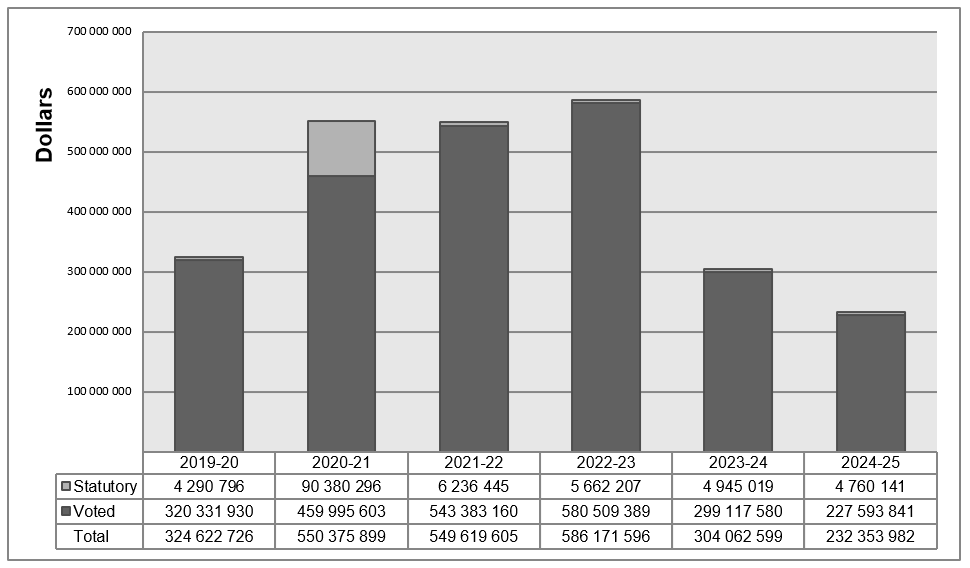
Text description of Departmental spending trend graph
From 2019–20 to 2024–25, planned statutory spending reached:
- $4,290,796 in 2019–20
- $90,380,296 in 2020–21
- $6,236,445 in 2021–22
- $5,662,207 in 2022–23
- $4,945,019 in 2023–24
- $4,760,141 in 2024–25
From 2019–20 to 2024–25, planned voted spending reached:
- $320,331,930, in 2019–20
- $459,995,603 in 2020–21
- $543,383,160 in 2021–22
- $580,509,389 in 2022–23
- $299,117,580 in 2023–24
- $227,593,841 in 2024–25
From 2019–20 to 2024–25, total planned spending reached:
- $324,622,726 in 2019–20
- $550,375,899 in 2020–21
- $549,619,605 in 2021–22
- $586,171,596 in 2022–23
- $304,062,599 in 2023–24
- $232,353,982 in 2024–25
In addition to the explanations provided in the following section, the significant decrease in planned spending from 2023–24 onward is due in part to the termination of several stimulus initiatives as of March 31, 2023. Also, planned spending from April 1, 2023 onwards does not include the reinvestment of revenue from repayable contributions from our clients, as approvals have not been obtained at the time of writing.
Budgetary planning summary for core responsibilities and internal services (dollars)
The following table shows information on spending for each of CED’s core responsibilities and for its internal services for 2022–23 and other relevant fiscal years.
| Core responsibilities and internal services | 2019–20 actual expenditures | 2020–21 actual expenditures | 2021–22 forecast spending | 2022–23 budgetary spending (as indicated in Main Estimates) | 2022–23 planned spending | 2023–24 planned spending | 2024–25 planned spending |
|---|---|---|---|---|---|---|---|
| Developing Quebec’s economy | 303,896,531 | 527,799,525 | 525,177,343 | 563,047,357 | 563,047,357 | 283,642,640 | 212,645,260 |
| Internal Services | 20,726,195 | 22,576,374 | 24,442,262 | 23,124,239 | 23,124,239 | 20,419,959 | 19,708,722 |
| Total | 324,622,726 | 550,375,899 | 549,619,605 | 586,171,596 | 586,171,596 | 304,062,599 | 232,353,982 |
In 2020–21, CED received additional funding to deliver one-time, targeted initiatives related to the COVID-19 pandemic, which accounts for the sharp increase in spending between 2019–20 and 2020–21.
Some of these initiatives were scheduled to end in 2020–21, but were extended into 2021–22, such as the Regional Recovery and Assistance Fund (RRAF) and the Canadian Seafood Stabilization Fund (CSPF). At the time of writing, authorized funding in G&C for COVID-19 related initiatives in 2021–2022 is as follows:
- Regional Recovery and Assistance Fund (RRAF): $80.7M;
- Regional Air Transportation Initiative: $57.5M;
- Black Community Entrepreneurship Program: $6.7M;
- Canadian Seafood Stabilization Fund: $6.0M.
Also, in the 2021 Budget, stimulus initiatives were announced and implemented as early as 2021-22. Funding for stimulus initiatives will peak in 2022–23. G&C funding for stimulus initiatives in 2022–23 is as follows:
- Major Festivals and Events Initiative: $75.0 million;
- Jobs and Growth Fund: $69.3M
- Tourism Fund: $69.1M
- Canadian Community Revitalization Fund: $50.8M
- Aerospace Stimulus Initiative: $35.9M
Planned human resources
The following table shows information on human resources, in full-time equivalents (FTEs), for each of CED’s core responsibilities and for its internal services for 2022–23 and the other relevant years.
| Core responsibilities and internal services | 2019–20 actual full‑time equivalents | 2020–21 actual full‑time equivalents | 2021–22 forecast full‑time equivalents | 2022–23 planned full‑time equivalents | 2023–24 planned full‑time equivalents | 2024–25 planned full‑time equivalents |
|---|---|---|---|---|---|---|
| Developing Quebec’s economy | 180 | 189 | 217 | 206 | 181 | 175 |
| Internal Services | 154 | 170 | 184 | 178 | 157 | 152 |
| Total | 334 | 359 | 401 | 384 | 338 | 327 |
The number of FTEs has been increasing since fiscal year 2020–21, when additional funding was received to help Quebec businesses, regions and communities overcome the economic challenges created by the COVID-19 crisis. These initiatives continued into 2021–22, while additional recovery initiatives were also announced in the 2021 Budget and took effect in 2021–22. In order to deliver all of our initiatives and programs, the number of resources was increased both in internal services and in the core responsibility, Developing Quebec's Economy. Thereafter, the marked decrease in the number of FTEs starting in 2023–24 is explained by the end of initiatives related to COVID-19 and the end of several economic recovery initiatives.
Estimates by vote
Information on CED’s organizational appropriations is available in the 2022–23 Main Estimates.
Future-oriented Condensed statement of operations
The future‑oriented condensed statement of operations provides an overview of CED’s operations for 2021–22 to 2022–23.
The forecast and planned amounts in this statement of operations were prepared on an accrual basis. The forecast and planned amounts presented in other sections of the Departmental Plan were prepared on an expenditure basis. Amounts may therefore differ.
A more detailed future‑oriented statement of operations and associated notes, including a reconciliation of the net cost of operations with the requested authorities, are available on CED’s website.
| Financial information | 2021–22 forecast results | 2022–23 planned results | Difference (2022–23 planned results minus 2021–22 forecast results) |
|---|---|---|---|
| Total expenses1 | 370,672,000 | 374,284,000 | 3,612,000 |
| Total revenues | 0 | 0 | 0 |
| Net cost of operations before government funding and transfers | 370,672,000 | 374,284,000 | 3,612,000 |
1 Expenditures are the economic resources used by CED during a period to deliver its programs. They are of two types: transfer payments and operations. Expenditures calculated in the Future-oriented Statement of Operations differ from the expenditures presented in other sections of the Departmental Plan, since unconditionally repayable contributions are accounted for as loans, thus reducing total transfer payment expenditures.
In 2022–23, CED's total net expenses are expected to be $374.3M. This is an increase of 1.0% over the previous fiscal year. This increase in projected expenses is primarily due to the funding of several economic recovery initiatives.
CED's planned expenses are largely comprised of transfer payments, which are expenses related to non-repayable and conditionally repayable contributions. These are expected to total $320.6M in 2022–23, an increase of 2.4% over 2021–22.
Our revenues, returned to the Consolidated Revenue Fund, are reported in our financial statements as earned on behalf of the government. Therefore, the organization's total net revenue is zero. Note that total gross revenues are projected to be $589 thousand in 2022–23, representing an increase of $296 thousand over 2021–22. The amount projected in 2022–23 represents the average of the organization's net revenues over the past several years.
Corporate information
Organizational profile
Appropriate minister:
The Honourable Pascale St-Onge, P.C., M.P.
Minister of Sport and Minister responsible for the Economic Development Agency of Canada for Quebec Regions
Institutional head:
Manon Brassard
Enabling instrument:
Economic Development Agency of Canada for the Regions of Quebec Act (S.C. 2005)
Year of incorporation / commencement: 2005
Raison d’être, mandate and role: who we are and what we do
Information on CED’s raison d’être, mandate and role is available on CED’s website.
For more information on the department’s organizational mandate letter commitments, see the Minister’s mandate letter.
Operating context
Information on the operating context is available on CED’s website.
Reporting framework
CED’s approved departmental results framework and program inventory for 2022–23 are as follows.
| Departmental results framework | Core Responsibility: Economic Development in Quebec | ||
|---|---|---|---|
| Departmental Result: Businesses are innovative and growing in Quebec | Indicator: Number of high growth firms in Quebec | Internal Services | |
| Indicator: Value of exports of good (in dollars) from Quebec | |||
| Indicator: Value of exports of clean technologies (in dollars) from Quebec | |||
| Indicator: Revenue growth rate of firms supported by CED programs | |||
| Departmental Result: Communities are economically diversified in Quebec | Indicator: Percentage of SMEs that are majority-owned by women, Indigenous people, youth, visible minorities and persons with disabilities in Quebec | ||
| Indicator: Percentage of professional, science and technology-related jobs in Quebec’s economy | |||
| Indicator: Amount leverage per dollar invested by CED in community projects | |||
| Departmental Result: Businesses invest in the development and commercialization of innovative technologies in Quebec | Indicator: Value of Business Expenditure in Research and Development (BERD) by firms receiving CED program funding (in dollars) | ||
| Indicator: Percentage of companies engaged in collaborations with higher education institutions in Quebec | |||
| Program Inventory | Program: Regional Innovation | ||
| Program: Community economic development and diversification | |||
| Program: Targeted transition support | |||
Supporting information on the program inventory
Supporting information on planned expenditures, human resources, and results related to CED’s program inventory is available in the GC InfoBase.
Supplementary information tables
The following supplementary information tables are available on CED’s website:
- Sustainable Development Goals
- Departmental Sustainable Development Strategy
- Details on transfer payment programs
- Gender-based analysis plus
Federal tax expenditures
CED’s Departmental Plan does not include information on tax expenditures.
Tax expenditures are the responsibility of the Minister of Finance. The Department of Finance Canada publishes cost estimates and projections for government‑wide tax expenditures each year in the Report on Federal Tax Expenditures.
This report provides detailed information on tax expenditures, including objectives, historical background and references to related federal spending programs, as well as evaluations, research papers and gender-based analysis plus.Organizational contact information
Mailing address
800 René Lévesque Blvd. West, Suite 500
Montréal, Quebec
H3B 1X9
Telephone: 514-283-3302
Fax: 514-283-3302
Website(s): www.ced.canada.ca
Appendix: definitions
- appropriation (crédit)
- Any authority of Parliament to pay money out of the Consolidated Revenue Fund.
- budgetary expenditures (dépenses budgétaires)
- Operating and capital expenditures; transfer payments to other levels of government, organizations or individuals; and payments to Crown corporations.
- Core Responsibility (responsabilité essentielle)
- An enduring function or role performed by a department. The intentions of the department with respect to a Core Responsibility are reflected in one or more related Departmental Results that the department seeks to contribute to or influence.
- Departmental Plan (plan ministériel)
- A document that sets out a department’s priorities, programs, expected results and associated resource requirements, covering a three year period beginning with the year indicated in the title of the report. Departmental Plans are tabled in Parliament each spring.
- Departmental Result (résultat ministériel)
- A change that a department seeks to influence. A departmental result is often outside departments’ immediate control, but it should be influenced by program-level outcomes.
- Departmental Result Indicator (indicateur de résultat ministériel)
- A factor or variable that provides a valid and reliable means to measure or describe progress on a Departmental Result.
- Departmental Results Framework (cadre ministériel des résultats)
- A framework that consists of the department’s core responsibilities, departmental results and departmental result indicators.
- Departmental Results Report (rapport sur les résultats ministériels)
- A report on a department’s actual performance in a fiscal year against its plans, priorities and expected results set out in its Departmental Plan for that year. Departmental Results Reports are usually tabled in Parliament each fall.
- Experimentation (expérimentation)
- The conducting of activities that explore, test and compare the effects and impacts of policies and interventions in order to inform decision-making and improve outcomes for Canadians. Experimentation is related to, but distinct from, innovation. Innovation is the trying of something new; experimentation involves a rigorous comparison of results. For example, introducing a new mobile application to communicate with Canadians can be an innovation; systematically testing the new application and comparing it against an existing website or other tools to see which one reaches more people, is experimentation.
- A measure of the extent to which an employee represents a full person-year charge against a departmental budget. Full-time equivalents are calculated as a ratio of assigned hours of work to scheduled hours of work. Scheduled hours of work are set out in collective agreements.
- gender-based analysis plus (GBA Plus)(analyse comparative entre les sexes plus [ACS Plus])
- An analytical process used to assess how diverse groups of women, men and gender-diverse people experience policies, programs and services based on multiple factors including race, ethnicity, religion, age, and mental or physical disability.
- government-wide priorities (priorités pangouvernementales)
- For the purpose of the 2022–23 Departmental Plan, government-wide priorities are the high-level themes outlining the government’s agenda in the 2021 Speech from the Throne: protecting Canadians from COVID-19; helping Canadians through the pandemic; building back better – a resiliency agenda for the middle class; the Canada we’re fighting for.
- horizontal initiative (initiative horizontale)
- An initiative where two or more departments are given funding to pursue a shared outcome, often linked to a government priority.
- non-budgetary expenditures (dépenses non budgétaires)
- Net outlays and receipts related to loans, investments and advances, which change the composition of the financial assets of the Government of Canada.
- performance (rendement)
- What an organization did with its resources to achieve its results, how well those results compare to what the organization intended to achieve, and how well lessons learned have been identified.
- plan (plan)
- The articulation of strategic choices, which provides information on how an organization intends to achieve its priorities and associated results. Generally, a plan will explain the logic behind the strategies chosen and tend to focus on actions that lead up to the expected result.
- planned spending (dépenses prévues)
- For Departmental Plans and Departmental Results Reports, planned spending refers to those amounts presented in Main Estimates.
- A department is expected to be aware of the authorities that it has sought and received. The determination of planned spending is a departmental responsibility, and departments must be able to defend the expenditure and accrual numbers presented in their Departmental Plans and Departmental Results Reports.
- program (programme)
- Individual or groups of services, activities or combinations thereof that are managed together within the department and focus on a specific set of outputs, outcomes or service levels.
- program inventory (répertoire des programmes)
- An inventory of a department’s programs that describes how resources are organized to carry out the department’s core responsibilities and achieve its planned results.
- result (résultat)
- An external consequence attributed, in part, to an organization, policy, program or initiative. Results are not within the control of a single organization, policy, program or initiative; instead they are within the area of the organization’s influence.
- statutory expenditures (dépenses législatives)
- Expenditures that Parliament has approved through legislation other than appropriation acts. The legislation sets out the purpose of the expenditures and the terms and conditions under which they may be made.
- target (cible)
- A measurable performance or success level that an organization, program or initiative plans to achieve within a specified time period. Targets can be either quantitative or qualitative.
- voted expenditures (dépenses votées)
- Expenditures that Parliament approves annually through an Appropriation Act. The Vote wording becomes the governing conditions under which these expenditures may be made.