
HUMA Committee binder: Appearance of the Secretary of State (Children and Youth) - November 18, 2025
Official title: Appearance by: Secretary of State (Children and Youth) Standing Committee on Human Resources, Skills and Social Development and the Status of Persons with Disabilities (HUMA) Mandate and Priorities, Date: November 18, 2025, 12:00 p.m. - 1:00 p.m.
On this page
- Secretary of State opening remarks
- Parliamentary environment
- Families, children and youth
- Youth Employment situation and key drivers
- Background on Child Poverty in Canada
- National School Food Program
- Food bank and Poverty report
- Supporting Quality of Life Placemat
- Impact of AI on employment rates
- Canada Summer Jobs (CSJ)
- Office of the Auditor General Audit Performance Audit on Canada summer jobs
- Standing Committee on Human Resources, Skills and Social Development and the Status of Persons with Disabilities (HUMA)'s CSJ recommendations
- Early Learning and Child Care (ELCC) and OAG report (2025)
- Youth Climate Corps
- Student Work Placement Program
- Youth Employment and Skills Strategy (YESS)
- Employment and Social Development Canade (ESDC) Supports to OLMC
- Corporate issues
- Ministerial mandate
1- Secretary of State opening remarks
Speaking notes for the Honourable Anna Gainey, Secretary of State (Children and Youth), for the appearance before the Standing Committee on Human Resources, Skills and Social Development and the Status of Persons with disabilities (HUMA), Theme: Affordability for families, House of Commons, November 18, 2025
Check against delivery. (2025 PA 0000042)
Thank you, Mr. Chair.
Before I begin, I would like to acknowledge we're on the [territorial acknowledgement].
I am accompanied today by [names].
Mr. Chair, colleagues.
The Prime Minister asked me in May to become Secretary of State for Children and Youth. It was an honour and privilege for me to accept.
In the months since, I have heard from Canadians across the country.
- Canadians who are struggling to make ends meet
- Canadians who deserve a government committed to making life affordable
- Canadians who deserve a government committed to building a stronger country where everyone can get ahead
It's my responsibility to continue the Government's mission of supporting Canada's children and youth-to give them and their families the help they need today, so they can succeed in the future.
Mr. Chair, I won't spend my time here delivering a message of doom and gloom or sugar-coating reality. We all know the challenges our country's economy is dealing with.
Instead, I want to highlight what the Government is doing about it and what we will be doing to ease the financial stresses on Canadians who are struggling to make ends meet.
Mr. Chair, tooth decay is the most common childhood chronic disease in Canada. Left untreated, it can lead to pain and infection, affecting children's sleep, learning, speaking and eating abilities.
But many Canadians don't have private insurance or the means to pay a dentist. It's why we introduced the phenomenally successful Canadian Dental Care Plan. It's now covering 5 million Canadians, including more than 612,000 under 18 years old.
While visiting the dentist isn't everyone's idea of a good time, it's brought smiles—quite literally—to many faces.
Dental plan patient Catherine said this after her treatment: "I danced, I was running around and telling everyone, get this, get this… After having seen my dentist, I am more confident, I feel great."
We all agree that children deserve the best chance of success we can offer. Going to school hungry is no way to start a day of learning.
In 2024, we invested $1 billion over five years to establish a National School Food Program, and I'm proud to say that we've signed agreements with all thirteen provinces and territories-and Indigenous partners-to enhance and expand their school food programs.
And Budget 2025 proposes to introduce legislation that will make the program permanent starting in 2029 to 2030.
It means the program will continue to help make school meals accessible for up to 400,000 children each year.
Sara, from central Newfoundland, reached out to tell me about the National School Food Program at their school.
She said: "It's wonderful! More students are getting healthy lunches, and the lunch lady went from part-time to full-time."
Mr. Chair, the Government's early learning and child care program is developing a system of affordable, inclusive, flexible and high-quality care.
It's a game changer for families across the country. 8 provinces and territories are delivering regulated child care for an average of $10 a day or less, and all other jurisdictions have reduced fees by 50% or more.
In fact, as a proportion of after-tax family income, the average spending on child care by families across Canada is now less than one third of what it was in 2021.
Families of about 900,000 children are currently benefiting from the program.
We heard from Adriana, a working mother in BC:
"
This is an amazing program for me. It was a blessing to me when I was able to find it. Alex House has a very flexible schedule. When you are a working parent, you must find a place where the schedule fits your own working hours."An important aspect of the early learning and child care program is its growing flexibility. It goes where the parents work instead of the other way around.
Manitoba physician and new dad Kristjan Thompson told us this:
"Having on-site child care options for health care workers is critical, because folks can best take care of others when they know their loved ones are being taken care of."
It's also a boost for family income and the labour market-because the program is enabling parents, especially mothers, to rejoin the workforce.
Conclusion
Last, but certainly not least, in our suite of programs making life more affordable for Canadian families, is the Canada Child Benefit. It's bringing relief to 3.5 million families and is tax free.
The CCB has helped reduce the number of children living in poverty by hundreds of thousands since its introduction in 2016. It has been indexed to inflation annually since 2018 ensuring it keeps pace with rising expenses.
Sarah, a mother of 2, is one of many parents we've heard from. She told us:
"
Having 2 kids in diapers impacts every part of our lives. The Canada Child benefit allows us to give our boys extra-curricular activities. It opens their world."Mr. Chair, the contact I've had with Canadians since May has been humbling.
It's taught me that people whose lives are being upended aren't only looking for help-they're also looking for hope.
We're responding with both.
Thank you, Mr. Chair and colleagues.
I'm happy to take your questions.
- 30 -
2- Parliamentary environment
a. Scenario note
The Standing Committee on Human Resources, Skills and Social Development and the Status of Persons with Disabilities (HUMA), Minister of State (Children and Youth) on, Mandate/Key Priorities and Youth Employment in Canada, November 18, 2025 - 16:30
Overview
- On June 18, 2025, the Standing Committee on Human Resources, Skills and Social Development and the Status of Persons with Disabilities (HUMA) passed a motion to invite "the Minister of Jobs and Families, the Minister of Housing and Infrastructure, the Secretary of State for Seniors, the Secretary of State for Labour, and the Secretary of State for Children and Youth to appear separately before the committee, each accompanied by their officials, for a minimum of one hour, to discuss their respective mandates and key priorities in their service to Canadians".
- Additionally, HUMA adopted a separate motion on September 18, 2025, to "prioritize an urgent study on employment in Canada, especially since youth employment has reached its lowest level in 25 years and young people continue to face barriers in accessing employment insurance, which increases their vulnerability", including "the Minister of Jobs and Families and the Secretary of State (Children and Youth) be invited to appear separately for two hours each, alongside their officials".
- The Secretary of State (Seniors) appeared on October 28, with the Secretary of State (Labour) expected to appear on November 20, and the Minister on November 25.
Committee proceedings
- During this appearance, you will be provided five minutes to deliver opening remarks Following that, questioning will begin.
- The first round of questions will give 6 minutes each to the CPC, LPC and BQ, in that order.
- The second (and subsequent rounds) of questions allocate 5 minutes to the CPC and LPC, 2 and a half minutes to the BQ, and then 5 minutes to the CPC and the LPC.
- Senior officials in attendance will be:
- Paul Thompson, Deputy Minister of Employment and Social Development
Parliamentary environment
- So far in the 45th Parliament, Youth unemployment and labour-related issues have mobilised most of the committee's attention.
- For your awareness, other topics of interest to the committee's business include:
- in the first panel of this current meeting, HUMA will have begun its study on "the impact of the lack of a definition of the term 'work' in Part III of the Canada Labour Code and into the Government's routine use of section 107 of the Canada Labour Code to refer labour disputes to the Canada Industrial Relations Board (CIRB) for binding arbitration"
- Budget 2025: legislation to make the National School Food Program permanent, renewing and re-focusing investments of the Youth Employment and Skills Strategy, legislative and regulatory amendments to address integrity issues related to private educational institutions, creation of a Youth Climate Corps, renewal and enhancement of the Student Work Placement Program
- Canada Summer Jobs program was launched on November 4, 2025, for the 2026 season
- On November 27, the Deputy Minister of ESDC, will appear before the Standing Committee on Public Accounts as part of its study of the Auditor General of Canada 2025 Report - Canada-Wide Early Learning and Child Care System.
Conservative Party of Canada
- CPC HUMA member and Employment critic Garnett Genuis proposed a motion on youth employment in June, which was rejected, and the CPC urged meetings over the summer adjournment to discuss the matter.
- On October 15, Mr. Genuis released their Jobs Youth Plan, calling on the government to "unleash the economy", "fix immigration", "fix training", and "build homes where jobs are".
- On November 3, Mr. Genuis moved concurrence of the first HUMA report which stated that it "is alarmed over the 25-year low youth employment data".
- In the House of Commons, CPC MPs, including HUMA members, have asked questions about youth employment, poverty, the National School Food program, food insecurity, and Early Learning and Child Care. The CPC have been critical of the costs of such programs, that Canada's youth will eventually have to repay the debt for these programs.
- Further, Laila Goodridge, critic for Social Development and Families and HUMA member, questioned the government on the Auditor General of Canada 2025 Report - Canada-Wide Early Learning and Child Care System, about the sustainability of the system and the government's ability to delivery on what was promised.
Bloc Québécois
- The BQ HUMA member and vice-chair has been supportive of the youth employment study, with a particular focus on Quebec. The MP may be particularly interested in the National School Food program announcement, and the agreement with the province of Quebec. BQ MPs often raise provincial jurisdictional issues as a concern, in particular in the area of children and youth.
- Regarding Early Learning and Child Care, the BQ has often brought up the asymmetrical agreement, without conditions, with the province of Quebec, and may do so again at this hearing.
b. Members biographies
House of Commons Standing Committee on Human Resources, Skills and Social Development and the Status of Persons with Disabilities (HUMA) - Membership
Robert J. Morrissey - Chair
Liberal, Egmont, Prince Edward Island

Brief Biography
First elected in 2015, Bobby Morrissey served as a Member on the Standing Committee on Fisheries and Oceans (FOPO), the Liaison Committee as well as the Standing Committee on Human Resources, Skills and Social Development and the Status of Persons with Disabilities (HUMA). He served as Chair of the HUMA during the 44th Parliament and was re-elected as Chair for the 45th Parliament.
Previously, he was elected to the Prince Edward Island Legislative Assembly in 1982 and has dedicated his career and volunteer life to serving the residents of PEI. Having served as MLA for nearly 20 years, Bobby has a deep understanding of his communities' needs. He has held a number of high-profile roles within the Assembly, such as Minister of Transportation and Public Works, Minister of Economic Development and Tourism, and Opposition House Leader. He was also responsible for the redevelopment of the Canadian Forces Base Summerside and the surrounding community following its closure by the federal government in 1989.
Bobby left politics in 2000 to join the private sector as a consultant specializing in government relations, fisheries, and the labour market. Bobby has been a member of the Board of Directors for the Heart & Stroke Foundation of PEI. He was the founding member and former president of the Tignish Seniors Home Care Co-op, and Vice-Chair of Tignish Special Needs Housing.
Caroline Desrochers
Liberal, Trois-Rivières, Quebec

Brief Biography
Caroline Desrocher was first elected in the general election of 2025 for the constituency of Trois-Rivières, Quebec. She is Parliamentary Secretary to the Minister of Housing and Infrastructure.
Born in Montreal, Québec, she has a bachelor's degree in economics from Concordia University in 2000, Caroline Desrochers has worked as a diplomat and civil servant before first running for office in 2021, when she was defeated.
Caroline brings a rich background in diplomacy, economics, and public service to her role, one that naturally intersects with issues of language rights and minority communities across Canada. Her affiliation and committee work suggest alignment with federal efforts to Strengthen the Official Languages Act and Support Community Institutions.
Jessica Fancy
Liberal, South Shore-St. Margarets, Nova Scotia

Brief Biography
Elected in April 2025, Jessica Fancy is a Member of Parliament for South Shore-St. Margarets, Nova Scotia.
Born and raised on a mushroom farm in Caledonia, Queens County, Jessica has deep roots in the region. She spent more than 20 years as an educator, shaping the lives of countless young people in her community. Along the way, she earned two Master of Education degrees from Memorial University - one in Curriculum and Instruction, and the other in Educational Leadership. She has coached local youth sports, led the Rural Communities Foundation of Nova Scotia, and worked tirelessly to direct millions of dollars in investments toward community initiatives.
Her advocacy has focused on addressing food insecurity, strengthening education, and promoting environmental sustainability. Her key interests involve the concerns and contributions of rural communities in Canada
Natilien Joseph
Liberal, Longueuil-Saint-Hubert, Quebec

Brief Biography
Elected in April 2025, Natalien Joseph is a Member of Parliament for Longueuil-Saint-Hubert, Quebec.
Born in Haiti, Natilien Joseph arrived in Quebec nearly 8 years ago. He obtained a Diploma of Vocational Studies (DVS) in refrigeration assembly and repair, a DVS in truck transport at the CFTC in Charlebourg, and a Diploma of College Studies (DCS) in residential real estate brokerage at the Institut Teccart in Brossard in 2021.
He worked as a residential real estate broker on Montreal's South Shore for over a year, before switching to paratransit. His interests include the need of government to address housing concerns among Canadians, including the fight against homelessness and access to affordable housing.
Annie Koutrakis
Liberal, Vimy, Quebec

Brief Biography
First elected to the House of Commons in 2019, Annie Koutrakis is the Member of
Parliament for Vimy and the Parliamentary Secretary to the Minister of Jobs and Families. During the 44th Parliament she acted as Parliamentary Secretary to the Minister of Tourism and Minister responsible for the Economic Development Agency of Canada for the Regions of Quebec and Parliamentary Secretary to the Minister of Transport. She was also a member of the Standing Committee on Official Languages (LANG), the Standing Joint Committee on the Library of Parliament (BILI), the Standing Committee on Transport, Infrastructure and Communities (TRAN) and the Special Joint Committee on Medical Assistance in Dying (AMAD).
Prior to becoming a Member of Parliament, Annie Koutrakis worked in full-service investment firms for 30 years, reaching the position of Vice President, Branch Manager, Advisor Services for a major financial services firm. A fervent believer in volunteerism, she has been involved in several community organizations, acting as President, CEO, Chair of the Executive Committee and member of the Board of Directors of the Hellenic Community of Greater Montreal, the Board of CLSC Normand-Bethune (now CLSC du Ruisseau-Papineau), the Board of Directors of Hellenic Social Services of Quebec, the Parents Committee at École Démosthènes, the Alexandria Fundraising Committee in Laval, and the Board of the Hellenic Board of Trade of Montreal. She has also volunteered in municipal, provincial, and federal elections in various roles.
Rosemarie Falk - Vice Chair
Conservative, Battlefords-Lloydminster-Meadow Lake, Saskatchewan

Brief Biography
Rosemarie Falk has been the Member for Parliament for Battlefords-Lloydminster since 2017. She served as Vice-Chair for HUMA during the 44th Parliament and was re-elected in that role for the 45th Parliament. During the 44th Parliament, she also served on the Standing Committee on Citizenship and Immigration (CIMM). She has acted as the Official Opposition's Associate Shadow Minister for Labour Since October 2022. She was the sponsor for Bill C-318, An Act to amend the Employment Insurance Act and the Canada Labour Code (adoptive and intended parents), during the 44th Parliament.
Born and raised in Lloydminster, she has always been actively engaged in her community. Rosemarie has previously worked as a registered Social Worker in Saskatchewan and has a Bachelor of Social Work from the University of Calgary. Throughout her social work career and extensive volunteer work she has worked with some of the most vulnerable members of the community. She was previously a legal assistant specializing in family law and as a legislative assistant in federal politics. She is committed to being a strong voice for seniors, families, taxpayers and rural communities.
Garnett Genius
Conservative, Sherwood Park-Fort Saskatchewan, Alberta

Brief Biography
Garnett Genius was first elected in 2015. During the 44th Parliament, he was the Vice-Chair and member of Standing Committee on Foreign Affairs and International Development (FAAE), member of the Standing Committee on Government Operations and Estimates (OGGO), the Standing Committee on Public Accounts (PACP), and the Standing Committee on Citizenship and Immigration (CIMM).
Mr. Genuis holds a Bachelor of Public Affairs and Policy Management from Carleton University and master's degree in public policy from the London School of Economics. Prior to running for office, he worked in the Prime Minister's Office under Stephen Harper. Currently the Conservative Shadow Minister for Employment, he was previously Critic for International Development and Human Rights and the Conservative Critic for Canada-China Relations and Multiculturalism.
He is a proponent of freedom of expression and has a strong interest in democracy and the rule of law.
Laila Goodridge
Conservative, Fort McMurray-Cold Lake, Alberta

Brief Biography
Laila Goodridge was first elected as the Member of Parliament for Fort McMurray-Cold Lake in September 2021. During the 44th Parliament she served on the Standing Committee on Health (HESA), the Standing Committee on Official Languages (LANG) and the Standing Committee on the Status of Women (FEWO).
She was first elected to the Legislative Assembly of Alberta as the MLA for Fort McMurray-Conklin in a by-election in 2018 and then re-elected in the general election of 2019 as MLA for Fort McMurray-Lac La Biche. Argues for support for minority language groups and support for the natural resources industry, particularly regarding the oil and gas industry. Previously, she was a policy advisor for the oil and sands industry. She was previously the Shadow Minister for Families, Children and Social Development and Addictions and is now the Conservative Shadow Minister for Social Development and Families.
Colin Reynolds
Conservative, Elmwood-Transcona, Manitoba

Brief Biography
Elected in April 2025, Colin Reynolds is the new Member of Parliament for Elmwood-Transcona, Manitoba.
A construction electrician and member of IBEW Local 2085, Colin Reynolds grew up in the Valley Gardens neighborhood. He advocates fiscal responsibility, aiming to reduce taxes and government spending to alleviate financial pressures on families and businesses.
Colin Reynolds positions himself as a strong advocate for workers, especially those in skilled trades. He supports policies focused on lowering taxes, improving housing affordability and strengthening public safety.
Marilène Gill - Vice Chair
Bloc Québécois, Côte-Nord-Kawawachikamach-Nitassinan, Quebec

Brief Biography
Originally from Sorel, Quebec, Marilène Gill has served as the Bloc Québécois Member of Parliament for the riding of Côte-Nord-Kawawachikamach-Nitassinan (formerly Manicouagan) since 2015. She currently holds the position of Deputy Whip for the Bloc Québécois and serves as the opposition critic for Employment and Social Development Canada (ESDC).
She now holds the role of Vice-Chair on the Standing Committee on Human Resources, Skills Development, Social Development and the Status of Persons with Disabilities. During the 44th Parliament, she served as Vice-Chair of the Standing Committee on Indigegous and Northern Affairs.
Prior to her first election in 2015, Marilène Gill taught at the college level while pursuing doctoral studies in literature. She holds a master's degree in literary studies from the Université du Québec à Trois-Rivières (2004).
3. Children, families and youth
a. Youth Employment Situation and Key Drivers
Issue
The labour market for youth has been deteriorating over the last year, with a surge in the youth population coupled with low economic growth seen as the main factors explaining the situation.
Background
- Labour market outcomes have been worsening for youth since early 2023. Their employment rate has been trending down, while their unemployment rate has been on a strong upward trend
- While typically higher, the youth unemployment rate generally follows a similar pattern to core-aged adults. On average, the youth unemployment rate has been 2.1 times that of core-aged adults. However, recently, the ratio of the youth-to-adult unemployment rate reached 2.4
- Canada experienced high population growth in recent years with the youth population growing the fastest and at a rate that far outpaced employment growth
- U.S. tariffs on imports from Canada and other countries have created global uncertainty and weakened business and consumer confidence, stalling labour demand in some industries, particularly where youth typically find employment
Key facts
- In October 2025, the unemployment rate for youth aged 15 to 24 stood at 14.1%. The rate has been on an upward trend since early 2023 and sits above the 2010 to 2019 average (12.7%)
- The youth employment rate was 54.2% in October 2025, the first increase since January. However, the youth employment rate has been trending down since May 2023, remaining 2.8 pp below its historical (2010 to .2019) average (57.0%)
- Between 2022 and 2025, the youth population has increased by 9.1% (+417,000), significantly outpacing the overall population growth of 6.9% (+2,702,000)
- The growth in the youth population was largely driven by an increase in non-permanent residents, which rose by 42.1% (+252,000) between 2022 and 2025
- In the first ten months of 2025, 2.7 million youth were employed - up 4.2% (or +108,400) from the same period in 2022. Core-aged adult employment, however, grew at a faster rate over this period, rising by 8.2%
- Over this period, youth employment declined in wholesale and retail trade (-39,200 or -5.3%) and was little changed in accommodation and food services (-4,900 or -1.1%) - the top 2 industries where youth typically find work
- The unemployment rate for students returning to school in the fall has increased each summer since 2022. In 2025, the average unemployment rate for returning students aged 15 to 24 was 17.9% (compared to 11.6% for non-students). This was the highest rate since the summer of 2009 (18.0%), apart from the pandemic
- See table below for ESDC estimated job openings in the construction industry
| Sector | Employment level in 2023 | Employment growth | Retirement, emigration, and in-service deaths | Total job openings |
|---|---|---|---|---|
| Construction (NAICS 23) | 1,582,500 | 246,900 (15.6%) | 406,500 (25.7%) | 653,400 (41.3%) |
Source: ESDC, 2024 COPS projections
Key messages
- Tougher labour market conditions have created widespread difficulties for youth
- Although population growth has slowed over the past year, the youth population remains significantly larger than it was prior to 2022, bolstered by large numbers of non-permanent residents
- While most youth are not directly employed in industries targeted by U.S. tariffs the new trade environment has created uncertainty, stalling labour demand in industries where youth typically find employment
- The combined impacts of muted labour demand in youth-employing industries with the surge in the youth population have pushed the youth employment rate down and the unemployment rate up significantly
- While there is still high economic uncertainty related to global trade and the global economy, there are still sectors with high demand, such as construction. My department estimates that over the 2024 to 2033 period, more than 400,000 construction workers will retire, providing excellent job prospects for young Canadians interested in skilled trade jobs
- In addition, this government announced new nation-building infrastructure projects that will transform and connect Canada's economy. For example, on November 13, PM Carney announced $56 billion in new investments to build our economy, expected to support 68,000 jobs across the country, which will benefit youth, among others, in the skilled trades
- ESDC has in place several programs to support Canadians, including youth, to find jobs aligned with their experience and skills
- Budget 2025 is proposing to further tackle youth unemployment by expanding access to skills training, work experience, and career development opportunities. These efforts aim to help young Canadians build meaningful careers, gain confidence in the labour market, and contribute to a stronger economy, including:
- $594.7 million over 2 years, starting in 2026-27, to ESDC for Canada Summer Jobs to support around 100,000 summer jobs in summer 2026
- $307.9 million over 2 years, starting in 2026-27, for the horizontal Youth Employment and Skills Strategy to provide employment, training, and wraparound supports (for example, mentorship, transportation, mental health counselling) to around 20,000 youth facing employment barriers annually
- $635.2 million over 3 years, starting in 2026 to 2027, to ESDC for the Student Work Placement Program to support around 55,000 work-integrated learning opportunities for post-secondary students in 2026 to 2027
- $40 million over 2 years, starting in 2026 to 2027, to ESDC, to create a Youth Climate Corps to provide paid skills training for young Canadians
b. Background on Child Poverty in Canada
- Child poverty in 2023 was 11.8%, compared to the overall poverty rate of 10.9%Footnote 1
- Approximately 886,000 children lived in poverty in 2023
- Child poverty is considerably higher amongst female lone-parent families
- The poverty rate for children living in female lone-parent families is 30.4% (291,000 children), compared to 8.7% for children in couple families
- Child poverty has trended downward since 2015, with some variability along the way
- Between 2015 (16.3%) and 2019 (10.4%), child poverty rates declined by 42.3%, largely as a result of measures aimed at reducing poverty, including the introduction of the Canada Child Benefit in 2016
- From 2020 to 2023, however, child poverty increased across all households. Circumstances pushing up child poverty from record-low rates in 2020 (5.1%) have largely been broader economic factors:
- the phasing out of pandemic benefits impacted the disposable incomes of some families with children significantly
- high rates of inflation between 2021 and 2023 drove up the cost of food, housing, transportation and other essentials and led to affordability challenges for many individuals and families, particularly those below or close to the poverty line
- real wages were lagging behind price increases, especially for the lowest income earners
- Despite this recent increase, child poverty remains 31.1% lower than it was in 2015
- Poverty is multi-dimensional, with important interactions and impacts with food insecurity, housing need, and health
- Children facing poverty experience other dimensions of inequities, including access to safe housing and communities; affordable nutritious food; opportunities for early childhood care and education; access to recreation, sport, social and cultural activities; and access to a primary health care provider
- Key Government of Canada measures that mitigate child poverty and its effects include:
- Canada Child Benefit (CCB): Provides targeted financial support to over 3.5 million families and over 6 million children, easing economic pressures on families
- investments in Early Learning and Child Care (ELCC): Supports workforce participation - especially for women - which helps with the cost of raising children under the age of 18 years of age; and enables children and their families to participate more fully in society with better life-long social and economic outcomes
- National School Food Program: improves affordability for households; mitigates food insecurity; and increases life-long inclusion and opportunity through health, education, and labour market outcomes
- Parental and Caregiving Employment Insurance benefits help support parents and families by partial income replacement during the early stages of childhood and through illnesses
- Canadian Dental Care Plan: Provides coverage to uninsured Canadians with annual family income less than $90,000
- Recent Budget 2025 measures could help reduce child poverty and improve wellbeing:
- Automatic Federal Benefits from the Canada Revenue Agency, including CCB and the GST/HST credit
- making National School Food Program permanent, which will continue to provide meals for up to 400,000 children
- build Canada Homes primarily focused on non-market housing, supporting a mix of income needs
Appendix: Child poverty charts and additional background
- Child poverty is 11.8% compared to the overall poverty rate of 10.9%
- Child poverty in female lone-parent families (30.4%) is much higher than in a couple families with children (8.7%)

Text description:
| Poverty rates 2023 (%) (2023-base MBM) | % |
|---|---|
| All persons | 10.9 |
| Children under 18 years | 11.8 |
| Children in couple families | 8.7 |
| Children in female lone-parent families | 30.4 |
Source: https://www150.statcan.gc.ca/t1/tbl1/en/tv.action?pid=1110013501&request_locale=en
- As with overall poverty, child poverty improved substantially between 2015 and 2019; decreased sharply in 2020 (largely from pandemic income-support responses); and has subsequently increased. Despite the recent variability, child poverty is still 31.1% lower compared to 2015
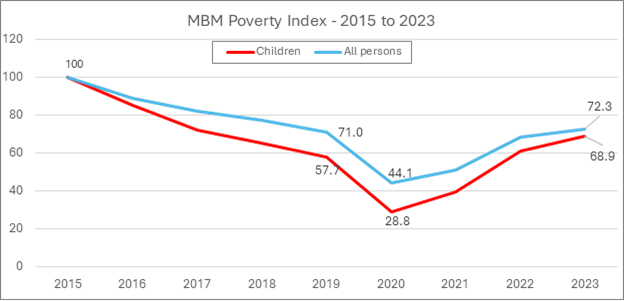
Text description:
| Year | All persons | Children under 18 years |
|---|---|---|
| 2015 | 100.0 | 100.0 |
| 2016 | 89.0 | 85.3 |
| 2017 | 82.1 | 71.8 |
| 2018 | 77.2 | 65.0 |
| 2019 | 71.0 | 57.7 |
| 2020 | 44.1 | 28.8 |
| 2021 | 51.0 | 39.3 |
| 2022 | 68.3 | 60.7 |
| 2023 | 72.3 | 68.9 |
Source: https://www.statcan.gc.ca/en/topics-start/poverty#info-povertyindex
- Child poverty also varies by province and territory ranging from 6.1% to 16.1%
- Poverty rates in the territories (Yukon 11.1%], Northwest Territories 20.6% and Nunavut 41.4%) are measured using the Norther Market Basket Measure (MBM-N) which is similar to the MBM but makes adjustments for Northern living

Text description:
| Province | All persons | Children under 18 years |
|---|---|---|
| Canada | 10.9 | 11.8 |
| Newfoundland and Labrador | 10.9 | 13.7 |
| Prince Edward Island | 10.5 | 12.3 |
| Nova Scotia | 11.5 | 13.4 |
| New Brunswick | 11.3 | 14.5 |
| Quebec | 7.6 | 6.1 |
| Ontario | 12.3 | 14.1 |
| Manitoba | 12.1 | 14.8 |
| Saskatchewan | 13.2 | 16.1 |
| Alberta | 9.1 | 10.5 |
| British Columbia | 12.5 | 13.5 |
Source: https://www150.statcan.gc.ca/t1/tbl1/en/cv.action?pid=1110013501
c. National School Food Policy and Program
Issue
Commitment to implement the National School Food Program.
Background
- On April 1, 2024, the Government of Canada announced an investment of $1 billion over 5 years in Budget 2024, to establish a National School Food Program. The National School Food Program is supporting provinces, territories, and Indigenous partners to enhance and expand access to school food programs across Canada, guided by the National School Food Policy
- As of March 2025, the Government of Canada signed 3 year agreements with all 13 provinces and territories under the National School Food Program
- As announced on November 4, 2025, Budget 2025 proposes to introduce legislation and provide $216.6 million per year, starting in 2029 to 2030, to Employment and Social Development Canada, Indigenous Services Canada, and Crown-Indigenous Relations and Northern Affairs Canada, to make the National School Food Program permanent. This will ensure kids get nutritious meals at school, while bringing down costs for parents
- The National School Food Program is providing real support to children and families across Canada and will enable up to 400,000 children each year to participate in school food programs within their communities. For a participating family with 2 children in school, this program can result in annual savings of $800 or more
- The funding announced also includes investments for First Nations, Inuit, and Métis governing bodies, including First Nations on-reserve and Modern Treaty and Self-government Agreement holders, many of whom experience some of the highest rates of food insecurity in Canada
- The National School Food Policy, released in June 2024, outlines the federal government's long-term vision for the delivery of school food programming in Canada. The Policy guides the work with provinces, territories, and Indigenous partners on National School Food Program implementation and is based on advancing shared national objectives for nutritious, accessible, flexible, and accountable school food programming
Key facts
- School food programming has been shown to improve academic performance, support positive health outcomes and health equity, and foster connections with culture and traditional food systems, all of which have positive immediate and lifelong impacts for children and their families
- Prior to the federal investment, Canada was the only G7 country without a national school food program
- Canada had approximately 6.6 million school-aged children (ages 4 to 18) in 2024 according to Statistics Canada population estimates
- According to the 2023 Canadian Income Survey released on May 1, 2025:
- 802,000 children (persons under 18) were living below the poverty line
- food insecurity among children and youth in Canada's provinces increased to 32.9% in 2023, up from 28.4% in 2022, with 24.7% of children experiencing moderate or severe food insecurity
- Provinces and territories have jurisdiction over health and education and are already actively supporting school food programming in their jurisdictions. Federal funding through the National School Food Program builds on these existing efforts by working collaboratively with provincial and territorial governments. Given variation in the current state of school food programs within each jurisdiction, alongside the diversity in regional priorities and needs, provinces and territories have the flexibility to decide how best to allocate federal school food funding
Key messages
- The Government is committed to bringing down costs and making life more affordable for families across Canada. Children can't learn on an empty stomach. School food programs boost our children's health and help them reach their full potential while also supporting their families through lower grocery bills
- That is why, through the National School Food Program, the Government of Canada is investing $1 billion over 5 years to help provinces and territories and Indigenous partners to enhance and expand school food programs across Canada
- The National School Food Program is providing real support to children and families across Canada. This program will enable up to 400,000 children each year to participate in school food programs. At the same time, for a participating family with 2 children in school, this program can result in annual savings of $800
- As of March 2025, the Government of Canada signed bilateral agreements with all provinces and territories on the National School Food Program. This school year, all provinces and territories will invest funding provided through these agreements to support children across Canada
- That is why, on October 10, the Prime Minister announced that the program will be made permanent, and was included in Budget 2025. This is a generational investment that will help ensure kids get nutritious meals at school, while bringing down costs for parents
- The investment supports the vision, principles and objectives for school food programs set out in the National School Food Policy, including ensuring access to school meals without stigma or barriers, fostering healthy practices, and strengthening connections with the environment, culture, and local food systems
- The National School Food Program is part of the federal government's work to build a more affordable Canada. This includes the Canada Child Benefit and other investments made through targeted social programs and income supplements, helping to bring down costs for families so they can get ahead
d. Food Bank and Poverty Report
Issue
Food Banks Canada's 2025 'Poverty Report Card' gives the Government of Canada's poverty reduction efforts a D grade, citing negative trends in poverty, food insecurity, and youth unemployment.
Background
- Food Banks Canada's annual "Poverty Report Card" is a tool that has tracked and compared poverty and related indicators at the federal level since 2023
- The 2025 Report Card emphasizes that poverty rates will likely not improve unless key contributing factors such as the need for affordable housing and inadequacies in the social security system are addressed. It provides policy recommendations including that the federal government commit to reducing food insecurity in Canada by 50% by 2030, enhance the Canada Child Benefit, and bolster the Canada Disability Benefit. These policy recommendations and others intended to tackle the root causes of poverty, make life more affordable, and address northern food insecurity are also included in Food Banks Canada's 2025 HungerCount report
- Food Banks Canada notes that recent investments in housing could help decrease the number of Canadians struggling with food insecurity
- The Government of Canada's released Opportunity for All - Canada's First Poverty Reduction Strategy (the Strategy) in 2018. The Strategy established Canada's Official Poverty Line, which is based on the cost of a "basket" of goods and services that individuals and families require to meet their basic needs and achieve a modest standard of living in communities across the country. In addition, it set concrete poverty reduction targets: a 20 percent reduction in poverty by 2020 and a 50 percent reduction in poverty by 2030. The Strategy recognizes that poverty and food security are intricately linked
- Recent budgets have introduced several measures that will help to reduce poverty and make life more affordable, including significant investments in:
- affordable childcare, which is saving some families thousands of dollars per year and freeing up money for other essentials
- school food for children, with estimates suggesting families could save around
- $800 annually for a two-child family with program participation, and
- the new Canada Disability Benefit, which is expected to lift 25,000 Canadians out of poverty annually and to improve food security by helping people with disabilities meet their basic needs, including food
Key facts
- Results from the 2023 Canadian Income Survey (CIS) show that between 2015 and 2023, close to 1.1 million Canadians have been lifted out of poverty, including 313,000 children. This represents a 30% decrease in the rate of poverty compared to 2015, the baseline year for Canada's legislated poverty reduction targets. However, the overall poverty rate in Canada increased in 2023 relative to 2022 (10.2% versus 9.9%)
- The 2023 CIS reports 25.5% of people in the provinces and 37.4% of people in the territories experienced food insecurity in 2023, up from 22.9% in 2022. Nunavut (58.1%) had the highest rate, followed by the Northwest Territories (34.2%) and Yukon (21.8%)
- Some groups, including unattached adults 18-64 years (31.4%), lone-parent families (26.5% for female-led), Indigenous people (17.4%), recent immigrants (15.3%), visible minorities (14.0%), and persons with a disability (12.0%) are more likely to experience poverty. These groups are also at higher risk of food insecurity; 31.7% of unattached adults, 52.1% of female-led lone-parent families, 34.4% of recent immigrants, 38.6% of Indigenous people, and 32.2% of visible minorities were food insecure in 2023Footnote 2
- Food Banks Canada's '2025 Hunger Count Report' notes there were nearly 2.2 million visits to food banks in March 2025 - the highest number in recorded history. This represents a 5.2% increase compared to 2024, and a 99.4% increase compared to 2019
- Since 2021, the overall Consumer Price Index has increased by over 18%. Shelter, food, and transportation have increased by 26%, 25%, and nearly 20%, respectively. The rising cost of essentials costs have exceeded average wage growth and align with the increase in food bank usage during this period
Key messages
- The Government is committed to building a better future for all Canadians and taking real action to bring down costs and make life more affordable. The Government recognizes that food insecurity is affecting many Canadians and that effective solutions are needed
- The Government has made significant investments in social programs and income supports such as the National School Food Program, the Canada-wide Early Learning and Child Care system, the Canada Child Benefit, and the new Canada Disability Benefit. These initiatives help to make life more affordable for Canadians, reducing financial burdens and improving access to basic needs
- The Government recently passed legislation providing tax relief for nearly 22 million Canadians. This will save up to $840 a year in 2026 for 2-income families
- The Government also recently launched Build Canada Homes, a new federal agency that will build and finance affordable housing at scale to help lower the financial burden on
- low-income households, allowing them to spend more of their budget on nutritious food
- These actions are helping Canadians to get ahead
- The Government of Canada is committed to continuing work with provinces, territories, and Indigenous partners to provide support to Canadians who need it most
If pressed (on poverty reduction or food insecurity target)
- The Government will continue to support Canadians currently struggling with higher costs of living. The Government remains committed to meeting its 2030 poverty reduction target
- Food insecurity is already tracked as a multidimensional indicator of poverty as part of Canada's Poverty Reduction Strategy's dashboard of indicators and reported on annually
e. Supporting Quality of Life in Canada
The mission
Employment and Social Development Canada (ESDC) works to build a stronger and more inclusive country by supporting Canadians to lead productive, rewarding lives and improving their quality of life.
According to the Organisation for Economic Co-operation and Development (OECD), Canada has ranked above average in life satisfaction since 2010. Most recently, Canadians gave Canada a life satisfaction score of 7 out of 10 which is higher than the OECD average of 6.7.
(Sources: OECD How's Life? Reports, 2010-2023.)
Affordability and Economic Context
While inflation has significantly eased, ongoing affordability challenges have negatively impacted quality of life. These issues are affecting all Canadians, and some groups face even more challenges in meeting their financial needs. This can also vary by region.
By August 2025, shelter prices had increased by 22.2% compared to four years prior.
(Source: Statistics Canada Table 18-10-0004-01.)
45% of Canadians were very concerned about their ability to afford housing due to rising housing costs or increasing rent in 2024, and 36% of Canadians with a housing challenge reported high life satisfaction, compared to 70% of those without a housing challenge.
(Source: Housing challenges related to affordability, adequacy, condition and discrimination, August 2 to September 15, 2024.)
By August 2025, food prices had increased by 24.6% compared to four years prior.
(Source: Statistics Canada Table 18-10-0004-01.)
Food insecurity affects many Canadians, including over one third of persons in lone-parent families.

Text description:
Diagram 1 description: A bar chart showing the percentage of persons who experienced moderate to severe food insecurity in 2023, among specific groups including persons in couple families with children, persons in lone-parent families, unattached individuals aged 65 and over, unattached individuals under 65, and the overall Canadian population. The group with the highest rate was persons in lone-parent families at 39.5%, and the group with the lowest rate was unattached individuals aged 65+ at 10.4%.
| Group | Percentage |
|---|---|
| All persons | 19.1% |
| Persons in couple families with children | 20.5% |
| Persons in lone-parent families | 39.5% |
| Unattached individuals (<65) (Note: Person not in an economic family) | 25.8% |
| Unattached individuals (65+) (Note: Person not in an economic family) | 10.4% |
(Source Diagram 1: Statistics Canada Table 13-10-0834-01.)

Text description:
Diagram 2 description: A bar chart showing the percentage of persons reporting difficulty for their household to meet their financial needs in the third quarter of 2023, broken down by demographic groups. The chart compares each group - immigrants, persons with disabilities, visible minorities, Indigenous peoples, and urban residents, with their respective comparison groups (for example, non-immigrants). In all cases, the reported group shows a higher percentage of financial difficulty. For instance, 39.4% of immigrants reported difficulty, compared to 30.8% of non-immigrants. The chart also includes age-based data: youth (15 to 24), adults (25 to 54), and seniors (65+), with the highest rate among adults aged 25 to 54 at 39.8%.
| Group | Percentage |
|---|---|
| Immigrants | 39.4% |
| Non-immigrants | 30.8% |
| Persons with a disability | 38.3% |
| Persons without a disability | 28.5% |
| Visible minority | 40.6% |
| Not a visible minority | 30.5% |
| Indigenous identity (Note: Data does not include those living on reserve or in the territories) | 40.3% |
| Non-Indigenous identity | 33.0% |
| Persons living in urban areas | 33.6% |
| Persons living in rural areas | 30.7% |
| Youth (15 to 24) | 25.6% |
| Age 25 to 54 | 39.8% |
| Seniors (65+) | 24.1% |
(Source Diagram 2: Statistics Canada Table 45-10-0087-01.)
Income Inequality and Poverty Persist
The inability to afford basic necessities can put individuals and families in economic hardship and negatively impact their quality of life. Rising affordability challenges and the widening income gap in Canada are creating barriers for individuals to improve their economic situation and achieve upward social mobility.

Text description:
Diagram 3 data: A bar chart showing the poverty rate in 2023, overall and by population group - including seniors aged 65 and older, children under age 18, women, persons with a disability, visible minorities, Indigenous people, and unattached individuals. The poverty rate was lowest for seniors at 5.0%, and highest for unattached individuals at 25.7%.
| Group | Poverty Rate |
|---|---|
| Total population | 10.2% |
| Seniors | 5.0% |
| Children (< 18) | 10.7% |
| Women | 10.2% |
| Persons with a disability | 12.5% |
| Visible minority | 14.0% |
| Indigenous population (Note: Data does not include those living on reserve) | 17.5% |
| Unattached individuals (Note: Persons not in an economic family) | 25.7% |
(Sources Diagram 3: Statistics Canada Tables 11-10-0093-01, 11-10-0090-01, 11-10-0135-01.)

Text description:
Diagram 4 description: A bar chart showing the change in annual disposable income after tax per household from 2019 to 2024, broken down by household income quintile. It shows that those in the highest income quintile had an average increase in disposable income of $47,829, and those in the lowest income quintile had an increase of $4,877.
| Income quintile | Change in annual disposable income from 2019 to 2024 |
|---|---|
| All households | $19,022 |
| Lowest income quintile | $4,877 |
| Second income quintile | $9,805 |
| Third income quintile | $12,100 |
| Fourth income quintile | $20,505 |
| Highest income quintile | $47,829 |
(Source Diagram 4: Statistics Canada Table 36-10-0587-01.)
Life Satisfaction and Optimism Decline
Canadians' life satisfaction and hope for the future has declined as economic pressures have increased.
46.1% of Canadians reported high life satisfaction in the second quarter of 2025, down from 51.4% 3 years prior.
(Source: Statistics Canada Table 13-10-0844-01.)

Text description:
Diagram 5 description: A line plot showing the percentage of Canadians who report having a hopeful view of the future "always" or "often", from the third quarter of 2021 to the second quarter of 2025. The rate is fairly steady around 65% from the third quarter of 2021 to the third quarter of 2022, when it sharply falls to 57.3%. There is missing data from then until the first quarter of 2024 with the exception of the second quarter of 2023, when the percentage was 56.8%. Throughout 2024, the rate declines from 59.9% in the first quarter to 56.3% in the fourth quarter. The rate declines to 55.9% in the second quarter of 2025.
| Quarter | Percentage |
|---|---|
| Q3 2021 | 65.5% |
| Q4 2021 | 63.1% |
| Q1 2022 | 63.8% |
| Q2 2022 | 62.6% |
| Q3 2022 | 64.6% |
| Q4 2022 | 57.3% |
| Q1 2023 | n/a |
| Q2 2023 | 56.8% |
| Q3 2024 | n/a |
| Q4 2024 | n/a |
| Q1 2024 | 59.9% |
| Q2 2024 | 53.0% |
| Q3 2024 | 57.2% |
| Q4 2024 | 56.3% |
| Q1 2025 | 57.8% |
| Q2 2025 | 55.9% |
(Source Diagram 5: Statistics Canada Table 13-10-0847-01.)

Text description:
Diagram 6 description: A bar chart showing the percentage of people who reported high life satisfaction in the second quarter of 2025, among demographic groups. The chart compares each group - immigrants, persons with a disability, visible minorities, Indigenous people, and urban residents, with their respective comparison groups (for example, non-immigrants). In all cases, the reported group shows a lower percentage of life satisfaction. For instance, 36.8% of persons with a disability reported high life satisfaction, compared to 53.3% of persons who do not have a disability. The chart also includes age-based data: youth (15 to 24), adults (25 to 54), and seniors (65+), with the highest rate among seniors at 60.5%.
| Group | Percentage |
|---|---|
| Immigrants | 43.5% |
| Non-immigrants | 47.4% |
| Persons with a disability | 36.8% |
| Persons without a disability | 53.3% |
| Visible minority | 40.5% |
| Not a visible minority | 48.4% |
| Indigenous identity (Note: Data does not include those living on reserve or in the territories) | 38.3% |
| Non-Indigenous identity | 46.3% |
| Persons living in urban areas | 44.8% |
| Persons living in rural areas | 55.0% |
| Youth (15 to 24) | 46.0% |
| Age 25 to 54 | 37.8% |
| Seniors (65+) | 60.5% |
(Source Diagram 6: Statistics Canada Table 13-10-0844-01)
29% of those with financial difficulties had high life satisfaction throughout 2021 to 2024, compared to 59% of those who did not have financial difficulties.
(Source: Charting changes in Canadians' mental and financial well-being, 2021 to 2024)
Uncertainty surrounding the economic impacts of ongoing political and trade tension risk putting downward pressure on Canadians' quality of life.
Supporting All Canadians
ESDC delivers programs and services to Canadians throughout every stage of their lives. Several of ESDC's social protection measures support more vulnerable groups, help address affordability pressures in Canada and support social inclusion, which drive growth and can lead to a more resilient economy and cohesive society.
Children and Families
Support for families is enabling choice and having positive impact, including decreasing child poverty.
The number of single-parent families in Canada has more than doubled in the last 30 years.
16.4% of all families in Canada were single-parent in 2021, mostly led by women.
29.3% of children in female-led lone-parent families lived below the poverty line in 2023, almost four times the rate of those in couple families (7.5%).
(Sources: A portrait of Canada's families in 2021, Statistics Canada Table 11-10-0135-01.)
ESDC supports children and families through key income and social programs such as:
- Canada Child Benefit
- Early Learning and Child Care
- Child Disability Benefit
- National School Food Program
- Canada Learning Bond
- Canada Education Savings Grant
- Social Development Partnerships Program - Children and Families
Youth and Young Adults
Youth often face difficulties entering the labour market. They are more likely to be unemployed, and when employed, they are more likely to be in low-wage and unstable jobs.
14.5% of youth aged 15 to 24 were unemployed in August 2025, more than double the rate for those aged 25 to 54 (6.1%).
11.5% of youth aged 15-29 were neither in employment, education or training in 2025. The number of youth not in employment, education or training is approximately 914,000 in 2025, an increase of 28% (201,800) since 2023.
(Sources: Statistics Canada Table 14-10-0287-02, Question Period Note: Employment and Skills Support for Canada's Youth (Jun 12th 2025, Ref: FCY_JUN2025_005))
ESDC helps youth to kickstart their careers by providing financial aid, improving access to post-secondary education, supporting employment opportunities and apprenticeships, and connecting job-seekers with employers.
List of ESDC programs supporting youth and young adults:
- Canada Student Grants and Loans
- Supports for Student Learning Program
- Youth Employment and Skills Strategy
- Canadian Apprenticeship Strategy
Working-Age Adults
Unemployed and unattached working-age (18 to 64 years of age) persons face significant economic vulnerabilities.
46% of "workers in poverty" -those who have substantial employment -were unattached individuals in 2019.
47% of working-age Canadians living in poverty were employed in 2022.
(Sources: CIS 2019 and 2022 internal calculations.)
ESDC assists working-age adults primarily through key income supports to help them meet their basic needs.
List of ESDC programs supporting working-age adults:
- Employment Insurance
- Canada Workers Benefit
- Foreign Credential Recognition Program
- Skills and apprenticeship programs
Older Adults and Seniors
In 2023, seniors had the lowest poverty rate among all age groups, whereas the rate for those aged 18 to 64 was more than double.
However, income security remains a concern as some households have not managed to build robust financial safety nets.
29% of Canadians in pre-retirement (aged 55 to 64) have no money set aside, for retirement or otherwise.
(Sources: Statistics Canada Table 11-10-0135-01, 2024 Canadian Retirement Survey by Healthcare of Ontario Pension Plan.)
ESDC programs enable seniors to live with dignity and security by providing crucial income stability and services to age comfortably at home, and by supporting local projects to improve quality of life.
List of ESDC programs supporting older adults and seniors:
- Old Age Security
- Guaranteed Income Supplement
- Canada Pension Plan
- New Horizons for Seniors Program
- Age Well at Home Initiative
Persons with Disabilities
Overall, persons with disabilities face greater challenges in finding employment, tend to have lower incomes, and are more likely to experience poverty than those without disabilities.

Text description:
Diagram 7 description: A bar chart shows the unemployment rate in 2024, broken down by disability status including no disability and mild, moderate, severe, and very severe disability. The unemployment rate was lowest for those without a disability at 5.6%, and gradually increases with increasing severity of disability, to the highest rate for those with very severe disability at 14.9%.
| Disability status | Unemployment rate |
|---|---|
| No disability | 5.6% |
| Mild disability | 7.0% |
| Moderate disability | 8.6% |
| Severe disability | 9.5% |
| Very severe disability | 14.9% |
(Source Diagram 7: Statistics Canada Table 14-10-0478-01.)
The average hourly wage for individuals with disabilities was 6.2% (or $2.22 per hour) lower than for those without disabilities in 2024.
(Source: Statistics Canada Table 14-10-0478-01.)
ESDC supports persons with disabilities by providing financial security, partial income replacement for those who work, and funding for communities and organizations who promote accessibility.
List of ESDC programs supporting persons with disability:
- Canada Disability Benefit
- Canada Disability Savings Program
- Canada Pension Plan disability benefits
- Enabling Accessibility Fund
- Social Development Partnerships Program - Disability
Indigenous Peoples
Indigenous Peoples face disproportionate barriers which have lasting impacts on their ability to accumulate wealth and achieve economic stability.
9.9% of Indigenous people were unemployed in 2024, compared to 6.2% for non-Indigenous people. (Note: data does not include those living on reserve or in the territories.)
The average hourly wage for Indigenous people living off-reserve was 10.4% (or $3.65 per hour) lower than for non-Indigenous people in 2024.
(Sources: Statistics Canada Tables 14-10-0365-01, 14-10-0418-01.)
ESDC programs promote high-quality, culturally specific early learning and child care designed for and with Indigenous communities. They also help Indigenous people improve their skills and find employment.
List of ESDC programs supporting Indigenous people:
- Indigenous Early Learning and Child Care
- Indigenous Skills and Employment Training Program
- Skills and Partnership Fund
Looking Forward
ESDC's existing and new social protection measures will continue to improve affordability, reduce poverty, and promote income equality, which are linked to improving health, wellbeing and social cohesion.
The demand for ESDC's programs will likely rise as Canadians face uncertain and challenging times, driven by factors like the implementation of tariffs and the effects of climate change, which risk further lowering financial wellbeing and security.
f. Leveraging artificial intelligence to enhance productivity, efficiency and effectiveness
- Employment and Social Development Canada (ESDC) is advancing artificial intelligence initiatives to better address emerging policy challenges, reduce operational costs, and enhance services for Canadians
- These efforts are grounded in a strong commitment to protecting the privacy and security of Canadians' information. They also reflect the department's focus on building a responsible Artificial Intelligence Strategy grounded in transparency and ethical adoption. ESDC's artificial intelligence initiatives contribute to progress across three key themes: enhancing productivity, efficiency, and effectiveness
Enhancing productivity
DatMedia
Status: Deployed
- Context: Government relies on timely news updates; however, scanning and searching through large volumes of articles to generate insightful summaries is resource-intensive
- Solution: DatMedia uses generative artificial intelligence and natural language processing to select and summarize relevant news articles
- Impact: Various groups within ESDC and one group in Canadian Heritage are using DatMedia, enabling timely news summaries with far fewer resources
Assist-me for Old Age Security
Status: Deployed
- Context: Old Age Security agents previously had to manually search for guidance when processing applications
- Solution: Assist-Me is an artificial intelligence chatbot that helps Old Age Security agents quickly access procedures, guides, links, and more
- Impact: Offers real-time, accurate answers to over 90% of staff enquiries, enhancing agents' productivity and effectiveness
ESDC virtual assistant, EVA
Status: Deployed
- Context: Generative artificial intelligence can enhance employee productivity, but publicly available tools are not tailored to meet the specific needs of ESDC employees
- Solution: EVA is a secure, employee-centred productivity tool that is highly customizable and scalable. Its Domain Assistant feature enables teams to interact directly with program-specific data
- Impact: Delivers secure artificial intelligence access to up to 25,000 ESDC employees through a Protected B cloud environment
Enhancing efficiencies
Record of Employment comment
Status: Deployed
- Context: In Employment Insurance applications, the Record of Employment form previously required manual review of open-text fields
- Solution: A natural language processing solution was developed to analyze open-text fields, determining relevance to the application without manual review
- Impact: The artificial intelligence component is integrated in a fully automated process, saving Employment Insurance agents thousands of processing hours annually
eSIN automation (Phase 1)
Status: Deployed
- Context: Online social insurance number (SIN) applications require agents to manually validate submitted documents
- Solution: eSIN Automation uses optical character recognition to validate a portion of the documents automatically
- Impact: Reduces wait times for online applicants, from several days to just minutes in some instances
DatScribe for pensions automation
Status: In Development
- Context: ESDC processes a large volume of paper forms and applications, which is resource intensive
- Solution: A custom optical character recognition tool that converts printed or handwritten text into machine-readable format for integration with pensions systems and processes
- Impact: The tool is custom-fitted to key departmental forms for future integration with automated processes, which will save processing agents tens of thousands of hours each year
Enhancing effectiveness
Guaranteed Income Supplement involuntary separation
Status: Deployed
- Context: ESDC needed to identify potential Guaranteed Income Supplement recipients impacted by changes in 2017 to the Old Age Security policy on involuntary separation
- Solution: A natural language processing solution was developed to review 10 months of open-text agent notes to identify potential beneficiaries
- Impact: Over 2 million dollars in Guaranteed Income Supplement payments was transferred to vulnerable Canadian seniors. ESDC received a 2020 International Social Security Association good practice award for this work
Artificial intelligence for Job Bank modernization
Status: In Development
- Context: Job Bank is a digital platform that connects job seekers with employers. ESDC is integrating artificial intelligence to better support labour market needs and improve platform usability
- Solution: Job Bank Modernization will introduce artificial intelligence-enabled capabilities including:
- Skills profile generation from job seeker resumes
- Improved job matching
- Identification of relevant training opportunities
- Impact: These improvements will help Canadians find suitable jobs more easily and assist employers in accessing the skilled labour they need
Looking forward
- These initiatives form part of Employment and Social Development Canada's broader commitment to advancing artificial intelligence. Additional projects are actively progressing across the department, each at different stages of development
- Many of these artificial intelligence solutions are designed to be scalable, allowing them to be adapted and applied to other programs, services, and operational contexts
g. Canada Summer Jobs
Issue
Investing in youth, their skills and experience through the Canada Summer Jobs program helps youth on their path to meaningful, well-paying careers. In 2026, Canada Summer Jobs will aim to support around 100,000 job opportunities for youth. Recent evidence shows that the program has long-term benefits for youth employment, earnings, and reduces reliance on social supports.
Background
- Canada Summer Jobs, delivered by ESDC under the Youth Employment and Skills Strategy, provides wage subsidies to employers from not-for-profit organizations, the public sector, and private sector organizations with 50 or fewer full-time employees, to create quality summer employment opportunities for youth aged 15 to 30
- For many young Canadians, CSJ is a pivotal first job experience that helps them gain on-the-job skills and work experience to prepare for their entry into the labour market and make future career choices. The program is responsive to labour market needs at the national and local level
- Since 2019, YESS, including CSJ, has benefitted from a series of funding enhancements, including historic investments during the pandemic. At its peak in 2021 to 2022, CSJ provided 120,000 job opportunities for youth during the summer months and since 2023, the program has funded over 70,000 job opportunities per year
- Budget 2024 allocated an additional $200.5 million for CSJ to create 70,000 job opportunities in summer 2025, with a targeted focus on sectors facing critical labour shortages, such as housing construction
- In response to the rise in youth unemployment, in June 2025, the Government reallocated $25M in Canada Summer Jobs to support an additional 6,000 job opportunities, on top of the 70,000 jobs already announced, for a total of 76,000 job opportunities for young people as part of CSJ 2025
- In 2024, the Standing Committee on Human Resources, Skills and Social Development and the Status of Persons with Disabilities (HUMA) conducted a study on CSJ. The HUMA report highlighted high satisfaction levels for participating youth and employers, and outlined seven key recommendations to improve flexibility, local responsiveness, client service, youth access to benefits, and equitable recruitment of youth
- The Department responded under three broader themes while still addressing each recommendation individually. Responses focused on:
- ongoing and future efforts to improve the CSJ program and service delivery with the objective of increasing client satisfaction. This has included optimizing resources to effectively manage high volumes of applications and funding agreements
- reviewing program flexibilities for employers and the role of local priorities identified by Members of Parliament, with the objective of better supporting youth facing barriers to employment. This has included improved outreach to youth and targeted communications to better reach youth facing barriers to employment
- increasing and improving communication with employers, youth and Canadians with goal of providing them with timely and relevant information about CSJ
Key facts
- In October 2025, youth (15 to 24) had an unemployment rate of 14.1%, a slight improvement from the September rate of 14.7%, which was above the pre-pandemic average of 10.8% (2017 to 2019)
- For summer 2025, the unemployment rate for returning students was at 17.9%, the highest since 2009 (excluding pandemic years)
- Teenagers (15 to 19) have faced difficulty with nearly 1 in 5 teens unable to find a job (Desjardins Economic View Point, "Why has the Youth Unemployment Rate Increased by so much, so fast?")
- Youth from under-represented groups (Indigenous youth), continue to face significantly higher rates of unemployment than their peers
- Since 2023, there has been a notable increase in the number of youth not in education, education or training (NEET)
- Budget 2025 proposed to support around 100,000 jobs for youth in summer 2026. An investment of $594.7 million over 2 years for CSJ, starting in 2026 to 2027 will continue to support quality jobs for youth over the summer months
- Since 2019, CSJ has supported more than 530,000 quality job opportunities for youth
- Recent evidence demonstrates the effectiveness of CSJ in improving long-term employment outcomes for youth:
- the 2024 independent audit of CSJ by the Office of the Auditor General of Canada found that CSJ successfully connects youth with employers, and that youth who participate in CSJ have better long-term labour market outcomes and earnings compared to non-participants
- The audit recommended that the Department continue to improve its efforts to increase the participation of youth facing barriers, better inform stakeholders on the objectives of the program, and focus its results on outcomes. ESDC has already begun to address the recommendations
- the 2024 horizontal evaluation of the YESS found that youth who participated in CSJ experienced higher wages, lower reliance on income support, and.
- the 2024 independent audit of CSJ by the Office of the Auditor General of Canada found that CSJ successfully connects youth with employers, and that youth who participate in CSJ have better long-term labour market outcomes and earnings compared to non-participants
Key messages
- The Government of Canada recognizes the importance of helping young Canadians connect with jobs and skills development opportunities to launch their professional lives
- This is why Budget 2025 proposes to increase to 100,000 the number of summer jobs for youth through the Canada Summer Jobs program in summer 2026
- Canada Summer Jobs is a key government initiative designed to help youth (aged 15 to 30) gain summer work experience. The program provides youth with opportunities to develop and improve their skills, and for many, it is a pivotal first job experience
- The program is responsive to labour market needs at the national and local level. Demand for Canada Summer Jobs remains consistently high, with applications exceeding available funding each year
- Recent evidence shows that youth who participate in Canada Summer Jobs have improved long-term earnings and experience less reliance on social supports
h. Office of the Auditor General Audit Performance Audit on Canada Summer Jobs
Issue
- On December 2, 2024, the Office of the Auditor General of Canada (OAG) tabled a performance audit of Canada Summer Jobs (CSJ). The report focused on whether ESDC provided wage subsidies to eligible employers that resulted in youth gaining work experience, including those facing barriers
- The report found that overall, the CSJ program helped to improve the success of youth in both current and future labour markets. Youth who participated in the program had better long‑term earnings when compared with youth who did not participate in the program
- The audit also recommended that the Department continue to improve its efforts to increase the participation of youth facing barriers in its program, improve data collection, and strengthen the overall design and delivery to ensure it meets its objectives
Background
The 7 recommendations from the OAG performance audit on the CSJ program are summarized as follows:
- improve data collection and analysis-particularly disaggregated and standardized data-to better understand the long-term socio-economic impacts of the CSJ program and to inform future decisions
- take into consideration provincial and territorial representation of underrepresented youth when setting targets for youth facing barriers
- implement a comprehensive outreach strategy to ensure the program reaches more youth facing barriers
- increase youth survey participation to better assess skill development and employment outcomes and to enable deeper analysis of participant experiences
- collect and analyze data to determine whether the program resulted in job creation
- streamline employer screening and approval processes to enhance efficiency
- strengthen the overall design and delivery of the program to ensure it meets its objectives and better supports youth facing barriers to employment
Key facts
- Canada Summer Jobs is a good program, and it works
- The OAG audit found that CSJ helped to improve the success of youth in both current and future labour markets. Youth who participated in the program had better long‑term earnings when compared with youth who did not participate in the program
- The Department has begun to address the 7 recommendations made by the OAG:
- the Department is working with partners to develop a plan for measuring and reporting on the long-term outcomes of the CSJ program, with completion expected by fall 2026
- CSJ 2025 incorporated youth labour market information at the provincial and territorial level as part of the analysis to set targets for youth facing barriers
- a comprehensive outreach strategy has been developed and implemented to better reach national priority youth groups ahead of the CSJ 2026 launch
- the Department is exploring ways to increase youth survey participation to enable more robust analysis of disaggregated data, with final recommendations anticipated in summer 2026
- efforts are underway to continue to improve reliable data collection and additional work is also being done to streamline employer processes and improve equitable hiring supports
Key messages
- The findings of the OAG's fall 2024 performance audit highlight CSJ's success in improving long-term outcomes for youth. Youth participants benefit from better long-term labour market outcomes, including increased earnings
- The audit calls for the Department to enhance information collection and analysis, do more to help youth facing barriers to gain employment, and make improvements to the overall design and delivery of the program
- Work is already underway to address these recommendations, which has already resulted in positive changes. For example, the Participant Questionnaire has been streamlined and is now sent directly to youth to encourage higher completion rates. In addition, improvements are being made to support better reaching diverse youth through an outreach strategy and enhancements are being considered to support more robust analysis of CSJ program outcomes
i. Standing Committee on Human Resources, Skills and Social Development and the Status of Persons with Disabilities (HUMA)'s CSJ Recommendations, including Summary of Government Response
Issue
The April 2024 report by the Standing Committee on Human Resources, Skills and Social Development and the Status of Persons with Disabilities (HUMA) on the Canada Summer Jobs program outlined seven key recommendations to improve flexibility, local responsiveness, client service, youth access to benefits, and equitable recruitment of youth. The Government's response detailed how support for these recommendations and that many of them would be addressed through ongoing program improvements to better meet the needs of youth and employers.
Background
- On April 9, 2024, the HUMA Committee tabled a report on the Canada Summer Jobs Program and requested that the Government table a comprehensive Response
- The report highlights the experiences of employers, youth, and stakeholders with the Canada Summer Jobs program, and presents seven recommendations to help the program better serve the youth and employers who participate. The recommendations are summarized as follows:
- confirm funding with employers earlier in the year, ideally between January and the end of February
- explore greater program flexibility, such as year-round access and flexible job durations
- update the scoring system to give more weight to local priorities identified by Members of Parliament
- undertake an end-to-end review of the application process to enhance efficiency, accessibility, and client service, while highlighting a need for streamlined operations and improved application guidance materials
- increase the availability of data on the impact of the program on youth and employers, making it publicly accessible
- introduce a mechanism to ensure work- and benefit-related information is made available to youth
- assess barriers that employers face in hiring diverse youth and inform applicants on best practices to improve the recruitment process
Key facts
- The Government Response (GR) supported HUMA's recommendations as part of continuous improvement of the Canada Summer Jobs program to better meet the needs of youth and employers
- The Department responded under 3 broader themes while still addressing each recommendation individually. Responses focused on:
- ongoing and future efforts to improve the CSJ program and process delivery with the objective of increasing client satisfaction
- reviewing program flexibilities for employers and the role of local priorities identified by Members of Parliament, with the objective of better supporting youth facing barriers to employment
- increasing and improving communication with employers, youth and Canadians with goal of providing them with timely and relevant information about CSJ
Key messages
- The Department recognizes the importance of supporting youth and employers through the Canada Summer Jobs (CSJ) program. As noted in the Government Response, many of the Committee's recommendations strengthen and complement ongoing efforts to continuously enhance the responsiveness of CSJ to better meet the needs of youth, employers and Canadians
- The Department has been moving forward with enhancements aligned to the HUMA recommendations. This has already resulted in positive changes, including an earlier notification date, direct communication with youth about their benefits, and streamlined application reviews for faster processes
- Recent studies confirm the effectiveness of CSJ in having improved long-term employment outcomes for youth:
- the 2024 horizontal evaluation of the YESS found that youth who participated in CSJ experienced higher wages, lower reliance on income support, and stronger workforce retention
- The 2024 OAG audit determined that CSJ successfully connects youth with employers, and that program participants benefited from better long-term labour market outcomes and earnings compared to non-participants
- The combined impact of these reviews, evaluations and audits are being taken into account, along with the recommendations of the Committee, on how to support ongoing improvements to the program so that it can continue to benefit young people in Canada through quality job opportunities
j. Early Learning and Child Care (ELCC) - OAG report (Fall 2025)
Issue
This note provides background on the Office of the Auditor General of Canada's (OAG) Performance Audit on Early Learning and Childcare (ELCC).
Background
- The OAG conducted a performance audit on the Canada-wide ELCC system, examining a period from April 1, 2021 until March 31, 2025
- The audit sought to determine whether Employment and Social Development Canada (ESDC) fulfilled its responsibilities to support ELCC across Canada
- The OAG concluded that while ESDC ultimately fulfilled its obligations, the Department did not effectively assess certain long-term inclusion objectives, nor was its reporting timely or comprehensive. Specifically, it found:
- ESDC supported Provincial, Territorial, and Indigenous initiatives to improve ELCC in Canada, and most regulated ELCC became more affordable, at roughly $16.50 per day in March 2024
- the target of 250,000 new ELCC spaces by March 2026 is at risk of not being met, given only 112,00 spaces were created in the first 3 years
- ESDC did not collect sufficient information related to its inclusion objectives, and lacked adequate information to assess improvements to Indigenous ELCC
- ESDC did not provide comprehensive reports, was behind in reporting, and lacked comparable performance information from provinces and territories
- Provinces and territories have raised concerns relating to the system's financial sustainability
- The Audit Report was tabled in Parliament on October 21, 2025, and made 3 recommendations for ESDC to:
- continue to work with Indigenous partners on a co-developed performance measurement plan to report on outcomes for Indigenous ELCC
- work with provinces and territories to obtain comparable performance information, including on spaces and unmet demand, inclusion, and financial sustainability
- report annually to Canadians about investments made and progress within the Canada-wide system
Key facts
- The Government of Canada committed over $30 billion over 5 years to work with provincial and territorial and Indigenous partners to build a Canada-wide ELCC system. The Canada-wide agreements with provinces and territories intended to reach an average fee of $10-a-day and create 250,000 new regulated spaces by March 2026
- To date, 8 provinces and territories are delivering regulated ELCC at an average of $10-a-day or less (including Quebec and Yukon, who achieved this prior to the Canada-wide system); all other jurisdictions have reduced fees by at least 50% on average. More than 200,000 new spaces have been announced to be created, and over 125,000 have been created
- Affordable Canada-wide ELCC is expected to increase mothers' labour force participation, and from 2019 to 2024, the labour force participation rate for core-aged (25 to 54) mothers of young children (0 to 5) rose by 3.3 percent
- Studies show that for every dollar invested in early childhood education, the broader economy receives between $1.50 to $2.80 in return; this benefit ratio reaches into the double digits for disadvantaged children
Key messages
- I welcome the report from the Auditor General. I am pleased to see that the report captures the significant progress and savings achieved for families under the Canada-wide ELCC system
- While the OAG concluded that ESDC fulfilled its responsibilities to support early learning and child care across Canada and that most regulated early learning and child care spaces have become more affordable, the report also includes important findings about where we can work to improve performance measurement and enhance transparency for Canadians
- We agree with the report's recommendations to continue co-developing performance measurement plans with Indigenous partners, collect comparable performance information from provinces and territories, and to report annually to Canadians
- Work continues with our provincial, territorial and Indigenous partners to build and enhance the ELCC system
If pressed on space creation
- Creating new child care spaces involves complex, multi-year projects that include time-consuming issues such as zoning requirements, environmental impact studies, and workforce challenges
- Provincial and territorial Action Plans reflect a gradual ramping up of space creation goals, with the largest space expansions planned in the last 2 years of the agreements
- This approach balances the Canada-wide objectives with the flexibility provinces and territories need to align space creation with their child care priorities and community needs
- The space creation target of 250,000 spaces is not due to be achieved until March 2026. It is too early to conclude that space achievements will not be met
- The Government of Canada will continue its work with provinces and territories to create spaces and improve access across the Canada-wide system. To date, provinces and territories have announced plans to create over 200,000 new spaces
If pressed on inclusion
- Although many of the Agreements with provinces and territories contain obligations to eventually ensure equitable representation, the commitments in those Agreements focus on jurisdictions' obligations to develop inclusion plans to support this goal
- The department assessed provincial and territorial inclusion plans according to its obligations, as these plans create the foundation for supporting diverse and vulnerable families
- The Government of Canada is committed to enhancing inclusion within ELCC, and will continue to work with provinces and territories to achieve those goals
If pressed on reporting
- The Government of Canada remains committed to ensuring Canadians have timely access to information regarding the federal investments in early learning and child care and the progress being made toward creating and maintaining a Canada-wide ELCC system
- ESDC relies heavily on annual reports from provinces and territories to complete national progress reports and is working with all of its partners to address the timeliness of annual reporting
If pressed on carry forwards
- The ability to carry forward funding from one fiscal year to the next is a tool that allows provinces and territories to better align funding with expenditures, in particular those related to capital costs
- All amounts that are carried forward must be used for eligible expenditures and be spent in the fiscal year in which the funding is carried forward. Provinces and territories are not entitled to retain unspent funds
- The Government of Canada will continue to work with provinces and territories to ensure proper management of federal funds
If pressed on Indigenous ELCC
- The audit scope was limited to only ESDC's role in Indigenous ELCC delivery. It did not include the performance of other federal departments who also deliver the horizontal Initiative (including Indigenous Services Canada (ISC), Crown-Indigenous Relations and Northern Affairs Canada (CIRNAC), Public Health Agency of Canada (PHAC)). Despite the limited focus, the audit findings were favourable and its recommendations were aligned with the department's performance measurement activities that are currently underway
- Since 2022, ESDC has undertaken significant work to co-develop distinctions-based results frameworks with Indigenous partners, by centering Indigenous-led approaches and decision-making. Co-development processes take time to complete and help to illustrate how Canada is meeting its obligations to advance reconciliation. ESDC is working with partners to finalize the results frameworks and will continue to collaborate on implementation plans to support reporting on outcomes for Indigenous ELCC
If pressed on status of negotiations (extension agreements)
- In February and March 2025, the Government of Canada reached agreements with 10 of 13 provinces and territories to extend their existing early learning and child care agreements until March 31, 2031, which included the fourth and final year of the Early Learning and Child Care Infrastructure Fund (fiscal year 2026 to 2027), providing nearly $20 billion over years. The agreements also included new funding for an annual 3% escalator from fiscal year 2027 to 2028 to 2030 to 2031 to ensure early learning and child care programs and services are protected from cost increases
- The Government of Canada has re-engaged in negotiations with provinces that have not yet extended their early learning and child care agreements (Alberta, Ontario and Saskatchewan)
- The Government of Canada also recently launched negotiations for action plans with those provinces and territories that have signed extensions to their existing early learning and child care agreements
- We remain committed to work with all provincial and territorial governments, in the interests of families across the country, to protect their ability to choose care that meets their needs. We are working together to continue to build a system that strengthens our communities and empowers parents to participate in the workforce
- This government is committed to protecting access to high-quality, affordable, flexible and inclusive early learning and child care programs and services, ensuring that families across the country have access to regulated/licensed child care at an affordable cost
- The economy is only truly strong when it serves everyone. Investing in early learning and child care supports economic growth and an increased participation in the workforce and aims at offering each child in Canada the best possible start in life
If pressed on system sustainability
- The Government of Canada has heard from provinces and territories about some of the challenges they are facing regarding the long-term sustainability of the Canada-wide early learning and child care system
- Given the unique challenges of some jurisdictions, we are taking the time to better understand and assess their concerns through ongoing discussions with our partners
- We remain committed to working together with provinces and territories and Indigenous partners to protect the long-term sustainability of this important program that makes life more affordable for families across Canada
k. Youth Climate Corps
Issue
- Investing in paid green skills training and job placements positions Canada to be competitive by equipping the workforce with what is needed to build a climate competitive economy
- A Youth Climate Corps will provide paid skills training for young Canadians. They will be trained to quickly respond to climate emergencies, support recovery, and strengthen resilience in communities across the country. The skills training and work experience opportunities created through a Youth Climate Corps support reducing youth unemployment, increasing innovation, and strengthening adaptation and mitigation projects
Background
- Employment and Social Development Canada (ESDC) undertook early engagement with youth and youth serving organizations in late 2024 and early 2025 to inform the potential design of a Youth Climate Corps as per a Budget 2024 commitment
- The idea for a Youth Climate Corps emerged from growing awareness of the climate crisis and the potential for youth engagement in environmental initiatives as a catalyst for change
Key facts
- Budget 2025 proposes to provide $40 million over two years, starting in 2026-27 to create a Youth Climate Corps. Work to fulfill this commitment is underway with a focus of early implementation by Summer 2026
- Implementation plans have not yet been confirmed, nor has a target for youth served through this initial pilot been determined
Key messages
- The Government of Canada understands that youth are facing challenges in the labour market. Canada's economic future depends on youth. Investing in their skills and experience today will create a stronger, more competitive workforce for tomorrow and drive long-term prosperity
- A Youth Climate Corps will support Canada in building the skilled workforce needed to meet the demands of an evolving economy while helping to put youth on a path to meaningful, well-paying careers
- Budget 2025 is investing in green skills training to equip the workforce needed to build a climate competitive economy by providing $40 million over two years to create a new Youth Climate Corps to train youth to quickly respond to climate emergencies, support recovery, and strengthen resilience in communities across Canada
l. Student Work Placement Program
Issue
The Student Work Placement Program helps connect students with employers across the Canadian economy to prepare for their future careers. In 2025-2026, the Student Work Placement Program will aim to support the creation of over 40,000 opportunities, comprised of 20,000 work placements and 20,000 innovative work-integrated learning opportunities. The Program has long-term benefits for students, helping them gain the necessary skills, education, and real-life work experience to transition successfully into the workforce.
Background
- The Student Work Placement (SWP) Program was launched in 2017 and helps students to: gain meaningful work experiences; develop their skills by reinforcing learning in the classroom; and build connections with employers in their fields of study. The Program helps students to better prepare for work, employers to hire and develop new recruits, and post-secondary institutions to keep pace with changing on-the-job expectations
- Through Budget 2019, the Government launched the Innovative Work-Integrated Learning (I-WIL) initiative, as part of the SWP Program. This Program was designed to broaden access to WIL to include various types of experiential learning models that leverage technology (beyond the original SWP Program work placement model)
- Since 2017, the SWP Program, has continued to expand through several successive time-limited investments, far exceeding its original four-year mandate and has supported over 300,000 work-integrated learning opportunities for post-secondary students across all provinces and territories as well as in the majority of sectors of the Canadian economy
- For this year (2025 to 2026), the Program will support the creation of over 40,000 opportunities, comprised of 20,000 work placements and 20,000 I-WIL opportunities. In addition, the Program has set a target of at least 25% of placements going to under-represented and first-year students
- Budget 2025 proposed to provide 635.2 million over three years of the SWP Program. In 2026 to 2027, the program will support around 55,000 work-integrated learning opportunities for post-secondary students
Key facts
- In September 2025, youth (15 to 24) had an unemployment rate of 14.7%, above the pre-pandemic average of 10.8% (2017 to 2019)
- For Summer 2025, the unemployment rate for returning students was at 17.9%, the highest since 2009 (excluding pandemic years)
- New graduates are also having difficulty securing employment - in the first quarter of 2025, the unemployment rate was 11.2% for recent graduates under 25 years old
- Youth from under-represented groups (Indigenous youth, continue to face significantly higher rates of unemployment than their peers)
- To date, the Program has supported over 300,000 work-integrated learning opportunities for post-secondary students across all provinces and territories, with over 45% of all opportunities for students that self-identified as being part of a designated under-represented group
- The program has engaged over 34,000 employers, predominately micro, small and medium-sized enterprises, in sectors including professional, scientific and technical services; information and cultural industries; manufacturing; health care and social assistance; waste management; transportation and utilities. The Program has also supported students from over 420 post-secondary education institutions in all Canadian provinces and territories
- Higher earnings and improved labour market outcomes are associated with work-integrated learning participation: 70% of students with work-integrated learning opportunities were able to find a job after graduation and earn on average 7% more than those who did not participate in work-integrated learning
- For thousands of Canadian college, university, polytechnic, and CEGEP students, work-integrated learning programs help to bring together academic learning and applied work experience. These opportunities can include but are not limited to co-ops, internships, or mentorship programs, as well as other non-traditional experiences like hackathons, boot camps, and micro-internships
Key messages
- The Government of Canada recognizes the importance of helping students develop work-ready skills through hands-on experience and training. This Program puts students on a path to meaningful, well-paying careers
- This is why the Government will support around 55,000 work-integrated learning opportunities for post-secondary students through the Student Work Placement Program in 2026 to 2027
- The Student Work Placement Program is a key government initiative that empowers post-secondary students to develop work-ready skills, helps employers to recruit and develop talent, and post-secondary institutions to adapt to changing labour market needs. These opportunities help students gain the necessary skills, education, and real-life work experience in sectors in demand, to transition successfully into the workforce
m. Youth Employment and Skills Strategy Program
Issue
- Investing in youth, their skills and experience through the Youth Employment and Skills Strategy (YESS) helps youth on their path to meaningful, well-paying careers. In 2025 to 2026, the YESS will aim to support around 20,000 youth facing employment barriers annually
- Recent evidence shows that the YESS has long-term benefits for youth employment, earnings, and reduces reliance on social supports
Background
- The Youth Employment and Skills Strategy is a horizontal Government of Canada initiative led by ESDC and delivered through a network of 12 federal departments, agencies, and Crown corporations. It supports youth (aged 15 to 30) in overcoming barriers to employment, including those furthest from opportunity (for example, those not in education, employment or training (NEET) to become job ready
- Employment and Social Development Canada is responsible for two programs under the Strategy:
- the ESDC Youth Employment and Skills Strategy (YESS) Program - supports youth (aged 15 to 30) facing barriers to employment (for example, Indigenous, racialized, newcomer youth, youth with disabilities, living in rural, remote areas and in OLMCs) in gaining the skills and employment opportunities needed to succeed in the labour market. This includes training, employability, work placements, mentorship, coaching and wrap around supports (for example, transportation, mental health counselling), individually tailored to youth needs. Supports allow to connect youth with opportunities in a range of sectors (IT, agriculture, forestry, environmental, housing, etc.)
- Canada Summer Jobs (CSJ) - provides paid summer work experiences to youth (aged 15 to 30) through wage subsidies to employers from not-for-profit organizations, the public sector, and private sector organizations with 50 or fewer full-time employees. The program is responsive to local and national labour market priorities
- In 2024, the Government had provided an additional $150.7 million for YESS to support 20,000 youth in gaining skills and work experience opportunities in 2025 to 2026, including over 7,000 through the ESDC-delivered YESS Program
Key facts
- In October 2025, youth (15 to 24) had an unemployment rate of 14.1%, above the pre-pandemic average of 10.8% (2017 to 2019)
- For Summer 2025, the unemployment rate for returning students was at 17.9%, the highest since 2009 (excluding pandemic years)
- Teenagers (15 to 19) have faced difficulty with nearly 1 in 5 teens unable to find a job (Desjardins Economic View Point, "Why has the Youth Unemployment Rate Increased by so much, so fast?")
- Youth from under-represented groups (Indigenous youth), continue to face significantly higher rates of unemployment than their peers
- Since 2023, there has been a notable increase in the number of youth not in education, education or training (NEET)
- Budget 2025 proposed to maintain support to 20,000 youth facing employment barriers annually through the YESS Program. An investment of $307.9 million over two years, starting in 2026 to 2027 will continue to support quality opportunities for youth to develop the confidence and skills they need to succeed
- Recent evidence demonstrates the effectiveness of the YESS Program in improving long-term employment outcomes for youth:
- the 2024 horizontal evaluation of the YESS found that youth who participated in the YESS Program experienced higher wages, lower reliance on income support, and stronger workforce retention
Key messages
- The Government of Canada recognizes the challenges youth are facing in the labour market and the importance of creating opportunities for young Canadians to connect with jobs and skills development opportunities to launch their professional lives
- This is why Budget 2025 announced additional investments to support approximately 175,000 youth in accessing employment and skills opportunities through Canada Summer Jobs, the Youth Employment and Skills strategy and the Student Work Placement Program in 2026 to 2027
- This includes an investment of $307M over two years to provide training, employment, wrap around supports to approximately 20,000 youth facing barriers to employment under the Youth Employment and Skills Strategy
- The Youth Employment and Skills Strategy is designed to support youth furthest from opportunity, including those not in employment, education or training (NEET youth), to gain work-related skills and experiences to become job ready. The Program allows youth to successfully transition into diverse sectors of the labour market. Evidence shows that youth who participate in the Youth Employment and Skills Strategy Program have improved employment outcomes, including higher long-term earnings compared to non-participants
n. OLMC uspports landscape across the GoC and ESDC
Background
- The GoC and ESDC's supports to official language minority communities (OLMCs) are aligned with the GoC commitments under Part VII of the 2023 modernized Official Languages Act (OLA). All federal institutions have an obligation to proactively take positive measures with a conscious intent to have a positive impact on the implementation of the GoC commitments to:
- enhance the vitality of English and French linguistic minorities, and support and assist their development
- foster the full recognition and use of English and French in Canadian society
- protect and promote French, recognizing and taking into account that French is in a minority situation in Canada and North America due to the predominant use of English, and
- advance opportunities for members of English and French linguistic minority communities to pursue quality learning in their own official language throughout their lives
Overview of the Action Plan for OL 2023 to 2028
- The GoC strategic initiatives to support OLMCs fall under the Action Plan 2023 to 2028: Protection - Promotion - Collaboration (the Action Plan), an investment of $4.1 billion in funding over 5 years
- The Action Plan is a concerted approach among the following partner federal institutions:
- Canadian Heritage
- Employment and Social Development Canada
- Immigration
- Refugees and Citizenship Canada
- Health Canada
- Department of Justice Canada,
- and Statistics Canada.
- Departments are funded based on their core mandate responsibilities
- The Action Plan features 4 pillars:
- (1) francophone immigration: towards the re-establishment of the demographic weight of francophones
- (2) promoting lifelong learning opportunities
- (3) strong measures in support of community vitality, and
- (4) leading by example: acting and collaborating to strengthen communities. The 4 pillars of the Action Plan have intersecting aims
ESDC's funding for Action Plan totals
- $394.1M over 5 years in support of pillars 2 and 3 of the Action Plan
ESDC's Approach to implementing Action Plan initiatives
ESDC's Action Plan initiatives are delivered via the following 4 programs
Enabling Fund official language minority (EF-OLMC) program (100 % CRF funded)
- Community Economic Development and Human Resources Development Stream (Stream 1) of the Enabling Fund for OLMCs (EF-OLMC): $74.5M
- Indexation Steam 1 of the EF-OLMC: $20.5M
- Employment Assistance Services for OLMCs Stream (Stream 2) of the EF-OLMC: $206.6M
Three Action Plan initiatives are delivered under the EF-OLMC Program, which supports the development and enhances the vitality of Canada's English and French linguistic minority communities. Stream 1 funds 14 OLMC organizations to support community economic and human resources development. Stream 2 funds diverse OLMC organizations to provide employment assistance services (EAS) to their communities, such as employment counselling on résumé writing and interview techniques, job search skills training, and placement services, in the official language of their choice.
Skills for Success Program (13% chargeable to EI - Exempt from CER)
- OLMC Literacy and Essential Skills Initiative: $7.5M
The OLMC Literacy and Essential Skills Initiative is part of the Skills for Success (SFS) Program's Action Plan commitment to support the skills development of Francophone Minorities Communities (FMCs). The SFS Program (previously the Office of Literacy and Essential Skills) has been supporting the Réseau pour le développement de l'alphabétisme et des compétences (RESDAC) since the first GoC strategy 2003-2008. In July 2024, the program signed a new $6 million funding agreement over 4 years with the organization. This new agreement, aims to establish a National Centre of Expertise, implement new programs and tools for FMCs.
Social Development Partnership Program (100% CRF funded)
- Social Partnership Initiative (SPI) for OLMCs: $5.4M
The Social Partnership Initiative (SPI) in OLMCs is an investment under the Social Development Partnership Program (SDPP) in funding for community organizations to boost their capacity and enable them to provide services to better meet the priorities of OLMCs and work in partnership to address shared social development challenges. SPI provides funding through 2 experienced intermediary organizations: the Fédération des aînées et aînés francophones du Canada (FAAFC) and the Regional Development Network (RDN), one serving FMCs and one serving ESCQ.
Early Learning and Child Care (ELCC) Program (100 % CRF funded)
- Renewal and Expansion of Funding for the Training and Capacity Building for Early Childhood Educators: $14.2M, and
- Funding to Support the Creation of a Network of Early Childhood Stakeholders and implementation of initiatives in OLMCs: $50M
The renewal and expansion of funding for the Training and Capacity Building for Early Childhood Educators, and the Funding to support the creation of a Network of Early Childhood Stakeholders and implementation of initiatives in OLMCs are investments under Early Learning and Child Care (ELCC) Program to support ELCC in FMCs.
The Commission nationale des parents francophones (CNPF) received funding to create a network of ELCC stakeholders that support cross-sectoral coordination in the implementation of specific initiatives for FMCs, improving access to high quality, affordable, flexible and inclusive ELCC services. The Association des collèges et universités de la francophonie canadienne (ACUFC) received funding to expand and continue the development of initial, continuous and specialized training programs for early childhood educators in FMCs.
4. Corporate issues
a. Full-time equivalents (FTEs)
Questions and answers for full-time equivalents (FTE)s published in ESDC's 2025-2026 Departmental Plan
| Core Responsibilities and Internal Services | Actuals 2022 to 2023 | Actuals 2023 to 2024 | Forecast 2024 to 2025 | Planned 2025 to 2026 | Planned 2026 to 2027 | Planned 2027 to 2028 |
|---|---|---|---|---|---|---|
| Core Responsibility 1: Social Development | 638 | 562 | 572 | 507 | 442 | 440 |
| Core Responsibility 2: Pensions and Benefits | 7,276 | 7,608 | 7,682 | 7,517 | 6,488 | 6,549 |
| Core Responsibility 3: Learning, Skills Development and Employment | 17,216 | 16,529 | 16,185 | 15,610 | 14,179 | 13,820 |
| Core Responsibility 4: Working Conditions and Workplace Relations | 872 | 807 | 857 | 839 | 831 | 831 |
| Core Responsibility 5: Information Delivery and Services for Other Departments | 4,382 | 4,748 | 4,932 | 4,045 | 3,370 | 2,319 |
| Internal Services | 6,575 | 6,361 | 5,713 | 5,806 | 5,346 | 5,275 |
| Total | 36,959 | 36,615 | 35,941 | 34,324 | 30,656 | 29,234 |
Q: What are Planned FTEs?
A: Planned FTEs are a measure of the extent to which an employee represents a full person-year charge against the departmental budget for future spending years. Full-time equivalents are calculated as a ratio of assigned hours of work to scheduled hours of work. Scheduled hours of work are set out in collective agreements.
FTEs are not the same as Headcount.
Q: What are FTE forecasts based on?
A: The FTE forecasts for fiscal year 2024 to 2025 are based on the confirmed salary spending authority, as approved by the Treasury Board at the time of the departmental plan's development.
Q: What are actual FTEs based on?
A: The actual FTEs are derived from the final salary spending at the end of the fiscal year and are reported in the Departmental Result Reports.
Q: How are Planned FTEs calculated in the Department Plan?
A: They are based on funding in the Department's reference levels, as per approved Treasury Board submissions and the 2025 to 2026 Main Estimates.
Generally, when salary operating budget is added to the Department's reference levels it will increase Planned FTEs. An increase to the reference levels would require a new funding decision, a Treasury Board submission, and when necessary, inclusion in an Estimates.
Q: Why is there a reduction of 1,617 between the Planned FTEs in fiscal year 2025-2026 compared to the forecasted FTEs in fiscal year 2024 to 2025?
A: The reduction in planned FTEs is mainly attributable to:
- a reduction in planned FTEs for the delivery of Passport services and other service delivery partnerships on behalf of other government departments, such as the Canadian Dental Care Plan, impacting the planned FTEs in future years
- lower FTEs for specific measures including the processing and payments of Employment Insurance and Old Age Security benefits
Q: Why is there a reduction of 5,090 Planned FTEs between fiscal years 2025 to 2026 and 2027 to 2028 in ESDC's 2025 to 2026 Departmental Plan?
A: The decrease of 5,090 planned full-time equivalents (FTEs) from fiscal year 2025 to 2026 to fiscal year 2027 to 2028 is mainly explained by:
- a reduction in temporary resources provided for the delivery of various departmental programs and initiatives such as Employment Insurance, Old Age Security and CPP processing and payments, as well as the Temporary Foreign Worker Program and Canada Summer Jobs
- modernization efforts and other efficiencies aimed at delivering Passport services and the Canadian Dental Care Plan, as well as partnership agreements to be renewed
- a decrease of FTEs for internal services, mainly explained by reductions in permanent funding and the sunsetting of funding for the corporate costs associated with various initiatives
The variance in Planned FTEs will diminish when additional budget is added to the Department's reference levels after the 2025 to 2026 Main Estimates, as a result of new funding decisions and the renewal of partnership agreements.
The final item approved for inclusion in ESDC's 2025 to 2026 reference levels received Treasury Board decision on February 18, 2025.
b. ESDC 2025 to 2026 Main Estimates overview

Descriptive text:
Figure on the left: ESDC total planned spending is $208.2 billion
- EI Benefits planned spending is $27.7 billion or 13.3% of total planned spending
- CPP Benefits planned spending is $68.8 billion or 33.1% of total planned spending
- Other EI and CPP Recoveries and Workers Compensation planned spending is $2.8 billion or 1.3% of total planned spending
- EI and CPP Operating Costs planned spending is $3.2 billion or 1.5% of total planned spending
- Main Estimates represents $105.7 billion or 50.8% of total planned spending
Figure on the right: ESDC Main Estimates is $105.7 billion
- Statutory planned spending is $92.6 billion or 88% of total Main Estimates
- Vote 1 - Operating Expenditures planned spending and Vote 10 - Debt Write-off are $1.5 billion or 1% of total Main Estimates
- Vote 5 - Grants and Contributions planned spending is $11.6 billion or 11% of total Main Estimates
Of the $105.7 billion in planned budgetary expenditures included in ESDC's 2025 to 2026 Main Estimates, $103.1 billion (98%) directly benefits Canadians through statutory and voted transfer payment programs:
- Old Age Security Program = $85.5 billion
- Canada Student Financial Assistance Program and Canada Apprentice Loans = $3.2 billion
- Canada Education Savings Program = $1.3 billion
- Canada Disability Benefit= $0.8 billion
- Canada Disability Savings Program = $0.7 billion
Main programs included in the $11.6 billion in voted grants and contributions in ESDC's 2025 to 2026 Main Estimates:
- Early Learning and Child Care = $8,521.5 million
- Workforce Development Agreements = $722.0 million
- Youth Employment and Skills Strategy = $412.5 million
- Indigenous ELCC Transformation Initiative= $311.1 million
- Indigenous Skills and Employment Training Program = $236.7 million
- Canadian Apprenticeship Strategy = $227.5 million
- Student Work Placement Program = $202.1 million
- National School Food Program = $142.2 million
- Opportunities Fund for Persons with Disabilities = $100.7 million
- Canada Service Corps = $82.9 million
- New Horizons for Seniors Program = $76.7 million
- Social Development Partnerships Program = $77.7 million
- Future Skills = $72.7 million
- Foreign Credential Recognition Program = $70.4 million
- Enabling Fund for Official Language Minority Communities = $67.7 million
- Social Innovation and Social Finance Strategy = $60.0 million
- Skills and Partnership Fund = $50.0 million
c. Comprehensive Expenditure Review
Issue
The Government has launched a Comprehensive Expenditure Review (CER) to ensure spending is responsible, cost-effective and delivers results for Canadians.
Background
- Departments were asked to bring forward ambitious savings to support a phased approach to achieving potential savings of 15 percent by fiscal year 2028-2029, based on planned spending in the 2025 to 2026 Main Estimates
- This target is ambitious and represents an 'up to' amount, providing the government with flexibility to select proposals that best align with its focus on balancing fiscal discipline, quality service delivery for Canadians, and economic growth
Key facts
ESDC, savings targets have been assigned as follows, based on 2025 to 2026 Main Estimates levels:
- 7.5 percent in 2026 to 2027
- 10 percent in 2027 to 2028
- 15 percent in 2028 to 2029
Budget 2025
- Budget 2025 announced $780.5 million in ongoing savings for the Department, following the Comprehensive Spending Review. These savings will be achieved through program optimization and jurisdictional alignment, modernizing government operations and seeking efficiencies through program consolidation
- To be able to continue to support the prosperity of Canada's youth and students, ESDC will be merging the Canada Service Corps and the Supports for Student Learning Program to streamline administration and reduce costs, generating ongoing savings of $50.5 million
Key messages
- The Comprehensive Expenditure Review is about ensuring that government spending is responsible, cost-effective and delivers results for Canadians
- As Secretary of State, I am cognisant of the important role that Government programs and services play in the lives of seniors. Any decisions taken as part of the Comprehensive Expenditure Review will be in the best interest of Canadians, including children and youth
d. Table of Budget 2025 Items (Table from original binder was transformed into lists for accessibility purposes)
Budget 2025 Items for Secretary of State (Children and Youth)
Below is a list of funded Budget items under your lead or support for the ESDC portfolio.
Lead
- Program/Initiative 1: Making the National School Food Program Permanent
- Budget 2025 Announcements 1
- As announced on October 10, 2025, Budget 2025 proposes to introduce legislation and provide $216.6 million per year, starting in 2029 to 2030, to Employment and Social Development Canada, Indigenous Services Canada, and Crown-Indigenous Relations and Northern Affairs Canada, to make the National School Food Program permanent.
- Budget 2025 Announcements 1
Supporting the Minister of Jobs and Families
- Program/Initiative 1: Helping Youth Find and Keep Jobs
- Budget 2025 Announcements 1
- Budget 2025 proposes to provide $594.7 million over two years, starting in 2026 to 2027, to Employment and Social Development Canada for Canada Summer Jobs to support around 100,000 summer jobs in summer 2026.
- Budget 2025 proposes to provide $307.9 million over two years, starting in 2026 to 2027, for the horizontal Youth Employment and Skills Strategy to provide employment, training, and wraparound supports (for example, mentorship, transportation, mental health counselling) to around 20,000 youth facing employment barriers annually. $20.1 million of this is offset by funding already provisioned in the fiscal framework.
- Budget 2025 Announcements 1
- Program/Initiative 2: Advancing the Youth Climate Corps
- Budget 2025 Announcements 2:
- Budget 2025 proposes to provide $40 million over two years, starting in 2026 to 2027, to Employment and Social Development Canada, to create a Youth Climate Corps to provide paid skills training for young Canadians. They will be trained to quickly respond to climate emergencies, support recovery, and strengthen resilience in communities across the country. The skills training and work experience opportunities created through a Youth Climate Corps support reducing youth unemployment, increasing innovation, and strengthening adaptation and mitigation projects.
- Budget 2025 Announcements 2:
Minister of Jobs and Families Led Items of Interest to the Secretary of State (Children and Youth)
- Program/Initiative 1: Employment Insurance Parental Benefits during Bereavement
- Budget 2025 Announcements 1
- Budget 2025 proposes to provide $17 million over three years, starting in 2027 to 2028, to Employment and Social Development Canada to amend the Employment Insurance Act to allow claimants receiving Employment Insurance parental benefits to access an additional eight weeks of parental benefits in the event of the death of the child.
- Program/Initiative 2: Lowering Barriers to Access the Canada Disability Benefit
- Budget 2025 Announcements 2:
- Budget 2025 reaffirms the government's intention to lower barriers to access the Canada Disability Benefit by helping to offset the costs of applying for the Disability Tax Credit for Canada Disability Benefit recipients. Budget 2025 proposes $115.7 million over four years, beginning in 2026 to 2027, and $10.1 million per year ongoing, including administrative costs, for a one-time supplemental Canada Disability Benefit payment of $150 in respect of each Disability Tax Credit certification, or re-certification, giving rise to a Canada Disability Benefit entitlement.
- Budget 2025 Announcements 2:
- Program/Initiative 3: Improving the Integrity of Student Financial Assistance
- Budget 2025 Announcements 3:
- Budget 2025 announces the government's intention to propose legislative and regulatory amendments to address integrity issues related to private educational institutions by generally limiting access to the Canada Student Grant for Full-time Students to students attending public educational institutions and not-for-profit private institutions within Canada. Internationally, Canada Student Loans and Grants generally would only be provided to those who attend public institutions. This measure is expected to result in savings of approximately $1.0 billion over four years, starting in 2026 to 2027, and $280.1 million ongoing.
- Budget 2025 Announcements 3:
5. Ministerial mandate
a. Mandate Priorities for Secretary of State (Children and Youth)
Issue
What is your mandate and how are you supporting the Government's priorities?
Background
- The Prime Minister's May 21, 2025, mandate letter asked Ministers and Secretaries of State to "meet a series of unprecedented challenges with both a disciplined focus on core priorities and new approaches to governing."
- The letter outlined seven specific missions:
- establishing a new economic and security relationship with the United States and strengthening our collaboration with reliable trading partners and allies around the world
- building one Canadian economy by removing barriers to interprovincial trade and identifying and expediting nation-building projects that will connect and transform our country
- bringing down costs for Canadians and helping them to get ahead
- making housing more affordable by unleashing the power of public-private cooperation, catalysing a modern housing industry, and creating new careers in the skilled trades
- protecting Canadian sovereignty and keeping Canadians safe by strengthening the Canadian Armed Forces, securing our borders, and reinforcing law enforcement
- attracting the best talent in the world to help build our economy, while returning our overall immigration rates to sustainable levels
- spending less on government operations so that Canadians can invest more in the people and businesses that will build the strongest economy in the G7
Points to Register
Children and Youth
- Our Government is committed to ensuring that every child has the opportunity to thrive and that every young person can build a successful future. To support this vision, the Government is taking concrete steps to ease the cost-of-living for families with children and investing to strengthen the labour market outcomes of young Canadians.
- As Secretary of State (Children and Youth), I am leading the National School Food Program which aims to provide meals to 400,000 more kids every year, in collaboration with provinces, territories, and Indigenous partners.
- Budget 2025 provided permanent funding to the National School Food Program of $216.6 million per year, starting in 2029 to 2030. This is on top of the commitment to enshrine this program in law.
- I am also committed to working with the Minister of Finance and National Revenue to ensure that the Canada Child Benefit, along with other benefits that make life more affordable for families, continue to be available for parents to manage everyday expenses.
- The Minister of Jobs and Families, the Honorable Patty Hajdu, has also asked me to support her on the Government's efforts to provide access to high-quality, affordable and inclusive child care.
- As Secretary of State (Children and Youth), I am also committed to tackling youth unemployment. To that end, Minister Hajdu has asked me to support her on initiatives that foster economic resilience among youth and help them become job-ready, such as the Youth Employment and Skills Strategy.
- Budget 2025 provided $307.9 million over two years for the Youth Employment and Skills Strategy over two years, starting in 2026 to 2027, to provide employment, training, wraparound supports to approximately 20,000 youth facing employment barriers annually.
- Budget 2025 also provided $594.7 million over two years for Canada Summer Jobs, starting in 2026 to 2027 to support summer jobs in summer 2026.
- Budget 2025 also provided $635.2 million over three years for the Student Work Placement Program, starting in 2026 to 2027, to support work-integrated learning opportunities for post-secondary students in 2026 to 2027.
Official Language Minority Communities
Minister Hajdu has also asked me to lead work on the Enabling Fund for Official Language Minority Communities which plays a vital role in fostering the economic development and vitality of Francophone and Anglophone minority communities across Canada. This program reflects the Government's commitment to linguistic duality and the long-term sustainability of minority language communities.