
OGGO Committee briefing binder: Appearance by the Associate Deputy Minister of Employment and Social Development Canada (ESDC) and Chief Operating Officer for Service Canada – April 21, 2026
Official title: Appearance by: The Associate Deputy Minister of Employment and Social Development Canada (ESDC) and Chief Operating Officer for Service Canada, Standing Committee on Government Operations and Estimates (OGGO), Subject: Comprehensive Expenditure Review, Date: April 21, 2026 - 4:30 p.m. to 5:30 p.m.
On this page
- 1. Opening remarks
- 2. Parliamentary environment
- 3. Issue notes
- a. Annex 3: Comprehensive expenditure review: Planned reductions by organisation Budget 2025
- b. Media Statement Work Force Adjustment (WFA) and Comprehensive Expenditure Review (CER)
- c. Comprehensive Expenditure Review - Question period card
- d. Comprehensive Expenditure Review
- e. Comprehensive Expenditure Review (CER) - Principals
- f. Q&As for Full-Time Equivalents (FTEs) published in ESDC's 2026 to 2027 Departmental Plan
- g. Question and answers on ESDC Contracting for Fiscal Year 2025-2026
- h. Workforce Management
- i. Leveraging Artificial Intelligence to Enhance Productivity, Efficiency and Effectiveness
- j. Student Work Placement Program
- k. Youth Employment and Skills Strategy Program
- l. Canada Summer Jobs
- m. ESDC 2026‑2027 Main Estimates Overview
1. Opening remarks
a. Opening remarks - Podium
Speaking Notes for Cliff Groen, Associate Deputy Minister of Employment and Social Development and Chief Operating Officer for Service Canada for Appearance Before the Standing Committee on Government Operations and Estimates - Theme: Committee Study of the Comprehensive Expenditure Review - House of Commons - April 21, 2026.
Check against delivery.
Thank you, Mr. Chair.
My name is Cliff Groen. I am the Associate Deputy Minister of Employment and Social Development Canada (ESDC) and Chief Operating Officer for Service Canada.
On behalf of my department, I appreciate the opportunity to appear before this committee today.
I would like to begin by acknowledging that the land on which we gather is the traditional unceded territory of the Algonquin Anishnaabeg people.
I am accompanied today by Danielle Lawlor, Director General of the Financial Management Advisory Services Directorate.
About ESDC
Our department strengthens Canada's economic and social security and gives all Canadians a fair chance to succeed at every stage of life.
This means ESDC invests in programs like Canada-wide early learning and child care and the National School Food Program.
ESDC also helps Canadians connect to good jobs and build the skills needed in a rapidly changing labour market.
This includes supporting youth as they start their careers, advancing skilled trades and expanding opportunities for underrepresented groups.
Our goal is to ensure Canadians are ready to seize the opportunities of the future.
And we continue to advance safe and fair workplaces by modernizing labour protections and fostering cooperative labour relations.
ESDC's ongoing work also strengthens income security for aging Canadians, providing greater stability and peace of mind as circumstances change.
And through Service Canada, we deliver programs and services directly to Canadians, providing timely, accessible support when and where they need it.
Comprehensive Expenditure Review
Budget 2025 set out a new direction for the public service by advancing the Comprehensive Expenditure Review (CER).
Budget 2025 also reinforced the central role of ESDC in supporting workers and families through economic disruptions and ongoing affordability challenges.
With that direction in mind, our department will continue delivering high‑quality services, including prioritizing digital services and AI capabilities and creating a more seamless Service Canada experience.
At the same time, we are committed to meeting the CER goals, which includes reducing ESDC's funding by $780.5 million by 2028-2029.
Meeting this commitment requires workforce reductions. ESDC is planning to reduce its workforce by 5,313 positions, plus 98 executive positions.Footnote 1 This includes 3,391 positions that were already reduced last fiscal year.
That process is ongoing.
As part of workforce adjustment, 3,028 indeterminate employees received affected letters this past January. This is expected to result in the elimination of 931 positions, plus 39 executive positions. Remaining reductions will be achieved through attrition and the natural end of term positions.
We expect final decisions to be made no later than this summer.
Future direction for ESDC
Implementing these savings provides ESDC with an opportunity to continue delivering high quality services for Canadians while enhancing efficiency and sharpening our focus on the Government of Canada's core priorities such as spending less on operations to strengthen the economy and bringing down costs for Canadians.
ESDC is looking inward to ensure that organizational structures and resources are aligned with program volumes and needs. This includes consolidating management and administrative support functions, reducing our reliance on external consultants and limiting travel and conference attendance.
ESDC will also streamline program delivery through changes to departmental grants and contributions programs, such as by merging Canada Service Corps and Supports for Student Learning to lower administrative costs.
This will help continue prioritizing spending on services to Canadians.
Closing
We look forward to working with this committee to advance ESDC's ambitious plans to deliver for Canadians and strengthen our country's future.
I now look forward to your questions.
Thank you.
2. Parliamentary environment
a. Scenario Note
Standing Committee on Government Operations and Estimates (OGGO)
Comprehensive Expenditure Review
April 21, 2026 - 4:30 p.m. - 5:30 p.m.
Overview
On Thursday, February 12, 2026, the Standing Committee on Government Operations and Estimates (OGGO) adopted the following motion:
"That the committee add two meetings with additional witnesses further to the upcoming appearance of the President of the Treasury Board and the relevant deputy minister regarding the budget cuts identified in the comprehensive expenditure review, provided that the meetings are held following the consideration of the subject matter of Bill C-15 and the consideration of the upcoming Supplementary Estimates (C), 2025-2026."
Further to this matter, on March 10, 2026, OGGO also agreed to the following:
"That, with regard to the study on the Comprehensive Expenditure Review, and despite any prior decision, the committee hold a third meeting of hearings with witnesses proposed by the government party, provided that the government party submits its witnesses to the clerk no later than Friday, March 13, 2026, at 12:00 p.m. and that this meeting is an opportunity to invite the Union of Canadian Correctional Officers to appear again."
On March 24, 2026, OGGO adopted an additional motion, moved by Marie-Hélène Gaudreau (BQ, Laurentides-Labelle). The motion, as amended:
"That, with regard to the study on the comprehensive expenditure review, the committee hold at most four additional meetings on the impacts of the cuts to the public service, paying particular attention to the increased use of outsourcing and the retention of internal expertise within the public service; that the committee report its findings and recommendations to the House; and that, pursuant to Standing Order 109, the government table a comprehensive response to the report.
It was agreed, - That the parties be able to submit further suggested witnesses for the study on the comprehensive expenditure review, provided that they do so no later than Thursday, April 2, 2026, at noon."
OGGO opposition members have all raised concerns about the impact that CER has had and will have on service delivery and are expected to question ESDC officials on this issue. Other shared concerns and lines of questioning have centered on the decision making processes applied by departments during the spending review and resulting cuts.
It is anticipated that CPC and BQ questions will also focus on the following:
Conservative Party of Canada
Topics: Fiscal lens, disproportionality of cuts (NCR vs regional/rural), impact on frontline workers and services, breakdown of cost savings vs departmental efficiency.
Questions:
- Departmental approach taken towards CER, reallocation of funds and workforce cuts
- Proportionality of cuts between the NCR and other regions of Canada
- Impact on service delivery and benefits overall as well as through a rural/regional lens
- Consequences of cuts on processing delays and existing backlogs
Bloc Québécois
Topics: Impact of CER through a generational lens, impact on vulnerable populations, loss of expertise in the public service and increased reliance on costly outsourcing for programs like Curam and OAS (like Pheonix and ArriveCAN).
Questions:
- Longterm impacts of cuts in relation to expertise within the public service
- Correlation between internal cuts and outsourcing in relation to OAS and Curam (likening to Pheonix and ArriveCAN)
- Perpetuating the reliance on external contracting
- Impacts of CER on vulnerable populations
Committee Proceedings
You will be appearing on the second panel for one hour, from 4:30 p.m. to 5:30 p.m. and will be accompanied by Danielle Lawlor. The first panel, from 3:30 p.m. to 4:30 p.m., will be comprised of witnesses from Library and Archives Canada.
During this appearance, five minutes will be provided to deliver opening remarks.
Following that, questioning will begin:
- the first round of questions will give six minutes each to the CPC, LPC and BQ, in that order
- the second (and subsequent rounds) of questions allocate five minutes to the CPC and LPC, two and a half minutes to the BQ, and then five minutes to the CPC and the LPC
Senior officials in attendance will be: Danielle Lawlor, Director General, Financial Management and Advisory Services
b. Committee Overview OGGO
Standing Committee on Government Operations and Estimates (OGGO)
Mandate of the Committee
The Standing Committee on Government Operations and Estimates focuses on the estimates process as well as on the effectiveness and proper functioning of government operations.
Under Standing Order 108(3)(c), the Committee's mandate includes the study of:
- the format and content of all estimates documents, and
- the effectiveness, management, and expenditure plans of:
- central departments and agencies
- new information and communication technologies adopted by the government
- cross-departmental mandates, including programs delivered by more than one department or agency
- Crown corporations and agencies that have not been specifically referred to another standing committee, and
- statutory programs, tax expenditures, loan guarantees, contingency funds and private foundations deriving the majority of their funding from the Government of Canada
Committee Operating Procedures
Witness' opening statements: 5 minutes
Questions Round 1
- Conservative: 6 minutes
- Liberal: 6 minutes
- Bloc Québécois: 6 minutes
Questions Round 2 (and subsequent rounds)
- Conservative: 5 minutes
- Liberal: 5 minutes
- Bloc Québécois: 2.5 minutes
- Conservative: 5 minutes
- Liberal: 5 minutes
Anticipated TBS-Related Activity - 45th Parliament
- Main Estimates & Supplementary Estimates
- Comprehensive Expenditure Review
- Creation and Planning of the Defence Investment Agency
- Purchase of the Official Residence of the Consul General in New York
- ArriveCAN
- Indigenous Procurement
Committee Members
Bio of the Members of the committee
Chair Kelly McCauley (Edmonton West, AB) Conservative

- Elected as the Member of Parliament in 2015 for Edmonton West, re-elected in 2019, 2021 and 2025
- Former Conservative Shadow Minister for Treasury Board
- Previously served on several committees, including the Standing Committee on Public Accounts
- Before his election in 2015, Mr. McCauley was a hospitality executive specialized in managing hotels and convention centres
- He has a graduate of BCIT in the Hospitality Management program
- Interest in the TBS portfolio:
- Reliance on subcontracting, eligibility of contractors, and recovery of funds
- Federal funds being used for infrastructure projects that employ illegal labour
- Transparency around auditing of government grants and contracts
- reforms to the PSDPA to protect whistleblowers, updates on the PSDPA taskforce
- ATIP system
- Tabling of the Public Accounts.
Vice-Chair Iqra Khalid (Mississauga-Erin Mills, ON) Liberal

- Elected as MP for Missisauga - Erin Mills in 2015, and re-elected in 2019, 2021 & 2025.
- Has served on the Standing Committee on Public Accounts and as previous Vice-Chair of the Standing Committee on Access to Information, Privacy, and Ethics.
- Before her election in 2015, she worked as a legal professional.
- Has a degree in criminology and professional writing and has a Juris Doctor degree at Western Michigan University Cooley Law School
- Interest in the TBS portfolio:
- Government contracts and ensuring conflict of interest rules are followed
- Diversity, equity and inclusion in the public service
- Access to information and Canadians' faith in the ATIP system
Vice-Chair Marie-Hélène Gaudreau (Laurentides-Labelle, QC) Bloc québécois

- Elected as the Member of Parliament in 2019 for Laurentides-Labelle, re-elected in 2021 and 2025
- Bloc québécois Critic for Estimates & Government Operations
- Also serves on the Standing Committee on Veterans Affairs
- Previously served as Viche-Chair of ETHI, as well as Member of the Standing Committee on Procedure and House Affairs and substitute for both OGGO and Public Accounts
- Prior to her election, she was a businesswoman, a consultant in HR and organizational development, and worked as a political staff for former Bloc MP, Johanne Deschamps
- She has a bachelor's degree in communications and human relations from Université du Québec à Montréal
- Interest in the TBS portfolio:
- overreliance on professional service contracts by the Government
- providing additional funding to the PSIC & better whistleblower protection
- Official Languages in the public service
Kelly Block (Carlton Trail-Eagle Creek, SK) Conservative

- Elected as the MP for Carlton Trail-Eagle Creek in 2008
- Shadow Minister for Government Transformation, Public Works and Procurement
- Previously served as Parliamentary Secretary to the Minister of Natural Resources and Member of Panel of Chairs during the 41st Parliament
- Previously sat on many committees, including Public Accounts
- Prior to her election, Ms. Block served 2 terms as mayor of Waldheim, SK
- Interest in the TBS portfolio:
- transparency regarding departmental data related to the Comprehensive Expenditure Review
- current practices in government procurement, including the amount spent and transparency around contracting outside professional services
- real property management & concerns over the dissolution of TBS' Centre for Expertise
- accountability and transparency in TBS' operations
Jeremy Patzer (Swift Current-Grasslands-Kindersley, SK) Conservative

- Elected as the Member of Parliament in 2019 Swift Current-Grasslands-Kindersley, re-elected in 2021 and 2025
- Previously served on many committees, including Public Accounts
- Prior to his election, Mr. Patzer worked in the telecommunications industry and in the farming industry
- Interest in the TBS portfolio:
- criticism over government spending
- lapsed funding and frozen allotments in the Estimates
- scrutiny of the Public Accounts
- outsourcing of Contracts by the Government.
Tamara Jansen (Cloverdale-Langley City, BC) Conservative

- Elected as the Member of Parliament in 2019 for Cloverdale-Langley City, re-elected in 2024 (by-election) and 2025
- Previously served on many committees, including Finance and Health
- In 2019, she served as the deputy shadow minister of Labour for the Conservatives
- Prior to her election, she owned and operated Darvonda Nurseries, a large plant nursery in British Columbia
- Interest in the TBS portfolio:
- reduction of executive positions in the public service
- oversight of government spending
- tabling of the Public Accounts
- use of federal office space & affordable housing
Vince Gasparro (Eglinton-Lawrence, ON) Liberal

- Elected as the Member of Parliament for the first time in 2025 for Eglinton-Lawrence
- Parliamentary Secretary to the Secretary of State (Combatting Crime)
- Previously served on many committees, including Public Accounts
- Prior to his election, he worked in private equity, working in acquisitions for Lynx Equity Limited from 2006 to 2018. He also worked as an executive for several entities, including Scotiabank's Roynat Capital and Vancity
- He also worked s a special assistant in the Office of the Prime Minister of Canada for Paul Martin and as principal secretary in the Office of the Mayor of Toronto for John Tory
- He holds a bachelor's degree in political science from York University, an MBA from the Villanova School of Business and a master's degree Political Economy from the London School of Economics
- Interest in the TBS portfolio:
- Whistleblower protection
- frozen allotments in the Estimates
- use of federal office space & coordination across departments in the real property portfolio
Jenna Sudds (Kanata, ON) Liberal

- Elected as the Member of Parliament in 2021for Kanata, re-elected in 2025
- Parliamentary Secretary to the Minister of Government Transformation, Public Works and Procurement and to the Secretary of State (Defence Procurement)
- Previously served as Minister of Families, Children an Social Development from 2023 to 2025, and Parliamentary Secretary to the Minister of Woman and Gender Equality and Youth from 2021 to 2023
- Prior to her election, she served as Deputy Mayor of Ottawa and member of the Ottawa City Council. She previously worked as a federal government economist for twelve years before becoming the first President of the Kanata North Business Association and later the inaugural executive director of the CIO Strategy Council
- Has a master's degree in economics from Carleton University
- Interest in the TBS portfolio:
- Federal procurement process
- Workforce Adjustments in the public service
- Digital transformation and service delivery
Pauline Rochefort (Nipissing-Timiskaming, ON) Liberal

- Elected as the Member of Parliament for the first time in 2025 for Nipissing-Timiskaming
- Parliamentary Secretary to the Secretary of State (Rural Development)
- Prior to her election, she served as Deputy Mayor of East Ferris from 2014 to 2018 and Mayor from 2018 to 2025
- She also worked at he Business Development Bank of Canada and as President of the Canadian Wood Council prior to joining municipal politics
- She holds a Bachelor of Commerce degree from the Laurentian University and an MBA from the University of Ottawa
- Interest in the TBS portfolio:
- use of federal office space
- integrity of the procurement system
3. Issue notes
a. Annex 3: Comprehensive expenditure review: Planned reductions by organisation Budget 2025
Employment and Workforce Development
- To meet up to 15 per cent in savings targets over three years, Employment and Social Development Canada (ESDC) will implement operational efficiencies and a targeted recalibration of its programs and its approach to delivering them, with a focus on ensuring that government funding generates real results for Canadians in core areas of federal responsibility. These efficiencies will be advanced while continuing to empower workers in Budget 2025 by expanding the Union Training and Innovation Program to boost union-based apprenticeship training in the Red Seal trades and investing in a Foreign Credential Recognition Action Fund to help qualified foreign-trained professionals contribute more quickly to Canada's workforce.
- To improve its efficiency, ESDC will increase its use of artificial intelligence to streamline and automate internal processes, reduce its real property portfolio by decreasing general office space, consolidate management and administrative support functions, reduce reliance on external consultants, and limit travel and conference attendance. ESDC will also streamline program delivery by consolidating the Canada Service Corps program and the Supports for Student Learning Program to bring down administration costs.
- ESDC will also increase its focus on core federal responsibilities and reduce or eliminate spending where it is duplicated by other federal departments or provinces and territories.
- ESDC will shift funding away from programs where there is reduced or limited need. To ensure funding goes to programs with the greatest impact, ESDC will decrease funding to underperforming programs and those with limited effectiveness and overlap with other federal initiatives.
| - | 2026-2027 | 2027-2028 | 2028-2029 | 2029-2030 | ongoing |
|---|---|---|---|---|---|
| Modernising Government Operations | 86.4 | 103.9 | 101.7 | 101.7 | 101.7 |
| Streamlining Program Delivery | 0.6 | 50.4 | 50.4 | 50.4 | 50.4 |
| Recalibrating Government Programs | 69.7 | 365.5 | 628.5 | 628.5 | 628.5 |
| Sub-Total | 156.8 | 519.8 | 780.5 | 780.5 | 780.5 |
| Canadian Centre for Occupational Health and Safety | 0.5 | 0.6 | 0.9 | 0.9 | 0.9 |
| Total | 157.2 | 520.4 | 781.5 | 781.5 | 781.5 |
b. Media Statement Work Force Adjustment (WFA) and Comprehensive Expenditure Review (CER)
Media Statement - Workforce Reductions and Comprehensive Expenditure Review
Statement
- Budget 2025 sets a new direction for the public service by advancing the Comprehensive Expenditure Review to reduce inefficiencies, focus on core priorities, and adjust the size of government, including a $780.5 million reduction to Employment and Social Development Canada's funding by 2028-2029 and ongoing
- After a careful review, Employment and Social Development Canada (ESDC) identified savings that safeguard critical services for Canadians while increasing operational efficiency and aligning with government‑wide efforts to refocus spending. Meeting these commitments requires reductions to our indeterminate and executive workforce
- ESDC is planning to reduce its workforce by 5,313 positions, plus 98 executive positions. This includes 3,391 positions that were already reduced earlier this fiscal year. In January 2026, 3,028 indeterminate employees received affected letters as part of workforce adjustment, which is expected to result in the elimination of 931 positions. Remaining reductions will be achieved through attrition and the natural end of term positions
- Throughout this process, our priority is to preserve indeterminate employment wherever possible and to provide employees with clear information and support, with most final surplus decisions expected no later than this summer. ESDC remains committed to maintaining an inclusive and representative workforce, upholding our Official Languages Act obligations, and continuing to deliver high‑quality services while improving efficiency and sharpening our focus on core priorities. This includes prioritizing digital services and responsible AI capabilities, integrating service channels for more seamless Service Canada experiences, and ensuring our organizational structures and resources align with program needs. To further protect service delivery, we will also reduce management layers, decrease reliance on consultants, streamline office space, and limit travel and conference spending
c. Comprehensive Expenditure Review - Question period card
Subject
Comprehensive Expenditure Review
Issue
Budget 2025 set out direction for the public service flowing from the Comprehensive Expenditure Review - reducing inefficiency, focusing on core priorities, and adjusting its size.
Key facts
- Through Budget 2025, ESDC funding is being reduced by $780.5 million by 2028 to 2029 and ongoing. Funds for the Canadian Centre for Occupational Health and Safety (CCOHS) are being reduced by $0.9 million by 2028 to 2029 and ongoing.
- ESDC savings targets were assigned based on 2025 to 2026 Main Estimates levels. As part of the Department's commitment to fiscal sustainability, ESDC is planning the following reductions:
- $156.8 million in 2026 to 2027;
- $519.8 million in 2027 to 2028;
- $780.5 million in 2028 to 2029.
- In total, 5,313 positions are being eliminated at ESDC, plus 98 executive positions.
- More specifically, as it relates to workforce adjustment, 3,028 indeterminate employees have received affected letters, which will result in a reduction of 931 positions, plus 39 executive positions that will be reduced through career transition. The remaining positions will be eliminated through a combination of attrition and by ending term contracts. All affected employees have been informed.
- ESDC is unable to provide details for some programming elements at this time as reduction plans remain under discussion and have yet to be confirmed.
Response
- ESDC's central role and mandate is to support workers and families through the disruptions we are seeing in the economy and meet ongoing affordability challenges. This will help to position Canadians for significant new opportunities ahead.
- Reductions in spending will focus on delivering better results for Canadians by:
- increasing the uptake of new technologies, such as using artificial intelligence to automate internal processes and streamline operations;
- integrating the services delivered by Service Canada to enhance efficiencies and drive improvements to ensure seamless client experiences;
- streamlining program delivery, such as by merging the Canada Service Corps and Supports for Student Learning Program, to lower administrative costs;
- streamlining administrative functions and processes;
- enhancing controls on discretionary spending in areas such as travel, conferences, and professional services.
If pressed (workforce adjustment)
- Achieving these savings requires a reduction in staffing levels. This includes indeterminate positions and the executive complement.
ESDC is committed to completing the workforce reduction process in a timely way to provide certainty for everyone involved. - Wherever possible, the goal throughout this process will be to maintain indeterminate employment for employees who wish to remain in the public service.
- The Department is taking great care to ensure that the workforce continues to be inclusive and representative of the diverse population of Canada.
- ESDC will continue to uphold its obligations under the Official Languages Act, ensuring that services will operate in both official languages.
Background
The government is committed to restraining the growth of day-to-day operational spending to make investments that will grow the economy and benefit Canadians. Employment and Social Development Canada will achieve these reductions by doing the following:
- implementing a new Digital Roadmap for ESDC to better harness technology, such as leveraging artificial intelligence to automate internal processes and streamline operations
- modernizing Service Canada by fully integrating our service channels, enhancing efficiencies and driving service improvements to ensure seamless client experiences
- streamlining program delivery through changes to departmental grants and contributions programs, such as by merging Canada Service Corps and Supports for Student Learning, to lower administrative costs
- streamlining administrative functions and processes
- enhancing controls on discretionary spending in areas such as travel, conferences and professional services
Citations / key quotes
Minister's quotes / quotes by key stakeholders
NIL
d. Comprehensive Expenditure Review
Issue
The Government has launched a Comprehensive Expenditure Review (CER) to ensure that spending is responsible, cost effective and delivers results for Canadians.
Background
- Departments brought forward plans for a phased approach to achieve potential savings of 15 percent by fiscal year 2028 to 2029, based on the 2025 to 2026 Main Estimates.
- This target is ambitious and represents an 'up to' amount, which provided the Government with flexibility to select proposals that best aligned with its efforts to balance fiscal discipline, quality service delivery for Canadians, and economic growth.
Key facts
- Budget 2025 announced $780.5 million in ongoing savings for Employment and Social Development (ESDC), following the CER. These savings will be achieved through the following measures:
- merging the Canada Service Corps and the Supports for Student Learning Program to streamline administration, reduce duplication, and improve program delivery
- modernizing departmental operations by implementing artificial intelligence, reducing office space, consolidating administrative functions, and limiting spending on consultants, travel and conferences
- focusing on core federal responsibilities, eliminating duplication with other jurisdictions and reallocating funding from programs with limited need or effectiveness
- In total, 5,313 positions are being eliminated at ESDC, plus 98 executive positions.
- More specifically, as it relates to workforce adjustment, 3,028 indeterminate employees have received affected letters, which will result in a reduction of 931 positions, plus 39 executive positions that will be reduced through career transition. The remaining positions will be eliminated through a combination of attrition and by ending term contracts. All affected employees have been informed.
Key messages
ESDC reductions and forward strategies
- CER is focused on ensuring government spending is responsible, cost-effective, and delivers tangible results for Canadians.
- ESDC is focusing resources where they matter most:
- supporting workers and families in Canada
- ESDC remains committed to continuing to deliver high‑quality services while improving efficiency and sharpening our focus on core priorities.
- ESDC will reduce, consolidate, or phase out programs that fall outside the federal mandate, overlap with other federal or provincial responsibilities, or demonstrate limited need
- ESDC also identified efficiencies that protect critical services while improving operational effectiveness, including through the use of artificial intelligence, reducing office space, consolidating administrative functions, limiting travel and conference attendance, and reducing reliance on external consultants
- in addition, workforce adjustments, including reductions in staffing levels, are being carried out with care and comprehensive support for affected employees. We remain committed to maintaining an inclusive and representative workforce and to meeting our obligations under the Official Languages Act, ensuring continued service in both official languages
Impacts to benefits, services and programs
- After thoughtful examination, ESDC identified areas where spending could be reduced while safeguarding critical programs and services Canadians rely on and ensuring focused and efficient spending on our operations.
- ESDC remains committed to continuing to deliver high‑quality services while improving efficiency and sharpening our focus on core priorities.
Benefits to Canadians
- Direct benefits to Canadians - including Employment Insurance, Canada Pension Plan/Canada Pension Plan-Disability and Old Age Security/Guaranteed Income Supplement - will not be reduced.
- ESDC will simplify and optimize pension and benefits processes by implementing digital solutions and integrating artificial intelligence across core operational areas.
- ESDC will continue to push forward with the adoption of digital service channels, for example, by enhancing online applications for Old Age Security.
Service delivery improvements
- ESDC remains committed to continuing to deliver high‑quality services while improving efficiency and sharpening our focus on core priorities. This includes prioritizing digital services and responsible AI capabilities, integrating service channels for more seamless Service Canada experiences, and ensuring our organizational structures and resources align with program needs.
- To further protect service delivery, we will also reduce management layers, decrease reliance on consultants, streamline office space, and limit travel and conference spending.
Program delivery
- The Department will limit any impacts on programs resulting from CER reductions, as funding will be reallocated to improve the focus of social supports on areas that are core to areas of federal responsibility.
- The Government of Canada recognizes that the importance of providing timely supports to help Canadians when they need them most. Notably, ESDC has recently been at the forefront of managing the Government's strategy to support workers in tariff-affected industries, including those who have been laid off.
e. Comprehensive Expenditure Review (CER) - Principals
Focus:
- returning to core responsibilities
- need to balance fiscal discipline, quality service delivery and catalyzing economic growth
Proposals should target programs that:
- are underperforming or not meeting their objectives
- are not core to the federal mandate or duplicate programs delivered by other federal government entities or other levels of government
- no longer align with current priorities
Direction from Government's platform and mandate letter:
- streamline service delivery
- consolidate grants and contributions
- reduce spending on external consultants
- better manage litigation/contingent liabilities and assets
- leverage technology to improve productivity
Operational objectives:
- improving service delivery by using automated tech like AI
- streamlining internal business processes and protocols
- reducing regulatory burden
Departmental approach to determining where cuts were applied
- The department's approach to applying reductions focused on core responsibilities while continuing to deliver high‑quality service delivery. Reductions were identified through a strategic review of programs and activities to ensure alignment with current government priorities.
- Criteria included assessing whether programs and activities were duplicative, were not fully achieving intended objectives, were not core to the federal mandate or overlapped with programs delivered by other federal entities or other levels of government, and no longer aligned with current priorities.
Key factors considered in allocating reductions
Reductions were allocated by branch responsibilities, with an emphasis on maintaining continuity of services to Canadians. Decisions took into account span of control and organizational structure, with a review of roles and responsibilities to reduce duplication and improve efficiency. Where possible, reallocations and reorganizations were considered to streamline accountabilities, strengthen management oversight, and ensure resources were aligned with priority functions.
Proportionality of cuts between the National Capital Region and other regions
Reductions were allocated with a primary focus on maintaining continuity of services to Canadians. As a result, the distribution of Full Time Equivalent (FTE) reductions are predominantly in the National Capital Region (NCR). This allocation demonstrates limited impact on the regions.
ESDC CER Implementation
Focusing on 5 objectives:
- implementing the new Digital Roadmap
- completing the Service Delivery Network modernization
- optimizing organizational structures in line with program volumes and new directions in core programs (including Grants and Contributions modernization)
- protecting core service delivery by streamlining administrative functions and processes
- strengthening controls on discretionary spending
Comprehensive Expenditure Review (CER) - Budget 2025 Annex 3
Employment and Workforce Development
- To meet up to 15 per cent in savings targets over three years, Employment and Social Development Canada (ESDC) will implement operational efficiencies and a targeted recalibration of its programs and its approach to delivering them, with a focus on ensuring that government funding generates real results for Canadians in core areas of federal responsibility. These efficiencies will be advanced while continuing to empower workers in Budget 2025 by expanding the Union Training and Innovation Program to boost union-based apprenticeship training in the Red Seal trades and investing in a Foreign Credential Recognition Action Fund to help qualified foreign-trained professionals contribute more quickly to Canada's workforce.
- To improve its efficiency, ESDC will increase its use of artificial intelligence to streamline and automate internal processes, reduce its real property portfolio by decreasing general office space, consolidate management and administrative support functions, reduce reliance on external consultants, and limit travel and conference attendance. ESDC will also streamline program delivery by consolidating the Canada Service Corps program and the Supports for Student Learning Program to bring down administration costs.
- ESDC will also increase its focus on core federal responsibilities and reduce or eliminate spending where it is duplicated by other federal departments or provinces and territories.
- ESDC will shift funding away from programs where there is reduced or limited need. To ensure funding goes to programs with the greatest impact, ESDC will decrease funding to underperforming programs and those with limited effectiveness and overlap with other federal initiatives.
| Millions of dollars | 2026-2027 | 2027-2028 | 2028-2029 | 2029-2030 | Ongoing |
|---|---|---|---|---|---|
| Modernizing Government Operations | 86.4 | 103.9 | 101.7 | 101.7 | 101.7 |
| Streamlining Program Delivery | 0.6 | 50.4 | 50.4 | 50.4 | 50.4 |
| Recalibrating Government Programs | 69.7 | 365.5 | 628.5 | 628.5 | 628.5 |
| Sub-Total Employment and Social Development Canada | 156.8 | 519.8 | 780.5 | 780.5 | 780.5 |
| Canadian Centre for Occupational Health and Safety | 0.5 | 0.6 | 0.9 | 0.9 | 0.9 |
| Total | 157.2 | 520.4 | 781.5 | 781.5 | 781.5 |
f. Q&As for Full-Time Equivalents (FTEs) published in ESDC's 2026 to 2027 Departmental Plan
| Core Responsibilities and Internal Services | Actuals 2023-24 | Actuals 2024-25 | Forecast2025-26 | Planned 2026-27 | Planned 2027-28 | Planned 2028-29 |
|---|---|---|---|---|---|---|
| Core Responsibility 1: Social Development | 562 | 658 | 507 | 417 | 410 | 381 |
| Core Responsibility 2: Pensions and Benefits | 7,608 | 8,446 | 7,548 | 6,426 | 6,459 | 4,861 |
| Core Responsibility 3: Learning, Skills Development and Employment | 16,529 | 16,457 | 15,757 | 14,452 | 13,935 | 10,351 |
| Core Responsibility 4: Working Conditions and Workplace Relations | 807 | 822 | 839 | 774 | 754 | 715 |
| Core Responsibility 5: Information Delivery and Services for Other Departments | 4,748 | 5,462 | 4,045 | 3,541 | 3,203 | 2,297 |
| Internal Services | 6,361 | 6,374 | 5,818 | 5,335 | 5,132 | 4,920 |
| Total | 36,615 | 38,219 | 34,514 | 30,945 | 29,893 | 23,525 |
Q: What are Planned FTEs?
A: Planned FTEs are a measure of the extent to which an employee represents a full person-year charge against the departmental budget for future spending years. Full-time equivalents are calculated as a ratio of assigned hours of work to scheduled hours of work. Scheduled hours of work are set out in collective agreements.
FTEs are not the same as Headcount.
Q: How are Planned FTEs calculated?
A: They are based on funding in the Department's reference levels, as per approved Treasury Board submissions as of the preparation of the 2026-2027 Main Estimates. These figures are subject to adjustment in accordance with subsequent funding decisions and/or the renewal of partnership agreements.
Generally, when salary operating budget is added to the Department's reference levels it will increase Planned FTEs. An increase to the reference levels would require a new funding decision, a Treasury Board submission, and when necessary, inclusion in an Estimates.
Q: What are actual FTEs based on?
A: The actual FTEs are derived from the final salary spending at the end of the fiscal year and are reported in the Departmental Results Report 2024-2025.
Q: Why is there a decrease of 2,101 FTEs between the fiscal years 2023-2024 and 2025-2026?
A: The decrease in actual FTEs is primarily attributed to:
- a decrease in FTEs resulting from the service delivery partnership with Passport Canada, resulting from efforts in modernization and efficiencies in the Passport program service delivery
- a decrease in temporary resources allocated for addressing the workload related to Employment Insurance
- a decrease of FTEs for internal services, mainly explained by reductions in permanent funding and the sunsetting of funding for the corporate costs associated with various initiatives
Q: Why the Planned FTEs in the fiscal year 2026-2027 are 3,569 lower compared to the forecasted FTEs in the fiscal year 2025-2026?
A: This decrease is mainly attributable to:
- a reduction in planned FTEs for the delivery of Passport services and other service delivery partnerships on behalf of other government departments, such as the Canadian Dental Care Plan, impacting the planned FTEs in future years
- lower FTEs for specific measures including the processing and payments of Employment Insurance, Canada Pension Plan and Old Age Security benefits
- a decrease of FTEs for internal services, mainly explained by reductions in permanent funding and the sunsetting of funding for the corporate costs associated with various initiatives
Q: Why is there a reduction of 7,420 Planned FTEs between the fiscal years 2026-2027 and 2028-2029 in ESDC's 2026-2027 Departmental Plan?
A: This decrease is mainly explained by:
- a reduction in temporary resources provided for the delivery of various departmental programs and initiatives such as Employment Insurance, Old Age Security processing and payments
- modernization efforts and other efficiencies aimed at delivering Passport services and the Canadian Dental Care Plan, as well as partnership agreements to be renewed
- a decrease of FTEs for internal services, mainly explained by reductions in permanent funding and the sunsetting of funding for the corporate costs associated with various initiatives
The variance in Planned FTEs will diminish when additional budget is added to the Department's reference levels after the 2026-2027 Main Estimates, as a result of new funding decisions and the renewal of partnership agreements.
The final item approved for inclusion in ESDC's 2026-2027 reference levels received Treasury Board decision on January 29, 2026.
g. Question and answers on ESDC Contracting for Fiscal Year 2025-2026
Question 1. What is the value of professional services expenditures by Employment and Social Development Canada (ESDC)?
In fiscal year (FY) 2024-2025, ESDC reported $998.5 million in professional and special services expenditures, a decrease from $1.02 billion in 2024. The majority of these expenditures supported core operational and modernization priorities, including:
- Business Services ($454M): Operational support such as program administration (for example, Canada Student Loans, Labour Market Development Agreements - transfer payments to provinces) and logistics
- Informatics Services ($447M): IT infrastructure and digital transformation initiatives, including re-platforming federal benefit systems (EI, CPP, OAS)
- Management Consulting ($29M): Strategic advisory services to enhance departmental efficiency and service delivery
These investments reflect ESDC's continued focus on service modernization, operational excellence, and program integrity.
Based on an analysis of departmental expenditures in the top three reporting categories - Business Services, Informatics Services, and Management Consulting - as well as some expenditures under Business Development and Modernization (BDM), we estimate that spending on per diem-based consultants in FY 2024-2025 was approximately 10% of the $998.5M.
If asked about the value of expenditures for 2025-2026:
Contracting and expenditure information for fiscal year 2025-26 remains subject to year end closing and validation processes. In accordance with standard reporting practices, public disclosure will occur following the tabling of the Public Accounts, typically in the fall.
Do these expenditures align with established procurement benchmarks or industry standards?
Overall, these expenditures demonstrate ESDC's commitment to responsible stewardship of public funds, continuous improvement, and alignment with government-wide priorities for digital transformation, accountability, and service excellence.
Major initiatives such as BDM leverage vendors with global experience in executing complex, large-scale business transformations. ESDC also engages independent third-party firms to conduct objective assessments, ensuring accountability and informed decision-making throughout the transformation process.
Question 2. What percentage of the Department's budget was spent on professional services?
| FY | Professional Services Spending | Total Operating Expenses | Percentage of Total Operating Expenses |
|---|---|---|---|
| 2019-2020 | $680M | $4.2B | 16.2% |
| 2020-2021 | $840M | $6.1B | 13.8% |
| 2021-2022 | $960M | $5.8B | 16.5% |
| 2022-2023 | $960M | $6.4B | 15.1% |
| 2023-2024 | $1.02B | $6.6B | 15.5% |
| 2024-2025 | $998.5M | $6.5B * | 15.4% |
- *Note: For comparative purposes, total operating expenses for FY 2024-25 have been reduced by $3.9B to exclude an exceptional and material bad debt expense associated with COVID related benefits.
According to Volume III of the Public Accounts of Canada, for the 2024-25 fiscal year, the five largest professional services expenditure categories at ESDC are as follows:
- Business Services: $454.2 M (includes Canada Student Loan, Labour Market Development Agreements, call centre operations and warehousing)
- Informatics Services: $446.8M (includes IT infrastructure and software support)
- Management Consulting: $29.2M (includes BDM governance and planning)
- Legal Services: $19.9M (includes specialized legal expertise and support)
- Training and Educational Services: $15.6M (includes staff training for digital systems)
These categories collectively represent the operational backbone of ESDC's modernization and service delivery efforts.
Question 3. What is the rationale for hiring consultants?
Consultants provide a flexible and rapid deployment of resources with specialized skills and expertise to support ESDC's operational requirements and internal systems, specifically providing guidance for the department's transformation efforts, and to help ensure ESDC programs and services are delivered efficiently, effectively, and prudently.
Question 4. How does ESDC ensure value for money in professional services contracts?
To strengthen oversight and ensure value for money in professional services procurement, new measures have been introduced for contracts based on hourly or daily rates. These include enhanced benchmarking against market standards and clearer expectations for cost-effectiveness. Vendor performance management has also been formalized as a mandatory requirement for new professional services contracts, supporting greater accountability and improved outcomes.
Question 5. How does the department ensure that the use of consultants complements, rather than replaces, the work of public servants?
ESDC engages consultants strategically to address temporary gaps in capacity or to access specialized expertise not readily available within the public service. These engagements are typically project-based and aligned with departmental priorities, such as the development and implementation of complex social programs, particularly during periods of exceptional demand, including the early stages of the COVID-19 pandemic. Professional services contracts are structured to include knowledge transfer components, ensuring that public servants are equipped to sustain and manage solutions over the long term.
The department remains committed to building internal capacity and reducing reliance on external resources as projects transition from development to operational phases. Notably, recent data indicates a substantial reduction in the number of active consultants across key branches, reflecting this shift toward sustainable, in-house delivery.
Question 6. What steps is ESDC taking to reduce its reliance on consultants and optimize their use?
A department-wide horizontal initiative reviewed the use of consultants across ESDC. This exercise provided a high-level assessment of consultant engagements, with a focus on staff augmentation and per diem-based contracts. The data gathered will be used to support strategic decision-making through targeted reviews, quarterly monitoring, and improved workforce planning.
The initiative aims to reduce reliance on high-cost consultants by distinguishing core from non-core activities, evaluating opportunities to internalize expertise, and prioritizing high-usage areas. Reviews are also underway to assess the necessity and value of atypical or high-cost consultant engagements.
Question 7. How does ESDC demonstrate stewardship and responsible management of public funds in professional services procurement?
ESDC follows all applicable policies, directives, laws, and trade agreements, in all its procurement activities. Notably, ESDC, conducts procurements in line with the key principles found in Treasury Board's Directive on the Management of Procurement, the Government Contracts Regulations (GCRs), and the guidance provided in PSPC's Supply Manual. Furthermore:
- per the requirements outlined in the Guide to the Proactive Publication of Contracts, ESDC proactively discloses all contracts/amendments valued over $10,000.00, on a quarterly basis
- ESDC carries out thorough due diligence to uphold principles of transparency and ensure value for money in all contracting activities. ESDC's efforts are supported by the Procurement Review Committee (PRC), which provides a challenge function aimed at upholding the principles of fairness, openness, transparency, and sound contract management
- ESDC relies on Public Services and Procurement Canada's (PSPC) mandatory government-wide procurement tools to manage professional services contracts, ensuring optimal value from private sector engagements, stronger contract oversight, and increased accountability for business owners
Question 8. How is centralized procurement data being leveraged to strengthen departmental oversight and inform strategic decision-making?
ESDC has implemented a centralised procurement repository to strengthen oversight and accountability across all branches. This integrated platform enables real-time tracking of consultant numbers, contract durations, and expenditure trends, providing leadership with a clear, department-wide view of professional services activity. By consolidating procurement data, ESDC can quickly identify opportunities for efficiency, monitor compliance with new policies, and ensure resources are allocated where they deliver the greatest value for Canadians. The repository supports evidence-based decision-making and reinforces ESDC's commitment to transparency and responsible stewardship of public funds.
h. Workforce Management
Decision‑Making Process and Criteria for Budget Reductions
Workforce Management
Business priorities (5) established to set out new direction following the CER (see: A recap of 2025 and looking ahead to 2026 and ESDC organizational and senior leadership changes)
- Advancing bold and ambitious efforts to harness the benefits of digital technology by implementing the new Digital Roadmap for ESDC
- Completing the implementation of the Service Delivery Network modernization within Service Canada, including the core concepts of integrated workforce management and integrated workload management
- Ensuring our organizational structures are:
- aligned with program volumes and with new directions in our core programs, including changes through the Comprehensive Expenditure Review to our Grants and Contributions programs
- optimal in terms of size, reporting relationships and span of control
- Protecting our core functions of program and service delivery to the extent possible by streamlining administrative functions and processes
- Enhancing controls on discretionary spending in areas such as travel, conferences and professional services
Organizationally this means:
- harnessing digital technology
- transitioning to the renewed regional Service Delivery Network
- modernizing our fraud and risk functions, and
- creating more efficiencies and consistency in our administrative functions
Workforce Adjustment
- In January 2026, ESDC declared workforce adjustment as a result of its review and reduction of operating and program spending related to the Comprehensive Expenditure and Review. On January 22, 2026 approximately 3,100 employees received affected letters.
- In the affected letters, all employees were provided with access to a 60-day Voluntary Departure Program (VDP). The VDP closed on March 26, 2026. Analysis is currently underway to determine next steps in the WFA process.
- Decision-making related to the Workforce Adjustment process has been based on NJC's Workforce Adjustment Directive and relevant appendices of applicable collective agreements which have been followed.
- Based on TBS guidance, departmental principles and considerations were applied when work units were defined.
- Ongoing Labor Management engagement through an established Workforce Adjustment Committee.
Human Resources and Organizational Capacity
Workforce Management
- Corporate knowledge transfer and succession planning are key elements to support sustaining knowledge base and capacity within the organization. Organizational structures and spans of control are being reviewed with a view to delayer and streamline work.
- Aligning WFA related departure dates to operational needs, ensuring sufficient time for knowledge transfer, and sequencing VDPs to allow adequate processing time and maintain operational feasibility.
- Vacancy Management System implemented to ensure that all ESDC employees affected by workforce adjustment wishing to remain in the public service are considered for at-level permanent positions that become available.
- Range of supporting resources for employees and managers were provided, including mental health and well-being tools, including information sessions for managers and employees.
- Merit-based approach and commitment to diversity, inclusion and reconciliation to ensure continued progress towards a representative workforce.
Governance, Risk Management, and Best Practices
Workforce Management
Development of a departmental digital learning framework focused on using digital and AI tools responsibly grounded in cybersecurity, data stewardship, accessibility and ethics.
i. Leveraging Artificial Intelligence to Enhance Productivity, Efficiency and Effectiveness
- Employment and Social Development Canada (ESDC) is advancing artificial intelligence initiatives to better address emerging policy challenges, reduce operational costs, and enhance services for Canadians.
- These efforts are grounded in a strong commitment to protecting the privacy and security of Canadians' information. They also reflect the department's focus on building a responsible Artificial Intelligence Strategy grounded in transparency and ethical adoption. ESDC's artificial intelligence initiatives contribute to progress across three key themes: enhancing productivity, efficiency, and effectiveness
Enhancing Productivity
DatMedia
Status: Deployed
- Context: Government relies on timely news updates; however, scanning and searching through large volumes of articles to generate insightful summaries is resource-intensive.
- Solution: DatMedia uses generative artificial intelligence and natural language processing to select and summarize relevant news articles.
- Impact: Various groups within ESDC and one group in Canadian Heritage are using DatMedia, enabling timely news summaries with far fewer resources.
Assist-Me for Old Age Security
Status: Deployed
- Context: Old Age Security agents previously had to manually search for guidance when processing applications.
- Solution: Assist-Me is an artificial intelligence chatbot that helps Old Age Security agents quickly access procedures, guides, links, and more.
- Impact: Offers real-time, accurate answers to over 90% of staff enquiries, enhancing agents' productivity and effectiveness.
ESDC Virtual Assistant, EVA
Status: Deployed
- Context: Generative artificial intelligence can enhance employee productivity, but publicly available tools are not tailored to meet the specific needs of ESDC employees.
- Solution: EVA is a secure, employee-centred productivity tool that is highly customizable and scalable. Its Domain Assistant feature enables teams to interact directly with program-specific data.
- Impact: Delivers secure artificial intelligence access to up to 25,000 ESDC employees through a Protected B cloud environment.
Enhancing Efficiencies
Record of Employment Comment
Status: Deployed
- Context: In Employment Insurance applications, the Record of Employment form previously required manual review of open-text fields.
- Solution: A natural language processing solution was developed to analyze open-text fields, determining relevance to the application without manual review.
- Impact: The artificial intelligence component is integrated in a fully automated process, saving Employment Insurance agents thousands of processing hours annually.
eSIN Automation
Status: Deployed
- Context: Online social insurance number (SIN) applications require agents to manually validate submitted documents.
- Solution: eSIN Automation uses optical character recognition to validate a portion of the documents automatically.
- Impact: Reduces wait times for online applicants, from several days to just minutes in some instances.
DatScribe for Pensions Automation
Status: In Development
- Context: ESDC processes a large volume of paper forms and applications, which is resource intensive.
- Solution: A custom optical character recognition tool that converts printed or handwritten text into machine-readable format for integration with pensions systems and processes.
- Impact: The tool is custom-fitted to key departmental forms for future integration with automated processes, which will save processing agents tens of thousands of hours each year.
Enhancing Effectiveness
Guaranteed Income Supplement Involuntary Separation
Status: Deployed
- Context: ESDC needed to identify potential Guaranteed Income Supplement recipients impacted by changes in 2017 to the Old Age Security policy on involuntary separation.
- Solution: A natural language processing solution was developed to review 10 months of open-text agent notes to identify potential beneficiaries.
- Impact: Over 2 million dollars in Guaranteed Income Supplement payments was transferred to vulnerable Canadian seniors. ESDC received a 2020 International Social Security Association good practice award for this work.
Artificial Intelligence for Job Bank Modernization
Status: In Development
- Context: Job Bank is a digital platform that connects job seekers with employers. ESDC is integrating artificial intelligence to better support labour market needs and improve platform usability.
- Solution: Job Bank Modernization will introduce artificial intelligence-enabled capabilities including:
- Skills profile generation from job seeker resumes
- Improved job matching
- Identification of relevant training opportunities
- Impact: These improvements will help Canadians find suitable jobs more easily and assist employers in accessing the skilled labour they need.
Looking Forward
- These initiatives form part of ESDC's broader commitment to advancing artificial intelligence. Additional projects are actively progressing across the department, each at different stages of development.
- Many of these artificial intelligence solutions are designed to be scalable, allowing them to be adapted and applied to other programs, services, and operational contexts.
j. Student Work Placement Program
Issue
- The Student Work Placement Program helps connect students with employers across the Canadian economy to prepare for their future careers. In 2025-2026, the SWPP is aiming to support the creation of over 40,000 opportunities, comprised of 20,000 work placements and 20,000 innovative work-integrated learning (I-WIL) experiences. The Program has long-term benefits for students, helping them gain the necessary skills, education, and real-life work experience to transition successfully into the workforce.
- On top of the planned target of 40,000 opportunities in 2025-2026, an additional 10,000 opportunities will be created between January-April 2026, with the provision of additional funding for organizations currently funded through existing SWPP contribution agreements.
Background
- The SWPP was launched in 2017 and helps students to: gain meaningful work experiences; develop their skills by reinforcing learning in the classroom; and build connections with employers in their fields of study. The Program helps students to better prepare for work, employers to hire and develop new recruits, and post-secondary institutions to keep pace with changing on-the-job expectations.
- Through Budget 2019, the Government launched the I-WIL initiative, as part of the SWPP. This Program was designed to broaden access to WIL to include various types of experiential learning models that leverage technology (beyond the original SWPP work placement model).
- Since 2017, the SWPP has continued to expand through several successive time-limited investments, far exceeding its original four-year mandate. In that time frame it has supported over 300,000 WIL opportunities for post-secondary students across all provinces and territories as well as in many sectors of the Canadian economy.
- For this year (2025-2026), the Program is supporting the creation of over 40,000 opportunities, comprised of 20,000 work placements and 20,000 I-WIL experiences. In addition, the Program has a target of at least 25% of opportunities going to under-represented and first-year students.
- Budget 2025 proposed to provide 635.2 million over three years to the SWPP. In 2026-2027, the Program will support around 55,000 WIL opportunities for post-secondary students, and around 40,000 opportunities per year for 2027-2028 and 2028-2029.
Key Facts
- In December 2025, youth (15-24) had an unemployment rate of 13.3%, a rate that is above the pre-pandemic average of 10.8% (2017-2019).
- For Summer 2025, the unemployment rate for returning students was at 17.9%, the highest since 2009 (excluding pandemic years).
- In addition, new graduates are having difficulty securing employment - in the first quarter of 2025, the unemployment rate was 11.2% for recent graduates under 25 years old.
- Youth from under-represented groups (e.g. Indigenous youth) continue to face significantly higher rates of unemployment than their peers.
- Since 2023, there has been a notable increase in the number of youth not in education, education or training (NEET).
- From 2017-2018 to 2024-2025 the SWPP has supported over 300,000 WIL opportunities for post-secondary students across all provinces and territories, with over 45% of these opportunities going to students who self-identified as being part of a designated under-represented group.
- The Program has engaged over 34,000 employers, predominately micro, small and medium-sized enterprises, in sectors that include: professional, scientific and technical services; information and cultural industries; manufacturing; health care and social assistance; waste management; and transportation and utilities. The Program has also supported students from over 420 post-secondary education institutions across all Canadian provinces and territories.
- Higher earnings and improved labour market outcomes are associated with work-integrated learning participation: 70% of students with WIL opportunities were able to find a job after graduation and earn on average 7% more than those who did not participate in WIL (Statistics Canada, 2024).
- For thousands of Canadian college, university, polytechnic, and CEGEP students, WIL programs help to bring together academic learning and applied work experience. These opportunities can include but are not limited to co-ops, internships, or mentorship programs, as well as other non-traditional experiences like hackathons, boot camps, and micro-internships.
Key Messages
- The Government of Canada recognizes the importance of helping students develop work-ready skills through hands-on experience and training. This Program puts students on a path to meaningful, well-paying careers.
- This is why the Government will support around 55,000 work-integrated learning opportunities for post-secondary students through the Student Work Placement Program in 2026-2027.
- The Student Work Placement Program is a key government initiative that empowers post-secondary students to develop work-ready skills, helps employers to recruit and develop talent, and post-secondary institutions to adapt to changing labour market needs.
k. Youth Employment and Skills Strategy Program
Issue
- Investing in youth, their skills and experience through the Youth Employment and Skills Strategy (YESS) helps youth on their path to meaningful, well-paying careers. In 2026, the YESS will aim to support around 20,000 youth facing employment barriers annually.
- Recent evidence shows that the YESS has long-term benefits for youth employment, earnings, and reduces reliance on social supports.
Background
- The YESS is a horizontal Government of Canada initiative led by Employment and Social Development Canada (ESDC) and delivered through a network of 12 federal departments, agencies, and Crown corporations. It supports youth (aged 15-30) in overcoming barriers to employment, including those furthest from opportunity (for example, those not in education, employment or training (NEET) to become job ready.
- Employment and Social Development Canada is responsible for two programs under the Strategy:
- the ESDC YESS Program - supports youth (aged 15-30) facing barriers to employment (for example, Indigenous, racialized, newcomer youth, youth with disabilities, living in rural, remote areas and in OLMCs) in gaining the skills and employment opportunities needed to succeed in the labour market. This includes training, employability, work placements, mentorship, coaching and wrap around supports (for example, transportation, mental health counselling), individually tailored to youth needs. Supports allow to connect youth with opportunities in a range of sectors (IT, agriculture, forestry, environmental, housing, etc.)
- Canada Summer Jobs (CSJ) - provides paid summer work experiences to youth (aged 15-30) through wage subsidies to employers from not-for-profit organizations, the public sector, and private sector organizations with 50 or fewer full-time employees. The program is responsive to local and national labour market priorities
- In 2024, the Government had provided an additional $150.7 million for YESS to support 20,000 youth in gaining skills and work experience opportunities in 2025-26, including over 7,000 through the ESDC-delivered YESS Program.
Key Facts
- In December 2025, youth (15-24) had an unemployment rate of 13.7%, a slight improvement from the September rate of 14.7%, which was above the pre-pandemic average of 10.8% (2017-2019)
- For Summer 2025, the unemployment rate for returning students was at 17.9%, the highest since 2009 (excluding pandemic years).
- Teenagers (15-19) have faced difficulty with nearly 1 in 5 teens unable to find a job (Desjardins Economic View Point, "Why has the Youth Unemployment Rate Increased by so much, so fast?").
- Youth from under-represented groups continue to face significantly higher rates of unemployment than their peers.
- Since 2023, there has been a notable increase in the number of youth not in education, education or training (NEET).
- Budget 2025 proposed to maintain support to 20,000 youth facing employment barriers annually through the YESS Program. An investment of $307.9 million over two years, starting in 2026-2027 will continue to support quality opportunities for youth to develop the confidence and skills they need to succeed.
- Recent evidence demonstrates the effectiveness of the YESS Program in improving long-term employment outcomes for youth:
- the 2024 horizontal evaluation of the YESS found that youth who participated in the YESS Program experienced higher wages, lower reliance on income support, and stronger workforce retention
Key Messages
- The Government of Canada recognizes the challenges youth are facing in the labour market and the importance of creating opportunities for young Canadians to connect with jobs and skills development opportunities to launch their professional lives.
- This is why Budget 2025 announced additional investments to support approximately 175,000 youth in accessing employment and skills opportunities through Canada Summer Jobs, the Youth Employment and Skills strategy and the Student Work Placement Program in 2026-2027.
- This includes an investment of $307M over two years to provide training, employment, wrap around supports to approximately 20,000 youth facing barriers to employment under the Youth Employment and Skills Strategy.
- The Youth Employment and Skills Strategy is designed to support youth furthest from opportunity, including those not in employment, education or training (NEET youth), to gain work-related skills and experiences to become job ready. The Program allows youth to successfully transition into diverse sectors of the labour market. Evidence shows that youth who participate in the Youth Employment and Skills Strategy Program have improved employment outcomes, including higher long-term earnings compared to non-participants.
l. Canada Summer Jobs
Issue
Investing in youth, their skills and experience through the Canada Summer Jobs (CSJ) program helps youth on their path to meaningful, well-paying careers. In 2026, CSJ will aim to support around 100,000 job opportunities for youth. Recent evidence shows that the program has long-term benefits for youth employment, earnings, and reduces reliance on social supports.
Background
- CSJ, delivered by Employment and Social Development Canada (ESDC) under the Youth Employment and Skills Strategy (YESS), provides wage subsidies to employers from not-for-profit organizations, the public sector, and private sector organizations with 50 or fewer full-time employees, to create quality summer employment opportunities for youth aged 15-30.
- For many young Canadians, CSJ is a pivotal first job experience that helps them gain on-the-job skills and work experience to prepare for their entry into the labour market and make future career choices. The program is responsive to labour market needs at the national and local level.
- Since 2019, YESS, including CSJ, has benefitted from a series of funding enhancements, including historic investments during the pandemic. At its peak in 2021-2022, CSJ provided 120,000 job opportunities for youth during the summer months and since 2023, the program has funded over 70,000 job opportunities per year.
- Budget 2024 allocated an additional $200.5 million for CSJ to create 70,000 job opportunities in Summer 2025, with a targeted focus on sectors facing critical labour shortages, such as housing construction
- In response to the rise in youth unemployment, in June 2025, the Government reallocated $25 million to CSJ to support an additional 6,000 job opportunities, on top of the 70,000 jobs already announced, for a total of 76,000 job opportunities for young people as part of CSJ 2025
- In 2024, the Standing Committee on Human Resources, Skills and Social Development and the Status of Persons with Disabilities (HUMA) conducted a study on CSJ. The HUMA report highlighted high satisfaction levels for participating youth and employers, and outlined seven key recommendations to improve flexibility, local responsiveness, client service, youth access to benefits, and equitable recruitment of youth.
- The Department responded under three broader themes while still addressing each recommendation individually. Responses focused on:
- ongoing and future efforts to improve the CSJ program and service delivery with the objective of increasing client satisfaction. This has included optimizing resources to effectively manage high volumes of applications and funding agreements
- reviewing program flexibilities for employers and the role of local priorities identified by Members of Parliament, with the objective of better supporting youth facing barriers to employment. This has included improved outreach to youth and targeted communications to better reach youth facing barriers to employment
- increasing and improving communication with employers, youth and Canadians with goal of providing them with timely and relevant information about CSJ
Key Facts
- In January 2026, youth (15-24) had an unemployment rate of 12.8%, an improvement from the September 2025 high of 14.7%, but still above the pre-pandemic average of 10.8% (2017-2019)
- For summer 2025, the unemployment rate for returning students was at 17.9%, the highest since 2009 (excluding pandemic years)
- Teenagers (15-19) have faced difficulty with nearly 1 in 5 teens unable to find a job (Desjardins Economic View Point, "Why has the Youth Unemployment Rate Increased by so much, so fast?")
- Youth from under-represented groups (Indigenous youth), continue to face significantly higher rates of unemployment than their peers.
- Since 2023, there has been a notable increase in the number of youth not in education, education or training (NEET).
- Budget 2025 proposed to support around 100,000 jobs for youth in summer 2026. An investment of $594.7 million over two years for CSJ, starting in 2026-2027 will continue to support quality jobs for youth over the summer months.
- Since 2019, CSJ has supported more than 530,000 quality job opportunities for youth.
- Recent evidence demonstrates the effectiveness of CSJ in improving long-term employment outcomes for youth:
- the 2024 independent audit of CSJ by the Office of the Auditor General of Canada found that CSJ successfully connects youth with employers, and that youth who participate in CSJ have better long-term labour market outcomes and earnings compared to non-participants.
- The audit recommended that the Department continue to improve its efforts to increase the participation of youth facing barriers, better inform stakeholders on the objectives of the program, and focus its results on outcomes. ESDC has already begun to address the recommendations.
- the 2024 horizontal evaluation of the YESS found that youth who participated in CSJ experienced higher wages, lower reliance on income support, and stronger workforce retention.
- the 2024 independent audit of CSJ by the Office of the Auditor General of Canada found that CSJ successfully connects youth with employers, and that youth who participate in CSJ have better long-term labour market outcomes and earnings compared to non-participants.
Key Messages
- The Government of Canada recognizes the importance of helping young Canadians connect with jobs and skills development opportunities to launch their professional lives.
- This is why Budget 2025 proposes to increase to 100,000 the number of summer jobs for youth through the Canada Summer Jobs program in summer 2026.
- Canada Summer Jobs is a key government initiative designed to help youth (aged 15 to 30) gain summer work experience. The program provides youth with opportunities to develop and improve their skills, and for many, it is a pivotal first job experience.
- The program is responsive to labour market needs at the national and local level. Demand for Canada Summer Jobs remains consistently high, with applications exceeding available funding each year.
- Recent evidence shows that youth who participate in Canada Summer Jobs have improved long-term earnings and experience less reliance on social supports.
m. ESDC 2026‑2027 Main Estimates Overview
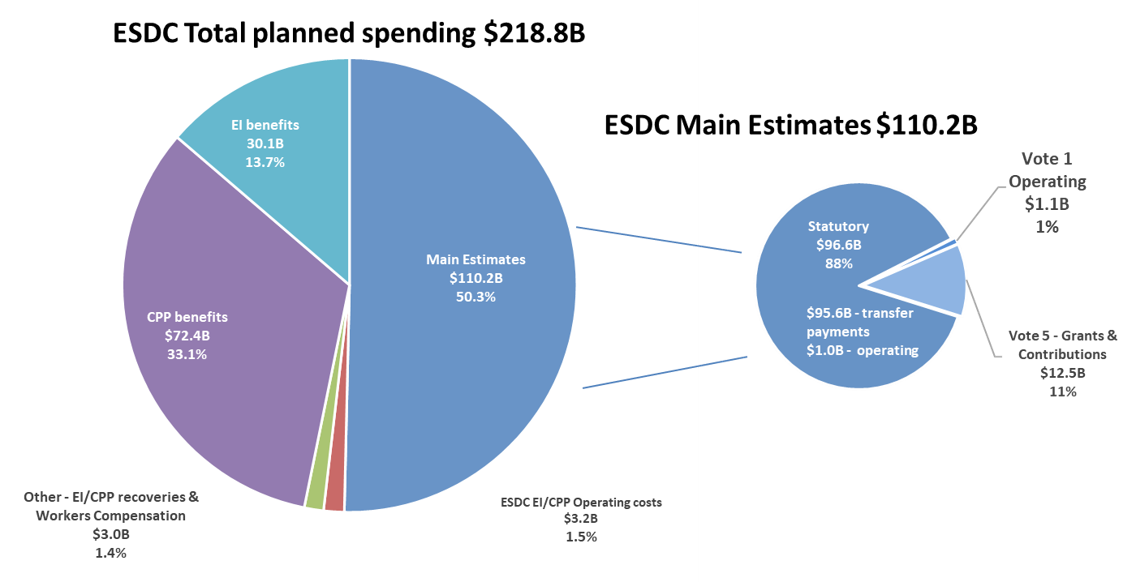
Descriptive text:
Figure on the left: ESDC total planned spending is $218.8 billion
- EI Benefits planned spending is $30.1 billion or 13.7% of total planned spending
- CPP Benefits planned spending is $72.4 billion or 33.1% of total planned spending
- Other EI and CPP Recoveries and Workers Compensation planned spending is $3.0 billion or 1.4% of total planned spending
- EI and CPP Operating Costs planned spending is $3.2 billion or 1.5% of total planned spending
- Main Estimates represents $110.2 billion or 50.3% of total planned spending
Figure on the right: ESDC Main Estimates is $110.2 billion
- Statutory planned spending is $96.6 billion or 88% of total Main Estimates
- Vote 1 - Operating Expenditures planned spending is $1.1 billion or 1% of total Main Estimates
- Vote 5 - Grants and Contributions planned spending is $12.5 billion or 11% of total Main Estimates
Of the $110.2 billion in planned budgetary expenditures included in ESDC's 2025‑2026 Main Estimates, $108.1 billion (98%) will benefit Canadians through statutory and voted transfer payment programs.
Programs included in the $95.6 billion of statutory transfer payments expenditures in ESDC's 2026-2027 Main Estimates are:
- Old Age Security Program = $88.8 billion
- Canada Student Financial Assistance Program and Canada Apprentice Loans = $3.4 billion
- Canada Education Savings Program = $1.3 billion
- Canada Disability Benefit= $1.1 billion
- Canada Disability Savings Program = $0.9 billion
Programs included in the $12.5 billion in voted grants and contributions in ESDC's 2026‑2027 Main Estimates:
- Early Learning and Child Care = $9,267.6 million
- Workforce Development Agreements = $722.0 million
- Youth Employment and Skills Strategy = $598.5 million
- Indigenous ELCC Transformation Initiative= $317.7 million
- Student Work Placement Program = $276.8 million
- Indigenous Skills and Employment Training Program = $235.5 million
- Canadian Apprenticeship Strategy = $181.4 million
- National School Food Program = $142.2 million
- Opportunities Fund for Persons with Disabilities = $100.7 million
- Canada Service Corps = $83.5 million
- Sectoral Workforce Solutions Program = $82.9 million
- Enabling Fund for Official Language Minority Communities = $67.7 million
- New Horizons for Seniors Program = $63.1 million
- Future Skills = $60.8 million
- Social Innovation and Social Finance Strategy = $51.0 million
- Skills and Partnership Fund = $50.0 million