
HUMA committee briefing binder: Appearance by the Minister of Job and Families - February 5, 2026
Official title: Appearance by: Minister of Job and Families, Standing Committee on Human Resources, Skills and Social Development and the Status of Persons with Disabilities (HUMA), Subject Matter Study of Bill C-15 (clause 571- Division 34, clauses 573 to 575 - Division 36, and clause 599 - Division 44), Date: February 5, 2026, 9:15 a.m. to 10:15 a.m.
On this page
- 1. Minister's Opening Remarks
- 2. Scenario Note
- 3. Budget 2025
- 4. Topics of Interest on Employment
- a. Employment Insurance Modernization
- b. Employment Insurance Supports for Workers in Seasonal Industries
- c. Extending Employment Insurance Parental Benefits During Bereavement
- d. Temporary Foreign Worker Program
- e. Impact of Artificial Intelligence (AI) on Employment Rates
- f. Labour Mobility for Workers in Skilled Trades
- g. Canadian Apprenticeship Strategy
- h. Skills Retraining in Sectors Impacted by Tariffs
- i. ESDC Measures for Tariff-Impacted Industries and Workers
- j. Foreign Credentials Recognition (FCR)
- k. Workforce Alliances and the Sectoral Workforce Innovation Fund
- l. Student Loan Forgiveness
- m. Recent Enhancements to Student Financial Assistance
- n. Budget 2025 and Private Educational Institutions
- o. Student Work Placement Program
- p. Youth Employment and Skills Strategy
- q. Work-Sharing Program and Response to Tariffs
- r. Major Projects
- 5. Families, Children and Youth
- a. Youth Employment Situation and Key Drivers
- b. Youth Support Measures
- c. Child Poverty in Canada
- d. Food Bank and Poverty Report
- e. Food Insecurity
- f. National School Food Program
- g. Supporting Quality of Life Placemat
- h. Canada Summer Jobs (CSJ)
- i. Office of the Auditor General Audit Performance Audit on Canada Summer Jobs
- j. Early Learning and Child Care (ELCC) and the OAG Report (Fall 2025)
- l. OLMC Supports Landscape Across the GoC and ESDC
- 6. Labour
- a. Labour Dispute at the Canada Post Corporation
- b. Labour disputes and Section 107
- c. West Coast Ports Industrial Inquiry Commission
- d. Protecting Federally Regulated Gig Workers/Misclassification/Incorporated Drivers
- e. Probe on Flight Attendants' Pay (definition of work)
- f. Forced Labour
- g. CUSMA Labour Provisions
- h. Paid Medical Leave
- 7. Seniors
- 8. Disability & Accessibility
- 9. Service Delivery
- 10. Corporate Issues
1. Minister's opening remarks
Opening Remarks
Opening remarks for the Honourable Patty Hajdu, Minister of Jobs and Families and Minister Responsible for the Federal Economic Development Agency for Northern Ontario for an appearance Before the Standing Committee on Human Resources, Skills and Social Development and the Status of Persons with Disabilities (HUMA), Theme: Affordability, House of Commons February 5, 2026
Check against delivery. (2025 PASRB 000088)
Thank you, Mr. Chair.
To begin, I'd like to acknowledge that we're on [territorial acknowledgement].
I'm joined by [names].
Mr. Chair, the Government of Canada's core mission is to lower costs for Canadians.
We have programs and policies in place to make life more affordable.
But these aren't just policies – they're promises.
And I'm honoured to highlight the steps we're taking to fulfill those promises.
Early learning and child care
Mr. Chair, high-quality child care shouldn't break the bank.
That's why we created the Canada-wide Early Learning and Child Care system.
Families are now saving thousands of dollars every year.
And all provinces and territories have extended their Canada-wide agreements past March 31, 2026.
That's good news for parents like Adriana from BC, who told us that affordable child care gives her peace of mind while she's at work.
We are strengthening the sense of security that Canadians rely on every day.
National school food program
Mr. Chair, children should never go hungry at school.
So, Budget 2025 will make our National School Food Program permanent —because when families can put food on the table, children can learn and thrive.
This $216 million annual investment will help up to 400,000 children each year to participate in school food programs. For a participating family with two children at school, this can result in annual savings of $800. Experts have called this step “monumental.”
But we know families are facing broader affordability pressures. That's why our government is introducing the new Canada Groceries and Essentials Benefit, increasing the former GST Credit by 25% for five years starting in July 2026 to help Canadians manage the rising cost of everyday essentials.
To support families in immediate need, we are providing $20 million to the Local Food Infrastructure Fund, helping food banks and community organizations deliver more nutritious food – this is part of our school food policy.
And to tackle the root causes of food insecurity, we are developing a National Food Security Strategy to strengthen domestic food production, support producers, and improve access to affordable, nutritious food across the country.
To deliver on the school food commitment, we've proposed that the National School Food Program become a permanent Act through Budget 2025.
I look forward to standing in support of this legislation, and I encourage my honourable colleagues to do the same.
Canada child benefit
Mr. Chair, the Canada Child Benefit is another key element of affordability for Canadian families.
About 3.5 million parents receive more than $28.6 billion in tax-free CCB payments each year. Plus, it is indexed every year, so it keeps up with the cost of living.
Parents who receive it have told us that this benefit has really made a difference.
But those who need benefits the most often don't receive them.
It's why Budget 2025 will implement Automatic Federal Benefits, beginning with the 2026 tax year, to help low-income Canadians access benefits more easily.
This measure is expected to benefit 5.5 million Canadians by the 2028 tax year and will strengthen Canada's social safety net.
Canada disability benefit/Disability tax credit
Mr. Chair, working-age persons with disabilities are more likely to live in poverty than those without disabilities.
This is unacceptable.
And it's why we've created the Canada Disability Benefit.
It provides a maximum of $2,400 per year to low-income persons with disabilities, between the ages of 18 and 64, who are eligible for the disability tax credit, and the first payments began last summer.
But obtaining a valid disability tax credit to become eligible for this benefit is sometimes too expensive.
That is why Budget 2025 announced that we'll offset the costs of applying for the Disability Tax Credit by providing a supplemental payment of $150 to Canada Disability Benefit recipients for each successful Disability Tax Credit certification or re-certification – putting the benefit, and affordability, in reach for more Canadians.
Personal support workers/SEIU announcement
Mr. Chair, personal support workers are integral to the strength of Canada's care system.
Hence why we invested almost $30 million last year to help personal support workers build a financial safety net and retire with confidence.
Additionally, Budget 2025 introduces a temporary five-year Personal Support Workers Tax Credit.
It's an investment that supports them and recognizes the vital role they play in our communities every day.
Youth investments
Mr. Chair, affordability also means improving youth employment opportunities.
So, Budget 2025 is helping young Canadians find jobs.
We've earmarked $594.7 million for Canada Summer Jobs, $307.9 million for the Youth Employment and Skills Strategy, and $635.2 million for the Student Work Placement Program.
We're also working hard to make the trades more attractive to young Canadians.
One of the ways we're doing this is through Budget 2025, which proposes to double Union Training and Innovation Program funding with $75 million over three years.
And we're investing nearly $1 billion each year in apprenticeship supports and projects!
These are investments that'll help young Canadians enter the workforce with solid training and confidence and build Canada's future.
Canadian dental care plan
Mr. Chair, many Canadians can't afford a visit to an oral health provider.
And roughly 2.26 million school days and 4.15 million working days are missed each year due to oral health concerns.
It's why we introduced the Canadian Dental Care Plan.
More than 6 million eligible Canadians are covered and saving on average more than $900 annually.
A couple in my riding told me that they received dental treatments for the first time in seven years because of the plan.
It was music to my ears and a great example of affordability in action.
Closing
Mr. Chair, this is a critical time for Canadians.
And we are meeting this moment with strength and with conviction.
We are building the future together by empowering our families and working relentlessly to make life more affordable for all Canadians.
Thank you.
-30-
2. Scenario Note
The Standing Committee on Human Resources, Skills and Social Development and the Status of Persons with Disabilities (HUMA) - Minister of Jobs and Families on the clauses of C-15, Budget 2025 Implementation Act, No. 1, referred to HUMA - February 5, 2026 – 9:15 a.m. – 10:15 a.m.
Overview
- On December 10, 2025, the House of Commons Standing Committee on Finance adopted a motion to refer to various other committees the subject matter of element of C-15, Budget 2025 Implementation Act, No. 1. HUMA is being asked to consider clause 571 (Division 34 - Amendment to the Government Annuities Improvement Act (GAIA)), clauses 573 to 575 (Division 36 - Canada Student Financial Assistance (CSFA) Integrity Issues), and clause 599 (Division 44 - National School Food Program). The Minister of Jobs and Families has been invited to appear before HUMA, for one hour, on this topic. Other committees who have been referred divisions of Bill C-15 will be receiving ministers as well.
- The Minister previously appeared before HUMA on November 25, 2025, on a study on her mandate and a myriad of ongoing studies including the Youth Employment in Canada study and “The definition of ‘work' and the use of section 107 in the Canada Labour Code”.
- Since then, the Committee has juggled its study on the Canada Labour Code with the “Impacts of the Temporary Foreign Worker Program on the Labour Market” study. The motion for this study calls on the Minister, as well as the Minister of Immigration and Refugees to appear.
Committee Proceedings
- During this appearance, five minutes will be provided to deliver opening remarks Following that, questioning will begin.
- The first round of questions will give six minutes each to the CPC, LPC and BQ, in that order.
- The second (and subsequent rounds) of questions allocate five minutes to the CPC and LPC, two and a half minutes to the BQ, and then five minutes to the CPC and the LPC.
- Senior officials in attendance will be:
- Paul Thompson, Deputy Minister of Employment and Social Development;
- Cliff Groen, Associate Deputy Minister of Employment and Social Development and Chief Operating Officer for Service Canada;
- Rob Wright, Deputy Minister of Labour and Associate Deputy Minister of Employment and Social Development.
Parliamentary Environment
- Despite the fact that the purpose of the present appearance is to address the divisions of C-15 relevant to ESDC, the Minister can expect to be questioned on a broader range of issues.
- For your awareness, other topics of interest include
- HUMA meeting with the Auditor General of Canada (AG) and her principles will appear to discuss their findings from the 2025 Reports of the Auditor General of Canada Canada-Wide Early Learning and Child Care System (ELCC).
- HUMA has concluded its youth employment study and held the first meeting of the current study on the Canada Labour Code, on November 18.
- HUMA also began its study on Impacts of Temporary Foreign Worker Program on the Labour Market at the end of November.
- The Standing Committee on Transport, Infrastructure and Communities (TRAN) is continuing its study of the Changing Landscape of Truck Drivers in Canada, with a production of papers order delivered on February 9.
- The Standing Committee on Public Accounts has received the Deputy Minister on two AG reports in autumn 2025: Canada-Wide Early Learning and Child Care System and Professional Services Contracts.
- The Standing Senate Committee on Transport and Communications (TRCM) has undertaken a study on the “Maintenance of transport services in the case of labour disruptions”, including the use of Section 107 of the Canada Labour Code.
- The Standing Senate Committee on Social Affairs, Science and Technology (SOCI) has begun the examination of Bill S-212, An Act respecting a national strategy for children and youth in Canada.
Conservative Party of Canada
- HUMA member and Employment critic Garnett Genuis has criticized the government for cutting off access to financial assistance to students with lower income backgrounds and fewer opportunities, who are pursuing particular vocational programs.
- Social Development and Families critic Layla Goodridge has raised concerns about inflation, rising food prices — including the cost of baby formula — as well as the Auditor General's findings on Early Learning and Child Care.
- CPC MPs have likewise argued that the National School Food Program is necessary only because food prices have increased so sharply, noting that babies do not attend school.
- HUMA vice-chair Rosemarie Falk has criticized the government for not implementing earlier budget measures, such as Employment Insurance (EI) supports for adoptive parents, while her 44th Parliament Private Members' Bill could not advance as it required a royal recommendation.
Bloc Québécois
The BQ has been very concerned about the stalled EI reform and contrasting food inflation with the school food program.
- Recently elected HUMA vice-chair and new ESDC critic Andréanne Larouche has been focussing her attention on Curam lately. She is now calling for the creation of a committee and an emergency meeting to clarify the situation surrounding the modernization of the system for paying benefits to seniors.
- The BQ's Budget 2025 amendment motion included the following: “end discrimination against people aged 65 to 74 who did not receive an equitable increase in Old Age Security”.
- BQ MPs have criticized the lack of new funding for the New Horizons for Seniors program.
- BQ MPs have also called for the Canada Summer Jobs funding to be indexed to inflation.
3. Budget 2025
a. Budget 2025 initiatives
Minister of Jobs and Families
Below is a list of Budget 2025 announcements under the purview of the Minister of Jobs and Families. Secretary of State-led items that would be of interest to the Minister are also provided.
Minister of Jobs and Families-led items
- Program/Initiative 1: Supporting Workers
- Theme: Building a Stronger Economy and Labour Market
- Budget 2025 Announcements 1: The government is implementing a new reskilling package for workers, has made Employment Insurance more flexible and with extended benefits, and will launch a new digital jobs and training platform with private-sector partners to connect Canadians more quickly to careers. Measures include:
- $570 million over three years, starting in 2025-2026, through Labour Market Development Agreements with provinces and territories to support training and employment assistance for workers impacted by tariffs and global market shifts.
- $382.9 million over five years, starting in 2026-2027, and $56.1 million ongoing, to launch new Workforce Alliances to bring together employers, unions, and industry groups to work on ways to help businesses and workers succeed in the changing labour market and coordinate public and private investments in skills development. A new Workforce Innovation Fund will invest in projects tailored to local job markets to help businesses in key sectors and regions recruit and retain the workforce they need.
- Temporary flexibilities to the Employment Insurance Work-Sharing program, as announced on
- March 7, 2025, to provide Employment Insurance benefits to eligible employees who agree to work reduced hours due to a decrease in business activity beyond their employer's control. This helps employers and employees avoid layoffs while supplementing reduced income with EI benefits. This measure is expected to cost $370.5 million over five years, starting in 2025-2026, and $18.5 million ongoing.
- Temporary EI measures that enhance income supports for Canadian workers whose jobs have been impacted by the economic uncertainty caused by foreign tariffs. These supports are expected to cost $3.7 billion over three years, starting in 2025-2026.
- $50 million over five years, starting in 2026-2027, and $8 million ongoing, to implement a new digital tool to facilitate job search and applications, and launch a national online training platform in partnership with the private sector.
- Theme: Building a Stronger Economy and Labour Market
- Program/Initiative 2: Helping Youth Find and Keep Jobs
- Theme: Building a Stronger Economy and Labour Market
- Budget 2025 Announcements 2: Budget 2025 proposes to provide $594.7 million over two years, starting in 2026-2027, to Employment and Social Development Canada for Canada Summer Jobs to support around 100,000 summer jobs in summer 2026.
- Budget 2025 proposes to provide $307.9 million over two years, starting in 2026-2027, for the horizontal Youth Employment and Skills Strategy to provide employment, training, and wraparound supports (for example, mentorship, transportation, mental health counselling) to around 20,000 youth facing employment barriers annually. $20.1 million of this is offset by funding already provisioned in the fiscal framework.
- Budget 2025 proposes to provide $635.2 million over three years, starting in 2026-27, to Employment and Social Development Canada for the Student Work Placement Program to support around 55,000 work-integrated learning opportunities for post-secondary students in 2026-2027.
- Theme: Building a Stronger Economy and Labour Market
- Program/Initiative 3: Advancing the Youth Climate Corps
- Theme: Building a Stronger Economy and Labour Market
- Budget 2025 Announcements 3: Budget 2025 proposes to provide $40 million over two years, starting in 2026-2027, to Employment and Social Development Canada, to create a Youth Climate Corps to provide paid skills training for young Canadians. They will be trained to quickly respond to climate emergencies, support recovery, and strengthen resilience in communities across the country. The skills training and work experience opportunities created through a Youth Climate Corps support reducing youth unemployment, increasing innovation, and strengthening adaptation and mitigation projects.
- Theme: Building a Stronger Economy and Labour Market
- Program/Initiative 4: Improving Foreign Credential Recognition
- Theme: Building a Stronger Economy and Labour Market
- Budget 2025 Announcements 4: As announced on October 27, 2025, Budget 2025 proposes to provide $97 million over five years, starting in 2026-2027, to Employment and Social Development Canada to establish the Foreign Credential Recognition Action Fund to work with the provinces and territories to improve the fairness, transparency, timeliness, and consistency of foreign credential recognition, with a focus on health and construction sectors. This funding will be sourced from existing departmental resources.
- Theme: Building a Stronger Economy and Labour Market
- Program/Initiative 5: Real-Time Employer Reported Payroll Information Pilot
- Theme: Building a Stronger Economy and Labour Market
- Budget 2025 Announcements 7: Budget 2025 proposes to provide $29 million over two years, starting in 2026-2027, to be charged to the Employment Insurance Operating Account, to Employment and Social Development Canada to support a two-year pilot project to assess whether Employment Insurance eligibility and entitlement can be determined accurately and securely using real-time payroll information.
- Theme: Building a Stronger Economy and Labour Market
- Program/Initiative 6: Employment Insurance Parental Benefits during Bereavement
- Theme: Building a Stronger Economy and Labour Market
- Budget 2025 Announcements 7: Budget 2025 proposes to provide $17 million over three years, starting in 2027-2028, to Employment and Social Development Canada to amend the Employment Insurance Act to allow claimants receiving Employment Insurance parental benefits to access an additional eight weeks of parental benefits in the event of the death of the child.
- Theme: Building a Stronger Economy and Labour Market
- Program/Initiative 7: Restricting Non-Compete Agreements
- Theme: Building a Stronger Economy and Labour Market
- Budget 2025 Announcements 7: Budget 2025 announces that the government intends to amend the Canada Labour Code to restrict the use of non-compete agreements in employment contracts for federally regulated businesses. The government will launch consultations on proposed legislative changes in early 2026.
- Theme: Building a Stronger Economy and Labour Market
- Program/Initiative 8: Lowering Barriers to Access the Canada Disability Benefit
- Theme: Tackling Affordability
- Budget 2025 Announcements 8: Budget 2025 reaffirms the government's intention to lower barriers to access the Canada Disability Benefit by helping to offset the costs of applying for the Disability Tax Credit for Canada Disability Benefit recipients. Budget 2025 proposes $115.7 million over four years, beginning in 2026-2027, and $10.1 million per year ongoing, including administrative costs, for a one-time supplemental Canada Disability Benefit payment of $150 in respect of each Disability Tax Credit certification, or re-certification, giving rise to a Canada Disability Benefit entitlement.
- Theme: Tackling Affordability
- Program/Initiative 9: Protecting Workers Against Wage Theft
- Theme: Tackling Affordability
- Budget 2025 Announcements 9: The 2024 Fall Economic Statement announced the government's intent to make regulatory changes to substantially increase the penalties imposed on federally regulated employers who commit wage theft. The government remains committed to ensuring workers are protected and compensated for the work they perform. The work to increase penalties is currently underway and consultations with workers and employers on proposed changes will take place over the coming months.
- Theme: Tackling Affordability
- Program/Initiative 10: Protecting Workers Against Improper Classification
- Theme: Tackling Affordability
- Budget 2025 Announcements 10: To crack down on employers that misclassify employees, Budget 2025 proposes to provide $77 million over four years starting in 2026-2027, with ongoing funding of $19.2 million annually, for the Canada Revenue Agency to implement a program that addresses non-compliance related to personal services businesses, as well as lift the moratorium on reporting fees for services in the trucking industry. Budget 2025 also proposes to amend the Income Tax Act and the Excise Tax Act to allow the Canada Revenue Agency to share information with Employment and Social Development Canada for the purpose of addressing worker misclassification.
- Theme: Tackling Affordability
- Program/Initiative 11: Improving the Integrity of Student Financial Assistance
- Theme: More Efficient and Effective Government
- Budget 2025 Announcements 11: Budget 2025 announces the government's intention to propose legislative and regulatory amendments to address integrity issues related to private educational institutions by generally limiting access to the Canada Student Grant for Full-time Students to students attending public educational institutions and not-for-profit private institutions within Canada. Internationally, Canada Student Loans and Grants generally would only be provided to those who attend public institutions. This measure is expected to result in savings of approximately $1.0 billion over four years, starting in 2026-2027, and $280.1 million ongoing.
- Theme: More Efficient and Effective Government
- Program/Initiative 12: Emergency Benefits Overpayments
- Theme: More Efficient and Effective Government
- Budget 2025 Announcements 12: Budget 2025 proposes to provide $123 million over two years, starting in 2026-2027, to continue collections for overpayments related to COVID-19 emergency benefits, in collaboration with the Canada Revenue Agency.
- Theme: More Efficient and Effective Government
- Program/Initiative 13: International Mobility Program Compliance
- Theme: More Efficient and Effective Government
- Budget 2025 Announcements 13: To reduce duplication and streamline delivery, Immigration, Refugees and Citizenship Canada will transfer responsibility for employer-focused compliance inspections under the International Mobility Program to Employment and Social Development Canada. Both organizations conduct parallel inspections under separate programs (the International Mobility Program and the Temporary Foreign Worker Program), using similar tools and authorities, resulting in duplication of effort, oversight, and internal service demands. This change would simplify the compliance landscape for employers, while supporting more coherent federal oversight.
- Theme: More Efficient and Effective Government
- Program/Initiative 14: Legislative Amendments to the Department of Employment and Social Development Act
- Theme: More Efficient and Effective Government
- Budget 2025 Announcements 14: In Budget 2025, the government proposes to amend the Department of Employment and Social Development Act to enable the delivery of integrated and efficient services across government.
- Theme: More Efficient and Effective Government
- Program/Initiative 15: Legislative Amendments to the Government Annuities Improvement Act
- Theme: More Efficient and Effective Government
- Budget 2025 Announcements 15: In Budget 2025, the government proposes to amend the Government Annuities Improvement Act to eliminate the legislative requirement for a duplicative audit of the Government Annuities Account.
- Theme: More Efficient and Effective Government
Secretary of State (Labour)-led Items of Interest to the Minister
- Program/Initiative 1: Union Training and Innovation Program to Train the Next Generation of Canadian Builders
- Theme: Building a Stronger Economy and Labour Market
- Budget 2025 Announcements 1: As announced on October 27, 2025, Budget 2025 proposes to provide $75 million over three years, starting in 2026-2027, to Employment and Social Development Canada to expand the Union Training and Innovation Program, which supports union-based apprenticeship training in the Red Seals trades.
- Theme: Building a Stronger Economy and Labour Market
Secretary of State (Children and Youth)-led Items of Interest to the Minister
- Program/Initiative 1: Making the National School Food Program Permanent
- Theme: Tackling Affordability
- Budget 2025 Announcements 1: As announced on October 10, 2025, Budget 2025 proposes to introduce legislation and provide $216.6 million per year, starting in 2029-2030, to Employment and Social Development Canada, Indigenous Services Canada, and Crown-Indigenous Relations and Northern Affairs Canada, to make the National School Food Program permanent.
- Theme: Tackling Affordability
Secretary of State (Seniors)-led Items of Interest to the Minister
No Budget 2025 announcement
Secretary of State (Seniors) support to other Cabinet Ministers
- Program/Initiative 1: Delivering Automatic Federal Benefits for Low-Income Individuals – Canada Revenue Agency
- Budget 2025 Announcements 1: As announced on October 10, through Budget 2025, Canada's new government will start Automatic Federal Benefits for the 2026 tax year that will reach up to 5.5 million low-income Canadians by the 2028 tax year.
- To help individuals with lower income receive the benefits to which they are entitled, Budget 2025 also proposes to amend the Income Tax Act to allow the Canada Revenue to file a tax return on behalf of certain eligible individuals with lower incomes in simple tax situations who do not owe tax and do not file themselves.
- Program/Initiative 2: Delivering for Personal Support Workers – Canada Revenue Agency
- Budget 2025 Announcements 2: As announced on October 27, Budget 2025 proposes to introduce a temporary Personal Support Workers Tax Credit, under which eligible personal support workers employed in the remaining provinces and territories could claim a refundable tax credit equal to 5 per cent of their eligible earnings, providing support of up to $1,100 per year. This measure to support front-line health care workers would be available for the 2026 to 2030 taxation years and is estimated to cost $1.48 billion over six years, starting in 2025-2026.
- Program/Initiative 3: Protecting Against Economic Abuse – Department of Finance
- Budget 2025 proposes to introduce a voluntary Code of Conduct for the Prevention of Economic Abuse for federally regulated banks. This code, to be overseen by the Financial Consumer Agency of Canada, will set clear expectations for how banks can identify, prevent, and respond to economic abuse to better protect Canadians.
- Program/Initiative 4: Combatting Financial Fraud – Department of Finance
- Budget 2025 Announcements 4: Budget 2025 announces the government's intention to develop a whole of-government National Anti-Fraud Strategy. This strategy will bring together financial institutions, technology, and telecommunication companies to develop a cross-sectoral approach to protect Canadians from evolving and highly complex fraud schemes.
b. Amendment to the Government Annuities Improvement Act – removal of audit requirement (part 5 – division 34)
Overview
This proposal is seeking an amendment to the Government Annuities Improvement Act to repeal Section 16 of the act which requires an audit of the Government Annuities Account (GAA). This audit provides no value added to Canadians, is a low value account ($54 million) at March 31, 2025, with a small number of annuitants (approximately 11,500) who have access to more useful information as the Office of the Chief Actuary (OCA) prepares an annual Actuarial Report on the Government Annuities. The amendment would enable the department and the Office of the Auditor General (OAG) to reallocate resources to better serve Canadians.
Key messages
The GAA is a Specified Purpose Account (SPA) managed through the Consolidated Revenue Fund and presented as a liability in the Departmental and the Government of Canada's financial statements. The audit requirement was established in 1975, when the liability amount was approximately $1.2 billion. The GAA liability is constantly decreasing as this is a closed group, the most recent published financial statements are showing a liability amount of $54 million. Removing the audit requirement will:
Avoid duplication
GAA are part of the Public Accounts of ESDC, which are audited on an annual basis by the OAG. A separate audit of GAA financial statements duplicates assurance activities without adding significant value. Also consider that overall, the value of the liability is not material to the reporting or audit of the Public Accounts of Canada. A small number of annuitants (approximately 11,500) have access to more useful information as the OCA prepares an annual Actuarial Report on the GAA.
Reduce cost and create efficiency
Removing this requirement streamlines reporting and reduces regulatory burden while maintaining accountability. It will enable the department and the OAG to reallocate resources to better serve Canadians.
Questions and answers
1. Why are we proposing to remove the audit requirement for GAA financial statements?
The primary reason is efficiency. Auditing the GAA statements duplicates assurance that is already available through the OCA report, which undergoes a rigorous review process. Removing the audit eliminates unnecessary overlap while maintaining strong accountability.
2. How will Canadians be assured that financial information remains accurate and reliable without this audit?
Canadians will continue to have assurance through OCA's independently validated reporting. OCA's report is subject to oversight and scrutiny. The removal of the audit requirement does not reduce transparency; it simply eliminates low value processes.
3. How does this proposal align with government commitments to transparency and fiscal responsibility?
It aligns directly. By removing redundant processes, the government demonstrates prudent stewardship of public funds, while still ensuring transparency through OCA's reports. It reinforces a principle of “right-sized” oversight: focusing efforts where they provide real value to Canadians.
4. Who supports this change, and has there been consultation?
Key financial management stakeholders, including the OAG and the Department of Finance, were consulted. There is broad agreement that duplication adds cost without improving transparency. Stakeholders support streamlining while preserving accountability.
5. What is the total value of the account?
The GAA liability is constantly decreasing as this is a closed group, the most recent published financial statements are showing a liability amount of $54 million. The audit requirement was established in 1975, when the liability amount was approximately $1.2 billion.
c. Address Integrity Issues related to Canada Student Financial Assistance Program
Part 5 – Division 36
Overview
- In recent years, there have been growing concerns around certain educational institutions related to fraud, integrity and growing financial risk to the Government of Canada and students.
- To address these concerns, this section proposes two new legislative measures. The first measure would provide the Minister with the flexibility to align with provincial/territorial (PT) decisions to suspend or deny provincial student financial assistance (SFA) by also suspending or denying federal SFA in certain circumstances.
- The second measure would deny federal SFA to students attending private, for-profit international institutions. This measure would include a provision to allow students who have previously received SFA while enrolled in their current program of study to remain eligible for SFA until July 31, 2029, provided that they stay at the same institution and in the same program of study.
- Division 36 of Part 5 amends the Canada Student Financial Assistance Act to deny the provision of federal SFA to students attending private, for-profit international educational institutions, and to provide the Minister the flexibility to suspend or deny federal SFA in certain circumstances to align with PT suspensions or denials.
Key Messages
- Post-secondary education is a key driver of economic growth and well-being in Canada. Through the Canada Student Financial Assistance (CSFA) Program, the Government provides Canada Student Grants and Loans to help students pay for their post-secondary education.
- In recent years, there have been growing concerns around certain educational institutions related to fraud, integrity and growing financial risk to the Government of Canada and students.
- To address these concerns, two new legislative measures are proposed. The first measure would provide the Minister with the flexibility to align with provincial/territorial (PT) decisions to suspend or deny provincial student financial assistance (SFA) by also suspending or denying federal SFA in certain circumstances. This new authority would better position the Government to more proactively address fraud, integrity, and financial risk, and to align federal and PT SFA. It would apply only to affected students in the relevant province or territory.
- The second measure would deny federal student financial assistance to students attending private, for-profit international institutions. This would address concerns regarding the quality of private, for-profit international institutions, including increased risk of fraud due to a lack of direct federal or provincial and territorial oversight of these institutions.
- This measure would include a provision to allow students who have previously received SFA while enrolled in their current program of study to remain eligible for SFA until July 31, 2029, provided that they stay at the same institution and in the same program of study.
- If these measures are approved, Employment and Social Development Canada would collaborate closely with PT partners to help ensure a smooth implementation.
Questions & Answers
Q1. What led the Government of Canada to commit to reviewing educational institutions for the purposes of the Canada Student Financial Assistance (CSFA) Program?
A. Post-secondary education (PSE) is a key driver of inclusive economic growth and well-being in Canada. Through the CSFA Program, the Government of Canada makes PSE more affordable and accessible for Canadian students by providing non-repayable grants, interest-free loans and repayment assistance to eligible borrowers. As part of the Government of Canada's mandate to ensure stewardship of public funds, the CSFA Program conducts regular reviews of its operations to identify areas of risk and concern.
Concerns have been growing about fraud and misuse of student financial assistance; some of the issues identified have resulted in some provinces and territories (PTs) taking unilateral actions regarding the provision of their own student aid.
These concerns taken together have led the Government to take action to protect students and taxpayers from poor educational outcomes and financial risk.
Q2. What are the two measures being introduced?
A. Two new legislative measures are being proposed. The first measure would provide the Minister with the flexibility to align with PT decisions to suspend or deny provincial student financial assistance (SFA) by also suspending or denying federal SFA in certain circumstances. This would provide the Minister with a greater ability to address concerns related to fraud, integrity, and growing financial risks. The second measure would deny federal SFA to students attending private, for-profit international institutions. This would address concerns regarding the quality of these institutions, including increased risk of fraud due to a lack of direct federal or PT oversight of these institutions.
Aligning with PT decisions
Q3. Why is the Government of Canada proposing to provide the Minister with the flexibility to align with PT decisions regarding the provision of SFA?
A. As PTs have direct oversight of educational institutions, they are better placed to monitor and ensure compliance, observe trends, and probe concerning indicators that could jeopardize successful student outcomes or represent fraud, integrity or financial risk to government. To address concerns related to fraud, integrity and growing financial risks, a number of jurisdictions have recently taken unilateral action and have suspended or denied provincial student financial assistance. The new authority would provide the Minister the ability to align with PT decisions when warranted. Federal alignment with a PT decision would apply only to impacted students in the relevant jurisdiction; federal alignment would not apply to all SFA borrowers across the country.
International Private For-Profit Schools
Q4. Why is the Government of Canada proposing to deny federal SFA to students attending private, for-profit international institutions?
A. Denying federal SFA for students attending private, for-profit international institutions would help address emerging concerns regarding the quality of these institutions, and increased risk of fraud due to a lack of direct federal or PT oversight with respect to international schools. Specifically, PTs have limited oversight mechanisms and controls for international schools given that there is no single jurisdiction responsible for managing these institutions. In addition, PTs have also noted challenges with assessing eligibility and compliance at international schools given varying institutional standards among different countries.
Q5. Who will be impacted by the proposed measure to deny SFA to students attending private, for-profit international institutions, and how will it affect students currently studying at these institutions and receiving federal SFA?
A. Students currently attending private, for-profit international institutions and in receipt of federal SFA, as well as prospective students who intend to apply to these institutions, could be impacted. In 2024-2025, a total of $26.8M in SFA was disbursed to approximately 2000 students who attended these institutions.
However, this measure would include a provision to allow students who have previously received SFA while enrolled in their current program of study to remain eligible for SFA until July 31, 2029, provided that they stay at the same institution and in the same program of study. This provision would allow students the flexibility to adjust and pivot their studies if needed, while providing a fixed funding cut-off date.
Q6. When will these measures come into effect?
A. Both of these measures would come into effect upon Royal Assent, which typically occurs 2-3 months after the Budget is tabled.
d. National School Food Program Act
Part 5 – Division 44
Overview
- Announced in Budget 2024 and launched in 2024-2025 with an investment of $1 billion over five years, the National School Food Program is supporting provinces, territories, and Indigenous partners to enhance and expand access to school food programs across Canada, guided by the National School Food Policy.
- As of March 2025, the Government of Canada has signed bilateral agreements with all provinces and territories on the Program and is also working directly with Indigenous partners on the rollout of distinctions-based funding for First Nations on reserve as well as Inuit, Métis, and Modern Treaty and Self-Government agreement holders.
- Budget 2025 proposes to introduce legislation and provide $216.6 million per year, starting in 2029-2030, to Employment and Social Development Canada, Indigenous Services Canada, and Crown-Indigenous Relations and Northern Affairs Canada, to make the National School Food Program permanent. This will ensure kids get access to nutritious meals, while bringing down costs for parents.
- The legislation to make the National School Food Program permanent will set out the Government of Canada's long-term vision for the Program, guided by the National School Food Policy. It will also cement the government's commitment to maintain long-term funding for the Program, and to continue working with provinces, territories and Indigenous partners to enhance and expand school food programs across Canada. The legislation will come into force on Royal Assent of the bill.
- The National School Food Program aims to provide up to 400,000 children each year with access to nutritious food at school. School food programs provide immediate and long-term benefits for children and their families and have been shown to improve academic performance, support positive health outcomes and health equity, and foster connections with culture and traditional food systems, all of which have positive lifelong impacts. Additionally, school food programs can reduce food-related spending for families. Research suggests that participation in such programs can save families with two children in school around $800 per year.
Key Messages
- Announced in Budget 2024 and launched in 2024-2025 with an investment of $1 billion over five years, the National School Food Program aims to provide meals to up to 400,000 kids every year, by supporting provinces, territories, and Indigenous partners to enhance and expand access to school food programs across Canada, guided by the National School Food Policy.
- Budget 2025 proposes to introduce legislation and provide $216.6 million per year, starting in 2029-2030, to Employment and Social Development Canada, Indigenous Services Canada, and Crown-Indigenous Relations and Northern Affairs Canada, to make the National School Food Program permanent.
- Making the National School Food Program permanent is an important step by the Government of Canada and a generational investment in the future of children, representing a strong commitment to work towards the long-term goal of every child in Canada having access to nutritious school meals.
- The National School Food Program Act, which will be enacted through the Budget Implementation Act, will set out the Government of Canada's long-term vision for the Program, guided by the National School Food Policy. It will also cement the government's commitment to maintain long-term funding for the Program, and to continue working with provinces, territories and Indigenous partners to implement a program that enhances and expands school food programs across Canada.
- School food programming has been shown to improve academic performance, support positive health outcomes and health equity, and foster connections with culture and traditional food systems, all of which have positive lifelong impacts. Additionally, school food programs can reduce food-related spending for families. Research suggests that participation in such programs can save families with two children in school around $800 per year.
- The National School Food Program is part of the federal government's work to build a more affordable Canada. These include the Canada Child Benefit and other investments made through targeted social programs and income supplements, helping to bring down costs for families so they can get ahead.
Questions & Answers
Q1. Why is the Government of Canada making the National School Food Program permanent?
A. Announced in Budget 2024 and launched in 2024-2025 with an investment of $1 billion over five years, the National School Food Program is supporting provinces, territories, and Indigenous partners to enhance and expand access to school food programs across Canada, guided by the National School Food Policy.
As of March 2025, the Government of Canada signed three-year agreements with all thirteen provinces and territories under the Program.
The National School Food Program is providing real support to children and families across Canada. This program will enable up to 400,000 children each year to participate in school food programs. At the same time, for a participating family with two children in school, this program can result in annual savings of $800.
As announced on November 4, 2025, Budget 2025 proposes to introduce legislation and provide $216.6 million per year, starting in 2029-2030, to Employment and Social Development Canada, Indigenous Services Canada, and Crown-Indigenous Relations and Northern Affairs Canada, to make the National School Food Program permanent. This will ensure kids get nutritious meals at school, while bringing down costs for parents. This is an important step by the Government of Canada and a generational investment in the future of our children, representing a strong commitment to work towards the long-term goal of every child in Canada having access to nutritious school meals.
The National School Food Program is part of the federal government's work to build a more affordable Canada. These include the Canada Child Benefit and other investments made through targeted social programs and income supplements, helping to bring down costs for families so they can get ahead.
Q2. Why is legislation required to make the National School Food Program permanent, and what will it cover?
A. Making the National School Food Program permanent through legislation will ensure children across Canada have long-term access to school food programs. The National School Food Program Act, which will be enacted through the Budget Implementation Act, 2025, No.1, sets out the Government of Canada's long-term vision for the National School Food Program, guided by the National School Food Policy. It will also cement the government's commitment to maintain long-term funding for the Program, and to continue working with provinces, territories and Indigenous partners to enhance and expand school food programs across Canada.
Q3. How will the federal government report on the impact of continued investment in the National School Food Program?
A. As prescribed in the proposed legislation, the Government of Canada will prepare an annual report on the National School Food Program, summarizing federal investments and progress made towards establishing and maintaining an accessible, health-promoting, inclusive, flexible, sustainable, and accountable Program. The report will be tabled in each House of Parliament.
Q4. What are the next steps for the bilateral agreements with provinces and territories?
A. The federal government will continue to work with provinces, territories, and Indigenous partners to deliver on the National School Food Program, building on the progress achieved during the initial years of implementation.
As of March 2025, the Government of Canada signed three-year bilateral agreements with all provinces and territories under the National School Food Program. The Government of Canada is committed to supporting provinces and territories in meeting the commitments outlined in these bilateral agreements.
The Program's implementation will continue to support the federal vision, principles and objectives set out in the National School Food Policy, including ensuring access to school meals without stigma or barriers, fostering healthy practices, and strengthening connections with the environment, culture and local food systems.
Q5. What are the next steps for the bilateral agreements with First Nations, Inuit, Métis and Self-Governing and Modern Treaty partners?
A. For Indigenouspartners receiving federal investment in school food programming, funding will flow through existing agreements with Indigenous Services Canada and Crown-Indigenous Relations and Northern Affairs Canada. Indigenous partners will have flexibility to determine how best to implement programming in their communities.
Q6. What is the role of the provinces and territories in school food programming?
A. Provinces and territories play a critical role in school food programming as it falls under their jurisdiction, and all currently provide funding for school meals. The National School Food Program builds on these existing efforts by working collaboratively with provincial and territorial governments. The Program is designed to account for local and regional diversity and to provide maximum flexibility to invest according to jurisdictional needs.
By making the National School Food Program permanent, the federal government will continue working with provinces and territories to enhance and expand school food programs across Canada over the long-term.
Q7. What are the benefits of investments in school food programming?
A. School food programming has been shown to improve academic performance, support positive health outcomes and health equity, and foster connections with culture and traditional food systems, all of which have positive lifelong impacts.
Studies have estimated that every dollar invested in school food programs yields a return of two to six dollars in educational, health, social, economic, and environmental benefits.
Additionally, school food programs can reduce food-related spending for families. Research suggests that participation in such programs can save families with two children in school around $800 per year.
Q8. What is the National School Food Policy?
A. The National School Food Policy, released on June 20, 2024, sets a collaborative, long-term vision for school food programs across the country. It emphasizes universal access to school meals without stigma or barriers, the promotion of healthy eating practices and the integration with local food systems, cultures, and environments.
As will be set out in the National School Food Program Act, the permanent Program will continue to be guided by the long-term vision, principles and objectives for school food programs set out in the National School Food Policy.
Q9. What will the National School Food Program in Canada cost?
A. As announced in Budget 2024, the Government of Canada is investing $1 billion from 2024-2025 to 2028-2029 to implement the National School Food Program. The announcement to make the National School Food Program permanent in Budget 2025 builds on the initial investment with annual investment of $216.6 million, starting in 2029-2030.
This includes investments for First Nations, Inuit, and Métis communities, as well as Self-Governing and Modern Treaty Partners, many of whom have some of the highest rates of food insecurity in Canada.
Q10. Will provinces and territories be required to match the federal spending to implement a national school food program?
A. No, the federal funding announced in Budget 2025 will not require dollar-for-dollar cost matching of the federal contribution.
Q11. How many children will be reached by making the National School Food Program permanent?
A. The National School Food Program aims to provide up to 400,000 children each year with access to nutritious food at school.
Q12. Why is the government not creating a universal school food program?
A. The proposed legislation will make the National School Food Program permanent. This long-term investment will support an ambitious and impactful national program.
There it is not a "one-size-fits-all" approach to school food programming, each jurisdiction is best placed to determine their programming needs. That is why federal funding through the National School Food Program provides the flexibility for provincial and territorial governments, and Indigenous partners, to determine their priorities and respond to needs. Funding will go towards enhancing and expanding existing school food programming, and towards expanding school food programming to communities where it is not currently available.
This is aligned with the National School Food Policy, contributing towards the long-term vision of working towards universal access to school meals.
Q13. How are provinces and territories expected to use federal funding received through the National School Food Program?
A. Provinces and territories have jurisdiction over health and education and are already actively supporting school food programming in their jurisdictions. Federal funding through the National School Food Program builds on these existing efforts by working collaboratively with provincial and territorial governments.
Given variation in the current state of school food programs within each jurisdiction, alongside the diversity in regional priorities and needs, provinces and territories will have the flexibility to decide how best to allocate federal school food funding. It is important that federal funding go towards enhancing or expanding existing school food programming or expanding school food programming to communities where it is not currently available.
Each province and territory will be responsible for maintaining commitments made through their National School Food Program bilateral agreement with the Government of Canada, which will include commitments on the use and reporting of federal funding.
Q14. Why does the government not transfer money to parents instead of investing in a school food program?
A. School food programs provide immediate and long-term benefits for children and their families. Studies have found that school food programs can reduce families' monthly grocery bills by 5% to 19%, which would amount to about $800 in relief for a family of four in Canada over the course of a year. Additionally, school food programming has been shown to improve academic performance, support positive health outcomes and health equity, and foster connections with culture and traditional food systems, all of which have positive lifelong impacts.
The National School Food Program is part of the federal government's work to build a more affordable Canada. These include the Canada Child Benefit and other investments made through targeted social programs and income supplements, helping to bring down costs for families so they can get ahead.
Q15. Have you engaged partners and stakeholders on the National School Food Policy and Program?
A. Extensive consultations were conducted throughout 2022 and 2023 with thousands of Canadians across the country, including with provinces, territories and Indigenous partners. These consultations showed strong support for a National School Food Policy and Program.
Another public engagement was undertaken from January to February 2025. Through this engagement, a diverse group of 285 respondents from across Canada shared their views on school food data and research, including areas to prioritize for the future.
What We Heard Reports for both the 2022-2023 and 2025 engagements can be found online.
Engagements are key to making the National School Food Program a strong, evidence-based program that helps improve children and youth's health, learning, and access to nutritious food at school—so every generation has the support they need to reach their full potential.
Q16. Are partners and stakeholders supportive of a federal role in the National School Food Policy and Program?
A. In response to the Budget 2024 announcement of funding for a National School Food Program, many stakeholders publicly voiced their support for the program. The Breakfast Club of Canada released a statement saying that this program marks “a turning point in the country's commitment to the well-being of all children”. The Coalition for Healthy School Food, also released a statement applauding the federal government for the investment and urged “all premiers in each province and territory to sign on to the federal government's new policy and to provide more nutritious, culturally appropriate, sustainable and affordable food to school children all across Canada as soon as possible.”
Prior to the announcement on the Program's permanency, stakeholders continued to advocate for the federal government to do more to support school food programs, including a long-term funding commitment, given increased demand and elevated food costs. In their pre-Budget 2025 submissions, stakeholders, including the Breakfast Club of Canada and the Coalition for Healthy School Food, called for the federal government to make the National School Food Program permanent through legislation.
Most recently, stakeholders, including the Breakfast Club of Canada and the Coalition for Healthy School Food, welcomed the Budget 2025 proposal to introduce legislation to make the National School Food Program permanent, just as they welcomed the introduction of the Program in Budget 2024.
Further, all provinces and territories have signed bilateral agreements with the Government of Canada under the Program. Indigenous partners are also working with the Government of Canada on the rollout of distinctions-based funding for First Nations on reserve as well as Inuit, Métis, and Modern Treaty and Self-Government agreement holders.
The announcement to make the National School Food Program permanent enables the federal government to continue this important work with provinces, territories, and Indigenous partners to enhance and expand school food programs across Canada over the long-term.
Q17. What commitments will Indigenous governments and populations be expected to meet to receive this new funding?
A. For Indigenous partners receiving federal investment in school food programming, funding will flow through existing agreements with Indigenous Services Canada and Crown-Indigenous Relations and Northern Affairs Canada. Indigenous governments will have flexibility over how best to implement programming in their communities.
Q18. Why aren't all Indigenous groups being funded through the Indigenous funding stream?
A. The National School Food Program provides funding to Indigenous governments for school food programming. The federal government exclusively provides funding for elementary and secondary education for First Nations students ordinarily resident on reserve, and has commitments (for example, the Collaborative Modern Treaty Implementation Policy) to support Modern Treaty implementation, self-determination and to uphold the right to self-government.
4. Topics of interest on employment
a. Employment Insurance Modernization
Issue
Why have you not announced a plan for modernizing the Employment Insurance (EI) program?
Background
- Current changes in the labour market, including adjusting to AI and automation in the workplace and the effects of climate change and natural disasters reinforce the need for an enhanced EI system that helps Canadians in preparing for jobs of the future and a strong economy.
- The Government's 2025 platform commits to strengthen Canada's social safety net and ensure no one is left behind. Specifically, it commits to “as a priority over the coming year … work[ing] on enhancing the EI system to better reflect the modern workforce with flexible and reliable support.”
- The Government of Canada has taken action to improve access and adequacy of EI income supports in response to foreign tariffs, with temporary measures introduced in March 2025 and additional supports introduced in September 2025 as part of a broader workforce support plan. The measures include:
- flexibilities to increase the access and duration of supports under the EI Work-Sharing program (available until March 2026)
- waiving the one-week waiting period (ending April 11, 2026)
- suspending some EI rules so workers don't have to exhaust severance pay before collecting benefits (ending April 11, 2026)
- making it easier to access benefits by adjusting regional unemployment rates so no worker needs more than 630 hours to qualify (ending October 11, 2025); and,
- 20 additional weeks of income support for long-tenured workers (up to a maximum of 65 weeks) starting October 12th (applying retrospectively to claims starting on or after June 15, 2025) and ending on April 11, 2026.
- In addition, Budget 2025 proposes to amend the Employment Insurance Act to allow claimants receiving EI parental benefits to access up to eight additional weeks of parental benefits in the event of the death of the child.
Key Facts
- Under Employment Insurance, the proportion of unemployed workers who pay premiums and meet eligibility requirements for income supports has increased from 39% in 2019 to close to half of the total unemployed population (49.6%) in 2023-2024.
- On September 12, 2025, the Canada Employment Insurance Commission set the EI premium rate for 2026 at $1.63 per $100 of insurable earnings, representing a one-cent decrease over the 2025 rate. The new rate will take effect on January 1, 2026.
- There are two Private Member Bills in the House currently proposing EI amendments.
- First, PMB C-222, introduced on September 18, 2025, by the Honourable Terry Beech, seeks to:
- 1) Amend the EI Act to allow parental benefit claimants to continue to receive all weeks of these benefits following the death of their child
- 2)Amend the Code to provide that employees in federally-regulated sectors who are on maternity or parental leave remain entitled to these job-protected leaves following the death of their child, and
- 3) Move forward provisions so that parental benefit claimants would not have to make a new claim for benefits, or prove their eligibility to receive or continue to receive these benefits.
- Second, PMB C-249 introduced on October 21, 2025 by MP Boulerice (NDP), seeks to:
- 1) Amend the EI Act to prevent the existing rules on combining regular and special benefits (52 weeks benefit period duration and maximum of 50 weeks paid) from applying to the specific situation of when regular benefits are combined with maternity and/or parental benefits, and
- 2) Increase the number of weeks for EI family caregiver benefit for adults from 15 to 26 weeks, similar to EI sickness benefit duration.
- First, PMB C-222, introduced on September 18, 2025, by the Honourable Terry Beech, seeks to:
Key Messages
- Millions of Canadians rely on Employment Insurance every year when they find themselves out of work, start a family, take time to care for a loved one, or need to get better themselves.
- However, the labour market is changing and is facing challenges. In these times of major labour market transformations, EI remains critical for supporting workers and help stabilize their income during job transitions and economic disruptions.
- To this end, our Government has taken decisive action to ensure it is responsive in these challenging times by introducing a suite of temporary EI measures and Work-Sharing flexibilities.
- More workers have been covered by EI in recent years than in the past, with coverage rates increasing by 10 percentage points in the last five years. Still, ensuring that more workers have access to EI remains a priority. We are exploring ways to continue to improve the program, especially for younger workers, who have been among the hardest hit in this difficult job market.
If pressed on changes to the EI program
- In addition to tariff actions, the Government of Canada has taken other important steps to modernize the EI program, including:
- extending EI sickness benefits from 15 to 26 weeks in 2022
- announcing a new sharable benefit for adoptive parents, passed in Parliament in June 2024 (being implemented); and,
- extending supports for seasonal workers in 13 targeted EI regions until October 2026; and
- in Budget 2025, the government proposes to amend the Employment Insurance Act to allow claimants receiving Employment Insurance parental benefits to access an additional eight weeks of parental benefits in the event of the death of the child.
If pressed on when the new EI adoption benefit be available
- In June 2024, Parliament passed legislation introducing a new, 15-week EI adoption benefit for people becoming parents through adoption or surrogacy, and corresponding job-protected leave under the Canada Labour Code for employees in federally regulated workplaces. The legislation states both will come into force on a day fixed by Order in Council.
- As is the case for any EI changes, implementation must be sequenced and take into account other EI priorities. In addition to the decisive actions taken to support workers affected by tariffs through the EI program, ESDC has been begun to implement the EI adoption benefit, including seeking implementation authorities and moving forward with required changes to regulations and internal IM/IT systems.
b. Employment Insurance Supports for Workers in Seasonal Industries
Issue
Many workers in seasonal industries rely on Employment Insurance benefits to avoid experiencing income gaps (“black holes”) between their seasonal jobs.
Background
- An income gap refers to a period during which the claimant has no employment income and their weeks of Employment Insurance temporary income support have ended before their return to employment (such as, next work season).
- In 2018, a pilot project was introduced to help mitigate income gaps; it provided up to five additional weeks of Employment Insurance regular benefits to eligible seasonal claimants in 13 targeted regions.
- Through Budget 2021, the Government amended the Employment Insurance Act to replicate the rules of the seasonal pilot project as a temporary measure to provide additional EI support workers in seasonal industries until October 2022.
- Budget 2022 and 2023 further extended the temporary measure until October 2023 and again until October 2024. Most recently, Budget 2024 extended the current temporary seasonal measure for two additional years, until October 2026.
- In November 2024, the Bloc Québécois introduced Private Members Bill C-418 which proposed extensive changes to the EI program that were largely aligned with what was heard from labour stakeholders during the 2021-2022 EI modernization consultations. One of the proposed measures in C-418 was allowing for payment of up to 21 additional weeks of regular benefits to address the “black hole” issue. The BQ has indicated that it will be re-introducing this bill in near future with minimal changes.
- The HUMA committee is currently preparing a report on their study of Workers in the Seasonal Industry and the Employment Insurance Program that was completed in the last parliamentary session. The Government of Canada must respond to the report within 120 days of its tabling in Parliament (approximately June, if tabled in February).
Key Facts
- In 2023-2024, seasonal claims made up approximately 28% of claims established for EI regular benefits (388,095 out of 1,374,813).
- Every year, approximately 10% of seasonal claimants face an income gap between the end of their Employment Insurance benefits and the start of their next work season.
- It is expected that 62,000 seasonal claimants will use at least one additional week of EI regular benefits each year of the current two-year extension of the seasonal temporary measure, which provides up to five additional weeks. The cost of this support is estimated at $263.5 million over four years.
- The 13 regions targeted by the seasonal measure are:
- Newfoundland / Labrador (excludes St. John's)
- Charlottetown
- Prince Edward Island (excludes Charlottetown)
- Eastern Nova Scotia
- Western Nova Scotia
- Madawaska – Charlotte
- Restigouche – Albert
- Gaspésie-Îles-de-la-Madeleine
- Central Québec
- North Western Québec
- Lower Saint Lawrence and North Shore
- Chicoutimi – Jonquière
- Yukon (excludes Whitehorse)
Key Messages
- Seasonal industries are an important part of Canada's economy; many workers in these industries rely on Employment Insurance for income support to avoid experiencing income gaps between their work seasons.
- Since 2018, the Government of Canada has supported workers in seasonal industries with temporary rules providing up to five additional weeks of Employment Insurance regular benefits to eligible seasonal workers in 13 targeted regions.
- Budget 2024 extended this measure to October 2026, providing continued support to workers in seasonal industries.
- In addition, in 2025, the Government of Canada took decisive action to introduce EI and Work-Sharing flexibilities that improve access and adequacy of income supports. These measures support workers and employers affected by tariffs, including those in seasonal industries.
- The Government of Canada looks forward to reading and responding to the Committee's expected report on Workers in the Seasonal Industry and the Employment Insurance Program.
- The Government of Canada is committed to improving the Employment Insurance program as a priority to respond to the realities of the modern workforce, including for workers and employers in seasonal industries.
c. Extending Employment Insurance Parental Benefits During Bereavement
Issue
What changes will be made to the Employment Insurance (EI) program to support parents following the death of a child?
Background
- The death of a child is devastating for parents and families. In the event a child dies, payment of EI maternity benefits (which are for recovery from childbirth or pregnancy) can continue for the full 15 weeks; however, EI parental benefits (which are for care of the child) cease to be paid.
- While grieving parental claimants can transition to EI sickness benefits (up to 26 weeks), notification to Service Canada is required to change benefit type and confirm eligibility. Claimants must also obtain a medical note and complete bi-weekly reporting to attest to their inability to work. Should there be delays, reconciling over-payments could increase financial hardships for the claimant. Also, if their employer provides paid sick leave, those leaves may need to be exhausted before EI sickness benefits can begin.
- On September 18, 2025, the Honourable Terry Beech introduced Private Members' Bill C-222 to:
- amend the Employment Insurance Act to allow EI parental benefit claimants to continue to receive all weeks of these benefits following the death of their child (that is 40-69 weeks of benefits if shared, 35-61 weeks if not shared)
- amend the Canada Labour Code (Code) to ensure that employees in federally-regulated sectors who are on maternity or parental leave remain entitled to these job-protected leaves following the death of their child and
- amend notification and reporting requirements so EI parental claimants would not have to make a new claim for additional support, or prove eligibility to receive or continue parental benefits
- On November 4, 2025, Budget 2025 announced funding of $21.1M over four years and $4.6M ongoing to allow claimants receiving EI parental benefits to access eight additional weeks of parental benefits in the event of the death of their child.
Key facts
- In 2023, over 3,200 child deaths were reported in Canada, of which 1,631 deaths were for infants under one year of age, and 1,200 (approximately 73%) of these infants passed in the first month.
- Providing increased support for bereaved parents eligible for EI parental benefits addresses longstanding stakeholder requests and is consistent with conclusions of the 2019 report on Supporting Families After the Loss of a Child from the Standing Committee on Human Resources, Skills and Social Development and the Status of Persons with Disabilities (HUMA). Two previous parliamentary petitions sponsored by the Conservative Party of Canada (CPC) have also supported implementation of the HUMA recommendations, and the CPC 2019 and 2021 platforms contained commitments to extend EI parental benefits by eight weeks when an infant dies.
- Bereavement leave under the Code has been extended to eight weeks for the death of a child starting December 2025, from the previous 10 days (including three days paid if three months of employment with their employer).
- Bill C-222 was debated for a second hour at Second Reading in House of Commons on January 29, 2026. On February 2, 2026, the Speaker issued a ruling that the Bill as written will require a royal recommendation. To date, the Bill has received strong all-party support, with the Conservative Party of Canada (CPC) supporting with possible amendment to transfer parental benefits from one parent to another if deceased.
Key messages
- The Government of Canada recognizes that the death of a child is devastating for parents and families and can have significant emotional, financial, and work-related impacts.
- Budget 2025 announced a new EI measure that would provide continued support through an extension to EI parental benefits to grieving parents who suffer the loss of a child.
- The Government of Canada looks forward to working with all Parties to help provide a more compassionate approach to supporting grieving families.
If pressed on whether a royal recommendation will be granted
I understand that you will study Bill C-222. I look forward to seeing the Committee's work on this important matter.
d. Temporary Foreign Worker Program
i. Program Overview in Protecting Canada's Labour Market
Issue
The Temporary Foreign Worker (TFW) Program is designed to be used by employers as a last resort, and only when Canadians and permanent residents are not available to hire.
Background
- The TFW Program is a demand-driven program that enables employers to fill genuine, short-term labour market needs when Canadians and permanent residents are not available.
- The Program is designed to be a responsive tool and contributes to meeting federal economic and sustainable immigration priorities, complementing other ongoing domestic workforce strategies. It plays an essential role in:
- addressing truly temporary labour market needs (serving as an accelerator to support major projects that lead to downstream labour market opportunities for Canadians)
- addressing skill shortages (serving as a stop-gap measure while longer-term workforce capacity building strategies take effect)
- addressing true labour shortages (bridging the gap between employer needs and availability of local labour to fill those needs), and
- supporting the onboarding of global talent (through the Global Talent Stream)
- The TFW Program represents approximately 1% of the Canadian labour force and its share of the total non-permanent resident population is less than 10%. Though small, the Program plays a critical role in supporting employers in rural and remote areas (for example, agriculture) and key sectors (for example, food processing, construction, health care).
- The Program has guardrails in place to protect the Canadian economy, Canadian jobs, and temporary foreign workers. This includes the Labour Market Impact Assessment (LMIA) process, the employer compliance regime, and program requirements and conditions.
Key Facts
- TFW Program requirements and policies are regularly reviewed to ensure they remain responsive to changing labour market conditions.
- In response to high unemployment rates, the Program introduced a series of tightening measures between October 2023 and November 2024. These specifically target low-wage positions, with a view to enhancing program integrity, restricting program access, and reducing employer reliance on temporary foreign labour (see Annex A for details).
- Preliminary results of the tightening measures indicate that the Program has seen an approximate 60% reduction in applications overall, with a reduction of nearly 70% for the Low-wage Stream specifically (a further decrease since September 2025, at which point overall applications had decreased by 50%).
- Prospective employers must obtain an LMIA prior to being permitted to hire a temporary foreign worker. The LMIA evaluates whether there are valid justifications and a genuine need to hire a foreign worker. It also serves as the first safeguard for worker protections by reinforcing program requirements related to wages and working conditions.
- In October 2024, the TFW Program expanded the use of enhanced assessments, which subject higher risk sectors and employers to a more rigorous LMIA evaluation process. This process includes probing questions and deeper fact-finding to validate business operations and labour market needs. Since April 1, 2025, more than 30% of LMIAs undergo an enhanced assessment.
- The TFW Program has in place a compliance regime to verify, through inspections, that employers are fulfilling the program requirements set out in their LMIA, along with working conditions as established in regulations. The compliance regime has evolved over the years, with the creation of new program conditions and authorities, including an approach that targets higher-risk areas for non-compliance and tougher penalties.
- During inspections, employers must demonstrate compliance with up to 29 conditions under the federal Immigration and Refugees Protection Regulations, designed to protect the Canadian labour market and protect temporary foreign workers from abuse and exploitation. In September 2022, the regulations were amended to further strengthen worker protections.
- In 2024-25, Employment and Social Development Canada (ESDC) conducted 1,435 employer compliance inspections, of which 10% of employers were found non-compliant. Penalties for non-compliance include warnings, Administrative Monetary Penalties, and/or bans from the Program.
- To reduce duplication and streamline delivery, Budget 2025 announced that responsibility for employer-focused compliance inspections under the International Mobility Program will transfer to ESDC. This change will simplify the compliance landscape for employers, while supporting more coherent federal oversight. ESDC and Immigration, Refugees and Citizenship Canada (IRCC) will work together to determine the path forward.
Key Messages
- When it comes to jobs, Canadians are always first in line. To be clear: the Temporary Foreign Worker Program is a last resort option for employers who cannot find qualified Canadians and permanent residents to fill job vacancies.
- In protecting Canadian jobs and the Canadian economy, the Government has restricted employer access to the Temporary Foreign Worker Program and is reducing employers' reliance on the Program.
- Tightening measures, implemented since 2023, have resulted in a 70% reduction in eligible applications for the Low-wage Stream and close to a 60% application reduction overall.
- In total, temporary foreign workers under the Program account for approximately 1% of Canada's overall workforce and support key regions and sectors that face serious labour shortages, like agriculture, food processing, construction, and health care.
Annex A: TFW Program Tightening Measures – October 2023 to November 2024
Effective October 26, 2023
- The LMIA validity period (that is, the period following an LMIA approval that an employer has to submit a work permit application) was reduced from a maximum of 18 months to a maximum of 12 months.
Effective May 1, 2024
- The LMIA validity period was reduced from a maximum of 12 months to a maximum of 6 months.
- The cap on low-wage workers was reduced from 30% to 20% for the seven sectors identified in the Workforce Solutions Road Map, with an exception for the construction and health care sectors. Positions in the primary agriculture sector are exempt from Program caps.
- Asylum seekers with a valid work permit were added to the list of underrepresented groups that employers must target with their recruitment activities before submitting an LMIA for a low-wage position.
Effective September 26, 2024
- A "Refusal to Process" (RTP) policy was implemented in census metropolitan areas (CMAs) with an unemployment rate of 6% or higher for positions in the Low-Wage Stream. This measure applies to both seasonal (270 days or less) and non-seasonal positions.
- Positions in the Primary Agriculture Stream, and occupations in food manufacturing (NAICS 311), construction (NAICS 23), and healthcare (NAICS 622 and 623) sectors will not be subject to this refusal to process, whether the position is seasonal or not.
- Hiring limitations were imposed for temporary foreign workers, permitting employers to hire temporary foreign workers in low-wage positions for up to a maximum of 10% of their total workforce, in a specific work location.
- The cap is 20% for occupations in food manufacturing (NAICS 311), construction (NAICS 23), and healthcare (NAICS 622 and 623) sectors.
- Low-wage positions in the Primary Agriculture Stream, seasonal positions of less than 270 days (which provides additional flexibility for sectors like fish and seafood with surge demands during peak season), and highly mobile or truly temporary positions (120 calendar days or less) remain exempt from this measure.
- Reducing maximum duration for the period of employment for workers hired in low-wage positions (from two years to one year).
- Low-wage positions in the Primary Agriculture Stream are exempted from this measure.
Effective October 28, 2024
- The Program increased the number of categories that trigger an enhanced assessment, and the use of attestations for demonstrating the genuineness of job offers and business engagement was tightened to help prevent misuse of the program and ensuring stronger worker protection.
ii. Temporary Foreign Worker Program Data
Key Facts
- The Temporary Foreign Worker (TFW) Program represents a small share of the entire Canadian labour force, representing about 1% of the labour force (based on November 2025 Statistics Canada data).
- This share decreases to under 1% when workers within the agriculture sector are excluded.
- As a share of all non-permanent residents (NPRs) in Canada, the TFW Program represents approximately 10% of all NPRs in Canada (or approximately 299,000 temporary foreign workers via the TFW Program), relative to other categories of NPRs (for example, asylum claimants, international students, and temporary foreign workers via the International Mobility Program).
| - | Volume | Share of total non-permanent resident volumes (%) |
|---|---|---|
| Work permit holders only (not under the TFW Program) | 1,185,437 | 41.6 |
| Asylum claimants, protected persons and related groups, with and without a work/study permit | 504,767 | 17.7 |
| Study permit holders only | 477,418 | 16.8 |
| Work permit holders under the TFW Program | 299,014 | 10.5 |
| Work permit and study permit holders (not under the TFW Program) | 244,424 | 8.6 |
| Other | 136,677 | 4.8 |
Impacts of Tightening Measures
- Tightening measures implemented since 2023 have translated to a 70% reduction in eligible applications for the Low-wage Stream and close to a 60% reduction overall (a further decrease since September 2025, at which point overall applications had decreased by 50%).
- Refusal rates have increased to nearly 10% this fiscal year (as of November 30, 2025), up from about 3.0% in 2024–2025.
- The Refusal to Process (RTP) policy is currently in place within 24 census metropolitan areas (CMAs), which account for about 45% of the Canadian population. The current list of CMAs was set on January 9, 2026, and is valid until April 9, 2026. The previous list, which was set on October 10, 2025 and was valid until January 8,2026, included 32 CMAs. The next update will occur on April 10, 2026, based on March 2026 unemployment rates published by Statistics Canada via the Labour Force Survey.
| - | April to Sept 2024 | April to Sept 2025 (YTD) | Variance |
|---|---|---|---|
| Global Talent | 2,040 | 1,568 | -23% |
| Agriculture | 4,598 | 4,014 | -13% |
| Seasonal Agriculture | 1,769 | 1,434 | -19% |
| High Wage | 19,067 | 13,542 | -29% |
| Low Wage | 36,997 | 10,802 | -71% |
| Permanent Resident - Dual Intent | 21,388 | 1,257 | -94% |
| Permanent Resident - Only | 1,583 | 61 | -96% |
| Undefined | 112 | 45 | -60% |
| Total | 87,554 | 32,723 | -63% |
| - | April to Sept 2024 | April to Sept 2025 (YTD) | Variance |
|---|---|---|---|
| British Columbia | 18,442 | 7,095 | -62% |
| Alberta | 14,326 | 4,050 | -72% |
| Saskatchewan | 1,965 | 915 | -53% |
| Manitoba | 2,141 | 643 | -70% |
| Ontario | 26,038 | 9,634 | -63% |
| Quebec | 21,733 | 8,689 | -60% |
| New Brunswick | 568 | 425 | -25% |
| Nova Scotia | 983 | 599 | -39% |
| Prince-Edward-Island | 271 | 169 | -38% |
| Newfoundland-and -Labrador | 808 | 338 | -58% |
| Territories | 279 | 166 | -41% |
| Total | 87,554 | 32,723 | -63% |
| - | April to Sept 2024 | April to Sept 2025 (YTD) | Variance |
|---|---|---|---|
| British Columbia | 5,606 | 2,203 | -61% |
| Alberta | 7,071 | 1,509 | -79% |
| Saskatchewan | 1,052 | 550 | -48% |
| Manitoba | 874 | 221 | -75% |
| Ontario | 7,207 | 2,648 | -63% |
| Quebec | 14,099 | 2,997 | -79% |
| New Brunswick | 298 | 206 | -31% |
| Nova Scotia | 444 | 256 | -42% |
| Prince-Edward-Island | 105 | 65 | -38% |
| Newfoundland-and -Labrador | 125 | 60 | -52% |
| Territories | 116 | 87 | -25% |
| Total | 36,997 | 10,802 | -71% |
Enhanced Assessments of LMIA Applications
- To prevent TFW Program misuse, higher-risk employers are subject to greater scrutiny of their LMIA applications. Higher-risk employers are flagged based on known patterns, past compliance, and red flags (for example, inflated wage offers).
- Since the expansion of enhanced assessments in October 2024, over 50,000 LMIA applications have undergone enhanced assessments, representing nearly 35% of all LMIAs processed, as of January 4, 2026. As a result of these enhanced assessments, nearly 9,000 LMIA applications have received a negative decision.
Compliance
- In fiscal year 2024–2025, the TFW Program conducted 1,435 employer compliance inspections, of which 10% of employers were found non-compliant. During the same period, penalties more than doubled from approximately $2 million to $4,8 million and resulted in 36 employers being banned from the TFW Program, a threefold increase the previous year.
- As of September 30, 2025, the Department has received and reviewed over 10,000 tips and allegations and more than 2,000 leads have resulted in compliance measures, such as launching a new inspection or adding to ongoing compliance inspections.
- The Department reviews all tips and allegations in two business days. All tips and allegations are reviewed using a triage and prioritization approach to assess their urgency, relevance, credibility, and potential risk to the health and safety of temporary foreign workers. Based on this assessment, appropriate actions are taken. It is important to note that not all tips and allegations result in compliance actions. Depending on the nature of the tip or allegation, it may lead to the initiation of a new inspection, informing an ongoing inspection, and/or resulting in a referral to an external partner such as the Royal Canadian Mounted Police or the Canada Border Services Agency.
iii. Program Usage
Issue
There are claims that the Temporary Foreign Worker (TFW) Program is contributing to high unemployment rates across Canada, especially among youth.
Background
- The TFW Program requires prospective employers to submit a Labour Market Impact Assessment (LMIA), prior to being permitted to hire a temporary foreign worker. Employers are generally required to demonstrate that they have made efforts to recruit Canadians and permanent residents before applying.
- The LMIA evaluates whether there is a valid justification and a genuine need for the employer to hire a temporary foreign worker.
- In addressing labour market needs, the TFW Program plays an essential role in matching temporary residents to specific skills and labour gaps, particularly in rural areas.
- Unemployment rates in Canada began to rise in late 2023. As a result, the TFW Program implemented a series of tightening measures specifically targeting low-wage positions; restricting access to the Program and reducing employer reliance on temporary foreign labour.
Key Facts
- Temporary foreign workers hired through the TFW Program account for approximately 1% of the total Canadian labour market, and about 10% of non-permanent resident volumes.
- As of October 1, 2025, there were nearly 2.9 million non-permanent residents in Canada, with approximately 299,000 holding a valid work permit through the TFW Program.
- Nearly 40% of positions employers were authorized to hire through the TFW Program in fiscal year 2024-25 were in rural areas.
- The tightening measures so far have resulted in a nearly 70% reduction in eligible applications for the Low-wage Stream and a close to 60% reduction overall (a further decrease since September 2025, at which point overall applications had decreased by 50%).
Key Messages
- When it comes to jobs, Canadians are always first in line. To be clear: the Temporary Foreign Worker Program is a last resort option for employers who cannot find qualified Canadians and permanent residents to fill job vacancies.
- In protecting Canadian jobs and the Canadian economy, the Government has restricted employer access to the Temporary Foreign Worker Program and is reducing employer's reliance on the Program.
- Tightening measures, implemented since 2023 have resulted in a 70% reduction in eligible applications for the Low-wage Stream and close to a 60% reduction overall.
- In total, temporary foreign workers under the Program account for approximately 1% of Canada's overall workforce and support key regions and sectors that face serious labour shortages, like agriculture, food processing, construction, and health care.
iv. Temporary Foreign Worker Program: Labour Market Impact Assessment Misuse and Fraud Associated with the Program
Issue
Fraudulent practices associated with the Temporary Foreign Worker (TFW) Program, and misuse of the Program and its Labour Market Impact Assessments (LMIAs), are serious issues that receive frequent media attention.
Background
- To access the TFW Program, employers must submit an LMIA application to demonstrate a genuine need to hire a temporary foreign worker. The LMIA is an important tool that not only serves to protect Canadian jobs and the Canadian labour market, but also acts as the first safeguard for worker protections.
- LMIA misuse can include the buying and selling of genuine LMIAs issued by Employment and Social Development Canada (ESDC). This misconduct is undertaken by unscrupulous employers for the intent of personal or financial gain rather than filling a legitimate labour or skill gap.
- TFW Program fraud refers to broader unethical and illegal recruitment practices, including falsifying job offers and LMIA decision letters targeting foreign nationals, both within Canada and abroad. Third-party recruiters, including unauthorized immigration consultants, have been known to engage in this misconduct.
- If criminal activity is suspected, the TFW Program works with partners such as the Canada Border Services Agency and the Royal Canadian Mounted Police to support the investigation of fraudulent activity.
- The TFW Program also has tools in place to prevent LMIA misuse as well as a compliance regime to hold employers who do not respect program requirements and conditions accountable.
Key Facts
- To prevent TFW Program misuse, higher-risk employers are subject to greater scrutiny of their LMIA applications and Job Bank proactively monitors employers' recruitment. In 2025, Job Bank removed more than 20,000 job ads.
- In 2026, the TFW Program will continue to leverage Job Bank job application data to ensure that LMIAs are not approved when job applications from Canadian workers have not been duly considered.
- Higher-risk employers are flagged based on known patterns, past compliance, and red flags (for example, inflated wage offers).
- Since the expansion of enhanced assessments in October 2024, over 50,000 LMIA applications have undergone enhanced assessments, representing nearly 35% of all LMIAs processed, as of January 4, 2026. As a result of these enhanced assessments, nearly 9,000 LMIA applications have received a negative decision.
- Employers found non-compliant with program requirements and conditions may face administrative monetary penalties of up to $1 million per year and bans from the TFW Program.
- The TFW Program shares intelligence with its partners such as Immigration, Refugees and Citizenship Canada, Canada Border Services Agency and the Royal Canadian Mounted Police to support investigations into criminal activity such as fraud.
- Service Canada offers a confidential tip line and online reporting tool for anonymous reporting of potential misuse and fraud.
Key Messages
- The Government of Canada is firmly committed to safeguarding the integrity of the Temporary Foreign Worker Program and the Canadian economy. Buying and selling Labour Market Impact Assessment positions for personal or financial gain is prohibited.
- Employers involved in this practice are non-compliant with program conditions and are subject to significant consequences, which can include administrative monetary penalties of up to $1 million per year and a ban from the TFW Program.
- When fraudulent activity is suspected, the Temporary Foreign Worker Program works with partners such as the Canada Border Services Agency and the Royal Canadian Mounted Police, who have the appropriate enforcement authorities to investigate criminal activities.
- Budget 2025 reinforces the government's ongoing commitment to strong compliance measures and announced its intention to launch a review of fines and penalties to ensure the charges are sufficient and that non-compliance is not just treated as the cost of doing business.
- Together, the Government of Canada and its partners are actively working to prevent misuse and crack down on suspected fraud.
v. Issue Sheet – Misclassification in the Trucking Sector
Issue
The practice of misclassification of transport truck drivers, particularly the use of the “Driver Inc.” model, violates Temporary Foreign Worker (TFW) Program requirements and undermines worker protections.
Background
- Employee misclassification is the illegal practice of treating workers, who meet the definition of employees, as independent contractors to avoid legal obligations under labour laws. In the road transportation sector, this often manifests as the scheme referred to as “Driver Inc.”, where employers require drivers to incorporate and operate as contractors. Companies using this scheme avoid paying source deductions, such as income tax, vacation pay, and employment benefits, while denying workers protections under the Canada Labour Code.
- From the TFW Program perspective, this practice is prohibited by Program requirements. All work permits issued via the TFW Program are employer-specific. To receive a work permit via the Program, a temporary foreign worker must be recruited, hired, and paid by a Canadian employer identified in a positive LMIA.
- Regulations do not permit the granting of LMIAs to foreign nationals or temporary foreign workers as applicants. LMIAs are only available to employers in Canada.
- A temporary foreign worker cannot incorporate or self-employ to work as a truck driver for a company that received a positive LMIA. The worker must be on the payroll and hired under the same conditions, including wages and benefits, as other truck drivers employed by that company. Incorporating as an owner operator violates LMIA conditions and constitutes non-compliance with the TFW Program.
- The TFW Program has signed a Memorandum of Understanding (MOU) with the Labour Program to help address non-compliance and better target enforcement activities, including in the road transportation sector.
- The Program also engages stakeholders through the Trucking Industry Committee (established in March 2025) to address LMIA misuse, worker protections, and labour market integrity.
Key Facts
- In 2025, there were approximately 4,500 LMIA positions approved via the TFW Program for transport truck driver positions (NOC 73300).
- In March 2025, TFW Program officials established a Trucking Industry Committee comprised of key industry stakeholders and federal department representatives. The committee focuses on shared priorities such as LMIA misuse, TFW Program non-compliance, labour market responsiveness, and worker protection. It also serves as a forum to gather labour market information and stakeholder perspectives.
- The TFW Program represents a small share of the entire Canadian labour force, approximately 1% as of November 2025. Similarly, the TFW Program represents approximately 10% of all non-permanent residents in Canada.
- All work permits issued to temporary foreign workers via the TFW Program are employer specific or “closed work permits”. Immigration Refugee and Citizenship Canada manages the authorization and issuance of other temporary entry programs into Canada, including any foreign nationals authorized to work in Canada on “open work permits.”
Key Messages
- The Temporary Foreign Worker Program requires participants to have an employer-employee relationship. The practice of worker misclassification is prohibited and constitutes non-compliance with the Program.
- While in Canada, temporary foreign workers have the same workplace rights and protections as Canadians and permanent residents. The Government of Canada remains firmly committed to safeguarding these rights and protections and works closely with its provincial and territorial governments, international partners, and worker support organizations on this front.
- If any suspected fraudulent or criminal activity is identified during LMIA processing or compliance inspections—including leads related to the misclassification of transport truck drivers—the TFW Program works closely with key federal partners such as the Labour Program (for federally regulated employers), Immigration, Refugees and Citizenship Canada (IRCC), the Canada Border Services Agency (CBSA), and the Royal Canadian Mounted Police (RCMP). The TFW Program also collaborates with provincial and territorial governments through referral and escalation processes. This collaboration supports the sharing of information related to employer compliance and worker protection.
If pressed
- The Government of Canada is continuously taking steps to strengthen the TFW Program to protect the Canadian economy, Canadian workers, and temporary foreign workers. The Program also has a confidential tip line and online reporting tool where temporary foreign workers or other parties can anonymously report potential wrongdoing and misuse of the TFW Program.
- Employers that are determined to be non-compliant can face significant consequences, including administrative monetary penalties and bans from the Program. Non-compliant employers are also listed on a public-facing Government of Canada website.
- The Government of Canada also funds the Migrant Worker Support Program, which supports temporary foreign workers in understanding and exercising their rights while working in Canada.
If pressed, specifically on trucking sector compliance in the TFW Program
- To help increase program integrity and to better address program misuse, the TFW Program conducts inspections in high-risk areas, including but not limited to the trucking sector.
- From 2018-2019 to September 30, 2025, the trucking sector had 82 non-compliant cases which represents an overall 14% non-compliance rate, more than double the 6% observed across all sectors for the same period. The total fines issued to trucking employers during this period has amounted to $2.68 million.
- Of the numbers above, when looking only at fiscal year 2024-2025, 28 trucking employers were found non-compliant. This represented 19% of all non-compliant cases under the TFW Program that year, a significant overrepresentation given trucking's 3.6% share of employers. The fines issued to these employers amounted to $1.14 million, accounting for 23% of all administrative monetary penalty amounts issued under the Program in 2024–2025.
| FY 2018-19 to 2025-26 | Total | Compliant | Justification | Non - Compliant | Non-Compliant Warning | Non- Compliant Monetary Penalty | Non-Compliant Ban and Monetary Penalty | AMP Amount | Total TFWP Overall Non-Compliant cases - # | Total TFWP Overall Non- Compliant cases - AMP amount |
|---|---|---|---|---|---|---|---|---|---|---|
| 2018-2019 | 9 | 7 | 2 | 0 | 0 | 0 | 0 | $0 | 74 | $102,250 |
| 2019-2020 | 19 | 11 | 8 | 0 | 0 | 0 | 0 | $0 | 79 | $171,250 |
| 2020-2021 | 76 | 42 | 34 | 0 | 0 | 0 | 0 | $0 | 25 | $143,750 |
| 2021-2022 | 125 | 39 | 73 | 13 | 0 | 13 | 0 | $181,500 | 343 | $2,819,500 |
| 2022-2023 | 109 | 35 | 55 | 19 | 2 | 16 | 1 | $387,500 | 117 | $1,543,500 |
| 2023-2024 | 107 | 37 | 61 | 9 | 2 | 6 | 1 | $174,500 | 131 | $2,085,750 |
| 2024-2025 | 95 | 25 | 42 | 28 | 1 | 20 | 7 | $1,138,750 | 147 | $4,882,500 |
| 2025-2026* | 46 | 9 | 24 | 13 | 0 | 10 | 3 | $796,000 | 65 | $4,020,500 |
| Total** | 586 | 205 | 299 | 82 | 5 | 65 | 12 | $2,678,250 | 981 | $15,769,000 |
Notes: Unique employers based on Organization ID, that received a positive LMIA for the period from April 1, 2018, to September 5, 2025, based on data extracted from the LMIA system on October 23, 2025.
*For the period of April 1, 2025 – September 30, 2025
** For the period of April 1, 2018 – September 30, 2025
vi. Temporary Foreign Worker Program: Proposed New Agriculture and Fish Processing Stream
Issue
Budget 2022 announced the Government of Canada's intention to develop a new Agriculture and Fish Processing Stream via the Temporary Foreign Worker (TFW) Program. Employment and Social Development Canada (ESDC), Immigration Refugees and Citizenship Canada (IRCC), and Global Affairs Canada (GAC) have been consulting stakeholders to inform key design elements of the new Stream.
Background
- Budget 2022 proposed a new Agriculture and Fish Processing Stream to reflect the changing nature of the agricultural sector, seasonal fish, seafood and primary food processing sectors, focused on strengthening worker protections and tailored to the unique needs of these employers and workers.
- In 2024, the TFW Program and IRCC, with support from GAC, consulted over 300 stakeholders, including international partners, provincial and territorial governments, industry, and migrant worker support organizations.
- ESDC sent discussion papers to stakeholders throughout 2024-2025 to solicit feedback on: employer-provided accommodations, occupational scope, stream-specific work permits, transportation requirements, wages and deductions, and healthcare provisions. ESDC and IRCC are reviewing all input received.
Key Facts
- The Primary Agriculture sector in Canada represents nearly 223,000 jobs and 1.4% of the GDP at $31.7 billion.
- Approximately 40% of the labour force within this sector is filled by temporary foreign workers, with nearly 86,000 positions approved via the TFW Program in 2024.
Key Messages
- Budget 2022 proposed a new Agriculture and Fishing Processing Stream via the Temporary Foreign Worker Program.
- In 2024-2025, the Temporary Foreign Worker Program and Immigration, Refugees and Citizenship Canada, with support from Global Affairs Canada, consulted over 300 stakeholders, nearly half of stakeholders consulted were focused on temporary foreign workers' rights and supports.
- No determinations or proposals have been made as stakeholder feedback is still being reviewed and considered.
- The Government of Canada is committed to continuing to work closely with partners and stakeholders to build on existing measures and to strengthen the TFW Program, including the design of the new Stream.
e. Impact of artificial intelligence (AI) on employment rates
Issue
As artificial intelligence (AI) becomes increasingly embedded in Canadian workplaces, changes are expected in the labour market, including impacts on youth, as well as a growing need for re-skilling and upskilling.
Background
- Canada is a global leader in responsible AI, supported by a strong workforce of developers and researchers and a policy framework that balances regulation with innovation, in line with G7 commitments.
- Although AI adoption remains low overall, Canadian businesses are increasingly integrating AI, with faster uptake in tech-intensive and professional sectors, and slower adoption in areas like agriculture and food services.
- The full impact of AI on employment remains uncertain. However, an analysis by Statistics Canada estimates that approximately 60% of Canadian jobs are exposed to AI.
- Of the jobs exposed to AI, roughly half are expected to benefit from the productivity enhancements that AI brings, while the other half may see certain human tasks replaced by AI.
- Unlike previous forms of automation, AI is forecasted to have a significant impact on high-skilled workers. This includes both positive impacts, through task support, and negative impacts, such as task displacement. On balance, however, more workers with post-secondary education are expected to benefit from AI adoption rather than be displaced by it.
- Youth, who tend to be more comfortable with digital technologies, may be well positioned in the labour market to take advantage of new AI tools; however, they could also be disadvantaged, as generative AI has the potential to reshape entry-level roles, potentially reducing opportunities to gain early work experience.
Key facts
- According to Statistics Canada, AI adoption among Canadian businesses doubled from 6% in 2024 to over 12% in 2025, with 18% planning to adopt AI software within the next year.
- Despite rising adoption, employers report limited impacts on employment. Among businesses that use AI, nearly 90% reported no change in employment, 4% reported an increase, and only 6% reported a decrease.
- Early Canadian data suggests that most businesses using AI are opting to train existing staff: nearly 40% have trained employees, compared to just 5% who hired AI-trained staff. This trend is expected to continue, with half of employers planning to train existing staff in AI over the next year.
- Statistics Canada estimates that Canadians living in urban areas, women, higher earners, and highly educated individuals are more likely to be employed in jobs that are highly exposed to AI. This exposure can lead to productivity enhancements but also poses risks of labour displacement.
- While a causal relationship between AI and youth unemployment has not been firmly established, some emerging evidence suggests a potential link. A recent Stanford University study of the American labour market found that young workers aged 22 to 25 in jobs most exposed to AI experienced a 13% decline in employment since 2022. Similar declines were not observed among older workers in these sectors, nor among youth in jobs with limited exposure to AI.
- While most projections do not anticipate large-scale worker displacement due to AI, changes in the composition of tasks due to AI means that an estimated 42% of the Canadian workforce will require reskilling to effectively use AI tools.Footnote 1
Key messages
- AI adoption is accelerating in Canadian workplaces, with usage doubling in one year and further growth expected. This will increase the impact of AI on jobs, making workforce adaptability and skill development more critical.
- It is too early to determine the definitive impact of AI on the labour market, including any link to the recent rise in unemployment, among youth or more broadly, as multiple factors are at play. Projections suggest that most AI-exposed jobs are not at immediate risk of elimination. Instead, many will be reshaped through task redesign, particularly for post-secondary educated workers who are better positioned to benefit.
- Successful AI integration into the labour market depends on robust upskilling and talent development strategies that equip workers with the knowledge and confidence to adapt their roles, deploy AI technologies, and drive innovation—while addressing the unique operational and technical needs of specific sectors.
- ESDC's income and training supports are available to help new labour market entrants and existing workers navigate a workplace where AI tools are increasingly present.
- Looking ahead, Innovation, Science and Economic Development Canada is consulting with stakeholders on the Government of Canada's AI Strategy. To help track AI's use in the economy and better understand its impact on employment, Budget 2025 announced an investment of $25 million over six years and $4.5 million in ongoing funding for Statistics Canada to launch the Artificial Intelligence and Technology Measurement Program (TechStat).
f. Labour Mobility for Workers in the Skilled Trades
Issue
In the context of economic uncertainty, it is crucial to support Canada's economy by removing interprovincial labour mobility and trade barriers and enabling workers to fill jobs wherever they are available in Canada.
Background
- The Government of Canada is committed to building one Canadian economy by removing barriers to interprovincial trade and labour mobility and identifying and expediting nation-building projects that will connect and transform our country (priority #2 of the May 21, 2025, Government of Canada's mandate). First Ministers reaffirmed this commitment at the January 29, 2026, meeting.
- The free movement of workers supports an efficient labour market and contributes to economic growth by optimizing the distribution of labour and skills. Labour mobility is primarily a provincial/territorial responsibility. Provinces and territories establish occupational standards and entry-to-practice requirements for most regulated occupations.
- The Red Seal Program, which receives federal funding and in-kind contributions from provinces and territories, is a federal, provincial and territorial (F-P/T) collaboration to establish common occupational standards for 54 Red Seal trades. This supports harmonized apprenticeship training and a well-recognized credential that shows that skilled tradespersons have met the requirements of the national standard, which in turn facilitates their mobility.
- In addition, Chapter Seven of the Canadian Free Trade Agreement (CFTA) signed by all provinces and territories and the federal government, provides for pan-Canadian mutual recognition for labour mobility through the certificate-to-certificate recognition principle.
- Through the Forum of Labour Market Ministers, F-P/T governments collaborate to implement a Labour Mobility Action Plan. This Plan will bring about immediate and long-term changes that will substantially reduce barriers to the mobility of workers in regulated occupations, including the skilled trades. Key initiatives include:
- amending Chapter Seven of the CFTA to eliminate administrative burden, increase predictability, accountability and support pan-Canadian consistency
- reviewing labour mobility exceptions applied on 14 occupations (only two of them are skilled trades)
- eliminating barriers to skilled trades mobility in collaboration with the Canadian Council of Directors of Apprenticeship (CCDA). The CCDA manages the Red Seal Program
- addressing health and safety issues by engaging the Canadian Association of Administrators of Labour Legislation (CAALL)
- These changes will improve the labour mobility of skilled tradespersons. For example:
- amendments to the CFTA will enable tradespersons:
- to receive a decision on their labour mobility application within 30 calendar days which will enable them to start work sooner
- to clearly understand the requirements and processes for certificate recognition, supported by the new obligation for regulatory authorities to clearly publish their recognition processes on their website
- the digital solution implemented by the CCDA enables employers and apprenticeship authorities to immediately verify the certificate of qualification of tradespersons and issue a local certificate (as required) so that tradespeople can begin work faster
- harmonizing occupational health and safety (OHS) requirements across provinces and territories through the CAALL will allow workers to work in different jurisdictions without having to repeat OHS training
- amendments to the CFTA will enable tradespersons:
Key Facts
- About 215,000 working age Canadians move between provinces and territories each year (5% of the 2024 population).
- Workers in regulated occupations, including compulsory skilled trades, are required to have their qualifications recognised in other provinces or territories to be able to practice there.
- However, labour mobility barriers persist hindering Canada's efficiency and productivity. They include red tape and administrative burden (for example, extensive documentation); varying occupational standards across jurisdictions; and a lack of clear information on labour mobility processes. This can make the labour mobility process expensive, lengthy and complex for workers and employers.
Key Messages
- In the context of economic uncertainty, we must support one Canadian economy by improving internal trade and labour mobility.
- We are working with provinces and territories to advance an ambitious plan to eliminate barriers to labour mobility, with a focus on the skilled trades.
- We are making labour mobility processes faster, streamlining labour mobility requirements, improving the availability of information for workers, and securing public reporting requirements.
- And we are already seeing results. For example, seven jurisdictions already have a service standard of 30 days or less to process labour mobility applications.
- We are also working with provinces and territories to create on-line registries where tradespersons' credentials can be verified immediately. In fact, six jurisdictions have already launched these tools so that employers can quickly hire the workers they need.
- Governments are also addressing differing occupational health and safety training requirements to improve workers' mobility so they can get to job sites faster.
- Taken together, these measures are supporting seamless labour mobility so that workers can fill jobs anywhere in Canada.
g. Canadian Apprenticeship Strategy
Issue
Canada needs more skilled trades workers to adapt to shifts in demographics, technology, global supply chains, and to support major national projects, including housing.
Background
- While apprenticeship is a provincial and territorial (PT) responsibility, the federal government plays a leadership role in fostering a cohesive trades and apprenticeship system in Canada, including by making significant investments through the Canadian Apprenticeship Strategy (CAS).
- Since 2022, the CAS has been contributing to strengthening Canada's apprenticeship ecosystem by helping its key actors (for example, employers, unions and training organizations) participate in skilled trades apprenticeships, thereby supporting a trades workforce that is skilled, inclusive, certified and productive.
- With 13 PT apprenticeship authorities responsible for regulating apprenticeship systems that respond to their respective industrial, economic and geographic realities, a cohesive approach to helping address skilled trades labour shortages is needed now, more than ever, to build housing at an unprecedented speed and deliver on current and anticipated major infrastructure projects.
- The CAS is essential to a well-coordinated, coherent ESDC-led response to growing a more robust and resilient skilled trades workforce capable of meeting labour market needs of today and tomorrow so the government can deliver on two key priorities: Building One Canadian Economy and Making Housing More Affordable (priorities #2 and #4 of the Prime Minister's Mandate Letter, May 21, 2025).
Key Facts
- Announced in 2019 and implemented in 2022, the CAS includes a suite of apprenticeship supports namely the Union Training and Innovation Program (UTIP), the Skilled Trades Awareness and Readiness (STAR) program, the Women in the Skilled Trades (WST) Initiative, the Apprenticeship Service, and support for Skills/Compétences Canada. It is also complemented by an award-winning National Campaign to promote the skilled trades as first-choice careers, as well as by the Red Seal Program and the Canada Apprentice Loan, the two latter initiatives separately funded by the Department. The CAS budget for 2025-2026 was over $195 million.
- Together, these initiatives empower the skilled trades training ecosystem and build Canada's skilled trades talent pipeline. Supports include:
- union-led apprenticeship training and innovative approaches to improving accessibility of training programs for apprentices from equity deserving groups in the Red Seal trades
- building awareness of the skilled trades (for example, through PT and national skilled trades competitions) and facilitating work experience opportunities for individuals wishing to pursue a career in the trades, and
- financial incentives to increase the number of employers participating in apprenticeship by making it easier and more affordable for them to hire first year apprentices. This then increases opportunities for apprentices to get the hands-on experience they need for a career in the skilled trades
- Feedback has been positive. For example, Canada's Building Trades Unions affiliates report that because of the support of the UTIP:
- their training centres now have the resources to build advanced curricula and online learning tools, enabling them to attract, train, and retain the next generation of tradespeople
- the equipment upgrades they were able to make mean apprentices are using new tools that reflect real-world conditions they will face on the job which is resulting in students being more engaged and better prepared for certification exams
- Participants from equity deserving groups are also sharing that UTIP “opened doors that were previously closed” and “provided mentorship that made all the difference” in their apprenticeship journey.
- There is a longstanding policy to link the eligibility of federal apprenticeship investments to Red Seal trades. Tying eligibility for federal apprenticeship supports to PT participation in the Red Seal Program is the mechanism through which the federal government ensures that support is focused on trades of national significance, where there is comparability/consistency of training and certification requirements at the national level,
- Budget 2016 announced $110 million over five years, from 2017-2018 to 2021-2022, and $25 million per year ongoing for the UTIP. This initiative provides annual funding to support union-based apprenticeship training, innovation, and enhanced partnerships in the Red Seal trades across Canada through two permanent streams of funding for investments in training equipment, and innovation in apprenticeship.
- Budget 2024 invested $90 million over two years to renew the Apprenticeship Service for small and medium-sized employers to create placements for first-year apprentices in Red Seal trades predominately found in the construction and manufacturing sectors.
- Budget 2024 also invested $10 million over two years, starting in 2024-2025, for the STAR Program to encourage Canadians to explore and prepare for careers in the skilled trades.
- Budget 2025 announced $75 million over three years, starting in 2026-2027, to double the UTIP, which supports union-based apprenticeship training in the Red Seal trades.
- In 2023-2024, CAS investments enabled 41,697 individuals to participate in skills training activities across 192 projects.
- In 2024, there was a record high in new apprenticeship registrations (close to 88,000 new registrations in a Red Seal trade). In addition to increased registration numbers, the Department is also seeing a rise in women's participation in male-dominated Red Seal trades, more youth joining apprenticeship programs, improved perception of skilled trades, and effective collaboration with provinces and territories on the Red Seal program (Registered Apprenticeship Information System.
- Demand for skilled trades workers is expected to remain strong, with more than 593,000 job openings in Red Seal trade-related occupations, mainly due to retirements and strong employment growth between 2024 and 2033 (Canadian Occupational Projection System, 2024 projection). These projections do not account for recent developments expected to impact labour markets, including tariffs, lower immigration targets, and rising ambition in major projects.
Key Messages
- We need more skilled trades workers to deliver the major projects Canadians expect, from housing to infrastructure. Our Canadian Apprenticeship Strategy is key to unlocking the trades workforce by boosting training, reducing financial hurdles, and helping more people get started.
- In Budget 2025 we strengthened a key piece of this strategy by doubling funding for the high impact Union Training and Innovation Program, with an extra $25 million per year starting in 2026–2027.
- We are building on momentum here to support union-led efforts to make sure we train the next generation of trades people on state‑of‑the‑art equipment and scale up the most innovative ways to help them to progress and complete certification.
- We have already taken steps to expand the program to help unions and their partners cover shipping and installation costs and allow for more flexible cost-sharing arrangements for those facing barriers including training centres in more rural and remote communities.
- Further program enhancements are underway and aim to strengthen the apprenticeship ecosystem and will ensure that federal programs work together to grow a skilled, inclusive, certified and productive workforce.
- Our investments deliver real results: record registrations, stronger training capacity, and national progress in the Red Seal trades.
- Canadian Apprenticeship Strategy investments supported 41,697 people across 192 projects in 2023–2024, and
- new Red Seal apprenticeship registrations reached almost 88,000 in 2024, the highest ever recorded.
- Canada faces more than 593,000 projected job openings in Red Seal trade‑related occupations between 2024 and 2033. Today, the Government of Canada is rising to the challenge. While uncertainty persists, we also have a powerful opportunity to rethink how we build, innovate, and respond to the evolving needs of our communities.
- Federal leadership ensures a cohesive, nationally consistent approach to apprenticeship training. By linking federal supports to Red Seal trades and coordinating with provinces and territories, current and future investments will help rise to the challenge of delivering housing and major infrastructure projects at an unprecedented pace.
- The Government of Canada's current investments of nearly $1 billion per year supporting our country's next generation of trades people through loans, tax credits, Employment Insurance benefits during in-school training, project funding, and support for the Red Seal program.
- The Canadian Apprenticeship Strategy contributes to growing a more robust and resilient skilled trades workforce capable of meeting labour market needs of today and tomorrow. Our investments strengthen the entire apprenticeship system and deliver real results for apprentices, employers, and Canada's economy.
If pressed on the sunset of the Apprenticeship Grants
- The previous suite of Apprenticeship Grants ended March 31, 2025, but we know financial barriers are still holding apprentices back. That's why we are moving forward with a modernized financial support for apprentices. Our focus is on getting apprentices the financial support they need when they really need it, in a cost-effective way for Canadians.
- This new support will build on and complement the measures we already have in place:
- Employment Insurance for Apprentices
- Canada Apprentice Loan (up to $20,000 per Red Seal apprentice)
- Tradesperson's Tools deduction
- Apprentice Mechanic Tools deduction
- Tuition Tax Credit
- Canada Training Credit
- Labour Mobility deduction
If pressed for examples of UTIP projects that get results
UTIP – Innovation in Apprenticeship
Ottawa, Ontario (National Project)
- Canada Building Trade Union's (CBTU) Building it Green project is receiving $5.3 million (2021 to 2026) to delivery climate literacy and green energy principles into construction trades curricula. Developed by tradespeople and for tradespeople, free training is provided to the next generation of construction professionals, who acquire climate literacy training needed for constructing and maintaining net-zero projects. Indigenous partners (for example, the Lodge) help integrate Indigenous perspectives into the Building it Green curriculum.
- In 2024-2025, the project supported nearly 550 participants, including 136 participants who took 12-week pre-apprenticeship modules focused on hands-on training, safety certifications, and ongoing mentorship, a pathway which helps graduates transition into unionized apprenticeship in various construction trades.
UTIP – Investments in Training Equipment
Winnipeg, Manitoba
- Through the Union Training and Innovation Program, the Operating Engineers of Manitoba – Local 987 received $217,000 to purchase virtual reality simulators for technical training for Crane Operator apprentices. This investment helped provide technical training to Indigenous and newcomer students, with thirteen participants obtaining Red Seal certification.
Cold Lake, Alberta
- Through the Union Training and Innovation Program, Portage College received $131,979 to modernize its welding lab. UTIP provides flexibility to support non-union organizations which provide provincially-recognized training to Red Seal apprentices. This funding is expected to help provide current and relevant training, help promote the college as a first-choice for apprenticeship training and train more Alberta apprentices who will readily contribute to Canada's economy.
h. Skills Retraining in Sectors Impacted by Tariffs
Issue
Since US and other tariffs are seriously affecting employment in various sectors in Canada, in the summer of 2025 the Prime Minister announced $570 million, over three years, in targeted support for steel and softwood lumber workers, and for workers from other tariff-impacted industries.
Background
- Tens of thousands of jobs are being affected by foreign tariffs, with more workers relying on Employment Insurance (EI) while they look for work. As EI claims increase, there is corresponding pressure on the training system to get people retrained and back to work, filling jobs in demand.
- Funding for EI income supports automatically adjust with unemployment levels, but investments in training do not. Tariff-affected workers who have paid into the EI system all of their careers will expect EI-funded training supports to be there for them when they need them. Training that is essential for workers to gain the skills and training they need to enhance their productivity and to thrive as our economy transitions.
- Over summer 2025, the Government of Canada made a series of announcements for a total of $570 million over three years, to provided highly targeted supports to tariff-affected workers. For expediency and efficiency, this investment is being delivered leveraging provincial and territorial training infrastructure, ensuring that training meets employers needs, filling gaps in Canada's labour supply to grow the Canadian economy.
- This investment builds on an annual investment of $2.9 billion delivered via bilateral labour market agreements with the provinces and territories (PTs). These agreements have a proven track record of getting people back to work quickly in higher-paying jobs. Over 30 years, these agreements helped millions of Canadians upgrade their skills and find employment each year, realizing billions of dollars in EI savings from people who retrain and return to work faster than they would without training.
- ESDC mobilized PTs urgently, and agreements are already in place with Ontario, British Columbia and Saskatchewan, representing more than half of the funding ($315M). The remaining PTs will sign in the coming weeks. Supports are being rolled out in the interim, since April 2025, ESDC has shared client-level data on over 600,000 EI applicants from all sectors with PTs for targeted outreach. In the first six months of this fiscal year, almost 200,000 workers have been retrained.
Key Facts
- The three-year investment of $570 million is targeting steel and softwood lumber workers, and workers from other tariff-impacted industries to support 66,000 workers across Canada:
- $450 million over three years to provide training and employment support for up to 50,000 tariff-impacted workers, including mid-career and long-tenured workers
- $70 million over three years, to support up to 10,000 Canadian steel workers, and
- $50 million over three years to support more than 6,000 Canadian softwood lumber workers
Key Messages
- Canadian workers expect their government to support them in their time of need. That is why we are investing an additional $570 million over three years to upskill 66,000 tariff-affected workers across Canada. This builds on close to $3 billion invested annually which supports 800,000 workers across Canada get the skills they need to fill jobs in demand.
- Canadians also expect their governments to work together during times of crisis, and that is why we are partnering with provincial and territorial governments to leverage the vast network of employment centres across Canada.
- Agreements with new features are ensuring that steel and softwood lumber workers are being targeted, and employers with EI Work Sharing agreements are getting training supports for their workers to help pivot to new lines of business. Every day, through the federal targeting, referral and feedback system, displaced workers on EI are being contacted by their local employment offices, with offers for skills development training or employment opportunities that align with their experience.
- Through this funding, Canadian workers from highly impacted sectors are getting the supports they need to rejoin the labour force and contribute to Canada's growing economy. Engagement with Canadian employers is ensuring that training aligns with employer needs.
- Across Canada, workers and employers are already getting support on the ground:
- Ontario is opening a dedicated employment center to support Algoma Steel
- British Columbia is working with Domtar Paper and West Fraser 100 Mile House Mill to provide enhanced services to workers
- Northwest Territories is actively working with Ekati Mines to help transition workers to new jobs
- Our action is helping workers move into new jobs. Since April 2025, provinces and territories have received data on 600,000+ EI applicants to connect workers with supports, and nearly 200,000 workers were retrained between April and September 2025.
- Between September and December last year, 800 auto workers in Ontario received supports, leveraging new data sharing arrangements.
- This training gets people back to work more quickly, using fewer weeks of EI, leading to an average of $1B in savings to EI every year.
i. ESDC Measures for Tariff-Impacted Industries and Workers
Issue
How is the Government of Canada supporting industries and workers to adapt to new economic realities?
Background
- To weather the uncertainty resulting from the ongoing trade-dispute, the Government of Canada implemented a series of measures over the last several months to help workers and businesses in trade-exposed sectors.
- These measures included temporary Employment Insurance (EI) flexibilities for income support and enhanced access to EI Work-Sharing. Temporary EI measures are enhancing income supports for Canadian workers whose jobs have been impacted by the economic uncertainty caused by foreign tariffs while the temporary flexibilities to EI Work-Sharing are helping employers avoid layoffs while supplementing employees reduced income with EI benefits.
- In addition, the Government invested in the Labour Market Development Agreements to provide training and employment services for affected workers in the steel and softwood lumber industries.
- Through Budget 2025 and other announcements, the Government introduced broader supports to invest in workers so they can drive Canada's economic transformation. The Government of Canada built on existing measures by implementing a new reskilling package for workers, making Employment Insurance more flexible and with extended benefits, and will launch a new digital jobs and training platform with private-sector partners to connect Canadians more quickly to careers. Measures that complement ESDC's existing tariff response include:
- investments of $570M/3 years starting in 2025-26 in a comprehensive employment assistance and training package through Labour Market Development Agreements with provinces and territories to support training and employment assistance for up to 66,000 workers impacted by tariffs and global market shifts
- $50M/5 years, starting in 2026-27, and $8M ongoing to implement a new digital tool to facilitate job search and applications, and launch a national online training platform in partnership with the private sector through the acceleration of Job Bank's AI transformation to modernize job matching
- $382M/5 years, starting in 2026-27, and $56M ongoing to launch new Workforce Alliances and a separate Sectoral Workforce Innovation Fund to bring together employers, unions, and industry groups to work on ways to help businesses and workers succeed in the changing labour market and coordinate public and private investments in skills development
- $594.7M/2 years, starting in 2026-27, for Canada Summer Jobs to support around 100,000 summer jobs in summer 2026
- $307.9M/2 years, starting in 2026-27, for the horizontal Youth Employment and Skills Strategy to provide employment, training, and wraparound supports (for example, mentorship, transportation, mental health counselling) to an additional 20,000 youth facing employment barriers annually
- $635.2M/3 years, starting in 2026-27, to ESDC for the Student Work Placement Program to support around 55,000 work-integrated learning opportunities for post-secondary students in 2026-27
- six-month extensions of two of the three temporary EI measures to April 2026:
- $423.8M/2 years to suspend the rules on separation payments, allowing claimants to receive EI benefits sooner, i.e. when they are laid off, without having to wait until they have exhausted separation monies. This measure is expected to benefit 1.4 million claims between March 30, 2025 and April 11, 2026
- $417.6M/2 years to waive the one-week waiting period, allowing claimants to receive benefits for their first week of unemployment to soften the shock of an income drop. This measure is expected to benefit 350,000 claimants between March 30, 2025, and April 11, 2026
- $1.6B/5 years to temporarily provide long-tenured workers 20 extra weeks (scalable) of EI income support (up to a maximum of 65 weeks), providing them with a longer bridge to unemployment in a challenging economic environment. As of January 4, 2026, over 3,200 workers accessed this measure, and an estimated total of 190,000 workers are expected to benefit
- investment of $100M/2 years starting in 2025-26 to bolster the Work-Sharing program and provide income top-ups to workers taking training, benefiting up to 26,000 workers in all sectors, including those who are working in highly tariff-exposed sectors, such as steel, softwood lumber and auto sectors. ESDC is seeking Treasury Board approvals to implement this measure in early 2026
- These measures will provide training and income support to workers laid off due to tariffs so they can acquire new jobs as quickly as possible; work with businesses to support workforce development in impacted sectors; and create a modern digital platform to help job seekers find new opportunities.
- With respect to training and employment services investments, work is under way with provinces and territories to develop a tariff response framework to ensure funds are targeted effectively. As part of these discussions, provinces and territories have been advocating for a broader tariff support package, one that not only addresses immediate impacts but also strengthens long-term workforce resilience and industrial competitiveness across the country.
Key Facts
- Economic uncertainty from our changing relationship with the US exacerbates economic trends, such as demographic shifts, technological change, global supply chain disruptions, and energy transitions which, taken together, pose profound challenges for Canada's economy and labour market.
- Canada's unemployment rate in December 2025 increased slightly to 6.8%, up from 6.5% in November, with employment remaining steady, with 8,200 jobs added as the labour market showed improvement after earlier increases in the jobless rate during the year.
Key Messages
- Our Government is committed to protecting and supporting workers in this period of uncertainty and change with one labour market. We will advance new opportunities among a one economy agenda and invest to ensure Canadians have the skills for in demand jobs.
- To build a strong, confident workforce to support this, our Government is implementing a suite of workforce measures, complementary to existing tariff measures, aimed at supporting both workers and employers.
- So far, our Government has been providing relief through temporary enhancements to the Employment Insurance Program, including Work-Sharing, that are providing enhanced benefits to thousands of workers impacted by tariffs and supporting business to adapt.
- Since January 2025, 1,603 Work-Sharing agreements have supported 49,000 workers (10,410 in the auto sector, 8,075 of which are active), and averted over 20,900 layoffs across autos, steel/aluminum, and softwood lumber. These supports provide unemployed workers with better income support, more time to find a job, and improved access to training opportunities.
- EI-funded skills training and employment assistance will help 92,000 workers to get back to work more quickly and help employers access the talent they need to Build Canada Strong.
- An important step in providing support is helping workers re-skill and upskill for jobs in demand. We have allocated $570 million, over three years, through a new federally driven approach via the LMDAs, for the provision of training and employments supports for 66,000 tariff-affected workers.
- Work is underway with the provinces and territories to implement employment assistance and training programs that are designed to meet the needs of business and workers in the current context.
- Further, as of the end of November 2025, all early deliverables designed to modernize Canada's online job tools, including customized referrals for workers and employers, as outlined in the September 5th announcement, were implemented and made available on Job Bank. Work is underway to implement new digital tools to facilitate job search and applications, as well as a new national online training platform in partnership with the private sector.
- As part of our September 5th announcement of sectoral supports and echoed in Budget 2025, we announced the creation of Workforce Alliances. I intend to launch up to six Alliances starting in April 2026. The alliances will mobilize key stakeholders on labour issues in core federal investments and missions.
- I also intend to launch the Sectoral Workforce Innovation Fund in early 2026 with a focus on tariff-impacted sectors. My goal will be to invest in projects that help workers transition quickly from industries impacted by tariffs to those industries in growth.
- ESDC is boosting workforce capacity to meet the workforce demands of the Government's missions. We are doing this by expanding training access, supporting talent attraction and retention, and strengthening sector-wide workforce planning.
- These measures will benefit workers from coast to coast, including mid-career, long-tenured workers affected by U.S. tariffs and global market shifts, as well as underrepresented groups, such as persons with disabilities, women and Indigenous Peoples.
j. Foreign Credential Recognition (FCR)
Issue
Despite significant labour shortages across key sectors in Canada, internationally trained professionals continue to face barriers to entering the labour market, such as a lack of Canadian work experience and the foreign credential recognition (FCR) process for regulated occupations.
Background
- FCR and licensure are largely a provincial and territorial responsibility that are often delegated through legislation to regulatory authorities. There are approximately 600 regulatory authorities in Canada and 65 to 275 regulated occupations, depending on the jurisdiction.
- The FCR Program helps to develop and strengthen Canada's foreign credential assessment and recognition capacity, contributes to improving the labour market integration outcomes of internationally trained professionals, and supports interprovincial labour mobility. The Program does this by: convening provinces and territories (P/Ts) to share information and best practices, and by providing funding to P/Ts, regulatory authorities, and other organizations to improve FCR processes by making them faster and more efficient; providing loans and support services to help internationally trained professionals with FCR expenses; and by providing employment supports to help internationally trained professionals gain Canadian work experience in their field of study.
Key Facts
- The total budget for the FCR Program in 2025 to 2026 is $71 million (includes transfers from other programs on top of ongoing funding).
- Budget 2024 provided an additional $50 million over two years starting in 2024 to 2025 for the Program, with a focus on residential construction and health care. This builds on Budget 2022 investments of $115 million over five years starting in 2022 to 2023 and $30 million ongoing for the Program, starting with a focus on supporting the labour market integration of internationally educated health professionals.
- Budget 2025 announced $97 million over five years, starting in 2026 to 2027, to establish a FCR Action Fund and work with the provinces and territories to improve the fairness, transparency, and timeliness of FCR, with a focus on health and construction sectors. This funding will be sourced from existing departmental resources.
- The Program supports system improvement projects to make processes faster and more efficient.
- For example, the FCR Program supported the National Nursing Assessment Service to create an Expedited Service. Launched in June 2023, this new service allows an internationally educated nurse to start the credentialing process for becoming a Registered Nurse or Licensed Practical Nurse in one application for a single price. It has reduced the credential assessment process by 85% (from 12 months to 6 weeks) and the cost of assessment by 40% (from $1,250 to $750). Currently, 80% of regulatory bodies representing the nursing professions are part of the Expedited Service
- The FCR Program supports loans projects to help internationally trained professionals cover FCR expenses. Since 2018, the FCR Program has supported the issuance of over $30 million in FCR loans to more than 3,300 internationally trained professionals.
- From 2018 to 2022, the Program funded 12 organizations that issued almost $17 million in loans to over 1,800 individuals. As of April 2025, 56% of borrowers have completed the FCR process and 63% have found employment in their field of expertise or related occupation, with a loan default rate of only 6%
- Since 2022, the Program has funded seven organizations that have issued over $13 million in loans to over 1,400 individuals. As of October 2025, 33% of borrowers have successfully completed the FCR process, and 44% have secured employment in their field of expertise or related occupation with a loan default rate of only 2%
- Employment support projects help internationally trained professionals gain Canadian work experience.
- Since 2021, over 13,000 participants were provided with employment supports. Of the projects which concluded, 44% of participants have gained Canadian work experience relevant to their profession or field of study and 41% have found employment in their field of expertise or an alternative career
- For example, the Program is currently supporting a $2.5 million project with La Société Économique de l'Ontario to help 250 internationally educated health professionals in Ontario and British Columbia gain Canadian work experience by providing structured, supervised internships
Key Messages
- We understand the hurdles that internationally trained professionals face when trying to use their skills in Canada.
- Through our Foreign Credential Recognition Program, we're breaking down barriers to help these professionals thrive in the job market.
- We're speeding up credential recognition, providing loans to cover costs, and offering job support so they can gain essential Canadian work experience.
- Real results are happening. The National Nursing Assessment Service slashed the credential assessment time for internationally educated nurses by 85%—from a year to just 6 weeks—and cut costs by 40%.
- And since 2018, our FCR Program has directly helped over 44,000 internationally trained professionals with loans and employment initiatives.
- And that's not all. With the new $97 million FCR Action Fund announced in Budget 2025, we will partner with provinces and territories to further streamline and lower the costs of credential recognition for targeted occupations that our economy needs.
Project examples
System improvements
- Association of Canadian Faculties of Dentistry ($8,306,400, January 2024 to January 2028, national)
- To design, implement, and evaluate a new certification pathway for Internationally Trained Dentists (ITDs) whose competencies align with graduates of accredited dental programs. The project aims to reduce barriers in the foreign credential recognition process and shorten the time for ITDs to enter the Canadian labour market. The pilot will be launched in Alberta, Ontario, and Quebec. To date, the project has provided mentorship and navigational support to 325 ITDs. The pilot is near completion and the first cohort expected to onboard soon
FCR loans
- Windmill Microlending ($8,495,400, January 2023 to December 2032, national)
- To provide loans to cover foreign credential recognition related expenses and support services (for example, one-on-one career and financial counselling) to internationally trained professionals. The project aims to deliver support services to 400 clients of which 322 will receive loans. To date, the project has supported 852 internationally trained professionals, of which 438 have received loans totaling $4.9 million
Employment supports
- Canadian Pharmacists Association ($5,186,097, January 2024 to January 2028, national)
- To provide Canadian work experience, mentorship opportunities, and targeted training to 900 internationally trained pharmacists to improve their understanding of Canadian pharmacy practice, licensure pathways, and alternative career options. To date, the project has supported 1,164 internationally trained pharmacists, providing navigational support to most participants, while 195 gained Canadian work experience through placements and 254 received mentorship
Testimonial/success story
- FCR Loans
- Testimonial from an internationally educated nurse who benefited from FCR Loans: “The Atlantic immigrant loan fund was the financial loan I needed very much to graduate from the re-entry program. It has played a large role in my success. I am glad that immigrants are able to access such loan programs”
k. Workforce Alliances and the Sectoral Workforce Innovation Fund
Issue
On September 5, 2025, as part of a broader tariff package, the Government announced $382 million over five years and $56 million ongoing to launch new Workforce Alliances and a Sectoral Workforce Innovation Fund (SWIF) to tackle urgent labour market challenges, bring together employers, unions, and educational institutions to develop and implement tailored workforce development strategies and drive growth.
Background
- There is a need for greater cohesion and more strategic workforce development in key sectors, exacerbated by the current geopolitical and economic context. Existing workforce development approaches to meet in-demand occupations are fragmented, and Provinces and Territories lack collaboration mechanisms to support alignment.
- Workforce Alliances will focus on sectors under pressure and those with growth potential, by bringing together employers, unions, educational institutions and industry associations to address labour market challenges and to coordinate public and private investments in skills development. These actions will help businesses and workers succeed in the changing labour market and ensure that there is a pipeline of talent in growth sectors.
- The new SWIF is an agile fund that will provide targeted strategic investments to help businesses in key sectors (at a national or regional level) boost skills development, recruitment, and retention of the workforce they need. It will also enhance labour market resilience through initiatives that help workers upskill, reskill, and transition to new jobs. The SWIF will invest in projects that support government priorities such as nation-building projects, defence industrial strategy and housing, among others. The fund will incentivise private sector investments as it is based on a cost-sharing model.
- By introducing a national coordinating mechanism with the tools to implement real solutions, the Workforce Alliances and the SWIF will help not only frame a coordinated response around tariff-impacted sectors but also support the government's mandate priorities focused on developing one Canadian economy, creating new careers in the skilled trades via a modern housing industry, and supporting the workforce to deliver on Canada's major projects.
Key Facts
- Global economic instability and shifting trade relationships are placing significant pressure on some of Canada's largest sectors, creating additional and evolving challenges for Canada's workforce such as significant labour shortages, adaptability challenges, skills mismatches, productivity lags, and supply chain issues. These disruptions manifest differently across sectors and industries, requiring tailored action.
- Between January and April 2025, Canadian exports to the United States declined by 26.2%, driven largely by newly imposed U.S. tariffs and shifting market conditions. The manufacturing and energy sectors were among the hardest hit, with significant drops in automotive and crude oil exports.
- Affected priority sectors are integral to achieving our goals, such as, mining and energy to protect Canada's sovereignty; manufacturing to drive affordability; transportation to remove trade barriers; and construction enabling our housing and infrastructure goals.
- At the same time, youth unemployment is high, and key industries are saying they are lacking the skills they need – both issues calling for new solutions to develop and match skills with demand-sectors.
Key Messages
- Canadian workers are feeling the impact of U.S. tariffs, and the Government is taking actions to support them.
- To protect workers, strengthen strategic industries, and help businesses and workers succeed in a changing labour market, we have announced the creation of Workforce Alliances and a new Sectoral Workforce Innovation Fund.
- Workforce development approaches remain siloed, and sectors need effective mechanisms to collaborate. This is limiting the ability to meet demand in key occupations.
- I am investing $81 million over five years to create up to six Workforce Alliances to tackle these issues and unleash Canada's future growth. I will announce shortly the priority areas for the alliances.
- The Alliances will solve this by bringing together employers, unions, and educational institutions to build coordinated, sector-led strategies that drive growth.
- Through the Workforce Alliances, I will be driving concrete outcomes, including:
- stronger coordination and accountability, by reducing siloed approaches and creating shared ownership of workforce outcomes
- earlier identification of workforce challenges and faster response to labour market changes, allowing sectors to act in a timely and targeted way
- more support for workers to move into quality jobs as demand changes (for example, mentorship and leadership development opportunities)
- one example of an Alliance is a potential Mining and Minerals Alliance, with a clear mission to support major projects and the defence industry
- The Alliance would develop a workforce strategy that could include, for example, fast-tracked apprenticeship to employment pipelines, giving young workers the certainty they need to choose mining as a career.
- similarly, through the Sectoral Workforce Innovation Fund the government is strengthening labour market resilience by investing in training, reskilling and upskilling projects that will build talent pipelines in key priority sectors
- it will also help workers in tariff-impacted sectors such as steel and automotive, transition into growth industries
- For example, the Fund could support the Mine Training Society's “Sustainable North: Our Workforce”, which provides transition supports and trains mid-career workers in the Northwest Territories for low-carbon jobs as diamond mines close
- together, the Workforce Alliances and the Sectoral Workforce Innovation Fund will help create self-sustaining workforce ecosystems that connect workers to quality careers and grow domestic talent pipelines for key sectors of our economy
l. Student Loan Forgiveness
Issue
- Budget 2024 committed to expanding the list of occupations eligible for Canada Student Loan (CSL) Forgiveness. Starting in 2025-2026, early childhood educators, dentists, dental hygienists, pharmacists, midwives, teachers, social workers, personal support workers, physiotherapists, and psychologists working in rural or remote communities may qualify for this benefit.
- The measure came into effect on December 31, 2025.
Background
- Canada Student Loan (CSL) Forgiveness was introduced in 2013 as one way to complement existing provincial, territorial and federal efforts to combat the shortage of health care professionals in rural and remote communities. Until December 31, 2025, CSL Forgiveness was only available to family doctors, family medicine residents, nurse practitioners, registered / licensed practical nurses, registered nurses, and registered psychiatric nurses.
- Budget 2022 committed to increasing the maximum forgivable amount of CSLs by 50 percent. This was implemented on November 3, 2023, with family doctors and family medicine residents now eligible to receive up to a maximum of $60,000 in loan forgiveness over five years and nurses and nurse practitioners eligible to receive up to a maximum of $30,000 in loan forgiveness over five years.
- To further enhance the benefit, Budget 2023 committed to expanding the definition of under-served rural and remote community to include all communities with a population of 30,000 or less. This was implemented on November 6, 2024. With this change, some communities with a population over 30,000 which were previously eligible for the benefit became ineligible. To mitigate the impact on these communities, they will remain eligible until the 2026 Census for doctors and nurses.
- Budget 2024 announced that the CSL Forgiveness benefit would be expanded to 10 new occupations: early childhood educators, dentists, dental hygienists, pharmacists, midwives, teachers, social workers, personal support workers, physiotherapists, and psychologists. Regulations were pre-published for comments in February 2025 and came into effect on December 31, 2025.
- CSL borrowers who have worked in an eligible community for at least 12 months and meet other eligibility criteria can now apply for the benefit.
Key Facts
- In the 2023-2024 fiscal year, $27 million in CSLs were forgiven under the CSL Forgiveness benefit and 5,700 individuals benefitted.
- Since its inception, over 20,000 doctors and nurses have received about $200 million in loan forgiveness under this measure.
Key Messages
- Since 2013, the Government of Canada has forgiven a portion of CSLs for eligible family doctors, family medicine residents, nurse practitioners, and nurses working in rural and remote communities as one tool to address the shortage of primary health care providers in these areas.
- In the 2023-2024 fiscal year, $27 million of CSLs were forgiven under the CSL Forgiveness benefit and 5,700 individuals benefitted.
- Recent Budget commitments have brought two key enhancements to the benefit: an increase to the maximum forgivable amount by 50 percent, implemented in Fall 2023; and an expansion of the definition of under-served rural and remote community to include all communities with populations of 30,000 or less, implemented in fall 2024.
- Budget 2024 committed to expand the list of eligible occupations to include 10 additional health care and social services occupations. These changes were implemented on December 31, 2025.
m. Recent Enhancements to Student Financial Assistance
- The Canada Student Financial Assistance (CSFA) Program provides need-based grants and interest-free loans to help students access post-secondary education and offers the Repayment Assistance Plan to borrowers with financial difficulty.
- In the 2023 to 2024 academic year, approximately 728,000 post-secondary students received financial assistance from the CSFA Program, in the form of grants and loans. The CSFA Program provided $2.6 billion in non-repayable Canada Student Grants to approximately 586,000 students and $4.8 billion in interest-free Canada Student Loans to 649,000 students.
- In response to the COVID-19 pandemic, Canada Student Grants (CSGs) were temporarily doubled over pre-pandemic amounts from the 2020-21 through 2022-2023 school years.
- To address ongoing affordability challenges, CSGs were subsequently increased by 40% over their pre-pandemic amounts for the 2023-2025 school years, with a recent extension for 2025-2026. Post-secondary students can benefit from these grants (including Canada Student Grant for Full-Time Students of up to $4,200 for a typical academic year versus up to $3,000 in 2019-2020).
- Canada Student Loans (CSLs) were also increased from $210 per week to $300 per week for two years (2023-25), and then again for 2025-2026. This means full-time students can receive a maximum of $10,200 for a typical 34-week academic year (previously $7,140). Prior to 2023-24, the weekly loan limit had remained at the same level ($210) since 2005-2006, except when it was temporarily increased to $350 for 2020-2021 as part of COVID-19 relief measures.
- On August 1, 2022, the Government expanded eligibility for supports for students with disabilities to recipients whose disabilities are persistent or prolonged, but not necessarily permanent.
- On November 1, 2022, the Government increased the zero-payment income threshold for the Repayment Assistance Plan so that single borrowers are not required to begin repaying their CSLs until they are earning at least $40,000 per year. This amount is adjusted upward based on family size. To ensure this support keeps pace with the cost of living, the zero-payment income threshold is indexed to inflation. As of August 1, 2025, the zero-payment income threshold for a single borrower is now $45,456 per year and for a family of four it is now $75,396.
- On April 1, 2023, the Government of Canada permanently eliminated interest accrual on CSLs and Canada Apprentice Loans. This built on temporary waivers on interest during the COVID-19 pandemic. The elimination of interest will save an average student loan borrower $350 per year, based on current interest rates.
- In August 2024, the Government of Canada modernized the shelter allowances used by the CSFA Program to assess students' financial needs. This new approach will provide additional student aid to help approximately 79,000 students each year with the real cost of rent.
- In Budget 2024, the Government announced automatic enrolment to the Canada Learning Bond, which provides up to $2,000 in a low-income family's child's Registered Education Savings Plan. Starting in 2028-29, all eligible children born in 2024 or later would have a Registered Education Savings Plan automatically opened for them and the eligible Canada Learning Bond payments would be auto-deposited in these accounts.
n. Budget 2025 and Private Educational Institutions
Why limit the funding available to students attending private for-profit post-secondary institutions?
- In Budget 2025, the government committed to addressing the integrity of student financial assistance, including a measure to no longer provide the Canada Student Grant for Full-Time Students to students attending for-profit private educational institutions. Subject to regulatory changes, this measure will come into effect in 2026-2027 school year.
- This measure aims to improve stewardship of public funds by ensuring that most non-repayable financial assistance is directed toward students attending public and not-for-profit institutions.
- As of academic year 2023-2024, the number of student grants and loan recipients in private for-profit post-secondary institutions more than doubled compared to five years ago, whereas recipients attending university remained stable, and those attending colleges declined by 11%.
- More importantly, during the same period, the number of recipients for the flagship grant, the Canada Student Grant for Full-Time Students (available only to students attending 2-year or longer programs) nearly tripled (from approximately 23,000 in 2018-19 to 66,000 in 2023-2024) along with the growth in programs over two years in length.
- The student loan default rate for private for-profit post-secondary students (16%) is significantly higher than for those attending public institutions (5% for university students and 9% for public college students).
- This is putting serious strain on the financial sustainability of the Canada Student Financial Assistance (CSFA) Program.
- The proposed measure will not impact most of the programming offered by private for-profit post-secondary institutions, which consists of flexible, short-term training programs (less than two years' duration) designed to meet labour market needs. Examples include personal support worker programs, skilled trades, and pre-apprenticeship programs.
- As the Canada Student Grant for Full-Time Students is only provided to students enrolled in programs with a duration of two years or more, students enrolled in programs that are shorter than two years will not experience any reduction on funding and will continue to be eligible for student loans, and the grants for students with disabilities, and students with dependants, as well as the services and equipment grant for students with disabilities.
- Preliminary estimates indicate that approximately 200 educational institutions out of 1,225 designated institutions in Canada would become ineligible for the Canada Student Grant for Full-Time Students. Most of these programs are in business or information technology, with a smaller number of programs in other areas; however, most of these programs are also available in public institutions at a lower cost.
Why exclude only private not-for-profit institutions?
- Most not-for-profit private institutions are also a charity, meaning they are subject to additional scrutiny, reporting, and legal limitations on their activities.
- Not-for-profit private institutions tend to be established to serve specific communities (for example, Indigenous institutions, French language institutions, religious and theological schools) or in highly specialized fields where there is very limited availability in the public sector (for example, Canada's National Ballet School, Maritime Conservatory of the Performing Arts, Foundation for Montessori Education, etc.). For example:
- all Indigenous institutions are not-for-profit, which make up almost a quarter of private not-for-profit institutions offering longer programs
- Collège Mathieu is Saskatchewan's only francophone post-secondary institution. It is private not-for-profit
What about for-profit private institutions offering programs in high demand?
Subject to regulatory approval, an exception process would be put in place that would allow the Government to exceptionally extend the grant to students attending a for-profit school if they meet certain criteria, for example, programs that are in high demand but are not available in the public system in a community.
What other integrity measures are being considered?
The Budget Implementation Act included two other legislative amendments to address integrity issues related to private educational institutions:
- Canada Student Loans and Grants will not be provided to those who attend for-profit private institutions outside of Canada.
- Alignment with provincial/territorial (PT) decisions, where appropriate, to suspend or deny federal SFA based on integrity or financial risk.
Supplementary Information
Does ESDC have any evidence of fraud or misappropriation of funds related to private post-secondary institutions?
- The measures announced in Budget 2025 are meant to strengthen the integrity of the program, with the objectives of limiting financial risk to the Crown and ensuring that post-secondary students have access to the best educational outcomes.
- Unrelated to the Budget announcement, between 2021 and 2025, ESDC identified approximately 800 cases of fraud and misrepresentation, representing over $14 million in losses of public money. The majority of these cases were related to students enrolled in private educational institutions.
- ESDC has implemented enhancements to the authentication and registration process which improves security measures for user authentication, along with greater controls to ensure the legitimacy of student enrolment at international schools.
- Separately, as part of its regular reviews, ESDC has identified a number of suspicious patterns related to funding for students attending some private educational institutions. Based on a significant sample of students applying for student financial assistance to attend certain private educational institutions who were selected for additional verification, close to half could not be validated as qualifying students for the purpose of student financial assistance.
- In the fall, ESDC notified five private educational institutions and their students that funding may be suspended or denied to students attending these schools due to significant financial risk. The Program has since received comments and submissions from students and the five schools, and a decision will be made upon careful examination of those submissions.
| Full vs Part time | Type of support | Name | Program length criteria | Amount |
|---|---|---|---|---|
| Full time | Grants | CSG-Full time | Minimum 2 years (60 weeks) in length | Up to $4,200*/ year |
| CSG-Dependants | 12 weeks | $2,240*/ year / dependant | ||
| Loans | CSL | 12 weeks | $300*/ week | |
| Part Time | Grants | CSG-Part time | 12 weeks | $2,520*/ year |
| CSG-Dependants | 12 weeks | $2,688*/ year | ||
| Loans | CSL-Part time | 12 weeks | $10,000 in outstanding loans | |
| Both | Grants | CSG-Disability | 12 weeks | $2,800*/ year |
| CSG-Services and Equipment | 12 weeks (and eligible for the CSG-D) | $20,000/ year (reimbursement for eligible equipment purchases) |
o. Student Work Placement Program
Issue
- The Student Work Placement Program helps connect students with employers across the Canadian economy to prepare for their future careers. In 2025-2026, the SWPP is aiming to support the creation of over 40,000 opportunities, comprised of 20,000 work placements and 20,000 innovative work-integrated learning (I-WIL) experiences. The Program has long-term benefits for students, helping them gain the necessary skills, education, and real-life work experience to transition successfully into the workforce.
- On top of the planned target of 40,000 opportunities in 2025-2026, an additional 10,000 opportunities will be created between January-April 2026, with the provision of additional funding for organizations currently funded through existing SWPP contribution agreements.
Background
- The SWPP was launched in 2017 and helps students to: gain meaningful work experiences; develop their skills by reinforcing learning in the classroom; and build connections with employers in their fields of study. The Program helps students to better prepare for work, employers to hire and develop new recruits, and post-secondary institutions to keep pace with changing on-the-job expectations.
- Through Budget 2019, the Government launched the I-WIL initiative, as part of the SWPP. This Program was designed to broaden access to WIL to include various types of experiential learning models that leverage technology (beyond the original SWPP work placement model).
- Since 2017, the SWPP has continued to expand through several successive time-limited investments, far exceeding its original four-year mandate. In that time frame it has supported over 300,000 WIL opportunities for post-secondary students across all provinces and territories as well as in many sectors of the Canadian economy.
- For this year (2025-2026), the Program is supporting the creation of over 40,000 opportunities, comprised of 20,000 work placements and 20,000 I-WIL experiences. In addition, the Program has a target of at least 25% of opportunities going to under-represented and first-year students.
- Budget 2025 proposed to provide 635.2 million over three years to the SWPP. In 2026-2027, the Program will support around 55,000 WIL opportunities for post-secondary students, and around 40,000 opportunities per year for 2027-2028 and 2028-2029.
Key Facts
- In December 2025, youth (15-24) had an unemployment rate of 13.3%, a rate that is above the pre-pandemic average of 10.8% (2017-2019).
- For Summer 2025, the unemployment rate for returning students was at 17.9%, the highest since 2009 (excluding pandemic years).
- In addition, new graduates are having difficulty securing employment - in the first quarter of 2025, the unemployment rate was 11.2% for recent graduates under 25 years old.
- Youth from under-represented groups (for example, Indigenous youth) continue to face significantly higher rates of unemployment than their peers.
- Since 2023, there has been a notable increase in the number of youth not in education, education or training (NEET).
- From 2017-2018 to 2024-2025 the SWPP has supported over 300,000 WIL opportunities for post-secondary students across all provinces and territories, with over 45% of these opportunities going to students who self-identified as being part of a designated under-represented group.
- The Program has engaged over 34,000 employers, predominately micro, small and medium-sized enterprises, in sectors that include: professional, scientific and technical services; information and cultural industries; manufacturing; health care and social assistance; waste management; and transportation and utilities. The Program has also supported students from over 420 post-secondary education institutions across all Canadian provinces and territories.
- Higher earnings and improved labour market outcomes are associated with work-integrated learning participation: 70% of students with WIL opportunities were able to find a job after graduation and earn on average 7% more than those who did not participate in WIL (Statistics Canada, 2024).
- For thousands of Canadian college, university, polytechnic, and CEGEP students, WIL programs help to bring together academic learning and applied work experience. These opportunities can include but are not limited to co-ops, internships, or mentorship programs, as well as other non-traditional experiences like hackathons, boot camps, and micro-internships.
Key Messages
- The Government of Canada recognizes the importance of helping students develop work-ready skills through hands-on experience and training. This Program puts students on a path to meaningful, well-paying careers.
- This is why the Government will support around 55,000 work-integrated learning opportunities for post-secondary students through the Student Work Placement Program in 2026-2027.
- The Student Work Placement Program is a key government initiative that empowers post-secondary students to develop work-ready skills, helps employers to recruit and develop talent, and post-secondary institutions to adapt to changing labour market needs.
p. Youth Employment and Skills Strategy Program
Issue
- Investing in youth, their skills and experience through the Youth Employment and Skills Strategy (YESS) helps youth on their path to meaningful, well-paying careers. In 2026, the YESS will aim to support around 20,000 youth facing employment barriers annually.
- Recent evidence shows that the YESS has long-term benefits for youth employment, earnings, and reduces reliance on social supports.
Background
- The YESS is a horizontal Government of Canada initiative led by Employment and Social Development Canada (ESDC) and delivered through a network of 12 federal departments, agencies, and Crown corporations. It supports youth (aged 15-30) in overcoming barriers to employment, including those furthest from opportunity (for example, those not in education, employment or training (NEET) to become job ready.
- Employment and Social Development Canada is responsible for two programs under the Strategy:
- the ESDC YESS Program – supports youth (aged 15-30) facing barriers to employment (for example, Indigenous, racialized, newcomer youth, youth with disabilities, living in rural, remote areas and in OLMCs) in gaining the skills and employment opportunities needed to succeed in the labour market. This includes training, employability, work placements, mentorship, coaching and wrap around supports (for example, transportation, mental health counselling), individually tailored to youth needs. Supports allow to connect youth with opportunities in a range of sectors (IT, agriculture, forestry, environmental, housing, etc.)
- Canada Summer Jobs (CSJ) - provides paid summer work experiences to youth (aged 15-30) through wage subsidies to employers from not-for-profit organizations, the public sector, and private sector organizations with 50 or fewer full-time employees. The program is responsive to local and national labour market priorities
- In 2024, the Government had provided an additional $150.7 million for YESS to support 20,000 youth in gaining skills and work experience opportunities in 2025-26, including over 7,000 through the ESDC-delivered YESS Program.
Key Facts
- In December 2025, youth (15-24) had an unemployment rate of 13.7%, a slight improvement from the September rate of 14.7%, which was above the pre-pandemic average of 10.8% (2017-2019).
- For Summer 2025, the unemployment rate for returning students was at 17.9%, the highest since 2009 (excluding pandemic years).
- Teenagers (15-19) have faced difficulty with nearly 1 in 5 teens unable to find a job (Desjardins Economic View Point, “Why has the Youth Unemployment Rate Increased by so much, so fast?”).
- Youth from under-represented groups continue to face significantly higher rates of unemployment than their peers.
- Since 2023, there has been a notable increase in the number of youth not in education, education or training (NEET).
- Budget 2025 proposed to maintain support to 20,000 youth facing employment barriers annually through the YESS Program. An investment of $307.9 million over two years, starting in 2026-2027 will continue to support quality opportunities for youth to develop the confidence and skills they need to succeed.
- Recent evidence demonstrates the effectiveness of the YESS Program in improving long-term employment outcomes for youth:
- the 2024 horizontal evaluation of the YESS found that youth who participated in the YESS Program experienced higher wages, lower reliance on income support, and stronger workforce retention
Key Messages
- The Government of Canada recognizes the challenges youth are facing in the labour market and the importance of creating opportunities for young Canadians to connect with jobs and skills development opportunities to launch their professional lives.
- This is why Budget 2025 announced additional investments to support approximately 175,000 youth in accessing employment and skills opportunities through Canada Summer Jobs, the Youth Employment and Skills strategy and the Student Work Placement Program in 2026-2027.
- This includes an investment of $307M over two years to provide training, employment, wrap around supports to approximately 20,000 youth facing barriers to employment under the Youth Employment and Skills Strategy.
- The Youth Employment and Skills Strategy is designed to support youth furthest from opportunity, including those not in employment, education or training (NEET youth), to gain work-related skills and experiences to become job ready. The Program allows youth to successfully transition into diverse sectors of the labour market. Evidence shows that youth who participate in the Youth Employment and Skills Strategy Program have improved employment outcomes, including higher long-term earnings compared to non-participants.
q. Work-Sharing Program and Response to Tariffs
Issue
How is the Work-Sharing program supporting the Government of Canada's response to foreign tariffs?
Background
- The Employment Insurance (EI) Work-Sharing Program helps businesses avert layoffs when they experience a decrease in business activity beyond their control, helping employers avoid the costly process of recruiting and training new workers when they recover and providing their employees who work reduced hours with EI Work-Sharing benefits while the business recovers.
- Work-Sharing agreements are signed jointly by employers, employees (unions, if applicable) and Service Canada, with minimum duration of six weeks and maximum of 26. Agreement can be extended for up to 12 additional weeks to 38 weeks, with a “cooling off” period between successive agreements.
- Under a Work-Sharing agreement, the average reduction in employees' regular working hours must be between a minimum of 10% and a maximum of 60%. Training activities may take place during the period of a Work-Sharing agreement and be included in the recovery measures.
- Under the rules of the program, the Canada EI Commission may introduce temporary special measures to Work-Sharing at any time to provide additional support for affected businesses during economic downturn, a natural disaster, or if a national emergency is declared.
- Between 2016 and 2024, flexibilities for Work-Sharing were introduced seven times, including during the COVID-19 pandemic and to respond to softwood lumber and steel and aluminum tariffs.
- On March 7, 2025, the Government announced the introduction of temporary special measures under Work-Sharing for all employers directly or indirectly affected by foreign tariffs (in place until March 6, 2026). These flexibilities expanded criteria for employers' and workers' access and eligibility to Work-Sharing supports, and extended agreement duration to 76 weeks, waving the cooling off period.
Key Facts
- Work-Sharing has helped over 120,000 workers keep their jobs since 2019. Most employers participating in Work-Sharing are small and medium-sized enterprises (SMEs) with less than 100 employees, and firms with over 20 years in operation, with businesses in the manufacturing sector being the largest user of the Program to date. Geographically, Ontario and Quebec account for most of the participating firms.
- From January 1, 2025 to January 31, 2026:
- 2,012 Work-Sharing applications received, resulting in 1,699 agreements established
- 80% of applications received are tariff-related, estimated to prevent around 19,000 layoffs and covering over 50,000 employees. Total layoffs averted from all applications is 22,000
- on sector breakdown: Softwood lumber (141), Fabricated Metal Product Manufacturing (236), and Machinery Manufacturing (152) account for the highest number of applications, mainly from Quebec (32%) and Ontario (47%)
- The new Worker Retention Grant for Work-Sharing employers, announced by the Prime Minister on November 26, 2025, provides just over $100M over two years to help employers who have active Work-Sharing agreements provide income top-ups to their Work-Sharing employees on training while in receipt of EI Work-Sharing benefits. Information on the Grant is expected to go live on ESDC website in coming weeks, with employers being able to submit applications to Service Canada by email in advance of the online application system being finalized in spring 2026 (target April).
Key Messages
- The Government continues to defend Canada and Canadian interests as we navigate the new trading environment. To this end, we will continue to use every tool at our disposal, including through the Employment Insurance Work-Sharing Program to support affected employers and workers.
- In March 2025, we moved quickly to introduce new flexibilities to expand access and extend duration of Work-Sharing supports as a first line of defence.
- These Work-Sharing flexibilities have proven to be effective, supporting more than 1,500 businesses since 2025 and helping avert close to an estimated 22,000 layoffs.
- The new Worker Retention Grant for Work-Sharing employers will help build Canada stronger by allowing employers with active Work-Sharing agreements to top-up the income of employees working reduced hours and taking training.
- The Grant will go live soon and is expected to help around 26,000 workers, including many in tariff-impacted steel, lumber and auto sectors. At the same time, employers will benefit from retaining skilled workers while they adjust their businesses to meet today's economic reality.
r. Major Projects
Issue
Employment and Social Development Canada (ESDC) is a key player in supporting the workforce essential to the delivery of nation-building projects, particularly through enabling skills matching and skills training aligned with industry needs.
Background
- The Major Projects Office (MPO) was established to accelerate approvals, financing, and delivery of projects of national interest in close partnership with provinces, territories, Indigenous Peoples, and private investors. These projects include clean power, housing, ports, and critical minerals, and their success depends on a workforce that is trained, mobile, and available as projects move forward.
- On September 11, 2025, the Prime Minister announced that the first series of projects were being referred to the MPO for consideration. On November 13, 2025, the Prime Minister announced a second tranche of nation building projects referred to the MPO to build Canada's economy. Projects represent approximately $116 billion in new investments.
Key Facts
- Several major projects on the MPO's list include sectors already facing a shortage of skilled labour. This includes mining, quarrying, oil and gas extraction, and construction, where over 70% of businesses have reported difficulties recruiting workers with suitable technical, practical, job specific skills. Specifically:
- the construction sector is one of Canada's largest economic drivers, contributing approximately $162 billion (about 7.5%) to Canada's annual Gross Domestic Product (GDP), and employing over 1.6 million workers. Construction supports housing, infrastructure and supply chains, spanning 34 trades and occupations within the construction industry, which includes residential and industrial, commercial and institutional construction and maintenance
- the sector is projected to have the second highest number of occupations in shortage, after healthcare
- the energy sector, including oil, gas, and electricity, contributed $222 billion to the GDP and employed 285,600 workers in 2023. Most of Canada's electricity comes from hydropower, with surplus clean energy exported to the United States. Growth opportunities exist in liquefied natural gas and clean energy (hydro, wind, solar, nuclear)
- While most energy occupations are balanced, shortages exist in roles like heavy-duty mechanics and industrial technicians.
- in 2023, the mining sector contributed $117 billion directly to Canada's GDP and directly employed about 430,000 workers. Indirect contributions added another $42 billion for a total for $159 billion (6% of Canada's total GDP)
Key Messages
- To realize the tremendous potential of major projects to connect our communities, create opportunities, and build Canada's strength, they must have access to workers with the right skills. For example:
- the Darlington New Nuclear Project requires approximately 1,600 skilled trades jobs
- the LNG Canada Phase 2 project is anticipated to hire between 7,000 and 10,000 workers during the construction phase, and
- the Nouveau Monde Graphite Matawinie Mine will create over 1,000 jobs
- These projects require skilled trade workers to build infrastructure, such as welders, pipefitter and electricians, as well as engineers, geologists, and mining technicians, to name just a few.
- ESDC is supporting workforce development efforts with a comprehensive suite of employment and skills development programs and initiatives to support workers and employers with the right skills for the right jobs. These include:
- extensive national and regional labour market information
- a modernized the national public employment service to facilitate job search, applications and matching and online training platform
- new Workforce Alliances and a Workforce Innovation Fund to bring together key stakeholders in sectors under strain
- partnerships with provinces, territories and Indigenous Skills and Employment Training holders to provide employment assistance and supports
- targeted supports for apprentices, and much more
- The message is simple: to deliver on our Build Canada Agenda, we need the workforce to match. That means focusing on developing and supporting the skilled workers who will help meet this demand.
Project Descriptions (if pressed)
Energy Sector
LNG Canada (LNG Canada Phase 2) in Kitimat, British Columbia
- The LNG Canada Phase 2 project will expand existing capacity by doubling LNG Canada's production of liquefied natural gas to attract $33 billion in private-sector capital to Canada, contribute to our GDP growth, and support jobs and economic growth in local communities.
- The LNG Canada Phase project is anticipated to hire between 7,000 and 10,000 workers during the construction phase and prioritize local and Indigenous workers. Operational permanent staff once up and running is anticipated to be around 300 workers. During the construction phase, the project requires skilled trade workers to build infrastructure, including construction trades such as welders, pipefitter and electricians, as well as general laborers, heavy and civil engineers, truck drivers, and environmental and safety monitors.
Darlington New Nuclear Project (Ontario Power Generation) in Bowmanville, Ontario
- The Darlington New Nuclear Project will make Canada the first G7 country to have an operational small modular reactor (SMR), accelerating the commercialization of a key technology that could support Canadian and global clean energy needs while driving $500 million annually into Ontario's nuclear supply chain.
- The project will provide reliable, affordable, clean power to 300,000 homes and support approximately 200 high‑paying permanent jobs, such as heavy and civil engineers and Information Technology professionals, in addition to approximately 1,600 skilled trades jobs during the construction phase, including millwrights, boilermakers, and electricians. The project has the potential to position Canada as a global leader in small modular reactor technology for use across the country and for export as early as 2030.
Mining Sector
McIlvenna Bay Foran Copper Mine Project (Foran Mining) in East-Central Saskatchewan
- McIIvenna Bay Foran Copper Mine Project is in one of Canada's richest mineral belts will supply copper and zinc to strengthen Canada's position as a global supplier of critical minerals for clean energy, advanced manufacturing, and modern infrastructure.
- The McIIvenna Bay Foran Copper Mine Project will create hundreds of jobs (approximately 450) boost local economies in Saskatchewan and Quebec, where the copper will be smelted, and will be one of the lowest-emission operations of its kind. The project's current needs are in underground mining and skilled trades, specifically mechanics, electricians, welders, mill operators, and instrumentation.
Nouveau Monde Graphite's Matawinie Mine (Nouveau Monde Graphite) in Saint Michel des Saints, Québec
- Nouveau Monde Graphite is developing an open pit graphite mine that will be integrated with a planned Battery Material Plant to produce spherical graphite for batteries and other advanced manufacturing applications. Graphite is an essential component of defence applications and electric vehicle and energy storage system batteries, and a key material for decarbonising the transportation sector.
- The Nouveau Monde Graphite Matawinie Mine will bolster the emerging battery hub in Bécancour, Québec, while potentially unlocking future graphite opportunities across Canada. It will draw $1.8 billion in investments, and it will create over 1,000 jobs in direct mining including engineers, geologists, and mining technicians, or support-activity jobs, such as wheel‑loader, truck, and dozer operator.
5. Families, children and youth
a. Youth Employment Situation and Key Drivers
Issue
The youth labour market has deteriorated since 2023. Recent months have showed signs of improvement, although it is still too early to confirm a broader trend of recovery for youth.
Background
- Labour market outcomes worsened for youth since early 2023. For most of 2025, the youth employment rate trended down and their unemployment rate trended up, but these indicators began to improve towards the end of year.
- While typically higher, the youth unemployment rate generally follows a similar pattern to core-aged adults. On average, the youth unemployment rate has been 2.1 times that of core-aged adults. In December 2025, the ratio of the youth-to-adult unemployment rate was 2.2 (compared to 2.5 in July 2025).
- S. tariffs on imports from Canada and other countries have created global uncertainty and weakened business and consumer confidence, stalling labour demand in some industries, particularly thosewhere youth often work.
- Canada experienced rapid population growth from 2022 to 2024 with the youth population growing the fastest and at a rate that far outpaced their employment growth. Recent policy changes to significantly reduce the number of non-permanent residents has already slowed youth population growth in 2025.
Key Facts
- In December 2025, the unemployment rate for youth aged 15 to 24 stood at 13.3%. The rate had trended up between early 2023 and September 2025. By December 2025, despite some declines, the rate still sat above the 2010-2019 average (12.7%).
- The youth employment rate was 54.8% in December 2025. The youth employment rate trended down since May 2023, remaining 2.2 percentage points below its historical (2010-2019) average (57.0%).
- Between 2022 and 2025, the youth population increased by 9.1% (+417,000), outpacing the pace of overall population growth of 6.9% (+2,702,000).
- Non-permanent residents (NPRs) contributed significantly to the growth in the youth population. However, recent policy changes have since limited the number of NPRs, including international students. In 2025, the number of young NPRs fell by 9.5% (-89,000) from the 2024 peak but remains 42.1% (+252,000) above the 2022 level.
- In 2025, 2.7 million youth were employed – up 4.5% (or +115,900) from 2022. Core-aged adult employment, however, grew at a faster rate over this period, rising by 8.2%.
- Over this period, youth employment declined in wholesale and retail trade (-37,900 or -5.1%) and edged down slightly in accommodation and food services (-8,300 or ‑1.8%) – the top 2 industries where youth typically find work. No table of figures entries found.
- The unemployment rate for students returning to school in the fall has increased each summer since 2022. In 2025, the average unemployment rate for returning students aged 15 to 24 was 17.9% (compared to 11.6% for non-students). This was the highest rate since the summer of 2009 (18.0%), apart from the pandemic.
- See table below for ESDC estimated job openings in the construction industry.
| Sector | Employment level in 2023 | Employment growth | Retirement, emigration, and in-service deaths | Total job openings |
|---|---|---|---|---|
Construction (NAICS 23) |
1,582,500 | 246,900 | 406,500 | 653,400 |
(source: ESDC, 2024 COPS projections)
Key Messages
- Tougher labour market conditions have created widespread difficulties for youth.
- Although population growth has slowed over the past year, the youth population remains significantly larger than it was prior to 2022, bolstered by large numbers of non-permanent residents.
- While most youth are not directly employed in industries targeted by U.S. tariffs the new trade environment has created uncertainty, stalling labour demand in industries where youth typically find employment.
- The combined impacts of muted labour demand in youth-employing industries with the surge in the youth population have pushed the youth employment rate down and the unemployment rate up significantly.
- While there is still significant economic uncertainty related to global trade and the global economy, there are still sectors facing long-term shortages, such health care and construction. My department estimates that over the 2024 to 2033 period, more than 400,000 constructions workers will retire, providing excellent job prospects for young Canadians interested in skilled trade jobs.
- In addition, this government announced new nation-building infrastructure projects that will transform and connect Canada's economy. For example, on November 13, PM Carney announced $56 billion in new investments to build our economy, expected to support 68,000 jobs across the country, which will benefit youth, among others, in the skilled trades.
- ESDC has in place several programs to support Canadians, including youth, to find jobs aligned with their experience and skills.
- Budget 2025 is proposing to further tackle youth unemployment by expanding access to skills training, work experience, and career development opportunities. These efforts aim to help young Canadians build meaningful careers, gain confidence in the labour market, and contribute to a stronger economy, including:
- $594.7 million over two years, starting in 2026 to 2027, to ESDC for Canada Summer Jobs to support around 100,000 summer jobs in summer 2026
- $307.9 million over two years, starting in 2026 to 2027, for the horizontal Youth Employment and Skills Strategy to provide employment, training, and wraparound supports (for example, mentorship, transportation, mental health counselling) to around 20,000 youth facing employment barriers annually.
- $635.2 million over three years, starting in 2026 to 2027, to ESDC for the Student Work Placement Program to support around 55,000 work-integrated learning opportunities for post-secondary students in 2026 to 2027.
- $40 million over two years, starting in 2026 to 2027, to ESDC, to create a Youth Climate Corps to provide paid skills training for young Canadians.
- $594.7 million over two years, starting in 2026 to 2027, to ESDC for Canada Summer Jobs to support around 100,000 summer jobs in summer 2026
b. Youth Support Measures
Issue
Through Budget 2025, the Government of Canada invested over $1.5 billion in skills development and employment opportunities for young people. This investment will support about 175,000 youth and students in 2026-2027, through a range of programs that help them build the skills, experience and confidence they need to succeed.
Background
The Youth Employment and Skills Strategy (YESS): The YESS is a horizontal program delivered by 12 government departments that helps youth (ages 15-30) on their path to meaningful careers through skills training, work placements, and wrap-around supports.
- Budget 2025 provided $307.9 million over two years, starting in 2026-2027.
- In 2026-2027, the YESS will aim to support around 20,000 youth facing employment barriers.
Canada Summer Jobs (CSJ): CSJ offers quality summer job opportunities for youth (ages 15-30) to gain vital skills and work experience.
- Budget 2025 provided $594.7 million over two years, starting in 2026-2027.
- CSJ will support around 100,000 summer jobs in Summer 2026.
- Since 2019, CSJ has supported more than 530,000 quality job opportunities for youth.
Student Work Placement Program (SWPP): SWPP supports the creation of work-integrated learning opportunities for students of all ages enrolled in any post-secondary education program at a college, university or polytechnic in Canada.
- Budget 2025 provided $635.2 million over three years, starting in 2026-2027.
- Departmental reinvestments will create around 10,000 additional work-integrated learning opportunities, on top of 40,000 opportunities already expected in 2025-2026.
- From 2017-2018 to 2024-2025, SWPP supported over 300,000 work-integrated learning opportunities for post-secondary students across all provinces and territories, with over 45% of all opportunities for students that self-identified as being part of a designated under-represented group.
- During this period, over 34,000 employers participated in the Program.
Youth Climate Corps (YCC): Budget 2025 announced the creation of a YCC, which will invest in paid green skills training and job placements for young people, equipping the workforce with what is needed to build a climate competitive economy.
- Budget 2025 provided $40 million over two years, starting in 2026-2027.
- Implementation work is underway with additional details to follow in the coming months.
- Employment and Social Development Canada (ESDC) undertook early engagement with youth and youth serving organizations in late 2024 and early 2025 to inform the potential design of a Youth Climate Corps.
Budget 2025 announced the Government's intention to consolidate the Supports for Student Learning Program (SSLP), which supports youth to stay in school, and the Canada Service Corps (CSC), which promotes civic engagement, into one new program.
- Subject to Parliamentary approval, the new program would be in place in 2027. Additional details regarding program consolidation are not yet available.
Key Facts
- In December 2025, youth (15-24) had an unemployment rate of 13.3%, an improvement from the September high of 14.7%, but still above the pre-pandemic average of 10.8% (2017-2019).
- For summer 2025, the unemployment rate for returning students was at 17.9%, the highest since 2009 (excluding pandemic years).
- New graduates are also having difficulty securing employment. In the first quarter of 2025, the unemployment rate was 11.2% for recent graduates under 25 years old.
- Recent evidence demonstrates the effectiveness of the YESS Program and CSJ in improving long-term employment outcomes for youth:
- a 2024 horizontal evaluation found that youth who participated in the YESS Program and CSJ experienced higher wages, lower reliance on income support, and stronger workforce retention
- the 2024 independent audit of CSJ by the Office of the Auditor General of Canada found that CSJ successfully connects youth with employers, and that youth who participate in CSJ have better long-term labour market outcomes and earnings compared to non-participants
- Higher earnings and improved labour market outcomes are associated with work-integrated learning participation: students with work-integrated learning opportunities are more likely to find a job after graduation and earn on average 7% more than those who did not participate in work-integrated learning (Statistics Canada, 2024).
- In 2024-2025, 12,487 employers responded to the Student Work Placement Program exit survey. Of this total, 3 out of 4 indicated a willingness to hire the students following their work placement.
Key Messages
- The Government of Canada recognizes the challenges youth are facing in the labour market and the importance of creating opportunities for young Canadians to connect with jobs and skills development opportunities to launch their professional lives.
- This is why Budget 2025 announced investments to support approximately 175,000 youth in accessing employment and skills opportunities through Canada Summer Jobs, the Youth Employment and Skills strategy and the Student Work Placement Program in 2026-2027.
- Budget 2025 also invested in the creation of a Youth Climate Corps, which will support Canada in building the skilled workforce needed to meet the demands of an evolving economy while helping to put youth on a path to meaningful, well-paying careers.
- Evidence shows that youth who participate in the Government of Canada programs like the Youth Employment and Skills Strategy or Canada Summer Jobs have improved employment outcomes, including higher long-term earnings and less reliance on social supports compared to non-participants.
c. Child Poverty in Canada
Issue
How is the Government of Canada helping address poverty among children?
Background
- The Government of Canada has put into place several policies and programs that support families and their wellbeing and help to mitigate child poverty:
- Canada Child Benefit (CCB): A monthly tax-free benefit helping families with the cost of raising children. Over 3.5 million low-to-moderate income families and over 6 million children benefit from the CCB each year. Most families receiving the maximum CCB amounts are single-parent families, with over 90% of them being single mothers
- Investments in early learning and child care: Supports workforce participation – especially for women – which helps with the cost of raising children under the age of 18 years of age; and enables children and their families to participate more fully in society with better life-long social and economic outcomes.
- National School Food Program: improves affordability for households; mitigates food insecurity; and increases life-long inclusion and opportunity through health, education, and labour market outcomes.
- Parental and Caregiving EI benefits help support parents and families by partial income replacement during the early stages of childhood and through illnesses.
- Canadian Dental Care Plan: Provides dental health coverage to uninsured Canadians with annual family income less than $90,000.
- Canada Child Benefit (CCB): A monthly tax-free benefit helping families with the cost of raising children. Over 3.5 million low-to-moderate income families and over 6 million children benefit from the CCB each year. Most families receiving the maximum CCB amounts are single-parent families, with over 90% of them being single mothers
- Recent Budget 2025 measures will help improve families economic security and wellbeing:
- Automatic Federal Benefits beginning with the 2026 tax year, will reach up to 5.5 million low-income Canadians by the 2028 tax year, ensuring Canadians effectively receive the benefits to which they qualify for, including the CCB.
- Making National School Food Program permanent, which will continue to provide meals for up to 400,000 children.
- Build Canada Homes is part of a series of measures needed to double housing construction, restore affordability, and reduce homelessness. It aims to expand non-market housing and will support a mix of income and housing needs.
Key Facts
- According to data from the Canadian Income Survey, child poverty in 2023 was 11.8%, compared to the overall poverty rate of 10.9%.
- Approximately 886,000 children lived in poverty in 2023.
- Child poverty is considerably higher amongst female lone-parent families.
- The poverty rate for children living in female lone-parent families is 4% (291,000 children), compared to 8.7% for children in couple families.
- Child poverty has trended downward since 2015, with some variability along the way.
- Between 2015 (16.3%) and 2019 (9.4%), child poverty declined by 3%, largely as a result of measures aimed at reducing poverty, including the introduction of the Canada Child Benefit in 2016.
- From 2020-2023, however, child poverty increased across all households. Circumstances pushing up child poverty from record-low rates in 2020 (5.1%) have largely been broader economic factors:
- the phasing out of pandemic benefits significantly impacted the disposable incomes of some families with children
- high rates of inflation between 2021 and 2023 drove up the cost of food, housing, transportation and other essentials, which resulted in increased poverty thresholds and led to additional families falling below the poverty line
- real wages were lagging behind price increases over this period, especially for the lowest income earners
- Despite this recent increase, child poverty remains 31.1% lower than it was in 2015.
- Poverty is multi-dimensional, with important interactions with food insecurity, housing and health needs.
- Children facing poverty experience other dimensions of inequities, including reduced access to: adequate housing and safe communities; affordable nutritious food; opportunities for early childhood care and education; recreation, sport, social and cultural activities; and to a primary health care provider.
- Food insecurity (all severity levels) among children has increased in recent years in large part due to rising costs of living - from 19.6% in 2020 to 32.9% in 2023. According to Food Banks Canada, a national charitable organization representing the food bank community across Canada, children continue to make up 33% of food bank clients in 2025, like in 2024.
Key Messages
- Supporting families and ensuring that every child gets the best possible start in life are priorities for the Government of Canada.
- Budget 2025 proposes several new measures that will benefit low-income Canadians including lower-income families with children. For example:
- implementing the Automatic Federal Benefits for low-income Canadians who don't file their taxes either because they don't have the resources or because they think that their income is too low for it to matter. This measure will begin with the 2026 tax year and is expected to benefit 5.5 million low-income Canadians by the 2028 tax year
- launching Build Canada Homes to increase the supply of deeply affordable housing for low-income households
- making the National School Food Program permanent, helping participating families with two children save an average of $800 per year on groceries
- Budget 2025 also reaffirmed the government's intention to lower barriers to access the Canada Disability Benefit by helping to offset the costs of applying for the Disability Tax Credit for Canada Disability Benefit recipients. By improving the financial well-being of low-income persons with disabilities, this measure benefits children in these families, who are disproportionately affected by poverty
- These measures complement key supports already in place that will continue to have a meaningful impact on Canadians' financial security and to reduce poverty such as the Canada Child Benefit and the Child Disability Benefit for families with children, as well as the Canada Workers Benefit and its disability supplement, which supplement the earnings of low-and moderate-income workers, and indexation of benefits to keep pace with cost of living.
Appendix: Child Poverty Charts and Additional Background
- Child poverty is 11.8% compared to the overall poverty rate of 10.9%.
- Child poverty in female lone-parent families (30.4%) is much higher than in couple families with children (8.7%).

Chart 1: text description
A bar chart displaying poverty rates in 2023 for the overall population (all persons) and for the following demographic groups: children under 18 years of age, children in couple families and children in female lone-parent families. The poverty rate was lowest for children in couple families at 8.7% and highest for children in female lone-parent families at 30.4%.
| Demographic | Poverty rate 2023 (%) (2023 MBM Base) |
|---|---|
| All persons | 10.9% |
| Children under 18 years | 11.8% |
| Children under 18 years in couple families | 8.7% |
| Children in female lone-parent families | 30.4% |
- Child poverty improved substantially between 2015 and 2019; decreased sharply in 2020 (largely from pandemic income-support responses); and has subsequently returned to pre-pandemic levels. Despite the recent variability, child poverty is still 31.1% lower compared to 2015.
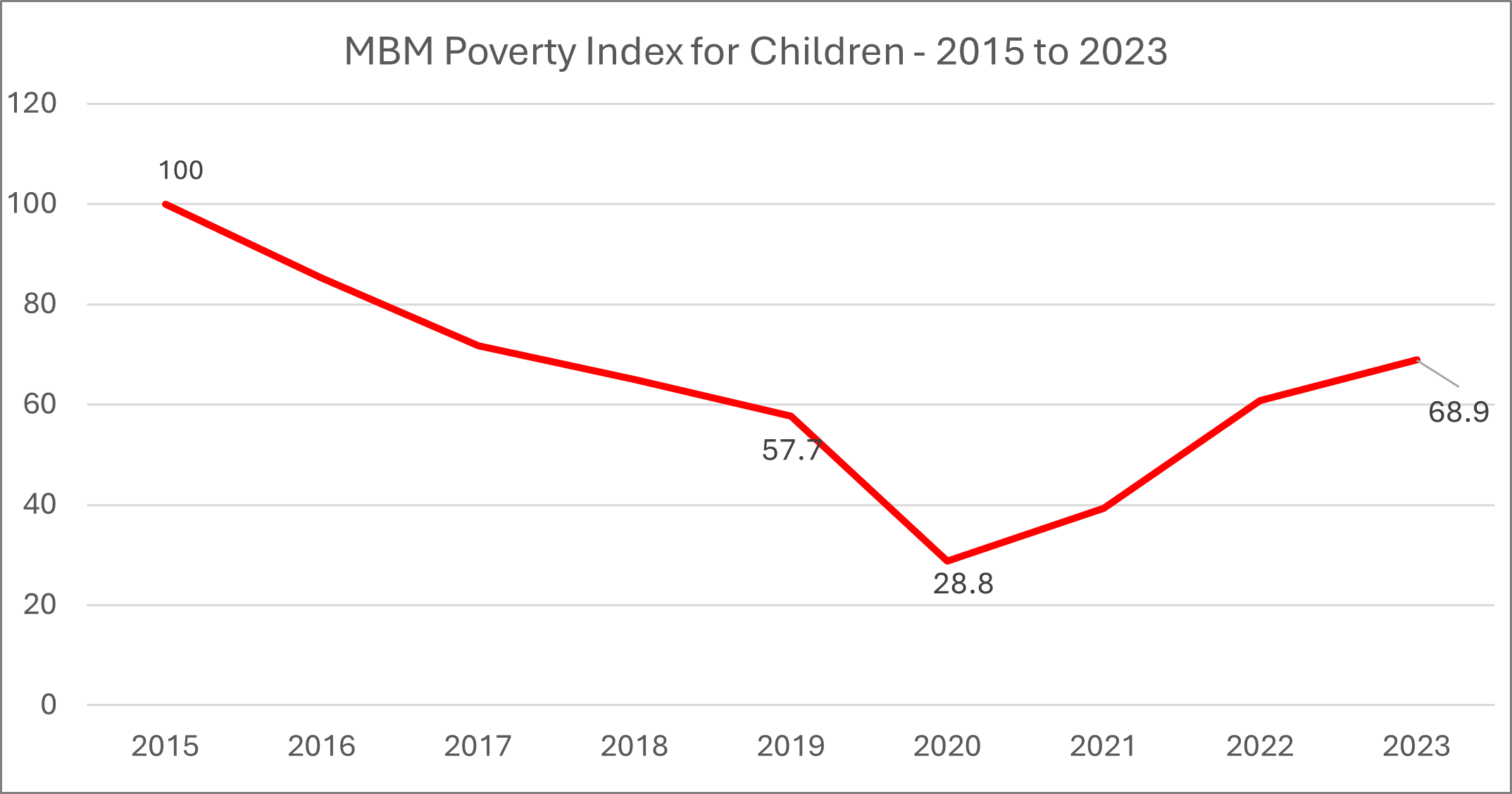
Chart 2: text description
A line chart displaying the Market Basket Measure Poverty Index for children from 2015 to 2023. The year 2015 is considered the base year and has a value of 100. Index values follow a downward trend from 2015 to 2020, reaching their lowest value in 2020: 28.8. Index values start to increase after 2020, reaching 68.9 in 2023.
| Demographic | 2015 | 2016 | 2017 | 2018 | 2019 | 2020 | 2021 | 2022 | 2023 |
|---|---|---|---|---|---|---|---|---|---|
| Children | 100 | 85.3 | 71.8 | 65.0 | 57.7 | 28.8 | 39.3 | 60.7 | 68.9 |
- Child poverty also varies by province ranging from 6.1% to 16.1%.

Chart 3: text description
A bar chart displaying Canada-wide and provincial-level poverty rates in 2023 for the following demographic groups: overall population (all persons) and children. Poverty rates for the overall population and children were lowest in Quebec (7.6% and 6.1%, respectively) and highest in Saskatchewan (13.2% and 16.1%, respectively).
| Canada and provinces | All persons (%) | Children under 18 years (%) |
|---|---|---|
| Canada | 10.9 | 11.8 |
| Newfoundland and Labrador | 10.9 | 13.7 |
| Prince Edward Island | 10.5 | 12.3 |
| Nova Scotia | 11.5 | 13.4 |
| New Brunswick | 11.3 | 14.5 |
| Quebec | 7.6 | 6.1 |
| Ontario | 12.3 | 14.1 |
| Manitoba | 12.1 | 14.8 |
| Saskatchewan | 13.2 | 16.1 |
| Alberta | 9.1 | 10.5 |
| British Columbia | 12.5 | 13.5 |
d. Food Bank and Poverty Report
Issue
Food Banks Canada's 2025 ‘Poverty Report Card' gives the Government of Canada's poverty reduction efforts a D grade, citing negative trends in poverty, food insecurity, and youth unemployment.
Background
- Food Banks Canada's annual “Poverty Report Card” is a tool that has tracked and compared poverty and related indicators at the federal level since 2023.
- The 2025 Report Card emphasizes that poverty rates will likely not improve unless key contributing factors such as the need for affordable housing and inadequacies in the social security system are addressed. It provides policy recommendations including that the federal government commit to reducing food insecurity in Canada by 50% by 2030, enhance the Canada Child Benefit, and bolster the Canada Disability Benefit. These policy recommendations and others intended to tackle the root causes of poverty, make life more affordable, and address northern food insecurity are also included in Food Banks Canada's 2025 HungerCount report.
- Food Banks Canada notes that recent investments in housing could help decrease the number of Canadians struggling with food insecurity.
- The Government of Canada released Opportunity for All – Canada's First Poverty Reduction Strategy (the Strategy) in 2018. The Strategy entrenches the Market Basket Measure (MBM) as Canada's Official Poverty Line. The MBM establishes poverty thresholds based on the cost of a “basket” of goods and services that individuals and families require to meet their basic needs and achieve a modest, basic standard of living in communities across the country. In addition, it set concrete poverty reduction targets: a 20 percent reduction in poverty by 2020 and a 50 percent reduction in poverty by 2030, relative to the 2015 level. The Strategy also introduced the Dimensions of poverty hub, tracking measures of poverty that go beyond income such as food insecurity, which captures self-reported experiences of food insecurity due to financial constraints.
- Recent budgets have introduced several measures that will help to reduce poverty and make life more affordable, including significant investments in:
- affordable childcare, which is supporting women's labour market participation and saving some families thousands of dollars per year and freeing up money for other essentials
- school food for children, with estimates suggesting families could save around $800 annually for a two-child family with program participation, and,
- the new Canada Disability Benefit, which is expected to lift 25,000 Canadians out of poverty annually and to improve food security by helping people with disabilities meet their basic needs, including food.
Key Facts
- Results from the 2023 Canadian Income Survey (CIS) show that by 2023, poverty in Canada fell by nearly 28% compared to 2015, the baseline year for Canada's legislated poverty reduction targets. While the overall poverty rate in Canada increased in 2023 relative to 2022 (10.9% versus 10.3%), poverty has followed an overall downward trend since 2015.
- The 2023 CIS reports 25.5% of people in the provinces and 37.4% of people in the territories experienced food insecurity (all severity levels) in 2023, up from 22.9% in 2022. Nunavut (58.1%) had the highest rate.
- Some groups, including unattached adults under age 65 (32.2%), persons in lone-parent families (27.5% for female-led), Indigenous people (18.3%), recent immigrants aged 15+ (16.2%), persons designated as visible minorities (15.2%), and persons with a disability aged 15+ (12.6%) are more likely to experience poverty. These groups are also at higher risk of food insecurity; 31.7% of unattached adults, 52.1% of female-led lone-parent families, 34.4% of recent immigrants, 38.6% of Indigenous people, and 32.2% of visible minorities were food insecure in 2023.
- Food Banks Canada's ‘2025 Hunger Count Report' notes there were nearly 2.2 million visits to food banks in March 2025 – the highest number in recorded history. This represents a 5.2% increase compared to 2024, and a 99.4% increase compared to 2019.
- Since 2021, the overall Consumer Price Index has increased by over 15%. Shelter, food, and transportation have increased by 22%, 24%, and nearly 11%, respectively. The rising cost of essential items have exceeded average wage growth and align with the increase in food bank usage during this period.
Key Messages
- The Government is committed to building a better future for all Canadians and taking real action to bring down costs and make life more affordable. The Government recognizes that food insecurity is affecting many Canadians and that effective solutions are needed.
- The federal Government has taken several concrete actions to make life more affordable and lower costs:
- introduced legislation to reduce taxes for nearly 22 million Canadians, saving a two-income family up to $840 a year
- making the National School Food Program permanent to provide meals for up to 400,000 children
- launched Build Canada Homes to build affordable housing at scale and capitalizing it with an initial $13 billion
- launched the Canada Disability Benefit, providing up to $2,400 per year to eligible recipients
- Budget 2025 also included the Automatic Federal Benefits initiative, starting for the 2026 tax year and estimated to reach up to 5.5 million low-income individuals by the 2028 tax year to ensure they receive the benefits and supports they are eligible for, thereby strengthening Canada's social safety net.
- These recent actions build on the significant investments made in social programs and income supports such as the enhanced Canada Workers Benefit, the Canada-wide Early Learning and Child Care system, Old Age Security and the Guaranteed Income Supplement, and the Canada Child Benefit that improve the ability of Canadians to afford essentials, including food. Federal income benefits are indexed to keep pace with the rising costs of living.
- These actions are helping Canadians to get ahead.
- The Government of Canada is committed to continuing work with provinces, territories, and Indigenous partners to provide support to Canadians who need it most.
If pressed (on poverty reduction or food insecurity target)
- The Government will continue to support Canadians currently struggling with higher costs of living. The Government remains committed to meeting its target to reduce poverty by 50% by 2030, compared to 2015.
- Food insecurity is tracked as a multidimensional indicator of poverty as part of Canada's Poverty Reduction Strategy's dashboard of indicators. It is reported annually to ensure the Government is held accountable and allows Canadians to monitor progress.
e. Food Insecurity
Background
- Food insecurity is generally understood as the inadequate or insecure access to food due to financial constraints.
- Statistics Canada measures food insecurity using the Household Food Insecurity Survey Module (HFSSM), a set of 18 questions self-reporting questions on adults' and children's food security experiences due to financial constraints over the previous 12 months.
- Three levels of food insecurity can be derived from HFSSM questions:
- ‘marginal food insecurity': worry about running out of food and/or limited food selection due to a lack of money
- ‘moderate food insecurity': compromise in quality and/or quantity of food consumed
- ‘severe food insecurity': reduced food intake and disrupted eating patterns
- The 2023 CIS reports 25.5% of people in the provinces and 37.4% of people in the territories experienced food insecurity in 2023. Nunavut (58.1%) had the highest rate.
- Food insecurity disproportionately affects groups that experience systemic inequalities.
- 4% of recent immigrants, 38.6% of Indigenous people off-reserve, and 32.2% of visible minorities were food insecure in 2023.
- Nearly half (47.8%) of people in one-parent families lived in food-insecure households in 2023. Unattached working-age individuals (31.7%) and children (32.9%) were also at a higher risk of food insecurity.
- Seniors, (12.6%), specifically senior couples (8.7%), were at a lower risk of experiencing food insecurity in 2023. Unattached seniors (14.3%) were also less likely to experience food insecurity.
- Food insecurity rates at all severity levels were relatively stable before gradually increasing starting in 2020.
- The rate of food insecurity has increased at varying degrees for different groups across the provinces. For example:
- for children, rates increased from 28.4% in 2022 to 32.9% in 2023
- for seniors, rates increased from 11.7% in 2022 to 12.6% in 2023
- The rate of food insecurity has increased at varying degrees for different groups across the provinces. For example:
- Food Banks Canada's ‘2025 Hunger Count Report' notes there were nearly 2.2 million visits to food banks in March 2025 – the highest number in recorded history. This represents a 5.2% increase compared to 2024, and a 99.4% increase compared to 2019.
- The number of children who visit food banks each month in Canada: 711,770 – an increase of nearly 340,000 monthly visits compared to six years ago.
- The proportion of food bank clients that are children is 33%, which is the same as 2024.
- The 2026 edition of the Canada Food Price Report forecasts that overall food prices will increase by 4% to 6% in 2026, which may continue to put upward pressure on food insecurity.
f. National School Food Program
Issue
Commitment to make the National School Food Program permanent.
Background
- On April 1, 2024, the Government of Canada announced an investment of $1 billion over five years in Budget 2024, to establish a National School Food Program (NSFP). The NSFP is supporting provinces, territories, and Indigenous partners to enhance and expand school food programs across Canada, guided by the National School Food Policy.
- As of March 2025, the Government of Canada has signed bilateral agreements with all provinces and territories on the NSFP and is also working directly with Indigenous partners on the rollout of distinctions-based funding for First Nations on reserve as well as Inuit, Métis, and Modern Treaty and Self-Government Agreement holders.
- As announced on November 4, 2025, Budget 2025 proposes to introduce legislation and provide $216.6 million per year, starting in 2029 to 2030, to Employment and Social Development Canada, Indigenous Services Canada, and Crown-Indigenous Relations and Northern Affairs Canada, to make the National School Food Program permanent. This will ensure kids get nutritious meals at school, while bringing down costs for parents.
- The NSFP is providing real support to children and families across Canada and aims to provide up to 400,000 children each year with access to nutritious food at school. For a participating family with two children in school, this program can result in annual savings of $800.
- The funding announced also includes investments for First Nations, Inuit, and Métis governing bodies, including First Nations on-reserve and Modern Treaty and Self-Government Agreement holders, many of whom experience some of the highest rates of food insecurity in Canada.
- The National School Food Policy, released in June 2024, outlines the federal government's long-term vision for the delivery of school food programming in Canada. The NSFP's implementation will continue to support the federal vision, principles and objectives set out in the National School Food Policy, including ensuring access to school meals without stigma or barriers, fostering healthy practices, and strengthening connections with the environment, culture and local food systems.
Key Facts
- School food programming has been shown to improve academic performance, support positive health outcomes and health equity, and foster connections with culture and traditional food systems, all of which have positive immediate and lifelong impacts for children and their families.
- Canada had approximately 6.6 million school-aged children (ages 4 to 18) in 2024 according to Statistics Canada population estimates.
- According to the 2023 Canadian Income Survey released on May 1, 2025:
- 802,000 children (persons under 18) were living below the poverty line
- food insecurity among children and youth in Canada's provinces increased to 32.9% in 2023, up from 28.4% in 2022, with 24.7% of children experiencing moderate or severe food insecurity
- Many provinces and territories have made investments in recent years. In 2025 to 2026 it is projected that provinces and territories will invest an estimated $400 million in school food in the 2025 to 2026 school year.
Key Messages
- The Government is committed to bringing down costs and making life more affordable for families across Canada. Children can't learn on an empty stomach. School food programs boost our children's health and help them reach their full potential while also supporting their families through lower grocery bills.
- That is why the Government of Canada launched the National School Food Program in 2024 to 2025 with an initial investment of $1 billion over five years to work with provinces, territories, and Indigenous partners to enhance and expand school food programs across Canada.
- Prior to this federal investment, Canada was the only G7 country without a national school food program.
- The National School Food Program is providing real support to children and families across Canada. This program will enable up to 400,000 children each year to participate in school food programs. At the same time, for a participating family with two children in school, this program can result in annual savings of $800.
- As of March 2025, the Government of Canada signed bilateral agreements with all provinces and territories on the National School Food Program. This school year, all provinces and territories will invest funding provided through these agreements to support children across Canada.
- Provinces and territories have jurisdiction over health and education and are already actively supporting school food programming in their jurisdictions. Federal funding through the National School Food Program builds on these existing efforts by working collaboratively with provincial and territorial governments.
- As announced on November 4, Budget 2025 proposes to introduce legislation and provide $216.6 million per year, starting in 2029 to 2030, to make the National School Food Program permanent. This is a generational investment that will help ensure kids get nutritious meals at school, while bringing down costs for parents.
- The investment supports the vision, principles and objectives for school food programs set out in the National School Food Policy, including ensuring access to school meals without stigma or barriers, fostering healthy practices, and strengthening connections with the environment, culture, and local food systems.
- The National School Food Program is part of the federal government's work to build a more affordable Canada. This includes the Canada Child Benefit and other investments made through targeted social programs and income supplements, helping to bring down costs for families so they can get ahead.
g. Supporting Quality of Life in Canada
The Mission
Employment and Social Development Canada (ESDC) works to build a stronger and more inclusive country by supporting Canadians to lead productive, rewarding lives and improving their quality of life.
Among the Organisation for Economic Co-operation and Development (OECD) countries, Canada has ranked above average in life satisfaction since 2010. However, the gap has been shrinking as Canada's overall life satisfaction declined in recent years.
(Sources: OECD How's Life? Reports, 2010-2023.)
Affordability and Economic Context
While inflation has significantly eased, ongoing affordability challenges have negatively impacted quality of life. These issues are affecting all Canadians, and some groups face even more challenges in meeting their financial needs. This can also vary by region.
By November 2025, shelter prices had increased by 21.6% compared to four years prior.
(Source: Statistics Canada Table 18-10-0004-01.)
45% of Canadians were very concerned about their ability to afford housing due to rising housing costs or increasing rent in 2024, and 36% of Canadians with a housing challenge reported high life satisfaction, compared to 70% of those without a housing challenge.
(Source: Housing challenges related to affordability, adequacy, condition and discrimination, August 2 to September 15, 2024.)
By November 2025, food prices had increased by 24.1% compared to four years prior.
(Source: Statistics Canada Table 18-10-0004-01.)
Food insecurity affects many Canadians, including over one third of persons in lone-parent families.

Diagram 1 text description
A bar chart showing the percentage of persons who experienced moderate to severe food insecurity in 2023, among specific groups including persons in couple families with children, persons in lone-parent families, unattached individuals aged 65 and over, unattached individuals under 65, and the overall Canadian population. The group with the highest rate was persons in lone-parent families at 39.5%, and the group with the lowest rate was unattached individuals aged 65+ at 10.4%.
Diagram 1 data: Percentage of persons experiencing moderate to severe food insecurity, 2023
| Group | Percentage |
|---|---|
| All persons | 19.1% |
| Persons in couple families with children | 20.5% |
| Persons in lone-parent families | 39.5% |
| Unattached individuals (<65) (Note: Person not in an economic family) | 25.8% |
| Unattached individuals (65+) (Note: Person not in an economic family) | 10.4% |
(Source Diagram 1: Statistics Canada Table 13-10-0834-01.)

Diagram 2 text description
A bar chart showing the percentage of persons reporting difficulty for their household to meet their financial needs in the third quarter of 2023, broken down by demographic groups. The chart compares each group - immigrants, persons with disabilities, visible minorities, Indigenous peoples, and urban residents, with their respective comparison groups (for example, non-immigrants). In all cases, the reported group shows a higher percentage of financial difficulty. For instance, 39.4% of immigrants reported difficulty, compared to 30.8% of non-immigrants. The chart also includes age-based data: youth (15 to 24), adults (25 to 54), and seniors (65+), with the highest rate among adults aged 25 to 54 at 39.8%.
| Group | Percentage |
|---|---|
| Immigrants | 39.4% |
| Non-immigrants | 30.8% |
| Persons with a disability | 38.3% |
| Persons without a disability | 28.5% |
| Visible minority | 40.6% |
| Not a visible minority | 30.5% |
| Indigenous identity (Note: Data does not include those living on reserve or in the territories) | 40.3% |
| Non-Indigenous identity | 33.0% |
| Persons living in urban areas | 33.6% |
| Persons living in rural areas | 30.7% |
| Youth (15 to 24) | 25.6% |
| Age 25 to 54 | 39.8% |
| Seniors (65+) | 24.1% |
(Source Diagram 2: Statistics Canada Table 45-10-0087-01.)
Income Inequality and Poverty Persist
The inability to afford basic necessities can put individuals and families in economic hardship and negatively impact their quality of life. Rising affordability challenges and the widening income gap in Canada are creating barriers for individuals to improve their economic situation and achieve upward social mobility.

Diagram 3 text description
A bar chart showing the poverty rate in 2023, overall and by population group - including seniors aged 65 and older, children under age 18, women, persons with a disability, visible minorities, Indigenous people, and unattached individuals. The poverty rate was lowest for seniors at 5.5%, and highest for unattached individuals at 26.5%.
| Group | Poverty Rate |
|---|---|
| Total population | 10.9 |
| Seniors | 5.5% |
| Children (< 18) | 11.8% |
| Women | 11.0% |
| Persons with a disability | 12.6% |
| Visible minority | 15.2% |
| Indigenous population (Note: Data does not include those living on reserve) | 18.5% |
| Unattached individuals (Note: Persons not in an economic family) | 26.5% |
(Sources Diagram 3: Statistics Canada Tables 11-10-0093-01, 11-10-0090-01, 11-10-0135-01.)

Diagram 4 text description
A bar chart showing the change in annual disposable income after tax per household from 2019 to 2024, broken down by household income quintile. It shows that those in the highest income quintile had an average increase in disposable income of $47,829, and those in the lowest income quintile had an increase of $4,877.
| Income quintile | Change in annual disposable income from 2019 to 2024 |
|---|---|
| All households | $19,022 |
| Lowest income quintile | $4,877 |
| Second income quintile | $9,805 |
| Third income quintile | $12,100 |
| Fourth income quintile | $20,505 |
| Highest income quintile | $47,829 |
(Source Diagram 4: Statistics Canada Table 36-10-0587-01.)
Life Satisfaction and Optimism Decline
Canadians' life satisfaction and hope for the future has declined as economic pressures have increased.
46.1% of Canadians reported high life satisfaction in the second quarter of 2025, down from 51.4% 3 years prior.
(Source: Statistics Canada Table 13-10-0844-01.)

Diagram 5 text description
A line plot showing the percentage of Canadians who report having a hopeful view of the future "always" or "often", from the third quarter of 2021 to the second quarter of 2025. The rate was fairly steady around 65% from the third quarter of 2021 to the third quarter of 2022, when it sharply fell to 57.3%. There is missing data from then until the first quarter of 2024 with the exception of the second quarter of 2023, when the percentage was 56.8%. Throughout 2024, the rate declined from 59.9% in the first quarter to 56.3% in the fourth quarter. The rate declined to 55.9% in the second quarter of 2025.
| Quarter | Percentage |
|---|---|
| Q3 2021 | 65.5% |
| Q4 2021 | 63.1% |
| Q1 2022 | 63.8% |
| Q2 2022 | 62.6% |
| Q3 2022 | 64.6% |
| Q4 2022 | 57.3% |
| Q1 2023 | n/a |
| Q2 2023 | 56.8% |
| Q3 2024 | n/a |
| Q4 2024 | n/a |
| Q1 2024 | 59.9% |
| Q2 2024 | 53.0% |
| Q3 2024 | 57.2% |
| Q4 2024 | 56.3% |
| Q1 2025 | 57.8% |
| Q2 2025 | 55.9% |
(Source Diagram 5: Statistics Canada Table 13-10-0847-01.)

Diagram 6 text description
A bar chart showing the percentage of people who reported high life satisfaction in the second quarter of 2025, among demographic groups. The chart compares each group - immigrants, persons with a disability, visible minorities, Indigenous people, and urban residents, with their respective comparison groups (for example, non-immigrants). In all cases, the reported group shows a lower percentage of life satisfaction. For instance, 36.8% of persons with a disability reported high life satisfaction, compared to 53.3% of persons who do not have a disability. The chart also includes age-based data: youth (15 to 24), adults (25 to 54), and seniors (65+), with the highest rate among seniors at 60.5%.
| Group | Percentage |
|---|---|
| Immigrants | 43.5% |
| Non-immigrants | 47.4% |
| Persons with a disability | 36.8% |
| Persons without a disability | 53.3% |
| Visible minority | 40.5% |
| Not a visible minority | 48.4% |
| Indigenous identity (Note: Data does not include those living on reserve or in the territories) | 38.3% |
| Non-Indigenous identity | 46.3% |
| Persons living in urban areas | 44.8% |
| Persons living in rural areas | 55.0% |
| Youth (15 to 24) | 46.0% |
| Age 25 to 54 | 37.8% |
| Seniors (65+) | 60.5% |
(Source Diagram 6: Statistics Canada Table 13-10-0844-01)
29% of those with financial difficulties had high life satisfaction throughout 2021 to 2024, compared to 59% of those who did not have financial difficulties.
(Source: Charting changes in Canadians' mental and financial well-being, 2021 to 2024)
Uncertainty surrounding the economic impacts of ongoing political and trade tension risk putting downward pressure on Canadians' quality of life.
Supporting All Canadians
ESDC delivers programs and services to Canadians throughout every stage of their lives. Several of ESDC's social protection measures support more vulnerable groups, help address affordability pressures in Canada and support social inclusion, which drive growth and can lead to a more resilient economy and cohesive society.
Children and Families
- Support for families is enabling choice and having positive impact, including decreasing child poverty.
- The number of single-parent families in Canada has more than doubled in the last 30 years.
- 4% of all families in Canada were single-parent in 2021, mostly led by women.
- 4% of children in female-led lone-parent families lived below the poverty line in 2023, almost four times the rate of those in couple families (8.7%).
- (Sources: A portrait of Canada's families in 2021, Statistics Canada Table 11-10-0135-01.)
- ESDC supports children and families through key income and social programs such as:
- Canada Child Benefit
- Early Learning and Child Care
- Child Disability Benefit
- National School Food Program
- Canada Learning Bond
- Canada Education Savings Grant
- Social Development Partnerships Program - Children and Families
Youth and Young Adults
- Youth often face difficulties entering the labour market. They are more likely to be unemployed, and when employed, they are more likely to be in low-wage and unstable jobs.
- 3% of youth aged 15 to 24 were unemployed in December 2025, more than double the rate for those aged 25 to 54 (6.0%).
- 5% of youth aged 15-29 were neither in employment, education or training in 2025. The number of youth not in employment, education or training is approximately 914,000 in 2025, an increase of 28% (201,800) since 2023.
- (Sources: Statistics Canada Table 14-10-0287-02, Question Period Note: Reference Number FCY_JUN2025_005)
- ESDC helps youth to kickstart their careers by providing financial aid, improving access to post-secondary education, supporting employment opportunities and apprenticeships, and connecting job-seekers with employers.
- List of ESDC programs supporting youth and young adults:
- Canada Student Grants and Loans
- Supports for Student Learning Program
- Youth Employment and Skills Strategy
- Canadian Apprenticeship Strategy
Working-Age Adults
- Unemployed and unattached working-age (18 to 64 years of age) persons face significant economic vulnerabilities.
- 46% of "workers in poverty" - those who have substantial employment - were unattached individuals in 2019.
- 47% of working-age Canadians living in poverty were employed in 2022.
- (Sources: Canadian Income Survey 2019 and 2022 internal calculations.)
- ESDC assists working-age adults primarily through key income supports to help them meet their basic needs.
- List of ESDC programs supporting working-age adults:
- Employment Insurance
- Canada Workers Benefit
- Foreign Credential Recognition Program
- Skills and apprenticeship programs
Older Adults and Seniors
- In 2023, seniors had the lowest poverty rate among all age groups, whereas the rate for those aged 18 to 64 was more than double.
- However, income security remains a concern as some households have not managed to build robust financial safety nets.
- 29% of Canadians in pre-retirement (aged 55 to 64) have no money set aside, for retirement or otherwise.
- (Sources: Statistics Canada Table 11-10-0135-01, 2024 Canadian Retirement Survey by Healthcare of Ontario Pension Plan.)
- ESDC programs enable seniors to live with dignity and security by providing crucial income stability and services to age comfortably at home, and by supporting local projects to improve quality of life.
- List of ESDC programs supporting older adults and seniors:
- Old Age Security
- Guaranteed Income Supplement
- Canada Pension Plan
- New Horizons for Seniors Program
- Age Well at Home Initiative
Persons with Disabilities
Overall, persons with disabilities face greater challenges in finding employment, tend to have lower incomes, and are more likely to experience poverty than those without disabilities.

Diagram 7 text description
A bar chart showing the unemployment rate in 2024, broken down by disability status including no disability and mild, moderate, severe, and very severe disability. The unemployment rate was lowest for those without a disability at 5.6%, and gradually increased with increasing severity of disability, to the highest rate for those with very severe disability at 14.9%.
| Disability status | Unemployment rate |
|---|---|
| No disability | 5.6% |
| Mild disability | 7.0% |
| Moderate disability | 8.6% |
| Severe disability | 9.5% |
| Very severe disability | 14.9% |
(Source Diagram 7: Statistics Canada Table 14-10-0478-01.)
The average hourly wage for individuals with disabilities was 6.2% (or $2.22 per hour) lower than for those without disabilities in 2024.
(Source: Statistics Canada Table 14-10-0478-01.)
ESDC supports persons with disabilities by providing financial security, partial income replacement for those who work, and funding for communities and organizations who promote accessibility.
List of ESDC programs supporting persons with disability:
- Canada Disability Benefit
- Canada Disability Savings Program
- Canada Pension Plan disability benefits
- Enabling Accessibility Fund
- Social Development Partnerships Program - Disability
Indigenous Peoples
- Indigenous Peoples face disproportionate barriers which have lasting impacts on their ability to accumulate wealth and achieve economic stability.
- 10.2% of Indigenous people were unemployed in 2025, compared to 6.8% for non-Indigenous people. (Note: data does not include those living on reserve or in the territories.)
- The average hourly wage for Indigenous people living off-reserve was 7.5% (or $2.72 per hour) lower than for non-Indigenous people in 2025.
- (Sources: Statistics Canada Tables 14-10-0470-01, 14-10-0418-01.)
- ESDC programs promote high-quality, culturally specific early learning and child care designed for and with Indigenous communities. They also help Indigenous people improve their skills and find employment.
- List of ESDC programs supporting Indigenous people:
- Indigenous Early Learning and Child Care
- Indigenous Skills and Employment Training Program
- Skills and Partnership Fund
Looking Forward
- ESDC's existing and new social protection measures will continue to improve affordability, reduce poverty, and promote income equality, which are linked to improving health, wellbeing and social cohesion.
- The demand for ESDC's programs will likely rise as Canadians face uncertain and challenging times, driven by factors like the implementation of tariffs and the effects of climate change, which risk further lowering financial wellbeing and security.
h. Canada Summer Jobs
Issue
Investing in youth, their skills and experience through the Canada Summer Jobs (CSJ) program helps youth on their path to meaningful, well-paying careers. In 2026, CSJ will aim to support around 100,000 job opportunities for youth. Recent evidence shows that the program has long-term benefits for youth employment, earnings, and reduces reliance on social supports.
Background
- CSJ, delivered by Employment and Social Development Canada (ESDC) under the Youth Employment and Skills Strategy (YESS), provides wage subsidies to employers from not-for-profit organizations, the public sector, and private sector organizations with 50 or fewer full-time employees, to create quality summer employment opportunities for youth aged 15-30.
- For many young Canadians, CSJ is a pivotal first job experience that helps them gain on-the-job skills and work experience to prepare for their entry into the labour market and make future career choices. The program is responsive to labour market needs at the national and local level.
- Since 2019, YESS, including CSJ, has benefitted from a series of funding enhancements, including historic investments during the pandemic. At its peak in 2021-2022, CSJ provided 120,000 job opportunities for youth during the summer months and since 2023, the program has funded over 70,000 job opportunities per year.
- Budget 2024 allocated an additional $200.5 million for CSJ to create 70,000 job opportunities in Summer 2025, with a targeted focus on sectors facing critical labour shortages, such as housing construction.
- In response to the rise in youth unemployment, in June 2025, the Government reallocated $25 milliontoCSJ to support an additional 6,000 job opportunities, on top of the 70,000 jobs already announced, for a total of 76,000 job opportunities for young people as part of CSJ 2025.
- In 2024, the Standing Committee on Human Resources, Skills and Social Development and the Status of Persons with Disabilities (HUMA) conducted a study on CSJ. The HUMA report highlighted high satisfaction levels for participating youth and employers, and outlined seven key recommendations to improve flexibility, local responsiveness, client service, youth access to benefits, and equitable recruitment of youth.
- The Department responded under three broader themes while still addressing each recommendation individually. Responses focused on:
- ongoing and future efforts to improve the CSJ program and service delivery with the objective of increasing client satisfaction. This has included optimizing resources to effectively manage high volumes of applications and funding agreements
- reviewing program flexibilities for employers and the role of local priorities identified by Members of Parliament, with the objective of better supporting youth facing barriers to employment. This has included improved outreach to youth and targeted communications to better reach youth facing barriers to employment
- increasing and improving communication with employers, youth and Canadians with goal of providing them with timely and relevant information about CSJ
Key Facts
- In January 2026, youth (15-24) had an unemployment rate of 12.8%, an improvement from the September 2025 high of 14.7%, but still above the pre-pandemic average of 10.8% (2017-2019)
- For summer 2025, the unemployment rate for returning students was at 17.9%, the highest since 2009 (excluding pandemic years)
- Teenagers (15-19) have faced difficulty with nearly 1 in 5 teens unable to find a job (Desjardins Economic View Point, “Why has the Youth Unemployment Rate Increased by so much, so fast?”)
- Youth from under-represented groups (Indigenous youth), continue to face significantly higher rates of unemployment than their peers.
- Since 2023, there has been a notable increase in the number of youth not in education, education or training (NEET).
- Budget 2025 proposed to support around 100,000 jobs for youth in summer 2026. An investment of $594.7 million over two years for CSJ, starting in 2026-2027 will continue to support quality jobs for youth over the summer months.
- Since 2019, CSJ has supported more than 530,000 quality job opportunities for youth.
- Recent evidence demonstrates the effectiveness of CSJ in improving long-term employment outcomes for youth:
- the 2024 independent audit of CSJ by the Office of the Auditor General of Canada found that CSJ successfully connects youth with employers, and that youth who participate in CSJ have better long-term labour market outcomes and earnings compared to non-participants
- The audit recommended that the Department continue to improve its efforts to increase the participation of youth facing barriers, better inform stakeholders on the objectives of the program, and focus its results on outcomes. ESDC has already begun to address the recommendations.
- the 2024 independent audit of CSJ by the Office of the Auditor General of Canada found that CSJ successfully connects youth with employers, and that youth who participate in CSJ have better long-term labour market outcomes and earnings compared to non-participants
- The 2024 horizontal evaluation of the YESS found that youth who participated in CSJ experienced higher wages, lower reliance on income support, and.
Key Messages
- The Government of Canada recognizes the importance of helping young Canadians connect with jobs and skills development opportunities to launch their professional lives.
- This is why Budget 2025 proposes to increase to 100,000 the number of summer jobs for youth through the Canada Summer Jobs program in summer 2026.
- Canada Summer Jobs is a key government initiative designed to help youth (aged 15 to 30) gain summer work experience. The program provides youth with opportunities to develop and improve their skills, and for many, it is a pivotal first job experience.
- The program is responsive to labour market needs at the national and local level. Demand for Canada Summer Jobs remains consistently high, with applications exceeding available funding each year.
- Recent evidence shows that youth who participate in Canada Summer Jobs have improved long-term earnings and experience less reliance on social supports.
i. Office of the Auditor General Audit Performance Audit on Canada Summer Jobs
Issue
- On December 2, 2024, the Office of the Auditor General of Canada (OAG) tabled a performance audit of Canada Summer Jobs (CSJ). The report focused on whether ESDC provided wage subsidies to eligible employers that resulted in youth gaining work experience, including those facing barriers.
- The report found that overall, the CSJ program helped to improve the success of youth in both current and future labour markets. Youth who participated in the program had better long‑term earnings when compared with youth who did not participate in the program.
- The audit also recommended that the Department continue to improve its efforts to increase the participation of youth facing barriers in its program, improve data collection, and strengthen the overall design and delivery to ensure it meets its objectives.
Background
The seven recommendations from the OAG performance audit on the CSJ program are summarized as follows:
- improve data collection and analysis—particularly disaggregated and standardized data—to better understand the long-term socio-economic impacts of the CSJ program and to inform future decisions
- take into consideration provincial and territorial representation of underrepresented youth when setting targets for youth facing barriers
- implement a comprehensive outreach strategy to ensure the program reaches more youth facing barriers
- increase youth survey participation to better assess skill development and employment outcomes and to enable deeper analysis of participant experiences
- collect and analyze data to determine whether the program resulted in job creation
- streamline employer screening and approval processes to enhance efficiency
- strengthen the overall design and delivery of the program to ensure it meets its objectives and better supports youth facing barriers to employment
Key Facts
- Canada Summer Jobs is a good program, and it works.
- The OAG audit found that CSJ helped to improve the success of youth in both current and future labour markets. Youth who participated in the program had better long‑term earnings when compared with youth who did not participate in the program.
- The Department has begun to address the seven recommendations made by the OAG:
- the Department is working with partners to develop a plan for measuring and reporting on the long-term outcomes of the CSJ program, with completion expected by fall 2026
- CSJ 2025 incorporated youth labour market information at the provincial and territorial level as part of the analysis to set targets for youth facing barriers
- a comprehensive outreach strategy has been developed and implemented to better reach national priority youth groups ahead of the CSJ 2026 launch
- the Department is exploring ways to increase youth survey participation to enable more robust analysis of disaggregated data, with final recommendations anticipated in summer 2026
- efforts are underway to continue to improve reliable data collection and additional work is also being done to streamline employer processes and improve equitable hiring supports
Key Messages
- The findings of the OAG's fall 2024 performance audit highlight CSJ's success in improving long-term outcomes for youth. Youth participants benefit from better long-term labour market outcomes, including increased earnings.
- The audit calls for the Department to enhance information collection and analysis, do more to help youth facing barriers to gain employment, and make improvements to the overall design and delivery of the program.
- Work is already underway to address these recommendations, which has already resulted in positive changes. For example, the Participant Questionnaire has been streamlined and is now sent directly to youth to encourage higher completion rates. In addition, improvements are being made to support better reaching diverse youth through an outreach strategy and enhancements are being considered to support more robust analysis of CSJ program outcomes.
j. Early Learning and Child Care (ELCC) and the OAG report (Fall 2025Footnote 2)
Issue
This note provides background on the Office of the Auditor General of Canada's (OAG) Performance Audit on Early Learning and Childcare (ELCC), as well as on key issues related to the program.
Background
- The OAG conducted a performance audit on the Canada-wide ELCC system, examining a period from April 1, 2021 until March 31, 2025.
- The audit sought to determine whether Employment and Social Development Canada (ESDC) fulfilled its responsibilities to support ELCC across Canada.
- The OAG concluded that while ESDC ultimately fulfilled its obligations, the Department did not effectively assess certain long-term inclusion objectives, nor was its reporting timely or comprehensive. Specifically, it found:
- ESDC supported provincial, territorial, and Indigenous initiatives to improve ELCC in Canada, and most regulated ELCC became more affordable, at roughly $16.50 per day in March 2024
- the target of 250,000 new ELCC spaces by March 2026 is at risk of not being met, given only 112,00 spaces were created in the first 3 years
- ESDC did not collect sufficient information related to its inclusion objectives, and lacked adequate information to assess improvements to Indigenous ELCC
- ESDC did not provide comprehensive reports, was behind in reporting, and lacked comparable performance information from provinces and territories (PTs), and
- PTs have raised concerns relating to the system's financial sustainability
- The Audit Report was tabled in Parliament on October 21, 2025, and made 3 recommendations for ESDC to:
- continue to work with Indigenous partners on a co-developed performance measurement plan to report on outcomes for Indigenous ELCC
- work with PTs to obtain comparable performance information, including on spaces and unmet demand, inclusion, and financial sustainability, and
- report annually to Canadians about investments made and progress within the Canada-wide system
- There has been significant interest in the Canada-wide ELCC system recently, given recent extension agreements announced with Ontario, Saskatchewan, and Alberta.
Key facts
- In 2021, the Government of Canada committed over $30 billion over 5 years to work with provincial and territorial and Indigenous partners to build a Canada-wide ELCC system. The Canada-wide agreements with provinces and territories intended to reach an average fee of $10-a-day and create more than 250,000 new regulated spaces by March 2026.
- To date, 8 PTs are delivering regulated ELCC at an average of $10-a-day or less (including Quebec and Yukon, who achieved this prior to the Canada-wide system); all other jurisdictions have reduced fees by at least 50% on average.
- More than 209,000 new spaces have been announced to be created, and over 149,000 have been created as of December 2025.
- The families of approximately 900,000 children are benefiting from affordable and high-quality child care across the country.
- As of December 2025, all provinces and territories have extended their Canada-wide agreements until at least March 31, 2027, with agreements with 11 jurisdictions extended to March 31, 2031. Through extended agreements, the Government of Canada is providing a total of $27.1 billion to continue supporting access to early learning and child care programs and services across the country beyond March 2026, the original end date of the existing agreements.
- Affordable Canada-wide ELCC is expected to increase mothers' labour force participation, and from 2019 to 2024, the labour force participation rate for core-aged (25 to 54) mothers of young children (0 to 5) rose by 3.3%.
- Studies show that for every dollar invested in early childhood education, the broader economy receives between $1.50 to $2.80 in return; this benefit ratio reaches into the double digits for disadvantaged children.
Key messages
- While the OAG concluded that ESDC fulfilled its responsibilities to support early learning and child care across Canada and that most regulated early learning and child care spaces have become more affordable, the report also includes important findings about where we can work to improve performance measurement and enhance transparency for Canadians.
- We agree with the report's recommendations to continue co-developing performance measurement plans with Indigenous partners, collect comparable performance information from provinces and territories, and to report annually to Canadians.
- Work continues with our provincial, territorial and Indigenous partners to build and enhance the Canada-wide ELCC system.
If pressed on risk to meeting 250,000 space creation target
- When the Government of Canada announced its intention to create a Canada-wide ELCC system in Budget 2021, 2 immediate priorities were clear: improving affordability and access.
- As reflected in the Auditor General's report, efforts to date have delivered significant savings for families across the country by as much as $8,900 on average per child, per year.
- Creating new child care spaces involves complex, multi-year projects that include time-consuming issues such as zoning requirements, environmental impact studies, and workforce challenges.
- Provincial and territorial Action Plans reflect a gradual ramping up of space creation goals, with the largest space expansions planned in the last 2 years of the agreements.
- This approach balances the Canada-wide objectives with the flexibility provinces and territories need to align space creation with their child care priorities and community needs.
- The Government of Canada will continue its work with provinces and territories to create spaces and improve access across the Canada-wide system while acknowledging that some provinces and territories may need additional flexibility to achieve that goal beyond 2026.
- As of December 2025, PTs have announced plans to create over 209,000 new spaces.
If pressed on pace of space creation
- The number of spaces announced to be created by PTs over the last 6 months has increased substantially from approximately 166,000 spaces across Canada in July 2025 to over 209,000 spaces in December 2025.
- This represents an increase of approximately 26% in a short period of time representing a continued and accelerated pace of investment and space creation commitment.
- While spaces announced do not equate to operational child care spaces, it is a strong indicator of increases in new child care spaces that are expected to become operational in the following fiscal years.
If pressed on inclusive space creation
- The Government of Canada acknowledges that many parents face challenges in accessing child care options and are experiencing long waitlists.
- Each agreement's Action Plan has a space creation commitment. This approach balances the Canada-wide objectives with the flexibility PTs need to create spaces in line with their child care priorities, and community needs.
- Agreements with PTs contain commitments to eventually ensure equitable representation of vulnerable and diverse families and on the development and funding of inclusion plans to support this goal.
- The Government of Canada is committed to enhancing inclusion within ELCC, and will continue to work with PTs to achieve those goals.
If pressed on ensuring equitable access
- Although many of the Agreements with provinces and territories contain obligations to eventually ensure equitable representation, the commitments in those Agreements focus on jurisdictions' obligations to develop inclusion plans to support this goal.
- The department assessed PT inclusion plans according to its obligations, as these plans create the foundation for supporting diverse and vulnerable families.
- The Government of Canada is committed to enhancing inclusion within ELCC and will continue to work with PTs to achieve those goals.
If pressed on waitlists
- Families across Canada are benefiting from historic investments in affordable child care. The Government of Canada is working with provinces and territories to expand access so more families can benefit.
- That said, the Government of Canada acknowledges that many parents face challenges in accessing child care options and are experiencing long waitlists.
- Long waitlists are evidence of an increased demand for the ELCC system, showing that families recognize the value of affordable and high quality ELCC. Federal investments are making more of this type of care possible.
- PTs may choose to voluntarily report on waitlists where the data is available and whenever it is possible. However, not all PTs maintain centralized waitlist systems, nor do they make publicly available an estimate of the number of children waiting to access ELCC in their jurisdiction.
- The Government of Canada will continue to work with its partners to improve reporting and its understanding of unmet child care demand.
If pressed on reporting
- The Government of Canada remains committed to ensuring Canadians have timely access to information regarding the federal investments in early learning and child care and the progress being made toward creating and maintaining a Canada-wide ELCC system.
- ESDC relies heavily on annual reports from provinces and territories to complete national progress reports and is working with all of its partners to improve the timeliness of annual reporting.
If pressed on reporting delays
- Under the Canada-wide ELCC agreements, provinces and territories are required to provide Canada with an annual report on progress made. This report is due by October 1 and outlines data and results achieved from the previous fiscal year.
- The Government compiles reporting and results provided by provinces and territories and uses it, along with other sources of information, to prepare a national progress report.
- The national report communicates results against targets committed to under the ELCC Agreements, including the number of new spaces created.
- To improve transparency in the short term, the Government has recently published a new webpage entitled Progress and impact of Canada-wide Early Learning and Child Care. This webpage outlines results of the ELCC system in an accessible and transparent way.
If pressed on timelines to publish delayed reports
- While there has been tremendous growth in the program, the Government of Canada has been working with provinces and territories to align existing provincial and territorial data with our Canada-wide system.
- These reports have been delayed as the Government of Canada aims to ensure that the data communicated within these reports are fully validated, accurate, and transparent to Canadians, which takes time and resources.
- The Government of Canada intends to publish reports which are overdue at the earliest possible opportunity. The fiscal year 2021 to 2022 report is expected to be published soon.
- The Government of Canada will continue to work with all of its partners to improve timely reporting including improving reporting, eliminating inefficiencies and streamlining processes.
If pressed on annual reporting requirements
- ESDC currently publishes National Progress Reports on its website. The Canada Early Learning and Child Care Act has strengthened requirements regarding transparency and reporting.
- The Act includes a requirement that the Minister table a report in Parliament for each fiscal year detailing federal investments and the progress being made under a Canada-wide system, including progress made as it relates to quality, availability, affordability, accessibility, inclusiveness of early learning and child care programs and services.
- As the Act came into force last year, fiscal year 2024 to 2025 will be the first fiscal year in which this requirement applies. Data for this report is starting to be finalized with PTs now and will need to be reviewed, validated, and integrated into the National Progress Report. Given this report is still in the data collection phase, it is not possible to share a projected tabling date at this time.
If pressed on carry forwards
- The ability to carry forward funding from one fiscal year to the next is a tool that allows provinces and territories to better align funding with expenditures, in particular those related to capital costs.
- All amounts that are carried forward must be used for eligible expenditures and be spent in the fiscal year in which the funding is carried forward. PTs are not entitled to retain unspent funds.
- The Government of Canada will continue to work with PTs to ensure proper management of federal funds.
If pressed on Indigenous ELCC
- The audit scope was limited to only ESDC's role in Indigenous ELCC delivery. It did not include the performance of other federal departments who also deliver the horizontal Initiative (that is, Indigenous Services Canada, Crown-Indigenous relations and Northern Affairs Canada, Public Health Agency of Canada). Despite the limited focus, the audit findings were favourable and its recommendations were aligned with the department's performance measurement activities that are currently underway.
- Since 2022, ESDC has undertaken significant work to co-develop distinctions-based results frameworks with Indigenous partners, by centering Indigenous-led approaches and decision-making. Co-development processes take time to complete and help to illustrate how Canada is meeting its obligations to advance reconciliation. ESDC is working with partners to finalize the results frameworks and will continue to collaborate on implementation plans to support reporting on outcomes for Indigenous ELCC.
If pressed on status of negotiations (Extension Agreements)
- In February and March 2025, the Government of Canada reached agreements with 10 of 13 provinces and territories to extend their existing early learning and child care agreements until March 31, 2031, which included the fourth and final year of the Early Learning and Child Care Infrastructure Fund (fiscal year 2026 to 2027), providing nearly $20 billion over 5 years. The agreements also included new funding for an annual 3% escalator from fiscal year 2027 to 2028 to fiscal year 2030 to 2031 to provide flexibility for PTs to respond to inflationary pressures.
- In the fall of 2025, the Government of Canada re-engaged in negotiations with provinces that had not yet extended their early learning and child care agreements (Alberta, Ontario and Saskatchewan).
- In November 2025 the Governments of Canada and Saskatchewan announced a 5-year extension, starting in fiscal year 2026 to 2027, to the existing bilateral Canada-Saskatchewan early learning and child care agreement and to the Canada–Saskatchewan Canada-Wide Early Learning and Child Care Agreement.
- And in December 2025, the Government of Canada reached 1-year ELCC extension agreements with Ontario and Alberta, until March 31, 2027, to help maintain current parent fees in those provinces.
Ontario
- Ontario agreed to a 1-year extension to the Canada–Ontario Canada-wide Early Learning and Child Care Agreement, until March 31, 2027.
- This means that more than $3.6 billion in federal funding will be allocated to the Government of Ontario in fiscal year 2026 to 2027 to support continued access to high-quality, affordable, flexible and inclusive early learning and child care programs and services for families. This includes a $695 million advanced allocation taken from future years of funding committed to Ontario, to help stabilize child care fees by keeping current fees at an average of $19 per day, until December 31, 2026.
- The 1-year extension to the Canada-wide ELCC Agreement outlines that Ontario remains committed to its original target of creating 86,000 net new child care spaces by December 31, 2026 and that Ontario will continue to work towards reaching an average of $10 a day by the end of fiscal year fiscal year 2026 to 2027 for all licensed child care spaces enrolled in the Canada-wide ELCC system.
- In addition to the Canada-wide agreement, Canada and Ontario have extended the bilateral agreement until March 2031 and the fourth and final year of the Early Learning and Child Care Infrastructure Fund, previously announced in March 2024.
Alberta
- Alberta agreed to a 1-year extension to both the Canada–Alberta Canada-wide Early Learning and Child Care Agreement and the Canada–Alberta Early Learning and Child Care Agreement, until March 31, 2027.
- This means that more than $1.17 billion in federal funding has been allocated to the Government of Alberta in fiscal year 2026 to 2027. This funding will support continued access to high-quality, affordable, flexible and inclusive early learning and child care programs and services, and help maintain the $15-a-day parent fees for licensed early learning and child care.
- The extended Canada-wide agreement includes funding for the final and fourth year (fiscal year 2026 to 2027) of the Early Learning and Child Care Infrastructure Fund, previously announced in March 2024.
- The 1-year extension to the Canada-wide ELCC Agreement outlines that Alberta remains committed to its target of creating 68,700 new child care spaces by March 31, 2027, and that Alberta will continue to work towards an average of $10-a-day in fiscal year 2026 to 2027 for all licensed child care spaces enrolled in the Canada-wide ELCC system.
- This government is committed to protecting access to high-quality, affordable, flexible and inclusive early learning and child care programs and services, ensuring that families across the country have access to regulated/licensed child care at an affordable cost.
- While these extensions ensure that families across the country will continue to have access to affordable and high-quality regulated child care beyond March 2026, Governments continue to work together in partnership on ensuring the long-term sustainability of the Canada-wide system so that it can continue to meet the needs of families in Canada.
- The economy is only truly strong when it serves everyone. Investing in early learning and child care supports economic growth and an increased participation in the workforce and aims at offering each child in Canada the best possible start in life.
If pressed on system sustainability
- The Government of Canada has heard from provinces and territories about some of the challenges they are facing regarding the long-term sustainability of the Canada-wide early learning and child care system.
- Given the unique challenges of some jurisdictions, we are taking the time to better understand and assess their concerns through ongoing discussions with our partners.
- We remain committed to working together with provinces and territories and Indigenous partners to protect the long-term sustainability of this important program that makes life more affordable for families across Canada.
If pressed on the National Advisory Council
- The National Advisory Council on Early Learning and Child Care brings a wealth of expertise and knowledge which is grounded in members' unique perspectives and experiences within the early learning and child care sector and has a mandate to provide third-party expert advice to the Government of Canada and serves as a forum for consultation on issues and challenges facing the early learning and child care sector.
- The Council's contributions over the last 3 years have been instrumental in supporting progress. To date, the Council has provided advice on various topics, including early childhood educator workforce issues and compensation; the development of ELCC Action Plans; challenges and barriers that underrepresented communities face in accessing affordable, high-quality, and culturally relevant ELCC; and, barriers to expansion of spaces within the public and not-for-profit sector.
k. OLMC Supports Landscape Across the GoC and ESDC
Background
- The GoC and ESDC's supports to official language minority communities (OLMCs) are aligned with the GoC commitments under Part VII of the 2023 modernized Official Languages Act. All federal institutions have an obligation to proactively take positive measures with a conscious intent to have a positive impact on the implementation of the GoC commitments to:
- enhance the vitality of English and French linguistic minorities, and support and assist their development
- foster the full recognition and use of English and French in Canadian society
- protect and promote French, recognizing and taking into account that French is in a minority situation in Canada and North America due to the predominant use of English, and
- advance opportunities for members of English and French linguistic minority communities to pursue quality learning in their own official language throughout their lives
Overview of the Action Plan for OL 2023–2028
- The GoC strategic initiatives to support OLMCs fall under the Action Plan 2023–2028: Protection – Promotion – Collaboration (the Action Plan), an investment of $4.1 billion in funding over five years.
- The Action Plan is a concerted approach among the following partner federal institutions: Canadian Heritage; Employment and Social Development Canada; Immigration, Refugees and Citizenship Canada; Health Canada; Department of Justice Canada; and Statistics Canada. Departments are funded based on their core mandate responsibilities.
- The Action Plan features four pillars:
- francophone Immigration: Towards the Re-Establishment of the Demographic Weight of Francophones
- promoting Lifelong Learning Opportunities
- strong Measures in Support of Community Vitality, and
- leading by Example: Acting and Collaborating to Strengthen Communities. The four pillars of the Action Plan have intersecting aims
- ESDC's funding for Action Plan totals $394.1M over five years in support of pillars 2 and 3 of the Action Plan.
ESDC's Approach to Implementing Action Plan Initiatives
- ESDC's Action Plan initiatives are delivered via the following four programs:
- enabling Fund Official Language Minority (EF-OLMC) Program (100 % CRF funded)
- Community Economic Development and Human Resources Development Stream (Stream 1) of the EF-OLMC: $74.5M
- Indexation Stream 1 of the EF-OLMC: $20.5M
- Employment Assistance Services (EAS) for OLMCs Stream (Stream 2) of the EF-OLMC: $206.6M
- Three Action Plan initiatives are delivered under the EF-OLMC Program, which supports the development and enhances the vitality of Canada's English and French linguistic minority communities. Stream 1 funds 14 OLMC organizations to support community economic and human resources development. Stream 2 funds diverse OLMC organizations to provide EAS to their communities, such as employment counselling on résumé writing and interview techniques, job search skills training, and placement services, in the official language of their choice.
Skills for Success Program (13% chargeable to EI – Exempt from CER)
OLMC Literacy and Essential Skills Initiative: $7.5M
The OLMC Literacy and Essential Skills Initiative is part of the Skills for Success (SFS) Program's Action Plan commitment to support the skills development of Francophone minorities communities (FMCs) and English-speaking communities in Quebec (ESCQ). The SFS Program (previously the Office of Literacy and Essential Skills) has been supporting the Réseau pour le développement de l'alphabétisme et des compétences since the first GoC strategy 2003-2008 on official languages. In July 2024, the Program signed a new $6 million funding agreement over 4 years with the organization. This new agreement, aims to establish a National Centre of Expertise, implement new programs and tools for FMCs. The SFS Program also supports Talking. Advocating. Living in Quebec (TALQ), formerly Quebec Community Groups Network, which serves ESCQ. The current 5-year agreement with TALQ valued at $2.8 million, will be ending in September 2026.
Social Development Partnership Program (100 % CRF funded)
Social Partnership Initiative (SPI) for OLMCs: $5.4M
The SPI in OLMCs is an investment under the Social Development Partnership Program in funding for community organizations to boost their capacity and enable them to provide services to better meet the priorities of OLMCs and work in partnership to address shared social development challenges. SPI provides funding through two experienced intermediary organizations: one serving FMCs and one serving ESCQ. An agreement is in place with the Fédération des aînées et aînés francophones du Canada.
Early Learning and Child Care (ELCC) Program (100 % CRF funded)
- Renewal and Expansion of Funding for the Training and Capacity Building for Early Childhood Educators: $14.2M; and
- Funding to Support the Creation of a Network of Early Childhood Stakeholders and implementation of initiatives in FMCs: $50M.
- The renewal and expansion of funding for the Training and Capacity Building for Early Childhood Educators, and the funding to support the creation of a Network of Early Childhood Stakeholders and implementation of initiatives in FMCs are investments under ELCC Program.
- The Commission nationale des parents francophones received funding to create a network of ELCC stakeholders that support cross-sectoral coordination in the implementation of specific initiatives for FMCs, improving access to high quality, affordable, flexible and inclusive ELCC programs and services.
- The Association des collèges et universités de la francophonie canadienne receives funding to expand and continue the development of initial, continuous and specialized training programs for early childhood educators in FMCs.
6. Labour
a. Labour Dispute at the Canada Post Corporation
Issue
Ongoing collective bargaining between the Canada Post Corporation (Canada Post) and the Canadian Union of Public Workers (CUPW).
Background
- Canada Post and CUPW are negotiating the renewal of two expired collective agreements covering the following bargaining units:
- the Urban Postal Operations unit, representing approximately 42,000 employees; and
- the Rural and Suburban Mail Carriers unit, representing approximately 10,900 employees.
- The parties have been engaged in bargaining since November 2023, holding over 120 meetings between then and August 2024. On August 2, 2024, CUPW filed notices of dispute to request assistance from the Federal Mediation and Conciliation Service. Two conciliation officers were appointed on August 13, 2024. Following the end of the conciliation period, two mediators were appointed on October 15, 2024, and a special mediator was appointed on November 14, 2024.
- The parties acquired the legal right to strike or lockout on November 3, 2024. On November 15, 2024, the union commenced a nationwide strike. On the same day, the employer announced changes to the terms and conditions of employment.
- On December 13, 2024, the previous Minister of Labour referred the disputes to the Canada Industrial Relations Board (CIRB) under section 107 of the Canada Labour Code (Code). The CIRB ordered a return to work and extended the existing agreements until May 22, 2025. On December 16, 2024, an Industrial Inquiry Commissioner, William Kaplan, was appointed under section 108 with a mandate to examine the current bargaining dispute and the positions of the parties, with special attention to the underlying causes of the dispute, specifically:
- the financial situation of Canada Post
- Canada Post's expressed need to diversify and/or alter its delivery models in the face of current business demands
- the viability of the business as it is currently configured
- the union's negotiated commitments to job security and full-time employment, and
- the need to protect the health and safety of employees
- The Commissioner submitted his report on May 15, 2025, and a copy was immediately shared with the parties.
- On May 23, 2025, the union initiated an overtime ban.
- On June 12, 2025, the Minister, pursuant to subsection 108.1(1) of the Code, ordered a vote on the final offers submitted by the employer to the union on May 28, 2025. On August 1, 2025, the CIRB announced that the union members of both bargaining units had voted to reject the employer's offers.
- On August 20, 2025, CUPW tabled offers for both bargaining units. Canada Post assessed that these proposals did not present a sufficient basis for further negotiations and indicated that the union should revise its offers to better align with the company's realities.
- On September 15, 2025, the union escalated its job action from an overtime ban to the cessation of commercial flyer delivery.
- On September 25, 2025, the Honourable Joël Lightbound, Minister of Government Transformation, Public Works and Procurement, announced that the Government would be implementing a series of measures based on the recommendations outlined in Commissioner Kaplan's report. These measures aim to address Canada Post's financial challenges and include lifting the moratorium on community mailbox conversions, ending the 1994 moratorium on rural post office closures, giving Canada Post flexibility on letter mail delivery standards, and reviewing the process for increasing the stamp rate. Minister Lightbound also directed Canada Post to immediately review its structure to identify efficiencies and reduce costs.
- In response to the Government's announcement, the union launched a nationwide strike on September 25, 2025. On October 3, 2025, the employer presented new offers, which the union described as a major step backward but agreed to review.
- On October 11, 2025, at 6 a.m. local time, the union moved from nationwide strike action to rotating strikes.
- On November 21, 2025, the parties arrived at agreements in principle, and agreed that strike/lockout activity would be suspended as they worked to finalize tentative agreements for signature. Federal mediators provided ongoing support.
- On December 22, 2025, the parties reached tentative agreements.
- On January 28, 2026, the parties finalized outstanding contractual language and the union announced that it will proceed to conduct a ratification vote among its members . It is presently working out the details of the ratification process and timelines are not yet known. The union is recommending acceptance of both agreements.
- There will be no strike or lockout during the ratification period.
Key Messages
- Canada Post and the Canadian Union of Postal Workers have spent more than two years working to renew the collective agreements for both the Urban unit and the Rural and Suburban Mail Carriers.
- To help address the dispute, the Government appointed an Industrial Inquiry Commission in December 2024 to examine the issues at play and better understand the positions of both sides. Commissioner Kaplan's report provided valuable insights and recommendations, many of which were adopted by Minister Lightbound, the minister responsible for Canada Post.
- With continued support from the Labour Program's Federal Mediation and Conciliation Service, Canada Post and the union have now reached tentative agreements. The union is recommending acceptance of both agreements, and details on ratification votes will be announced soon.
- Both parties have agreed not to engage in any strike or lockout activity during the ratification period, ensuring stable service for Canadians while the voting process takes place.
- Due to the lengthy and contentious bargaining process that led to the tentative agreement, the subsequent ratification process is expected to be challenging and time consuming.
b. Labour Disputes and Section 107
Issue
Use of section 107 of the Canada Labour Code in labour disputes.
Background
- Under section 107 of the Canada Labour Code (the Code), the Minister of Labour may refer any question or direct the Canada Industrial Relations Board (CIRB) to do such things as to the Minister seem likely to maintain or secure industrial peace and to promote conditions favourable to the settlement of disputes.
- The text of section 107 is as follows:
Additional powers
107 The Minister, where the Minister deems it expedient, may do such things as to the Minister seem likely to maintain or secure industrial peace and to promote conditions favourable to the settlement of industrial disputes or differences and to those ends the Minister may refer any question to the Board or direct the Board to do such things as the Minister deems necessary.
- Although “industrial peace” is not defined in the Code, it can refer to a state of harmonious labour relations between employers and employees whereby industrial disputes, if they arise, are resolved in a way that avoids or reduces work stoppages.
Most recent use of section 107
- On August 16, 2025, a strike and lockout began in the dispute involving Air Canada and Canadian Union of Public Employees (CUPE) Airline Division.
- That same day on August 16, 2025, the Minister of Labour invoked section 107 of the Code and directed the CIRB to order the parties to resume airline service operations, impose final binding arbitration to resolve outstanding terms of the collective agreement, and extend the existing collective agreement until a new one is determined by the arbitrator. The CIRB followed the Minister's direction and effectively ordered an end to the work stoppage on August 17, 2025.
- CUPE defied the CIRB's orders and remained on strike, leading the employer to file an application to the CIRB seeking a declaration of unlawful strike. The CIRB declared the strike unlawful on August 18, 2025, but CUPE remained on strike until August 19, 2025, when the parties reached a tentative agreement.
Key Facts
- Since 2023, 10 referrals have been made under section 107, 9 of which have been made to end or temporarily pause a strike or lockout and/or impose arbitration. The most recent referrals were made in the following labour disputes:
- Air Canada (August 2025)
- Canada Post (December 2024)
- West Coast ports (November 2024)
- Port of Montreal (November 2024)
- Port of Quebec (November 2024)
- Canadian National Railway and Canadian Pacific Kansas City Railway (August 2024)
- Unions have challenged the section 107 referrals, and the CIRB's related orders, that ended or temporarily suspended strikes and lockouts and/or ordered arbitration in 2024 and 2025, arguing that the referrals and orders interfered with the meaningful process of collective bargaining, which includes the right to strike, as protected by section 2(d) (freedom of association) of the Canadian Charter of Rights and Freedoms. These challenges are proceeding before the Federal Court and the Federal Court of Appeal.
- On October 6, 2025, MP Leah Gazan of the New Democratic Party introduced Bill C-247, An Act to amend the Canada Labour Code. The Bill proposes to repeal section 107 of the Code entirely. Ms. Gazan is 39th on the list of consideration for private members' business, meaning that Bill C-247 currently falls outside the Order of Precedence.
- The replenishment of the Order of Precedence is expected in winter/spring 2026 (TBC). At that time, Ms. Gazan could select Bill C-247. It typically takes between 10 and 29 months for a PMB to receive Royal Assent, should it be adopted by both Houses of Parliament.
Key Messages
General
- The right to strike is fundamental, and the Government fully supports this cornerstone of Canada's labour relations system. The Government knows that negotiated agreements are always best.
- It is always incumbent on employers and unions to work together to reach an agreement.
- The Government supports the parties through the Federal Mediation and Conciliation Service, which was established to provide dispute resolution and relationship development assistance to parties under the jurisdiction of the Canada Labour Code.
- In fiscal year 2024 to 2025, the Federal Mediation and Conciliation Service settled 97% of disputes without a work stoppage.
- In recent months, the Federal Mediation and Conciliation Service has successfully supported parties in the following major disputes:
- Air Transat and its pilot bargaining unit represented by the Air Line Pilots Association (ALPA)
- Canada Post and its employees represented by Canadian Union of Postal Workers (Urban and Rural)
- the Société de Transport de l'Outaouais and the Amalgamated Transit Union arrived at a negotiated settlement, with the support of federal mediators, following a short work stoppage, and
- VIA Rail and Unifor in the renegotiation of three collective agreements, covering approximately 2,400 employees. This was accomplished without a work stoppage
- Of those disputes in the last fiscal year that did result in a work stoppage, many were resolved without government intervention and with the ongoing support of federal mediators, notably:
- DHL Express and two bargaining units represented by Unifor (covering operations throughout Canada)
- Vancouver Terminal Elevators Association and the Grain Workers Union (covering operations at grain terminals in the Port of Vancouver and North Vancouver)
- Vidéotron and the Canadian Union of Public Employees (covering operations in the broader Gatineau area)
- The above examples provide evidence that most disputes get settled without government intervention.
Use of section 107
- Section 107 of the Canada Labour Code gives the Minister of Labour authority to help maintain stable labour relations in Canada. It allows the Minister to take actions considered necessary to preserve industrial peace and to promote conditions favourable to the settlement of labour disputes.
- To achieve these goals, the Minister may also refer questions to the Canada Industrial Relations Board or direct the Board to take specific actions when needed.
- A decision to invoke section 107 is not taken lightly and is considered on a case-by-case basis.
- The Government uses section 107 to end work stoppages as a last resort and only after collective bargaining efforts – mediation, conciliation and direct support from federal labour officials – have failed to produce an agreement.
- The Government has used section 107 to end work stoppages in order to secure industrial peace and to promote conditions favourable to the settlement of disputes when work stoppages were causing significant impacts on Canadians, the Canadian economy, public safety and supply chains.
- The goal is to move parties toward a fair resolution without causing significant impacts to Canadians and the Canadian economy.
Next steps
- This Government is focused on strengthening collective bargaining and early dispute‑resolution tools so that intervention under section 107 becomes increasingly rare.
- The Government continues to consider the recommendations of the Industrial Inquiry Commission at the West Coast ports and I have recently met with the parties to discuss this important issue.
- The Government is looking forward to seeing the results of this Committee's study on section 107 of the Code and to consider its findings when they are available.
c. West Coast Ports Industrial Inquiry Commission
Issue
What are the next steps following the Industrial Inquiry Commission investigating longshoring labour disputes at the West Coast ports?
Background
West Coast Ports Dispute
- The July 2023 labour dispute between the International Longshore and Warehouse Union (ILWU) Canada and the British Columbia Maritime Employers Association (BCMEA) culminated into a 13-day strike at the West Coast ports. The work stoppage shut down major operations across West Coast ports, including the Port of Vancouver, which is the third largest port in North America and the largest in Canada in terms of volume.
- The labour dispute between ILWU Canada and the BCMEA at the West Coast ports in July 2023 caused serious disruptions to Canada's economy and supply chains.
Industrial Inquiry Commission on the West Coast Ports
- On April 22, 2024, an Industrial Inquiry Commission (Commission) was appointed under section 108 of the Canada Labour Code (Code) to conduct a comprehensive review of the underlying issues at the West Coast ports. The two-person Commission consisted of Vincent Ready as its Chair and Amanda Rogers as a member.
- The Commission submitted its final report with recommendations to the former Minister of Jobs and Families on May 8, 2025.
Findings of the Report
- The report highlights a number of underlying issues that are impacting longshoring labour disputes at Canada's West Coast ports. It underscores that the longshoring industry has undergone significant transformation over the last few decades, and that the West Coast ports are facing complex challenges and evolving dynamics impacting collective bargaining.
- It suggests that these challenges necessitate attention and action to ensure that the rights of union members are appropriately balanced with employer rights and the national interest in maintaining labour stability.
- The Government is carefully evaluating the Commission's findings and recommendations as it considers next steps.
Key Facts
- The labour dispute between the ILWU Canada and the BCMEA involved a 13-day strike at the West Coast ports in July 2023 that caused serious disruption to the Canadian economy and supply chains.
- The work stoppage shut down major operations at 30 West Coast ports, including the Port of Vancouver, which is the third largest port in North America and the largest in Canada in terms of volume.
- The serious disruptions caused by the West Coast ports strike added to existing challenges for Canada's economy, including supply chain volatility, wildfires, and labour shortages. The dispute impeded the movement of cargo valued at around $10 billion in total, impacting Canadian supply chains in all regions of the country. The most impacted industries were transportation, warehousing, construction, manufacturing, natural resources, and retail trade.
Key Messages
- After the 2023 labour disruptions at West Coast ports, the Government took action and set up an Industrial Inquiry Commission to look into the deeper issues that keep leading to longshoring disputes.
- The Commission's job was to recommend practical solutions that respect collective bargaining and help employers and workers reach agreements without resorting to work stoppages. The goal is to support workers, reduce future disruptions and keep Canada's supply chains stable.
- The Commission delivered its final report in May 2025, and the Government is now carefully reviewing its findings and recommendations.
- To move this work forward, I met with West Coast longshoring unions and employers at the end of January. The focus was on identifying areas where the parties can align and begin advancing some of the Commission's proposals.
- The meeting was productive and encouraging. Everyone agreed that continued dialogue is essential—and that working together is the best way to find solutions that benefit both workers and industry.
d. Protecting Federally Regulated Gig Workers/Misclassification/Incorporated Drivers
Issue
Addressing employee misclassification in the road transportation industry and protecting federally regulated gig workers under the Canada Labour Code.
Background
- The misclassification of employees has garnered significant attention in recent months, due to media attention and the launch on October 9, 2025, of a probe on the changing landscape of truck drivers in Canada by the House of Commons Standing Committee on Transport, Infrastructure and Communities (TRAN).
- Misclassification, however, has been a long-standing issue for key stakeholders in the road transportation sector, including the Canadian Trucking Alliance (CTA), which have lobbied for stronger enforcement of labour, safety and taxation rules that they allege are being flouted by enterprises using the “Drivers Inc.” business model.
- From a Labour Program perspective, a number of measures have been taken to better protect workers from being misclassified, including legislative changes to the Canada Labour Code (Code), increased collaboration between government organizations, and enhanced compliance and enforcement efforts.
Employee Misclassification
- Misclassification occurs when an employer wrongfully classifies an employee as an independent contractor and, as a result, the employee is denied basic employee rights, protections and entitlements. As a result, these workers may experience precarious working conditions and economic vulnerability.
- For example, misclassified truck drivers treated as self-employed independent contractors may be deprived of job protections, including:
- Union and collective bargaining rights
- occupational health and safety protections
- minimum labour standards (for example, minimum wage, paid medical leave, overtime pay, vacation pay, paid general holidays), and
- other employment-related benefits, such as Employment Insurance
- Misclassification also creates unfair competition, undercutting legitimate businesses that comply with the Code and provide related employment benefits.
- Provisions for combatting employee misclassification were first added to the Code in 2021, when it became prohibited for employers to treat an employee as if they were not their employee to avoid their obligations under Part III (Labour Standards) of the Code.
- A pilot project launched in the Ontario Region to support the new misclassification measures uncovered widespread misclassification in the road transportation industry.
- Subsequently, the 2022 Fall Economic Statement committed $26.3 million over five years to the Labour Program to amplify compliance and enforcement activities needed to combat employee misclassification in the federally regulated road transportation industry. Since then, the Labour Program has established a dedicated team that conducts inspections of workplaces where employers are suspected of misclassifying employees.
- In June 2024, legislative changes to the Code that better protect workers against misclassification and simplify enforcement came into force.
- The amendments introduced strengthened prohibitions on misclassification under Part I (industrial relations), Part II (occupational health and safety) and Part III (labour standards) of the Code and a presumption that all workers, including gig workers, are employees unless proven otherwise, placing the burden of proof on employers if a worker's employee status is contested.
- Workers who are true independent contractors are not affected by these amendments.
- In addition, to bolster compliance and enforcement respecting the prohibition on misclassification, Budget Implementation Act, 2024, No. 1 (Budget 2024) also announced that Employment and Social Development Canada (ESDC) and the Canada Revenue Agency (CRA) would enter into data-sharing agreements.
- An information-sharing agreement between the Labour Program and the Canada Revenue Agency (CRA) has been in place since March 2025. This enables the Labour Program to share information with CRA on employers alleged or found to be misclassifying employees.
- In Budget 2025, the Government announced its intention to amend the information sharing provisions of the Income Tax Actand the Excise Tax Act to allow CRA to share relevant taxpayer and confidential information with ESDC for the purposes of furthering collaboration to address the misclassification of workers. The proposed amendments were included in the Budget 2025 Implementation Act, No. 1, which was tabled in Parliament on November 18, 2025.
- The Labour Program and the Temporary Foreign Worker Program (TFWP) have signed a Memorandum of Understanding (MOU) to share information. This will help address non-compliance and better target enforcement activities in the road transportation sector. Under this agreement, both programs will exchange employer and business information, including details on complaints and investigations, particularly for employers found in violation of legislation or with a high number of pending complaints.
Key Facts
- The road transportation industry has more than 8,000 federally regulated employers, and 260,000 employees. According to Labour Force Survey data, there are approximately 31,800 incorporated self-employed truck drivers without employees in the federally regulated road transportation industry.
- Since its inception in April 2023 to December 24, 2025, the Labour Program's National Misclassification Team has undertaken over 860 inspections and 546 education activities with carriers in the federally regulated road transportation sector.
- The Misclassification Team has obtained voluntary agreement from more than 80% of employers inspected, and found not to be complying with the rules, to properly classify their drivers as employees. Employers who did not cooperate with Labour Program inspectors or did not come into compliance, have been issued Compliance Orders (CO) and Administrative Monetary Penalties (AMPs).
- As of December 24, 2025, the Labour Program has issued 37 Compliance Orders and 28 AMPs to address misclassification in the road transportation sector.
- The Misclassification Team also collaborates with federal and provincial partner agencies to raise awareness about misclassification among truck drivers at commercial motor vehicle inspection stations (weigh stations) across Canada.
- Since late 2024, joint operations have taken place at weigh stations in Quebec, Ontario, Nova Scotia, British Columbia, Alberta, Saskatchewan and Manitoba.
- Within the joint operations, the Labour Program seeks to educate drivers about misclassification and their rights under the Code and gather information on employers who may be misclassifying workers.
- These enforcement activities are often undertaken in partnership with other federal departments, such as the CRA, and provincial regulatory agencies, including workers' compensation boards.
Key Messages
- The Government of Canada is committed to protecting workers' rights and making sure all employers follow fair labour practices.
- Misclassifying workers—especially in the road transportation sector—remains a top priority because it harms workers, creates unfair competition, and undermines confidence in the labour market.
- That's why our government took action. Budget 2025 invested $77 million over 4 years for the Canada Revenue Agency to crack down on employers who misclassify employees.
- The Canada Labour Code is clear: worker misclassification is illegal. All workers are presumed to be employees unless proven otherwise. This puts the responsibility on employers while preserving the status of true independent contractors.
- Our strategic enforcement approach strengthens protections for workers and supports employers who already play by the rules.
What We've Done So Far
- Over the past 2 years, the Labour Program has:
- inspected more than 850 employers
- delivered over 500 outreach and education sessions
- issued penalties and other enforcement measures to employers who failed to follow the Canada Labour Code
Working With Partners
- We work closely with federal and provincial partners across the country.
- Our presence at truck weigh stations helps educate drivers and detect potential misclassification.
- We also share information with key partners—including the Canada Revenue Agency—to support a coordinated effort to stop misclassification
Why This Matters
- The Labour Program's continued focus on the road transportation industry protects workers, supports fair competition, and helps raise standards across the sector.
If Pressed: Government Investments
- In the 2022 Fall Economic Statement, the Government provided $26.3 million over 5 years to address misclassification and strengthen compliance in the federally regulated road transportation sector.
- A dedicated team of inspectors now focuses on truck‑driver misclassification through outreach, education, inspections, and enforcement.
- Collaboration with provinces and other federal partners has expanded, including joint operations at weigh stations in Quebec, Ontario, Nova Scotia, British Columbia, Alberta, Saskatchewan, and Manitoba. In some cases, Workers' Compensation Boards and the CRA participate as well.
If Pressed: Government Enforcement
- Employers who misclassify workers and deny them their rights are violating the Canada Labour Code and may face administrative monetary penalties, compliance orders, or payment orders for wages owed.
- Between April 1, 2024, and December 24, 2025, the Labour Program issued over 890 payment orders, totalling more than $5.1 million in unpaid wages and related amounts.
- As of December 24, 2025, enforcement actions related to misclassification include:
- 28 Administrative Monetary Penalties
- 37 compliance orders
- Public naming of 3 non‑compliant employers
- The Labour Program is exploring ways to strengthen the AMPs regime, including increased penalties and more frequent public naming of non‑compliant employers.
Hamilton–GTA Inspection Blitz (December 1–5, 2025)
- A large, coordinated inspection blitz brought together labour standards and health and safety inspectors.
- As of December 24, 2025, early results include:
- 188 misclassification inspections with 12 potential cases identified; 178 investigations are still underway
- 74 health and safety inspections with 45 violations found; 67 investigations are ongoing
- Information from this blitz will also be shared with the CRA to support coordinated enforcement.
Next Steps
Due to the success of the December blitz, planning has begun for a similar operation in the Montreal area, tentatively scheduled for March 2026.
e. Probe on flight attendants' pay (definition of work)
Issue
Why is the Government conducting a probe on flight attendants' unpaid work? Will it add a definition of “work” in the Canada Labour Code?
Background
Canada Labour Code
- Part III of the Canada Labour Code (Code) sets out standards regarding employment conditions including hours of work, payment of wages, leaves, annual vacations, holidays and rights on termination of employment. There are roughly 1,020,000 employees subject to Part III of the Code who are employed by approximately 18,500 federally regulated private-sector employers and Crown corporations.
- Part III does not include a definition of what constitutes “work”. However, the Labour Program has developed Interpretations, Policies and Guidelines (IPGs) that clarify the meaning of “work” to ensure consistent interpretation of the Code. The interpretation of work described in the IPG on hours of work includes training, time spent at the employer's disposal at the worksite waiting to be assigned work, and time spent while on break but remaining at the employer's disposal.
- For flight attendants, approximately 90% of whom are unionized, the meaning of work and the calculation of pay for time worked is negotiated between employers and employees' bargaining agents. The Canadian Union of Public Employees – Air Canada Component (CUPE) agreed to the remuneration formula provided for in the collective agreement that was signed approximately 10 years ago with Air Canada.
- Certain divisions under Part III of the Code, including the “Minimum Wage and Age of Employment” division, do not apply to employees represented by a union, if the collective agreement provides rights and benefits at least as favourable as those provided in those divisions. This means that an employer and a union may negotiate an alternative rate of pay so long as employees receive at least the minimum wage.
Private Member's Bills C-409 and C-415
- During the previous parliamentary sitting, Members of Parliament from the Conservative Party of Canada and the New Democratic Party (NDP) each introduced similar Private Member's Bills (PMBs) (C-409 and C-415, respectively), proposing to amend the Code to specify that flight attendants must be paid for certain work activities. Both bills died on the Order Paper.
- In response to the bills, the former Minister of Labour indicated that the Government should not be commenting on the hours of work and wage provisions included in a collective agreement, and that the role of the Government is to establish minimum standards and let parties negotiate agreements.
- During the 2025 electoral campaign, both the NDP leader and Green Party co-leader signed a pledge to introduce legislation to ban unpaid work for flight attendants. On October 21, 2025, the NDP introduced a private member's bill C-250, An Act to amend the Canada Labour Code (flight attendants), which is identical to NDP's previous private member's bill C-415, which died on the Order Paper in the previous parliamentary session.
HUMA
- On September 18, 2025, the Standing Committee on Human Resources, Skills and Social Development and the Status of Persons with Disabilities (HUMA) adopted a motion to undertake a study of the impact of “work” not being defined in Part III of the Code, and the use of section 107 to refer labour disputes to the Canada Industrial Relations Board, including its recent intervention in the Air Canada-CUPE dispute.
- HUMA announced that it was to receive briefs from the public on these issues until January 30, 2026. HUMA is expected to table a report with recommendations in Parliament in winter/spring 2026 and to request a government response be tabled within 120 days.
Key Facts
- In the recent labour dispute between Air Canada and CUPE, CUPE claimed that pre- and post-flight tasks performed by flight attendants are unpaid.
- On August 18, 2025, the Minister of Jobs and Families announced the launch of a fact-finding probe into compensation practices in the airline sector, with a focus on whether flight attendants' pay complies with the requirements of the Code.
- Following the rejection on September 6, 2025, of a tentative agreement reached on August 19 by CUPE members working for Air Canada – which, according to both parties, included pay for time spent performing pre- and post-flight activities – all outstanding issues have been referred to final and binding interest arbitration. In accordance with the terms of the agreement reached, there can be no strike or lockout.
- As part of the probe, 4 sessions of targeted consultations with stakeholders in the airline sector took place from September 23 to October 3, 2025. Stakeholders were invited to provide written submissions until October 17, 2025. The Labour Program published a What We Heard report on February 4, 2026.
Key Messages
- Flight attendants are essential to passenger and crew safety. Like all federally regulated workers, they must be paid for all work performed under the Canada Labour Code. The Government of Canada sets these standards and ensures they are followed.
- The Government takes concerns about unpaid or underpaid work seriously. That is why I launched a fact‑finding probe into airline compensation practices, with a specific focus on whether flight attendant pay meets the requirements of the Code.
- As part of this work, the Government requested detailed information from both airlines and unions. The information we received did not demonstrate a sector‑wide pattern of non‑compliance with the Code's wage requirements.
- At the same time, information provided did create credible concerns that there may be compliance issues in some circumstances—particularly affecting junior flight attendants. That is exactly why the Government is moving to a second phase: to verify practices, confirm compliance with standards and ensure workers are paid properly.
- Phase II is about confirmation and compliance. We are directing airlines to conduct wage‑compliance self‑audits, alongside regulatory inspections, investigations, and continued complaint handling. Where non‑compliance is found, the Government will take appropriate action to ensure the Code is upheld.
- We are also examining how “work” is defined and applied under the Code in practice. Engagement with airlines, unions, and other stakeholders will help build a shared understanding of wage protections, how they apply in practice, and the tools available to employees.
- In parallel, this Committee is studying this issue. The Government will carefully consider the Committee's findings—alongside evidence gathered through Phase II and stakeholder input—when assessing whether additional measures are warranted.
f. Canadian Legislative Measures to Address Forced Labour in Global Supply Chains Issue
This document outlines responsive lines regarding the forced labour import ban, due diligence legislation, and An Act to Enact the Fighting Against Forced Labour and Child Labour in Supply Chains Act.
Background
- Canada is currently the only country that has both federal supply chain legislation (former Bill S-211, referred to as “The Supply Chains Act”) and an import ban on goods produced with forced labour currently in place.
- The previous government's 2021 mandate letters (for the ministers responsible for international trade, federal procurement, public safety and labour) and Budgets 2023 and 2024 included commitments to introduce legislation to eradicate forced labour from Canadian supply chains and strengthen the import prohibition on goods produced using forced labour. In the 2024 Fall Economic Statement (FES), the previous government announced its intent to introduce a new supply chain due diligence regime and legislative amendments to strengthen Canada's ban on imports of goods produced with forced labour. However, such legislation has not been tabled and no funding has been allocated to any implicated departments.
- In January 2024, Canada introduced The Supply Chains Act, which requires certain entities and government institutions to report on steps taken to prevent and reduce risks of forced labour in their supply chains. Public Safety Canada is responsible for its implementation.
- In 2020, as part of the Canada-United States-Mexico Agreement (CUSMA), Canada amended the Customs Tarriff to include a prohibition on the import of goods mined, manufactured or produced forced labour into Canada.
- The Canada Border Services Agency (CBSA) is responsible for the administration and enforcement of the import prohibition.
- In Fall 2024, Global Affairs Canada (GAC) led public consultations with businesses, government entities and civil society organizations on potential measures to strengthen the forced labour import ban.
- The Government also supports CUSMA technical-level exchanges among labour, border, and trade officials in the U.S., Canada and Mexico to advance collaboration on forced labour research and enforcement. The most recent technical exchanges took place during the third CUSMA Labour Council in December, 2025.
- Through the Labour Funding Program, Canada partners with the International Labour Organization (ILO) to support technical assistance projects that help strengthen labour standards in current and potential free trade partner countries. These projects are designed to help countries uphold and enforce fundamental labour rights, including eliminating forced labour and child labour.
- Over the past 5 years, Canada has funded 8 such projects, with a total value of more than $18 million. These initiatives have supported efforts in Mexico, Jordan, Indonesia, Lao People's Democratic Republic, Malaysia, the Philippines, Thailand, as well as a project covering all member states of the Association of Southeast Asian Nations (ASEAN). Most of these projects are delivered by the ILO.
- In Fall 2025, the Standing Committee on International Trade (CIIT) undertook a “study of at least 3 meetings to examine the relevance and urgency of introducing legislation prohibiting the importation of any product resulting from forced labour, as well as the impacts of such legislation on Canada's relations with its partners, particularly the United States.”
- On October 21, 2025, Bloc Québécois MP Simon-Pierre Savard-Tremblay tabled PMB C-251. The Bill seeks to strengthen the forced labour import ban by introducing aspects of the U.S. reverse onus enforcement model in Canada. Officials from implicated departments and agencies are closely studying Bill C-251 to better understand its potential impacts. Additional analysis is required to evaluate the bill's feasibility and understand its implications for Canadians.
Key Messages (Responsive)
- Forced labour is a complex and cross-cutting file linked to questions including the protection of human rights, international governance, labour mobility, global supply chains, trade policy, law enforcement, border management, private sector education and engagement, and overseas capacity building.
- Given the multifaceted nature of related issues, the Government of Canada is working across departments to address forced labour and labour exploitation in global supply chains. This is a priority that requires a coordinated, whole of government approach.
- Federal departments and agencies such as Global Affairs Canada, the Canada Border Services Agency (CBSA), Public Safety Canada and Employment and Social Development Canada work jointly to align the government's overall strategy on this important issue, and the Labour Program fully supports these efforts.
- Canada already has several federal measures in place to combat exploitation in supply chains. These include the Fighting Against Forced Labour and Child Labour in Supply Chains Act—administered by Public Safety Canada—and a prohibition on the importation of goods produced with forced labour, enforced by CBSA.
On the Fighting Against Forced Labour and Child Labour in Supply Chains Act (Responsive)
- The Act came into force on January 1, 2024, strengthening Canada's efforts to address forced and child labour risks in supply chains. Public Safety Canada is responsible for its ongoing implementation.
- The Government remains firmly committed to eradicating the importation of goods produced with forced labour and child labour.
On the Import Ban on Goods Produced with Forced Labour (Responsive)
- Global Affairs Canada coordinates policy direction to federal departments involved in the implementation of this regime.
- The Canada Border Services Agency enforces the import ban, ensuring goods produced with forced labour cannot enter Canada.
- Departments continue to work closely together to identify ways to strengthen Canada's approach, informed by consultations led by Global Affairs Canada and ongoing collaboration with international partners, including the United States.
- Canada's Labour Program supports this effort by conducting research and providing expert advice to the lead departments.
On Potential Legislative Changes or Proposals such as Bill C‑251 (Responsive)
Federal departments will continue to work collaboratively—and with international partners—on measures to strengthen protections and ensure Canadian supply chains are free of exploitation.
g. CUSMA Labour Provisions
Issue
Canada-United States-Mexico Agreement (CUSMA) Labour Provisions
Background
- CUSMA came into force on July 1, 2020. The agreement includes a comprehensive chapter on labour, which is subject to enforceable dispute settlement that could lead to trade sanctions if all other cooperative and consultations mechanisms fail to resolve issues of non-compliance with labour obligations.
- The Labour Program of Employment and Social Development Canada (ESDC) and Global Affairs Canada co-lead the implementation of the labour provisions under CUSMA.
- This chapter aims to level the playing field on labour standards and working conditions in North America by ensuring the Parties do not lower their levels of protection to attract trade or investment.
- CUSMA's labour provisions also require each Party to prohibit the importation of goods into its territory from other sources produced in whole or in part by forced or compulsory labour, including forced or compulsory child labour. In accordance with this commitment, in 2020 Canada amended the Customs Tarriff to include a prohibition on the import of goods mined, manufactured or produced by forced labour into Canada.
- CUSMA's labour provisions, under Annex 23-A, commit Mexico to provide for the effective recognition of the right to collective bargaining, in line with its labour reform.
- The Canada-Mexico Facility-Specific Rapid Response Labour Mechanism was also established to allow Canada to request an inspection of a specific facility in Mexico based on a good faith belief that obligations related to freedom of association and collective bargaining in covered facilities are not being respected. The United States (U.S.) has an equivalent mechanism with Mexico.
- Canada remains committed to supporting Mexico in meeting its labour obligations under CUSMA. This commitment is reflected in Canada's ongoing efforts to help consolidate Mexico's labour reform through targeted initiatives that promote workers' rights, strengthen labour justice institutions, improve social dialogue, and enhance compliance with international labour standards. Canada has been funding six technical assistance projects, for a total of $20 million (FY 2021–2022–FY 2024–2025, funding ended, although some project activities are expected to continue into 2027).
Key Facts
Labour Council and 2025 Labour Chapter Review (prior to 2026 CUSMA Review)
- On December 9–10, 2025, the Labour Program of ESDC and Global Affairs Canada hosted the CUSMA Labour Council, welcoming senior representatives from trade and labour ministries of Canada, the United States and Mexico.
- Established under Article 23.14 of the CUSMA Labour Chapter, the Labour Council meets every 2 years and is mandated to oversee the implementation of obligations under the Chapter and to facilitate cooperative activities among the 3 Parties.
- The 2025 Labour Council agenda included a closed session among officials to discuss approaches to enforcing the forced labour import ban, the 5 year review of the Labour Chapter's operation and effectiveness, and a series of bilateral meetings. The Labour Council further held a public session where civil society organizations shared perspectives.
- The focus of the Labour Chapter review was to assess progress achieved to date in implementing the Chapter's obligations, particularly in the areas of cooperation and technical assistance. In line with the provisions of the Chapter, the review did not entail any reopening or renegotiation of its text. This is separate and different from the overall CUSMA review scheduled to take place in 2026.
CUSMA Review
- CUSMA includes a sunset clause dictating the automatic expiry of the Agreement 16 years after the date of its entry into force, unless each Party confirms it wishes to continue this Agreement following a joint review of the functioning of the Agreement a first time on the sixth anniversary of its entry into force (July 1, 2026). This review allows Parties to decide, by consensus, on any appropriate actions, and on whether to extend the Agreement's term for another 16 years. Absent consensus on extension in 2026, annual reviews continue until there is an agreement on extending in following reviews or expiry in 2036.
- While Canada's preference is to keep the scope of the CUSMA review narrow, Canada's trade negotiators will be prepared to respond to what could be a broad range of U.S. asks.
- In the United States Trade Representative, Ambassador Jamieson Greer's Opening Statement for House Ways and Means and Senate Finance Committees on December 16 and 17, 2025, presenting the outcomes of the United States' mandatory public consultation process in advance of the CUSMA review, he identified the following issues with respect to Canada: Market access for U.S. dairy products and addressing Canada's exports of certain dairy products; The impact of Canada's Online Streaming and Online News Acts for U.S. digital service providers; Provincial bans on the distribution of U.S. alcohol beverages; Discriminatory procurement measures in Ontario, Quebec, and British Columbia; Complicated customs registration for Canadian recipients of U.S. exports; and Alberta's unfair treatment of electrical power distribution providers in Montana. Ambassador Greer also mentioned the following matters with respect to both Canada and Mexico: Strengthening the rules of origin for non-automotive industrial goods; Enhancing economic security alignment on tariffs, export controls, and investment screening; Developing mechanisms to penalize offshoring of U.S. production to Mexico or Canada; and Developing a Critical Minerals Marketplace to incentivize more mining, processing, recycling, reuse, and manufacturing of critical minerals and derivatives products in the region.
- Most notably from a labour perspective, Ambassador Greer mentioned improving implementation of both Canada's and Mexico's forced labour import bans.
- Mexico's President Sheinbaum has signalled that she would like to see a more balanced usage of CUSMA's rapid response labour mechanisms to also protect workers' rights in the U.S. and Canada.
- All 3 Parties have conducted national consultations regarding the operation of the Agreement in the fall 2025 to inform the joint review.
Key Messages
- Trade and labour protections go hand in hand. Canada believes that a strong and sustainable economy includes safe, healthy, and fair workplaces. That is why we work to show, internationally, that strong labour standards support long‑term economic success.
- We continue to work closely with our partners in the United States and Mexico to ensure the Labour Chapter of CUSMA is implemented effectively and benefits workers across North America.
Responsive – CUSMA Review
- The Government of Canada is ready to engage with our CUSMA partners to strengthen our shared economic security and prosperity across the continent.
Responsive - 2025 Labour Council and Labour Chapter review
- Canada hosted the CUSMA Labour Council on December 9–10, 2025, which included a dedicated session to review how well the Labour Chapter is working, as required under the Agreement.
- Canada is committed to working closely with the United States and Mexico to administer CUSMA's labour provisions. This includes ongoing trilateral technical discussions on forced labour in global supply chains.
- The 2025 Labour Chapter review focused on assessing progress to date, especially in areas such as cooperation and technical assistance. In keeping with the Agreement, the review did not involve reopening or renegotiating the text of the Labour Chapter.
Responsive – if asked about potential expansion of the Facility-Specific Rapid Response Labour Mechanism (RRLM)
Any potential expansion of the RRLM would require thoughtful dialogue among all three CUSMA partners, taking into account feedback received through public consultations.
h. Paid medical leave
Issue
The Government introduced legislation that provides ten days of medical leave with pay for employees in the federally regulated private sector, which came into force in December 2022.
Background
Ten days of medical leave with pay
- Amendments to Part III of the Canada Labour Code, passed as part of An Act to amend the Criminal Code and the Canada Labour Code (Bill C-3), and the Budget Implementation Act, 2022, No. 1 (Bill C-19), have provided employees in federally regulated workplaces with up to ten days of medical leave with pay per year. The legislation received royal assent in December 2021. The provisions came into force in December 2022 to allow for the preparation of regulations and to provide employers with sufficient time to implement the necessary payroll and organizational changes.
- The Labour Program secured $8.9M over 3 years starting in 2022 to support the implementation of medical leave with pay. This funding provided the Labour Program with temporary additional resources to support compliance and enforcement of these new provisions.
- In addition, two Interpretations, Policies and Guidelines (IPGs) – on Medical Leave with Pay and Medical Leave with Pay-No Stacking – have been published to clarify the implementation of the leave and the interaction with existing employer benefits.
- Employer stakeholders continue to express concerns with the medical leave with pay provisions and their implementation, including potential misuse of the leave leading to possible increased absenteeism and operational challenges. They also raised concerns that the new entitlement could “stack” on top of existing medical leave benefits already provided through workplace policies or collective agreements.
- In September 2024, the Labour Program commissioned a survey of federally regulated employers on their experience with the implementation of the medical leave with pay provisions.
- The survey findings indicate that implementation has had uneven effects, with each employer's experience shaped by factors such as organizational capacity, collective agreements, attitudes towards leave, and employee relations more broadly. For example, larger organizations and those in transportation and communications sectors reported greater implementation challenges than their smaller counterparts and those in other industries, citing difficulties with planning around peak demand periods amidst increased absenteeism.
- A sizable number of employers reported little to no significant negative impact from the new leave. This finding aligns with emerging research showing that paid medical leave yields net positive benefits with a modest impact on business costs, improving productivity by reducing turnover and presenteeism and contributes to better health and economic outcomes.
- The results of the survey were published on Canada.ca on November 14, 2025.
Key facts
- Part III of the Canada Labour Code sets labour standards for employees in the federally regulated private sector and in Crown and shared-governance corporations, totalling just over 1 million employes (or roughly 6% of the Canadian employees) and 18,500 employers.
- When Bill C-3 came into force in December 2021, at least 60% of employees under Part III had access to fewer than ten days of paid leave per year to treat a personal illness or injury.
Key messages
- Bill C‑3, passed with support from all parties, gives employees in federally regulated workplaces access to ten days of paid medical leave each year. This ensures workers can take the time they need when they are sick—without sacrificing their income.
- These Canada Labour Code amendments strengthen health and safety at work. By allowing employees to stay home when unwell, they help reduce the spread of illness and support safer, healthier workplaces for everyone.
- The Government will continue to monitor how these changes are working, and remains open to exploring how to better support employers and employees in the federally regulated private sector.
If asked about the implementation of paid medical leave
- The Labour Program obtained $8.9M over three years starting in 2022 to support the implementation of the medical leave with pay. This funding provided the Labour Program with additional capacity to support the enforcement of these new provisions.
- The Labour Program has provided employers with guidance to support the implementation and address questions on the interaction with existing benefits.
7. Seniors
a. Seniors Poverty
Issue
How is the Government of Canada helping address poverty and food insecurity among seniors?
Background
- The Government has made significant investments in social programs and income supports that support the wellbeing of seniors and help to reduce poverty among seniors, including by:
- restoring the age of eligibility from 67 to 65 for both the Old Age Security (OAS) pension and the Guaranteed Income Supplement (GIS), which helped 100,000 seniors aged 65 and 66 to avoid falling into poverty
- increasing the maximum GIS benefit for single seniors by 10% in 2016, improving the financial security of close to 900,000 seniors who rely almost exclusively on the OAS pension and the GIS. This provided up to $1,150 in additional benefits in 2023, indexed to inflation every quarter
- raising the OAS pension by 10 per cent for seniors 75 years and older, which provided more than $800 in new support to full pensioners over the first year, and increased benefits for more than 3 million seniors
- indexing OAS benefits quarterly to keep pace with the rising cost of living
- implementing the Canadian Dental Care Plan, which provides dental coverage to uninsured Canadians with annual family incomes of less than $90,000
Key Facts
- The latest data from the Canadian Income Survey (CIS) shows that the poverty rate for seniors was 5.5% in 2023 as measured by Canada's Official Poverty Line (the Market Basket Measure, using the 2023-base), compared to 6.3% in 2022. In 2023, seniors poverty in Canada was 26.2% lower than the level observed in 2015. The number of seniors living in poverty in Canada in 2023 was estimated at 408,000.
- In 2023, the poverty rate for senior women (5.7%) was slightly higher than for senior men (5.3%).
- Single seniors continue to have higher poverty rates than those living in families. The poverty rate for single seniors was 12.5% in 2023, while the poverty rate for seniors living in families was 3.0%.
- Seniors with disabilities had higher poverty rates (6.9%), compared to seniors without disabilities (3.9%).
- In 2023, seniors aged 75 and older had a lower poverty rate (3.8%) than those aged 65-74 (5.9%). Both rates declined from 2015, when they were 7.6% and 6.8% respectively.
- In 2023, seniors from vulnerable groups such as Indigenous seniors living off reserve (7.9%), immigrant seniors (7.0%), and visible minority seniors (8.7%) had relatively higher poverty rates than the overall senior population.
- According to the 2023 CIS, 9.0% of Canadian seniors experienced food insecurity in 2023 (measured as moderate or severe food insecurity), significantly lower than the national average (19.1%). Yet, this rate was up from 8.0% in 2022 and 6.3% in 2021.
- According to Food Banks Canada, a national charitable organization representing the food bank community across Canada, there were nearly 2.2 million visits to food banks in March 2025, an all-time high. 8.3% of food bank visits were by seniors in March 2025, up from 6.8% in March 2019. Senior food bank clients are part of a more recent increase in users who primarily rely on government pensions that have not kept pace with expenses and are affected by rising food and housing costs.
Key Messages
- Our Government is committed to continuing to build a strong economy that works for everyone by bringing down costs for Canadians – including seniors - and helping them to get ahead.
- To support seniors, the Government has made significant investments, including increasing the maximum GIS for single seniors, and increasing the OAS pension for seniors 75 and older. OAS benefits are also indexed quarterly to help keep up with the rising cost of living.
- We are also making historic investments in key initiatives that support seniors' well-being, such as Canada's Housing Plan and the Canadian Dental Care Plan.
- Additional measures introduced in Budget 2025 include significant and decisive actions to improve affordability and promote income equality for all Canadians, including seniors. These include:
- introduction of a temporary, non-refundable Top-Up Tax Credit for individuals whose non-refundable credits exceed the first tax bracket and who could owe more tax due to the reduction of the first personal tax rate and related credit rate
- introduction of legislation to reduce taxes for nearly 22 million Canadians, saving a two-income family up to $840 a year
- implementation of Automatic Federal Benefits, starting in the 2026 tax year, to help Canadians access benefits more easily. This measure is expected to benefit 5.5 million low-income Canadians by the 2028 tax year and will strengthen Canada's social safety net
- build Canada Homes to significantly increase the supply of affordable and non-market housing
- Our poverty reduction efforts are working. The poverty rate among seniors stood at 5.5% in 2023, which represents a 26.2% reduction in poverty among seniors since 2015.
- We will continue to stand with seniors who are feeling the impact of higher costs and ensure they have the support they need to meet their basic needs and live with dignity.
b. The Old Age Security Pension
Issue
How is the Old Age Security (OAS) pension supporting seniors?
Background
- The OAS program plays a significant role in providing income security to Canadians in their senior years. Its objective is to provide a minimum level of income to seniors and contribute to their income replacement in retirement
- The benefits under the OAS program include:
- the quasi-universal OAS pension, which is paid to all seniors aged 65 or over who meet the residence and legal status requirements
- the Guaranteed Income Supplement (GIS) which provides additional support for OAS pensioners who have little or no income other than the OAS pension
- the Allowances for low-income Canadians aged 60 to 64 who are the spouses or common-law partners of GIS recipients, or who are widows or widowers
- To ensure that they retain their value over time, OAS benefits are reviewed four times per year (in January, April, July and October) in accordance with changes in the Consumer Price Index (CPI). The CPI measures the price of a collection of foundational goods and services, such as food, shelter, gas and clothing, commonly purchased by Canadian households
- Quarterly indexation ensures that OAS benefits are increased quickly when prices go up. In addition, the Old Age Security Act contains a guarantee ensuring that benefits can never be reduced, even in the event of a decline in the CPI
Key facts
- In 2024 to 2025, $80.2 billion was paid in OAS program benefits (OAS, GIS and Allowance) to 7.5 million beneficiaries. This included $60.6 billion in OAS pension benefits to 7.4 million seniors and $18.9 billion in GIS benefits to 2.5 million low-income OAS pensioners
- In January 2026, a senior aged 65 to 74 can receive a maximum monthly OAS pension benefit of $742.31, while a senior aged 75 and over can receive a maximum monthly benefit of $816.54
- For the January to March 2026 quarter, OAS pension benefits increased by 0.3% compared to the October to December 2025 quarter, for a cumulative increase of 2.0% over the past year, from January 2025 to January 2026
- In 2024 to 2025, 87.5% of OAS benefits were paid within the first month of entitlement, compared to 86.6% in 2023 to 2024 and 87.6% in 2022 to 2023. The service standard target is at least 90%
- In March 2025, the OAS program successfully migrated from its 60-year-old system to a new and modern system platform called Cúram
- Service Canada will continue to modernize OAS service delivery through a digital first approach and will continue to expand automation and the use of new and emerging technology such as Artificial Intelligence (AI) to enhance service to Canadians
Key messages
- The Government of Canada is committed to strengthening public pensions and improving the lives of Canada's seniors
- Since 2016, the Government has implemented several enhancements to the OAS pension to improve the financial security of Canadian seniors
- In 2016, the Government restored the age of eligibility for the OAS pension to 65, preventing thousands of future 65- and 66-years olds from falling into poverty
- In July 2022, the OAS pension was increased by 10% for seniors aged 75 and over to provide additional support to seniors as they age
- The Government is also helping low-income OAS pensioners through enhancements to the GIS. In 2016, the Supplement amount for the lowest income single seniors was increased by 10%, providing up to almost $1,150 in additional benefits in 2023, indexed to inflation every quarter. In 2020, the GIS Earnings Exemption was enhanced to further assist low-income seniors who work
- Since 2025, the Government is focused on bringing down costs, keeping communities safe, diversifying trade, and building one Canadian economy. It has already passed legislation to cut taxes for the middle class and first-time home buyers. The Government will continue to review measures to make life more affordable for Canadians
- With seniors among the fastest-growing segment of the Canadian population, the government is committed to ensuring seniors receive the level of service they have come to expect while modernizing for the future
- As a Department, Employment and Social Development Canada (ESDC) and Service Canada are committed to ensuring continued timely service delivery to seniors by simplifying communications to clients, streamlining processes, enhancing the client experience and increasing efficiencies through its digital first delivery focus and the use of automation and AI
Questions and answers
Q1. How is entitlement to the OAS pension determined?
A1. To receive an OAS pension, a person must be at least 65 years of age, meet the residence requirements, and be lawfully in Canada on the day their application is approved.
The amount of a person's OAS pension is determined by how long they have resided in Canada:
- to qualify for a full OAS pension, a person must have lived in Canada for at least 40 years after the age of 18
- a person is eligible for a partial OAS pension if they have lived in Canada between 10 and 39 years after the age of 18. The partial pension is paid at the rate of 1 to 40 of the full amount for each year of residence in Canada after 18 years of age
Prorating the OAS pension based on the number of years of residence in Canada provides a good compromise between a person's contribution to Canadian society, and the right to a lifelong pension.
Q2. Why is the OAS pension higher for seniors aged 75 and over?
A2. In July 2022, the OAS pension was permanently increased by 10% for seniors aged 75 and over.
This measure was designed to help address the increased financial vulnerability that seniors face as they age.
Seniors are living longer than ever before. With increasing age, seniors tend to have lower incomes and often face higher health-related expenses because of the onset of illness or disability.
This financial vulnerability is further compounded by fewer opportunities to supplement income with paid work, and the risk of outliving personal savings.
Q3. The leader of the opposition party, the Honourable Pierre Poilievre, has stated that seniors are being affected by tariffs. What is the Government doing to reduce costs for seniors?
A3. The Government is committed to strengthening public pensions and improving the lives of Canada's seniors.
To keep pace with the cost of living, OAS benefits are reviewed four times per year (in January, April, July and October) in accordance with changes in the CPI. Quarterly indexation allows for faster benefit increases when prices rise. In the event of a decline in the CPI, the Old Age Security Act guarantees that OAS benefit amounts stay at the same level as during the previous quarter.
Because the OAS pension is indexed quarterly, benefit increases may look small. However, when the change in the inflation rate is taken into consideration over the course of a year, the increase is actually larger. For the January to March 2026 quarter, OAS benefits have increased by 0.3% compared to the October to December 2026 quarter, for a cumulative increase of 2.0% over the past year, from January 2025 to January 2026.
Moreover, since 2016, the Government has undertaken several measures to improve the financial security of low-income seniors.
- In 2016, the Government restored the age of eligibility for the OAS pension and the GIS to 65, preventing an estimated 100,000 future 65- and 66-years olds from falling into poverty
- The Government also increased the maximum GIS benefit for single seniors by 10%, providing up to almost $1,150 in additional benefits in 2023, indexed to inflation every quarter, and the GIS Earnings Exemption was enhanced to further assist low-income seniors who work
- In July 2022, the OAS pension was increased by 10% for seniors aged 75 and over to provide additional support to seniors as they age
Since 2025, the Government is focused on bringing down costs, keeping communities safe, diversifying trade, and building one Canadian economy. It has already passed legislation to cut taxes for the middle class and first-time home buyers. The Government will continue to review measures to make life more affordable for Canadians.
Q4. On October 21, 2025, the National Post published an article by Dr. Paul Kershaw, founder of Generation Squeeze, entitled “Liberals urged to cut Old Age Security spending in upcoming budget”. As in similar earlier articles, Dr. Kershaw is calling for OAS pension payments to be reduced for retired couples with incomes over $100,000, arguing that this proposal would save Canadians $7 billion per year, which would be enough to lift most of the approximately 400,000 seniors living in poverty to an adequate standard of living. Is the Government considering changes to the phase-out design of the Old Age Security Recovery Tax?
A4. Employment and Social Development Canada (ESDC) is aware of the proposal that has been suggested by Generation Squeeze.
As the OAS Recovery Tax is a measure that is legislated under the Income Tax Act, its design parameters fall within the purview of the Honourable François-Philippe Champagne, Minister of Finance and National Revenue.
Q5. When will the Government deliver on its commitment to temporarily increase the GIS by 5% for one year?
A5. The Government's 2025 electoral platform included a commitment to “give a temporary income boost to low‑income seniors by increasing the GIS by 5%, providing up to an additional $652 in income per year, tax free”.
While the proposed temporary increase to the GIS was not included in the 2025 Federal Budget, this remains a priority for the Government of Canada. Once final decisions have been made, details will be made public.
c. Old Age Security (former Bill C-319)
Issue
What did Private Member Bill C-319 propose?
Background
- Private Member Bill C-319 was introduced by Ms. Andréanne Larouche (Bloc Québécois, Shefford) in the House of Commons on March 8, 2023. The Bill proposed two sets of amendments to the Old Age Security Act (OAS Act):
- a 10% increase to the full monthly Old Age Security (OAS) pension for seniors aged 65 to 74, effective January 2023; and
- an increase to the amount of the full Guaranteed Income Supplement (GIS) Earnings Exemption from $5,000 to $6,500, and an extension to the partial earnings exemption from the next $10,000 of qualifying work income to the next $13,000 of qualifying work income, effective July 2023
- This Bill expired when the 44th Parliament was dissolved on March 23, 2025, however, it is anticipated that the Bloc Québécois could reintroduce the Bill in the current 45th Parliament
10% increase to the OAS pension for seniors 65 to 74
- In July 2022, the OAS pension was permanently increased by 10% for seniors aged 75 and over. This increase was designed to address the fact that as seniors get older, they tend to have lower incomes and often face higher health-related expenses because of the onset of illness or disability. This increased vulnerability is further compounded by a reduced ability to work, the risk of outliving personal savings and the risk of becoming a widow or widower. This measure was put into place to help make life more affordable for Canadians as they age, and has benefitted over 3 million OAS pensioners aged 75 and over in 2023 to 2024
GIS Earnings Exemption
- The GIS Earnings Exemption is a provision under the OAS Act which allows GIS recipients who wish to remain active in the labour market to exempt a portion of their earnings from the calculation of their GIS benefit, helping them keep more of what they earn. Since July 2020, a GIS recipient can fully exempt up to $5,000 of their annual employment and/or self-employment earnings, as well as a 50% exemption of their next $10,000 of earnings. This provides a total exemption of $10,000 of a person's first $15,000 of employment and self-employment earnings. Bill C-319's proposed amendments to the GIS Earnings Exemption would increase the maximum exemption amounts from $10,000 to $13,000 for single seniors, and from $20,000 to $26,000 for senior couples where both members work
Key facts
- In 2024 to 2025, $80.2 billion was paid in OAS benefits to 7.5 million beneficiaries. This included $60.6 billion in OAS pension benefits to 7.4 million seniors and $18.9 billion in GIS benefits to 2.5 million low-income OAS pensioners
- The Chief Actuary estimated that Bill C-319's proposed increase to the OAS pension would have provided higher benefits for 4.1 million OAS pensioners aged 65 to 74 in 2023 to 2024, the first full year of implementation, at a cost of $3.24 billion. These costs would increase over time with aging demographics and the quarterly indexation of OAS program benefits
- Bill C-319's proposed increase to the GIS Earnings Exemption would have been available to 2.8 million GIS and Allowance beneficiaries (including 53,000 new beneficiaries) in 2024 to 2025, the first full year of implementation, at a cost of $235 million. These costs would increase over time with population aging and benefit indexation
- In total, the Chief Actuary estimated that Bill C-319's amendments to the OAS Act would have increased OAS program costs by $19.76 billion over the first six years, from fiscal year 2022 and 2023 to 2027 and 2028. These costs would increase significantly over time
Key messages
- In the previous session of Parliament, the Bloc Québécois put forward Private Member Bill C-319, which primarily proposed to increase the amount of the full monthly OAS pension for seniors aged 65 to 74 by 10%
- Implementing this Bill would have undermined the policy rationale for the targeted 10% increase to the OAS pension introduced in July 2022 for seniors aged 75 and over. These older seniors face greater financial vulnerability as they tend to have lower incomes and higher health-related expenses
- Creating a single OAS pension rate for all pensioners, regardless of age, would mean that the OAS program would no longer reflect the differing needs and economic realities faced by these two age groups
d. Combatting Fraud for Seniors
Issue
What is the Government of Canada doing to protect older persons in Canada from fraud?
Background
- Awareness-raising activities have been a key strategy for preventing financial mistreatment and fraud at the federal level
- Employment and Social Development Canada plays a preventative and an active role regarding financial mistreatment and fraud of older persons through policies and programs, research and engagement, communication initiatives, and in its role as the federal focal point for issues affecting seniors
- In addition to Employment and Social Development Canada, the following federal departments and agencies have a lead role in helping Canadians, including seniors, identify signs of financial mistreatment, fraud, and deceptive sales practices: Finance Canada, the Financial Consumer Agency of Canada, and the Royal Canadian Mounted Police, including the Canadian Anti-Fraud Centre
- Finance is responsible for legislation that governs the market conduct of federally regulated financial institutions, including consumer protection requirements designed to protect all consumers, regardless of age
- The Financial Consumer Agency of Canada is a federal agency that protects financial consumers by supervising federally regulated entities for compliance with legislation, public commitments, and codes of conduct. This includes the implementation of the Financial Consumer Protection Framework in the Bank Act, as well as the Code of Conduct for the Delivery of Banking Services to Seniors
- The Canadian Anti-Fraud Centre is a national policing service that gathers intelligence on fraud across Canada and assists Police of Jurisdiction with enforcement and prevention efforts. The Canadian Anti-Fraud Centre also helps citizens and businesses report fraud, learn about different types of fraud, recognize the warning signs, protect themselves, and provide information to law enforcement and governments in Canada and around the world. The Canadian Anti-Fraud Centre is jointly managed by the Royal Canadian Mounted Police, the Competition Bureau Canada, and the Ontario Provincial Police
Key Facts
- According to the overall data compiled by the Canadian Anti-Fraud Centre, under the purview of the Royal Canadian Mounted Police, older adults (60+) are the group most targeted by fraud in Canada, accounting for 23.4% of all fraud victims reported to the Canadian Anti-Fraud Centre in 2024, up from 15.5% in 2021Footnote 3
- Based on fraud reported to the Canadian Anti-Fraud Centre in 2024, older adults (60+) lost at least $179.9 million to fraud in Canada (compared to $89.3 million in 2021), with nearly $111.3 million (61.9%) of that being lost to investment fraud (compared to $41.3 million in 2021)Footnote 4
- The amount lost by older adults reported in 2024 represents 27.9% of the total $643 million lost to fraud in Canada that year, compared to 23% in 2021Footnote 5
Key Messages
- Too many Canadians, including seniors, fall victim to fraud, identity theft, and scams each year
- Our government is investing in the well-being of older Canadians, and we are steadfast in our mission to protect the dignity and security of those who built this country through a lifetime of hard work
- We take a whole-of-government approach to protect Canadians by implementing a number of activities to raise awareness among seniors to prevent fraud
- This includes protecting seniors through awareness campaigns such as Fraud Prevention Month, Cyber Security Awareness Month, and Financial Literacy month
- Budget 2025 announced the government's intention to develop Canada's first-ever whole-of-government National Anti-Fraud Strategy. As a first step, our government will introduce legislative amendments requiring banks to have policies to prevent and address fraud, while giving consumers more control over their bank accounts. All Canadians, especially seniors, would benefit from stronger fraud-related consumer protections
- The government will also establish a newFinancial Crimes Agency to lead Canada's efforts in combatting sophisticated financial crimes
- The government will also work with stakeholders and banks to develop a Code of Conduct for the Prevention of Economic Abuse. Economic abuse – such as restricting access to money, sabotaging employment, or forcing debt – is a common yet under-recognised form of gender-based violence and financial harm. Seniors are also particularly vulnerable, especially when financial control or exploitation comes from family members or caregivers
Questions and Answers – Federal Anti-Fraud Strategy
Q1. What will be included in the federal strategy to address fraud?
A1. The intent of the strategy will be to establish a multi-sector approach to fighting financial fraud at all stages of its lifecycle – from preventing fraudsters' initial contact with victims, to preventing fraudulent transactions, to mitigating harms to fraud victims. The strategy will be led by Finance Canada, in collaboration with other key federal actors.
Q2. How long will it take to develop the strategy and what will be the next steps?
A2. Announcements about timelines and specific measures included in the strategy will follow.
Questions and Answers – Addressing Economic Abuse
Q1. What is a code of conduct? Why is it voluntary?
A1. Voluntary codes of conduct are established instruments in the Canadian financial sector. For example, the Code of Conduct for the Delivery of Banking Services to Seniors addresses specific consumer needs related to seniors. These codes are often developed through consultation with industry, consumer advocacy groups, and affected communities to ensure they reflect real-world challenges and workable solutions.
While it is voluntary for a bank to sign on to voluntary codes, adherence to such codes is monitored by the Financial Consumer Agency of Canada (FCAC), ensuring transparency and accountability once banks sign on.
Q2. What is the goal of the Code of Conduct for the Prevention of Economic Abuse?
A2. At its foundation, the Code will recognize economic abuse as a serious form of harm that can significantly affect an individual's ability to maintain control over their finances and make independent decisions. The goal would be to ensure that banks can respond to economic abuse in ways that reduce harm and support long-term financial stability.
By adopting the Code, banks will acknowledge the role they plan in helping clients who may be living in, or recovering from, abusive situations. The Code will provide a framework of shared commitments, while allowing flexibility for banks to adapt their approaches to their own operations.
8. Disability and accessibility
a. Way Forward on Barrier-free Canada by 2040
Issue
Progress on the implementation of the Accessible Canada Act (ACA), which will help support Canadians get ahead by removing and preventing barriers to full participation in the workforce and in society.
Background
- The ACA came into force in 2019 and has the overarching goal of realizing a barrier-free Canada by 2040 through the proactive identification, removal and prevention of barriers to accessibility in seven (7) priority areas including the built environment, employment, digital technologies, service delivery, procurement, transportation and communication. The ACA applies to a wide range of federally regulated entities including government departments and agencies, Crown corporations, Parliament and certain private sectors like banking and transportation service providers such as airlines.
- Regulation making and compliance authorities under the ACA are shared across three government organizations, including:
- the Canadian Radio-television and Telecommunications Commission (CRTC), which is responsible for regulatory oversight of the telecommunication and broadcasting sector
- the Canadian Transportation Agency (CTA), which is responsible for regulatory oversight of the national transportation system and
- Employment and Social Development Canada, acting on behalf of the Governor in Council, which has the authority to make regulations in all other areas not covered by the CRTC or the CTA; compliance promotion and enforcement of these regulations is the responsibility of the Accessibility Commissioner, housed within the Canadian Human Rights Commission
Key Facts
Implementation of the ACA is well underway with the establishment of two new roles and one new organization under the ACA
- Accessibility Standards Canada (ASC) was established in 2019 with a mandate to develop national accessibility standards. These standards are voluntary. If adopted into regulation, they become mandatory. To date, ASC has published four new standards in the areas of employment, accessible-ready housing, accessible and equitable AI systems, and plain language, and adopted the European standard on digital accessibility for use in Canada. The organization has collaborated with CSA Group to publish standards on topics such as accessible dwellings and accessible design for self-service interactive devices and has many technical committees working to develop standards in areas such as accessible childcare centres and accessible tourism.
- Canada's first Chief Accessibility Officer (CAO), Stephanie Cadieux, was appointed in May 2022. I recently received the CAO's third annual report, which is focused on transportation, and I will be tabling it shortly.
- Canada's second Accessibility Commissioner (AC), Christopher Sutton, was appointed in May 2025. The AC published their third annual report in September 2025, with a focus on the progress made related to the enforcement of the Accessible Canada Regulations planning and reporting requirements in the private and public sectors.
Significant progress has been made on regulatory development
- Three sets of accessibility planning and reporting regulations were published in December 2021. These regulations that operationalize requirements related to accessibility plans, progress reports, feedback processes and administrative monetary penalties.
- The Department also published Digital Technologies Accessibility Regulations (Phase 1) in the Canada Gazette, Part II, on December 17, 2025. These Regulations apply to all federal public sector organizations regardless of size. They also apply to large and medium-sized federally regulated private sector businesses such as banks, airlines and telecommunications service providers with 100 or more employees. The Regulations focus on the accessibility of new and less complex digital technologies (websites, mobile applications and digital documents) so organizations start designing digital content and systems to be accessible from the start. They are focussed on training and procurement to build capacity for future improvements. The finalized Phase 1 Regulations reflect the extensive feedback we received from different stakeholders during the public comment period. Digital technologies are a significant part of people's daily life and are also an important element of the employment continuum for persons with disabilities and other Canadians.
- The Department has also published an overview guidance document to help regulated entities understand and comply with the new regulatory requirements.
- Phase 2 of digital accessibility regulations would focus on more complex digital technology, such as legacy content, software, hardware and/or artificial intelligence. The Department is closely monitoring standards developed by ASC to inform future regulatory development.
The Government has invested and continues to invest in advancing accessibility and disability inclusion and building capacity within the disability community
- Since 2019, the Accessible Canada Fund has provided $2.7M in annual funding to support community-led projects that celebrate National AccessAbility Week and help build capacity and create necessary partnerships between the disability community and other sectors. The Department also provided $5.5M under the Opportunities Fund for Persons with Disabilities to support five projects that aim to enhance access to professional sign language interpretation.
- The Department has also hosted three Canadian Congresses on Disability Inclusion since May 2022. These events, which brought together academia, the general public, the disability community and all levels of government to exchange ideas and insights regarding accessible and inclusively designed communities and workplaces reached over 11,000 participants from across Canada and beyond.
- Lastly, in recognition that federal effort alone is not enough to realize a barrier-free Canada, the Department published the Accessible Canada Roadmap (the Roadmap) in January 2026. The Roadmap sets out a national framework that helps guide cohesive and complimentary action on accessibility across Canada and in all levels of Canadian society.
Measuring progress in the removal of barriers is an important aspect of the implementation of the ACA
- To support the implementation of the ACA, the Department published a Federal Data and Measurement Strategy for Accessibility 2022-2027 in 2022. The Strategy aims to provide Canadians with comprehensive information and data on barriers to accessibility support policy development and decision-making towards the removal of barriers within and beyond the federal jurisdiction. Data, which largely comes from general population surveys such as the Canadian Survey on Disability and other smaller post census surveys, is publicly shared via the Accessibility Statistics Hub.
Key Messages
- The Government of Canada remains committed to advancing accessibility and disability inclusion. Ensuring the economic, social and civic participation of all persons in Canada, including persons with disabilities, is essential to creating a better Canada where no one is left behind.
- The Government introduced the landmark Accessible Canada Act in 2019 with the goal of creating a barrier-free Canada by January 1, 2040.
- It stands as one of the most significant achievements ever for disability rights in Canada and the legislation has been recognized internationally for its broad scope of application and its proactive approach to removing barriers to accessibility.
- The reality is that with 27% of Canadians aged 15 and older having at least one disability and an aging population that is likely to experience disability in some way in the future, we can no longer afford to think about accessibility as an afterthought.
- With its focus on identifying, removing and preventing barriers, the ACA is paving the way for the widespread adoption of an inclusive culture across Canada. To date, regulated organizations have published their first accessibility plans, and many have published their first and second progress reports demonstrating their commitment to identifying, removing and preventing barriers.
- In January 2026, the Government published the Accessible Canada Roadmap, a national framework to guide Canadians who are working to help make Canada barrier-free. Guided by the principle of "Nothing Without Us," the Roadmap was informed through an extensive engagement, including with persons with disabilities and diverse stakeholders.
- Digital technologies are a significant part of people's daily lives and are also an important gateway to employment. The Government published the finalized Phase 1 Digital Technologies Accessibility Regulations (Phase 1 Regulations) in the Canada Gazette, Part II, on December 17, 2025.These regulations reflect the extensive feedback received from stakeholders.
- I am committed to working with my Cabinet colleagues to ensure that they consider accessibility and inclusion in their work, so that we avoid introducing new barriers as we advance other federal priorities.
b. Employment Strategy for Canadians with Disabilities
Issue
Persons with disabilities continue to face barriers to employment and advancement in Canada's labour market. The Employment Strategy for Canadians with Disabilities provides the framework to close the employment gap between Canadians with and without disabilities by 2040.
Background
- The Employment Strategy for Canadians with Disabilities, launched in July 2024, is the first national framework designed to improve employment outcomes for persons with disabilities.
- The Strategy fulfilled a commitment from the 2020 Speech from the Throne and was reaffirmed in Budget 2022, by providing $272.6 million over five years (2022–2027) to support its implementation through the Opportunities Fund for Persons with Disabilities.
- The Strategy aims to close the employment gap between Canadians with and without disabilities by 2040, addressing the persistent barriers that limit participation and advancement in the labour market.
- The Strategy builds on the Opportunities Fund, created in 1997, which provides $40 million annually to fund projects that help persons with disabilities prepare for, obtain, and maintain employment. The Opportunities Fund also helps employers create inclusive and accessible workplaces and recruit, hire, and retain persons with disabilities.
- The Strategy takes a holistic and intersectional approach, by using three pillars:
- individuals – helping persons with disabilities find and maintain good jobs, advance in their careers, or become entrepreneurs
- employers – helping them diversify their workforces and create inclusive and accessible workplaces
- enablers – increasing the capacity of individuals and organizations that promote disability inclusion and accessibility in employment
Key Facts
- 8 million Canadians (27%) aged 15 and over have at least one disability (2022 Canadian Survey on Disability, Statistics Canada).
- Over 1 million working-age Canadians with disabilities (15–64) who are not employed report that they could work if the right supports were in place (2022 Canadian Survey on Disability, Statistics Canada).
- Employment rate: 67% for persons with disabilities aged 25–64 compared to 83% for those without – a 16-point gap (2024 Labour Force Survey).
- Budget 2022 provided $272.6 million over five years (2022–2027) to implement the Employment Strategy for Canadians with Disabilities.
- $40 million annual base funding through the Opportunities Fund, supporting ~115 projects, over 6,000 participants, and 4,000 employers each year.
- Opportunities Fund program results (Evaluation 2022–2023): participants' average annual earnings increased by 38%, and each $1 invested in skills training generates up to $4.40 in economic return over 10 years.
Key Messages
- Persons with disabilities continue to face real barriers to finding and keeping good jobs. That's w0hy our government is focused on breaking down those barriers and building more inclusive workplaces across Canada.
- In July 2024, we launched Canada's first-ever Employment Strategy for Canadians with Disabilities — a national framework that will help close the employment gap between Canadians with and without disabilities by 2040.
- The Strategy is supported by $272.6 million over five years through the Opportunities Fund for Persons with Disabilities. It builds on the $40 million already provided annually through the Opportunities Fund for Persons with Disabilities program. These investments are helping over 6,000 Canadians with disabilities and 4,000 employers each year through approximately 115 community projects across the country.
- These projects help persons with disabilities gain skills, prepare for work, and succeed on the job — while also supporting employers to create inclusive workplaces. It also includes dedicated initiatives for Black, Indigenous, and other racialized persons with disabilities.
c. Canada disability benefit
Issue
How the Canada Disability Benefit is being implemented.
Background
- In June 2025, the Government of Canada successfully launched the new Canada Disability Benefit (CDB) and recipients began receiving payments in July 2025
- The CDB is intended to supplement, not replace existing federal and provincial/territorial (P/T) programs and benefits by providing a maximum of $2,400 per year to low-income persons with disabilities between the ages of 18 and 64
- To be eligible for the benefit, individuals must be approved for the Disability Tax Credit (DTC) and meet other eligibility criteria
- In the spirit of “Nothing Without Us”, the CDB application and invitation to apply letters were tested with the disability community. Feedback from the testing was incorporated to ensure that the CDB application process was made as barrier-free as possible
- Budget 2024 announced $6.1 billion over six years for the CDB, beginning in 2024-2025, and $1.4 billion per year ongoing, including costs to deliver the benefit, with first payments in July 2025. The Budget also included funds for community-based navigation services to improve awareness and take-up of federal and P/T programs, including the CDB (led by ESDC)
- Budget 2025 proposes funding of $115.7 million over 4 years, beginning in 2026-27, and $10.1 million per year ongoing for a supplemental CDB payment of $150 in respect of each DTC certification or re-certification giving rise to a CDB entitlement. The first supplemental payments are expected to be made to CDB recipients before the end of 2026-27
- Separate from this work, the government is committed to looking at ways to provide such a payment in respect of other DTC certifications as part of its work to review and reform the process to apply for the tax credit
Key facts
- The CDB is a new statutory income-tested benefit intended to support the financial security of working-age persons with disabilities
- Persons with disabilities aged 18-64 are significantly more likely than their peers without disabilities to be living in poverty (14.7% compared to 8.6%, 2023 Canadian Income Survey)
- The employment rate of persons with disabilities aged 25 to 64 was 67.1% in 2024, compared with 83.0% among those without disabilities. This represents an employment gap of 15.9% (2024 Labour Force Survey)
- The employment rate of persons with more severe disabilities aged 25 to 64 is substantially lower than those with less severe disabilities. Only 54.2% of those with severe disabilities and 32.0% of those with very severe disabilities were working in 2024 (2024 Labour Force Survey)
- Budget 2025 re-confirmed the government's intention to bring forward legislation to exempt the CDB from being treated as income under the Income Tax Act (ITA). An amendment to the ITA is needed to help prevent CDB clawbacks from other federal, provincial and territorial programs and benefits that use the ITA definition of income. On November 18, 2025, the Honourable François-Philippe Champagne, Minister of Finance and National Revenue, introduced Bill C-15, Budget 2025 Implementation Act, Number 1, to advance key Budget 2025 priorities, including exempting the CDB from income. Once Bill C-15 is passed, CDB payments will not have to be reported on a recipient's income tax return starting in the 2025 tax year
Post program launch
- As of January 4, 2026, over 372 thousand client decisions have been processed and more than 246 thousand clients have received payments since applications opened in June 2025
- As of January 4, 2026, over $270 million has been paid to clients since payments began in July 2025
- Eligible applicants may receive back payments for up to 24 months from the date Service Canada receives their application (excluding months prior to the June 2025 launch of the program)
- The CDB Call Centre continues to respond to high volumes, with over 215 thousand calls answered between June 9 and January 4, 2026, with an average wait time of approximately 10 minutes
Key messages
- In June 2025, the Government of Canada successfully launched the new Canada Disability Benefit (CDB) to support the financial security of working-age Canadians with disabilities. The first payments began in July 2025
- The CDB is the cornerstone of Canada's Disability Inclusion Action Plan, representing a significant step in reducing poverty and improving financial security for working-age persons with disabilities
- It is estimated that this benefit could improve the financial well-being of over 600,000 low-income individuals by the end of the decade, helping reduce poverty and promote inclusion
- People who are eligible for the Disability Tax Credit (DTC), have filed their taxes, and meet the income thresholds for the CDB have received a letter inviting them to apply for the benefit
- As of January 4, 2026, over 424 thousand potential beneficiaries have been sent a letter inviting them to apply for the benefit
- Individuals who do not receive a letter of invitation can still apply online, by phone, telewriter, through the Canada Video Relay Service, by mail, in person at a Service Canada Centre or through a Community Outreach and Liaison Service
- The maximum CDB amount is $200 per month ($2,400 annually) for the first year, with annual inflation adjustments starting in July 2026
Amendment to the Income Tax Act
- Budget 2025 confirmed the government's intention to bring forward legislation to exempt the CDB from being treated as income under the Income Tax Act, preventing the CDB from reducing other federal benefits like the Canada Child Benefit and Canada Workers Benefit
- Bill C-15 Budget 2025 Implementation Act, Number 1 was introduced in the House of Commons on November 18, 2025 and includes amendments to the Income Tax Act to exempt the CDB from being treated as income under the Act
Disability tax credit
- Using the DTC streamlines and simplifies the application process for the many working-age persons with disabilities who are already qualified for the tax credit
- Basing disability eligibility for the CDB on the DTC ensured that the CDB could be delivered in a consistent and equal way across Canada and that the program could be launched quickly, since the DTC already existed and many Canadians with disabilities had already applied and been approved for the tax credit
- The DTC can provide access to many other federal programs, such as the Registered Disability Savings Plan, including the Canada Disability Savings Bond and the Canada Disability Savings Grant, and the Canada Workers Benefit disability supplement
- The government is aware that, for many, obtaining a valid DTC certificate to become eligible for the CDB can represent a financial barrier
- Budget 2025 reaffirms the government's intention to lower barriers to access the CDB by helping to offset the costs of applying for the DTC. This will be through a supplemental CDB payment of $150 for each DTC certificate or re-certification giving rise to a CDB entitlement. These payments will be made to current and past CDB recipients and are expected to be paid before the end of 2026-27, following the successful completion of a regulatory process to amend the Canada Disability Benefit Regulations
- In addition, the government is committed to looking at ways to provide such a payment in respect of other DTC certifications as part of its work to review and reform the process to apply for the credit
Navigator services
- In addition, the Department has invested in community-based navigation services to improve awareness and take-up of federal, provincial, and territorial programs available to working-age Canadians with disabilities, including the DTC and the CDB
- These organizations are well positioned to provide disability benefits navigation in accessible and culturally appropriate ways
- Their reach extends across Canada including to persons with marginalized identities, cross-disability populations, and those living in rural and remote areas
Service delivery
- Service Canada is working with the Canada Revenue Agency (CRA) to leverage available client information through a data sharing agreement ensuring clients are not repeatedly providing the same information to the Government of Canada
- The CDB is being promoted to persons with disabilities through Service Canada's Community Outreach and Liaison Service (COLS)
- COLS builds relationships with community organizations to raise awareness of and offer application support for programs and benefits through application intake clinics
- This includes dedicated capacity to reach all Indigenous communities and an effort to reach a broad range of demographic groups, including vulnerable and harder to reach populations
- Client feedback has been received from the post-online application survey. As of September 30, 2025, the results show:
- 82% satisfaction with the application process
- 91% found the process easy to complete
- 81% understood next steps
- 85% found the application quick to complete, and
- 88% found the process to be barrier-free
Delay in payment
- In August 2025, a system issue resulted in a delay in payment for a limited number of CDB recipients. The issue was caused by discrepancies in client bank account data received from the CRA
- Service Canada, in close collaboration with the CRA, took immediate corrective action and payments were reissued to affected clients within 3 business days from the time the issue was identified
- The Department is actively working to address all underlying systems issues to ensure that upcoming payment cycles are completed in full and in adherence with published payment dates
CDB amount and employment income exemption
- During a review of applications processed between June 20 and July 14, 2025, a discrepancy was identified in the calculation of applicants' employment income and their Working Income Exemption. As a result, some eligible applicants may have received either no payment or a lower payment than their entitlement
- By December 2025, all files impacted have been successfully reprocessed and payments have been issued according to the revised benefit rate (as applicable). Impacted clients have been advised by letter
9. Service Delivery
a. Benefits Delivery Modernization
Issue
Overview of Benefits Delivery Modernization (BDM) Programme Costing
Key Facts
- The Benefits Delivery Modernization (BDM) Programme is the largest digital transformation initiative ever undertaken by the Government of Canada. Through a phased approach with an expected completion date of 2030-31, the Programme is modernizing how the federal government delivers Old Age Security (OAS), Employment Insurance (EI) and Canada Pension Plan (CPP) benefits, by replacing old systems with technology fit for the digital age.
- At its core, the BDM Programme is replacing outdated systems that deliver over $160 billion annually in OAS, EI, and CPP benefits to Canadians. With an estimated cost of $6.6 billion over the 10-year life of BDM, the total investment represents approximately 0.5% of the projected $1.6 trillion in benefit payouts— highlighting the Programme's critical role in ensuring reliable and accurate service delivery.
- Through this new foundational system, BDM will scale technology solutions and help address critical risks, while also leveraging technological advancements to improve the client experience, drive productivity, and increase policy agility.
- As outlined in the Prime Minister's Mandate Letter, the government is committed to “[building] the strongest economy in the G7” by “spending less on government operations”, “[becoming] more productive by deploying [artificial intelligence] at scale”, and “removing barriers” to growth. Through strategic innovation and smarter service delivery, BDM ensures the long-term “sustainability of [Canada's] social programs” while driving a commitment to a more efficient, responsive government that delivers real results and efficiencies for Canadians.
- As a pathfinder programme, BDM operates in uncharted territory with few comparable initiatives across government, limiting access to established best practices or benchmarks. To mitigate risk and ensure sound financial stewardship, BDM collaborates with internal and external partners—including central agencies and industry experts—to inform planning and costing. BDM funds are held in a Special Purpose Allotment (SPA) for dedicated funding and oversight, while competitive procurement processes help validate and refine cost estimates. Finally, actual expenditure data is continuously monitored and used to inform cost estimates. These measures collectively strengthen cost accuracy, support informed decision-making, and build internal capacity as the programme evolves.
- This means that costs will continue to evolve as the complexity of unravelling the legacy systems is further assessed and informs the scope, timelines, and dependencies. Cost estimates are based on an approved methodology, including detailed analysis and calculations, considering various known factors. In addition, costing is now based on experience, not just planning, and resources from the Office of the Comptroller General Costing Centre of Expertise have been embedded in the Department of ESD Finance team to support the evolution of BDM's costing approach.
- As the Programme learns to better manage complexity in implementation, costing approaches for “best‑in‑time” estimates will continue to evolve and be strengthened.
Response
- In 2017, the Government of Canada began digitally transforming benefit delivery for key programs at ESDC.
- The Programme Authority represents the estimated total cost of the Programme from its launch in 2017 through to the projected completion of the Canada Pension Plan migration in fiscal year 2030–2031. It is currently estimated at $6.6 billion (including taxes), representing roughly 0.5% of the more than $1.6 trillion in total benefit payments expected over the 10‑year life of BDM. This amount includes expenditures, anticipated costs, contingency, inflation, and estimated costs for projects not yet funded or authorized.
- To date, the Government of Canada has committed $4.8 billion (including taxes; $4.5 billion before taxes). This investment covers known costs and approved Budget decisions to onboard OAS and EI to the BDM Platform, migrate Contact Centres from the ageing legacy solution by October 2027, and develop the Common Benefit Platform, including Programme Management and Oversight.
- As of March 31, 2025, BDM has spent $1.5B (including taxes).
If Pressed
- In 2017, BDM's preliminary planning assumption was $1.75 billion; today, the estimate is $6.6 billion (including taxes). This reflects that early estimates were made with limited information on scope, timelines, and dependencies, and that BDM—operating as a pathfinder at unprecedented scale—faced complexities not fully understood at the outset.
- As the Programme gained deeper insight into the challenges of replacing decades old legacy systems and working with legacy data, the scope, timelines, and dependencies expanded. Cost estimates evolved accordingly as the true complexity of the work became clearer.
- This evolution aligns with the Office of the Comptroller General's “cone of uncertainty”: early estimates carry high uncertainty, but as risks are better understood and advanced costing techniques are applied, estimates become more accurate and comprehensive.
- BDM has strengthened its costing approach by embedding OCG Costing Centre of Expertise resources within ESDC Finance, maintaining funds in a Special Purpose Allotment for dedicated oversight, validating costs through competitive procurement, and continuously monitoring actual expenditures—ensuring strong financial stewardship as the Programme progresses.
Background
- Canada's social services have evolved over the past half century. The Department continues to meet its service delivery mandate across a complex landscape of social programs, but aging systems limit policy agility and efficiency. Over the past decade, ESDC has spent over $1B maintaining legacy platforms. Without BDM, these costs will persist and grow.
- The Department is actively managing delivery risks associated with legacy system complexity and service transitions for OAS, EI, and CPP. Measures include modernizing system architecture, streamlining integration, and ensuring operational readiness. Technical safeguards and communications plans are in place to protect timelines and ensure accurate, timely benefit delivery to Canadians.
- The BDM Programme will simplify application processes, expand self-serve options, and improve processing efficiency. Clients will experience seamless transitions between self-service and assisted channels. The recent implementation of benefits estimators for both OAS and EI are already helping Canadians plan and manage their benefits.
- In addition to delivery and operational considerations, BDM is supported by a clear financial governance structure.
- Programme Authority (commonly referred to as Programme approval) authorizes a Programme to seek expenditure authority, but it does not, in and of itself, convey authority to expend funds on the Programme.
- The Expenditure Authority represents the concrete investments that the Government of Canada has committed to, whereas the Programme Authority is more likely to change as the future vision for BDM becomes clear. The variance between Programme Authority and Expenditure Authority arises from both projects and contingency amounts for which the Programme has not received expenditure authority or funding.
Old Age Security – Service Delivery and Modernization
Issue
What is the status of Old Age Security (OAS) service delivery results and benefit delivery modernization (BDM)?
Key Facts
- The Benefits Delivery Modernization (BDM) Programme is the largest digital transformation initiative ever undertaken by the Government of Canada. Through a phased approach with an expected completion date of 2030-31, the Programme is modernizing how the federal government delivers Old Age Security (OAS), Employment Insurance (EI) and Canada Pension Plan (CPP) benefits, by replacing old systems with technology fit for the digital age.
- Old Age Security (OAS) is one of the Government's largest programs, currently providing 7.7 million seniors with pension benefits every month. In 2024-2025, seniors received more than $80.2 billion in benefit payments.
- In 2025-2026, as of December 2025, 80.5% of Old Age Security (OAS) benefits were paid in the client's first month of entitlement, as compared to 86.7% for the same period in 2024-2025 (target is 90%).
- As of the week ending January 9, 2026, the Pensions Call Centre has answered 2.34 million calls with an average wait time of 15 minutes.
- The first OAS on BDM release on the new, more modern platform (Curam) occurred on June 12, 2023, when 600,000 OAS Foreign Benefits clients were migrated to the modern system.
- On March 17, 2025, all remaining 7.4 million OAS clients were migrated to the new benefits delivery system. Since then, the new Cúram system is operating correctly and 74.5 million payments have been issued, with a value of nearly $67 billion.
Response
- Service Canada is committed to supporting seniors through timely delivery of Old Age Security benefits, including the Guaranteed Income Supplement.
- 7 million Canadians are currently receiving their OAS benefit payments on time, every month.
- In March 2025, the migration of OAS clients to a more modern platform was completed. Since then, the new Cúram system is operating correctly and 74.5 million payments have been issued, with a value of nearly $67 billion.
- Some OAS applications may take longer to process for a variety of reasons, such as missing or additional information needed from clients, and this can result in late initial payment of the OAS benefit. This was also the case before the transition to the new platform.
- Any clients experiencing issues with their OAS payments should contact the Service Canada Pensions Call Centre to get the required support as quickly and seamlessly as possible.
If Pressed
Employee Adoption
- Employment and Social Development Canada recognizes the significance of this change for employees and continues to provide them with the tools and training required to be successful.
- Refresher training remains available on an ongoing basis and dedicated support teams have been established to provide support and guidance to employees.
- In addition, Employment and Social Development Canada's first generative Artificial Intelligence-powered chatbot provides accurate, real-time answers to staff enquiries, allowing employees to be more productive.
Payments
- Since the migration from the legacy system to the new platform, my Department has seen several benefits, including the best results in the history of the OAS program during GIS renewal season last July. This resulted in fewer clients waiting to receive the benefits they are entitled to.
- This new system introduces improved ways for clients to interact with Service Canada and for employees to review applications. For example, new online self-service features allow Canadians to submit applications and report life events without needing to call or visit an office.
- Recognizing the importance of timely payment of benefits, Service Canada has implemented an action plan to reduce delays and prioritize putting clients into pay. As a result, the inventory of new OAS applications is on a downward trend and has decreased by 16% since late September, and continued progress is expected over the coming months.
- Numerous measures are in place to help seniors obtain benefits in a timely manner, including automatic enrolment of certain clients in OAS, a dedicated call centre, and mobile outreach services delivered directly in communities.
Background
- The Old Age Security (OAS) program is one of the largest programs of the Government of Canada. In 2024-2025, the program paid $80.2B in benefits to 7.4M seniors. For a significant number of these seniors, OAS benefits (including the Guaranteed Income Supplement and other income tested benefits) represent their only source of income. Not receiving these core benefits on time can cause serious financial hardship.
- OAS workload refers to the processing of OAS applications, revisions to benefits and appeals, as well as the supporting elements that provide oversight, ensure timeliness, and quality. An aging population and rising life expectancy has increased the OAS client base, and therefore the workload. In addition, processing applications has become more complex due to changing demographics (more seniors have lived or worked abroad).
- The inventory of new OAS applications was 249,898 on September 28, 2025. As of January 26, 2026, the inventory is 207,765 representing a decrease of 17% or 42,133. Of these applications in the inventory, 85,537 are outside of the first month of entitlement.
- ESDC is undertaking a major transformation through the Benefits Delivery Modernisation (BDM) Programme. By 2030-31, a modern common benefits delivery platform will be used to deliver Old Age Security (OAS), Employment Insurance (EI) and Canada Pension Plan (CPP) to Canadians.
- Canada's social services have evolved over the past half century. The Department continues to meet its service delivery mandate across a complex landscape of social programs, but aging systems limit policy agility and efficiency. Over the past decade, ESDC has spent over $1 billion maintaining legacy platforms. Without BDM, these costs will persist and grow.
- ESDC is investing in the BDM Programme, which will culminate in the migration of OAS, EI and CPP to a modern processing platform, and with new capabilities added over time, transforming service delivery.
- In alignment with best practices and lessons learned from other large transformation projects, OAS on BDM was implemented incrementally across three (3) releases:
- release 1 (June 2023) migrated 600,000 International Agreement Foreign Benefit clients to the new system, demonstrating its security and stability
- release 2 (February 2025) was a full Non-Production Pilot that tested end-to-end functionality of the new system and how prepared OAS employees were to use the new solution
- release 3 (March 2025) was the full implementation, which successfully moved all 7.4 million clients to the modern solution
b. EI Board of Appeal
Issue
What is the government doing to implement the Employment Insurance (EI) Board of Appeal?
Background
- First announced in August 2019, the Employment Insurance (EI) Board of Appeal is part of broader improvements to the EI and Income Security recourse processes, returning to a locally based tripartite model for first-level EI appeals.
- Consultations were held in summer 2022 with stakeholders, parliamentarians, and the public to shape the legislation to meet the needs of Canadians.
- The Budget Implementation Act, 2023, No. 1 received Royal Assent on June 22, 2023, introducing amendments to the Department of Employment and Social Development Act to establish the new independent EI Board of Appeal.
- This initiative supports the government's commitment to improve the EI appeals process and ensure fair, client-centric service delivery.
Key Facts
- The Employment Insurance (EI) Board of Appeal is a new, tripartite, decision-making body to replace the existing EI Section of the Social Security Tribunal's General Division, which will ensure greater regional representation and participation from employers, workers and government.
- Legislation that was introduced under the Budget Implementation Act, 2023, No. 1 in March 2023, to enable the creation of EI Board of Appeal, received royal assent and became law on June 22, 2023.
- Key activities to launch the EI Board of Appeal are well advanced, in anticipation of the Coming into Force date, which will be set by Order in Council.
- In March 2025, the EI Board of Appeal Regulations were published in the Canada Gazette; and the Executive Head of the Board of Appeal was appointed.
- In December 2025, four Regional Coordinators and 27 Governor in Council (GIC) members were appointed.
Key Messages
- The Government is improving the Employment Insurance appeals process by launching the new Employment Insurance Board of Appeal, which will be dedicated to ensuring fair, impartial and client-centric decisions.
- Under this new decision-making body, first level Employment Insurance appeals will be heard by regionally dispersed, tripartite panels comprised of three members. One member will be appointed by the Governor in Council, acting as the presiding member, and two members will be appointed by the Canada Employment Insurance Commission, one from the worker community and one from the employer community.
- Key activities for the Employment Insurance Board of Appeal are progressing well, in anticipation of the launch date, which will be set by Order in Council.
c. Canada Dental Care Plan
Issue
How is Service Canada managing the application and renewal process for the Canadian Dental Care Plan (CDCP).
Background
- Budget 2023 announced $13.0 billion over five years, starting in 2023-2024, and $4.4 billion to implement the CDCP.
- It is estimated that up to ten-and-a-half million individuals may be eligible for the plan once fully implemented.
- On behalf of Health Canada, Service Canada:
- promotes the plan and provides information through targeted communication efforts and by responding to Canadians' enquiries.
- accepts applications and processes CDCP eligibility based on criteria determined by Health Canada.
- communicates enrolment information to applicants and to a Third-Party Administrator, Sun Life.
- provides application services and dedicated client support via call centres, digital services, and through its community outreach network across Canada.
- Sun Life delivers the dental plan coverage to Canadians through a contract established by Health Canada and Public Services & Procurement Canada.
- The CDCP specialised call centre has responded to over 2.82M calls about the Plan since its launch in December 2023.
- In March 2025, Service Canada launched for the first time its annual renewal system, enabling existing members to renew their coverage.
- As of January 5, 2026, of the 3,369,094 total renewal applications completed, just over 91% (3,066,053) are eligible, suggesting communication efforts on who can apply, when, and how have been strong.
- For the current 2025-26 benefit year, from June 1, 2025, to January 2, 2026, Service Canada has received 7,646,576 completed applications, including:
- 3,263,788 from individuals aged 65 and over.
- 1,033,563 for children under the age of 18; and
- 3,349,225 from adults aged 18 to 64.
Key facts
- The Canadian Dental Care Plan (CDCP) is led by Health Canada and aims to reduce cost barriers to oral health care to the greatest extent possible, with a focus on diagnostic, preventative, and restorative services.
- As of January 2, 2026, over five million (5,844,607) Canadians are currently enrolled for benefits, and 3.63 million clients have received care since applications opened in December 2023. So far, this fiscal year (April 2025), Sun Life has paid out over $2.9 billion in approved claims.
- Through its Community Outreach and Liaison Service, Service Canada promotes the Canadian Dental Care Plan with a focus on vulnerable populations who face barriers.
- As of January 4, 2026, the department conducted over 36,500 liaison services with community organizations and facilitated over 7,200 outreach events, reaching approximately 158,900 participants to raise awareness of and assist with the Canadian Dental Care Plan.
Key messages
- The Canadian Dental Care Plan has significantly improved affordability and access to dental care for millions of Canadians across the country.
- Since the Canadian Dental Care Plan was launched in December 2023, close to six million Canadians have been enrolled in the plan and can receive the dental care they need.
- All eligible Canadians now have access to the Canadian Dental Care Plan.
d. Passports and Workforce Alignment
Issue
Service Canada has aligned its workforce levels to reflect projected lower passport demand in 2025-26 to remain fiscally responsible while maintaining timely delivery of the Passport Program.
Background
- ESDC/Service Canada continually assesses its workforce levels to align with forecasted volumes to make sure the Passport program is adequately staffed. ESDC/Service Canada carefully manages its spending and human resources to support the continuity of operations allowing the Department to fulfil its mandate to serve Canadians, while ensuring that future operations remain sustainable and deliver the best value for money for Canadians.
- ESDC/Service Canada has measures in place to monitor performance against service standards, respond to unforeseen surges, and adapt to changing client needs.
Key facts
- The Passport Program is led by Immigration, Refugees and Citizenship Canada (IRCC). On behalf of IRCC, Service Canada leads the delivery of the Passport Program to Canadians in Canada.
- The Passport Program budget is based on the volume of applications forecasted by IRCC. IRCC projected lower passport volumes in 2025–2026.
- Workforce alignment was completed in 2025-2026 to reflect forecasted volumes.
- An early termination of 800 term employees took place in June 2025, another 184 term employees in August 2025 and an additional reduction of 134 employees (107 indeterminate and 27 term) was completed in Fall 2025.
- Through workforce adjustment, the indeterminate employees affected by the reduction are being supported, including guarantee of a reasonable job offer and priority status.
Key messages
- As a full cost-recovery program, the Passport Program must align workforce capacity with the service demand and balance revenues with costs, including employee salaries.
- IRCC projected lower passport demand in 2025–2026 compared to 2024–2025.
- As a result of this projected reduction in passport demand, Service Canada has been adjusting its passport workforce since June 2025 to align with the forecasted volumes.
- Service Canada is taking steps to monitor Passport service results to make sure that Canadians receive timely passport services.
- As of January 4, 2026, Service Canada is surpassing its annual service standard for the Passport Program, with 91% of complete applications being processed within the service standard.
10. Corporate issues
a. Q&As for FTEs published in ESDC's 2025-2026 Departmental Plan
Q: What are the FTEs published in ESDC's 2025-2026 Departmental Plan?
| Core Responsibilities and Internal Services | Actuals 2022-23 | Actuals 2023-24 | Forecast 2024-25 | Planned 2025-26 | Planned 2026-27 | Planned 2027-28 |
|---|---|---|---|---|---|---|
| Core Responsibility 1: Social Development | 638 | 562 | 572 | 507 | 442 | 440 |
| Core Responsibility 2: Pensions and Benefits | 7,276 | 7,608 | 7,682 | 7,517 | 6,488 | 6,549 |
| Core Responsibility 3: Learning, Skills Development and Employment | 17,216 | 16,529 | 16,185 | 15,610 | 14,179 | 13,820 |
| Core Responsibility 4: Working Conditions and Workplace Relations | 872 | 807 | 857 | 839 | 831 | 831 |
| Core Responsibility 5: Information Delivery and Services for Other Departments | 4,382 | 4,748 | 4,932 | 4,045 | 3,370 | 2,319 |
| Internal Services | 6,575 | 6,361 | 5,713 | 5,806 | 5,346 | 5,275 |
| Total | 36,959 | 36,615 | 35,941 | 34,324 | 30,656 | 29,234 |
Q: What are Planned FTEs?
A: Planned FTEs are a measure of the extent to which an employee represents a full person-year charge against the departmental budget for future spending years. Full-time equivalents are calculated as a ratio of assigned hours of work to scheduled hours of work. Scheduled hours of work are set out in collective agreements.
FTEs are not the same as Headcount.
Q: What are FTE forecasts based on?
A: The FTE forecasts for fiscal year 2024–2025 are based on the confirmed salary spending authority, as approved by the Treasury Board at the time of the departmental plan's development.
Q: What are actual FTEs based on?
A: The actual FTEs are derived from the final salary spending at the end of the fiscal year and are reported in the Departmental Result Reports.
Q: How are Planned FTEs calculated in the Department Plan?
A: They are based on funding in the Department's reference levels, as per approved Treasury Board submissions and the 2025-2026 Main Estimates.
Generally, when salary operating budget is added to the Department's reference levels it will increase Planned FTEs. An increase to the reference levels would require a new funding decision, a Treasury Board submission, and when necessary, inclusion in an Estimates.
Q: Why is there a reduction of 1,617 between the Planned FTEs in fiscal year 2025-2026 compared to the forecasted FTEs in fiscal year 2024-2025?
A: The reduction in planned FTEs is mainly attributable to:
- a reduction in planned FTEs for the delivery of Passport services and other service delivery partnerships on behalf of other government departments, such as the Canadian Dental Care Plan, impacting the planned FTEs in future years.
- lower FTEs for specific measures including the processing and payments of Employment Insurance and Old Age Security benefits.
Q: Why is there a reduction of 5,090 Planned FTEs between fiscal years 2025-2026 and 2027-2028 in ESDC's 2025-2026 Departmental Plan?
A: The decrease of 5,090 planned full-time equivalents (FTEs) from fiscal year 2025 to 2026 to fiscal year 2027 to 2028 is mainly explained by:
- a reduction in temporary resources provided for the delivery of various departmental programs and initiatives such as Employment Insurance, Old Age Security and CPP processing and payments, as well as the Temporary Foreign Worker Program and Canada Summer Jobs
- modernization efforts and other efficiencies aimed at delivering Passport services and the Canadian Dental Care Plan, as well as partnership agreements to be renewed
- a decrease of FTEs for internal services, mainly explained by reductions in permanent funding and the sunsetting of funding for the corporate costs associated with various initiatives
The variance in Planned FTEs will diminish when additional budget is added to the Department's reference levels after the 2025-2026 Main Estimates, as a result of new funding decisions and the renewal of partnership agreements.
The final item approved for inclusion in ESDC's 2025–2026 reference levels received Treasury Board decision on February 18, 2025.
b. Q & A on ESDC Contracting – Fiscal Year 2025 to 2026 Update
Question 1: What is the value of professional services expenditures by Employment and Social Development Canada (ESDC)?
In fiscal year 2024 to 2025, ESDC reported $998.5 million in professional and special services expenditures, a decrease from $1.02 billion in 2024. Most of these expenditures supported core operational and modernization priorities, including:
- Business Services ($454M): Operational support such as program administration (for example: Canada Student Loans, Labour Market Development Agreements – transfer payments to provinces) and logistics
- Informatics Services ($447M): IT infrastructure and digital transformation initiatives, including re-platforming federal benefit systems (EI, CPP, OAS)
- Management Consulting ($29M): Strategic advisory services to enhance departmental efficiency and service delivery
These investments reflect ESDC's continued focus on service modernization, operational excellence, and program integrity.
Based on an analysis of departmental expenditures in the top 3 reporting categories – Business Services, Informatics Services, and Management Consulting – as well as some expenditures under the Benefits Delivery Modernization (BDM) Programme, we estimate that spending on per diem-based consultants in fiscal year 2024 to 2025 was approximately 10% of the $998.5M.
Do these expenditures align with established procurement benchmarks or industry standards?
- Overall, these expenditures demonstrate ESDC's commitment to responsible stewardship of public funds, continuous improvement, and alignment with government-wide priorities for digital transformation, accountability, and service excellence.
- Major initiatives such as BDM leverage vendors with global experience in executing complex, large-scale business transformations. ESDC also engages independent third-party firms to conduct objective assessments, ensuring accountability and informed decision-making throughout the transformation process.
Question 2: What percentage of the Department's budget was spent on professional services?
| Fiscal Year | Professional Services Spending | Total Operating Expenses | Percentage of Total Operating Expenses |
|---|---|---|---|
| 2019 to 2020 | $680M | $4.2B | 16.2% |
| 2020 to 2021 | $840M | $6.1B | 13.8% |
| 2021 to 2022 | $960M | $5.8B | 16.5% |
| 2022 to 2023 | $960M | $6.4B | 15.1% |
| 2023 to 2024 | $1.02B | $6.6B | 15.5% |
| 2024 to 2025 | $998.5M | $6.5B * | 15.4% |
*Note: For comparative purposes, total operating expenses for fiscal year 2024 to 2025 have been reduced by $3.9B to exclude an exceptional and material bad debt expense associated with COVID related benefits.
According to Volume III of the Public Accounts of Canada, for the 2024 to 2025 fiscal year, the 5 largest professional services expenditure categories at ESDC are as follows:
- Business Services: $454.2 M (includes Canada Student Loan, Labour Market Development Agreements, call centre operations and warehousing)
- Informatics Services: $446.8M (includes IT infrastructure and software support)
- Management Consulting: $29.2M (includes BDM governance and planning)
- Legal Services: $19.9M (includes specialized legal expertise and support)
- Training and Educational Services: $15.6M (includes staff training for digital systems)
These categories collectively represent the operational backbone of ESDC's modernization and service delivery efforts.
Question 3: What is the rationale for hiring consultants?
Consultants provide a flexible and rapid deployment of resources with specialized skills and expertise to support ESDC's operational requirements and internal systems, specifically providing guidance for the department's transformation efforts, and to help ensure ESDC programs and services are delivered efficiently, effectively, and prudently. ESDC's professional service contracts provide resources with specialized skills and expertise to support ESDC operational requirements and internal systems.
Question 4: How does ESDC ensure value for money in professional services contracts?
To strengthen oversight and ensure value for money in professional services procurement, new measures have been introduced for contracts based on hourly or daily rates. These include enhanced benchmarking against market standards and clearer expectations for cost-effectiveness. Vendor performance management has also been formalized as a mandatory requirement for new professional services contracts, supporting greater accountability and improved outcomes.
Question 5: How does the department ensure that the use of consultants complements, rather than replaces, the work of public servants?
- ESDC engages consultants strategically to address temporary gaps in capacity or to access specialized expertise not readily available within the public service. These engagements are typically project-based and aligned with departmental priorities, such as the development and implementation of complex social programs, particularly during periods of exceptional demand, including the early stages of the COVID-19 pandemic. Professional services contracts are structured to include knowledge transfer components, ensuring that public servants are equipped to sustain and manage solutions over the long term.
- The department remains committed to building internal capacity and reducing reliance on external resources as projects transition from development to operational phases. Notably, recent data indicates a substantial reduction in the number of active consultants across key branches, reflecting this shift toward sustainable, in-house delivery.
Question 6: What steps is ESDC taking to reduce its reliance on consultants and optimize their use?
- A department-wide horizontal initiative is currently reviewing the use of consultants across ESDC. This exercise provides a high-level assessment of consultant engagements, with a focus on staff augmentation and per diem-based contracts. It supports strategic decision-making through targeted reviews, quarterly monitoring, and improved workforce planning.
- The initiative aims to reduce reliance on high-cost consultants by distinguishing core from non-core activities, evaluating opportunities to internalize expertise, and prioritizing high-usage areas. Reviews are also underway to assess the necessity and value of atypical or high-cost consultant engagements.
Question 7: How does ESDC demonstrate stewardship and responsible management of public funds in professional services procurement?
ESDC follows all applicable laws, policies, directives, and trade agreements, in all its procurement activities. Notably, ESDC, conducts procurements in line with the key principles found in Treasury Board's Directive on the Management of Procurement, the Government Contracts Regulations (GCRs), and the guidance provided in Public Services and Procurement Canada's Supply Manual. Furthermore:
- as per the requirements outlined in the Guide to the Proactive Publication of Contracts, ESDC proactively discloses all contracts/amendments valued over $10,000.00, on a quarterly basis
- ESDC conducts comprehensive due diligence to uphold principles of transparency and ensure value for money in all contracting activities. Their efforts are supported by the Procurement Review Committee (PRC), which provides a challenge function aimed at upholding the principles of fairness, openness, transparency, and sound contract management
- ESDC relies on Public Services and Procurement Canada's mandatory government-wide procurement tools to manage professional services contracts, ensuring optimal value from private sector engagements, stronger contract oversight, and increased accountability for business owners
Question 8: How is centralized procurement data being leveraged to strengthen departmental oversight and inform strategic decision-making?
ESDC has implemented a centralised procurement repository to strengthen oversight and accountability across all branches. This integrated platform enables real-time tracking of consultant numbers, contract durations, and expenditure trends, providing leadership with a clear, department-wide view of professional services activity. By consolidating procurement data, ESDC can quickly identify opportunities for efficiency, monitor compliance with new policies, and ensure resources are allocated where they deliver the greatest value for Canadians. The repository supports evidence-based decision-making and reinforces ESDC's commitment to transparency and responsible stewardship of public funds.
c. Leveraging Artificial Intelligence to Enhance Productivity, Efficiency and Effectiveness
- Employment and Social Development Canada (ESDC) is advancing artificial intelligence initiatives to better address emerging policy challenges, reduce operational costs, and enhance services for Canadians.
- These efforts are grounded in a strong commitment to protecting the privacy and security of Canadians' information. They also reflect the department's focus on building a responsible Artificial Intelligence Strategy grounded in transparency and ethical adoption. ESDC's artificial intelligence initiatives contribute to progress across three key themes: enhancing productivity, efficiency, and effectiveness
Enhancing Productivity
DatMedia
Status: Deployed
- Context: Government relies on timely news updates; however, scanning and searching through large volumes of articles to generate insightful summaries is resource-intensive.
- Solution: DatMedia uses generative artificial intelligence and natural language processing to select and summarize relevant news articles.
- Impact: Various groups within ESDC and one group in Canadian Heritage are using DatMedia, enabling timely news summaries with far fewer resources.
Assist-Me for Old Age Security
Status: Deployed
- Context: Old Age Security agents previously had to manually search for guidance when processing applications.
- Solution: Assist-Me is an artificial intelligence chatbot that helps Old Age Security agents quickly access procedures, guides, links, and more.
- Impact: Offers real-time, accurate answers to over 90% of staff enquiries, enhancing agents' productivity and effectiveness.
ESDC Virtual Assistant, EVA
Status: Deployed
- Context: Generative artificial intelligence can enhance employee productivity, but publicly available tools are not tailored to meet the specific needs of ESDC employees.
- Solution: EVA is a secure, employee-centred productivity tool that is highly customizable and scalable. Its Domain Assistant feature enables teams to interact directly with program-specific data.
- Impact: Delivers secure artificial intelligence access to up to 25,000 ESDC employees through a Protected B cloud environment.
Enhancing Efficiencies
Record of Employment Comment
Status: Deployed
- Context: In Employment Insurance applications, the Record of Employment form previously required manual review of open-text fields.
- Solution: A natural language processing solution was developed to analyze open-text fields, determining relevance to the application without manual review.
- Impact: The artificial intelligence component is integrated in a fully automated process, saving Employment Insurance agents thousands of processing hours annually.
eSIN Automation
Status: Deployed
- Context: Online social insurance number (SIN) applications require agents to manually validate submitted documents.
- Solution: eSIN Automation uses optical character recognition to validate a portion of the documents automatically.
- Impact: Reduces wait times for online applicants, from several days to just minutes in some instances.
DatScribe for Pensions Automation
Status: In Development
- Context: ESDC processes a large volume of paper forms and applications, which is resource intensive.
- Solution: A custom optical character recognition tool that converts printed or handwritten text into machine-readable format for integration with pensions systems and processes.
- Impact: The tool is custom-fitted to key departmental forms for future integration with automated processes, which will save processing agents tens of thousands of hours each year.
Enhancing Effectiveness
Guaranteed Income Supplement Involuntary Separation
Status: Deployed
- Context: ESDC needed to identify potential Guaranteed Income Supplement recipients impacted by changes in 2017 to the Old Age Security policy on involuntary separation.
- Solution: A natural language processing solution was developed to review 10 months of open-text agent notes to identify potential beneficiaries.
- Impact: Over 2 million dollars in Guaranteed Income Supplement payments was transferred to vulnerable Canadian seniors. ESDC received a 2020 International Social Security Association good practice award for this work.
Artificial Intelligence for Job Bank Modernization
Status: In Development
- Context: Job Bank is a digital platform that connects job seekers with employers. ESDC is integrating artificial intelligence to better support labour market needs and improve platform usability.
- Solution: Job Bank Modernization will introduce artificial intelligence-enabled capabilities including:
- skills profile generation from job seeker resumes
- improved job matching
- identification of relevant training opportunities
- Impact: These improvements will help Canadians find suitable jobs more easily and assist employers in accessing the skilled labour they need.
Looking Forward
- These initiatives form part of ESDC's broader commitment to advancing artificial intelligence. Additional projects are actively progressing across the department, each at different stages of development.
- Many of these artificial intelligence solutions are designed to be scalable, allowing them to be adapted and applied to other programs, services, and operational contexts.
d. Comprehensive Expenditure Review
Issue
The Government has launched a Comprehensive Expenditure Review (CER) to ensure that spending is responsible, cost effective and delivers results for Canadians.
Background
- Departments brought forward plans for a phased approach to achieve potential savings of 15% by fiscal year 2028 to 2029, based on the 2025 to 2026 Main Estimates.
- This target is ambitious and represents an ‘up to' amount, which provided the Government with flexibility to select proposals that best aligned with its efforts to balance fiscal discipline, quality service delivery for Canadians, and economic growth.
Key facts
- Budget 2025 announced $780.5 million in ongoing savings for Employment and Social Development (ESDC), following the CER. These savings will be achieved through the following measures:
- merging the Canada Service Corps and the Supports for Student Learning Program to streamline administration, reduce duplication, and improve program delivery
- modernizing departmental operations by implementing artificial intelligence, reducing office space, consolidating administrative functions, and limiting spending on consultants, travel and conferences
- focusing on core federal responsibilities, eliminating duplication with other jurisdictions and reallocating funding from programs with limited need or effectiveness
- In total, 5,313 positions are being eliminated at ESDC, plus 98 executive positions.
- More specifically, as it relates to workforce adjustment, 3,028 indeterminate employees have received affected letters, which will result in a reduction of 931 positions, plus 39 executive positions that will be reduced through career transition. The remaining positions will be eliminated through a combination of attrition and by ending term contracts. All affected employees have been informed.
Key messages
ESDC reductions and forward strategies – overall
- CER is focused on ensuring government spending is responsible, cost-effective, and delivers tangible results for Canadians.
- ESDC is focusing resources where they matter most: supporting workers and families in Canada. ESDC remains committed to continuing to deliver high‑quality services while improving efficiency and sharpening our focus on core priorities.
- ESDC will reduce, consolidate, or phase out programs that fall outside the federal mandate, overlap with other federal or provincial responsibilities, or demonstrate limited need.
- ESDC also identified efficiencies that protect critical services while improving operational effectiveness, including through the use of artificial intelligence, reducing office space, consolidating administrative functions, limiting travel and conference attendance, and reducing reliance on external consultants.
- In addition, workforce adjustments, including reductions in staffing levels, are being carried out with care and comprehensive support for affected employees. We remain committed to maintaining an inclusive and representative workforce and to meeting our obligations under the Official Languages Act, ensuring continued service in both official languages.
Impacts to benefits, services and programs
- After thoughtful examination, ESDC identified areas where spending could be reduced while safeguarding critical programs and services Canadians rely on and ensuring focused and efficient spending on our operations.
- ESDC remains committed to continuing to deliver high‑quality services while improving efficiency and sharpening our focus on core priorities.
Benefits to Canadians
- Direct benefits to Canadians – including Employment Insurance, Canada Pension Plan/Canada Pension Plan-Disability and Old Age Security/Guaranteed Income Supplement – will not be reduced.
- ESDC will simplify and optimize pension and benefits processes by implementing digital solutions and integrating artificial intelligence across core operational areas.
- ESDC will continue to push forward with the adoption of digital service channels, for example, by enhancing online applications for Old Age Security.
Service delivery improvements
- ESDC remains committed to continuing to deliver high‑quality services while improving efficiency and sharpening our focus on core priorities. This includes prioritizing digital services and responsible AI capabilities, integrating service channels for more seamless Service Canada experiences, and ensuring our organizational structures and resources align with program needs.
- To further protect service delivery, we will also reduce management layers, decrease reliance on consultants, streamline office space, and limit travel and conference spending.
Program delivery
- The Department will limit any impacts on programs resulting from CER reductions, as funding will be reallocated to improve the focus of social supports on areas that are core to areas of federal responsibility.
- The Government of Canada recognizes that the importance of providing timely supports to help Canadians when they need them most. Notably, ESDC has recently been at the forefront of managing the Government's strategy to support workers in tariff-affected industries, including those who have been laid off.