
HUMA Committee briefing binder: Appearance by the Minister of Job and Families – May 28, 2026
Official title: Appearance by: Minister of Job and Families, Standing Committee on Human Resources, Skills and Social Development and the Status of Persons with Disabilities (HUMA), Subject: Main Estimates 2026-2027, Date: May 28, 2026 - 8:15 am to 9:15 am
On this page
- Minister's Opening remarks
- Scenario Note
- Team Canada Strong
- Recent Labour Market Development Agreements (LMDAs) signed
- Employment Insurance parental benefits
- New Employment Insurance benefit for parents through adoption or surrogacy
- EI and seasonal workers
- Canada Summer Jobs
- Key Budget 2025 Student Financial Assistance Measures
- Benefits Delivery Modernization & 2026 Spring Economic Update - Overview
- Canada Disability Benefit rollout and Disability Tax Credit proposed changes
- Consultations on Labour Package: 'Building Canada Strong for All - Powered by Canada's Workers'
- Probe on Unpaid Work in the Airline Sector
- Main Estimates Overview 2026-27
- ESDC 2026‑2027 Main Estimates Overview
- Old Age Security Program: Increased Costs for Older Seniors
- Flexibilities in Canada-wide ELCC Agreements
1. Minister's Opening remarks
Opening remarks
Remarks For the Honourable Patty Hajdu, Minister of Jobs and Families and Minister Responsible for the Federal Economic Development Agency for Northern Ontario for Appearance Before the Standing Committee on Human Resources, Skills and Social Development and the Status of Persons with Disabilities (HUMA) on the Main Estimates 2026-27.
House of Commons, May 28, 2026.
Thank you, Mr. Chair.
I would like to begin by acknowledging that the land on which we gather is the traditional unceded territory of the Algonquin Anishnaabeg people.
I am accompanied today by Paul Thompson, Deputy Minister of Employment and Social Development, Cliff Groen, Associate Deputy Minister of Employment and Social Development and Chief Operating Officer for Service Canada, Rob Wright, Deputy Minister of Labour and Associate Deputy Minister of Employment and Social Development, and Serena Francis, Chief Financial Officer.
This is a critical time for all Canadians.
Many people, young and old, employees and employers, face significant challenges.
My department is here to help.
ESDC works to strengthen Canada's economic and social security and to give all Canadians a fair chance to succeed at every stage of life.
This includes helping Canadians build the skills needed in a rapidly changing labour market. Our goal is to ensure young Canadians are ready to seize the opportunities of the future.
Workers
This is the reality we need to acknowledge - Canada is facing a serious shortage of skilled workers.
Our Spring Economic Update 2026: Canada Strong for All is our clear commitment to meet that challenge by strengthening today's workforce and preparing Canadians for the jobs our economy urgently needs.
We need to build more homes. We need to upgrade and build major infrastructure. We need to build our national defence capacity.
The future prosperity of our country depends on the new generation of tradespeople. People with the skills, training, and opportunities to build Canada's future.
Investing in skills and the trades is not just about jobs. It's about our economy, our communities, and our country's strength for generations to come.
That is why the Spring Economic Update announced a $6 billion nationwide effort to recruit, train, and hire 100,000 new Red Seal trades workers in the next five years.
This ambitious strategy has three basic pillars:
- Recruitment;
- Training; and
- Hiring
We need to do a better job of selling the skilled trades to young Canadians and showing them the real opportunities these careers offer. That's why we're taking action.
We're investing $2 billion to support young Canadians to learn about, and enter into, the skilled trades. This investment provides youth with paid, entry-level, trades-related work experience, the opportunity to connect with employers, and the support they need to pursue a career in the skilled trades.
We will also help employers cover up to $10,000 of an apprentice's first-year salary.
We'll modernize the Red Seal Program and we'll expand the Union Training and Innovation Program to support certifications in Red Seal trades with $331 million in funding over five years, starting in 2026-27.
And, finally, as a direct financial support, apprentices will receive a $400 weekly income top-up while they attend mandatory in-class training in addition to EI.
And we will offer a one-time $5,000 apprenticeship completion bonus to those that obtain certification in a Red Seal trade.
Youth
The proposed measures will help us mobilize youth.
But at the end of the day, it comes down to affordability.
So, we're ensuring education is more affordable.
We've extended the current temporary 40% increase to Canada Student Grants and the temporary increase to the weekly Canada Student Loan limit of $300 for the 2026-2027 academic year. About 571,000 students are expected to benefit from the increase to non-repayable grants, and 422,000 students could benefit from the weekly loan limit increase.
Businesses
The workforce measures in Budget 2025 were meant to tackle immediate challenges. With the Spring Economic Update 2026 we have turned to proactive measures.
That's where the Canada Strong Fund fits in.
As the Prime Minister has said, "Canada's next chapter of growth starts with investing at home."
Since September 2025, the government has invested more than $126 billion to advance major projects across energy, critical minerals, and transportation infrastructure.
The Spring Economic Update 2026 announced the government's intention to create the Canada Strong Fund. Through an initial federal contribution of $25 billion, the Fund will invest in strategic projects and companies that keep us competitive.
And we won't do it alone. Canadian companies, alongside global investors, will help us build the energy, transportation and telecommunications infrastructure Canada needs.
Importantly, Canadians themselves will be able to invest in the Fund, ensuring that the returns from Build Canada Strong are shared with Canadians.
Closing
Mr. Chair, this Spring Economic Update reflects the progress we have made-and the work that remains.
Yes, there are mighty challenges in building our workforce. But we are well placed to take full advantage of the opportunities ahead of us.
This is how we build Canada strong for all.
We now look forward to answering your questions.
Thank you, Mr. Chair.
2. Scenario Note
The Standing Committee on Human Resources, Skills and Social Development and the Status of Persons with Disabilities (HUMA), Minister of Jobs and Families on Main Estimates 2026-2027, May 28, 2026 - 8:15 a.m. - 9:15 a.m.
Overview
On Thursday, April 23, 2026, the Standing Committee on Human Resources, Skills and Social Development and the Status of Persons with Disabilities (HUMA), by unanimous consent, adopted the following motion "That the Minister of Housing and Infrastructure and the Minister of Jobs and Families be invited to appear before the committee on the subject of Main Estimates 2026-2027 for no less than one hour, individually, no later than the end of May 2026."
The Minister previously appeared before HUMA on March 26, 2026, to discuss the Benefits Delivery Modernization (BDM) Programme and on February 5, 2026, on the subject matter of Bill C-15, Budget 2025 Implementation Act, No. 1. On May 7, 2026, ESDC officials appeared to answer questions on the BDM Programme.
Since the Minister's previous appearance, the Committee has mainly been seized with its study of Bill C-222, An Act to amend the Employment Insurance Act and the Canada Labour Code (death of a child), Bill C-20, Build Canada Homes Act, and recently began the Housing Starts in Relation to Federal Programs study. During the week of May 25, HUMA is expected to receive the Minister of Housing and Infrastructure on Main Estimates, to resume the Housing Starts study, and to begin a new study on Homelessness.
Continued scrutiny on the BDM programme in light of new funding in the Spring Economic update, and questions on student grants, employment insurance, youth employment and affordability may be expected. Further, as the Conservative Party announced on May 7 "reforms that would make parental leave more flexible, expand the availability of childcare and support families during the important early years of a child's life", questioning on this proposal can be expect. It is worth noting that HUMA recently adopted its report on Youth Employment in Canada, likely to be tabled during the week of May 25, and will request a government response.
Committee Proceedings
During this appearance, five minutes will be provided to deliver opening remarks. Following that, questioning will begin:
- the first round of questions will give six minutes each to the CPC, LPC and BQ, in that order
- the second (and subsequent rounds) of questions allocate five minutes to the CPC and LPC, two and a half minutes to the BQ, and then five minutes to the CPC and the LPC
Senior officials in attendance will be:
- Paul Thompson, Deputy Minister of Employment and Social Development
- Cliff Groen, Associate Deputy Minister of Employment and Social Development and Chief Operating Officer for Service Canada
- Rob Wright, Deputy Minister of Labour and Associate Deputy Minister of Employment and Social Development
- Serena Francis, Chief Financial Officer
3. Team Canada Strong
Issue
Canada needs a stronger and sustained pipeline of skilled trades workers to address labour shortages and to advance Canada's nation-building priorities, including major projects, housing, and infrastructure, while supporting better economic outcomes for young Canadians.
Background
- Skilled trades are the cornerstone to building homes and infrastructure and supporting Canada's economy
- While apprenticeship is a provincial and territorial (PT) responsibility, the federal government plays a leadership role in fostering a cohesive national trades and apprenticeship system, one that brings together 13 distinct PT authorities with their own industrial, economic and geographic realities, to help address a national skilled-trades labour shortage, support the rapid construction of housing, and deliver major infrastructure projects at the pace Canada needs
- Through the recently announced investments of up to $6 billion under the Team Canada Strong initiative, the Government of Canada is demonstrating its commitment to growing the skilled trades workforce, improving access to training across Canada for these workers, and bringing more youth into the trades
- This announcement aligned with the Minister's mandate to grow a more robust and resilient skilled trades workforce, central to delivering on the government's priorities of Building One Canadian Economy and Making Housing More Affordable (priorities #2 and #4 of the Prime Minister`s Mandate Letter)
Key Facts
- Canada will need more than $1.4 million additional skilled trades workers by 2033, driven by retirements, economic and industry growth, and intensified by new pressures such as tariffs, reduced immigration, and major housing and infrastructure investments that will further tighten labour markets
- Youth unemployment remains persistently high, sitting at 13.8% in March 2026 compared to 6.7% for the entire workforce
- Moreover, youth aged 15 to 24 remain underrepresented in construction, accounting for only 7.4% of employment in the sector, compared to 24.1% in retail and 16.6% in accommodation and food services (StatsCan)
- The median age to start an apprenticeship is 26 and the average age is 28, which highlights an opportunity to engage youth earlier into the skilled trades
- The number of new apprentice registrations is seeing an upward trend, in particular among youth. In 2024 new registrations of those under 20 saw the largest year-over-year increase (+17%) of all age groups and reached a level (17,784) that surpassed the previous record from 2008 and represented a share of registrations (20%) not seen since 2010. The increase in the proportion of youth under 20 years old is observed in virtually all jurisdictions, an encouraging development as the federal government works to promote the skilled trades as a first-choice career path
- The Government of Canada recently announced proposed investments in the skilled trades valued up to $6 billion through the Team Canada Strong initiative, a 5 year end-to-end approach to recruit, train, and hire 80,000 to 100,000 new Red Seal skilled trades workers by 203 to 2031 providing paid pathways for Canadians into building housing, major infrastructure, and defence projects at speed and scale. This includes:
- $2 billion over 5 years, starting in 2026 to 2027, with $262 million ongoing for:
- the new Team Canada Strong Program, which will provide youth aged 15 to 30 with paid, entry-level, trades-related work experience that can lead into apprenticeship, and
- the Build Canada Apprenticeship Service, that will help employers to hire and train apprentices by providing wage subsidies of up to $10,000 for their first-year salary, helping to match apprentices to job opportunities, and offering hands on navigation and support
- $331 million over 5 years, starting in 2026 to 2027, with $18 million ongoing for:
- the Red Seal Program modernization, reducing certification delays and improving consistency nationwide by introducing online exams, digital logbooks, and secure credentials, and creating a single national registered apprenticeship number, and
- the Union Training and Innovation Program (UTIP) expansion, enabling union-run training centres to upgrade facilities, expand capacity, and invest in modern equipment
- $3.4 billion over 5 years, starting in 2026 to 2027, and $468 million ongoing for:
- Apprenticeship Training Grant, providing apprentices with a weekly income top up of $400 per week while they are attending mandatory in class technical training, paid in addition to Employment Insurance
- Apprenticeship completion bonus and continuation support to increase apprenticeship completion rates by providing a one-time $5,000 bonus to apprentices obtaining certification in a Red Seal trade and providing income supports for those between training and work
- $2 billion over 5 years, starting in 2026 to 2027, with $262 million ongoing for:
Key Messages
- Canada's trades labour supply is facing challenges and more skilled trades workers are needed to deliver major projects, defense priorities and housing Canadians expect
- We need to move quickly to recruit and train the workers we need: retirements and economic growth mean that Canada will need more than $1.4 million additional skilled trades workers by 2033, and the scale of investments in housing and infrastructure projects will add to this demand
- That is why the Government is investing in the skilled trades through the new Team Canada Strong initiative, which will be launched to recruit, train and hire 80,000 to 100,000 new Red Seal skilled trades by 2030 to 2031
- This $6 billion investment over 5 years will develop Canada's skilled trades workforce by expanding training access, supporting talent attraction and retention, and strengthening sector-wide workforce planning
- We are working on implementing these Team Canada Strong initiatives and more information will be shared as programs and implementation details become available
4. Recent Labour Market Development Agreements (LMDAs) signed
Recent LMDA Agreements Signed
Issue
Recent Labour Market Development Agreements (LMDAs) signed with each province and territory.
Background
- Labour market agreements (LMAs): through its LMAs with provinces and territories - comprised of the LMDAs and the Workforce Development Agreements (WDAs) - the Government of Canada provides $2.9 billion annually for provincial-territorial delivery of training and employment supports. Career development officers at provincial and territorial employment assistance offices have the real-time labour market information and knowledge of local employment opportunities to help hundreds of thousands of Canadians each year to upgrade their skills and secure employment.
- Workforce Tariff Response (WTR): through the EI Program's LMDAs, the Government of Canada is providing an additional $570 million over three years (2025-2026 to 2027-2028) to assist steel and softwood lumber workers, and workers from other tariff-impacted industries. Agreements have now been signed with every province and territory for this additional LMDA funding. This investment will provide training and upskilling support for up to 66,000 tariff-affected workers.
Key Facts
| Province/Territory | LMDA + WDA Allocation | Additional WTR LMDA Allocation | Estimated People Served |
|---|---|---|---|
| British Columbia | $395 M | $41.8 M | 88,000 |
| Alberta | $257.2 M | $40.6 M | 66,000 |
| Saskatchewan | $65 M | $9 M | 32,000 |
| Manitoba | $76.8 M | $10.7 M | 28,000 |
| Ontario | $930 M | $132.8 M | 270,000 |
| Québec | $740.5 M | $72.4 M | 226,000 |
| New Brunswick | $108 M | $8.2 M | 23,000 |
| Nova Scotia | $100 M | $8.2 M | 16,000 |
| Newfoundland and Labrador | $140 M | $6.3 M | 10,000 |
| Prince Edward Island | $30 M | $2.0 M | 9,700 |
| Yukon | $5.6 M | $914,000 | 700 |
| Nunavut | $5.8 M | $906,000 | TBC |
| Northwest Territories | $6.6 M | $927,000 | 440 |
5. Employment Insurance parental benefits
Issue
Current government policies on issues related to the Conservative Party of Canada (CPC) proposals regarding changes to Canada's parental leave system.
Background
On May 7, 2026, Mr. Garnett Genuis, Conservative Shadow Minister for Employment, issued a statement launching three proposals to strengthen families and improve flexibility and fairness in Canada's parental leave system:
flexible parental leave: Allow parental leave to be paused and then resumed, within the existing maximum parental leave timeframe of 18 months and based on mutual agreement between employer and employee
learning on leave: Ensure parents can pursue education or skills training while on parental leave without losing access to their benefits
a caregiving exception to Employment Insurance (EI) parental benefits clawbacks: Introduce a caregiving exception to benefit clawbacks so as not to penalize parents who provide additional paid caregiving support to other families while caring for their own children
EI parental benefits
EI parental benefits provide temporary income support to parents who are away from work to care for their newborn or their newly adopted child. Parents can chose between:
- up to 40 weeks of standard parental benefits when shared, paid at 55% of average weekly earnings, to a maximum of $729 in 2026, over the 12-month period following the birth or placement for adoption of the child. No parent can access more than 35 weeks
- up to 69 weeks of extended parental benefits when shared, paid at 33% of average weekly earnings, to a maximum of $437 in 2026, over the 18-month period following the birth or placement for adoption of the child. No parents can access or more than 61 weeks
Parents have the flexibility to take parental benefits when it is best for them, provided they are paid within the timeframes above. For example, a mother who has already received 15 weeks of maternity benefits and is planning to take 20 weeks of standard parental benefits could decide to receive 10 weeks of parental benefits, go back to work for 15 weeks and resume the remaining 10 weeks of parental benefits (assuming the employer agreed to fraction the parental leave).
Claimants in receipt of EI parental benefits can also work while receiving benefits. The current Working While on Claim rules enable EI claimants to keep 50 cents of their EI benefits for every dollar they earn, up to 90% of the weekly earnings used to calculate their EI benefit rate.
Parents can also take training (For example, technical training or part-time school) while on parental benefits as long as they can demonstrate that they continue to care for their child as per the objective of parental benefits.
Consultations were held in 2016 on flexible maternity, parental and caregiving benefits during which employers and business stakeholders expressed strong concern about allowing parental leave to be taken in blocks of time up to 18 months as that could impact their business stability.
Employment standards and parental leave
- Under the Canada Labour Code (Code), employees may access up to 63 weeks of unpaid parental leave to care for a newborn child or a child that has come into the employee's care for the purpose of adoption (the additional two weeks account for the previous two-week waiting period claimants must serve under the EI program before they can receive benefits). Parents who both work for federally regulated employers may share parental leave to access an additional 8 weeks of leave, for a total of 71 weeks. The leave must be taken during the 78-week period starting on the day the child is born or, in the case of adoption, on the day the child comes into the care of the employee. This ensures that employees in the federally regulate private sector have access to job-protected leave while they avail themselves of EI parental benefits.
- Parental leave under the Code is normally taken as one continuous, uninterrupted period, and may only be interrupted in limited circumstances, such as when the employee becomes entitled to another statutory leave (For example, medical leave or compassionate care leave) or when the child is hospitalized, or if the employer agrees that they fraction the leave.
- In all provinces and territories, parental leave must be taken continuously in one uninterrupted block. In Quebec, a parent receiving benefits under the Quebec Parental Insurance Plan (except maternity benefits) may return to work on a part time or intermittent basis only if their employer agrees, over a period of 18 months.
Key Facts
- According to the EI Monitoring and Assessment Report, there was just over 256,500 new claims for parental benefits in 2024-2025.
- Approximately 81% of these claims were for standard parental benefits and 19% for extended parental benefits.
Key Messages
- The Government of Canada recognizes that balancing family, work, and financial considerations is a challenging task for Canadians raising young children and that each family has its own needs.
- That is why the Government has made several important changes since 2017 to the Employment Insurance program that give working parents more flexibility in their use of EI maternity and parental benefits, including an option to choose the parental benefit duration that best suits their family needs.
- The Government of Canada is committed to simplifying and improving the EI program to ensure that it meets the needs of the Canadian workforce of today.
- We are exploring ways to continue to improve the program to ensure parents and families can rely on a strong social safety net as Canada builds the skilled workforce of tomorrow.
If pressed on Flexible parental leave
There is some flexibility for parents to break up their parental leave, but this flexibility varies based on their circumstances.
Under the EI program, parents can choose when to take parental benefits, including in separate blocks, as long as they are paid within specific timeframes:
- for standard parental benefits: Within the 12-month period of the child's birth or placement for adoption
- for extended parental benefits: Within the 18-month period of the child's birth or placement for adoption
However, labour standards legislation generally provides that parental leave be taken as one continuous, uninterrupted period. If an employee subject to the Canada Labour Code wishes to break up their leave, their employer would need to agree.
If pressed on Learning on leave
Parents can take training while on parental benefits but must demonstrate that they continue to care for their child while taking training, which is the objective of parental benefits.
These cases are assessed on a case-by-case basis.
If pressed on Caregiving exception to EI parental benefits clawbacks
Claimants in receipt of EI parental benefits can work while receiving benefits.
The Working While on Claim rules enable EI claimants to keep 50 cents of their EI benefits for every dollar they earn, up to 90% of their weekly earnings.
6. New Employment Insurance benefit for parents through adoption or surrogacy
Issue
When will the new Employment Insurance (EI) adoption benefit and corresponding job-protected leave under the Canada Labour Code (Code) be available, given that legislation received royal assent in June 2024?
Background
- In June 2024, Parliament passed legislation introducing a new 15-week shareable EI benefit for people becoming parents through adoption or surrogacy, and corresponding job-protected leave under the Code for employees in federally regulated workplaces.
- The new EI benefit will support parents who carry out responsibilities related to the placement of the child for adoption or, in case of surrogacy, the arrival of the child into their care.
- The new benefit would apply to the same types of placements for adoption already covered by EI parental benefits, including Indigenous customary adoptions under an applicable Indigenous law in the province or territory in which the person resides, and placements under a foster-to-adoption program.
- Once it is in place, parents through adoption or surrogacy will be able to combine the new benefit with parental benefits, making the total number of weeks of EI benefits available to adoptive parents the same as that of birth parents (who can combine maternity and parental benefits). As a result, both groups will have a maximum total of 55 weeks (when standard parental benefits are shared) or 84 weeks (when extended benefits are shared).
- The EI adoption benefit will also bring EI more in line with benefits offered to parents in Quebec through the Quebec Parental Insurance Plan.
- Associated amendments to the Code will provide employees in federally regulated workplaces with up to 16 weeks of unpaid job-protected leave (the additional week accounts for the one-week waiting period claimants must serve under the EI program before they can receive benefits). The leave duration provides one additional week of job-protected leave to allow EI claimants to serve the one-week waiting period prior to receiving their benefits.
- The federally regulated private sector includes about 1,020,000 employees (or 6% of all Canadian employees) working for 19,150 employers in industries such as banking, telecommunications, broadcasting, and inter-provincial and international transportation (including air, rail, maritime, and trucking), as well as federal Crown corporations. Part III does not apply to the federal public service.
Key Facts
- Providing adoptive parents with more time to spend with their child in the critical period surrounding the placement for adoption can lead to more successful family formation, reduce anxiety for the parents and child, who often experienced traumatic events and establish trust. This would indirectly help the child(ren) adapt to a new home, school, routines and access services.
- The 2023 Fall Economic Statement announced the introduction of a new 15‑week shareable EI adoption benefit.
- As per legislation, both the new EI adoption benefit and corresponding job-protected leave will come into force on a day fixed by Order in Council.
- While work continues on implementation for this important new EI measure, it is occurring at the same time as other EI tariff-response priorities to support workers and businesses. Implementation of changes to the EI program needs to be sequenced due to operational and systems requirements.
- This new benefit is expected to support approximately 1,700 Canadian parents each year.
- Regarding other EI supports for parents, the EI parental benefit provides temporary income support to qualifying parents who take a leave from work to care for their newborn or newly adopted child or children. It is available to birth parents as well as to parents through adoption or surrogacy. Parents can share the benefit and choose between the standard option (up to 40 weeks, if shared) or the extended option (up to 69 weeks, if shared).
- Also, the EI maternity benefit provides up to 15 weeks of income support to qualifying workers who are pregnant or who have recently given birth to support their recovery. As such, the maternity benefit is not available to adoptive parents or parents through surrogacy, but a surrogate can receive maternity benefits because they experienced pregnancy or childbirth.
Key Messages
- The Government of Canada recognizes that balancing family, work and financial considerations is challenging, incluging dor Canadians raising young children.
- In addition to the decisive actions the Government is taking to support workers affected by tariffs, my department is working to implement the new Employment Insurance adoption benefits to support parents through adoption or surrogacy during the critical period surrounding the placement of their child.
- We will make an announcement when more information is available, but work is underway to implement this benefit by the end of 2026.
- Once this benefit is in place, these parents will have access to the same number of weeks of income support as birth parents, making Employment Insurance more inclusive of the ways Canadian families are formed.
7. EI and seasonal workers
Employment Insurance Supports for Workers in Seasonal Industries
Issue
Many workers in seasonal industries are at risk of experiencing an income gap ("black hole") between work seasons and rely on Employment Insurance benefits for the financial support they need during the off-season.
Background
- An income gap refers to a period during which the claimant has no employment income and their weeks of Employment Insurance (EI) temporary income support have ended before their return to employment (such as, next work season).
- In 2018, a pilot project was introduced to help minimize their risk of experiencing an income gap; it provided up to five additional weeks of EI regular benefits, up to a maximum of 45 weeks, to eligible seasonal claimants in 13 targeted regions in Atlantic Canada, Quebec and the Yukon.
- When the pilot project ended, the Government amended the Employment Insurance Act in 2021 to replicate the rules as a temporary legislated measure providing an additional 5 weeks of EI support to workers in seasonal industries in the same 13 targeted regions. This temporary measure has been extended several times. Most recently, the Spring Economic Update 2026 proposed to extend it until October 7, 2028 (Bill C-30).
- In March 2026, the HUMA committee tabled Report 6 on their study of ''Workers in the Seasonal Industry and the Employment Insurance Program''. The Committee has requested a comprehensive Government response to this report (work is ongoing on the response, with the target of July 2026 for the response to be tabled).
Key facts
- In 2024-2025, seasonal claims made up close to 30% of all regular benefit claims established (403,100 out of 1.4 million), a proportion that has remained stable over the past decade.
- In 2024-2025, approximately 9% of seasonal claimants were "seasonal gappers", meaning that they experienced a period without income between when their EI benefits ended and their return to seasonal work.
- For the current seasonal measure, it is estimated that 62,000 seasonal claimants per year have used at least one additional week out of the extra five weeks of regular benefits provided. The same annual volume of seasonal claimants is expected to benefit from the Spring Economic Update 2026 announcement of a two-year extension of this measure. The cost of this measure is estimated at $356.2 million over five years, starting in 2026-2027.
- The 13 regions targeted by the seasonal measure are:
- Newfoundland / Labrador (excludes St. John's)
- Charlottetown
- Prince Edward Island (excludes Charlottetown)
- Eastern Nova Scotia
- Western Nova Scotia
- Madawaska - Charlotte
- Restigouche - Albert
- Gaspésie-Îles-de-la-Madeleine
- Central Québec
- North Western Québec
- Lower Saint Lawrence and North Shore
- Chicoutimi - Jonquière
- Yukon (excludes Whitehorse)
Key Messages
- The Government of Canada recognizes the importance of workers in seasonal employment and their employers and the vital role they play in local economies. Many workers in these industries rely on Employment Insurance (EI) for support between work seasons.
- Since 2018, the Government of Canada has supported workers in seasonal industries with temporary rules providing up to five additional weeks of EI regular benefits to eligible seasonal workers in 13 targeted regions.
- To help address income gaps between work seasons, the Spring Economic Update 2026 proposes to extend, until October 7, 2028, the temporary measure that currently provides up to five additional weeks of regular benefits to eligible seasonal workers in 13 EI regions (Bill C-30).
- The extension will help seasonal workers maintain financial stability and remain in their communities. It will also benefit employers and regional economies by ensuring that experienced workers return each season.
- The Government is committed to simplifying and improving the EI program to ensure that it meets the needs of the Canadian workforce of today. We are exploring ways to continue to improve the program to ensure workers can rely on strong social safety net, as Canada builds the skilled workforce of tomorrow.
8. Canada Summer Jobs
Issue
Investing in youth, their skills and experience through the Canada Summer Jobs (CSJ) program helps them on their path to meaningful, well-paying careers. In 2026, CSJ will aim to support up to 100,000 job opportunities for youth. Recent evidence shows that the program has long-term benefits for youth employment, earnings, and reduces reliance on social supports.
Background
The CSJ program, delivered by Employment and Social Development Canada (ESDC) under the Youth Employment and Skills Strategy (YESS), creates quality summer employment opportunities for youth, aged 15-30, by providing wage subsidies to employers from not-for-profit organizations, the public sector, and private sector organizations with 50 or fewer full-time employees.
For many young Canadians, CSJ is a pivotal first job experience that helps them gain on-the-job skills and work experience to prepare for their entry into the labour market and make future career choices. The program is responsive to labour market needs at the national and local level.
Since 2019, CSJ has supported more than 600,000 quality job opportunities for youth.
Recent investments include:
- Budget 2024 allocated an additional $200.5 million for CSJ to create 70,000 job opportunities in Summer 2025, with a targeted focus on sectors facing critical labour shortages, such as housing construction
- in response to the rise in youth unemployment, in June 2025, the Government reallocated $25 million in CSJ to support up to 6,000 additional job opportunities, on top of the 70,000 jobs already announced, supporting a total of 75,000 jobs for young people as part of CSJ 2025
- Budget 2025 announced support for up to 100,000 jobs for youth in Summer 2026. An investment of $594.7 million over two years for CSJ, starting in 2026-2027, will continue to support quality jobs for youth over the summer months
Recent evidence demonstrates the effectiveness of CSJ in improving long-term employment outcomes for youth:
- the 2024 independent audit of CSJ by the Office of the Auditor General of Canada found that CSJ successfully connects youth with employers, and that youth who participate in CSJ have better long-term labour market outcomes and earnings compared to non-participants
- The audit recommended that the Department continue to improve its efforts to increase the participation of youth facing barriers, better inform stakeholders on the objectives of the program, and focus its results on outcomes. ESDC has already begun to address the recommendations.
- the 2024 horizontal evaluation of the YESS found that youth who participated in CSJ experienced higher wages, lower reliance on income support, and stronger workforce retention
HUMA Study of CSJ in 2024
In 2024, the Standing Committee on Human Resources, Skills and Social Development and the Status of Persons with Disabilities (HUMA) conducted a study on CSJ. The HUMA report highlighted high satisfaction levels for participating youth and employers, and outlined seven key recommendations to improve flexibility, local responsiveness, client service, youth access to benefits, and equitable recruitment of youth.
The Department responded under three broader themes while still addressing each recommendation individually. Responses focused on:
- ongoing and future efforts to improve the CSJ program and service delivery with the objective of increasing client satisfaction. This has included optimizing resources to effectively manage high volumes of applications and funding agreements
- reviewing program flexibilities for employers and the role of local priorities identified by Members of Parliament, with the objective of better supporting youth facing barriers to employment. This has included improved outreach to youth and targeted communications to better reach youth facing barriers to employment
- increasing and improving communication with employers, youth and Canadians with goal of providing them with timely and relevant information about CSJ
Key Facts
In April 2026, youth (15-24) had an unemployment rate of 14.3%, an improvement from the September high of 14.7%, but still above the pre-pandemic average of 10.8% (2017-2019).
For Summer 2025, the unemployment rate for returning students was at 17.9%, the highest since 2009 (excluding pandemic years).
Teenagers (15-19) have faced difficulty with nearly 1 in 5 teens unable to find a job (Desjardins Economic View Point, "Why has the Youth Unemployment Rate Increased by so much, so fast?").
Youth from under-represented groups (for example, Indigenous youth) continue to face significantly higher rates of unemployment than their peers.
Since 2023, there has been a notable increase in the number of youth not in education, employment or training. However, a declining youth population resulting from scaled back immigration has pulled the rate down slightly in 2026.
Key Messages
The Government of Canada recognizes the importance of helping young Canadians connect with jobs and skills development opportunities to launch their professional lives.
This is why Budget 2025 proposes to immediately increase the number of youth supported by Canada Summer Jobs up to 100,000 in Summer 2026.
Canada Summer Jobs is a key government initiative designed to help youth (aged 15 to 30) gain summer work experience. The program provides youth with opportunities to develop and improve their skills, and for many, it is a pivotal first job experience.
The program is responsive to labour market needs at the national and local level. Demand for Canada Summer Jobs remains consistently high, with applications exceeding available funding each year.
Recent evidence shows that youth who participate in Canada Summer Jobs have improved long-term earnings and experience less reliance on social supports.
9. Key Budget 2025 Student Financial Assistance Measures
Issue
Budget 2025 announced that the Government will generally limit access within Canada to the Canada Student Grant for Full-Time Students (CSG-FT) to students attending public educational institutions and not-for-profit private institutions, starting in 2026-2027. The Budget also announced that internationally, all federal student financial assistance (SFA) will be restricted for students attending private, for-profit international institutions starting August 1, 2026, with a transition for current students.
Background
- Internationally, legislative changes will deny federal SFA to students attending private, for-profit international institutions. New students enrolled at these institutions as of August 1, 2026 will no longer be eligible for any Canada Student Loans or Canada Student Grants. A transitional provision will allow students who are currently receiving federal SFA for their studies at an affected international institution to remain eligible for federal SFA until July 31, 2029, provided they continue in the same program of study at the same institution.
- Domestically, pending regulatory approval, most students attending for-profit private institutions in Canada, which includes most private career colleges (PCCs), will no longer be eligible to receive the CSG-FT beginning on August 1, 2026. Students attending domestic private for-profit institutions will continue to have access to other forms of federal SFA, and it is proposed that exemptions will be available for high-need programs that meet certain criteria.
- Four programs of study at domestic for-profit private institutions have been identified for an exemption for the 2026 to 2027 school year: Nursing, Dental Hygiene, Early Childhood Education and Paramedic
- For the 2027-2028 school year and beyond, a domestic for-profit institution or a province/territory may apply for a program to be exempt from the CSG-FT restriction, should they prove they meet a combination of the following criteria:
- the program of study qualifies a graduate to work in an occupation where there is strong evidence of a labour shortage
- the program of study qualifies a graduate to work in an occupation that is regulated by the designating province or territory
- the exemption is not opposed by provinces/territories
Key Facts
- To be eligible for the CSG-FT, a student must be enrolled in a post-secondary program of study that is at least two years (60 weeks) in duration. Students enrolled in shorter programs, including trade and pre-apprentice programs, have never been eligible for this grant and are therefore not impacted by this measure.
- Recent rapid growth in CSG-FT disbursements to students at domestic private institutions, including PCCs, is leading to increased cost and financial risks for students and the Government. Disbursement of the CSG-FT to these students has increased by 320% between 2019-2020 and 2023-2024 (from $68.7 million to $288.5 million). Over the same period, disbursements to students at public colleges and universities increased by 37% (from $1.1 billion to $1.5 billion).
- Students in CSG-FT eligible programs at private institutions, including PCCs, face higher costs than equivalent public programs. They also have higher student loan default rates, at 15.8% compared with 4.8% for universities and 9% for public colleges.
- The measure to restrict CSG-FT eligibility is expected to result in savings of approximately $1 billion over four years, starting in 2026-2027. It will impact approximately 68,000 students in 2026-2027, increasing to 69,000 in 2029-2030.
- Chiropractors and Traditional Chinese Medine and Acupuncture programs have been raised by stakeholders as being significantly affected by the domestic measure to restrict CSG-FTs. Domestically, as all accredited domestic Chiropractor programs are delivered by public or not-profit institutions, they are not impacted. While some Traditional Chinese Medicine and Acupuncture programs delivered in private institutions will be impacted by the domestic measure, programs at public institutions will remain available. Furthermore, labour market projections do not predict shortages with this occupation.
- Internationally, there are 37 accredited chiropractic programs. Only one is offered by a private, for-profit institution. Students at the International Medical University in Malaysia will become ineligible for federal SFA (with the exception of those that qualify for the transitional provision). Students enrolled in the remaining 36 accredited international programs will continue to be eligible for all CSFA Program grants and loans.
Key Messages
- Private Institutions, including PCCs, are an important part of the Canadian post-secondary education landscape. PCCs in particular emphasize job-specific skills through short, flexible programming. In the past, they focused mostly on programs shorter than 2 years, below the minimum length for CSG-FT eligibility (such as, 2 years/60 weeks).
- The measures announced in Budget 2025 are necessary to ensure the fiscal sustainability of the Canada Student Financial Assistance (CSFA) Program through effective stewardship of taxpayer funds, given the large growth in funding provided to students at private institutions in recent years.
- Students attending domestic for-profit private institutions will continue to have access to most supports provided by the CSFA Program. This includes interest-free Canada Student Loans as well as Canada Student Grants for Students with Dependants, Students with Disabilities, Part-Time Studies, and the Grant for Services and Equipment for Students with Disabilities.
10. Benefits Delivery Modernization & 2026 Spring Economic Update - Overview
Issue
Overview of Benefits Delivery Modernization (BDM) programme and the 2026 Spring Economic Update (SEU).
Key Facts
Programme Authority
- The current Programme Authority for BDM, which is the estimated total cost from launch in 2017 through to the projected completion in 2031, is $6.6 billion. This Programme Authority does not denote expenditures.
- As of December 31, 2025, $1.8 billion has been spent.
Client Impact
- Once completed, the BDM platform will deliver OAS, EI, and CPP benefits to more than 17 million clients annually, meaning an approximate investment of $388 per client in 2026 dollars ($6.6 billion divided by 17 million clients) to protect and maintain benefits delivery.
- OAS currently delivers monthly payments to 7.7 million seniors on the new platform.
- For 2025-2026, there were 3.33 million EI applications received. EI program is currently being migrated to the new platform, with completion planned for 2028.
Service Delivery Results
- Full OAS migration was completed on March 17, 2025. As of April 30, 2026, 97.2 million payments have been issued, delivering $87.5 billion in OAS to 7.7 million clients.
- OAS clients waiting beyond their first month of entitlement for their first benefit payments have been reduced from about 85,000 (Jan 2026) to 50,000 (April 30, 2026) - a reduction of approximately 41%.
- EI service delivery modernization began in November 2025 with the first release of Compassionate Care Benefits for the self‑employed, marking the initial client‑facing delivery in a phased rollout from 2025 to 2028.
Migration and Testing
- BDM uses a phased, incremental migration approach to ensure continuity of benefits and minimize risk to clients.
- Migration is supported by multi‑year testing, including unit testing, system integration testing, performance and security testing, parallel runs, and end‑to‑end user acceptance testing with operational staff.
- Migration readiness and testing are conducted over multiple years and aligned to each release.
2026 Spring Economic Update (SEU)
- The SEU presents $473 million under Improving Services to Canadians.
- $175.9 million supports OAS operations and systems at ESDC
- $297.1 million is for the Canada Revenue Agency (CRA) to retain call centre agents and implement a new telephony platform. It is important to note that these items are grouped together in the SEU due to government-wide coordination of major service delivery and contact centre initiatives, despite supporting distinct departmental responsibilities. The CRA funding is unrelated to ESDC.
- This amount will be used to process OAS applications and keep the system running and includes non-discretionary maintenance costs, licenses and cloud fees. This funding is for the types of ongoing costs that are needed to run any IT or benefit system.
- The funding specifically relates to growing workforce needs, driven by changes in the population.
Key Messages
- BDM is a long‑term investment to ensure reliable, secure, and sustainable delivery of critical income benefits for Canadians.
- The increase from the 2017 planning estimate of $1.75 billion to the current $6.6 billion estimate reflects better understanding of system complexity, cybersecurity needs, and expanded scope, including call centre modernization.
- OAS migration demonstrates that modernization can be delivered at scale while maintaining benefit continuity; EI modernization is building on lessons learned through a phased rollout ending in 2028.
- The modern BDM platform improves efficiency by reducing manual processing and rework through standardized workflows, automation, and improved data quality. OAS results include a 36% reduction in application inventory since September 2025 and improved system stability supporting reliable monthly payments to millions of clients.
- Over time, enhanced digital self‑service and system reliability are expected to reduce call centre volumes, improve staff productivity, and enable faster implementation of policy and legislative changes compared to legacy systems.
- Strong governance, competitive procurement, and continuous cost validation ensure transparency, accountability, and value for money throughout the Programme.
- Of the $473 million presented in the 2026 SEU, only $175.9 million supports OAS operations and systems at ESDC; over half of the SEU funds are for CRA call centre staffing and telephony modernization, not BDM nor the Cúram platform.
Background
- The BDM Programme is a digital transformation across multiple programs and business lines.
- Canada's social programs have expanded significantly, but legacy IT systems used to deliver these programs-some over 60 years old-limit service quality, policy agility, and operational efficiency, with maintenance costs exceeding $1 billion over the past decade.
- BDM is modernizing the systems that deliver over $160 billion annually in Old Age Security (OAS), Employment Insurance (EI), and Canada Pension Plan (CPP) benefits to Canadians.
- The Programme is one of the largest transformation initiatives in the history of the Government of Canada. It is deployed in a phased delivery, with close central agency engagements, and with sustained risk management.
- OAS has fully migrated to the new platform, while EI modernization is underway through an incremental, agile rollout to ensure benefit continuity.
- BDM relies on a multi‑vendor delivery model to access scarce technical expertise, avoid single‑vendor dependency, and support knowledge transfer to public servants.
11. Canada Disability Benefit rollout and Disability Tax Credit proposed changes
Issue
Could the government provide an update on the Canada Disability Benefit, and the recent announcement related to the Disability Tax Credit?
Background
- The Canada Disability Benefit Act received Royal Assent on June 22, 2023, and came into force on June 22, 2024. The Act establishes the framework for the Canada Disability Benefit (CDB) and provides authority to make regulations to enable the benefit to be paid. The CDB Regulations, which set out key details of the benefit (including eligibility and amount), came into force on May 15, 2025.
- Budget 2024 committed to an investment of $6.1 billion over six years beginning in 2024-25, and $1.4 billion ongoing for the CDB, to provide a maximum of $2,400 per year to low-income persons with disabilities between the ages of 18 and 64.
- In June 2025, the Government of Canada successfully launched the new Canada Disability Benefit (CDB) and recipients began receiving payments in July 2025.
- Bill C-15 - Budget 2025 Implementation Act, No. 1 - was introduced in the House of Commons on November 18, 2025, and received Royal Assent on March 26, 2026. This included amendments to the Income Tax Act to exempt the CDB from being treated as income under the Act.
- Additionally, Budget 2025 proposes funding of $115.7 million over four years, beginning in 2026-27, and $10.1 million per year ongoing, including administrative costs, for a supplemental CDB payment of $150 in respect of each Disability Tax Credit (DTC) certification, or re-certification, giving rise to CDB entitlement.
- The Disability Tax Credit (DTC) provides significant tax relief for persons with disabilities and their supporting family members. Eligibility for the credit serves as a key requirement for other supports including the Canada Disability Benefit, the Child Disability Benefit, and the Registered Disability Savings Plan along with the Canada Disability Savings Grant and Bond.
Key Facts
- Since applications opened in June 2025, as of May 10, 2026, over 459K potential beneficiaries received a letter inviting them to apply for the Benefit. Those who did not receive a letter can still apply.
- The maximum benefit amount is $200 per month ($2,400 annually) for the first year (July 2025-June 2026) with annual inflation adjustments starting July 2026.
- As of May 10, 2026, over 434K client decisions have been processed, and more than 296K clients have received payments.
- As of May 10, 2026, over $532 million has been paid to clients since payments began in July 2025.
- Eligible applicants may receive back payments for up to 24 months from the date Service Canada receives their application (excluding months prior to the June 2025 launch of the program).
- The Canada Disability Benefit Call Centre continues to provide ongoing support, with over 302K calls answered between June 9, 2025, and May 10, 2026, with an average wait time of approximately 10 minutes.
Key Messages
- The CDB was launched on June 20, 2025, to provide direct financial support to low-income working-age persons with disabilities (aged 18 to 64). It is intended to supplement, not replace, existing supports.
- In the spirit of "Nothing Without Us", Canadians with disabilities, disability stakeholders, Indigenous governments and organizations, and provincial and territorial governments, were actively engaged in the design and development of the benefit and regulations.
- Engagement with the disability community and other stakeholders has been on-going since 2021. Client-facing products such as the application and letters were tested with the disability community. Feedback from the testing was incorporated, to ensure that the CDB application process is as barrier-free as possible.
Budget 2025 Announcements
- Through Budget 2025, the government reaffirmed its intention to lower barriers to access the CDB by helping to offset the costs of applying for the Disability Tax Credit (DTC) for CDB recipients.
- These supplemental payments will be made to current and past CDB recipients and first payments are expected to be paid before the end of fiscal 2026-2027, following the successful completion of a regulatory process to amend the CDB Regulations.
- In addition, as part of Budget 2025's commitment to help ensure CDB recipients keep the full value of their benefits, the government tabled and passed legislation that exempts the CDB from being treated as income under the Income Tax Act.
Spring Economic Update 2026 Announcements (CRA and Finance lead)
- As announced in the Spring Economic Update 2026, the government is streamlining the application process for individuals with certain long-lasting medical conditions. The list of medical practitioners who can certify eligibility for the DTC will be expanded. This will help ensure that Canadians with severe disabilities have access to the supports they need, including the Canada Disability Benefit.
- The Canada Revenue Agency will continue to have authority to ask for additional information to verify that the DTC criteria are met.
12. Consultations on Labour Package: 'Building Canada Strong for All - Powered by Canada's Workers'
Issue
Consultations on the Labour Program's package entitled 'Building Canada Strong for All - Powered by Canada's Workers'.
Background
- Amid economic uncertainty and challenges for workers, industries, and communities, the Government of Canada is focused on building a strong, resilient, economy and protecting Canadian jobs. Strong labour relations and modern tools that support Canadian jobs are critical to the stability of our country, economy, and communities.
- Since receiving the final report of the Industrial Inquiry Commission (Commission) on longshoring labour disputes at Canada's West Coast ports in May 2025, the Government has been engaging stakeholders and analyzing the Commission's recommendations.
- On April 17, 2026, the Government of Canada launched targeted consultations on ways to strengthen the federal labour relations framework and to ensure strong supports for workers.
- Between April 17 and May 25, 2026, over 100 employers and employer groups, unions and employee groups, and Indigenous partners and organizations across the country were invited to participate in roundtables and to submit written feedback on potential measures to strengthen worker protections and the federal labour framework as a whole.
- Stakeholders had a range of opportunities to provide input, including through written submissions, over a 5 week period and/or through various targeted roundtables that took place throughout April and May. This engagement process included:
- 13 virtual roundtables over 20 hours
- meetings with the Tripartite Advisory Council, and
- over 200 submissions received
- A What We Heard Report, summarizing stakeholder input, will be published online.
- Measures that the Government sought feedback on include:
- labour stability:
- revising the timelines for direct bargaining
- revising the conciliation and cooling off periods
- revising the notice of strike or lockout timelines
- creating a new special mediator role
- reviewing section 107
- introducing expedited grievance arbitration provisions, and
- assessing examples of bargaining approaches from other jurisdictions
- worker supports:
- training for workers impacted by automation and artificial intelligence
- strengthening protections against misclassification and wage theft
- strengthening workplace health and safety protections and working on labour mobility to harmonize training standards and regulations
- extending successor rights in cases of contract retendering, and
- sustaining the Wage Earner Protection Program to ensure its integrity
- labour stability:
Key Facts
- Consultations with stakeholders on the various measures took place from April 17 to May 25, 2026.
- The Labour Program invited over 100 employers and employer representatives, unions and employee groups, First Nations, Inuit, and Métis governments and rights holders, and other stakeholders.
- Stakeholders had a range of opportunities to provide feedback, including through 13 targeted virtual roundtable sessions over 20 hours and over 200 written submissions.
- The input gathered through this process will be published in a "What We Heard" report and carefully analyzed to inform policy decisions.
Key Messages
- Against a backdrop of recent labour disruptions and growing geopolitical and economic pressures, the Government is strengthening tools to support collective bargaining and prevent disputes from escalating and disrupting workers, businesses, and the broader economy.
- Strong labour relations are essential to keeping Canadians working, supply chains moving, and communities stable.
- These consultations are about ensuring the federal labour relations framework remains effective, balanced, and fit for the realities of today's workforce and economy.
- We sought input from workers, unions, employers, Indigenous governments, and other stakeholders to inform any decisions that could affect collective bargaining, workplace protections, and labour market stability.
- A "What We Heard" report will be published online and used to inform next steps on strengthening the labour relations framework.
- Right after this Committee, I am meeting with my Tripartite Advisory Council to gather additional feedback and input.
13. Probe on Unpaid Work in the Airline Sector
Issue
In August 2025, the Minister of Jobs and Families and Minister responsible for the Federal Economic Development Agency for Northern Ontario launched a Probe on unpaid work in the airline sector in response to allegations concerning unpaid work by flight attendants.
Background
- In Fall 2025, the Government conducted consultations with stakeholders, with a focus on flight attendants' pay and its compliance with the Canada Labour Code (Code). The findings from the Probe on Unpaid Work in the Airline Sector: Phase I - What We Heard Report published on February 12, 2026, indicated no sector-wide failure to meet the Code's wage standard, but identified areas (junior flight attendants) for further scrutiny in compensation practices.
- On February 19, 2026, the second part of the probe commenced, requiring airlines to conduct self-audits focused on the most junior flight attendants to evaluate compensation structure against hours worked. Employers were asked to submit their self-audit results by May 22, 2026.
- As of May 26, 2026, all 20 companies submitted self-audits.
- Since all employers have voluntarily submitted their self-audits, the Head of Compliance and Enforcement of the Labour Program will not be issuing any Internal Audit Orders.
- Additionally, feedback on the definition of "work" under the Code was part of broader consultations that took place from April 17 to May 25, 2026. Written submissions are currently being reviewed and then What We Heard Report will be developed and published. Concurrently, the House of Commons Standing Committee on Human Resources, Skills and Social Development and the Status of Persons with Disabilities (HUMA) is examining the definition of "work" in the Code. The Government will carefully consider stakeholder input, alongside the Committee's findings, to determine whether policy changes are needed.
- The findings from Phase II of the Probe will be published in a final report.
Key Facts
- The Canada Labour Code prohibits unpaid work and explicitly states that federally regulated employees must be paid an amount that is equal to, or greater than, the minimum wage.
- Collective agreements can provide different benefits and rights if they are equal or more favourable to the employees than the minimum standards set under the Code. For unionized flight attendants, the definition of work and what work is to be paid is negotiated between employers and bargaining agents. The terms and conditions of employment are agreed upon during collective bargaining, including hours of work and compensation, which are then set in their respective collective agreements.
- Complaints made to the Labour Program by all employees (including unionized employees) that the Code's standard is not being met will be investigated. Unionized employees who believe they are not being paid minimum wage are encouraged to file a grievance with their union, in accordance with their collective agreement.
- As of May 26, 2026, no complaints from flight attendants have been received by the Labour Program.
Key Messages
- The Government takes concerns about unpaid work seriously. The Canada Labour Code prohibits unpaid work and requires that all federally regulated employees be paid at least the minimum wage for all hours worked.
- In response to union complaints, the Government launched a fact-finding probe into compensation practices in the airline sector, focusing on the compliance of flight attendants' pay with the Code.
- Airline employers were asked to conduct self-audits of flight attendant pay, with results due by May 22, 2026.
- As of May 26, 2026, all 20 companies submitted self-audits. The self-audits are currently under review and a report summarizing the findings will be prepared once the review is completed. If non-compliance is identified, the Government will take necessary action, including inspections, compliance orders and administrative monetary penalties.
If asked about pay structure set for flight attendants and current requirements under the Code
- The Code allows flexibility for various compensation systems-such as systems that do not provide hour-for-hour pay-provided they offer rights and benefits that are equal to or greater than the Code's standards and are negotiated by employers and unions through collective bargaining.
- This means that collective agreements may include different benefits or rights if they are equal or more favourable to the employees than the Code's minimum standards.
- Unionized employees who believe they are not being paid minimum wage are encouraged to file a grievance with their union, in accordance with their collective agreement. All employees (including unionized employees) who believe they are being paid less than the federal minimum wage may file a formal complaint with the Labour Program.
14. Main Estimates Overview 2026-27
Main Estimates for the Department of Employment and Social Development for the fiscal year ending March 31, 2027
Issue
What are the financial highlights for the Department of Employment and Social Development's Main Estimates for the fiscal year ending March 31, 2027?
Key Facts
In Part II of Main Estimates for the fiscal year ending March 31, 2027, the Department of Employment and Social Development presents planned budgetary expenditures of $110.2 billion, which is $4.5 billion higher than the planned budgetary expenditures of $105.7 billion for the fiscal year ending March 31, 2026.
Response
- For the fiscal year ending March 31, 2027, planned budgetary expenditures for the Department of Employment and Social Development are totalling $110.2 billion.
- Almost 98% of planned budgetary expenditures will benefit Canadians through voted and statutory transfer payment programs.
- This represents a net increase of approximately $4.4 billion - or approximately 4% - over the Main Estimates of $105.7 billion for the fiscal year ending March 31, 2026.
- The increase is primarily attributable to:
- a $3.4 billion increase in Old Age Security (OAS) Program statutory forecasts, mainly due to the increasing population of seniors and the indexation of benefits, and
- a $0.9 billion increase in voted grants and contributions, primarily for Early Learning and Child Care payment transfers to provinces and territoires
Background
| Main Estimates by fiscal year | Vote 1 Operating | Vote 5 Grants and Contributions |
Vote 10 Debt Write‑off |
Statutory Items | Total |
|---|---|---|---|---|---|
| 2026‑2027 Main Estimates | 1,111.8 | 12,513.1 | 0.0 | 96,553.3 | 110,178.2 |
| 2025-2206 Main Estimates | 1,299.7 | 11,647.0 | 197.3 | 92,589.4 | 105,733.4 |
| Increase / Decrease | -187.9 | 866.1 | -197.3 | 3,963.9 | 4,444.8 |
Approximately $110,178.2 million in total budgetary funding for the Department of Employment and Social Development is anticipated through the 2026-2027 Main Estimates ($13,624.9 million in voted appropriations and $96,553.3 million in planned statutory spending).
Almost 98% of planned budgetary expenditures will benefit Canadians through voted and statutory transfer payment programs, including the Old Age Security (OAS) program, the Canada Student Financial Assistance Program and Canada Apprentice Loans, the Canada Education Savings Program, the Canada Disability Savings Program, the Canada Disability Benefit, the Early Learning and Child Care Program, and Workforce Development Agreements.
Employment Insurance and Canada Pension Plan benefits and related administrative costs are not included in the Estimates but are reflected in the Departmental Plan.
Overall, the Department of Employment and Social Development's total budgetary authorities for the year ending March 31, 2027 show a net increase of $4,444.8 million, or approximately 4% from the previous year's total Main Estimates of $105,733.4 million.
This increase is primarily attributable to the following items:
- an increase of $3,356.0 million to the OAS program planned spending, including Guaranteed Income Supplement and Allowance payments, mainly explained by the increasing population of seniors and projected increases to average monthly benefit amounts paid resulting from the indexation of benefits
- voted grants and contributions (Vote 5) are expected to reach $12,513.10 million by March 31, 2027, an increase of $866.1 million from the Main Estimates for the year ending March 31, 2026, mainly attributable to investments to Early Learning and Child Care and to the Youth Employment Skills Strategy, including the Canada Summer Jobs program
- an increase of $350.0 million to the Canada Disability Benefit planned spending. This program started in July 2025 and provides a payment of up to $200 per recipient per month for persons with disabilities that are in the lowest income thresholds
- an increase of $188.0 million to the Canada Student Financial Assistance Program and Canada Apprentice Loans, mainly due to extending for an additional year the Budget 2024 measure increasing Canada Student Grants by 40% above pre-pandemic levels until July 31, 2026
- an increase of $122.2 million to Canada Disability Savings Grants and Bond is due to forecast adjustments reflecting actual expenditure trends
- an increase of $12.9 million for other items
These increases are offset by the following decreases:
- a decrease of $197.3 million for write-off of unrecoverable Canada Student Loans and Canada Apprentice Loans (Vote 10). This amount was originally intended to be included in the final Estimates of the year ending March 31, 2025 however, due to the prorogation of Parliament at the beginning of 2025, it was exceptionally included in the Main Estimates for the year ending March 31, 2026
- the Department plans to spend $1,111.8 million in net operating expenditures (Vote 1) in the year ending March 31, 2027, representing a decrease of $187.9 million from previous year's total Main Estimates of $1,299.7 million. The decrease is mainly attributable to savings achieved through the modernization of government operations, the streamlining of program delivery and the sunsetting of investments to modernize information technology infrastructure supporting benefit delivery related to the onboarding of OAS
- a decrease of $65.2 million attributable to the sunsetting of statutory pandemic-related benefit administration costs
Regarding non-budgetary loans, there is a net increase in authorities of $528.2 million from the Main Estimates for the year ending March 31, 2026, mainly to reflect higher disbursements of Canada Student Loans, driven by increases in enrolment of eligible students, as well as the one-year extension of the increase to the weekly Canada Student Loan limit from $210 to $300 until July 31, 2026.
Key Quotes
Nil
15. ESDC 2026‑2027 Main Estimates Overview
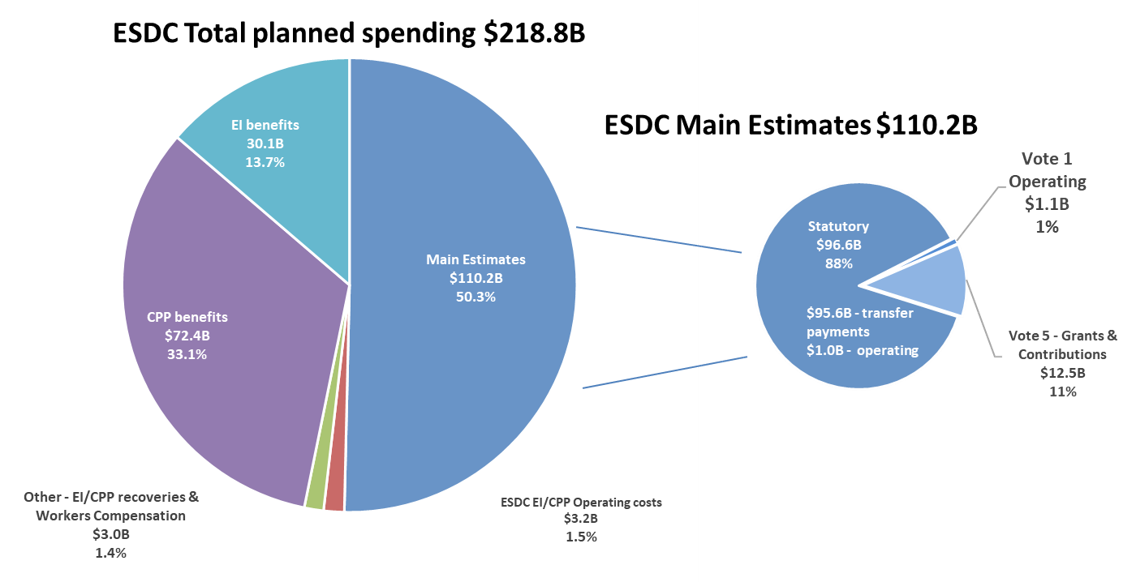
Descriptive text
Figure on the left: ESDC total planned spending is $218.8 billion
- EI Benefits planned spending is $30.1 billion or 13.7% of total planned spending
- CPP Benefits planned spending is $72.4 billion or 33.1% of total planned spending
- Other EI and CPP Recoveries and Workers Compensation planned spending is $3.0 billion or 1.4% of total planned spending
- EI and CPP Operating Costs planned spending is $3.2 billion or 1.5% of total planned spending
- Main Estimates represents $110.2 billion or 50.3% of total planned spending
Figure on the right: ESDC Main Estimates is $110.2 billion
- Statutory planned spending is $96.6 billion or 88% of total Main Estimates
- Vote 1 - Operating Expenditures planned spending is $1.1 billion or 1% of total Main Estimates
- Vote 5 - Grants and Contributions planned spending is $12.5 billion or 11% of total Main Estimates
Of the $110.2 billion in planned budgetary expenditures included in ESDC's 2025‑26 Main Estimates, $108.1 billion (98%) will benefit Canadians through statutory and voted transfer payment programs.
Programs included in the $95.6 billion of statutory transfer payments expenditures in ESDC's 2026-27 Main Estimates are:
- Old Age Security Program = $88.8 billion
- Canada Student Financial Assistance Program and Canada Apprentice Loans = $3.4 billion
- Canada Education Savings Program = $1.3 billion
- Canada Disability Benefit= $1.1 billion
- Canada Disability Savings Program = $0.9 billion
Programs included in the $12.5 billion in voted grants and contributions in ESDC's 2026‑27 Main Estimates:
- Early Learning and Child Care = $9,267.6 million
- Workforce Development Agreements = $722.0 million
- Youth Employment and Skills Strategy = $598.5 million
- Indigenous ELCC Transformation Initiative= $317.7 million
- Student Work Placement Program = $276.8 million
- Indigenous Skills and Employment Training Program = $235.5 million
- Canadian Apprenticeship Strategy = $181.4 million
- National School Food Program = $142.2 million
- Opportunities Fund for Persons with Disabilities = $100.7 million
- Canada Service Corps = $83.5 million
- Sectoral Workforce Solutions Program = $82.9 million
- Enabling Fund for Official Language Minority Communities = $67.7 million
- New Horizons for Seniors Program = $63.1 million
- Future Skills = $60.8 million
- Social Innovation and Social Finance Strategy = $51.0 million
- Skills and Partnership Fund = $50.0 million
16. Old Age Security Program: Increased Costs for Older Seniors
Questions and Answers
Q1. Why do seniors face increased costs as they age?
A1. As seniors get older, they tend to have lower income and often face higher health-related expenses because of the onset of illness or disability. This vulnerability is further compounded by a reduced ability to supplement income with paid work, by the risk of outliving savings and the risk of widowhood. Data shows that older seniors:
- are more likely to incur higher health-related expenses
In 2022, close to half (49%) of seniors aged 75 and over had a disability, compared to one third (35%) of those aged 65-74. Seniors aged 75 and over were also more likely than younger seniors to have a severe disability (27% vs. 16%).
According to a 2018 Conference Board of Canada report, population aging was expected to add $93 billion in health care related costs between 2017 and 2026. This represents 20% of all health care spending growth over that decade. - are more likely to be widowed
In 2022, the proportion of seniors who were widowed and had not remarried was more than three times higher among seniors aged 75 and over compared to seniors aged 65-74 (38% vs. 11%). Research shows that the loss of spouse or partner can lead to a significant decline in the standard of living of seniors, particularly among women. - are less able to supplement their income with paid work
In 2018, the proportion of seniors with employment income was substantially lower among those aged 75 and over (14%) compared to those aged 65-74 (36%). Among those who worked, median employment income was also much lower for the oldest seniors ($1,280 vs. $17.200). - are more likely to be eligible for the Guaranteed Income Supplement
Because older seniors are more likely to have low incomes, they are more likely to be eligible for the GIS. In 2023-24, 32% of OAS pensioners aged 65-74 received the GIS, compared to 38% of those aged 75 and over.
Q2. What is the Government doing to help seniors face increasing costs as they age?
A2. The Government recognizes that seniors face increased financial vulnerability as they age.
In July 2022, the Old Age Security (OAS) pension was permanently increased by 10% for seniors aged 75 and over.
Thanks to this measure, in May 2026, a senior aged 75 and over eligible for a full OAS pension receives $817.36 per month in OAS pension (or $9,808.32 per year). This is $74.31 more per month (or $891.72 more per year) than a senior's aged 65 to 74, who receives $743.05 per month (or $8,916.60 per year).
In April 2026, of all 7.6 million OAS pensioners, 3.6 million are aged 75 and over, and among these older seniors 56% (2.0 million) are women and 44 % (1.6 million) are men.
Among the 4.0 million OAS pensioners who are aged 65 to 74, approximately 53% (2.1 million) are women and approximately 48% (1.9 million) are men (percentages do not add up due to rounding).
Additional Data Points on All Seniors
Caregiving
- As noted by the National Institute on Ageing in 2023, many older persons in Canada rely on family/friend caregivers. Caregivers provide at least 75% of the home care and often incur significant costs.
Housing
- Regarding housing, the 2025 FPT Seniors Forum highlighted that renters in subsidized housing have a higher rate of unaffordable housing:
- 42% (5,035) of renters aged 55+ who are in subsidized housing spending 30% or more of household income on shelter costs. Of this group, over half (2,660) are aged 65 to 84 years
- out of renters aged 65 to 84 years who are living in unaffordable subsidized housing, 12% (325) identify as Indigenous, and over a third (38% or 1,005) have difficulties with 3 or more activities of daily living
- about three-quarters (74% or 1,980) are living alone in 1-bedroom homes, and 38% (1,020) are living in apartment buildings with fewer than 5 storeys, of which 41% (415) were built between 1961 and 1980
Gender also plays a role, and Statistics Canada revealed in 2023 that women aged 65+ have an average income that is 27% lower than the average income of men aged 65+, meaning they are more reliant on low-cost housing.
17. Flexibilities in Canada-wide ELCC Agreements
Key Messages
- The Government of Canada continues to work with provincial, territorial and Indigenous partners to support the ongoing implementation of the Canada-wide early learning and child care (ELCC) system, with the goal of ensuring that families across the country continue to have access to affordable, high-quality and inclusive child care.
- Provinces and territories continue to work towards their affordability and access targets beyond March 2026.
- Each province and territory has the responsibility to develop child care systems that best respond to the needs and priorities of their communities. That is why we continue to discuss with provinces and territories to ensure families can access high-quality and affordable child care, while allowing flexibilities for provinces and territories to respond to the needs and priorities of their communities.
Questions and Answers
1. What flexibilities exist in Canada-wide agreements to support provinces and territories in their affordability and access commitments?
Provinces and territories have flexibility built in their agreements to achieve their commitments. To reduce fees for regulated ELCC across the country, some provinces and territories have elected to do so through a flat rate while others are accomplishing the reduction through direct rebates to families, subsidy programs which may be income tested, or through a combination of methods.
Unlike fee reductions, creating new child care spaces involves complex, multi-year projects that include time-consuming issues such as zoning requirements, environmental impact studies, and workforce challenges. Provincial and territorial Action Plans reflect a gradual ramping up of space creation goals, with the largest space expansions planned in the last 2 years of the agreements.
In 2025, agreements were extended to support continued access to high-quality, affordable and inclusive ELCC programs and services. Through these extended agreements, some jurisdictions received additional flexibility to continue to work towards their affordability and access targets beyond March 2026.
The Government of Canada continues to work with provinces and territories to ensure families can access high-quality and affordable child care, including flexibility for jurisdictions to respond to the needs and priorities of their communities.
2. What flexibilities exist in CWELCC agreements including Not-For-Profit/For-Profit ratios?
The Canada-wide ELCC Agreements and the Canada Early Learning and Child Care Act predominantly support growth in the not-for-profit, public, and home-based child care sectors. Focusing on growth in this sector supports the sound use of public funds, including ensuring that surplus earnings are reinvested in the programs and services to allow for continued growth of higher-quality programs, rather than distributed for the personal benefit of owners, members, investors or to enhance asset growth.
However, given the unique ELCC landscape across the country, the Government of Canada recognizes that licensed, for-profit child care will continue to play a role. Through the ELCC Agreements, the Government of Canada is working with provinces and territories to support the growth of quality child care spaces across the country, while ensuring that families in existing licensed spaces - including for-profit spaces - benefit from more affordable child care.
Further, some agreements allow limited growth in the for-profit sector and include either a fixed ratio or a cap on the number of spaces alongside strong guardrails such as cost control frameworks and focus on underserved needs of specific communities such as francophone minority communities in New Brunswick. All agreements are tailored to reflect the realities of each jurisdiction and to allow for flexibility in order to achieve the objectives of the Canada-wide system.
3. What flexibilities exist for women entrepreneurs providing child care services?
Women entrepreneurs, in particular those who run regulated child care out of their homes, are essential to the success of the Canada-wide system. There is no limit on the number of regulated home-based child care spaces that can be supported in agreements with provinces and territories.
However, given the focus on growth in the not-for-profit and public sectors to support higher-quality spaces and the sound use of public funds the agreements either have limited or no growth in the for-profit sector. All agreements are tailored to reflect the realities of each jurisdiction and to allow for flexibility in order to achieve the objectives of the Canada-wide system.