
Accessible Canada Roadmap: Towards a barrier-free Canada by 2040
On this page
- List of abbreviations
- Definitions and concepts
- 1. Introduction
- 2. How to use this roadmap
- 3. Engaging with Canadians on an Accessible Canada roadmap
- 4. Realizing a barrier-free Canada: a shared responsibility
- 5. Core elements of the roadmap
- 6. Conclusion
- Annex A: Federal government efforts to advance accessibility
Alternate formats

The Accessible Canada Roadmap: Towards a barrier-free Canada by 2040 [PDF - 1.07 MB]
Large print, braille, MP3 (audio), e-text and DAISY formats are available on demand by ordering online or calling 1 800 O-Canada (1-800-622-6232). If you use a teletypewriter (TTY), call 1-800-926-9105.
List of abbreviations
- ACA
- Accessible Canada Act
- ACD
- Accessible Canada Directorate
- AI
- Artificial Intelligence
- CRPD
- Convention on the Rights of Persons with Disabilities
- CRTC
- Canadian Radio-television and Telecommunications Commission
- CSD
- Canadian Survey on Disability
- CTA
- Canadian Transportation Agency
- ESDC
- Employment and Social Development Canada
- ICT
- Information and Communication Technologies
Definitions and concepts
- Accessibility confidence
- Also called "disability confidence," this term refers to the ability of organizations to manage accessibility and disability as a business priority related to customer experience, talent, productivity, innovation, new product development, brand reputation and investment in human potential. (Source: Accessibility Strategy for the Public Service of Canada)
- Barriers
- Anything — including anything physical, architectural, technological or attitudinal, anything that is based on information or communications or anything that is the result of a policy or a practice — that hinders the full and equal participation in society of persons with an impairment, including a physical, mental, intellectual, cognitive, learning, communication or sensory impairment or a functional limitation. (Source: ACA)
- Disability
- Any impairment, including a physical, mental, intellectual, cognitive, learning, communication or sensory impairment — or a functional limitation — whether permanent, temporary or episodic in nature, or evident or not, that, in interaction with a barrier, hinders a person's full and equal participation in society. (Source: ACA)
- The social model of disability
- The social model of disability says that people are disabled by society's barriers, not by impairments or differences. It views social organization as an important source of a person's limitation and disability experience. A person's condition or disability is not an issue when society removes barriers. (Source: A Guide for Communicating with and About Persons with Disabilities)
- Intersectionality
- The need for systems, policies, programs, and services to consider the different ways people interact with their environments and the multiple, intersecting forms of marginalization and discrimination they face. (Source: Disability Inclusion Action Plan)
1. Introduction
The Accessible Canada roadmap (the roadmap) is a national framework that supports Canadians working to create a barrier-free Canada by 2040. Its development was guided by the principle of Nothing Without Us, which requires persons with disabilities to be engaged in the development of legislation, policies, programs, products and services that affect them. Through a wide-reaching national engagement process, diverse stakeholders across the accessibility landscape came together to share their vision of a Canada where everyone can participate fully in society, regardless of disability.
Disability is part of the human experience. Findings from the 2022 Canadian Survey on Disability showed that 27% of Canadians aged 15 and older, or 8 million people, identified as having a disability.Footnote 1
The population of persons with disabilities is large and diverse, with many persons with disabilities experiencing more than one type of disability. Some individuals may be born with a disability while others may develop a disability at some point in their lives because of injury, illness or aging. These disabilities may be visible or non-visible. A disability may be permanent or temporary, or may fluctuate over time, and can range from mild to severe. In addition to persons with disabilities themselves, many people have family members, friends, neighbours or co-workers with disabilities. While disability is a natural part of life, the barriers that prevent people from fully participating in society do not have to be. Removing barriers benefits everyone.
Advancing accessibility and disability inclusion are priorities for the Government of Canada. In 2010 Canada joined the United Nations Convention on the Rights of Persons with Disabilities, which protects and promotes the rights and dignity of persons with disabilities without discrimination and on an equal basis. The CRDP has been a driver of change in Canada. Building on this commitment, the Government of Canada passed the Accessible Canada Act (ACA) in 2019 to help create a more accessible and inclusive Canada. The contributions and perspectives of the disability community played a key role in shaping the Bill that eventually became the ACA.
The ACA gives the Government of Canada a broad mandate to put in place regulations, policies, programs and initiatives to advance accessibility and inclusion. The goal of the ACA is to advance accessibility by identifying, removing and preventing barriers to accessibility in seven priority areas:
- employment
- the built environment
- information and communication technologies (ICT)
- communication other than ICT
- the design and delivery of programs and services
- the procurement of goods, services and facilities, and
- transportation
In 2022, the Government of Canada published the Federal Data and Measurement Strategy for Accessibility. This strategy sets out 4 areas of work that aim to support measuring progress in the removal of barriers to accessibility over time. The strategy has led to the publication of a performance indicator framework that includes indicators for all seven priority areas.
Federally regulated organizations are also required to publish accessibility plans, progress reports, and feedback mechanisms, helping to ensure transparency and accountability. Details on compliance and enforcement mechanisms of the ACA, including the roles of key regulators, are provided in Annex A.
Although the ACA applies to federally-regulated organizations, it has a broader goal of realizing a barrier-free Canada by 2040. Achieving this goal requires collaborative action across the country, involving all levels of government, the private sector, the disability community, Indigenous Peoples, and other organizations and individuals working together to advance change in our communities and workplaces.
Advancements in accessibility are happening all around us. Provinces, territories and municipalities are introducing legislation, regulations, standards, policies and plans relevant to their responsibilities and priorities. More and more businesses and civil society organizations are removing barriers to become better employers of persons with disabilities and to improve client inclusion and satisfaction. The disability community continues to advocate for a barrier-free Canada and to actively advance accessibility efforts.
As part of its commitment to disability inclusion and accessibility, the federal government launched the Disability Inclusion Action Plan (DIAP) in 2022, and published an Employment Strategy for Canadians with Disabilities in 2024. Further details on the DIAP and the employment strategy can be found in Annex A. The roadmap complements the DIAP's whole-of-government approach through a unifying vision that connects accessibility efforts and encourages broader action across Canada.
While these steps represent important progress, more needs to be done to drive meaningful progress towards the goal of a barrier-free Canada by 2040. And the effort that is needed requires collaboration across jurisdictions, sectors and communities.
2. How to use this roadmap
The Accessible Canada roadmap is not a new policy or funding program. Instead, it serves as a national framework to guide Canadians working toward a barrier-free Canada by 2040. It provides a foundation to support coordinated efforts, while also being inclusive of diverse priorities, responsibilities, and mandates. The roadmap is based on the understanding that achieving this collective goal will take contributions from everyone, and that everyone has a unique role to play.
The roadmap also helps to focus conversations on how governments, businesses, organizations, and individuals can contribute to this national vision in meaningful ways. While some goals may take time to achieve, there are many areas where action can begin immediately or over the short term. Whatever the goals may be, the roadmap can help guide efforts to achieve them. It is a resource that can help identify gaps, build on existing knowledge and expertise, and spark new actions and partnerships that bring Canada closer to its accessibility goals. Ultimately, the roadmap aims to help build momentum and advance progress towards a barrier-free Canada.
3. Engaging with Canadians on an Accessible Canada roadmap
In 2024, to mark the 5-year anniversary of the ACA coming into force, ESDC launched a national discussion on developing a roadmap to guide efforts towards a barrier-free Canada by 2040. To spark this important conversation, ESDC published a discussion paper introducing the draft Accessible Canada roadmap, a proposed national vision to guide and support those working to advance accessibility.
Between September 2024 and January 2025, ESDC undertook a significant national engagement effort, gathering insights from a wide range of voices across the accessibility landscape, including persons with disabilities, disability organizations, Indigenous partners, federally-regulated organizations in the private and public sectors, provinces, territories, and municipalities, academia and the public.
Engagement activities included the following:
- An online survey from September 2024 through January 2025 in which over 100 submissions were received, including written feedback submissions on the roadmap and its core elements
- Seven virtual engagement sessions in October and November 2024, and January 2025. These sessions provided an opportunity for small, facilitated group discussions and feedback on the draft roadmap
- Two webinars in November 2024 to provide an opportunity for questions from stakeholders, and
- A full-day Knowledge Exchange in December 2024 where accessibility leaders from the disability community, Indigenous organizations, the private sector, academia and other levels of government had the opportunity to discuss the draft roadmap and how to put it into action
In the spirit of Nothing Without Us, the roadmap reflects the diverse views and meaningful feedback shared by Canadians during the engagement process.
4. Realizing a barrier-free Canada: a shared responsibility
What is a barrier?
The ACA defines a barrier as anything that prevents persons with disabilities from fully participating in society. For persons with disabilities, barriers to their full and equal participation can be found all around us. The 2022 Canadian Survey on Disability (CSD) provides some important data on barriers faced by persons with disabilities.
- Over half (56%) of persons with disabilities ages 15 and over reported experiencing barriers to accessibility in public spaces where they live, work, and playFootnote 2
- Nearly half (48%) of persons with disabilities experienced communication barriers when communicating with family or friends, health-care professionals, or when accessing services or supports from government or private-sector customer service representativesFootnote 3
- Over half (57%) of persons with disabilities faced barriers when using information and communications technology applications, including websites, electronic devices and mobile applications,Footnote 4 tools that are vital to inclusion in education, employment and cultural life
- Nearly half of persons with disabilities (48%) experienced barriers when accessing programs and services offered by the public and private sectorsFootnote 5
- Nearly 7 in 10 persons with disabilities (69%) experienced barriers while at workFootnote 6
- Just over half (52%) of persons with disabilities experienced an accessibility-related barrier in travel by airplane, train, bus, or ferryFootnote 7
The roadmap is built around the essential idea that just as accessibility benefits everyone, everyone also has a role to play in removing barriers. Achieving a barrier-free Canada will require efforts across jurisdictions and across all sectors of our economy and society. Some have formal obligations under laws, regulations or standards, while others contribute in meaningful ways through inclusive attitudes and actions. Each of us has a unique role to play, based on who we are, what we do, and the jurisdiction in which we live.
The disability community continues to play an important role in raising awareness and promoting and advancing accessibility across Canada. The disability community includes persons with disabilities and the organizations that represent them. Together, their longstanding commitment to accessibility and inclusion is helping to bring about meaningful change.
Figure 1 illustrates the key groups involved in advancing accessibility. The figure also represents the unique role of persons with disabilities, who are members of all these groups and central to accessibility efforts.

Figure 1: Text version
A pie chart is divided into five segments, each representing a key group that contributes to advancing accessibility: disability organizations, governments, the private sector, Indigenous Peoples, and the public. Persons with disabilities are shown in an overlapping circle in the center showing that they are part of all these groups and central to accessibility efforts.
4.1 Persons with disabilities
Persons with disabilities are a diverse group. They include individuals with different, and sometimes multiple, types of disabilities. These can include physical, mental, intellectual, cognitive, learning, or communication disabilities; sensory impairments, or a functional limitation. Disabilities can be visible or non-visible and can be permanent, temporary, or occasional. Persons with disabilities also have intersecting identities, such as age, race, ethnicity, Indigenous identity, sex, gender, sexual orientation, income, and whether they live in urban or rural areas. These factors can influence how persons with disabilities experience barriers and can lead to increased discrimination and marginalization.
Disability in Canada
The population of persons with disabilities increased by 5% between 2017 and 2022 in part because of the aging population and the large increase in mental health-related disabilities among youth and working-age adults. In 2022, the rate of disability was higher among women (30%) than men (24%), following the same pattern as in 2017. Canadians aged 65 and older are more likely to have a disability because of health conditions associated with aging. In Canada, 40% of persons aged 65 and older reported having a disability, compared with working-age adults ages 25 to 64 years (24%) and youth ages 15 to 24 years (20%). As individuals age, they are also more likely to experience a higher number of co-occurring disabilities.
Among persons with a disability, the most commonly reported types were pain-related (62%), flexibility (40%), mobility (39%), and mental health-related (39%).Footnote 8 Beyond these, there are many other types of disability, including learning and cognitive disabilities, seeing or hearing disabilities, chemical sensitivities, and others.
The combined lived experiences and diversity of persons with disabilities offers valuable knowledge and expertise about barriers and how to remove them. Upholding the principle of Nothing Without Us is essential when developing policies, laws, products, programs and services.
4.2 Disability organizations
Disability organizations are as diverse as the persons with disabilities they represent. These organizations work with persons with disabilities to help amplify their voices, contribute to systemic change and play an important role in advocating for the rights of persons with disabilities and advancing accessibility. Some may focus on a specific type of disability, multiple disabilities, or on persons with disabilities who have intersecting identities. They may represent local or regional communities or represent the interests of persons with disabilities at the national level.
4.3 Governments
All levels of government, including federal, provincial, territorial, and municipal, are advancing accessibility according to their jurisdictional responsibilities and priorities. Before the ACA came into force, Ontario, Quebec, Manitoba, and Nova Scotia already had accessibility legislation in place. Since 2019, Newfoundland and Labrador, British Columbia, Saskatchewan, and New Brunswick have also passed accessibility legislation. Municipalities across Canada are similarly working to advance accessibility in their communities.
Governments play a leading role in driving systemic change within their own jurisdictions, including in both the public and private sectors they regulate as well as by raising awareness and supporting research and engagement on accessibility. The ACA applies to federal departments, agencies, and Crown corporations. Other public sector organizations may fall under provincial or territorial accessibility legislation.
As employers of persons with disabilities and providers of public-facing services and programs, governments can encourage new inclusive practices and lead by example.
Collaboration between jurisdictions is important for creating coherent and seamless experiences for persons with disabilities across Canada.
4.4 Private sector
Businesses and private organizations play a key role in advancing accessibility in Canada. Some are regulated under the ACA, including those in the financial, transportation, broadcasting, and telecommunications sectors. Many others may fall under provincial accessibility legislation, regulations, or standards.
Businesses contribute to accessibility by employing persons with disabilities and offering accessible products and services. Regardless of size, the private sector is a leader in establishing an inclusive design culture. It also plays an important role in developing and adopting innovative practices and technologies that remove barriers for employees, clients, and customers with disabilities. Removing barriers to accessibility also gives businesses a competitive edge in attracting talent, reaching new markets, and improving customer experiences, all of which help them thrive.
4.5 Indigenous Peoples
Indigenous Peoples have unique and diverse perspectives on disability. Many Indigenous communities experience gaps in infrastructure, housing, and access to community services, including health services, which may be considered barriers or which can impact a community's ability to address barriers. As a result, identifying and removing barriers to accessibility must be both culturally appropriate and community-led. A distinctions-based approach to advancing accessibility must be followed to reflect the distinct rights, interests, and circumstances of First Nations, Inuit, and Métis communities.
4.6 Public
All Canadians have an important role to play in improving accessibility and promoting a culture of inclusion. Individuals, including persons with disabilities, as well as their families and friends, advance accessibility by identifying and removing barriers, ensuring that persons with disabilities are included in decision-making processes, removing the stigma associated with disability, and raising awareness of how inclusion benefits everyone in society.
5. Core elements of the roadmap
This section introduces the core elements of the roadmap and outlines how, collectively, we can take action to advance accessibility and help realize a barrier-free Canada by 2040. These core elements were developed through national discussions with stakeholders and partners, including persons with disabilities and disability organizations.
As shown in Figure 2, the roadmap for a barrier-free Canada includes five guiding principles and four themes, each with its own areas of action. The themes and related areas of action are intended to break down accessibility efforts into distinct, concrete areas of work. Using the roadmap as a framework, organizations and individuals can choose to develop their own practical, actionable goals that align with the themes and areas of action. These goals can be adapted to reflect their unique mandate, responsibilities, priorities, sector, and circumstances. These goals can serve as a practical way for diverse organizations to work towards shared outcomes to create a barrier-free Canada.
The principles, themes, and areas of action work together to support the outcomes described below.
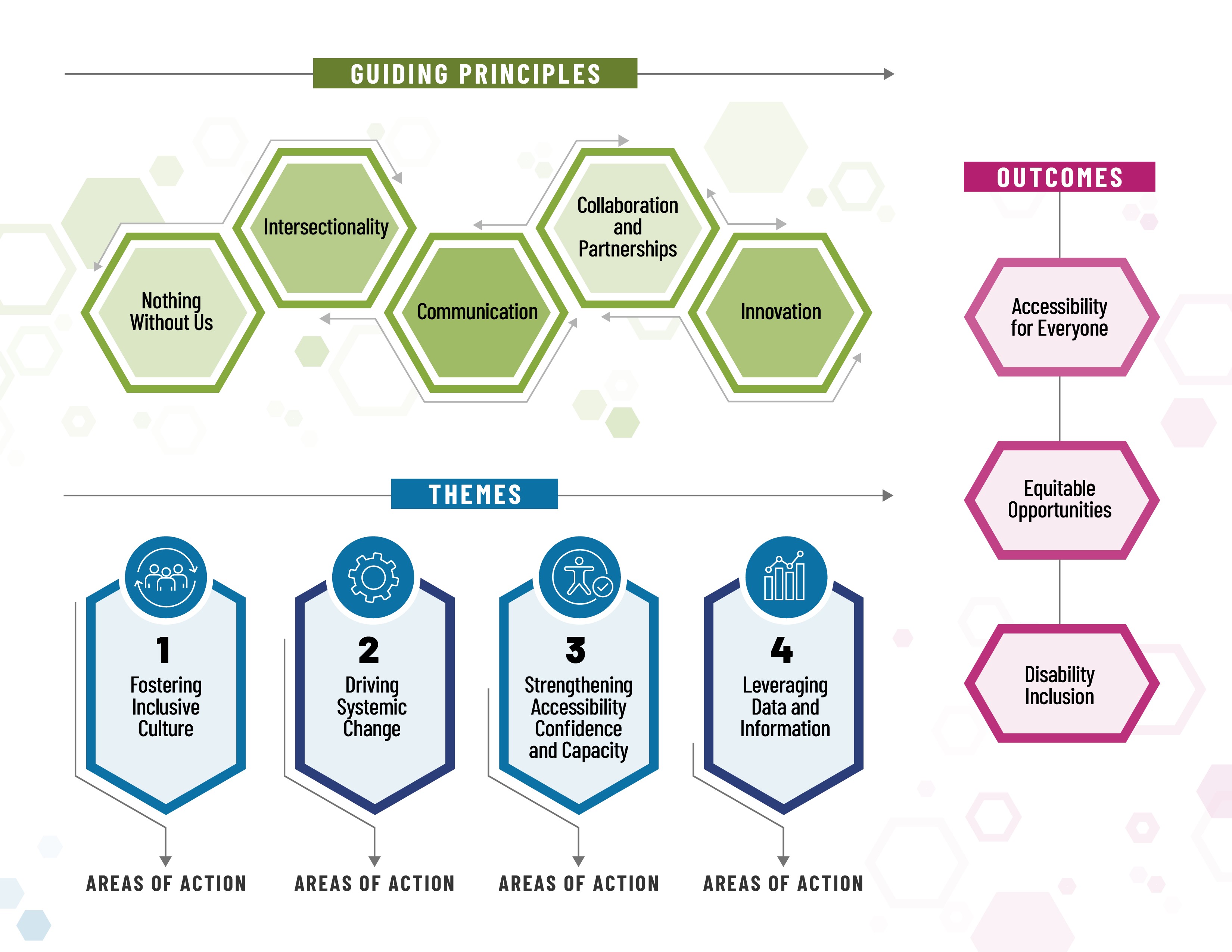
Figure 2: Text version
The roadmap includes the following core elements in relation to each other: five guiding principles at the top-left and four themes below them, with each theme supported by distinct areas of action. Together, the principles and themes support three outcomes listed on the right side. These elements are described in detail below the image, starting in Section 4.1 Outcomes.
The five guiding principles are listed as: nothing without us, intersectionality, communication, collaboration and partnerships, and innovation. The four themes are listed as: fostering inclusive culture, driving systemic change, strengthening accessibility confidence and capacity, and leveraging data and information. The three outcomes are listed as: accessibility for everyone, equitable opportunities, and disability inclusion.
5.1 Outcomes
The roadmap identifies three outcomes that show progress towards realizing a barrier-free Canada by 2040 — one where everyone can fully participate in social and economic life. These outcomes are:
- Accessibility for everyone: Spaces, products, programs, and services are designed from the beginning to be accessible to all Canadians, including persons with disabilities
- Equitable opportunities: Canadians, regardless of disability, have barrier-free access to full and equitable participation in society
- Disability inclusion: Persons with disabilities are included in all aspects of society
5.2 Guiding principles
The following guiding principles reflect the spirit of the ACA, guide the areas of action under each theme, and help to achieve the outcomes described above.
- Nothing Without Us
- Intersectionality
- Communication
- Collaboration and partnerships
- Innovation
Nothing Without Us
A central principle of both the United Nations CRPD and the ACA, Nothing Without Us calls for persons with disabilities to be engaged in the development of legislation, policies, programs, products, and services.
Intersectionality
Intersectional analysis looks at how overlapping identities can affect a person's access to opportunities, resources and rights, and how these intersections can increase experiences of discrimination and barriers. Identity factors may include age, ethnicity, race, Indigenous identity, sex, gender, sexual orientation, income, geography, and other factors.
Intersectionality and barriers
Using an intersectional approach can help create solutions that are more inclusive and responsive to the diverse realities people experience. For example, youth are more likely to experience communication barriers compared to other age groups.Footnote 9 Additionally, 2SLGBTQI+ persons with disabilities experience a much higher prevalence of attitudinal barriers (58%) compared to non-2SLGBTQI+ groups (35%).Footnote 10
Communication
As more people and organizations share their progress and contributions to advancing accessibility, they inspire new actions and reinforce the actions of others. Publicly communicating success stories and achievements demonstrates the positive impact of accessibility, reinforces the importance of collective action, and helps build momentum for change.
Collaboration and partnerships
Promoting cohesive and complementary action is at the heart of the roadmap. It values collaboration and shared learning to encourage the adoption of consistent standards and best practices, helping to further accelerate change.
Innovation
Innovation can take many forms. New and emerging technologies and service innovations are creating exciting opportunities to advance accessibility. Whether through apps that map accessible routes for wheelchair users, thought-controlled prosthetics, or other adaptive and assistive technologies or services, these innovations can help make our environments and communities more accessible.
But innovation is about more than new technology, it's also about rethinking why and how we do things. It means taking a system-wide approach to accessibility and committing to continuous improvement, and to including persons with disabilities in the design of new technologies, products or services. Innovation in accessibility can also include implementing more inclusive workplace practices or adopting existing technologies more broadly to remove barriers for clients and employees with disabilities.
5.3. Themes
The four themes of the roadmap represent the high-level priorities where strong and coordinated effort is needed to help realize a barrier-free Canada:
- fostering inclusive culture
- driving systemic change
- strengthening accessibility confidence and capacity
- leveraging data and information
Each theme and its related areas of action are described in the sections that follow.
Theme 1: Fostering inclusive culture
The first theme recognizes that raising awareness and changing attitudes about inclusion and accessibility is essential to making progress in other areas. Accessibility and inclusion create social and economic value. It has been estimated that an accessible and inclusive society would create over $337 billion in value for Canadian society, based on analysis of data from the reference year of 2017.Footnote 11 Still, negative attitudes, discrimination, and stigma about disability and accessibility remain significant barriers to the inclusion of persons with disabilities. Being misunderstood, doubted, or judged can often lead to frustration and marginalization.Footnote 12
Taking meaningful action is key to fostering a more inclusive culture in workplaces and communities. This theme requires the participation of all change agents, including governments, the private sector and the public.
Areas of action:
- Changing attitudes and behaviours: The CSD showed that more than one-third of persons with disabilities (37%) experienced attitudinal barriers in 2022. These barriers included behaviours, misconceptions, or assumptions made by family and friends, medical professionals, or staff of businesses or government services and programs.Footnote 13 Overcoming stigma and mistaken beliefs about disability and accessibility is an important step that can drive advances in accessibility for generations. Actions in this area could include public awareness campaigns in workplaces or communities and steps to ensure workplaces are safe and accommodating for everyone — including those with less visible disabilities such as mental-health related disabilities, chemical sensitivities, hearing or learning disabilities, neurodivergence or other cognitive or neurological differences
- Accessible by design: When accessibility is proactively and thoughtfully integrated from the start in the design of programs, services, products, and the built environment, barriers can often be prevented before they occur. Accessible design is also frequently less costly than adding accessibility features after the fact. Examples of supporting actions could include adopting accessibility standards that go above the minimum accessibility requirements, building flexibility into workplace policies and practices to reduce the need for individual accommodations, or designing assistive devices and mobility aids in ways that enable persons with disabilities to maintain and repair their own devices, if they wish. Involving disability-inclusive teams in the development of new products and services can help to promote inclusive design. Lastly, inclusive design can also touch on accessible procurement by ensuring that vendors of goods and services are aware of relevant accessibility legislation and standards and how to meet applicable accessibility requirements
- Leveraging innovative approaches: Innovative accessibility approaches are all around us. Learning from others and coordinating approaches can help reduce duplication and support a more seamless and barrier-free experience across Canada. Actions in this area could include bringing together leaders to promote innovations within their sector and help dispel myths about accessible design. It could also include developing accessibility strategies for sectors where barriers are frequently identified. These strategies can serve as models that other regions or jurisdictions can follow
- Accessible employment: Supporting and investing in employees is a smart business move. Teams with diverse people and perspectives are key to increasing productivity and driving innovation. Disability-inclusive teams also help ensure that organizations are representative of their customer base and the broader societyFootnote 14
Accessible employment by the numbers
Nearly 3 in 5 persons with a disability (59%) report experiencing accessibility barriers related to the labour market. These include barriers experienced at work, during a hiring process, or barriers that discouraged or prevented them from working.Footnote 15 Removing barriers to employment is critical to promoting accessible employment and closing the labour market gap. The employment rate for persons with disabilities aged 25 to 64 years old (62%) is lower than for their peers without disabilities (78%).Footnote 16 Statistics Canada estimates that over 741,000 persons with disabilities aged 25 to 64 could work in an inclusive labour market but did not have a job.Footnote 17 With growing skills and labour shortages across key sectors of the economy, tapping into the underrepresented talent pool of persons with disabilities can help meet pressing workforce needs, improve productivity and support long-term growth.
Employers and governments play an important role in developing and implementing accessible employment strategies. These include strategies for hiring and retaining persons with disabilities and creating accessible workplaces. Actions in this area could include implementing initiatives that keep employees with disabilities active in the workforce through flexible work arrangements, or supporting youth with disabilities in accessing employment and early job experiences that build skills many employers are looking for.Footnote 18 Other examples of actions include helping persons with disabilities find and keep meaningful employment, providing training opportunities to support career growth, or helping persons with disabilities start their own business.
Theme 2: Driving systemic change
The second theme recognizes that all levels of governments are uniquely positioned to drive change. They can use levers such as legislation, regulations, and standards to set clear expectations and enforceable requirements, promote accountability, and ensure consistent implementation of accessibility measures across sectors. While many jurisdictions have adopted accessibility legislation or standards, others may follow different strategies to achieve their specific objectives. The private sector also plays an important role by complying with applicable legislation, regulations and adopting relevant standards.
Areas of action:
- Legislation and regulations: Legislation and regulations are concrete levers that governments use to drive change. Setting and enforcing clear legal requirements for accessibility helps ensure that organizations are held accountable for creating inclusive environments and for making accessibility a standard part of everyday life. Actions in this area could include developing more regulations under the ACA priority areas, or reviewing existing legislation and regulations to see if they are still relevant and adjust them as needed. Other levels of government may introduce new legislation or regulations that reflect their own priorities
- Accessibility standards: Standards can help guide actions to remove and prevent barriers. Improving standard consistency across jurisdictions can also support stronger coordination and make accessibility experiences more seamless across Canada. Adopting voluntary standards can help support faster progress and improve accessibility to identify, remove and prevent barriers. Actions in this area could include developing new standards, promoting the adoption of standards by the private sector, and reviewing existing standards to ensure they remain relevant and adjusting them as needed.
- Compliance promotion and enforcement: Strong compliance and enforcement measures are critical to advancing accessibility by regulated entities. Compliance promotion activities aim to help regulated entities meet established regulatory requirements through the use of guidance documents, tools, newsletters and other resources, that raise awareness about legal obligations and regulatory requirements. When these obligations are not met, progressive enforcement approaches, including consequences for non-compliance, such as administrative monetary penalties, help support accountability and drive systemic change. Establishing an accessible complaints process can also facilitate barrier-free access to processes that support both compliance and enforcement
- Early consideration of accessibility: Strengthening the ability of policy makers to consider accessibility early in their work helps ensure that accessibility is built into the development of policies, programs, and services from the start. Tools that can support this include using an accessibility lens, which examines new policies, programs and service delivery processes from the perspective of users with diverse disabilities and intersectional identities and can prevent new barriers from being introduced
- Programs and initiatives to support removing barriers: Governments and businesses can also advance accessibility through programs and initiatives that identify or remove barriers. Actions under this area could include supports for innovative approaches to accessible employment, or initiatives that promote accessibility improvements or build effective partnerships to advance accessibility
- Advancing accessibility in Indigenous communities: Approaches to supporting the removal of barriers to accessibility must respect the rights of First Nations, Inuit and Métis to make their own decisions and must be culturally appropriate, Indigenous-led and responsive to the needs of each community. Approaches should also recognize the infrastructure gap in many communities and the fact that communities face inequitable access to programs and services that support persons with disabilities. These efforts should reflect commitments to truth and reconciliation. Actions under this area could include supporting the co-development of solutions that respond to the unique world views of Indigenous Peoples in relation to how they understand and experience disability. Accessibility approaches should be aligned with the United Nations Declaration of the Rights of Indigenous Peoples Act further to Canada endorsing the United Nations Declaration on the Rights of Indigenous Peoples in 2016
Theme 3: Strengthening accessibility confidence and capacity
While awareness answers the question "why is accessibility important", accessibility confidence answers "how can we effectively meet the diverse needs of persons with disabilities". Organizations and employees with accessibility confidence understand how to make accessibility a part of their everyday work, from accessible hiring practices to designing innovative and inclusive services. This theme focuses on helping people and organizations build the skills, knowledge, and tools needed to confidently support accessibility. It also focuses on increasing access to accessible technologies and support services, since these are essential to inclusion and are sometimes in short supply.
Areas of action:
- Strengthening accessibility confidence: Accessibility confidence can be learned. Training and tools play an important role in helping individuals and organizations build their accessibility confidence and become better prepared to support accessibility efforts. This could include accessibility awareness and sensitivity training to all employees, especially managers and those working directly with clients or the public. It could also include making accessibility a shared responsibility across the organization by building accessibility into workplace culture and governance structures so that accessibility efforts continue through leadership changes. Many disability organizations offer tools and information to help organizations strengthen their understanding of accessibility and their inclusion of persons with disabilities
- Increasing accessible support services and technologies: Accessible technologies and support services include a wide range of tools such as sign language interpretation, video relay services, captioning, Communications Access Realtime Transcription (CART), reading materials in alternate formats, electronic braille displays and braille typewriters, screen readers, and more. They also include adaptive and assistive technologies, as well as support services that help with daily living. As governments, businesses, and communities continue to advance accessibility, the growing demand for accessibility support services is outpacing the availability of qualified professionals. Workforce gaps in fields such as sign language interpretation, real-time transcription and personal support work are limiting access to critical accessibility support services
Addressing these gaps is essential to ensuring that accessibility commitments can be fully realized, and both governments and the private sector play an important role. Actions in this area could include developing strategies to attract and retain talent in accessibility-related careers, supporting training and certification programs, and promoting awareness of these professions
Advancing research and the development of innovative technologies and service solutions is also important. This should be done in collaboration with the disability community to ensure that resulting products become powerful tools for advancing accessibility - Building connections to foster confidence and capacity: Creating connections with the disability community to better understand barriers and potential solutions can help governments and businesses build accessibility confidence and capacity. The disability community, including disability organizations and individuals with lived experiences, brings valuable knowledge about of barriers and solutions. Building strong partnerships with the disability community, including intersectional and non-traditional partnerships, is important for developing trust and supporting the identification of innovative accessibility solutions. This approach is also central to the principle of Nothing Without Us
Theme 4: Leveraging data and information
The fourth theme highlights the essential role of collecting data and sharing knowledge to track progress in removing or preventing barriers over time, as well as to support evidence-based decision-making. There is currently a lack of data on accessibility, which the Government of Canada is working to address. As more data becomes available, it will be important for all levels of government and the private sector to improve data sharing and expand access to it whenever possible. Engaging persons with disabilities on the development of data and information helps build a better understanding of barriers and how to prevent or remove them. As with all efforts to collect and share data, it is essential to obtain consent, safeguard privacy, and protect personal information.
Areas of action:
- Measuring progress in removing barriers to accessibility: ESDC, in collaboration with Statistics Canada, supports the collection and analysis of data to measure progress in removing barriers in the seven priority areas under the ACA. Data collection is equally important for other levels of government and the private sector, including regulated entities, to help understand their own progress in removing barriers. Actions in this area include identifying new sources of data and collaborating on data collection. It is also important to help ensure that, where possible, data is disaggregated, or separated into detailed categories, since this can provide a clearer picture of the unique barriers faced by persons with disabilities who have different disability types or other intersectional identities
- Knowledge mobilization: Collecting data and initiating research is just the start. To make an impact, data must be analyzed, shared, and used. Making data and information widely available can help groups involved in advancing accessibility make informed decisions, demonstrate the positive impact of taking an "accessible by design" approach, and build momentum for change. Actions that support this area could include monitoring and sharing progress, making sure that data tables and other knowledge mobilization products are properly formatted and fully accessible so they are useable by the widest range of persons with disabilities, and showcasing innovative accessibility practices advancements that could apply to multiple sectors or industries
- Research into emerging accessibility issues or solutions: Our society is changing exponentially, and each change can bring both new opportunities as well as risks. Stimulating or undertaking research in emerging areas of accessibility can help to further drive innovation and the application of new solutions, while avoiding new barriers. One area where opportunities and risks are especially evident is in the rapid adoption of digital services and artificial intelligence (AI). As AI and automated decision-making tools become more prevalent in employment, education, and service delivery, it is increasingly important to ensure these technologies are designed inclusively from the start. Advancing digital accessibility, promoting the inclusive design of AI systems, and embedding accessibility into digital service standards are essential to realizing a barrier-free Canada. This requires the participation of people at the forefront of innovation, including universities and private sector organizations, and should be undertaken in collaboration with the disability community so innovation reflects lived experience
6. Conclusion
Accessibility is a shared responsibility for all Canadians. The goal of a barrier-free Canada by 2040, as set out in the Accessible Canada Act and this roadmap, is one that all Canadians should aspire to realize. This roadmap is a call to action for each of us to imagine and help build a country where everyone, regardless of ability, can thrive.
While much needs to be done, the roadmap is intended as a guide for governments, businesses, organizations and individuals as they consider where and how to focus their efforts to improve accessibility. While the roadmap presents many areas of action, others exist and can be pursued. Governments, businesses, organizations and individuals are encouraged to consider how they can use the roadmap according to their own priorities, responsibilities, and mandate. Without action, the vision of a barrier-free Canada will not become a reality. All Canadians are encouraged to read the roadmap, share it, and identify goals and actions they can take, today, tomorrow, and in the future, to align with its principles, themes and areas of actions.
Addressing barriers to accessibility is not a one-time task. As challenges and solutions continue to evolve, a flexible framework is needed to guide and support meaningful change. For this reason the roadmap is designed to evolve over time. As progress is made, it will be important to review and update the roadmap. Engaging communities, stakeholders, and persons with disabilities in this process will help ensure the roadmap remains relevant and that Canada continues to move closer to realizing a barrier-free Canada.
Annex A: Federal government efforts to advance accessibility
The Accessible Canada Act — Laying the foundations for a barrier-free Canada
The Accessible Canada Act (ACA) supports the realization of a barrier-free Canada by requiring regulated entities to identify, remove, and prevent barriers to accessibility in seven priority areas:
- employment
- the built environment
- information and communication technologies (ICT)
- communication other than ICT
- the design and delivery of programs and services
- the procurement of goods, services and facilities, and
- transportation
The ACA applies to all federally regulated organizations. This includes federal departments and agencies, Crown corporations, the Royal Canadian Mounted Police, the Canadian Armed Forces, Parliament, and First Nations band councils. It also applies to private sector businesses regulated by the federal government, such as banks, interprovincial transportation service providers, and broadcasting and telecommunications service providers.
The ACA establishes a framework with regulatory responsibilities shared between the Canadian Transportation Agency (CTA), the Canadian Radio-television and Telecommunications Commission (CRTC), and Employment and Social Development Canada (ESDC). The CTA and the CRTC make and enforce most accessibility regulations affecting the passenger transportation sector and the broadcasting and telecommunications sector, respectively. ESDC is responsible for making regulations for all other areas.
The Accessible Canada Directorate (ACD) is part of Employment and Social Development Canada (ESDC). It was created after the ACA came into force and serves as the Government of Canada's focal point for the ACA, its implementation, and related initiatives.
Compliance and enforcement of regulations made by ESDC are the responsibility of the Accessibility Commissioner, a position created by the ACA and housed within the Canadian Human Rights Commission.
The ACA also created the position of Chief Accessibility Officer, a special advisor to the Minister responsible for the ACA. The Chief Accessibility Officer reports on systemic and emerging accessibility issues and on outcomes achieved under the ACA.
In addition, the ACA expanded the duties and functions of 2 other Government of Canada organizations:
- the Canadian Human Rights Tribunal, which handles appeals of decisions made by the Accessibility Commissioner about complaints regarding violations of regulations made by ESDC, and
- the Federal Public Sector Labour Relations and Employment Board, which handles accessibility-related staffing complaints and grievances from federal public servants, the Royal Canadian Mounted Police, and parliamentary employees. It also hears some appeals of decisions made by the Accessibility Commissioner related to complaints
Finally, the ACA created Accessibility Standards Canada. Its mandate is to develop national accessibility standards that help prevent, identify, and removal barriers in the 7 priority areas, and to fund research that supports the development of these standards.
Progress under the ACA
While these roles and structures are important, implementation of the ACA has not stopped there. Other key accomplishments by the federal government include:
Regulations and standards
- Several regulations came into force in 2021 to support the planning and reporting requirements of the ACA. These include the Accessible Canada Regulations, the Accessible Transportation Planning and Reporting Regulations and the CRTC Accessibility Reporting Regulations
- Publication of first accessibility plans by all regulated entities. Many federally regulated entities have already published their first progress reports
- Launch of regulatory development under the ACA, beginning with draft information and communication technologies (ICT) regulations published for consultation in December 2024
- Publication of several national accessibility standards for public comment and establishment of many other technical committees currently working on additional standards
The Accessibility Commissioner and the Chief Accessibility Officer
- Canada's second Accessibility Commissioner (AC), Christopher Sutton, was appointed in May 2025. The AC published their third annual report in September 2025, with a focus on progress made related to the enforcement of the Accessible Canada Regulations planning and reporting requirements in the private and public sectors
- Canada's first Chief Accessibility Officer (CAO), Stephanie Cadieux, was appointed in May 2022. The CAO published their second annual report in June 2025 with a focus on employment: Getting to Work: Accessible Employment in Canada, 2024
Accessibility standards
- Accessibility Standards Canada (ASC) has published national accessibility standards, including those for employment, information and communication technologies, and built environment. ASC is also developing other accessibility standards, such as standards for service delivery and for accessible and equitable artificial intelligence systems. The ASC maintains a Centre of Expertise where information about accessibility standards (both completed and in development) and related research can be accessed
Data and measurement
- Published the Federal Data and Measurement Strategy on Accessibility in June 2022, along with performance indicators for all 7 priority areas, to support data collection and measure progress in identifying and removing accessibility barriers over time
- Updating the Accessibility Statistics Hub
Building capacity
- Providing support to the disability community to build capacity and foster key partnerships between the disability community and federally regulated and other sectors through the Accessible Canada grants and contributions program
- Raising awareness of accessibility and celebrated the contributions of persons with disabilities in Canada during National AccessAbility Week activities and the annual Canadian Congress on Disability and Inclusion
- Established the Office of Public Service Accessibility in 2019 within the Treasury Board Secretariat to provide advice and leadership to federal departments and agencies related to advancing accessibility across the public service
Federal, provincial, and territorial collaboration
- ESDC is the federal co-chair for the Open Forum on Accessibility, a mechanism for information-sharing and collaboration with provincial and territorial governments to advance accessibility across Canada and create seamless experiences for Canadians, no matter where they live or work
Federal action plan on disability inclusion
- Canada's Disability Inclusion Action Plan is a comprehensive, whole-of-government approach that aims to improve disability inclusion and accessibility. It includes actions across federal programs and makes targeted investments in key areas to drive change. The plan builds on existing programs and introduces new, meaningful actions to strengthen inclusion
- The action plan has 4 pillars - financial security, employment, accessible and inclusive communities and a modern approach to disability
- The federal government reports publicly on the progress and impact of the action plan to show how it is advancing disability inclusion and accessibility
Employment Strategy for Canadians with Disabilities
- The Employment Strategy for Canadians with Disabilities is a key action under the employment pillar of the Disability Inclusion Action Plan. Launched in July 2024, it provides a framework to guide government action and ensure that ESDC programs better include and serve persons with disabilities. With the vision of closing the employment gap between persons with disabilities and those without by 2040, the employment strategy includes a range of measures organized under 3 goals:
- Individuals — help them find and keep good jobs, advance in their careers, or become entrepreneurs
- Employers — help them to diversify their workforces by creating inclusive and accessible workplaces, and
- Enablers — increase the supply, capacity, and reach of individuals and organizations that support disability inclusion and accessibility in employment
- In 2022, to support the implementation of the employment strategy, ESDC's Opportunities Fund for Persons with Disabilities program received $272.6 million over 5 years. These investments are funding projects that help increase the labour market inclusion of Canadians with disabilities. Annual public updates will track progress under the employment strategy and guide ongoing refinement of actions