
Summary of the Accessible Canada Roadmap: Towards a barrier-free Canada by 2040
To read or download the full roadmap, please visit the Accessible Canada Roadmap: Towards a barrier-free Canada by 2040 website.
1. Introduction
The Accessible Canada Roadmap is a national framework that supports and anchors the efforts of Canadians working to make Canada barrier-free by 2040. Making Canada barrier-free is a goal of the Accessible Canada Act (ACA). Through an extensive engagement process, Canadians, including persons with disabilities, shared feedback that helped shape the roadmap.
Removing barriers helps everyone. In 2022, 27% of Canadians aged 15 and older said they had at least one disability. Some disabilities are easy to see, others are not. Disabilities can last a short time, a long time, or be permanent. Many people may be born with a disability or may develop one at some point in their lives because of injury, illness or aging. Others may have family members, friends, neighbours or co-workers with disabilities. Disability is a part of the human experience, but barriers do not have to be.
Governments, businesses and civil society organizations, as well as individual Canadians, are working to make the country more accessible. As part of its commitment to disability inclusion and accessibility, the federal government continues to implement the ACA through new regulations and standards, the Disability Inclusion Action Plan (launched in 2022) and the Employment Strategy for Canadians with Disabilities (launched in 2024).
While these steps are important, there is however, still more to do. To reach the goal of a barrier-free Canada, we all need to work together.
2. How to use this roadmap
The roadmap is not a new program, policy or funding. It is meant to foster coherence and guide governments, businesses, organizations, and individuals as they think about what they can do to make Canada more accessible. Everyone is encouraged to read the roadmap, share it, and most importantly, to use the roadmap to establish goals and actions they can take to remove or prevent barriers to accessibility so that all persons with disabilities can fully take part in society. Through our collective efforts, we can all contribute to achieving the vision of a barrier-free Canada.
3. Engaging with Canadians on an Accessible Canada Roadmap
In the spirit of Nothing Without Us, the government held a wide-reaching national engagement process between fall 2024 and winter 2025. Engagement activities involved persons with disabilities, disability organizations, Indigenous partners, federally regulated businesses, federal government departments and agencies, academia, other levels of government and the public. All were invited to share their feedback on a discussion paper on the roadmap published on Canada.ca.
People shared their feedback in different ways: through an online survey, written submissions, via virtual engagement sessions and through a one-day meeting with leaders in accessibility that included both in-person and virtual participation. The roadmap reflects the diverse views shared during this process.
4. Realizing a barrier-free Canada: A shared responsibility
The Accessible Canada Act defines a barrier as anything that prevents persons with disabilities from fully taking part in society. Removing these barriers is a shared responsibility where everyone has a role to play. The five groups described below are key to advancing accessibility. Because each group has different roles and responsibilities, working together is important to make real progress.
Persons with disabilities
They help lead accessibility efforts because they know what it is like to live with disability. This group includes people with different kinds of disabilities, as well as different backgrounds, like age, ethnicity, Indigenous identity, sex, gender, and income, and those who live in urban, rural or northern parts of Canada. All these differences affect the barriers they face. Persons with disabilities are also part of all the other groups, where they continue to lead and support accessibility efforts in many areas of society.
Disability organizations
These organizations work with persons with disabilities to help strengthen their voices and support systemic change. They are as diverse as the persons with disabilities they represent.
Governments
Federal, provincial, territorial and municipal governments can lead by example, raise awareness and support research and engagement on accessibility, and help drive system-wide changes. Governments also need to be accessible when hiring people and providing services. Many provinces already have accessibility laws. It is important for all governments to work together to make Canada more accessible for everyone.
Private sector
Improving accessibility can help private sector businesses grow and succeed. Many private sector businesses already hire persons with disabilities and develop new products and services that are easier for everyone to use. These efforts support inclusion and can help bring in new customers. Private sector businesses may also need to follow federal or provincial accessibility laws or standards that apply to them.
Indigenous Peoples
First Nations, Inuit, and Métis communities bring unique perspectives on disability. That is why accessibility efforts with Indigenous communities should respect their cultures, be led by individual communities wherever possible, and recognize their distinct rights and interests.
The public
Everyone can help make Canada more accessible and inclusive. This means talking about accessibility, making sure persons with disabilities are included in decision-making processes, speaking out against negative and unfair attitudes, and working together to remove barriers to accessibility.
5. Core elements of the roadmap
The roadmap is made up of five guiding principles, four themes and three outcomes. Each theme has its own areas of action that break down accessibility efforts into concrete areas of work. The principles, themes and areas of action work together to support the outcomes to create a barrier-free Canada. This framework can help governments, businesses, organizations or individuals create their own goals that align with the themes and areas of action. These goals can be adapted to reflect their unique mandate, responsibilities, priorities and circumstances.
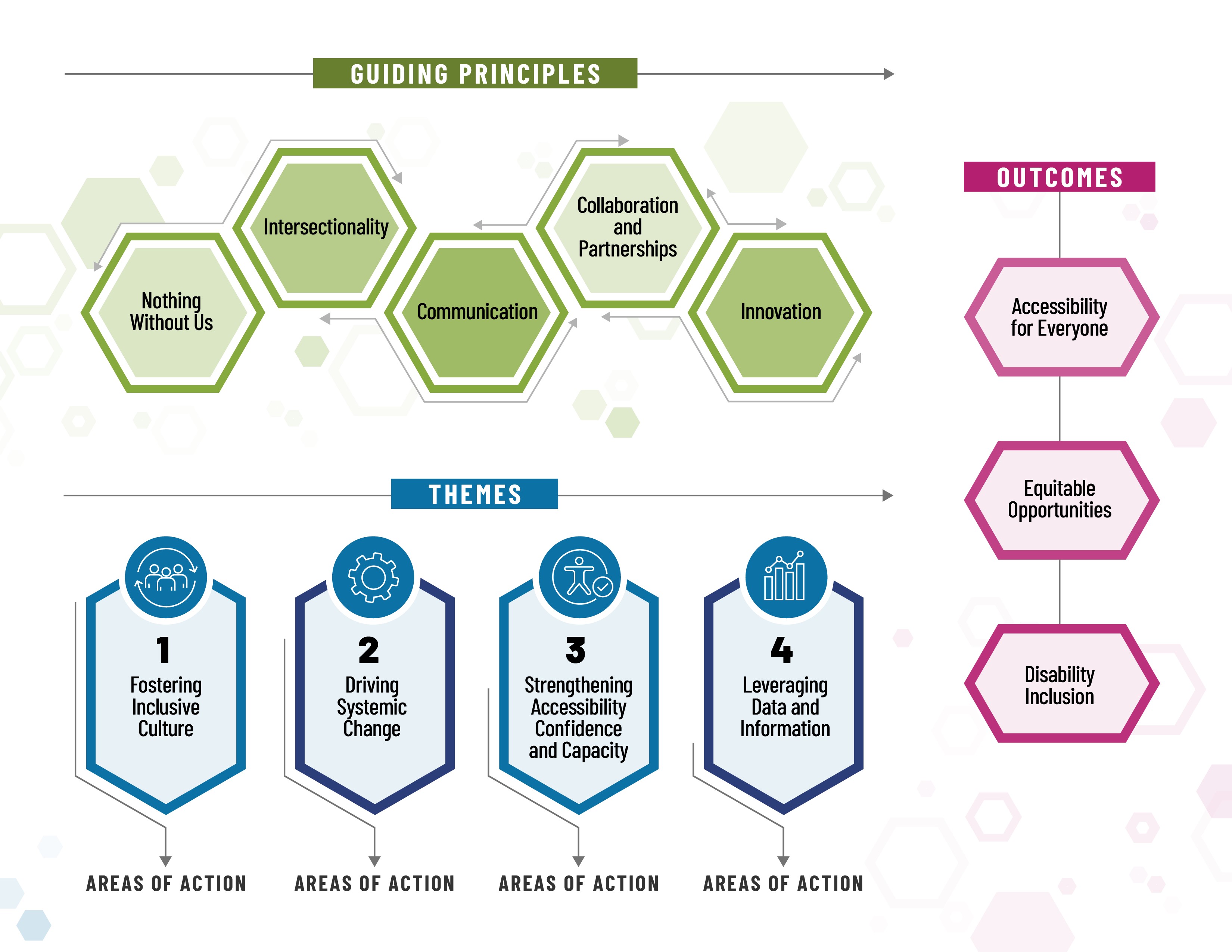
Figure 1: Text description
The roadmap includes the following core elements in relation to each other: five guiding principles at the top-left and four themes below them, with each theme supported by distinct areas of action. Together, the principles and themes support three outcomes listed the right side. These elements are described in detail below the image.
The five guiding principles are listed as: nothing without us, intersectionality, communication, collaboration and partnerships, and innovation. The four themes are listed as: fostering inclusive culture, driving systemic change, strengthening accessibility confidence and capacity, and leveraging data and information. The three outcomes are listed as: accessibility for everyone, equitable opportunities, and disability inclusion.
Outcomes
The roadmap focuses on three outcomes that show progress towards a barrier-free Canada:
- Accessibility for everyone: Spaces, products, programs and services are easy to use for all, including persons with disabilities.
- Equitable opportunities: Everyone, no matter their disabilities, can take part fully in society.
- Disability Inclusion: Persons with disabilities are included in all aspects of work, life and play.
Guiding principles
The roadmap is shaped by the following guiding principles:
- Nothing Without Us: Persons with disabilities should be engaged in the development of laws, policies, products, programs and services
- Intersectionality: Different identities and experiences can lead to unique barriers and discrimination. Systems, policies, programs and services must consider the different ways that persons interact with their environments
- Communication: Sharing progress on accessibility help inspire new action from others and helps build momentum for change
- Collaboration and partnerships: Joining forces and learning from each other can help speed up change
- Innovation: Innovation can help to remove barriers whether by using new or existing technologies or finding creative ways of doing things differently to promote accessibility
Themes
The roadmap includes four themes or priorities that show where strong and coordinated effort is needed to help reach the goal of a barrier-free Canada. Each theme has areas of action that break down accessibility efforts into clear areas of work.
Theme 1: Fostering inclusive culture
Inclusive spaces help businesses and communities succeed and grow. Raising awareness of accessibility and removing stigma around disability are key ways to making lasting change. Areas of action include:
- Changing attitudes and behaviors
- Accessible by design
- Leveraging innovative approaches
- Accessible employment
Theme 2: Driving systemic change

Many tools and policies can help promote accessibility. Governments and businesses play a role in creating and/or following these rules. Areas of action include:
- Legislation and regulations
- Accessibility standards
- Compliance promotion and enforcement
- Early considerations of accessibility
- Programs and initiatives to support removing barriers
- Advancing accessibility in Indigenous communities
Theme 3: Strengthening accessibility confidence and capacity
Accessibility confidence means understanding how to meet the needs of persons with disabilities. Given the importance of accessible technologies and services, there is a need to help ensure the supply of these meets the growing demand. Areas of action include:
- Strengthening accessibility confidence
- Increasing accessible support services and technologies
- Building connections to foster confidence and capacity
Theme 4: Leveraging data and information

Collecting and analysing data is key for tracking accessibility efforts. It is important to engage with persons with disabilities whenever undertaking research on barriers, to help us make us make smarter choices about how to improve accessibility. Areas of action include:
- Measuring progress in removing barriers to accessibility
- Knowledge mobilization
- Research into emerging accessibility issues or solutions
6. Conclusion
The Accessible Canada Roadmap is a call to each of us to imagine and build a Canada where everyone, regardless of ability, can thrive. While much still needs to be done, the roadmap can help guide businesses, organizations, governments and individuals on steps they can take to help contribute to the goal of a barrier-free Canada by 2040, that benefits us all.