
Evaluation of the Canadian Centre for Climate Services
Acknowledgements
The Audit and Evaluation Branch would like to thank those who contributed to this project. We would like to acknowledge the contribution of ECCC representatives who provided input and comments throughout this evaluation.
This report was prepared by the Evaluation Division of the Audit and Evaluation Branch, Environment and Climate Change Canada.
The report was approved by the Deputy Minister on November 24, 2025.
Accessibility Statement
As of the date of publication, the document has been verified for accessibility.
If you have any questions about this document, please contact us at: audit-evaluation@ec.gc.ca.

Download the alternative format
(PDF format, 967 KB, 39 pages)
List of acronyms and abbreviations
- CCCS
- Canadian Centre for Climate Services
- CCAPD
- Climate Change Adaptation Policy Division
- CCB
- Climate Change Branch
- CESD
- Commissioner of the Environment and Sustainable Development
- CIRNAC
- Crown-Indigenous Relations and Northern Affairs Canada
- CRIM
- Centre de recherche informatique de Montréal
- CSFB
- Corporate Services and Finance Branch
- DPO
- Data and Products Office
- DSB
- Digital Services Branch
- FTE
- Full-time Equivalents
- GBA
- Plus Gender-based Analysis Plus
- ICL
- Indigenous Climate Leadership
- IDF
- Intensity Duration Frequency
- MSC
- Meteorological Service of Canada
- O&E
- Outreach and Engagement team
- O&M
- Operations and Maintenance
- OGDs
- Other Government Departments
- ORCCA
- Ontario Resource Centre for Climate Adaptation
- PAVIC
- Power Analytics and Visualization for Climate Science
- PCIC
- Pacific Climate Impacts Consortium
- PIP
- Performance Information Profile
- PORAB
- Programs, Operations and Regional Affairs Branch
- PTAP
- Pan-Territorial Adaptation Partnership
- RCC
- Regional Coordinating Committee for Climate Services
- S2D
- Seasonal-to-Decadal
- SD
- Service Delivery
- SPIAB
- Strategic Policy and International Affairs Branch
- STB
- Science and Technology Branch
1. Introduction
This report presents the findings from the evaluation of Environment and Climate Change Canada’s (ECCC) Canadian Centre for Climate Services, herein after referred to as “the Centre” or “CCCS”. This evaluation covers a 8-year period from 2017-2018 to 2024-2025 and was conducted in accordance with the Treasury Board Policy on Results.
1.1. Background
In 2016, the Canadian government published the Pan-Canadian Framework on Clean Growth and Climate Change. This framework outlines a plan to address climate change and grow the economy. Adaptation and climate resilience are one of the four pillars of this framework. This pillar involves making sure that Canada is prepared for climate change and increasing climate risks.
One of the measures in the 2017 federal budget, in support of this pillar, was the creation of a Canadian Centre for Climate Services.
1.2. Overview of the Canadian Centre for Climate Services
The CCCS is made up of a dedicated multi-disciplinary team with a broad range of climate-related expertise. Its goal is to help the Canadian population increase resilience to climate change by improving their understanding of the extent to which the climate is changing, what impacts these changes may have, and how to incorporate this information in their daily decision-making. The CCCS is currently funded until 2028.
The CCCS’ activities are centered around the following goals:
- Developing and delivering climate services driven by user needs
- Providing access to climate information
- Building local capacity by partnering with regional climate organizations and with other partners
- Offering training and support to help the Canadian population make sense of climate information and integrate this information into their decision-making frameworks
Governance and organization
The CCCS falls under ECCC’s Core Responsibility of “Taking Action on Clean Growth and Climate Change” and under its program inventory “Climate Change Adaptation”.
Since its inception, the CCCS has been part of several ECCC branches. From 2017 to 2019, it was under the leadership of the Pan-Canadian Framework Implementation Office. It then became part of the Climate Change Branch (CCB), under the Climate Change Adaptation Directorate. In February 2025, as part of a reorganization, the Directorate was moved to the Strategic Policy and International Affairs Branch (SPIAB).
In recent years, the Centre has been led by an Executive Director, supported by a staff complement of roughly fifty employees, organized around three teams with the following distinct functions:
- Data and Products
- Outreach and Engagement
- Service Delivery
Other ECCC branches support the CCCS:
- The Science and Technology Branch (STB) undertakes fundamental work at increasing knowledge about emerging threats in Canada’s ecosystems through atmospheric and climate modelling, and the Meteorological Service of Canada (MSC), as the primary supplier of meteorological and water resources information in Canada. Both are key enabling functions for climate services within their respective areas of expertise
- The Corporate Services and Finance Branch (CSFB) provided administrative and financial support for the administration of grants and contributions up until early 2025. This responsibility now is with the Programs, Operations and Regional Affairs Branch (PORAB)
- The Digital Services Branch (DSB), established in 2024, provides IT infrastructure and support for the CCCS Government of Canada web presence
Beyond ECCC, the CCCS works closely with numerous other federal departments and agencies, provincial and territorial departments and agencies, indigenous nations, communities and organizations, as well as regional climate organizations. Section 2.3 provides a complete analysis of the governance.
Resources
Funding for the CCCS was originally announced in Budget 2017. ECCC was allocated $107.61M over 11 years, beginning in 2017-2018 and ending in 2027-2028, to establish the CCCS. Budget 2023 further provided the Centre with additional resources from 2023-2024 to 2027-2028, with a goal to increase its provision of climate data and continue the development of sector-specific services.
Annual expenditures managed by the CCCS averaged $10.9M between 2017-2018 and 2024-2025. Section 2.2 provides more financial information.
1.3. About this Evaluation
The evaluation of the CCCS is part of ECCC’s Audit and Evaluation Plan 2024 to 2029; it covers the 8-year period from the program’s inception in 2017-2018 to 2024-2025.
The evaluation examines the following themes:
- Relevance and responsiveness
- Results and efficiency
- Governance
The evaluation scope does not include activities that are directed by partners or regional climate organizations, nor work around the Climate Risk Data Strategy.
Multiple lines of evidence were used in conducting the evaluation, including:
- Document review: The document review covered CCCS-specific documents; Government of Canada policy documents; and research from third parties. A media scan of articles from April 2023 to April 2025 was also conducted.
- Interviews: 20 interviews were conducted. These included ECCC program representatives that play a role in the delivery of the program, as well as representatives from ECCC’s partners, including other federal government departments.
- Case studies: 5 CCCS-related projects were selected to better understand the full breadth of CCCS activities. These include the establishment of CLIMAtlantic; the Canadian Climate Archives Modernization; projects that exemplify the new value chain approach; the ClimateData.ca website; and the Fire Weather Projections Application and its outreach campaign.
- Survey: A survey of internal and external partners, collaborators, users, and other CCCS’ contacts was conducted for the purpose of gathering information related to the evaluation themes. Out of a final list of 350 potential respondents, 90 individuals provided responses, which corresponds to a response rate of 26% and is consistent with response rates from previous surveys.
- Analysis of administrative, performance, and financial data: These data provided information on CCCS’ achievement of results and on the availability, use, and quality of performance information.
GenAI (Copilot) was used for the analysis of various lines of evidence, including surveys, interviews, document review and media scan.
2. Findings
2.1. Relevance and Responsiveness
Key findings: The evaluation noted that the demand for CCCS services is steadily increasing, reflecting the Canadian population’s growing awareness and ambition regarding climate change adaptation. The Climate Services Support Desk is responsive, with high satisfaction rates among users. The evaluation found evidence of established robust processes aimed at prioritizing the Centre’s work effectiveness. Despite challenges in managing demand and the need for increased collaboration with other federal initiatives, the CCCS continues to improve its processes and to explore potential products and services to support its mandate.
Climate change is already impacting the Canadian population in various ways, including more frequent and intense extreme events and rising temperatures. Each year, the impacts of climate change cost billion of dollars, and this yearly cost is expected to rise. Adapting to climate change is crucial to reduce the risks and costs to the population, and adaptation decisions and actions must be well-informed.
Climate products and services have a key role in helping users make informed decisions in adapting to climate change. Demand-driven climate services can provide information and tools for users across multiple sectors, including, but not limited to agriculture and food security, disaster risk reduction, energy, health. Climate services can provide value by helping users to minimize adaptation costs and to take advantage of opportunities.
The federal government has a role to play in providing climate products and services, as climate services can be considered a public good. While climate services can also be supplied by the private sector, this type of services have some limitations. For example, privatized climate services might contribute to reinforcing inequities. Moreover, users might feel less confident using private services. Therefore, the CCCS ‘s goal of providing authoritative climate change information proves relevant.
Demonstrated and continued need for the CCCS
Before the CCCS was established in 2018, there was no single pan-Canadian organization with a mandate to coordinate and systematically provide comprehensive climate data and informationFootnote 1. Stakeholders noted that there was a need for targeted, accessible, and understandable climate information; for a single authoritative source for climate information; and for leadership and enhanced coordination among climate services stakeholders.
Almost all interviewees agreed on the fact that there is a continued need for ECCC involvement in the field of climate services. Multiple interviewees’ explanations included the need for available, accessible, and useable climate information as well as the need for an authority like ECCC to provide trustworthy verification of this information. Interviewees also mentioned the need to fill gaps left by regional providers and the need for the transparent methodology that the CCCS provides.
Program documents and interviewees also indicated some specific users who need the services provided by the CCCS:
- At least 10 other federal programs are enabled by CCCS’ climate data and services. Including Health Canada’s HealthADAPT, Natural Resources Canada’s Climate Resilient Mining Program; and Crown and Indigenous Relations’ First Nations Adapt and Climate Change Preparedness in the NorthFootnote 2
- Both the private sector and the communities need access to reliable climate data for risk analysis and financial decision-making
- Users of CCCS products and services that were highlighted by interviewees include the federal government; provincial, territorial, and municipal governments; partners in the North; Indigenous groups; and specific sectors including the banking and infrastructure sectors
Furthermore, program documents and interviewees noted that the need for the CCCS is increasing. The number of users accessing CCCS climate services is steadily growing (see section 2.2 for additional data), and the Centre expects this trend to continue, given the citizens’ growing awareness and ambition related to climate change adaptation. Interviewees also mentioned the increasing need for the CCCS given escalating climate change impacts as well as increasing sources of climate data that users need to sort through.
Most survey respondents (92%) also agreed that there is a continued need for the CCCS’ involvement in the field of climate services organizations, with 82% strongly agreeing. Only 1% of respondents disagreed. In their explanations, multiple respondents mentioned the need to support adaptation decision-making, as well as the need for an authoritative, trusted, and/or up-to-date source of climate data and information. Respondents, especially those affiliated with regional climate services organizations, also mentioned that the CCCS is needed to complement, collaborate with, and/or coordinate with regional organizations.
Based on information from program documents we had access to, without the CCCS, the Canadian population would have more limited access to up-to-date climate data and services to inform preparedness and adaptation actions. Data we had access to indicates that ClimateData.ca currently receives 91% of its funding from the CCCS, meaning its existence in its current form would likely be put at risk without the CCCS. CCCS’ products and services are heavily used by individuals whose region is served by a local organization.
Responsiveness to needs
With some minor nuances, all interviewees agreed that the CCCS has been responsive to the needs of the Canadian population. Multiple interviewees described processes and structures in place to consult with stakeholders in developing products and services that are responsive to users. Program documents also show that the CCCS considers user needs when choosing and developing new data products or learning products. For example, assessing user needs is the first step of the CCCS’ Value Chain workflow for choosing and developing new products and services. See the section on CCCS’ prioritization of efforts below for more details.
One example of the CCCS’ responsiveness to user needs is the Intensity-Duration-Frequency (IDF) curves. IDF curves are graphical tools that describe the likelihood of short-duration, high-intensity rainfall events. The CCCS noted that the Support Desk had received many inquiries related to extreme precipitation and expected to receive more requests in the future. The CCCS collected information to understand how and why IDF curves were used and what users’ actual needs were. The CCCS identified specific aspects of IDF curves that were poorly understood; a need for guidance on how to use IDF curves; and a need to make the latest science available and accessible. The CCCS used these findings to inform their next steps, including co-developing useful guidance and co-delivering a training webinar on IDF curves in a changing climate. Other examples of the CCCS’ process in ensuring that it is responding to user needs were found in developing future humidex data, snowfall data and return period indices.
Multiple interviewees pointed to the CCCS’ Climate Services Support Desk as a specific service that they believe responds well to user needs. Users can contact the support desk to receive help with finding, understanding, or using climate information to fulfill their needs. The CCCS support desk allows the public to either leave feedback or submit an inquiry, whether through the web, by email or using a toll-free telephone number. The support desk aims to respond within an informal 5-day response standard.
Based on internal data collected, the service desk has seen increasing cases since its creation, with an average of 600 cases per year. In April 2025, it reached 4,000 requests since creation. Statistics from March 2020 to January 2, 2025, show that over 80% of clients were satisfied or very satisfied with response time, overall support, and would recommend the service desk service to others. The support desk responded to a variety of users from nine different provinces and with a variety of backgrounds (academia, governments, private companies, not-for-profit, consultants, farm owners, general public, etc.).
User feedback on CCCS services also shows ways that the CCCS is responding to user needs. For example, most survey respondents felt that the CCCS had been responsive to the needs of their organization, with over 90% rating the CCCS as either very responsive or somewhat responsive
Multiple interviewees noted that needs for climate services are constantly increasing, but the Centre has finite resources and therefore must prioritize.
Some interviewees felt the CCCS is as responsive as it can be within its context, while others suggested the CCCS should be more responsive in a specific region (the North) or on specific types of data (vulnerability and exposure, which is currently not within the Centre’s mandate).
As previously mentioned, some climate data needs are not met by the CCCS because they fall outside its core mandate of providing climate / environmental information. To conduct a physical risk assessment, for example, users need exposure data (for instance vulnerability data against a hazard), impact data (such as financial/human estimates of potential damages) and hazard data (for example flood maps, wildfire data). Leadership in generating or gathering these types of information are under the purview of other governmental or private organizations. Multiple reports from the Smart Prosperity Institute and a letter from the Sustainable Finance Action Council emphasize that users need climate data to support physical and transition riskFootnote 3 assessments and climate-related financial disclosures, noting that there are significant gaps in the availability and quality of these data. ECCC departmental priorities reflect this issue and instructed the development of a climate data strategy to ensure that the private sector and the communities have access to data to inform planning and infrastructure investments. CCCS, with its State of Play for the Climate Data Strategy, has laid the groundwork for developing a Climate Risk Data Strategy. The intent of such undertaking is to harness the federal government’s capacity in developing and disseminating climate change risk-relevant data through horizontal coordination and strategic investments in existing programs, and in addressing the needs of the Canadian population for data to support physical and transition risk assessments.
CCCS products and services are not intended to respond to all user needs across the climate science and adaptation fields. They aim to be complementary with products and services offered by other partners. For example:
- Some products are less relevant in certain regions. For example, the Fire Weather Index is more useful in the West and less useful for the Atlantic provinces, where the reality of fires is different
- Many products are too technical for the public and are useful for informed users who know how to interpret the data. Some interviewees and survey respondents believe that it is not necessarily a problem that CCCS data and tools required interpretation by informed users. On the other hand, some survey respondents felt there was a need to make information clearer to the general public or to add more information targeted to the general public. When asked what areas the CCCS should expand, multiple respondents suggested making existing data clearer to non-experts, as well as adding various products that are friendlier to the public, such as more infographics, plain language summaries, learning products, and storytelling
- CCCS does support resources and services for a diverse range of users, including the following:
- Providing downscaled climate projections to the Climate Atlas of Canada, which supplies basic data, summaries, and videos
- Supporting the collaborative data portal, ClimateData.ca, which provides high-resolution climate data and is targeted to informed users like municipal planners and engineers (CCCS’ target audience)
- Contributing data to the Power Analytics and Visualization for Climate Science (PAVIC) which is targeted to expert users such as researchers and climate modellers
Prioritization of Efforts
There was evidence that robust processes have been established to support prioritization of efforts in the following two important areas of the Centre’s work:
- Assessment and review of needs
- Development of products
For the assessment and review of needs, the Centre has developed an approach called Lynx, which includes both a complete tracking of user needs and a review process supported by a team of representatives from its three teams. The tracking of user needs is done through multiple sourcing: support desk cases, engagement sessions, events, ad hoc meetings, feedback from external partners, etc. As of early 2025, the tracker had over 150 entries of different needs, with associated information for audience, link to source materials, themes, and comments, all meant as a first triage. Subsequently, for a subset of projects potentially selected for development, a thorough analysis is performed with several associated questions organized around the following guiding principles:
- The project falls within CCCS’s mandate
- The project is feasible
- The project addresses a priority need
For the development of products and services, the Centre has adopted, in 2023, a Value Chain approach which is a designed, streamlined and predictable workflow with the aim of delivering high-quality products. It is meant to be a flexible tool, with roles set out for all the Centre’s teams and is tied to user needs. To support this approach, each step has a detailed description, team lead / support, and relevant standard operating procedures (see Figure 1 below). The Centre’s teams have also developed yearly work planning for individual files or projects. Overall, the Centre prioritizes its efforts on value-added activities, where gaps in climate information or products exist, all of this to the largest benefit of the Canadian population.
Interviewees within other branches of ECCC also indicated that they were well informed of work plans, with meetings in place for sharing information and allowing for proper coordination of the Centre’s products and services.
Lastly, within the broader federal government, some interviewees noted the need for increased collaboration to prioritize work given the existence of several complementary initiatives, with some organizations working on climate change products specific to their organizations’ mandate (i.e., Infrastructure Canada, Public Safety Canada, etc.)
Looking forward, the evaluation found that the Centre had a lot of potential products and services that could be further developed in support of its mandate. These would range from tailored products such as permafrost projections, extreme coastal water levels, to more complex approaches requiring federal coordination like the Climate Risk Data Strategy. Internally, the program is also always looking for ways to improve as demonstrated by an internal review of its Value Chain approach and its recent State of Play report.
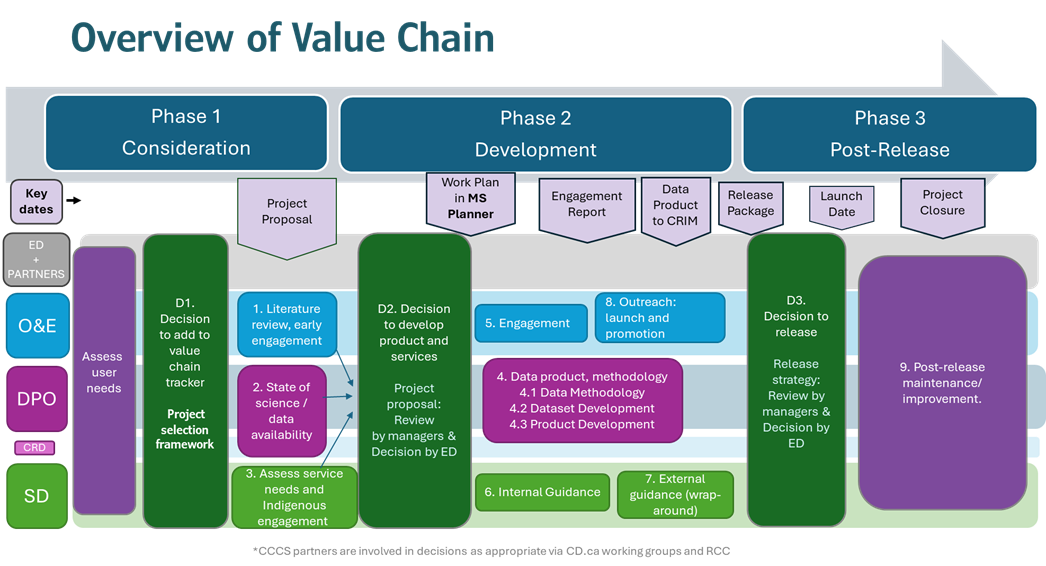
Long description
The figure shows three phases representing the CCCS Value Chain approach. Under Phase 1 entitled “Consideration” involves key dates for ED and partners to engage in user needs assessment, to decide on additions to the value chain tracker, and to develop a project selection framework. This phase includes the project proposal which entails the conduct of literature review and early engagement, the validation of the state of science or data availability, and the assessment of service needs and Indigenous engagement.
Phase 2 entitled “Development” evolves through three steps including the design of a work plan in MS planner, the development of an engagement report, and the transmission of data product to CRIM. This phase involves the decision to develop product and services and the project proposal for review by managers and for decision by ED. It comprises a total of seven stages including the engagement, the outreach, the data product methodology, Internal Guidance, and External guidance.
Phase 3 entitled “Post-Release” evolves through three main stages including the release package, the launch, and the project closure. It involves the decision to release through a strategy involving a review by managers and decision by ED, followed by the post-release maintenance for the purpose of improvement.
Communication and Outreach Efforts
The evaluation found that there are several communication and outreach efforts to inform users about CCCS activities and products. The Centre uses its two main web interfaces as its primary communication and outreach tool. First, it uses its main CCCS page hosted on Canada.ca, which uses the standard GoC web interface and is organized around four areas: a library of climate resources, climate information, climate services support desk, and display and download climate data. Secondly, it leverages expertise from the Centre de recherche informatique de Montréal (CRIM) with Climatedata.ca, which provides high-resolution climate data to help decision makers, with location data, variables. It presents further information relevant to key climate sensitive sectors such as transportation, agriculture, health, and buildings. A thorough learning zone is also presented, with 8 topics and over 40 resources.
In addition to those tools, and the CCCS support desk noted earlier, we have found a suite of other communication and outreach efforts:
- Between the 2019-2024 period, there were over 100 training days in the area of delivery, to which a CCCS staff participated with a conservative estimated reach of over 6000 individuals. The evaluation also found evidence that materials were adjusted to the diversified audiences, with special attention paid to providing information to meet their individual needs
- CCCS has also led targeted outreach campaigns, meant to provide different types of information (case studies, blog posts, social media posts, emails, presentations) to varied audiences that can act in face of the changing climate. For example, campaigns were conducted on winter recreation, health and, more recently, maple syrup
- Another example of a project is the Fire Weather App, which was launched in 2024. A campaign was designed (press release, social media outreach, blogs, step-by-step guidance, public webinar on how to use the app) to promote the app, focusing on raising awareness of the application itself, the Canadian Fire Weather Index, and on future wildfire activity and climate change in general. See figure 3 below
- Podcasts have also been developed recently to cover areas such as climate risk assessments and data and adapting transportation
Also of interest, following an analysis of news articles from April 2023 to April 2025, we found the Centre has been part of the media landscape by providing credible scientific data, emphasizing the tangible impacts of climate change, and promoting proactive adaptation and mitigation strategies. Of over 100 articles reviewed, 17 were relevant to CCCS (and ClimateData.ca specifically), while the others spoke of the regional climate organizations that the CCCS supports and partners with.
As part of the partner survey, 95% of respondents agreed that ClimateData.ca is informative, compared to 87% for the CCCS website. When prompted on how these resources could improve, the responses varied greatly, from having more specific products and data available, to case studies on how to use the data, to more plain language, in providing users with a better sense of the numerous different resources available to the public.
2.2. Results and Efficiency
Key findings: The Canadian Centre for Climate Services (CCCS) has delivered results on its original three main pillars. While it has created the Northern and Indigenous Service Delivery team to address unique northern needs, gaps in the North still exist and require attention. Overall, the CCCS has made a significant difference in the area of adaptation by leveraging existing data, providing user-friendly tools, and fostering cooperation with partners. The financial data shows stable expenditures over the first six years, with increases in the last two years due to Budget 2023 funding, totaling $65.2M over eight years. The difference between planned spending and actual spending has been significant, averaging $1.4M over the eight-year period.
Results Achieved
At its launch in 2018, the Centre’s stated objective was to help people across the country make decisions about adapting to climate change. Three main pillars were communicated:
- Deliver climate services driven by user needs
- Provide access to climate information
- Build local capacity. Since then, as noted in the introduction, a fourth component (offering training and support) was added
The evaluation found evidence that results were achieved on all three pillars:
- On the delivery of climate services driven by user needs, there are numerous examples, such as the work on IDF Curves or the Humidex scenarios to support heath authorities in alerting people to the potential danger to health during hot weather. Similarly, ClimateData.ca provides a section organized around specific sectors (transportation, agriculture, health, buildings) to support unique work and needs
- As raised in the relevance section, the Centre provides climate information through various web portals, whether the CCCS website, the ClimateData.ca portal, map of adaptation actions, or other sources of information. These have all seen increased traffic over the years. Through these websites, there are numerous learning zones in place
- Leveraging from the experience of Ouranos and Pacific Climate Impacts Consortium (PCIC), the Centre advanced the building of local capacity, as demonstrated by successes in establishing the regional hubs of ClimateWest (2021), CLIMAtlantic (2021), and the Ontario Resource Centre for Climate Adaptation (ORCCA) (2023) through contribution agreements and/or memorandum of understanding. CCCS leadership has enabled the regional organizations to also work collaboratively and share approaches
Beyond these pillars, funding was also secured for Canadian Climate Archives modernization activities to enhance the quality assurance of existing archived climate data and improve access to these data.
One area where progress has been hampered is the establishment of a regional hub for the North. The North presents unique circumstances and doesn’t have the luxury of having numerous provincial/territorial and/or regional organizations operating in the climate field from which partnerships can easily be leveraged. Therefore, there is a need for strong federal leadership in providing climate expertise and leadership that responds to the uniqueness of the territory and its needs. To date, there has been no consensus as to what type of model would work best to support the North with climate data services.
To address this situation, the CCCS created its Northern and Indigenous Service Delivery team in 2022, with a dedicated team of 4 full-time equivalents (FTE), whose objective is to increase northern and Indigenous specific climate services. Exchanges between CCCS and its territorial partners have been occurring to ensure meaningful products and tools are developed and shared to best serve the northern needs. Collaboration is also ongoing with the Climate Change Preparedness in the North Program, administered by Crown-Indigenous Relations and Northern Affairs Canada (CIRNAC), which provides project funding and guidance to build Northern adaptation capacity and to implement adaptation measures.
Despite those efforts, several interviewees and survey respondents emphasized the fact that the creation of a northern regional hub is still of the highest importance mainly because the North is facing the most important climate change impacts, of scarcity of some resources, and of the increased attention to Canada’s northern sovereignty. There were ongoing exchanges with territorial governments to advance both the Indigenous Climate Leadership (ICL) Agenda and National Adaptation Strategy’s priority areas, for which increased climate information services has been key. The evaluation has noted some internal, unsuccessful, attempts at securing additional resources for these activities in recent years.
Recommendation 1: The Assistant Deputy Minister of the Strategic Policy and International Branch (SPIAB) should map out what palatable options would be available for CCCS to increase its products and services in the North. The options should be based on approaches that would integrate territorial perspectives and voices in the process, taking lessons from their experiences with regional hubs establishment.
Most interviewees and survey respondents recognized the impact that CCCS’ has made in adaptation. Most interviewees further noted that the strength of the Centre has shown in leveraging existing data and making transformations to make it user friendly, more accessible and context driven. Instead of simply releasing the data, it provides tools, user guidance and case studies to support the users. Several interviewees further noted that the Centre offers an essential, central source of information for all users. Similarly, 83% of survey respondents agreed on the fact that CCCS offerings support adaptation decisions.
A secondary objective of the Centre has been cooperation in the climate services area. Most interviewees agreed or strongly agreed on the fact that there has been effective delivery of activities in enhancing cooperation and alignment with partners. Similarly, collaboration stands as the key point emphasized in the document review, interviews and surveys. Finally, for any single initiative or product, collaboration with internal and external partners is required to enable successful results, and the Centre’s ability to collaborate was raised as a success both internally and by partners.
Efficient Use of Resources
All ECCC interviewees either agreed or strongly agreed that the Centre’s resources had been used efficiently. A few noted that there was a maturation of processes since the creation of the Centre in 2018 in resource utilization, which is inherent to the launch of a new initiative. Time has allowed for governance mechanisms to be refined, and relationships to be fostered to maximize efficiency. As raised in section 1.3 (prioritization of resources), the establishment of internal processes to better collaborate and ensure maximum value for money have been noted as an efficiency mechanism by some members of the personnel.
Survey respondents who indicated that a financial agreement was in place between ECCC and their organizations agreed on the fact that the said agreements were established in a way that maximizes efficiency by a 90% proportion. They noted that the arrangement enabled them to develop products, services, and tools that they share with CCCS today, while ensuring a regional lens.
Similarly, leveraging the use of the government’s grants and contributions has been a strong vector of efficiency, by allowing the pooling of different resources and information to advance climate services, such as for ClimateData.ca. Numerous interviewees and survey respondents noted in open-ended questions that this was the best example of a collaborative approach to providing information to users, breaking away from the template of standard governmental websites. Similarly, the establishment and continued collaboration with regional hubs allow for climate services and information to reach multiple audiences with authoritative information.
Financial situation
The Centre’s activities have been funded solely through Budget 2017 (to establish the CCCS) and Budget 2023 (support expanded roles through the National Adaptation Strategy). No A-Base (permanent) funding has been allocated for the Centre’s activities. In analyzing the expenses over the eight-year period from 2017-2018 to 2024-2025, the following can be observed:
- While the reported average expenditures have been of $8.1M over the period, they have been stable for the first six years at $7.2M annually and increased to $8.8M and $13.1M for 2023-2024 and 2024-2025 respectively. Total expenditures over the period were $65.2M - The distribution of expenses has been on average $4.4M (54%) on salary, $1.6M (20%) on operations and maintenance (O&M), and $2.1M (26%) on contributions
- The difference between planned spending and actual spending has been significant, averaging $1.4M over the eight-year period. The years of higher variance were in the first year of new funding, with $2.5M in 2017-2018 and $3.9M in 2023-2024. Overall, this represents $11M of planned spending of $76.2M, or 14.5%. Multiple reasons were shared to explain this, such as:
- First years of funding are typically associated with challenges in ramping up expenditures quickly (e.g., hiring staff takes time), further compounded by frequent challenges in receiving the funds later in the budgetary cycle
- Establishing contribution agreements with partners can take more time than expected, as negotiations are required
- Challenges inherent to staff turnover and finding replacements over a given time period, especially in periods of high competition within and outside of the federal public service and for the highly specialized staff that CCCS employs
- The pandemic period, roughly from 2020 to 2022, led to less spending for events, conferences, travel and delays in projects
- Of money spent by ECCC over the period, expenditures were allocated to the former CCB (67.1%), CSFB/DSBFootnote 4 (13.3%), and MSC (11.8%). Over the last two years, STB has received a more important share as a result of Budget 2023 funding
The Table below provides an overview of financial information for the period.
| In $M | Budget | Expenses | Variance |
|---|---|---|---|
| 2017-2018 | 5.22 | 2.63 | 2.59 |
| 2018-2019 | 8.66 | 8.31 | 0.35 |
| 2019-2020 | 8.88 | 9.04 | (0.16) |
| 2020-2021 | 8.40 | 7.96 | 0.44 |
| 2021-2022 | 9.14 | 7.98 | 1.16 |
| 2022-2023 | 7.62 | 7.33 | 0.29 |
| 2023-2024 | 12.69 | 8.82 | 3.88 |
| 2024-2025 | 15.57 | 13.10 | 2.47 |
| Total | 76.19 | 65.16 | 11.03 |
Source: Financial information provided by CFSB/FMA
Performance Information
CCCS has established a suite of indicators to measure its performance (See Table 1). The results of the Performance Information Profile (PIP) indicators indicate that the program achieves its target outcomes, with trends showing sustained progress (also see appendix B for complete, year-to-year results). However, the availability of results for some indicators is inconsistent either due to the frequency of data collection or because the data collection methods has not produced the expected result.
| PIP # | Indicator & Target (current) | Baseline | Last available result |
|---|---|---|---|
| Ad-1 | Annual number of downloads of climate datasets (based on a 3-year rolling average) Target: 220,000 by March 20, 2024 |
83,139 | 7,020,585 between April 2023-March 2024 |
| Ad-2a | Number of clients accessing climate information through CCCS climate information portals Target: Increase over the preceding year’s result |
175,500 (As of FY2019-2020) | 2023-2024: 250,055 2022-2023: 193,259 |
| Ad-3 | Percentage of clients who indicate they are better equipped to consider climate change in their decisions following a CCCS service Target: N/A |
90% (as of FY 2022-2023) | 90% (as of FY 2022-2023) |
| Ad-4 | Percentage of CCCS collaborators who are satisfied with the services provided by the CCCS for supporting adaptation decisions Target: N/A |
89% (as of FY 2022-2023) | 89% (as of FY 2022-2023) |
| Ad-5 | Percentage of Indigenous clients that have indicated that CCCS information was used to support decision making Target: N/A |
N/A | N/A |
| Ad-6 | Number of individuals, businesses, and government’s accessing climate services and using that information to inform decision-making Target: Increase over the preceding year’s result |
176,140 | 2023-2024: 252,340 2022-2023: 197,038 |
The wording of indicators has evolved to reflect the changes that the CCCS has gone through. Other changes such as those made to indicator Ad-6 (Users accessing climate services and using that information to inform decision-making) were necessary because the data sources for both these new indicators were different (Web metrics vs. survey) and each came with their own advantages and limitations. This holds great promise regarding the program’s prospects in making changes to indicators where data availability is an issue.
Interviewees either agreed or strongly agreed to the fact that the CCCS has quality performance information to guide decision making. Some, however, noted in an open-ended question that the current indicators do not fully measure the work being performed by the CCCS. It was clear through the interviews that many use informal performance information to measure the pulse of the program. These include biweekly reports to senior management, the support desk monthly dashboard and user feedback. During interviews, only one individual mentioned the Performance Information Profile directly.
Gender-based Analysis Plus (GBA Plus) is an analytical tool used to support the development of responsive and inclusive policies, programs, and other initiatives. In addition to sex and gender, GBA Plus considers all identity factors, such as race, ethnicity, religion, age and mental and physical ability. Considerations for indigenous groups is also part of GBA Plus. Although the CCCS has considered the needs and concerns of Indigenous users, it has not integrated GBA Plus in a comprehensive manner because:
- CCCS does not gather the necessary disaggregated data to speak to such considerations
- CCCS decided to remain neutral by focusing on its core mandate of providing climate services
Interviewees now see the CCCS as ready to start considering GBA Plus in a more comprehensive capacity. They point to the potential Climate Data Risk Strategy as an approach that could advance collection of data to support GBA Plus. However, more exploratory work would be required with partners to advance this complex work.
2.3. Governance
Key findings: The CCCS adopted a horizontal structure comprising three core teams. Despite challenges such as staff turnover and the need for specialized staff, the CCCS has demonstrated agility and adaptability to emerging needs.
The CCCS works closely with other ECCC branches, such as the Meteorological Service of Canada (MSC) and the Science and Technology Branch (STB), utilizing formal and informal structures which support efficient delivery of climate services and optimize roles and responsibilities. However, there are opportunities to improve information exchange, data management, and coordinated engagement with other government departments (OGDs).
CCCS Internal Governance
The internal governance structure of the CCCS evolved over time to align with its mandate and partner needs. The CCCS grew from an organization with roughly 26 FTEs in its early years to over 50 FTEs in recent years. All ECCC representatives who commented on CCCS internal governance agreed to the fact that the current structures support the achievement of results and highlighted the agility and adaptability of CCCS to emerging needs. The CCCS has developed a Strategic Plan for the period 2021-2025, which one CCCS interviewee described as useful in aligning work objectives among staff.
As noted in the introduction and depicted in Figure 2 below, the Centre adopted a horizontal structure, comprising three core teams in line with the key functions of the CCCS: the Data and Products Office (DPO), the Outreach and Engagement team (O&E), and the Service Delivery team (SD). Each team has annual work plans which are integrated with the CCCS Value Chain (see section 1.2). The Value Chain governance includes four internal working groups, leverages 10 existing external working groups, and high-level roles and responsibilities are shared for four roles: coordinator, managers, project managers and executive directors. Since March 2024, the adoption of the Value Chain approach has facilitated better coordination and collaboration across CCCS teams, resulting in more structured and standardized procedures. Interviewees also noted that the clarity and complementarity of the roles and responsibilities between CCCS teams has improved.
The evolution of the Departmental priorities and policy landscape to develop a GoC Climate Data Strategy has impacted the roles and responsibilities of the CCCS’ Executive Director since 2022. The CCCS created the informal Climate Data Secretariat to lead the federal strategy development process, and action plans to fulfill this commitment and to build a new network with the finance sector and expertise around risk. The development of the strategy is currently on hold.
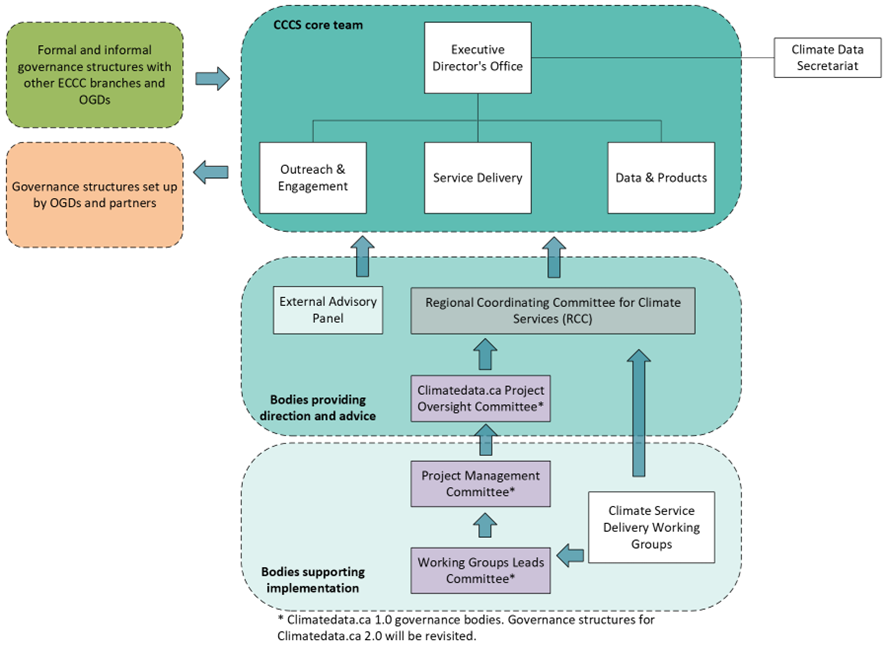
Long description
The figure represents the CCCS government structures through a total of five boxes, three of which are subdivided into three sub-boxes each. The first box in the upper left represents the formal and informal governance structures with other ECCC branches and OGDs. The box beneath represents the governance structures set up by OGDs and partners. The upper box has an arrow pointing to the right towards a box representing the CCCS core team which includes the Executive Director’s office playing the role of Climate Data Secretariat which the main activities of which include the outreach and delivery, the service delivery, and the data and products.
The CCCS core team box has an arrow pointing to the box representing the Governance structures set up by OGDs and partners.
The box beneath the CCCS core team represents the bodies that provide direction and advice; these include the External Advisory Panel, the Regional Coordinating Committee for Climate Services (RCC) and the Climatedata.ca Project Oversight Committee. There are three arrows pointing towards the CCCS core team from this box, indicating that the bodies report to the CCCS core team.
The box beneath the Advisory bodies team represents the bodies supporting the implementation process. They include the Project Management Committee, the Working Groups Leads Committee, and the Climate Service Delivery Working Groups. The Climate Service Delivery Working Groups reports to the Working Groups Leads Committee, which reports to the Project Management Committee which, in turn, reports to the Climatedata.ca Project Oversight Committee.
The box representing the Climate Service Delivery Working Groups has an arrow pointing towards the box representing the Regional Coordinating Committee for Climate Services (RCC), which indicates that it also reports directly to the RCCC.
As a small organization, the CCCS has faced challenges in terms of staffing due to staff turnover and the need for specialized staff in a field that is still considered as emerging. Additionally, further refinement and institutionalization of the Value Chain process were identified in documents and by interviewees as the CCCS is still in its early stages of adopting this process.
CCCS as part of ECCC Governance
As mentioned in section 1.2, the CCCS has been part of several branches within ECCC since its inception in 2018. Since 2021, the CCCS has been under the same directorate as the Climate Change Adaptation Policy Division (CCAPD), first within the Climate Change Branch and more recently under the new Strategic Policy and International Affairs Branch. Interviewees consider having been with the CCAPD under the same directorate to have benefited all parties involved, creating greater alignment and coordination, particularly around the National Adaptation Strategy. CCCS’s proximity to data users and producers (e.g., provinces, territories and regional climate services organizations) feeds back into the policy process and provides credibility to the Policy Team’s work. In turn, CCCS activities are better aligned with strategic policy directions and programming.
The CCCS has worked with MSC and STB, utilizing formal and informal structures such as regular bilateral meetings, thematic working groups, and project-specific governance structures. Most interviewees and survey respondents agree that the current governance mechanisms support efficient delivery of climate services, and that roles and responsibilities are optimized. Interviewees noted that these structures have allowed teams to share knowledge, expertise and resources (e.g., GeoMet) and that coordination and collaboration have overall improved both at working and management levels.
Interviews highlighted departmental silos within ECCC that could be further improved as described below:
Information exchange and data management and related IT investments: The roles and responsibilities around data governance, including IT, data management, and related investments, need more clarity. The forthcoming 2025 report of the Audit of IT governance also explores the current challenges around roles and responsibilities and IT planning and prioritization at ECCC in more depth.
Clarity around ECCC data and service offerings to the public/users: There is a need for improved clarity around what suite of climate data and services ECCC delivers, and how to make it available to the public/users in the most coherent and clear way.
Coordinated engagement with OGDs: When working with OGDs, there is an opportunity to create a more coordinated approach within ECCC to prevent duplication or inefficiencies.
Coordination and collaboration in “near future” modelling: There is a growing potential for overlapping between MSC, STB and the CCCS in the realm of “near future” modeling, which covers seasonal, annual to multi-year projections. These zones, where meteorology and climatology increasingly converge, require a complementary and well-coordinated horizontal approach.
Governance with OGDs and partners
The CCCS was conceived as a pan-Canadian whole-of-government approach, involving ongoing collaboration with OGDs, provincial, territorial, and municipal governments, academia, industry, Indigenous Peoples, and regional climate services organizations. This collaborative mandate is reflected in CCCS's Strategic Objective 1: “CCCS provides leadership in cross-Canada co-delivery of Climate Services.”
Between 2018-2024, CCCS experienced a 90% increase in external partnerships and collaborations due to increased demand for services and a new Departmental commitment to develop a federal climate data strategy. Thirty percent (30%) of new relationships were in the new mandate, which increased the complexity of relationship management. Over the review period, the CCCS set up and has been leading a range of formal and informal governance mechanisms with partners and stakeholders across Canada, facilitating and driving coordination, collaboration, and partnerships.
The CCCS engages in formal and informal collaborations with a wide range of OGDsFootnote 5 in support of a whole-of-government approach. These collaborations encompass activities ranging from technical, project-specific engagements to strategic discussions aligning mandates. Through these efforts, the CCCS not only involves OGDs as users of its services but also contributes its expertise to enhance the products and services offered by OGDs.
CCCS has established governance and coordination mechanisms with regions. To jointly develop and deliver climate services, the CCCS has established formal partnerships with regional climate organizations through the Regional Coordinating Committee for Climate Services (RCC) and its sub-committees. As depicted in Figure 1 on the Value Chain process in section 2.1, partners are involved in decision-making as appropriate via the Climatedata.ca governance bodies and the RCC. The CCCS has also partnered with provinces and territories through Memoranda of Understanding, for instance for the establishment of CLIMAtlantic and ClimateWest or the ongoing dialogue around a potential Northern Hub. One interviewee also noted that these relationships have also been helpful in coordinating adaptation programming between provinces and the federal government.
In open-ended questions, some interviewees also mentioned the External Advisory Panel as a useful body that has provided client-oriented strategic advice to the CCCS. It is composed of senior-level members from user and provider organizations (12 external experts and regional climate services organizations as observers).
The Centre is an active participant in various working groups and committees set up by government and non-government stakeholders. Examples include national adaptation bodies (e.g., the Adaptation Plenary and Adaptation Network), sectoral working groups (e.g., Federal Provincial Territorial Working Group on Climate Change Adaptation in the Transportation Sector), and international fora (e.g., Knowledge Exchange between Climate Adaptation Platforms project). The CCCS also serves on the Board of Directors of three regional climate services organizations (CLIMAtlantic, ClimateWest, and Ouranos), the ORCCA Steering Committee, and the PCIC Program Advisory Committee.
The CCCS has put in place internal governance structures to support its engagement with national and community-based Indigenous organizations and governments, as noted in section 2.2 with regards to its Northern and Indigenous Service Delivery team.
All interviewees from OGDs and partners and most survey respondents agreed on the fact that current governance structures support the achievement of results and the efficient delivery of climate services. Interviewees noted that CCCS has established itself as a key player and partner. Examples of successes include:
- Growing the number of regional climate services organizations from two in 2018 to five in 2025
- Strengthening the collaboration between regional climate services organizations as well as between the federal and regional levels. The RCC and other bodies set up by the CCCS have facilitated information and knowledge exchange, resource sharing and alignment of work planning. Interviewees and survey respondents mentioned that the degree of collaboration between regional climate services organizations has improved since the establishment of the CCCS
- Developing new platforms, tools, and resources. Governance structures have facilitated the development of user-informed products and services, including Climatedata.ca, the Fire Weather Projections application, and the Map of Adaptation Actions
While interviewees both internal and external to the CCCS acknowledged that it took time to create appropriate governance structures, interview and survey data shows general agreement on the fact that the current roles and responsibilities are optimized. Despite the successes and improvements of CCCS’s governance approach, the following opportunities for improvement were mentioned:
Broader Adaptation Governance Structures
Governance structures within the adaptation space require further attention. The fact that several structures coexist and are in flux were mentioned as challenges. The 2025 report of the Commissioner of the Environment and Sustainable Development (CESD) on the National Adaptation Strategy outlines related challenges in detail and includes recommendations around governance. The CESD recommendations with regards to governance mirror challenges identified by the present evaluation, and ECCC’s response and action plan is expected to have a positive impact in that regard.
While the clarity of roles and responsibilities between CCCS and its partners has improved over time for the overall initiative, interviewees and survey respondents also mentioned that expectations for certain working groups could be further defined. For instance, one interviewee noted that the federal departments have not quite figured out “where things fit,” and which has been a challenge for CCCS as well.
Interviewees acknowledged that setting up more clearly defined structures and processes for the work in the North is a continuous process and challenging due to limited resources. However, relationships were found to be well established between CIRNAC and different CCCS teams.
Recommendation 2: The Assistant Deputy Minister of the Strategic Policy and International Affairs Branch should act toward reducing the departmental silos between ECCC branches to further strengthen/harmonize/streamline ECCC’s climate data engagement and service delivery to partners and the wider public. This should be implemented by leveraging identified challenges and management responses in the Commissioner of the Environment and Sustainable Development’s Audit of Climate Change Adaptation and ECCC Audit of IT Governance. This includes increased coordination in areas where climate and meteorological modelling converge and coordination around data and information management and related IT investments.
3. Conclusions
Relevance and Responsiveness
The evaluation noted that the demand for CCCS’ services is steadily increasing, reflecting the growing awareness and ambition of the Canadian population regarding climate change adaptation. The Climate Services Support Desk is responsive, with high satisfaction rates among users. The evaluation found robust processes established to prioritize its work effectively. Despite challenges in managing demand and the need for increased collaboration with other federal initiatives, the CCCS continues to improve its processes and explore potential products and services to support its mandate.
Results and Efficiency
The Centre has delivered on its original three main pillars. While it has created the Northern and Indigenous Service Delivery team to address unique northern needs, gaps in the North still exist and require attention.
Overall, the CCCS has made a significant impact in the adaptation space by leveraging existing data, providing user-friendly tools, and fostering cooperation with partners. Financial data shows stable expenditures over the first six years, with increases in the last two years due to Budget 2023 funding, totaling $65.2M over eight years. The difference between planned spending and actual spending has been significant, averaging $1.4M over the eight-year period.
Governance
The CCCS adopted a horizontal structure comprising three core teams. Despite challenges such as staff turnover and the need for specialized staff, the CCCS has demonstrated agility and adaptability to emerging needs.
The CCCS works closely with other ECCC branches, such as the Meteorological Service of Canada (MSC) and the Science and Technology Branch (STB), utilizing formal and informal structures which support efficient delivery of climate services and optimize roles and responsibilities. However, there are opportunities to improve information exchange, data management, and coordinated engagement with other government departments (OGDs).
4. Recommendations, Management Responses and Action Plan
The following recommendations are addressed to the Assistant Deputy Minister of the Strategic Policy and International Affairs Branch, as the senior departmental official responsible for the Canadian Centre for Climate Services.
Recommendation 1: The Assistant Deputy Minister of the Strategic Policy and International Affairs Branch should map out what palatable options would be available for CCCS to increase its products and services in the North. The options should be based on approaches that would integrate territorial perspectives and voices in the process, taking learnings from its experiences with regional hubs establishment.
Management Response:
The Assistant Deputy Minister (ADM) of the Strategic Policy and International Affairs Branch agrees with the recommendation.
The CCCS recognizes that Northern Canada is warming at roughly three times the global average. Increasing temperatures will drive further reductions in sea ice, glacial mass, annual snow cover, duration of lake ice cover and increase rates of permafrost thaw (Canada’s Changing Climate Report, 2019). Northern communities will need to consider a rapidly changing climate in decisions concerning security, economy, transportation, infrastructure and culture. Access to data about future climate conditions in the north will be vital. The unique governance structures and capacity constraints in northern regions require tailored solutions that leverage rather than duplicate capacity available in other jurisdictions and climate services organizations.
The CCCS has been evolving its role in delivering regional climate services in the North to keep pace with growing demand and operating context for the program (including funding). The focus has been on increasing partnerships and responsiveness to the needs and priorities of northerners, as well as aligning with the Government of Canada’s Adaptation Action Plan. The CCCS’ response to this recommendation will consist of increasing the number of northern climate data products available on ClimateData.ca, Canada’s national collaborative climate data portal. The response will also aim at improving the regional relevance of the services it provides to northerners in collaboration with Crown-Indigenous Relations and Northern Affairs Canada (CIRNAC), territorial governments and Indigenous organizations, and others in the North. This will be implemented through the following two actions:
- Showing leadership by developing and implementing a northern focused workplan for new products and services
- Engaging with and listening to northern partners about their preferred service model and providing input that reflects CCCS’s vision for enhanced northern services in a national context.
The Pan-Territorial Adaptation Partnership (PTAP), which includes the three Territorial governments, is currently conducting a project entitled “Enhancing Climate Services for Canada's North” (with support from CIRNAC) which will propose a model for enhanced northern territorial climate services. Through this process, CCCS will hear directly from northern partners about climate services’ needs, gaps, challenges, and opportunities, and how CCCS can support these governments.
From CCCS’ perspective, the following constitute the three factors that are key to the success of any new regional climate service organization in the North:
- Leveraging partnerships and avoiding duplication – A successful new northern climate services provider will prioritize the establishment of partnerships, notably on climate science and data. Climate services data products are based on data from Earth system models and historical data from observational or reanalysis datasets. The science infrastructure and personnel required to develop user-centric climate data products from climate model outputs is substantial. A northern climate service provider can maximize the use of their resources by leveraging partnerships with organizations that already have climate science capacity (i.e., ECCC [CCCS, CRD, MSC], Pacific Climate Impacts Consortium (PCIC), Ouranos and universities). Similarly, a successful northern climate services expert organization will not duplicate existing climate services’ data platforms, when Canada’s national climate data platform (i.e., ClimateData.ca) and other regional platforms (e.g., PCIC and Ouranos), already cover the North or parts of the North, respectively. Instead, a northern climate services provider will participate in the ClimateData.ca consortium or that of regional partners (who already participate in the ClimateData.ca consortium) to leverage the existing data platform and make it more relevant to northern users
- Sustainable resourcing model – A successful northern climate services organization will be underpinned by a diversified funding model that supports the long-term sustainability of the organization. In addition to federal funding, southern regional organizations have funding from provinces, and it could be valuable to explore funding opportunities with Territorial governments. Seeking funding from other federal departments and agencies has been another successful strategy employed by regional climate services organizations (e.g., CIRNAC, NRCan, HIC, and others). Some regional providers have resources from partnerships with public utilities. Support from philanthropic and non-governmental organizations could also be explored
- Leadership – A successful northern climate services organization will demonstrate national leadership in an aspect of climate services delivery. One opportunity is leadership in the development of services for Indigenous partners and clients. While all climate services organizations in Canada deliver services to Indigenous partners, there is an opportunity to take a leadership role in evolving these services. Involving Indigenous partners, on a distinction’s basis, in a northern climate services organization from inception could help chart a mutually beneficial path forward. Climate services providers in Canada recognize that climate data is one piece of information, that combined with other types of information (for example, Indigenous Knowledge), can tell a fuller story through local voices that drives adaptation action
Action 1: Show leadership by implementing a northern focused workplan that expands the offerings of new northern products and services.
| Deliverables | Timeline | Responsible |
|---|---|---|
| Implement a northern workplan of new products and services, informed by northern partner priorities. | March 31, 2026 | DG, CCAD |
| Launch a northern landing page, northern specific guidance, and filter functionality on ClimateData.ca. | June 30, 2026 | DG, CCAD |
| Complete and publish a comparative study that comprehensively assesses the different types of northern climate data – looking at their suitability for climate change adaptation purposes. | Completion – March 31, 2026 Scientific publication – March 31, 2027 |
DG, CCAD |
Action 2: Engaging with and listening to northern partners about their preferred service model and providing input that reflects CCCS’ vision for enhanced northern services in a national context.
| Deliverables | Timeline | Responsible |
|---|---|---|
| Provide input to PTAP’s project to identify a northern climate services delivery model. | March 31, 2026 | DG, CCAD |
| Engage existing regional climate services organizations to explore their interest in enhancing services to northern areas. | March 31, 2026 | DG, CCAD |
Recommendation 2: The Assistant Deputy Minister of the Strategic Policy and International Affairs Branch should work on reducing departmental silos between ECCC branches to further strengthen/harmonize/streamline ECCC’s climate data engagement and service delivery to partners and the wider public. This includes increased coordination in areas where climate and meteorological modelling converge and coordination around data and information management and related IT investments.
Management Response:
The ADM of the Strategic Policy and International Affairs Branch agrees with the recommendation that there would be benefits to streamlining collaboration and formalizing mechanisms across ECCC branches, specifically on climate data, information, products and services.
At the outset, the ADM recognizes that the Canadian Centre for Climate Services (CCCS) has employed innovative models to foster productive and enduring partnerships within and outside of government to deliver state-of-the-science climate services to Canadians; in fact, its model and practices have been heralded in reports by other countries and recognized by domestic commentators. The evaluation of CCCS found that it has effectively delivered its activities, notably by fostering cooperation and aligning with partners. Stakeholders raised the Centre’s ability to collaborate both internally and externally as a success. The Centre has used this collaborative approach effectively when taking on additional functions such as leading the development of a climate risk data strategy and advancing new lines of business such as seasonal-to-decadal (S2D) services.
The CCCS works closely with other ECCC branches including the Science and Technology Branch (STB), responsible for foundational climate research, and the Meteorological Service of Canada (MSC), the primary provider of meteorological information; both branches are key enablers of climate services. CCCS also works with the Digital Services Branch (DSB) and the Corporate and Finances Services Branch (CFSB) / Programs, Operations and Regional Affairs Branch (PORAB) who provide infrastructure and administrative support to the CCCS, respectively: this includes support of a customer relationship management system, CCCS’ web presence on Canada.ca, and the development of contribution agreements to enable the collaborative delivery of climate services across Canada. The CCCS and its ECCC partners use formal and informal mechanisms to support the delivery of climate services. Most of the feedback collected in support of the evaluation indicates that current governance mechanisms (such as regular bilateral meetings, thematic working groups, and project-specific governance structures) have allowed teams to share knowledge, expertise and resources, and that coordination and collaboration at working and management levels have improved since CCCS’ beginnings. The CCCS will continue to use and leverage collaboration mechanisms that have been successful to date.
The evaluation report, however, notes opportunities to improve collaboration in the following areas:
- Clarity around ECCC climate data and services offerings to the public/users
- Coordinated engagement with OGDs
- Coordination and collaboration in “near future” modelling
- Information exchange and data management and related IT investments
As such, the ADM concurs that it would be beneficial to further clarify roles and responsibilities of relevant departments, departmental branches, directorates and divisions on work related to climate change data, information products, and services, including public-facing digital delivery. The path forward will include:
- confirmation of a common understanding of the scope of the Department’s offerings by branch as it relates to climate change-related data, products and services, now and in the foreseeable future
- endorsement of critical workflows to support the collective delivery of climate information to Canadians as it relates to each branch’s mandate
Implementation of these steps will be supported by existing collaboration mechanisms, which could be better exploited to address uncertainties related to scope, mandate, and critical workflows specific to the emerging field of climate services. Common roadmaps will be developed to support the alignment of priorities and timely exchange of information by teams involved in research, data modelling, ODG engagement, and delivery of services related to climate change. These plans will be regularly reviewed and updated.
With respect to “information exchange and data management and related IT investments”, it is of the ADM’s view that the forthcoming 2025 audit report on IT governance will provide a good foundation for engaging in departmental discussions concerning data governance, data management, and related IT investments. To date, CCCS employs a program delivery model that capitalizes on data governance, data management, and related IT investments led by other Branches (notably, GeoMet API enabled data services managed by MSC, High Performance Computer managed by SSC, MSC and STB, and OpenData managed by DSB). The outcome of the audit will provide more specificity regarding opportunities to better influence these processes.
Collectively, the proposed measures will reduce departmental silos between ECCC branches to further strengthen/harmonize/streamline ECCC’s climate data engagement and service delivery to partners and the wider public. The measures will capitalize on existing collaboration mechanisms to increase coordination in areas where climate and meteorological services converge. Coordination around data and information management and related IT investments will leverage the outcomes of the upcoming evaluation of departmental processes. The proposed measures will serve to clarify roles, processes and commitments, enable coordinated action, and thus support a more coherent presentation of the department’s climate services to Canadians.
Action 1: Establish accountability at a senior executive level to limit work in silos within ECCC by soliciting key ADMs and DGs support in facilitating the establishment of a more formal framework involving climate change-related research, data development, modelling, services, engagement with ODGs and IT/data governance and management.
| Deliverables | Timeline | Responsible |
|---|---|---|
Hold multilateral discussions with other ECCC ADMs and DGs using existing mechanisms to achieve the following:
|
March 31, 2026 | ADM, SPIAB DG, CCAD In collaboration with: ADM, MSC ADM, STB ADM, DSB ADM, PORAB and Executives identified in meeting records |
| Develop multilateral workflows that highlight the intersection of branch activities contributing to the delivery of climate services. * | March 31, 2026 Updated on a recurrent basis – to be agreed by parties | DG, CCAD ED, CCCS In collaboration with Executives identified in ADMs and DGs meeting records |
| Branches to share and discuss relevant strategic plans and value chains or workflows with each other, including the CCCS Strategic Plan to ensure a common understanding of roles, responsibilities, and vision. | January 1st, 2026 | DG, CCAD ED, CCCS In collaboration with Executives identified in meeting records |
*Given that the recommendation states explicitly some fields of action, namely areas where climate and meteorological services converge, and areas related to data and information management, Actions 2 and 3 focus on those areas. There may be repetitive concepts already presented in Action 1. Action 1 is meant to be global and responsive to the ADM facilitation, while Actions 2 and 3 continue to respond precisely to the recommendation.
Action 2: Increase coordination across MSC, STB and SPIAB to support the delivery of seasonal-to-decadal (S2D) climate data and services by leveraging the existing S2D working group and by sharing key outcomes with ADMs
| Deliverables | Timeline | Responsible |
|---|---|---|
| Communicating key outcomes from the S2D working group (comprised of CCCS (SPIAB), CRD (STB), and CCMEP (MSC) staff) with relevant ADMs on a semi-annual basis or as required. | At a minimum semi-annually, or as required DG, CCAD (SPIAB) | DG, CRD (STB) DG, CCMEP (MSC) In collaboration with ADM (SPIAB) ADM (STB) ADM (MSC) |
| Review the roles and responsibilities of CCCS (SPIAB), CRD (STB) and CCMEP (MSC) of the S2D working group, which supports the development and production of S2D data products and services. | March 31, 2026 | DG, CCAD (SPIAB) In collaboration with DG, CRD (STB) DG, CCEMP (MSC) |
Action 3: Review the recommendations of the 2025 audit report on IT governance, assess applicability to climate data and services at ECCC and, if so, the possibility of leveraging outcome(s) to further clarify roles and responsibilities regarding ECCC data governance, management, and related IT investments as it relates to climate data and services.
| Deliverables | Timeline | Responsible |
|---|---|---|
| Assess report on applicability of the 2025 audit report on IT governance with a view to improving ECCC data governance and management as it relates to climate services. | 1 year after the release of the audit | ED, CCCS |
5. Appendices
5.1. Appendix A – Detailed Indicator information for CCCS
| Ind. No. | Indicator | Target – 2023-2024 | Baseline | Results 2018-2019 | Results 2019-2020 | Results 2020-2021 | Results 2021-2022 | Results 2022-2023 | Results 2023-2024 |
|---|---|---|---|---|---|---|---|---|---|
| Ad-1 | Annual number of downloads of climate datasets (based on a 3-year rolling average) | 220,000 by March 20, 2024 | 83,139 | As per the PIP: 212,489 | As per the PIP: 1,543,615 | As per the PIP: 1,968,869 | As per the PIP: 624,558 | As per the PIP: 1,809,342 | As per the PIP: 7,020,585 |
| Ad-2a | Number of clients accessing climate information through CCCS climate information portals | Increase over the preceding year’s result | 175,500 (As of FY 2019-2020) | N/A – No full reporting cycle completed | As per the PIP: 175,500 | As per the PIP: 131,100 | As per the PIP: 162,729 | As per the PIP: 193,259 | As per the PIP: 250,055 |
| Ad-3 | Percentage of clients who indicate they are better equipped to consider climate change in their decisions following a CCCS service | N/A | 90% (as of FY 2022-2023) | N/A – No full reporting cycle completed | N/A – Results available after the first reporting period in March 2023 | N/A | N/A – Results available after the first reporting period in March 2023 | 90% | No Results / Insufficient Data |
| Ad-4 | Percentage of CCCS collaborators who are satisfied with the services provided by the CCCS for supporting adaptation decisions | N/A – reporting at year 5 and year 10 of program delivery | 89% (as of FY 2022-2023) | N/A – No full reporting cycle completed | N/A – Results available after the first reporting period in March 2023 | N/A – Results available after the first reporting period in March 2023 | N/A – Results available after the first reporting period in March 2023 | As per the PIP: 89% | No Results / Insufficient Data |
| Ad-5 | Percentage of Indigenous clients that have indicated that CCCS information was used to support decision making | N/A – reporting at year 5 and year 10 of program delivery | N/A – Not able to establish a Baseline | N/A – No full reporting cycle completed | N/A – Results available after the first reporting period in March 2023 | N/A – Results available after the first reporting period in March 2023 | N/A – Results available after the first reporting period in March 2023 | N/A – No results due to indigenous clients not self-identifying | N/A – No results due to indigenous clients not self-identifying |
| Ad-6 | Number of individuals, businesses, and government’s accessing climate services and using that information to inform decision-making | Increase over the preceding year’s result | As per the PIP: 176,140 | As per the PIP: Was not available at the time. | As per the PIP: 176,140 As per the DP: 180,390 |
As per the DP: 201,272 | As per the DP: 262,812 | As per the PIP: 197,038 As per the DP: 296,974 |
As per the PIP: 252,340 |