
What We Heard Report: New Substances Notification Regulations (Chemicals and Polymers)
Executive summary
Environment and Climate Change Canada (ECCC) is currently reviewing the New Substances Notification Regulations (Chemicals and Polymers) in collaboration with Health Canada, with which it manages the New Substances Program. This review is a part of ECCC’s regulatory stock review plan, which it carries out in accordance with the Cabinet Directive on Regulation. As part of the stock review process, departments and agencies engaged with external parties to seek their input on four possible recommendations being considered for the Regulations. The four possible recommendations are for the Regulations to be (1) kept as they are; (2) amended; (3) replaced; or (4) removed.
For the engagement event, participants were invited to respond to the New Substances Notification Regulations (Chemicals and Polymers) Engagement Page in the official language of their choice, which posed questions on two key themes:
- Do these Regulations adequately protect the environment and human health from the risks of new substances being manufactured in or imported into Canada?
- Is there an opportunity to minimize administrative load to comply with the Regulations?
The engagement event was conducted over a 32-day period, from May 9, 2023, to June 9, 2023, on the virtual platform PlaceSpeak. PlaceSpeak is a citizen engagement platform that is designed to facilitate legitimate public input processes through targeting individuals based on their geographical location.
A total of 2,184 individuals were invited via email to participate in this engagement. The New Substances Notification Regulations (Chemicals and Polymers) Review PlaceSpeak page received 2,103 views and 249 connections. Participants had the opportunity to complete an anonymous survey (Appendixes A and B) as well as to post publicly on the Noticeboard section of the engagement page. A total of 163 survey responses were submitted, and 8 posts were made on the Noticeboard.
Of the 163 survey responses, the majority of respondents self-identified as either a member of the general public (50%), or a manufacturer or importer of chemicals or polymers or a company intending to do so (31%). Eighty-one percent (81%) of all 163 respondents identified as being familiar with the Regulations.
The majority of respondents stated that the Regulations, as they are, need significant updating or revision or should be replaced with substantially redesigned Regulations or some other instrument (58%). Ten percent (10%) of respondents stated that the Regulations should be kept as they are, and 29% stated that the Regulations need minor updating. Two percent (2%) of respondents stated that the Regulations should be removed completely.
Introduction
Environment and Climate Change Canada (ECCC) is currently reviewing the New Substances Notification Regulations (Chemicals and Polymers) in collaboration with Health Canada, with which it manages the New Substances Program. This review is a part of ECCC’s regulatory stock review plan, which it carries out in accordance with the Cabinet Directive on Regulation. The review’s primary objective was to ensure that the Regulations align with advances in science and technology. Secondary objectives were to determine whether regulatory burden could be reduced and whether Canadian industry competitiveness can be maintained while still protecting human health and the environment. External engagement on these themes was also undertaken.
There are a number of potential additional drivers for why we are engaging on these Regulations including the following considerations: promoting alignment of regulatory requirements with other jurisdictions, promoting transparency, assessing impacts of changes in other Acts and Regulations (and policies and guidelines), and promotion of reduced reliance on animal testing. The stock review process helps to ensure that various people and groups, including members of the public, Indigenous communities and organizations, industry, and non-governmental organizations, have an opportunity to provide their input. All comments received during this engagement from these various groups will be considered and will help the Government to arrive at a recommendation on the Regulations.
The 4 possible recommendations being considered are for the Regulations to be:
- kept as they are
- amended (that is revised but not substantially redesigned)
- replaced (either with substantially redesigned Regulations or with another instrument)
- removed
The New Substances Notification Regulations (Chemicals and Polymers) have not undergone any significant changes since 2005. The review has sought feedback from the public on the current effectiveness of these Regulations at protecting human health and the environment.
Those who were invited to participate in this PlaceSpeak event could do so through PlaceSpeak’s “Survey” and “Noticeboard” functions. Additional information about the objective of this engagement, the Regulations, and the New Substances Program were made available in the “Resources” section of the engagement page.
Participants were also notified that they may be invited for further engagement if the review concludes with a recommendation to amend these Regulations.

Long description
The four possible recommendations being considered for the Regulations, leading to future engagements.
What we heard in deciding to keep the Regulations as they are, or to revise or to replace them
Long description
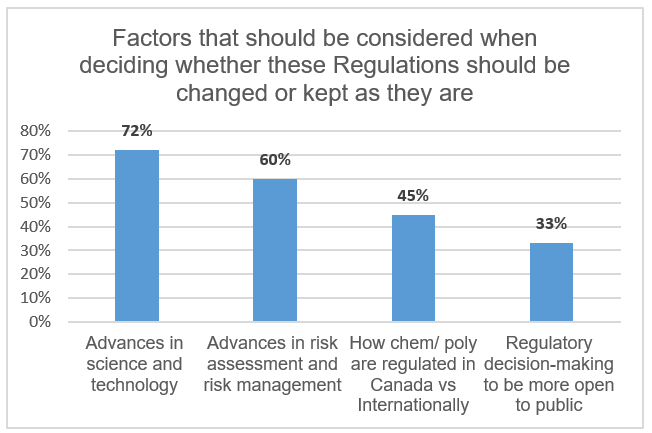
Factors identified by respondents that should be considered when deciding whether these Regulations should be changed or kept as they are.
Factors
The majority of respondents stated that the Regulations as they are need significant updating or revision or should be replaced with substantially redesigned Regulations or some other instrument (58%). Ten percent (10%) stated that the Regulations should be kept as they are, and 29% stated that the Regulations need minor updating. Two percent (2%) of respondents stated that the Regulations should be removed completely.
Respondents identified a number of factors that should be considered when deciding whether these Regulations should be changed or kept as they are. These factors included:
- advances in science and technology (72%)
- advances in risk assessment and risk management (60%)
- how chemicals and polymers are regulated in Canada versus internationally (45%)
- regulatory decision-making to be more open to the public (33%)
Additional factors included:
- considerations of adverse endpoints in conducting risk assessment, including explicit requirements to provide data on potential for carcinogenicity, mutagenicity, reproductive and developmental toxicity, endocrine disruption and neurotoxicity persistence, bioaccumulation and mobility of substances
- redundancy with amendments to CEPA in Bill S-5 for addressing new approach methods (NAMs) and nanomaterials
Following the identification of advances in science and technology as a factor to be considered, specifically the harmful effects of toxicity testing (animal testing), during the course of the online engagement, the New Substances Program received 1033 emails relating to this factor. The emails urged the government to amend the Regulations in order to reform its stance on animal testing. The content of those emails was not included in the survey results.
Considerations
Respondents identified several considerations that are important in deciding whether these Regulations should be changed or kept as they are. These included:
- tighter government regulation of chemicals and polymers (56%)
- government removal of barriers to innovation/improving access to new products (39%)
- reducing time and resources to comply with regulatory requirements (34%)
- government to regulate chemicals and polymers less tightly (6%)
Additionally, 18% of overall responses indicated that “other” considerations were important in deciding whether these Regulations should be changed or kept as they are. These additional considerations included:
- efficiency in the government’s New Substances Notification (NSN) review process, to support market agility and competitiveness in Canada and improve Canadians' access to new and better science advancements
- increasing accountability for the chemicals/polymers entering the Canadian market to better guide the evaluation of such chemicals
- minimizing administrative load to comply with the Regulations and align with other jurisdictions

Long description
Considerations that respondents identified as being important in deciding whether these Regulations should be changed or kept as they are.
Long description
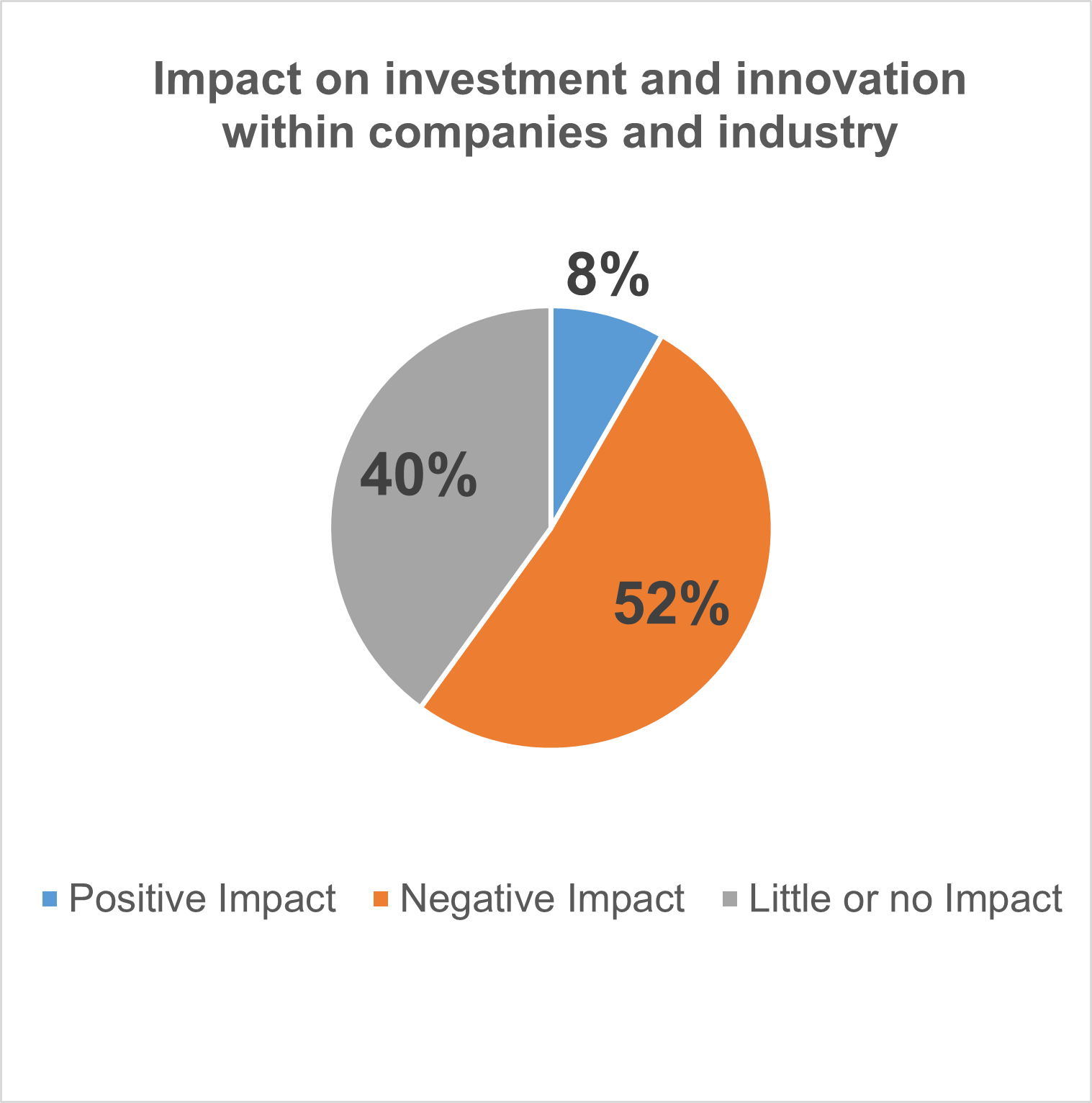
The level of impact that the Regulations currently have on investment and innovation, as identified by respondents.
Impacts on investment and innovation
Respondents who stated that they or their organization imported or manufactured chemicals or polymers represented the second largest participant group in this online engagement (36%), with 31% of those respondents self-identifying as manufacturers or importers or as companies intending to do so, and 5% self-identifying as consultants to such companies. Of this 36%, 68% stated that they or their organizations have imported or manufactured chemicals or polymers new to the Canadian market or have intended to do so. In addition, 70% of this 36% stated they prepare notifications under the New Substances Notification Regulations (Chemicals and Polymers).
Finally, 52% of this 36% stated that the Regulations had a negative impact on investment and innovation within companies and industry. When asked to briefly explain their answer, a number of respondents stated that the Regulations hinder decision making (4) or new product development (3), and restrict Canada’s market agility and competitiveness with international markets (3).
However, many respondents stated they found the Regulations to have little or no impact (40%) on investment and innovation within companies and industry. A number of respondents specifically indicated that their products typically contain less than the trigger quantities required for a New Substance Notification (NSN) submission (3); as a result, they see minimal/ no impact of these Regulations on investment and innovation.
Some respondents who stated that the Regulations have a positive impact (8%) on investment and innovation within companies and industry indicated that the Regulations as they are provide a clear notification process (1), and ensure the appropriate level of accountability within industry (1).
Overall satisfaction with the current Regulations
Respondents were given the opportunity to state their overall satisfaction with the Regulations as they are. The question was asked in a sliding scale format, 1 = not satisfied at all (should be removed) to 5 = very satisfied (should be kept as they are).
When asked to provide their opinions on a sliding scale, most respondents indicated they are somewhat satisfied with the Regulations as they currently operate, with 64% answering between 2 and 3 on the sliding scale. Only 9% of respondents stated that they were very satisfied (5), and 10% stated that they were not satisfied at all (1) with the Regulations as they currently are.

Long description
Overall satisfaction with the Regulations they currently operate, as stated by respondents.
Conclusion and next steps
The majority of respondents stated that the Regulations as they are need significant updating or revision or should be replaced with substantially redesigned Regulations or some other instrument (58%); whereas 10% of respondents stated that the Regulations should be kept as they are, and 30% stated that the Regulations need minor updating. Finally, 2% of respondents stated that the Regulations should be removed completely.

Long description
Recommendation for potential amendments, as identified by respondents.
All of the reviews conducted under the stock review process involve engagement with a range of people and groups outside of government, including non-governmental organizations, university researchers, Indigenous organizations and governments, and industries subject to the Regulations. The New Substances Program has considered, and will continue to consider, all of the comments received during this engagement session in making its recommendation to keep the New Substances Notification Regulations (Chemicals and Polymers) as they are or to revise, repeal, or replace them.
This report will be posted on the PlaceSpeak site and on a Government of Canada webpage. Those who participated in this online engagement will be notified. Furthermore, those who were invited to participate in this survey were informed that if the results of this engagement and the New Substances Program’s own analysis indicate that these Regulations should be changed, they will be contacted as part of the program’s future work to see what specific changes need to be made.
Appendix A: What we asked
Survey questions
- Which of the following best describes you, your government, or your organization?
- Academic
- Member of the general public
- Member of a First Nations, Métis, or Inuit government or organization
- Manufacturer or importer of chemicals or polymers or a company intending to do so
- Consultant to companies that currently manufacture or import chemicals or polymers or intend to do so
- Non-governmental organization representative
- Other; please specify: Click here to enter [text].
Stakeholder Group |
Number of respondents |
Percentage of total* |
|---|---|---|
Academic |
7 |
4% |
Member of the general public |
82 |
50% |
Member of a First Nations, Métis, or Inuit government or organization |
1 |
1% |
Manufacturer or importer of chemicals or polymers or a company intending to do so |
50 |
31% |
Consultant to companies that currently manufacture or import chemicals or polymers or intend to do so |
8 |
5% |
Non-governmental organization representative |
8 |
5% |
Other; please specify: Click here to enter text.
|
7 |
4% |
* Percentage of total numbers reported have been rounded to the nearest whole number
- How familiar are you with the New Substances Notification Regulations (Chemicals and Polymers)?
- Very familiar
- Somewhat familiar
- Not familiar
How familiar are you with the New Substances Notification Regulations (Chemicals and Polymers)? |
Total |
Percentage of total* |
|---|---|---|
Very familiar |
47 |
29% |
Somewhat familiar |
85 |
52% |
Not familiar |
31 |
19% |
* Percentage of total numbers reported have been rounded to the nearest whole number
- Have you or your organization imported or manufactured chemicals or polymers new to the Canadian market or are you intending to do so?
- Yes
- No
Have you or your organization imported or manufactured chemicals or polymers new to the Canadian market or are you intending to do so? |
Total |
Percentage of total* |
|---|---|---|
Yes |
110 |
67% |
No |
53 |
33% |
* Percentage of total numbers reported have been rounded to the nearest whole number
- Do you or your organization prepare notifications under the New Substances Notification Regulations (Chemicals and Polymers)?
- Yes
- No
Do you or your organization prepare notifications under the New Substances Notification Regulations (Chemicals and Polymers)? |
Total |
Percentage of total* |
|---|---|---|
Yes |
115 |
71% |
No |
48 |
29% |
* Percentage of total numbers reported have been rounded to the nearest whole number
- From what you know about the New Substances Notification Regulations (Chemicals and Polymers), what factors would you say are important for deciding whether these Regulations should be changed or kept as they are? Please choose all that apply:
- Advances in science and technology (such as the development of nanotechnology)
- Advances in risk assessment and risk management (such as the use of alternatives to animal testing)
- Differences in how chemicals and polymers are regulated in Canada versus the United States, Europe, Australia, or elsewhere
- Calls for regulatory decision-making to become more open to the public or to those subject to Regulations
- Other (please specify) Click here to enter [text]
From what you know about the New Substances Notification Regulations (Chemicals and Polymers), what factors would you say are important for deciding whether these regulations should be changed or kept as they are? Please choose all that apply |
Total selected |
Percentage of total* |
|---|---|---|
Advances in science and technology (such as the development of nanotechnology) |
118 |
72% |
Advances in risk assessment and risk management (such as the use of alternatives to animal testing) |
97 |
60% |
Differences in how chemicals and polymers are regulated in Canada versus the United States, Europe, Australia, or elsewhere |
74 |
45% |
Calls for regulatory decision-making to become more open to the public or to those subject to Regulations |
54 |
33% |
Other (please specify) Click here to enter text. |
31 |
19% |
* Percentage of total numbers reported have been rounded to the nearest whole number
- From what you know about the New Substances Notification Regulations (Chemicals and Polymers), what considerations would you say are important for deciding whether these Regulations should be changed or kept as they are? Please choose all that apply:
- Reducing the time and other resources needed for companies to comply with regulatory requirements
- The need for government to regulate chemicals and polymers more tightly
- The need for government to regulate chemicals and polymers less tightly
- The need for government to remove barriers to innovation and improve Canadians’ access to new products
- Other (please specify) Click here to enter text
From what you know about the New Substances Notification Regulations (Chemicals and Polymers), what factors would you say are important for deciding whether these Regulations should be changed or kept as they are? Please choose all that apply |
Total selected |
Percentage of total* |
|---|---|---|
Reducing the time and other resources needed for companies to comply with regulatory requirements |
56 |
34% |
The need for government to regulate chemicals and polymers more tightly |
92 |
56% |
The need for government to regulate chemicals and polymers less tightly |
10 |
6% |
The need for government to remove barriers to innovation and improve Canadians’ access to new products |
63 |
39% |
Other (please specify) Click here to enter text. |
29 |
18% |
* Percentage of total numbers reported have been rounded to the nearest whole number
- If you represent a company regulated under these Regulations, which of the following would you say best describes the impact of these Regulations on investment and innovation at your company or in your industry?
- Positive impact
- Negative impact
- Little or no impact
- Not applicable
If you answered a, b, or c, please briefly explain your answer. [Click here to enter text]
| If you represent a company regulated under these Regulations, which of the following would you say best describes the impact of these Regulations on investment and innovation at your company or in your industry? | Total |
Percentage of total* |
|---|---|---|
Positive impact |
5 |
3% |
Negative impact |
31 |
19% |
Little or no impact |
24 |
15% |
Not applicable |
103 |
63% |
* Percentage of total numbers reported have been rounded to the nearest whole number
- From what you know about the Regulations, would you say that they:
- should be kept as they are
- need minor updating
- need significant updating or revision or should be replaced with substantially redesigned Regulations or some other instrument
- should be removed
Please briefly explain your answer. [Click here to enter text]
| From what you know about the Regulations, would you say that they | Total |
Percentage of total* |
|---|---|---|
Should be kept as they are |
17 |
10% |
Need minor updating |
48 |
29% |
Need significant updating or revision or should be replaced with substantially redesigned Regulations or some other instrument |
95 |
58% |
Should be removed |
3 |
2% |
* Percentage of total numbers reported have been rounded to the nearest whole number
- How satisfied are you with the Regulations as they operate currently?
Sliding scale [not satisfied at all (should be removed) - very satisfied (should be kept as they are)]
| How satisfied are you with the Regulations as they operate currently? | Total |
Percentage of total* |
|---|---|---|
1 [not satisfied at all (should be removed)] |
17 |
10% |
2 |
62 |
38% |
3 |
42 |
26% |
4 |
28 |
17% |
5 [very satisfied (should be kept as they are)] |
14 |
9% |
* Percentage of total numbers reported have been rounded to the nearest whole number
Appendix B: Who we heard from
In total, 2,184 individual parties were invited via email to participate in this engagement. Of those 2,184, 1,997 belonged to the general stakeholder group, 187 belonged to the Indigenous governments/organizations group. 163 respondents total completed the survey.
Stakeholder group |
Number of respondents |
Percentage of total* |
|---|---|---|
Academic |
7 |
4% |
Member of the general public |
82 |
50% |
Member of a First Nations, Métis, or Inuit government or organization |
1 |
1% |
Manufacturer or importer of chemicals or polymers or a company intending to do so |
50 |
31% |
Consultant to companies that currently manufacture or import chemicals or polymers or intend to do so |
8 |
5% |
Non-governmental organization representative |
8 |
5% |
Other; please specify: Click here to enter text.
|
7 |
4% |
* Percentage of total numbers reported have been rounded to the nearest whole number

Long description
Stakeholder groups that participated in this engagement.
Pan-Canadian engagement figures:

Province/Territory |
Total |
Percentage of total* |
|---|---|---|
Alberta |
12 |
7% |
British Columbia |
25 |
15% |
Manitoba |
2 |
1% |
New Brunswick |
2 |
1% |
Northwest Territories |
1 |
1% |
Nova Scotia |
1 |
1% |
Ontario |
79 |
49% |
Quebec |
13 |
8% |
Saskatchewan |
1 |
1% |
Yukon |
1 |
1% |
Non-Resident |
26 |
16% |
* Percentage of total numbers reported have been rounded to the nearest whole number
| Official Language | Total |
Percentage of total* |
|---|---|---|
English |
156 |
96% |
French |
7 |
4% |
* Percentage of total numbers reported have been rounded to the nearest whole number