
Prescription drugs in Canada
Learn about Canada's role in managing prescription drugs, the process for reviewing and pricing prescription drugs, and drug plans in Canada.
On this page
- Canada's role in managing prescription drugs
- Canada's process for reviewing and pricing prescription drugs
- Drug plans in Canada
Canada's role in managing prescription drugs
Prescription drugs are medications prescribed to a patient by a health professional to help manage health conditions.
Prescription drugs are an important part of our health care system. They can help to:
- diagnose, cure, control and prevent disease
- manage symptoms and improve quality of life
Canada plays a central role in managing prescription drugs.
We work with our partners to ensure that prescription drugs are:
- safe, effective and of high quality
- available and accessible
- used appropriately
Canada's process for reviewing and pricing prescription drugs
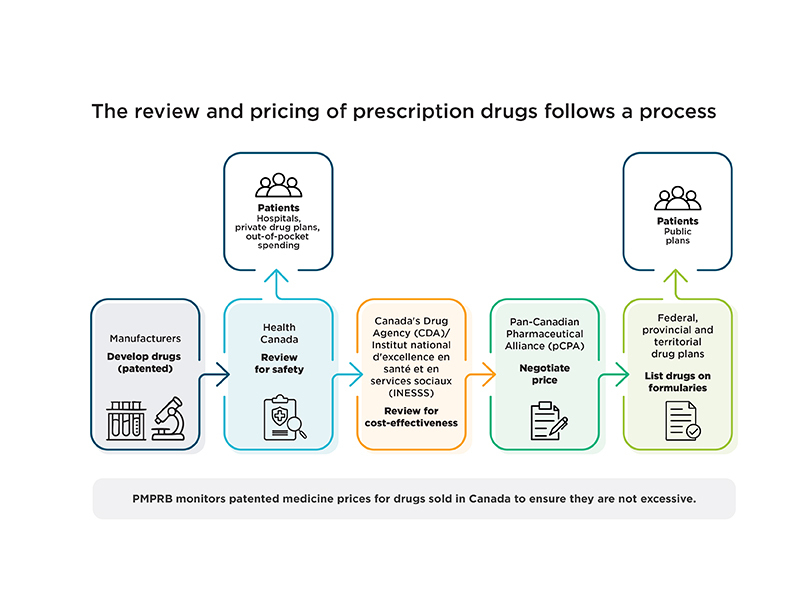
The Government of Canada, provinces and territories, and other partners all have a role in the management of prescription drugs.
When a manufacturer wants to sell a prescription drug in Canada, Health Canada first reviews the drug. Our review involves ensuring the new drug meets the safety, efficacy and quality requirements set out in the Food and Drugs Act and its regulations.
Canada's Drug Agency (CDA-AMC) or the Institut national d'excellence en santé et en services sociaux (INESSS) in Quebec then looks at whether the drug offers good value for money. Based on their recommendations, the pan-Canadian Pharmaceutical Alliance (pCPA) negotiates the price of selected approved drugs with drug sponsors. The alliance does this on behalf of the provinces and territories and participating federal drug plans.
The provinces and territories decide which new drugs will be listed on their formularies for patient access and under what conditions for their eligible populations.
Hospitals select approved drugs for their patients. Private insurance plans select approved drugs they reimburse for their patients. Patients may also purchase an approved drug from their pharmacy.
The Patented Medicine Prices Review Board (PMPRB) monitors patented medicine prices for drugs sold in Canada to ensure they are not excessive.
Learn more about how we regulate and review health products for safety, efficacy and quality.
Learn more about our partners:
- Canada's Drug Agency
- pan-Canadian Pharmaceutical Alliance
- Patented Medicine Prices Review Board
- Institut national d'excellence en santé et en services sociaux
Drug plans in Canada
In Canada, there are public and private drug plans.
Public plans
The provinces and territories administer their own public drug plans. They decide:
- who they will cover
- which prescription drugs they will cover
- what portion of the cost of the drug the patient will pay
In general, public plans are for those most in need, based on age, income and medical condition.
Access your provincial and territorial public drug benefit program.
For some initiatives (for example National Pharmacare or National Strategy for Drugs for Rare Diseases, the federal government provides funding to provinces and territories to help improve access to certain medications.
Private plans
Many people in Canada and their family members have drug coverage linked to their job. These privately funded plans help to cover the cost of prescription drugs.
No drug coverage
If your prescription drug isn't covered under a public plan and you don't have a private plan, you will have to pay the full cost.
Provinces and territories provide special coverage for people facing very high drug costs who are having trouble paying. This coverage is offered through what's called a catastrophic drug coverage program.
Contact your provincial and territorial health care ministry for more information on the help that may be available to you.
Federal coverage for certain groups
We provide drug coverage for about 1 million people who are members of certain groups. These groups include:
- First Nations and Inuit
- inmates in federal correctional institutions
- qualified veterans by Veterans Affairs Canada
- members of the Royal Canadian Mounted Police
- eligible members of the Canadian Armed Forces
- refugees, asylum seekers, protected persons, victims of human trafficking and other groups
Learn more:
Other coverage for specific drugs
National pharmacare
Canada has signed pharmacare agreements with a number of provinces and territories. The agreements will make a range of contraceptives and diabetes medications available for free or at low cost at pharmacies.
Learn about national pharmacare.
National Strategy for Drugs for Rare Diseases
Canada has also signed agreements with all provinces and territories in support of the first-ever National Strategy for Drugs for Rare Diseases. This funding will help increase access to and make effective drugs for rare diseases more affordable.
Learn about the National Strategy for Drugs for Rare Diseases.