
Office of the Intelligence Commissioner’s 2026-27 Departmental Plan

At a glance
This departmental plan details Office of the Intelligence Commissioner’s (ICO) priorities, plans, and associated costs for the upcoming three fiscal years.
These plans align with the priorities outlined in the ICO’s Vision, mission, raison d’être and operating context.
Key priorities
The ICO identified the following key priorities for 2026-27:
- Timely, comprehensive quasi-judicial reviews
- Transparency
- Effective and efficient management of resources
Comprehensive Expenditure Review
The government is committed to restraining the growth of day-to-day operational spending to make investments that will grow the economy and benefit Canadians.
The ICO does not have planned reductions under the Comprehensive Expenditure Review.
The ICO will, however, respect the spirit of the exercise by doing the following:
- Reduce the number of professional services contracts
- Review discretionary spending
- Maximize resource efficiency
Highlights for the ICO in 2026-27
The ICO will focus on its core responsibility of performing quasi-judicial reviews of certain ministerial conclusions.
The ICO is also committed to ensuring that its spending is sustainable and directed to the quasi-judicial review program and other activities that are cost-effective, core to the IC’s mandate, and complementary to other government programming.
In 2026-27, total planned spending (including internal services) for the ICO is $2,650,617 and total planned full-time equivalent staff (including internal services) is 8.5.
Summary of planned results
The following provides a summary of the results the department plans to achieve in 2026-27 under its main areas of activity, called “core responsibilities.”
Core responsibility 1: Quasi-judicial review of certain ministerial conclusions
In 2026-27, the ICO remains committed to ensuring the IC’s decisions and the reasons for them are delivered in accordance with the deadlines set out in legislation. The ICO will continue to publish the IC’s decisions, while taking into consideration accessibility requirements, including plain language and alternative formats.
Planned spending: $1,918,268
Planned human resources: 6.5
More information about the quasi-judicial review of certain ministerial conclusions can be found in the full plan.
For complete information on the ICO’s total planned spending and human resources, read the Planned spending and human resources section of the full plan.
From the Institutional head
As Intelligence Commissioner (IC) and Deputy Head, I am pleased to present the 2026–27 Departmental Plan for the Office of the Intelligence Commissioner (ICO). The 2026–27 Departmental Plan provides Canadians with an overview of the ICO’s objectives, planned activities and expected results during the reporting period, as well as the financial and human resources forecast to deliver those results.
The ICO is an independent quasi-judicial agency of the Government of Canada. The ICO supports the fulfilment of the IC’s oversight mandate as set out in the Intelligence Commissioner Act (IC Act). The IC approves – or does not approve – certain national security and intelligence activities planned by the Communications Security Establishment and the Canadian Security Intelligence Service (CSIS) and authorized by their respective ministers.
In the interest of national security and intelligence collection, these agencies may sometimes engage in activities that could involve breaking the laws of Canada or interfere with the privacy interests of Canadians. Any activities of this kind must first be authorized in writing by the minister responsible for the agency involved or, in some cases, by the Director of CSIS. The ministerial authorization must include the conclusions – effectively the reasons – supporting the activities that are being authorized.
I review the conclusions given for authorizing the activities to determine whether they meet the test of “reasonableness” as recognized by Canadian courts. If so, I approve the ministerial authorization, and the agency can proceed with the planned activities. The activities cannot take place without my approval.
My oversight continues to show the importance of information flow for effective decision making. Before approving activities, I must be certain that the decision maker has fully considered the potential implications for the rule of law and what impact the activities may have on the rights and privacy interests of Canadians. To enable this full consideration, it is essential that CSE and CSIS provide all relevant information to their respective decision makers. Since my appointment as IC in October 2022, I have insisted in my decisions that both agencies implement specific measures to improve the sharing of information with their decision makers. I am pleased to report noticeable and ongoing improvement in this area. There is no question that the better-informed decision makers are, the more thoroughly they will be able to assess the impacts of their decisions – and the more confident Canadians can be in those decisions.
The ICO remains committed to ensuring that my decisions and the reasons for them are delivered in accordance with the deadlines set out in legislation. The ICO continues to publish my decisions, while taking into consideration accessibility requirements, including plain language and alternative formats.
The ICO is fully committed to ensuring that its spending is sustainable and directed to programs and activities that are cost-effective, core to my mandate, and complementary to other government programming. The 2026–27 plan will continue to build upon the results of the strategic resource planning exercise undertaken during the 2024–25 fiscal year, by fully implementing the necessary changes to ensure that a right balance between human and financial resources is achieved to support the fulfilment of my mandate. In 2026–27, the ICO will continue to work with other government departments and agencies to leverage services and best practices to ensure effective, efficient, and sustainable service delivery.
The current environment reflects the ongoing need for adaptability in oversight. Effective national security and intelligence activities require meaningful scrutiny. The evolution of my role within the existing legislative framework is necessary to fulfil the important function played by the IC in the governance of these activities. I am confident that the ICO will continue to effectively and efficiently support the fulfilment of my mandate in 2026–27.
The Honourable Simon Noël, K.C.
Intelligence Commissioner
Plans to deliver on core responsibilities and internal services
Core responsibilities and internal services:
Core responsibility 1: Quasi-judicial review of certain ministerial conclusions
In this section
- Description
- Quality of life impacts
- Indicators, results and targets
- Plans to achieve results
- Gender-based Analysis Plus
- Planned resources to achieve results
- Program inventory
Description
The ICO is an independent oversight body. Under the IC Act, the IC is responsible for performing quasi-judicial reviews of the conclusions on the basis of which certain authorizations are issued or amended, and certain determinations are made, under the Communications Security Establishment Act and the Canadian Security Intelligence Service Act. In each case, the IC, supported by the ICO, undertakes an in-depth analysis of the records. If the IC is satisfied that the conclusions reached by the decision-maker are reasonable, the IC must approve the authorization or determination in a written decision that sets out the reasons for doing so.
Consistent with the IC’s oversight role, an authorization or determination is valid only after it is approved by the IC. The activities described in the authorizations or determinations cannot be carried out by the intelligence agencies without the IC’s approval.
The IC Act requires that the IC’s decision be rendered within 30 days after the day on which the IC received notice of the authorization or determination, or within any other period that may be agreed on by the IC and the decision-maker. In the case of an authorization issued by the Director of CSIS for a query of a dataset in exigent circumstances, the IC must render his or her decision and the reasons for it as soon as feasible.
Quality of life impacts
This core responsibility contributes to the "Good Governance" domain of the Quality of Life Framework for Canada and, more specifically, "confidence in institutions," and "respect of justice and human rights" through all the activities mentioned in the core responsibility description.
Indicators, results and targets
This section presents details on the department’s indicators, the actual results from the three most recently reported fiscal years, the targets and target dates approved in 2025–26 for the quasi-judicial review of certain ministerial conclusions. Details are presented by departmental result.
Table 1: Enhancing transparency and accountability of the national security framework
Table 1 provides a summary of the target and actual results for each indicator associated with the results under the quasi-judicial review of certain ministerial conclusions.
| Departmental Result Indicators | Actual Results | 2026-27 Target | Date to achieve target |
|---|---|---|---|
| % of decisions and the reasons for them delivered in accordance with the deadlines set out in the legislation | 2022-23: 100% 2023-24: 100% 2024-25: 100% |
100% | March 2027 |
| Annual report on Commissioner’s activities delivered to the Prime Minister by March 31st | 2022-23: 100% 2023-24: 100% 2024-25: 100% |
100% | March 2027 |
Additional information on the detailed results and performance information for the ICO’s program inventory is available on GC InfoBase.
Plans to achieve results
The following section describes the planned results for the quasi-judicial review of certain ministerial conclusions in 2026-27.
Enhancing transparency and accountability of the national security framework
The role of the IC and that of the ICO is to provide greater transparency, better accountability and, ultimately to bolster public confidence in Canada’s national security framework. To carry out that role, the IC and the ICO’s core responsibility is to perform quasi-judicial reviews of certain ministerial conclusions.
Results we plan to achieve
- 100% of decisions and the reasons for them delivered in accordance with the deadlines set out in the legislation
- Annual report on the IC’s activities delivered to the Prime Minister by March 31, 2027
Gender-based Analysis Plus
The ICO fully supports the implementation of GBA+ at the departmental level. The ICO is a micro agency (less than 7 FTEs) and does not have the capacity in place for significant data collection. The quasi-judicial review program has a very narrow focus; it is delivered internally within government. Nevertheless, GBA+ will be an ongoing consideration in human resources management. The full range of identity factors will be addressed as key elements, primarily, in the staffing program.
Planned resources to achieve results
Table 2: Planned resources to achieve results for the Quasi-judicial review of certain ministerial conclusions
Table 2 provides a summary of the planned spending and full-time equivalents required to achieve results.
| Resource | Planned |
|---|---|
| Spending | $1,918,268 |
| Full-time equivalents | 6.5 |
Complete financial and human resources information for the ICO’s program inventory is available on GC InfoBase.
Program inventory
The quasi-judicial review of certain ministerial conclusions is supported by the following program:
- Quasi-judicial review program
Additional information related to the program inventory for the quasi-judicial review of certain ministerial conclusions is available on the Results page on GC InfoBase.
Internal services
In this section
- Description
- Plans to achieve results
- Planned resources to achieve results
- Planning for contracts awarded to Indigenous businesses
Description
Internal services are the services that are provided within a department so that it can meet its corporate obligations and deliver its programs. There are 10 categories of internal services:
- acquisition management services
- communications services
- financial management services
- human resources management services
- information management services
- information technology services
- legal services
- materiel management services
- management and oversight services
- real property management services
Plans to achieve results
This section presents details the department’s plans to achieve results and meet targets for internal services.
- The ICO plans on continuing to obtain internal services offered by other government departments to leverage established expertise, avoid duplication of work and reduce costs.
- The ICO continues to invest in its security infrastructure and will work with Public Services and Procurement Canada to complete necessary security enhancements.
- As part of the ICO’s accessibility plan, the ICO will address outstanding accessibility considerations during new construction projects.
- These actions will contribute to the effective and efficient achievement of the ICO’s departmental results.
Planned resources to achieve results
Table 3: Planned resources to achieve results for internal services this year
Table 3 provides a summary of the planned spending and full-time equivalents required to achieve results.
| Resource | Planned |
|---|---|
| Spending | $732,349 |
| Full-time equivalents | 2 |
Complete financial and human resources information for the ICO’s program inventory is available on GC InfoBase.
Planning for contracts awarded to Indigenous businesses
The ICO is committed to meet the mandatory minimum target of 5% of the total value of contracts awarded to Indigenous businesses annually. The ICO will leverage tools established by Public Services and Procurement Canada, such as standing offers and supply arrangements, to assist in contracting with Indigenous businesses.
Table 4: Percentage of contracts planned and awarded to Indigenous businesses
Table 4 presents the current, actual results with forecasted and planned results for the total percentage of contracts the department awarded to Indigenous businesses.
| 5% reporting field | 2024-25 actual result | 2025-26 forecasted result | 2026-27 planned result |
|---|---|---|---|
| Total percentage of contracts with Indigenous businesses | 8% | 5% | 5% |
Department-wide considerations
Related government priorities
More information on the ICO’s contributions to Canada’s Federal Implementation Plan on the 2030 Agenda and the Federal Sustainable Development Strategy can be found in our Departmental Sustainable Development Strategy.
Key risks
Human resources management
The ICO must ensure that it has sufficient resources in place to meet the review and reporting requirements set out in the legislation. Regardless of the number and complexity of the quasi-judicial reviews conducted, the requirements of the legislation must be met. The ICO’s workload is largely demand-driven by the reviews submitted to the IC for approval, and subject to fluctuations in the volume and complexity of the files submitted over which the ICO has limited control. This significantly affects the ICO’s operational context and places pressures on the ICO.
The ICO will continue to apply strategies to effectively recruit, retain and manage its human resources to meet the requirements of the IC and provide the necessary support to achieve program delivery.
Planned spending and human resources
This section provides an overview of ICO’s planned spending and human resources for the next three fiscal years and compares planned spending for 2026–27 with actual spending from previous years.
In this section
Spending
This section presents an overview of the department's planned expenditures from 2023-24 to 2028-29.
Budgetary performance summary
Table 5: Three-year spending summary for core responsibilities and internal services (dollars)
Table 5 presents the ICO’s spending over the past three years to carry out its core responsibilities and for internal services. Amounts for the 2025–26 fiscal year are forecasted based on spending to date.
| Core responsibilities and internal services | 2023–2024 actual expenditures | 2024–2025 actual expenditures | 2025–2026 forecast spending |
|---|---|---|---|
| Quasi-judicial review of certain ministerial conclusions | $1,555,054 | $1,621,305 | $1,685,657 |
| Internal services | $673,370 | $438,105 | $787,149 |
| Total | $2,228,424 | $2,059,410 | $2,472,806 |
Analysis of the past three years of spending
Despite some variations in spending related to salaries (to reflect collective agreements signed in the core public administration), and translation services, spending over the past three years has been relatively constant. The higher forecast spending for 2025–26 reflects an increase in planned spending related to security enhancements during the fiscal year as well as one-time costs associated with the transition away from contracting for professional services to obtaining internal services from other federal government departments through fixed-cost service level agreements. Given the modest size of the budget, increase in spending has the potential to have a significant impact on the ICO’s financial standing. As a result, strong and sound financial stewardship is essential to ensure that all spending is appropriately assessed.
More financial information from previous years is available on the finances section of GC Infobase.
Table 6: Planned three-year spending on core responsibilities and internal services (dollars)
Table 6 presents how much money ICO plans to spend over the next three years to carry out its core responsibilities and for internal services.
| Core responsibilities and internal services | 2026-27 planned spending | 2027-28 planned spending | 2028-29 planned spending |
|---|---|---|---|
| Quasi-judicial review of certain ministerial conclusions | $1,918,268 | $1,918,268 | $1,918,268 |
| Internal services | $732,349 | $732,349 | $732,349 |
| Total | $2,650,617 | $2,650,617 | $2,650,617 |
Analysis of the next three years of spending
More detailed financial information on planned spending is available on the Finances section of GC Infobase.
Funding
This section provides an overview of the department's voted and statutory funding for its core responsibilities and for internal services. For further information on funding authorities, consult the Government of Canada budgets and expenditures.
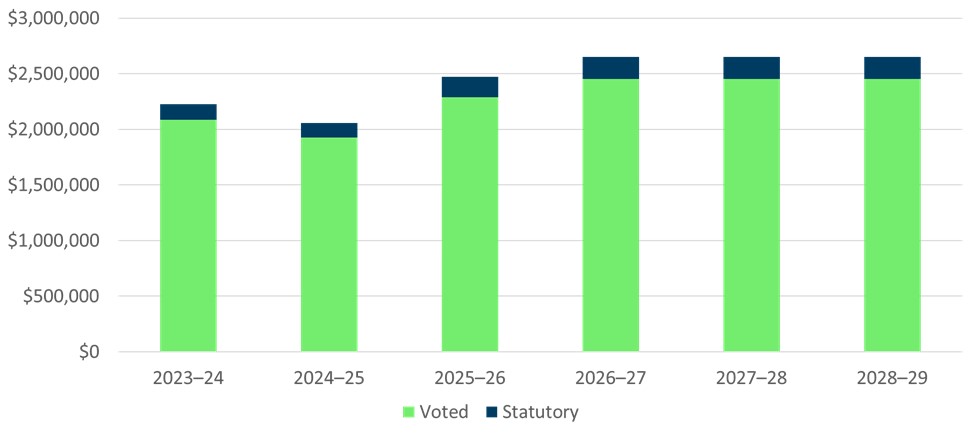
Graph 1: Approved funding (statutory and voted) over a six-year period
Graph 1 summarizes the department's approved voted and statutory funding from 2023-24 to 2028-29.
Text description of graph 1
| Fiscal year | Total | Voted | Statutory |
|---|---|---|---|
| 2023-24 | $2,228,424 | $2,085,193 | $143,231 |
| 2024-25 | $2,059,410 | $1,926,739 | $132,671 |
| 2025-26 | $2,472,806 | $2,289,834 | $182,972 |
| 2026-27 | $2,650,617 | $2,454,225 | $196,392 |
| 2027-28 | $2,650,617 | $2,454,225 | $196,392 |
| 2028-29 | $2,650,617 | $2,454,225 | $196,392 |
Analysis of statutory and voted funding over a six-year period
There are no significant trends or variations. The slight differences in total funding (salary and employee benefits) among the years are due to collective agreements signed in the core public administration and compensation revisions approved by Treasury Board for unrepresented employees.
For further information on the ICO’s departmental appropriations, consult the 2026-27 Main Estimates.
Future-oriented condensed statement of operations
The future-oriented condensed statement of operations provides an overview of the ICO’s operations for 2025-26 to 2026-27.
Table 7: Future-oriented condensed statement of operations for the year ended March 31, 2027 (dollars)
Table 7 summarizes the expenses and revenues which net to the cost of operations before government funding and transfers for 2025-26 to 2026-27. The forecast and planned amounts in this statement of operations were prepared on an accrual basis. The forecast and planned amounts presented in other sections of the Departmental Plan were prepared on an expenditure basis. Amounts may therefore differ.
| Financial information | 2025–26 forecast results | 2026–27 planned results | Difference (planned results minus forecast results) |
|---|---|---|---|
| Total expenses | $2,450,630 | $2,937,712 | $487,082 |
| Total revenues | $0 | $0 | $0 |
| Net cost of operations before government funding and transfers | $2,450,630 | $2,937,712 | $487,082 |
Analysis of forecasted and planned results
The variance between the planned and forecast results reflects the fact that the planned results are based on reaching a full FTE complement in 2026–27 and the forecasted building enhancements and upgrades are a capitalizable leasehold improvement, meaning the costs incurred in 2025–26 will generate an asset, which will be amortized into spending (accrual basis) starting next year until the end of the current lease term.
A more detailed Future-Oriented Statement of Operations and associated Notes for 2026-27, including a reconciliation of the net cost of operations with the requested authorities, is available on the ICO’s website.
Human resources
This section presents an overview of the department’s actual and planned human resources from 2023-24 to 2028-29.
Table 8: Actual human resources for core responsibilities and internal services
Table 8 shows a summary of human resources, in full-time equivalents, for the ICO’s core responsibilities and for its internal services for the previous three fiscal years. Human resources for the 2025–26 fiscal year are forecasted based on year to date.
| Core responsibilities and internal services | 2023–24 actual FTEs | 2024–25 actual FTEs | 2025–26 forecasted FTEs |
|---|---|---|---|
| Quasi-judicial review of certain ministerial conclusions | 4.5 | 4.5 | 5 |
| Internal services | 2 | 1 | 1 |
| Total | 8.5 | 8.5 | 8.5 |
Analysis of human resources over the last three years
There are no significant trends or variations.
Table 9: Human resources planning summary for core responsibilities and internal services
Table 9 shows information on human resources, in full-time equivalents, for each of the ICO’s core responsibilities and for its internal services planned for the next three years.
| Core responsibilities and internal services | 2026–27 planned fulltime equivalents | 2027–28 planned fulltime equivalents | 2028–28 planned fulltime equivalents |
|---|---|---|---|
| Quasi-judicial review of certain ministerial conclusions | 6.5 | 6.5 | 6.5 |
| Internal services | 2 | 2 | 2 |
| Total | 8.5 | 8.5 | 8.5 |
Analysis of human resources for the next three years
The ICO will review planned positions to ensure FTE count accurately reflects operational requirements.
Supplementary information tables
Information on the ICO’s departmental sustainable development strategy can be found on ICO’s website.
Federal tax expenditures
The ICO’s Departmental Plan does not include information on tax expenditures.
The tax system can be used to achieve public policy objectives through the application of special measures such as low tax rates, exemptions, deductions, deferrals and credits. The Department of Finance Canada publishes cost estimates and projections for these measures each year in the Report on Federal Tax Expenditures.
This report also provides detailed background information on tax expenditures, including descriptions, objectives, historical information and references to related federal spending programs as well as evaluations and GBA Plus of tax expenditures.
Corporate information
Departmental profile
Appropriate minister: The Right Honourable Mark Carney – Prime Minister of Canada
Institutional head: The Honourable Simon Noël, K.C. – Intelligence Commissioner
Ministerial portfolio: Prime Minister
Enabling instrument: Intelligence Commissioner Act
Year of incorporation / commencement: 2019
Organizational contact information
Mailing address
Office of the Intelligence Commissioner
P.O. Box 1474, Station B
Ottawa, ON K1P 5P6
Telephone: 613-992-3044
Email: info@ico-bcr.gc.ca
Website: www.canada.ca/en/intelligence-commissioner.html
Definitions
appropriation (
Any authority of Parliament to pay money out of the Consolidated Revenue Fund.
budgetary expenditures (
Operating and capital expenditures; transfer payments to other levels of government, organizations or individuals; and payments to Crown corporations.
core responsibility (
An enduring function or role performed by a department. The intentions of the department with respect to a core responsibility are reflected in one or more related departmental results that the department seeks to contribute to or influence.
Departmental Plan (
A document that sets out a department’s priorities, programs, expected results and associated resource requirements, covering a three year period beginning with the year indicated in the title of the report. Departmental Plans are tabled in Parliament each spring.
departmental result (
A consequence or outcome that a department seeks to achieve. A departmental result is often outside departments’ immediate control, but it should be influenced by program-level outcomes.
departmental result indicator (
A quantitative measure of progress on a departmental result.
departmental results framework (
A framework that consists of the department’s core responsibilities, departmental results and departmental result indicators.
Departmental Results Report (
A report on a department’s actual performance in a fiscal year against its plans, priorities and expected results set out in its Departmental Plan for that year. Departmental Results Reports are usually tabled in Parliament each fall.
full time equivalent (
A measure of the extent to which an employee represents a full person year charge against a departmental budget. Full time equivalents are calculated as a ratio of assigned hours of work to scheduled hours of work. Scheduled hours of work are set out in collective agreements.
gender-based analysis plus (GBA Plus) (
An analytical tool used to support the development of responsive and inclusive policies, programs and other initiatives. GBA Plus is a process for understanding who is impacted by the issue or opportunity being addressed by the initiative; identifying how the initiative could be tailored to meet diverse needs of the people most impacted; and anticipating and mitigating any barriers to accessing or benefitting from the initiative. GBA Plus is an intersectional analysis that goes beyond biological (sex) and socio-cultural (gender) differences to consider other factors, such as age, disability, education, ethnicity, economic status, geography, language, race, religion, and sexual orientation.
Using GBA Plus involves taking a gender- and diversity-sensitive approach to our work. Considering all intersecting identity factors as part of GBA Plus, not only sex and gender, is a Government of Canada commitment.
government priorities (
For the purpose of the 2026-27 Departmental Plan, government priorities are the high-level themes outlining the government’s agenda in the 2025 Speech from the Throne.
horizontal initiative (
An initiative in which two or more federal organizations are given funding to pursue a shared outcome, often linked to a government priority.
Indigenous business (
Requirements for verifying Indigenous businesses for the purposes of the departmental result report are available through the Indigenous Services Canada Mandatory minimum 5% Indigenous procurement target website.
non budgetary expenditures (
Non-budgetary authorities that comprise assets and liabilities transactions for loans, investments and advances, or specified purpose accounts, that have been established under specific statutes or under non-statutory authorities in the Estimates and elsewhere. Non-budgetary transactions are those expenditures and receipts related to the government's financial claims on, and obligations to, outside parties. These consist of transactions in loans, investments and advances; in cash and accounts receivable; in public money received or collected for specified purposes; and in all other assets and liabilities. Other assets and liabilities, not specifically defined in G to P authority codes are to be recorded to an R authority code, which is the residual authority code for all other assets and liabilities.
performance indicator (
A qualitative or quantitative means of measuring an output or outcome, with the intention of gauging the performance of an department, program, policy or initiative respecting expected results.
plan (plan)
The articulation of strategic choices, which provides information on how an organization intends to achieve its priorities and associated results. Generally, a plan will explain the logic behind the strategies chosen and tend to focus on actions that lead up to the expected result.
planned spending (
For Departmental Plans and Departmental Results Reports, planned spending refers to those amounts presented in the Main Estimates.
A department is expected to be aware of the authorities that it has sought and received. The determination of planned spending is a departmental responsibility, and departments must be able to defend the expenditure and accrual numbers presented in their Departmental Plans and Departmental Results Reports.
program (
Individual or groups of services, activities or combinations thereof that are managed together within a department and that focus on a specific set of outputs, outcomes or service levels.
program inventory (
An inventory of a department’s programs that describes how resources are organized to carry out the department’s core responsibilities and achieve its planned results.
result (
A consequence attributed, in part, to a department, policy, program or initiative. Results are not within the control of a single department, policy, program or initiative; instead they are within the area of the department’s influence.
statutory expenditures (
Expenditures that Parliament has approved through legislation other than appropriation acts. The legislation sets out the purpose of the expenditures and the terms and conditions under which they may be made.
target (
A measurable performance or success level that an organization, program or initiative plans to achieve within a specified time period. Targets can be either quantitative or qualitative.
voted expenditures (
Expenditures that Parliament approves annually through an Appropriation Act. The vote wording becomes the governing conditions under which these expenditures may be made.