
Applying for Clemency
Please note: You can apply directly for clemency to the Parole Board of Canada. You do not need to use a lawyer or third party service provider (see Protect Yourself from Fraud).
Please note you are responsible for any additional fees required as part of your application, such as fingerprints, copies of your criminal record, court documents and police checks.
All you need to do is follow the step-by-step instructions.
-
Step 1 - Fill in the Royal Prerogative of Mercy (RPM)/ Clemency Application
Form:
Instructions:
Answer all the questions in the Royal Prerogative of Mercy (RPM)/Clemency Application Form.
Print in CAPITAL letters using black or blue ink only.
Please do not use correction tape/fluid on your application.
Tip: If you need more space to include all the information, attach additional pages to your application.
Make sure that you have:
Answered all questions on the application form; and
Answered all questions truthfully and completely.
-
Step 2 – Get your Criminal Record
Instructions:
Please note that if a decision for a record suspension/pardon under the Criminal Records Act has already been made, you may not need to provide your criminal record. If unsure, please contact the Parole Board of Canada for additional information.
Get your fingerprints taken.
Visit an accredited fingerprinting company or a police service that can submit your fingerprints electronically.
Ask your local police service if they offer this service or visit the "Where do I get a Criminal Record check?" for more information.
Your electronic fingerprint submission must clearly state you are applying for a record suspensionFootnote 1 .
Wait to receive your Criminal Record (Criminal convictions, conditional and absolute discharges) or a Certification of No Criminal Record from the Royal Canadian Mounted Police (RCMP). Any documents provided by the RCMP must be included with your application.
If you have convictions outside of Canada, you MUST also submit information to the Parole Board of Canada on these convictions, along with your Criminal Record.
When you receive your Criminal Record
- Review to ensure all of your convictions are included.
- It is your responsibility to report all your convictions to the Parole Board of Canada (PBC).
- If ALL your convictions are included, go to STEP 3.
- If any of your conviction(s) is/are missing from your Criminal Record, you must get a Proof of Conviction for each one.
To get this, contact the court that heard your case and/or the police service that arrested you. The Proof of Conviction must include:
- Date and court where you were sentenced;
- Offence that resulted in your conviction;
- Sentence you received; and
- Arresting police force.
If the court and/or police service do not have a record of your convictions, call the PBC's toll-free info line: 1-800-874-2652.
-
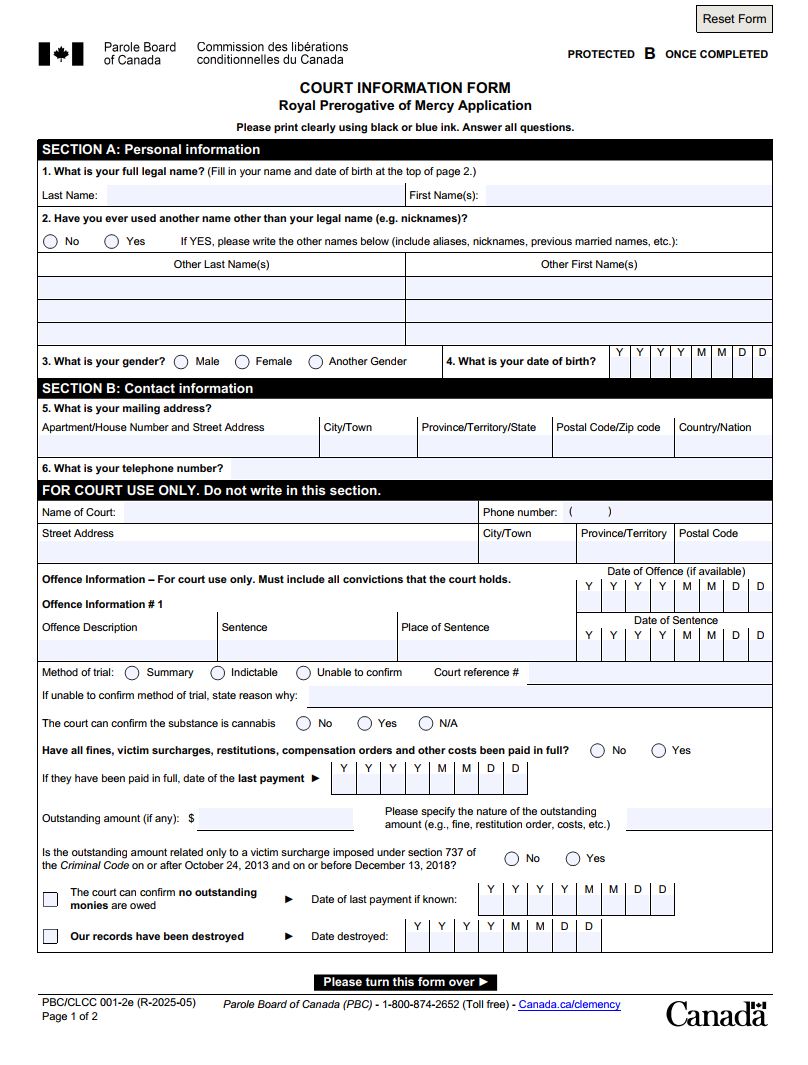
Step 3 – Get your court information
Form:
Instructions:
If a decision for a record suspension/pardon under the Criminal Records Act has already been made, you may not need to provide your court documents. If unsure, please contact the Parole Board of Canada for additional information.
You must get court information for each of your convictions. This MUST include proof and date of last payment for any fines, victim surchargesFootnote 2 , restitution, and compensationFootnote 3 .
Answer questions 1 to 6 on the Court Information Form.
Tip: Make copies of the form in case you need to provide the same information to another court.
Contact the court that heard your case
If you were sentenced in more than one court, you must ask each of them to complete the form.
Give each court a copy of your criminal record and ask them to fill in the section For Court Use Only.
IMPORTANT!
Make sure each court:
- Fills in all of the For Court Use Only section of the form;
- Includes proof and date of last payment for any fines, victim surcharges, restitution, and compensation;
- Includes the method of trial for each conviction (either summary, indictable or unknown);
- Includes all of your convictions from that court;
- Signs and dates the form; and
- Includes an official court seal or stamp on the form.
Tip: Ask for extra copies of all court documents. You may need them in the future. It will be easier to get copies now as they may not be available if your record suspension is ordered.
Check that the information on the Court Information Form is the same as your Criminal Record.
If the information on the Court Information Form and Criminal Record do not match, or if the court has a record of conviction that is not on your Criminal Record, you must ask the court for a Proof of Conviction (consult Step 2).
-
Step 4 – Get your Military Conduct Sheet
Form: Please see the instructions below
Instructions:
IF YOU ARE NOT a current or past member of the Canadian Armed Forces, go to Step 5.
IF YOU ARE a current or past member of the Canadian Armed Forces (Regular or Reserve), you must get a certified, signed and dated copy of your Military Conduct Sheet by contacting the appropriate organization below.
If no conduct sheet exists, you must provide a letter from your Commanding Officer or the appropriate organization, which indicates that no information is available.
For Current Regular or Reserve Members:
You must request a Military Conduct Sheet from your Commanding Officer.
FOR FORMER REGULAR MEMBERS:
If you left on or after January 1, 1998, contact the Department of National Defence Access to Information and Privacy (ATIP) Branch under the Privacy Act:
Director, Access to Information and Privacy
National Defence Headquarters
Major-general George R. Pearkes Bldg.
101 Colonel By Drive
Ottawa, Ontario K1A 0K2Website: Personal Information Request Form
If you left before January 1, 1998, contact the Library and Archives Canada ATIP Branch:
Access to Information and Privacy Branch
Library and Archives Canada
550 de la Cité Boulevard
Gatineau, Quebec J8T 0A7Website: Online requests and forms
FOR FORMER RESERVE MEMBERS:
If you left on or after March 1, 2008, contact the Department of National Defence Access to Information and Privacy (ATIP) Branch under the Privacy Act:
Director, Access to Information and Privacy
National Defence Headquarters
Major-general George R. Pearkes Bldg.
101 Colonel By Drive
Ottawa, Ontario K1A 0K2Website: Personal Information Request Form
If you left before March 1, 2008, contact the Library and Archives Canada ATIP Branch:
Access to Information and Privacy Branch
Library and Archives Canada
550 de la Cité Boulevard
Gatineau, Quebec J8T 0A7Website: Online requests and forms
IMPORTANT!
- Include all correspondence from your Commanding Officer, National Defence or Library and Archives Canada with your application.
- Make sure that your request for your Military Conduct sheet includes the following information:
- Shows that the reason for the request is for a Record Suspension/Clemency Application;
- Your first and last name (if it has since changed, it must state your name at the time);
- Your date of birth;
- Your Service Number;
- Your signature;
- Enrolment and discharge dates.
-
Step 5 – Get your Local Police Records Check(s)
Form:
Instructions:
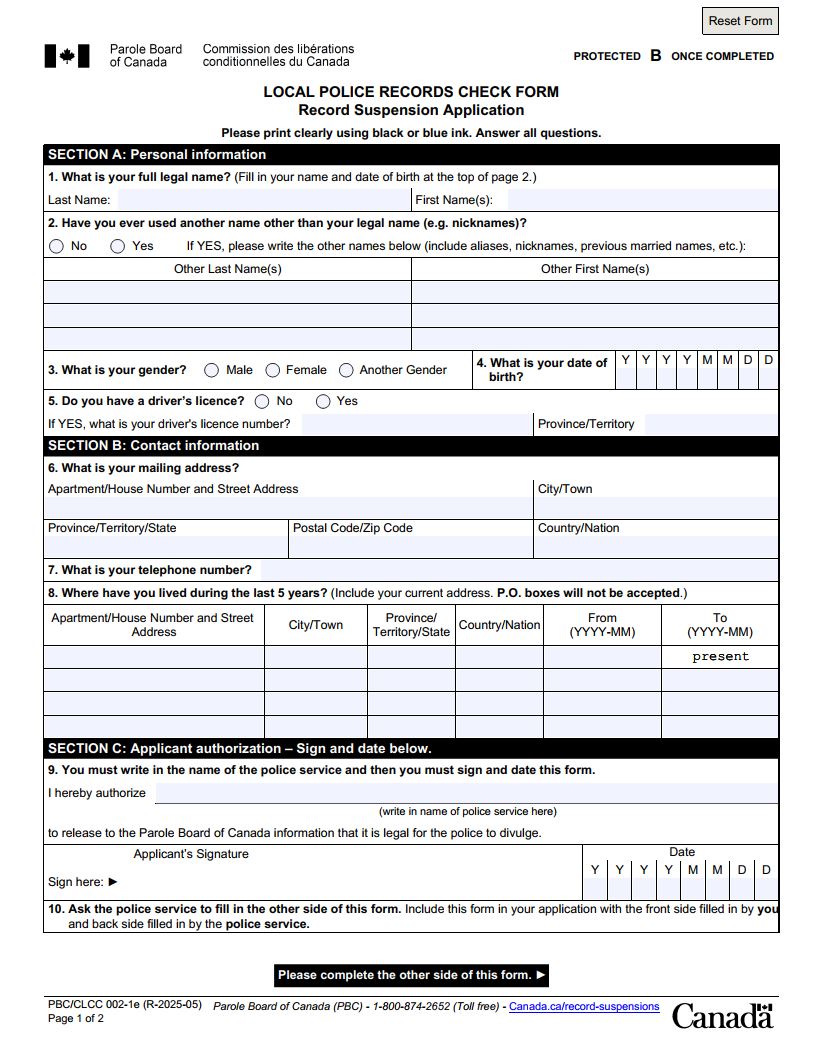
You must get a Local Police Records Check(s) for:
- The city or town where you live now (your current address); AND
- Each city or town where you lived during the last 5 years (if you lived in that place for 3 months or more).
Important!
Each Local Police Records Check(s) is only valid for 12 months from the date it was issued.
How to get a Local Police Records Check
- Fill in all questions on page 1 of the Local Police Records Check Form.
Tip: Photocopy it for each local police service you contact. - Contact the local police service for the address where you live now. If you have lived in different places during the last 5 years, you must contact the police service for each place. If you are not sure who to contact, ask your local police service.
- If you lived outside of Canada, you still need to contact the local police service where you lived.
- If the police service outside Canada will not give you a local police records check, a signed letter from the police service stating that you have been law-abiding will be accepted.
- If it is in a foreign language, you must have it translated into English or French and submit both the original and the translated version with your application form.
- If you lived outside of Canada, you still need to contact the local police service where you lived.
- Show your criminal record to each local police service and ask them to fill in the section on the Local Police Records Check Form called “For Police Use Only” (page 2).
- You will need to show them a current photo ID and a second piece of ID.
Tip: Contact the local police service in advance to find out the types of ID they accept.
IMPORTANT!
The Parole Board of Canada will return your application if your Local Police Records Check Form does not include the following information:
- All information required in the “For Police Use Only” section on page 2;
- Signature and the completed form date of the local police service; and
- Local police service official seal or stamp.
-
Step 6 – Provide a copy of your document to support your identity
Instructions:
You must submit a clear photocopy of a valid document that supports your identity.
It must be a government issued document (federal, territorial, provincial or municipal) that includes:
- your name;
- date of birth; and
- signature
Examples include: a driver’s license or passport.
-
Step 7 – Provide official third-party proof to substantiate your claim of undue hardship
Clemency applications are assessed on factual information; therefore, you are responsible for providing adequate, reliable, relevant and verifiable evidence to support your application.
If you wish to provide documents or statements from a third-party to support a case of undue hardship, an injustice, inequity, or an error in law, please note that the Parole Board of Canada will review these as part of your application.
Please complete the Undue Hardship Documents at the end of this Guide.
IMPORTANT!
There are many kinds and sources of “third-party proof”.
You will need to decide which documents (e.g., medical, educational, employment, financial, character reference letters, etc.) are directly relevant in your case.
-
Step 8 – Clemency Applicant Consent & Privacy Form
Form:
Instructions:
You must read and complete the Clemency Applicant Consent & Privacy Form.
Please ensure that you include your full legal name and date of birth on the top of page 1, as well as sign and date the form on page 2.
IMPORTANT!
The consent & privacy form is only valid for 12 months from the date you sign it.
-
Before you submit your application
IMPORTANT!
You must provide the original documents with the original signature and official seal and/or stamp from the courts and the police.
Before you submit your application, make sure to keep a photocopy of your documents, including the forms to keep for future reference.
ROYAL PREROGATIVE OF MERCY (CLEMENCY) APPLICATION CHECKLIST
Have you included these documents in your application?
- Original Royal Prerogative of Mercy (RPM)/Clemency Application Form (explained in Step 1)
- Original Criminal Record or certification of No Criminal Record AND proof of conviction documents, as required (explained in Step 2)
- Original Court Information Form(s) (explained in Step 3)
- Original Military Conduct Sheet, if required (explained in Step 4)
- Original Local Police Records Check Form(s) (explained in Step 5)
- Photocopy of your identification document (explained in Step 6)
- Provide official third-party proof to substantiate your claim of undue hardship (complete Undue Hardship Documents (e.g., doctor, school, employer, etc.)). (explained in Step 7)
- Clemency Applicant Consent & Privacy Form (explained in Step 8)
Mail your Application Form and all official documents (originals only, with the exception of your identification document) to the following address:Parole Board of Canada
Clemency and Record Suspension Division
410 Laurier Avenue West, 5th Floor
Ottawa, Ontario K1A 0R1


Have a question or need assistance with your application? Contact us
IMPORTANT:
- You must answer all questions truthfully and completely.
- Withholding information or making false statements could lead to your application being returned to you.
- The Parole Board of Canada does not give preferential treatment to any application. All applications are treated the same.
NOTE
The Parole Board of Canada must be able to contact you now and in the future. If your mailing address changes, you must send the Parole Board of Canada a letter with your new mailing address.
This letter must include:
- Your name;
- Your new mailing address;
- Your Royal Prerogative of Mercy’s Application Reference Number;
- Your signature. As the applicant, you MUST sign the letter.
Send the letter to the following address:
Parole Board of Canada
Clemency and Record Suspension Division
410 Laurier Avenue West, 5th Floor
Ottawa, Ontario K1A 0R1