
Year-end recap from Canada’s Fentanyl Czar

This past year has been defined by both the human cost of the toxic drug crisis, as well as the accelerated action of our national response.
As we close out 2025 and look ahead to our work into the New Year, it is important that we take a moment to reflect on our successes, as we reaffirm our commitment to the fight ahead.
As we all know, Canada is not a source of fentanyl, be it for the U.S. or abroad. According to U.S. data, seizures attributed to the Northern Border region accounted for 0.1% of total U.S. fentanyl seizures involving border enforcement.
Despite this fact, we continue to share the urgent concern of the devastation caused by organized crime and illicit fentanyl on both sides of the border.
Much like the rest of the world, Canada is contending with transnational organized crime syndicates, who seek to exploit gaps in regulations, cryptocurrencies, and global supply chains to profit from the sale of toxic drugs.
We recognize the complexity of the problem and are adapting at the pace of the threat by updating our laws, policies, tools and partnerships. This is exactly why we are taking a deliberate, whole-of-government approach that targets the root causes of addiction coupled with strong law enforcement.
My job in all of this has been to integrate the work done across government departments, bring people and function together and ensure the implementation of a coordinated and cohesive national response.
Substantial progress has been made this past year, with significant and necessary additional investments in law enforcement, legislative changes and stronger, more secure borders.
We are starting to see demonstrable, measurable improvements through our strategic and coordinated efforts, with a suite of complementary measures coming together. For instance:
- The introduction of legislative reform (Bills C-2 and C-12) and regulatory changes by Health Canada will make it much harder for criminals to manufacture illicit fentanyl, keeping our communities safer.
- A stronger anti-money-laundering framework, including intelligence-sharing partnerships with banks, is playing a key role in disrupting the financial flows that fuel trafficking.
- Intensified, coordinated law enforcement operations are translating policy and legislative tools into concrete, on-the-ground action with record-breaking seizures and arrests that interrupt supply before it reaches communities.
As we move into 2026, we will maintain momentum and continue pushing forward with our mission of keeping Canadians safe by reducing supply, curbing demand, while also securing our borders.
I am encouraged by our ongoing progress and look forward to building on the foundations that have been built as we continue delivering for Canadians.
Kevin Brosseau, Canada’s Fentanyl Czar
Key actions
The Government of Canada’s Border Plan
Historic $1.3B investment to bolster border security, strengthen our immigration system and increase support to law enforcement agencies in detecting, intercepting and addressing fentanyl and precursor chemicals.
Designating transnational criminal organizations as terrorists
Ensures law enforcement has every resource available to dismantle and disrupt the operations of these organizations in our communities, while respecting other countries’ sovereignty and territorial integrity.
New legislation
The Strong Borders Act (Bill C-2) / Strengthening Canada's Immigration System and Borders Act (Bill C-12) are designed to keep Canadians safe by helping disrupt increasingly complex criminal groups, strengthen border security, and improve our immigration system. These legislative changes provide Canada with new tools, while protecting privacy and rights under the Canadian Charter of Rights and Freedoms.
Budget 2025
Took actions to ensure Canada can adapt and respond to emerging threats, including illegal drugs. This includes a new Financial Crimes Agency, as well as the hiring of 1,000 additional RCMP personnel, as well as 1,000 CBSA officers.
G7 interior and security ministers
Canada hosted its G7 counterparts to discuss global safety and security challenges and strengthen international collaboration on common security threats such as transnational organized crime and the production and trafficking of synthetic drugs.
Enforcement results
As the tip of the spear, Canadian law enforcement operations undertook strong, coordinated operational actions lead to significant seizures of fentanyl, other synthetics and precursor chemicals, preventing them from reaching our communities.
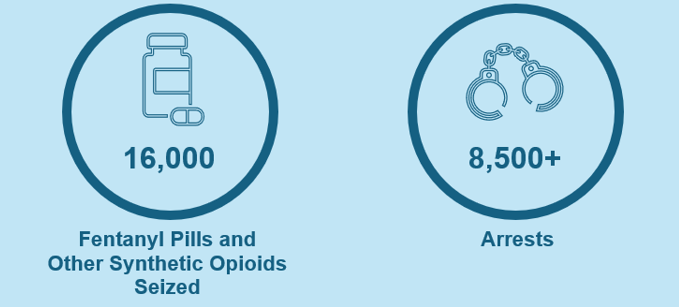
This year, the Canadian Integrated Response to Organized Crime (CIROC) Committee, co-chaired by the RCMP launched two dedicated “Fentanyl Sprint” operations.
Combined, these operations yielded:
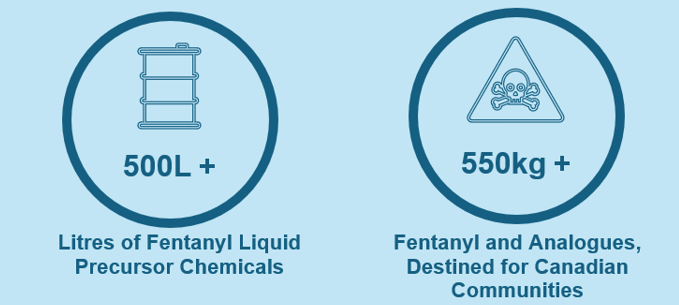
- Over 430kg of fentanyl
- Nearly 16,000 fentanyl pills
- Over 250 kilograms of precursor chemicals.
Similarly, CBSA seized:
- 2.6 kilograms of fentanyl
- 922 kilograms of other opioids
- 500+ Litres of Propionyl Chloride – a fentanyl precursor
Deaths decreasing
Recent data from the Public Health Agency of Canada has shown encouraging trends at the national level.
From July 2024 to June 2025, there was a meaningful decrease in opioid-related deaths of 22% compared to the year before, and the lowest observed since 2020.
The number of hospitalizations, emergency department visits, and Emergency Medical Services responses appear to have stabilized in the first half of 2025, with continued very high level of harms.
- 22% fewer apparent opioid toxicity deaths than in the previous 12 months.
- 21% fewer opioid-related poisoning hospitalizations than the previous 12 months.
- 22% fewer opioid-related poisoning Emergency Department (ED) visits than the previous 12 months.
- 16% fewer Emergency Medical Services (EMS) responses to suspected opioid-related overdoses.
6,161
Apparent opioid toxicity deaths
(22% lower than the previous 12 months)
17
Deaths per day on average
4,935
Opioid-related poisoning hospitalizations
(21% lower than the previous 12 months)
14
Hospitalizations per day on average
21,664
Opioid-related poisoning emergency
department (ED) visits
(22% lower than the previous 12 months)
59
ED visits per day on average
34,177
Emergency Medical Services (EMS) responses to suspected opioid-related overdoses
(16% lower than the previous 12 months)
94
EMS responses per day on average