
Public Health Agency of Canada's Environmental Surveillance Strategic Framework for Antimicrobial Resistance

Download in PDF format
(3.6 MB, 18 pages)
Organization: Public Health Agency of Canada
Pathways to Action: Advancing the Pan-Canadian Action Plan on Antimicrobial Resistance
Date published: December 8, 2025
On this page
- Context
- AMR in the environment
- Scope of the framework
- Guiding the path forward: vision, goal, objectives and principles
- Actions and milestones
- Expected outcomes
- Conclusion
- Evidence summary: key concepts and messages
- Acknowledgements
- References
Context
Antimicrobials, including antibiotics, antifungals, antivirals, and antiparasitics, are essential for protecting human, animal, and plant/crop health against infections. However, bacteria, fungi, and other microorganisms that can cause infections are adapting in ways that reduce the effectiveness of these treatments. This phenomenon is known as antimicrobial resistance (AMR). While some level of AMR exists naturally, contributing factors such as contamination with resistant microorganisms, genetic material, and chemical pollutants can accelerate its development and spreadFootnote 1.
Recognized by the World Health Organization (WHO) as one of the top ten global public health threatsFootnote 2, AMR already has a tangible impact in Canada. In 2018, an estimated 5,400 lives were lost to AMR-related infections, and Canada's gross domestic product was reduced by $2 billionFootnote 3. Beyond human health, effective antimicrobials are vital for maintaining economic stability, enabling labour productivity and reducing threats to agricultural and other industries.
There is global recognition of the need for a unified One Health approach that includes the environmental dimension of AMR, given that AMR does not recognize international boundaries. The United Nations General Assembly has acknowledged the need for addressing AMR from environmental sources as part of National Action Plans, but few countries have taken concrete action.
In 2023, Canada's federal, provincial, and territorial Ministers of Health and Agriculture released the Pan-Canadian Action Plan on Antimicrobial Resistance (PCAP), a five-year plan to coordinate an accelerated pan-Canadian response to AMRFootnote 4. Founded on a One Health approach, the PCAP acknowledges that antimicrobial-resistant organisms can originate in, and move between, humans, animals, plants/crops, and the environment.
The Public Health Agency of Canada (PHAC) is the lead federal department for combatting AMR and coordinating actions to address the threat of AMRFootnote 5, including leading surveillance activities. PHAC's mandate with respect to environmental surveillance for AMR is founded on:
- Reducing the potential for human health risks, both directly (e.g. exposure to AMR from environmental sources), or indirectly (e.g. through the food chain) and
- Improving the coordination of efforts to increase the sources, coverage, and integration of surveillance data on environmental AMR and transmission pathways across One Health sectors.
To date, PHAC-led AMR surveillance efforts have largely focused on the human and animal health sectors. For example, tracking AMR trends in hospital patients, monitoring resistance in animals and food of animal origin, and reporting antimicrobial use (AMU) in Canada. However, there is increasing evidence that the environment, and transmission pathways between One Health sectors, can accelerate the development of AMR. Contaminated water, for example, can expose humans and animals, as well as plants and crops, to antimicrobial resistant organisms. As a result, public health action related to AMR and the environment is an increasing area of priority, both internationally and in Canada.
The Environmental Surveillance Strategic Framework (ESSF) provides guidance for PHAC to lead efforts to obtain surveillance data on environmental AMR, associated drivers, and transmission pathways among One Health sectors. These data will be integrated into the Canadian Antimicrobial Resistance Surveillance System (CARSS), Canada's national system for collecting, integrating, analysing and sharing data on AMR and AMU to inform public health research, policy, and interventions.
- Overview of key concepts
- AMR: AMR occurs when microorganisms, such as bacteria, fungi, viruses and parasites, change in ways that make antimicrobials less effective. This can lead to treatment failure for infections in humans, livestock and companion animals, and cultivated plants/crops.
- One Health AMR surveillance: Traditional surveillance systems have often had to prioritize specific diseases or organisms in isolation. However, AMR can exist in, and be shared among, multiple microorganisms that can cause infections in humans, animals, and plants/crops, and can also exist in the environment (i.e. One Health continuum). A holistic response to AMR requires surveillance efforts across all One Health sectors, to monitor how and where AMR develops and spreads, including relevant transmission pathways between sectors.
- Antimicrobial resistance genes: These genes are the genetic material responsible for AMR, including multi-drug resistance, in microorganisms. Some resistance genes are found on mobile genetic elements that can be shared between microorganisms, potentially leading to the rapid spread of AMR in microbial communities.
- AMR in the environment: AMR exists in the environment because microorganisms must survive and multiply in the presence of naturally occurring substances that have antimicrobial activity. However, certain human activities, such as the use of antimicrobials and the disposal of wastes contaminated with antimicrobial resistant organisms, genes and other pollutants, can promote the development of AMR in the environment.
AMR in the environment
Environmental surveillance for AMR is inherently complex. Antimicrobial resistant organisms and genes can be present in, and transmitted through, water, air, soil, flora, and fauna. Human exposure to antimicrobial resistant organisms from environmental sources can occur through different interactions. This includes recreational activities, occupational activities, food, water, air, and wildlife (Figure 1). Similarly, livestock, companion animals, and plants/crops are also at risk of exposure to AMR from environmental sources.
While the monitoring of AMR is an important part of environmental surveillance, drivers that promote the development and dissemination of AMR in the environment must also be considered. These can include contaminants associated with healthcare waste, industrial and agricultural activities, as well as municipal wastewater.
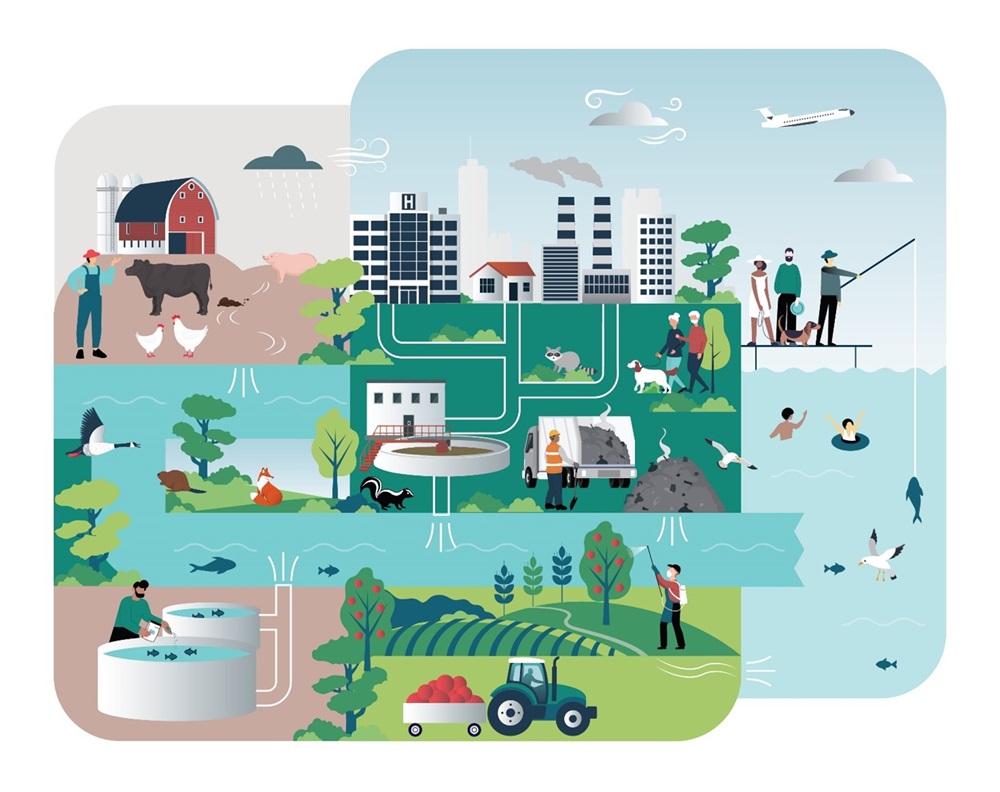
Figure 1: Text description
Diagram showing how antimicrobial resistance can spread through the environment and among humans, animals, and food production systems.
The figure illustrates how antimicrobial resistance (AMR) can develop and spread in the environment and how humans, animals, and plants/crops can be exposed. It shows several interconnected settings: farms with livestock and crops, urban and industrial areas with wastewater systems, and natural environments with wildlife. This represents how resistant organisms, genes and drivers for their development can move through water, air, soil, flora and fauna. Occupational and recreational activities are depicted as examples of human exposure to AMR from environmental sources.
The figure illustrates that environmental surveillance for AMR needs to consider resistant organisms and genes, as well as the drivers promoting AMR development and transmission, including contaminants from agricultural runoff, healthcare waste, industrial discharge, and municipal wastewater.
Scope of the framework
While internationally recognized definitions for human and animal sectors in a One Health surveillance context exist and are widely acceptedFootnote 6Footnote 7Footnote 8Footnote 9, there is a lack of consensus on the scope of environmental surveillanceFootnote 10Footnote 11Footnote 12.
Challenges also exist in differentiating the origins and drivers of AMR in the broader environment, due to the interconnectedness of One Health sectorsFootnote 13. In the context of this document, the environment, and environmental AMR surveillance, are defined as follows.
- Key definitions used in the ESSF
-
Environment:
"the components of the Earth and include[s] (a) air, land and water; (b) all layers of the atmosphere; (c) all organic and inorganic matter and living organisms; and (d) the interacting natural systems that include components referred to in paragraphs (a) to (c)."
Source: Canadian Environmental Protection Act 1999, Pest Control Products Act
-
Environmental surveillance:
The systematic ongoing surveillance, validation, analysis, interpretation, and communication of data on AMR and associated drivers in (1) the environment; and (2) interactions within or across One Health Sectors that are not currently included in existing dedicated AMR surveillance efforts (such as food processing, veterinary and health care facilities), to promote action.
Source: Definition developed for the ESSF by the Public Health Agency of Canada
-
There is limited evidence that AMR adversely affects environmental healthFootnote 14Footnote 15. Therefore, the ESSF excludes considerations related to the potential ecological effects of AMR, and maintains a focus on the environmental aspects related to the development, amplification, persistence, and transmission of AMR to humans, and their animals, plants and crops.
The ESSF does not include an assessment of the availability of resources and stakeholder capacity, and should be modified as new research, surveillance methodologies, scientific approaches, and international guidelines become available.
Future efforts will include the publication of the supporting evidence and expert input used to develop the ESSF.
Guiding the path forward: vision, goal, objectives and principles
Vision
Through PHAC's leadership and collaboration with partners, Canada has increased One Health capacity to detect, understand, and act upon the threat of AMR by monitoring environmental sources, pathways, and drivers for the development, amplification, and transmission of AMR organisms and associated genetic elements.
Goal
Acquire and integrate surveillance data on AMR (and associated drivers) from environmental sources into the Canadian Antimicrobial Resistance Surveillance System to inform interventions.
Strategic objectives
- Promote data-driven approaches to identify and prioritize environmental sources, relevant drivers, and exposure pathways that contribute to the development, amplification, and transmission of AMR across One Health sectors.
- Increase PHAC's ability to monitor temporal and spatial patterns of antimicrobial-resistant organisms, AMR genes, mobile genetic elements associated with AMR, and drivers of AMR in the environment.
- Ensure actionable data are available to assess and mitigate public health risks related to AMR from environmental sources.
Principles
Six key principles were identified to help PHAC guide collaborative efforts for AMR environmental surveillance. Together, they form the foundation for the ESFF's overarching vision, goal, and strategic objectives.
One Health approach: Recognize and consider each sector and the interplay between the health of humans, animals, plants/crops, and their shared environment.
Collaboration: Foster a multidisciplinary and transparent approach to addressing AMR that promotes cooperation between scientists, policymakers, epidemiologists, surveillance experts, regulators, human and animal health care providers, pharmaceutical and chemical manufacturers, and risk assessors, globally and across relevant sectors and levels of government in Canada.
Coordination and integration: Leverage resources and capacity to minimize duplication and promote standardized methods for the collection, analysis, and sharing of data across jurisdictions and sectors, to ensure the quality and interoperability of AMR environmental surveillance data nationally and internationally.
Capacity building: Increase expertise, skills, resources, and access to tools across sectors and disciplines to address the complexities of monitoring the role of the environment in AMR with a multidimensional lens.
Agility: Adopt a targeted and flexible approach to environmental surveillance that emphasizes priority sites for the development, amplification and/or transmission of AMR and iteratively integrates new scientific approaches and international guidance in this rapidly developing field.
Equity: Ensure that the voices and needs of populations disproportionately affected by environmental AMR are explicitly included in the development and implementation of any surveillance activities that impact them and that critical knowledge is shared collaboratively among all stakeholders.
Actions and milestones
The ESSF vision, goal and strategic objectives can be achieved through 1) short-term PHAC-led actions, targeting data on environmental AMR exposure and drivers with a focus on human health; 2) medium-term actions, targeting interdepartmental projects to further increase the availability and access to environmental AMR data; and 3) long-term actions, targeting formalized consultations between federal partners for a One Health approach to AMR environmental surveillance.
Short-term actions and milestones
Actions
PHAC to act as a convenor for technical expertise on environmental AMR and to conduct time-limited surveillance initiatives that fall within PHAC's mandate. These efforts are necessary for PHAC to identify the most relevant transmission pathways for human exposure to AMR from the environment. Methods should align to existing international standards, where available and applicable to the Canadian context.
Milestones
- Formalize technical consultations on environmental AMR by establishing a working group that concentrates Canadian expertise and assesses evidence related to exposure to AMR from environmental sources
- Identify opportunities to improve availability and access to data on human exposure to environmental AMR, including drivers for its development, through collaboration between PHAC surveillance programs
- Prioritize environmental AMR data collection and reporting that aligns to existing international standards, where possible
Medium-term actions and milestones
Actions
PHAC to lead engagement with federal partners to identify and prioritize environmental AMR data gaps, while targeting the integration of data from existing federal sources.
Milestones
- Engage federal partners to identify and prioritize environmental AMR data gaps for enhanced One Health surveillance
- Identify opportunities to improve availability and access to environmental AMR data through collaboration with federal partners, and engaging with stakeholders from the environment sector
- Where possible, support the expansion of existing interdepartmental activities to improve availability and access to AMR environmental data
Long-term actions and milestones
Actions
Lead formalized consultations between federal partners to identify specific opportunities to close gaps in AMR environmental surveillance through existing enabling roles and responsibilities, and collaborate on establishing a strategy for sustainable resourcing.
Milestones
- Formalize consultations between all federal departments involved in the collection of data on environmental AMR and associated drivers
- Close prioritized gaps in AMR environmental surveillance through existing enabling roles and responsibilities
- Ensure a coordinated federal response to environmental AMR through sustained engagement, resourcing and the evaluation of surveillance efforts
Future considerations
PHAC to use the results of formalized consultations between federal partners to drive engagement and collaboration with all PCAP partners, including provincial and territorial governments.
Expected outcomes
The ESSF represents a foundational step in strengthening Canada's One Health response to AMR. It provides a flexible and forward-looking approach to guide PHAC in enhancing collaboration with PCAP partners and stakeholders from across One Health sectors. These sectors have complementary mandates, resources, programs, and capacity that can help to close data gaps related to environmental AMR. Improving the availability and access to environmental AMR data will:
- Enable the identification of environmental sources of AMR, associated drivers, and relevant exposure pathways for humans, animals, and plants/crops
- Inform assessments of the relative risks of AMR from environmental sources
- Enhance surveillance for AMR threats associated with environmental transmission, and assess the necessity and effectiveness of interventions over time
- Help prepare Canada for potential increases in environmental AMR linked to global One Health issues (e.g. climate change, pollution)
- Support Canada's commitment to a One Health response to AMR
Conclusion
Improving access to environmental AMR data is an important PCAP deliverable and can help achieve One Health reporting on AMR and associated drivers to inform evidence-based action. Implementation of PHAC's ESSF can also promote progress in other areas of the PCAP, such as the commitment to research and innovation. These efforts will require support from effective governance structures to manage collaboration between different authorities and stakeholders associated with Canada's environmental sector.
The ESSF is aligned to PHAC strategic direction, and promotes (1) collaborative effort rooted in the principles outlined in PHAC's Science StrategyFootnote 16, (2) action related to the forthcoming Climate Change and Public Health Plan, and (3) the implementation of Vision 2030Footnote 17 through improving availability and access to public health insights on environmental AMR that can enable action to safeguard the health and safety of all people who live in Canada.
The ESSF supports Canada's international AMR-related commitments, including at the United Nation's General Assembly High Level Meeting on AMR and the 4th High-Level Ministerial Conference on AMR (Jeddah Commitments [PDF]). Efforts to reduce environmental AMR can also simultaneously advance several international commitments related to the World Health Organization's Sustainable Development Goals.
Continued engagement, innovation, capacity building, collaboration, coordination and integration will be essential to ensure that Canada is at the forefront of global efforts to address the environmental dimension of AMR.
"By learning from each other, scaling existing strengths, and fostering the innovation already happening, public health surveillance can continue to provide timely, comprehensive insights to enhance decision-making, reduce health inequities, and improve health outcomes for all people in Canada."
- PHAC Vision 2030Footnote 17
Evidence summary: key concepts and messages
The following section highlights themes and concepts that helped to inform the development of the ESSF. This section, which will be expanded upon in greater detail in a future publication, was developed through the valuable input of numerous collaborators who generously contributed their time, insights, and expertise (Acknowledgements).
Why is AMR found in the environment?
- Many microorganisms in the environment are inherently resistant to antimicrobials used in health care, manufacturing, and food production settings.
- The development and spread of AMR in the environment can be accelerated by the release of antimicrobial-resistant organisms and genes, as well as other contaminants found in waste from municipal, industrial, healthcare-related activities, and from agricultural operations.
- Resistance genes can be shared between bacteria of the same or different species via horizontal gene transfer, facilitating the rapid spread of AMR.
Where is AMR found in the environment?
- There are limited data on AMR from environmental sources both globally, and in Canada, making it challenging to focus resources for surveillance and to mitigate impacts on human, animal, and plant health.
- Environments contaminated with fecal matter, such as terrestrial environments where animal waste is spread and aquatic bodies receiving sewage effluent, have been found to have increased levels of AMR.
- Water is the common factor that connects humans, animals, and plants/crops. Experts have identified surface water as the most important environmental matrix to monitor for AMR development and its transmission across One Health sectors.
- Air and soil have been highlighted by experts as additional matrices that could be considered for environmental AMR surveillance.
- Wildlife can contribute to the global spread and amplification of AMR, for example via migratory birds.
What drives the development and spread of environmental AMR?
- The United Nations Environment Programme highlighted that chemical contaminants, along with other stressors like climate change, enhance the development and transmission of AMR, particularly in heavily polluted environments.
- Waste and effluents from domestic, industrial, healthcare and agricultural sources are important contributors of biological and chemical contaminants that can drive the development of AMR in the environment.
- However, the relative importance of these contaminant sources is unclear, and there are a lack of data on how chemicals, such as antimicrobials and pesticides are being used, and how and where they are released into the Canadian environment.
How is the environment involved in the transmission of AMR?
- There is growing evidence that the environment is a critical factor in the transmission of AMR across One Health sectors, and that addressing AMR from environmental sources is a key part of mitigating this global public health crisis.
- There are many potential pathways by which humans, animals, and plants/crops can be exposed to antimicrobial-resistant organisms, such as in drinking, irrigation, and recreational waters, via aerosols released as a result of agricultural or waste management activities, or through interactions with wildlife.
- The complexity of monitoring the spread of AMR in the environment, and between One Health sectors, is a major challenge.
- Critically, the relative risk of the many different exposure pathways for AMR from environmental sources is still unknown, complicating the design and assessment of mitigation measures.
Who is likely to be affected by AMR from environmental sources?
- Populations engaged in commercial, agricultural, and recreational activities, as well as Indigenous communities and others living in close connection with natural environments, may be at greater risk of exposure to environmental AMR, particularly in areas heavily impacted by pollution that contributes to AMR development and spread.
- Immunocompromised and other vulnerable populations, such as the elderly or those with chronic diseases, may be disproportionally susceptible to environmentally acquired AMR infections
- Surveillance data to identify populations likely to be exposed to AMR from environmental sources is important to inform risk assessments and targeted mitigation measures.
What are some examples of knowledge gaps in AMR environmental surveillance in Canada?
- It is not known where, when, and how much antimicrobial-resistant organisms and genes, and pollutants that drive their development, are being released into the Canadian environment.
- The relative importance of exposure pathways for the transmission of AMR from environmental sources to other One Health sectors is not known.
- The use of standardized methods, indicators and modernized laboratory testing, such as genomics, can produce data that integrates results from all One Health sectors, and can help assess the relative importance of different exposure pathways for the transmission of AMR.
Is there guidance for the implementation of Environmental Surveillance for AMR?
- There is a lack of guidance from international organizations on how to implement AMR environmental surveillance.
- An exception is the WHO's Tricycle Protocol, an integrated One Health surveillance protocol that could be adapted to the Canadian context.
- PHAC has existing, but limited, innovative programs that are compatible with the Tricycle protocol and is well positioned to help address multiple interconnected One Health issues.
Related links
Acknowledgements
Public Health Agency of Canada
Antimicrobial Resistance Task Force
Champions: Dhurata Ikonomi, Executive Director; Tanya Lary, Director
Community and Environmental Surveillance of Antimicrobial Resistance Team
Manager: Jayson Shurgold
Technical Lead: Sigrun Kullik
Technical Support: Kira Allison and Mojgan Kashefy
Technical Working Group of internal and external federal experts
Rasha Abu-Meizer, Lee Beaudette, Kamya Bhatnagar, Jordyn Broadbent, Catherine Carillo, Carolee Carson, Melanie Cousins, Dounia Hamoutene, Chand S. Mangat, Tim McAllister, Dominic Poulin-Laprade, Deborah Ratzlaff, Clarence Tam
Public Health Agency of Canada Expert Advisory Group on AMR
Additional contributors
Sharon Calvin, Alison Franklin, David Graham, Esther Seto, Donald Sheppard, Lina Taing, Edward Topp, Hannah Whitelaw, Michael G. Wilson, and the many participants at the 7th Environmental Dimension of AMR (EDAR7) conference, who shared approaches and best practices for the surveillance of AMR from environmental sources.
Opinions and recommendations shared with PHAC were based on contributors' professional judgement and technical expertise. These views may not necessarily reflect the official positions of their respective organizations.
Suggested Citation: Public Health Agency of Canada. The Public Health Agency of Canada's Environmental Surveillance Strategic Framework for Antimicrobial Resistance. Pathways to action: advancing the Pan-Canadian Action Plan on Antimicrobial Resistance. Government of Canada; 2025.
References
- Footnote 1
-
UNEP. Bracing for superbugs: Strengthening environmental action in the One Health response to antimicrobial resistance. 2023. https://www.unep.org/resources/superbugs/environmental-action
- Footnote 2
-
WHO. Antimicrobial resistance. 2023. https://www.who.int/news-room/fact-sheets/detail/antimicrobial-resistance. Accessed 2025-11-18.
- Footnote 3
-
CCA. When antibiotics fail - the expert panel on the potential socio-economic impacts of antimicrobial resistance in Canada. 2019. https://cca-reports.ca/wp-content/uploads/2023/05/Updated-AMR-report_EN.pdf.
- Footnote 4
-
PHAC. Pan-Canadian action plan on antimicrobial resistance. 2023. https://www.canada.ca/en/public-health/services/publications/drugs-health-products/pan-canadian-action-plan-antimicrobial-resistance.html.
- Footnote 5
-
OAG. Reports of the Auditor General of Canada to the Parliament of Canada. Office of the Auditor General of Canada. 2023. https://www.oag-bvg.gc.ca/internet/English/parl_oag_202310_06_e_44339.html.
- Footnote 6
-
WOAH. Animal welfare: A vital asset for a more sustainable world. 2024. https://www.woah.org/app/uploads/2024/01/en-woah-visionpaper-animalwelfare.pdf.
- Footnote 7
-
WHO. Constitution of the World Health Organization. https://www.who.int/about/governance/constitution. Updated 1946.
- Footnote 8
-
Delpy L, Astbury CC, Aenishaenslin C, et al. Integrated surveillance systems for antibiotic resistance in a One Health context: A scoping review. BMC Public Health. 2024;24(1):1717. https://bmcpublichealth.biomedcentral.com/articles/10.1186/s12889-024-19158-6. doi: 10.1186/s12889-024-19158-6.
- Footnote 9
-
Zinsstag J, Schelling E, Waltner-Toews D, Tanner M. From "One Medicine" to "One Health" and systemic approaches to health and well-being. Prev Vet Med. 2011;101(3):148–156. https://www.sciencedirect.com/science/article/pii/S0167587710002023. doi: 10.1016/j.prevetmed.2010.07.003.
- Footnote 10
-
Huijbers PMC, Flach C, Larsson DGJ. A conceptual framework for the environmental surveillance of antibiotics and antibiotic resistance. Environ Int. 2019;130:104880. http://www.ncbi.nlm.nih.gov/pubmed/31220750. doi: 10.1016/j.envint.2019.05.074.
- Footnote 11
-
FAO, UNEP, WHO, WOAH. Quadripartite One Health intelligence scoping study. 2022. https://www.who.int/publications/m/item/quadripartite-one-health-intelligence-scoping-study.
- Footnote 12
-
Bengtsson-Palme J, Abramova A, Berendonk TU, et al. Towards monitoring of antimicrobial resistance in the environment: For what reasons, how to implement it, and what are the data needs? Environ Int. 2023;178:108089. https://academic.oup.com/femsre/article/42/1/fux053/4563583?login=true. doi: 10.1016/j.envint.2023.108089.
- Footnote 13
-
Graham DW, Bergeron G, Bourassa MW, et al. Complexities in understanding antimicrobial resistance across domesticated animal, human, and environmental systems. Ann N Y Acad Sci. 2019;1441(1):17–30. https://nyaspubs.onlinelibrary.wiley.com/doi/10.1111/nyas.14036. doi: 10.1111/nyas.14036.
- Footnote 14
-
Klümper U, Leonard AFC, Stanton IC, et al. Towards developing an international environmental AMR surveillance strategy. 2022. https://www.researchgate.net/publication/363647959_Towards_developing_an_international_environmental_AMR_surveillance_strategy.
- Footnote 15
-
Larsson DGJ, Gaze WH, Laxminarayan R, Topp E. AMR, One Health and the environment. Nature Microbiology. 2023;8(5):754–755. https://www.nature.com/articles/s41564-023-01351-9. doi: 10.1038/s41564-023-01351-9.
- Footnote 16
-
PHAC. PHAC Science Strategy 2024–25 to 2029–30 - Advancing health, well-being, and equity through science. 2024. https://www.canada.ca/en/public-health/services/publications/science-research-data/science-strategy-2024-2025-2029-2030.html
- Footnote 17
-
PHAC. Vision 2030: Moving data to public health action. 2025. https://www.canada.ca/en/public-health/services/publications/science-research-data/vision-2030-moving-data-action.html