
Standing Committee on Public Accounts: May 6, 2026
Auditor General’s report—Modernizing the Pay System
Date: May 6, 2026
Location: In person
Present: Arianne Reza, Deputy Minister Public Services and Procurement Canada
On this page
General items
1. Opening statement
Arianne Reza, Deputy Minister
Public Services and Procurement Canada
At Standing Committee on Public Accounts
Office of the Auditor General of Canada (OAG) Pay Modernization
May 6, 2026
Check against delivery
730 words
Opening
Thank you, Mr. Chair.
I’m joined today by my colleague, Kim Steele, Assistant Deputy Minister of the Human Capital Management Solutions Branch at Public Services and Procurement Canada.
We are here today to discuss the recommendations of the Auditor General in her recent report on Pay Modernization.
Mr. Chair, regarding the current pay system, its journey and history are well known—from the early days of promise to a middle period of error and dysfunction, through to the recent positive changes to address the backlog of cases and replace Phoenix with a more reliable and effective system.
History
Mr. Chair, in the early 2000s, the federal government was facing considerable pressures related to pay. At that time, the Government was working with an aging and failing pay system as well as a compensation advisor community that was experiencing substantial turnover across a number of departments.
To address these issues, in 2009, the Government launched the Transformation of Pay Administration Initiative.
The Initiative entailed two main projects. First, Pay Modernization to replace the 40-year-old existing system with a commercial off-the-shelf option. And second, Pay Consolidation that would transfer the pay services of individual departments to a single pay centre.
By 2012, the new pay centre was up and running in Miramichi, New Brunswick, transferring the pay services of 46 departments to a smaller, more consolidated team.
By 2016, the Phoenix payroll system was launched, and the Transformation of Pay Administration initiative was thought to be complete.
Mr. Chair. changing the service delivery model at the same time as implementing a new system was a massive undertaking. Ultimately, it was the underestimation of doing both transformation at once led to its failure.
It relied on the convergence of a number of success factors, including training, technology, communication, and governance.
As the Phoenix system took hold, an array of challenges quickly emerged, including issues around overtime, shift work, acting pay, and employee transfers from one department to another.
PSPC took action, working with the Treasury Board of Canada Secretariat and other departments and agencies, to resolve outstanding pay requests and develop an HR-to-Pay Integrated Plan to standardize business processes.
From the outset, PSPC has not relented in its efforts to identify, address and eliminate pay disruptions.
And we have taken several steps to improve the situation. These include hiring and training additional compensation advisors, expanding client support services, enabling priority and emergency salary advances, and introducing bulk processing. We have also improved automation and AI-enabled supports to reduce manual workloads and accelerate processing.
Mr. Chair, we have come a long way.
Today
Today, we are here to assure the committee that PSPC is on track to implement a new pay solution that will better serve our hard-working public servants and meet the expectations of Canadian taxpayers.
In the last few years, as a result of targeted investments, operational reforms and enhanced tools, the total number of outstanding pay transactions has decreased by 65% since the peak of January 2018—a reduction of 412,000 transactions.
Pay accuracy has also steadily improved, reaching an average of 98.4% at the end of 2025.
At the same time, PSPC is focused on delivering a long-term solution that will improve data quality at the source, streamline processes and reduce the risk of errors.
In May 2025, following extensive research, testing and a feasibility assessment, the Government of Canada confirmed that Dayforce will replace Phoenix and more than 30 existing HR systems.
The approach being used is grounded in lessons learned, including strengthened governance, robust engagement with departments and bargaining agents, phased implementation, and full transparency.
Recommendation of the Auditor General
As we work toward these goals, external oversight is critical. I want to thank the Auditor General (AG) for her recent study of Pay Modernization efforts.
PSPC agrees with the AG’s recommendations that we must:
- improve our approach to eliminating the backlog
- work with TBS to address gaps in service standards
- develop key performance indicators that would measure whether costs to process pay transactions with Dayforce will decrease as compared to Phoenix
Our actions and planning will help reduce the backlog, bring greater predictability and uniformity to the new pay solution, and ensure accurate and transparent costing throughout.
We recognize that there have been real consequences for public servants and their families over the years. PSPC will continue to address those impacts with care, urgency and accountability.
Thank you and I look forward to your questions.
2. Office of the Auditor General’s report on Modernizing the Pay System
Issue
The objective of the Office of the Auditor General’s audit was to examine if the Treasury Board of Canada Secretariat and Public Services and Procurement Canada were managing the Human Resources and Pay Transformation Project so that they could ensure that federal public servant's pay transactions would be accurate and on time, and the project would provide value for money, once implemented. There were 3 recommendations implicating Public Services and Procurement Canada.
Recommendation 1—Backlog elimination
Public Services and Procurement Canada (PSPC) should:
- assess and mitigate potential adverse effects of its approach to eliminating the backlog, including on departments and agencies onboarding to Dayforce later in the project, and promptly inform them
- include as part of this assessment ongoing and potential future events that may impact the number of new pay transactions, such as a reduction in the workforce of the public service
Recommendation 2—Service standards
The Treasury Board of Canada Secretariat (TBS), in coordination with PSPC, should address gaps in service standards that support timely and accurate pay and report government-wide results in meeting the standards to help ensure the employees' transactions are processed in a timely and accurate way.
Recommendation 3—Detailed costing
As PSPC develops detailed cost estimates for the HR and Pay Transformation Project, the department should:
- include estimates of costs to transition departments and agencies to the new system
- develop KPIs that would measure whether costs to process pay transactions with Dayforce will decrease as compared to Phoenix
Key facts
- As of March 25, 2026, the overall inventory of transactions waiting to be processed at the Pay Centre has decreased by 65% since the peak of January 2018, representing a reduction of 412,000 transactions
Key messages
- The Auditor General found that we are managing the project to transform the pay system so that public servants will be paid accurately and on time and that the project will provide value for money once implemented
- Public Services and Procurement Canada accepts the Auditor General’s recommendations and will continue to implement them
- Public Services and Procurement Canada is working with the Treasury Board of Canada Secretariat to review existing service standards and government-wide reporting mechanisms to ensure they remain relevant in today’s environment and support timely and accurate pay
- Also, Public Services and Procurement Canada will include costs to transition departments and agencies to the new system in its cost estimates, and will demonstrate good value for money by measuring whether costs to process pay transactions in Dayforce will decrease compared to the current stat
If pressed on the Phoenix replacement costs ($4.2 billion) outlined in the Auditor General's report:
- the high-level estimates that referenced the $4.2 billion figure were based on the preliminary analysis of project costs
- deploying a modern human resources and pay solution for the federal public service is being informed by a carefully planned phased approach to implementing the transformation and costs to onboard to the new system will be developed in due course
If pressed on additional costs for cloud extensions:
- foundational work has been undertaken to standardize and simplify business processes in preparation for Dayforce. Approximately 200 human resource processes have been standardized. However, there are some unique Government of Canada requirements that will not change
- examples include acting and retroactive payment rules
- to meet these unique needs, Dayforce is building cloud extensions
- they are part of the vendor’s standard cloud service, designed to work with the core system without creating a separate, customized version that the government would need to maintain
- there are currently 9 cloud extensions planned for Dayforce to meet enterprise Government of Canada human resources and pay requirements
- as a comparison, Phoenix has hundreds of customizations
Background
The Office of the Auditor General of Canada has tabled a report examining the government’s efforts to modernize the federal pay system following the challenges associated with the Phoenix pay system.
The Auditor General found that progress was slow regarding the simplification of pay rules, that Public Services and Procurement Canada (PSPC) made limited progress in eliminating the backlog of pay transactions, and that PSPC had gaps in its preliminary cost estimates. The Auditor General concluded that the Treasury Board Secretariat (TBS) and PSPC are managing the HR-to-Pay Transformation in a way that ensures the future system will deliver accurate pay on time and demonstrate value for money.
The Auditor General recommends that TBS and PSPC fix gaps in service standards, and that PSPC assess and mitigate any adverse effects of its backlog reduction approach, especially for departments that will onboard Dayforce later in the project, while considering factors that could increase pay transactions, such as workforce reductions. The Auditor General further recommends that PSPC’s cost estimates include costs to transition departments and agencies to the new system, and that PSPC determine if costs to process pay transactions will decrease with Dayforce, compared to the current state.
Lessons learned from previous pay initiatives
We are taking a cautious and deliberate approach to reduce operational risks, avoid mistakes of the past, and apply lessons from Goss Gilroy’s 2018 independent review, such as:
- a single project sponsor and broad, inclusive governance supported by an effective challenge function and 3rd party oversight
- proactive and open communication of relevant details, project documentation, and decisions through the Transparency by Design initiative
- engaging and involving public servants and bargaining agents through sessions to build awareness, validate requirements, and comprehensively test the new system
- Public Services and Procurement Canada will deploy Dayforce across the Government of Canada in a structured, phased approach to reduce risk, manage complexity, incorporate lessons learned and verify readiness across departments. Each phase is interdependent and includes detailed deliverables, timelines, and governance checkpoints
3. Update on the move to Dayforce
Issue
Progress continues to be made on the transition from the Phoenix system to the Dayforce human resources and pay solution.
Notes
- All questions related to the mental health of public servants, collective agreements, overpayment write-offs due to the six-year statutory restriction and compensation for Phoenix damages should be directed to the President of the Treasury Board
- Issues related to income tax are under the purview of the Minister of Finance and National Revenue
Key facts
- As of March 25, 2026, the overall inventory of transactions waiting to be processed at the Pay Centre has decreased by 65% since the peak of January 2018, representing a reduction of 412,000 transactions
Key messages
- The Government of Canada remains committed to supporting employees and continues to take action and implement measures on all fronts to resolve public service pay issues
- In July 2025, the Government of Canada shifted its focus to finalizing the design and build of the Dayforce solution, which reinforces its commitment to digital transformation focused on transparency, efficiency, and paying employees accurately and on time
- The Dayforce solution is progressing well, with pre-implementation activities underway, including design and build
- Enterprise testing is set to begin in summer 2026. The Canadian Nuclear Safety Commission will deploy first, followed by Public Services and Procurement Canada and Shared Services Canada, with all three having a planned go-live date in 2027 to 2028
If pressed on the effects of Workforce Adjustment and the backlog:
- as part of workforce adjustment, affected employee accounts will be resolved, including any backlog cases
- collaboration with client departments, ongoing monitoring of intake patterns, and capacity allocation according to case complexity are critical to mitigating risk
- adjustments to prioritization strategies will be required to protect service standards and maintain overall backlog stabilization
If pressed on the 10-year Phoenix report by the Professional Institute of the Public Service of Canada:
- while meaningful progress has been achieved, Public Services and Procurement Canada acknowledges that some employees continue to experience pay issues
- the department continues to invest in the stabilization of the current system while providing targeted, compassionate support to affected employees
- this includes:
- the increased use of technological tools now makes it possible to process a large volume of compensation cases, speeding up the resolution of complex transactions and significantly reducing processing times
- continued modernization of human resources and pay management processes, and standardization of pay processes across departments
Background
In 2025 to 2026 and 2026 to 2027, Public Services and Procurement Canada (PSPC), in collaboration with its partners, will focus on finalizing the building and testing of the Dayforce solution. In parallel, essential change management activities will be undertaken to support departmental, operational, and enterprise readiness for a potential deployment.
On August 21, 2025, the acquisition of Dayforce by Thoma Bravo, a private equity firm specializing in software investments, based in the United States, was announced. The contract between the Government of Canada and Dayforce, which was amended on March 31, 2025, remains valid. The solution is hosted in Canada and all the resources who work on the contract directly require Canadian clearances or equivalent. The contract also requires that all data be stored in Canada. Dayforce reaffirmed its commitments to the Government of Canada and emphasized that the acquisition would not affect the existing partnership, service delivery, or contractual obligations.
Since the launch of Phoenix, PSPC has implemented a series of measures focused on stabilizing the administration of pay. We have also focused on other operational priorities in pay administration including parental leave, disability management, terminations, and overpayment recovery. We have improved service standard compliance while managing sustained increases of transactions submitted to the Pay Centre by departments and agencies. PSPC is looking at Artificial Intelligence (AI) to further automate case processing. AI will play a key role in managing transactions at the Pay Centre, and it will help to process transactions faster, with greater efficiency and accuracy. We are also taking a proactive approach to transparency by publicly sharing updates on our AI activities and achievements.
In addition, the Automated Benefit Enrollment initiative is a multi-phase project designed to streamline and automate benefits enrollment. By reducing manual processes, this initiative allows compensation advisors to focus on complex transactions across the Government of Canada.
Dayforce
Following extensive research, rigorous testing and a comprehensive feasibility assessment, the Government of Canada confirmed that Dayforce will replace Phoenix and more than 30 existing HR systems. This new approach is grounded in lessons learned, including strengthened governance, robust engagement with departments and bargaining agents, phased implementation, and full transparency.
As part of the change management approach, training will be a key factor for success and efforts to begin supporting organizations in their readiness to onboard have already begun. These efforts aim to ensure a smooth transition and reflect the government’s commitment to transparency, efficiency, and paying public servants on time and accurately.
Overpayments
Since October 2021, we have increased our efforts to seek repayment from employees and former employees who were overpaid. In the 2025 calendar year, pay accuracy now sits around 98.4%, and most remaining errors are caused by human resources (HR) actions that are delayed or entered incorrectly. The most common cause of an overpayment is a late entry or processing of a transaction that affects an employee's pay, which accounts for about 70% of all overpayments. Strong HR management and accountability are essential. Departments and managers must enter information on time and accurately. When they do not, it can lead to incorrect pay, including overpayments. The Pay Centre provides regular updates where the importance of timely and accurate data entry by HR within our client departments is reiterated.
Additionally, as part of the Unified Actions for Pay (UAP) initiative, Treasury Board of Canada Secretariat and PSPC introduced new measures to strengthen HR and pay practices and improve the reliability and consistency of HR data. These measures support better pay outcomes for employees, increase system automation and enhance data quality within existing procedures and standards.
Status of the backlog
As of March 25, 2026, the overall inventory of transactions waiting to be processed at the Pay Centre has decreased by 65% since the peak of January 2018, representing a reduction of 412,000 transactions. Additionally, there are 92,000 outstanding transactions over one year old, a decrease of 6,000 from the previous month.
Between April 2025 and June 2026, PSPC estimates that it will process a total of 122,500 backlog and priority cases as part of its commitment to the backlog and in preparation for the initial onboarding to Dayforce.
4. Public Service Pay Centre dashboard
The Public Service Pay Centre provides pay and compensation services to 49 departments and agencies, representing over 250,000 active public servants. Our goal is to process transactions within service standards 95% of the time and have no transactions older than one year. We continue to work at all levels to resolve the number of outstanding transactions older than one year. This dashboard reports on the progress being made to ensure that public servants are paid accurately and on time.
This dashboard includes data up to and including March 25, 2026. We update this information monthly.
Transactions ready to be processed
- 206,000 for Pay Centre client departments and agencies. Between February 26 and March 25, 2026, the number of transactions ready to be processed decreased by 10,000
- Breakdown by transaction types:
- 137,000 financial transactions
- 65,000 transactions with no financial impact, or general inquiries
- 4,000 collective agreement transactions
Breakdown in relation to service standards
- Currently within service standard; 74,000 transactions (36%)
- Outside service standard, but less than a year old; 40,000 transactions (19%)
- Over 1 year past date received; 92,000 transactions (45%)
Between February 26 and March 25, 2026, the number of outstanding transactions over a year old decreased by 6,000.
Figure 1: Transactions by service standard categories over the last 12 months
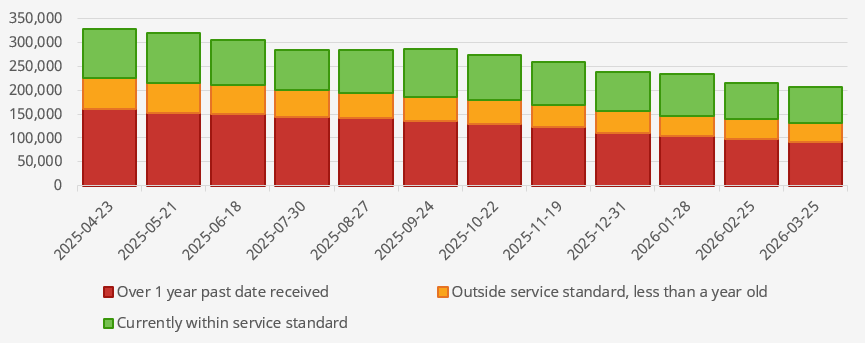
Figure 1: Text version
| Date | Currently within service standard | Outside service standard, less than a year old | Over 1 year past date received | Total |
|---|---|---|---|---|
| 2025-04-23 | 102,000 | 64,000 | 161,000 | 327,000 |
| 2025-05-21 | 105,000 | 62,000 | 153,000 | 320,000 |
| 2025-06-18 | 94,000 | 60,000 | 150,000 | 304,000 |
| 2025-07-30 | 84,000 | 56,000 | 144,000 | 284,000 |
| 2025-08-27 | 90,000 | 54,000 | 141,000 | 285,000 |
| 2025-09-24 | 101,000 | 50,000 | 136,000 | 287,000 |
| 2025-10-22 | 94,000 | 50,000 | 130,000 | 274,000 |
| 2025-11-19 | 88,000 | 48,000 | 122,000 | 258,000 |
| 2025-12-31 | 82,000 | 45,000 | 111,000 | 238,000 |
| 2026-01-28 | 87,000 | 41,000 | 105,000 | 233,000 |
| 2026-02-25 | 77,000 | 41,000 | 98,000 | 216,000 |
| 2026-03-25 | 74,000 | 40,000 | 92,000 | 206,000 |
This month
- 94,000 new transactions received between February 26 and March 25, 2026
- 104,000 transactions processed between February 26 and March 25, 2026, with 79000 processed manually and 25,000 processed through automation
- 87% of non-collective bargaining transactions within the last 12 months were processed within service standards
Figure 2: Transactions received and processed over the last 12 months
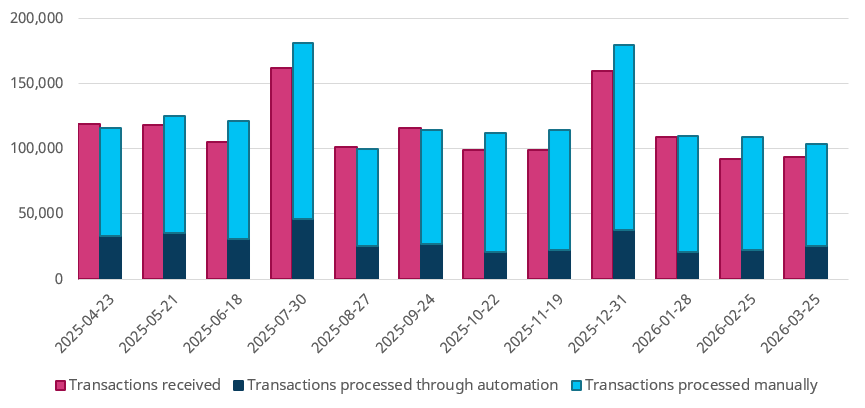
Figure 2: Text version
| Version date | Transactions received | Transactions processed through automation | Transactions processed manually |
|---|---|---|---|
| 2025-04-23 | 119,000 | 33,000 | 83,000 |
| 2025-05-21 | 118,000 | 35,000 | 90,000 |
| 2025-06-18 | 105,000 | 31,000 | 90,000 |
| 2025-07-30 | 162,000 | 46,000 | 135,000 |
| 2025-08-27 | 101,000 | 25,000 | 75,000 |
| 2025-09-24 | 116,000 | 27,000 | 87,000 |
| 2025-10-22 | 99,000 | 21,000 | 91,000 |
| 2025-11-19 | 99,000 | 22,000 | 92,000 |
| 2025-12-31 | 160,000 | 38,000 | 142,000 |
| 2026-01-28 | 109,000 | 21,000 | 89,000 |
| 2026-02-25 | 92,000 | 22,000 | 87,000 |
| 2026-03-25 | 94,000 | 25,000 | 79,000 |
5. Management Action Plan to the recommendations of the report of the Auditor General of Canada on Modernizing the Pay System
Recommendation 1—Backlog Elimination
OAG recommendation
Public Services and Procurement Canada (PSPC) should:
- assess and mitigate potential adverse effects of its approach to eliminating the backlog, including on departments and agencies onboarding to Dayforce later in the project, and promptly inform them
- include as part of this assessment ongoing and potential future events that may impact the number of new pay transactions, such as a reduction in the workforce of the public service
Departmental response
Agree.
PSPC agrees with the recommendation. Prioritizing any segment of the inventory over another must be informed by a comprehensive understanding of the impacts across departments and agencies.
PSPC will:
- assess the impacts of its approach on departments and agencies that will onboard to Dayforce later in the project and integrate findings into future backlog reduction strategies
- use evidence-based forecasting, to assess backlog reduction timelines and targets in light of future events that may impact the number of new pay transactions. This will help ensure legacy issues are addressed and not carried into Dayforce
Current Pay Centre inventory figures are available at:
Public Service Pay Centre dashboard
Description of final expected outcome/result
Backlog reduction plans consider deployment waves while ensuring equitable treatment and are:
- based on traceable, auditable evidence
- using repeatable, consistent logic to arrive at conclusions
- updated regularly with the latest data available
Risk monitoring for the backlog timelines:
- includes evidence-based metrics
- assesses backlog progress against the planned deployment timelines
- alerts of potential risks quickly
- is informed by the latest forecasts of incoming new pay transactions
Expected outcome:
A stable, predictable, and risk informed inventory analysis that provides insight into Dayforce onboarding readiness as well as cross-departmental progress on backlog elimination.
Continued optimization of operational planning to respond to immediate needs while adopting a more balanced approach to the elimination of older pay transactions for all Pay Centre departments.
Integration of any new risk assessments and evidence-based forecasting into backlog and inventory management planning and strategies.
Expected final completion date
Q4 FY 2026-27
Key interim milestones (description/dates)
- PSPC will assess its approach to eliminating the backlog of pay cases in the Phoenix system on departments and agencies that will be onboarding to the Dayforce Solution later in the project. (Due Date: Q1 FY 2026 to 2027)
- PSPC will present a post-June 2026 backlog reduction strategy to the Program Management Committee and Deputy Minister Sponsoring Group. (Due Date: Q1 FY 2026 to 2027)
- PSPC will promptly inform Pay Centre client departments of the results of activities described under interim milestones 1 and 2. (Due Date: Q2 FY 2026 to 2027)
- PSPC will model potential future events that could impact transaction volumes related to inventory including backlog, in addition to ongoing evidence-based modeling. (Due date: Q1 to Q4 FY 2026 to 2027)
Responsible organization/point of contact
PSPC—Human Capital Management (HCM)—Pay Administration Branch
PSPC—HCM—Strategy and Integration Branch
Recommendation 2—Service standards
OAG recommendation
The Treasury Board of Canada Secretariat (TBS), in coordination with PSPC, should address gaps in service standards that support timely and accurate pay and report government-wide results in meeting the standards to help ensure the employees' transactions are processed in a timely and accurate way.
Departmental response
Agree.
TBS’s Office of the Chief Human Resources Officer (TBS-OCHRO) has launched a review of the existing timeliness standards to ensure the standards and underlying methodologies remain relevant in today’s evolving operational environment.
To support this work, a Human Resources and Pay Subject Matter Expert Working Group was re established on November 26, 2025, with 22 participating organizations representing a balanced mix of Core Public Administration (CPA) and non-CPA organizations, separate employers, different pay service delivery models, and HR system clusters.
A phased approach is being taken where various core elements will be reviewed including the alignment of standards for all departments using the federal pay system to input accurate and timely data into Phoenix/Dayforce, as well the reporting against these standards.
Description of final expected outcome/result
Using in-depth data analytics to inform the review, the Working Group’s recommendations will be presented at the end of each phase.
The current phases are:
- Transactions Review—Business validation of included and excluded transactions
- Lateness Review—Analyzing lateness to consider a secondary target
- Pay Outcomes Review—Analyzing pay outcomes for employees to validate that methodologies for timeliness meet the business needs
- Reporting Review—Review and update reporting practices to ensure they meet both central agency and organizational needs
Expected final completion date
Q4 FY 2026 to 2027
Key interim milestones (description/dates)
The current phases are:
- Transactions Review—Business validation of included and excluded transactions (Due date: Q1 FY 2026 to 2027)
- Lateness Review—Analyzing lateness to consider a secondary target (Due date: Q2 FY 2026 to 2027)
- Pay Outcomes Review—Analyzing pay outcomes for employees to validate that methodologies for timeliness meet the business needs (Due date: Q3 FY 2026 to 2027)
- Reporting Review—Review and update reporting practices to ensure they meet both central agency and organizational needs (Due date: Q4 FY 2026 to 2027)
Responsible organization/point of contact
TBS-OCHRO
Recommendation 3—Detailed costing
OAG recommendation
As PSPC develops detailed cost estimates for the HR and Pay Transformation Project, the department should:
- include estimates of costs to transition departments and agencies to the new system
- develop KPIs that would measure whether costs to process pay transactions with Dayforce will decrease as compared to Phoenix
Departmental response
Agree.
PSPC agrees with the recommendation.
PSPC will include, in their detailed cost estimates for the project, cost estimates for the centralized surge capacity, targeted hyper-care, and concierge support services that PSPC will provide to departments in order to ensure consistent readiness in their transition to the new system.
PSPC will develop key performance indicators (KPIs), and the supporting methodological approach, that best supports conducting a cost analysis exercise to establish the closest approximation of transactional costs for processing pay between the two systems. Combined with our cost analysis for operating and maintenance, PSPC will be able to demonstrate whether costs to process pay transaction with Dayforce will decrease as compared to Phoenix.
Description of final expected outcome/result
- Clear and transparent cost estimates that fully account for the resources required to support departments throughout the transition, enabling informed financial planning and governance decision making
- A validated framework to establish the approximation of transactional costs for processing pay between Phoenix and Dayforce, supported by KPIs and a defensible, repeatable methodology
- An evidence based demonstration of whether Dayforce will reduce the cost of processing pay transactions relative to Phoenix, when assessed alongside ongoing operating and maintenance costs
Expected final completion date
Q1 FY 2028 to 2029
Key interim milestones (description/dates)
- PSPC will draft a cost assessment for the implementation of the Dayforce solution. (Due date: Q4 FY 2026 to 2027)
- PSPC will develop KPIs, aligned with benefits realization, and a supporting methodology that will be used to demonstrate the approximate costs of pay transactions of the two systems. (Due date: Q3 FY 2026 to 2027)
- PSPC will establish baselines for costs to process pay transactions in the current state. (Due date: Q4 FY 2026 to 2027)
- PSPC will begin collecting data to determine the cost to process pay in Dayforce following the Vanguard (CNSC, SSC, PSPC) deployments (Due date: Q4 FY 2027 to 2028)
- PSPC will produce an assessment of the results and demonstrate approximate costs to process pay transactions with Dayforce for Vanguard departments (Due date: Q1 FY 2028 to 2029)
Responsible organization/point of contact
Milestone 1: PSPC—HCM—Solutions Branch
Milestones 2 to 5: PSPC—HCM—Strategy and Integration Branch