
2026 National Adaptation Strategy Progress Report

Download the alternative format
(PDF format, 2.79 MB, 115 pages)
Minister’s Foreword
When we build resilience, we build a stronger Canada for generations to come. Our climate is changing, and we are already feeling the impacts. More frequent and severe weather events are increasing risks to our health and communities. That’s why we are improving our understanding of the risks and taking action to mitigate them while keeping affordability top of mind.
In 2023, the Government of Canada released the National Adaptation Strategy (NAS), setting out a vision to reduce the risk of climate-related disasters; protect nature and biodiversity; strengthen health systems; build and maintain resilient infrastructure; and support a strong, sustainable economy. The first National Adaptation Strategy Progress Report marks an important milestone in advancing that vision.
Since Fall 2022, the Government of Canada has committed more than $2.1 billion to implement the National Adaptation Strategy and support a wide range of adaptation-related activities. More recently, Budget 2025 introduced new community infrastructure and youth-focused initiatives that will further advance climate adaptation and resilience objectives across the country.
We continue to take action to strengthen resilience in communities across Canada. Most recently, we announced support for 141 climate resilience projects in 128 communities through the Green Municipal Fund’s Local Leadership for Climate Adaptation initiative.
This report highlights how whole-of-society commitments under the National Adaptation Strategy are leading to action across the country, as well as where progress has been made and where more action is still needed. This includes contributions from all orders of government, Indigenous communities and organizations, the private sector, and civil society. Progress includes improving awareness of wildfire risks across households in Canada and embedding climate resilience into federal infrastructure investments. It also provides evidence and insight to support informed decision-making on the next steps to increase Canada's climate resilience.
Since the launch of the strategy, we’ve made meaningful advancements across the five National Adaptation Strategy systems—disaster resilience, health and well-being, nature and biodiversity, infrastructure, and economy and workers—and we are controlling what we can.
One of our most recent strides was the release of “A Force of Nature: Canada’s Strategy to Protect Nature,” in March 2026. Canada’s natural environment is increasingly under threat. This strategy sets out how we will protect and restore critical habitats, ensure industrial strategies complement our conservation efforts, and mobilize new capital for nature. It also contributes to our goal to halt and reverse biodiversity loss under the National Adaptation Strategy.
The efforts outlined in this progress report showcase what can be accomplished through collaboration, innovation, and shared leadership. This evidence gives us the knowledge and confidence needed to act decisively.
As extreme weather events—like wildfires, floods, and extreme heat—become more severe and more frequent, ongoing action and investments across all jurisdictions are essential. Research shows that for every $1 we invest in adaptation measures, we save ourselves up to $15 in costs across the economy.
Building resilience is economically smart and fiscally responsible—it protects communities and ecosystems while reducing long-term costs and strengthening certainty for investments and economic growth.
Climate risks are growing, but so is our capacity to respond. Together, we are building Canada strong, fostering climate-resilience, and positioning ourselves for long-term economic success.
Executive summary
Climate change is increasing risks to Canada’s communities, health systems, ecosystems and economy, with its impacts growing in scale, cost and complexity. More frequent and severe wildfires, floods, heat waves, storms, as well as changes such as permafrost thaw and sea‑level rise are damaging infrastructure, disrupting services, increasing everyday costs, and placing lives and livelihoods at risk. These impacts worsen existing social and economic inequities, disproportionately affecting Indigenous, northern and underserved communities. When left unaddressed, these climate risks undermine productivity, increase costs, and affect confidence in Canada as a reliable destination for domestic and global investment.
The National Adaptation Strategy (NAS) provides Canada’s first whole-of-society framework to manage climate risks and build long-term climate resilience. It recognizes that climate resilience requires collective action across governments, Indigenous Peoples, businesses, civil society, institutions, and individuals. This first NAS Progress Report explores how well the NAS is working and provides an evidence-based snapshot of the state of climate resilience across Canada. It also measures progress against the updated NAS monitoring and evaluation framework.
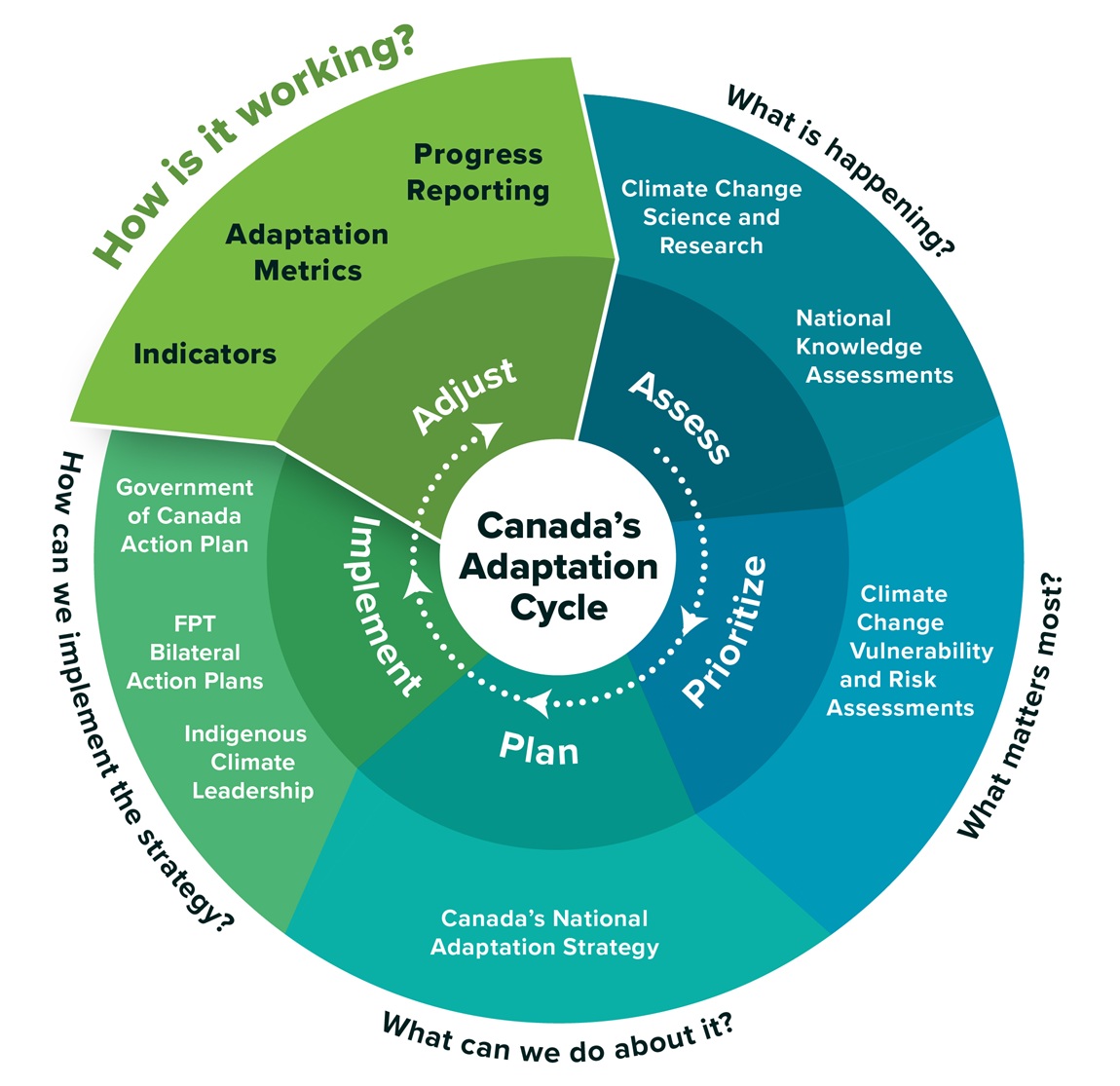
Long description
A circular figure with three levels describing Canada’s climate adaptation cycle, with an emphasis on the Adjust phase. The cycle consists of five iterative steps (level 1), each of which outlines key supporting documents and plans (level 2), and addresses key five questions (level 3), as follows: Step 1. Assess – through Climate Change Science and Research, National Knowledge Assessment, and Indigenous Knowledge Systems – responds to “What is happening?”; Step 2. Prioritize – through Climate Change Vulnerability and Risk Assessments – responds to “What matters most?”; Step 3. Plan – through Canada’s National Adaptation Strategy – responds to “What can we do about it?”; Step 4. Implement – through Government of Canada Action Plan, Federal-Provincial-Territorial Bilateral Action Plans, and Indigenous Climate Leadership – responds to “How can we implement the Strategy; and, Step 5. Adjust – through progress reporting, adaptation metrics, and indicators – responds to “How is it working?”.
Since the release of the NAS, meaningful progress on climate resilience has been made across the country. Results are emerging across all NAS systems.
- Foundational: Adaptation-enabling climate data, services, tailored tools, and governance systems have grown and are continuing to be expanded across Canada, supporting decision-making by communities, professionals, businesses and governments.
- Disaster resilience: Adaptation and risk reduction are increasingly being considered in Canada’s emergency management and disaster resilience efforts, with a greater emphasis on prevention, preparedness, and building back better, alongside growing awareness of flood and wildfire risks.
- Health and well-being: Health regions and systems across Canada are taking evidence-based adaptation measures to reduce risks, develop Heat Alert and Response Systems, and strengthen expertise on issues such as infectious diseases.
- Nature and biodiversity: Climate resilience is a benefit of many actions that prioritize the protection, conservation, restoration, and management of ecosystems, contributing to the protection of nature and biodiversity.
- Infrastructure: Resilience is increasingly being embedded into infrastructure planning, design, and investment decisions across Canada, and in 2025, Canada became the first country to embed future climate design values within the National Building Code.
- Economy and workers: Sectors across the country are integrating climate risk into business planning, operational standards and investment decisions.
Across Canada, coordinated efforts are underway to advance adaptation through policy, programs, standards, investment, and on‑the‑ground action. The Government of Canada Adaptation Action Plan is advancing 73 actions across 22 federal departments and agencies, enabling coordinated action across jurisdictions and systems. Federal, provincial and territorial cooperation on adaptation has continued to grow, with bilateral collaboration mechanisms underway between the Government of Canada and Governments of Northwest Territories, Yukon, Prince Edward Island, Manitoba, and Quebec. First Nations, Inuit and Métis governments and organizations have developed national, regional, and community-level climate change plans and strategies to advance Indigenous-led action. Across economic sectors, businesses and institutions are increasingly incorporating climate risk into planning, asset management and investment decisions. These efforts are protecting critical systems and strengthening Canada’s ability to manage climate risks.
Canada has achieved several near-term adaptation targets which together prioritized improving awareness of climate risks, climate services, consideration of climate resilience in decision-making and safeguarding nature. However, further implementation is required to build on this momentum and achieve transformational adaptation.
At the same time, Canada is warming about twice as fast as the global average, and about three times as fast in northern Canada, and the climate is continuing to change rapidly. Current efforts must expand and accelerate to keep pace with these growing impacts. While investments in adaptation are producing clear benefits, people across Canada continue to be exposed to significant risks and rising costs. Gaps remain between planning and implementation, with uneven capacity and access to tools and resources across regions and communities. Although the business case for adaptation is strong, competing priorities, capacity needs, and compounding risks are limiting our ability to act. Since the NAS was released, several important areas have emerged as priorities requiring greater climate resilience: food and water security, defence and national security, displacement of people, financial and economic resilience, housing, and artificial intelligence.
The National Adaptation Strategy provides Canada a strong foundation for action to improve climate resilience, and identifies new opportunities to strengthen these accomplishments and to address new and emerging areas. This report provides an early but important assessment of collective progress, reinforcing the need for sustained coordination across governments, strong Indigenous leadership and private sector engagement. By acting decisively together, across all of society, Canada can reduce climate risks, protect what matters most, and build a stronger, more resilient economy for current and future generations.
Introduction
Climate change threatens the well-being of people in Canada and the natural ecosystems on which all life forms depend. Social, economic and ecological disruptions caused by a changing climate are costing billions of dollars and affecting the health and well-being of everyone in Canada.
To prepare for and adapt to the unprecedented disruptions of a changing climate, Canada’s National Adaptation Strategy (NAS): Building Resilient Communities and a Strong Economy was published in 2023. The NAS presents a whole-of-society, collaborative approach for adapting to the impacts of climate change through five interconnected areas of adaptation action, or “systems”: disaster resilience, health and well-being, nature and biodiversity, infrastructure and economy and workers. It outlines a clear vision for climate resilience in Canada:
“All of us living in Canada, our communities, and the natural environment are resilient in the face of a changing climate. Our collective adaptation actions enhance our well-being and safety, promote justice, equity, and reconciliation with Indigenous Peoples, and secure a thriving natural environment and economy for future generations.”
The NAS is supported by other national and pan-Canadian strategies that are helping the people of Canada to build resilience and reduce greenhouse gas emissions across the country. These strategies include Canada’s 2030 Emissions Reduction Plan, Canada’s 2030 Nature Strategy, National Housing Strategy, Canada’s Poverty Reduction Strategy, Canadian Wildland Fire Strategy, the Emergency Management Strategy for Canada, Canada’s Greening Government Strategy and others. Within Canada, adaptation is a shared responsibility across every order of government, with federal, provincial, territorial, Indigenous and municipal governments sharing responsibility to advance action within their jurisdiction. Canada also recognizes that adaptation is a global challenge and the NAS contributes towards meeting the Global Goal on Adaptation under the Paris Agreement.
This Progress Report reflects how governments, organizations, industries and individuals across the country are implementing the NAS. Environment and Climate Change Canada (ECCC) led the development of the report with contributions from other government departments, provinces and territories, Indigenous representative organizations and adaptation stakeholders. This report includes an overview of collective progress and challenges in achieving the NAS’ goals, objectives, and targets to the end of 2025. It provides updates on the NAS’ guiding principles, implementation mechanisms, identifies emerging and developing policy areas for further action and international considerations. Annex 1 reports on the first update to the NAS monitoring and evaluation (M&E) framework, including new indicators to enable a more robust assessment of progress. Subsequent annexes provide an overview of actions underway across the federal government, provincial and territorial governments, First Nations, Inuit and Métis, and highly exposed economic sectors.
Progress towards goals, objectives and targets
Canada’s progress towards the goals, objectives, and targets of the National Adaptation Strategy are presented below with a focus on the foundational elements that underpin effective adaptation (knowledge and understanding, tools and resources, and governance and leadership) and five interconnected systems that support individuals and communities (disaster resilience, health and well-being, nature and biodiversity, infrastructure, and economy and workers).
Foundational elements
State of adaptation
Knowledge and understanding
Since the release of the NAS, the scientific understanding of future climate scenarios in Canada and how climate change will affect communities, economies, and nature has expanded. The Government of Canada has improved access to this knowledge by tailoring information to the needs of different sectors and communities. The Canadian Centre for Climate Services (CCCS) plays a central role in this work by providing climate data and information to help people in Canada become more resilient to climate change. CCCS-led products and services involve extensive user engagement, the production of future climate data products, the development of guidance and training, and coordinated dissemination of data and services with partners. Their work enables climate-sensitive sectors and communities to access climate projections across multiple emissions scenarios. Canada in a Changing Climate: National Assessment Process further supports adaptation by synthesizing and communicating the latest evidence on climate impacts. Recent publications include the Indigenous-led 2024 For Our Future: Indigenous Resilience Report and the 2026 Canada’s Changing Climate Report, a scientific assessment of past and future changes in Canada’s climate.
The Government of Canada is enabling adaptation through the development and provision of authoritative climate research, predictions, projections and modeling. This includes:
- The development of the Canadian Three Ocean Downscaling System, a regional ocean model for Canada, and the publication of high-resolution predictions and projections for precipitation, permafrost, sea ice, wildland fires, ocean waves, and sea-level rise. Modeling studies are also in progress to determine risks to water security in Canada.
- Monitoring and modelling changes in ocean conditions (including warming, deoxygenation, acidification, and sea-level rise), studying the impacts of those changes on ocean species, ecosystems, and coastal communities, and the development of nationally consistent decision-support tools (e.g. the Vertical Allowance and Relative Sea-Level Change datasets hosted on ClimateData.ca).
- Monitoring climate change’s effects on Canada’s permafrost, glaciers, sea levels, groundwater and marine landforms.
- Development of tools and guidance for land-use planning, infrastructure, community resilience and resource development.
- Investing in research to develop knowledge and tools to advance forest ecosystem resilience and sustainable forest management. This includes addressing wildland fire risk prevention and mitigation, forest change projections, biodiversity conservation, forest pests and disease, and developing new forestry practices.
The advancement of snow modelling, including upgrades to the Snow, Vegetation, Surface model, which provide more accurate snow water equivalent estimates. This knowledge is important for water management, hydropower, agriculture and flood forecasting. In 2025, ECCC released a reanalysis dataset (CaSR v.3.1) which combines weather observations with weather models to produce seamless weather records across space and time. These types of datasets are particularly useful in regions with limited weather station coverage. CaSR is used as a target dataset for downscaling climate projections, for hydrological trend studies, artificial intelligence model development, and North America-wide surface observation.
Rapid Extreme Weather Event Attribution system
Canada’s Rapid Extreme Weather Event Attribution system determines the link between human-caused climate change and extreme weather events across Canada. These insights inform response planning, decision-making and public understanding of climate impacts. For example, climate scientists in Canada examined 10 of the hottest heat waves that occurred in the country in July and August 2025. The system shows that of these heat waves, nine were made much more likely because of climate change. The August 7-14, 2025, heat wave in Atlantic Canada was at least 10 times more likely to occur because of human influence on the climate. The system is now also being used to analyze extreme precipitation.
Learn more at: Extreme weather event attribution - Canada.ca
Collaborations are critical to the Government of Canada’s research outputs. For example, climate scientists and policymakers within ECCC worked together to develop and share seasonal forecast products that align with the needs of users via ClimateData. Providing early insight into the most likely seasonal climate conditions empowers decision-makers in sectors such as agriculture, energy, defence and security to better assess potential risks and opportunities. Future work will expand access to a range of seasonal to decadal climate forecast products.
There is also an advancing body of adaptation implementation research. For example, in 2021 the National Research Council of Canada (NRC) launched the Resilience and Adaptation to Climatic Extreme Wildfires project to support mitigation and preparedness for growing wildland fire risks. The project is producing publications related to hazard and exposure assessment and developing modeling tools to plan for community evacuation. Furthermore, Canada is developing the capacity to better project changes to the water cycle in a changing climate. This includes the implementation of hydrological models to simulate streamflow under a range of future climate conditions and the development of water quality modelling systems to address the impacts of climate change on aquatic ecology and biodiversity.
The Government of Canada has increased investments in Indigenous Knowledge Systems and adaptation knowledge co-production aligned with First Nations, Inuit and Métis research protocols and data sovereignty. The Climate Change Preparedness in the North, First Nation Adapt, Indigenous Community-Based Climate Monitoring and the Climate Change and Health Adaptation programs work with Indigenous Peoples and northern communities and organizations to assess and respond to climate impacts. Projects cover the full spectrum of the adaptation cycle from risk and vulnerability assessments to the implementation of adaptation measures and monitoring. Projects also span a wide range of sectors including emergency preparedness, infrastructure, food security, health and transportation. By investing over $226 million in community-led projects since 2016, these programs have resulted in the following tangible adaptation outcomes:
- monitoring projects have hired 132 community members and trained 729 community members; including 105 youth hired, 138 trained
- invested in the establishment of 147 weather stations, 141 snow and ice monitoring programs and winter road and trail construction to ensure safe travel on the land
- supported 193 communities to undertake community-based monitoring initiatives, resulting in the establishment of 160 community baseline datasets and 153 multiyear datasets
- invested in 372 community risk and vulnerability assessments, enabling communities to identify adaptation measures and act on them
- supported 169 First Nations communities to undertake flood-mapping projects, resulting in 331 floodplain maps including in high-risk watersheds
- invested in 44 wildfire preparedness and FireSmart projects in Indigenous and northern communities
- a total of 169 initiatives in the North for erosion, flooding, and permafrost hazards
Demand for projects that support Indigenous and northern resiliency remain high, with many federal programs in this space being oversubscribed.
Tools and resources
People in Canada need access to practical tools and resources, along with strong local, regional and institutional capacity to integrate resilience considerations into decision-making and to turn knowledge into action.
Since 2023, Canada’s climate services landscape—and the demand for those services—has expanded. Uptake of tools and resources, including ClimateData.ca and ClimateInsight.ca, has grown sharply, with more people than ever accessing high-resolution climate data, analysis tools, and guidance to inform decision-making. For example, year-to-year growth in ClimateData.ca users has been accelerating since inception. There has been a near doubling of users between 2023-24 and 2024-25. Platforms supported by the CCCS now attract more than 20,000 monthly visitors, 3,000 monthly data downloads, and have more than 3,000 social media followers.
The CCCS Support Desk provides personalized support and guidance to help businesses, governments, researchers, NGOs and the general public access and use climate data. Since 2019, the Support Desk has responded to more than 4,500 requests for one-on-one support and guidance on integrating climate projections to support resilient infrastructure, national defence, Arctic development, public health, municipal planning and more. Data gaps identified through Support Desk requests inform the development of the next generation of user-friendly climate data products and services.
Canada’s national network of climate services providers continues to build local, regional and institutional capacity for adaptation. The organizations in this network, namely, the Pacific Climate Impacts Consortium, ClimateWest, Ouranos, CLIMAtlantic, and the Ontario Resource Centre for Climate Adaptation now provide full provincial coverage across Canada. Climate service providers are working to better meet the needs of Indigenous partners and clients. For example, the CCCS has been working with Cambium Indigenous Professional Services and the Cree Nation Government on approaches to translate climate data into context with lived experience so that it can be considered alongside Indigenous Knowledge as part of community adaptation planning. This approach along with network expansion has strengthened Canada’s capacity to coordinate and deliver locally relevant climate services.
Local Leadership for Climate Adaptation program
The Federation of Canadian Municipalities (FCM) launched its Local Leadership for Climate Adaptation program in 2024 to help communities strengthen their resilience to climate impacts. To support this commitment, Canada invested $530 million to fund community-based adaptation projects through the initiative, delivered via the FCM’s Green Municipal Fund.
The Local Leadership for Climate Adaptation initiative includes three funding tracks that aim to address different aspects of municipal climate resilience. The first track, “Climate-Ready Plans and Processes”, allocates $130 million to projects that integrate climate resilience into municipal systems, enhance adaptation planning in communities, and provide capacity development support for adaptation projects. The second track, “Adaptation in Action”, provides $227 million for projects focused on implementation, including feasibility assessments, fiscal tools, regulations, land-use planning, and small-scale capital projects that respond to municipal adaptation priorities. The third track, “Financing Adaptation”, dedicates $173 million to capital projects that test innovative financial models and leverage private sector investment in adaptation. This track has the goal of encouraging long-term financial support for municipal adaptation initiatives.
Since the initiative’s launch, the FCM has announced $36.7 million in funding for municipalities and organizations. This funding aims to strengthen local climate resilience across the Climate-Ready Plans and Processes and Adaptation in Action tracks. Further program launches are planned for 2026. The Residential Resilience Financing under the Financing Adaptation track provides funding to help Canadian municipalities develop and implement financing programs that make it easier for homeowners to invest in solutions to protect their homes from extreme weather, flooding, wildland fires and other climate threats.
Furthermore, organizations across Canada are developing and disseminating tools and resources to translate risk awareness into practical action. For example, the University of Waterloo’s Intact Centre on Climate Adaptation (Intact Centre) has developed accessible and evidence-based climate-ready infographics to help people take action to protect their homes and communities against extreme heat, flooding and wildfires. Intact Centre’s flood infographics are distributed by financial institutions and municipalities to approximately 3.7 million households, with 70% of recipients sharing that they implement at least two adaptation measures within six months. This model highlights the value of partnerships in translating research into user-friendly tools that empower people to prepare for climate risks, ultimately strengthening climate resilience and reducing long-term costs.
Governance and leadership
Responsibilities for climate change adaptation are shared across Canada.
- The federal government makes key contributions to adaptation action by demonstrating leadership, supporting foundational science and information, building knowledge and capacity, convening partners to coordinate action, and investing in adaptation solutions.
- Provinces and territories have jurisdiction over many areas that are critical for climate change resilience (e.g., land-use planning, building regulations, natural resource management, health systems, infrastructure, municipal affairs, emergency management).
- First Nations, Inuit and Métis equally are key partners in adaptation, holding rights to lands and territories. Indigenous Peoples are active drivers of change, contributing vital knowledge, experience, innovation and leadership on adaptation.
- Local governments are on the forefront of adaptation, particularly in areas such as land-use planning, emergency preparedness, and the delivery of local services that support community resilience.
This means that strong governance and leadership are required to establish clear roles and collaboration across jurisdictions.
Since the release of the National Adaptation Strategy, adaptation governance has been strengthened and expanded at all levels. At the federal level, adaptation governance tables steer interdepartmental coordination and strategic planning for NAS implementation. Further, each NAS system has a dedicated table at the federal level to advance coherent and effective action within that system. For example, Housing, Infrastructure and Communities Canada convenes the Accelerating Infrastructure Resilience table bringing together officials from across federal departments and agencies to facilitate a whole-of-government approach to advancing the goals and objectives of the infrastructure system and to ensure alignment across all NAS systems.
Providing leadership and ensuring that adaptation actions are aligned and coherent across the federal government is a key federal responsibility outlined in the NAS. Mechanisms outlined in the Government of Canada Adaptation Action Plan (GOCAAP) and detailed annexes clarifying federal roles and responsibilities have strengthened governance and coordination. Adaptation is affected by multiple mandates, sectors, and jurisdictions; addressing this complexity of climate impacts requires consistent uptake and coordinated implementation.
Multilateral partnerships among federal, provincial and territorial governments are increasing. Collaboration on adaptation and climate resilience are advanced through fora including the Canadian Council of Ministers of the Environment, Ministers Responsible for Emergency Management, Canadian Ministers of Agriculture, Ministers of Infrastructure, Canadian Council of Forest Ministers and Council of Ministers Responsible for Transportation and Highway Safety. Health authorities across the country engage through the Heat-Health Community of Practice, a forum for sharing best practices in protecting the health of people from extreme heat. Bilateral work between federal-provincial and federal-territorial governments is outlined in the Update on implementation mechanisms section of this report, and in provincial and territorial actions in Annex 3.
Between 2023 and 2025, the Government of Canada collaborated with First Nations, Inuit, Métis, and Modern Treaty and Self-Governing Nations to develop a distinctions-based Indigenous Climate Leadership Agenda. This work established partnerships with more than 50 Indigenous governments, treaty organizations, and representative organizations across Canada to advance climate adaptation and mitigation objectives. The Update on implementation mechanisms section of this report provides further details of Indigenous-led action, and First Nations, Inuit and Métis actions are outlined in Annex 4.
Indigenous leadership in adaptation is supported by bilateral engagement between the Government of Canada and Indigenous governments and organizations across the country. It is also supported by the three distinctions-based senior bilateral tables with First Nations, Inuit and Métis partners:
- The First Nations-Canada Joint Committee on Climate Action works to uplift First Nations rights and priorities in federal climate policy and programming.
- The Inuit-Canada Table on Clean Growth and Climate Change focuses on strengthening relationships, priorities identified in the National Inuit Climate Change Strategy and regional Inuit climate strategies, and advancing joint climate action.
- The Goose Moon Table (formerly the Métis Nation-Canada Joint Table on Clean Growth and Climate Change) focuses on building relationships, sharing information on joint policy development, and identifying Métis-specific priorities for federal climate programs and funding.
Indigenous Peoples across Canada also have distinct systems of governance that work to implement self-determined climate priorities. Examples include the Assembly of First Nation’s Advisory Committee on Climate Action and the Environment and Makivvik Corporation’s regional climate change committee.
Canada’s Climate Change Adaptation Platform established the Adaptation Plenary (2012-2026) to convene adaptation partners and stakeholders from across jurisdictions and sectors. The Plenary provided a national forum for knowledge exchange, relationship-building and alignment across governments, national Indigenous organizations, experts and non-governmental organizations (NGOs). As the adaptation landscape has evolved and expanded, the Plenary has fulfilled its original convening role, with engagement now continuing through other mechanisms—such as Adaptation Canada, the national adaptation conference.
Municipal leadership continues to strengthen through new investments. The NAS included an investment of $530 million in the Federation of Canadian Municipalities’ Green Municipal Fund which established the Local Leadership for Climate Adaptation initiative (see more details in the Tools and resources section of this report). There are also organizations across Canada that drive local action and leadership in resilience. These organizations include ICLEI – Local Governments for Sustainability Canada, a network of local governments committed to sustainable urban development. ICLEI Canada works with over 550 municipalities across the country and collaborates with diverse partners in government, Indigenous communities, industry, academia and NGOs to build equitable, net-zero, and climate-resilient communities.
Métis Nation British Columbia Adopt an Elder program
The Métis Nation British Columbia “Adopt an Elder” project is developing a culturally safe curriculum for Métis citizens in British Columbia to check in on elders in the community during extreme weather events such as extreme heat or extreme cold. This is an example of improving social connections, reducing isolation, and supporting cultural practices to enhance overall community resilience to climate change.
Future opportunities
As NAS implementation continues, there is an opportunity to scale-up efforts to ensure that foundational knowledge, tools and governance underpin adaptation. Climate considerations need to be integrated into routine planning and investment decisions, moving beyond fragmented efforts and towards the NAS vision. Decision-makers face challenges in understanding increasingly complex and interconnected climate risks at different timescales. While many jurisdictions across Canada have risk assessments in place, an updated national climate change risk assessment would enable comparison across regions and strengthen understanding of compounding and cascading risks. As Canada invests in nation-building projects that have a focus on supply chain resilience, economic diversification and energy reliability, there is an opportunity to consider a holistic and multi-hazard view of climate risk and build infrastructure that is resilient for generations to come.
Northern Canada is warming at roughly three times the global average and faces profound challenges fueled by climate change. Engaging Indigenous Knowledge Systems alongside northern-tailored climate services that help build climate service capacity in northern institutions and people will enable proactive risk identification and mitigation, driving the mobilization of public and private resources toward a climate-resilient society.
In addition, there is an opportunity to better communicate the benefits of resilience measures to help communities with decision-making for locally appropriate solutions. Continued collaboration and information-sharing at the local, regional and national levels, including through information services like ClimateData.ca and conferences like Adaptation Canada, will help build adaptive capacity.
Disaster resilience
State of adaptation
The costs of disaster response and recovery and the scale of potential losses from climate-related disasters far outpace the costs of proactive, ongoing work to address our climate risks. The goal of the disaster resilience system is that communities and all people in Canada are better prepared to prevent, mitigate, respond to, and recover from the hazards, risks and consequences of disasters linked to a changing climate, the well-being and livelihoods of people in Canada are better protected and overall disaster risks have been reduced, particularly for vulnerable sectors, regions, and populations at greater risk.
The Emergency Management Strategy for Canada: Toward a Resilient 2030 sets out shared priorities among federal, provincial and territorial governments and their partners for building disaster resilience in emergency management. The strategy identifies the need to shift focus toward proactive prevention, disaster risk reduction efforts and forward-looking recovery measures. It calls for enhanced collaboration and governance, improved disaster risk understanding, enhanced response capacity and coordination and strengthening recovery efforts by building back better.
Reducing the impacts of hazards and improving support for vulnerable communities
Growing evidence suggests that investments in climate adaptation and disaster risk reduction can reduce future disaster costs and impactsFootnote 1. Reducing disaster impacts and costs requires moving away from a post-disaster response only towards proactive, sustained investments in risk reduction and climate adaptation. Initiatives like the Disaster Mitigation and Adaptation Fund (DMAF), that focus on proactive disaster risk reduction, help curb future disaster costs and lessen reliance on the Disaster Financial Assistance Arrangements (DFAA). Since 2018, the DMAF has committed close to $3.66 billion to support structural and natural infrastructure projects that build resilience to the impacts of future disasters.
Resilience initiatives are expected to have a lasting positive impact on how Canada responds to and recovers from climate-related disasters. Modernized disaster financial assistance and risk reduction investments are expected to reduce the impacts of repeated disasters on communities across Canada. More accurate and accessible risk information is anticipated to give individuals, businesses, and communities more agency to develop and implement locally-appropriate adaptation solutions to address disaster risk.
Canada’s Northern residents and First Nations, Inuit and Métis are disproportionately impacted by climate-related disasters. This is due to the rapid pace of climate change in the North and the complex challenges of geographic remoteness, inadequate infrastructure and limited access to emergency services and resources.Footnote 2 First Nations communities are eighteen times more likely to be evacuated in emergencies, such as floods or wildfires, compared to other communities in Canada.Footnote 3 Disaster resilience in Indigenous communities continues to be shaped by systemic challenges, such as limitations in funding availability and eligibility, coordination and capacity challenges, and access to locally- and culturally-appropriate solutions. These intersect with the enduring impacts of colonization causing Indigenous Peoples to cope with the impacts of several disasters concurrently while facing ongoing barriers to disaster recovery and resilience.
To help address these challenges, Indigenous Services Canada (ISC)’s Emergency Management Assistance Program provides comprehensive emergency management supports for First Nations communities. This ensures that communities receive emergency support that is equitable and responsive to their unique needs. When an emergency event occurs, ISC reimburses 100% of eligible response and recovery costs for First Nations who have been affected. In addition, the Emergency Management Assistance Program provides funding to First Nations on reserve for mitigation and preparedness activities and helps restore communities and assets in a manner that reduces future vulnerability and strengthens resilience.
Despite the unique challenges they face, Indigenous Peoples have significant capacity and expertise, and have expressed the desire to build self-determined, community-based emergency management capacity focused on prevention, mitigation and preparedness. Supporting self-determined First Nations, Inuit and Métis leadership is critical to advancing more just and effective disaster resilience. Strengthened collaboration has resulted in a number of positive changes. These include the development of more culturally appropriate solutions to community evacuations in recent flood and wildfire seasons, such as on-the-land options and nations hosting nations.Footnote 4 Complementary efforts through the Oceans Protection Plan are also strengthening safety and response capacity in the Arctic, which will help Northern and Indigenous communities better prepare for and respond to growing climate-related risks.
ISC has also worked to better prioritize funding for community infrastructure improvements under the First Nations Infrastructure Fund. In addition, funding under the Capacity Enhancement stream of the Emergency Management Assistance Program for First Nations has supported the hiring of emergency management coordinators who provide local leadership in disaster planning and risk reduction.
Governance mechanisms are established for stronger disaster risk reduction coordination
As disasters and hazards become more complex in scale, governance systems need to leverage successes and foster broader collaboration. Senior Officials Responsible for Emergency Management is a federal-provincial-territorial body that works to harmonize and improve emergency practices across the country. The forum is also responsible for providing direction, advice and support to committees and working groups and non-governmental organizations dealing with crisis and consequence management issues at a national level.
To support efforts to reduce climate equity disparities and the disproportionate impacts of climate change on Indigenous Peoples, the Government of Canada has provided funding to increase Emergency Management Coordinator coverage to support First Nations communities and Tribal Councils at highest risk. This strengthens community preparedness, supports planning, coordination, and readiness. Coordinators also improve emergency response capacity and help ensure emergency management approaches are culturally grounded and community driven in First Nations communities. In parallel, a federally-led Indigenous Emergency Management Working Group that includes Indigenous partners and federal, provincial, and territorial senior officials has been established and is expected to convene regularly to align and coordinate on priority actions aimed at building distinction-based emergency management and disaster resilience.Footnote 5
All communities can improve emergency readiness
The Intact Centre’s Alberta FireSmart Community Scorecard established the foundation for a National FireSmart Community Scorecard. This tool is designed to help municipalities identify gaps and strengthen wildfire resilience across Canada.
Since 1993, FireSmart Canada is a national public safety and risk reduction program focused on home- and neighborhood-level fire resilience. The program provides information, educational tools, and outreach to support individuals and communities in applying FireSmart principles. In response to the high national demand for this program, the Government of Canada is providing funding under the Resilient Communities through FireSmart program to enable more communities across Canada to adopt FireSmart measures.
Wadin Bay, Saskatchewan’s first FireSmart community, credited the program for sparing the town from severe damage when a wildfire passed directly over it in 2015. Footnote 6
The Resilient Communities through FireSmart program is part of the Wildfire Resilient Futures Initiative, which provides over $284 million over five years, starting in 2023-24 toward projects to help communities adapt and be safe. The Initiative also supports research projects that build and mobilize foundational wildland fire knowledge, and the development of a national virtual Centre of Excellence for Wildland Fire Innovation and Resilience—the Wildfire Resilience Consortium of Canada. The Consortium was established in 2025 to act as a national and international resource on wildland fire science and knowledge. The Consortium integrates Indigenous fire stewardship, advanced technology, and diverse knowledge sharing networks to transform wildfire management in Canada. Together, these initiatives strengthen both immediate preparedness and long-term adaptation to wildfire risk.
Informed and inclusive readiness, mitigation and recovery plans and policies
Whether communities are recovering from a disaster or working to prevent and prepare for a future disaster, they often lack practical guidance and expertise on how to implement mitigation and resilience measures. To address this challenge, the Government of Canada, in partnership with the Institute for Catastrophic Loss Reduction, established the Canadian Centre for Recovery and Resilience. The Centre provides support before, during and after disasters, helping communities develop recovery plans that embed risk reduction and resilience principles. It connects communities with a network of experienced practitioners, maintains a comprehensive library of tools and resources and offers tailored training and learning events. It can also offer direct support to communities before or after a disaster to help them plan for resilient recovery and supplement local capacity.
Regional cooperation and collaboration: towns of Banff and Canmore, Alberta
Banff and Canmore share similar hazards, risks, and vulnerabilities, as well as a long-standing history of sharing human and operational resources. The 2013 southern Alberta floods made clear the need for joint emergency management functions. Also, the increasing wildland fire risk profile throughout the region necessitated more formal interjurisdictional planning and cooperation.
In 2023, both towns approved their respective Bow Valley Regional Emergency Management Bylaws. These bylaws were the impetus for creating a regional emergency management advisory committee, an agency with representation from both towns, and a regional emergency management plan, and to hire a Regional Emergency Management Coordinator. The regional emergency management plan was made possible by funding from an Alberta Community Partnership Intermunicipal Collaboration grant. It includes a governance structure that applies throughout the preparedness, response, and recovery phases of incidents, which eliminates uncertainty around authorities and jurisdiction during emergencies, and reduces costly duplication and competition for resources.
Canmore and Banff continue to collaborate to provide regional incident management team training, and to share resources with neighboring jurisdictions to support projects related to regional evacuation and mass casualty incidents. The regional framework was successfully used in June 2025 to establish a Regional Emergency Coordination Centre to manage the G7 Leaders’ Summit in Kananaskis.
Flooding is Canada’s most common and costly natural hazard, causing approximately $800 million in insurable losses annually over the past decade.Footnote 7 Canada’s exposure to flood hazards is growing due to increases in extreme precipitation and rapid urban development in flood-prone areas. Yet 94% of people located in high-risk flood areas are not aware that their home or property is susceptible.Footnote 8 Making risk information available helps raise public awareness and mobilize action.
The Flood Hazard Identification and Mapping Program partners the federal government with key stakeholders to advance flood hazard mapping including collaborating with provincial and territorial governments to map flood hazard across Canada. Under this program, there are over 400 flood mapping related projects established under agreements with all provinces and territories. These projects contribute to foundational datasets for mapping and are expected to produce over 1,000 updated flood hazard maps from detailed engineered flood studies for over 800 communities or higher risk areas. There are also over 30 projects to advance flood hazard mapping science including projects that advance innovative artificial intelligence solutions and regional modelling where it was not feasible to undertake detailed engineered studies. The program also supports the Federal Flood Mapping Guidelines series, which are resources for practitioners to help advance flood mapping in Canada.
Federal, provincial, and territorial cooperation to advance flood hazard mapping coverage throughout Canada: Prince Edward Island Spotlight
Prince Edward Island is the first province to achieve full coverage in flood hazard mapping. The Government of Prince Edward Island and the University of Prince Edward Island Climate Smart Lab enhanced and launched the Climate Hazard and Risk Information System in 2025. This interactive mapping portal is designed to help residents, municipalities, and professionals understand and prepare for climate-related risks. The platform integrates Mi’kmaq place names across the map viewer. It recognizes the Island as Epekwitk, meaning “something lying on the water”, and honors the Mi’kmaq as the original stewards of these lands and waters for over 12,000 years.
Using a Canada-wide flood hazard model, the Government of Canada has created the Federally Identified Flood Risk Areas datasets to supplement and complement existing flood hazard information. The datasets identify areas of low, moderate, high, and extreme flood hazard for all of Canada and include information on the contributing flood types. The Government of Canada will use these datasets to make flood hazard rating and flood type information publicly viewable through Canada’s Flood Risk Finder.
Coastal flooding risks are also becoming easier to understand through tools such as the Canadian Extreme Water Level Adaptation Tool. The Tool combines sea-level rise projections with observed water-level data to estimate future coastal flood thresholds, helping communities assess when extreme water levels may exceed critical elevations and infrastructure heights. The findings support evidence-based planning, infrastructure design and adaptation decisions in coastal regions that are vulnerable to storm surges and climate-driven sea-level rise.
Minimizing disruptions to people
As climate disasters become more severe and frequent, long-term recovery solutions are becoming increasingly urgent. In response, in 2025, the Government of Canada launched the modernized DFAA program. The DFAA is Canada’s primary mechanism for providing financial support to provinces and territories for large-scale disaster response and recovery. The program has historically focused on repairing damages to pre-disaster levels. The new DFAA focuses on creating opportunities for risk reduction in a post-disaster context by providing significant funding for strategic risk mitigation measures to damage homes and infrastructure. New eligibility requirements set minimum resilience standards and discourage rebuilding in ways that perpetuate vulnerability to future events. Furthermore, the DFAA program expands post-disaster support for housing, mental health, and financial assistance, helping individuals and communities recover more effectively while building lasting resilience.
The DFAA includes a financial incentive for provinces and territories for activities to reduce risk and implement adaptation measures. The incentive encourages risk assessments, mitigation planning and pre-disaster recovery planning. By promoting resilience and pre-disaster risk reduction as part of the recovery process, the DFAA can serve as a catalyst for local climate adaptation. This is especially true in high-risk areas while reducing the long-term costs and the impacts of climate-related disasters.
Future opportunities
Human activities have already affected the frequency and intensity of extreme temperature events in Canada. For example, summer droughts are projected to become longer, more intense and occur more frequently in southern Canada. As climate risks evolve, people in Canada are increasingly likely to experience new disasters before they have recovered from the previous one. This presents an opportunity to strengthen how communities, governments and institutions plan for and manage interconnected hazards across the emergency management cycle.
Viewing emergency management as an intrinsic part of the broader disaster resilience system creates opportunities to further align prevention, preparedness, response, and recovery. Emergency management should be more clearly linked to and supported as part of disaster resilience as a system, reinforcing climate adaptation and disaster risk reduction as driving principles. Updated national data and information on climate risks are important steps to support better decision making. As emergency management policies come under review and renewal, policy instruments are developed, and funding opportunities emerge, there will be opportunities to consider how emergency management and broader disaster resilience can be mutually reinforced.
As implementation continues, there is an opportunity to mobilize whole-of-society resources for disaster resilience. For example, risk sharing can transform insurance coverage to allow access to coverage for hazards that are under-insured. Over 1.5 million Canadian households at high risk lack access to adequate and affordable flood insurance.Footnote 9 Since 2021, federal, provincial and territorial officials, the insurance industry, and other partners have worked together to explore potential solutions to address this critical protection gap.
Health and well-being
State of adaptation
Climate change poses an increasing threat to the health and well-being of people in CanadaFootnote 10. It is influencing the frequency and intensity of extreme heat, wildfires, hurricanes, floods, and the spread of climate-sensitive infectious diseases, exposing people to greater health risks. Climate change is also degrading air and water quality, compromising food safety and security, and impacting mental health. These growing risks can affect everyone. However, children, youth, older adults, people with pre-existing physical and mental health conditions, people with disabilities, people facing financial hardship, and Indigenous Peoples are among those most at risk.
In addition to the direct impacts on people’s health, climate change also threatens the ability of health systems to deliver services. Health systems include all individuals, institutions and activities dedicated to promoting, restoring or maintaining health. Climate-related events can damage critical infrastructure such as hospitals, clinics, and pharmacies; compromise medical and non-medical supply chains; strain information and transportation systems; and jeopardize essential support services like power, water and food supply. These impacts can be especially detrimental to small, remote, and rural communities. At the same time, the impacts of climate change can increase demand for health services. This dual pressure can drive up health sector costs and strain system capacity, overburden the health workforce, and compound existing inequities for access to health services. Effective adaptation to climate change requires actions at various levels within health systems and coordinated efforts across society such as energy systems, built environment, and emergency management.
These impacts on people’s health and health systems have far-reaching consequences for society. For example, when extreme weather disrupts health services, people may miss work due to long wait times at hospital emergency departments or untreated illnesses. This reduces productivity and slows economic activity. In 2024, heat exposure resulted in a loss of an estimated 40,220,000 potential labour hours in Canada, 136% more than the annual averages experienced between 1990 and 1999.Footnote 11 Health systems play a critical role in driving economic and social well-being within communities, and functioning health services are essential for enabling economic development and increasing Canada’s economic competitiveness. Additionally, Canadian defence and security forces are reliant on civilian health systems to seek care, and they are called upon to support responses to emergencies resulting from extreme events, diverting resources from their mission to defend Canada.
The objectives of the health and well-being system under the NAS reflect the broad scope of action needed to address current climate-related health risks while preparing for future challenges. Despite progress having been made in adapting health systems in Canada, climate risks are increasing. Canada’s focus on strengthening the economy and protecting national sovereignty has further highlighted the need to improve the resilience of health systems.
Strengthening expertise, knowledge, and resources to address health risks
Many health systems in Canada are taking measures to strengthen their capacity to address climate-related health risks by allocating resources for climate change and health adaptation initiatives, training the health workforce, leveraging international guidance, developing new guidance and tools, and addressing critical knowledge gaps through research. These efforts aim to equip health systems with the expertise and information needed to understand the health impacts of climate change and implement equitable and evidence-based interventions to address these impacts.
Continuing to build a climate-ready health workforce requires equipping staff with the knowledge and skills to prevent and manage the health risks and impacts of climate change. To support this, in British Columbia, the Ministry of Health developed a training course tailored to the province’s health workforce. This course targets a broad range of learners from frontline staff to senior leadership across diverse areas (e.g., public health, emergency management, clinical care, facilities and food services). Drawing on real-world examples from the British Columbia context, the course explores the impacts of climate change on health and the health system, examines the environmental impact of health care, and empowers staff to build climate action into their daily work. At the national level, Health Canada partnered with international organizations (e.g., the Global Consortium on Climate and Health Education, World Health Organization, Pan-American Health Organization) to develop guidance and deliver courses to educate health professionals on building climate-resilient health systems.
Research is advancing to help provide decision-makers, policymakers, health professionals, and the public with the knowledge needed to protect health from the repercussions of a changing climate. For example, the University of Ottawa is conducting research on the risks to human health caused by exposure to high indoor temperatures. This research aims to help protect those most susceptible, including older adults and individuals living with mental illnesses. The Centre for Health and Community Research at the University of Prince Edward Island worked with partners to design spatial and story maps to visualize the social and health factors that affect people’s abilities to adapt and respond to the health impacts of climate change. Research results are helping decision-makers tailor adaptation measures to protect people at greater risk.
In addition, through the Canadian Institutes of Health Research (CIHR), the Government of Canada continues to fund research on climate change and health. This includes supporting community-based research projects focused on climate change priority areas such as climate justice, health impacts on older adults, infectious diseases such as Lyme disease, and food security in northern communities. CIHR has also invested in climate change emergencies, assessing the impact of wildfires on health; one study assesses how wildfire smoke affects long-term lung health, determining how factors like age or lifestyle influence its impact, to inform future clinical and public health responses. CIHR also invested in the Network Environments for Indigenous Health Research National Coordinating Centre at the University of Saskatchewan, to assess health impacts of wildfire evacuation on First Nations and Métis communities.
However, resource and information gaps remain within health systems across Canada. For example, health authorities and community organizations lack access to resources dedicated to climate change and health work. This limits their abilities to undertake vulnerability assessments, train staff, and monitor risks and impacts. Current levels of climate and health education and training among health professionals remain insufficient, and knowledge of climate-related health impacts within health systems varies. For instance, a 2024 national survey highlighted that few health professionals feel confident providing zoonotic, including climate-sensitive infectious disease-related, information or services. Many are interested in additional training—especially on treatment, prevention, and diagnosis.Footnote 12 A 2025 report drawing from the 2022 national climate change and health assessment led by Health Canada, Health of Canadians in a Changing Climate: Advancing our Knowledge for Action, highlighted 135 specific research needs across nine key areas requiring further investigation.Footnote 13 Sustained efforts are needed to address persisting knowledge gaps and to equip health sector professionals and people in Canada with information, guidance and tools to protect health and address the growing risks associated with a rapidly warming climate.
Monitoring the risks and evaluating progress in climate adaptation
Many Indigenous, provincial, territorial and regional health authorities are conducting assessments to understand the relationship between climate change and health, to identify populations and regions that are disproportionately impacted, and to develop adaptation plans. Under the Climate Change and Health Capacity Building Program’s two streams, HealthADAPT and HeatADAPT, Health Canada supports work that strengthens the climate resilience of health systems and that helps to protect the health of people in Canada from extreme heat, respectively. In 2024 and as part of this initiative, Health Canada supported six organizations to focus on activities that included developing and implementing climate-health vulnerability and adaptation assessments, adaptation plans, and targeted interventions.
ISC expanded funding to support First Nations and Inuit communities through the Climate Change and Health Adaptation Program in the North. Since 2023, this funding has supported 25 new First Nations and Inuit-led projects that identify, assess and respond to local and regional climate-related health impacts. As a result, nearly all Northern communities, including those across Inuit Nunangat, have reportedFootnote 14 being better equipped to lead adaptation actions, strengthen local capacity and build resilience to growing climate-driven health challenges. ISC also supported a two-year engagement process led by regional Indigenous health organizations to identify gaps and priorities in building climate-resilient Indigenous health systems. Preliminary outcomes indicate stronger cross-government partnerships and community-led initiatives are beginning to mainstream climate change across Indigenous health programming, though sustained funding is needed to scale up impact. Indigenous-led, culturally grounded approaches, particularly in emergency management, food sovereignty, climate-health education and data stewardship, are essential next steps in strengthening Indigenous health systems and long-term wellness for people, lands and future generations.
At the same time, Canada’s ability to monitor climate-related health risks and track adaptation progress is constrained by gaps in data to inform an understanding of how climate shocks and stresses are affecting the performance of health systems and people’s health. These gaps are most pronounced for Indigenous Peoples, racialized communities, and residents of Northern, rural and remote regions. There are also gaps in areas such as mental health impacts, health outcomes from community evacuations, and the economic implications of climate-health risks and adaptation actions.
While meaningful progress is underway, there is still work ahead to build the evidence base needed to effectively monitor risks and evaluate Canada’s climate-health adaptation efforts.
Preparing for health risks in British Columbia
BC’s Ministry of Health, with support from the federal government, commissioned the report Climate Change and Health in British Columbia: From Risk to Resilience to enhance understanding and awareness of the health impacts of climate change in BC. The report examines key climate hazards, such as extreme heat, wildfire, flooding and drought, and their implications for population health and B.C.’s health system, as well as the factors that influence health risks and system resilience. Knowledge products and resources developed alongside the report include interactive story maps and research and policy guides. Building on the provincial report, all regional health authorities in the province have initiated or completed climate and health assessments to better understand the risks and adaptive capacity within their organizations and regions. These provincial and regional assessments have directly informed the development of climate plans and strategies, which are now in place at BC’s Ministry of Health and all regional health authorities.
Protecting people from urgent climate-related health risks
Health systems are implementing and improving actions to protect people’s health from climate-related health risks. One example is the work to advance Heat Alert and Response Systems, which are implemented by health authorities to help the health sector and communities prepare for and respond to extreme heat events. The systems can include community mobilization and engagement, an alert protocol, a community response plan, a communication plan, and an evaluation plan. Provinces, territories and regional health authorities have systems in place, with more under development. For example, Newfoundland and Labrador and Prince Edward Island are in the early stages of developing province-wide Heat Alert and Response Systems. Some regional health authorities are also partnering with municipalities to develop heat response plans.
To support health authorities during wildfires, in 2024, the Wildfire Toolkit for Public Health Authorities was updated to incorporate guidance on evacuations and other public health measures. This helps to support safer, more equitable responses to wildfires. Canada has also updated its air quality information provided through the Air Quality Health Index to better reflect the health risks from wildfire smoke. While these updates are applied nationwide during wildfire season, the Air Quality Health Index currently reaches only 80% of the population and approximately one fifth of Indigenous communities. In addition, Canada strengthened the health protective messaging in air quality alerts issued to all communities affected by wildfire smoke.
Climate change is also increasing the spread of zoonotic, food- and water-borne infectious diseases transmitted via animals, humans and the environment. In response, new partnerships have been initiated between the Public Health Agency of Canada (PHAC) and health professional associations. These partnerships aim to update public health guidance, enhance the integration of new climate change content into nursing education and share best practices for building capacity on zoonoses and the health effects of climate change. In 2024, PHAC partnered with the Canadian Centre for Occupational Health and Safety to develop and implement an occupational exposure strategy with resources to help prevent zoonotic diseases, including tick-borne and mosquito-borne diseases. Additional activities were undertaken to enhance access to and awareness of vector-borne disease education and knowledge resources through social media campaigns, virtual and travelling tick exhibits, infographics and interactive maps. New and improved data-generating activities (e.g., surveillance and modelling) and data management systems have also enabled effective data sharing to support decision-making. For example, PHAC launched interactive data dashboards on tick-borne and mosquito-borne diseases to provide timely and accessible surveillance information and case updates during periods of high transmission.
Effective adaptation requires implementing actions that benefit those who are disproportionately impacted. Indigenous Peoples in Canada are experiencing increasing and unique health impacts from climate-related changes to their environments. These impacts include unpredictable ice conditions, shifting wildlife patterns, and more frequent emergencies resulting from wildfires, floods and extreme weather events. These impacts, compounded with the multi-generational impact of colonialism, affect food safety, increase injury risk, and contribute to physical and mental health disparities. Indigenous health systems are working to implement and strengthen measures to protect health during these events while simultaneously adapting to long-term climate pressures. This includes community-driven environmental health monitoring (e.g., health impacts and air quality) that incorporates traditional knowledge. Indigenous health leaders are also advancing climate-ready health services, but more work is needed to promote wellness and strengthen health system resilience in the face of rapidly accelerating climate change.
Protecting health from climate change impacts requires timely access to responsive, high-quality and affordable healthcare. Universal health coverage provides protection from the health impacts of climate-related disasters and from the longer-term effects of climate change. Canada scores high globally on the World Health Organization’s universal health coverage index. However, access to care, including primary care, continues to be a challenge in Canada. Furthermore, access to care varies significantly across population groups. Strengthening the resilience of health facility infrastructure and supply chains, supporting the well-being of healthcare staff, and ensuring continuity of service delivery during emergencies, can improve universal health coverage in the face of climate change. The federal government’s funding through the “Working Together to Improve Health Care in Canada” bilateral agreements with all provinces and territories is intended to be flexible and tailored, so that provinces and territories can address the unique needs of their population and geography. Additionally, standards organizations are exploring opportunities to update standards and requirements for health facilities and institutions in Canada to include climate resilience considerations in their operational and infrastructure planning.
Maximizing health benefits through cross-sectoral climate action
Efforts are being made to collaborate across sectors (e.g., water, agriculture, insurance, defence, housing, energy, environment, emergency management, transport, labour and infrastructure) to incorporate health considerations in broader adaptation actions and avoid measures that may be harmful to health. Demonstrating and emphasizing health co-benefits can help individuals, communities, and decision-makers understand the direct and tangible advantages of climate action. For example, since most heat-related deaths in Canada occur indoors, health authorities and municipalities across Canada are considering opportunities to protect health from indoor heat. Notably, British Columbia updated its Provincial Building Code in 2024 to require all new homes to include at least one room that can be maintained below 26°C, as research shows setting a maximum indoor temperature limit can significantly reduce health risks. As another example, the Standards Council of Canada Guidebook Fundamentals for Thermal Comfort and Safety: Designing Climate-Ready Playgrounds, informs stakeholders on how to design playgrounds that reduce health risks from climate change and improve the comfort and safety of children. Finally, ECCC launched colour-coded weather alerts with yellow, orange, and red levels for weather warnings, advisories and watches. The colours are based on the forecast confidence and the potential impacts of weather conditions, including the effects on people’s health. The new system aims to make it easier for people to take actions that keep themselves and their communities healthy and safe.
Another driver of cross-sectoral collaboration is the economic impact of illness, injury and disease from climate change. Outdoor workers, such as those in construction, farming, and security as well as workers in hot indoor environments (e.g., manufacturing plants) can face greater risks of heat illness and death. In addition, climate change is threatening the mental health of people in Canada, with widespread impacts and costs, yet effective adaptation measures to protect the mental health of people in Canada remain limited. The costs of mental health disorders are already high in Canada (e.g., productivity losses associated with depression cost approximately $34 billion per year)Footnote 15. Future costs are expected to grow because of the impacts of climate change. The federal government is working collaboratively with provinces, territories and stakeholders to improve mental wellness supports across the country, including through significant investments through the Youth Mental Health Fund and the expansion of Integrated Youth Services hubs.
An enabling factor for cross-sectoral collaboration has been the incorporation of climate change and health within strategic plans and governance. For example, climate change adaptation is a key goal in Ottawa Public Health’s strategic plan. Ottawa Public Health has aligned adaptation actions with the City of Ottawa’s climate resiliency plans and policies. Additionally, the City has incorporated climate actions into governance structures, through integration of public health staff into its climate resiliency unit.
Future opportunities
To address the impacts of climate change on people’s health, increased and widespread action and collaboration, particularly for at-risk populations, are needed across health systems. The health sector can maximize impact by integrating health into broader adaptation actions. For example, climate-resilient housing that includes protection from extreme heat, wildland fires, and floods (and in the North, the effects of thawing permafrost, which may increase radon exposure and air quality issues as a result of mold), help to protect the health of occupants, thereby reducing costs and burdens on health systems. Enhancing access to the social, structural and environmental determinants of health can promote people’s abilities to take decisions that protect their health.
Enhancing health system capacity to respond to climate-related impacts can also support economic and security objectives. Increasing health system resilience would reduce the need to mobilize civilian or military first responders during extreme weather events. Evaluating and identifying cost-effective and protective health adaptation measures and integrating health within adaptation action can also lessen the economic impacts of climate change. This can be done by reducing medical costs to individuals, minimizing health sector costs from system-level disruptions, and preventing costs associated with lost labour productivity and diminished quality of life. Further research and strong partnerships across sectors, all levels of government, Indigenous communities, and international partners are needed to reduce economic and security impacts and protect health in a changing climate.
In addition, there is a knowledge gap around climate-sensitive infectious diseases and how to improve preventive behaviours. Addressing this requires training of professionals, identifying behavioural barriers and motivators, assessing disease impacts, and evaluating tools to develop targeted interventions. To anticipate emerging disease risks, there is a need to advance laboratory diagnostics, detection technologies and strengthen forecasting, modelling, scientific analysis, and research capacity allowing for earlier warnings of future threats. The health sector can improve surveillance systems and data management tools by embedding equity considerations and strengthening One HealthFootnote 16 approaches to surveillance and monitoring activities. One Health is an integrated, collaborative and transdisciplinary approach aimed at optimizing the health of people, animals, plants and the ecosystem. It is important to engage Indigenous partners to meaningfully integrate Indigenous Knowledge Systems, which have long recognized the interconnectedness between all beings and the environment.
Looking ahead, strengthening health information systems in Canada presents a major opportunity to accelerate progress in climate-health adaptation. Robust, interoperable and consistent data infrastructures are foundational for effective adaptation measures and for advancing all health and well-being system objectives. Priorities include conducting vulnerability and adaptation assessments in regions not yet assessed, expanding and diversifying data sources, strengthening the linkages between climate and health data, establishing standardized M&E frameworks with meaningful indicators and building capacity within health systems to routinely collect, analyze, and interpret climate-related health information. For example, the way that current health information systems are designed means it is challenging to attribute and correlate health outcomes and impacts (e.g., chronic diseases, injuries, mental health) to climate-related events in a specific geographic location or period. Evaluations are needed on the effectiveness of adaptation measures tailored to the context in Canada. With these improvements, Canada can generate the evidence needed to guide more equitable, effective and forward-looking climate-health adaptation efforts. This information is critical to inform interventions that protect everyone in Canada, especially those who are at greater risk from climate impacts.
Nature and biodiversity
This system aims to halt and reverse biodiversity loss and to enhance the resilience of ecosystems and communities in a changing climate. To achieve this, actions taken seek to advance four objectives: transforming activities for nature, scaling nature-based climate solutions, strengthening ecosystem resilience and supporting Indigenous stewardship. The nexus between nature and adaptation is also reflected across multiple NAS systems, underscoring the urgency of addressing climate change and nature loss concurrently and the value of implementing integrated solutions to these challenges that compound each other.
State of adaptation
As Canada’s 2030 Nature Strategy makes clear, climate change and biodiversity loss are inextricably linked and must be addressed together. Nature provides essential goods and services that support the well-being of communities across the country. These include clean air and water, fertile soils, flood control, climate regulation, pollination and food. The changing climate has profound implications for Canada’s economic and social prosperity, as well as national security, as all are fully dependent on a healthy and functioning environment. The relationship between nature and climate change adaptation can be viewed in two ways: the impacts of climate change on nature and biodiversity, and the role of nature in reducing climate change risks and supporting human well-being. These two lenses are addressed in greater detail below.
Transforming human activities to protect biodiversity and enhance ecosystem connectivity
Climate change is degrading ecosystems and causing biodiversity loss across Canada. As a result, adaptation efforts for nature must focus on reducing the pressures and vulnerabilities that undermine ecosystem health. This aim can be achieved by accounting for current and future climate conditions in the conservation, protection, restoration, and management of ecosystems. For example, the ongoing riverbank restoration project in Miawpukek First Nation in Newfoundland and Labrador. This initiative is helping to restore marine ecosystem health to improve conditions for salmon and other aquatic species by reducing erosion accelerated by extreme weather conditions.
A 2024 Canadian-based study conducted the first comprehensive assessment of the flood prevention benefits provided by Canada’s natural ecosystems. The study found that forests and wetlands protect 3.7 million people in 358 Canadian population centres, while another 20.1 million people were found to indirectly benefit from nature-based flood protection. The study also found that only a small fraction of the highest priority areas providing provide flood mitigation benefits in Canada are currently designated as protected. The study’s findings could help inform future conservation planning and decision-making efforts.
Since the NAS was released, progress has been made to reduce biodiversity loss and improve ecosystem connectivity. Canada has continued to add to its network of protected and conserved areas, working towards the global objective to conserve 30% of terrestrial and marine areas by 2030. Currently, total protected and conserved land and water percentage areas are 14% and 15.5%, respectively. Efforts have included many new and expanded protected and conserved areas, including increasing recognition of other effective territorial-based conservation measures, Indigenous-led area-based conservation, and partnerships with environmental NGOs and land trusts to facilitate the conservation of private lands. Important contributions of Indigenous-led conservation include the Great Bear Sea Project Finance for Permanence, which includes collaborative governance agreements with First Nations, and the SINAA agreement which funds Inuit partners to support the establishment, management and stewardship of Inuit Protected and Conserved Areas. Protection and management of natural areas support healthy habitats for wildlife populations and all species.
Marine protected areas and other effective marine-based conservation measures protect and conserve Canada’s oceans and waterways. This supports species-at-risk recovery and providing socio-economic and cultural benefits to people in Canada. By the end of 2015, around 1% of marine and coastal territory had been protected. Canada has now conserved 15.5% of its marine territory. Meeting Canada’s goal to protect 30% of its oceans by 2030 requires investment in scientific and socio-economic research and engagement with partners and stakeholders. To date, investments in these efforts have resulted in the establishment of fourteen Oceans Act Marine Protected Areas, by collaborating with Indigenous governing bodies, organizations and communities. Management plans guide the implementation process. For example, the Scotian Shelf-Bay of Fundy Bioregional Marine Refuge Management Plan (2024) provides management guidance to coordinate management of marine refuges in the bioregion and include climate change objectives and priority actions.
Canada’s 2030 Nature Strategy is closely aligned with the NAS. For example, actions related to Target 3 (protected and conserved areas), Target 8 (climate change and biodiversity), Target 11 (ecosystem services and functions), and Target 12 (urban green and blue spaces) all contribute to progress on the nature and biodiversity system in the NAS. Canada’s ongoing assessment of progress toward the 2030 Nature Strategy targets, compiled in Canada’s 7th National Report to the Convention on Biological Diversity. Actions are being undertaken to support the implementation of both strategies. In 2023, the Government of Canada and academic partners developed a national map of priority areas for ecological corridors to support effective ecological connectivity and species adaptation. The NAS target to recognize and support a minimum of three ecological corridors by 2025 has been exceeded, with 27 corridor projects supported. However, the percentage of protected and conserved areas has only slightly increased since the NAS was launched in 2023. Quebec’s 2030 Nature Plan, launched in 2024, includes investments to support the implementation of nature-based climate solutions and ecological connectivity.
In terms of standards development, the Standards to Support Resilience in Infrastructure Program is supporting the creation of an array of solutions. These include tools, specifications and national standards to increase the climate resilience of infrastructure and housing. Topics being addressed include green roofs, bioretention systems, flood and erosion management, and natural asset assessment and costing. The Canadian Forest Service has developed research and tools to guide climate-smart restoration, inform forest soil-carbon dynamics, and research and map drought- and wildland fire-resilient landscapes. Progress is ongoing to understand and mitigate the impacts of forest pests and diseases that are being amplified by climate change. These include mountain pine beetle and spruce budworm. In support of community capacity building efforts, Housing, Infrastructure and Communities Canada is actively making resources available to mainstream the application of nature-based climate solutions across Canada. Some examples include new and upcoming content on the Climate Insight platform and the development of a Compendium of Natural Infrastructure Solutions. The Climate Resilient Built Environment Initiative is leading the development of design specifications, policy guidelines and decision support tools. These are used to reduce the impacts of urban heat island effect and urban flooding through nature-based climate solutions.
Nature-based climate solutions and maximizing co-benefits
Healthy ecosystems contribute to climate change adaptation and mitigation. Natural infrastructure and nature-based climate solutions leverage and enhance these services to build greater resilience to climate change. Nature-for-adaptation can be accomplished through deliberate and targeted protection, conservation, restoration and management of ecosystems with a view to adapt to a changing climate. An example of this is the ongoing construction of Canada’s first ‘green firebreak’ in Whitehorse, Yukon. A permanent firebreak made of fire-resistant trees (e.g., aspens) is being constructed to help reduce future wildland fire risk for the city.
The International Institute for Sustainable Development released the ‘Funding the Future’ report in 2025 with recommendations for integration of natural infrastructure into funding programs.
Canada is laying the foundation for nature-based climate solutions to be planned and deployed more effectively. This effort includes new tools, guidance, and research to help make better decisions about natural assets for climate adaptation and to support ecological resilience. For example, Canada’s national standard for natural asset inventories, CSA W218:23, was published in 2023 to guide municipalities in integrating natural assets into asset management plans.
Many federal programs and initiatives are driving the implementation of nature-based climate solutions. The Disaster Mitigation and Adaptation Fund and the Canada Housing Infrastructure Fund included natural infrastructure as an eligible expenditure and have supported a range of natural infrastructure projects. The Natural Infrastructure Fund was Canada’s first program dedicated to the implementation of natural and hybrid infrastructure for delivering community services and co-benefits, including for climate resilience. Since its launch in 2021, the program has been fully subscribed. While most projects are not yet completed, some are already performing beyond expectations (e.g., St. George Rainway in Vancouver, British Columbia). The Aquatic Ecosystem Restoration Fund continues to support the implementation of nature-based climate solutions projects that restore aquatic habitats to improve ecosystem resilience and climate change adaptation. In parallel, projects to help fight aquatic invasive species and the threats they pose for aquatic biodiversity continue to be supported through the Aquatic Invasive Species Prevention Fund. Parks Canada is making strong progress towards designating fifteen national urban parks by 2030.
Provincial and territorial governments and Indigenous governments and organizations are equally important drivers in the implementation of nature-based climate solutions. One example is the Northwest Territories’ 2024 Climate Change Risks and Opportunities Assessment. The assessment identifies healthy ecosystems and existing Indigenous stewardship practices as evidence based, cost-effective adaptation measures to reduce climate risks, such as flooding and erosion, while strengthening community resilience. Many First Nations, Inuit, and Métis governments and organizations have developed climate strategies that conceptualize self-determined climate solutions and provide concrete pathways to achieving climate adaptation. For example, the Métis National Council Nature Strategy highlights five interconnected national priorities: ecosystem healing; Métis-led conservation areas; examining the state of the environment; food security and sovereignty; and water, ice, and snow. For each priority, the Strategy provides a five-year outcome, a set of concrete actions, and tailored engagement, collaboration, and partnership activities.
Municipalities and non-governmental organizations are also developing tools and guidance to integrate nature-based climate solutions into asset management planning and financial systems. To help advance natural asset mainstreaming, the Intact Centre on Climate Adaptation, in partnership with the Natural Assets Initiative and KPMG, released ‘Getting Nature into Financial Reporting’ (2025) to help governments disclose natural asset values and their role in climate resilience. The Local Leadership for Climate Adaptation program provides incentives for projects that incorporate nature-based climate solutions (e.g., wetlands conservation and restoration), to advance nature-positive adaptation. The Federation of Canadian Municipalities has awarded $1 million in incentives for projects that emphasize nature-based climate solutions since the inception of the program. The International Institute for Sustainable Development also highlighted the program’s incentive as a model to follow for mainstreaming natural infrastructure within federal infrastructure programming.
Monitoring, restoring and managing the ecosystems most affected by climate change
Governments, organizations, and people across the country are supporting efforts to monitor, restore, and manage ecosystems impacted by climate change. Restoration initiatives from coast to coast to coast are leveraging programs from governments and non-governmental organizations to protect the ecosystems that matter to local communities. For example:
- In 2025, the Kus-kus-sum estuary restoration project in British Columbia restored 8.3 acres to reduce flooding and create marsh habitat
- In Hamilton, Ontario the ongoing Saltfleet Conservation Area Wetland Restoration Project led to the creation of four new wetlands and the establishment of a conservation area to protect residents and businesses against flooding and erosion
- The ongoing work in Newfoundland and Labrador’s Placentia Bay to restore degraded eelgrass beds, install artificial reefs and remove barriers to fish passage, will help establish healthy coastal habitats for aquatic species to enhance habitat productivity and conserve biodiversity
- In 2024, the Restoring Land with Willows project in Saint-Patrice-de-Sherrington in Quebec planted 97,191 willows across a 5.3-hectare area to restore agricultural land affected by soil erosion
- Since 2024–25, the Canada Water Agency’s Great Lakes Freshwater Ecosystem Initiative has invested $17 million in 19 projects to restore coastal areas and wetlands, strengthening ecosystem health and resilience to climate impacts
Coastal regions face growing pressures from sea-level rise and storm surges, with annual damages currently estimated at $2.6 to $5.4 billion and projected to rise to $48.1 billion by 2080. Proactive adaptation can reduce these losses by up to 75% by 2100, even after accounting for construction costs. Conventional coastal protection infrastructure in Canada has relied on hard or ‘grey’ infrastructure. However, there is increasing evidence supporting nature-based infrastructure or hybrid approaches, underscoring the need for more flexible and adaptive coastal protection strategies.
Indigenous self-determined ecosystem stewardship initiatives
Climate change and its impacts are threatening the lands, waters and ecosystems that Indigenous Peoples have long cared for and maintained through deep relationships and stewardship spanning millennia. These lands, waters, and ecosystems continue to sustain all of us and are essential to our collective food systems, prosperity, and well-being. First Nations, Inuit and Métis are leading ecosystem conservation and stewardship initiatives across the country. Since 2018, significant progress has been made to support new and existing Guardians initiatives, establish new Indigenous Guardians Networks, and support communities to build capacity to establish more Indigenous Protected and Conserved Areas by 2026. Distinctions-based funding has also continued to support Inuit and Métis Guardians.
Future opportunities
Opportunities exist to strengthen the nature and biodiversity system, particularly in areas where progress has been slower or limited.
- Interventions can be more targeted, scaled and systematic as understanding of climate impacts and ecosystem responses grows. As changing weather patterns, sea level rise, ocean acidification and other physical impacts transform our ecosystems, it is crucial to anticipate risks, support communities with adapting to new realities, and ensure that responses are grounded in the best available knowledge.
- There is scope to adjust conservation, restoration, and management approaches to strengthen ecosystem resilience, mitigate impacts from anthropogenic activities, safeguard investments, and address rapidly changing climatic and ecosystem conditions.
- Closing critical science gaps is essential while working with First Nations, Inuit, and Métis knowledge holders to ethically engage with different ways of knowing. Conducting research on climate-informed restoration techniques and innovative technologies, species adaptation thresholds and ecosystem tipping points can help manage trade-offs and improve outcomes. Closing this gap is an opportunity for greater participation from Indigenous Peoples in the monitoring of ecosystems necessary for climate change adaptation.
- Scaling successful nature-based projects offers an opportunity to deliver measurable emissions reductions while enhancing biodiversity, ecosystem services and resilience. Aligning place-based initiatives with regional and landscape-level strategies can maximize climate and ecological co-benefits.
- Targeted monitoring of both ecological health and adaptation outcomes will support continuous improvement.
The nature-adaptation nexus spans jurisdictions, sectors and disciplines. Greater coordination among environmental, infrastructure, and municipal actors, including governments, independent financial institutions, industry partnerships, local practitioners and planners and researchers could lead to increased adoption of climate change adaptation practices and facilitate knowledge sharing. Canada has key advantages in advancing this work, including a large, diverse landscape that provides rich opportunities for ecosystem-based adaptation and a skilled, interdisciplinary workforce capable of tackling complex adaptation challenges. There are also growing opportunities to employ innovative finance mechanisms to encourage a whole-of-society approach to implementing nature-based solutions for climate change adaptation. As work continues at the nature-adaptation intersection, refining the nature and biodiversity system’s M&E framework will help ensure progress is effectively tracked, gaps are identified, and lessons are continuously applied.
Infrastructure
State of adaptation
Infrastructure touches all aspects of our everyday lives in Canada, from the roads we travel on, to the systems that provide clean drinking water and reliable energy and to the recreation and cultural facilities that are at the heart of our communities. Reliable infrastructure also underpins a resilient and competitive economy, allowing for the efficient movement of goods, services and labour and supporting long-term, sustainable growth. Yet Canada’s infrastructure systems are aging and increasingly strained, making them more vulnerable to failure. Ensuring built and natural infrastructure assets can withstand and recover from climate change impacts is more important than ever.
The National Adaptation Strategy sets a long-term, transformational goal that by 2050, all infrastructure systems in Canada are climate-resilient and undergo continuous adaptation to adjust for future impacts to deliver reliable, equitable and sustainable services. Since its launch in June 2023, there has been marked progress in prioritizing climate resilient infrastructure assets and systems by all orders of government.
Updated or new technical standards, planning and decision-making processes
Using the best available data, climate-informed codes, standards and guidance, are among the most impactful and cost-effective ways to ensure resilient housing and infrastructure in a changing climate. The NAS reinforced and expanded trilateral partnership between Housing, Infrastructure and Communities Canada’s (HICC), the National Research Council, and the Standards Council of Canada. The partnership delivers innovative research, code updates, national standards, tools, training and guidance to ensure that Canada’s infrastructure is ready for future climate impacts. Publicly available guidance supports the resilience of critical assets such as coastal barrier systems, buildings and residential structures, healthcare facilities and water management infrastructure. In 2025, Canada became the first country to embed future climate design values within the National Building Code. Climate resilience has also been incorporated into Canada’s Highway Bridge Design Code and Electrical Code. Other notable achievements include guidance on natural asset disclosures for local governments, helping to integrate valuable ecosystem services into financial reporting for Canadian communities. Starting in 2026, the next phase of work with the National Research Council and Standards Council of Canada will focus on knowledge mobilization. It will initiatives such as equipping the workforce with targeted training and education, partnering with provinces and municipalities to undertake resilience pilot studies, and strengthening the integration of adaptation considerations into planning, procurement and asset management.
Access to place-based datasets, user-driven tools to assess climate risks and identify treatment options, and trusted guidance, are essential for enabling communities to plan, design, and build resilient infrastructure and sustainable housing. To close this gap, the federal government launched the Climate Toolkit for Housing and Infrastructure in 2024. The toolkit provides municipalities and infrastructure asset owners with integrated capacity building services, including the Climate Help Desk, a Roster of Infrastructure and Climate Experts, and open access resources hosted on the Climate Insight platform. These services contributed toward the NAS by helping HICC programming applicants prepare more robust, climate-aligned project proposals that meet federal resiliency requirements.
Spotlight: Climate Toolkit for Housing and Infrastructure
Launched in October 2024, the Climate Toolkit is a service-delivery initiative to help communities build low-carbon, energy-efficient and sustainable housing and infrastructure. In its first year, the Climate Toolkit supported more than 450 communities, including 73 Indigenous communities, by improving access to climate data, risk tools, and tailored support services that build local capacity. Its online platform, ClimateInsight.ca, has been the single window for easy access to curated information and tools with more than 100,000 webpage visits. These efforts advance Canada’s NAS by helping communities of all sizes—including small, rural, northern, and Indigenous—access the tools and expertise needed to reduce disaster-related risks and to build resilient infrastructure for a changing climate.
NGOs are advancing infrastructure resilience by bringing stakeholders and partners together and providing training to help further develop practitioners’ skills. NGOs are also conducting research on key climate and infrastructure challenges and supporting policymakers and infrastructure owners and operators in making climate-informed decisions. For example, the Climate Proof Canada Coalition, led by the Insurance Bureau of Canada, brings together the insurance industry, disaster relief organizations, research groups and others to develop recommendations for the federal government on building a more disaster-resilient Canada. Research organizations like the Canadian Climate Institute and the Institute for Catastrophic Loss Reduction also help fill infrastructure and resilience knowledge gaps. This is done through in-depth research projects and reports that help inform public policy and program development. Some organizations also provide capacity development and training support. For example, ICLEI Canada’s Building Adaptive and Resilient Communities Guide equips local governments with a plan to move from climate risk awareness to coordinated, sustained local action. The Public Infrastructure Engineering Vulnerability Committee Protocol, advanced through the Institute for Catastrophic Loss Reduction and the Climate Risk Institute, provides infrastructure professionals with an approach to factor climate change impacts into infrastructure design, operation and maintenance. To date, over 50 infrastructure projects in Canada have used the Protocol, and the Climate Risk Institute offers robust training on its methodology to build resilience capacity in Canada.
Challenges
Government, industry, NGOs and private sector partners are driving innovation and investment in resilient infrastructure. However, there are ongoing gaps and barriers to advancing climate resilience objectives. These include challenges related to capacity, accessible climate data, codes and guidance development, and funding and procurement approaches.
Construction codes, standards and guidance are beginning to address climate risks like flooding, wildfires, hail and extreme rain, providing innovative solutions that ensure more climate-resilient infrastructure. However, widespread adoption of resilient practices faces major hurdles. Regulatory complexity is a key challenge, as provinces, territories, and municipalities all have roles and responsibilities that govern development and construction. Additional challenges include determining risks and navigating site-specific technical solutions, emphasis on near-term rather than long-term costs and co-benefits, the costs of adaptation in rural, remote, and Indigenous communities, and varying levels of public and professional awareness on the importance of climate resilience. These factors, combined with the urgent need to repair or replace aging infrastructure, require rapid decision-making, leaving little room to fully account for climate risks. At present, climate hazard-related losses are equivalent to 3% of spending in the construction sector—averaging $9.2 billion annually and estimated to double within eight years.Footnote 17 Code, standards and guidance that use life cycle analysis, along with signals from financial institutions like insurers that quantify risk, are needed to better demonstrate benefits of resilience, so that the asset owners know they need to build it right, or else they may need to build it twice.
Risk-informed public and private decision making
Governments and key actors across the private sector are supporting risk-informed infrastructure decision-making in Canada.
Municipalities have been advancing local climate adaptation through on-the-ground projects, guiding strategies, bylaws and innovative tools.
- The Southwest borough in Montreal, Quebec (one of Montréal’s 19 boroughs) uses a Climate Resilience Factor Tool during infrastructure planning. The Tool is used to set requirements for real estate development aimed at reducing urban heat island effects and better managing stormwater.
- Calgary, Alberta has completed 19 climate risk and resilience assessments for assets including water, transit, recreation and roadways, in support of the Climate Strategy—Pathways to 2050. These assessments identify adaptation recommendations, including cost-benefits analysis and implementation plans for addressing adaptation through planning, design and operations.
- Selkirk, Manitoba embeds climate adaptation into its capital asset management program through a dedicated adaptation strategy.
- Municipalities are also implementing on-the-ground adaptation solutions, using both built and natural infrastructure. In Mahone Bay, Nova Scotia, a living shoreline is using nature to help protect part of the town against flooding.
Provinces and territories have been playing a pivotal role in infrastructure resilience by supporting municipalities, setting policy direction, integrating resilience into asset management and planning, and leading regional projects. Many are advancing data and knowledge initiatives to better understand key climate hazards and risks impacting infrastructure assets. For example, the Government of Yukon’s Highway Climate Risk Assessment and Action Plan and the Financial Accountability Office of Ontario’s project on Costing Climate Change Impacts to Public Infrastructure. The Office estimated budgetary impacts of climate hazards on public infrastructure to inform investment and maintenance decisions.
Provinces and Territories are also implementing regionally significant resilience projects. For example, a wildland fire mitigation program in Saskatchewan that will help protect 84 communities by rehabilitating and expanding fuel mitigation and power infrastructure. This program directly benefits over 150,000 people. Similarly, the Government of Nunavut is addressing permafrost-related risks by replacing the deteriorating Arviat Air Terminal Building with a new structure designed to stabilize and minimize the impacts of permafrost thaw, protecting an essential community asset.
Federal funding is also supporting resilience building infrastructure directly. Through the Disaster Mitigation and Adaptation Fund, 149 protective infrastructure projects are helping to climate-proof communities and regions in Canada. For example, funding was awarded for the upgrade of dikes in the Bay of Fundy region that will help protect 60 communities along the coast of Nova Scotia from flood riskFootnote 18. Canada’s new Build Communities Strong Fund, announced in Budget 2025, will also support protective infrastructure projects to strengthen community resilience. The Government of Canada is also funding infrastructure that better connects people, trade and goods. As of November 2025, $4.1 billion has been invested through the National Trade Corridors Fund for 214 projects that enhance Canada’s trade infrastructure and strengthen economic resilience.Footnote 19 The Canada Infrastructure Bank is also investing in adaptive infrastructure, such as the Thompson Airport Redevelopment Project which will protect a key Northern transportation hub from permafrost thaw impacts.
The private sector is another key partner in building infrastructure resilience through financing and research and by building, maintaining and insuring resilient assets. For example, the Co-operators’ Resilience Acceleration Lab aims to demonstrate the need for and viability of private capital for infrastructure adaptation projects. The Lab is prioritizing building a pipeline of investment-ready resilience projects across Canada. Intact Insurance, a leading municipal insurer, supports resilience through its research-focused Intact Centre on Climate Adaptation at the University of Waterloo and through the Intact Municipal Climate Resiliency Grants Program, which provided $3.1 million in 2025 for implementing climate adaptation solutions.Footnote 20
Challenges
To close knowledge gaps and better support risk informed decision making, the Canadian Infrastructure Council, in its first National Infrastructure Assessment released in November 2025, recommended the need for better, more consistent and publicly accessible data on infrastructure capacity, service usage, market and climate risk. It also recommended strengthening asset management planning and risk assessments to improve public-private coordination. By strengthening these factors, governments can help ensure infrastructure is built to last.
Identifying climate risks and choosing the right technical solutions requires interpreting evolving guidance, understanding how different hazards could affect different assets, and adapting solutions to fit local conditions. Guidance and support services are now available through the Climate Toolkit for Housing and Infrastructure.
Despite growing awareness of climate risks in Canada, communities and jurisdictions signal that resources to address these risks to infrastructure remain insufficient and largely inflexible. The cost of adapting to climate change at the municipal level, which represents 60% of public infrastructure in Canada, is an estimated $5.3 billion per year.Footnote 21 In Canada’s North, costs of climate-driven damage to buildings could reach $30 to $38 million per year by mid-century, without adaptation.Footnote 22 Current funding programs are not equal to this demand.
Supporting underserved populations
First Nations, Inuit and Métis experience disproportionate impacts that are compounded by historical and ongoing traumas associated with colonization. The Assembly of First Nations estimates that to achieve on-reserve infrastructure outcomes by 2030, climate adaptation will cost $30.9 billion. Similarly, they estimate that net zero carbon measures will cost $12.7 billion.Footnote 23 The Disaster Mitigation and Adaptation Fund had a distinct allocation for Indigenous recipients to help reduce the impacts of disasters and extreme weather events.
First Nations, Inuit, and Métis governments and organizations, whose infrastructure is disproportionately affected by climate change, have been leading adaptation at the local and national levels. For example, through the Wataynikaneyap Power Project, 24 First Nations are working together to connect 17 diesel-dependent remote communities in northern Ontario to the provincial electricity grid. The project provides clean, reliable power, that increases community resilience to climate change. Increased resilience is critical during heatwaves, wildfires, flooding, winter storms and other extreme events. The project will result in major benefits to participating communities and to Canada. These benefits include decreased emissions, avoided diesel spills, more resilient environmental systems, improved air quality, and better health outcomes of community residents. In Alberta, Métis are also taking action to address climate change. In 2025, the Otipemsiwak Métis Government released its Climate Risk and Vulnerability Assessment. Informed by scientific data and local and cultural knowledge, the report details the impacts of climate across the region, including temperature changes, extreme weather, and shifts in the natural environment, providing communities with the information needed to address the risks and vulnerabilities that threaten livelihoods, community resilience, and Métis ways of life.
People with disabilities face greater climate risks, including increased fatality rates from extreme weather events. Climate change impacts and disasters magnify existing barriers through a lack of inclusive planning related to housing and infrastructure. In response, the Government of Quebec’s Residential Adaptation Assistance Program provides financial help for homeowners or tenants with significant, persistent disabilities to adapt their homes and stay safer in their homes for longer. Accessibility at home directly impacts the ability of persons with disabilities to stay safe, access essential services and medical support, evacuate, and stay sheltered during extreme weather and climate disasters. This helps prevent disproportionate injury or death.
In May 2025, the Diversity Institute published a Publicly Available Specification on Applying Inclusion, Diversity, Equity, and Accessibility Within Climate-Resilient Infrastructure. This specification will help infrastructure owners and operators incorporate equity considerations into decision-making and risk management for climate resilient infrastructure projects. The specification supports end-users to better understand the services the infrastructure offers, the population and their needs, who would be most affected by climate impacts and hazards, and how to address those disproportionate impacts and needs through project design and portfolio management.
Equity in adaptation: City of Vancouver’s Sea 2 City Design Challenge
The City of Vancouver is a leader in equity-informed adaptation, illustrated by the City’s 2024-25 Adaptation Strategy and work on the Sea2City Design Challenge. The challenge is a collaborative initiative to reimagine the future of the False Creek shoreline, a densely populated and economically vital waterfront. This is in response to growing risks related to sea-level rise and coastal flooding. The challenge centers Indigenous knowledge and community priorities through its “collaboratoriums” - workshop sessions with community members, youth, and other groups – as well as decolonization sessions and public engagement events. The challenge considered the potential risks to 38,000 residents, $19 billion in property value, critical infrastructure, parks and cultural landmarks, like Granville Island, that make up the waterfront area. The initiative focused on nature-based solutions, adaptive urban design, and community-driven strategies to mitigate climate change risks. The planning principles and strategies outlined in the Challenges section are informing ongoing adaptation work. This includes Vancouver’s Coastal Adaptation Plan and coastal flood management policy.
Challenges
Co-development of tailored solutions with equity-deserving communities and governments will lead to inclusive and informed planning. Despite progress, many communities still struggle with limited staff capacity, access to programming, competing priorities, the complexity of climate issues, and underinvestment. These challenges are especially difficult for small, rural, northern communities and Indigenous Peoples. Northern and remote communities face added barriers to accessing funding programs due to short application windows and timelines that do not account for limited construction seasons or logistical constraints, and a complex program landscape.
New investments apply resilience criteria, adopt climate change guidance and standards and use future design data
In alignment with the NAS target that starting in 2024, resilience to climate change impacts is factored into all new federal infrastructure funding programs, the Government of Canada has been embedding resilience considerations into new and recapitalized infrastructure funding programs. These include the Canada Housing Infrastructure Fund, the Canada Public Transit Fund and the First Nation Infrastructure Fund. Doing so has been an opportunity to increase the resilience of communities, by ensuring that key climate risks to the projects are adequately identified and, where needed, mitigated.
Provinces and territories also provide funding for on the ground project implementation like Prince Edward Island’s Climate Challenge Fund. The fund prioritizes funding for projects that build resilience and advance provincial adaptation objectives.
NGOs play a critical role in providing access to future climate data needed to design and build resilient infrastructure. Engineers, architects, planners, and other professionals use climatic design variables when designing buildings and infrastructure. Under climate change, historical design values are no longer adequate for planning for the environmental extremes to which infrastructure may be exposed. The Design Value Explorer, developed by the Pacific Climate Impacts Consortium, is a web-based tool for accessing 19 climatic design values and projections for the future including driving wind rain pressure, moisture index, design snow loads and wind pressures. The tool allows professionals to examine how climate change will influence designs under different potential future scenarios.
Challenges
Many public funding programs face structural challenges that hinder progress on climate-resilient infrastructure. Unpredictable, short-term funding creates long-term uncertainty and often leads to oversubscribed programs, leaving many high-risk and lower-capacity communities at a continued disadvantage. Limited flexibility in program implementation across the federal government, and the lack of dedicated funding for infrastructure planning and pre-capital expenditures further restricts communities’ ability to plan and implement adaptation measures that respond to local needs. A lack of capacity funding means communities with fewer technical and administrative resources often struggle to complete climate risk assessments and prepare, competitive funding proposals, which reinforces existing inequities.
Public procurement and planning processes also often disincentivize long-term risk reduction in favor of approaches that prioritize lower up-front costs and quicker timelines. This further slows the uptake on climate-resilient infrastructure.
Future opportunities
Building strong consensus on the importance of climate-resilient codes, standards and guidance to foster uptake and implementation will be critical to ensure adequate alignment across provincial, territorial, municipal, and Indigenous jurisdictions and for housing and infrastructure professionals. The focus of new work of the National Research Council and Standards Council of Canada, supported by Housing, Infrastructure and Communities Canada, will be on accelerating the use and impact of climate-informed guidance for housing and infrastructure in Canadian communities. Life cycle analysis can strengthen the business case for resilient construction, while financial institutions and insurers can help by quantifying and monetizing climate-related risks. Improving harmonization between jurisdictions could foster domestic trade and economic growth, with common requirements for manufacturing, construction and professional services across Canada.
Consistency in adoption across provinces and territories will ease implementation for the construction sector, while lowering costs for accessing standards will provide additional support to project proponents. There are also opportunities to integrate Indigenous Knowledge, local expertise, and nature-based solutions into long-term planning and investments, which can reduce uncertainty, avoid maladaptation and provide additional co-benefits for nature.
Accelerating the integration of climate resilience into all infrastructure decisions—capital, operations and maintenance—across all orders of government will reduce long-term costs, prevent service disruptions, safeguard public safety, support economic stability, and create more sustainable communities. Through the federal government’s future infrastructure investments, there is a significant opportunity to ensure investments support projects that can withstand the current and future impacts of climate change. In addition to providing direct funding support for adaptation projects, the new Build Communities Strong Fund requires all projects to identify climate hazards and incorporate adaptation measures into their design.
Provincial, territorial, Indigenous and local governments have also been taking positive steps towards a more resilient future. Prioritizing climate risk identification, establishing requirements that reduce risk, and addressing system-wide, cascading impacts are important steps in building and maintaining resilient public infrastructure and a competitive economy. Strengthening infrastructure resilience through comprehensive climate planning can help identify vulnerabilities, prioritize upgrades, and guide climate-informed decisions on operations and maintenance.
Closing the funding gap, while accelerating adaptation efforts, will require coordinated efforts across orders of government and strong partnerships with the private sector to mobilize investment. There is an opportunity for governments to better ensure infrastructure funding programs are adequately invested in for the long-term and are flexible and responsive to the diverse needs of communities. This is especially important for lower-capacity communities and those most susceptible to the impacts of climate change.
However, public funding alone is not sufficient to meet the scale of climate-resilient infrastructure needs. There is a strong economic case for increasing private sector investment. By identifying projects that are well suited to leverage private sector investment, governments can prioritize public funding for projects and communities with the highest need. Going forward, governments will need to better understand the private sector landscape and address policy and regulatory barriers that may be preventing more private investment in climate resilient infrastructure.
Economy and workers
State of adaptation
Canada’s economic priorities have evolved, with an emphasis on economic growth, productivity, affordability, and long-term competitiveness in a changing climate. Economic pressures are driving businesses to prepare for and address potential climate impacts to ensure that their operations are sustainable and resilient. These circumstances present both challenges (e.g., ensuring that future climate risks are considered in the face of competing priorities) and opportunities (e.g., Arctic development that will draw attention to climate resilient, Indigenous and northern-informed solutions).
Building the business case
Climate impacts are driving up costs for people in Canada, reinforcing the importance of early, targeted adaptation as a means of economic stability. The Canadian Climate Institute estimates $78 billion and $101 billion in annual economic losses by mid-century for a low and high emissions scenario respectively.Footnote 24 The Institute for Sustainable Finance estimates that between 2015 and 2100, Canada could lose between $2.8 trillion and $5.5 trillion in total capital output due to climate change.Footnote 25
The business case for climate adaptation is strong. In many economic sectors, information to support decision-makers and professionals has been developed to outline how adaptation is a smart, strategic investment that protects assets and reduces costs while ensuring long-term resilience. A clear understanding of the economic and social risks, and awareness of best practices and knowledge gaps helps businesses and communities make the business case and integrate adaptation and climate resilience into their operations. The latest data from the Canadian Survey on Business Conditions indicate that, in the fourth quarter of 2025, 13.8% of businesses across Canada were impacted to some degree by natural disasters or weather-related emergencies in the 12 months prior to the survey. Of those, nearly 3 in 10 (27.7%) reported a high impact.Footnote 26
Addressing regional considerations is especially important in areas that are most severely impacted by climate change, such as the North, Indigenous and coastal communities. For example, Natural Resources Canada (NRCan)’s Climate Change Adaptation Program and Climate Resilient Coastal Communities Program included dedicated support for Indigenous-led projects to help strengthen economic resilience and adaptation capacity in Northern and Indigenous communities. Furthermore, the Government of Northwest Territories is developing tools and guidance in collaboration with Indigenous communities to implement community driven climate change adaptation and resilience actions, which include planned relocations. This work will also inform future economic development initiatives that rely on Northern infrastructure and communities, which are a gateway to key shipping routes across the Arctic.
Mainstreaming adaptation considerations into operational activities can help businesses take a practical approach to making their businesses more climate resilient. For example, in the energy sector, incorporating lessons learned to modify future operations and capital spending is common as climate hazards pose reliability risks. In other sectors, research focuses on understanding climate impacts and addressing knowledge gaps to support long-term resource management and resilient operations. The forest sector is developing forest management practices and tools for improving competitiveness. These help address and reduce climate-associated risks to the sector as well as communities and infrastructure. These risks include wildland fires, drought, invasive species, insect outbreaks and diseaseFootnote 27. In the mining sector, collaborative research conducted through federal laboratories, in partnership with industry and Indigenous communities integrates genomics, traditional monitoring, and Indigenous Knowledge and science to strengthen understanding of climate impacts on freshwater and peatland ecosystems affected by mining.
Challenges
Despite growing guidance, challenges remain when moving from knowledge to action, as uncertainty continues to play a factor in decision-making. These challenges include a lack of consistent, standardized, future-looking and regionally relevant data to support risk assessments, especially for wildland fires and floods, as well as tools and guidance to support decision-making. This information requires consistent, long-term investments to monitor risks and adaptation effectiveness, assess benefits and cost and improve efficiency and impact of adaptation action that support current and future resilience and competitiveness. Evaluating trade-offs between the immediate costs of adaptation, such as operational costs and changes, with longer term returns also remains a barrier to adoption. Further engagement with sector experts from governments and industry as well as Indigenous experts could provide valuable insights on how best to address risks and analyze costs and benefits. The North is targeted for potential economic development, yet data and information remain limited despite the severe climate change impacts experienced to date and anticipated in the future.
Creating policy and financial incentives
Investors and financial institutions are increasingly adopting climate risk valuation into decision-making processes to protect assets and financial stability. These efforts build on the recommendations of the Task Force on Climate-related Financial Disclosures and on voluntary sustainability standards developed by the Canadian Sustainability Standards Board. For example, in the financial sector, the Office of the Superintendent of Financial Institutions and the Autorité des marchés financiers require financial sector institutions to regularly assess and map physical hazards to their portfolios, evaluate the cost of potential impacts, and demonstrate how they are integrating risks into capital planning, liquidity management, performance objectives and insurance coverageFootnote 28. In the insurance sector, insurers are working to demonstrate the viability and need for private capital investments in climate resilience. This is being done through the mobilization of private capital financing and de-risking for innovative, whole-of-society adaptation and resilience projects in partnership with municipalities.
Federal, provincial, territorial, and Indigenous governments are supporting community leaders in areas most affected by climate impacts to support proactive and preventative adaptation. This includes providing guidance related to land-use planning, emergency planning and response and public asset management. Governments are also working with the private sector, Indigenous governments, communities and organizations, academia, and non-governmental organizations to address climate risks. For example, through the Building Regional Adaptation Capacity and Expertise program, the Government of Manitoba and the International Institute for Sustainable Development developed step-by-step guidance for municipalities to meet regulatory requirements for robust, data-driven hazard risk and vulnerability assessments.
Challenges
Challenges, such as accelerating the uptake of adaptation measures to keep pace with the scale and scope of a rapidly changing climate, remain. Governments and industry are adapting to new economic realities and evolving climate change policies. At the sector level, climate risk and adaptation are becoming more common considerations in the development of standards and regulations. Primary responsibility for climate risk mitigation remains at the organizational level, underscoring the need to have the tools, information and skilled professionals to make the business case and prioritize adaptation.
Building Canada’s workforce readiness
As Canada’s economy changes and climate impacts become more severe, climate adaptation and resilience skills will be increasingly important to Canada’s workforce. With increasing awareness of climate risks across sectors in Canada, existing initiatives seek to understand the adaptation skills needed by working professionals and barriers to building a skilled and resilient workforce.
Key skills needed to address climate risks include recognition of the effects of climate change, understanding the tools and resources that can support the workforce, and ensuring that guidance and training are available and accessible to support professionals, front-line workers, and other decision-makers.
In Canada’s North, CIRNAC provides project funding and guidance to build Northern adaptation capacity and to implement adaptation measures that increase the climate resilience of communities and their infrastructure. NRCan’s Climate Change Adaptation program is co-funding projects across Canada that advance adaptation in the natural resource sectors (forestry, mining, and energy) and enhance skills for adapting to climate change. Through initiatives such as Indigenous fire stewardship gatherings, climate adaptation micro‑credentials, and practitioner training programs, the program strengthens local decision‑making capacity and economic participation for Indigenous governments, workers, and knowledge holders. By prioritizing accessible, community- and sector-relevant, and Northern context training, NRCan’s adaptation programs also help to build sustainable, in-community expertise that supports vulnerable communities and reduces reliance on external support.
The Federal Sustainable Jobs Initiative is leading and facilitating a worker-centred transition to a net-zero emissions economy by 2050 by investing in skills development, and the labour market to prepare for the economy of the future. The 2026 Sustainable Jobs Action Plan outlines federal government measures to facilitate and promote clean economic growth and support workers and communities with the tools and supports they need to thrive in a net-zero future. The plan includes highlights of key initiatives to ensure that climate risks and resilience are considered by key professionals including workers in the trades. Furthermore, Budget 2025 announced $40 million over two years to create a Youth Climate Corps that will provide paid training to young people in Canada to support quick responses to climate emergencies, increased resilience in communities, recovery efforts, increased innovation and strengthened adaptation projects.
Climate Adaptation and Resilience Training in Atlantic Canada
CLIMAtlantic’s bilingual Climate Adaptation & Resilience Training program launched in January 2025. The program is a free, cohort-based initiative for people in Atlantic Canada who wish to address climate change impacts, such as municipal and provincial staff, consultants, members of non-governmental or Indigenous organizations, watershed groups, and recent graduates entering the adaptation field. It has helped fill a training gap and addresses growing employment needs by training over 250 individuals across Atlantic Canada to date. Online modules and face-to-face activities focus on climate information, risk, adaptation, communications, collaboration, process management, and navigating governments.
Challenges
Some challenges in building a skilled and resilient workforce are a lack of knowledge and expertise in applying data and implementing adaptation actions; the financial costs, accessibility, and flexibility of training and capacity building initiatives; and the need for workers to keep pace with changing technologies while also balancing climate risk knowledge.
Another challenge is ensuring that the workforce has the training and skill to incorporate adaptation into decision-making. For example, a 2023 adaptation survey of engineers, accountants, planners and architects revealed that only 44% of engineers and 52% of architects felt skilled enough to incorporate adaptation into their workFootnote 29. More work is needed to raise awareness of, and increase access to, the tools, information and resources needed to address climate risks, and to build capacity across a broad range of professions.
Adapting economic sectors
The NAS identifies several sectors as highly exposed to climate change impacts: energy, forestry, mining, transportation, agriculture, fisheries, and tourism. Sectors are increasingly integrating climate risk considerations into routine business planning, operational standards, and investment decision-making, moving beyond risk and vulnerability assessments and toward ongoing climate risk management and adopting adaptive practices. The agriculture sector is one of the most exposed sectors to climate related events, and as such, the federal government is working with provinces and territories to deliver cost-shared programming under the Sustainable Canadian Agricultural Partnership. This includes the Resilient Agricultural Landscapes Program which helps producers conserve and enhance the resiliency of agricultural landscapes. While each sector faces unique climate-related challenges, there are some key areas in which progress is taking place.
Responding to more frequent climate disasters
More frequent and severe climate-related disasters have significant implications for livelihoods in these sectors, extending beyond infrastructure to affect employment, local economies and the continuity of essential services in climate-sensitive regions.
Several sectors are taking action to develop guidance and frameworks for addressing climate change and extreme weather events.
- In 2023 and 2024, the energy sector developed wildfire risk management frameworks and guidance (in French only) to reduce fire exposure and support adaptation for the industry and adjacent communities.
- The forestry sector is investing in fire-smart practices to mitigate the risks and impacts of wildland fires that affect communities and infrastructure.
- In 2024, the Canadian Council of Forest Ministers published the Strategic Plan for the Advancement of National Climate-Sensitive Growth and Yield Modelling in Canada. The collaboration among federal, provincial, and territorial governments will develop more accurate and reliable growth and yield models that consider forest change and support the sustainable management of forest resources under a changing climate.
In non-resource sectors, like tourism and transportation, action focuses on emergency preparedness and recovery. For example, the Canadian Council of Tourism Ministers established an intergovernmental working group in 2025 on the responsiveness and preparedness of the tourism sector to emergency events.
ClimateREADi Power Framework
Canada’s Climate Change Adaptation Program aims to advance adaptation in the natural resource sectors (forestry, mining, and energy) and expand knowledge on the economics of adaptation. The program is supporting a cost-shared project led by the Electric Power Research Institute to pilot their ClimateREADi Power Framework for Ontario’s electricity system. The Institute is working with Ontario Power Generation, Bruce Power and the Independent Electricity System Operator to incorporate climate risk into power system modeling and collaborative decision-making. They are developing step-by-step guidance so that sector practitioners can replicate the process in other parts of the country. Joint participation has helped Ontario Power Generation and Independent Electricity System Operator representatives make progress towards incorporating climate change considerations into their planning, asset management and everyday operations.
Assessing and planning for climate risks
Assessing operational vulnerabilities and risks presented by a changing climate are critical to building the foundational understanding needed to address risk in economic sectors that are highly exposed to climate change. Work is underway in several sectors to conduct and incorporate risk assessments, vulnerability assessments and/or flood mapping exercises into planning protocols. For example:
- In the mining sector, initiatives under the Canadian Critical Minerals Strategy, like the federal Critical Minerals Infrastructure Fund, have employed assessment processes that consider how climate resilience is incorporated into project planning and design. This and other initiatives such as the federal Climate Resilient Mining Program support mining practices and infrastructure development to be prepared for hazards such as flooding, permafrost thaw and wildland fire exposure, supporting long-term climate resilience outcomes.
- Canada continues to apply the Fisheries Act’s Fish Stocks Provisions, requiring that major fish stocks listed in regulation be maintained at levels necessary to promote their sustainability, or that rebuilding plans be developed and implemented if they become depleted, while considering stock biology and environmental conditions.
- Canada is working with Indigenous Peoples and their governments and representative organizations to identify innovative solutions to build resiliently in a changing climate. This includes collaborative work between CIRNAC, Makivvik, the Kativik Regional Government, the Government of Quebec, and l'Université Laval to assess climate risks to built infrastructure and the construction sector and identify community-led approaches to transition building methods to piles to mitigate the impacts of permafrost thaw, reduce building costs, and create new economic opportunities in Northern hamlets.
Challenges
For many sectors, climate considerations and risk assessments are generally based on historical information and data rather than future climate projections. This is a particular challenge for the fisheries and forest sectors, which must account for future conditions to ensure long-term resource availability and cost-effective planning. It is also a concern for the agriculture sector, where producers need forward-looking, region-specific climate risk information to guide long-term decisions about cropping and on-farm practices. Additionally, a lack of regional data and common guidance for industry can also pose challenges for implementing effective adaptation practicesFootnote 30.
Data gaps, particularly in northern, remote, and resource-based regions, limit the ability to detect rapid climate-driven changes. Variability in monitoring capacity and the absence of standardized national protocols for data collection hinder comparability across jurisdictions. Additionally, complex cumulative effects from multiple stressors, including climate change and industrial activities, continue to complicate attribution and adaptive management. Conducting vulnerability assessments and closing data gaps can also be challenging due to lack of funding and data, certified professionals or understanding of climate risk disclosure requirements, or the need to balance multiple values and trade-offs. At the same time, assessments need to keep pace with the speed of knowledge production and technological development (e.g., artificial intelligence), requiring enhanced accessibility and timely updates so that decisions are based on the latest data, science, and knowledge.
Making supply chains resilient
Interruptions in Canada’s supply chains can have a devastating impact on the economy. For example, a one-week transport disruption along the Chignecto Isthmus between Nova Scotia and New Brunswick could hold up $1.8 billion worth of goods ($259 million per day)Footnote 31. The Port of Vancouver is a massive economic hub, enabling the trade of more than $300 billion in goods annually. The 2021 atmospheric river caused flooding and landslides that blocked, damaged or washed out countless sections of road leading to the Port of Vancouver. It also immobilized British Columbia’s supply chain for over a week. Each day the port operations stalled represented a staggering $840 million in cargo.
To reduce these vulnerabilities and strengthen coastal infrastructure resilience across the country, the Government of Canada is taking proactive measures. For example, future modifications to small craft harbour assets are being planned with climate change impacts in mind. Similarly, new small craft harbour assets are being designed to be better equipped for Canada’s changing climate. Coastal studies, using the Canada Extreme Water Level Adaptation Tool and the Coastal Infrastructure Vulnerability Index are informing these efforts.
Canada’s economy is dependent on domestic and international trade and will increasingly experience economic repercussions of climate-related extreme weather and the impacts of climate change and adaptation efforts elsewhere in the world. This is especially true when close trading partners are affected. A significant number of transportation systems across the country are aging. Costly repairs and disruptions are impacting the resilience of Canada’s supply chains. Building back better when supply chain infrastructure is damaged presents an opportunity to increase resilience. NRCan’s Climate-Resilient Coastal Communities program is co-funding a project with the Vancouver Fraser Port Authority to develop a climate adaptation plan that identifies key climate risks and priority actions to increase the long-term resilience of port infrastructure, operations and regional supply chains and services that enable trade.
Provinces are also building resilience for supply chains by diversifying energy generation, ensuring that infrastructure for energy transmission and distribution is reliable, and reducing the risks of flooding on critical transportation infrastructure, such as highways, railways, ports, and roads. This ensures goods and services can continue to move safely under future climate conditions.
Future opportunities
Engaging with industry to better understand regional- and sector-specific needs and explore standardized approaches to risk assessment and adaptation (such as through voluntary standards and certifications) is an opportunity to demonstrate leadership, encourage new partnerships, and attract investment. Measuring and communicating outcomes and lessons learned can inform policy and program design. Other opportunities include federal/provincial/territorial cost-shared programs and the promotion of climate risk disclosure initiatives. The increasing use of climate risk disclosure, environmental, social and governance requirements among investors and mandatory requirements in some jurisdictions where Canadian industries do business will require that these economic sectors be resilient to climate risks. Internal capacity, access to data and resources, and the ability to demonstrate how they are addressing climate risks will be critical.
Furthermore, there is an opportunity to ensure that technologies, tools and information resources are accessible to those who need them and to inform risk management. Increasing access to innovative and new approaches in science, technology and research can help businesses and communities better understand, assess and address risks. Continued engagement with Indigenous rightsholders and industry stakeholders, as well as the ethical engagement of Indigenous Knowledge and research will remain essential to ensuring that research outputs are relevant and support resilient, sustainable resource development under changing climate conditions. Capitalizing on the reach and local impact of NGOs can also help to build workforce capacity and ensure that resources and knowledge of best practices reach those who could most benefit from them.
Lastly, key economic sectors have an opportunity to build climate resilience as economic development initiatives and high-profile projects are pursued. Adaptation advances key priorities related to affordability, supply chain resilience for the natural resource sectors, increased interprovincial coordination and nation-building projects. Projects in these areas will support supply chain resilience, economic diversification and energy reliability and these could benefit from a holistic, all-hazards approach to climate-risk. Building on lessons learned from the Climate Resilient Coastal Communities program provides a strong foundation for future efforts. Bringing together governments, industry, communities, and other partners to take a regional, systems-based approach to adaptation will further strengthen this work. Together, these actions will support Canada’s economy well into the future.
Guiding principles
The National Adaptation Strategy is framed by a set of four guiding principles that direct and inform decisions on how adaptation actions are designed and advanced across Canada. These principles uphold the importance of a whole-of-society approach to climate adaptation. How we achieve the Strategy’s goals, objectives, and targets matters to their success. Examples of how these principles are being applied are woven throughout this report. The principles themselves are explored briefly below.
1. Respect jurisdictions and uphold Indigenous Peoples’ rights
Adaptation efforts must respect the jurisdictions of local, provincial, territorial, national, and First Nations, Inuit, and Métis governments, and act to accelerate and build upon their existing efforts. The three implementation mechanisms (federal action, federal-provincial-territorial collaboration and Indigenous-led action) outlined below reflect this commitment. As of 2025, implementation is ongoing and will continue to be guided by respect for jurisdiction and upholding Indigenous Peoples’ rights.
Bilateral collaboration with provinces and territories is an example of how implementation is aimed at demonstrating respect for jurisdictions in Canada. Efforts are focused on establishing clear roles and the responsibilities of each government, while ensuring minimal gaps in vulnerability at the local level. Collaboration is being achieved through pooling resources and ensuring that policy instruments are aligned to achieve meaningful outcomes.
With Indigenous-led action as a key implementation pillar of the NAS, the Strategy respects the right for Indigenous Peoples to choose and advance their own self-determined actions on adaptation. As outlined above, First Nations, Inuit, and Métis are advancing considerable and coordinated efforts to adapt to the impacts of climate change and take climate action. Canada has a responsibility to uphold the rights of First Nations, Inuit, and Métis to own, use, develop, control, conserve and protect the environment of their lands, ice, waters, territories and resources, in alignment with the principles of the UN Declaration on the Rights of Indigenous Peoples.
2. Advance equity and climate and environmental justice
While all people in Canada are susceptible to the impacts of climate change, these risks are not shared equally. Implementation of the NAS is guided by the need to advance equity, climate, and environmental justice. This is done by directing adaptation actions to address and minimize social, gender, racial, and intergenerational inequities, prioritizing populations and communities at greater risk, and closing existing equity gaps.
Canada has made notable progress in integrating climate equity into adaptation planning. Several adaptation programs now prioritize equity-deserving communities. However, accelerating climate impacts are amplifying existing social and economic disparities. Historically marginalized groups, including Indigenous People, racialized communities, youth, older adults, gender and sexual diverse populations, and people living with disabilities, are among those most likely to be impacted when climate-related events occur. For example, climate-related stressors are contributing to rising mental health concerns among youth, who already face barriers related to employment, housing, and cost of living. Similarly, underserved populations often have limited adaptive capacity and are more likely to live in areas with higher exposure to climate hazards, such as flood-prone zones or in neighbourhoods with limited cooling options during heat waves.
The inclusion of historically and systemically marginalized priorities, voices, and leadership in policymaking and horizontal governance is foundational to achieving equitable outcomes. For instance, disability-inclusive adaptation policies can ensure accessible transportation and shelter options during displacement. Further, strengthening data and knowledge on climate equity will help identify and address vulnerability across the country. Equitable access to funding and capacity-building initiatives, particularly for First Nations, Inuit and Métis, is also necessary to achieve equitable outcomes.
3. Take proactive, risk-based measures to reduce climate impacts before they occur
Proactive, risk-based measures reduce the impacts of climate change. Across Canada, climate risk assessments guide decisions at the local, institutional and project levels. There are opportunities for Canada to be more strategic in prioritizing actions and investments, as discussed in the Update on implementation mechanisms section below. The business case for adaptation is strengthened by a robust evidence base, including climate science, assessments of risk, and economic information.
Since 2023, federal coordination between adaptation and disaster risk reduction efforts has improved. The federal government has made significant investments in the Disaster Mitigation and Adaptation Fund and modernization of the Disaster Financial Assistance Arrangements to embed resilience standards. Risk-based planning is evident in flood hazard mapping, wildland fire resilience initiatives and integration of future climate design values into the National Building Code.
4. Maximize benefits and avoid maladaptation
Adaptation efforts should maximize co-benefits for the well-being of people, the economy, and the environment. Nature-based solutions are an excellent example of actions that deliver strong co-benefits. For example, urban parks protect biodiversity, manage floods, and increase opportunities for the local community to enjoy the health benefits of spending time in nature. To ensure that these benefits are real, they should be systematically tracked and integrated into planning and policy frameworks.
Avoiding maladaptation, such as increased emissions, nature loss, harm to equity-seeking groups, or reduced resilience elsewhere, is equally important. For instance, building a sea wall to protect one coastal community from flooding and erosion may unintentionally shift the risk to a neighbouring community, increasing their vulnerability. Maladaptation can be mitigated by evaluating interconnected issues and systems, regular monitoring and evaluation, and robust policy coherence.
As implementation of the NAS continues, the interconnected nature of the five systems will be critical to prevent fragmented action and ensure that adaptation strengthens resilience across the board. Emerging and developing areas, such as food and water security, also need to be addressed.
Update on implementation mechanisms
Implementing the NAS requires coordinated action across the country and at all levels. Every order of government has varying levels of expertise and capacity to advance action within their jurisdiction. To ensure whole-of-society action, the NAS outlines three implementation mechanisms: federal action through the Government of Canada Adaptation Action Plan (GOCAAP), collaboration with provinces and territories, and Indigenous-led action.
Federal actions
The Government of Canada plays a leadership role in climate change adaptation by creating an enabling environment for effective and equitable adaptation by and for all. The GOCAAP lays out how the federal government is taking strategic and targeted action to adapt to climate change. This inventory of 73 federal actions across 22 departments and agencies illustrates the depth and breadth of action being taken. This includes existing action and new actions announced alongside the NAS, as well as investments announced in Budget 2024 which were added in the Spring 2024 update of the GOCAAP.
Although federal adaptation funding has expanded over time, the scale of climate impacts and associated costs are also increasing. The Disaster Financial Assistance Arrangements program has provided over $9.6 billion in disaster response and recovery support since 1970, with outstanding liabilities exceeding $5 billion. This does not include the costs of Royal Canadian Mounted Police or military deployments to respond to extreme events. Studies commissioned by The Centre for Greening Government at the Treasury Board of Canada Secretariat found that by 2020climate change impacts had cost the federal government at least $14.1 billion when assessed across 21 programs over a 20-year period (1998-99 to 2019-20). Looking forward, climate change impacts will directly cost the federal government between $3 and $8 billion (at a minimum) annually by 2030 and between $6.2 and $13.5 billion annually by 2050 as the effects of climate change intensify.
Most federal adaptation funding supports action by provinces, territories, municipalities, Indigenous governments and stakeholders. Programs are consistently oversubscribed, underscoring strong demand and pointing to the need for complementary approaches. These include standards, governance, and regulatory measures which scale impact beyond available funding. Progress updates for each action in the GOCAAP are included in Annex 2 and integrated throughout this report. In addition, Departmental Results Reports and the Climate Change Adaptation Horizontal Initiative reporting provide additional information related to federal adaptation programs.
The Commissioner of the Environment and Sustainable Development regularly conducts audits of federal climate change mitigation and adaptation programs. This is done to assess the Government’s management of environmental and sustainable development issues and work to mitigate climate change. The spring 2025 adaptation audit found that the GOCAAP did not clearly prioritize actions based on risk or impact, making it more difficult to assess sufficiency of actions and focus resources on highest climate risks. The GOCAAP will be revised as the federal approach to climate resilience is refined, offering opportunities for continuous improvement.
Going forward, the federal priority is to strengthen the coherence and effectiveness of federal adaptation action. This includes work to:
- Develop a more integrated federal approach. There is a need for the Strategy, the M&E Framework, and the GOCAAP to function as a more aligned system. The Government of Canada is continuing to explore how to better connect planning, reporting, and decision making, and how to clarify the contribution of federal actions to national targets and outcomes. Future updates to the GOCAAP may place greater emphasis on tracking collective progress, identifying gaps, and adjusting course as needed.
- Clarify federal roles and priorities. Updating the GOCAAP will provide an opportunity to assess where federal action is most needed, including areas where federal responsibilities are distinct such as data, standards, and work with Indigenous partners. This can help ensure federal efforts remain targeted and aligned with Government priorities and complement the actions of partners.
Together, these areas of work can support a more coordinated, strategic, and adaptive federal contribution to national resilience, one that keeps pace with rising climate risks and supports whole-of-society action.
Federal, provincial, territorial cooperation
Climate change adaptation is a shared responsibility across different orders of government and is best advanced through collaboration. The federal government makes key contributions to adaptation action by demonstrating leadership, supporting foundational science and information, building knowledge and capacity, convening partners to coordinate action, and investing in adaptation solutions. Provincial and territorial governments set direction for adaptation within their jurisdictions, particularly related to building resilience and investing using key policy and regulatory levers under their responsibility (e.g., land-use planning, building regulations, health care systems, emergency services, environmental protection). Different orders of government must work together to:
- establish clear roles and responsibilities and identify gaps and priorities so that no key climate vulnerabilities go unaddressed
- pool their resources and align investments to scale up and address the growing costs of climate impacts
- coordinate in provision of local data, knowledge, and technical support
- ensure legal and regulatory consistency (e.g., building codes, floodplain regulations)
To support the regional implementation of the NAS, governments are working together to establish collaboration mechanisms that enable joint federal-provincial and federal-territorial actions. In 2025, bilateral Adaptation Tables were established between the Government of Canada and governments of Northwest Territories, Yukon, Prince Edward Island, and Manitoba. The Governments of Quebec and Canada also agreed to a collaboration mechanism to advance joint priorities in support of their respective strategies. Adaptation Tables have been extended to Indigenous partners to establish trilateral dialogue.
The goals, objectives and targets in the NAS were informed by and largely align with those in provincial and territorial climate strategies. However, climate risks, adaptation priorities, and levels of readiness vary across the country. Federal-provincial and federal-territorial Adaptation Tables are established to better calibrate national and regional adaptation efforts in support of local needs. For example, the Tables have discussed better alignment in federal and provincial adaptation programs aimed at municipal resilience, integration of climate impact considerations in government operations, and climate literacy.
Sharing information at these Tables has been a critical first step in fostering collaboration, bringing together key government ministries to discuss adaptation priorities and to encourage uptake of climate considerations in broader government investments. To date, discussions have been the most successful where provinces and territories have articulated a clear set of adaptation priorities.
Indigenous-led actions
Indigenous Peoples’ leadership is central to Canada’s efforts to address and respond to climate change. Living on the front lines of climate impacts—including thawing permafrost, flooding, wildfires, and food insecurity—Indigenous communities are disproportionately exposed to climate risks. These impacts intensify pre-existing vulnerabilities and inequalities rooted in colonial systems and policies. Climate-driven changes are increasingly affecting Indigenous Peoples’ ability to exercise their constitutionally protected and inherent rights and to transmit Indigenous Knowledge, traditions, and ways of knowing and doing. Shifts in the abundance, timing, and health of country foods, medicines, and other natural resources are undermining food security, as well as social, cultural, and economic practices.
Indigenous Peoples are key leaders and drivers of climate action, at local, regional, national, and international levels. Indigenous governments, organizations, and communities know which urgent and effective actions must be taken in their jurisdictions, and how to prioritize efficient, results-based initiatives. In the last several years, First Nations, Inuit and Métis governments and organizations from across Canada have developed national, regional, and community-level climate change plans and strategies that seek to predict, monitor and address adverse climate impacts; provide scalable Indigenous-led climate solutions; and identify key actions to reduce risks.
Indigenous climate strategies and action plans
Indigenous climate strategies and action plans developed by Indigenous governments and representative organizations articulate the range of unique and regional impacts of climate change across the country and provide Indigenous-led solutions to a changing climate. Examples include:
- Assembly of First Nations National Climate Strategy
- National Inuit Climate Change Strategy
- The Métis Nation Climate Change Strategy
- Reconnection Vision – Council of Yukon First Nations
- BC First Nations Climate Strategy and Action Plan
- Cree Nation of Eeyou Istchee Climate Declaration and Action Plan
- Inuvialuit Settlement Region Climate Change Strategy
- Nunavik Climate Change Adaptation Strategy
- Sungiutisannik Nunatsiavummi – An Inuit Approach to Climate Change Mitigation and Adaptation in Nunatsiavut
- Métis Nation-Saskatchewan Climate Change Strategy Report
- Métis Nation of British Columbia Climate Priority Paper
Indigenous Climate Leadership Agenda
Between 2023 and 2025, the Government of Canada worked in collaboration with First Nations, Inuit, Métis, and Modern Treaty and Self-Governing Nations to develop a distinctions-based Indigenous Climate Leadership (ICL) Agenda. Over three years (2022–23 to 2024–25), Canada provided more than $25 million in contribution funding to support First Nations, Inuit and Métis partners in designing and delivering self-determined engagement approaches, which included more than 100 Indigenous-led engagement sessions with rightsholders, communities, and political leadership.
Drawing on the outcomes of this engagement, Indigenous governments and representative organizations developed national and regional distinctions-based climate strategies and recommendations that identify priority actions and proposals across key areas. These areas include emergency management; clean energy; infrastructure; economic development; cultural revitalization and land stewardship; adaptation, including health, wellness, and food security; and long-term partnership with the federal government. In addition, Indigenous partners submitted 35 unique distinction-specific sets of policy recommendations, providing roadmaps for long-term, distinctions-based partnerships on climate action. While reflecting diverse regional and distinction-specific priorities, the recommendations shared several common elements:
- grounding federal climate action in the recognition, protection, and implementation of Indigenous Constitutionally protected, inherent, and Treaty rights
- streamlining the delivery of climate funding to Indigenous partners
- providing long-term, flexible investments to support self-determined climate action
- strengthening Crown–Indigenous dialogue on climate policy and programs
Throughout this process, the Government of Canada also convened national, distinctions-based meetings with First Nations, Modern Treaty and Self-Governing First Nations, Inuit and Métis partners and rightsholders. These forums enabled the discussion of shared priorities of national interest, information-sharing on regionally led engagement processes, and joint monitoring of progress toward the development of the ICL Agenda. In parallel, ECCC and CIRNAC collaborated with federal departments responsible for climate-related mandates to advance best practices for meaningful Indigenous engagement and to improve Indigenous Peoples’ access to federal programming through more flexible and equitable program design and implementation.
Despite strong federal-Indigenous collaboration throughout the ICL Agenda process and significant dialogue and effort to identify and support First Nations, Inuit and Métis climate priorities, federal implementation of Indigenous climate recommendations has not yet been realized, and significant gaps remain between the level of support sought to advance Indigenous priorities and the availability of federal resources to advance this work.
With First Nations, Inuit and Métis governments and representative organizations having developed climate strategies at both national and regional levels, Indigenous partners are ready and keen to contribute to Canada’s prosperity and security, while building community resilience and advancing innovative climate solutions. Lack of support for Indigenous climate priorities poses significant risks to Indigenous Peoples’ capacity to address and respond to the impacts of climate change.
The Government of Canada remains committed to taking climate action in partnership with Indigenous Peoples and exploring opportunities to support the implementation of self-determined Indigenous climate strategies and priorities. Further details on First Nations, Inuit and Métis actions can be found in Annex 4.
Emerging and developing issues
The evolving and disruptive nature of climate impacts is revealing additional areas of concern, particularly as these climate impacts grow and accumulate. While climate hazards often have severe and direct impacts, they also drive indirect affects through cumulative, cascading, and cross‑system pressures. These pressures underscore the reality that climate impacts rarely occur in isolation; disruptions in one system can propagate across others. In this context the need for strengthened governance structures, clearer coordination mechanisms, and deeper cooperation across jurisdictions and systems is only becoming more clear. Some of these national, cross-cutting emerging issues are identified below.
Agriculture, food and water security
Climate change is intensifying pressures across food systems in Canada, with more frequent extreme weather, shifting growing seasons, changing precipitation patterns, and rising pest and disease risks disrupting production and supply chains across the country. These pressures are particularly acute for Northern, Indigenous, and remote communities, where climate change compounds existing challenges related to food access, traditional food systems and harvesting. At the same time, climate-related stresses on water quality, freshwater availability, and watershed health pose growing risks to sectors that rely on water resources, including food production.
Agriculture, food and water security intersect in many places across NAS systems, reinforcing the need to better integrate adaptation into related policies and planning. Food producers are already adopting practices and technologies that enhance resilience. A continued focus on strengthening adaptation across food and water systems will be important to support economic sustainability and uphold Canada’s role in global food supply.
Defence and security
Climate change is impacting defence planning, capabilities, and operational readiness in Canada. Its rapid and dynamic impacts challenge long-standing assumptions about security, stability, infrastructure needs, and equipment performance. Domestically, the Canadian Armed Forces are increasingly called upon to aid disaster response efforts, including responding to floods, ice storms, wildland fires, and other extreme weather events. Internationally, climate change is contributing to greater geopolitical volatility, including through heightened interest in Arctic access and the growing risk of resource-based competition and conflict. As climate impacts intensify, the implications for defence and security are expected to grow. This reinforces the importance of continued attention to climate risks within operational planning, asset management, and strategic decision‑making.
Displacement of people
People across Canada, particularly Indigenous Peoples and those living in rural, remote and northern communities, are increasingly being evacuated from their homes due to climate-related disasters. Many households are also facing the risk of permanent relocation due to slow-onset impacts such as sea level rise and permafrost thaw. Both temporary and permanent relocations require coordinated and thoughtfully designed policy approaches in partnership with all relevant jurisdictions and those impacted to ensure that they are carried out in a healthy, safe and equitable manner. These challenges are compounded by the deep cultural, historical, and personal connections people have to their homes, making relocation emotionally and socially complex.
At the same time, trends in human migration resulting from climate-related displacement, both within and across borders, can shift rapidly in response to environmental pressures. Climate change is increasingly a major driver of global migration, as disasters and slow-onset impacts degrade living conditions, strain socio-economic systems, and heighten vulnerability. As a major migrant-receiving country, Canada is increasingly affected by these dynamics, reinforcing the importance of anticipating how climate-related migration may interact with social, economic, and demographic systems and the need for proactive policy frameworks to support communities facing displacement.
Financial and economic resilience
Climate-related disasters are rapidly escalating costs across Canada, outpacing the capacity of public funds to meet growing prevention, response, and recovery needs. Climate-driven instability is also reshaping financial and investment decisions across the economy. More frequent and severe extreme events are contributing to increases in insurance premiums and deductibles for households and businesses, adding pressure on affordability and signaling broader market stress.
Canada continues to face gaps in its ability to assess the full socio-economic costs of climate inaction, with limited data, inconsistent metrics, and narrow accounting approaches hindering evidence-based investment decisions. At the same time, adaptation funding can be fragmented and administratively challenging, particularly for communities with fewer resources. Strengthening financial and economic resilience will depend on more predictable funding, improved climate-risk data, and enabling conditions for broader investment, informed by tools such as the Organisation for Economic Co-operation and Development Climate Adaptation Investment Framework and innovative public–private financing models.
Housing
Since the NAS was developed, addressing Canada’s housing shortages and affordability issues have become national priorities. These crises, paired with escalating insurability risks driven by extreme weather events, demonstrate that resilient housing is critical to long-lasting communities. As climate-related disasters drive record-breaking losses, securing adequate and affordable housing insurance has become increasingly difficult, exacerbating household risk and affordability challenges. Further, limited supports and services exist to help retrofit Canada’s aging housing stock, highlighting a significant gap in households’ ability to proactively build resilience. Integrating climate resilience into new builds, retrofits, and community planning can reduce physical, health and financial impacts from current and future climate risks and maintain the stability of insurance markets.
As housing developers work to build safe and comfortable homes, selecting sites at lower-risk of climate impacts, using sustainable housing designs, choosing durable materials, and adopting innovative approaches will help ensure homes protect people’s health and are built to last. Continued efforts to develop and expand the adoption of climate resilient building codes, supported by federal leadership and implemented by provinces and territories, will further strengthen housing resilience. Municipalities continue to play a key role by integrating climate risk assessments into zoning and land-use planning, and by supporting the ongoing implementation of property-level adaptation solutions. Build Canada Homes, the new federal agency designed to rapidly increase Canada’s affordable housing supply, has committed to favour projects that demonstrate energy efficiency and climate performance, including climate-informed site selection and design features that address local hazards, such as flooding, wildfire, hail, and extreme heat.
Technology and artificial intelligence
New technologies such as Artificial Intelligence are transforming sectors across the economy and creating new opportunities to enhance efficiency. Artificial intelligence shows potential to enhance early warning systems, improve management of climate risks and strengthen adaptation planning. Although the use of artificial intelligence and related technologies in climate policy and adaptation planning is still in its early stages, continued testing, phased integration, and responsible application offer promising avenues to support more climate‑informed decision‑making over time. At the same time, artificial intelligence depends on energy intensive data centers which contribute to growing energy demands and associated emissions. Managing this footprint to ensure the benefits of artificial intelligence do not outweigh broader sustainability goals will be important as adoption grows.
International considerations
Climate change is a global challenge with impacts that span borders and disproportionately affect the planet’s most vulnerable populations. As a Party to the Paris Agreement, an international treaty on climate change, Canada is committed to advancing climate change mitigation and adaptation at home, while supporting developing countries in their efforts to reduce greenhouse gas emissions and adapt to climate impacts. The United Nations Framework Convention on Climate Change (UNFCCC), an international treaty with 198 parties, aims to stabilize atmospheric greenhouse gas concentrations and prevent dangerous human-induced interference with the climate system. Taken together, the UNFCCC and the Paris Agreement set out processes and protocols for communicating national planning and progress towards climate goals. With regard to adaptation, Parties are encouraged to regularly submit Adaptation Communications, reporting national progress, priorities and support needs for adapting to climate impacts based on respective National Adaptation Plans.
Canada’s NAS aims to strengthen resilience domestically, while contributing to global adaptation goals. As a member of the Least Developed Countries Expert Group, Canada also provides technical climate change adaptation guidance and support to least developed countries. Canada’s 2021-2026 $5.3-billion climate finance commitment includes assisting partner countries transition toward low-carbon, climate-resilient, nature-positive and inclusive development pathways. This includes at least 40% of Canada’s climate finance commitment going towards support for adaptation planning and implementation, disaster risk reduction and community-driven resilience, areas that are closely aligned with the guiding principles and priority systems of the NAS. This exchange of knowledge, evidence and best practices Canada contributes to other countries and also benefits from global insights and collective action. While contributing financial resources and technical expertise, Canada also draws lessons from the innovative adaptation approaches being implemented by other countries and regions that face climate risks and challenges similar to Canada’s.
Climate change issues with cross border implications such as transboundary water management are coordinated through binational agreements and organizations such as the International Joint Commission. Canada also supports work on climate-security linkages, including as the Framework Nation of the North Atlantic Treaty Organization Climate Change and Security Centre of Excellence in Montreal. The Center provides a setting for knowledge exchange and acts as a platform for outreach with diverse global participants, with the objectives of facilitating a better common understanding of the impacts of climate change and promoting innovative solutions in energy security, capability and infrastructure resilience, and interoperability.
Canada also works closely with the World Health Organization in its efforts to address the health impacts of climate change and strengthen the climate resilience of health systems. In October 2023, Canada hosted the 7th Adaptation Futures Conference in Montreal. The Conference brought together more than 2,200 participants from 120 countries to share knowledge and experiences among researchers, practitioners, policymakers and Indigenous leaders.
Conclusion
This report presents significant steps made since the release of the National Adaptation Strategy in 2023. Across the five interconnected systems of disaster resilience, health and well-being, nature and biodiversity, infrastructure and economy and workers, every part of society has worked to reduce climate change risks, strengthen capacity and build a stronger and more resilient Canada.
While progress has been considerable, climate impacts are intensifying and the pace and scale of adaptation needs to accelerate to match this urgency. Persistent challenges, such as the need for more accessible and available climate data, capacity constraints and fragmented implementation, continue to limit the ability of communities and sectors to plan for and address climate risks at the necessary speed and scale. Overcoming these barriers requires renewed investments, clearer coordination of roles and responsibilities and stronger alignment, accountability and monitoring before, during and after implementation. As outlined in ECCC’s response to the Commissioner of the Environment and Sustainable Development’s 2025 audit of the National Adaptation Strategy, the federal government has committed to better outlining the roles and responsibilities of federal departments leading implementation, advancing a national climate risk assessment process, and working with provincial and territorial partners to advance adaptation outcomes.
The NAS envisions a Canada where our communities and the natural environment are resilient in the face of a changing climate. This requires sustained and coordinated effort. Actions must include practical approaches into everyday planning and decision-making. Through continued collaboration and evidence-informed policy, Canada can further reduce climate risks, protect health and well-being, safeguard ecosystems, and build the resilient infrastructure and economies that empower people in Canada to thrive in the face of a changing climate.
Annexes
Annex 1: Monitoring, evaluation and learning
Monitoring, evaluation, and learning are critical components of the adaptation cycle, occupying a prominent role in international best practices as one of four dimensional targets that operationalize the Global Goal on Adaptation (Article 7 of the Paris Agreement). Monitoring and evaluation across the policy cycle (from inputs and activities to outputs, outcomes and impacts, and against defined objectives and targets) supports evidence-based course correction, learning, and continuous improvement through policy adjustments.
Canada’s National Adaptation Strategy was published with an initial suite of 13 indicators. The updated M&E framework, presented here and reported against below, includes 47 indicators intended to capture whole-of-society progress in achieving the NAS goals, objectives, and targets. This expanded M&E framework was completed by the NAS Progress Reporting Working Group, a federal interdepartmental group that provides a platform to collaborate on the NAS monitoring, evaluation and reporting. This first update sought to ensure that the targets in the NAS have associated indicators against which to measure progress. To the extent possible, these indicators leverage existing national-level data sources. The NAS M&E framework is not comprehensive or exhaustive of all adaptation and resilience measurement efforts across the country and is intended to be complemented by other measurement frameworks.
Canada’s NAS M&E framework is designed to be updated as new indicators and data become available. Future updates may expand the framework to go beyond tracking progress toward the NAS and include assessments of environmental conditions, measures of adaptation and resilience across Canada, and new indicators co-developed with partners. Although no new targets have been established since the NAS was published, new targets could be set in the next policy cycle to align with NAS objectives, the latest adaptation evidence, and emerging and developing issues. Furthermore, as Canada contributes to reporting towards the Global Goal on Adaptation, additional indicators may be co-developed for policy alignment.
The tables below provide progress updates towards each indicator in the NAS M&E framework. Indicators are mapped to medium-term objectives. Available indicators do not always fully represent progress towards implementation of NAS objectives. Progress towards medium-term objectives is integrated into the narrative throughout this report, supplemented by the following information. Near-term targets which were due by 2026 are identified by a blue label.
Foundational elements
These cross-cutting foundational objectives support resilience across the Strategy’s five systems of disaster resilience, health and well-being, nature and biodiversity, infrastructure, and economy and workers.
Knowledge and understanding
Indicator |
Target |
Progress update |
|---|---|---|
See ‘Progress update’ column |
N/A |
Strong progress has been made, as reported narratively in this report |
Indicator |
Target |
Progress update |
|---|---|---|
See ‘Progress update’ column |
N/A |
Initial steps advanced, as reported narratively in this report |
Indicator |
Target |
Progress update |
|---|---|---|
The number of individuals, businesses, and governments accessing climate services and using that information to inform decision-making |
By 2024, over 180,000 people per year in Canada per year access climate services to support adaptation decision-making |
Target exceeded: In 2024-25, 295,068 users accessed climate services via the Portals supported by the Canadian Centre for Climate Services, inquiries received via the support desk, as well as training and engagement sessions. In 2022-23, 98% of individuals, businesses, and governments accessing climate services indicated that they intended to use this information to inform decision-making. This is an increase from 197,038 in 2022-23 and 252,340 in 2023-24. (Source: Environment and Climate Change Canada) |
Tools and resources
Indicator |
Target |
Progress update |
|---|---|---|
See ‘Progress update’ column |
By 2030, all northern and Indigenous communities have resources to develop, or have access to, culturally appropriate tools and information to address climate risks |
More progress is needed. Indicators would be co-developed with partners over the long-term as the Indigenous-led action implementation mechanism is advanced. |
The number of Canadian mobile subscribers with access to public alerting through wireless service providers |
N/A |
In 2024, 37.45 million people in Canada had access to public alerting through their mobile subscription. This is a notable increase from 33.50 million people in 2021. (Source: CRTC Annual Telecommunications Survey) |
Indicator |
Target |
Progress update |
|---|---|---|
See ‘Progress update’ column |
N/A |
Initial steps advanced, as reported narratively in this report. |
Indicator |
Target |
Progress update |
|---|---|---|
See ‘Progress update’ column |
N/A |
Progress has been made, as reported narratively in this report. |
Governance and leadership
Indicator |
Target |
Progress update |
|---|---|---|
See ‘Progress update’ column |
N/A |
Strong progress has been made, as reported narratively in this report |
Indicator |
Target |
Progress update |
|---|---|---|
See ‘Progress update’ column |
N/A |
Initial steps advanced, as reported narratively in this report |
Indicator |
Target |
Progress update |
|---|---|---|
Percentage of people in Canada with strong sense of belonging to local community |
N/A |
In the second quarter of 2025, 48.1% of the population reported a very or somewhat strong sense of belonging to their local community. The sense of belonging to a community is strongest among younger (aged 15 to 19) and older (aged 60 and older) Canadians. This is a slight increase from 46.1% in the second quarter of 2023. (Source: Statistics Canada) |
Someone to count on |
N/A |
In the last quarter of 2024, 72.9% of the population reported that they often or always have people they can depend on when they really need it. This figure was 84.6% among people aged 15 to 24. This is a slight increase from 71.2% in the second quarter of 2023. (Source: Statistics Canada, Canadian Social Survey, 2021 to 2024) |
Indicator |
Target |
Progress update |
|---|---|---|
See ‘Progress update’ column |
N/A |
Progress is underway, as reported narratively in this report |
Disaster Resilience
System goal, objectives, targets and indicators
Goal: Communities and all people living in Canada are better prepared to prevent, mitigate, respond to, and recover from the hazards, risks and consequences of disasters linked to the changing climate; the well-being and livelihoods of people living in Canada are better protected; and overall disaster risks have been reduced, particularly for vulnerable sectors, regions, and populations at greater risk.
Indicator |
Target |
Progress update |
|---|---|---|
Percentage of Canadians who are aware of risks facing their household |
By 2025, 60% of Canadians, including northerners and Indigenous Peoples, are aware of the disaster risks facing their household |
Target exceeded: In 2024-25, 92% of Canadians were aware of risks facing their household. This is relatively unchanged from 92% in 2022-23 and 91% in 2023-24. (Source: Public Safety Canada Departmental Plan) |
Percentage of Canadians who have taken measures to respond to risks facing their household |
By 2025, 50% of Canadians have taken concrete actions to better prepare for and respond to climate change risks facing their household |
Target not met: In 2024-25, 30% of Canadians had taken measures to respond to risks facing their household. This is relatively unchanged from 29% in 2022-23 and 32% in 2023-24. (Source: Public Safety Canada Departmental Plan) |
Indicator |
Target |
Progress update |
|---|---|---|
Number of times the Indigenous Emergency Management Working Group has met to address distinction-based priorities related to EM and, where possible, climate adaptation to promote disaster resilience |
By 2025, a federally-led table that includes federal, provincial, and territorial governments and Indigenous partners has engaged regularly to align and coordinate emergency management adaptation activities to promote disaster resilience |
Target achieved: The Indigenous Emergency Management Working Group has been established and has had an inauguration meeting. A forward agenda for future meetings is in development. (Source: Public Safety Canada) |
Indicator |
Target |
Progress update |
|---|---|---|
Number of at-risk communities who report having developed a wildfire community prevention and mitigation plan and are considered “FireSmart Ready” |
Communities, including northern and Indigenous communities, in zones of high risk, as identified by provinces and territories, develop wildfire community prevention and mitigation plans by 2030, with up to 15% implemented by 2028 |
42 communities have reported having developed a wildfire community prevention and mitigation plan and were considered “FireSmart ready”. (Source: Natural Resources Canada) |
Percent of at-risk communities that have developed a wildfire community prevention and mitigation plan who have adopted local level prevention and mitigation measures |
Communities, including northern and Indigenous communities, in zones of high risk, as identified by provinces and territories, develop wildfire community prevention and mitigation plans by 2030, with up to 15% implemented by 2028 |
Results will be available in 2028 |
Indicator |
Target |
Progress update |
|---|---|---|
Percentage of targeted high-risk areas covered by current flood hazard maps made available on Open Maps or provincial portals |
By 2028, the federal government, provinces, and territories have worked collaboratively to prioritize at least 200 higher-risk flood areas for new flood hazard maps / regional level modelling, and have taken evidence-based risk mitigation actions in accordance with scientific guidance |
As of January 2026, 50% of targeted high-risk areas are covered by current flood hazard maps through the Flood Hazard Identification and Mapping Program. (Source: Natural Resources Canada) |
Number of communities covered by flood maps produced under the Flood Hazard Identification and Mapping Program |
By 2028, the federal government, provinces, and territories have worked collaboratively to prioritize at least 200 higher-risk flood areas for new flood hazard maps / regional level modelling, and have taken evidence-based risk mitigation actions in accordance with scientific guidance |
Over 480 communities have flood hazard information coverage under the Flood Hazard Identification and Mapping Program. The FHIMP anticipates that over 1,000 communities will be covered by 2028. (Source: Natural Resources Canada) |
Indicator |
Target |
Progress update |
|---|---|---|
Completion of the 4 DFAA modernization milestones: Completion of the DFAA review; DFAA redesign and development, including the new Terms and Conditions; Completion of the DFAA Guidelines; and launch of the new DFAA by 2025 |
By 2025, complete the modernization of the Disaster Financial Assistance Arrangements to incentivize disaster risk reduction and improve recovery outcomes from large-scale disasters |
Target achieved: Terms and Conditions approved; Guidelines developed collaboratively with provinces and territories; Program launched on April 1st 2025. (Source: Public Safety Canada) |
Publication of the National Recovery Strategy and its indicators |
By 2028, a national recovery strategy is developed which sets out shorter timeframes for displaced individuals to be able to return to their homes or resettle after climate change disaster events |
Development is in the early exploration phase. Results will be available in 2028. (Source: Public Safety Canada) |
Health and Well-being
System goal, objectives, targets and indicators
Goal: The health of all people in Canada is safeguarded and supported by a climate-resilient and adaptive health sector that has robust and agile systems and services that account for and support the diverse components of well-being.
Indicator |
Target |
Progress update |
|---|---|---|
Percentage of First Nations and Inuit communities covered by climate change health adaptation funded projects |
N/A |
50.8% (as of March 31, 2025) (Source: Annual Project Reports) |
Percentage of First Nations funding recipients who agreed or strongly agreed that their climate change and health adaptation projects improved their community’s ability to adapt to climate change |
N/A |
92.5% (as of March 31, 2025) (Source: Annual Project Reports) |
Percentage of Inuit funding recipients who agreed or strongly agreed that their climate change and health adaptation projects improved their community’s ability to adapt to climate change |
N/A |
94% (as of March 31, 2025) (Source: Annual Project Reports) |
Percentage of medical schools with compulsory training on the health impacts of climate change |
N/A |
21.05% (2025-26) (Source: public information) |
Number of new/enhanced systems and tools focused on climate-sensitive infectious diseases |
N/A |
158 (2024-25) (Source: Data collected through PHAC’s Infectious Disease and Climate Change Program) |
Indicator |
Target |
Progress update |
|---|---|---|
Percentage of Canada’s population who live in an area where a health authority has completed a climate change and health vulnerability and adaptation assessment |
By 2030, health systems have identified risks, developed adaptation plans, and are measuring progress towards climate-resilience |
First results expected in 2026-27 |
Proportion of provinces and territories that have a health adaptation plan |
By 2030, health systems have identified risks, developed adaptation plans, and are measuring progress towards climate-resilience |
First results expected in 2026-27 |
Indicator |
Target |
Progress update |
|---|---|---|
Percentage of Canada’s population who live in an area where a health authority has implemented adaptations identified in a climate change and health vulnerability and adaptation assessment |
N/A |
First results expected in 2026-27 |
Percentage of health regions implementing evidence-based adaptation measures to protect health from extreme heat |
By 2026, 80% of health regions will have implemented evidence-based adaptation measures to protect health from extreme heat |
Target exceeded: 100%. Target was met ahead of schedule in 2024-25. (Source: Information is gathered through scans of health region and P/T websites (and social media where required) and interviews with key partners (e.g., ECCC, former Health Canada staff, health partners)) |
Percentage of Canada’s population who live in an area where a health authority has a heat alert and response system |
N/A |
First results expected in 2026-27 |
Number of deaths classified as heat-related occurring during extreme heat events in Canada |
By 2040, deaths due to extreme heatwaves have been eliminated |
First results expected in 2026-27 |
Percentage of people covered by Air Quality Health Index risk communications |
N/A |
80% (2024-25) (Source: Statistics Canada official census data and ECCC Air Quality Health Index monitoring stations and modelling data) |
Extent of implementation of mental health and psychosocial support for climate-sensitive events |
N/A |
First results expected in 2026-27 |
Canadians with same day or next day access to a health provider |
N/A |
26.8% for adults; 42.4% for children and youth (2024) (Source: Survey on Health Care Access and Experiences - Primary and Specialist Care (SHCAE-PSC), Statistics Canada for 2024-25; Canadian Community Health Survey (CCHS), Statistics Canada starting 2025-26; and Canadian Health Survey on Children and Youth (CHSCY), Statistics Canada) |
Indicator |
Target |
Progress update |
|---|---|---|
Inclusion of climate-related health considerations in key built environment guidelines |
By 2030, consideration of health impacts and benefits are integrated into key climate change tools, guidelines and standards |
First results expected in 2026-27 |
Nature and Biodiversity
System goal, objectives, targets and indicators
Goal: Biodiversity loss has been halted and reversed, and nature has fully recovered allowing for natural and human adaptation, where ecosystems and communities are thriving together in a changing climate, with human systems existing in close connection with natural systems.
Indicator |
Target |
Progress update |
|---|---|---|
Changes in land use, such as from forests to croplands and settlements |
N/A |
Between 2010 and 2015, the Ontario and Quebec region experienced the largest loss of forest cover (1,150 km2), followed by the Prairies region (1,096 km2). The Ontario and Quebec region had the largest conversion to settlement (610 km2), followed by the Prairies region (256 km2). (Source: Canadian Environmental Sustainability Indicators) |
Proportion of terrestrial and marine area conserved |
Conserve 25% of our lands and waters by 2025 and 30% of each by 2030, working to halt and reverse nature loss by 2030 in Canada |
Limited progress towards meeting interim target: At the end of 2024, Canada had conserved 14% of its terrestrial area, and 15.5% of its marine territory. (Source: Canadian Environmental Sustainability Indicators) |
Number of ecological corridors identified and supported in Canada |
Recognize and support at least 3 ecological corridors by 2026, to improve ecological connectivity between protected and conserved areas |
Target exceeded: Since the program’s launch in 2022, it has supported 27 partner-led ecological corridor projects, 10 of which are led by Indigenous communities or organizations. (Source: National Program for Ecological Corridors) |
Indicator |
Target |
Progress update |
|---|---|---|
Status of key fish stocks |
N/A |
Of the 199 key fish stocks assessed in 2023: 70 stocks (35%) were in the Healthy Zone; 23 stocks (12%) were in the Cautious Zone; 31 stocks (16%) were in the Critical Zone; 75 stocks (38%) could not be classified and have an uncertain status. (Source: Canadian Environmental Sustainability Indicators) |
Extent of Canada’s wetlands |
N/A |
Based on 2024 data, Canada had about 1.25 million km2 of wetlands, covering about 13% of Canada’s terrestrial and freshwater area. (Source: Canadian Environmental Sustainability Indicators) |
Indicator |
Target |
Progress update |
|---|---|---|
Number of Indigenous governments, organizations and communities engaged in Guardians initiatives |
By 2026, support new and existing Guardians initiatives, establish new Indigenous Guardians Networks, and support Indigenous communities to build capacity to establish more Indigenous Protected and Conserved Areas |
Target achieved: In 2025-26, the Indigenous Guardians Program is engaging over 100 Guardians initiatives. Between 2021 and 2025, Guardians initiatives have created approximately 1,000 part-time and full-time jobs. |
Indicator |
Target |
Progress update |
|---|---|---|
Percentage of tree canopy cover in urban areas (urban greenness) |
N/A |
In the summer of 2025, just under three-quarters (74.5%) of the land area of 1,016 population centers across Canada was classed as green, a slight decrease from 75.6% in the summer of 2024. (Source: Statistics Canada, Census of Environment) |
Percentage of households with park or green space close to home |
N/A |
In 2023, 90% of households had a park of green space close to home. (Source: Statistics Canada, Census of Environment) |
Number of national urban parks |
Designate 15 new national urban parks by 2030 to conserve nature, connect people with nature, and advance reconciliation with Indigenous Peoples |
The Interim National Urban Parks Policy was released in 2024 to guide the designation and management of new national urban parks. National urban park candidate sites in Halifax, and Saskatoon, completed pre-feasibility reports in 2024 and planning activities are advancing at both sites. In Windsor, Ontario, the federal government secured land along the Detroit River in 2023 to advance the creation of a new national urban park. A pre-feasibility report for the national urban park in Windsor was published in 2023, and planning activities are underway. (Source: Parks Canada) |
Infrastructure
System goal, objectives, targets and indicators
Goal: All infrastructure systems in Canada are climate-resilient and undergo continuous adaptation to adjust for future impacts to deliver reliable, equitable, and sustainable services to all of society.
Indicator |
Target |
Progress update |
|---|---|---|
Number of updates to codes |
By 2026, additional climate change resiliency considerations are incorporated into 3 Canadian Codes (National Building Code, Canadian Highway Bridge Design Code and Canadian Electrical Code) |
2 updates to codes by the end of 2025 (Source: NRC - CRBE Annual Report, supplemented by internal reporting) |
Number of standardization strategies advanced that incorporate climate change considerations |
By 2030, robust guidance, codes and standards covering the top climate change risks for key public infrastructure systems are available to be adopted by all infrastructure decision-makers |
22 standardization strategies by the end of 2025 (Source: Standards Council of Canada - SSRIP Annual Report, supplemented by internal program and/or corporate reviews and assessments) |
Number of new standards and guidance documents produced |
By 2030, robust guidance, codes and standards covering the top climate change risks for key public infrastructure systems are available to be adopted by all infrastructure decision-makers |
9 new standards and guidance documents by the end of 2025 (Source: NRC - CRBE Annual Report, supplemented by internal reporting) |
Number of updates to codes |
By 2030, robust guidance, codes and standards covering the top climate change risks for key public infrastructure systems are available to be adopted by all infrastructure decision-makers |
2 updates to codes by the end of 2025 (Source: NRC - CRBE Annual Report, supplemented by internal reporting) |
Indicator |
Target |
Progress update |
|---|---|---|
Percentage of public and municipal organizations that factored climate change adaptation into decision making processes for infrastructure |
By 2030, 80% of public and municipal organizations have factored climate change adaptation into their decision-making processes |
54.4% (Source: 2022 CCPI Survey) |
Indicator |
Target |
Progress update |
|---|---|---|
Number of long-term drinking water advisories for public systems on reserve |
N/A |
39 advisories in 37 communities (Source: Indigenous Services Canada) |
See ‘Progress update’ column |
The Government of Canada, in partnership with First Nations, Inuit and Métis will continue to make immediate and long-term investments to support ongoing work to close the infrastructure gap by 2030 |
Initial progress is underway, as reported narratively in the textbox below |
Indicator |
Target |
Progress update |
|---|---|---|
Percentage of federal infrastructure funding programs launched or renewed since April 1, 2024, that have factored resilience to climate change impacts by design |
Starting in 2024, resilience to climate change impacts is factored into all new federal infrastructure funding programs |
Target achieved: 100% (Source: Housing, Infrastructure and Communities Canada) |
Closing the infrastructure gap
The Government of Canada’s funding, technical advice, and policy guidance supports First Nations, Inuit, and Métis rights-holders in advancing their community-identified infrastructure needs. These include construction, renovation, and retrofits for sustainable housing, water and wastewater systems. This also includes supporting health, education and other community infrastructure. In consultation with partners, government departments are implementing internal, external, and fiscal reforms, aiming to secure sufficient predictable funding and tools necessary to facilitate long-term climate-resilient infrastructure planning and implementation that match the magnitude and time horizon of the climate risks faced by First Nations communities. Due to First Nations’ climate stewardship and inherent right to define and meet their priorities based on their knowledge and preferences, the government invests in First Nations capacity-building with the long-term goal of gradually transferring infrastructure service delivery to First Nations in a way that respects First Nations’ readiness and circumstances.
In 2024-2025, Indigenous Services Canada invested over $4 billion in targeted infrastructure funds, facilitating the completion of 1,361 projects in on-reserve First Nations communities, including over 4,000 new or renovated housing units, 8 new schools, over 200 health-related infrastructure projects and more than 100 other community infrastructure projects, such as roads and bridges, energy systems, connectivity, and structural mitigation and climate adaptation measures that strengthen community climate resiliency. Over 30% of the total targeted infrastructure investments supported capacity-building in infrastructure operation and management which have advanced communities’ self-determination. The funding contributed to increased housing supply, water systems, and improved community accessibility, sustainability, climate resilience, and well-being. Budget 2025 confirmed the government’s continued commitment to infrastructure investments, e.g., through the commitments of $2.8 billion for Canada’s Urban, Rural, and Northern Indigenous Housing Strategy and $2.3 billion for the renewal of the First Nations water and wastewater enhanced program.
Additionally, HICC programming supports ISC and Crown-Indigenous Relations and Northern Affairs Canada (CIRNAC) in working with Indigenous communities to close the infrastructure gap and make community infrastructure more resilient in the face of increased climate risk. HICC is supporting several First Nations, Inuit, and Métis-led projects in communities across Canada to advance infrastructure priorities, including active transportation, broadband, capacity building, culture, disaster mitigation, drinking water, education, and green energy. The Government of Canada’s newly announced Build Communities Strong Fund will continue these efforts and includes a direct delivery stream ($6 billion over 10 years) that will support climate adaptation and community infrastructure.
Learn more at: Indigenous Community Infrastructure Map; Housing and Infrastructure Project Map
Economy and Workers
System goal, objectives, targets and indicators
Goal: Canada’s economy is structured to anticipate, manage, adapt and respond to climate change impacts; and to actively advance new and inclusive opportunities within a changing climate, particularly for communities at greater risk, Indigenous Peoples, and vulnerable economic sectors.
Indicator |
Target |
Progress update |
|---|---|---|
Percentage of communities and businesses reporting they have access to the information and tools they need to develop adaptation solutions |
By 2027, 80% of coastal communities and 60% of businesses located in coastal regions are implementing adaptation actions to increase climate resilience and reduce the economic impacts of climate change |
Results will be available in 2027 |
Indicator |
Target |
Progress update |
|---|---|---|
See ‘Progress update’ column |
N/A |
Progress is underway, as reported narratively in this report. |
Indicator |
Target |
Progress update |
|---|---|---|
Percentage of natural resource businesses reporting that they have the training and skills to apply climate change adaptation tools and information for adaptation decision-making |
By 2027, 70% of the members of relevant professional associations (e.g., civil engineers, planners, landscape architects, accountants, and others) have the capacity to apply climate change adaptation tools and information and communicate the business case for adaptation measures to their clients or target audiences |
Results will be available in 2027 |
Indicator |
Target |
Progress update |
|---|---|---|
Percentage of businesses in sectors that have been identified as being particularly exposed to climate change risk are addressing these risks, and any opportunities, in their business plans and strategies |
By 2027, 80% of highly exposed businesses include adaptation to climate change in plans and strategies to strengthen their competitiveness. Sectors at highest risk include forestry, agriculture, fisheries, energy, mining, transportation, and tourism |
Results in some sectors will be available in 2027 |
Indicator |
Target |
Progress update |
|---|---|---|
See ‘Progress update’ column |
N/A |
Progress is underway, as reported narratively in this report |
Annex 2: Federal actions
Foundational – Governance and leadership
- NATO Climate Change and Security Centre of Excellence
- Lead: Global Affairs Canada; Department of National Defence
- Progress update: The Centre opened in October 2023 and was accredited as a North Atlantic Treaty Organization Centre of Excellence in May 2024.
- Indigenous Climate Leadership
- Lead: CIRNAC; ECCC
- Progress update: Through the ICL Agenda's co-development process, supported over 100 Indigenous-led engagement sessions and received region-specific climate recommendations from First Nations, Inuit, and Métis partners, endorsed by Indigenous political leaders.
- Integrated Climate Lens
- Lead: ECCC
- Progress Update: This action is complete. In April 2024, the Integrated Climate Lens was integrated into the new Cabinet Directive on Strategic Environmental and Economic Assessment. This directive now requires the consideration of climate change impacts and resilience for strategic proposals being put forward for decision. This includes Funding requests to the Minister of Finance, Memoranda to Cabinet, TB Submissions and regulatory proposals.
- Greening Government Strategy
- Lead: Treasury Board of Canada Secretariat
- Progress Update: 90% of departments surveyed have completed or initiated climate risk assessments. Of those departments with critical assets, 14% have either initiated or completed facility-level risk assessments on those assets. Treasury Board of Canada Secretariat hosts regular communities of practice to showcase best practices in adopting climate resilient practices.
Foundational – Knowledge and understanding
- Expansion of foundational climate data, information, science and communications
- Lead: ECCC
- Progress update: ECCC has led the development of the second edition of Canada’s Changing Climate Report. This report, scheduled for release in spring 2026, will provide an authoritative scientific assessment of past and future changes in Canada’s climate.
- Expansion of foundational climate data, information, science and communications
- Lead: ECCC
- Progress update: ECCC has led the development of the second edition of Canada’s Changing Climate Report. This report, scheduled for release in spring 2026, will provide an authoritative scientific assessment of past and future changes in Canada’s climate.
- Indigenous Community-based Climate Monitoring
- Lead: CIRNAC
- Progress Update: Since 2017, the Program has funded 266 projects which has resulted in 153 communities with baselines and multi-year data.
- Canada’s National Assessment Process (Canada in a Changing Climate: Advancing our Knowledge for Action)
- Lead: NRCan
- Progress Update: The Canada in a Changing Climate: National Assessment Process produces reports on how and why Canada’s climate is changing; the impacts of these changes on our communities, health, environment and economy; and how we are adapting across the country. The 5th Assessment Cycle is currently underway.
- Canadian Centre for Climate Services
- Lead: ECCC
- Progress Update: The CCCS works with partners and stakeholders to provide people in Canada with authoritative climate data, information, tools and support to consider climate change in their decisions; the number of individuals, businesses, and governments accessing CCCS services has been growing yearly, from 197 038 in 2022-23 to 295 068 in 2024-25. See 2024-25 Departmental Results Report for more information.
- Climate Science 2050
- Lead: ECCC
- Progress Update: ECCC has led the development of the second edition of Canada’s Changing Climate Report, scheduled for release in May 2026.
- Climate science to inform risk assessment and adaptation planning
- Lead: ECCC
- Progress Update: ECCC’s Climate Research Division has developed (1) a new version of the Canadian Earth System Model to deliver a new generation of Canada-focused climate projections, and (2) the Rapid Extreme Weather Event Attribution System to identify the impact of climate change on extreme temperature and precipitation events. Access ECCC’s climate data.
- The Meteorological Service of Canada’s work in response to hazards
- Lead: ECCC
- Progress Update: The Meteorological Service of Canada, the authoritative source of hydro-meteorological data, continues to support the health, safety, and economic prosperity of people in Canada by forecasting and warning for dangerous weather hazards, while also providing its data to inform adaptation. These data are disseminated widely on multiple platforms, such as on weather.gc.ca, which saw 413.9 million visits in 2024. See 2024-25 Departmental Results Report for more information.
- Aquatic Climate Change Adaptation Services Program
- Lead: DFO
- Progress Update: Scientists are monitoring, modelling, and studying changing ocean conditions and their effects on Canada’s fisheries, aquatic ecosystems, and coastlines. Cross-sectoral collaborations to support adaptive decision-making for resilient oceans, industry, and coastal communities are being explored. See Research funded by the Aquatic Climate Change Adaptation Services Program (ACCASP) for more information.
- Enhancing Sustainable Forest Management Practices Program
- Lead: NRCan
- Progress Update: From 2023-24 to 2025-26 the program funded more than 120 science projects across the themes of accessible national forest data, remote sensing, impacts of forest management practices on ecosystem services, and integration of data from long-term research sites.
- Resourceful, Resilient, Ready: Canada’s Strategy for Satellite Earth Observation
- Lead: Canadian Space Agency; NRCan; ECCC
- Progress Update: Canadian Space Agency, NRCan, and ECCC continue to develop and advance satellite earth observation initiatives that help to strengthen the delivery of critical services that monitor our waters, lands and atmosphere, and generate solutions for climate change mitigation and adaptation, particularly in Canada’s North.
- Agroclimatic data, analysis and the Canadian Drought Monitor
- Lead: Agriculture and Agri-Food Canada
- Progress Update: As the national lead for drought monitoring and reporting, Agriculture and Agri-Food Canada continues to provide monthly data and analysis on agroclimatic conditions to support Canada’s decision-makers, including the agriculture industry, to plan and adapt to changing climate conditions through tools such as the Canadian Drought Monitor, the Canadian Drought Outlook and the National Agroclimate Risk Report.
Foundational – Tools and resources
- Advancing Municipal Adaptation Action through the Green Municipal Fund
- Lead: ECCC
- Progress Update: Local Leadership for Climate Adaptation launched through the Green Municipal Fund; funding awarded to support over 250 municipal climate resilience projects across Canada to advance local climate risk assessments, adaptation planning, climate integration into asset management, implementation of adaptation solutions, and capacity building for implementation of local climate adaptation actions.
- Climate Change Preparedness in the North
- Lead: CIRNAC
- Progress Update: Since 2016, Climate Change Preparedness in the North has funded 421 which has resulted in 92 vulnerability assessments and 283 projects implementing adaptive measures.
- First Nation Adapt
- Lead: CIRNAC
- Progress Update: Since 2016, First Nations Adapt has funded 296 projects that has resulted in 280 vulnerability assessments and adaptation plans and 331 floodplain maps.
Disaster resilience
- Wildfire Resilient Futures Initiative
- Lead: NRCan
- Progress Update: The initiative has supported more than 40 agreements across Canada—partnering with provinces and territories, the Canadian Interagency Forest Fire Centre, academic institutions, Indigenous communities and organizations, industry, and other non‑profits. These investments advance wildfire planning, prevention, and mitigation; strengthen capacity; generate and share knowledge; and accelerate the adoption of practices that reduce wildfire risk.
- Advancing the Flood Hazard Identification and Mapping Program
- Lead: NRCan
- Progress Update: The Program works with key stakeholders to advance flood mapping and collaborates with provinces and territories to complete flood hazard maps in targeted higher-risk areas and make this information available to the public. From 2023 to 2025, the Program began approximately 200 flood mapping related projects, anticipated to produce over 1,000 maps for higher risk communities throughout Canada.
- Flood Insurance and Relocation
- Lead: Public Safety Canada
- Progress Update: Work to develop a national flood insurance program is ongoing. Public Safety Canada has been working closely with the Canada Mortgage and Housing Corporation to design a flood insurance program, aimed at protecting households at high risk of flooding and without access to adequate insurance.
- Disaster Financial Assistance Arrangements
- Lead: Public Safety Canada
- Progress Update: The modernized DFAA program launched on April 1, 2025, with new Terms and Conditions and Guidelines developed collaboratively with provinces and territories. The modernized program provides expanded funding and eligibility for strategic mitigation and disaster risk reduction, including structural and non-structural mitigation – particularly in high-risk areas.
- Flood Risk Awareness Portal
- Lead: Public Safety Canada
- Progress Update: Statistics Canada and Public Safety Canada are working to provide accessible, centralized Canada-wide flood hazard and risk information.
- National Risk Profile
- Lead: Public Safety Canada
- Progress Update: Public release of the Round 2 data is envisioned for 2026 and will complete the risk and capability assessments conducted between 2023 and 2025.
- National Public Alerting System
- Lead: Public Safety Canada
- Progress Update: Public Safety Canada continued its regular support in 2025 and began early work to support the renewed National Public Alerting System model announced in Budget 2025, which aims to ensure people in Canada keep receiving critical alerts during emergencies.
- Emergency Preparedness Week
- Lead: Public Safety Canada
- Progress Update: The 30th annual Emergency Preparedness Week took place May 5-9, 2025; the theme was “Be Prepared. Know Your Risks”.
- Federal Emergency Response Plan
- Lead: Public Safety Canada
- Progress Update: Engagement is ongoing to inform the renewed Federal Emergency Response Plan.
- Wildfire Risk Management
- Lead: NRCan
- Progress Update: From 2023-24 to 2025-26, researchers led 146 science projects across multiple themes, including projects in Adaptive Forestry, Risk Assessment and Mitigation, Operational Tool Development and Indigenous Fire Stewardship.\
- Advancing the Federal-Provincial-Territorial Emergency Management Strategy: Areas for Action
- Lead: Public Safety Canada
- Progress Update: The plan was published in 2024 and aims to advance collaboration on the five priority areas delineated in the Emergency Management Strategy.
- Heavy Urban Search and Rescue (HUSAR) Program
- Lead: Public Safety Canada
- Progress Update: In 2025, the Program achieved several milestones critical to nationally interoperable disaster response assets, including: the IRNAP Leadership Course for all Task Force Leads, publication of the first Heavy Urban Search and Rescue Concept of Operations to set the policy foundation for coordination and deployment of Urban Search and Rescue assets in Canada, and publication of the first full length Canadian Team Standard to guide operational standards for Urban Search and Rescue assets.
- Humanitarian workforce
- Lead: Public Safety Canada
- Progress Update: The program funds NGOs to maintain critical capacity to provide surge support in response to large-scale domestic emergencies. To-date, 23 deployments to 10 PTs have been funded through the program, including nine deployments to three PTs during the 2024 and 2025 wildfire seasons.
- Parks Canada Wildfire Management Program
- Lead: Parks Canada Agency
- Progress Update: In 2025–26, Parks Canada 1) completed 15 prescribed fires across nine national parks, restoring ecological conditions and treating a total of 1,987 hectares; and 2) delivered 44 risk reduction initiatives in 20 national parks, treating over 700 hectares. In 2025, Parks Canada deployed 126 personnel to 7 provinces and territories to support wildfire management.
- Provide Statistics Canada data that can be used to support emergency preparedness, response and disasters
- Lead: Statistics Canada
- Progress Update: Statistics Canada has developed the Canadian Index of Social Resilience and the Canadian Index of Social Vulnerability, to assess an area’s social resilience and social vulnerability to natural hazards and disasters. These indexes are applicable to all types of natural hazards, and help identify socioeconomic variability and inequities at the community level.
- Canadian Disaster Database
- Lead: Public Safety Canada
- Progress Update: In 2025, the database was updated to include events up to and including 2022, alongside additional historical event data. A renewal of the web service is underway.
- Geoscience supporting public safety and climate change resilience
- Lead: NRCan
- Progress Update: By publishing timely and relevant geoscience knowledge and data, the Geological Survey of Canada improves decision-makers’ understanding of Canada’s dynamic landforms and associated natural hazards. In 2025, initiatives included landslide mapping on key transportation corridors (Fraser Canyon, Kitimat-Terrace, Thompson River Valley, Vancouver Island, and Assiniboine), characterizing earthquake hazard and risk in the North and investigating previously unknown faults in SW BC, monitoring permafrost in the North, investigating seafloor hazards in the Arctic, assessing relative sea-level rise based on the latest climate projections, and contributing glacier mass balance measurements to the World Glacier Monitoring Service for the International Year of Glacier Preservation.
- National Fire Information Database
- Lead: Statistics Canada
- Progress Update: With funding from Defense Research and Development Canada, Statistics Canada is scaling up the Community Fire Risk Reduction Dashboard.
- Federal Flood Mapping Guideline Series
- Lead: NRCan
- Progress Update: Now funded under the Flood Hazard Identification and Mapping Program, the guidelines have published 10 updated or new documents, creating a new technical bulletin series as well as supporting guidelines to help further engagement in flood hazard education.
- Emergency Geomatics Services
- Lead: NRCan
- Progress Update: From 2023 to 2025, the Service delivered near real‑time satellite‑based flood and wildfire related damage assessments, landslide, and ground‑stability mapping in support of federal, provincial/territorial, and international response efforts, including major events in Quebec, British Columbia, Alberta, Saskatchewan, Nova Scotia, Newfoundland, Türkiye-Syria, Haiti and Jamaica.
- Enhanced mandate for forest mapping of northern forests, and to enhance capacity of the Canadian Interagency Forest Fire Centre
- Lead: NRCan
- Progress Update: The Northern Forest Mapping program enhanced fuel mapping across northern Canada to help fire agencies produce better fire behaviour predictions and inform community fire hazard assessments; 2024 fuel type map is available online and accomplishments were reported in Canada’s 2025 State of the Forests Report.Between 2023 and 2025, over 13,000 wildland firefighting personnel, 144 aircraft, and other firefighting equipment were exchanged; FireSmart Canada was delivered and fostered continuous improvement of wildland fire management, prevention and mitigation.
- WildfireSat
- Lead: NRCan
- Progress Update: In 2025, WildFireSat was expanded and will now monitor active wildland fired across the entire global vegetated landmass; targeted for launch in 2029.
- Sustainable Canadian Agricultural Partnership: AgriRecovery Framework
- Lead: Agriculture and Agri-Food Canada
- Progress Update: Agricultural producers continue to have access to a suite of business risk management programs to help producers reduce income losses stemming from production losses from severe weather events that are largely beyond their capacity to manage. In addition, the AgriRecovery Framework implemented 13 initiatives over the 2023-2025 calendar period for drought, excess moisture and extreme cold events.
- Government Operations Centre Request for Federal Assistance
- Lead: Public Safety Canada
- Progress Update: The Government Operations Centre has assisted many emergency response efforts. Learn more about requests for federal assistance here.
- Emergency Management Assistance Program
- Lead: ISC
- Progress Update: Over 300 Emergency Management coordinators provide local leadership in disaster planning, risk reduction, and emergency preparedness, including directed funding for communities at highest risk. ISC proactively engages with First Nations communities to prepare for a range of threats—including the pre-positioning of critical equipment in high-risk areas, mobilizing surge capacity internally and with partners, and delivering incident command system training to support key emergency operations. ISC also supports wildfire prevention and mitigation activities, including FireSmart initiatives, non-structural mitigation and preparedness measures, and sharing wildfire forecasts. The Build Back Better strategy provides a post emergency recovery framework, where feasible, promoting mitigation measures resulting in long-term community resilience.
- Federal Investments in Wildfire Management (response and operations)
- Lead: NRCan
- Progress Update: During the 2023-2025 wildland fire seasons, Response and Operations services included 17 formal resource orders in addition to direct specialized modelling, mapping and advisory services to 9 provinces and territories and Parks Canada, including deployment to Jasper for fire behaviour reconstruction in 2024. The Canadian Wildland Fire Information System received 11.7 million visits during this period.
Health and well-being
- Protecting the Health of Canadians from Extreme Heat
- Lead: Health Canada
- Progress Update: Since 2024-25, the Program launched 18 new multi-year projects to protect the health of people in Canada from extreme heat. Partner-led projects aimed to reduce the health impacts of indoor heat, enhance capacity to respond to extreme heat events, and improve understanding of heat-related health risks through the development of tools. Early results included the development of a heat health management tool tailored for individuals with schizophrenia, and the delivery of 3 sessions to raise awareness of the health impacts of heat and indoor overheating.
- HealthADAPT
- Lead: Health Canada
- Progress Update: Since 2024-25, the Program launched 6 new multi-year projects to strengthen the climate resilience of Canada's health system. Partner-led projects focused on developing and implementing climate and health vulnerability assessments, adaptation plans, and targeted interventions. These projects also supported the creation of guidance, training, and networks to build long-term capacity in the health sector.
- Climate Change and Health Adaptation Program for First Nation and Inuit Communities
- Lead: ISC
- Progress Update: ISC continues to support First Nations and Inuit communities across Canada to identify, assess, and adapt to new and existing health impacts from climate change; the number of communities accessing this climate funding is increasing, with over 50% of First Nations and Inuit communities having been part of a project.
- Climate Change Research and Knowledge Mobilization Initiative
- Lead: CIHR
- Progress Update: From Budget 2017 investments, CIHR supported the establishment of the Canadian Lyme Disease Research Network to strengthen national research and capacity; and advanced the Food Security and Climate Change in the Canadian North Initiative to support research that deepens understanding of these systems, with a particular focus on Indigenous communities. In addition, CIHR recently funded (2025) climate- and health-related research, including catalyst grants on climate justice, Lyme disease diagnoses, food security in northern communities, and climate impacts on older adults.
- Infectious Disease and Climate Change Program
- Lead: PHAC
- Progress Update: The Program worked with partners and stakeholders to help prepare for and protect people in Canada from climate-sensitive infectious diseases that are zoonotic, food-borne or water-borne through actions on surveillance, monitoring, risk assessments, modelling, laboratory diagnostics, as well as education and awareness activities geared towards health professionals as well as the public. See 2024-25 Departmental Results Report for more information.
Nature and biodiversity
- National Urban Parks Program
- Lead: Parks Canada Agency
- Progress Update: The program published the Interim National Urban Parks Policy in 2024, establishing a formal mechanism for the designation of national urban parks by Parks Canada. There are currently seven national urban park candidate sites across the country at varying stages of designation.
- Creation of the Canada Water Agency, strengthening the Freshwater Action Plan, and modernization of the Canada Water Act
- Lead: Canada Water Agency
- Progress Update: The Canada Water Agency Act came into force on October 15, 2024, which established the Canada Water Agency. The strengthened Freshwater Action Plan is investing $650 million between 2023 and 2033 to restore and protect freshwater ecosystems across Canada through strong partnerships, sound science and knowledge, collaborative governance, and effective stewardship. The Canada Water Agency is advancing modernization of the Canada Water Act to address evolving challenges, beginning with a review of the Act.
- Natural Climate Solutions Fund
- Lead: ECCC; NRCan; Agriculture and Agri-Food Canada
- Progress Update: In 2024-25, the Natural Climate Solutions Fund horizontal initiative was advanced, supporting 321 projects. See Horizontal initiative – Natural Climate Solutions Fund 2024-25 for more information.
- 2 Billion Trees
- Lead: NRCan
- Progress Update: In 2024-25, the planting of an additional 434 million trees and 83 communities were supported. In 2024, the Program supported tree planting across more than 34,000 hectares to enhance forest resilience to climate change, including over 85,700 stems of 10 tree species at risk. Since 2021, projects have planted over 300 species at more than 8,200 sites across Canada; 93% of these projects planted more than 2 types of trees.
- Nature Smart Climate Solutions Fund
- Lead: ECCC
- Progress Update: In 2024-25, actively supported 153 projects, with a total investment of $94.2 million, that contributed to reducing greenhouse gas emissions, advanced engagement and capacity-building efforts, fostered collaboration with partners and stakeholders and facilitated the dissemination of new information on natural climate solutions.
- Marine Conservation Program
- Lead: DFO
- Progress Update: As of June 2025, Canada increased conserved marine and coastal areas to 15.55%, including 14 Oceans Act Marine Protected Areas and 61 marine refuges, while advancing international leadership through strengthened protection standards and supporting Indigenous-led conservation through efforts such as the Great Bear Sea and SINAA Project Finance for Permanence initiatives. Canada also released the first set of Marine Protected Areas annual reports; see Reaching Canada's marine conservation targets for more information.
- Canada’s Enhanced Nature Legacy Program
- Lead: ECCC
- Progress Update: The Initiative has continued to advance conservation projects across Canada, including the establishment of protected areas, other effective area-based conservation measures, and habitat recovery for species at risk, in collaboration with provinces and territories, Indigenous Peoples and other partners.
- National Program for Ecological Corridors
- Lead: Parks Canada Agency
- Progress Update: The Program developed a national standard for ecological corridors including criteria and guidance for a common approach. 23 national priority areas were identified and 27 corridor initiatives were supported for a total investment of $47.5M including matching funds.
- Aquatic Ecosystems Restoration Fund
- Lead: DFO
- Progress Update: Since its launch in 2022, the Fund has committed $75 million in funding to 45 projects. As of March 2026, a total of 22,479,583 square meters of aquatic habitat were restored across Canada’s coastlines. This is in addition to approximately 739,864,792 square meters of aquatic habitat restored during the previous phase of the Fund between 2017 and 2022.
Infrastructure
- Disaster Mitigation and Adaptation Fund
- Lead: HICC
- Progress Update: As of December 2025, the Fund has approved close to $3.66 billion in contributions for 149 built and natural infrastructure projects to help communities better prepare for hazards like floods and wildfires. The program is now fully allocated.
- Climate Resilient Built Environment (CRBE) Initiative
- Lead: HICC; NRC
- Progress Update: Since 2021, the Initiative has advanced climate resilient buildings and infrastructure research, guidance development and codes updates, including for community resilience to flooding, extreme heat and wildfire; resilient bridges, dams, roads, water infrastructure; and nature-based solutions.
- Standards to Support Resilience in Infrastructure Program (SSRIP)
- Lead: HICC; Standards Council of Canada
- Progress Update: Since 2021, the Initiative has supported the development of standards and guidance to help decision-makers adapt to changing climate conditions across six priority areas: northern-specific infrastructure; strengthening assets against extreme weather events; integrating risk management; nature-based solutions; low-carbon resilient building materials; and climate-resilient transportation infrastructure.
- Supporting Climate Resilient Infrastructure
- Lead: HICC
- Progress Update: The Climate Toolkit for Housing and Infrastructure launched in October 2024, including a Climate Help Desk, the ClimateInsight.ca platform with tools and resources, and a Roster of Climate and Infrastructure Experts that provides technical advice. Since launch, the Toolkit has supported more than 450 communities—including 73 Indigenous communities—and the ClimateInsight.ca platform has received over 100,000 visits, with approximately 2,000 active users each month.
- Natural Infrastructure Fund
- Lead: HICC
- Progress Update: As of December 2025, the Fund has approved close to $117 million in grants and contributions for 68 natural or hybrid infrastructure projects that promote healthy, resilient and prosperous communities, such as urban forests, bioswales or wetlands. The program is fully allocated.
- National Trade Corridors Fund
- Lead: Transport Canada
- Progress Update: As of November 2025, the Fund has invested in 214 projects ($4.1 billion) to support all modes of transportation, prioritize investments in infrastructure of national importance, support digital infrastructure and innovative technologies, and strengthen resilience to the impacts of a changing climate.
- First Nation Infrastructure Fund
- Lead: ISC
- Progress Update: In 2025, the Fund invested $11.2 million of targeted funding in climate resilient infrastructure through its structural mitigation asset category.* In the previous fiscal year, ISC invested $21.4 million.
*Funding disbursed between 1 April and 31 December 2025.
- Capital Facilities and Maintenance Program
- Lead: ISC
- Progress Update: See ‘First Nation Infrastructure Fund’ update.
Economy and workers
- Climate-Resilient Coastal Communities Program
- Lead: NRCan
- Progress Update: The Program is co-funding 21 innovative, regional-scale pilot projects (for a total of $30M invested), including 5 Indigenous-led projects, that foster a collaborative approach to climate resilience and risk reduction.
- National Supply Chain Office
- Lead: Transport Canada
- Progress Update: Up to and throughout 2025, the Office expanded its collaboration with private and public sector partners to strengthen the performance of Canada’s supply chains, increasing the efficiency, fluidity, reliability and resiliency across Canada's supply chains, including working with stakeholders, other federal departments, and provinces and territories to mitigate impacts from major disruptions. See 2024-25 Departmental results report for more information.
- Sustainable Canadian Agricultural Partnership: Federal, provincial, territorial (FPT) cost-shared programs
- Lead: Agriculture and Agri-Food Canada
- Progress Update: The current framework (2023-2028) allocates just over $600 million to climate change and environment priorities and includes the $250M Resilient Agricultural Landscape Program. In 2023-24, nearly 2,000 projects were implemented that incorporated 68 beneficial management practices intended to improve biodiversity, soil, water or air quality, reduce GHG emissions, and/or increase carbon sequestration.
- Sustainable Canadian Agricultural Partnership: Agriculture and Agri-food Canada Science and Innovation programs
- Lead: Agriculture and Agri-Food Canada
- Progress Update: The AgriScience and AgriInnovate programs support climate resiliency and sustainability by funding research and the adoption of innovative practices and technologies that benefits the agriculture and agri-food sector and people in Canada. Agriscience has supported pre-commercial science across 3 priority areas: climate change and environment, economic growth and development, and sector resilience and societal challenges.
- Sustainable Canadian Agricultural Partnership: FPT Business Risk Management Programs
- Lead: Agriculture and Agri-Food Canada
- Progress Update: Agricultural producers continue to have access to a suite of business risk management programs to help producers reduce income losses stemming from production losses from severe weather events that are largely beyond their capacity to manage. In addition to these programs, the AgriRecovery Framework implemented 13 initiatives over the 2023-2025 calendar period for drought, excess moisture and extreme cold events.
- Climate Change Adaptation Program
- Lead: NRCan
- Progress Update: The Climate Change Adaptation is co-funding 40 projects ($17M invested across Canada), including 5 Indigenous-led projects and 6 projects in the Territories, that support research and planning to enhance resilience in forestry, mining, and energy sectors by building adaptation skills, advancing knowledge of the economics of climate change adaptation, and funding adaptation actions in natural resources sectors.
- Using Scenario Analysis to Assess Climate Risk
- Lead: Office of the Superintendent of Financial Institutions
- Progress Update: Complete. In 2024, the Office of the Superintendent of Financial Institutions, in collaboration with the Autorité des marches financiers and with participation from more than 250 federally and provincially regulated financial institutions, conducted the Standardized Climate Scenario Exercise to enhance the financial sector's understanding of climate-related financial risks, foster the development of climate risk measurement capabilities, and provide a standardized, comparable view of physical and transition risks across financial institutions. These insights were published in 2025.
- Climate Resilient Mining Program
- Lead: NRCan
- Progress Update: Since 2023, CanmetMINING has delivered climate adaptation research, guidance, and monitoring tools through the Program to help industry, regulators, and Indigenous partners manage climate risks to mine waste, water quality, and sensitive ecosystems.
- Rail Climate Change Adaptation Program
- Lead: Transport Canada
- Progress Update: Projects will be completed by March 2026.
- Sectoral Workforce Solutions Program
- Lead: Economic and Social Development Canada
- Progress Update: No longer active.
- Agricultural Climate Solutions – On-Farm Climate Action Fund
- Lead: Agriculture and Agri-Food Canada
- Progress Update: In 2022-23 and 2023-24 performance reports, recipients reported supporting 1) over 8,200 producers to implement beneficial management practices, resulting in approximately 2.9M ha of land under improved management practices including soil testing, agronomic services and/or rotational grazing plans; and 2) the training over 1,800 professionals such as agronomists and held many peer-to-peer learning and on-farm demonstration events, with over 30,000 producer attendees.
- Agricultural Climate Solutions – Living Labs
- Lead: Agriculture and Agri-Food Canada
- Progress Update: The Program will be winding down as existing contribution agreements conclude in 2027 and 2028. The current five-year agreements, with a national network of 14 Living Labs, will continue as planned.
Annex 3: Provinces and Territories
Nine provinces and territories in Canada have comprehensive adaptation strategies or action plans in place and seven have conducted province- or territory-wide climate risk assessments. Provincial and territorial plans identify priority areas for adaptation actions and resource allocation, informed by local and regional climate risks. They aim to integrate climate considerations into sub-national policies and planning, promote coordination with and between local partners, and track progress and evaluate effectiveness of actions.
Since 2023, B.C., Quebec, Prince Edward Island and Newfoundland and Labrador have released new or updated their respective strategies, and Ontario, B.C., and the Northwest Territories have conducted comprehensive climate risk and vulnerability assessments.
Alberta
Climate risks, adaptation planning and action
The Government of Alberta is building resilience to major climate hazards, including floods, droughts, wildfires, and extreme weather, by implementing programs and integrating adaptation and resilience into government operations, policies, and decisions.
Municipalities across Alberta are also undertaking work to understand and build resilience to climate risks at the local level. Approximately fifteen percent of municipalities in Alberta have completed a climate risk assessment to guide the development of adaptation strategies and actions to enhance resilience. Since 2019, Calgary has been using a Climate Risk Assessment Framework to identify climate hazards to guide strategies for managing and adapting public infrastructure and facilities.
The Alberta Emissions Reduction and Energy Development Plan, released in 2023 and updated in 2024, is primarily focused on reducing emissions and shaping the province’s energy future. This plan also identifies provincial initiatives that enhance climate resilience and adaptation, and these are summarized below.
The Alberta Emergency Plan provides a framework for emergency management, helping communities prepare for, respond to, and recover from disasters while building resilience. Its guidelines address a range of hazards, including floods and wildfires.
The province supports and has several programs to manage and reduce wildfire risks, including the FireSmart Program. This program helps communities, homeowners, and municipalities reduce the risk of wildfire damage. It focuses on prevention, preparedness, and planning to protect people, property, and ecosystems. To keep the public informed, the province developed a wildfire app and web-based status map that provides information on nearby wildfires, fire bans, and fire danger ratings.
Alberta is undertaking and investing in projects that strengthen resilience to floods and drought. In May 2025, the province completed the Springbank Off-Stream Reservoir, an $849.4 million (including $168.5 million from the federal government) investment to increase flood protection along the Elbow River in Calgary and downstream. The province also supports municipalities, Indigenous communities, and non-profits through programs that strengthen resilience to flooding and drought through programs such as the Drought and Flood Protection Program, Watershed Resiliency and Restoration Program, and Wetland Replacement Program.
Alberta is also updating its flood mapping, which now covers 1,500 km of rivers and more than 60 municipalities and First Nations communities. These updates provide more accurate, up-to-date information to support land-use planning, emergency preparedness, and risk-reduction decisions.
Legislation
Alberta’s Emissions Management and Climate Resilience Act (2023) governs the province’s approach to reducing greenhouse gas emissions and enhancing climate resilience. The Act allows the Minister to create or participate in programs and measures to achieve its goals, including those focused on climate adaptation. It also describes authorities and measures to ensure compliance with the legislation.
Partnerships
Alberta works with partners to understand and monitor the changing climate and to provide information to build resilience across the province, including:
- ClimateWest, a central hub for climate services in the Prairies. It provides regionally relevant climate information for communities, businesses, non-profits and governments to use in their planning and decision-making.
- The Municipal Climate Change Adaptation Centre helps municipalities develop adaptation and resilience plans. Together, these initiatives build Alberta’s capacity to respond to climate risks across communities and sectors.
- Alberta’s Office of the Chief Scientist provides the public with information about trends in the condition of Alberta’s environment. The Indigenous Wisdom Advisory Panel, an independent panel reporting to the Chief Scientist and the Minister of Environment and Protected Areas, provides advice and guidance about the incorporation of traditional ecological knowledge and the environmental science program. Guided by the advice of the Indigenous Wisdom Advisory Panel, the Indigenous Climate Change Observation Network supports shared stewardship of Alberta natural resources by enabling Alberta’s Indigenous knowledge holders and scientists to co-produce the best available knowledge about climate change.
British Columbia
Climate change risks
The British Columbia Disaster and Climate Risk and Resilience Assessment and the B.C. Hazard Insights Tool, published in October 2025, provide key information on six different hazards—riverine flood, coastal flood, extreme heat, wildfire, drought and water scarcity, and earthquake—and how they could impact interconnected areas of value: natural environment, built environment, economy, governance, health and well-being, and society, cultures and relationality. More than 200 subject matter experts and organizations including First Nations and Indigenous organizations, academic and technical institutions, local governments, non-governmental organizations and community groups collaborated with the Province on the Disaster and Climate Risk and Resilience Assessment and B.C. Hazard Insights Tool.
Climate change influences the hazards considered in the Disaster and Climate Risk and Resilience Assessment. The annual average surface temperature in B.C. is rising faster than global trends; since 1948, it has risen 1.7°C. This means: warmer winters and fewer days below freezing; hotter summer days with more frequent heat waves; less rainfall and longer dry spells in the summer; more precipitation in the fall, winter, and spring; and increased severity of extreme precipitation and storm events. The increasing frequency and severity of climate-related risks underscore the urgency of proactive risk reduction to limit impacts on the economy, society, and environment. The Disaster and Climate Risk and Resilience Assessment shows that impacts are not felt evenly, with equity-deserving groups—such as Indigenous Peoples, low-income households, older adults, people with chronic health conditions, and other groups—facing heightened and disproportionate disaster and climate risks due to systemic inequities.
The Disaster and Climate Risk and Resilience Assessment establishes a provincial-scale foundation for risk and resilience assessment and lays groundwork for strategic risk reduction and resilience-building. Additional work is planned, including assessing additional hazards and developing guidance for risk assessments.
Climate change adaptation plan / strategy
B.C.’s Climate Preparedness and Adaptation Strategy: Actions for 2022-2025, released in 2022, builds on over a decade of foundational work and strengthens B.C.’s approach and capacity for preparing for and adapting to the changing climate. The Strategy provided over $500 million in provincial funding from 2022 to 2025 to support investments in climate adaptation. Climate adaptation remains essential, and the key adaptation priorities reflected in the Strategy remain priorities today. These include emergency management and climate action support to communities; wildfire resilience; highway infrastructure climate adaptation; and other essential activities for climate preparedness and adaptation in health, agriculture, forests and watersheds, and collaboration with Indigenous Peoples.
The Strategy has yielded significant outcomes such as improved reliability of B.C.’s highways, expanded mapping of B.C.’s rivers and lakeshores, strengthened flood and drought forecasting and response capabilities, enhanced on-farm resilience to extreme weather, Canada’s first ocean acidification and hypoxia action plan, the creation of the Future Forest Ecosystem Centre, more climate resilient communities, and a more adaptive health care system.
Governance, frameworks and partnerships
B.C.’s Climate Change Accountability Act creates a climate change accountability framework with annual reporting to the legislature in the Climate Change Accountability Report on actions to reduce emissions and manage climate change risks, including adaptation measures. B.C.’s Climate Action Secretariat collects annual updates on climate action across government as part of this reporting process.
The Climate Action Secretariat provides cross-government leadership and coordinates implementation of adaptation actions through the Climate Preparedness and Adaptation Strategy’s Executive Director Implementation Committee and Inter-Agency Working Group. The Indigenous Climate Adaptation Working Group and the First Nations Leadership Council Technical Working Group on Climate Change provide guidance on upholding and integrating Indigenous knowledges and perspectives on climate change.
Measuring, monitoring and reporting
Work is ongoing to develop adaptation and resilience indicators for B.C.’s climate adaptation projects and programs, in collaboration with cross-ministry program areas, external partners, and Federal-Provincial-Territorial governments. Early work to develop these indicators was informed by advice from the Climate Solutions Council and other external partners and included research into local and international practices on adaptation M&E.
The 2024 and 2025 Climate Change Accountability Reports included climate adaptation and resilience output indicators for a number of B.C.’s climate adaptation initiatives. For example, as of 2024, all of B.C.’s provincial health agencies, including health authorities and the Ministry of Health, had dedicated staff specifically assigned to climate change preparedness and adaptation—up from only one health agency in 2018. In addition, under the Local Government Climate Action Program, which started in 2022, 113 communities had systems in place to monitor climate risks or impacts, 98 were collaborating with other communities to build resilience to climate impacts, and 118 had developed climate action plans as of the end of 2024. The Climate Action Secretariat is continuing work to develop climate adaptation and resilience indicators for inclusion in future accountability reports.
Climate adjacent work / efforts
In 2024, though B.C.’s Energy Saving Program, jointly funded by the federal Low Carbon Economy Leadership fund, B.C. expanded its household heat-pump program and committed $100 million over two years for additional electric heat pump rebate programming for low- and moderate-income households, increasing resilience, supporting affordability, and helping more households improve the comfort and safety of their homes. In 2024/25, the program provided over 3,500 rebates for heat pumps, representing a 16% increase from the previous year.
As of 2024, B.C. has provided $100 million to the Agriculture Water Infrastructure Program. Launched in 2023, the program helps B.C.’s agricultural producers improve water management and water supply for crops and livestock, resulting in more agricultural production and strengthened food security.
Manitoba
Climate change risks
Manitoba has completed an internal government climate vulnerability and risk assessment to direct government operations. The highest climate risks in Manitoba are extreme weather events, drought, floods, and wildfires. Increased temperatures, variable weather, permafrost thaw, and pressures from invasive species are also key risks. Manitoba has also conducted vulnerability and risk assessment training with municipalities. Manitoba is currently undertaking developing climate risk profiles for our vulnerable population.
Climate change adaptation plan
Manitoba is exploring the development of a climate adaptation strategic framework to strengthen climate resiliency action. As the prairie provinces are projected to continue warming faster than the global average, the need to prepare and adapt becomes more pressing. The Framework and adaptation planning at the local level will compliment Manitoba’s Path to Net Zero document released in October 2025.
Legislation, oversight, policy and investments
Manitoba enacted the Climate and Green Plan Implementation Act in 2018. This legislation includes greenhouse gas targets, an Expert Advisory Council, an independent group of experts to inform policy and monitor progress related to greenhouse gas reduction, and climate adaptation and the requirement for annual reporting. The legislation also includes the Climate Action Fund (previously the Climate and Green Fund), that provides support for projects that advance climate resiliency. Examples include adaptation planning and support tools, engagement and workshops for municipalities, Indigenous communities, small and medium sized enterprises, engineers and the agricultural sector. This legislation will be amended as Manitoba’s Path to Net Zero provides direction to make important changes to provincial climate legislation.
During 2025, Manitoba experienced its worst wildfire season in 30 years. The province and the Expert Advisory Council will conduct a review with recommendations on wildfire awareness and education, prevention and preparedness, and air quality.
Manitoba has been working to integrate climate resiliency into other government strategies.
- Manitoba Government’s Path to Net Zero by 2050 (2025)
- Manitoba's Economic Development Strategy (2025)
- Manitoba’s Water Management Strategy (2022) and Initial Action Plan (2023)
- Poverty Reduction Strategy (to be released in 2026)
- Manitoba’s Health Status Report (to be released in 2026)
- New Regional Plan for the Winnipeg Metropolitan Region (in progress)
Manitoba is also looking at formalising the incorporation of climate change considerations and building resilience into the guidelines of Environment Act licenses and other development projects.
Partnerships
Federal Government
Manitoba works with various federal departments to build resiliency to climate risks. In 2025, the federal government and the province established the Canada-Manitoba Bilateral Climate Adaptation Table to strengthen climate resiliency collaboration. A work plan was drafted in 2025 to identify areas and actions that the two jurisdictions can advance together.
Municipal Governments
Manitoba collaborates with the Association of Manitoba Municipalities, Eco-West (Association of Manitoba Bilingual Municipalities) and municipal councils to strengthen climate resilience. Manitoba has developed a series of guides and delivered a number of workshops/webinars through the Manitoba Climate Resilience Training program to help communities conduct a vulnerability and risk assessment develop their climate adaptation plans and access provincial and/or federal funding (FCM funding).
Indigenous Partners
Manitoba partners with Indigenous communities on climate adaptation by combining local knowledge and science, supporting planning, risk assessments, and community-led resilience projects. In 2023, Manitoba collaborated with First Nations communities to understand climate impacts, perspectives on resiliency and adaptation, and barriers to preparedness. A summary of this work was produced and will guide future climate adaptation and resiliency efforts.
Research, Policy and Outreach Partners
We actively support the development of Manitoba as a Centre of Excellence for climate preparedness, supporting research and policy with organizations such as the University of Winnipeg’s Prairie Climate Centre, ClimateWest and the International Institute of Sustainable Development.
Prairie Climate Centre provides scientific research and communication support to improve access to climate information, data, and services enabling government, businesses, and sectors to adapt to climate change. Their data and interpretations underpin all training courses and guidebook materials, to both government and the public, for risk assessment and preparedness planning for climate, municipal or emergency management.
ClimateWest is the regional climate services hub for Alberta, Saskatchewan, and Manitoba providing invaluable information and working directly with organizations, businesses and governments to deliver tailored climate services that support planning and action on adaptation. ClimateWest partnered with the province to deliver the Manitoba Climate Resilience Training Project, designed to help municipalities and communities develop adaptation plans. ClimateWest hosts an Annual Forum that brings together a wide range of sectors working towards a climate resilient future. Manitoba will be hosting the Forum in Spring 2026.
International Institute for Sustainable Development is working with Manitoba to gain a better understanding of vulnerable population groups in Manitoba and the pathways for building adaptive capacity, emergency preparedness, and resilience in a changing climate through activities that work with the local community service organizations supporting these populations.
Climate adjacent work/efforts
Manitoba Environment and Climate Change is working closely with Manitoba’s Emergency Measures Organization to streamline language and enhance Hazard Risk and Vulnerability Assessments to advance resilience and adaptation, including disaster preparedness. Manitoba Health is also a partner incorporating Environment and Climate Change into their health Adapt and Heat Adapt projects.
Adaptation story
Manitoba has worked with municipalities and other sectors to build skills, tools and partnerships that strengthen local climate preparedness. For example:
- “From Impacts to Actions” Guidebook & Workbook for Manitoba Communities: A practical guide for municipalities to move from climate impact identification to actionable adaptation planning. It includes checklists, templates, and step-by-step processes for developing local adaptation plans.
- Manitoba’s Climate Forecast Cards developed by Prairie Climate Centre offer community-specific climate data and projections, enabling informed decision-making and planning at the local level.
- Manitoba Climate Resilience Training webinars: A three-part webinar series focusing on climate preparedness, vulnerability and risk assessment and adaptation planning tailored for communities and other sectors. These modules build capacity to integrate climate risk assessments and resilience strategies into decision-making and infrastructure planning.
New Brunswick
Climate change risks and vulnerabilities
New Brunswick, as part of the Atlantic region, is projected to experience significant sea‑level rise, among the highest in Canada, combined with declining sea ice, increasing risks of coastal flooding, erosion and larger wave heights. The province has already experienced annual warming below the Canadian average, with stronger summer warming, alongside projected hotter temperatures, longer growing seasons, and increases in both annual average and extreme precipitation.
Climate risks for New Brunswick include growing threats to infrastructure from flooding and erosion, heightened pressures on public health and well-being, and vulnerabilities within key economic sectors such as forestry, agriculture and fisheries. Indigenous experiences in the region also highlight the importance of strengthening adaptive capacity, as climate change exacerbates environmental and ‑being, and vulnerabilities within key economic sectors such as forestry, agriculture and fisheries. Indigenous experiences in the region also highlight the importance of strengthening adaptive capacity, as climate change exacerbates environmental and community‑level risks.Footnote 32
The Government of New Brunswick released a Climate Change Risk Assessment in 2026 to provide an in-depth understanding of the most significant climate hazards and areas of highest risk. The assessment will support future climate adaptation planning and decision-making, which will guide coordinated adaptation efforts across government, communities, and sectors.
Climate change adaptation strategy
New Brunswick’s Climate Change Action Plan 2022–2027 outlines the province’s pathway toward decarbonization and climate resilience. Building on earlier plans, the province positions this renewed plan as a coordinated, whole‑of‑government effort to reduce emissions, strengthen resilience, and support a sustainable, low‑carbon future. It introduces 30 measurable actions, organized under 3 main pillars.
The plan emphasizes the provincial government’s role in driving climate action through stronger governance, transparent reporting, and targeted capacity‑building. One of the main pillars focuses on preparing the province for worsening climate impacts through improved risk awareness, strategic planning, and nature‑based resilience measures. It calls for updated climate information, enhanced monitoring systems, and public education on climate risks. Along with the Climate Change Risk Assessment, the plan commits the government to produce a comprehensive provincial risk assessment, municipal and departmental adaptation plans, and infrastructure resilience measures, complemented by biodiversity conservation efforts, including a renewed Biodiversity Strategy and a Living Shorelines program, to leverage natural systems in reducing climate vulnerability.
Governance, frameworks and partnerships
The New Brunswick Climate Change Act establishes long‑term provincial greenhouse gas reduction targets and provides structural support for adaptation. It mandates a Climate Change Action Plan to guide mitigation and resilience efforts and creates a Climate Change Fund that supports those efforts, such as adaptation projects, public education, and climate‑related research. In 2024-2025, the fund allocated $47 million to support climate initiatives within the province. The Act assigns oversight and annual public reporting responsibilities to the Minister of Environment and Local Government.
The Climate Change Action Plan’s structure and focus on stronger governance is reinforced by the legislated obligations under the Climate Change Act, enhanced accountability for implementation, and planning tools, such as risk assessments, adaptation plans, and statements of public interest, that embed climate considerations into provincial and local decision‑making.
CLIMAtlantic plays a key role in supporting provincial climate resilience by engaging clients, stakeholders, and partners across multiple sectors, and by providing up‑to‑date climate data, education and awareness initiatives, training, and practical climate tools that strengthen risk awareness and inform evidence‑based decision‑making.
Measuring, monitoring and reporting
The Climate Change Action Plan advances a strengthened governance framework that links New Brunswick’s long‑term climate targets with clear, measurable actions and transparent reporting requirements. It establishes a whole‑of‑government approach in which each new action is assigned to a lead department, supported by annual public progress reports, regular updates to Cabinet, and continued reporting through national and international climate frameworks.
The 2023-2024 Climate Change Action Plan Progress Report provides the Government of New Brunswick’s second annual update on implementing its Climate Change Action Plan, outlining advancements across mitigation and adaptation measures to support the province’s pathway toward decarbonization and climate resilience. Progress includes the launch of an online climate action reporting portal, which enabled approximately 65% of local governments to report on their adaptation planning status. Additionally, 62% of local governments now have completed Climate Change Adaptation Plans, all of which include implementation schedules, helping communities begin delivering priority adaptation measures.
Adaptation story
Both the fisheries and aquaculture sectors are increasingly affected by climate‑driven pressures, including eutrophication, anoxic events, harmful algal blooms, and resulting biodiversity loss. In the Atlantic region, where Atlantic salmon and oysters are the primary species under cultivation, a range of collaborative initiatives are underway to address these emerging challenges.
Support to New Brunswick’s aquaculture sector is strengthened through the Making Adaptation Count: Implementing Adaptation Pathways across the East Coast project, delivered by CLIMAtlantic, supported by Natural Resources Canada, and building on the province’s ongoing efforts, aims to develop and improve strategies, tools, and practitioner capacity for climate‑resilient coastal sectors.
Through this project, regional stakeholders are piloting the Pathways approach, a decision‑making model designed to address the long‑term, uncertain, and complex nature of climate adaptation by moving beyond the short timelines and limited scope of conventional planning. It emphasizes understanding present and future contexts, identifying decision points and thresholds, and structuring choices as a roadmap to navigate uncertainty. The method can complement tools such as cost‑benefit or multicriteria analyses while integrating systems thinking and stakeholder values through effective engagement. Its core components include a problem statement, baseline and future context, thresholds for action, and continuous monitoring, evaluation, and learning.
By combining this national support with New Brunswick’s existing adaptation planning efforts, stakeholders across government, CLIMAtlantic, local practitioners, and industry groups are collectively advancing a more resilient future for the province’s coastal economy.
Newfoundland and Labrador
Climate change risks and vulnerabilities
In Newfoundland and Labrador, over 90 percent of the population live in communities adjacent to the coast and almost 10 percent live within one kilometer of the coast. The province’s diverse coastal geography, including an island and remote northern area, is experiencing significant climate risks that threaten communities, infrastructure, transportation linkages, supply chains, and economic sectors such as fisheries, forestry, and agriculture. The province is projected to warm steadily to 2100, with the greatest increases in Labrador’s interior and high latitudes. Cold extremes are projected to decline while heat extremes and periods of drought intensify, alongside increased incidence and severity of extreme precipitation events, changes in freeze-thaw cycles, and increased incidence of freezing rain. Sea level rise is projected at up to one meter for the island of Newfoundland by 2100 which, combined with storm surges and reduced sea ice, will increase risk of saltwater inundation, coastal flooding, and erosion. Downstream risks will also increase, such as wildfires, invasive species and pests, drinking water quantity and quality, and changes in marine ecosystems and terrestrial vegetation.
Many municipalities, most of which have a population of less than 1,000 people, face challenges in coordinating disaster and emergency management and in managing aging transportation, stormwater, wastewater, and marine-based recreational infrastructure and assets. Similarly, commercial coastal-based infrastructure in communities, such as commercial wharves, fish processing facilities, and terminals for energy and mining exports, is susceptible to sea level rise and its associated impacts.Footnote 33
Climate change adaptation framework
Newfoundland and Labrador is investing in measures to build adaptation capacity and resilience, such as investments in tools and resources such as downscaled climate projections and flood risk mapping studies (see Adaptation story), enhanced emergency and disaster capacity, and risk assessments specifically addressing municipalities, renewable industries, and health vulnerability and adaptation.
Academic institutions are also investing in adaptation through education and training, serving as hubs for conducting research, and driving innovation. This includes the College of the North Atlantic’s new School of Sustainable Development, expanded infrastructure at Memorial University’s Marine Institute, and the Labrador-based Arctic and Subarctic Interdisciplinary Studies program, as well as public-private-academic partnerships such as the Oceans Supercluster Initiative.
Newfoundland and Labrador’s current adaptation policy framework focuses on priority areas, such as strengthening capacity building and partnerships, addressing infrastructure and economic risks, enhancing health and well-being as it relates to climate change, and expanding programs and partnerships related to disaster and emergency preparedness. The framework recognizes the value of establishing indicators to measure progress on adaptation over time. The framework seeks to foster collaboration with federal and Indigenous governments, municipalities, academia, and industry to improve our response to climate change.
Governance, frameworks and partnerships
The Department of Environment, Conservation and Climate Change coordinates adaptation leadership across government and in collaboration with relevant departments, implements actions. This includes for example, the Departments of Transportation and Infrastructure, Justice and Public Safety, Forestry, Agriculture and Lands, Fisheries and Aquaculture, Health and Community Services, and Municipal and Community Affairs. The Transparency and Accountability Act sets the framework for planning and reporting for each Department, requiring strategies and annual reports to ensure accountability.
CLIMAtlantic is a key regional partner, providing resources such as climate data guides, adaptation project stories, and advice related to extreme weather, drought, and wildfires. CLIMAtlantic’s staff in the province assist in building local capacity and knowledge with a view to improving decision-making by municipalities, Indigenous governments and organizations, and other stakeholders.
Measuring, monitoring and reporting
Each Department develops three-year strategic plans highlighting structure, mandate, vision, and indicators to monitor progress, and annual performance reports detail results on stated goals. Addressing climate challenges is one of the strategic issues for the Department of Environment, Conservation and Climate Change in the 2023–2026 Strategic Plan.
Adaptation story: Flood risk mapping and flood forecasting
The frequency of tropical storms, hurricanes, and extratropical remnants in the province has increased by almost 50 percent since the end of the 20th century. This has resulted in increased flooding, damage, cost, and demand for emergency response services. Floodplain mapping can identify areas at greatest risk of flooding, allow for better municipal and residential land use planning and development, identify infrastructure that may need to be upgraded, reduce personal hardship, property damage, and economic losses, and provide for more targeted emergency response programming.
Coastal and riverine flood hazard maps that incorporate climate change have been completed for 20 communities in the province over the past decade. The focus on coastal issues is increasing. All provincial flood hazard mapping now includes consideration of coastal flooding from storm surge and waves. The Provincial Government Atlas of Storm Surge and Wave Climates, published in 2024, provides insight into the present and future characteristics of storm surges and waves. The Atlas is a valuable tool for researchers, decision-makers, and planners, as it aids in understanding the potential risks and impacts of sea level rise and extreme weather events, allowing for informed decision making and effective planning. The Atlas builds on previous initiatives, such as guidance on how to use coastal erosion data. In coastal communities with local river systems, mapping both coastal and riverine flood risks is essential for understanding overall hazards. These risks have different drivers but can interact where rivers meet the coast, creating compounded impacts.Footnote 34
Flood hazard mapping is complemented by increased capacity to understand flooding along major rivers. River flood forecasting systems are early warning systems that allows flood watches and warnings to be issued to potentially impacted communities. There are currently three river flood forecasting systems in the province, including the Exploits and Badger River system in central Newfoundland, the Humber River system in western Newfoundland, and the Churchill River system in Labrador.Footnote 35
Northwest Territories
Climate change is a serious threat to our territory’s economic, environmental, social and cultural sustainability. Along with the rest of Northern Canada, the Northwest Territories is experiencing rapid warming, with some areas warming at up to four times the global rate. Over the past five years, residents have experienced a series of extreme weather events. Climate change-influenced events led to record-setting flooding in Northwest Territories communities in 2021, 2022, and 2023—immediately followed by extreme drought conditions and low water levels that contributed to a devastating 2023 wildfire season in which roughly two thirds of Northwest Territories residents were forced to evacuate their home communities. These events have threatened people’s safety, caused significant physical damage to several communities, and highlighted vulnerabilities in critical public infrastructure such as transportation and economic corridors.
In the Northwest Territories, climate change adaptation means addressing the urgent need to prepare communities, critical infrastructure, as public services to better withstand and recover from the impacts of escalating climate change risks and hazards.
The Government of the Northwest Territories released the territory’s first Climate Change Risks and Opportunities Assessment in 2024. By understanding the risks and opportunities faced, meaningful action can be taken to protect Northwest Territories communities, ecosystems, and way of life.
The assessment identifies seven key climate change hazards:
- Changes in climate and weather
- Changes to plants and wildlife
- Changes to freshwater
- Changes to marine and coastal areas
- Wildfires
- Thawing permafrost, and
- River erosion
The Government of the Northwest Territories initiated a three-pronged approach to climate change in 2018 that entailed the implementation of three interrelated initiatives:
- 2030 Northwest Territories Climate Change Strategic Framework
- 2030 Energy Strategy
- Northwest Territories Carbon Tax
To implement adaptation actions under the 2030 Climate Change Strategic Framework, the Government developed and actioned a 2019-2023 Climate Change Strategic Framework Action Plan and developed a draft 2025-2029 Northwest Territories Climate Change Action Plan that was released for comment in late 2024. This Framework and action plan are intrinsically linked with the implementation of the 2030 Energy Strategy and its action plans, as well as the Government’s approach to carbon pricing, through a shared goal of reducing greenhouse gas emissions in the Northwest Territories.
The Government is currently in the process of shifting its approach to climate change planning and actions, moving towards a more coordinated approach on energy and climate change mitigation and adaptation. This whole-of-government approach, announced in May 2025, will bring together the existing climate change and energy strategies to enable more efficient, coherent, and impactful activities across government.
The Government anticipates releasing their new strategy, focusing on people being safe and well, communities being livable, infrastructure and supply chains being dependable and an economy that can adapt and grow, in the spring of 2026. Meanwhile, the Government of the Northwest Territories continues to implement actions proposed in the draft 2025-2029 Northwest Territories Climate Change Action Plan.
Mitigating the present and future negative impacts of climate change on the people of the Northwest Territories will require sustained collaborative efforts from residents, businesses, non-government agencies, and all orders of government. Across the territory, Indigenous governments, organizations, and municipal governments are also undertaking work to develop or update climate change adaptation strategies and actions.
For example, the Inuvialuit Regional Government published a Climate Change Strategy for the Inuvialuit Settlement Region in 2022, focusing on policy actions across six thematic areas: food security [and] wellness, safety, housing and infrastructure, education and awareness; ecosystem sustainability, and energy. Municipal and community governments in Northwest Territories are also taking a systemic approach to adaptation (e.g., the Northwest Territories Association on Communities Climate Change Adaptation Strategy and Action Plan, Yellowknife 2026-2036 Climate Action Plan).
The Government of the Northwest Territories coordinates two forums to facilitate information sharing, collaboration and engagement on climate change adaptation:
- Climate Change Council: consisting of staff from Indigenous governments and Indigenous organizations, representatives of Northwest Territories communities and the Government of the Northwest Territories, the Climate Change Council provides guidance and advice to inform and advance Government of the Northwest Territories climate change programs. The Council provides an opportunity to build on and strengthen relationships, shared understandings, and trust, which support the Government of the Northwest Territories’ commitment to move towards implementation of the United Nations Declaration on the Rights of Indigenous Peoples.
- Climate Change Youth Council: members are youth between the ages of 18 and 35. this council consists of 12 members representing the five Northwest Territories regions. They work to engage communities and residents in conversations about climate change, and offer input and advice to the Climate Change Council and the Government of the Northwest Territories on related issues.
Nova Scotia
Climate change risks
Preparing for and responding to the effects of climate change means doing things differently. Taking steps to adapt to climate change can bring many benefits such as making Nova Scotia’s economy more resilient, keeping people safe and healthy, building stronger communities, protecting the infrastructure and services people rely on, and saving money by avoiding or reducing costs.
The Province’s updated 2025 climate change risk assessment provides a more detailed understanding of how climate hazards will evolve and impact the well-being of Nova Scotians. Using the Well-being-at-Risk Index developed in the 2022 risk assessment, the update analyzed twenty hazards (15 risks and 5 opportunities) under high and moderate emissions scenarios for the 2050s and 2080s using the Intergovernmental Panel on Climate Change risk framework, which includes climate hazard, exposure, and vulnerability components. Findings confirm that rising temperatures, changing precipitation patterns, stronger storms and rising sea levels will intensify climate risks, affecting the well-being and health of communities, infrastructure, the economy, and the environment. Heat extremes affecting ecosystems, vector-borne diseases, and declining water quality are among the top risks for the 2050s. Other risks of top concern include heat extremes for transport infrastructure, shifting ecoregions and wildfire potential. By the 2080s, hazards are projected to worsen, with a combination of shifts in seasonal precipitation and increases in temperature driving risk, with impacts becoming more severe. Regional differences remain significant, with counties such as Hants, Cumberland, Pictou, Cape Breton, Digby, Colchester, Halifax, and Cape Breton identified as among the regions with the greatest need to adapt to climate risks.
The assessment also highlights climate opportunities alongside risks, including longer growing seasons, reduced heating demand, and extended summer tourism periods. However, these potential benefits will require proactive management to offset challenges. For example, fewer freeze-thaw cycles may mean less damage to infrastructure, but increasing temperatures may make infrastructure more susceptible to heat extremes. Adaptation opportunities include reducing exposure and sensitivity while strengthening coping and adaptive capacity. The report reinforces the importance of continued reduction in greenhouse gases and global cooperation to reduce long-term impacts. This update provides a foundation for evidence-based planning and community-led action to build resilience across Nova Scotia.
Climate adaptation commitments
Nova Scotia’s adaptation commitments are anchored under the Environmental Goals and Climate Change Reduction Act and two strategic, whole-of-government action plans: 1) Our Climate, Our Future – Nova Scotia’s Climate Change Plan for Clean Growth and 2) The Future of Nova Scotia’s Coastline: A plan to protect people, homes and nature from climate change.
Several actions under Act advance climate adaptation in the province, including the release of a provincial climate change risk assessment every five years and requiring climate adaptation planning across every Government department. As Government departments build on previous efforts and expand their adaptation planning and action, adaptation is gaining momentum and becoming integrated into other activities. Several other actions include dimensions of climate adaptation or resilience, including the establishment of the Sustainable Communities Challenge Fund. The Fund helps diverse communities, researchers, and municipalities with funding for climate change action and sustainability projects at the local level.
The Climate Change Plan for Clean Growth prioritizes practical measures to help Nova Scotians prepare for and respond to climate impacts. Key actions include improving access to climate data and tools, supporting communities and businesses in developing and implementing adaptation strategies, and addressing climate risks of top concern, such as flooding and heat extremes. Other examples include upgrading the provincial water monitoring network, developing flood hazard maps, and developing a new Funding Navigator position to help communities and businesses access climate funding. We also support the Community Climate Capacity program, hosted by Clean Foundation, which provides municipalities and communities with dedicated support to identify climate challenges, develop policy and planning initiatives, and implement local adaptation and mitigation actions. Importantly, this program also helps participants apply for and secure funding – a critical component in advancing local climate solutions.
The Future of Nova Scotia’s Coastline: A plan to protect people, homes and nature from climate change was released in 2024 and responds to growing climate changes that result in more coastal flooding and erosion.
The plan is organized into actions that help coastal property owners make informed decisions, support municipalities in leading local coastal‑protection efforts, and ensure government resources are aligned to strengthen coastal resilience.
It emphasizes tools and guidance to help property owners and municipalities adapt to changing conditions, such as the interactive Coastal Hazard Map and individualized Coastal Hazard Assessment Reports, a Nature-based Solutions guide, resources for real estate agents and their clients, and model coastal by-laws for municipalities to support them in coastal protection measures.
Governance, frameworks and reporting
In 2022, Nova Scotia passed the Environmental Goals and Climate Change Reduction Act, which sets legislated actions and goals for environmental sustainability, climate adaptation, greenhouse gas reductions, and growing Nova Scotia’s clean economy. The Act also includes a commitment to release a strategic climate change plan. Our Climate, Our Future – Nova Scotia’s Climate Change Plan for Clean Growth was released in 2022 and sets out a coordinated approach to address climate change through 68 climate mitigation and adaptation actions. Actions emphasize collaboration across government, communities, and sectors. The provincial climate change risk assessment, also released in 2022 as a legislated commitment under the Act, informed many of the adaptation actions within the Climate Change Plan for Clean Growth.
Measuring, monitoring and reporting
Nova Scotia measures and reports on adaptation and resilience through a legislated framework under the Environmental Goals and Climate Change Reduction Act and associated Climate Change Plan for Clean Growth. The Act requires annual progress reporting to the House of Assembly, as well as a review of the Act and the Climate Change Plan within five years. Key indicators and performance measures have been developed for each of the 68 actions to track progress and support annual reporting.
Adaptation story
Climate Adaptation Leadership Program with Nova Scotia agricultural sectors
The Government of Nova Scotia, through Our Climate, Our Future – Nova Scotia’s Climate Change Plan for Clean Growth, invested over $2.4 million in agricultural and food sector climate change adaptation. Delivered in partnership between Department of Environment and Climate Change, the Department of Agriculture, Perennia, and six agriculture industry associations, Nova Scotia’s Climate Adaptation Leadership Program supports the province’s agricultural sector in developing and implementing climate change adaptation strategies to promote resilient economic growth. Actions taken as part of these strategies will support communities and businesses, especially in rural regions that are specialized in forestry and agriculture activities. From leveraging remote sensing to managing heat stress among livestock, industry-led climate adaptations demonstrate the economic value of analyzing and acting on climate risk and opportunities. For example, the province partnered with the agricultural industry to expand a network of weather stations across the province. These stations provide real-time weather data to farmers, helping them save money, improve crop yields, and plan effectively. This network multiplies the value of the investment because many farms can access data from a single station. Over its lifespan, benefits to the agriculture sector could reach up to $14 million, depending on usage.
Dykeland system upgrades to protect communities, natural spaces, and businesses
The Province of Nova Scotia is undertaking significant upgrades to its dykeland systems to address accelerating climate risks along the Bay of Fundy. Through a partnership between the Department of Agriculture and the federal Disaster Mitigation and Adaptation Fund, the province is enhancing more than 25% of its 241‑kilometre dykeland network. This nearly $50‑million, eight‑year initiative launched in 2019 focuses on improving resilience against increasingly severe storms, sea‑level rise, and erosion, ultimately protecting tens of thousands of residents, farmland, Mi’kmaw communities, and heritage sites along the Bay of Fundy. The work also supports broader coastal adaptation efforts by enhancing natural infrastructure and ensuring long‑term protection of Nova Scotia’s coastal ecosystems and working landscapes.
Nunavut
The Government of Nunavut continues to advance several climate change adaptation initiatives, with a strong focus on permafrost monitoring, community-level planning, and integrating climate considerations into government decision-making, supported by recent government-wide work to identify priority climate risks, resilience gaps, and decision-relevant information needed to advance coordinated action across departments.
The Government of Nunavut’s adaptation efforts are increasingly data‑driven, community‑focused, and integrated into government operations. The territory is prioritizing:
- Infrastructure resilience in a rapidly warming Arctic
- Permafrost monitoring and planning
- Training and capacity‑building within government
- Collaboration with federal partners and local communities
Current climate adaptation actions in Nunavut
1. Community‑Level Adaptation Work
- The Government of Nunavut continues to work closely with the Nunavut Association of Municipalities in understanding climate risk at the municipal level and ways to support adaptation efforts. Ex: Partnering on a pilot project to implement the new Bureau de normalisation du Québec Standard, a Risk-Based Approach to Community Planning
3. Climate Change Training for Government Staff
- With the support of NRCan’s Climate Change Adaptation Program, the Government of Nunavut is updating an outdated Climate Change Training Course for Nunavut Decision-makers
- This training will help staff understand climate impacts and incorporate adaptation into policies, programs, and planning across all sectors.
4. Community Outreach and Engagement
- Outreach efforts continue across Nunavut to help residents understand climate impacts—such as changing snow patterns, thawing permafrost, and shifting hunting routes—and to support local adaptation strategies.
5. Pan-Territorial Collaboration
- The three territorial governments work collaboratively on climate change adaptation efforts, including the development of northern indicators and improving access to climate services for Northern Services.
Ontario
Climate change risks
In 2023, the government of Ontario released the Provincial Climate Change Impact Assessment, to help government and public and private institutions better understand where and how climate change is likely to affect the province and to make more informed decisions on planning and investments to keep Ontario communities healthy and safe.
The Provincial Climate Change Impact Assessment provides a foundational understanding of regional climate change impacts in Ontario across 6 regions into the 2050s and 2080s under two greenhouse gas emissions scenarios for five areas of focus: infrastructure, agriculture and food, business and economy, natural environment, and people and communities.
The assessment provides risk-based evidence to government, Indigenous communities, municipalities, businesses, and Ontarians and will help guide future decision making. Overall takeaway findings from the Provincial Climate Change Impact Assessment include:
- The climate has changed, is changing and will continue to change across all regions of Ontario. Climate change impacts are being observed across sectors, ecosystems, communities and industries and will increase in the future.
- High and extreme temperatures, extreme precipitation events and changes in seasonal temperatures are the main drivers of the highest risks across Ontario.
- Wildfire, drought and changes in seasonal precipitation are also especially impactful for certain regions and sectors.
- Overall, Ontario has a relatively high capacity to adapt to impacts however, climate impacts, and the associated economic shocks will not be uniform across Ontario.
Adaptation strategy
To address these risks, Ontario is implementing a range of adaptation and resilience initiatives, including nature-based solutions. Key accomplishments to date include:
- Conserving wetlands by investing approximately $11 million in projects completed between 2023 and 2025 under the Wetlands Conservation Partner Program to support wetland restoration and enhancement projects across the province to help protect communities from flooding, drought and other extreme weather. Ontario announced a further $9.6 million investment in new projects in 2025, bringing the province’s total investment in wetlands to nearly $41 million since the program was launched in 2020.
- Through the Municipal Housing Infrastructure Program, Ontario is funding core infrastructure projects that enable and maintain housing, while promoting climate resilience and adaptation. As part of the evaluation criteria for critical infrastructure such as water, stormwater, and wastewater systems, the province assesses the environmental impacts of the project, including climate resiliency. For example, projects selected for funding under the MHIP-Health and Safety Water Stream aim to protect communities and strengthen resilience to extreme weather, while the MHIP-Agriculture and Irrigation Stream funds efficient irrigation and wastewater treatment to reduce environmental risks and support agriculture.
- Ontario is investing $7 million in the Evergreen Brick Works Recovery and Climate Resilience project to protect one of Canada’s first large-scale community environmental hubs and top destination for residents and tourists in the heart of Toronto. The project showcases how climate-resilient infrastructure can help protect communities and keep residents safe from floods and other weather events, including stormwater green infrastructure.
- Ontario also invested $15 million between 2022 and 2025 to support improvements to wastewater and stormwater management systems in 18 Lake Ontario basin municipalities.
- Ontario continues to implement commitments in the 2021 Canada-Ontario Agreement on Great Lakes Water Quality and Ecosystem Health. Specifically Annex 10 of the agreement is focused on building an understanding of climate change impacts on the Great Lakes and integrating this knowledge into adaptation strategies and management actions.
- Through initiatives such as the Sustainable Canadian Agricultural Partnership and the Ontario Agri-Food Research Initiative, Ontario is supporting farmers in adopting technologies and practices to reduce GHG emissions and make their lands more resilient to climate change.
- Issuing $24.6 billion in green bonds to help finance transit initiatives, extreme-weather resistant infrastructure, and energy efficiency and conservation projects.
- Supporting the Port Lands Flood Protection Project in Toronto through Ontario’s Sustainable Bond Program, with $400.4 million allocated to reducing flood risk by creating a naturalized mouth for the Don River in the Port Lands, constructing a new river valley, and creating a flood protected area.
- Renewing the Provincial Hazard Identification and Risk Assessment program to support emergency management partners to better understand hazards, emerging risks, and resiliency opportunities to strengthen Ontario’s emergency preparedness for an evolving risk landscape. Ministries and municipalities can access planning tools, templates, and resources, including the 2025 Provincial Risk Assessment.
Governance, frameworks and partnerships
- The Provincial Planning Statement 2024 is Ontario’s land use planning policy framework that includes requirements for planning authorities to plan to reduce greenhouse gas emissions and prepare for the impacts of a changing climate. These requirements are supported through approaches that help achieve transit supportive and complete communities, support energy conservation and efficiency, promote low impact development and green infrastructure, and incorporate climate change considerations into infrastructure planning.
- Ontario has strengthened its emergency management capacity to address the evolving and complex nature of emergency hazards and risks, including:
- Sustained investments in emergency capacity and community resilience;
- Establishing a standalone Ministry of Emergency Preparedness and Response;
- Releasing the Provincial Emergency Management Strategy and Action Plan, which outlines a comprehensive vision of a safe, practiced and prepared Ontario, and provides updates on the ministry’s actions through annual reporting;
- Launching Ontario Corps – a province-wide network of skilled professionals, highly trained volunteers and partners that can be mobilized quickly to help communities during emergencies;
- Legislative modernization through the Emergency Management Modernization Act to enable a more effective, coordinated and comprehensive approach to provincial and community emergency management.
- Ontario is also implementing its Flooding Strategy, released in 2020, to better understand flood risks, strengthen long-term preparedness, enhance emergency readiness and guide investments in flood risk reduction.
Prince Edward Island
Climate change risks
In 2021, the government of Prince Edward Island published the Climate Change Risk Assessment to improve understanding of climate‑related impacts across social, environmental, health, economic, and cultural domains. It was designed to provide a consistent, repeatable framework to identify hazards, assess likelihood and consequences, and support adaptation planning. This framework establishes a process for updating assessments as climate conditions and socio‑economic factors evolve, therefore supporting the publication of subsequent quinquennial risk assessments as legislated.
The Climate Change Risk Assessment finds coastal erosion poses the highest risk by 2050, followed by post‑tropical storms, with significant implications for infrastructure, communities, and ecosystems. Heat waves and heavy precipitation are expected to increase in frequency and severity, while ice storm risk declines. Earlier, warmer springs create mixed impacts, and seasonal drought remains a moderate concern. Together, these hazards highlight cross‑sectoral vulnerabilities and the need for coordinated adaptation efforts.
PEI is currently planning an update to its climate risk assessment over the next two years.
Adaptation strategy
Building on the province’s Climate Change Risk Assessment, Prince Edward Island published its climate adaptation plan to provide a coordinated, Island‑wide framework to strengthen resilience across communities, ecosystems, and key sectors. The plan is grounded in collaborative engagement across government, communities, and Indigenous partners, recognizing that climate change is reshaping conditions across the Island. It sets a forward‑looking vision that emphasizes collective responsibility to safeguard communities, economies, and natural systems while preparing for increasingly severe climate impacts.
The plan’s whole-of-government approach focuses around six themes: disaster resilience and response, resilient communities, climate‑ready industries, health and mental well‑being, natural habitat and biodiversity, and knowledge and capacity. Each theme addresses distinct yet interconnected dimensions of resilience, reflecting an understanding that long‑term resilience depends on coordinated action across all sectors of society.
Actions include increasing back up power for critical infrastructure, developing a provincial Heat Alert and Response System, and increasing public awareness of key climate hazards. To protect natural habitat and biodiversity, measures include safeguarding surface water through strengthened buffers, regulating coastal development, and promoting nature‑based coastal protection.
The government also released the Prince Edward Island Seafood Sector Adaptation Strategy advancing measures that bolster the sector’s ability to cope with climate change impacts.
Governance, frameworks and partnerships
The Net‑Zero Carbon Act establishes a structured governance framework that embeds climate change mitigation, adaptation, and sustainable prosperity across government decision‑making. The Act mandates province‑wide leadership and shared responsibility for addressing climate risks, supported by an advisory committee that provides annual guidance on mitigation actions, the management of climate change risks, and the development of sustainability indicators. The act mandates a full determination of climate change risks every fifth year. This framework creates an integrated cycle of assessment, planning, and transparent public reporting, reinforcing accountability for climate resilience and supporting long‑term adaptation efforts across sectors.
CLIMAtlantic plays a key role in strengthening provincial climate resilience, including through its collaboration with the province on shoreline management initiatives, where the organization serves on the steering committee. CLIMAtlantic provides practical support to homeowners and communities by responding to questions about flooding, erosion risks, and available adaptation options. It offers training to government staff and connects them with relevant stakeholders, collaborators, and funding partners across sectors and provinces.
Measuring, monitoring and reporting
The Net Zero Act requires systematic, recurring reporting: each year the Minister must publish a report detailing greenhouse gas emissions, actions taken and planned to reduce emissions and manage climate risks, expected outcomes, and advice received from the advisory committee.
Adaptation story
Recognizing the importance of the coast for the populations and its vulnerability to climate impacts, the province commissioned a report to assess the state of Prince Edward Island’s coastline. The Prince Edward Island State of the Coast Report offers a province‑wide overview of natural and built coastal systems, emphasizing how dynamic shoreline processes shape environmental and community vulnerability. It details shore types, habitats, and climate‑driven changes, alongside assessments of settlement patterns, infrastructure exposure, and shoreline armouring.
Building on the State of the Coast Report, the Province, with recommendations from the University of Prince Edward Island, released a Coastal Policy Recommendations Report to guide long‑term coastal resilience efforts. The report identifies 16 priority areas for action, with its foremost recommendation calling for the development of shoreline management plans for all 17 littoral cells. This work is now underway through the Department of Land and Environment, with five shoreline management plans expected to be completed by 2027, and the remaining 12 shoreline management plans to be completed by 2029.
Quebec
Quebec does not consider itself bound by the NAS and has positioned itself separately from the goals, objectives, targets, and indicators established by it. That said, Quebec was the first jurisdiction to participate in a bilateral collaboration mechanism through the Canada-Quebec bilateral roundtable on adaptation. Although this work takes place outside the context of the NAS, this table aims to ensure that the Government of Canada's adaptation initiatives complements those of Quebec's and supports them.
The Government of Quebec’s actions and investments in climate change adaptation are detailed in the 2025-2030 Implementation Plan for the 2030 Green Economy Plan, the Government’s policy framework on climate change and electrification.
Saskatchewan
Adaptation strategy
The Government of Saskatchewan launched Prairie Resilience: A Made-in-Saskatchewan Climate Change Strategy in December 2017. This comprehensive strategy continues to support Saskatchewan’s readiness and resilience to the environmental, economic and policy effects of a changing climate. Recognizing the interdependence of nature (including working landscapes, water, and forests), the economy, infrastructure, communities, and the well-being of people, Saskatchewan takes a system-wide perspective, integrating adaptation and practical preparedness with emissions stewardship to foster overall resilience and prosperity.
These interdependent systems promote resilience through mutually beneficial interactions. For example:
- Sustainable growth in the province’s economy has far-reaching benefits to livelihoods, communities, and reduction of emissions in the global atmosphere.
- Responsible stewardship of agricultural lands maintains working landscapes, sequesters carbon in the soil, bolsters economic growth, and builds food security.
- Strengthening resilience of highway infrastructure promotes reliable transportation for people and businesses, while also connecting people and communities to critical goods and services during emergency events.
Faced with the challenges naturally inherent in climate and geography, the people of Saskatchewan have shown themselves to be thriving and pragmatic innovators. By viewing policies, programs, and investments through a resilience lens, Saskatchewan has shaped an implicit resource framework for adaptation across all sectors and ministries. This mainstreamed approach integrates climate adaptation principles into decision-making, channeling investments in infrastructure, public health, agriculture, environmental management, and emergency preparedness—demonstrating that Saskatchewan is broadly delivering adaptation benefits, even when initiatives and efforts are not explicitly labeled as such.
Many of these adaptation investments are also designed to deliver tangible economic benefits (e.g., investments in irrigation infrastructure, crop research, transportation networks) to people across Saskatchewan. A strong economy is the foundation of Saskatchewan’s capacity to adapt to long-term changes and recover from unexpected or severe environmental events.
Some key actions and initiatives promoting adaptation include:
- Saskatchewan’s Protected and Conserved Areas Network, with a goal of 12% provincial coverage to support ecosystem function and landscape resilience.
- Ongoing culvert upgrades on the highway system to meet enhanced flood mitigation standards.
- Wildfire and disaster preparedness through:
- Wildfire community preparedness plans and fuel mitigation work (which is at nearly 60% of the 2028 target for at-risk northern communities).
- Pre-registration tools such as the Sask Evac App (for evacuation support) and the Values at Risk Inventory (for documenting key assets).
- The SaskAlert emergency notification alert system.
- An upgraded airtanker fleet for emergency wildfire response.
- Updated and expanded flood mapping to identify flood-prone areas and guide land-use planning.
- Recovery and social support through the Provincial Disaster Assistance Program and Community Resilience Centers, offering counselling, financial aid, and help navigating government programs.
- The One Health Program, which coordinates surveillance and response to integrated human, animal, and environmental health concerns that may emerge or worsen with changes in climate.
- The Healthy Beaches Program, which monitors water quality for toxins and organisms to create alerts that protect recreational users from respiratory infections and gastrointestinal illnesses.
- Programs such as the Resilient Agricultural Landscapes Program, Farm and Ranch Water Infrastructure Program, Agriculture Development Fund, and Strategic Research Initiative, drive innovation in crop science, soil health, water security, and livestock management.
Governance, frameworks and partnerships
Saskatchewan’s approach to adaptation is guided by a combination of provincial strategies, legal frameworks and policies that coordinate actions across multiple agencies and ministries. Examples of key policies and strategies and their goals include:
- Prairie Resilience: An umbrella strategy that establishes over 40 resilience commitments related to natural systems, physical infrastructure, economic sustainability, and community preparedness.
- The Wildfire Act: Legislation that provides a framework for managing wildfire in Saskatchewan, enhancing public safety and environmental protection.
- The Wildlife Habitat Protection Act: Legislation to designate Crown land for the protection of wildlife, allowing certain agricultural practices while ensuring ecological values remain protected.
- Protected and Conserved Areas Network: A program focused on conserving biodiversity, managing ecosystems, and sustainable land use through designation and safeguarding of selected natural habitats and cultural values.
- Habitat Management Plan: A plan that aims to maintain healthy and resilient landscapes through the conservation and restoration of natural habitats for supporting fish and wildlife populations.
- Saskatchewan’s Crop Biosecurity Guidelines: Guidelines to prevent the transmission and spread of environmental and agricultural infectious diseases and invasive species.
- The Water Security Agency’s Strategic Plan: A plan to promote resilient water management for the long-term needs of Saskatchewan’s residents.
- Saskatchewan Agricultural Drought Preparedness Plan: A plan to inform how Saskatchewan anticipates, monitors, and manages drought impacts and response.
- The Agricultural Water Stewardship Policy: A policy to promote sustainable water use, improved on-farm water management, landscape resilience, and long-term water security.
- The Planning and Development Act, 2007: Legislation that provides overarching community planning frameworks that promote economic growth, environmental sustainability, social and cultural development, and sustainable communities.
In addition, there are many provincial and national partnerships that support and advance resilience in Saskatchewan. For instance:
- The Disaster Mitigation and Adaptation Fund: A federal-provincial funding partnership that supports infrastructure and natural adaptation projects.
- Investing in Canada Infrastructure Program: A bilateral federal agreement with Saskatchewan to support various infrastructure projects benefiting residents through a cleaner environment, improved services, and better transportation.
- Sustainable Canadian Agricultural Partnership: A federal-provincial partnership for sustainable animal agriculture and environmental stewardship projects.
- ClimateWest: A federal-regional (Alberta, Saskatchewan, Manitoba) partnership, that builds capacity for climate adaptation services in Saskatchewan.
Collectively, these frameworks, policies, and partnerships form an integrated provincial approach that advances adaptation, strengthens local capacity, and enhances Saskatchewan’s overall resilience.
Measuring, monitoring and reporting
As the pioneering resilience measurement instrument in Canadian climate policy, the Climate Resilience Measurement Framework, implemented in 2018, has provided a broad and balanced reporting approach for the province. Through several reporting cycles, Saskatchewan has cultivated a greater appreciation for the resilience infused through the province’s history, economy, and culture beyond what selected metrics may show. Resilience shines through in programs, research developments, industry innovation, technological advancements, and day-to-day actions within communities. Moving forward, Saskatchewan is refining its reporting structure with diverse and enriched content that embraces the strength of a narrative-based online platform, which will host a curation of stories within key resilience areas and cross-cutting themes (e.g., drought readiness, food security). This refreshed framework will effectively showcase Saskatchewan’s resilience journey, highlighting historical actions, current progress, and future aspirations, backed by the real-world examples that have made Saskatchewan a leader in sustainable development and practical preparedness without sacrificing economic prosperity.
Adaptation-adjacent work towards resilience
Prairie Resilience integrates adaptation with economic growth and emissions stewardship, which focuses on reducing the emissions intensity of Saskatchewan’s economy through responsible production of carbon-efficient essential goods (e.g., food, fuel and fertilizer) for the world and sustainable management of natural systems to promote carbon sequestration. Notably, Saskatchewan produces some of the world’s most carbon-efficient crops including canola, wheat, lentils, peas, oats, and barley compared to competing jurisdictions. Resilience is further promoted through methane reduction and carbon capture technology deployment, supported by industrial regulations under the Output-Based Performance Standards Program and the Saskatchewan Technology Fund. These efforts are complemented by Saskatchewan’s commitment to affordable and increasingly carbon-efficient power generation and expansion of the province’s critical minerals mining and rare earth element processing capacity to support world demand for clean energy and low-carbon technologies. Collectively, Saskatchewan’s approach nurtures the integrated stability of maintaining energy, water and food security, practical preparedness, thriving families and communities, and a strong economy.
Adaptation showcase
Saskatchewan has taken a proactive approach to adaptation by investing in irrigation infrastructure to safeguard crop yields and food security. Between 2020 and 2024, more than 81,000 acres of irrigation were developed, supported by a $19 million commitment in 2024 to strengthen irrigation districts. This effort is complemented by targeted programs such as the Irrigation Rehabilitation Program, which upgrades existing irrigation infrastructure for long-term sustainability; the Irrigation Development and Efficiency Programs under the Sustainable Canadian Agricultural Partnership, which expand capacity and promote water and energy efficiency; and the Lake Diefenbaker Irrigation Projects, poised to add up to 500,000 acres of irrigated land. Additionally, nearly $2.7 million has been invested in research to ensure innovative and sustainable irrigation practices, backed by strong legislative frameworks and multi-stakeholder collaboration. These initiatives exemplify how strategic infrastructure development and policy integration can enhance agricultural resilience, food security and deliver long-term adaptation benefits.
Yukon
Climate change risks
The Government of Yukon conducted a comprehensive Climate Change Risk and Resilience Assessment in 2022, with support from a wide range of experts, knowledge- and rights holders. The assessment identified seven high priority risks, specifically impacts from (1) extreme weather and precipitation events that threaten transportation infrastructure; (2) floods and fires that affect communities and livelihoods; (3) permafrost thaw that affects communities, infrastructure and access; (4) changing climate conditions that affect land, water, animals and plants; (5) changing conditions on the land that pose risks to safety, access, culture and heritage, and livelihoods; (6) multiple climate change impacts that affect health and well-being; and (7) risks to the Yukon’s economy.
The assessment emphasized that Indigenous Peoples and First Nations are often leading adaptation across the Yukon. Indigenous knowledge offers teachings about living with uncertainty, building relationships to cope with changes, and broadening the understanding of resilience to maintain a way of life and culture. Furthermore, climate impacts are not equally distributed across the Territory. The Yukon’s communities are remote and therefore face additional challenges due to their relative isolation and limited financial resources. The Government of Yukon is now reviewing this assessment to build on the original report by evaluating how well current Government of Yukon-led adaptation actions are reducing climate risks and strengthening resilience, while identifying gaps and future priorities for long-term monitoring and decision-making.
Adaptation strategy
The Government of Yukon is now developing a new climate action plan to help the Yukon adapt to the changing climate and support climate resilient communities, which will be informed by the findings of this risk assessment review. The findings of the 2022 risk assessment were used to identify and update the adaptation efforts in support of the former territorial climate change strategy, which advanced actions focused on disaster resilience, infrastructure, health and well-being, environment, and economy.
As of 2025, the Yukon has made significant progress in building resilience including the development and endorsement of community wildfire protection plans, community hazard maps, and integrated asset management plans to inform government investments. Twelve communities and 854km of road have undergone geohazard mapping, and all transportation corridors in the Territory have been analyzed for flood risks.
Almost all communities in Yukon have air quality monitoring devices, over 700 people have received safety on the land courses, learning about safe hunting, fishing and wilderness survival in a changing climate. The Territory’s total protected area has increased to 21.1% of its land and waters. It has integrated climate change indicators in surface and ground water monitoring stations and monitors 8 climate indicator species including porcupine caribou, polar bear, snowshoe hare, and winter ticks.
The Government of Yukon also led several initiatives to support businesses operating in a changing climate, including projects to help agricultural producers adapt to climate impacts, active monitoring of sustainable tourism indicators, and opportunities for green economy professional development. The resilience of the electricity infrastructure is another priority in Yukon.
Governance, frameworks and partnerships
The Government of Yukon Climate Change Secretariat develops climate change policies and strategies and coordinates territorial efforts. The Secretariat forms climate change partnerships with the federal government, First Nations, Yukon University and other organizations.
For example, as part of the Yukon Climate Change Committee on Adaptation, the Secretariat works with the Council of Yukon First Nations and representatives from Yukon First Nations, municipalities, Yukon University and federal partners to ensure that federal funding decisions align with the climate change adaptation priorities of Yukon’s communities. This group reviews and makes recommendations for funding community-led proposals for three federal funds: the Climate Change Preparedness in the North program, the Climate Change Health Adaptation program, and the Indigenous Community Based Climate Monitoring Program. The committee also meets with First Nations governments and communities, trave to see projects underway and learns about climate change issues affecting First Nations’ lands and waters.
Measuring, monitoring and reporting
The Government of Yukon has published annual progress reports on implementation of its previous climate change strategy, providing the status of supporting actions and outlining new efforts.
With support from CIRNAC’s Climate Preparedness in the North program, the Yukon is leading a Pan-Territorial Adaptation Partnership project with the Northwest Territories and Nunavut to develop northern-specific climate resilience and adaptation indicators. These indicators will address the unique environmental, socioeconomic and cultural conditions in the territories. They will also enable territorial governments to more consistently measure progress, evaluate the effectiveness of adaptation actions and ensure northern perspectives are reflected in climate monitoring and reporting frameworks.
Adaptation-adjacent work towards resilience
To strengthen the capacity of Yukon communities to adapt to a rapidly changing climate, the Yukon Sustainable Communities Forum brings together municipal and First Nation governments, territorial departments, and partner organizations to build a shared foundation of climate adaptation knowledge and skills.
Each forum centres on climate related challenges, such as flooding, wildfire risk, and asset management under shifting environmental conditions, and provides participants with practical tools, training, and collaborative learning opportunities to support proactive, resilience focused planning.
Starting in 2024, the semi-annual forums have advanced hands-on learning, scenario exploration, and peer to peer knowledge exchange, enabling communities to better understand climate risks and the implications for infrastructure, emergency preparedness, and long-term community well-being. Participants apply asset management principles to real climate-related challenges, explore future climate scenarios, and share experiences that highlight both vulnerabilities and opportunities for resilience. The Forum’s emphasis on integrating climate considerations into decision-making helps communities move from reactive responses to strategic, anticipatory planning.
The initiative is funded through the Adaptation Skills stream of Natural Resources Canada’s Climate Change Adaptation Program, which specifically allocated funding to reduce funding barriers and meet northern and territorial adaptation needs.
Annex 4: First Nations, Inuit and Métis
As original stewards of the lands and waters in Canada, First Nations, Inuit and Métis are uniquely positioned to lead efforts to protect, conserve, and sustainably manage the environment and its resources. This annex provides an overview of Indigenous-led climate resilience actions underway.
First Nations
From coast to coast to coast, First Nations have been advancing practical, place-based resilience by strengthening governance, stewardship capacity, and self-determined priorities through evidence-based approaches to climate solutions.
In 2025, Canada recorded one of the most severe wildfires seasons on record, with Manitoba among the hardest hit as the widespread fires forced mass evacuations, disrupted power transmission, and strained emergency systems disproportionately affecting many First Nations.Footnote 36 Simultaneously, other regions across the country faced wildfires, extreme heat, flooding, drought, and severe storms. The impacts of these extreme weather events experienced by First Nations included drinking water contamination and damage to housing during an ongoing housing crisis. Evacuations displaced communities and limited their access to essential health services, disrupted education and social support, and compounded trauma, illustrating the unpredictable nature of climate risks. Persistent climate data gaps, particularly on First Nations territories, continue to create barriers for effective adaptation and policy implementation. Effective adaptation requires centering First Nations as rights-holders, knowledge-holders, and leaders, advancing self-determination through nation-to-nation relationships, and supporting distinct- and place-based climate solutions.
Examples of First Nations Climate Solutions
First Nations-led climate solutions in Canada demonstrate how place-based adaptation can advance national and provincial climate goals. Examples of First Nations’ leadership in climate resilience and environmental stewardship are highlighted below.
In Nova Scotia, First Nations nature-based solutions have resulted in a successful partnership with government and industry. One example is the Mi’kmaq Forestry Initiative that combines Mi’kmaw traditional knowledge with western science to guide forestry practices. The result is a resilient and robust ecosystem able to adapt to climate change impacts.
In Quebec, the Government of Quebec’s 2030 Plan for a Green Economy is funding 12 community projects addressing food sovereignty, climate and water monitoring, wildfire emergency management, and youth mobilization.
In Ontario, energy sovereignty is being pursued through First Nations-driven planning and implementation, and by capacity building, including the Chiefs of Ontario’s development of a First Nations Energy Toolkit.
In Manitoba, First Nations are leading community‑driven efforts to adapt to and respond to wildfires through land stewardship and emergency preparedness initiatives, while protecting watersheds and monitoring water quality to safeguard water sources and ecosystem health. For example, in 2024-25, the Southern Chiefs’ Organization conducted over 260 tests and monitored surface water sources in 31 First Nations through its Water Testing Program. The data collected supported a centralized, community-controlled database to help track and maintain water quality.Footnote 37
In Saskatchewan, the File Hills Qu'Appelle Tribal Council (FHQTC) is conducting a multi-phased project to support adaptation planning to address the impacts of climate change. This project includes the development of a FHQTC adaptation strategy and action plan, a regional climate risk assessment for the Treaty 4 territory, and a groundwater risk assessment. Results of this project will provide FHQTC with a regional overview of climate change impacts and will help to inform localized adaptation strategies and priorities by member communities.
In Alberta, First Nations are actively engaged in climate change adaptation, focusing on building community resilience and mitigating risks from wildfires, flooding, and drought. For example, the Blood Tribe is developing a Wildfire Adaptation for Critical Infrastructure Program to allow the community to adapt to and manage its wildfire risk and decrease the likelihood of disruption to essential services.
The BC Assembly of First Nations (BC AFN) initiated a Spiritual Knowledge Keepers Gathering and regional engagement sessions that brought together First Nations leadership, technical staff, youth, and Elders. Together, they identified key climate challenges and policy directions that shaped the development of the BC First Nations Climate Leadership (FNCL) Agenda. The BC AFN Chiefs-in-Assembly fully endorsed the BC FNCL Agenda and directed the BC AFN to facilitate regional Climate Gatherings to ensure that First Nations' knowledge, law, and ceremony continue to guide climate action and the implementation of the BC FNCL Agenda, resulting in three 2026 Nation-led climate gatherings.
In the Yukon, thirteen First Nations Youth developed the Reconnection Vision emphasizing the concept of Reconnection—the practice of getting back into good relationship with spirit, self, each other, and the Land—as climate action. The Reconnection Vision guides people to nurture their whole selves (spiritual, emotional, physical, mental), so they can transform how they make decisions that shape our society.
First Nations in the Northwest Territories are leading climate adaptation through First Nations-led conservation, climate-resilient infrastructure, and measures to ensure community safety. Changing water levels are affecting access to traditional harvesting and cultural areas along key boat routes on the south shore of Great Slave Lake. In response, the Deninu Kue First Nation is leading the development of a community-based monitoring program that combines Traditional Knowledge, mobile monitoring, and water level gauges to support safe travel and inform decision-making, with data shared through real-time water level monitoring tools and a digital pocketbook.
Nationally, the Assembly of First Nations (AFN), as part of implementing the AFN National Climate Strategy, hosts a Climate Gathering biennially, gathering over 800 participants across the country to enhance climate adaptation capacity by sharing First Nations-led climate solutions. Detailed summaries of the last three Climate Gatherings, including Reports and Conference videos, are on the AFN website (www.afn.ca). The AFN is also working collaboratively with First Nations on the development of a First Nations Climate Action Toolkit, supporting First Nations to develop their own climate strategies and plans.
Moving Forward
The National Adaptation Strategy committed to advance the “Indigenous Climate Leadership Agenda” as the main pathway for implementing First Nations adaptation priorities. Following two years of engagement, led by over 35 First Nations Regional Leads, First Nation recommendations for adaptation priorities have not been acted on.
Assembly of First Nations’ Resolution 25/2025, Advocating for an ambitious, fully-funded, and implemented First Nations Climate Leadership Agenda, outlines the First Nations-in-Assembly's expectation for relevant departments in the Government of Canada moving forward: “... fully implementing and funding the recommendations identified in the First Nations Climate Leadership Agenda, including regional-specific recommendations, ensuring stable, adequate, and long-term funding for First Nations rights, title, and Treaty holders to implement their own climate priorities and strategies.”
Broadly, these recommendations include:
- Embedding nation-to-nation partnerships to support multi-jurisdictional climate action that respects First Nations decision-making authority in permitting, assessments, and land and water governance, in alignment with the United Nations Declaration on the Rights of Indigenous Peoples;
- Institutionalizing a structural determinants lens to adaptation, grounded in the First Nations Climate Lens, to address barriers preventing First Nations adaptation actions;
- Providing direct, ongoing, and flexible investments in First Nations-led climate action; and
- Taking a whole-of-government approach to supporting First Nations’ adaptation actions.
Inuit
Inuit Tapiriit Kanatami is the national, democratic Inuit representative organization whose mandate is determined by Inuvialuit Regional Corporation, Nunavut Tunngavik Inc., Makivvik, and Nunatsiavut Government. These four Inuit Treaty Organizations have each signed one or more modern treaties with the Crown. They are the only Section 35 Inuit rights holding organizations in the country and their members include all Inuit.
Inuit are one of three Indigenous Peoples recognized by Section 35 of Canada’s Constitution. Our homeland, Inuit Nunangat, makes up 40 percent of the country’s land area, 72 per cent of its coastline, 32 percent of Canada’s surface water, and significant marine areas. Our people monitor, use and manage all of it.
Climate change is not a distant threat for Inuit communities; it is an everyday reality that requires us to constantly adapt. Despite these challenges, we remain resilient and are actively leading climate solutions. We aim to carry this momentum forward in partnership with Canada.
Climate strategies and plans
The National Inuit Climate Change Strategy, published by Inuit Tapiriit Kanatami in 2019, identifies the coordinated actions necessary within five priority areas to meet Inuit needs for adaptation, mitigation, and resilience-building in the face of rapid climate change, and a quickly evolving climate policy environment. The Strategy lays out practical objectives to advance Inuit-driven climate actions and guidance on how to work with Inuit to protect the Inuit way of life and support the sustainability of Inuit communities in the face of our changing climate reality. It focuses on five priority areas: knowledge and capacity; health, well-being, and the environment; food systems; infrastructure; and energy.
The Inuvialuit Settlement Region’s Climate Change Strategy, released in 2022, summarizes a wide range of environmental impacts facing the Inuvialuit Settlement Region and provides a plan for community focused policy actions. Policy actions span six thematic areas: food and wellness; safety; housing and infrastructure; education and awareness; ecosystem health and diversity; and energy.
After five years of collaboration with regional organizations, two regional climate change workshops, and consultations in all 14 Nunavik communities, Makivvik launched the Nunavik Climate Change Adaptation Strategy in April 2024. The strategy identifies four pillars for strengthening the resilience of Nunavik to climate change: advance Nunavik Inuit self-determination and equity (this first pillar is overarching and supports the other three); protect Nunavimmiut health, well-being, and culture; maintain and protect built infrastructure in communities; and improve delivery of essential services.
The Nunatsiavut Government released Sungiutisannik Nunatsiavummi (Adapt Nunatsiavut) in 2025. It is a comprehensive approach focused on mitigation and adaptation, reflecting the voices and knowledge of Labrador Inuit. The strategy identifies actions to address current and future impacts of climate change across seven key areas: culture and education; energy; environment; health and well-being; food security; economic development; and infrastructure and transportation.
Beginning in Fall 2024, Nunavut Tunngavik Inc., in collaboration with the three Regional Inuit Associations, developed a Nunavut Inuit Climate Action Plan after engaging all 25 Nunavut communities to shape a strategic vision for a resilient future in the face of climate change. The Nunavut Inuit Climate Action Plan is scheduled for publication in 2026.
Highlights of regional climate adaptation initiatives
In Nunavik, regional and local organizations, including Makivvik and the Nunavik Research Centre, are leading adaptation projects aligned with the Nunavik Climate Change Adaptation Strategy. Examples include a trail marking project to mark a 160 km trail to Lake Minto to avoid dangerous ice and support safe access to an important harvesting area; training hunters to use the SIKU app for ice and wildlife observations and installing weather stations along key routes for real-time data to help land-users plan safe travel in increasingly unpredictable conditions. Additional efforts focus on tracking beaver expansion due to warming temperatures, monitoring river conditions affecting Arctic char migration, and studying the increasing presence of Atlantic salmon along the Hudson Bay coast to assess potential range expansion.
Inuvialuit Regional Corporation is advancing several initiatives to enhance climate resilience and energy security. Highlights include a Weather Network Pilot Project providing real-time data for safe travel on the land, clean energy programs such as Energy Champions, and Residential Winterization to build local capacity and improve efficiency, and a Renewable Energy Cabin Retrofit Pilot to increase access to renewable energy equipment for Inuvialuit-owned cabins. Additionally, recent and upcoming publications highlight cultural and environmental knowledge transfer, including Water Quality: Elders’ Voices, an Inuvialuktun Climate Change, Energy, and Science Glossary, and a forthcoming children’s book promoting knowledge transfer between elders and youth on environmental themes.
Inuit remain committed to joint climate action in partnership with Canada, building on the work of the Inuit-Canada Table on Clean Growth and Climate Change and the Inuit Climate Leadership Agenda. Partnership requires sustained, Inuit-specific investment that reflects our self-determined climate priorities.
Métis
The Métis Nation emerged in the 18th century during the fur trade in the historic Northwest, where generations of Indigenous women and European fur traders formed distinct and culturally cohesive communities across the Métis Homeland in west-central North America.
The Métis Homeland spans diverse ecosystems, including northern boreal regions to prairies. Across the Homeland, Métis citizens and their way of life are currently exposed to significant impacts of climate change, which disrupt Métis communities, culture and the ways in which Métis interact with the land and waters.
While regional priorities and responses to climate change across the Métis Homeland are distinct, Métis Governments and representative organizations across the country are taking action to mitigate and adapt to the impacts of climate change and safeguard traditional practices, lands, and waters.
Métis citizens are in a unique position of being able to combine their deeply held connection to the lands, waters and skies across the Métis Homeland with their distinct history of adaptation and resiliency. This provides the much-needed leadership and solutions needed to address the numerous challenges posed by changing climate.
Métis National Council, Otipemisiwak Métis Government of the Métis Nation within Alberta, and Métis Nation Ontario
The Métis Nation was formed through adaptation and resilience. Despite the challenges posed by the climate crisis and the past and current systemic marginalization, Métis people and governments continue to embody these principles. In response to the interconnected risks and impacts of climate change, the Métis National Council, Otipemisiwak Métis Government, and Métis Nation of Ontario are advancing climate adaptation work grounded in Métis values and citizen voices. Métis people are already experiencing the negative impacts of climate change. These include increased frequency and intensity of extreme weather events, wildfires and floods; changes in the ranges, health, and abundance of plants and animals; decreased quantities of clean water, snow, and ice; and more frequent extreme heat events. These changes have had, and will continue to have, significant effects on Métis livelihoods. Harvesters are losing access to crucial food sources such as deer, elk, moose, and fish. Trappers are seeing generational traplines damaged or destroyed by wildfires and flooding. Métis citizens are facing growing food insecurity as prices rise and access to traditional foods becomes increasingly limited. Physical health risks are intensifying due to increased exposure to wildfire smoke, extreme heat, and vector-borne diseases. Youth and Elders are experiencing eco-grief and anxiety as they think about the world they will inherit and the world they are leaving behind. Climate events such as wildfires, extreme weather, and prolonged heat are making it more difficult to gather and restricting the ability to practice culture with community.
The Métis National Council provides support and recommendations to enhance Métis participation and inclusion in decisions relating to climate policy, programs, and funding. The Métis National Council also continues to advocate for long-term, flexible, and sustainable funding to support Governing Members to advance self-determined climate priorities. These priorities, outlined in the 2024 Métis Nation Climate Change Strategy, include nature stewardship, sustainable energy and infrastructure, emergency management and climate resilience, health and well-being, and economic development and prosperity.
The Otipemisiwak Métis Government has taken a comprehensive and holistic approach to identify and address climate risks through a tailored climate risk and vulnerability assessment. This work was informed by over 3000 citizen voices and identified the climate impacts and risks of greatest concern to Métis citizens in Alberta. As part of this project, climate modeling was used to estimate how specific climate risks may affect Alberta over the next century. These modelling results were layered with citizen engagement data and made available online as a “climate map” The map provides Métis citizens and the public with accessible climate data to support local awareness and planning. By combining Métis citizen knowledge with climate modeling, the Otipemisiwak Métis Government developed a set of culturally relevant adaptation actions, several of which are already underway. Ongoing monitoring of lakes, fish, wildlife, and plants supports evidence-based decision making and helps safeguard culturally significant species and ecosystems. Food security initiatives include a seed mail out program, which provides vegetable, gardening tools, and a garden guide developed with tips from Métis citizens in Alberta. Housing and energy initiatives have allowed citizens to access barrier free retrofits, reducing emissions, lowering household energy cost, and improving the home comfort and safety. Emergency management initiatives and continued land conservation efforts aim to safeguard citizens and species from the negative effects of climate change by providing physical, mental, and spiritual support in times of need.
The Métis Nation of Ontario is advancing a Climate Change and Adaptation Strategy that articulates Métis priorities for mitigation and adaptation while centering Métis culture, values, and responsibilities for all relations. The strategy developed through extensive engagement with Métis citizens in Ontario and advisory councils, ensures inclusive and representative governance. Core priorities include health and well-being, emergency management, sustainable energy and infrastructure, prosperity in a low-carbon economy, and planning for seven generations. To operationalize these priorities, the Métis Nation of Ontario has developed Regional Action Plans that translate strategic goals into regionally specific actions that respond directly to citizen-identified climate impacts and risks. Additional work supporting climate adaptation capacity includes the development of an emergency management needs assessment and creation of accessible emergency preparedness resources to support citizens that may be impacted by physical climate hazards such as wildfires or floods. Collaborative research with the University of Toronto is ongoing to develop a nature-based solutions matrix for wildfire management and seeks to balance ecological recovery with the economic impacts on Métis harvesting and livelihoods. In addition, the Métis Nation of Ontario conducts water quality, native bee, and bat monitoring to ensure that species critical to culturally relevant ecosystems are understood and protected.
Together, the Otipemisiwak Métis Government and the Métis Nation of Ontario, supported by the Métis National Council, demonstrate a holistic, culturally grounded approach to climate adaptation. The approach integrates risk assessment, governance, partnerships, and on the ground action to build resilience of Métis people now and into the future.
Manitoba Métis Federation
Key climate risks, threats, and impacts
The Red River Métis Homeland is experiencing accelerating climate impacts that threaten cultural continuity, community well-being, and the exercise of Métis harvesting rights. Intensification of extreme weather events places additional pressures on infrastructure emergency response systems, creating disproportionate impacts for Citizens living in rural or remote areas.
Climate change is also reshaping ecological relationships across the Homeland, affecting boreal forests, grasslands, wetlands, and waterways that sustain traditional harvesting. Shifts in distribution, pest and disease outbreaks, and habitat loss are stressing wildlife and fish populations and reducing berry and medicinal plant availability. These impacts threaten intergenerational knowledge transfer, harvesting culture and Métis food sovereignty.
As climate risks increase, so do risks to health and safety. Environmental changes intersect with socio-economic factors such as housing quality, energy affordability and access to emergency services, amplifying Citizen vulnerabilities, and reducing adaptive capacity.
Climate adaptation strategies and plans
The Manitoba Métis Federation as the representative Government of the Red River Métis, is taking a proactive, rights-based approach to climate adaptation grounded in Métis values, Homeland-specific priorities, and the self-determined governance authority of the Métis Nation.
- The Red River Métis Stewards of the Homeland Program
- The Métis Community-Based Monitoring Program
- Food and harvesting security initiatives that support the continuation of Métis harvesting rights
- Climate data, mapping, and monitoring through the Carbon and Climate Data Mapping Program, ecosystem monitoring, and partnerships with universities
- Emergency preparedness and community supports to aid Citizens during extreme weather events
Governance and partnerships
Climate adaptation work is coordinated through the Manitoba Métis Federation’s Energy, Infrastructure and Resource Management Department in collaboration with regions, affiliates, and Citizens. The Manitoba Métis Federation maintains government-to-government relationships with the Government of Canada on climate policy, adaptation programming, infrastructure planning, and nature-based climate solutions. The Manitoba Métis Federation also engages in partnerships with academic institutions, municipalities, NGOs, and industry where appropriate. These partnerships support research, ecosystem restoration, climate adaptation technologies, and watershed-level collaboration.
Climate adjacent work
Many Manitoba Métis Federation initiatives strengthen resilience and support climate adaptation, even when not climate-specific, including housing and home-efficiency programs that improve energy affordability and temperature resilience; cultural and land-based programs; environmental stewardship efforts; and economic development initiatives that advance Métis participation in clean energy, green construction, local food production, and environmental services, enhancing economic resilience in the face of climate impacts.
Other important adaptation information
The Manitoba Métis Federation remains committed to self-determination and rights affirmation. Distinctions-based reporting approaches are critical for ensuring Métis visibility and leadership within national climate frameworks.
The Manitoba Métis Federation continues advancing an approach to climate adaptation that integrates Métis knowledge, cultural values, and locally informed definitions of resilience. A growing emphasis is placed on culturally grounded indicators of environmental change, ensuring that adaptation planning reflects Red River Métis Citizens’ priorities and ways of knowing.
Métis Nation-Saskatchewan
The Métis people of this province have seen their homes destroyed, their livelihoods go up in smoke, and their sacred places of medicines and harvesting erased by the unprecedented wildfires faced by northern Saskatchewan in the summer of 2025. The unfortunate reality is that “unprecedented” is now the norm and puts our communities at the forefront of the hazards of climate change. The Métis Nation–Saskatchewan is the democratically elected government representing Métis citizens in Saskatchewan, continues to support our citizens, advocate for their needs, and seek a distinctions-based approach that respects the Métis people’s unique perspectives and desires for self-determination. We are not passive observers to these changes, the Métis of this province are at the forefront and at this moment action is what is required.
Métis Nation-Saskatchewan’s Climate Change Strategy was finalized in 2026 and is the culmination of years of work for the Métis Nation-Saskatchewan Ministry of Lands and Resources, Agriculture, and Environment. The strategy reflects both the work that has been done to date and the vision of what is hoped to come, a self-directed vision of Métis distinct approaches to climate change adaptation. The Métis Nation-Saskatchewan Strategy document lays out five key priorities areas: Nature Stewardship, Energy and Infrastructure, Emergency Management, Health and Climate, and Economic Development.
Nature Stewardship – Through programs such as the Nature Smart Climate Solution Funds, Indigenous-Led Area-Based Conservation, Guardians program and others, Métis Nation-Saskatchewan has been able to form partnerships and develop projects throughout the province. We seek to monitor, protect and conserve the lands our citizens depend on and are connected to. We monitor the ice roads our citizens rely on, we’ve partnered with the University of Saskatchewan on a soon to be published research paper on carbon sequestration within muskegs, we’ve worked with the Province of Saskatchewan to address the northern spread of Chronic Wasting Disease into caribou habitats, we monitor the impact of industry on the land and the foods we eat, and we’ve sought additional stewarded places. Our relationships are our strength.
Energy and Infrastructure – Saskatchewan has the second highest per capita emissions of all provinces. Our energy is dirty, and in northern Saskatchewan, unreliable. In partnership with Métis Nation-Saskatchewan Ministry of Housing, the Ministry of Lands and Resources, Agriculture, and Environment has delivered home efficiency initiatives across the province under the Canada Greener Homes Grant and supported over 300 citizens in installing solar panels on their homes through the Low Carbon Economy Fund. Métis Nation-Saskatchewan has also partnered with Enbridge and five First Nations on the Seven Stars Energy Project that will bring a 200-megawatt wind energy project southeast of Weyburn. The Nation is acting and ready to lead.
Emergency Management – in the summer of 2025, thousands were evacuated from dozens of northern Saskatchewan communities including La Ronge. Métis Nation-Saskatchewan opened the gates to our Back to Batoche Festival Grounds to hundreds of our citizens, First Nations, and non-Indigenous people. All needing refuge were welcomed. Métis Nation-Saskatchewan is uniquely positioned as an Indigenous government with major facilities outside of the area of wildfire risk. Our staff provide culturally appropriate supports, cultural activities, and mental health and addictions support. We continue to work with and support the Saskatchewan Public Safety Agency but believe that but believe that Métis people should be allowed to do what Métis people excel at - providing the most economical actions and greatest quality of care during crises faced by Métis families.
Health and Climate – Communities cannot adapt or respond to the challenges of climate change if they are suffering and hungry. Métis Nation-Saskatchewan has launched community food initiatives through the National Adaptation Strategy funding and continue to develop a One Health approach with our Ministry of Health & Mental Health.
Economic Development – When Métis communities thrive- Métis families are stronger, communities succeed, Saskatchewan benefits, and all of Canada thrives. Robust communities are resilient communities. We have great opportunities for major projects in Saskatchewan that have the potential to mitigate climate change through clean energy supply and generation. Métis Nation-Saskatchewan is uniquely placed as the only area in the Homeland with two uranium mines, and now with proposed nuclear power facilities. Métis communities have a constitutional right to be meaningfully consulted on these projects and need a seat at the table. Meaningfully involving the Métis in these projects will continue to benefit Canada, the Métis, and provide a path to meaningful reductions in Canada’s carbon emissions.
Métis Nation British Columbia
Métis Nation British Columbia’s Ministry of Environment, Climate Change, and Food Security engages in activities at international, federal, provincial, regional, and local levels to support Métis environmental and climate change needs and concerns.
Métis Nation British Columbia does not currently receive long-term funding from the province to support climate change or emergency management work. However, by leveraging federal adaptation investments, the Nation has built internal capacity which has allowed for strong working relationships with provincial ministries. This includes providing access for Métis in BC to grants and rebates for home energy upgrades through the provincial Partners in Indigenous Energy Efficiency & Resilience program and Geographic Information System mapping of Métis Nation British Columbia assets and citizens through the BC Common Operating Picture, providing real-time risk analysis and situational awareness during emergencies and evacuations.
The recent publications of the Métis Nation Climate Change Strategy and Métis Nation British Columbia’s Climate Change Priority Paper embodies years of engagement to guide their work in a good way. Métis Nation British Columbia has actioned a range of programs that have lasting benefits to support Métis citizens in adapting and strengthening their resilience to climate change. These initiatives build long-term capacity by supporting cultural connections, environmental stewardship, and community self-determination. Key Programs and Initiatives include:
- Millions of Trees Program: Supports the planting and monitoring of 3 million trees across BC through NRCan’s 2 Billion Trees Indigenous funding stream. It focuses on mass reforestation of lands affected by wildfires, community tree planting, and Métis capacity building through the training of 120 Métis citizens in planting and monitoring. The project also strengthens Métis Nation British Columbia’s partnerships, internal capacity, and collaboration with First Nations.
- Sîpihkisôwin Low Carbon Energy Program: Helps Métis households access low-carbon technologies and energy-efficient home upgrades to improve affordability, comfort, and health while reducing GHG emissions. Funded through the Low Carbon Economy Fund’s Indigenous Leadership Fund, the program prioritizes applicants facing high energy burden and supports EnerGuide evaluations and contractor hiring. Métis Nation British Columbia is working with additional federal partners to address program gaps and broaden the reach to meet citizen demand. Métis Nation British Columbia will also be working closely with Provincial utility providers such as BC Hydro and FortisBC to streamline rebates and maximize benefits for citizens.
- Emergency Management: Focusing on measures to support Métis citizens through emergency preparedness and response initiatives, including direct assistance for evacuees; relationship building with provincial and regional emergency services; Emergency Preparedness Webinar Series; Marine Safety Training Program; Adopt an Elder Program; and Climate Hazard Risk Mapping.
- Food Security: Advocating for Métis citizens access to culturally appropriate foods through programs such as Home Garden Program and Harvester Support grants. These programs address rising food insecurity due to climate impacts by providing seeds, gardening support, and/or small grants to Métis households.
- Nature & Biodiversity: Advancing nature and biodiversity stewardship through programs such as the Pollinators at Risk initiative (educates citizens through events and conservation kits) and the Guardian’s Program (supports identifying and protecting culturally important species and habitats).
Overall, Métis Nation British Columbia’s initiatives integrate capacity building, environmental stewardship, community engagement, and climate resilience, ensuring Métis citizens across BC can adapt to climate change while maintaining cultural and community well-being. The Ministry of Environment, Climate Change, and Food Security remains committed to working with partners to help build a sustainable future for Métis people, all people in Canada, and all our relations.
Annex 5: Highly exposed economic sectors
The following information highlights key federal achievements in each of the economic sectors identified as highly exposed to climate change impacts in the National Adaptation Strategy.
Energy
Resilience in the energy sector is critical, both for the competitiveness of the sector and because electricity is an essential service. The energy sector has always been highly exposed to climate hazards and incorporates weather-related considerations into its operations. Increased instances of extreme weather coupled with greater concern for physical risks to infrastructure investments are growing areas of concern for the energy sector that require adaptation and emergency response planning. With growing interest in energy security and affordability, ensuring resilient energy production and grids is essential. In 2023 and 2024, the energy sector developed wildfire risk management frameworks and guidance to reduce fire exposure and support adaptation for the industry and adjacent communities. Many stakeholders in the energy sector are currently focused on identifying key risks, working with flood plain mapping initiatives and developing reporting that better capture physical risks.
Forestry
Climate change is increasing the frequency and severity of disturbances–such as wildland fires, invasive species, insect outbreaks, drought, and windthrow–threatening forest health, a sustainable resource availability, and the livelihoods of 300 forest-reliant communities and around 200,000 forest sector workers. Adaptation initiatives help forest practitioners maintain diverse ecosystem values and services, while also mitigating climate change impacts on Canada’s forests and forest sector.
Researchers and practitioners in the forest sector are developing climate-smart forest management and silviculture practices. These ensure healthy, resilient growing forests, reduce emissions from sector operations, including maximizing storage and substitution with wood products and protecting stored forest carbon. The sector is also investing in practices to mitigate the risks and impacts of wildland fires that affect communities and infrastructure. In 2024, the Canadian Council of Forest Ministers published the Strategic Plan for the Advancement of National Climate-Sensitive Growth and Yield Modelling in Canada. The collaboration among federal, provincial, and territorial governments will develop more accurate and reliable growth and yield models that consider forest change and support the sustainable management of forest resources under a changing climate.
The Canadian Forest Service invests in science and technology on climate adaptive forest management and silviculture. These initiatives include developing and disseminating data, tools, publications and reports on climate change trends and vulnerability of forests and potential adaptation options. For example, through an international collaboration, researchers developed the Climate Smart Restoration Tool, a tool that supports climate-smart forest management across North America by providing seed transfer and vegetation restoration guidance to forest resource managers and conservation practicers under current and future climates. Such applied research produces tools, practices, and data advance next-generation forest management in Canada strengthens forest resilience, competitiveness, and the bioeconomy.
Mining
Climate impacts on transportation infrastructure in the mining sector can lead to disruptions in operations, the delivery of raw materials, consumables, and reagents. This can curtail or limit the efficiency of production, and the delivery of finished products ready for markets. Industry-led initiatives, such as the Towards Sustainable Mining Climate Change Protocol developed by the Mining Association of Canada, require companies to report on how they manage climate risks. At the same time, federal actions under the Canadian Critical Minerals Strategy focus on strengthening supply chain resilience and improving infrastructure in remote and northern regions. These initiatives, including the federal Critical Minerals Infrastructure Fund, have employed assessment processes that consider how climate resilience is incorporated into project planning and design. This helps ensure that new infrastructure is prepared for hazards such as flooding, permafrost thaw, and wildfire exposure, supporting long-term adaptation outcomes. In addition, the federal Climate Resilient Mining Program, delivered through CanmetMINING, continues to advance, generate, and share adaptation-focused knowledge products, including scientific publications, technical guidance, and climate informed monitoring approaches and tools. Developed in collaboration with industry, regulators, and Indigenous partners, these outputs help integrate climate considerations into mine planning, environmental management, and regulatory decisions.
Transportation
Strengthening the climate resilience of Canada’s transport sector is a shared responsibility amongst all orders of government, asset owners and operators. Since the release of the NAS, Transport Canada has continued to invest in projects to help the transport sector strengthen its resilience to the impacts of a changing climate, such as the National Trade Corridors Fund and the Rail Climate Change Adaptation Program. Additionally, Transport Canada has continued to collaborate with industry and other orders of government to address disruptions, including those caused by climate change, and coordinate efforts to improve the capacity, efficiency, and reliability of Canada’s transportation supply chain infrastructure.
Additionally, other transport owners and operators have also taken climate action within their purview to strengthen climate resilience. Several of Canada’s large transit agencies have begun adapting to climate change by preparing climate vulnerability assessments, and work is being done to adapt best practices for climate adaptation. British Columbia’s Ministry of Transportation and Transit has updated guidance on examining infrastructure interdependencies and economic considerations for resilient transportation systems that are adapted to extreme weather and climate risks. Major transport stakeholders (e.g., Canadian National Railway, Canadian Pacific Kansas City Limited, VIA Rail, Air Canada, and major port and airport authorities) also disclose and incorporate their climate-related risks to comply with the Task Force on Climate-related Financial Disclosures.
Agriculture
Agriculture continues to be one of the sectors most impacted by climate change, which is intensifying the frequency and severity of extreme events. Many producers in the agriculture sector are implementing beneficial management practices, adopting innovative tools and technologies, and investing in infrastructure that improves their on-farm resilience, sustainability, and long-term profitability. These efforts are supported by federal-provincial-territorial programs under the Sustainable Canadian Agricultural Partnership, where climate change adaptation is addressed through broader agri-environmental and innovation initiatives. Agriculture and Agri-Food Canada also continues to advance science-based research that supports and informs climate adaptation across the sector.
Continued and expanded adoption of these practices will position Canadian farmers for long-term success in an increasingly uncertain climate, economic, and trade environment. Beneficial management practices hold significant potential to improve adaptation outcomes across diverse farming systems. Increased information sharing on climate risks, improved access to regionally relevant data and advice, and widespread adoption of proactive strategies, including nature-based solutions, will be important to strengthen adaptive capacity throughout the sector.
Fisheries
Climate risk assessments and strategies for the seafood, aquaculture and commercial fisheries sectors ensure that adaptation considerations are one of many factors included in decision-making and routine operations. Climate driven changes are resulting in significant environmental, economic and social shifts that threaten the stability and long-term feasibility of Canada’s fishing sector and the communities that depend on it. Pressures include changes to species redistribution, stock health and abundance, international trade instability, and increasing calls from resource users for flexibility and transparency. The complex nature of fisheries management in Canada requires a move towards policies and decision-making that consistently incorporates future-focused responses to these shifts. At the federal level, Fisheries and Oceans Canada (DFO) is exploring ways to support resilient and adaptive fisheries. For example, DFO advances the development of an integrated framework and easy to use application to support fisheries managers in in their proactive adaptation to climate-induced stock range shifts across management boundaries. The work focuses on translating spatial and climate information into decision-relevant insights that can use within existing fisheries management processes.
DFO continues to expand implementation of its Sustainable Fisheries Framework, a suite of policies that detail precautionary, risk-based methods to manage the effects of fisheries on fish stocks and the surrounding ecosystem. This will contribute to the sustainable use of fisheries resources. Provincial governments complement these efforts by tailoring adaptation strategies to local contexts. For example, Prince Edward Island is working to ensure its seafood industry is resilient to the impacts of climate change through the Prince Edward Island Seafood Industry Climate Change Adaptation Strategy. Released in 2023, the Strategy provides a comprehensive overview of potential measures to enhance the resilience of the seafood industry in the face of climate change (e.g., provincial infrastructure, planning, research and monitoring programs). Additionally, in Nova Scotia, the provincial government is undertaking several initiatives that will help the seafood sector adapt, such as upgrades to fish hatcheries.
Tourism
Canada’s tourism sector is increasingly vulnerable to climate change, with rising risks from wildfires, floods, and other extreme events. These challenges affect not only tourism businesses—most of which are small and medium-sized—but also visitors, whose safety, travel plans, and experiences depend on effective emergency preparedness and climate adaptation.
The Canadian Council of Tourism Ministers discussed the importance of effective emergency management and disaster preparedness across jurisdictions at their annual meetings in 2024 and 2025, including key initiatives to support the tourism sector’s response during emergency situations such as British Columbia’s Tourism Emergency Management Framework. Ministers established a federal/provincial/territorial working group in 2025 on the responsiveness and preparedness of the tourism sector to emergency events and have renewed the mandate of the working group for 2026.
Innovation Science and Economic Development Canada collaborates with other federal departments, provincial and territorial partners, and stakeholders to support tourism businesses, determine gaps and needs around climate adaptation, and raise awareness of climate change challenges.
Emergency preparedness is an important component of securing the sustainable growth and international competitiveness of the tourism economy. More work is needed to ensure that tourism businesses across Canada have the resources they need to prepare for, adapt to, and recover from climate related emergencies.
Annex 6: Abbreviations and acronyms
- BC
- British Columbia
- CCCS
- Canadian Centre for Climate Services
- CIHR
- Canadian Institutes of Health Research
- CIRNAC
- Crown-Indigenous Relations and Northern Affairs Canada
- CRBE
- Climate Resilient Built Environment Initiative
- DFAA
- Disaster Financial Assistance Arrangements
- DFO
- Fisheries and Oceans Canada
- DMAF
- Disaster Mitigation and Adaptation Fund
- ECCC
- Environment and Climate Change Canada
- FCM
- Federation of Canadian Municipalities
- GOCAAP
- Government of Canada Adaptation Action Plan
- HICC
- Housing, Infrastructure and Communities Canada
- ICL
- Indigenous Climate Leadership
- ISC
- Indigenous Services Canada
- M&E
- Monitoring and evaluation
- NAS
- National Adaptation Strategy
- NGOs
- Non-governmental organizations
- NL
- Newfoundland and Labrador
- NRC
- National Research Council of Canada
- NRCan
- Natural Resources Canada
- NS
- Nova Scotia
- PCIC
- Pacific Climate Impacts Consortium
- PHAC
- Public Health Agency of Canada
- PTs
- Provinces and territories
- UNFCCC
- United Nations Framework Convention on Climate Change