
Combined exposure to multiple chemicals (mixture) risk assessment: Quick reference guide for risk assessors
On this page
- Working group members
- Introduction
- Quick reference guide: Combined exposure to multiple chemicals (mixture) risk assessment
- Case studies
- References
- Appendix A: Overview of guidance on combined exposure RA used by international agencies
- Appendix B: Glossary of common terminology
- Appendix C: Acronyms
- Appendix D: A Working table for integration and comparison of data for mixture RA
Working group members
This guide was prepared by the Task Force on Scientific Risk Assessment's working group on chemical mixture risk assessment.
- Ivy Moffat, Water Quality Science Division, Water and Air Quality Bureau, Safe Environments Directorate, HECSB (Co-Chair)
- Jane MacAulay, Water Quality Science Division, Water and Air Quality Bureau, Safe Environments Directorate, HECSB (Co-Chair)
- Jillian Ashley-Martin, Population Studies Division, Environmental Health Science and Research Bureau, Environmental and Radiation Health Sciences Directorate, HECSB
- Gordon Barrett, Chemical Health Hazard Assessment Division, Bureau of Chemical Safety, Food Directorate, HPFB
- Sean Collins, Existing Substances RA Bureau, Safe Environments Directorate, HECSB
- Kristin Eccles, Exposure and Biomonitoring Division, Environmental Health Science and Research Bureau, HECSB
- Janice Hu, Population Studies Division, Environmental Health Science and Research Bureau, Environmental and Radiation Health Sciences Directorate, HECSB
- Seon Oh, Health Effects Division 2, Health Evaluation Directorate, PMRA
- Sara Mohr, Existing Substances RA Bureau, Safe Environments Directorate, HECSB
- Jocelyn Moore, Air Quality RA Division, Water and Air Quality Bureau, Safe Environments Directorate, HECSB
- Isabelle Pilote, Section Head, Cumulative Health Assessment Section, Health Evaluation Directorate, PMRA
Introduction
Health Canada's mandate is to help Canadians to maintain and improve their health. One way to minimize health risks is to regulate and/or establish guidelines for substances that may be of concern to human health and safety (for example, environmental contaminants and health products). Human health risk assessment (RA) is critical to inform these measures. In 2009, Health Canada established the Task Force for Scientific Risk Assessment (TFSRA) to support human health RA activities. The TFSRA is comprised of risk assessors and managers across various Bureaus and seeks to enhance the coordination, consistency and coherence of scientific RAs across program areas. The TFSRA creates working groups comprised of subject matter experts to develop explanatory reports, position or guidance documents and other deliverables for human health RA issues. The TFSRA identified the RA of mixtures as a priority requiring further investigation.
In general, exposure to a mixture can be defined as co-exposure to two or more chemicals that may jointly contribute to potential effects. Different terms can be used to describe exposure to a mixture of chemicals including 'cumulative exposure' and 'combined exposure to multiple chemicals', as well as for the assessment of the risks associated with the exposure to these multiple chemicals, which can be referred to as 'mixture RA', 'cumulative exposure RA' or 'combined exposure RA'. However, some of these terms may represent a more specific context than intended here. For example, the Pest Management Regulatory Agency (PMRA) has a specific definition regarding cumulative RA (that is, human health risks associated with co-exposures to two or more pesticides that cause a common toxic effect(s) by the same, or essentially the same, sequence of major biochemical events [that is, a common mechanism of toxicity]), and has developed policy for applying these concepts within the specific context of their program, which is beyond the scope of this document (Health Canada, 2018a).
For the purpose of this guide, a mixture RA refers to the 'combined exposure to multiple chemicals RA' (note that a common mechanism of toxicity is not necessarily required), which is consistent with the terminology used by the World Health Organization (WHO)/International Program on Chemical Safety (IPCS), the Organization for Economic Cooperation and Development (OECD), the European Food Safety Authority (EFSA), the Agency for Toxic Substances and Disease Registry (ATSDR) and the Health and Environmental Sciences Institute (HESI). Multiple guidance documents on the RA of a mixture have been published; however, it is difficult and time-consuming for risk assessors to navigate this vast information to select the most appropriate approach and research how to apply it to a given RA. Therefore, the TFSRA created a working group to develop a 'Quick Reference Guide' to support risk assessors with screening, prioritization and evaluation of a mixture for RA. This 'Quick Reference Guide' (a) provides fit-for-purpose internationally consistent guidance for Health Canada's program areas and (b) promotes opportunities to increase the uptake of mixture RA by reducing barriers (time and resources) to conducting RAs of mixtures for human health. This technical guide is intended for risk assessors. While focus is on human health, it could be extended to ecological mixture RA since many methodological similarities exist.
Quick reference guide: combined exposure to multiple chemicals (mixture) risk assessment
This quick reference guide (Figure 1) can be used for whole or component-based mixtures to:
- organize and consider all relevant information for human mixture RA in a systematic, iterative and "fit-for-purpose" way
- hypothesize effects that could result from combined exposure to multiple chemicals
- prioritize substances for further testing (highlight areas of uncertainty and identify critical data needs)
- guide development of more efficient targeted testing and non-testing strategies for data-poor situations
- determine a margin of exposure (MOE), risk estimate, acceptable level or substances for risk management
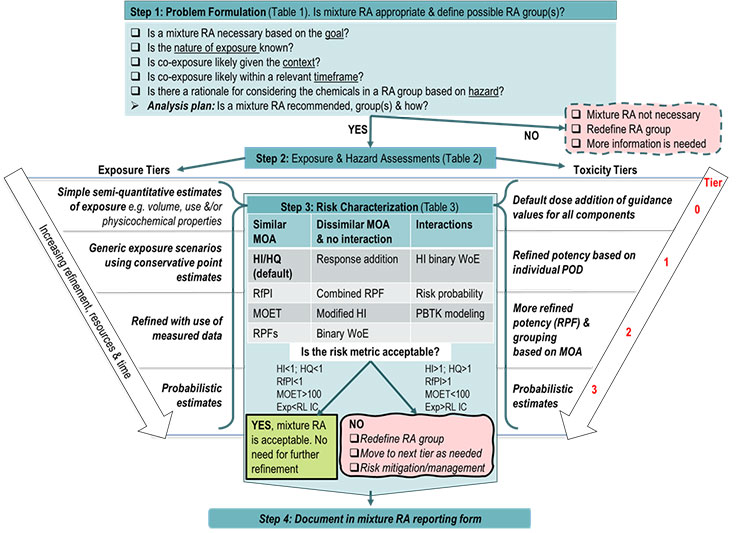
Figure 1: Text description
Figure 1 provides a graphical illustration of the process and decisions described in the "Quick Reference Guide".
Step 1: uses problem formulation (Table 1) to consider if a mixture RA is appropriate and define assessment group(s). The table asks the following summary questions:
- Is a mixture RA necessary based on the goal?
- Is the nature of exposure known?
- Is co-exposure likely given the context?
- Is co-exposure likely within a relevant timeframe?
- Is there a rationale for considering the chemicals in a RA group based on hazard?
The answers to these questions form the analysis plan and answer the question: Is a mixture RA recommended and if so, what are the group(s) and how will the analysis be conducted?
If co-exposure to the substances is likely (given the context AND timeframe) AND there is potential for at least 1 of the substances to cause adverse health effects in humans, then YES, a mixture RA is appropriate; If NO, then the options are: 1) mixture RA is not necessary, 2) redefine RA group or 3) more information is needed.
If the answers is YES, a mixture RA is appropriate, then Step 2 is preformed.
Step 2: uses tiered exposure and hazard information, from table 2, in a stepwise, integrated and iterative analyses to inform the decision. The exposure and toxicity tiers are summarized in the following table:
| Tier | Exposure Tiers | Toxicity Tiers |
|---|---|---|
| 0 | Simple semi-quantitative estimates of exposure For example volume, use and/or physicochemical properties | Default dose addition of guidance values for all components |
| 1 | Generic exposure scenarios using conservative point estimates | Refined potency based on individual POD |
| 2 | Refined with use of measured data | More refined potency (RPF) & grouping based on MOA |
| 3 | Probabilistic estimates | Probabilistic estimates |
A higher numbered tier is more refined (less conservative and uncertain) but also more resource-intensive (labour and data).
The next step, Step 3: risk characterization, compares potential exposure vs. hazard using models from table 3 recommended based on the tiers of information from step 2. The methods from table 3 are summarized in the following table:
| Similar MOA | Dissimilar MOA & no interaction | Interactions |
|---|---|---|
| HI/HQ (default) | Response addition | HI binary WoE |
| RfPI | Combined RPF | Risk probability |
| MOET | Modified HI | PBTK modeling |
| RPFs | Binary WoE | empty |
The appropriate method from table 3 is used to answer the question: Is the risk metric acceptable?
- The answer is yes if one of the following: HI<1, HQ<1, RfPI<1, MOET>100 or Exp<RL IC
- The answer is no if one of the following: HI>1, HQ>1, RfPI>1, MOET<100, Exp>RL IC
If the answer is yes, then the mixture RA is acceptable and therefore, no further action needed.
If the answer is no, then there are 3 options: 1) redefine RA group using step 1, 2) refine exposure or hazard information by moving to a higher numbered tier in step 2 (Table 2) or 3) risk mitigation or risk management.
Finally, in Step 4: Document in the mixture RA reporting form all critical information, including the risk metric and uncertainty analysis. This form is used to inform the decision for transparency and communication. This guidance is adapted from National and International health-related agencies (Appendix A).
Exp: exposure; HI: hazard index; HQ hazard quotient; IC: index chemical; MOA: mode of action; MOE: margin of exposure; MOET: margin of exposure total; PBTK: physiological based toxicokinetic; POD: point of departure; RA: risk assessment; RfPI: reference point index; RL: reference level; RPF: Relative potency factor; WoE: weight of evidence.
Step 1: uses problem formulation to consider if a mixture RA is appropriate and define assessment group(s) (Table 1). If co-exposure to the substances is likely (given the context AND timeframe) AND there is potential for at least 1 of the substances to cause adverse health effects in humans, then YES, a mixture RA is appropriate; If NO, then mixture RA is not necessary, redefine RA group or more information is needed (pink dash-outlined box).
Step 2: uses tiered exposure and hazard information in a stepwise, integrated and iterative analyses to inform the decision (the tiers are summarized in Table 2). A higher numbered tier is more refined (less conservative and uncertain) but also more resource-intensive (labour and data).
Step 3: compares potential exposure vs. hazard for risk characterization using models recommended based on the tiers of information from step 2 (methods are summarized in Table 3 for components in a mixture that have a similar MOA, dissimilar MOA – no interaction and for those components that interact). At any tier, the outcome could be: mixture RA is acceptable and therefore, no further action needed (green single-outlined box), or in the pink wavy-outlined box: redefine RA group using step 1, refine exposure or hazard information by moving to a higher numbered tier in step 2 (Table 2) or risk mitigation or risk management.
Step 4: Document in the mixture RA reporting form all critical information, including the risk metric and uncertainty analysis, used to inform the decision for transparency and communication. Guidance is adapted from National and International health-related agencies (Appendix A). Exp: exposure; HI: hazard index; HQ hazard quotient; IC: index chemical; MOA: mode of action; MOE: margin of exposure; MOET: margin of exposure total; PBTK: physiological based toxicokinetic; POD: point of departure; RA: risk assessment; RfPI: reference point index; RL: reference level; RPF: Relative potency factor; WoE: weight of evidence.
Step 1: Problem formulation
Problem formulation is an iterative process starting with an exchange between risk assessors and the requester to determine the scope, possible RA groups (or whole mixture) and data availability. The initial grouping of substances is defined in the problem formulation by the assessor. It can include metabolites and degradation products, and can be based on potential for co-exposure or hazard. The questions posed in Table 1 ensure the mixture RA is appropriate and fit-for-purpose.
If information is not available to answer all of the questions in the problem formulation, then consideration should be given to the use of data-filling tools (such as, surrogate component, trend analysis, read across, new approach methods [NAMs]).The outcome of the problem formulation is a recommendation and rationale for conducting a mixture RA (or not).
If a mixture RA is recommended, an analysis plan should describe:
- the purpose of the RA
- the rationale for selecting specific pathways/substances and excluding others
- a description of data, methods, models and risk metric or decision point to be used in the exposure, hazard and risk characterization steps, including uncertainty
The final output is the risk metric, complete with its interpretation and an overall uncertainty analysis.
| Problem formulation | Considerations |
|---|---|
| RA purpose or goal: | The primary question to be answered is "What is the desired outcome from the requester?" Considerations may include: Is the RA part of a regulatory mandate? What is the scope? For example, is the RA assessing the general population or a defined subpopulation? What is the area of applicability? For example, is a mixture RA requested or necessary? How will the RA be applied (for example, screening, prioritization, full guideline development)? The mixture RA may be quantitative or qualitative. If some exposure pathways are minor or unlikely, they can be assessed qualitatively (covered by other pathways that are more significant). If there is no data for exposure or hazard, then the outcome would be "more information is needed" or "use risk mitigation or management strategy". |
| Is the nature of exposure known? | The nature of exposure can be obtained by examining the makeup of a mixture and its components: Combined exposure: Exposure to multiple substances by a single route and/or exposure to multiple substances by multiple routes. Whole or component-based mixture (preferred when components are known) approach. A combination of approaches may be used, for example, if a mixture is poorly defined but contains components of concern (for example, genotoxic substances). How consistent is the mixture composition (for example, variability of components, stability)? |
| Is co-exposure likely given the context? | Considerations include: Are the substances used similarly, is this occasional or frequent use (including repeated or intermittent use or exposures)? Do the substances occur in the same media? Exposure could be through 'use of a product', or through exposure to environmental contaminants (that is, unintentional - not through 'use' of a product). |
| Is co-exposure likely within a relevant timeframe? | Consideration is given to external and internal co-exposure factors as well as biomonitoring measures: External co-exposure: Do substances occur in same, overlapping or sequential time and location? Do substances in the RA group have physico-chemical properties that allow for co-exposure (for example, solubility, volatility, environmental fate and half-life)? Are the substances persistent (do not degrade or dilute) in the environment? Is the time between initial and subsequent exposures sufficient for co-exposures? Internal co-exposure: Do substances have similar absorption, distribution to target tissues, are they metabolized to an active or inactive substance (kinetics)? Are the effects of short or chronic duration (dynamics)? Biomonitoring measures of exposure: Are traces of substances detected in the various media (for example, urine, serum, breast milk, cord blood) at the same time? |
| Is there a rationale for considering the substances in a RA group based on hazard | If there is potential for at least 1 of the substances to cause adverse health effects in humans, consideration may be given to placing the substance into subgroups based on similar or dissimilar considerations including regulatory mandate, structure (functional groups), kinetics, health effects (human and/or animal) and mode of action (MOA) or adverse outcome pathway (AOP) if applicable. The hazard-based rationale may be based on actual or predictive data. Category and analogue approaches can be used to group chemicals. |
| Analysis Plan | Recommendation options may include:
|
| Sources: WHO 2017, EFSA et al., 2019 (Appendix A). | |
Step 2: Exposure and hazard assessments
Exposure and hazard information are used in stepwise, integrated and iterative analyses to inform the mixture RA decision. The mixture components are defined in the previous problem formulation step. For both whole mixture and component-based mixture RAs, exposure and hazard information are assessed using concepts and methods similar to an approach typically used for single chemicals (EFSA et al., 2019).
Whole-mixture RA
For a whole-mixture mixture RA, the mixture is treated as a single entity and a quantitative assessment is done directly on available exposure and toxicity data and then compared in step 3, which involves risk characterization using the hazard quotient method (Table 3).
- Advantages: Whole mixture RAs can be used for poorly defined mixtures as, they account for any unidentified materials in the chemical mixture as well as any interactions among components.
- Limitations: Whole mixture RAs are only applicable to stable mixtures that are not variable in composition and are not expected to change over time (such as driveway sealant, capsaicin, fuels) (ATSDR, 2018; EFSA et al., 2019). The database of information available is typically limited. When data on the mixture of interest is missing, exposure and toxicity data on a sufficiently similar or surrogate mixture (that is, those that are similar in components and proportions) can also be used; however, these data tend to be sparse, variable and lack information on potential interactions between components within the similar/surrogate mixture.
Component-based mixture RA
For a component-based mixture RA, exposure and toxicity information are assessed in a tiered, integrated and iterative fashion to inform the mixture RA decision (Table 2). Tiers start with predictive methodologies and conservative assumptions in early tiers (tiers 0 and 1) and can move to more refined approaches based on increasingly data-informed and probabilistic approaches (tiers 2 and 3) if necessary. Moving to a higher numbered tier may be necessary if the risk characterization (step 3) suggests insufficient protection (for example, exposure exceeds the reference limit). It may also be necessary to refine the RA group by returning to the problem formulation step and using weight of evidence approaches, dosimetry (kinetics) or mechanistic data (such as MOA or AOP) or requesting that critical data be generated. The assessment is iteratively refined using more complex exposure and hazard models for subsequent tiers until the mixture RA is acceptable (that is, no further refinement is needed). If further refinement or an RA is not possible, a risk mitigation or management strategy needs to be developed.
- Advantages: A larger database of information for chemical components is available and applicable to the RA of variable mixtures (may change in components and proportions).
- Limitations: The mixture RA may not account for unidentified materials in the chemical mixture and may not account for interactions among components, which could lead to an underestimate or overestimate of the risk. Information on the MOA and any potential association of the individual components is important, otherwise the default assumption that component interactions either do not occur or are insignificant at relevant exposure levels must be made.
General considerations for exposure and hazard assessments:
- Different tiers for exposure and toxicity can be used (Table 2)
- Data-filling tools are available to fill a gap for a RA group member, for example:
- OECD testing guidelines, read-across, trend analysis
- Quantitative Structure Activity Relationships (QSARs)
- threshold of toxicological concern (TTC)
- physiologically-based modeling
- new approach methods (NAMs), as appropriate
- Refining RA based on MOA: uncertainties, degree of confidence, type of MOA or AOP (such as, putative, qualitative or quantitative), level of complexity, level of external review (that is, under development, under review, approved or endorsed) and key event should be considered.
- Factors to consider: interspecies differences (including relevance to humans), inter-individual variation (including persons who are disproportionally impacted), quality and robustness of the database, nature of the hazard and temporal aspects.
- Genotoxicity data: can be used to help inform a direct-DNA binding MOA and the type of RA approach (that is, linear or threshold) for both whole mixture and component mixture RAs.
- Substances that interact:
- toxicologically relevant interactions are uncommon at low levels of exposure;
- when data suggests that interactions are likely, it is appropriate to calculate exposure for each component separately and deal with potential synergies or antagonisms in the hazard assessment step;
- the methods to be applied will depend on the nature and the quality of the evidence available for such interactions (ATSDR, 2018; EFSA et al., 2019).
- Uncertainties should be made explicit, particularly for different tiers and data-filling tools.
| Tier | Exposure | Hazard |
|---|---|---|
| All | Is there credible evidence of exposure to some or all of the substances in the selected RA group? | Is there evidence of potential for adverse effects in humans and do the chemicals in the selected RA group cause toxicity in a similar way or affect the same organ(s), or not? Risk characterization approaches for similar or dissimilar MOA are provided in Step 3-Table 3. |
| 0 | Simple semi-quantitative estimates of exposure. Often derived using default assumptions; potentially exposed sub-groups should be considered. Volume, use and/or physicochemical properties can be combined to provide a relative ranking of the substances, which can then be compared with quantitative estimates for substances with similar profiles. Predictive or hypothetical information can be used. |
Default: dose addition of reference levels (RLs) and /or guidance values (GVs) for all components without refinement. Assume all components have the same potency as the most toxic compound known. Conservative and protective, based on critical effects at the lowest dose. RA group(s): based on target organs or similar MOA/AOP. Data: RLs/GVs (such as, TDI, ADI, MRL) or predictive data for each component (such as, in silico (QSAR, read across), in vitro, phys-chem, in vivo; TTC values) can be used when GVs are unavailable, as appropriate. If data is unavailable for a component, the most potent component GV and an UF can be used or data-filling tools can be used (see above). Limitations: UFs may vary for each GV. Method to use for Step 3:Hazard index(HI; Table 3). |
| 1 | Generic exposure scenarios using conservative point estimates. Summation of deterministic estimates of exposure for all components based on measured and/or modeled data (for example, upper bound daily use or intake). Consideration of use and exposure pattern (for example, if products are used within a relevant timeframe). Limitations: individual differences in exposure not accounted for, inconsistent biological half-life data and physico-chemical property predictions. |
Refined potency based on individual POD. RA group(s): based on target organs or similar MOA or AOP. Data: predictive data for each component such as, in silico (QSAR, read across), in vitro, phys-chem, in vivo, TTC. Refine POD by incorporating potency of individual components for the common effect and more accurate measures of POD (BMD modeling) for hazard. Dose response for at least 1 key event in MOA or AOP for each component (OECD, 2018). Assumes dose addition. Method to use for Step 3:HI or POD index (Table 3). |
| 2 | Refined exposure assessment, with increased use of actual measured data. Deterministic exposure scenarios are better defined (more specific to the situation). Models may incorporate more parameters and data to be more realistic but still conservative. Multiple sources of exposure can be accounted for by summation. Deterministic sensitivity analysis may be conducted by establishing low, medium or high values. Consideration of exposure data for different subgroups (more or less sensitive, more or less risk than general population). Limitation: requires more data. |
More refined potency (for example, RPF) and grouping based on MOA RA group(s): Refined based on MOA or AOP (could be at level of molecular target). Similar MOA (Step 3 Method: dose or concentration addition); Dissimilar MOA (Step 3 Method: response addition); Interactive: effect can be greater (synergistic, potentiating, supra-additive) than predicted by dose concentration or response addition, or weaker (antagonistic, inhibitive, sub-additive, infra-additive) (Step 3 Method: See Table 3 interactions). Data: in silico, in vitro, NAMs (such as, omics). Need information to support dissimilar AOP or MOA or data to support interaction potential. Requires information across substances for the same test system(s). Refined potency (RPF): if available, the potency of each component is expressed as an equivalent of that for an index compound (for example, POD of an index compound divided by the POD of the compound of interest). |
| 3 | Probabilistic exposure estimates account for distributions of exposure factors and/or exposure data. Information for the exposure scenario and relevant populations for different uses and across populations is needed. Models include multiple source exposures and potentially consider differences in absorption and disposition among the substances. Limitations: May require extensive data and evaluator training to use these approaches. |
Probabilistic hazard estimates. Assessment group(s): incorporate increasingly refined information on AOP or MOA. Data: Ideally, information on several key events within AOP or MOA is available. Incorporate kinetic and dynamic information on MOA using PBTK and BBDR models, and probabilistic estimates of hazard. Models help translate external or in vitro data to internal exposure concentrations associated with potential hazards. Models could also serve to adjust concentrations in order to account for differences in hazard (such as, potency), extrapolate concentrations across species, and from route of exposure. NAM approaches (such as, omics, IVIVE) are also useful to fill data gaps as appropriate. The sum of exposure activity ratios (EAR) or bioactivity exposure ratios (BER) can be used to quantify the risk of combined chemical exposures. EAR is the external concentration (for example, measurement in water) divided by a hazard level produced using the NAM (for example, AC50). BER is the internal concentration (for example, steady-state plasma concentration) divided by hazard measure from a NAM (for example, AC50) that has been converted into a human equivalent dose using IVIVE. For both of these approaches, a sum > 1 may be considered a threshold of concern. Advantage: improves the characterization of interspecies differences and human variability. Limitations: May require extensive data and evaluator training to use these approaches; may not be appropriate for some situations. |
| AC50: concentration at which 50% of maximum activity is observed; ADI: acceptable daily intake; AOP: adverse outcome pathway; BBDR: biologically based dose-response; IVIVE: in vitro to in vivo extrapolation; MOA: mode of action; MRL: maximum residue limit; NAM: new approach methods; PBTK: physiologically based toxicokinetic; POD: point of departure; QSAR: quantitative structure-activity relationship; RFP: relative potency factor; SAR: structure activity relationship; TDI: tolerable daily intake; TTC: threshold of toxicological concern; UF: uncertainty factor (EFSA et al., 2019; WHO, 2017). | ||
Step 3: Risk characterization and uncertainty analysis
Risk characterization is the evaluation of the likelihood and severity of adverse effects. It determines the probability of potential adverse effect(s) occurring in a given organism or (sub) population under exposure conditions defined by the problem formulation. This probability or risk metric is determined using methods comparing potential exposure versus hazard(s) for both whole mixture and component mixture RA (Table 2). The recommended 'Step 3: Risk Characterization' methods are described in Table 3. Methods can be used for carcinogenic and non-carcinogenic substances (ATSDR, 2018).
Dose addition methods are default methods commonly used when a MOA is unknown or for chemicals with a similar MOA or shared target organ toxicity. Dose addition is considered conservative and health-protective (based on empirical analyses of the effects of combined chemical exposures) (ATSDR, 2018; EFSA et al., 2019).
At higher numbered tiers in Step 2, the risk metrics become more quantitative and probabilistic with consideration of internal dose using either TK data or PBTK or PBTK-TD modeling; however, such data are rarely available (EFSA et al., 2019). MOA information allows using methods that account for the interaction between substances and substances with dissimilar MOAs.
The adequacy of the risk metric depends on the goal, exposure conditions, and the uncertainties of the mixture RA outlined in the problem formulation. An uncertainty analysis should examine potential exposure uncertainties, hazard uncertainties, and general uncertainties. These uncertainties should be documented at each mixture RA step, as well as for the overall mixture RA in the mixture RA reporting form (Step 4). Usually, a risk metric less than 1 is considered acceptable, while a risk metric of 1 or more reflects a potential risk (ATSDR, 2018; ECHA, 2017; EFSA et al., 2019; OECD, 2018; WHO, 2017). This interpretation of the level of concern is proposed as guidance, and program areas may choose to tailor the interpretation to fit their needs. If a potential risk is identified, there are three possible options (outlined in Figure 1):
- Redefine RA group (iterative Step 1 problem formulation),
- Refine data in a higher numbered tier or generation of additional data (iterative Step 2) or
- Risk mitigation or management based on the goal of the mixture RA.
| Method and InterpretationTablenote a | Summary and Advantages | Limitations | Use in framework |
|---|---|---|---|
Whole Mixture approach: Hazard quotient (HQ) For genotoxic and carcinogenic substances MOE ≥ 10,000 low concernTablenote a. |
The HQ is used to assess the risk of exposure to a single substance. In this case, the mixture is treated like a single substance. RL can be TDI, ADI, MRL etc. Transparent, rapid and simple to apply. If one or more components of a mixture are genotoxic and carcinogenic, an MOE for the mixture >10,000 is considered to be of low concern (when calculated based on a BMDL10 from an animal study) (Health Canada, 2021). A higher or lower MOE may be considered of low concern based on the data and uncertainty factors used for data gaps (EFSA et al., 2019). The acceptability of a MOE is judged by risk managers. HQ = exposure/ Reference level (RL) |
Same as for whole mixtures: applicable only to mixtures that are not variable in composition and are not expected to change over time (EFSA et al., 2019). Sample collection, data and the availability of analytical standards are limited. 'Sufficiently similar' chemical mixtures are limited due to the variable nature of each mixture. Any reference level or guidance value for one mixture is unlikely to be applicable to others. | Whole mixtures |
Component Approach: For chemicals with similar MOA (default assumption when data not available); Dose addition Hazard Index (HI) HI < 1 low risk |
Sum of exposure in relation to RLs. Transparent, rapid and simple to apply. Able to account for various routes and sources of exposure. E – Exposure level of each individual component; RL – reference level (for example, TDI, ADI, MRL etc) for each individual component but must be the same for each component. Endpoints do not need to be the same for RL selection (OECD, 2018). If RLs are not available for all components, the lowest available RL can be used (for the most potent chemical and assuming that all of the components are equally potent). Often provides a conservative risk estimate (EFSA et al., 2019). HI = E1/RL1 + E2/RL2 + … + En/RLn |
RLs often not directly comparable (varying critical effects, UFs, policy/scientific judgements, periods of review and methodologies). May need to develop a RL, if data is available. Difficult for new and data-poor chemicals without RLs. Potential to be overly conservative (OECD, 2018). Ignores interactions. Assumes dose-response curves of the components have a congruent or similar shape. | Screening: for tier 0 and tier 1 risk characterization (is higher numbered tier necessary). For tier 1, RL is adjusted for the common effect; Or a PODI can be calculated (see below). When the database is richer, the Target Organ Toxicity Dose (TTD) could be used in a refined Hazard Index approach considering that not all the components have the same adverse effect or target organ, resulting for each endpoint in an endpoint-specific HI. |
Component Approach: For chemicals with similar MOA (default assumption when data not available); Dose addition Reference Point RfPI x UFgroup < 1Tablenote a MOET > 100Tablenote acombined risk is acceptable |
Sums exposure in relation to RfP (or POD) for the relevant effect (selected benchmark response). Since UFs are not used, the RfPs are directly comparable. The method is transparent, rapid and simple to apply. It can be applied to chemicals without RLs, reduces the uncertainty associated with the HI approach and reduces the overestimation of potential risk (OECD, 2018). The reciprocal of the RfPI is the combined margin of exposure (MOET), where the individual margin of exposure (MOE) is the ratio of the RfP to the level of exposure in humans (measured or estimated). |
Difficult for data-poor chemicals. Requires POD to be known from animal toxicity indicators for specific effect. | Tiers 1, 2 or 3. |
Component Approach: For chemicals with similar MOA (default assumption when data not available); Dose addition Relative Potency |
For mixtures that consist of a single class of chemicals cause similar effects via a common MOA, and where extensive information is available for at least one member of the chemical class (index chemical - IC). It may be used in situations where less is known about other members. Scaling factors (RPFs or PEFs or TEFs) can be used to express the toxicity of the other chemicals in terms of an equivalent dose of the IC in order to determine the overall toxicity of the mixture. Potencies are typically derived from dose-response curves, using the same benchmark response (such as, 10%), although NOAELs have also been used. The activity of the mixture is then determined from the sum of the potency normalized doses to yield a total equivalent exposure expressed as IC equivalents. This total equivalent exposure is then compared to the RL of the IC (such as, dioxins and other Aryl Hydrocarbon receptor agonists). This method provides a better basis for standardizing dose metrics for each chemical and straightforward method (if RPFs exist). If no TEFs are available, the assessment may be based on a surrogate component (for example, BaP for PAHs, PBDEs). Assumes: mixture toxicity is equivalent to the toxicity of its most potent or most studied component, scaled by relative exposure; Common MOA and parallel dose response curves for all substances. |
Assessment focuses on a specific effect or mechanism. Other relevant effects or mechanisms could be addressed through a separate assessment. RPF or TEF or PEF of a chemical is presumed to be equivalent for the endpoints relevant to the assessment and exposure scenarios, although RPFs may vary depending on the dosing scheme, route, endpoint, species and strain. Note, however, that route-specific RPFs can be derived and incorporated into the assessment. Relevance of RPFs derived from external doses for assessment of internal concentrations (that is, human biomonitoring data) is often unknown. Reliance on the quality of the toxicological database of the IC. Labour-intensive for chemicals which do not have RPFs. Used only when common effects from one or more sufficiently known key biological events can be identified. |
As with Tier 1, in Tier 2 MOE is considered in the context of associated uncertainties as a basis to determine whether a higher numbered-tier assessment is needed. |
Component Approach: For chemicals with independent, dissimilar and no interaction MOATablenote b Response addition |
Calculates the probability that exposure to the mixture (pm) will result in an adverse effect by multiplying the probabilities of adverse effects occurring due to exposure for each component (p1, p2, pi, etc.): pm = 1 – (1-p1)* (1-p2)* … *(1-pn) Risk can be estimated as the percentile of the population exceeding the reference value, as the maximum exceedance of the reference value or as the percentage of the population at or below the reference value for a given percentile of the distribution (for example, 99.9th percentile). |
Data reliability at low dose levels increases exponentially as the number of mixture components rises. Poor data quality from a single component can decrease reliability. | Hazard screening and higher numbered tier use. |
Component Approach: For chemicals with independent, dissimilar and no interaction MOATablenote b Combined RPF |
Advantages of RPF method apply. Accounts for the potency of different groups of chemicals present in the mixture. For example, RA of drinking-water mixtures of disinfection by-products. These mixtures contain sub-groups of components that produce similar effects. Components were grouped into subclasses based on their MOA. For each sub-class an IC was identified and RPFs derived for all other chemicals in each sub-class. Risk estimates were then made for each sub-class based on the dose-response relationship for the IC. Finally, the sub-class risk estimates were added, using methods for response addition, to arrive at a risk estimate for the whole mixture. | Disadvantages of RPF method apply. Relies on the existence of RPF scaling or potency factors for different groups of chemicals. |
Combines dose addition and independent action. Use in higher numbered tiers. |
Component Approach: For chemicals with independent, dissimilar and no interaction MOATablenote b Modified HI |
The simplest approach for chemical mixtures showing independent action. Consider each component independently using a modified HI approach. An additional UF (between 1 and 100) is added to the conventional HI calculation to reflect the degree of confidence in the available information for interactions and the concentration of the mixture components (since there is a greater likelihood of interactions with increasing dose). Approach is straightforward and can be used if data are scarce. Advantages of HI apply. | Does not consider varying sensitivities to components of the mixture within a population. |
Should only be considered for a preliminary RA (tier 0). |
Component Approach: For chemicals with independent, dissimilar and no interaction MOATablenote b
Binary weight |
Systematic evaluation of the types of interactions; numeric scores are assigned in various circumstances. | Complex and lengthy approach. | Lengthy process. Higher numbered tiers. |
Component Approach: For chemicals that interact HI modified by binary interactions |
Advantages of HI apply. Evaluate hazard data for possible pairs of chemicals to determine the binary WOE for each of these pairs, determining the expected direction of an interaction (EFSA et al., 2019). | Disadvantages of HI apply. Data intensive. | Use at a lower tier. |
Component Approach: For chemicals that interact Interaction |
Advantages of HI apply. Information on the interaction is converted into a numerical score on an expert judgment basis or a weight of evidence evaluation (ATSDR, 2018; U.S. EPA, 2007). The numerical score considers: 1) nature of the interaction; 2) quality of the available data; 3) biological or toxicological plausibility of the interaction under real exposure conditions; and 4) relevance for human health (EFSA et al., 2019). The studied interactions between pairs of substances within a mixture are used to weight the HI (ANSES, 2021). An uncertainty factor can be used to account for interactions among components of a mixture (ATSDR, 2018). |
Provides only a numerical score of potential risk, relies on subjective evaluation, intrinsic uncertainties affecting reference values are combined and amplified (EFSA et al., 2019). Unable to predict nature of interaction other than common target. | Tier 2 or higher. |
Component Approach: For chemicals that interact Overall Risk Probability (ORP) |
Extended response additivity based upon independent, antagonistic and synergistic effects. Assumes that the ORP of each contaminant remains the same as if the contaminants were in a single-contaminant system (ANSES, 2021). | Data rarely available, complex to perform. | Higher numbered tier. |
Component Approach: For chemicals thatinteract PBTK modelling |
Used to 1) estimate internal concentration of individual contaminants relative to external exposure in a mixture (biological hazard index), 2) investigate possible toxicokinetic interactions between contaminants in the mixture and 3) estimate internal exposure for a given route based on data from another exposure route (ANSES, 2021). | Data rarely available, complex to perform. Expert guidance needed. | Higher numbered tier. |
|
|||
Step 4: Document in mixture RA reporting form
Document all critical information for transparency and consistent communication in the mixture RA reporting form. This reporting form is a summary of all the critical information from steps 1 to 3.
| Problem Formulation | Consideration |
|---|---|
| RA purpose or goal: | Primary question: What is the desired outcome from the requester? Considerations may include: Is a mixture RA requested or necessary? Is the desired outcome from the requester? Is the RA part of a regulatory mandate? What is the scope? For example, is the RA assessing the general population or a defined subpopulation? How will the RA be applied? For example, screening, prioritization, full guideline development? |
| Is the nature of exposure known? | The nature of exposure can be obtained by examining the make-up of a mixture and its components. Considerations include: whole mixture or components? Which components? Is there exposure data available to use? Is the mixture composition consistent? |
| Is co-exposure likely given the context? | Considerations include: Are the substances used similarly, is this occasional or usual? Do the substances occur in the same media? |
| Is co-exposure likely within a relevant timeframe? | External co-exposure: Do the substances occur in same or overlapping or sequential time and location or have physico-chemical properties that allow for co-exposure? Internal co-exposure: Do the substances have similar kinetics? Biomonitoring: Are traces of the substances detected in various biological media? |
| Is there a rationale for considering the substances in an RA group based on hazard? | If there is potential for at least 1 of the substances to cause adverse health effects in humans, consideration may be given to placing the substances into subgroups based on similar or dissimilar factors including: regulatory mandate, structure (functional groups), kinetics, health effects and MOA or AOP (if applicable). The rationale may be based on actual or predictive data. Category and analogue approaches can be used to group chemicals. |
| Analysis Plan | May indicate that mixture RA is not necessary; outline included or excluded substances; conclude that more information is needed; or that mixture RA is applicable and specify analysis plan: For example, exposure and hazard information will be considered by an iterative and tiered approach and compared for risk characterization using the default dose additive approach (unless data indicates interaction or response addition (different MOAs) methods are more appropriate). Uncertainty will be documented for both hazard and exposure analyses. The risk metric first evaluated will be the hazard index (component-based mixture) or the risk quotient (whole mixture). A risk metric is considered adequate when the appropriate method and corresponding interpretation of the data can be justified (Table 3). The final output of the mixture RA will be the risk metric, its interpretation and overall uncertainty analysis. |
| Tier | Exposure | Hazard |
|---|---|---|
| All | Is there credible evidence of exposure to some or all of the chemicals in the RA group? | Is there evidence of potential for adverse effects in humans and do the chemicals in the RA group cause toxicity in a similar way or affect the same organ(s)? Risk characterization approaches for similar/dissimilar MOA are provided in Step 3/Table 3. |
| 0 | Simple semi-quantitative estimates of exposure
|
Default dose addition of reference levels or guidance values for all components without refinement
|
| 1-3 | If necessary | If necessary |
| Risk characterization and analysis of uncertainties | Considerations |
|---|---|
Risk metric, derivation and interpretation: Assumptions: For example, dose addition, response addition, interactions, stable mixture |
Uncertainty analysis: Potential exposure uncertainties, hazard uncertainties and general uncertainties should be documented at each mixture RA step, and for the overall mixture RA. Also document limitations of the approach used (whole mixture RA or the component-based mixture RA). |
Recommended mixture RA decision Goal of mixture RA: Recommendation: |
Assumptions, limitations and uncertainties: Information that could potentially change the decision: |
Case studies
The reporting form guided the risk assessor through the process of assessing a mixture and was modified to fit the purpose and needs for each case study.
Case study 1: Mixture RA is not appropriate for 4 trihalomethanes (THMs) in drinking water
| Problem Formulation | Considerations |
|---|---|
| RA purpose or goal: | To determine if the RA and management of four trihalomethanes (THMs) in drinking water should be based on individual substances, a mixture of all four substances or a mixture of the brominated substances only. To highlight areas of uncertainty and identify critical data needs. |
| Is the nature of exposure known? | Yes. The mixture is component-based and includes chloroform, BDCM, DBCM and bromoform, the latter three of which are considered to be the "brominated THMs". Monitoring data for these substances in drinking water are available from all provinces and territories across Canada, with the exception of the Northwest Territories. |
| Is co-exposure likely given the context? | Yes. All four THMs are by-products of the disinfection of drinking water. They are formed when the chlorine or bromine used to disinfect drinking water reacts with organic matter found naturally in raw water supplies. Consequently, they are routinely found together in drinking water and co-exposure is likely. |
| Is co-exposure likely within a relevant timeframe? | External Co-exposure: Yes. The four THMs are moderately to highly soluble in water. Since they are routinely found together in drinking water, external co-exposure during a similar timeframe is likely. Internal co-exposure: Yes. Internal co-exposure is likely through the ingestion of water. All 4 THMs are rapidly absorbed and distributed throughout the body. All 4 THMs are metabolized via oxidative and reductive pathways. However, unlike chloroform, the brominated THMs can also be metabolized via conjugation to mutagenic metabolites. Biomonitoring: All 4 THMs have been detected together in plasma, urine and exhaled breath. |
| Is there a rationale for considering the substances in an RA group based on hazard? | All four THMs affect the liver and the kidneys. The brominated THMs also have effects on the colon, while chloroform has effects on nasal passages. While all four THMs are metabolized via oxidative and reductive pathways, the brominated THMs can also be metabolized via conjugation to mutagenic metabolites. While this is a quantitatively minor pathway, the mutagenic metabolites are likely disproportionately more toxic. Effects are likely observed in the colon for the brominated THMs, and not chloroform, because the CYP2E1 enzymes in the colon are more easily overwhelmed (as compared to the liver) shunting metabolism to the conjugation pathway. This toxic metabolic pathway occurs in the brominated THMs but not chloroform. Thus, chlorine-based THM has a different MOA than the brominated THMs. |
| Analysis Plan | Recommendation: mixture RA not necessary. Although co-exposure to the four THMs is likely within a relevant context and timeframe, and all four THMs can affect common target organs (liver and kidneys), mixture RA was not applied: The modes of action causing the critical effects used to calculate the health-based values are different between chloroform (non-cancer effects in the kidneys) and BDCM (cancer in the large intestine). Given the different MOA, chloroform and BDCM should not be added together. Despite having some affected organs in common, the overall decision was made not to apply the mixture RA. |
| Tier | Exposure | Hazard |
|---|---|---|
| All | Is there credible evidence of exposure to some or all of the chemicals in the RA group? Yes. | Is there evidence of potential for adverse effects in humans and do the chemicals in the RA group cause toxicity in a similar way or affect the same organ(s)? No, do not cause toxicity in a similar way. |
Step 3: Risk characterization and analysis of uncertainties
Not applicable
Source: Guidelines for Canadian Drinking Water Quality – Technical Documents for Trihalomethanes, for public consultation (https://www.canada.ca/en/health-canada/programs/consultation-draft-guidelines-canadian-drinking-water-quality-trihalomethanes.html; Final will be available at https://www.canada.ca/en/health-canada/services/environmental-workplace-health/reports-publications/water-quality.html#tech_doc).
Case study 2: Screening and prioritization of which metals should be included in a group for research on a mixture
| Problem Formulation | Considerations |
|---|---|
| RA purpose or goal: | A research scientist studying arsenic toxicity requested a risk assessor to recommend an additional priority metal to consider in generating toxicity data for a binary mixture with arsenic, with the goal to help inform future soil and water quality guidelines. Scope: to support development of soil and water quality guidelines. Assessment for people living in Canada. Exposure pathways to consider include oral (drinking water) and activities around contaminated sites (soil quality). |
| Is the nature of exposure known? | Assessment group: Potential components to recommend grouping with Arsenic (As): lead (Pb), cadmium (Cd), chromium (Cr) and manganese (Mn). Exposure: chronic oral (drinking water). Data availability: yes, for individual components but limited for whole mixtures and defined component mixtures. |
| Is co-exposure likely given the context? | Yes, the substances may enter water and soil through natural weathering processes, water treatment/distribution, mining and waste sites. Although variations across Canada are likely, there is potential for co-exposure of As with the other metals. The toxicological significance and corresponding risk to human health of these co-exposures will depend on many environmental and biological factors. |
| Is co-exposure likely within a relevant timeframe? | External Co-exposure: Yes, the substances could occur at the same time and location. Their physical-chemical properties allow for co-exposure. Substances persist in the environment. Internal co-exposure (similar kinetics?): All components are absorbed in the gastrointestinal system and then enter systemic circulation for wide distribution. Higher absorption levels in infants/children than adults for Pb and Mn. Lower absorption rates for Cr. All substances cross the blood-brain barrier and placenta. As, Pb, Cd and Mn internal half-life (T1/2) indicate potential for long co-exposure (days to years). Cr has a shorter T1/2 of 40 hrs, indicating that it is not as persistent internally as the other chemicals. Based on chemical concentrations and temporal patterns, exposure can be of acute, sub-chronic, and chronic duration. Chronic exposure leading to chronic effects is necessary for Canadian guideline development. Biomonitoring: detected in same media (for example, blood and urine). |
| Is there a rationale for considering the substances in a RA group based on hazard? | Yes. As, Pb, Cd and Mn have similar kinetics and affect neurological and developmental endpoints, resulting in neurotoxicity. Studies report additivity of As with Pb and Cd. Cr and As: less than additivity and exposure does not result similar health effects (intestinal effects vs. neurotoxicity). The MOA is not fully understood but potentially plausible for additivity with As and Pb. There is a potential for a common epigenetic MOA for As, Cd and Mn. This evidence provides a rationale for excluding Cr from the assessment group because it does not share a common MOA. |
| Analysis Plan | Recommendation: mixture RA is applicable, but Cr should not be considered in the assessment group. The mixture RA should consider exposure and hazard information for As, Pb, Cd and Mn in an iterative and tiered approach. For risk characterization a dose additive approach is appropriate (no data indicates interaction or response addition is more appropriate). Uncertainty should be documented for both hazard and exposure analysis, and a hazard index (HI) will be used. A HI<1 will be considered low risk and HI≥1 will be of potential concern and necessitate consideration of exposure or hazard information at the next tier. |
| Tier | Exposure | Hazard |
|---|---|---|
| All | Is there credible evidence of exposure to some or all of the chemicals in the RA group? Yes. | Is there evidence of potential for adverse effects in humans and do the chemicals in the RA group cause toxicity in a similar way or affect the same organ(s)? Yes. |
| 0 | Not necessary. Enough information to inform decision was obtained. | Data: guidance values for all components Hazard metric: Guidance values (maximum acceptable value or health-based value) µg/L. Assumptions, limitations and uncertainties: Assumes the default approach of dose addition, given that there is no interaction and there are no data to suggest otherwise and, MOA similar or unknown, and all components have the same potency. Uncertainty factors for the individual component guidance values vary. Neurotoxicity is the critical and sensitive endpoint of concern. General uncertainties: Differing quantity and quality of the data for different components. Tier outcome: acceptable for providing recommendation to research group (goal of the problem formulation). Refine data: need to move to a higher tier or data generation is necessary for As. |
| 1 | Data: Measured levels in Canadian drinking water. Exposure: mean levels in the µg/L range. Assumptions, limitations and uncertainties: Individual metal measurement and no direct measurements of co-exposure. Sampling methods make measures of Pb exposure difficult. |
Not necessary given the goal of this mixture RA. |
| 2 and 3 | Not necessary. Enough information to inform decision was obtained. | Not necessary given the goal of this mixture RA. |
| Risk characterization and analysis of uncertainties | Considerations |
|---|---|
Risk metric, derivation and interpretation: HI (sum of Exposure (E) divided by hazard(H) for each component) HI = EAs/HAs + EPb/HPb + ECd/HCd + EMn/HMn |
Sample calculation: HI = 2.6 µg/L/0.3 µg/L + 1.3 µg/L/5 µg/L + 0.07 µg/L/7 µg/L +10.8 µg/L/120 µg/L HI = 8.67 + 0.26 + 0.01 + 0.09 HI = 8.96 Assumptions: dose addition, no interactions and stable mixture. Since the HI is ≥ 1 this mixture RA is of potential concern and necessitates consideration of hazard information at the next tier. Especially data considering the neurotoxicity and MOA for As with Pb, Cd and/or Mn. |
| Recommended mixture RA decision. | Goal of mixture RA: Recommend which additional priority metal to test in a binary mixture with As to support development of Canadian drinking water and soil quality guidelines Recommendation: generation of data on the neurotoxicity, MOA and interaction of As with either Pb, Mn or Cd (priority could potentially be based on HI). Ideally data would be generated for all. |
| Sources: Health Canada, Guidelines for Canadian Drinking Water Quality – Technical Documents for As, Cr, Cd, Mn and Pb (https://www.canada.ca/en/health-canada/services/environmental-workplace-health/reports-publications/water-quality.html#tech_doc) | |
Case Study 3: Addition of biomonitoring data
| Problem Formulation | Considerations |
|---|---|
| RA purpose or goal: | To assess the association between a prenatal mixture of 5 metals (arsenic (As), cadmium (Cd), manganese (Mn), lead (Pb), and mercury (Hg)) and infant birth weight among MIREC study participants. |
| Is the nature of exposure known? |
In the MIREC study, metal exposure was assessed via biomonitoring data in whole blood samples collected from the pregnant participants during the first trimester of pregnancy. Data on dietary patterns and health history behaviours (for example. intake of Cd from smoking) are available but measurements of the metals in environmental samples based on exposure source or route of exposure (such as, in drinking water, house dust, food) are not available. |
| Is co-exposure likely given the context? | Yes. To assess co-exposure, correlation coefficients were calculated. They vary from 0.0 to a high of 0.4 between As and Hg, suggesting a moderate correlation. Data on co-exposure within the participants' environment (for example, water treatment or distribution sources, proximity to mining or waste sites) are not available. |
| Is co-exposure likely within a relevant timeframe? | Yes. Given the relatively similar and overlapping half-lives of Pb (1-2 months), Hg (50 days), Cd (10-40 years) and Mn (10-42 days) in blood samples (CDC, 2022), we presumed that the biomonitoring data represent exogenous exposure that occurred in the preconception and early pregnancy time periods. Therefore, co-exposure is likely. Compared to other metals, blood As concentration has a shorter half-life of 2 to 4 days (CDC, 2022). As a result, the first trimester As concentration may reflect more recent exposure. However, many MIREC participants likely have a steady-state exposure to As through drinking water and dietary sources. Therefore, co-exposure with other metals is likely. |
| Is there a rationale for considering the substances in a RA group based on hazard? | Yes. The metals have similar toxicokinetics, a shared mode of action and shared effects on health outcomes. However, this analysis did not group the metals based on known reductions in birth weight. Instead, the metals were grouped based on chemical class and further subgrouped into essential (Mn) and non-essential metals (As, Cd, Pb, Hg). |
| Analysis Plan | Recommendation: mixture RA is applicable. Exposure and hazard relationship should be examined using the statistical method of Bayesian Kernel Machine Regression (BKMR) and the effects will be quantified using linear regression. The hazard metric evaluated will be a change in birth weight (grams). BKMR graphical output will include the overall mixture effects, individual chemical contributions to the mixture and any interactive effects among the metals. The final output will be hazard metric (main effects), its interpretation and overall uncertainties (95% confidence intervals). Sex-specific analysis will also be examined. |
| Tier | Exposure | Hazard |
|---|---|---|
| All | Is there credible evidence of exposure to some or all of the chemicals in the selected group? Yes, all metals were detected in at least 90% of the first trimester blood samples. Data: Blood samples collected from first trimester of pregnancy. Exposure metric: blood levels (μg/L). Assumptions/Limitations/Uncertainties: The limitation of using biomonitoring data include unknown route, timing, duration and intensity of exposure. The limitation of analytical procedure allowed for detections of only five metals. Metal concentrations were log2-transformed to reduce the potential influence of outliers. |
Is there evidence of potential for adverse effects in humans and do the chemicals in the selected group cause toxicity in a similar way or affect the same organ(s)? Yes RA group(s): grouped based on essential vs. non-essential metals. Data: infant birth weight (grams) abstracted from the medical records. Hazard metric: a change in birth weight (grams) for every 2-fold increase in metal blood concentrations was examined. Assumptions, limitations and uncertainties: we assume that we can sufficiently minimize confounding bias by adjusting for confounders and available covariates. Outcome: In this epidemiological study, the mixture of metals was monotonically associated with a reduction in birth weight across the whole range of exposures. Pb was identified as the most important metal in this mixture. |
| Risk characterization and analysis of uncertainties | Considerations |
|---|---|
| Results and interpretations: To determine whether there is an association between the exposure and hazard metrices, we examined the BKMR graphical output for trends (Figure 2). The negative regression line indicates an association where an increase in metal mixture concentration is associated with a birth weight reduction. | Overall Assumptions, limitations, and uncertainties: Epidemiologic studies focus on measuring associations; however, finding an association does not imply causality. The uncertainties are those common to epidemiological studies and include the potential roles of chance, selection or measurement biases, and confounding factors. This study was able to minimize the potential impact of these issues by controlling for factors such as smoking, sex, maternal age, race, pre-pregnancy body mass index and socioeconomic status and by conducting analyses using multiple statistical methods (BKMR and linear regression). However, while BKMR, a non-parametric machine learning method, is highly flexible, capable of estimating complex dose-response shapes, and can distinguish between metals with positive and negative associations with the outcome, the results are not easily interpretable. Therefore, other methods such as linear regression that examines individual chemicals and assumes linearity could be used to quantify the relationship between birth weight and exposure to metals. In this case study, consistent results were obtained from both mixture (BKMR) and single chemical methods (linear regression). Lastly, the MIREC study population comprises primarily white, Canadian-born, non-smoking participants of moderate to high socioeconomic status with low metal concentrations compared to the general population. Therefore, the nature of this study population results in minimal confounding due to sociodemographic factors. However, the results are not generalizable to populations of differing exposure levels, sociodemographic characteristics, or health histories. |
| Conclusion: An increase in metal mixture concentration is associated with a birth weight reduction. Study results show that Pb is the main component associated with lower birth weight even at the low blood lead concentrations (median = 6.0 µg/L, interquartile range = 4.1 µg/L) measured in the MIREC participants. Linear regression results indicated that every doubling of first trimester Pb concentrations was associated with a 39 g (95% CI: -69, -9) decrease in birth weight. | Information that could potentially change the decision: Future work and studies that include the complex interactions of chemical and non-chemical factors such as social stress, race, nutrition and inflammation may expand our knowledge. |
| Source:(Hu et al., 2021) | |
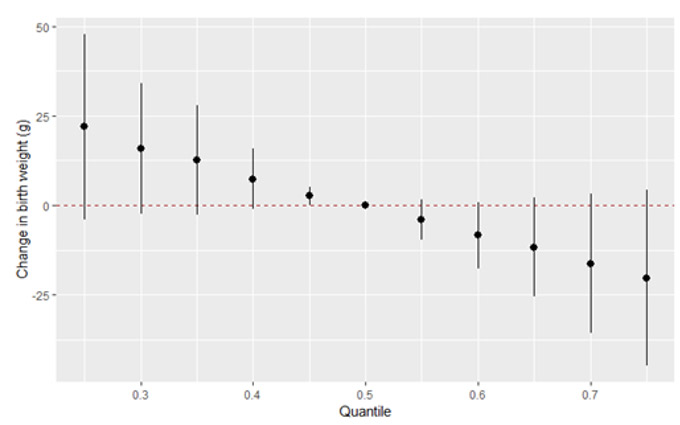
Figure 2: Text description
Figure 2 provides a graph of exposure plotted on the x-axis (from quantiles 0.3 to 0.7) and change in birth weight plotted on the y-axis (from -25 to 50 grams). Overall, the plot shows an increase in metal mixture concentration is associated with a birth weight reduction.
Case study 4: Dose addition and use of a surrogate: Chemicals in drinking water
| Problem Formulation | Considerations |
|---|---|
| RA purpose or goal: | To determine if the RA and management of 4 substances in drinking water should be based on guidance values for the individual substances, a mixture of all four substances, or a subgroup. To highlight areas of uncertainty and identify critical data needs. |
| Is the nature of exposure known? | Yes. The mixture is component-based and monitoring data for these substances in drinking water are available from all provinces and territories across Canada. |
| Is co-exposure likely given the context? | Yes. All four components are routinely found together in drinking water and co-exposure is likely. |
| Is co-exposure likely within a relevant timeframe? | External Co-exposure: Yes. The four components are moderately to highly soluble in water. Since they are routinely found together in drinking water, external co-exposure during a similar time frame is likely. Internal co-exposure: Yes. Internal co-exposure is likely through the ingestion of water, inhalation of vapour (during bathing) and dermal absorption. All 4 components are rapidly absorbed and distributed throughout the body. All are metabolized via oxidative and reductive pathways. Biomonitoring: All 4 components have been detected together in plasma, urine and exhaled breath. |
| Is there a rationale for considering the substances in a RA group based on hazard? | All 4 components have a similar functional group, are metabolized via oxidative and reductive pathways (similar kinetics), affect the liver and the kidneys (similar health effects) and have a similar MOA. |
| Analysis Plan | Recommendation: The mixture RA is applicable. Consider exposure and hazard information in an iterative and tiered approach and compare for risk characterization using a dose additive approach (no data indicate that interaction or response addition is more appropriate). The hazard index (HI) will be used. A HI<1 will be considered low risk and HI≥1 will be of potential concern and necessitate consideration of additional exposure and/or hazard information. |
| Tier | Exposure | Hazard |
|---|---|---|
| All | Is there credible evidence of exposure to some or all of the chemicals in the selected group? Yes. | Is there evidence of potential for adverse effects in humans and do the chemicals in the selected group cause toxicity in a similar way or affect the same organ(s)? Yes. |
| 0 | Not necessary. Enough information to make the decision. | Default dose addition of guidance values (Health-based values; HBV) for all components without refinement Assessment group(s): 4 components Hazard metric: HBV (µg/L) Risk Metric: hazard index (HI) Assumptions, limitations and uncertainties: Assumes dose addition and no interaction. Since no HBV was available for component 4, the lowest (most potent) HBV was used as a surrogate (component 2). Tier outcome: HI<1 for all 4 components. The mixture RA is acceptable, and no further refinement is necessary. |
| 1 | Assessment group(s): 4 components Data: Measured levels in Canadian drinking water (median, 90th percentile concentrations from provincial and territorial monitoring data) Exposure metric: µg/L Assumptions, limitations and uncertainties: Not all compounds are measured by all jurisdictions. |
Not necessary. Enough information to make the decision. |
| 2 and 3 | Not necessary. Enough information to make the decision. | Not necessary. Enough information to make the decision. |
| Risk characterization and analysis of uncertainties | Considerations |
|---|---|
Risk metric, derivation and interpretation: |
Assumptions: Dose addition, no interactions, stable mixture. Overall uncertainty analysis: Not all compound exposures are measured by all jurisdictions, hazard database is not adequate for all compounds, lack of HBVs for 1 compound (use of surrogate), knowledge of human relevance is deficient, assumes dose addition and independent action of compounds. |
Recommended mixture RA decision Goal of mixture RA: To determine if the RA and management of 4 substances in drinking water should be based on guidance values for the individual substances, a mixture of all 4 substances, or a subgroup. |
Recommendation: The mixture RA is acceptable, and the 4 substances can be assessed together. Information that could potentially change the decision: If hazard data becomes available that is sufficient to derive an HBV for component 3, this information would be used in place of a surrogate. |
Case Study 5: Response addition and use of surrogates: Mixture RA of Haloacetic Acids (HAAs) in drinking water
In drinking water, HAAs often occur as a mixture with each other and other disinfection by-products (DBPs). The database of studies on the effects of oral exposure to mixtures of HAAs is limited. Therefore, a mixture RA for people in Canada orally exposed to HAAs through drinking water was conducted using the quick reference guide.
| Problem Formulation | Considerations |
|---|---|
| RA purpose or goal: | To determine if the 13 HAAs under assessment should be considered individually or together for RA and management. To support development of water quality guidelines for the people living in Canada. |
| Is the nature of exposure known? | Yes. The mixture is component-based and includes 13 different types of HAAs including 9 chlorine and bromine-containing mono-, di-, or tri-haloacetic acids and 4 iodine-containing acetic acids (I-HAAs). Canadian monitoring data for these substances in drinking water are available from provinces and territories. HAAs are long-lived in water. |
| Is co-exposure likely given the context? | Yes. All HAAs are by-products of the disinfection of drinking water. Consequently, they are routinely found together in drinking water. |
| Is co-exposure likely within a relevant timeframe? | External Co-exposure: Yes. Since HAAs are highly soluble in water and routinely found together in drinking water, external co-exposure during a similar timeframe is likely. However, bromine treatment is not expected at the same time as chlorine treatment, one form of disinfection is usually selected over the use of the other. Therefore, co-exposure of brominated HAAs together with chlorinated HAAs is less likely. Internal co-exposure: Yes. Internal co-exposure is likely through the ingestion of water. Mono-, di- and tri-HAAs are rapidly absorbed and widely distributed internally. However, there are differences in plasma protein binding, metabolism and clearance which could provide a rationale for separating substances into subgroups. The available data trends appear consistent across species (human, mouse and rat). Biomonitoring: no data available. |
| Is there a rationale for considering the substances in a RA group based on hazard? | Yes. However, the structure, kinetics, potential health effects and MOAs of these substances vary depending on their structural substitution type or number. Bromine-containing HAAs are more readily metabolized and exert a greater degree of toxicity than chlorine-containing HAAs. HAAs that contain at least two halogens (one of which is a bromine), induce liver tumours in mice, malignant mesotheliomas in rats and extrahepatic tumours in mice and rats. Conversely, no extrahepatic tumours were induced by the chlorine containing HAAs. The carcinogenic MOA is dependent on the HAA speciation (chlorine vs bromine vs iodine). Brominated HAAs have a greater potential for a direct-DNA reactive MOA while the chlorinated HAAs MOA is non-directly DNA reactive (epigenetic and/or altered energy metabolism). I-HAAs are also potentially direct-DNA reactive. Since all HAAs do not share a common MOA, it is recommended to group them by their MOA, direct-DNA or non-direct DNA reactive. |
| Analysis Plan | Recommendation: mixture RA applicable. There is credible evidence of combined exposure to HAAs, there is evidence that exposure to HAAs may result in adverse effects in humans, and there is a potential for HAAs to cause toxicity in a similar way or affect the same organ(s). A mixture RA is appropriate for subgroups of HAAs, rather than consideration of all 13 HAAs together. It is not reasonable to assume MOAs for all HAAs are the same and therefore, the simple dose addition hazard index approach is not appropriate. HAAs should be subgrouped based on their MOAs (direct-DNA reactive vs non- direct DNA reactive). Exposure and hazard information should be considered by an iterative and tiered approach and compared for risk characterization using a response-addition method. Thus, the Combined Relative Potency Factor (CRPF) response addition method for combining the exposure and hazard information for the mixture should be used. This approach was also used elsewhere for RA of drinking-water DBP mixtures (HAA and THMs) (U.S. EPA, 2003). Uncertainty will be documented for both hazard and exposure analysis. |
| Tier | Exposure | Hazard |
|---|---|---|
| 0 | Simple semi-quantitative estimates of exposure. Not necessary since monitoring data is available. | Default dose addition of guidance values for all components without refinement |
| 1 | Generic exposure scenarios using conservative point estimates Assessment group(s): components subgrouped based on their MOA (direct-DNA reactive vs non-direct DNA reactive). Data: Measured levels in Canadian drinking water Exposure metric: µg/L Assumptions, limitations and uncertainties: Not all compounds are measured by all jurisdictions. |
Refined potency based on individual POD Outcome of tiers: Not appropriate since it is not reasonable to assume MOAs for all HAAs are the same. |
| 2 | Not necessary, enough information to make the decision | More refined potency and grouping based on MOA RA groups: components subgrouped based on their MOA (direct-DNA reactive vs non- direct DNA reactive). Data: Relative potency factor (RPF), the potency of each component is expressed as an equivalent of that for an index compound (IC) (that is, human equivalent dose (HED) of an IC divided by the HED of the compound of interest). Hazard metric: POD (HED) mg/kg bw per day Risk Metric: Combined Relative Potency Factor (CRPF) Response addition to derive a subgroup index chemical equivalent dose (ICED), see step 3 for further details. Assumptions, limitations and uncertainties: Assumes response addition, no interactions, stable mixture and HAAs are 100% bioavailable. Uncertainties: hazard database is not adequate for all components, lack of HEDs for 2 HAAs (use of surrogates), knowledge of human relevance is deficient. Limitations: reliance on the quality of the toxicological database of the IC. Labour intensive for chemicals which do not have defined scaling or potency factors. I-HAAs were excluded as there were insufficient data for the assessment. Tier outcome: Since the subgroup ICEDs < GVs for subgroup IC the combined risk is considered acceptable (see legend to table below). |
| 3 | Not necessary, enough information to make the decision. | Tier 3: Future potential for data-filling tools (such as., NAMs) for data poor HAAs, including I-HAAs. |
| Risk characterization and analysis of uncertainties | Considerations |
|---|---|
| Risk metric, derivation and interpretation: Combined Relative Potency Factor (CRPF) Response addition (see Table 4 derivation). If the subgroup ICED < guideline value (GV) of the index compound (IC), then the combined risk is considered acceptable. |
Components of the mixture were grouped into subgroups based on their MOA (direct-DNA reactive or non-direct DNA reactive). Relative Potency Factors (RPFs) were derived for all other HAAs in each subgroup relative to an index chemical (IC; DBAA or DCAA). The potencies are the human equivalent doses (HEDs) from dose-response curves (meeting the assumption of similarly shaped dose-response curves within the exposure region of interest), using the same benchmark response (10%) for common critical effect. The RPF for each HAA was calculated by dividing the HEDIC by the HEDcomponentHAA. If a RPF is not available, a surrogate component can be used. Assumes: mixture toxicity is equivalent to the toxicity of its most potent or most studied component, scaled by relative exposure (next step). A component Index Chemical Equivalent Dose (ICED) for each component in a subgroup is calculated by multiplying the component exposure by the component RPF. A subgroup ICED is the sum of all the component ICEDs within each subgroup. The subgroup ICED can then be compared to the GV of the IC. If the subgroup ICED < GV of the IC, then the combined risk is considered acceptable. If necessary, the subgroup ICED could be multiplied by the slope factor of the IC to obtain a subgroup risk estimate. If desired, the total mixture average cancer risk estimate can be derived by adding the subgroup risks. For the direct-DNA reactive subgroup the proposed GV of the IC (DBAA) is 0.00275 mg/L and the non-direct DNA reactive subgroup the proposed GV of the IC (DCAA) is 0.07mg/L. The Table 4 provides an exposure example, where a subgroup ICED is calculated using the mean occurrence of HAAs in a drinking water distribution system (μg/L). If the subgroup ICEDs < GVs for the subgroup IC the mixture RA is considered acceptable. |
| Recommended mixture RA decision Goal of mixture RA: To determine if the 13 HAAs under assessment should be considered individually or together for RA and management. Recommendation: Based on available information, 9 HAAs can be subgrouped based on their MOA for a CRPF assessment. The mixture RA is considered acceptable. Currently, there is not enough data to include the 4 I-HAAs within the subgroups. |
Assumptions, limitations and uncertainties: Assumes response addition, no interactions, stable mixture and HAAs are 100% bioavailable. Uncertainties: hazard database is not adequate for all components, lack of GVs for 2 HAAs (use of surrogates), knowledge of human relevance is deficient. Limitations: reliance on the quality of the toxicological database of the IC. Labour intensive for chemicals which do not have defined scaling/potency factors. Not enough data for the assessment of I-HAAs, and therefore they were excluded. Exposure: Not all compounds are measured by all jurisdictions and potential variability in exposure across different populations or geographic regions. Information that could potentially change the decision: Hazard information for MBAA, TBAA, CDBAA and I-HAAs. Advantages and potential future considerations: This mixture RA accounts for the potency of different groups of chemicals present in the mixture. This approach can accommodate other DBPs for which fewer toxicity data exist. Although in vivo data may not be available, RPFs can be derived using other measures of potency (such as, in vitro genotoxicity data, in vitro development data or I-HAA quantitative in vitro to in vivo extrapolation(qIVIVE) data), providing these data are relevant to the endpoint of interest and are also available for the index chemical. Refined PBPK models could be useful to derive internal estimates of exposure for the assessment. Probabilistic hazard estimate data from NAMs could be included (for example, qIVIVE data from I-HAAs) for data poor chemicals. A mixture RA for mixtures of THMs and HAAs in drinking water could also be considered using this approach. |
| Source: Guideline for Canadian Drinking Water Quality – Technical Documents for Haloacetic acids, for public consultation (https://www.canada.ca/en/health-canada/services/publications/healthy-living/guidelines-drinking-water-quality-haloacetic-acids.html; Final will be available at https://www.canada.ca/en/health-canada/services/environmental-workplace-health/reports-publications/water-quality.html#tech_doc). | |
| Direct-DNA reactive HAA subgroup |
HED (mg/kg bw per day) |
RPF (HEDic/HED) |
Exposure Example (μg/L) |
Component ICED (μg/L) Exposure*RPF |
Subgroup ICED (μg/L) sum ofcomponents |
|---|---|---|---|---|---|
| DBAATablenote * | 0.57 | 1 | 0.2 | 0.20 | 0.95 |
| MBAA | NA | 1 | 0.1 | 0.1 | n/a |
| TBAA | NA | 1 | 0.1 | 0.1 | n/a |
| BCAA | 1 | 0.57 | 0.5 | 0.29 | n/a |
| CDBAA | NA | 1 | 0.3 | 0.30 | n/a |
| BDCAA | 0.87 | 0.66 | 0.1 | 0.07 | n/a |
| Non-direct DNA reactive HAA subgroup |
HED (mg/kg bw per day) |
RPF (HEDic/HED) |
Exposure Example (μg/L) |
Component ICED (μg/L) Exposure*RPF |
Subgroup ICED (μg/L) sum of components |
|---|---|---|---|---|---|
| DCAATablenote * | 0.50 | 1 | 23 | 22.90 | 37.77 |
| TCAA | 0.85 | 0.6 | 23 | 13.24 | n/a |
| MCAA | 0.92 | 0.54 | 3 | 1.63 | n/a |
|
|||||
References
ANSES. (2021). Existing knowledge on methods for taking mixtures into account in the areas of health risk assessment and the setting of reference values. (No. Request 2016-SA-0101 and 2018-SA-0152). ANSES: Maisons-Alfort. https://www.anses.fr/en/system/files/Rapport_VGAI_melange_phase1_vconsult_EN.pdf
ATSDR. (2018). Framework for Assessing Health Impacts of Multiple Chemicals and Other Stressors. Atlanta, GA: U.S. Department of Health and Human Services, Public Health Service. https://www.atsdr.cdc.gov/interactionprofiles/ipga.html
Beronius, A., Zilliacus, J., Hanberg, A., Luijten, M., van der Voet, H., and van Klaveren, J. (2020). Methodology for health risk assessment of combined exposures to multiple chemicals. Food and Chemical Toxicology : An International Journal Published for the British Industrial Biological Research Association, 143, 111520. https://10.1016/j.fct.2020.111520
CDC. (2022), National Biomonitoring Program | Centers for Disease control and prevention. Retrieved Nov 2, 2023, from https://www.cdc.gov/biomonitoring/index.html
ECHA. (2017). Guidance on the BPR: Volume III Human Health, Assessment and Evaluation (Parts B+C). Version 4.0. https://echa.europa.eu/documents/10162/23036412/biocides_guidance_human_health_ra_iii_part_bc_en.pdf/30d53d7d-9723-7db4-357a-ca68739f5094
EFSA, More, S. J., Bampidis, V., Benford, D., Bennekou, S. H., Bragard, C., Halldorsson, T. I., Hernández-Jerez, A. F., Koutsoumanis, K., Naegeli, H., Schlatter, J. R., Silano, V., Nielsen, S. S., Schrenk, D., Turck, D., Younes, M., Benfenati, E., Castle, L., Cedergreen, N.,... Hogstrand, C. (2019). Guidance on harmonised methodologies for human health, animal health and ecological risk assessment of combined exposure to multiple chemicals. EFSA Journal. European Food Safety Authority, 17(3), e05634. https://10.2903/j.efsa.2019.5634
enHealth. (2012). Environmental Health RA—Guidelines for assessing human health risks from environmental hazards. Canberra: Commonwealth of Australia. www.health.gov.au/sites/default/files/documents/2022/07/enhealth-guidance-guidelines-for-assessing-human-health-risks-from-environmental-hazards.pdf
Health Canada. Guidelines for Canadian Drinking Water Quality – Technical Documents for As, Cr, Cd, Mn and Pb.Technical documents available at: www.canada.ca/en/health-canada/services/environmental-workplace-health/reports-publications/water-quality.html#tech_doc
Health Canada. (2000). Health Canada Decision-Making Framework for Identifying, Assessing, and Managing Health Risks. Available at: https://publications.gc.ca/collections/collection_2013/sc-hc/H14-131-2000-eng.pdf
Health Canada (2018a). Science Policy Note SPN2018-02, Cumulative Health Risk Assessment Framework. Pest Management Regulatory Agency. Document available at: www.canada.ca/en/health-canada/services/consumer-product-safety/reports-publications/pesticides-pest-management/policies-guidelines/science-policy-notes/2018/cumulative-health-risk-assessment-framework-spn2018-02.html
Health Canada. (2018b). Weight of Evidence: General Principles and Current Applications at Health Canada. Prepared for: Task Force on Scientific Risk Assessment TFSRA). Prepared by: Weight of Evidence Working Group. Available at: https://www.canada.ca/en/health-canada/services/publications/science-research-data/weight-evidence-general-principles-current-applications.html
Health Canada. (2021). Cancer Risk Assessment Methodology. A Survey of Current Practices at Health Canada. Prepared for: Task Force on Scientific Risk Assessment (TFSRA). Prepared by: Working Group on Cancer Risk Assessment. Document available at: www.canada.ca/content/dam/hc-sc/documents/services/publications/science-research-data/cancer-risk-assessment-methodology-survey-current-practices/cancer-risk-assessment-methodology-a-survey-of-current-practices-at-health-canada-eng.pdf
Meek, M. E. (2013). International experience in addressing combined exposures: increasing the efficiency of assessment. Toxicology, 313(2-3), 185-189. https://S0300-483X(12)00370-8 [pii]
Meek, M. E., Boobis, A. R., Crofton, K. M., Heinemeyer, G., Raaij, M. V., and Vickers, C. (2011). Risk assessment of combined exposure to multiple chemicals: A WHO/IPCS framework. Regulatory Toxicology and Pharmacology : RTP, https://S0273-2300(11)00063-8
Moretto, A., Bachman, A., Boobis, A., Solomon, K. R., Pastoor, T. P., Wilks, M. F., and Embry, M. R. (2017). A framework for cumulative risk assessment in the 21st century. Critical Reviews in Toxicology, 47(2), 85-97. https://10.1080/10408444.2016.1211618
OECD. (2018). Considerations for Assessing the Risks of Combined Exposure to Multiple Chemicals, Series on Testing and Assessment . (No. 296).Environment, Health and Safety Division, Environment Directorate. https://www.oecd.org/en/publications/considerations-for-assessing-the-risks-of-combined-exposure-to-multiple-chemicals_ceca15a9-en.html
Rotter, S., Beronius, A., Boobis, A. R., Hanberg, A., van Klaveren, J., Luijten, M., Machera, K., Nikolopoulou, D., van der Voet, H., Zilliacus, J., and Solecki, R. (2018). Overview on legislation and scientific approaches for risk assessment of combined exposure to multiple chemicals: the potential EuroMix contribution. Critical Reviews in Toxicology, 48(9), 796-814. https://10.1080/10408444.2018.1541964
U.S. EPA. (2007). Concepts, Methods and Data Sources for Cumulative Health Risk Assessment of Multiple Chemicals, Exposures and Effects: A Resource Document. (No. EPA/600/R-06/013F). Cincinnati, OH: U.S. Environmental Protection Agency, National Center for Environmental Assessment. https://cfpub.epa.gov/ncea/risk/recordisplay.cfm?deid=190187
U.S. EPA. (2003). The Feasibility of Performing Cumulative Risk Assessments for Mixtures of Disinfection By-Products in Drinking Water. EPA/600/R-03/051. Cincinnati, OH: https://cfpub.epa.gov/ncea/risk/recordisplay.cfm?deid=56834
WHO. (2017). Chemical mixtures in source water and drinking-water. (No. ISBN 978-92-4-151237-4). Geneva: World Health Organization. 9789241512374-eng.pdf (who.int)
Appendix A: Overview of guidance on combined exposure RA used by international agencies
To develop an easy-to-use 'Quick Reference Guide' for evaluators to conduct RAs of mixtures, a comparison of available guidance documents developed by international agencies was first performed to identify similarities and differences (Table A). Common elements to international agency guidance documents include:
- Purpose: To prioritize, estimate risk, safe levels or MOE. For human, animal and ecological mixture RA.
- Based on WHO guidance (Meek et al., 2011; Meek, 2013; WHO, 2017)
- Based on the RA paradigm (problem formulation, exposure assessment, hazard characterization and risk characterization).
- Flexible and fit-for-purpose, including tiered and stepwise approaches to assess whole mixtures and/or components.
- Dose addition model is considered an acceptably conservative approach to support decision-making in the absence of more specific information.
Differences between the guidance documents include presentation style of information, reporting of decisions, formatting style and terminology used.
Since the WHO guidance is the foundation on which other guidance documents are based, the WHO guidance was used as the foundation whereby additional elements from recent international agency guidance were incorporated to provide an updated Quick Reference Guide: Combined Exposure to Multiple Substances (Mixture) RA'.
| Reference | Overview | Discussion |
|---|---|---|
| WHO (Meek et al., 2011; Meek, 2013; WHO, 2017). |
Guidance includes problem formulation to consider appropriate grouping(s), followed by tiers to integrate exposure and hazard information in an iterative analysis. At any tier, the outcome can be risk management, no further action, generation of additional data, or additional refinement in a higher tier based on context-specific evaluation. Many other organizations either build-on or refer to WHO methodology and foundation publications. | Excels at: Key guidance that many agencies used for their guidance. Based on published expert workshop, published case studies and published international lessons learned. |
| ANSES (ANSES, 2021) |
Follows general approach with guidance to: 1) Identify mixtures most relevant to human health, 2) group contaminants (based on chemical class, common health effect, exposure of the population or combining approach based on exposure and common effects) and 3) Cumulative RA methods for additivity and interaction. | Excels at: Methods and interpretation for risk characterization for mixture RA for substances that interact. |
| EFSA (EFSA et al., 2019) |
Based on the RA paradigm, with tiered approaches for both whole mixtures or components (builds on WHO guidance). Includes the grouping of chemicals into common assessment groups, the use of dose addition as a default assumption, approaches to integrate evidence of interactions and the refinement of assessment groups. The first tier is a mixture RA of all components regardless of a toxicological endpoint. At the next tier, grouping is based on specific effects, and a target organ toxicity dose is derived for each endpoint. For multiple routes, aggregate exposure assessment is not addressed explicitly. | Excels at: Worksheets, tables and reporting form. Analysis plan as outcome of problem formulation and uncertainty analysis. Based on expert workshops and publications. |
| ATSDR (ATSDR, 2018) | The framework is a 3-tiered approach for the evaluation of exposure and toxic effects data to determine how exposure to multiple chemicals and other stressors may impact public health in ways not anticipated by single-agent analysis. Background issues and options include: 1) quantitative and qualitative approaches to determining sufficient similarity among mixtures; 2) science underlying default assumptions of dose addition or response addition; 3) hazard index approach, toxicity-organ target modification of the hazard index approach and weight-of-evidence schemes to evaluate evidence for additivity and interactions among binary components of chemical mixtures; and 4) state of the science to incorporate other nonchemical stressors into health assessments. | Excels at: Incorporating other nonchemical stressors into health assessments. Explicitly providing guidance for substances that cause cancer. |
| OECD (OECD, 2018) | Provides an overview of the technical aspects of various approaches and methodologies available for mixture RA. Approach is based on the WHO framework, with considerations and guidance at each step based on guidance from multiple agencies (for example, U.S. EPA, ATSDR, WHO, OECD). Expanded guidance is included for developing a problem formulation, hazard assessment, exposure assessment and risk characterisation. Tables present options for different approaches to each element, with references to original sources. Mathematical formulae for risk characterization are presented. A tiered approach (as in WHO) is assumed, with considerations about the level and quality of data required for hazard and exposure assessment. | Excels at: Provides additional guidance and considerations for problem formulation, hazard assessment, co-exposure assessment, and risk characterization. Guidance and considerations are practical and appear to be intended for working-level risk assessors. This should be considered as a companion piece to the WHO framework. |
| ECHA (ECHA, 2017) |
Cumulative exposure to multiple substances from one source or different sources can adopt WHO approach along with additional methodology provided within the EC Report (European Commission, 2010). Tiered approach in their guidance document for mixture RA of active substances in biocidal products. Tier 1 is to assess each product/substance for risks to primary and secondary exposure in all the scenarios or the HQ without consideration of target organs or systems. Before proceeding to Tier 2, refinement of the risk characterization should be performed. The goal of tier 2 is to assess combined mixture exposure by concentration addition by calculating HI. Tier 3 includes confirmation of concentration (dose) addition in the mixture/biocidal product. Tier 3 is divided in 3 steps of refinement, by grouping them with common target organ or mode of action, then accepted exposure level, then finally considering the mechanism of action. | Excels at: Tiered approach for mixture RA with consideration of primary and secondary exposure. If there is a borderline situation or already clear concern, refinement of the risk characterization should be performed in a second tier. In this second tier, a refined exposure estimate is established by introducing risk management tools. In the second tier, refined hazard assessment should also be considered together with refinement of exposure estimates where relevant. Includes useful diagrams to facilitate understanding of the approach. |
| HESI (Moretto et al., 2017) |
Evidence-based framework that uses a problem formulation step to identify whether it is appropriate to conduct a mixture RA based on likelihood of co-exposure within a relevant timeframe AND evidence for dose-additive response. Subsequently, a tiered approach is outlined, where additional chemical stressors and/or non-chemical modulating factors are considered using specified criteria. The approach combines RISK21 and mixture RA principles: 1. Focus on problem formulation; 2. Utilize existing information; 3. Consider exposure early in the RA process; 4. Use a tiered approach for development of data and decision-making. Framework: 1. A gatekeeper step for determining whether a mixture RA is necessary; 2. Problem formulation; 3. Evaluation and collection of toxicity and exposure data in a tier-wise approach using evidence/concordance tables; 4. Use of the RISK21 Matrix to assess risk. Evaluate individual chemicals then evaluate cumulative risk; 5. Evaluation of modulating factors in a stepwise and iterative process. | Excels at: Emphasis on gatekeeper and problem formulation steps as critical for the assessment process. Evaluation and collection of toxicity and exposure data in a tier-wise approach using evidence or concordance tables. Evaluates modulating factors. Provides a case study: residues of the triazole fungicides. |
| Australia (enHealth, 2012) | Provides background on U.S. EPA guidance and definitions for aggregate and cumulative exposure. Reports: "'interaction threshold' appears to be higher than the dose or exposure where toxicity is seen, thus suggesting that interactions are unlikely to be relevant. A possible exception is where the toxic effects are mediated via disruption of the endocrine system, a system potentially sensitive to very low doses of environmental chemicals". Summarizes 5 basic approaches: assessment of representative mixtures, toxicity equivalence factor approach, summation of risk estimates (hazard index), component elimination or simplification (risk estimate associated with the most toxic components or those with the greatest exposure potential are assessed independently) and biomarker approach (measure that aggregates the effects of all components of a mixture that operate via this pathway). | Excels at: Good and simple overview of environmental human health RA guidelines. |
| Other European initiatives | EuroMix (Beronius et al., 2020; Rotter et al., 2018) : Provide an overview of legislation; are based on WHO, OECD and EFSA approaches to development of an integrated test strategy using in vitro and in silico tests verified for chemical mixtures based on more appropriate data on potential combined effects. Strategy includes use of adverse outcome pathway (AOP) networks for development of tiered testing strategies and grouping of substances, as well as considerations for use of dose addition methodology. Other approaches cited in (Rotter et al., 2018): Norwegian Scientific Committee for Food Safety, 2008. Combined toxic effects of multiple chemical exposures. Guide for component-based approach; doesn't clearly state: exposure assessment approach, default dose addition assumption, strategy for independent action or interaction. Report from the UK interdepartmental group on health risks from chemical (2009). Refers to approaches from U.S. EPA and ATSDR. WHO approach adapted by: scientific committees of the European Commission (2012) and the European Chemical Industry Council (2012). German Federal Institute for RA (2014) Human health RA from combined exposure in the framework of plant protection products and biocidal products. Refers to EFSA; guidance for chronic RA limited. |
Summary of legislation, frameworks and highlights future needs (Rotter et al., 2018). |
| U.S. EPA, (U.S. EPA, 2007) | Focuses on 1) initiating factors for a cumulative RA and 2) technical approaches for assessing and characterizing human health risks associated with a subset of cumulative risk issues (that is, multiple chemicals, exposures and effects). Communication of variability and uncertainty is stressed as part of the final Risk Characterization. U.S. EPA is currently drafting 'Guidelines for Cumulative RA: Planning and Problem Formulation'. | Excels at: identifying initiating factors. Flow chart showing the component-based approaches for evaluating multiple chemicals, exposure routes, effects and toxicological interactions. |
Appendix B: Glossary
Terminology used throughout this document are those described or adapted from key documents (EFSA et al., 2019; Meek et al., 2011; Meek, 2013; WHO, 2017). Combined exposure to multiple chemicals RA and mixture RA are used interchangeably within this guide. Dose and concentration are use interchangeable within this guide.
Acceptable daily intake (ADI); Tolerable daily intake (TDI)
Estimated maximum amount of an agent, expressed on a body mass basis, to which individuals in a (sub) population may be exposed, by all routes of interest, daily over their lifetimes without appreciable health risk. The ADI or TDI is expressed in milligrams of the chemical per kilogram of body weight.
Additivity
See 'Dose Addition' or 'Response Addition"
Adverse effect
Change in the morphology, physiology, growth, development, reproduction or life span of an organism, system or (sub) population that results in an impairment of functional capacity, an impairment of the capacity to compensate for additional stress or an increase in susceptibility to other influences.
Aggregate exposure
The combined exposures to a single chemical across multiple routes (oral, dermal, inhalation) and across multiple pathways (such as, food, drinking-water, residential). Also known as multi-media or -route exposure.Analogue approach to group substances
Used when the grouping is based on a very limited number of chemicals. Data from one or more similar chemical(s) (that is, the analogue) can be used to predict the endpoint for the target chemical(s). Hypothesis for the selection of the analogue(s): properties of a series of chemicals with common structural features will show coherent trends in their physicochemical, toxicological or environmental fate properties.Benchmark dose (BMD); Benchmark concentration (BMC)
A dose or concentration that produces a predetermined change in response rate of a biological effect (called the benchmark response - BMR) compared to background. A dose that is generally derived from the modelled dose-response relationship for a substance and is associated with a specified low incidence of risk (for example, 1–10%) of a health effect.Benchmark dose lower confidence limit (BMDL) Category approach to group substances
The lower boundary of the confidence interval on the benchmark dose. The BMDL accounts for the uncertainty in the estimate of the dose–response that is due to characteristics of the experimental design, such as sample size. The BMDL can be used as the point of departure for derivation of a health-based guidance value or a margin of exposure.
Physicochemical and human health and/or environmental toxicological properties and/or environmental fate properties are likely to be similar or follow a regular pattern as a result of structural similarity (or other similarity characteristic). Where data are unavailable, a number of data-filling tools can be used; normally, grouping would be based on predictive information on chemical structure, such as structure-activity relationships (SARs), quantitative structure-activity relationship (QSAR) modelling, structural alerts or, alternatively, data on hazard or other biological data (toxicity or efficacy) that lead to the conclusion that effects are likely to be similar (read-across, trend analysis).
Combined exposure to multiple chemicals risk assessment or Mixture risk assessment
Risks associated with temporal co-exposure to two or more chemicals that may jointly contribute to actual or potential effects in a receptor population; by a single route or exposure to multiple chemicals by multiple routes. This document uses 'mixture RA' and 'combined exposure to multiple chemicals RA' interchangeably. The definition of a mixture (the chemical components that make-up the mixture) can vary between assessments, and completion of a problem formulation may serve to define the mixture of concern (that is, synthesis of information on route, timing and kinetics of co-exposure). The term 'cumulative RA' is used by some groups to describe the analysis of the combined risks to health or the environment from multiple agents or stressors. The cumulative assessment approach used by Health Canada's Pest Management Regulatory Agency is aimed at identifying the human health risks associated with co-exposures to two or more pesticides that cause a common toxic effect(s) by the same, or essentially the same, sequence of major biochemical events (that is, a common mechanism of toxicity). Concurrent exposure routes (oral, dermal, inhalation) and pathways (for example, diet, drinking water, residential use) to pesticides that share a common mechanism of toxicity are assessed to determine the potential for cumulative effects, based on the likelihood that people may be exposed to more than one of these pesticides at the same time.Component based approach Dose or concentration Dose or Concentration Addition
The risk of combined exposure to multiple substances is assessed based on exposure and effect data of the individual components.
Total amount of a substance administered to, taken up by or absorbed by, an organism, system or (sub)population.
Applied to substances in a mixture that act by the same mode of action and/or at the same target cell, tissue or organ and differ only in their potencies. Dose addition is the default assumption when data is not available. See Table 3 for summary for dose addition methods for risk characterization. Dose addition is applicable to a wide range of endpoints and provides sound approximations of observed combination effects; it produces the most conservative prediction, and therefore this approach is preferred in decision-making processes in the context of health or environmental protection, and selected as the default model (EFSA et al., 2019). Common methods include hazard index (HI), relative potency factor (RPF) and toxic equivalency factor (TEF).
Dose-response
Relationship between the amount of a substance administered to, taken up by or absorbed by, an organism, system or (sub)population and the change developed in that organism, system or (sub)population in reaction to the substance.Exposure
Concentration or amount of a particular substance that reaches a target organism, system or (sub)population in a specific frequency for a defined duration.Exposure assessment
Evaluation of the exposure of an organism, system or (sub)population to a substance (and its derivatives). Exposure assessment is one of the steps in the process of RA.Guidance value
See 'reference level'Hazard
Inherent property of a substance or situation having the potential to cause adverse effects when an organism, system or (sub)population is exposed to that agent.Hazard assessment
A process designed to determine the possible adverse effects of a substance or situation to which an organism, system or (sub)population could be exposed. The process includes hazard identification and hazard characterization. The process focuses on the hazard, in contrast to RA, where exposure assessment is a distinct additional step.Hazard characterization
The qualitative and, wherever possible, quantitative description of the inherent properties of a substance or situation having the potential to cause adverse effects. This should, where possible, include a dose-response assessment and its attendant uncertainties. Hazard characterization is the second stage in the process of hazard assessment and the second step in RA.Hazard identification
The identification of the type and nature of adverse effects that a substance has an inherent capacity to cause in an organism, system or (sub)population. Hazard identification is the first stage in hazard assessment and the first step in the process of RA.Hazard index (HI)
The sum of the exposures to each of the component compounds of an assessment group divided by their respective reference values. As such, it represents risk-based summation of exposures to individual components, adjusted by their relative hazard. If HI > 1, the total concentration (or dose) of mixture components exceeds the level considered to be acceptable.Hazard quotient (HQ)
The ratio of the potential exposure to the substance to the level at which no adverse effects are expected (such as, acceptable daily intake - ADI or tolerable daily intake - TDI). Used in calculation of HI.Independent action
Occurs if substances act independently from each other, usually through discrete modes of action that do not influence each other, or at different target cells, tissues or organs.
Interaction
The situation in which individual substances in a mixture influence the way the body responds to other substances present. Interactions can lead to under or over-estimation of risk. Interactions can be categorized as less than additive (antagonism, inhibition, masking) or greater than additive (synergism, potentiation). Interactions could be chemical–chemical, toxicokinetic or toxicodynamic. Risk assessors have the option to derive and apply either default uncertainty factors or chemical-specific adjustment factors together with an extra uncertainty factor derived from interaction data at higher doses, if data are available (EFSA et al., 2019). The direction (synergism or antagonism) and magnitude of deviation from dose or response addition (that is, model deviation ratio) is performed by comparing the available dose–response for each substance and the dose–response of the multiple substances; The slopes of the dose–responses for the single chemicals and the mixture can be compared using benchmark dose modelling and a magnitude of interaction can be derived (EFSA et al., 2019).
Lowest observed adverse effect level (LOAEL); Lowest observed effect level (LOEL)
The lowest concentration or amount of a substance, found by experiment or observation, that causes an adverse alteration of morphology, functional capacity, growth, development or lifespan of the target organism distinguishable from normal (control) organisms of the same species and strain under the same defined conditions of exposure.Margin of exposure (MOE) Maximum cumulative ratio (MCR)
Ratio of the identified point of departure (such as, no observed adverse effect level (NOAEL) or benchmark dose (BMD) or its lower confidence limit (BMDL)) for the critical effect to the theoretical, predicted or estimated exposure dose or concentration. Ratio of the toxicity of the most potent chemical component to the total toxicity of all chemical components of mixture.Mechanistic data for refinement of groupings
Mechanistic data from in vivo assays, OMIC technologies (transcriptomics, metabolomics, proteomics, etc.) and in vitro assays including high throughput screening (HTS) data may support the refinement of grouping substances in assessment groups. Specifically, mechanistic data can inform on common modes of action or adverse outcome pathways (MOAs or AOPs).Mixture risk assessment
See 'combined exposure to multiple chemicals risk assessment'.Mixture of concern
A group of substances or whole mixture that is the subject of a RA because there are indications that the substances in the group or whole mixture may contribute to the risk.Mode of action (MOA)
Describes the sequence of key cytological and biochemical events leading to an observed effect. Each key event must be both measurable and necessary to the observed effect.No observed adverse effect level (NOAEL); No observed effect level (NOEL)
Greatest concentration or amount of a substance, found by experiment or observation, that causes no (adverse) alteration of morphology, functional capacity, growth, development or lifespan of the target organism distinguishable from those observed in normal (control) organisms of the same species and strain under the same defined conditions of exposurePhysiologically-based pharmacodynamic modelling (PBPD)
PBPD modelling is a model that simulates the toxicological effects of chemicals in the cell or tissue in response to a chemical that is delivered to and interacts with the target site or molecular initiating event site.Physiologically-based pharmacokinetic modelling (PBPK)
A model that estimates the dose to target tissue by considering the rate of absorption into the body, distribution and storage in tissues, metabolism and excretion based on interplay among critical physiological, physicochemical and biochemical determinants.Potency equivalency factor (PEF)
See relative potency factor.Point of departure (POD)
Dose or concentration selected as the point for comparison with exposure estimates as a basis for consideration of risk. Examples include no observed adverse effect level (NOAEL), lowest observed adverse effect level (LOAEL) and benchmark dose level (BMDL).Problem formulation
Initial step in the assessment that acts as a basis to consider if a combined exposures RA should be performed and what chemicals should be grouped (or not).Quantitative structure-activity relationships (QSAR)
Computational tools that enable the toxic effects of chemicals to be predicted based on an analysis of the chemical structure.Read-across
A technique used to predict endpoint information for one chemical by using data for the same endpoint from another chemical which is similar (structural similarity and similar properties and/or activities and/or uses).Reference Level (Value) or Guidance Value
The estimated maximum dose (on a body mass basis) or concentration of an agent to which an individual may be exposed over a specified period without appreciable risk. Often the endpoint of the RA. Varies depending on the department or agency. Examples include (but not limited to): health-based value, maximum acceptable concentration, acceptable daily intake, tolerable upper intake levels.Relative potency factor (RPF)
A numerical indicator of the toxicological potency of a chemical in relation to that of an index chemical (often the most toxic from the same chemical class or the chemical with the most amount of toxicological information). May also be referred to as a Potency equivalency factor - PEF). Note that toxic equivalency factor - TEF is a special case of the RPF.Response addition
Is applied in the case of substances or assessment groups that act via independent modes of action to elicit the same response. The toxic response (rate, incidence, risk or probability of effects) from the combination is equal to the conditional sum of component responses as defined by the formula for the sum of independent event probabilities. Models for response additivity are not widely applied (EFSA et al., 2019). Response addition has added value only if the underlying hazard data quantify a response level, that is, the percentage of individuals in a population that shows a predefined effect (such as, mortality, immobility or cancer) or exceeds a certain critical effect level (such as, NOEL, ADI, EC50). The response values can then be combined using the rule for independent random events. Response addition is rarely used in the human and animal health area as the reference points (that is, NOAELs) reflect a response level below the detection limit. Experimental NOAELs have been shown to often represent a 1–10% response level remaining undetected due to methodological constraints. In principle, the dose–response curve used in BMDL modelling could be used in the response addition model if evidence of independent action indicated that the default assumption of dose addition is not appropriate. If inter-individual variability in exposure is quantified, and reference values for multiple chemical substances are exceeded for part of the population, response addition can be used to quantify the fraction of the population at risk, that is, the fraction exceeding one or multiple reference values; However, as exposures to multiple chemical substances often correlated, it can be more realistic to perform an individual-based exposure and RA (EFSA et al., 2019).Risk or Risk Metric
The probability of an adverse effect in a (sub)population caused under specified circumstances by exposure to a substance. Risk metric could be Margin of Exposure (MOE), Hazard index, POD index, etc. See step 3: Risk Characterization, 'Risk Characterization' and Table 3).Risk assessment (RA)
Process to calculate or estimate the risk to a given target organism, system or (sub)population following exposure to a substance, includes evaluation of uncertainties, inherent characteristics of the substance and the characteristics of the specific target system.Risk characterization
The qualitative and, wherever possible, quantitative determination, including attendant uncertainties, of the probability of occurrence of known and potential adverse effects of a substance in a (sub)population, under defined exposure conditions.Similar (sufficiently) mixture
A mixture of substances that differs slightly from the mixture of concern, that is, in components, concentration levels of components, or both. A similar mixture has, or is expected to have, the same types(s) of biological activity as the mixture of concern, and it would act by the same mode(s) of action and/or affect the same toxic endpoints.Synergism
Substances that interact to produce an effect greater than that predicted on the basis of additivity. Can also be referred to as potentiating, supra-additive.Threshold of toxicological concern (TTC)
Based on the premise that chemicals will have a 'practical human threshold value', below which there will be no significant risk to health.Tolerable daily intake (TDI)
Analogous to acceptable daily intake.Toxic equivalency factor (TEF)
A factor that expresses the toxicity of one component from an assessment group relative to an index compound.Toxic equivalence quotient (TEQ)
The TEQ for a mixture of chemically related substances expresses the toxicity of the mixture in terms of an equivalent dose of a key indicator chemical from that category of substances.Toxicity
Inherent property of an agent to cause an adverse biological effect.Trend analysis
For a given category endpoint, the category members are often related by a trend (such as, increasing, decreasing or constant) in an effect, and a trend analysis can be carried out using a model based on the data for the members of the category.Uncertainty analysis
Document uncertainties at each mixture RA step and for the overall mixture RA in the mixture RA reporting form (Step 4; Table 4). Potential general uncertainties: differing quantity and quality of the data for different components, censoring data (data reported below the limit of detection) and assumptions made (IGHRC, 2009; referred to in (EFSA et al., 2019)). Potential exposure uncertainties: level of characterized accuracy; extent and profile of co-exposure (different chemicals have different persistence in the environment and in the body); determination of the identity of the chemicals involved (IGHRC, 2009; referred to in (EFSA et al., 2019)). Potential hazard uncertainties: adequacy of the database; knowledge on human relevance; assumptions on dose addition, independent action or response addition, synergy, antagonism; PODs (EFSA et al., 2019).Uncertainty factor (UF)
A product of several single factors by which the point of departure (POD) of the critical effect is divided to derive a tolerable intake. These factors account for adequacy of the pivotal study, interspecies extrapolation, inter-individual variability in humans, adequacy of the overall database and nature of toxicity. The choice of uncertainty factor should be based on the available scientific evidence. Typically, a default 10x UF is applied to the POD to account for interspecies differences (such as, when extrapolating from experimental animal data to human) and a further 10x UF to account for intraspecies variability. Note: The concept of chemical-specific adjustment factors (CSAFs) has been introduced to provide a method for the incorporation of quantitative data on interspecies differences or human variability in either toxicokinetics or toxicodynamics (mode of action) into the RA procedure, by replacing the relevant toxicokinetic or toxicodynamic default subfactors of the UFs of 10 with chemical-specific data.Weight of Evidence (WoE) approach
A qualitative measure that takes into account the nature and quality of scientific studies intended to examine the risk of an agent. Uncertainties that result from the incompleteness and unavailability of scientific data frequently require scientists to make inferences, assumptions, and judgements in order to characterize a risk. Making judgements about risk based on scientific information is called "evaluating the weight of evidence" (Health Canada, 2018b; 2000).Whole mixture approach
A RA approach in which the mixture is treated as a single entity, similar to single chemicals, and therefore dose-response information for the mixture of concern or a (sufficiently) similar mixture is needed. Similar mixtures are expected to have similar fate, transport and toxicological effects as the mixture of concern. Identification of marker substances (measurable and prevalent components of the mixture) can be used in the exposure assessment and the dose–response analysis. This approach is applicable to poorly defined mixtures and mixtures of known composition.
Advantage: accounts for any unidentified materials in the chemical mixture and for any interactions among components. Limitations: applicable only to mixtures that are not variable in composition and are not expected to change over time (EFSA et al., 2019. Sample collection, data and the availability of analytical standards are limited. 'Sufficiently similar' chemical mixtures are limited due to the variable nature of each mixture. In essence, any reference level or guidance value for one mixture is unlikely to be applicable to others.
Appendix C: Acronyms
- ADI:
- Acceptable Daily Intake
- AOP:
- Adverse Outcome Pathway
- ATSDR:
- Agency for Toxic Substances and Disease Registry
- BBDR:
- Biologically Based Dose-response
- BCAA:
- Bromochloroacetic Acid
- BER:
- Bioactivity Exposure Ratio
- CDBAA:
- Chlorodibromoacetic Acid
- DBAA:
- Dibromoacetic Acid
- DCAA:
- Dichloroacetic Acid
- EAR:
- Exposure Activity Ratio
- EFSA:
- European Food Safety Authority
- GV:
- Guidance value
- HAAs:
- Haloacetic acids
- HED:
- Human Equivalent Dose
- HESI:
- Health and Environmental Sciences Institute
- HI:
- Hazard Index
- HQ:
- Hazard Quotient
- IC:
- Index Chemical
- ICED:
- Index Chemical Equivalent Dose
- IPCS:
- International Program on Chemical Safety
- IVIVE:
- In Vitro to in Vivo Extrapolation
- MBAA:
- Monobromoacetic Acid
- MCAA:
- Monochloroacetic Acid
- MIREC:
- Maternal-Infant Research on Environmental Chemicals study
- MOA:
- Mode of Action
- MOE:
- Margin of Exposure
- MOET:
- Margin of Exposure Total
- MRL:
- Maximum residue limit
- NAM:
- New Approach Methods
- NOAEL:
- No Observed Adverse Effect Level
- OECD:
- Organization for Economic Cooperation and Development
- ORP:
- Overall Risk Probability
- PBTK:
- Physiologically Based Toxicokinetic
- PBTK-TD:
- Physiologically Based Toxicokinetic-Toxicodynamic
- PEF:
- Potency Equivalency Factor
- POD:
- Point of Departure
- PODI:
- Point of Departure Index
- QSARs:
- Quantitative Structure Activity Relationships
- RA:
- Risk Assessment
- RfPI:
- Reference Point Index
- RL:
- Reference Level
- RPF:
- Relative Potency Factor
- SAR:
- Structure Activity Relationship
- TBAA:
- Tribromoacetic Acid
- TCAA:
- Trichloroacetic Acid
- TDI:
- Tolerable Daily Intake
- TFSRA:
- Task Force on Scientific Risk Assessment
- THMs:
- Trihalomethanes
- TTC:
- Threshold of Toxicological Concern
- UF:
- Uncertainty Factor
- WHO:
- World Health Organization
- WoE:
- Weight of Evidence
Appendix D. A Working Table for Integration and Comparison of Data for Mixture RA
This working table can be filled with chemical specific data (csd) for transparency of decision making.
| Information | Component 1 | Component 2 | Component 3 | Component 4 | Data on mixture/ or group(s) (Trends, surrogates, additive?) |
|---|---|---|---|---|---|
| Structure (functional groups) | csd | csd | csd | csd | csd |
| Nature and context of exposure | csd | csd | csd | csd | csd |
| Potential for external co-exposure | csd | csd | csd | csd | csd |
| Internal potential for co-exposure (Kinetics; biomonitoring data) |
csd | csd | csd | csd | csd |
| Critical health effects non-cancer and/or cancer |
csd | csd | csd | csd | csd |
| Early event in cancer MOA (if applicable) | csd | csd | csd | csd | csd |
| Reference level or Guidance Value (mg/L) (if available) |
csd | csd | csd | csd | csd |